Pathophysiology and Therapeutics
Gastroesophageal Reflux Disease
(GERD)
Israel Sefah (FPCPharm)
9/27/2023 1
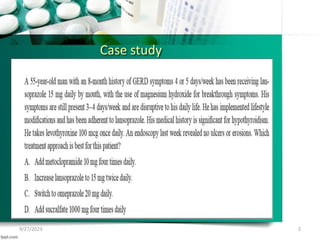
Case study
9/27/2023 2
Outline
• Learning objectives
• Introduction
• Symptoms
• Long term complications
• Diagnosis
• Treatment strategies
• Cases
• Reference
9/27/2023 3
Learning objectives
• Review International guidelines
• Discuss diagnosis criteria
• Recommend appropriate therapy
• Apply knowledge to solve clinical cases
9/27/2023 4
Introduction - WGO 2015 Guidelines
• GERD is defined as troublesome symptoms
sufficient to impair an individual’s quality of life,
• or injury or complications that result from the
retrograde flow of gastric contents into the
esophagus, oropharynx, and/or respiratory tract.
• “PPI trial.” 1-2 weeks of empirical short to ascertain
if patience symptoms is acid related is no longer
recommended
• A formal course of PPI therapy, of adequate duration
(usually 8 weeks) is required in order to assess the
treatment response in GERD patients
9/27/2023 5
GERD Diagnosis (ACG 2013 Guideline)
• A presumptive diagnosis of GERD can be
established in the setting of typical symptoms
of heartburn and regurgitation.
• Empiric medical therapy with PPI is
recommended in this setting
9/27/2023 6
Introduction - ACG 2013 Guideline
• A formal course of PPI therapy, of adequate
duration (usually 8 weeks) is required in order
to assess the treatment response in GERD
patients
• Endoscopy is particularly recommended for
patients with alarm features
9/27/2023 7
Introduction
• GERD is a common medical disorder.
• GERD is defined by consensus
• It is defined as symptoms or complications
resulting from refluxed stomach contents into the
esophagus or beyond, into the oral cavity
(including the larynx) or lung
• Episodic heartburn that is not frequent enough or
painful enough to be considered bothersome by
the patient is not included in this definition of
GERD.
9/27/2023
8
Introduction - Pathophysiology
• The key factor is abnormal reflux of gastric
contents
• GERD is associated with defective lower
esophageal sphincter leading to:
– spontaneous transient LES relaxations
– transient increases in intra-abdominal
pressure
– an atonic LES, all of which may lead to the
development of GERD
9/27/2023 9
Introduction - Pathophysiology
• Dysfunctional defense mechanism may also
contribute such as:
– abnormal esophageal anatomy: Hiatal hernia
– improper esophageal clearance of gastric fluids
– reduced mucosal resistance to acid
– delayed or ineffective gastric emptying and
intra-abdominal pressure
– and reduced salivary buffering of acid
9/27/2023 10
• Refluxates that may promote esophageal
damage on reflux into the esophagus include:
– gastric acid
– pepsin
– bile acids
– and pancreatic enzymes
9/27/2023 11
Introduction - GERD Subtypes
• Symptoms without erosions on endoscopy
(nonerosive reflux disease - NERD)
• Symptoms with erosions on endoscopy
(erosive reflux disease -ERD)
9/27/2023 12
Symptoms -1
• Typical symptoms:
– Heartburn (pyrosis)
– Dypepsia
– Water-brash
– Regurgitation
• Alarm symptoms
– These symptoms warrant immediate referral
for more invasive testing.
• Extra-esophageal or atypical symptoms
9/27/2023 13
Symptoms -2
• Spectrum of injury starts with no erosion to
esophagitis, erosive esophagitis (erosion of
squamous epithelium) to complicated forms
• Most patients do not progress to erosive
esophagitis
9/27/2023 14
Extraesophageal or atypical symptom
• Chronic cough
• asthma-like symptoms
• recurrent sore throat, laryngitis or hoarseness
• dental enamel loss
• noncardiac chest pain
• sinusitis, pneumonia, bronchitis, and otitis media
(less common atypical symptoms)
• Atypical symptoms require referral for addtitional
testing
9/27/2023 15
Alarm symptoms
• Dysphagia: difficulty with swallowing
• Odynophagia: pain with swallowing
• Bleeding
• Weight loss
• Hematemesis
• Melena
• Chest pain
• Epigastric mass
• These symptoms warrant immediate referral for
more invasive testing (endoscopy)
9/27/2023 16
Aggravating factors
• Recumbency (gravity)
• Elevated intra-abdominal pressure
• Reduced gastric motility (e.g., gastroparesis)
• Decreased lower esophageal sphincter (LES)
tone (e.g., peppermint, caffeine, nicotine)
• Direct mucosal irritation (e.g., irritating foods,
bisphosphonates, NSAIDs).
9/27/2023 17
Long-term complications
• Esophageal erosion
• Strictures
• Obstruction
• Barrett esophagus
replacement of squamous epithelial cells with
columnar epithelial cells within the lower
esophagus
Results in increased risk of esophageal
carcinoma
9/27/2023 18
Diagnosis - Symptom
• A presumptive diagnosis of GERD is made
when typical symptoms of heartburn and
regurgitation are present
• Empiric therapy with a proton pump inhibitor
(PPI) is recommended if patient has typical
symptoms of heartburn or regurgitation.
9/27/2023 19
Diagnosis -Symptom
• Screening for H. pylori is not recommended.
H. pylori screening is only recommended in
patients with PUD, a history of a documented
peptic ulcer, or gastric mucosa-associated
lymphoid tissue lymphoma (MALT)
• Patients with noncardiac chest pain that is
suspected of having been caused by GERD should
have a diagnostic evaluation before institution of
therapy
9/27/2023 20
Diagnosis - Endoscopy
• Upper endoscopy is not necessary in the
presence of typical GERD symptoms.
• Endoscopy is recommended in the presence
of alarm symptoms and in the screening of
patients at high risk of complications.
• Repeat endoscopy is not indicated in patients
without Barrett esophagus in the absence of
new symptoms
9/27/2023 21
Diagnosis - Ambulatory pH testing
• Ambulatory esophageal reflux monitoring is
indicated before considering endoscopic or
surgical therapy in patients with NERD (or unclear
diagnosis)
• This should be part of the evaluation of patients
who are refractory to PPI therapy and in situations
when the diagnosis of GERD is in question.
• Ambulatory reflux monitoring is the only test that
can assess reflux symptom association.
9/27/2023 22
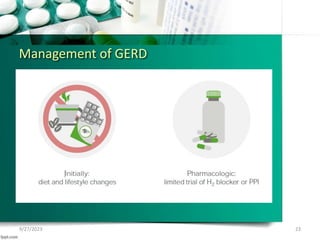
Management of GERD
9/27/2023 23
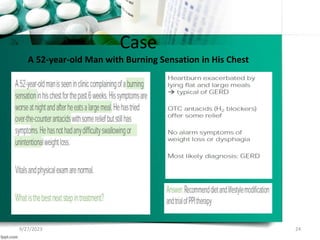
Case
A 52-year-old Man with Burning Sensation in His Chest
9/27/2023 24
Treatment Strategies – Non-pharmacological
• Non-pharmacologic interventions and lifestyle
modifications are unlikely to control symptoms
in most patients
• The American Gastroenterological Association
(AGA) guidelines cite insufficient evidence to
advocate lifestyle modifications for all patients
• AGA advocate this for use in targeted
populations
9/27/2023 25
Treatment Strategies – Non-pharmacological
• Dietary modifications in patients whose
symptoms are associated with certain foods or
drinks
• Avoid aggravating foods and beverages
Reduce LES pressure (alcohol, caffeine,
chocolate, citrus juices, garlic, onions,
peppermint or spearmint)
Direct irritation (spicy foods, tomato juice,
or coffee).
9/27/2023 26
• Reduce fat intake (high-fat meals slow gastric
emptying) and portion size
• Avoid eating 2–3 hours before bedtime
• Remain upright for two hours after meals
• Weight loss if overweight or recent weight gain
• Reduce or discontinue nicotine use in patients
who use tobacco products (affects LES).
• Elevate head of bed and avoid meals 2–3 hours
before bedtime if nocturnal symptoms.
9/27/2023 27
• Avoid tight-fitting clothing (decreases intra-
abdominal pressure).
• Avoid medications that may:
Reduce LES pressure (α-adrenergic antagonists,
calcium channel blockers, anticholinergics,
theophylline, benzodiazepines, opiates)
Delay gastric emptying (opiates, tricyclic
antidepressants, calcium channel blockers,
progesterone)
Direct irritation (NSAIDs, aspirin,
corticosteroids).
9/27/2023 28
Pharmacologic therapies
• Initial treatment depends on the severity,
frequency, and duration of symptoms
• “Step-down” treatment: Starting with maximal
therapy, such as therapeutic doses of PPIs
Is always appropriate as a first-line strategy in
patients with documented esophageal erosion.
Advantages: Rapid symptom relief, avoidance
of over-investigation
 Disadvantages: Potential overtreatment,
higher drug cost, increased potential for
adverse effects
9/27/2023 29
• “Step-up” treatment: Starting with lower-dose
over-the-counter (OTC) products
Its appropriate for patients with less severe
symptoms without evidence of esophageal
erosion.
Advantages: Avoids overtreatment, has lower
initial drug cost.
Disadvantages: Potential under-treatment
(partial symptom relief; may take longer for
symptom control; may lead to over-
investigation)
9/27/2023 30
• Treatment duration of at least 4 weeks if
NERD
• 8 weeks if ERD.
• Maintenance therapy should be used if
symptoms recur or complications are present
9/27/2023 31
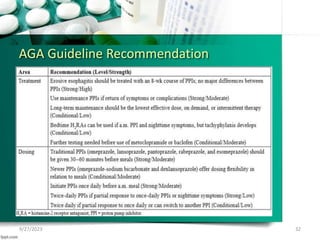
AGA Guideline Recommendation
9/27/2023 32
STG - 2017
• NERD – Antacid or PPI daily for 4 – 8 weeks
• Severe or Erosive GERD – PPI standard dose
/double dose for 8 weeks
• Severe or Erosive GERD (with bloating) – Use
drugs for ERD + Promotility (6 – 8hrly)
9/27/2023 33
Pharmacologic agents - Antacids
• Calcium-, aluminum-, and magnesium-based
products are available OTC in a wide variety of
formulations (capsules, tablets, chewable
tablets, and suspensions).
– Neutralizing acid and raising intragastric pH
– Results in decreased activation of
pepsinogen and increased LES pressure
– Rapid onset of action but short duration,
necessitating frequent dosing
9/27/2023 34
Antacids
• Some products (Gaviscon) also contain the
antirefluxant alginic acid.
• Alginic acid which forms a viscous layer on top of
gastric contents to act as a barrier to reflux
• Use antacid as first-line therapy for:
– intermittent (less than twice weekly) symptoms or
– as breakthrough therapy for those on PPI/H2RA
therapy
• Antacids are not appropriate for healing established
esophageal erosions
9/27/2023 35
Antacids
• Adverse reactions:
Constipation (aluminum)
Diarrhea (magnesium)
Accumulation of aluminum and magnesium in
renal disease with repeated dosing
• Drug interactions:
Chelation (fluoroquinolones, tetracyclines)
 reduced absorption owing to increases in pH
(ketoconazole, itraconazole, iron, atazanavir,
delavirdine, indinavir, nelfinavir)
9/27/2023 36
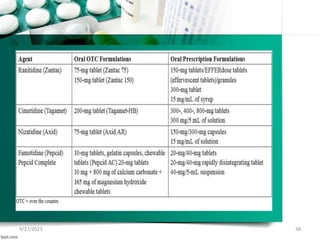
Pharmacologic agents – H2RAs
• Reversibly inhibit histamine-2 receptors on the
parietal cell
• Prolonged use is associated with the
development of tolerance and reduced efficacy
(tachyphylaxis).
• Therapy with H2RAs is less efficacious than
therapy with PPIs in healing erosive
esophagitis
9/27/2023 37
9/27/2023 38
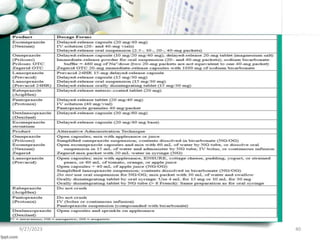
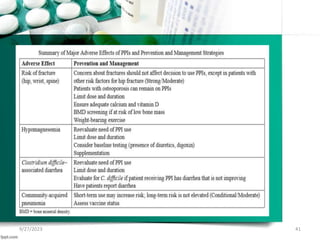
Pharmacologic agents – PPIs
• Irreversibly inhibit the final step in gastric acid
secretion; greater degree of acid suppression
achieved and typically longer duration of action
than H2RAs
• Most effective agents for short- and long-term
management of GERD and for management of
erosive disease
• Most effective when taken orally 30 -60 minutes
before meals; for divided dosing, give evening
dose before evening meal instead of at bedtime.
9/27/2023 39
9/27/2023 40
9/27/2023 41
Promotility agents
• The 2013 guidelines state that therapy for
GERD other than acid suppression, including
prokinetic therapy or baclofen, should not be
used in patients with GERD without diagnostic
evaluation
• These agents work through cholinergic
mechanisms to facilitate increased gastric
emptying
9/27/2023 42
Promitility agent - Metoclopramide
• Dopamine antagonist
• Must be dosed several times a day
• Associated with many adverse effects such as
dizziness, fatigue, somnolence, drowsiness,
extrapyramidal symptoms (EPS), and
hyperprolactinemia.
• Indications for GERD and diabetic gastroparesis
• Combination with PPI offers modest improvement
9/27/2023 43
Promitility agent - Bethanechol
• Cholinergic agonist
• Poorly tolerated because of adverse effects
such as diarrhea, blurred vision, and
abdominal cramping
• May also increase gastric acid production
9/27/2023 44
Promitility agent - Cisapride
• Available only on a restricted basis for patients
whose other therapies have failed
• Cisapride was withdrawn from the market
initially because of cardiac arrhythmia
(torsades de pointes) when used in
combination with drugs inhibiting CYP3A4.
9/27/2023 45
Mucosal protectants
• Sucralfate has a limited role in the treatment
of GERD.
9/27/2023 46
Surgical therapy
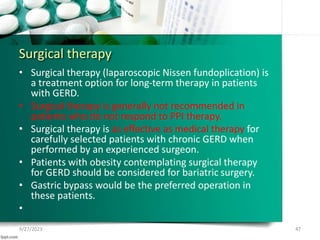
• Surgical therapy (laparoscopic Nissen fundoplication) is
a treatment option for long-term therapy in patients
with GERD.
• Surgical therapy is generally not recommended in
patients who do not respond to PPI therapy.
• Surgical therapy is as effective as medical therapy for
carefully selected patients with chronic GERD when
performed by an experienced surgeon.
• Patients with obesity contemplating surgical therapy
for GERD should be considered for bariatric surgery.
• Gastric bypass would be the preferred operation in
these patients.
•
9/27/2023 47
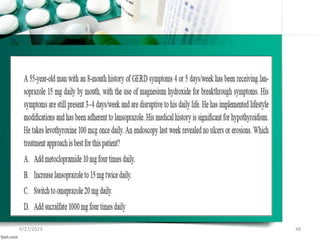
9/27/2023 48
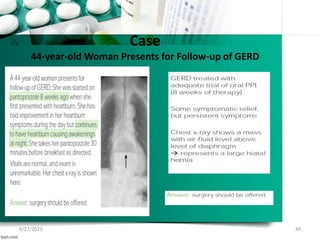
Case
44-year-old Woman Presents for Follow-up of GERD
9/27/2023 49
References
• American Gastroenterological Association
Institute. 2013 Guideline for the diagnosis and
management of gastroesophageal reflux disease.
• Haag S, Andrews JM, Katelaris PH, et al.
Management of reflux symptoms with over-the
counter proton pump inhibitors: issues and
proposed guidelines. Digestion 2009;80:226-34.
• Pharmacotherapy by Dipiro et al, 10th Edition
9/27/2023 50

GERD update.pptx

  • 1.
    Pathophysiology and Therapeutics GastroesophagealReflux Disease (GERD) Israel Sefah (FPCPharm) 9/27/2023 1
  • 2.
  • 3.
    Outline • Learning objectives •Introduction • Symptoms • Long term complications • Diagnosis • Treatment strategies • Cases • Reference 9/27/2023 3
  • 4.
    Learning objectives • ReviewInternational guidelines • Discuss diagnosis criteria • Recommend appropriate therapy • Apply knowledge to solve clinical cases 9/27/2023 4
  • 5.
    Introduction - WGO2015 Guidelines • GERD is defined as troublesome symptoms sufficient to impair an individual’s quality of life, • or injury or complications that result from the retrograde flow of gastric contents into the esophagus, oropharynx, and/or respiratory tract. • “PPI trial.” 1-2 weeks of empirical short to ascertain if patience symptoms is acid related is no longer recommended • A formal course of PPI therapy, of adequate duration (usually 8 weeks) is required in order to assess the treatment response in GERD patients 9/27/2023 5
  • 6.
    GERD Diagnosis (ACG2013 Guideline) • A presumptive diagnosis of GERD can be established in the setting of typical symptoms of heartburn and regurgitation. • Empiric medical therapy with PPI is recommended in this setting 9/27/2023 6
  • 7.
    Introduction - ACG2013 Guideline • A formal course of PPI therapy, of adequate duration (usually 8 weeks) is required in order to assess the treatment response in GERD patients • Endoscopy is particularly recommended for patients with alarm features 9/27/2023 7
  • 8.
    Introduction • GERD isa common medical disorder. • GERD is defined by consensus • It is defined as symptoms or complications resulting from refluxed stomach contents into the esophagus or beyond, into the oral cavity (including the larynx) or lung • Episodic heartburn that is not frequent enough or painful enough to be considered bothersome by the patient is not included in this definition of GERD. 9/27/2023 8
  • 9.
    Introduction - Pathophysiology •The key factor is abnormal reflux of gastric contents • GERD is associated with defective lower esophageal sphincter leading to: – spontaneous transient LES relaxations – transient increases in intra-abdominal pressure – an atonic LES, all of which may lead to the development of GERD 9/27/2023 9
  • 10.
    Introduction - Pathophysiology •Dysfunctional defense mechanism may also contribute such as: – abnormal esophageal anatomy: Hiatal hernia – improper esophageal clearance of gastric fluids – reduced mucosal resistance to acid – delayed or ineffective gastric emptying and intra-abdominal pressure – and reduced salivary buffering of acid 9/27/2023 10
  • 11.
    • Refluxates thatmay promote esophageal damage on reflux into the esophagus include: – gastric acid – pepsin – bile acids – and pancreatic enzymes 9/27/2023 11
  • 12.
    Introduction - GERDSubtypes • Symptoms without erosions on endoscopy (nonerosive reflux disease - NERD) • Symptoms with erosions on endoscopy (erosive reflux disease -ERD) 9/27/2023 12
  • 13.
    Symptoms -1 • Typicalsymptoms: – Heartburn (pyrosis) – Dypepsia – Water-brash – Regurgitation • Alarm symptoms – These symptoms warrant immediate referral for more invasive testing. • Extra-esophageal or atypical symptoms 9/27/2023 13
  • 14.
    Symptoms -2 • Spectrumof injury starts with no erosion to esophagitis, erosive esophagitis (erosion of squamous epithelium) to complicated forms • Most patients do not progress to erosive esophagitis 9/27/2023 14
  • 15.
    Extraesophageal or atypicalsymptom • Chronic cough • asthma-like symptoms • recurrent sore throat, laryngitis or hoarseness • dental enamel loss • noncardiac chest pain • sinusitis, pneumonia, bronchitis, and otitis media (less common atypical symptoms) • Atypical symptoms require referral for addtitional testing 9/27/2023 15
  • 16.
    Alarm symptoms • Dysphagia:difficulty with swallowing • Odynophagia: pain with swallowing • Bleeding • Weight loss • Hematemesis • Melena • Chest pain • Epigastric mass • These symptoms warrant immediate referral for more invasive testing (endoscopy) 9/27/2023 16
  • 17.
    Aggravating factors • Recumbency(gravity) • Elevated intra-abdominal pressure • Reduced gastric motility (e.g., gastroparesis) • Decreased lower esophageal sphincter (LES) tone (e.g., peppermint, caffeine, nicotine) • Direct mucosal irritation (e.g., irritating foods, bisphosphonates, NSAIDs). 9/27/2023 17
  • 18.
    Long-term complications • Esophagealerosion • Strictures • Obstruction • Barrett esophagus replacement of squamous epithelial cells with columnar epithelial cells within the lower esophagus Results in increased risk of esophageal carcinoma 9/27/2023 18
  • 19.
    Diagnosis - Symptom •A presumptive diagnosis of GERD is made when typical symptoms of heartburn and regurgitation are present • Empiric therapy with a proton pump inhibitor (PPI) is recommended if patient has typical symptoms of heartburn or regurgitation. 9/27/2023 19
  • 20.
    Diagnosis -Symptom • Screeningfor H. pylori is not recommended. H. pylori screening is only recommended in patients with PUD, a history of a documented peptic ulcer, or gastric mucosa-associated lymphoid tissue lymphoma (MALT) • Patients with noncardiac chest pain that is suspected of having been caused by GERD should have a diagnostic evaluation before institution of therapy 9/27/2023 20
  • 21.
    Diagnosis - Endoscopy •Upper endoscopy is not necessary in the presence of typical GERD symptoms. • Endoscopy is recommended in the presence of alarm symptoms and in the screening of patients at high risk of complications. • Repeat endoscopy is not indicated in patients without Barrett esophagus in the absence of new symptoms 9/27/2023 21
  • 22.
    Diagnosis - AmbulatorypH testing • Ambulatory esophageal reflux monitoring is indicated before considering endoscopic or surgical therapy in patients with NERD (or unclear diagnosis) • This should be part of the evaluation of patients who are refractory to PPI therapy and in situations when the diagnosis of GERD is in question. • Ambulatory reflux monitoring is the only test that can assess reflux symptom association. 9/27/2023 22
  • 23.
  • 24.
    Case A 52-year-old Manwith Burning Sensation in His Chest 9/27/2023 24
  • 25.
    Treatment Strategies –Non-pharmacological • Non-pharmacologic interventions and lifestyle modifications are unlikely to control symptoms in most patients • The American Gastroenterological Association (AGA) guidelines cite insufficient evidence to advocate lifestyle modifications for all patients • AGA advocate this for use in targeted populations 9/27/2023 25
  • 26.
    Treatment Strategies –Non-pharmacological • Dietary modifications in patients whose symptoms are associated with certain foods or drinks • Avoid aggravating foods and beverages Reduce LES pressure (alcohol, caffeine, chocolate, citrus juices, garlic, onions, peppermint or spearmint) Direct irritation (spicy foods, tomato juice, or coffee). 9/27/2023 26
  • 27.
    • Reduce fatintake (high-fat meals slow gastric emptying) and portion size • Avoid eating 2–3 hours before bedtime • Remain upright for two hours after meals • Weight loss if overweight or recent weight gain • Reduce or discontinue nicotine use in patients who use tobacco products (affects LES). • Elevate head of bed and avoid meals 2–3 hours before bedtime if nocturnal symptoms. 9/27/2023 27
  • 28.
    • Avoid tight-fittingclothing (decreases intra- abdominal pressure). • Avoid medications that may: Reduce LES pressure (α-adrenergic antagonists, calcium channel blockers, anticholinergics, theophylline, benzodiazepines, opiates) Delay gastric emptying (opiates, tricyclic antidepressants, calcium channel blockers, progesterone) Direct irritation (NSAIDs, aspirin, corticosteroids). 9/27/2023 28
  • 29.
    Pharmacologic therapies • Initialtreatment depends on the severity, frequency, and duration of symptoms • “Step-down” treatment: Starting with maximal therapy, such as therapeutic doses of PPIs Is always appropriate as a first-line strategy in patients with documented esophageal erosion. Advantages: Rapid symptom relief, avoidance of over-investigation  Disadvantages: Potential overtreatment, higher drug cost, increased potential for adverse effects 9/27/2023 29
  • 30.
    • “Step-up” treatment:Starting with lower-dose over-the-counter (OTC) products Its appropriate for patients with less severe symptoms without evidence of esophageal erosion. Advantages: Avoids overtreatment, has lower initial drug cost. Disadvantages: Potential under-treatment (partial symptom relief; may take longer for symptom control; may lead to over- investigation) 9/27/2023 30
  • 31.
    • Treatment durationof at least 4 weeks if NERD • 8 weeks if ERD. • Maintenance therapy should be used if symptoms recur or complications are present 9/27/2023 31
  • 32.
  • 33.
    STG - 2017 •NERD – Antacid or PPI daily for 4 – 8 weeks • Severe or Erosive GERD – PPI standard dose /double dose for 8 weeks • Severe or Erosive GERD (with bloating) – Use drugs for ERD + Promotility (6 – 8hrly) 9/27/2023 33
  • 34.
    Pharmacologic agents -Antacids • Calcium-, aluminum-, and magnesium-based products are available OTC in a wide variety of formulations (capsules, tablets, chewable tablets, and suspensions). – Neutralizing acid and raising intragastric pH – Results in decreased activation of pepsinogen and increased LES pressure – Rapid onset of action but short duration, necessitating frequent dosing 9/27/2023 34
  • 35.
    Antacids • Some products(Gaviscon) also contain the antirefluxant alginic acid. • Alginic acid which forms a viscous layer on top of gastric contents to act as a barrier to reflux • Use antacid as first-line therapy for: – intermittent (less than twice weekly) symptoms or – as breakthrough therapy for those on PPI/H2RA therapy • Antacids are not appropriate for healing established esophageal erosions 9/27/2023 35
  • 36.
    Antacids • Adverse reactions: Constipation(aluminum) Diarrhea (magnesium) Accumulation of aluminum and magnesium in renal disease with repeated dosing • Drug interactions: Chelation (fluoroquinolones, tetracyclines)  reduced absorption owing to increases in pH (ketoconazole, itraconazole, iron, atazanavir, delavirdine, indinavir, nelfinavir) 9/27/2023 36
  • 37.
    Pharmacologic agents –H2RAs • Reversibly inhibit histamine-2 receptors on the parietal cell • Prolonged use is associated with the development of tolerance and reduced efficacy (tachyphylaxis). • Therapy with H2RAs is less efficacious than therapy with PPIs in healing erosive esophagitis 9/27/2023 37
  • 38.
  • 39.
    Pharmacologic agents –PPIs • Irreversibly inhibit the final step in gastric acid secretion; greater degree of acid suppression achieved and typically longer duration of action than H2RAs • Most effective agents for short- and long-term management of GERD and for management of erosive disease • Most effective when taken orally 30 -60 minutes before meals; for divided dosing, give evening dose before evening meal instead of at bedtime. 9/27/2023 39
  • 40.
  • 41.
  • 42.
    Promotility agents • The2013 guidelines state that therapy for GERD other than acid suppression, including prokinetic therapy or baclofen, should not be used in patients with GERD without diagnostic evaluation • These agents work through cholinergic mechanisms to facilitate increased gastric emptying 9/27/2023 42
  • 43.
    Promitility agent -Metoclopramide • Dopamine antagonist • Must be dosed several times a day • Associated with many adverse effects such as dizziness, fatigue, somnolence, drowsiness, extrapyramidal symptoms (EPS), and hyperprolactinemia. • Indications for GERD and diabetic gastroparesis • Combination with PPI offers modest improvement 9/27/2023 43
  • 44.
    Promitility agent -Bethanechol • Cholinergic agonist • Poorly tolerated because of adverse effects such as diarrhea, blurred vision, and abdominal cramping • May also increase gastric acid production 9/27/2023 44
  • 45.
    Promitility agent -Cisapride • Available only on a restricted basis for patients whose other therapies have failed • Cisapride was withdrawn from the market initially because of cardiac arrhythmia (torsades de pointes) when used in combination with drugs inhibiting CYP3A4. 9/27/2023 45
  • 46.
    Mucosal protectants • Sucralfatehas a limited role in the treatment of GERD. 9/27/2023 46
  • 47.
    Surgical therapy • Surgicaltherapy (laparoscopic Nissen fundoplication) is a treatment option for long-term therapy in patients with GERD. • Surgical therapy is generally not recommended in patients who do not respond to PPI therapy. • Surgical therapy is as effective as medical therapy for carefully selected patients with chronic GERD when performed by an experienced surgeon. • Patients with obesity contemplating surgical therapy for GERD should be considered for bariatric surgery. • Gastric bypass would be the preferred operation in these patients. • 9/27/2023 47
  • 48.
  • 49.
    Case 44-year-old Woman Presentsfor Follow-up of GERD 9/27/2023 49
  • 50.
    References • American GastroenterologicalAssociation Institute. 2013 Guideline for the diagnosis and management of gastroesophageal reflux disease. • Haag S, Andrews JM, Katelaris PH, et al. Management of reflux symptoms with over-the counter proton pump inhibitors: issues and proposed guidelines. Digestion 2009;80:226-34. • Pharmacotherapy by Dipiro et al, 10th Edition 9/27/2023 50