

Dr.Mohammad Shaikhani.
Esophageal & gastric motor Disorders:
ESOPHAGEAL MOTOR
DISORDERS
 Present with chest pain, dysphagia, or both.
 Dysphagia is for liquids as well as solids.
 Chest pain may mimic cardiac disease(non-cardiac chest pain)
& must be excluded.
 Include:
 Oropharyngeal dysphagia.
 Esophageal dysphagia, from:
 Primary esophageal motor disorders.
 Secondary motor disorder.
Oropharyngeal dysphagia:
 Due to Neuro Muscular disorders of the oropharynx& the
skeletal muscle of the esophagus, as stroke, Parkinson’s disease,
ALS, MS, myasthenia gravis, polymyositis, myotonic dystrophy.
 Characterized by difficulty in bolus transfer from mouth to
esophagus, with nasal regurgitation or coughing (from
aspiration) with swallowing.
 Commonly have signs / symptoms of underlying disorder.
 Diagnosis: modified Ba swallow with videofluoroscopy.
 Nutritional support via diet, swallow maneuvers, feeding tubes,
or PEG is appropriate+ neuromuscular disorder trt.
Esophageal dysphagia:
 Due to disease of the smooth muscles of the esophagus.
 Dysphagia is not accompanied by failure of bolus transfer
from mouth to esophagus, nasal regurgitation, or coughing
with swallowing.
 Dysphagia characteristically occurs with liquids as well as
solids, indicating a lack of discrimination for bolus size.
Esophageal dysphagia:
 Primary esophageal motor disorders:
 Achalasia.
 Diffuse esophageal spasm.
 Nutcracker esophagus, hypertensive LES& ineffective
peristalsis: are manometric abnormalities may be
symptomatic or not.
 Secondary disorder: scleroderma is the most common.
 Manometry is the diagnostic procedure of choice because it
yields both quantitative& qualitative information about
peristaltic &sphincter function.
ACHALASIA: “failure to relax
 The most common primary esophageal motor disorder.
 Prevalence 10/100,000, etiology is unknown
 Can occur at any age but usually 30 -60 years.
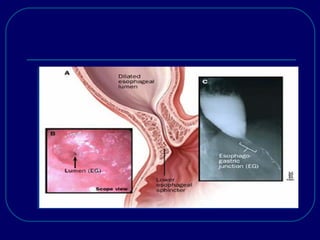
 Histopathology: degeneration of Auerbach’s plexus, but
changes also occur in the vagus nerve&swallowing center.
 Increase in pressure& incomplete relaxation of the LES with
swallowing &complete aperistalsis in eso body, all produces an
obstruction at the GEJ that leads to esophageal retention.
 Dilation of eso body occurs due to the increase in intraluminal
pressure &the presence of weak, aperistaltic contractions.
ACHALASIA:
 Symptoms are chronic.
 Dysphagia for liquids& solids is the primary complaint.
 Regurgitation is common, nocturnal cough suggests aspiration
on reclining.
 Atypical chest pain &heartburn occur in 1/3 due to increased
intraesophageal pressure& stasis-induced mucosal
inflammation, respectively.
 Weight loss is highly variable & should raise concerns about
adenocarcinoma of the esophagus or gastric cardia.
 Chagas’ disease, due to Trypanosoma cruzi can mimic
achalasia by producing a megaesophagus.
ACHALASIA:
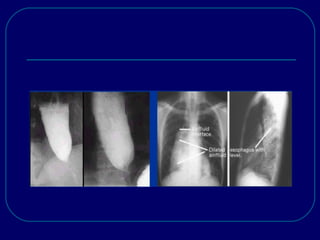
 CXR show a widened mediastinum, air-fluid level& absent
gastric air bubble.
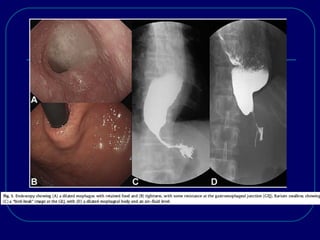
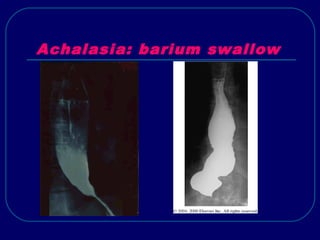
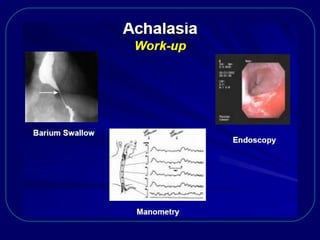
 Barium swallow shows a dilated esophagus, air-fluid level,
delayed esophageal emptying& a smooth, tapered “bird’s
beak” deformity at the LES.
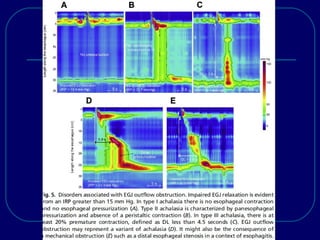
 Manometry show characteristic incomplete relaxation of the
LES with swallows& complete aperistalsis in the body.
 LES pressure may or may not be elevated.
 Neither radiographic nor manometric criteria can effectively
exclude achalasia secondary to cancer, so endoscopy must be
performed prior to treatment.
ACHALASIA:Management
 A muscle relaxant, as nifedipine 10 mg sublingually before meals,
may be helpful.
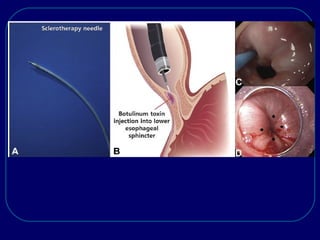
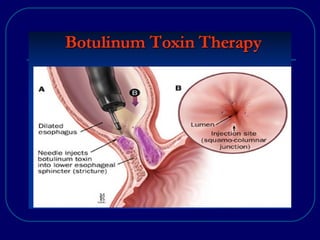
 More effective treatment; either endoscopic inj of botulinum toxin
into the LES (25 units per quadrant), pneumatic dilation, or
surgical Heller myotomy.
 The benefits of botulinum toxin are relatively short lived (3- 6
months) compared with pneumatic dilation, so repeated injections
are necessary for the life of the patient.
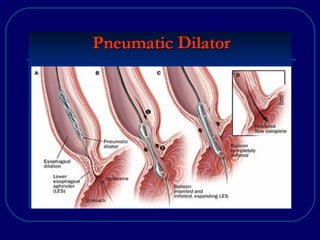
 Pneumatic dilation under conscious sedation inflates a balloon
placed across the LES to rupture its musculature; repeated
treatment may be necessary for maximum benefit.
ESOPHAGEAL MOTOR
DISORDERS
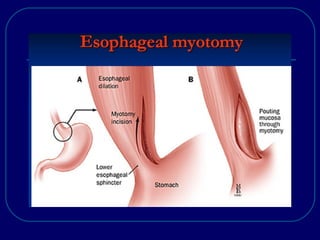
 A surgical Heller myotomy,direct incision of the LES, is usually
done laparoscopically.
 Success rates with pneumatic dilation or Heller myotomy are
comparable, with excellent relief of symptoms for 5 - 10 years in
85%.
 The major risk of pneumatic dilation is esophageal perforation
(3%) &the major side effect of Heller myotomy is reflux
esophagitis (25%), antireflux procedure with the Heller myotomy
reduce this risk.
 Achalasia can predispose to SC cancer esophagus.
Achalasia: barium swallow
DIFFUSE ESOPHAGEAL SPASM:
 Uncommon motor disorder presents clinically with chest pain,
dysphagia, or both.
 It remains one of the most commonly sought (but uncommonly
found) in patients with non-cardiac chest pain.
 Symptoms /signs are intermittent, so diagnosis may be difficult.
 Like achalasia, associated with degeneration of the nerves in
Auerbach’s plexus& in rarely evolve to achalasia.
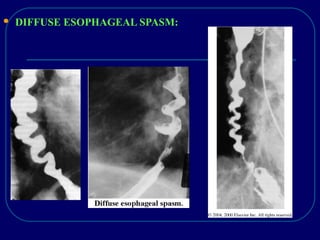
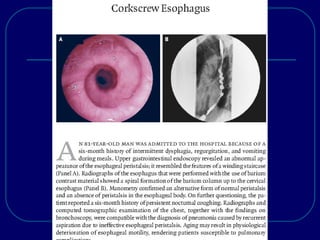
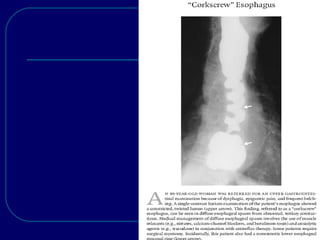
 Ba swallow: prominent, spontaneous, nonpropulsive, tertiary
contractions give rise to a “corkscrew” esophagus,but this not
pathognomonic as it also observed in asymptomatic elderly;
presbyesophagus.
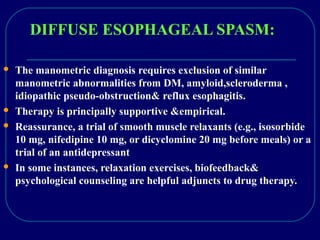
 The manometric diagnosis requires exclusion of similar
manometric abnormalities from DM, amyloid,scleroderma ,
idiopathic pseudo-obstruction& reflux esophagitis.
 Therapy is principally supportive &empirical.
 Reassurance, a trial of smooth muscle relaxants (e.g., isosorbide
10 mg, nifedipine 10 mg, or dicyclomine 20 mg before meals) or a
trial of an antidepressant
 In some instances, relaxation exercises, biofeedback&
psychological counseling are helpful adjuncts to drug therapy.
DIFFUSE ESOPHAGEAL SPASM:
 DIFFUSE ESOPHAGEAL SPASM:
NUTCRACKER ESOPHAGUS.
 A relatively common manometric pattern found in patients with
noncardiac chest pain.
 Consists of normal peristalsis but with contractions of very high
amplitude (average > 180 mm Hg).
 Reduction in contraction amplitude by CCBs has no consistent
effect on chest pain&chest pain can be relieved by medications
(e.g., trazodone) having no effect on amplitude.
 Patients with chest pain& nutcracker esophagus commonly
exhibit symptoms /signs of depression or anxiety.
 Treatment: TADs or anxiolytics may relieve the chest pain.
SCLERODERMA.
 The esophagus is the GI organ most often affected in
scleroderma , resulting in a characteristic manometric pattern of
low LES pressure &weak aperistaltic contractions in the smooth
muscle part of the esophageal body.
 UES&skeletal muscle–lined upper eso contractions are normal.
 Results in dysphagia, regurgitation, heartburn.
 When dysphagia for solids is prominent, it likely reflects a peptic
stricture or adenocarcinoma in Barrett’s esophagus.
 Patients should be treated prophylactically for GERD.
Gastric functional motility
disorders:
 Non-ulcer dyspepsia (NUD).
 Gastropariesis.
 Functional vomiting.
NON-ULCER DYSPEPSIA (NUD, Functional dyspepsia):
 Dyspepsia with normal upper endoscopy.
 Dyspepsia: epigastric pain,postprandial heaviness,early
satiety&nausea.
 Dyspepsia D.Diagnosis:
 PUD,Gastritis,gastropariesis,gastric cancer,NUD.
 Subgroups: 'Ulcer-like' & 'dysmotility-type’, but there is great
overlap between these & also with irritable bowel syndrome.
 Aetiology: probably covers a spectrum of mucosal, motility &
psychiatric disorders.
NON-ULCER DYSPEPSIA: Clinical features
 Usually young (< 40 years), women are affected twice.
 Symptoms disproportionate to clinical well-being & no weight
loss.
NON-ULCER DYSPEPSIA: Clinical features
 Patients often appear anxious.
 A drug history should be taken and the possibility of a depressive
illness should be considered.
 Pregnancy should be ruled out in young women before
radiological studies are undertaken.
 Alcohol misuse should be suspected when early morning nausea &
retching are prominent.
NON-ULCER DYSPEPSIA: Investigations
 The history will often suggest the diagnosis but in older subjects
an endoscopy is necessary to exclude mucosal disease.
 While an ultrasound scan may detect gallstones, these are rarely
responsible for dyspeptic symptoms.
NON-ULCER DYSPEPSIA: Management
 The most important: explanation /reassurance.
 Possible psychological factors should be explored.
 Symptoms which can be associated with an identifiable cause of
stress resolve with appropriate counselling.
 Some have chronic psychological disorders causing persistent or
recurrent symptoms & need behavioural or psychotherapy
 Fat restriction may help.
 Antacids are sometimes helpful.
 Prokinetic drugs such as metoclopramide (10 mg 8-hourly) or
domperidone (10-20 mg 8-hourly) may be given before meals if
nausea, vomiting or bloating is prominent.
NON-ULCER DYSPEPSIA: Management
 PPI may be tried if night pain or heartburn is troublesome.
 Low-dose amitriptyline is sometimes of value.
 The role of H. pylori eradication remains controversial, although
10% may benefit.
 Eradication also removes a major risk factor for gastric cancer
but at the cost of a small risk of side-effects.
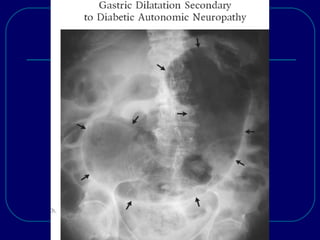
GASTROPARESIS
 Defective gastric emptying without mechanical obstruction
 Causes:
 DM,Postop,postviral,vasculitis,amyloidosis,idiopathic.
 Early satiety & recurrent vomiting are the major symptoms;
abdominal fullness & a succussion splash may be present on
exam.
 Diagnosis: documentation of delayed stomach emptying by gastric
sintigraphy by radio active labeled test meal & excluding
mechanical gastric outlet obstruction.
GASTROPARESIS
 Treatment:metoclopramide / domperidone/ IV erythromycin.
 Treating undelying causes as DM.
 In severe cases long-term jejunostomy feeding or total parenteral
nutrition is required.
 Surgical insertion of a gastric pacing device has been successful in
some cases but remains experimental.
Petra, Jordan
THANKS:

GIT 4th motility 2016.

  • 1.
    Dr.Mohammad Shaikhani. Esophageal &gastric motor Disorders:
  • 2.
    ESOPHAGEAL MOTOR DISORDERS  Presentwith chest pain, dysphagia, or both.  Dysphagia is for liquids as well as solids.  Chest pain may mimic cardiac disease(non-cardiac chest pain) & must be excluded.  Include:  Oropharyngeal dysphagia.  Esophageal dysphagia, from:  Primary esophageal motor disorders.  Secondary motor disorder.
  • 3.
    Oropharyngeal dysphagia:  Dueto Neuro Muscular disorders of the oropharynx& the skeletal muscle of the esophagus, as stroke, Parkinson’s disease, ALS, MS, myasthenia gravis, polymyositis, myotonic dystrophy.  Characterized by difficulty in bolus transfer from mouth to esophagus, with nasal regurgitation or coughing (from aspiration) with swallowing.  Commonly have signs / symptoms of underlying disorder.  Diagnosis: modified Ba swallow with videofluoroscopy.  Nutritional support via diet, swallow maneuvers, feeding tubes, or PEG is appropriate+ neuromuscular disorder trt.
  • 4.
    Esophageal dysphagia:  Dueto disease of the smooth muscles of the esophagus.  Dysphagia is not accompanied by failure of bolus transfer from mouth to esophagus, nasal regurgitation, or coughing with swallowing.  Dysphagia characteristically occurs with liquids as well as solids, indicating a lack of discrimination for bolus size.
  • 5.
    Esophageal dysphagia:  Primaryesophageal motor disorders:  Achalasia.  Diffuse esophageal spasm.  Nutcracker esophagus, hypertensive LES& ineffective peristalsis: are manometric abnormalities may be symptomatic or not.  Secondary disorder: scleroderma is the most common.  Manometry is the diagnostic procedure of choice because it yields both quantitative& qualitative information about peristaltic &sphincter function.
  • 6.
    ACHALASIA: “failure torelax  The most common primary esophageal motor disorder.  Prevalence 10/100,000, etiology is unknown  Can occur at any age but usually 30 -60 years.  Histopathology: degeneration of Auerbach’s plexus, but changes also occur in the vagus nerve&swallowing center.  Increase in pressure& incomplete relaxation of the LES with swallowing &complete aperistalsis in eso body, all produces an obstruction at the GEJ that leads to esophageal retention.  Dilation of eso body occurs due to the increase in intraluminal pressure &the presence of weak, aperistaltic contractions.
  • 7.
    ACHALASIA:  Symptoms arechronic.  Dysphagia for liquids& solids is the primary complaint.  Regurgitation is common, nocturnal cough suggests aspiration on reclining.  Atypical chest pain &heartburn occur in 1/3 due to increased intraesophageal pressure& stasis-induced mucosal inflammation, respectively.  Weight loss is highly variable & should raise concerns about adenocarcinoma of the esophagus or gastric cardia.  Chagas’ disease, due to Trypanosoma cruzi can mimic achalasia by producing a megaesophagus.
  • 8.
    ACHALASIA:  CXR showa widened mediastinum, air-fluid level& absent gastric air bubble.  Barium swallow shows a dilated esophagus, air-fluid level, delayed esophageal emptying& a smooth, tapered “bird’s beak” deformity at the LES.  Manometry show characteristic incomplete relaxation of the LES with swallows& complete aperistalsis in the body.  LES pressure may or may not be elevated.  Neither radiographic nor manometric criteria can effectively exclude achalasia secondary to cancer, so endoscopy must be performed prior to treatment.
  • 9.
    ACHALASIA:Management  A musclerelaxant, as nifedipine 10 mg sublingually before meals, may be helpful.  More effective treatment; either endoscopic inj of botulinum toxin into the LES (25 units per quadrant), pneumatic dilation, or surgical Heller myotomy.  The benefits of botulinum toxin are relatively short lived (3- 6 months) compared with pneumatic dilation, so repeated injections are necessary for the life of the patient.  Pneumatic dilation under conscious sedation inflates a balloon placed across the LES to rupture its musculature; repeated treatment may be necessary for maximum benefit.
  • 10.
    ESOPHAGEAL MOTOR DISORDERS  Asurgical Heller myotomy,direct incision of the LES, is usually done laparoscopically.  Success rates with pneumatic dilation or Heller myotomy are comparable, with excellent relief of symptoms for 5 - 10 years in 85%.  The major risk of pneumatic dilation is esophageal perforation (3%) &the major side effect of Heller myotomy is reflux esophagitis (25%), antireflux procedure with the Heller myotomy reduce this risk.  Achalasia can predispose to SC cancer esophagus.
  • 15.
  • 21.
    DIFFUSE ESOPHAGEAL SPASM: Uncommon motor disorder presents clinically with chest pain, dysphagia, or both.  It remains one of the most commonly sought (but uncommonly found) in patients with non-cardiac chest pain.  Symptoms /signs are intermittent, so diagnosis may be difficult.  Like achalasia, associated with degeneration of the nerves in Auerbach’s plexus& in rarely evolve to achalasia.  Ba swallow: prominent, spontaneous, nonpropulsive, tertiary contractions give rise to a “corkscrew” esophagus,but this not pathognomonic as it also observed in asymptomatic elderly; presbyesophagus.
  • 22.
     The manometricdiagnosis requires exclusion of similar manometric abnormalities from DM, amyloid,scleroderma , idiopathic pseudo-obstruction& reflux esophagitis.  Therapy is principally supportive &empirical.  Reassurance, a trial of smooth muscle relaxants (e.g., isosorbide 10 mg, nifedipine 10 mg, or dicyclomine 20 mg before meals) or a trial of an antidepressant  In some instances, relaxation exercises, biofeedback& psychological counseling are helpful adjuncts to drug therapy. DIFFUSE ESOPHAGEAL SPASM:
  • 23.
  • 26.
    NUTCRACKER ESOPHAGUS.  Arelatively common manometric pattern found in patients with noncardiac chest pain.  Consists of normal peristalsis but with contractions of very high amplitude (average > 180 mm Hg).  Reduction in contraction amplitude by CCBs has no consistent effect on chest pain&chest pain can be relieved by medications (e.g., trazodone) having no effect on amplitude.  Patients with chest pain& nutcracker esophagus commonly exhibit symptoms /signs of depression or anxiety.  Treatment: TADs or anxiolytics may relieve the chest pain.
  • 27.
    SCLERODERMA.  The esophagusis the GI organ most often affected in scleroderma , resulting in a characteristic manometric pattern of low LES pressure &weak aperistaltic contractions in the smooth muscle part of the esophageal body.  UES&skeletal muscle–lined upper eso contractions are normal.  Results in dysphagia, regurgitation, heartburn.  When dysphagia for solids is prominent, it likely reflects a peptic stricture or adenocarcinoma in Barrett’s esophagus.  Patients should be treated prophylactically for GERD.
  • 28.
    Gastric functional motility disorders: Non-ulcer dyspepsia (NUD).  Gastropariesis.  Functional vomiting.
  • 29.
    NON-ULCER DYSPEPSIA (NUD,Functional dyspepsia):  Dyspepsia with normal upper endoscopy.  Dyspepsia: epigastric pain,postprandial heaviness,early satiety&nausea.  Dyspepsia D.Diagnosis:  PUD,Gastritis,gastropariesis,gastric cancer,NUD.  Subgroups: 'Ulcer-like' & 'dysmotility-type’, but there is great overlap between these & also with irritable bowel syndrome.  Aetiology: probably covers a spectrum of mucosal, motility & psychiatric disorders.
  • 30.
    NON-ULCER DYSPEPSIA: Clinicalfeatures  Usually young (< 40 years), women are affected twice.  Symptoms disproportionate to clinical well-being & no weight loss.
  • 31.
    NON-ULCER DYSPEPSIA: Clinicalfeatures  Patients often appear anxious.  A drug history should be taken and the possibility of a depressive illness should be considered.  Pregnancy should be ruled out in young women before radiological studies are undertaken.  Alcohol misuse should be suspected when early morning nausea & retching are prominent.
  • 32.
    NON-ULCER DYSPEPSIA: Investigations The history will often suggest the diagnosis but in older subjects an endoscopy is necessary to exclude mucosal disease.  While an ultrasound scan may detect gallstones, these are rarely responsible for dyspeptic symptoms.
  • 33.
    NON-ULCER DYSPEPSIA: Management The most important: explanation /reassurance.  Possible psychological factors should be explored.  Symptoms which can be associated with an identifiable cause of stress resolve with appropriate counselling.  Some have chronic psychological disorders causing persistent or recurrent symptoms & need behavioural or psychotherapy  Fat restriction may help.  Antacids are sometimes helpful.  Prokinetic drugs such as metoclopramide (10 mg 8-hourly) or domperidone (10-20 mg 8-hourly) may be given before meals if nausea, vomiting or bloating is prominent.
  • 34.
    NON-ULCER DYSPEPSIA: Management PPI may be tried if night pain or heartburn is troublesome.  Low-dose amitriptyline is sometimes of value.  The role of H. pylori eradication remains controversial, although 10% may benefit.  Eradication also removes a major risk factor for gastric cancer but at the cost of a small risk of side-effects.
  • 35.
    GASTROPARESIS  Defective gastricemptying without mechanical obstruction  Causes:  DM,Postop,postviral,vasculitis,amyloidosis,idiopathic.  Early satiety & recurrent vomiting are the major symptoms; abdominal fullness & a succussion splash may be present on exam.  Diagnosis: documentation of delayed stomach emptying by gastric sintigraphy by radio active labeled test meal & excluding mechanical gastric outlet obstruction.
  • 36.
    GASTROPARESIS  Treatment:metoclopramide /domperidone/ IV erythromycin.  Treating undelying causes as DM.  In severe cases long-term jejunostomy feeding or total parenteral nutrition is required.  Surgical insertion of a gastric pacing device has been successful in some cases but remains experimental.
  • 39.
  • 40.