MEDIA AUDIENCES
‘CULTIVATION THEORY – GERBNER’
Exposure to television over long periods of time cultivates standardised
roles and behaviours. Gerbner used content analysis to analyse repeated
media messages and values, then found that heavy users of televisions
were more likely, for example, to develop ‘mean world syndrome’ – a
cynical, mistrusting attitude toward others – following prolonged exposure
to high level of television violence.
Gerbner found that heavy TV viewing led to ‘mainstreaming’ – a common
outlook on the world based on the images and labels on TV.
Mainstreamers would describe themselves as politically moderate.
CULTIVATION THEORY– GERBNER
Exposure to television over long periods of time cultivates standardised
roles and behaviours. Gerbner used content analysis to analyse repeated
media messages and values, then found that heavy users of televisions
were more likely, for example, to develop ‘mean world syndrome’ – a
cynical, mistrusting attitude toward others – following prolonged exposure
to high level of television violence.
Gerbner found that heavy TV viewing led to ‘mainstreaming’ – a common
outlook on the world based on the images and labels on TV.
Mainstreamers would describe themselves as politically moderate.
CULTIVATION THEORY– GERBNER
Exposure to television over long periods of time cultivates standardised
roles and behaviours. Gerbner used content analysis to analyse repeated
media messages and values, then found that heavy users of televisions
were more likely, for example, to develop ‘mean world syndrome’ – a
cynical, mistrusting attitude toward others – following prolonged exposure
to high level of television violence.
Gerbner found that heavy TV viewing led to ‘mainstreaming’ – a common
outlook on the world based on the images and labels on TV.
Mainstreamers would describe themselves as politically moderate.
CULTIVATION THEORY– GERBNER
Gerbner claims that patterns of social roles and behaviours that are consistently depicted in television programmes present a narrow
and stereotypical view of society. He points to four interconnected areas of concern:
Repetition and Consistency: Television programmes repeatedly depict roles and behaviours, creating a consistent portrayal of social
norms. e.g. women portrayed as caregivers/homemakers, men are depicted as breadwinners or authority figures.
Stereotypical Representations: These representations reinforce stereotypical notions of gender, race, class, and other social
categories. e.g. women may be portrayed as emotional and dependent; men are depicted as strong and assertive. Gerbner claims that
these stereotypes can contribute to the perpetuation of social inequalities and biases.
Limited Diversity: Standardised roles and behaviours reflect a limited range of experiences and identities, excluding or stereotyping
marginalised groups and reinforcing existing power dynamics.
Impact on Audience Perceptions: Gerbner claims that prolonged exposure to these standardised roles and behaviours shape viewers'
perceptions of social reality; they internalise these depictions as representative of the real world, leading to the cultivation of beliefs
and attitudes that align with the portrayals they see on television.
‘mean world syndrome’ – a cynical, mistrusting attitude toward others
CULTIVATION THEORY– GERBNER
‘mean world syndrome’ – a cynical, mistrusting attitude toward others
CULTIVATION THEORY– GERBNER
In a nutshell, "mean world syndrome" refers to the phenomenon where individuals who are heavy consumers of media,
develop an exaggerated belief that the world is a more dangerous and violent place than it really is.
Exposure to Violence on Television: Gerbner's research suggests that TV programmes, especially news and
entertainment, frequently depicted violence and crime. These portrayals often emphasised sensational and dramatic
incidents, creating an exaggerated perception of the prevalence of violence in society.
Cultivation of Fear and Anxiety: Through repeated exposure to these depictions of violence, viewers may develop a
heightened sense of fear and anxiety about their personal safety and the state of the world. They may come to believe
that the world is a much more dangerous place than statistical evidence or their own lived experiences suggest.
Impact on Perceptions and Behaviours: Mean world syndrome can influence individuals' perceptions of risk, their
attitudes toward others, and their behaviour in social contexts. E.g. people who believe the world is inherently violent are
more likely to adopt defensive or mistrustful attitudes toward others, even when there is no real threat.
Social and Cultural Implications: Gerbner argued that mean world syndrome has broader social and cultural implications,
affecting how people interact with each other and how they perceive social issues such as crime, law enforcement, and
justice. The cultivation of fear and mistrust can contribute to a climate of social paranoia and exacerbate social divisions
and conflicts.
‘mainstreaming’ – a common outlook on the world based on the images and labels
CULTIVATION THEORY– GERBNER
‘mainstreaming’ – a common outlook on the world based on the images and labels
CULTIVATION THEORY– GERBNER
Gerbner theorises that heavy exposure to TV(media) content leads to the homogenisation of cultural differences and diverse viewpoints among
viewers.
Impact of T.V. Content: He argued that TV programming, particularly the dominant and widely watched content, has the power to shape viewers'
perceptions of social reality; repeated exposure to specific messages and representations can influence how viewers understand and interpret
the world.
Overriding Other Sources of Information: Mainstreaming occurs when the messages and values conveyed through TV (media) become more
influential than other sources of information, such as personal experiences, social interactions, or alternative media sources. TV’s reach and
accessibility make it a primary source of cultural information for many people, leading to the homogenisation of attitudes and beliefs across
diverse audience segments.
Creation of a Shared Reality: Mainstreaming contributes to the creation of a shared cultural reality among television viewers, where common
themes, values, and perspectives dominate. This shared reality may override differences in cultural background, socioeconomic status, or
personal experiences, leading to a more uniform worldview among audience members.
Social and Political Implications: Gerbner argued that mainstreaming has significant social and political implications, as it can reinforce dominant
ideologies and power structures. By promoting certain values and perspectives while marginalising others, TV can shape public discourse and
influence social attitudes and behaviours on issues such as gender roles, race relations, and political beliefs.
Cultivation Theory - Gerbner
• Gerbner suggests that the media can influence the audience
over a long period.
• Gerbner found that people who watched a lot of television
were likely to have a more negative view of the world (mean
world syndrome) than people who did not watch a lot of
television.
• People who watched a lot of television were likely to have
similar views – something he called ‘mainstreaming’.
Key Ideas
One Sentence
Summary
The media can influence audience perceptions of the world
over a long period of time through the repetition of similar
messages.
Cultivation Theory - Gerbner
Gerbner theorises that the media can influence audience perceptions
of the world over a long period of time through the repetition of
similar messages. He found that people who watched a lot of
television were likely to have a more negative view of the world,
which he called mean world syndrome and that long term and
consistent TV viewing lead to the homogenisation of social and
political views, which he called ‘mainstreaming’.
Key Ideas
One Sentence
Summary
The media can influence audience perceptions of the world
over a long period of time through the repetition of similar
messages.
Applying Gerbner to Stranger Things
• What messages about society are communicated in Stranger Things?
• Is Stranger Things likely to reinforce existing values or beliefs?
Stranger Things reflects a range of social values in relation to areas such as gender roles and
the family. Its depiction of social norms can be seen as an example of mainstreaming. This
is especially true in episode one, in which the ‘normality’ of the Wheeler family, with its
traditional depiction of gender roles is juxtaposed with the single parent Byers family.
Gerbner might argue that Will’s kidnapping reinforces the idea that one parent families are
inferior to mainstream nuclear family and contribute to the marginalisation of both
parents and children in this social class. This storyline in Stranger Things also potentially
contributes to mean world syndrome through its depiction of the vulnerability of children,
and its representation of sinister government conspiracies, whose agents seem to operate
unchecked, even murdering ordinary citizens in the quiet small-town community of
Hawkins Indiana. It is clear to see how episode one of the series may validate the
usefulness of cultivation theory, but Gerbner’s theory fails to acknowledge the complexity
of representations as the series progresses or the nuanced depictions of different social
groups, in particular the way that it offers empowering representations of women across a
range of different ages and social classes.
Applying Gerbner to Stranger Things
• What messages about society are communicated in Stranger Things?
• Is Stranger Things likely to reinforce existing values or beliefs?
Stranger Things reflects a range of social values in relation to areas such as gender roles and
the family. Its depiction of social norms can be seen as an example of mainstreaming. This
is especially true in episode one, in which the ‘normality’ of the Wheeler family, with its
traditional depiction of gender roles is juxtaposed with the single parent Byers family.
Gerbner might argue that Will’s kidnapping reinforces the idea that one parent families are
inferior to mainstream nuclear family and contribute to the marginalisation of both
parents and children in this social class. This storyline in Stranger Things also potentially
contributes to mean world syndrome through its depiction of the vulnerability of children,
and its representation of sinister government conspiracies, whose agents seem to operate
unchecked, even murdering ordinary citizens in the quiet small-town community of
Hawkins Indiana. It is clear to see how episode one of the series may validate the
usefulness of cultivation theory, but Gerbner’s theory fails to acknowledge the complexity
of representations as the series progresses or the nuanced depictions of different social
groups, in particular the way that it offers empowering representations of women across a
range of different ages and social classes.
Applying Gerbner to Stranger Things
• What messages about society are communicated in Stranger Things?
• Is Stranger Things likely to reinforce existing values or beliefs?
Stranger Things reflects a range of social values in relation to areas such as gender roles and
the family. Its depiction of social norms can be seen as an example of mainstreaming. This
is especially true in episode one, in which the ‘normality’ of the Wheeler family, with its
traditional depiction of gender roles is juxtaposed with the single parent Byers family.
Gerbner might argue that Will’s kidnapping reinforces the idea that one parent families are
inferior to mainstream nuclear family and contribute to the marginalisation of both
parents and children in this social class. This storyline in Stranger Things also potentially
contributes to mean world syndrome through its depiction of the vulnerability of children,
and its representation of sinister government conspiracies, whose agents seem to operate
unchecked, even murdering ordinary citizens in the quiet small-town community of
Hawkins Indiana. It is clear to see how episode one of the series may validate the
usefulness of cultivation theory, but Gerbner’s theory fails to acknowledge the complexity
of representations as the series progresses or the nuanced depictions of different social
groups, in particular the way that it offers empowering representations of women across a
range of different ages and social classes.
IDENTIFY THE
EVALUATIVE
STATEMENTS
Applying Gerbner to Stranger Things
• What messages about society are communicated in Stranger Things?
• Is Stranger Things likely to reinforce existing values or beliefs?
Stranger Things reflects a range of social values in relation to areas such as gender roles and
the family. Its depiction of social norms can be seen as an example of mainstreaming. This
is especially true in episode one, in which the ‘normality’ of the Wheeler family, with its
traditional depiction of gender roles is juxtaposed with the single parent Byers family.
Gerbner might argue that Will’s kidnapping reinforces the idea that one parent families are
inferior to mainstream nuclear family and contribute to the marginalisation of both
parents and children in this social class. This storyline in Stranger Things also potentially
contributes to mean world syndrome through its depiction of the vulnerability of children,
and its representation of sinister government conspiracies, whose agents seem to operate
unchecked, even murdering ordinary citizens in the quiet small-town community of
Hawkins Indiana. It is clear to see how episode one of the series may validate the
usefulness of cultivation theory, but Gerbner’s theory fails to acknowledge the complexity
of representations as the series progresses or the nuanced depictions of different social
groups, in particular the way that it offers empowering representations of women across a
range of different ages and social classes.
IDENTIFY THE
EVALUATIVE
STATEMENTS
Applying Gerbner to Deutschland 83
• What messages about society are communicated in D83?
• Is D83 likely to reinforce existing values or beliefs?
Unlike Stranger Things, D83’s depiction of social values avoids mainstreaming from the very start. The
opening scene introduces the audience to Lenora, who is revealed to be the leader of an HVA spy
network in West Germany. As the episode continues, she is revealed to be ruthless in her devotion to
her duties, even arranging the murder of the real Moritz Stamm, to allow Martin to assume his role.
This defies the labelling (gender stereotyping) of women as homemakers or caregivers that Gerbner
identified in his research. We might be tempted to see this as invalidating Gerbner’s theories related
to mainstreaming, but it could be argued that modern audiences see empowered women as a
mainstream depiction precisely because of the widespread depiction of this stereotype in modern TV
representations.
Like Stranger Things, we could argue that D83 contributes to mean world syndrome through its
depiction of violence, especially given that the perpetrators seem to feel almost casual about it. More
deeply, we could argue that it perpetuates mean world syndrome by constructing a narrative that
depicts NATO in the role of villain. Gerbner’s work would likely point out that this type of depiction
may reinforce cynical mistrust of Western values. However, D83’s depiction of a communist hero
notably defies genre conventions, therefore it could be argued that it actively works against
mainstreaming and offers a vision of the political and historical context that might lead audiences to a
nuanced understanding that makes mean world syndrome difficult to apply.
Applying Gerbner to Deutschland 83
• What messages about society are communicated in D83?
• Is D83 likely to reinforce existing values or beliefs?
Unlike Stranger Things, D83’s depiction of social values avoids mainstreaming from the very start. The
opening scene introduces the audience to Lenora, who is revealed to be the leader of an HVA spy
network in West Germany. As the episode continues, she is revealed to be ruthless in her devotion to
her duties, even arranging the murder of the real Moritz Stamm, to allow Martin to assume his role.
This defies the labelling (gender stereotyping) of women as homemakers or caregivers that Gerbner
identified in his research. We might be tempted to see this as invalidating Gerbner’s theories related
to mainstreaming, but it could be argued that modern audiences see empowered women as a
mainstream depiction precisely because of the widespread depiction of this stereotype in modern TV
representations.
Like Stranger Things, we could argue that D83 contributes to mean world syndrome through its
depiction of violence, especially given that the perpetrators seem to feel almost casual about it. More
deeply, we could argue that it perpetuates mean world syndrome by constructing a narrative that
depicts NATO in the role of villain. Gerbner’s work would likely point out that this type of depiction
may reinforce cynical mistrust of Western values. However, D83’s depiction of a communist hero
notably defies genre conventions, therefore it could be argued that it actively works against
mainstreaming and offers a vision of the political and historical context that might lead audiences to a
nuanced understanding that makes mean world syndrome difficult to apply.
CULTIVATION THEORY– NEWSPAPERS
2022 Question:
Evaluate the effectiveness of one of the following theories in understanding
how audiences interpret newspapers, including how they may interpret the
same newspapers in different ways:
EITHER
• Gerbner’s cultivation theory
OR
• Bandura’s media effects theory
Galtung & Ruge, identified a set of criteria known as news values.
They influence the selection and prioritisation of news stories by
editors in a process known as gatekeeping. The list on the next
slide is not exhaustive, and the order of priority will change based
on context and audience. For example, tabloid newspapers will tend
to prioritise sensationalism.
It is worth considering that Galtung and Ruge were writing about
print newspapers, but that the same values may be amplified by
online news.
How might you use these in an essay?
In essays about codes and conventions or representations, it is
worth considering the impact of news values on the content of the
extract.
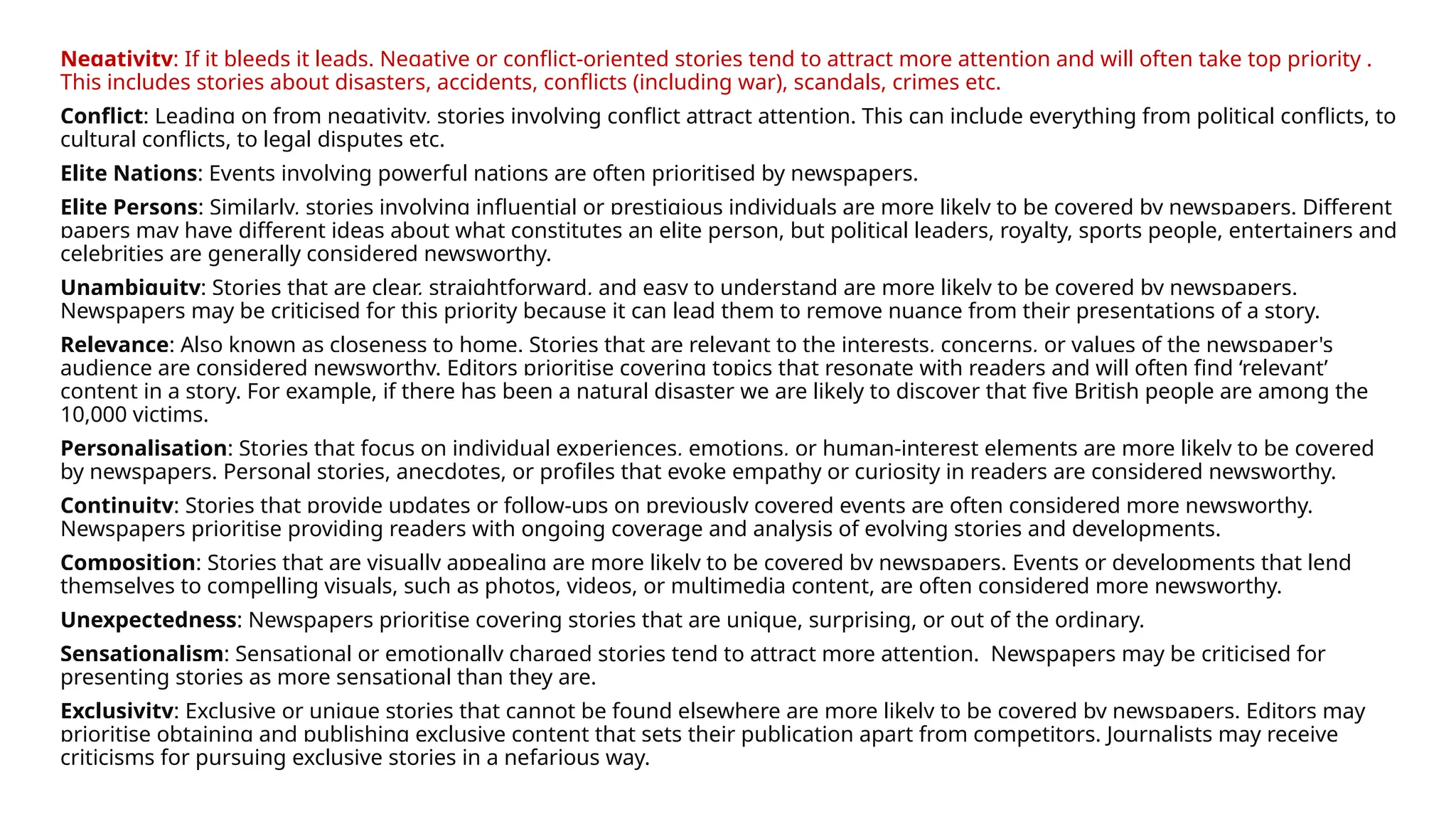
Negativity: If it bleeds it leads. Negative or conflict-oriented stories tend to attract more attention and will often take top priority .
This includes stories about disasters, accidents, conflicts (including war), scandals, crimes etc.
Conflict: Leading on from negativity, stories involving conflict attract attention. This can include everything from political conflicts, to
cultural conflicts, to legal disputes etc.
Elite Nations: Events involving powerful nations are often prioritised by newspapers.
Elite Persons: Similarly, stories involving influential or prestigious individuals are more likely to be covered by newspapers. Different
papers may have different ideas about what constitutes an elite person, but political leaders, royalty, sports people, entertainers and
celebrities are generally considered newsworthy.
Unambiguity: Stories that are clear, straightforward, and easy to understand are more likely to be covered by newspapers.
Newspapers may be criticised for this priority because it can lead them to remove nuance from their presentations of a story.
Relevance: Also known as closeness to home. Stories that are relevant to the interests, concerns, or values of the newspaper's
audience are considered newsworthy. Editors prioritise covering topics that resonate with readers and will often find ‘relevant’
content in a story. For example, if there has been a natural disaster we are likely to discover that five British people are among the
10,000 victims.
Personalisation: Stories that focus on individual experiences, emotions, or human-interest elements are more likely to be covered
by newspapers. Personal stories, anecdotes, or profiles that evoke empathy or curiosity in readers are considered newsworthy.
Continuity: Stories that provide updates or follow-ups on previously covered events are often considered more newsworthy.
Newspapers prioritise providing readers with ongoing coverage and analysis of evolving stories and developments.
Composition: Stories that are visually appealing are more likely to be covered by newspapers. Events or developments that lend
themselves to compelling visuals, such as photos, videos, or multimedia content, are often considered more newsworthy.
Unexpectedness: Newspapers prioritise covering stories that are unique, surprising, or out of the ordinary.
Sensationalism: Sensational or emotionally charged stories tend to attract more attention. Newspapers may be criticised for
presenting stories as more sensational than they are.
Exclusivity: Exclusive or unique stories that cannot be found elsewhere are more likely to be covered by newspapers. Editors may
prioritise obtaining and publishing exclusive content that sets their publication apart from competitors. Journalists may receive
criticisms for pursuing exclusive stories in a nefarious way.
Negativity: If it bleeds it leads. Negative or conflict-oriented stories tend to attract more attention and will often take top priority .
This includes stories about disasters, accidents, conflicts (including war), scandals, crimes etc.
Conflict: Leading on from negativity, stories involving conflict attract attention. This can include everything from political conflicts, to
cultural conflicts, to legal disputes etc.
Elite Nations: Events involving powerful nations are often prioritised by newspapers.
Elite Persons: Similarly, stories involving influential or prestigious individuals are more likely to be covered by newspapers. Different
papers may have different ideas about what constitutes an elite person, but political leaders, royalty, sports people, entertainers and
celebrities are generally considered newsworthy.
Unambiguity: Stories that are clear, straightforward, and easy to understand are more likely to be covered by newspapers.
Newspapers may be criticised for this priority because it can lead them to remove nuance from their presentations of a story.
Relevance: Also known as closeness to home. Stories that are relevant to the interests, concerns, or values of the newspaper's
audience are considered newsworthy. Editors prioritise covering topics that resonate with readers and will often find ‘relevant’
content in a story. For example, if there has been a natural disaster we are likely to discover that five British people are among the
10,000 victims.
Personalisation: Stories that focus on individual experiences, emotions, or human-interest elements are more likely to be covered
by newspapers. Personal stories, anecdotes, or profiles that evoke empathy or curiosity in readers are considered newsworthy.
Continuity: Stories that provide updates or follow-ups on previously covered events are often considered more newsworthy.
Newspapers prioritise providing readers with ongoing coverage and analysis of evolving stories and developments.
Composition: Stories that are visually appealing are more likely to be covered by newspapers. Events or developments that lend
themselves to compelling visuals, such as photos, videos, or multimedia content, are often considered more newsworthy.
Unexpectedness: Newspapers prioritise covering stories that are unique, surprising, or out of the ordinary.
Sensationalism: Sensational or emotionally charged stories tend to attract more attention. Newspapers may be criticised for
presenting stories as more sensational than they are.
Exclusivity: Exclusive or unique stories that cannot be found elsewhere are more likely to be covered by newspapers. Editors may
prioritise obtaining and publishing exclusive content that sets their publication apart from competitors. Journalists may receive
criticisms for pursuing exclusive stories in a nefarious way.
Introduction
Gerbner theorises that the media can influence audience perceptions of the
world over a long period of time through the repetition of similar messages.
He found that people who watched a lot of television were likely to have a
more negative view of the world, which he called mean world syndrome and
that long term and consistent TV viewing leads to the homogenisation of
social and political views, which he called ‘mainstreaming’.
CULTIVATION THEORY– NEWSPAPERS
Introduction
Gerbner theorises that the media can influence audience perceptions of the
world over a long period of time through the repetition of similar messages.
He found that people who watched a lot of television were likely to have a
more negative view of the world, which he called mean world syndrome and
that long term and consistent TV viewing leads to the homogenisation of
social and political views, which he called ‘mainstreaming’.
CULTIVATION THEORY– NEWSPAPERS
Introduction
Gerbner theorises that the media can influence audience perceptions of the
world over a long period of time through the repetition of similar messages.
He found that people who watched a lot of television were likely to have a
more negative view of the world, which he called mean world syndrome and
that long term and consistent media consumption leads to the
homogenisation of social and political views, which he called
‘mainstreaming’.
CULTIVATION THEORY– NEWSPAPERS
Indicative Content – Gerbner (From the markscheme – mostly)
Gerbner’s cultivation theory places stress on long term media effects on attitudes rather than short term immediate effects, interest in media representation of
violence, concern for the effects of heavy media use – is not specifically related to newspapers and therefore may not be relevant.
Cultivation theory best fits those media producing consistent messages about the world that might cultivate attitudes in media users – this may be seen to be
appropriate in relation to newspapers and may help to explain why some readers might, over time, respond in different ways.
Gerbner’s stress on the increased media effects on heavy media users might be appropriate to describe the effects on regular readers of newspapers compared to
those who are casual readers and who thus might respond differently to the same stories.
Gerbner’s interest in the attitudinal effects of violent representations suggests that newspapers which value ‘bad’ news are possibly creating the belief in the audience
that the world is a dangerous place (‘mean world syndrome’) characterised by negative events; audiences who have a broader media consumption may not feel the
same way as those whose primary source is a particular newspaper whilst those who only read one newspaper might perceive the world differently to audiences
which read more than one.
Gerbner’s ideas can be applied to a wide range of media products, including newspapers, where content analysis is widely used to study consistency in messages and
would most apply to strongly delivered newspaper messages that are consistent across newspapers, e.g. about the wrongness of terrorism; different audiences might
receive these stories differently depending upon other influences.
Gerbner’s ideas draw attention to the need to investigate the longer-term effects on individuals who consume newspapers and support the arguments of those who
think newspapers should be regulated to avoid public harm.
However, as noted above, the theory was developed to explain the power of television, so may be less applicable to newspapers, where media consumption is rarely
as heavy.
Newspaper messages are likely to be contradicted by messages from politically and socially opposing newspapers (e.g. The Guardian and the Mail), especially in areas
of social or political conflict (e.g. Brexit); it is less likely that ideologically different audiences are going to read (and thus respond differently to) different newspapers.
Prioritising the effects of the media on the audience may mean that the effects of the audience on the media are underestimated.
CULTIVATION THEORY– NEWSPAPERS
Indicative Content – Gerbner (From the markscheme – mostly)
Gerbner’s cultivation theory places stress on long term media effects on attitudes rather than short term immediate effects, interest in media representation of
violence, concern for the effects of heavy media use – is not specifically related to newspapers and therefore may not be relevant.
Cultivation theory best fits those media producing consistent messages about the world that might cultivate attitudes in media users – this may be seen to be
appropriate in relation to newspapers and may help to explain why some readers might, over time, respond in different ways.
Gerbner’s stress on the increased media effects on heavy media users might be appropriate to describe the effects on regular readers of newspapers compared to
those who are casual readers and who thus might respond differently to the same stories.
Gerbner’s interest in the attitudinal effects of violent representations suggests that newspapers which value ‘bad’ news are possibly creating the belief in the audience
that the world is a dangerous place (‘mean world syndrome’) characterised by negative events; audiences who have a broader media consumption may not feel the
same way as those whose primary source is a particular newspaper whilst those who only read one newspaper might perceive the world differently to audiences
which read more than one.
Gerbner’s ideas can be applied to a wide range of media products, including newspapers, where content analysis is widely used to study consistency in messages and
would most apply to strongly delivered newspaper messages that are consistent across newspapers, e.g. about the wrongness of terrorism; different audiences might
receive these stories differently depending upon other influences.
Gerbner’s ideas draw attention to the need to investigate the longer-term effects on individuals who consume newspapers and support the arguments of those who
think newspapers should be regulated to avoid public harm.
However, as noted above, the theory was developed to explain the power of television, so may be less applicable to newspapers, where media consumption is rarely
as heavy.
Newspaper messages are likely to be contradicted by messages from politically and socially opposing newspapers (e.g. The Guardian and the Mail), especially in areas
of social or political conflict (e.g. Brexit); it is less likely that ideologically different audiences are going to read (and thus respond differently to) different newspapers.
Prioritising the effects of the media on the audience may mean that the effects of the audience on the media are underestimated.
CULTIVATION THEORY– NEWSPAPERS
Gerbner’s interest in the attitudinal effects of violent representations suggests that
newspapers which value ‘bad’ news are possibly creating the belief in the audience that
the world is a dangerous place (‘mean world syndrome’) characterised by negative
events; audiences who have a broader media consumption may not feel the same way as
those whose primary source is a particular newspaper whilst those who only read one
newspaper might perceive the world differently to audiences that read more than one.
CULTIVATION THEORY– NEWSPAPERS
Gerbner’s interest in the attitudinal effects of violent representations suggests that
newspapers which value ‘bad’ news are possibly creating the belief in the audience that
the world is a dangerous place (‘mean world syndrome’) characterised by negative
events; audiences who have a broader media consumption may not feel the same way as
those whose primary source is a particular newspaper whilst those who only read one
newspaper might perceive the world differently to audiences that read more than one.
Simplified:
Gerbner theorises that the representation of violence in newspapers make the world
seem a dangerous place, leading to a phenomenon called mean world syndrome. If
Gerbner is correct, more popular newspapers may feature more sensationalist and
violent content.
CULTIVATION THEORY– NEWSPAPERS
Gerbner’s interest in the attitudinal effects of violent representations suggests that
newspapers which value ‘bad’ news are possibly creating the belief in the audience that
the world is a dangerous place (‘mean world syndrome’) characterised by negative
events; audiences who have a broader media consumption may not feel the same way as
those whose primary source is a particular newspaper whilst those who only read one
newspaper might perceive the world differently to audiences that read more than one.
Simplified:
Gerbner theorises that the representation of violence in newspapers make the world
seem a dangerous place, leading to a phenomenon called mean world syndrome. If
Gerbner is correct, more popular newspapers may feature more sensationalist and
violent content.
CULTIVATION THEORY– NEWSPAPERS
Gerbner’s interest in the attitudinal effects of violent representations suggests that
newspapers which value ‘bad’ news are possibly creating the belief in the audience that
the world is a dangerous place (‘mean world syndrome’) characterised by negative
events; audiences who have a broader media consumption may not feel the same way as
those whose primary source is a particular newspaper whilst those who only read one
newspaper might perceive the world differently to audiences that read more than one.
Simplified:
Gerbner theorises that the representation of violence in newspapers make the world
seem a dangerous place, leading to a phenomenon called mean world syndrome. If
Gerbner is correct, more popular newspapers may feature more sensationalist and
violent content. Galtung and Ruge point out that negativity may be the most
significant of all news values; if it bleeds it leads. The Daily Mail is known for its
negativity around a range of topics, from immigration, to lawlessness on UK
streets; in 2018, it’s June 8th
cover depicted a machete wielding man and a
headline that read “CHILLING REALITY OF WILD WEST UK.” Given that the Daily
Mail has the highest circulation of any UK newspaper, this may indicate the
validity of applying Gerbner’s theory to their perpetuation of mean world
syndrome through their lurid depiction of violence.
CULTIVATION THEORY– NEWSPAPERS
Gerbner’s interest in the attitudinal effects of violent representations suggests that
newspapers which value ‘bad’ news are possibly creating the belief in the audience that
the world is a dangerous place (‘mean world syndrome’) characterised by negative
events; audiences who have a broader media consumption may not feel the same way
as those whose primary source is a particular newspaper whilst those who only read
one newspaper might perceive the world differently to audiences that read more than
one.
Simplified:
While this may be true of people who only reader one newspaper, Gerbner's theory
might suggest that reading several different papers could offer a range of different
perspectives and make it more difficult to develop mean world syndrome. The
Guardian have a reputation for sober reporting that avoids sensationalism. We
might therefore expect news readers who also read The Guardian to have a more
nuanced take and to avoid mean world syndrome. However, for the past three
years their website has included a substantial info hub dedicated to live updates
of the war in Ukraine, which suggests that Gerbner’s mean world syndrome may
be relevant across even the most socio-politically different publications and
perhaps that even those that read more than one paper will not be able to escape its
influence.
CULTIVATION THEORY– NEWSPAPERS
Gerbner’s interest in the attitudinal effects of violent representations suggests that
newspapers which value ‘bad’ news are possibly creating the belief in the audience that
the world is a dangerous place (‘mean world syndrome’) characterised by negative
events; audiences who have a broader media consumption may not feel the same way
as those whose primary source is a particular newspaper whilst those who only read
one newspaper might perceive the world differently to audiences that read more than
one.
Simplified:
While this may be true of people who only reader one newspaper, Gerbner's theory
might suggest that reading several different papers could offer a range of different
perspectives and make it more difficult to develop mean world syndrome. The
Guardian have a reputation for sober reporting that avoids sensationalism. We
might therefore expect news readers who also read The Guardian to have a more
nuanced take and to avoid mean world syndrome. However, for the past three
years their website has included a substantial info hub dedicated to live updates
of the war in Ukraine, which suggests that Gerbner’s mean world syndrome may
be relevant across even the most socio-politically different publications and
perhaps that even those that read more than one paper will not be able to escape its
influence.
CULTIVATION THEORY– NEWSPAPERS
Gerbner’s interest in the attitudinal effects of violent representations suggests that
newspapers which value ‘bad’ news are possibly creating the belief in the audience that
the world is a dangerous place (‘mean world syndrome’) characterised by negative
events; audiences who have a broader media consumption may not feel the same way
as those whose primary source is a particular newspaper whilst those who only read
one newspaper might perceive the world differently to audiences that read more than
one.
Simplified:
While this may be true of people who only reader one newspaper, Gerbner's theory
might suggest that reading several different papers could offer a range of different
perspectives and make it more difficult to develop mean world syndrome. The
Guardian have a reputation for sober reporting that avoids sensationalism. We
might therefore expect news readers who also read The Guardian to have a more
nuanced take and to avoid mean world syndrome. However, for the past three
years their website has included a substantial info hub dedicated to live updates
of the war in Ukraine, which suggests that Gerbner’s mean world syndrome may
be relevant across even the most socio-politically different publications and
perhaps that even those that read more than one paper will not be able to escape its
influence.
CULTIVATION THEORY– NEWSPAPERS
WHOLE PARAGRAPH:
Gerbner theorises that the representation of violence in newspapers make the world seem a dangerous place,
leading to a phenomenon called mean world syndrome. If Gerbner is correct, more popular newspapers may
feature more sensationalist and violent content. Galtung and Ruge point out that negativity may be the most
significant of all news values; if it bleeds it leads. The Daily Mail is known for its negativity around a range of topics,
from immigration, to lawlessness on UK streets; in 2018, it’s June 8th
cover depicted a machete wielding man and a
headline that read “CHILLING REALITY OF WILD WEST UK.” Given that the Daily Mail has the highest circulation of
any UK newspaper, this may indicate the validity of applying Gerbner’s theory to their perpetuation of mean world
syndrome through their lurid depiction of violence. While this may be true of people who only reader one
newspaper, Gerbner's theory might suggest that reading several different papers could offer a range of different
perspectives and make it more difficult to develop mean world syndrome. The Guardian have a reputation for sober
reporting that avoids sensationalism. We might therefore expect news readers who also read The Guardian to have
a more nuanced take and to avoid mean world syndrome. However, for the past three years their website has
included a substantial info hub dedicated to live updates of the war in Ukraine, which suggests that Gerbner’s mean
world syndrome may be relevant across even the most socio-politically different publications and perhaps that even
those that read more than one paper will not be able to escape its influence.
CULTIVATION THEORY– NEWSPAPERS
Indicative Content – Gerbner (From the markscheme – mostly)
Gerbner’s cultivation theory places stress on long term media effects on attitudes rather than short term immediate effects, interest in media representation of
violence, concern for the effects of heavy media use – is not specifically related to newspapers and therefore may not be relevant.
Cultivation theory best fits those media producing consistent messages about the world that might cultivate attitudes in media users – this may be seen to be
appropriate in relation to newspapers and may help to explain why some readers might, over time, respond in different ways.
Gerbner’s stress on the increased media effects on heavy media users might be appropriate to describe the effects on regular readers of newspapers compared to
those who are casual readers and who thus might respond differently to the same stories.
Gerbner’s interest in the attitudinal effects of violent representations suggests that newspapers which value ‘bad’ news are possibly creating the belief in the audience
that the world is a dangerous place (‘mean world syndrome’) characterised by negative events; audiences who have a broader media consumption may not feel the
same way as those whose primary source is a particular newspaper whilst those who only read one newspaper might perceive the world differently to audiences
which read more than one.
Gerbner’s ideas can be applied to a wide range of media products, including newspapers, where content analysis is widely used to study consistency in messages and
would most apply to strongly delivered newspaper messages that are consistent across newspapers, e.g. about the wrongness of terrorism; different audiences might
receive these stories differently depending upon other influences.
Gerbner’s ideas draw attention to the need to investigate the longer-term effects on individuals who consume newspapers and support the arguments of those who
think newspapers should be regulated to avoid public harm.
However, as noted above, the theory was developed to explain the power of television, so may be less applicable to newspapers, where media consumption is rarely
as heavy.
Newspaper messages are likely to be contradicted by messages from politically and socially opposing newspapers (e.g. The Guardian and the Mail), especially in areas
of social or political conflict (e.g. Brexit); it is less likely that ideologically different audiences are going to read (and thus respond differently to) different newspapers.
Prioritising the effects of the media on the audience may mean that the effects of the audience on the media are underestimated.
CULTIVATION THEORY– NEWSPAPERS
Newspaper messages are likely to be contradicted by messages from politically and socially opposing newspapers (e.g. The
Guardian and the Mail), especially in areas of social or political conflict (e.g. Brexit); it is less likely that ideologically different
audiences are going to read (and thus respond differently to) different newspapers.
Simplified:
Gerbner theorises that repeated and long-term media consumption leads to mainstreaming. However, UK newspapers are
notably socially and politically distinct (e.g. The left-wing Guardian and the right-wing Mail). They are likely to offer
contradictory messages, especially when they are dealing with a highly contentious issue (e.g. Brexit). On November 4th
2016,
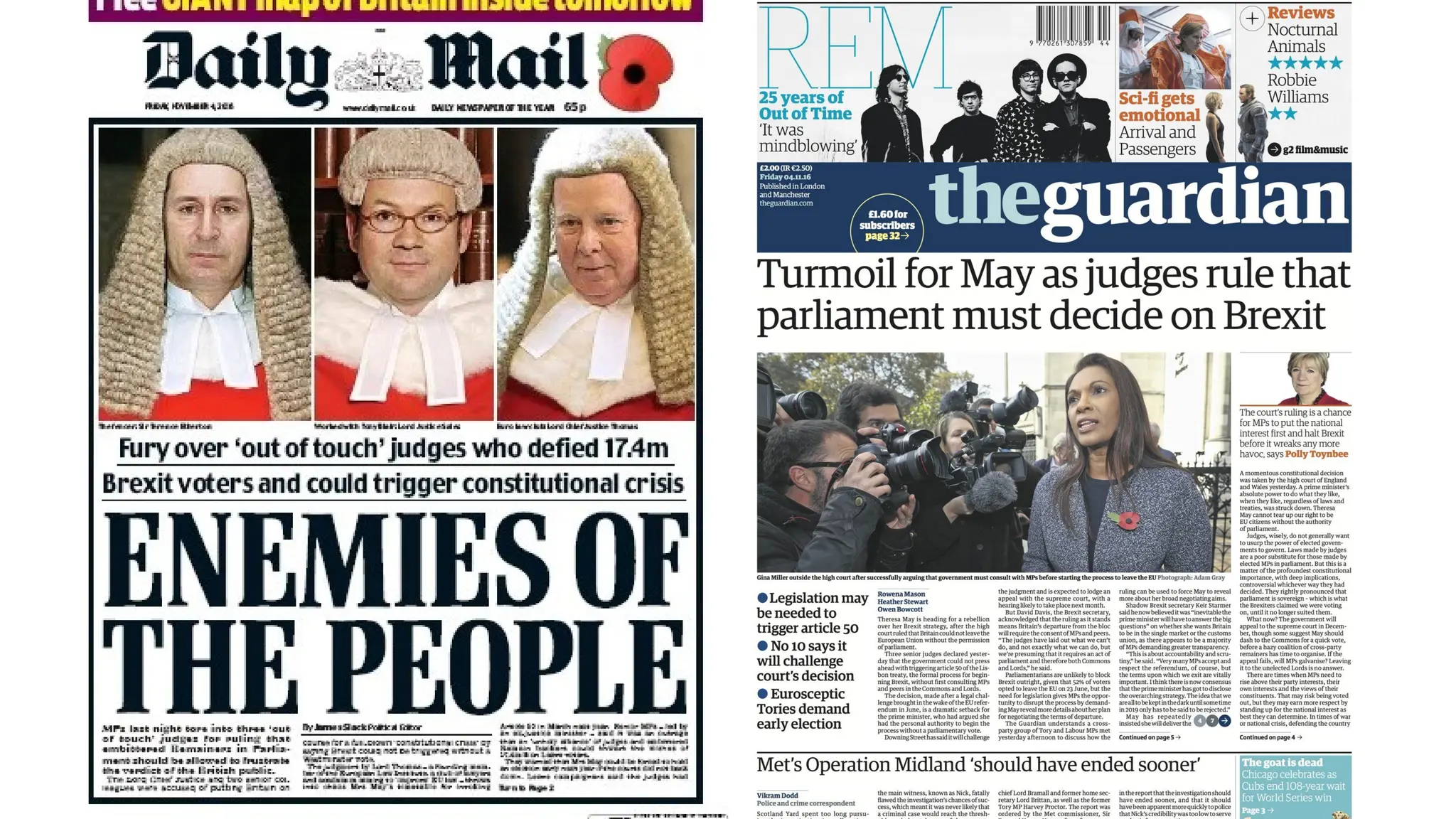
The Guardian and The Mail took a very different approach to the reporting of the high court ruling on triggering article 50. The
Mail branded the judges “ENEMIES OF THE PEOPLE,” while The Guardian headline acknowledged the difficulty that the ruling
posed for the prime minister while remaining politically neutral. We might argue that these contradictory messages invalidate
Gerbner’s idea of mainstreaming being applied to newspapers by demonstrating that this medium conveys often very
different messaging. However, it is unlikely that ideologically different audiences are going to read and thus respond
differently to different newspapers. Daily Mail readers for example, are likely to continue to read stories that reinforce their
negative views on Europe, on immigration and a host of other right-wing talking points. It may therefore be useful to apply
Gerbner 's ideas about mainstreaming when considering the normalisation of these views among Daily Mail's readers.
CULTIVATION THEORY– NEWSPAPERS
Newspaper messages are likely to be contradicted by messages from politically and socially opposing newspapers (e.g. The
Guardian and the Mail), especially in areas of social or political conflict (e.g. Brexit); it is less likely that ideologically different
audiences are going to read (and thus respond differently to) different newspapers.
Simplified:
Gerbner theorises that repeated and long-term media consumption leads to mainstreaming. However, UK newspapers are
notably socially and politically distinct (e.g. The left-wing Guardian and the right-wing Mail). They are likely to offer
contradictory messages, especially when they are dealing with a highly contentious issue (e.g. Brexit). On November 4th
2016,
The Guardian and The Mail took a very different approach to the reporting of the high court ruling on triggering article 50. The
Mail branded the judges “ENEMIES OF THE PEOPLE,” while The Guardian headline acknowledged the difficulty that the ruling
posed for the prime minister while remaining politically neutral. We might argue that these contradictory messages invalidate
Gerbner’s idea of mainstreaming being applied to newspapers by demonstrating that this medium conveys often very
different messaging. However, it is unlikely that ideologically different audiences are going to read and thus respond
differently to different newspapers. Daily Mail readers for example, are likely to continue to read stories that reinforce their
negative views on Europe, on immigration and a host of other right-wing talking points. It may therefore be useful to apply
Gerbner 's ideas about mainstreaming when considering the normalisation of these views among Daily Mail's readers.
CULTIVATION THEORY– NEWSPAPERS
POINT: Newspaper messages are likely to be contradicted by messages from politically and socially opposing
newspapers (e.g. The Guardian and the Mail), especially in areas of social or political conflict (e.g. Brexit); it is
less likely that ideologically different audiences are going to read (and thus respond differently to) different
newspapers.
CULTIVATION THEORY– NEWSPAPERS
Newspaper messages are likely to be contradicted by messages from politically and socially opposing newspapers (e.g. The
Guardian and the Mail), especially in areas of social or political conflict (e.g. Brexit); it is less likely that ideologically different
audiences are going to read (and thus respond differently to) different newspapers.
Simplified:
Gerbner theorises that repeated and long-term media consumption leads to mainstreaming. However, UK newspapers are
notably socially and politically distinct (e.g. The left-wing Guardian and the right-wing Mail). They are likely to offer
contradictory messages, especially when they are dealing with a highly contentious issue (e.g. Brexit). On November 4th
2016,
The Guardian and The Mail took a very different approach to the reporting of the high court ruling on triggering article 50. The
Mail branded the judges “ENEMIES OF THE PEOPLE,” while The Guardian headline acknowledged the difficulty that the ruling
posed for the prime minister while remaining politically neutral. We might argue that these contradictory messages invalidate
Gerbner’s idea of mainstreaming being applied to newspapers by demonstrating that this medium conveys often very
different messaging. However, it is unlikely that ideologically different audiences are going to read and thus respond
differently to different newspapers. Daily Mail readers for example, are likely to continue to read stories that reinforce their
negative views on Europe, on immigration and a host of other right-wing talking points. It may therefore be useful to apply
Gerbner 's ideas about mainstreaming when considering the normalisation of these views among Daily Mail's readers.
CULTIVATION THEORY– NEWSPAPERS
Newspaper messages are likely to be contradicted by messages from politically and socially opposing newspapers (e.g. The
Guardian and the Mail), especially in areas of social or political conflict (e.g. Brexit); it is less likely that ideologically different
audiences are going to read (and thus respond differently to) different newspapers.
Simplified:
Gerbner theorises that repeated and long-term media consumption leads to mainstreaming. However, UK newspapers are
notably socially and politically distinct (e.g. The left-wing Guardian and the right-wing Mail). They are likely to offer
contradictory messages, especially when they are dealing with a highly contentious issue (e.g. Brexit). On November 4th
2016,
The Guardian and The Mail took a very different approach to the reporting of the high court ruling on triggering article 50. The
Mail branded the judges “ENEMIES OF THE PEOPLE,” while The Guardian headline acknowledged the difficulty that the ruling
posed for the prime minister while remaining politically neutral. We might argue that these contradictory messages invalidate
Gerbner’s idea of mainstreaming being applied to newspapers by demonstrating that this medium conveys often very
different messaging. However, it is unlikely that ideologically different audiences are going to read and thus respond
differently to different newspapers. Daily Mail readers for example, are likely to continue to read stories that reinforce their
negative views on Europe, on immigration and a host of other right-wing talking points. It may therefore be useful to apply
Gerbner 's ideas about mainstreaming when considering the normalisation of these views among Daily Mail's readers.
CULTIVATION THEORY– NEWSPAPERS
Indicative Content – Gerbner (From the markscheme – mostly)
Gerbner’s cultivation theory places stress on long term media effects on attitudes rather than short term immediate effects, interest in media representation of
violence, concern for the effects of heavy media use – is not specifically related to newspapers and therefore may not be relevant.
Cultivation theory best fits those media producing consistent messages about the world that might cultivate attitudes in media users – this may be seen to be
appropriate in relation to newspapers and may help to explain why some readers might, over time, respond in different ways.
Gerbner’s stress on the increased media effects on heavy media users might be appropriate to describe the effects on regular readers of newspapers compared to
those who are casual readers and who thus might respond differently to the same stories.
Gerbner’s interest in the attitudinal effects of violent representations suggests that newspapers which value ‘bad’ news are possibly creating the belief in the audience
that the world is a dangerous place (‘mean world syndrome’) characterised by negative events; audiences who have a broader media consumption may not feel the
same way as those whose primary source is a particular newspaper whilst those who only read one newspaper might perceive the world differently to audiences
which read more than one.
Gerbner’s ideas can be applied to a wide range of media products, including newspapers, where content analysis is widely used to study consistency in messages and
would most apply to strongly delivered newspaper messages that are consistent across newspapers, e.g. about the wrongness of terrorism; different audiences might
receive these stories differently depending upon other influences.
Gerbner’s ideas draw attention to the need to investigate the longer-term effects on individuals who consume newspapers and support the arguments of those who
think newspapers should be regulated to avoid public harm.
However, as noted above, the theory was developed to explain the power of television, so may be less applicable to newspapers, where media consumption is rarely
as heavy.
Newspaper messages are likely to be contradicted by messages from politically and socially opposing newspapers (e.g. The Guardian and the Mail), especially in areas
of social or political conflict (e.g. Brexit); it is less likely that ideologically different audiences are going to read (and thus respond differently to) different newspapers.
Prioritising the effects of the media on the audience may mean that the effects of the audience on the media are underestimated.
CULTIVATION THEORY– NEWSPAPERS

AUDIENCE THEORY - GERBNER CULTIVATION THEORY

  • 1.
  • 2.
    Exposure to televisionover long periods of time cultivates standardised roles and behaviours. Gerbner used content analysis to analyse repeated media messages and values, then found that heavy users of televisions were more likely, for example, to develop ‘mean world syndrome’ – a cynical, mistrusting attitude toward others – following prolonged exposure to high level of television violence. Gerbner found that heavy TV viewing led to ‘mainstreaming’ – a common outlook on the world based on the images and labels on TV. Mainstreamers would describe themselves as politically moderate. CULTIVATION THEORY– GERBNER
  • 3.
    Exposure to televisionover long periods of time cultivates standardised roles and behaviours. Gerbner used content analysis to analyse repeated media messages and values, then found that heavy users of televisions were more likely, for example, to develop ‘mean world syndrome’ – a cynical, mistrusting attitude toward others – following prolonged exposure to high level of television violence. Gerbner found that heavy TV viewing led to ‘mainstreaming’ – a common outlook on the world based on the images and labels on TV. Mainstreamers would describe themselves as politically moderate. CULTIVATION THEORY– GERBNER
  • 4.
    Exposure to televisionover long periods of time cultivates standardised roles and behaviours. Gerbner used content analysis to analyse repeated media messages and values, then found that heavy users of televisions were more likely, for example, to develop ‘mean world syndrome’ – a cynical, mistrusting attitude toward others – following prolonged exposure to high level of television violence. Gerbner found that heavy TV viewing led to ‘mainstreaming’ – a common outlook on the world based on the images and labels on TV. Mainstreamers would describe themselves as politically moderate. CULTIVATION THEORY– GERBNER Gerbner claims that patterns of social roles and behaviours that are consistently depicted in television programmes present a narrow and stereotypical view of society. He points to four interconnected areas of concern: Repetition and Consistency: Television programmes repeatedly depict roles and behaviours, creating a consistent portrayal of social norms. e.g. women portrayed as caregivers/homemakers, men are depicted as breadwinners or authority figures. Stereotypical Representations: These representations reinforce stereotypical notions of gender, race, class, and other social categories. e.g. women may be portrayed as emotional and dependent; men are depicted as strong and assertive. Gerbner claims that these stereotypes can contribute to the perpetuation of social inequalities and biases. Limited Diversity: Standardised roles and behaviours reflect a limited range of experiences and identities, excluding or stereotyping marginalised groups and reinforcing existing power dynamics. Impact on Audience Perceptions: Gerbner claims that prolonged exposure to these standardised roles and behaviours shape viewers' perceptions of social reality; they internalise these depictions as representative of the real world, leading to the cultivation of beliefs and attitudes that align with the portrayals they see on television.
  • 5.
    ‘mean world syndrome’– a cynical, mistrusting attitude toward others CULTIVATION THEORY– GERBNER
  • 6.
    ‘mean world syndrome’– a cynical, mistrusting attitude toward others CULTIVATION THEORY– GERBNER In a nutshell, "mean world syndrome" refers to the phenomenon where individuals who are heavy consumers of media, develop an exaggerated belief that the world is a more dangerous and violent place than it really is. Exposure to Violence on Television: Gerbner's research suggests that TV programmes, especially news and entertainment, frequently depicted violence and crime. These portrayals often emphasised sensational and dramatic incidents, creating an exaggerated perception of the prevalence of violence in society. Cultivation of Fear and Anxiety: Through repeated exposure to these depictions of violence, viewers may develop a heightened sense of fear and anxiety about their personal safety and the state of the world. They may come to believe that the world is a much more dangerous place than statistical evidence or their own lived experiences suggest. Impact on Perceptions and Behaviours: Mean world syndrome can influence individuals' perceptions of risk, their attitudes toward others, and their behaviour in social contexts. E.g. people who believe the world is inherently violent are more likely to adopt defensive or mistrustful attitudes toward others, even when there is no real threat. Social and Cultural Implications: Gerbner argued that mean world syndrome has broader social and cultural implications, affecting how people interact with each other and how they perceive social issues such as crime, law enforcement, and justice. The cultivation of fear and mistrust can contribute to a climate of social paranoia and exacerbate social divisions and conflicts.
  • 7.
    ‘mainstreaming’ – acommon outlook on the world based on the images and labels CULTIVATION THEORY– GERBNER
  • 8.
    ‘mainstreaming’ – acommon outlook on the world based on the images and labels CULTIVATION THEORY– GERBNER Gerbner theorises that heavy exposure to TV(media) content leads to the homogenisation of cultural differences and diverse viewpoints among viewers. Impact of T.V. Content: He argued that TV programming, particularly the dominant and widely watched content, has the power to shape viewers' perceptions of social reality; repeated exposure to specific messages and representations can influence how viewers understand and interpret the world. Overriding Other Sources of Information: Mainstreaming occurs when the messages and values conveyed through TV (media) become more influential than other sources of information, such as personal experiences, social interactions, or alternative media sources. TV’s reach and accessibility make it a primary source of cultural information for many people, leading to the homogenisation of attitudes and beliefs across diverse audience segments. Creation of a Shared Reality: Mainstreaming contributes to the creation of a shared cultural reality among television viewers, where common themes, values, and perspectives dominate. This shared reality may override differences in cultural background, socioeconomic status, or personal experiences, leading to a more uniform worldview among audience members. Social and Political Implications: Gerbner argued that mainstreaming has significant social and political implications, as it can reinforce dominant ideologies and power structures. By promoting certain values and perspectives while marginalising others, TV can shape public discourse and influence social attitudes and behaviours on issues such as gender roles, race relations, and political beliefs.
  • 9.
    Cultivation Theory -Gerbner • Gerbner suggests that the media can influence the audience over a long period. • Gerbner found that people who watched a lot of television were likely to have a more negative view of the world (mean world syndrome) than people who did not watch a lot of television. • People who watched a lot of television were likely to have similar views – something he called ‘mainstreaming’. Key Ideas One Sentence Summary The media can influence audience perceptions of the world over a long period of time through the repetition of similar messages.
  • 10.
    Cultivation Theory -Gerbner Gerbner theorises that the media can influence audience perceptions of the world over a long period of time through the repetition of similar messages. He found that people who watched a lot of television were likely to have a more negative view of the world, which he called mean world syndrome and that long term and consistent TV viewing lead to the homogenisation of social and political views, which he called ‘mainstreaming’. Key Ideas One Sentence Summary The media can influence audience perceptions of the world over a long period of time through the repetition of similar messages.
  • 11.
    Applying Gerbner toStranger Things • What messages about society are communicated in Stranger Things? • Is Stranger Things likely to reinforce existing values or beliefs? Stranger Things reflects a range of social values in relation to areas such as gender roles and the family. Its depiction of social norms can be seen as an example of mainstreaming. This is especially true in episode one, in which the ‘normality’ of the Wheeler family, with its traditional depiction of gender roles is juxtaposed with the single parent Byers family. Gerbner might argue that Will’s kidnapping reinforces the idea that one parent families are inferior to mainstream nuclear family and contribute to the marginalisation of both parents and children in this social class. This storyline in Stranger Things also potentially contributes to mean world syndrome through its depiction of the vulnerability of children, and its representation of sinister government conspiracies, whose agents seem to operate unchecked, even murdering ordinary citizens in the quiet small-town community of Hawkins Indiana. It is clear to see how episode one of the series may validate the usefulness of cultivation theory, but Gerbner’s theory fails to acknowledge the complexity of representations as the series progresses or the nuanced depictions of different social groups, in particular the way that it offers empowering representations of women across a range of different ages and social classes.
  • 12.
    Applying Gerbner toStranger Things • What messages about society are communicated in Stranger Things? • Is Stranger Things likely to reinforce existing values or beliefs? Stranger Things reflects a range of social values in relation to areas such as gender roles and the family. Its depiction of social norms can be seen as an example of mainstreaming. This is especially true in episode one, in which the ‘normality’ of the Wheeler family, with its traditional depiction of gender roles is juxtaposed with the single parent Byers family. Gerbner might argue that Will’s kidnapping reinforces the idea that one parent families are inferior to mainstream nuclear family and contribute to the marginalisation of both parents and children in this social class. This storyline in Stranger Things also potentially contributes to mean world syndrome through its depiction of the vulnerability of children, and its representation of sinister government conspiracies, whose agents seem to operate unchecked, even murdering ordinary citizens in the quiet small-town community of Hawkins Indiana. It is clear to see how episode one of the series may validate the usefulness of cultivation theory, but Gerbner’s theory fails to acknowledge the complexity of representations as the series progresses or the nuanced depictions of different social groups, in particular the way that it offers empowering representations of women across a range of different ages and social classes.
  • 13.
    Applying Gerbner toStranger Things • What messages about society are communicated in Stranger Things? • Is Stranger Things likely to reinforce existing values or beliefs? Stranger Things reflects a range of social values in relation to areas such as gender roles and the family. Its depiction of social norms can be seen as an example of mainstreaming. This is especially true in episode one, in which the ‘normality’ of the Wheeler family, with its traditional depiction of gender roles is juxtaposed with the single parent Byers family. Gerbner might argue that Will’s kidnapping reinforces the idea that one parent families are inferior to mainstream nuclear family and contribute to the marginalisation of both parents and children in this social class. This storyline in Stranger Things also potentially contributes to mean world syndrome through its depiction of the vulnerability of children, and its representation of sinister government conspiracies, whose agents seem to operate unchecked, even murdering ordinary citizens in the quiet small-town community of Hawkins Indiana. It is clear to see how episode one of the series may validate the usefulness of cultivation theory, but Gerbner’s theory fails to acknowledge the complexity of representations as the series progresses or the nuanced depictions of different social groups, in particular the way that it offers empowering representations of women across a range of different ages and social classes. IDENTIFY THE EVALUATIVE STATEMENTS
  • 14.
    Applying Gerbner toStranger Things • What messages about society are communicated in Stranger Things? • Is Stranger Things likely to reinforce existing values or beliefs? Stranger Things reflects a range of social values in relation to areas such as gender roles and the family. Its depiction of social norms can be seen as an example of mainstreaming. This is especially true in episode one, in which the ‘normality’ of the Wheeler family, with its traditional depiction of gender roles is juxtaposed with the single parent Byers family. Gerbner might argue that Will’s kidnapping reinforces the idea that one parent families are inferior to mainstream nuclear family and contribute to the marginalisation of both parents and children in this social class. This storyline in Stranger Things also potentially contributes to mean world syndrome through its depiction of the vulnerability of children, and its representation of sinister government conspiracies, whose agents seem to operate unchecked, even murdering ordinary citizens in the quiet small-town community of Hawkins Indiana. It is clear to see how episode one of the series may validate the usefulness of cultivation theory, but Gerbner’s theory fails to acknowledge the complexity of representations as the series progresses or the nuanced depictions of different social groups, in particular the way that it offers empowering representations of women across a range of different ages and social classes. IDENTIFY THE EVALUATIVE STATEMENTS
  • 15.
    Applying Gerbner toDeutschland 83 • What messages about society are communicated in D83? • Is D83 likely to reinforce existing values or beliefs? Unlike Stranger Things, D83’s depiction of social values avoids mainstreaming from the very start. The opening scene introduces the audience to Lenora, who is revealed to be the leader of an HVA spy network in West Germany. As the episode continues, she is revealed to be ruthless in her devotion to her duties, even arranging the murder of the real Moritz Stamm, to allow Martin to assume his role. This defies the labelling (gender stereotyping) of women as homemakers or caregivers that Gerbner identified in his research. We might be tempted to see this as invalidating Gerbner’s theories related to mainstreaming, but it could be argued that modern audiences see empowered women as a mainstream depiction precisely because of the widespread depiction of this stereotype in modern TV representations. Like Stranger Things, we could argue that D83 contributes to mean world syndrome through its depiction of violence, especially given that the perpetrators seem to feel almost casual about it. More deeply, we could argue that it perpetuates mean world syndrome by constructing a narrative that depicts NATO in the role of villain. Gerbner’s work would likely point out that this type of depiction may reinforce cynical mistrust of Western values. However, D83’s depiction of a communist hero notably defies genre conventions, therefore it could be argued that it actively works against mainstreaming and offers a vision of the political and historical context that might lead audiences to a nuanced understanding that makes mean world syndrome difficult to apply.
  • 16.
    Applying Gerbner toDeutschland 83 • What messages about society are communicated in D83? • Is D83 likely to reinforce existing values or beliefs? Unlike Stranger Things, D83’s depiction of social values avoids mainstreaming from the very start. The opening scene introduces the audience to Lenora, who is revealed to be the leader of an HVA spy network in West Germany. As the episode continues, she is revealed to be ruthless in her devotion to her duties, even arranging the murder of the real Moritz Stamm, to allow Martin to assume his role. This defies the labelling (gender stereotyping) of women as homemakers or caregivers that Gerbner identified in his research. We might be tempted to see this as invalidating Gerbner’s theories related to mainstreaming, but it could be argued that modern audiences see empowered women as a mainstream depiction precisely because of the widespread depiction of this stereotype in modern TV representations. Like Stranger Things, we could argue that D83 contributes to mean world syndrome through its depiction of violence, especially given that the perpetrators seem to feel almost casual about it. More deeply, we could argue that it perpetuates mean world syndrome by constructing a narrative that depicts NATO in the role of villain. Gerbner’s work would likely point out that this type of depiction may reinforce cynical mistrust of Western values. However, D83’s depiction of a communist hero notably defies genre conventions, therefore it could be argued that it actively works against mainstreaming and offers a vision of the political and historical context that might lead audiences to a nuanced understanding that makes mean world syndrome difficult to apply.
  • 17.
    CULTIVATION THEORY– NEWSPAPERS 2022Question: Evaluate the effectiveness of one of the following theories in understanding how audiences interpret newspapers, including how they may interpret the same newspapers in different ways: EITHER • Gerbner’s cultivation theory OR • Bandura’s media effects theory
  • 18.
    Galtung & Ruge,identified a set of criteria known as news values. They influence the selection and prioritisation of news stories by editors in a process known as gatekeeping. The list on the next slide is not exhaustive, and the order of priority will change based on context and audience. For example, tabloid newspapers will tend to prioritise sensationalism. It is worth considering that Galtung and Ruge were writing about print newspapers, but that the same values may be amplified by online news. How might you use these in an essay? In essays about codes and conventions or representations, it is worth considering the impact of news values on the content of the extract.
  • 19.
    Negativity: If itbleeds it leads. Negative or conflict-oriented stories tend to attract more attention and will often take top priority . This includes stories about disasters, accidents, conflicts (including war), scandals, crimes etc. Conflict: Leading on from negativity, stories involving conflict attract attention. This can include everything from political conflicts, to cultural conflicts, to legal disputes etc. Elite Nations: Events involving powerful nations are often prioritised by newspapers. Elite Persons: Similarly, stories involving influential or prestigious individuals are more likely to be covered by newspapers. Different papers may have different ideas about what constitutes an elite person, but political leaders, royalty, sports people, entertainers and celebrities are generally considered newsworthy. Unambiguity: Stories that are clear, straightforward, and easy to understand are more likely to be covered by newspapers. Newspapers may be criticised for this priority because it can lead them to remove nuance from their presentations of a story. Relevance: Also known as closeness to home. Stories that are relevant to the interests, concerns, or values of the newspaper's audience are considered newsworthy. Editors prioritise covering topics that resonate with readers and will often find ‘relevant’ content in a story. For example, if there has been a natural disaster we are likely to discover that five British people are among the 10,000 victims. Personalisation: Stories that focus on individual experiences, emotions, or human-interest elements are more likely to be covered by newspapers. Personal stories, anecdotes, or profiles that evoke empathy or curiosity in readers are considered newsworthy. Continuity: Stories that provide updates or follow-ups on previously covered events are often considered more newsworthy. Newspapers prioritise providing readers with ongoing coverage and analysis of evolving stories and developments. Composition: Stories that are visually appealing are more likely to be covered by newspapers. Events or developments that lend themselves to compelling visuals, such as photos, videos, or multimedia content, are often considered more newsworthy. Unexpectedness: Newspapers prioritise covering stories that are unique, surprising, or out of the ordinary. Sensationalism: Sensational or emotionally charged stories tend to attract more attention. Newspapers may be criticised for presenting stories as more sensational than they are. Exclusivity: Exclusive or unique stories that cannot be found elsewhere are more likely to be covered by newspapers. Editors may prioritise obtaining and publishing exclusive content that sets their publication apart from competitors. Journalists may receive criticisms for pursuing exclusive stories in a nefarious way.
  • 20.
    Negativity: If itbleeds it leads. Negative or conflict-oriented stories tend to attract more attention and will often take top priority . This includes stories about disasters, accidents, conflicts (including war), scandals, crimes etc. Conflict: Leading on from negativity, stories involving conflict attract attention. This can include everything from political conflicts, to cultural conflicts, to legal disputes etc. Elite Nations: Events involving powerful nations are often prioritised by newspapers. Elite Persons: Similarly, stories involving influential or prestigious individuals are more likely to be covered by newspapers. Different papers may have different ideas about what constitutes an elite person, but political leaders, royalty, sports people, entertainers and celebrities are generally considered newsworthy. Unambiguity: Stories that are clear, straightforward, and easy to understand are more likely to be covered by newspapers. Newspapers may be criticised for this priority because it can lead them to remove nuance from their presentations of a story. Relevance: Also known as closeness to home. Stories that are relevant to the interests, concerns, or values of the newspaper's audience are considered newsworthy. Editors prioritise covering topics that resonate with readers and will often find ‘relevant’ content in a story. For example, if there has been a natural disaster we are likely to discover that five British people are among the 10,000 victims. Personalisation: Stories that focus on individual experiences, emotions, or human-interest elements are more likely to be covered by newspapers. Personal stories, anecdotes, or profiles that evoke empathy or curiosity in readers are considered newsworthy. Continuity: Stories that provide updates or follow-ups on previously covered events are often considered more newsworthy. Newspapers prioritise providing readers with ongoing coverage and analysis of evolving stories and developments. Composition: Stories that are visually appealing are more likely to be covered by newspapers. Events or developments that lend themselves to compelling visuals, such as photos, videos, or multimedia content, are often considered more newsworthy. Unexpectedness: Newspapers prioritise covering stories that are unique, surprising, or out of the ordinary. Sensationalism: Sensational or emotionally charged stories tend to attract more attention. Newspapers may be criticised for presenting stories as more sensational than they are. Exclusivity: Exclusive or unique stories that cannot be found elsewhere are more likely to be covered by newspapers. Editors may prioritise obtaining and publishing exclusive content that sets their publication apart from competitors. Journalists may receive criticisms for pursuing exclusive stories in a nefarious way.
  • 21.
    Introduction Gerbner theorises thatthe media can influence audience perceptions of the world over a long period of time through the repetition of similar messages. He found that people who watched a lot of television were likely to have a more negative view of the world, which he called mean world syndrome and that long term and consistent TV viewing leads to the homogenisation of social and political views, which he called ‘mainstreaming’. CULTIVATION THEORY– NEWSPAPERS
  • 22.
    Introduction Gerbner theorises thatthe media can influence audience perceptions of the world over a long period of time through the repetition of similar messages. He found that people who watched a lot of television were likely to have a more negative view of the world, which he called mean world syndrome and that long term and consistent TV viewing leads to the homogenisation of social and political views, which he called ‘mainstreaming’. CULTIVATION THEORY– NEWSPAPERS
  • 23.
    Introduction Gerbner theorises thatthe media can influence audience perceptions of the world over a long period of time through the repetition of similar messages. He found that people who watched a lot of television were likely to have a more negative view of the world, which he called mean world syndrome and that long term and consistent media consumption leads to the homogenisation of social and political views, which he called ‘mainstreaming’. CULTIVATION THEORY– NEWSPAPERS
  • 24.
    Indicative Content –Gerbner (From the markscheme – mostly) Gerbner’s cultivation theory places stress on long term media effects on attitudes rather than short term immediate effects, interest in media representation of violence, concern for the effects of heavy media use – is not specifically related to newspapers and therefore may not be relevant. Cultivation theory best fits those media producing consistent messages about the world that might cultivate attitudes in media users – this may be seen to be appropriate in relation to newspapers and may help to explain why some readers might, over time, respond in different ways. Gerbner’s stress on the increased media effects on heavy media users might be appropriate to describe the effects on regular readers of newspapers compared to those who are casual readers and who thus might respond differently to the same stories. Gerbner’s interest in the attitudinal effects of violent representations suggests that newspapers which value ‘bad’ news are possibly creating the belief in the audience that the world is a dangerous place (‘mean world syndrome’) characterised by negative events; audiences who have a broader media consumption may not feel the same way as those whose primary source is a particular newspaper whilst those who only read one newspaper might perceive the world differently to audiences which read more than one. Gerbner’s ideas can be applied to a wide range of media products, including newspapers, where content analysis is widely used to study consistency in messages and would most apply to strongly delivered newspaper messages that are consistent across newspapers, e.g. about the wrongness of terrorism; different audiences might receive these stories differently depending upon other influences. Gerbner’s ideas draw attention to the need to investigate the longer-term effects on individuals who consume newspapers and support the arguments of those who think newspapers should be regulated to avoid public harm. However, as noted above, the theory was developed to explain the power of television, so may be less applicable to newspapers, where media consumption is rarely as heavy. Newspaper messages are likely to be contradicted by messages from politically and socially opposing newspapers (e.g. The Guardian and the Mail), especially in areas of social or political conflict (e.g. Brexit); it is less likely that ideologically different audiences are going to read (and thus respond differently to) different newspapers. Prioritising the effects of the media on the audience may mean that the effects of the audience on the media are underestimated. CULTIVATION THEORY– NEWSPAPERS
  • 25.
    Indicative Content –Gerbner (From the markscheme – mostly) Gerbner’s cultivation theory places stress on long term media effects on attitudes rather than short term immediate effects, interest in media representation of violence, concern for the effects of heavy media use – is not specifically related to newspapers and therefore may not be relevant. Cultivation theory best fits those media producing consistent messages about the world that might cultivate attitudes in media users – this may be seen to be appropriate in relation to newspapers and may help to explain why some readers might, over time, respond in different ways. Gerbner’s stress on the increased media effects on heavy media users might be appropriate to describe the effects on regular readers of newspapers compared to those who are casual readers and who thus might respond differently to the same stories. Gerbner’s interest in the attitudinal effects of violent representations suggests that newspapers which value ‘bad’ news are possibly creating the belief in the audience that the world is a dangerous place (‘mean world syndrome’) characterised by negative events; audiences who have a broader media consumption may not feel the same way as those whose primary source is a particular newspaper whilst those who only read one newspaper might perceive the world differently to audiences which read more than one. Gerbner’s ideas can be applied to a wide range of media products, including newspapers, where content analysis is widely used to study consistency in messages and would most apply to strongly delivered newspaper messages that are consistent across newspapers, e.g. about the wrongness of terrorism; different audiences might receive these stories differently depending upon other influences. Gerbner’s ideas draw attention to the need to investigate the longer-term effects on individuals who consume newspapers and support the arguments of those who think newspapers should be regulated to avoid public harm. However, as noted above, the theory was developed to explain the power of television, so may be less applicable to newspapers, where media consumption is rarely as heavy. Newspaper messages are likely to be contradicted by messages from politically and socially opposing newspapers (e.g. The Guardian and the Mail), especially in areas of social or political conflict (e.g. Brexit); it is less likely that ideologically different audiences are going to read (and thus respond differently to) different newspapers. Prioritising the effects of the media on the audience may mean that the effects of the audience on the media are underestimated. CULTIVATION THEORY– NEWSPAPERS
  • 26.
    Gerbner’s interest inthe attitudinal effects of violent representations suggests that newspapers which value ‘bad’ news are possibly creating the belief in the audience that the world is a dangerous place (‘mean world syndrome’) characterised by negative events; audiences who have a broader media consumption may not feel the same way as those whose primary source is a particular newspaper whilst those who only read one newspaper might perceive the world differently to audiences that read more than one. CULTIVATION THEORY– NEWSPAPERS
  • 27.
    Gerbner’s interest inthe attitudinal effects of violent representations suggests that newspapers which value ‘bad’ news are possibly creating the belief in the audience that the world is a dangerous place (‘mean world syndrome’) characterised by negative events; audiences who have a broader media consumption may not feel the same way as those whose primary source is a particular newspaper whilst those who only read one newspaper might perceive the world differently to audiences that read more than one. Simplified: Gerbner theorises that the representation of violence in newspapers make the world seem a dangerous place, leading to a phenomenon called mean world syndrome. If Gerbner is correct, more popular newspapers may feature more sensationalist and violent content. CULTIVATION THEORY– NEWSPAPERS
  • 28.
    Gerbner’s interest inthe attitudinal effects of violent representations suggests that newspapers which value ‘bad’ news are possibly creating the belief in the audience that the world is a dangerous place (‘mean world syndrome’) characterised by negative events; audiences who have a broader media consumption may not feel the same way as those whose primary source is a particular newspaper whilst those who only read one newspaper might perceive the world differently to audiences that read more than one. Simplified: Gerbner theorises that the representation of violence in newspapers make the world seem a dangerous place, leading to a phenomenon called mean world syndrome. If Gerbner is correct, more popular newspapers may feature more sensationalist and violent content. CULTIVATION THEORY– NEWSPAPERS
  • 29.
    Gerbner’s interest inthe attitudinal effects of violent representations suggests that newspapers which value ‘bad’ news are possibly creating the belief in the audience that the world is a dangerous place (‘mean world syndrome’) characterised by negative events; audiences who have a broader media consumption may not feel the same way as those whose primary source is a particular newspaper whilst those who only read one newspaper might perceive the world differently to audiences that read more than one. Simplified: Gerbner theorises that the representation of violence in newspapers make the world seem a dangerous place, leading to a phenomenon called mean world syndrome. If Gerbner is correct, more popular newspapers may feature more sensationalist and violent content. Galtung and Ruge point out that negativity may be the most significant of all news values; if it bleeds it leads. The Daily Mail is known for its negativity around a range of topics, from immigration, to lawlessness on UK streets; in 2018, it’s June 8th cover depicted a machete wielding man and a headline that read “CHILLING REALITY OF WILD WEST UK.” Given that the Daily Mail has the highest circulation of any UK newspaper, this may indicate the validity of applying Gerbner’s theory to their perpetuation of mean world syndrome through their lurid depiction of violence. CULTIVATION THEORY– NEWSPAPERS
  • 30.
    Gerbner’s interest inthe attitudinal effects of violent representations suggests that newspapers which value ‘bad’ news are possibly creating the belief in the audience that the world is a dangerous place (‘mean world syndrome’) characterised by negative events; audiences who have a broader media consumption may not feel the same way as those whose primary source is a particular newspaper whilst those who only read one newspaper might perceive the world differently to audiences that read more than one. Simplified: While this may be true of people who only reader one newspaper, Gerbner's theory might suggest that reading several different papers could offer a range of different perspectives and make it more difficult to develop mean world syndrome. The Guardian have a reputation for sober reporting that avoids sensationalism. We might therefore expect news readers who also read The Guardian to have a more nuanced take and to avoid mean world syndrome. However, for the past three years their website has included a substantial info hub dedicated to live updates of the war in Ukraine, which suggests that Gerbner’s mean world syndrome may be relevant across even the most socio-politically different publications and perhaps that even those that read more than one paper will not be able to escape its influence. CULTIVATION THEORY– NEWSPAPERS
  • 31.
    Gerbner’s interest inthe attitudinal effects of violent representations suggests that newspapers which value ‘bad’ news are possibly creating the belief in the audience that the world is a dangerous place (‘mean world syndrome’) characterised by negative events; audiences who have a broader media consumption may not feel the same way as those whose primary source is a particular newspaper whilst those who only read one newspaper might perceive the world differently to audiences that read more than one. Simplified: While this may be true of people who only reader one newspaper, Gerbner's theory might suggest that reading several different papers could offer a range of different perspectives and make it more difficult to develop mean world syndrome. The Guardian have a reputation for sober reporting that avoids sensationalism. We might therefore expect news readers who also read The Guardian to have a more nuanced take and to avoid mean world syndrome. However, for the past three years their website has included a substantial info hub dedicated to live updates of the war in Ukraine, which suggests that Gerbner’s mean world syndrome may be relevant across even the most socio-politically different publications and perhaps that even those that read more than one paper will not be able to escape its influence. CULTIVATION THEORY– NEWSPAPERS
  • 32.
    Gerbner’s interest inthe attitudinal effects of violent representations suggests that newspapers which value ‘bad’ news are possibly creating the belief in the audience that the world is a dangerous place (‘mean world syndrome’) characterised by negative events; audiences who have a broader media consumption may not feel the same way as those whose primary source is a particular newspaper whilst those who only read one newspaper might perceive the world differently to audiences that read more than one. Simplified: While this may be true of people who only reader one newspaper, Gerbner's theory might suggest that reading several different papers could offer a range of different perspectives and make it more difficult to develop mean world syndrome. The Guardian have a reputation for sober reporting that avoids sensationalism. We might therefore expect news readers who also read The Guardian to have a more nuanced take and to avoid mean world syndrome. However, for the past three years their website has included a substantial info hub dedicated to live updates of the war in Ukraine, which suggests that Gerbner’s mean world syndrome may be relevant across even the most socio-politically different publications and perhaps that even those that read more than one paper will not be able to escape its influence. CULTIVATION THEORY– NEWSPAPERS
  • 33.
    WHOLE PARAGRAPH: Gerbner theorisesthat the representation of violence in newspapers make the world seem a dangerous place, leading to a phenomenon called mean world syndrome. If Gerbner is correct, more popular newspapers may feature more sensationalist and violent content. Galtung and Ruge point out that negativity may be the most significant of all news values; if it bleeds it leads. The Daily Mail is known for its negativity around a range of topics, from immigration, to lawlessness on UK streets; in 2018, it’s June 8th cover depicted a machete wielding man and a headline that read “CHILLING REALITY OF WILD WEST UK.” Given that the Daily Mail has the highest circulation of any UK newspaper, this may indicate the validity of applying Gerbner’s theory to their perpetuation of mean world syndrome through their lurid depiction of violence. While this may be true of people who only reader one newspaper, Gerbner's theory might suggest that reading several different papers could offer a range of different perspectives and make it more difficult to develop mean world syndrome. The Guardian have a reputation for sober reporting that avoids sensationalism. We might therefore expect news readers who also read The Guardian to have a more nuanced take and to avoid mean world syndrome. However, for the past three years their website has included a substantial info hub dedicated to live updates of the war in Ukraine, which suggests that Gerbner’s mean world syndrome may be relevant across even the most socio-politically different publications and perhaps that even those that read more than one paper will not be able to escape its influence. CULTIVATION THEORY– NEWSPAPERS
  • 34.
    Indicative Content –Gerbner (From the markscheme – mostly) Gerbner’s cultivation theory places stress on long term media effects on attitudes rather than short term immediate effects, interest in media representation of violence, concern for the effects of heavy media use – is not specifically related to newspapers and therefore may not be relevant. Cultivation theory best fits those media producing consistent messages about the world that might cultivate attitudes in media users – this may be seen to be appropriate in relation to newspapers and may help to explain why some readers might, over time, respond in different ways. Gerbner’s stress on the increased media effects on heavy media users might be appropriate to describe the effects on regular readers of newspapers compared to those who are casual readers and who thus might respond differently to the same stories. Gerbner’s interest in the attitudinal effects of violent representations suggests that newspapers which value ‘bad’ news are possibly creating the belief in the audience that the world is a dangerous place (‘mean world syndrome’) characterised by negative events; audiences who have a broader media consumption may not feel the same way as those whose primary source is a particular newspaper whilst those who only read one newspaper might perceive the world differently to audiences which read more than one. Gerbner’s ideas can be applied to a wide range of media products, including newspapers, where content analysis is widely used to study consistency in messages and would most apply to strongly delivered newspaper messages that are consistent across newspapers, e.g. about the wrongness of terrorism; different audiences might receive these stories differently depending upon other influences. Gerbner’s ideas draw attention to the need to investigate the longer-term effects on individuals who consume newspapers and support the arguments of those who think newspapers should be regulated to avoid public harm. However, as noted above, the theory was developed to explain the power of television, so may be less applicable to newspapers, where media consumption is rarely as heavy. Newspaper messages are likely to be contradicted by messages from politically and socially opposing newspapers (e.g. The Guardian and the Mail), especially in areas of social or political conflict (e.g. Brexit); it is less likely that ideologically different audiences are going to read (and thus respond differently to) different newspapers. Prioritising the effects of the media on the audience may mean that the effects of the audience on the media are underestimated. CULTIVATION THEORY– NEWSPAPERS
  • 35.
    Newspaper messages arelikely to be contradicted by messages from politically and socially opposing newspapers (e.g. The Guardian and the Mail), especially in areas of social or political conflict (e.g. Brexit); it is less likely that ideologically different audiences are going to read (and thus respond differently to) different newspapers. Simplified: Gerbner theorises that repeated and long-term media consumption leads to mainstreaming. However, UK newspapers are notably socially and politically distinct (e.g. The left-wing Guardian and the right-wing Mail). They are likely to offer contradictory messages, especially when they are dealing with a highly contentious issue (e.g. Brexit). On November 4th 2016, The Guardian and The Mail took a very different approach to the reporting of the high court ruling on triggering article 50. The Mail branded the judges “ENEMIES OF THE PEOPLE,” while The Guardian headline acknowledged the difficulty that the ruling posed for the prime minister while remaining politically neutral. We might argue that these contradictory messages invalidate Gerbner’s idea of mainstreaming being applied to newspapers by demonstrating that this medium conveys often very different messaging. However, it is unlikely that ideologically different audiences are going to read and thus respond differently to different newspapers. Daily Mail readers for example, are likely to continue to read stories that reinforce their negative views on Europe, on immigration and a host of other right-wing talking points. It may therefore be useful to apply Gerbner 's ideas about mainstreaming when considering the normalisation of these views among Daily Mail's readers. CULTIVATION THEORY– NEWSPAPERS
  • 36.
    Newspaper messages arelikely to be contradicted by messages from politically and socially opposing newspapers (e.g. The Guardian and the Mail), especially in areas of social or political conflict (e.g. Brexit); it is less likely that ideologically different audiences are going to read (and thus respond differently to) different newspapers. Simplified: Gerbner theorises that repeated and long-term media consumption leads to mainstreaming. However, UK newspapers are notably socially and politically distinct (e.g. The left-wing Guardian and the right-wing Mail). They are likely to offer contradictory messages, especially when they are dealing with a highly contentious issue (e.g. Brexit). On November 4th 2016, The Guardian and The Mail took a very different approach to the reporting of the high court ruling on triggering article 50. The Mail branded the judges “ENEMIES OF THE PEOPLE,” while The Guardian headline acknowledged the difficulty that the ruling posed for the prime minister while remaining politically neutral. We might argue that these contradictory messages invalidate Gerbner’s idea of mainstreaming being applied to newspapers by demonstrating that this medium conveys often very different messaging. However, it is unlikely that ideologically different audiences are going to read and thus respond differently to different newspapers. Daily Mail readers for example, are likely to continue to read stories that reinforce their negative views on Europe, on immigration and a host of other right-wing talking points. It may therefore be useful to apply Gerbner 's ideas about mainstreaming when considering the normalisation of these views among Daily Mail's readers. CULTIVATION THEORY– NEWSPAPERS
  • 37.
    POINT: Newspaper messagesare likely to be contradicted by messages from politically and socially opposing newspapers (e.g. The Guardian and the Mail), especially in areas of social or political conflict (e.g. Brexit); it is less likely that ideologically different audiences are going to read (and thus respond differently to) different newspapers. CULTIVATION THEORY– NEWSPAPERS
  • 38.
    Newspaper messages arelikely to be contradicted by messages from politically and socially opposing newspapers (e.g. The Guardian and the Mail), especially in areas of social or political conflict (e.g. Brexit); it is less likely that ideologically different audiences are going to read (and thus respond differently to) different newspapers. Simplified: Gerbner theorises that repeated and long-term media consumption leads to mainstreaming. However, UK newspapers are notably socially and politically distinct (e.g. The left-wing Guardian and the right-wing Mail). They are likely to offer contradictory messages, especially when they are dealing with a highly contentious issue (e.g. Brexit). On November 4th 2016, The Guardian and The Mail took a very different approach to the reporting of the high court ruling on triggering article 50. The Mail branded the judges “ENEMIES OF THE PEOPLE,” while The Guardian headline acknowledged the difficulty that the ruling posed for the prime minister while remaining politically neutral. We might argue that these contradictory messages invalidate Gerbner’s idea of mainstreaming being applied to newspapers by demonstrating that this medium conveys often very different messaging. However, it is unlikely that ideologically different audiences are going to read and thus respond differently to different newspapers. Daily Mail readers for example, are likely to continue to read stories that reinforce their negative views on Europe, on immigration and a host of other right-wing talking points. It may therefore be useful to apply Gerbner 's ideas about mainstreaming when considering the normalisation of these views among Daily Mail's readers. CULTIVATION THEORY– NEWSPAPERS
  • 39.
    Newspaper messages arelikely to be contradicted by messages from politically and socially opposing newspapers (e.g. The Guardian and the Mail), especially in areas of social or political conflict (e.g. Brexit); it is less likely that ideologically different audiences are going to read (and thus respond differently to) different newspapers. Simplified: Gerbner theorises that repeated and long-term media consumption leads to mainstreaming. However, UK newspapers are notably socially and politically distinct (e.g. The left-wing Guardian and the right-wing Mail). They are likely to offer contradictory messages, especially when they are dealing with a highly contentious issue (e.g. Brexit). On November 4th 2016, The Guardian and The Mail took a very different approach to the reporting of the high court ruling on triggering article 50. The Mail branded the judges “ENEMIES OF THE PEOPLE,” while The Guardian headline acknowledged the difficulty that the ruling posed for the prime minister while remaining politically neutral. We might argue that these contradictory messages invalidate Gerbner’s idea of mainstreaming being applied to newspapers by demonstrating that this medium conveys often very different messaging. However, it is unlikely that ideologically different audiences are going to read and thus respond differently to different newspapers. Daily Mail readers for example, are likely to continue to read stories that reinforce their negative views on Europe, on immigration and a host of other right-wing talking points. It may therefore be useful to apply Gerbner 's ideas about mainstreaming when considering the normalisation of these views among Daily Mail's readers. CULTIVATION THEORY– NEWSPAPERS
  • 40.
    Indicative Content –Gerbner (From the markscheme – mostly) Gerbner’s cultivation theory places stress on long term media effects on attitudes rather than short term immediate effects, interest in media representation of violence, concern for the effects of heavy media use – is not specifically related to newspapers and therefore may not be relevant. Cultivation theory best fits those media producing consistent messages about the world that might cultivate attitudes in media users – this may be seen to be appropriate in relation to newspapers and may help to explain why some readers might, over time, respond in different ways. Gerbner’s stress on the increased media effects on heavy media users might be appropriate to describe the effects on regular readers of newspapers compared to those who are casual readers and who thus might respond differently to the same stories. Gerbner’s interest in the attitudinal effects of violent representations suggests that newspapers which value ‘bad’ news are possibly creating the belief in the audience that the world is a dangerous place (‘mean world syndrome’) characterised by negative events; audiences who have a broader media consumption may not feel the same way as those whose primary source is a particular newspaper whilst those who only read one newspaper might perceive the world differently to audiences which read more than one. Gerbner’s ideas can be applied to a wide range of media products, including newspapers, where content analysis is widely used to study consistency in messages and would most apply to strongly delivered newspaper messages that are consistent across newspapers, e.g. about the wrongness of terrorism; different audiences might receive these stories differently depending upon other influences. Gerbner’s ideas draw attention to the need to investigate the longer-term effects on individuals who consume newspapers and support the arguments of those who think newspapers should be regulated to avoid public harm. However, as noted above, the theory was developed to explain the power of television, so may be less applicable to newspapers, where media consumption is rarely as heavy. Newspaper messages are likely to be contradicted by messages from politically and socially opposing newspapers (e.g. The Guardian and the Mail), especially in areas of social or political conflict (e.g. Brexit); it is less likely that ideologically different audiences are going to read (and thus respond differently to) different newspapers. Prioritising the effects of the media on the audience may mean that the effects of the audience on the media are underestimated. CULTIVATION THEORY– NEWSPAPERS