National Aeronautics and Space Administration


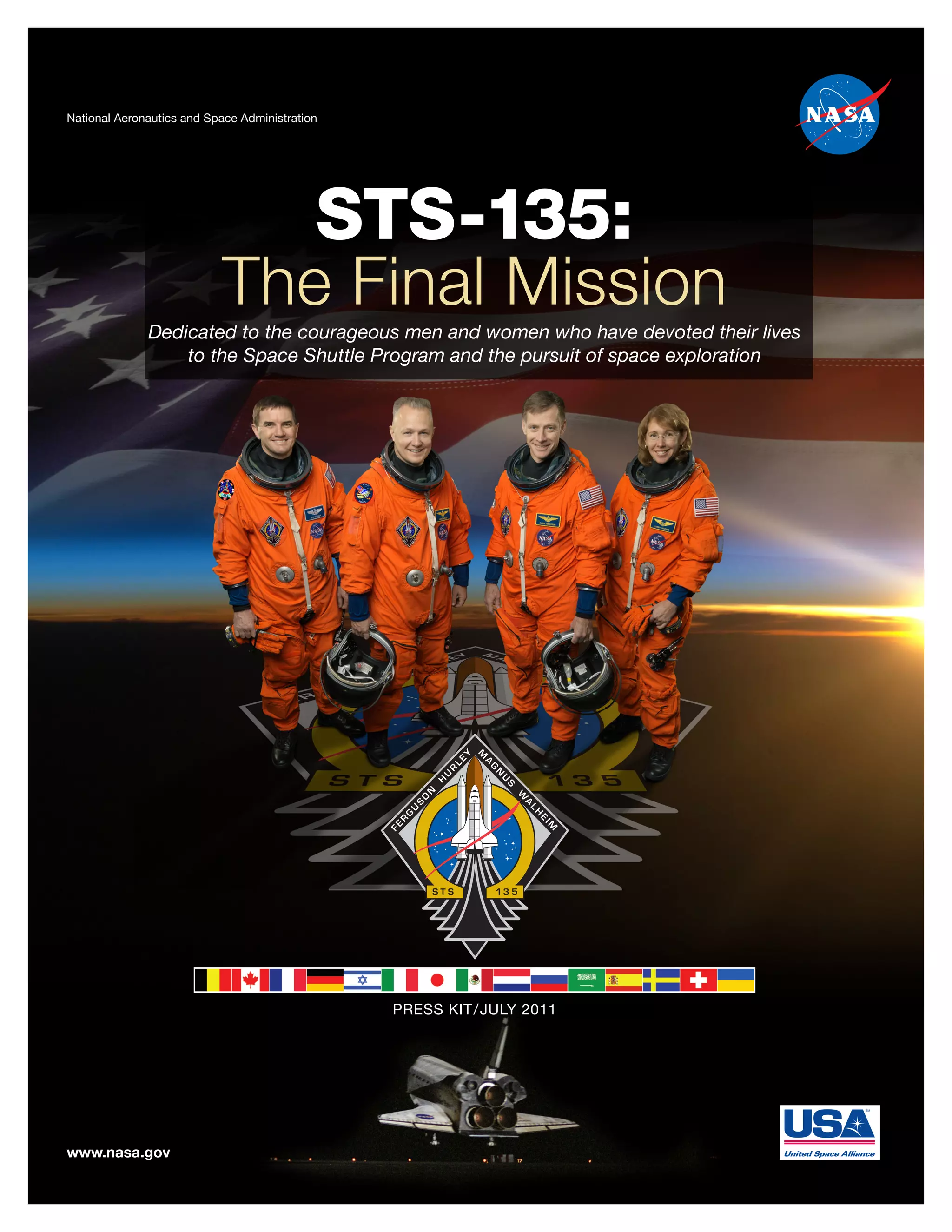
                                            STS-135:
                           The Final Mission
              Dedicated to the courageous men and women who have devoted their lives
                  to the Space Shuttle Program and the pursuit of space exploration


                                                PRESS KIT / JULY 2011


www.nasa.gov
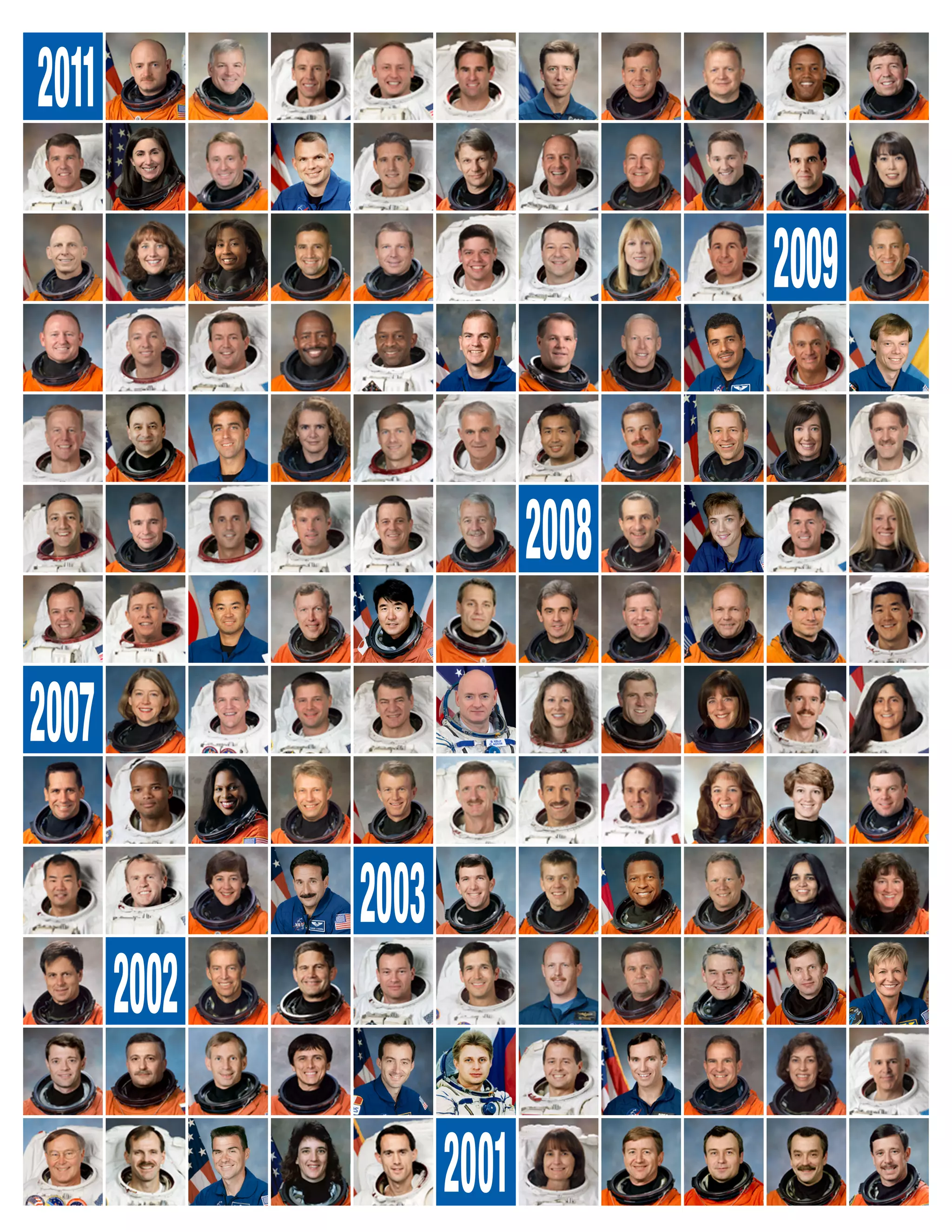
2011

                                   2009


                            2008

2007

              2003
       2002

                     2001
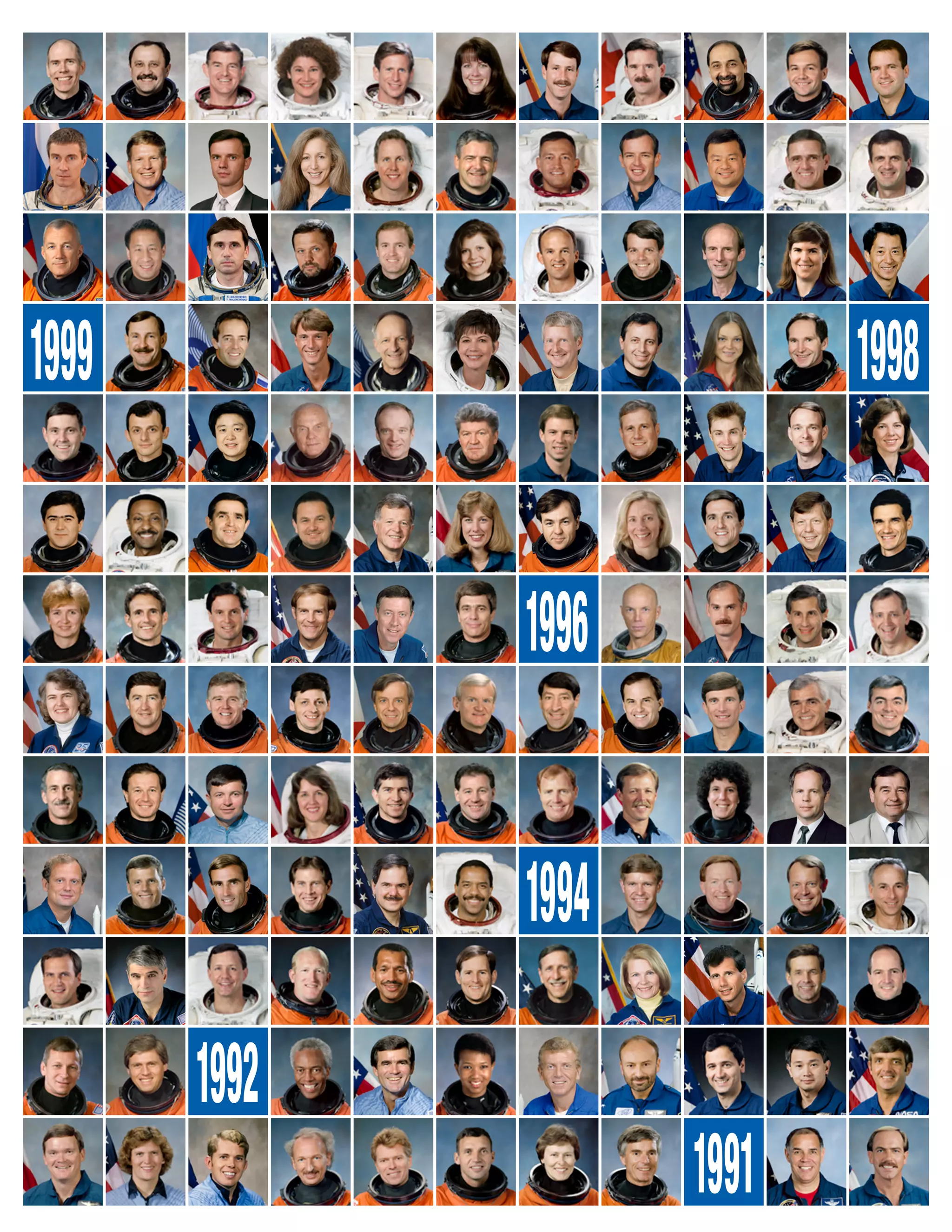
1999                        1998


              1996


              1994

       1992
                     1991
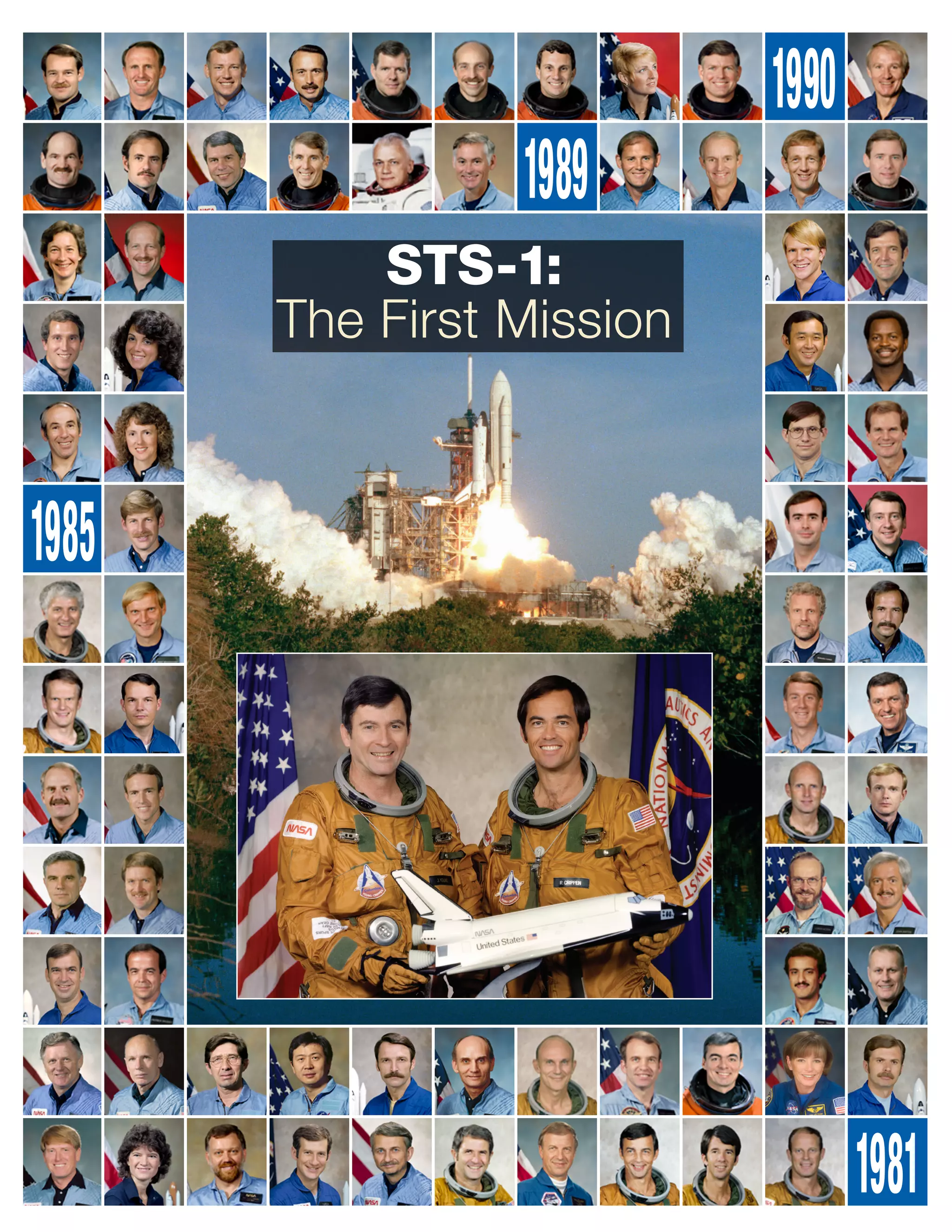
1990
                 1989
           STS-1:
       The First Mission


1985


                                  1981
CONTENTS

Section                                                                                                                                                                                                                                                                                         Page

SPACE SHUTTLE HISTORY ......................................................................................................                                                                                                                                                                       1
    I N T RO D U CT IO N . . . . . . . . . . . . . . . . . . . . . . . . . . . . . . . . . . . . . . . . . . . . . . . . . . . . . . . . . . . . . . . . . . . . . . . . . . . . . . . . . . . . . . . . . . . . . . . . . . . . . . . . . . . . . . . . . .. . . . . . . . . . . . . . . . .      1
    S PA C E SH U TT L E C O N C EP T A ND DEVELOPM ENT . . . . . . . . . . . . . . . . . . . . . . . . . . . . . . . . . . . . . . . . . . . . . . . . . . . . . . . . . . . . . . . . . . . . . . . . . . . . . . . . . . .                                                                      2
    T H E S PA C E SH UT TL E ER A B E G I N S . . . . . . . . . . . . . . . . . . . . . . . . . . . . . . . . . . . . . . . . . . . . . . . . . . . . . . . . . . . . . . . . . . . . . . . . . . . . . . . . . . . . . . . . . . . . . . . . . .. . . . .                                        7
    N A SA R EB O UND S INTO SPA C E . . . . . . . . . . . . . . . . . . . . . . . . . . . . . . . . . . . . . . . . . . . . . . . . . . . . . . . . . . . . . . . . . . . . . . . . . . . . . . . . . . . . . . . . . . . . . . . . . . . . . .. . . . . .                                       14
    F R OM M I R TO TH E I NT E RNA TI O NAL S PA C E S TAT I O N . . . . . . . . . . . . . . . . . . . . . . . . . . . . . . . . . . . . . . . . . . . . . . . . . . . . . . . . . . . . . . . . . . . . . . . . . .                                                                             20
    S T AT I ON A SSEM BL Y C OMPL ET E D AFT ER C O L UMB IA . . . . . . . . . . . . . . . . . . . . . . . . . . . . . . . . . . . . . . . . . . . . . . . . . . . . . . . . . . . . . . . . . . . . . . . . . . .                                                                               25
    M I SSI O N C ON T R OL R O S ES E X P R ES S THA N K S , S UPP OR T . . . . . . . . . . . . . . . . . . . . . . . . . . . . . . . . . . . . . . . . . . . . . . . . . . . . . . . . . . . . . . . . . . . .                                                                                 30
    S PA C E SH U TT L E PR O GRAM ’ S K EY S TAT I ST I C S (T HR U S TS -1 3 4 ) . . . . . . . . . . . . . . . . . . . . . . . . . . . . . . . . . . . . . . . . . . . . . . . . . . . . . . . .                                                                                                32
    T H E O RB I T ER F L E ET . . . . . . . . . . . . . . . . . . . . . . . . . . . . . . . . . . . . . . . . . . . . . . . . . . . . . . . . . . . . . . . . . . . . . . . . . . . . . . . . . . . . . . . . . . . . . . . . . . . . . . . . . . . . .. . . . . . . . . . . . . . . .          32
    S H UT TL E UPS A N D DOW NS : L AU N C H, LAND AND LAUNCH A GA I N . . . . . . . . . . . . . . . . . . . . . . . . . . . . . . . . . . . . . . . . . . . . . . . . . . . . . . .                                                                                                             41
    T HR E E L A N D ING S I TES U SE D , MANY M OR E A VA IL A BLE . . . . . . . . . . . . . . . . . . . . . . . . . . . . . . . . . . . . . . . . . . . . . . . . . . . . . . . . . . . . . . . . . . . . . . .                                                                                 44
    A S TR O NA UT C O RP S M ARKS C HA N G E S IN S PAC E , S OC I E T Y . . . . . . . . . . . . . . . . . . . . . . . . . . . . . . . . . . . . . . . . . . . . . . . . . . . . . . . . . . . . . . . .                                                                                         46
    H U BBL E A ND T H E S HU TT L E: N E W VI E WS O F O U R U NI V E R S E . . . . . . . . . . . . . . . . . . . . . . . . . . . . . . . . . . . . . . . . . . . . . . . . . . . . . . . . . . . . . .                                                                                         49

STS-135 MISSION OVERVIEW ...............................................................................................                                                                                                                                                                         51

STS-135 TIMELINE OVERVIEW ...............................................................................................                                                                                                                                                                        61

STS-135 MISSION PROFILE ...................................................................................................                                                                                                                                                                      63

STS-135 MISSION OBJECTIVES .............................................................................................                                                                                                                                                                         65

MISSION PERSONNEL .............................................................................................................                                                                                                                                                                  67

STS-135 ATLANTIS CREW ......................................................................................................                                                                                                                                                                     69

PAYLOAD OVERVIEW ..............................................................................................................                                                                                                                                                                  75
    R A F FA EL L O MUL T I -P UR POSE L OG I ST I CS M O DUL E (MP L M ) FLI GHT MO D UL E 2 ( F M2 ) . . . . . . . . . . . . . . . . . . . . . . . . . .                                                                                                                                        77
    MP L M B A CKG R O UN D I N FORM AT ION . . . . . . . . . . . . . . . . . . . . . . . . . . . . . . . . . . . . . . . . . . . . . . . . . . . . . . . . . . . . . . . . . . . . . . . . . . . . . . . . . . . . . . . . . . . . . . . . . . .                                                 78
    T H E L I GH TWE I GH T M UL T I- P UR PO S E EXP E RIM E N T SUPP O RT ST RUC T UR E C ARR I ER (L M C) . . . . . . . . . . . . . . . .                                                                                                                                                      79
    R O B OT I C R E FUE L I N G M I SSI O N ( RRM ) . . . . . . . . . . . . . . . . . . . . . . . . . . . . . . . . . . . . . . . . . . . . . . . . . . . . . . . . . . . . . . . . . . . . . . . . . . . . . . . . . . . . . . . . . . . . . . ..                                              82
    P UM P MOD UL E (PM ) . . . . . . . . . . . . . . . . . . . . . . . . . . . . . . . . . . . . . . . . . . . . . . . . . . . . . . . . . . . . . . . . . . . . . . . . . . . . . . . . . . . . . . . . . . . . . . . . . . . . . . . . . . . . . .. . . . . . . . . . . . .                   85


JULY 2011                                                                                                                              CONTENTS                                                                                                                                                    i
Section                                                                                                                                                                                                                                                                                                        Page

RENDEZVOUS & DOCKING .......................................................................................................                                                                                                                                                                                     87
     U N D O CK I NG , S E PA RA TI O N A N D D EPA RTU R E . . . . . . . . . . . . . . . . . . . . . . . . . . . . . . . . . . . . . . . . . . . . . . . . . . . . . . . . . . . . . . . . . . . . . . . . . . . . . . . . . . . . . . .                                                                        88

SPACEWALKS .........................................................................................................................                                                                                                                                                                            89

STS-135 EXPERIMENTS ..........................................................................................................                                                                                                                                                                                  93
     S T S -1 3 5 / UL F7 R E S EA R CH A N D TE C HN OL OG Y D EV EL OPM E N T . . . . . . . . . . . . . . . . . . . . . . . . . . . . . . . . . . . . . . . . . . . . . . . . . . . . . . . . . . . . . .                                                                                                      93
     S H OR T- D UR AT I O N R E S EA RC H TO B E C OMP LETED ON STS-135 / UL F7 . . . . . . . . . . . . . . . . . . . . . . . . . . . . . . . . . . . . . . . . . . . . . . . . . .                                                                                                                             94
     R E S EA R CH TO B E D EL I V ER E D TO S TA TI O N O N SH UTT L E . . . . . . . . . . . . . . . . . . . . . . . . . . . . . . . . . . . . . . . . . . . . . . . . . . . . . . . . . . . . . . . . . . . . . .                                                                                              96
     R E S EA R CH OF O PP O RT U NI T Y . . . . . . . . . . . . . . . . . . . . . . . . . . . . . . . . . . . . . . . . . . . . . . . . . . . . . . . . . . . . . . . . . . . . . . . . . . . . . . . . . . . . . . . . . . . . . . . . . . . . . . .. . . . . . .                                              97
     R E S EA R CH TO B E R ET UR NE D O N S PA C E S H UT TL E . . . . . . . . . . . . . . . . . . . . . . . . . . . . . . . . . . . . . . . . . . . . . . . . . . . . . . . . . . . . . . . . . . . . . . . . . . . . . . .                                                                                    98
     PICO-SAT ELLITE SOLA R CEL L TES T BED . . . . . . . . . . . . . . . . . . . . . . . . . . . . . . . . . . . . . . . . . . . . . . . . . . . . . . . . . . . . . . . . . . . . . . . . . . . . . . . . . . . . . . . . . . . . .. .                                                                        100
     D E V E L O PM E NT T E ST O B JEC T I V E S ( DT O) A N D D ETA ILE D S U PPL EMEN T AR Y O B J ECTIVES (DSO) . . . . . . . . . .                                                                                                                                                                         102
     S T U D E NT EXP ERIM E N T S . . . . . . . . . . . . . . . . . . . . . . . . . . . . . . . . . . . . . . . . . . . . . . . . . . . . . . . . . . . . . . . . . . . . . . . . . . . . . . . . . . . . . . . . . . . . . . . . . . . . . . . . . . .. . . . . . . . . . .                                   105

SHUTTLE REFERENCE DATA ....................................................................................................                                                                                                                                                                                     117

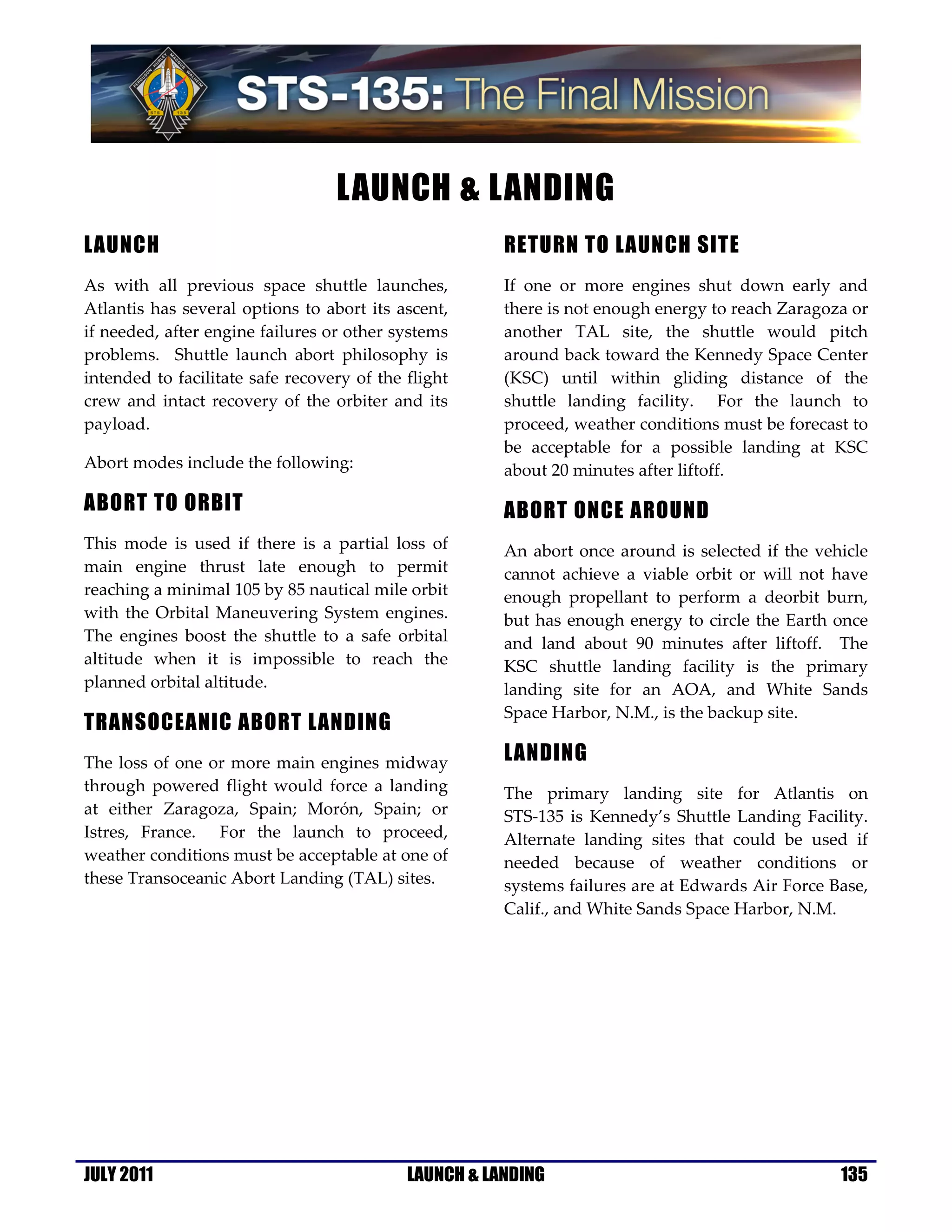
LAUNCH & LANDING ................................................................................................................                                                                                                                                                                              135
     L A U N CH . . . . . . . . . . . . . . . . . . . . . . . . . . . . . . . . . . . . . . . . . . . . . . . . . . . . . . . . . . . . . . . . . . . . . . . . . . . . . . . . . . . . . . . . . . . . . . . . . . . . . . . . . . . . . . . . . . . . . . . .. . . . . . . . . . . . . . . . . . . . . . .    135
     A B OR T T O OR B IT . . . . . . . . . . . . . . . . . . . . . . . . . . . . . . . . . . . . . . . . . . . . . . . . . . . . . . . . . . . . . . . . . . . . . . . . . . . . . . . . . . . . . . . . . . . . . . . . . . . . . . . . . . . . . . . .. . . . . . . . . . . . . . . . .                      135
     T RA N S O C EA NI C A BO RT L AN D I N G . . . . . . . . . . . . . . . . . . . . . . . . . . . . . . . . . . . . . . . . . . . . . . . . . . . . . . . . . . . . . . . . . . . . . . . . . . . . . . . . . . . . . . . . . . . . . . . . . . . .. . . .                                                   135
     R E T UR N TO L A UNCH SIT E . . . . . . . . . . . . . . . . . . . . . . . . . . . . . . . . . . . . . . . . . . . . . . . . . . . . . . . . . . . . . . . . . . . . . . . . . . . . . . . . . . . . . . . . . . . . . . . . . . . . . . . . .. . . . . . . . . . .                                        135
     A B OR T O N C E A RO U N D . . . . . . . . . . . . . . . . . . . . . . . . . . . . . . . . . . . . . . . . . . . . . . . . . . . . . . . . . . . . . . . . . . . . . . . . . . . . . . . . . . . . . . . . . . . . . . . . . . . . . . . . . . . . .. . . . . . . . . . . .                               135
     L A N D I NG . . . . . . . . . . . . . . . . . . . . . . . . . . . . . . . . . . . . . . . . . . . . . . . . . . . . . . . . . . . . . . . . . . . . . . . . . . . . . . . . . . . . . . . . . . . . . . . . . . . . . . . . . . . . . . . . . . . . . . .. . . . . . . . . . . . . . . . . . . . . .      135

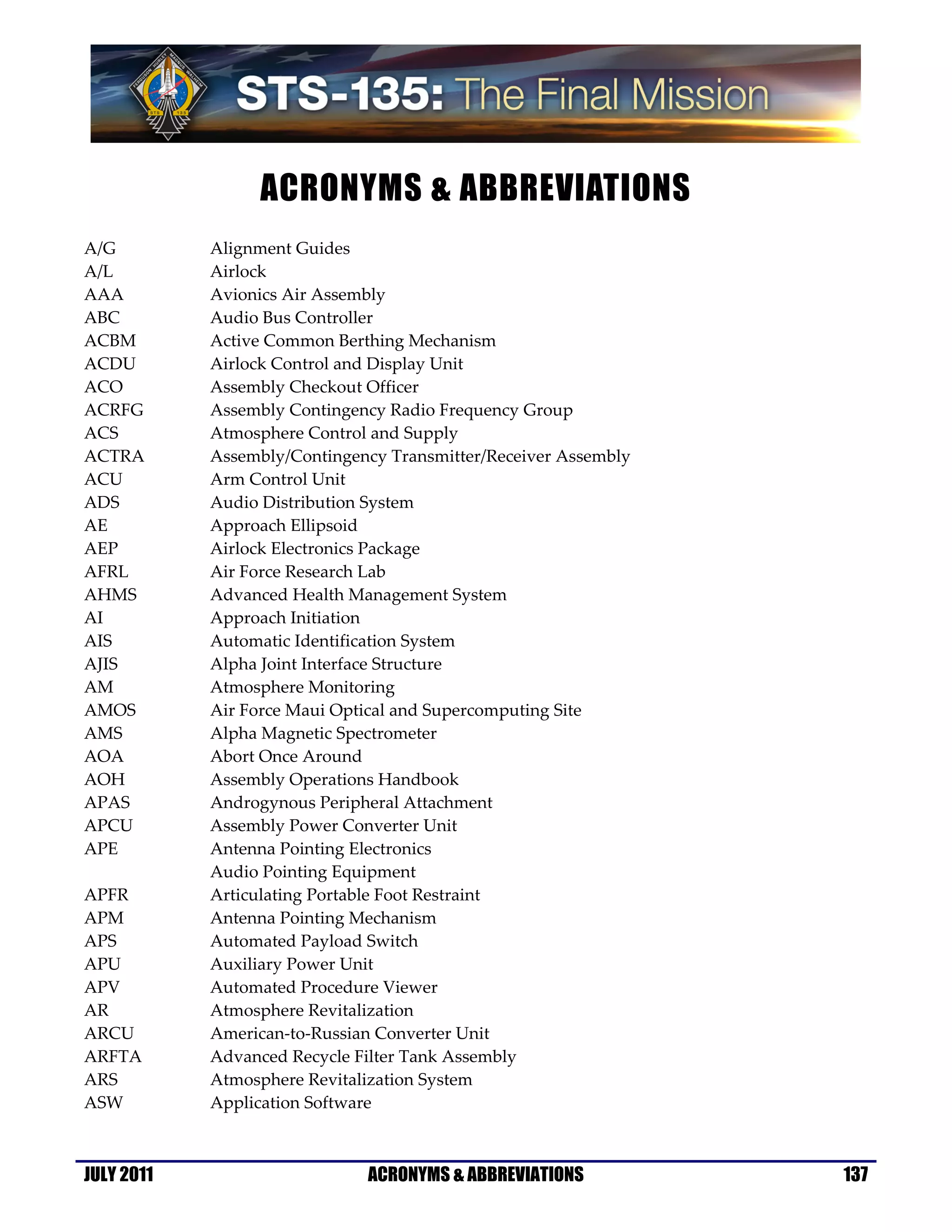
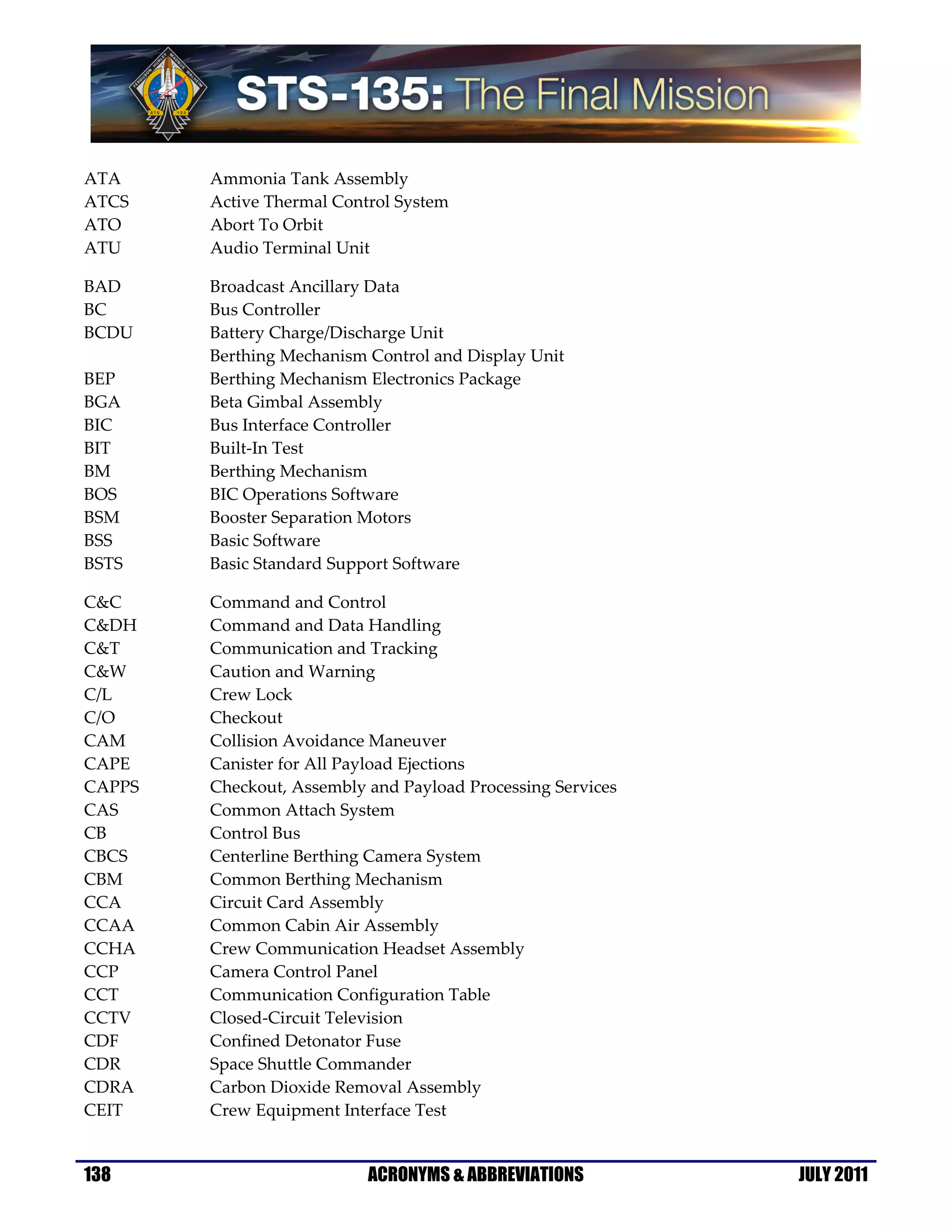
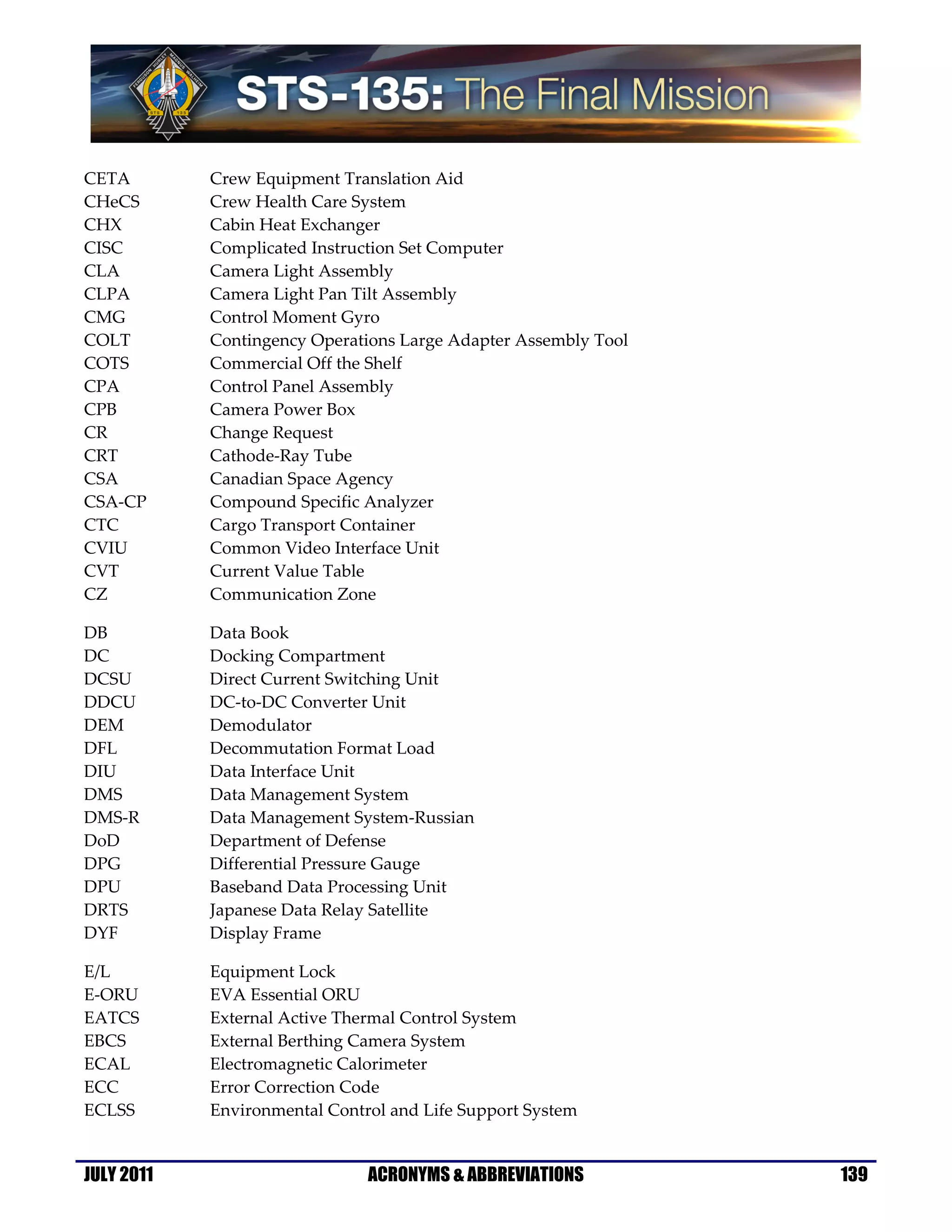
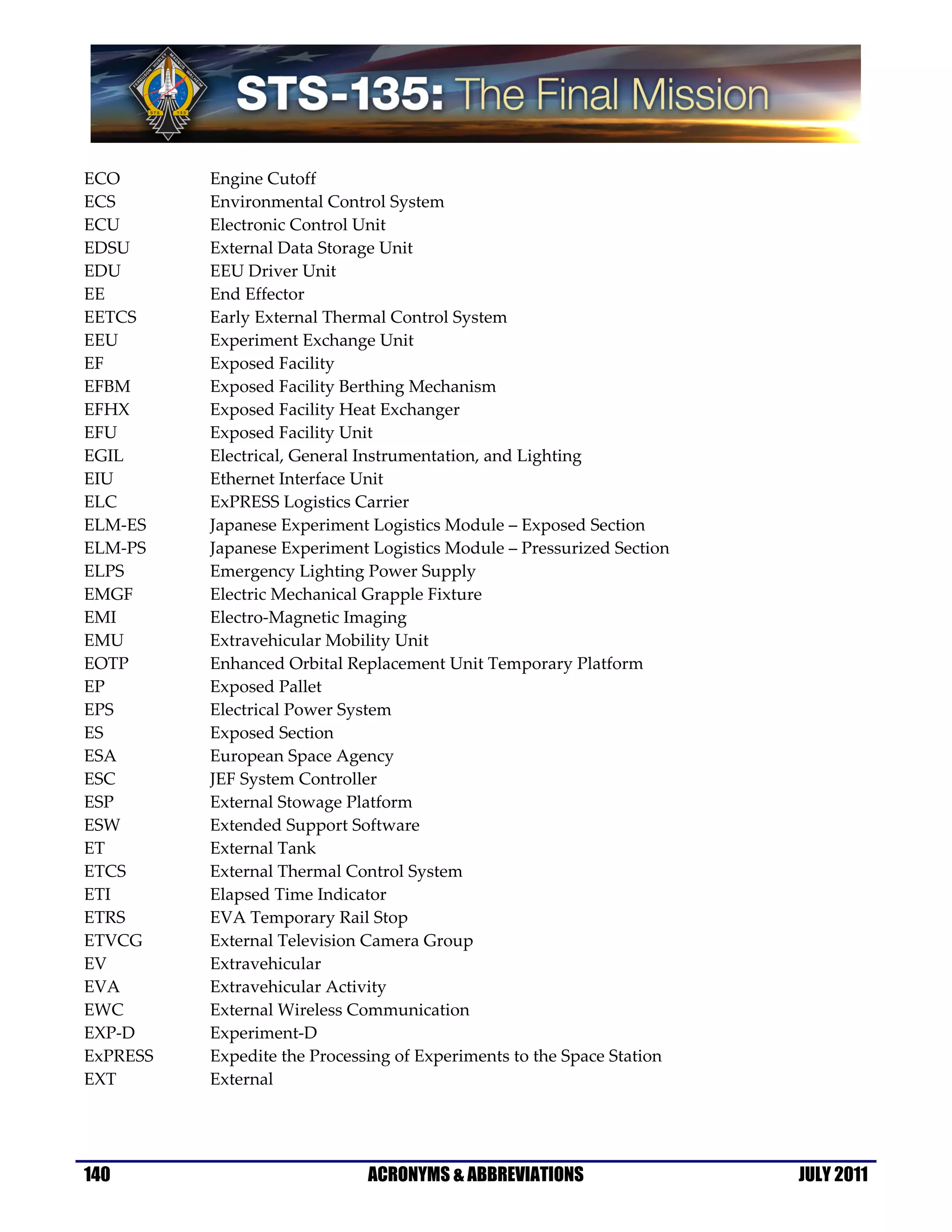
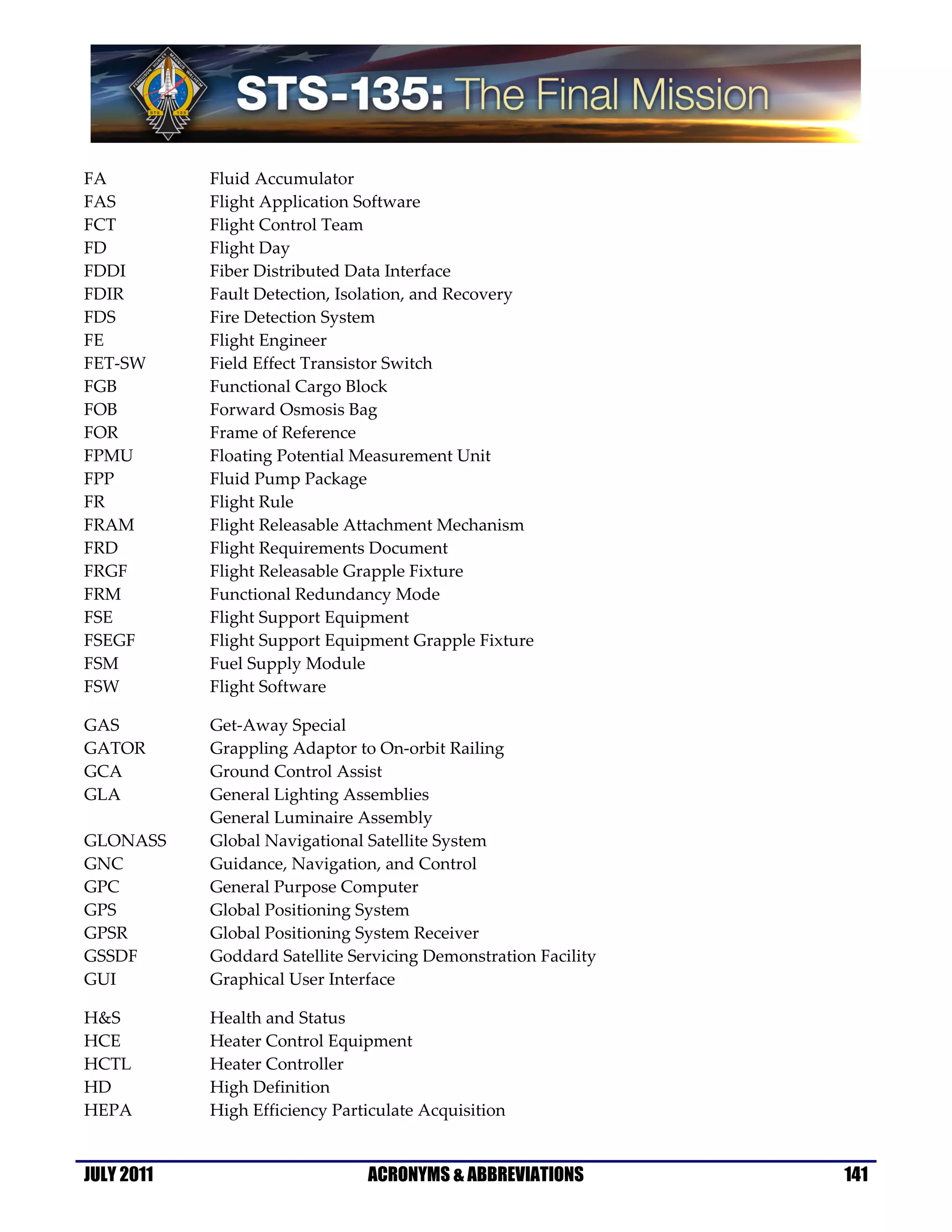
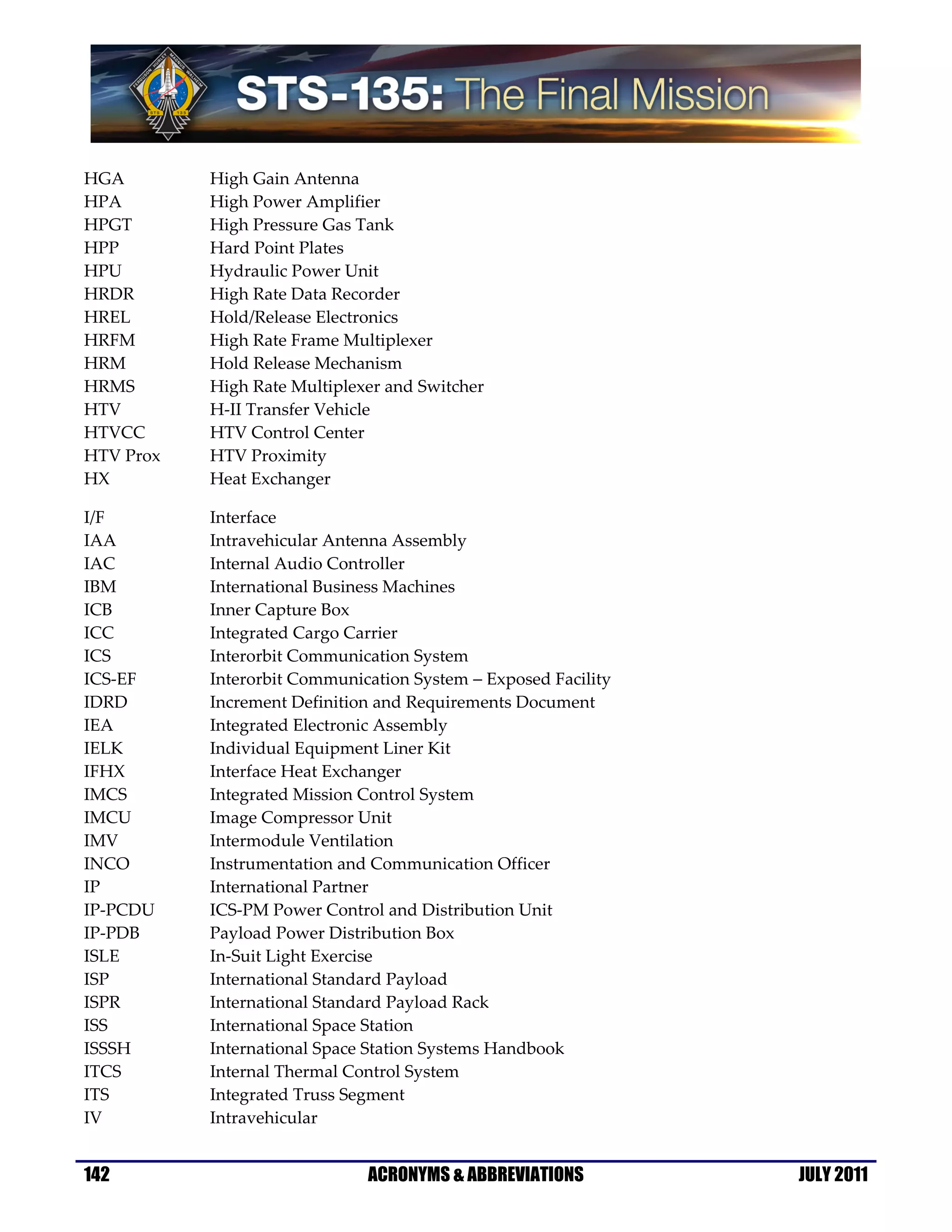
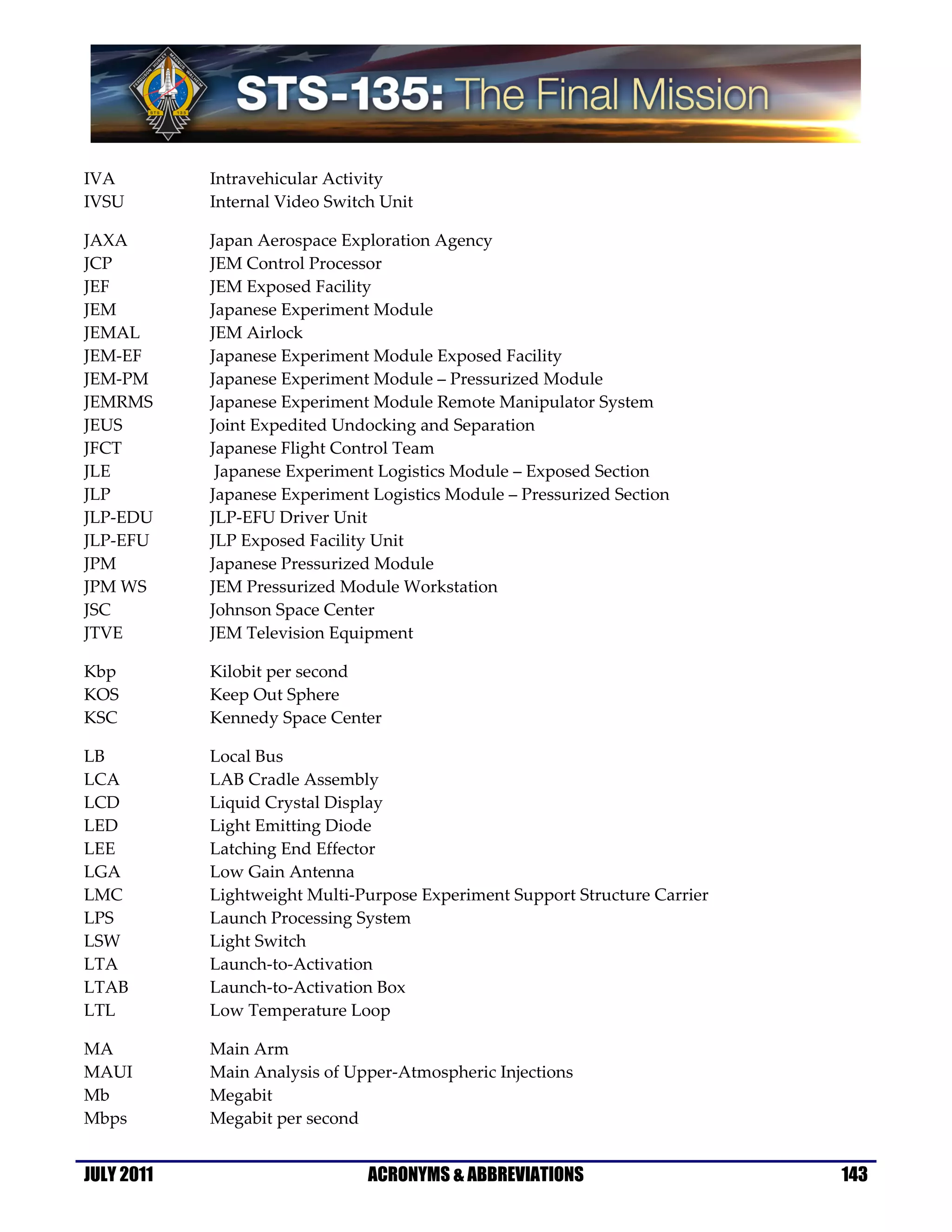
ACRONYMS & ABBREVIATIONS ..............................................................................................                                                                                                                                                                                         137

MEDIA ASSISTANCE ...............................................................................................................                                                                                                                                                                               153

SPACE SHUTTLE AND INTERNATIONAL SPACE STATION − PUBLIC AFFAIRS CONTACTS .....                                                                                                                                                                                                                                  155

THE FUTURE ............................................................................................................................                                                                                                                                                                        159
     O R I ON MUL T I- P UR PO S E CR E W V EHI CLE . . . . . . . . . . . . . . . . . . . . . . . . . . . . . . . . . . . . . . . . . . . . . . . . . . . . . . . . . . . . . . . . . . . . . . . . . . . . . . . . . . . . . . . . . . . . .                                                                   15 9
     N A SA C OMMER C IAL C R EW PR OG RAM . . . . . . . . . . . . . . . . . . . . . . . . . . . . . . . . . . . . . . . . . . . . . . . . . . . . . . . . . . . . . . . . . . . . . . . . . . . . . . . . . . . . . . . . . . . . . . . . .                                                                    1 62


ii                                                                                                                                             CONTENTS                                                                                                                                                JULY 2011
SPACE SHUTTLE HISTORY
INTRODUCTION                                          Engineering and technological advances were
                                                      required in development of the shuttle. It
Shuttle History: Knowledge,                           was called the most complex machine ever
Capabilities, and Cooperation                         built. Its main engines stretched design and
                                                      metallurgical capabilities.      Its thermal
For 30 years, the space shuttle has been the U.S.
                                                      protection system, which shielded the orbiter
human access to space. It has capabilities no
                                                      from temperatures as high as 3,000 degrees
other spacecraft can claim. No other spacecraft
                                                      Fahrenheit during re-entry, was a work in
is likely to match those capabilities in this
                                                      progress until shortly before the first shuttle
generation.
                                                      launch. Engines and the thermal protection
It is the fastest winged vehicle ever to fly, with    system were designed for repeated reuse.
an orbital velocity of 17,500 mph, 10 times the
                                                      Both have been continually improved during
speed of a high-powered rifle bullet. It is the
                                                      the life of the Space Shuttle Program. So has
only winged vehicle to reach orbit, and the only
                                                      just about every other major shuttle system.
reusable space launch and landing vehicle.
                                                      Science, in addition to the advances required
The shuttle can carry cargos of substantial
                                                      for the spacecraft’s development, has made
weight and dimensions. It has taken into space
                                                      huge strides with the help of the space shuttle.
more than half the mass of all payloads
                                                      We have learned more about ourselves, about
launched by all nations since Sputnik in 1957 –
                                                      how our bodies and those of other organisms
3,450,143 pounds (though STS-132) and
                                                      function, from the subcellular level on up. We
counting as the final shuttle launch approaches.
                                                      have learned how we as individuals interact
More singular still is the shuttle’s ability to       with one another under unusual and stressful
return payloads from space. It has brought            circumstances – and how to work together.
back from orbit more than 97 percent of
                                                      We have learned about our planet, its land
all mass returned to Earth, a total of
                                                      masses, its oceans, its atmosphere and its
225,574 pounds (though STS-132) before the
                                                      environment as a whole. With the help of the
upcoming final flight.
                                                      shuttle we have learned more about our moon,
It has launched 802 crew members including            solar system, our galaxy and our universe.
those lost on Challenger and Columbia. Crew
                                                      The Hubble Space Telescope, for example,
members returning on the shuttle numbered
                                                      launched and repeatedly upgraded and
789. Many crew members flew more than once.
                                                      repaired on shuttle missions, has given us
A total of 356 different individuals have flown
                                                      unprecedented vision of distant stars, some
aboard the shuttle (all through STS-132).
                                                      with planets orbiting them. It has allowed us to
It leaves a significant legacy.                       look at objects so distant that viewing the light
                                                      from them takes us back in time to nearer the
                                                      beginning of the universe.


JULY 2011                                SPACE SHUTTLE HISTORY                                        1
Scientific advances continue aboard the             ranged from political and funding concerns to
International Space Station. The shuttle has        competing design ideas and conflicting systems
been instrumental in the station’s construction     requirements – when one system changed
and operation.                                      others were impacted.

Perhaps as important as any element of the          There were different requirements of users.
shuttle legacy is the development of                Contractors and program managers worked out
international cooperation in space. Humans          compromises of their own.
from many nations have begun to work
together in space. Shuttle visits to the Russian    All in all, more than 50 different shuttle
space station Mir were a beginning that led to      versions were developed during the design
that new cooperation we see today aboard the        process. Eventually, they evolved into the
International Space Station.                        space shuttle that has flown since Columbia’s
                                                    first launch in April 1981. It was the first of
It has helped to develop respect and                135 launches, a string scheduled to end in July.
understanding for people and technological
capabilities of many countries, including some      The prospect of reusable spacecraft capable of
former enemies. Such synergies could give           carrying large cargos and humans into space
humans as a whole greater potential for space       had been talked about for decades in science
exploration and development that any single         fiction and by scientists since shortly after
nation could achieve alone. Such capabilities       World War II.
eventually could be critical in how well our        Indeed, a German design looked at a winged
species flourishes or, indeed, survives.            craft to be launched from a supersonic sled,
The shuttle has provided inspiration – for the      rocket itself into suborbital space, skip along
young and the not so young.                         the upper atmosphere and bomb New York.
                                                    After gliding to a landing and refueling, it
It has encouraged uncounted youths to focus         would return home using the same technique.
on science and technology.       The idea of
becoming an astronaut, as some certainly            Ideas for the next generation of U.S. human
will, is a powerful motivation. So too is the       spacecraft had been discussed within NASA
prospect of using such an education to advance      and the Department of Defense. In late 1958,
human knowledge and understanding in space.         NASA had established a working group based
                                                    at Langley Research Center in Hampton, Va., to
People of all the nations contributing to the       look at the nation’s future human space
space shuttle’s design and operation can take       program.
pride in its accomplishments.
                                                    Among the group’s 37 original engineers
SPACE SHUTTLE CONCEPT AND                           headed by Robert Gilruth were Maxime Faget,
DEVELOPMENT                                         head of engineering; Chris Kraft of flight
                                                    operations; and Glynn Lunney, who, at 21, was
Like any project of its magnitude, the space        the youngest member of the team.
shuttle was a series of compromises. They


2                                      SPACE SHUTTLE HISTORY                              JULY 2011
On April 1, 1969, Faget, director of engineering     President Spiro Agnew, was established that
and development at the Manned Spacecraft             February.    It issued a report called “The
Center (now Johnson Space Center (JSC), held a       Post-Apollo Space Program: Directions for the
meeting with 20 colleagues at which he               Future” in September 1969.
presented a balsa-framed, paper-skinned
model. It was about 18 inches long, had              The Space Task Group recommended, among
straight, stubby wings and a shark-like nose.        other things, “low-cost, flexible, long-lived,
                                                     highly reusable, operational space systems with
Faget, who designed the Mercury spacecraft           a high degree of commonality and reusability.”
and contributed to U.S. spacecraft design            It suggested a system that could carry people,
through the space shuttle, told them, “We’re         equipment, supplies and fuel to and from orbit
going to build America’s next spacecraft. It’s       routinely, as well as support a range of
going to launch like a spacecraft; it’s going to     Department of Defense missions.
land like a plane.” The first humans landed on
the moon the following July 20.                      Phase B contracts for project definition went to
                                                     two orbiter teams, one McDonnell Douglas and
A request for proposals for “An Integral             Martin Marietta, and the other North American
Launch and Reentry Vehicle” had been issued          Rockwell and General Dynamics. Both teams
on Oct. 30, 1968, through the Manned                 would look at competing NASA designs, the
Spacecraft Center in Houston and the Marshall        Maxime Faget design with limited cross-range
Space Flight Center in Huntsville, Ala. It called    and cargo capabilities but lower heating on
for studies on configurations for launch and         re-entry and a high cross-range design with
landing vehicles. Safety and economy were            a delta wing, a larger cargo bay and cargo
emphasized over the capability to carry heavy        capability. Main engine contracts went to
cargos.                                              Pratt & Whitney, Rocketdyne and Aerojet.

Four companies got 10-month study contracts          Funding limitations caused Phase B to be
in February 1969.         General Dynamics,          amended, with the option of an expendable
Lockheed, McDonnell Douglas, and North               external tank. Eventually, that concept was
American Rockwell came up with various               adopted, and solid rocket boosters were
concepts, some involving expendable and some         attached to the tank. The Air Force insisted on
reusable launchers. Engine contracts went to         the long cargo bay and heavy payload
Pratt & Whitney and Rocketdyne. This was the         capability as well as a cross range of 1,265 miles
beginning of Phase A of a four-step process          to launch large satellites into polar orbit from
culminating in production and operation of a         Vandenberg Air Force Base in California and
national space shuttle.                              return there after a single orbit. Department of
                                                     Defense political support was an important
NASA decided during Phase A that it wanted a         shuttle consideration.
two-stage craft, both stages reusable.
                                                     Cargo bay dimensions were an example of the
While those studies were going on, the Space         compromises at work. The length, which
Task Group, established by newly elected             wound up being 60 feet, was the Air Force
President Richard Nixon and chaired by Vice


JULY 2011                               SPACE SHUTTLE HISTORY                                        3
requirement, while NASA required the 15-foot        orbital maneuvering system engines.          But
width to accommodate space station modules.         Enterprise would provide additional valuable
                                                    information on flight characteristics, atop a
The requirement for two fly-back stages was         shuttle carrier aircraft and in free flight.
dropped as was, in early 1974, the idea to
provide air-breathing engines for the orbiter       When the shuttle’s air-breathing engines were
approach and landing and ferry flights under        dropped, it became apparent that NASA would
its own power.                                      have to find a way to transport the orbiter.
                                                    Designing a specific-purpose aircraft and using
Phases C (design) and D (production and             the Air Force C5A were considered.
operation) were combined. President Nixon
gave NASA the OK to go ahead with the larger        Eventually, NASA settled for a used 747-100
payload bay on Jan. 3, 1972. North American         that had flown almost 9,000 hours for American
Rockwell was named winner of the orbiter            Airlines, most on its New York-Los Angeles
contract on July 26 of that year.                   route. It bought the plane on July 18, 1974.
                                                    (A second used 747 was acquired from Japan
Rocketdyne, a division of North American            Air Lines for NASA by Boeing in April 1988
Rockwell, had been named winner of the              and delivered to the space agency in
engine contract on July 13. NASA announced          November 1990.)
Thiokol as winner of the Solid Rocket Booster
development contract on June 24, 1973, and less     Under a $30 million contract with Boeing, the
than a month later, Martin Marietta got the nod     former American Airlines plane’s structure was
to design, develop and test the external tank.      strengthened and instrumentation improved,
                                                    orbiter mounting assembly fittings were
The war in Southeast Asia, a recession and the      installed and vertical endplates were added to
fading of the excitement of the Apollo moon         its horizontal stabilizers. The modifications
landings had made spaceflight funding tight.        were completed by January 1977.
Shuttle development was to be stretched over
a longer time and the space station, one            Approach and landing tests using Enterprise
justification for the shuttle’s development, was    and the 747 (its American Airlines logo still
put on hold. Appeals of some of the contract        faintly visible on each side) began the following
awards also caused delays.                          month at Edwards Air Force Base in California.
                                                    First came three taxi tests on Feb. 15, the third
Rockwell began building the first orbiter,          reaching a speed of 157 mph. Five “inactive”
Orbiter Vehicle 101, in Palmdale, Calif., on        flight tests followed from Feb. 18 to March 2.
June 4, 1974. It was to have been named
Constitution, but after 100,000 fans of the TV      Two astronaut crews, the first Fred Haise and
series “Star Trek” wrote in, the name was           Charles “Gordon” Fullerton and the second
changed to Enterprise. It was rolled out on         Joe Engle and Richard Truly, alternated at
Sept. 17, 1976.                                     Enterprise controls for three active test flights
                                                    captive atop the 747 beginning Aug. 12 and five
By then, it already had been subjected to a         free flights involving Enterprise being released
series of vibration tests. It had no main or        from the aircraft and landing at Edwards.


4                                      SPACE SHUTTLE HISTORY                               JULY 2011
The first four of the five, beginning Aug. 12,       Gulfstreams were acquired in the 1980s and
landed on Edwards’ dry lakebed. The fifth, on        converted to shuttle trainers.)
Oct. 26, wound up the 1977 test series with an
exciting Enterprise landing by Haise and             New crew members would be needed. In
Fullerton on Edwards’ concrete runway. The           January 1978 a new group of astronauts was
fourth and fifth of those flights were flown         selected. It was the first new astronaut class
without the tail cone, giving a more accurate        since the seven new astronauts had been
picture of how an orbiter would glide to a           selected in August 1969.
landing after a spaceflight.                         The group, the eighth beginning with the
After some additional tests, Enterprise was to       Mercury astronauts selected in 1957, was unlike
have been returned to Rockwell to be outfitted       any chosen before. Six of the 35 members were
to fly in space, but it was not to be. NASA          women; two of them were medical doctors and
decided it would be quicker and cheaper to           the others held Ph.D.s. Three were African
convert a structural test article, OV-99, into a     American; two of them held Ph.D.s. One was an
flight orbiter.    That orbiter was named            Asian American.
Challenger.                                          Many members of the new group would
Enterprise was subjected to additional tests,        become the heart of the new category of
including some at Vandenberg, and was                astronauts, shuttle mission specialists. Their
displayed at several locations, including the        qualifications were varied from the mostly test
Paris Air Show in 1983 and the World’s Fair          pilots who made up earlier groups. Several of
in New Orleans in 1985. It was officially            the new selectees were civilians, often with
transferred to the Smithsonian Institution’s         considerably different perspectives than their
National Air and Space Museum on                     military predecessors.
Nov. 18, 1985, though NASA continued to              Mission specialist physical qualifications were
borrow parts from it for testing in subsequent       different, and still differ slightly, for pilots and
years.                                               mission specialists. Mercury astronauts could
Other preparations for shuttle flight continued:     be no taller than 5 feet 11 inches – for groups of
                                                     the Gemini and Apollo era, the maximum was
NASA bought two Gulfstream II business jets          6 feet -- so they would fit into space capsules.
and converted them into shuttle training             Now astronauts well over six feet tall could fly
aircraft.    They realistically simulate the         in space.
behavior of a returning orbiter between
35,000 feet and a point just above the runway –      Launch facilities and equipment were modified
the height of the spacecraft’s cockpit on            at Kennedy Space Center in Florida and a new
landing.                                             launch site was being built at Vandenberg.
                                                     Various contractor and NASA field center test
The controls on the left side are much like          facilities were established or modified.
those used by a space shuttle commander
on landing, and the plane reacts to inputs           As development continued, efforts were made
like a descending orbiter. (Two additional           to reduce spacecraft weight and improve


JULY 2011                               SPACE SHUTTLE HISTORY                                          5
performance. Qualification testing, aimed at           number of problems. In April 1977, a test of
showing various elements of the shuttle were           two engines was dubbed successful, but
ready to fly safely, was heating up.                   turbopump problems continued.

By early 1980, formal qualification tests had          Finally, by late 1980, the difficulties seemed
been completed on the orbital maneuvering              to be largely resolved.      A key test was
system engines and the reaction control system         completed on Jan. 17, 1981. Columbia’s three
jets. Testing for qualification of the solid rocket    main engines were successfully test fired at the
boosters was completed about that time.                launch pad for 20 seconds on Feb. 20, providing
                                                       additional confidence for launch of STS-1 less
NASA had not used solid rockets in human               than two months later, on April 12.
spaceflight before. Each solid rocket booster
has four motor segments. They are transported          The thermal protection system, particularly the
by rail from Thiokol’s Utah facility and that          tiles, was a persistent problem. The ablative
mode of travel, with its curves and tunnels,           heat shields used from Mercury through Apollo
necessitated their being built in segments and         were obviously not reusable.        Reinforced
attached to one another once they reach Florida.       carbon-carbon was used in areas subject to the
                                                       greatest heating like the nose cone and wing
Marshall Space Flight Center did a series of           leading edges.
tests on the external tank.      A series of
weight-saving measures, and additional tests,          After a lot of testing, a ceramic heat shield was
were introduced during early phases of tank            chosen to protect much of the aluminum body
construction and beyond. Later tanks were              of the orbiter. Shielding in these areas was
more than 10,000 pounds lighter than the early         made up of tiles.
production models.
                                                       Black tiles were used where heat did not exceed
It became apparent that the greatest threat of         2,300 degrees Fahrenheit (e.g., orbiter’s bottom)
delay was in development of the shuttle main           and white tiles were used where temperatures
engines and the thermal protection system.             did not get above 1,200 degrees. Thermal
                                                       blankets were used in areas that stayed below
The main engine was a challenge. Chamber               700 degrees.
pressures were higher than those of any
previous liquid-fueled rocket engine.       The        Attaching the rigid tiles to the aluminum skin
design was for a reusable, two-stage engine that       of the orbiter was a problem. An intervening
could be throttled. It required turbopumps that        felt pad was thought to be a solution. A
operated at higher speeds and higher pressures         stronger bond between the tile and the pad was
than any before.                                       found to be necessary, but when that was done,
                                                       the combination of adhesive, felt, adhesive, tile
Rocketdyne built an engine test bed at a NASA          resulted in a loss of about 50 percent of the
facility in Mississippi, at what is now Stennis        strength of the four elements.
Space Center, where it tested an engine larger
and heavier than those built for flight, which         NASA decided to fill voids on the inward side
were not yet available. It found and resolved a        of the tile, a “densification” process. Far


6                                         SPACE SHUTTLE HISTORY                               JULY 2011
behind schedule because of the delays, NASA            Young and Crippen landed Columbia on the
decided to fly Columbia from Palmdale to               dry lakebed at Edwards Air Force Base.
Kennedy in March 1979, with about 6,000 of the
30,000 tiles still not installed. A number of tiles    STS-2, commanded by Joe Engle and piloted by
that had been installed were lost during that          Richard Truly, launched Nov. 12 marking the
flight.                                                first time a launch and entry spacecraft had
                                                       been used. It was the first flight of the
Nondestructive tests were developed to check           Canadian robotic arm, which was tested
tiles’ conditions, and gap fillers were installed      thoroughly during the mission.
to prevent tile rotation under shock-wave
stress. Tile installation and testing went on          The arm, just over 50 feet long, was an early
around the clock six days a week for 20 months.        international contribution to the shuttle
Many newly installed tiles had to be removed           program. Stowed on the left sill of the payload
after testing and reinstalled. By the end of           bay, it can deploy and retrieve payloads, move
November 1980, the number of tiles to be               spacewalkers around and help inspect the
installed was below 1,000.                             orbiter.

Finally, on Dec. 29, 1980, Columbia was rolled         Although the flight was shortened from
out on the newly modified mobile launch                five days to two days, six hours after one of
platform, from Kennedy’s Vehicle Assembly              three fuel cells failed, the two crew members
Building to Pad 39A. Its gleaming white                completed most of their planned tasks. They
external tank seemed to harmonize with the             also landed on Edwards’ dry lake bed.
white of the solid rocket boosters and the             The third flight was different in a number of
black-trimmed white of the orbiter.                    ways, beginning visually. The external tank,
                                                       which had been painted white on the
THE SPACE SHUTTLE ERA BEGINS
                                                       first two flights, was now the rust color that
On April 12, 1981, Commander John Young and            characterized it from then on.       Engineers
Pilot Robert Crippen launched from Kennedy             decided the white paint was not needed. That
Space Center’s Pad 39A aboard Columbia on              decision resulted in a weight savings of
STS-1.                                                 595 pounds, almost all of it translating into
                                                       increased cargo capacity.
The space shuttle era was under way.
                                                       Commander       Jack    Lousma   and     Pilot
STS-1 was the first of four test flights. Each         Gordon     Fullerton   launched   STS-3     on
carried a two-man crew. The commander and              March 22, 1982. They flew Columbia in various
pilot had ejection seats.                              attitudes to check out thermal characteristics,
                                                       conducted more tests of the robotic arm and
The first flight lasted just over two days,
                                                       did scientific experiments, some involving
six hours and 20 minutes. It orbited the Earth
                                                       plants and insects.
36 times at an inclination of 40 degrees and an
altitude of 166 statute miles and traveled             Rain at Edwards caused the landing to be
1,074,111 miles. After testing orbiter systems,        moved to the strip on the White Sands Missile


JULY 2011                                 SPACE SHUTTLE HISTORY                                      7
Range, and a New Mexico dust storm delayed           Privately owned communications satellites had
it for a day. Finally, on March 30, they landed      become a growing field while the shuttle was
after a flight of just over eight days.              being developed and more and more
                                                     communications satellites would require launch
The final test flight launched June 27, 1982,        and the shuttle seemed perfectly suited to
with Commander Ken Mattingly and Pilot               provide it.
Henry Hartsfield. They did extensive tests of
Columbia systems and conducted several               Legislation had given the space agency a
experiments.                                         monopoly on the domestic satellite launch
                                                     market. NASA aggressively marketed that
Among the experiments was a classified one           launch capability, both domestically and
from the Department of Defense. It marked a          internationally.    Estimates had foreseen
new way of doing things for NASA. Previous           between 30 and 60 shuttle flights.
public openness was partly muted. No camera
views of the payload bay were transmitted to         Bargain prices were offered for multiple
Earth and oral communications relating to            launches over the firsts five years of the
the payload were conducted in a simple, but          program, with the idea of building repeat
effective code.                                      business.

After a flight of more than seven days and           Columbia launched on the first operational
3.3 million miles, STS-4 landed on Edwards’          flight on Nov. 11, 1982.            In the crew
concrete runway, a first for an orbiter returning    compartment, in addition to Commander
from space.                                          Vance Brand and Pilot Robert Overmyer, were
                                                     the first mission specialists, Joseph P. Allen and
At Edwards, they got a July 4 welcome from           William Lenore.        Both had been among
President Ronald Reagan and his wife Nancy           the Group 6 science astronauts selected in
and a holiday crowd of thousands. At the             August 1967.
ceremony, NASA Administrator James Beggs
declared the space shuttle operational.              Two commercial satellites were in the payload
                                                     bay. The first to be launched from a shuttle,
The president compared the completion of             SBS-C, left the payload bay about eight hours
the test flight series to the driving of the         into the flight.     The Canadian Telesat-E
gold spike marking completion of the                 followed. Both were successfully boosted into
transcontinental railroad.      “It marks our        geostationary orbits, 22,300 feet above the
entrance into a new era,” he said.                   Earth, by Payload Assist Modules.
Shortly after Columbia had landed, Challenger        By mid-January 1986, a total of 24 commercial
passed close by. Atop the shuttle carrier            satellites had been deployed from the shuttle.
aircraft, it was departing on its first cross        Of those, the Payload Assist Module boosters
country flight, its delivery to Kennedy Space        of two, the Indonesian Palapa B2 and the
Center.                                              Westar-VI, had failed to fire, leaving the
With the test phase finished, it was time to get     satellites useless in a low orbit.
down to business.


8                                       SPACE SHUTTLE HISTORY                                JULY 2011
The astronauts aboard Challenger on that 10th          The TDRS booster sustained failure, leaving the
shuttle flight, STS-41-B, in February 1984 had         spacecraft well below geosynchronous altitude
performed flawlessly. But the failure of the           but far too high for the shuttle to reach. NASA
boosters gave the shuttle a chance to                  and TDRS builder, TRW, came up with a
demonstrate another capability.                        method to use its thrusters to gradually lift it to
                                                       the proper orbit, a process that took several
Both those satellites were later retrieved and         weeks.
returned to Earth by Discovery astronauts on
the 14th shuttle mission, STS-51-A.       They         Challenger’s STS-7 mission launched June 18 to
worked under contract with the insurance               deploy two commercial satellites. It carried
companies, which already had paid the owners           various experiments, including those on the
for their loss.                                        German Shuttle Pallet Satellite which was
                                                       deployed from the cargo bay by the robotic
Lloyds of London was delighted with the                arm. After a time as a free flyer in its own orbit,
recovery, and rang its Lutine bell to mark the         Challenger rendezvoused with it, grappled it
importance of the event. It gave the insurance         with the arm and secured it in the cargo bay for
companies partial reimbursement. It was then           return home.
called monetarily the largest salvage recovery.
The satellites were refurbished and sold to new        Commander Crippen’s four crew members
owners to be launched again.                           were from the shuttle-focused astronaut
                                                       Group 8. It included Sally Ride, the first
The new numbering system for shuttle flights           U.S. woman in space.
was introduced after STS-9. The following
flight became STS-41-B. The first number               The next Challenger mission, STS-8, had
designated the fiscal year and the second              three more Group 8 alumnae, including
number was the launch site – 1 for Kennedy             Guyon Bluford, the first U.S. black in space.
and 2 for Vandenberg Air Force Base. The               Commanded by Truly, it was the first to launch
letter was the order of launch assignment, so B        at night, on Aug. 30, 1983. It deployed a
was the second scheduled for that fiscal year.         satellite from India. Its landing also was at
                                                       night.
The old numbering system was revived for
                                                       Columbia was back for STS-9, launched Nov. 28
STS-26, the return-to-flight mission after the
                                                       as the final flight of 1983. It was the first
Challenger accident.
                                                       Spacelab flight.     Commanded by Young
The STS-6 mission, Challenger’s first flight,          (making the last of his six spaceflights, which
launched April 4, 1983, and began a series of          included two missions to the moon) with
other firsts. The flight carried the first Tracking    Brewster Shaw as pilot, its six-man crew
and Data Relay Satellite (TDRS). The TDRS              included the first payload specialists,
system replaced the ground, a NASA                     Byron Lichtenberg of Massachusetts Institute of
communications satellite which began the               Technology and Ulf Merbold, a German
replacement of the ground stations on which            physicist.
the space agency had relied through the end of
                                                       The European Space Agency built the
the Apollo era.
                                                       $1-billion, 23-foot laboratory flown in


JULY 2011                                 SPACE SHUTTLE HISTORY                                         9
Columbia’s cargo bay. The crew, including              replaced failed components. Hart put it back
Mission Specialists Robert Parker and                  into its own orbit with the arm.
Owen Garriott, worked around the clock in two
shifts, conducting more than 70 experiments.           After an attention-getting June 26 abort seconds
                                                       before scheduled liftoff, Discovery launched on
The 10th shuttle flight, STS-41-B, saw the             its first flight, STS-41-D, flight 12, on Aug. 30
program’s first spacewalks, and with them,             with Commander Hartsfield and Pilot
demonstration of a jet backpack that took              Michael Coats.         With Mission Specialists
Mission Specialists Bruce McCandless and               Richard Mullane, Steve Hawley, Judith Resnik
Robert Stewart untethered out of the cargo bay.        and Charles Walker, they launched two
                                                       communications satellites and deployed, tested
The mission, launched Feb. 3, 1984, with               and restowed a large solar array.
Commander Vance Brad, Pilot Robert Gibson
and Mission Specialist Ronald McNair, was              Crippen commanded STS-41-G.         The 13th
demonstrating the use of the Manned                    flight launched with Pilot Jon McBride on
Maneuvering Unit’s potential in the capture            Oct. 5 on board Challenger. It was the first to
and repair of the Solar Maximum Satellite,             have two women mission specialists, Ride and
scheduled for the next flight. They could not          Kathryn Sullivan. Sullivan became the first
guess how important the jet backpack would be          female spacewalker on a 3.5-hour outing with
to the future of the two satellites deployed from      Mission Specialist Dave Leestma to test a
their cargo bay, the Indonesian Palapa B2 and          satellite refueling system.
the Westar-VI.
                                                       Two mission specialists, Paul Scully-Power,
It was the first mission to land at Kennedy            an Australian oceanographer, and Canadian
Space Center.                                          Marc Garneau made this seven-member crew
                                                       the largest yet. The largely scientific flight
Crippen commanded the STS-41-C flight, the             focusing on Earth included release of a satellite
program’s 11th, with Pilot Francis “Dick”              to measure solar radiation reaching Earth.
Scobee and Mission Specialist van Hoften. It
launched April 6 with a 30-foot, 22,000-pound          The two-satellite retrieval mission, STS-51-A,
Long Duration Exposure Facility and its                was commanded by Frederick Hauck. Crew
57 experiments in the cargo bay. On the way to         members were Pilot Dave Walker and Mission
the ailing satellite, Mission Specialist Terry Hart    Specialists Joseph Allen, Anna Fisher and
used the robotic arm to deploy the container,          Dale Gardner. Discovery launched Nov. 8 on
scheduled to stay in orbit for a year.                 the year’s final flight.

After rendezvous with the satellite, Mission           An early task was to launch two
Specialist George Nelson flew to it with the jet       communications satellites it had brought into
backpack. Initial efforts to attach a docking          orbit. Then, after rendezvous with Palapa B-2,
device failed, but succeeded the next day after        Allen jetted to the satellite with the backpack
some help from Goddard Space Flight Center.            and attached a capture device. Fisher used the
In the cargo bay Nelson and van Hoften                 arm to bring it back to Discovery, but a
                                                       problem prevented its docking in the cargo bay.


10                                        SPACE SHUTTLE HISTORY                               JULY 2011
Using a backup plan, Allen got into foot             Garn, who chaired the Senate committee with
restraints, removed the satellite from the           NASA budget oversight, volunteered for space
arm and held it over his head for about              sickness studies. He said later he had indeed
90 minutes, one orbit of the Earth.      The         suffered from that malady.
satellite’s weight on Earth was about
1,600 pounds, about nine times that of Allen.        Challenger’s STS-51-B flight, the 17th of
Gardner attached an adapter and secured the          the program, launched April 29 and was the
satellite for the trip home.                         second Spacelab mission.    Crew members
                                                     were      Commander     Overmyer,      Pilot
The Westar VI was less of a problem. Using           Frederick    Gregory,  Mission    Specialists
their experience two days before, Gardner            Don Leslie Lind, Norman Thagard and
jetted to the satellite and together they secured    William Thornton, and Payload Specialists
it in the cargo bay.                                 Taylor E. Wang (a Jet Propulsion Laboratory
                                                     physicist) and Lodewijk van der Berg, an
Discovery’s flight STS-51-C, the 15th flight         EG & G scientist.
was a Department of Defense mission,
launched Jan. 24, 1985.          Commanded by        Again, the crew worked around the clock, in
Mattingly, it lasted just over three days and had    two shifts.   The wide-ranging experiments
an all-military-astronaut crew.                      involved disciplines, ranging from astronomy
                                                     to materials processing.     In the lab were
The launch had been delayed one day because          two squirrel monkeys and 24 rats flown to test
of freezing weather.                                 cages, which proved inadequate.
U.S. Senator Jake Garn of Utah, a former Navy        When the cages were opened to feed the
pilot, was aboard Discovery for the 16th             occupants, food debris and feces were released
shuttle flight, STS-51-D. Launched on April 12       to float throughout the lab and even into the
and commanded by Karol Bobko, the flight             crew compartment. The problem was solved
included Pilot Donald Williams, Mission              by putting plastic bags over food trays when
Specialists Jeffrey Hoffman, David Griggs            crew members, in surgical masks, removed
and Rhea Seddon and Payload Specialist               them, and using a vacuum cleaner.
Charles Walker.
                                                     Daniel Brandenstein commanded the 18th
The flight launched two communications               shuttle flight, STS-51-G, in Discovery, with
satellites, but the booster of one did not           Pilot John Creighton, Mission Specialists
activate.    Crew members spent an extra             John Fabian, Steve Nagel and Shannon Lucid,
two days in orbit, using the robotic arm with a      and Payload Specialists Patrick Baudry
flyswatter-like device at its end, trying without    (a French astronomer) and Saudi Arabian
success to activate a switch satellite thought       Prince Sultan Salman Abdul Azziz Al Sa’ud.
to be in the wrong position on the Leasat 3. The
satellite was repaired on flight STS-51-I that       The flight, launched June 17, deployed three
October.                                             communications satellites, one for Mexico, one
                                                     for Saudi Arabia and one U.S. A satellite called
                                                     Spartan, an astronomy experiment, was


JULY 2011                               SPACE SHUTTLE HISTORY                                      11
deployed with the robotic arm and,                   successfully deployed the new satellites (one
subsequently, after a separation of more than        Australian and two U.S., including Leasat-4),
100 miles, was recaptured and returned to            then successfully rendezvoused with and
Earth. A number of other experiments were            captured the Leasat-3. Van Hoften and Fisher,
aboard including several from France.                a surgeon, repaired it during two spacewalks
                                                     and it was redeployed.
Challenger’s flight STS-51-F, the program’s
19th, started badly.        Five minutes and         Atlantis made its first flight on STS-51-J, the
45 seconds after the July 29 launch the No. 1        21st flight of the shuttle program.          The
engine shut down prematurely (the cause              Department of Defense mission, commanded
turned out to be a faulty sensor reading) and an     by Bobko with Pilot Ronald J. Grabe, Mission
abort to orbit was declared.                         Specialists David C. Hilmers and Stewart and
                                                     Payload Specialist William A. Pailes, lasted just
After running the remaining two main engines         over four days and reached a then-record
for almost a minute and a half longer than           altitude of 319 statute miles.
planned, Challenger wound up in a lower than
normal orbit, 164 by 124 statute miles. The          Challenger flew the Spacelab module with its
orbital maneuvering system engines were used         76 experiments on 61-A, Mission No. 22. A
to raise the orbit enough to continue to the         record eight crew members were aboard,
flight’s planned conclusion.                         Commander Hartsfield, Pilot Nagel, Mission
                                                     Specialists James. F. Buchli, Bluford and
This was another Spacelab mission, though the        Bonnie J. Dunbar and Payload Specialists
module was not aboard. Many experiments              Reinhard Furrer of Germany, Wubbo Ockels of
were on a pallet in the cargo bay. The crew,         the Netherlands and Ernst Messerschmid, also
Commander Fullerton, Pilot Roy Bridges,              of Germany.
Mission      Specialists     Story  Musgrave,
Anthony England and Karl Heinz, and Payload          The mission was largely financed by West
Specialists Loren Acton (a Lockheed solar            Germany.    The mostly material processing
physicist) and John-David Bartoe from the            experiments were operated by two shifts of
Naval Research Laboratory, worked around             three crew members with the other two
the clock in 12-hour shifts.                         working as needed.

The 20th shuttle flight, STS-51-I, launched          The last mission of 1985, the 23rd for a shuttle,
Aug. 27 on Discovery, to deploy three                61-B by Atlantis, launched the night of Nov. 26
communications satellites, then capture, repair      on a flight that put the space station on the
and release another – the Leasat-3. It had been      spaceflight stage. President Reagan had told
the object of the unsuccessful flyswatter efforts    NASA to start work on a space station during
by STS-51-D astronauts when it failed to             his State of the Union message in 1984.
activate after its deployment the previous April.
                                                     Two spacewalks, both by Mission Specialists
The    crew,   Commander      Engle,   Pilot         Sherwood Spring and Jerry Ross, saw repeated
Richard Covey and Mission Specialists                assembly and disassembly of a framework
van Hoften, William Fisher and John Lounge,          beam using almost 100 tube-like struts that


12                                      SPACE SHUTTLE HISTORY                               JULY 2011
snapped together. They also assembled and           Nelson represented the district that included
disassembled an upside-down pyramid frame           Kennedy Space Center, and was chairman
using six 12-foot aluminum bars. After the          of the Subcommittee on Space Science and
second spacewalk, they pronounced themselves        Applications.   He participated on some
ready to build a space station.                     experiments on the flight, which launched an
                                                    RCA communications satellite.
Brewster Shaw commanded the flight with
Bryan D. O’Connor as pilot. Mary Cleave was         With Columbia scheduled to launch again in
the third mission specialist and payload            early March and several experiments hampered
specialists were Charles Walker of McDonnell        by instrument failures, the flight was shortened
Douglas and Rudolfo Neri Vela of Mexico.            from five days to four. But weather caused
Early in the flight, three satellites were          attempts to return to Kennedy on the new
deployed, one U.S., one Mexican and one             landing day and the day after that. With
Australian.                                         Florida weather still not cooperating on day 3,
                                                    Columbia landed at Edwards.
Columbia returned after a two-year refit,
without its ejection seats (they had been           On a cold, clear, bright Florida day,
disabled after the last test flight and removed     Jan. 28, 1986, Challenger launched at 11:38 a.m.
during the overhaul) and with the agency            local time. The spacecraft exploded 73 seconds
anxious to get started on the 15 launches           after launch at an altitude of almost nine miles.
scheduled for 1986.
                                                    The seven crew members, Commander
Weather and technical problems caused seven         Francis R. “Dick” Scobee, Pilot Michael J. Smith,
postponements before 61-C., Flight No. 24, was      Mission Specialists Ellison S. Onizuka,
launched on Jan 12.     Gibson commanded            Judith A. Resnik and Ronald E. McNair, and
Columbia, with Pilot Charles Bolden, Mission        Payload Specialists Gregory Jarvis and Teacher
Specialists George Nelson, Hawley and               in Space Sharon Christa McAuliffe, were killed.
Franklin Chang-Diaz, and Payload Specialists
Robert Cenker (an RCA engineer) and U.S. Rep.
Bill Nelson.


JULY 2011                              SPACE SHUTTLE HISTORY                                      13
Five astronauts and two payload specialists made up the Challenger crew in January of 1986.
  Crew members are (left to right, front row) astronauts Michael J. Smith, Francis R. (Dick) Scobee
     and Ronald E. McNair; Ellison S. Onizuka, Sharon Christa McAuliffe, Gregory Jarvis and
                                           Judith A. Resnik.

NASA REBOUNDS INTO SPACE                              than at any previous launch. No one really
                                                      understood how the seals on the boosters’ field
The first sign of trouble had been a puff of gray     joints worked, or how potentially serious the
smoke from the aft field joint of the right solid     partial burn-through of O-ring seals seen in
rocket booster about half a second after              those joints after some previous flights had
Challenger’s launch, the investigation revealed.      been.
It was followed by additional puffs, then flame
and finally the explosion.                            Over the next three months, search teams
                                                      recovered about 30 percent of the orbiter and
The temperature that Jan. 28 at 11:38 a.m. was        parts of the boosters were recovered from the
36 degrees Fahrenheit, about 15 degrees colder        bottom of the Atlantic off Florida.


14                                      SPACE SHUTTLE HISTORY                               JULY 2011
On Feb. 3, President Reagan named a                      forbidden, with certain exceptions, to launch
commission to investigate the accident. It               commercial satellites.
was chaired by former Secretary of State
William P. Rogers. Among its 14 members                  Thirty-two months later, after overhauls that
were     astronauts     Neil    Armstrong     and        brought more than 450 changes to each of the
Sally Ride, test pilot and retired Air Force Brig.       remaining three orbiters, with redesigned solid
Gen. Chuck Yeager, physicist and Nobel                   rocket boosters, a plethora of changes in
laureate Richard P. Feynman and other leading            processes and management procedures and
scientists and engineers.                                more, NASA was ready to fly again.

Among its recommendations                                Discovery launched on STS-26, the Return To
                                                         Flight mission, on Sept. 29, 1988. The orbiter
•   The faulty booster joint seal must be                carried a veteran five-man crew commanded by
    changed.                                             Frederick Hauk. The TDRS-C, a new Tracking
                                                         and Data Relay Satellite replacing the one lost
•   The Shuttle Program management structure             on Challenger, was in the cargo bay.
    should be reviewed.
                                                         NASA had returned to the flight numbering
•   NASA should encourage transition of                  system used until STS-9. The missions retained
    qualified astronauts into management                 the assigned number even if the launch
    positions.                                           sequence changed.
•   NASA should establish an office of Safety,           Mission      Specialists   John    Lounge    and
    Reliability and Quality Assurance reporting          David Hilmers deployed the TDRS-C six hours
    directly to the administrator.                       into the flight. Scientific experiments and tests
•   Reliance on a single launch capability               of the upgraded orbiter occupied other
    should be avoided and NASA must                      crewmen, Pilot Richard Covey and Mission
    establish a flight rate consistent with its          Specialist George Nelson, during much of the
    resources.                                           four-day flight.

Eventually, after NASA and the National                  During a news conference from orbit the day
Transportation Safety Board had done a                   before landing, crew members delivered
thorough evaluation of the Challenger debris,            moving tributes to the Challenger crew.
they were sealed in unused Minuteman missile             Discovery landed on a dry-lakebed runway at
silos not far from the spacecraft’s launch pad.          Edwards Air Force Base.          Managers had
                                                         decided to end all missions there until the brake
Challenger had changed a lot.      It was a              and landing system upgrades could be checked
very public disaster, watched on live TV by              out.
millions and millions more on subsequent
newscasts.    The space agency and its                   A four-day, nine-hour STS-27 Department of
contractors changed in management and                    Defense (DoD) mission with five crew members
philosophy.    And following the Rogers                  aboard Atlantis commanded by Robert Gibson
Commission recommendation, NASA was                      was launched Dec. 2 as the last flight of 1988.


JULY 2011                                   SPACE SHUTTLE HISTORY                                      15
The TDRS-D was deployed on STS-29 shortly           intentionally crashed to gather information
after Discovery’s launch March 13, 1989, by         about its atmosphere.
Mission Specialists Robert Springer and
James Bagian. With its predecessor, TDRS-A,         The explorer did not fare as well – he was killed
the new satellite in its geosynchronous orbit       in the Philippines in 1521, but 18 of his 237 men
was able, after its checkout, to provide            returned to Spain, completing the first
communications with a shuttle about 85 percent      circumnavigation. The satellite circled Venus
of the time. The figure for ground stations was     thousands of times, and sent back data that
less than 20 percent.                               changed our ideas about the planet.

Commander Michael Coats, Pilot John Blaha           Another DoD mission, STS-28, commanded by
and Mission Specialist James Buchli worked          Brewster Shaw, followed with an Aug. 8
with experiments during the five-day flight.        launch. Next up was the shuttle’s second
They also captured extensive Earth views with       planetary payload deployment
a 70 mm IMAX camera. Discovery landed on            Atlantis, commanded by Donald Williams and
Edwards’ concrete runway.                           piloted by Michael McCulley, launched on
While NASA generally could not launch               STS-34 Oct. 18 with the $l.5-billion Galileo
commercial satellites, a backlog of other           spacecraft. Mission Specialists Shannon Lucid,
spacecraft, including government satellites and     Ellen Baker and Franklin Chang-Diaz deployed
planetary probes, had accumulated while the         Galileo a little over six hours after liftoff.
shuttle was not flying.                             Galileo, managed by NASA’s Jet Propulsion
Magellan was the first planetary mission to be      Laboratory in Pasadena, Calif., swung around
launched by a space shuttle. Its flight to Venus    Venus, then twice around Earth to gain
began on STS-30 in Atlantis’ cargo bay on           momentum. En route to Jupiter, it captured
May 4. Six hours later it was deployed.             images     of   two     asteroids   (one with
                                                    the first asteroid moon discovered). It also
Magellan’s departure was the highlight of the       observed fragments of Comet Shoemaker-Levy
four-day flight of Atlantis crew members,           crashing into Jupiter in July 1994.
Commander David Walker, Pilot Ronald Grabe
and Mission Specialists Norman Thagard,             Galileo went into orbit around Jupiter
Mary Cleave and Mark Brown. The 15-month            Dec. 7, 1995, and dropped a probe into its
flight to Venus took it 1 1/2 times around the      atmosphere. Galileo itself was intentionally
sun before it went into orbit around the target     crashed into Jupiter on Sept. 21, 2003, but not
planet.                                             before returning a wealth of information about
                                                    the gas giant and four of its moons.
Like its explorer namesake, Ferdinand
Magellan, the spacecraft did not make it home.      The fifth shuttle DoD mission and 1989’s final
But it was not supposed to. After radar             flight, STS-33 by Discovery, was launched in
mapping of 98 percent of Venus’ surface and         darkness on Nov. 22 under command of
measuring its gravity field, Magellan was           Frederick Gregory.


16                                     SPACE SHUTTLE HISTORY                               JULY 2011
An 11-day flight, the longest to that time, was      Some observations were possible, particularly
commanded by Daniel Brandenstein and                 those of bright objects, before the replanned
launched Jan. 9, 1990, as STS-32 in Columbia. It     first servicing mission was flown. Scientists
deployed a Navy communications satellite and         were able to use image processing to improve
retrieved the Long Duration Exposure                 results. But there was considerable criticism
Facility (LDEF).                                     from the public, political figures and the
                                                     scientific community.
LDEF, launched on April 6, 1984, on Flight
41-C, the 11th of the shuttle program, with          That first servicing mission, STS-61, launched
57 experiments expected to stay in orbit for a       on Endeavour Dec. 2, 1993, with seven crew
year. Its retrieval was first deferred to a later    members. After five lengthy spacewalks, a
mission then delayed after the Challenger            reboosted Hubble was released with cleared
accident.                                            vision, one new camera, new solar arrays, four
                                                     (of six) new gyroscopes and some new
After the sixth DoD flight of the program,           electronics.
STS-36    on     Atlantis   commanded     by
John Creighton launched Feb. 28, 1990,               In early January, NASA declared the mission a
perhaps one of the most meaningful payloads          success, and released the first of thousands of
launched aboard a shuttle went into orbit            sharp, remarkable images Hubble has sent
aboard Discovery on April 24. The Hubble             down over the years. The space telescope was
Space Telescope helped change the way we see,        functioning as advertised.
and think about, our universe.
                                                     Four more servicing missions followed, the
It was the first of four NASA Great                  most recent in May 2009 on Atlantis. Each of
Observatories, three of them taken into orbit by     those missions upgraded Hubble’s capabilities
space shuttles.                                      and extended its life. (See related story.)

The Discovery crew on that STS-31 flight             Ulysses, a joint NASA-European Space Agency
was Commander Loren Shriver, Pilot                   mission, was launched Oct. 6, 1990, in
Charles Bolden and Mission Specialists               Discovery’s cargo bay on the STS-41 flight
Steven Hawley, Bruce McCandless and                  commanded by Richard Richards and piloted
Kathryn Sullivan.      They deployed Hubble          by Robert Cabana. Ulysses made a swing
about 24 hours after launch at an altitude of        around Jupiter before entering a solar polar
about 380 statute miles.                             orbit.

The deployment went flawlessly, but it soon          Expected to have a lifetime of five years,
became apparent that all was not well with           Ulysses made almost three orbits around the
Hubble. A mistake had been made in the               sun and gathered information on most of
grinding of its main mirror. The mirror had          two 11-year solar cycles. It was deactivated in
been ground to the wrong shape, but ground           mid-2009.
precisely so that correction was possible.


JULY 2011                               SPACE SHUTTLE HISTORY                                     17
After a DoD mission in November 1990 and a             commanded by Daniel Brandenstein and
science flight, the last of the year, the second of    piloted by Kevin Chilton was the Intelsat VI,
NASA’s great observatories, the Gamma-Ray              stranded in a useless orbit since its March 1990
Observatory, was ready to go. Its STS-37               launch on a Titan III.
mission would see an unplanned spacewalk to
free a stuck antenna on the spacecraft. It was         On the flight’s first spacewalk, Mission
the first spacewalk in almost six years.               Specialists Pierre Thuot and Richard Hieb
                                                       could not attach a capture bar to the satellite.
Atlantis launched on the deployment mission            A second attempt the next day also was
on April 5, 1991. The observatory’s high-gain          unsuccessful.
antenna did not deploy correctly when
commanded by the ground. Mission Specialists           After a day off and discussion with Mission
Jerry Ross and Jerome Apt freed the antenna            Control, the spacewalk plan for the third
during a 4 1/2-hour spacewalk.                         spacewalk called for three spacewalkers, with
                                                       the     addition   of     Mission   Specialist
They also completed a planned spacewalk of a           Thomas Akers. Perched on the payload bay
little over six hours the following day to test        sill, they would grab the satellite when
ideas about how to move about and move                 Brandenstein maneuvered Endeavour close
equipment during space station assembly and            enough for them to reach it.
maintenance.
                                                       It worked. The new booster they attached sent
After a science flight, a Spacelab Life                Intelsat into its proper orbit. It was the first
Sciences mission, deployment of TDRS-D and             three-person spacewalk. The flight was a
deployment of an Upper Atmosphere Research             powerful argument for the value of humans in
Satellite, Atlantis on STS-44 wound up the 1991        space. It also marked the first use of a drag
flight year with a Nov. 24 launch to deploy a          parachute when Endeavour landed at Edwards.
Defense Support Program satellite.
                                                       The following microgravity laboratory flight
Discovery on STS-42 began 1992 with a Jan. 22          launched in June 1992. STS-50, in Columbia,
launch of an around-the-clock flight of the            was the longest by a shuttle to that time,
International Microgravity Laboratory in the           13 days, 19 hours and 30 minutes. Atlantis,
Spacelab module. It was followed by a March            launched in July, tested a tethered satellite as a
launch of Atlantis with the Atmospheric                power generator.
Laboratory for Applications and Science, made
up of 12 instruments from seven countries. It          Endeavour’s second flight, STS-47 in September
was mounted on Spacelab pallets in the cargo           with Spacelab life sciences and materials
bay.                                                   processing experiments, boasted a number of
                                                       shuttle firsts – the first Japanese astronaut,
The first flight of Endeavour, the replacement         Mamoru Mohri; the first black woman
for Challenger put together largely with               astronaut, Mae Jemison; and the first married
available spare parts, launched May 7 on a             couple to fly together, Mission Specialists
dramatic communications satellite rescue               Mark Lee and N. Jan Davis.
attempt. The target of the STS-49 mission


18                                        SPACE SHUTTLE HISTORY                                JULY 2011
A science and satellite deployment mission,           The mission, with Mission Specialists
STS-52 on Columbia, followed in October.              Michael Foale, Janice Voss and Bernard Harris,
Next came the STS-53 mission on Discovery,            was a step toward development of the
the last of 1992 and the last of 11 dedicated         International Space Station. It was one of the
DoD flights on shuttles. Endeavour began 1993         things the space shuttle had been designed to
with the January launch of STS-54 to deploy the       do.
TDRS-F satellite.
                                                      In the 1984 State of the Union Address,
STS-56 on Discovery took scientific experiments       President Ronald Reagan had directed NASA
into orbit in March and STS-55 in Columbia            to start working on a space station. That
followed with a Spacelab mission in April.            concept, an American orbiting outpost named
Launched in June, STS-57 saw the first flight of      Freedom, languished, particularly after the
a Spacehab module, a commercially owned               Challenger accident.
pressurized module in the cargo bay, and a
                                                      But in 1992, President George H.W. Bush and
spacewalk rehearsal for the first Hubble
                                                      Russian President Boris Yeltsin signed an
Servicing Mission and for station construction.
                                                      agreement for collaboration in space.
A Spacelab life science mission followed with
                                                      Cosmonauts would fly on space shuttles and
an October launch on Columbia mission
                                                      astronauts would serve on Mir. That was the
STS-58.
                                                      beginning of the Shuttle-Mir Program.
The long awaited Hubble flight followed. That
                                                      After an intervening scientific shuttle
mission, STS-61 on Endeavour, was followed
                                                      mission, cosmonauts Anatoly Solovyez and
by one that was a precursor of far-reaching
                                                      Nikolai Budarin launched on STS-71 aboard
changes in shuttle activities.     One of the
                                                      Atlantis   June   27     with    Commander
mission specialists on Discovery’s STS-60
                                                      Robert Gibson, Pilot Charles Precourt
flight launched Feb. 3, 1994, was cosmonaut
                                                      and    Mission   Specialists  Ellen  Baker,
Sergei Krikalev of the Russian Space Agency.
                                                      Gregory Harbaugh and Bonnie Dunbar.
Krikalev’s flight seemed to have little direct        Atlantis brought water, tools and supplies to
connection with station-related activities. But,      Mir and took home experiment results and a
after a series of half-a-dozen mostly scientific      broken Mir computer.
shuttle missions, the flight of fellow cosmonaut
Vladimir Titov certainly did.                         Also coming home aboard Atlantis was
                                                      Norman Thagard, who had launched to Mir on
As part of the Shuttle-Mir Program, he came           a Soyuz spacecraft four months before, and his
within about 40 feet of the Russian space             fellow Mir crew members, cosmonauts
station     on    Discovery’s      STS-63   flight    Vladimir Dezhurov and Gennadiy Strekalov.
launched Feb. 3, 1995. After the rendezvous           The cosmonauts who had come to Mir in
and approach to Mir (peace), Commander                Atlantis got into a Soyuz to film Atlantis
James Wetherbee and Pilot Eileen Collins              separating from Mir.
(the first female shuttle pilot) guided Discovery
on a fly-around of the station.                       After Thagard’s mission and the visit of
                                                      Atlantis, things would never be the same.


JULY 2011                                SPACE SHUTTLE HISTORY                                   19
FROM MIR TO THE INTERNATIONAL                       It marked the first time representatives of those
SPACE STATION                                       four agencies had been together in space. It
                                                    would not be the last.
A total of nine space shuttle flights docked to
the Russian space station Mir. Each brought         The flight brought water, equipment and
equipment and supplies. Each provided new           supplies and returned scientific samples to
knowledge and new understanding among the           Earth.   The new docking module, which
U.S., Russians and other international partners.    provided better clearance for shuttle dockings,
                                                    remained on Mir.
Working together on those missions, their
preparation and execution, created a respect        Astronaut Shannon Lucid was aboard STS-76
among astronauts and cosmonauts, and among          on her way to become the second
the people and programs supporting them.            U.S. crew member on Mir.           Launched
Shuttle-Mir also helped lay a firm foundation       March 22, 1996, with a Spacehab module
for development, construction and operation of      containing equipment and supplies, the flight
the International Space Station.                    began a record-breaking stay for Lucid and
                                                    two years of continuous U.S. astronaut
The first Mir docking flight by Atlantis on         presence on Mir.
STS-71 brought home on July 7, 1995, a
wealth of information with astronaut                A Spacehab double module with 4,000 pounds
Norman Thagard, who had served a pioneering         of equipment and supplies was aboard Atlantis
four months aboard the Russian space station        on STS-79 when it brought astronaut
with two cosmonaut crewmates. It caused both        John Blaha to Mir to replace Lucid. When she
sides to look at how the other did things in        landed on Sept. 26, she had spent 188 days
space and sometimes used that knowledge to          space, a new U.S. record and a world record for
improve their own methods or to develop new         a woman.
ways combining the best elements of both.
                                                    The first shuttle flight of 1997, STS-81 was
The next flight, STS-70 on Discovery, was the       launched on Atlantis Jan. 12, again with a
launch of TDRS G. It was notable, in part, for a    Spacehab double module packed with water,
delay caused by nesting Flicker Woodpeckers         supplies and equipment for Mir. Aboard was
damaging the external tank – they made more         astronaut Jerry Linenger, Blaha’s replacement.
than 70 holes ranging from four inches to half
                                                    During his increment, Linenger and his
an inch in diameter over the Memorial Day
                                                    crewmates successfully fought a Feb. 23 fire
weekend and caused a rollback for repairs. The
                                                    that had broken out in an oxygen-generating
flight finally launched July 13.
                                                    “candle.” It filled the station with smoke, but
Atlantis launched to Mir again on Nov. 12,          none of the six people aboard was badly hurt.
STS-74,    with    a   new     Russian-built
                                                    Atlantis launched May 15 on STS-84 with
docking module and Canadian astronaut
                                                    Linenger’s replacement, Michael Foale, and
Chris Hadfield. On Mir was European Space
                                                    about 7,500 pounds of material for the station.
Agency astronaut Thomas Reiter of Germany.
                                                    His increment, like Linenger’s, was in many
No crew members were exchanged.


20                                     SPACE SHUTTLE HISTORY                               JULY 2011
ways successful, but it too was punctuated by       It gave us valuable experience in training crew
an accident.                                        members from different nations, and showed
                                                    us how to operate an international space
An unpiloted Progress collided with Mir on          program. It gave us experience in support of
June 25, causing a breech in the hull. One          long-duration spaceflight and in dealing with
compartment was sealed off and internal and         unexpected challenges.
external spacewalks, including one by Foale,
were done later to rectify and inspect damage.      It helped develop the cooperation and trust we
                                                    see each day on the International Space Station
Both accidents, and especially the weeks-long       and in control centers around the world.
recovery from the collision, were learning
experiences.                                        In addition to the woodpecker-plagued STS-70
                                                    flight on Discovery, total of 13 non-Mir shuttle
STS-86, again on Atlantis, launched on Sept. 25     flights took place between the time of the first
and brought astronaut David Wolf to Mir along       and the final shuttle dockings to Mir. Each
with a Spacehab double module with                  contributed to science, to development of
equipment and supplies, and returned home           techniques to build the International Space
with Foale. Wolf’s 119 days aboard Mir were         Station and/or to better spaceflight operational
relatively uneventful, in that his increment        understanding and capability.
went largely as planned.
                                                    Among them were
Endeavour became the first orbiter other
than Atlantis to dock at Mir after its STS-89       •   Endeavour’s STS-69 flight in
launch on Jan. 22, 1998. It brought another             September 1995 which included the
8,000 pounds of equipment and supplies, along           Spartan astronomy tool and a spacewalk
with Andrew Thomas, the Australian-born U.S.            to check out International Space Station
astronaut, and cosmonaut Salizhan Sharipov.             assembly and maintenance tools and
                                                        procedures.
The final flight of the Shuttle-Mir Program
was STS-91 launched June 2 on Discovery. It         •   Endeavour’s January 1996 mission,
delivered about 6,000 pounds of equipment and           STS-72, with two spacewalks to evaluate
supplies and returned to Earth with Thomas              International Space Station fixtures, tool
and long-term U.S. experiments from Mir.                holders and an umbilical holder.

The    Shuttle-Mir   Program     provided     a     •   The STS-82 flight of Discovery in
foundation for the International Space Station.         February 1997, the second Hubble Space
It gave U.S. astronauts extended time in orbit.         Telescope servicing mission. (See related
The science program provided a basis for the            story.)
more extensive International Space Station
science activities.


JULY 2011                              SPACE SHUTTLE HISTORY                                         21
•    The July 1997, STS-94 mission of                 Launched May 27, 1999, the Spacehab double
     Columbia with the first Microgravity             module in the cargo bay held supplies and
     Science Laboratory, in a Spacelab module         internal outfitting equipment.
     in the orbiter’s cargo bay.
                                                      An Integrated Cargo Carrier held a Russian
•    The Neurolab mission, STS-90, in                 Strela crane and a U.S. crane, both installed on
     April 1998, also in a Spacelab module in         the station during a spacewalk.
     Columbia’s cargo bay.
                                                      The third of NASA’s great observatories, the
A single shuttle mission was flown between            Chandra X-Ray Observatory, was launched on
the final flight to Mir and the first shuttle         Columbia’s STS-93 flight July 23. The flight
launch of an International Space Station              was the first with a female commander,
module. That single mission was STS-95 on             Eileen Collins.
Discovery, launched Oct. 29, 1998. Among its
crew members was Payload Specialist                   Next up was Hubble Space Telescope Servicing
John Glenn.                                           Mission 3A, 1999’s last mission launched
                                                      Dec 19.
Glenn had become the first American to orbit
the Earth on Feb. 20, 1962, in his Friendship 7       The Shuttle Radar Topography Mission
Mercury spacecraft, a flight of just under            provided      mapping       information      of
five hours. More than 36 years and a stint in         unprecedented accuracy covering about
the U.S. Senate later, he was back in space,          80 percent of the Earth’s land surface, home
this time for almost nine days on a largely           to 95 percent of its population.         STS-99
scientific mission.                                   launched on Endeavour Feb. 11, 2000.
                                                      The    around-the-clock    mission     gathered
Assembly of the International Space Station           simultaneous radar images from an antenna in
began on the STS-88 mission of Endeavour,             the cargo bay and another at the end of a
launched Dec. 4, 1998.    With Commander              197-foot boom, providing strips of 3D images of
Robert Cabana and Pilot Rick Sturckow were            the Earth below.
robotic  arm     operator    Nancy  Currie,
spacewalkers Jerry Ross and James Newman,             After that flight, the shuttle flight focus was on
and cosmonaut Sergei Krikalev.                        the space station.

The Unity Node, Node 1, a connector module            Atlantis launched May 19 on STS-101, the first
was mated late Dec. 6 with the Russian-built          flight of the new glass cockpit, to take
Zarya module, launched the previous Nov. 20           equipment and supplies to the station. A
from the Baikonur Cosmodrome in Kazakhstan.           spacewalk by James Voss and Jeffery Williams
Ross and Newman did three spacewalks to               made equipment changes before the arrival of
connect power and data cables.                        the Zevzda Service Module.

Another rollback, this one caused by hail             Zvezda, the first fully Russian contribution
damage, delayed the start of Discovery’s STS-96       to the ISS – Zarya was Russian built, but U.S.
flight, the first logistics flight to the station.    funded – launched from the Baikonur
                                                      Cosmodrome and docked to the station July 25.


22                                       SPACE SHUTTLE HISTORY                                JULY 2011
Atlantis went to the station again on STS-106,      Discovery, launched on STS-102 March 8. It
launched Sept. 8 with more than 5,000 pounds        was the first visit of the Multi-Purpose Logistics
of equipment and supplies.          The crew        Module (MPLM) Leonardo to the station, and
prepared the station for the arrival of the         took home Expedition One.
first crew, and a spacewalk by Edward Lu and
Yuri Malenchenko connected cables between           Helms and Voss did one spacewalk to prepare
Zvezda and the adjacent Zarya module.               a berthing port for Leonardo.       Mission
                                                    Specialists Paul Richards and Andy Thomas
The Z-1 Truss with its four 600-pound attitude      did a second spacewalk to help prepare the
control gyroscopes was launched to the station      station for its own robotic arm.
by Endeavour Oct. 11 on STS-92, the 100th
space shuttle mission. Four spacewalks, two by      Canadarm2, that 58-foot station robotic arm,
Leroy Chiao and William McArthur and two by         and the cargo carrier Raffaello MPLM came to
Jeff Wisoff and Michael Lopez-Alegria, were         the station on Endeavour’s STS-100 flight,
devoted largely to making connections between       launched April 19.      Scott Parazynski and
the station and the new truss, and a new            Chris Hadfield did two spacewalks to install
pressurized mating adaptor also brought to the      the arm and an antenna.
station by Endeavour.                               Atlantis brought a new airlock to the station on
Endeavour flew again on STS-97, launched            STS-104, launched July 12. The airlock, named
Nov. 30 on the final shuttle flight of 2000.        Quest, was installed by Helms with help
It carried the P6 Truss and its 240- by 38-foot     from spacewalkers Michael Gernhardt and
solar wings.      They could provide almost         James Reilly.
64 kilowatts of power for the station’s             The spacewalks installed four related
Expedition     One     crew,   Bill  Shepherd,      high-pressure tanks, two oxygen and two
Yuri Gidzenko and Sergei Krikalev, which had        nitrogen, on two subsequent spacewalks. The
arrived at the station Nov. 2.                      final spacewalk was the first to be made from
Mission Specialists Joseph Tanner and               the airlock itself.
Carlos Noriega made three spacewalks,               The second station crew exchange saw
hooking up the new P6 to the Z1 Truss and           Frank Culbertson, Vladimir Dezhurov and
preparing for the arrival of the U.S. laboratory    Mikhail Turin brought to the station and
Destiny.                                            Expedition Two brought home by Discovery on
Destiny came to the space station on Atlantis’      STS-105, launched Aug. 10. It brought the
STS-98 mission, launched Feb. 7, 2001. Mission      cargo carrier Leonardo back to the station and
Specialists Thomas Jones and Robert Curbeam         included outfitting spacewalks by Daniel Barry
did three spacewalks to connect Destiny to the      and Patrick Forrester.
station, install a docking connector to its         Endeavour, on STS-108, took a new station
forward end and install an antenna.                 crew, Yuri Onufrienko, Daniel Bursch and
The Expedition Two crew, Yury Usachev,              Carl Walz, into orbit and took Expedition 3
Susan Helms and James Voss, came up on              home. The Raffaello MPLM came to the station


JULY 2011                              SPACE SHUTTLE HISTORY                                       23
and spacewalkers Linda Godwin and                     launched Nov. 23 on the final flight of 2002
Daniel Tani installed insulation on a P6 array        brought the Port One (P1) piece and a new
rotating device.                                      station crew.

Columbia’s STS-109 flight was to the Hubble           Atlantis Mission Specialists Dave Wolf and
Space Telescope for Servicing Mission 3B.             Piers Sellers made three spacewalks from the
                                                      station airlock to help install and to connect S1,
The first segment of the station’s main truss, the    install cameras and release restraints on a
central Starboard Zero (S0), was brought up on        handcart for the station railway.
STS-110 by Atlantis, launched April 8. The
mobile transporter, which eventually would            Endeavour     launched     to     the    station
move along the truss rails, was part of the           Expedition      6,     Kenneth        Bowersox,
cargo.                                                Nikolai Budarin and Donald Pettit.            Its
                                                      spacewalkers, Michael Lopez-Alegria and
Two teams, Steven Smith and Rex Walheim and           John Herrington, helped shuttle and station
Jerry Ross and Lee Morin, made a total of             arm operators attach P1 and then installed
four spacewalks focusing on hooking up the            connectors between it and S0, installed part of a
new truss segment and station outfitting.             wireless video system for spacewalks and
MPLM Leonardo was back for a third station            attached ammonia tank lines.
visit on Endeavour’s STS-111, which also              On Jan. 16, 2003, Columbia launched on a
brought up a new station crew, Expedition 5’s         long-planned and much anticipated science
Valery     Korzun,  Peggy      Whitson   and          mission. It carried more than 80 experiments,
Sergei Treschev. The flight, launched June 5,         most in a Spacehab research double module in
also carried the mobile base system for the           the cargo bay. Crew members worked around
station’s railroad.                                   the clock in two 12-hour shifts.
Astronaut      Franklin     Chang-Diaz        and     After what appeared to be a successful flight,
Philippe Perrin of the French Space Agency did        Columbia was minutes away from its
three spacewalks to install the mobile base           scheduled Feb. 1 landing when it broke apart.
system, continue outfitting the station’s exterior
and replace Canadarm2’s wrist roll joint.             The seven crew members, Commander
                                                      Rick Husband, Pilot William McCool, Payload
The next two flights each brought an additional       Commander Michael Anderson, Mission
truss segment. STS-112 by Atlantis launched           Specialists Kalpana Chawla, David Brown,
Oct. 7 brought the Starboard One (S1) segment         Laurel Clark and Payload Specialist Ilan Ramon
to the truss while STS-113 on Endeavour,              of Israel, were killed.


24                                       SPACE SHUTTLE HISTORY                                JULY 2011
Columbia crew members, seated in front from left, are astronauts Rick D. Husband, mission
    commander; Kalpana Chawla, mission specialist; and William C. McCool, pilot. Standing are
 (from the left) David M. Brown, Laurel B. Clark, and Michael P. Anderson, all mission specialists;
             and Ilan Ramon, payload specialist representing the Israeli Space Agency.

STATION ASSEMBLY COMPLETED                           When it struck the left wing’s leading edge
AFTER COLUMBIA                                       82 seconds after launch, Columbia was at about
                                                     66,000 feet and traveling at 1,650 mph. The
Columbia’s mission launched from Kennedy             relative velocity of the foam to Columbia at
Space Center’s Pad 39A at 10:39 a.m. EST that        impact was about 545 mph.
Jan. 16, 2003. A piece of foam that detached
from the external tank’s left bipod foam ramp        Columbia’s mission went smoothly.           But
later was determined to be perhaps 24 inches         shortly after it began its Feb. 1 re-entry,
long and 15 inches wide.                             problems began. The foam had struck the
                                                     reinforced carbon-carbon heat shield on the left
                                                     wing’s leading edge. The damage allowed


JULY 2011                             SPACE SHUTTLE HISTORY                                       25
superheated gases to penetrate the wing during      The 29 recommendations of the CAIB included
re-entry, causing catastrophic failure.             better preflight inspections, better shuttle
                                                    imagery during ascent and in flight
Radar and video recordings indicate the orbiter     establishment of an independent technical
was shedding debris beginning when it crossed       engineering authority to better control hazards,
California.   The most westerly confirmed           and recertification of all shuttle components by
Columbia debris was found at Littlefield, Texas,    2010.
northwest of Lubbock.
                                                    On Jan. 14, 2004, almost a year after the
Videos showed the spacecraft breaking up            accident, President George W. Bush released
south of Dallas-Fort Worth. The most easterly       the Vision for Space Exploration. Among its
debris, heavy engine parts, was found at            goals was to complete assembly of the
Fort Polk, La.                                      International Space Station and then retire the
More    than     25,000  people     from     270    space shuttle.
organizations spent 1.5 million hours searching     Two “Return to Flight” missions, each with a
an area almost as big as Connecticut looking        number of test activities, were scheduled for the
for debris.    They and the public found            resumption of shuttle flights. The first was
84,000    pieces     of   Columbia,      almost     STS-114 on Discovery, with Eileen Collins
85,000 pounds or 38 percent of the orbiter’s dry    making her fourth shuttle flight and second as
weight.                                             commander.
The Columbia Accident Investigation Board           Discovery launched July 26, 2005.       Changes
(CAIB) was headed by Retired Navy Adm.              were evident early in the mission.
Harold W. Gehman Jr. Among its 12 other
eminently qualified members was former              A 50-foot extension of the shuttle’s robotic arm
astronaut Sally Ride, who had served on the         with laser and video cameras at its end was
Rogers Commission investigating the loss of         deployed to examine the spacecraft’s nose cap
Challenger.                                         and wing leading edges on flight day two. The
                                                    next day Discovery paused in its approach to
The CAIB found the immediate cause of the           the station to do a slow back flip.
accident was foam from the external tank
breaking free and breaking the reinforced           That allowed station crew members to get
carbon-carbon heat shield.        That allowed      numerous photos of the orbiter’s thermal
superheated gases into the wing during              protection system. They were sent to experts
re-entry and caused the loss of Columbia.           on the ground for detailed analysis.

The report, issued in August 2003, gave equal       Both were among new procedures done on all
weight to organizational causes, including          subsequent shuttle flights.
management acceptance of the risk of damage
from tank foam shedding because of previous         Discovery brought the Multi-Purpose Logistics
experience.                                         Module (MPLM) Raffaello filled with
                                                    equipment and supplies to the station. On
                                                    three   spacewalks,    Mission    Specialists


26                                     SPACE SHUTTLE HISTORY                               JULY 2011
Stephen Robinson and Soichi Noguchi of Japan          The next flight, STS-115 on Atlantis, launched
replaced one of the station’s four 600-pound          Sept. 9, seemed to verify Sellers’ observations.
attitude control gyroscopes and restored power        It brought port truss segments three and four
to another and installed a stowage platform and       and a second set of 240-foot solar wings.
a materials experiment.                               Two spacewalks by Mission Specialists
                                                      Heidemarie Stefanyshyn-Piper and Joe Tanner
They also demonstrated repair procedures for          and one by Dan Burbank and Steve MacLean of
the shuttle’s heat shield. Robinson, at the end       Canada focused on the truss segments’
of the station arm, also pulled two protruding        installation and related activities.
gap fillers from between heat-resistant tiles on
the shuttle’s belly.                                  The spacewalks marked the first use of the
                                                      “camp out” procedure, with spacewalkers
Discovery landed at Edwards Air Force Base on         spending the previous night in the airlock at a
Aug. 9 after a mission that generally went            reduced pressure of 10.2 psi. That reduces the
smoothly. But there had been an unexpected            nitrogen content of the blood, to avoid the
loss of foam from the external tank shortly after     condition called the bends.
launch. While the orbiter had not sustained
major damage, more work and testing on the            The final flight of 2006, STS-116 on Discovery,
foam-shedding issue was required.                     launched Dec. 9 on Discovery with port truss
                                                      segment 5. Four spacewalks were done, three
The second Return to Flight mission, STS-121,         by Mission Specialists Robert Curbeam and
again on Discovery, was launched July 4, 2006.        Christer Fuglesang of Sweden and one by
It brought another MPLM, Leonardo, to the             Curbeam and Sunita Williams, a new station
station with supplies and equipment, including        crew member brought up by Atlantis.
a laboratory freezer. In the cargo bay, it
brought a cargo carrier and a container with          The spacewalks helped install and connect the
materials for tests of repair procedures for the      new truss segment. The fourth spacewalk by
shuttle’s thermal control system.                     Curbeam and Fuglesang was added to help
                                                      retract the P6 snagged solar array, which had
During three spacewalks, Mission Specialists          been deployed for six years atop the station.
Piers Sellers and Michael Fossum fixed the            That done, the new array brought up on
mobile transporter base for the station arm on        STS-115 was extended and activated.
the main truss railroad, tested the shuttle arm
extension as a work platform and tested the           Hail delayed the launch of STS-117. The storm,
heat shield repair procedures.                        on Feb. 26, 2007, was described as “a very
                                                      dynamic event” by those at the pad.
The mission was important in several ways.            Hailstones, some as big as golf balls, damaged
Sellers said late in the flight that it showed the    thermal protection tiles on Atlantis’ left wing
shuttle capable of flying without major               and caused 2,600 dings in the external tank
problems, and that it left the station ready for      foam.
continued assembly.
                                                      After repairs, the flight launched June 8 with
                                                      the Starboard three and four truss segments


JULY 2011                                SPACE SHUTTLE HISTORY                                     27
and a third set of solar wings. Four spacewalks,      On the fourth spacewalk, Parazynski rode the
two by Mission Specialists James Riley and            station arm and the shuttle’s arm extension to
Danny Olivas and two by Lee Archambauld               the area of the tear. There he cut a fouled wire
and Patrick Foster, helped install and hook up        and installed reinforcing “cuff links,” the
the truss segments.                                   products of improvised fabrication from
                                                      materials available inside the station the
They also helped complete retraction and              previous night. They enabled the P6 solar
prepare the P6 truss segment for relocation           wing deployment to be completed.
from atop the station to the end of the main
station truss.                                        For the first time, two female commanders, the
                                                      shuttle’s Pamela Melroy and ISS commander
Endeavour returned after a four-year                  Peggy Whitson, met in space.
modernization program which included
installation of a system to allow it to take power    Europe’s Columbus Laboratory was launched
from the station enabling it to stay three extra      Feb. 7, 2008, on the STS-122 mission of Atlantis.
days at the space station. Its STS-118 flight         The European Space Agency’s largest
launched on Aug. 8 with the starboard 5 truss         contribution to the station added 2,648 cubic
segment.                                              feet of pressurized volume to the station.

Four spacewalks were done by Mission                  Three spacewalks helped install and set up
Specialists Richard Mastracchio, Canadian             Columbus. The spacewalkers, Rex Walheim,
Dave Williams and station Flight Engineer             Stanley and ESA’s Hans Schlegel, also swapped
Clayton Anderson, rotating on two-person              out a nitrogen tank and installed a European
teams. They helped install and hook up the            experiment outside Columbus.
S5 segment. They also replaced one of the
600-pound attitude control gyroscopes.                Endeavour launched March 11 on STS-123 with
                                                      the Japanese Experiment Logistics Module
On this mission, Barbara Morgan became the            named Kibo and the Canadian Special Purpose
first mission specialist educator in space.           Dexterous Manipulator, called Dextre.

Station assembly continued at a brisk pace. The       The two-week flight saw a record five
STS-120 flight of Discovery was launched              spacewalks, during which the Japanese module
Oct. 22, 2007, with the Italian-built Node 2          was installed in a temporary location and
connecting module.        Spacewalkers Scott          Dextre was assembled and installed. The
Pasrazynski, Doug Wheelock and Daniel Tani            spacewalkers also tested heat shield repair
(a station crew member who came up on                 methods and installed a materials experiment.
Discovery) did four spacewalks.
                                                      Discovery carried the main section of the Kibo
They involved preparing and disconnecting the         lab, the 32,558-pound Japanese Experiment
P6 truss from Z1 and helping with its                 Module, to the station on STS-124, launched
installation at the end of the port truss, its new    May 31.      Three spacewalks by Mission
home. As the P6 solar wings were being                Specialists Michael Fossum and Ron Garan
deployed, one blanket was torn.


28                                       SPACE SHUTTLE HISTORY                               JULY 2011
helped install and hook up Kibo, the largest         Atlantis launched May 11 on STS-125, the final
pressurized module on the station.                   Hubble Space Telescope servicing mission.
                                                     (See related story.)
Mission Specialists Karen Nyberg (who on
STS-124 became the 50th woman in space) and          A total of 13 spacefarers representing all
Akihiko Hoshide of Japan used the station arm        partner nations, the most ever on one
for Kibo installation, and later moved the           spacecraft, were aboard the station during
pressurized logistics module, brought up on          Endeavour’s STS-127 mission launched July 15.
STS-123, to its permanent Kibo location.             Crew members completed the construction of
                                                     the Japanese Kibo science laboratory.
Expansion of the station crew from three to six
members was made possible by Endeavour on            They added an external experiment platform
STS-126, which saw the 10th anniversary of           called the exposed facility to Kibo. Crew
station construction. Launched Nov. 14, 2008,        members did five spacewalks, installing that
the flight brought to the station the Leonardo       platform and swapping out six 367-pound
MPLM with additional sleep stations, a new           batteries on the P6 truss. Endeavour also
galley, a new bathroom and a water recovery          delivered spare parts.
system.
                                                     The Discovery crew delivered more than seven
During four spacewalks, done in two-member           tons of laboratory facilities, exercise equipment,
teams by Heidemarie Stefanyshyn-Piper,               food, water and other supplies on its STS-128
Stephen Bowen and Robert Kimbrough,                  mission, launched Aug. 28.
astronauts repaired and serviced Solar Alpha
Rotary Joints (SARJs). The joints allow the          Mission Specialists Danny Olivas, Nicole Stott
station’s 240-foot solar wing assemblies to track    and Christer Fugelsang of ESA, paired up for
the sun.                                             three spacewalks, replacing an ammonia tank
                                                     for station cooling and retrieving materials
The final piece of the station’s 335-foot main       samples that could help in development of
truss was on Discovery’s STS-119 flight              future spacecraft.
launched March 15, 2009. The Starboard 6 (S6)
segment, with the fourth set of solar wings,         The STS-129 flight of Atlantis focused on
was installed by Canadarm2 with help                 delivery of spare parts too big and too massive
from spacewalkers Steve Swanson and                  to fly on other vehicles. Launched Nov. 16, it
Richard Arnold, who also completed                   brought to the station about 14 tons of cargo in
connections.                                         its payload bay, including two large carriers
                                                     with heavy spare parts that were stored on the
Joseph Acaba joined Swanson and Arnold in            station’s exterior.
two additional spacewalks, installing an
antenna and relocating a handcar on the              Three two-man spacewalks by Mike Foreman,
station’s main truss. When Discovery left, the       Robert Satcher and Randy Bresnik installed an
station was more than 80 percent complete and        antenna and cabling, payload attachment
the four solar wing assemblies had a total area      systems, a high-pressure oxygen tank and a
of .9 acre, or 38,400 square feet.                   materials experiment.


JULY 2011                               SPACE SHUTTLE HISTORY                                       29
The final U.S. pressurized station module,            six more 367-pound batteries for the P6 truss
Node 3 Tranquility, came to the station on the        and other equipment and supplies for the
STS-130 flight of Atlantis, launched Feb. 8, 2010,    station.
along with a Cupola robotics workstation with
                                                      The flight included three spacewalks, two each
seven windows giving crew members a unique
                                                      by Mission Specialists Garrett Reisman and
view of their home planet and the station.
                                                      Steve Bowen.         They installed a second
Commander George Zamka, Pilot Terry Virts             high-data-rate Ku-band antenna and a spare
and Mission Specialists Kathryn Hire,                 parts platform for Dextre. They also completed
Stephen Robinson, Nicholas Patrick and                the P6 battery replacement, leaving it with a
Robert Behnken left behind more than                  full set of 12 new batteries.
36,000 pounds of hardware that included the
                                                      Mission Specialists Piers Sellers and Reisman
Tranquility Node 3 and the redundant cupola.
                                                      used Canadarm2 and a Russian language
Behnken and Patrick did three spacewalks,             computer to install the Mini-Research
helping connect Tranquility to the station’s          Module 1, named Rassvet (Dawn) on the
Unity node and helped with relocation of the          Earth-facing port of the station’s Zarya module.
Cupola from the end of Tranquility to its
                                                      The refitted MPLM Leonardo, now a
Earth-facing port. Zamka dedicated the Cupola
                                                      Pressurized Multipurpose Module, came to its
with a plaque containing four moon rocks that
                                                      permanent home on the station on Discovery’s
Parazynski had taken to the summit of Mount
                                                      STS-133 mission, in 2011.      With it came
Everest and returned, along with a piece of rock
                                                      Robonaut 2, a legless robot, and an ExPRESS
from atop the world’s highest mountain.
                                                      Logistics Carrier (ELC) with equipment and
The Leonardo pressurized cargo module                 supplies.
completed its last round trip to the station on
the STS-131 flight of Discovery, launched             MISSION CONTROL ROSES EXPRESS
April 5. But it was back after a refit to serve as    THANKS, SUPPORT
a permanent station module.
                                                      Traditions develop over the years in the course
Discovery brought more than 17,000 pounds             of activities as demanding, complex and
of equipment and supplies to the station.             rewarding as the Space Shuttle Program. Most
Richard Mastracchio and Clayton Anderson              originate internally, but one began more than
did three spacewalks, replacing an ammonia            100 shuttle missions ago with a bouquet of
tank, retrieving an experiment from Kibo and          roses sent to the Mission Control Center in
replacing a rate gyro assembly.                       Houston.

Four women were together for the first time in        It happened during the STS-26 flight of
space, as were two Japanese astronauts,               Discovery launched in September 1988, the
Mission Specialist Naoko Yamazaki and station         Return to Flight mission after the Challenger
Flight Engineer Soichi Noguchi.                       accident in January 1986. An accompanying
                                                      card expressing congratulations and good
Atlantis launched May 14 on the STS-132               wishes was signed, but no one recognized the
mission to deliver a Russian research module,         name.


30                                       SPACE SHUTTLE HISTORY                              JULY 2011
Image shows one set of roses among many sent to the MCC during missions.

Milt Heflin, then a flight director and now         The roses kept coming, mission by mission, for
Johnson Space Center associate director, found      more than 22 years, even as the shuttle program
contact information on the senders, Mark and        neared its end. Heflin said they mean so much
Terry and their daughter MacKenzie Shelton          because they had not been asked for and were
who live in the Dallas area. He called to say       not initially expected. They are an island of
thanks.                                             beauty in an otherwise very businesslike MCC.

Mark Shelton said he was a long-time follower       The card on a recent bouquet said: “To our
of the space program, and wanted to quietly         good friends at Mission Control,” and the crews
and personally express his admiration and           of the shuttle and the International Space
support. The Sheltons visited JSC in 1990.          station. “May God bless you all! God speed.”
They came again in March 2009, to deliver their
100th bouquet of roses in person.                   There were seven red roses, one for each shuttle
                                                    crew member, and a pink rose for each station
                                                    crew member. There was a white rose, too, for
                                                    those who had given their lives to further space
                                                    exploration.


JULY 2011                              SPACE SHUTTLE HISTORY                                     31
SPACE SHUTTLE PROGRAM’S KEY                               •   Total time in flight = 1,310 days
STATISTICS (THRU STS-134)                                     (31,440 hours, 59 minutes, 33 seconds)

•    Total # of individual human                          •   Total # of orbits = 20,830
     spaceflights = 847 crew members launched;
                                                          •   Total # of flights = 134
     833 crew members returned (14 crew
     members were lost in flight in the                   •   MIR Dockings = 9
     Challenger and Columbia accidents);
     355 different individuals flown onboard              •   International Space Station Dockings = 36
     the shuttle                                          http://www.nasa.gov/mission_pages/shuttle/launch
                                                          /orbiter_flights.html
•    Total # of human spaceflight hours on
     shuttle = 198,728.25 man-hours
                                                          THE ORBITER FLEET
     (approximately 8,280 man-days)
                                                          Enterprise: Now a Museum Piece
•    Total number of payloads deployed
     (i.e., satellites, International Space Station       Enterprise, the first space shuttle orbiter, was
     components, etc.) into space from the                named after the spacecraft in the popular TV
     shuttle = 179                                        science fiction series Star Trek. Plans had called
                                                          for it to be converted to an operational orbiter
•    Total number of payloads (i.e., satellites,          after ground and approach and landing tests,
     space station components) returned from              but it never flew in space.
     space using the shuttle = 52
                                                          Designated OV-101, Enterprise was delivered
•    Total number of payloads serviced                    to NASA’s Dryden Flight Research Facility at
     (retrieved, repaired, then deployed, i.e.,           Edwards Airs Force Base on Jan. 31, 1977,
     HST, Solar Max) on shuttle missions = 7              for the nine-month test series. Tests included
     (not accounted for in the deployed and               ground tests atop the shuttle carrier aircraft.
     returned numbers above)
                                                          They were followed by five captive flight tests
•    Total usable cargo mass delivered into               of the unmanned Enterprise atop the carrier
     space = 3,513,638 pounds (This value is the          aircraft. Three more captive flights were flown
     total amount of cargo launched in the cargo          with two-man crews aboard the orbiter to check
     bay and middeck. Some of this was                    Enterprise’s flight controls and other systems.
     deployed, some transferred, some
     returned.)                                           In five subsequent free flights, two alternating
                                                          astronaut crews separated the orbiter from the
•    Total usable cargo mass returned from                carrier aircraft and landed at Edwards. Four of
     space = 229,132 pounds (This value is the            the landings were on a dry lake bed, and the
     total amount of cargo retrieved from space           fifth was on the base’s main concrete runway.
     and returned, i.e., LDEF, middeck cargo
     returned from ISS; does not include cargo            Four local ferry flight tests were followed by
     launched and returned such as Spacelab)              modifications for vertical ground vibration


32                                           SPACE SHUTTLE HISTORY                                JULY 2011
tests. On March 13, 1978, Enterprise flew              Aug. 26, 1974       Start structural assembly of aft-
aboard the carrier aircraft to Marshall Space                              fuselage
Flight Center in Huntsville, Ala., for those tests.
                                                       May 23, 1975        Wings arrive at Palmdale from
On April 10, 1979, Enterprise was ferried to the                           Grumman
Kennedy Space Center. Mated with an external
tank and solid rocket boosters, it was moved           Aug. 24, 1975       Start of Final Assembly
on the mobile launcher platform to Launch              March 12, 1976 Completed Final Assembly
Pad 39A. There, it served as a practice and
launch complex fit-check tool.                         Sept. 17, 1976      Rollout from Palmdale

By then, it had been decided that it would be          Jan. 31, 1977       Overland transport from
too expensive to convert Enterprise to a                                   Palmdale to Edwards
spaceflight vehicle.     It was taken back to
Rockwell’s Palmdale final assembly facility.           April 4, 1979       Delivery to Kennedy Space
Some of its parts were refurbished for use on                              Center
flight vehicles being assembled at Palmdale.           Enterprise’s Flights
Though Enterprise never got to space, it did see       Taxi Tests
Paris, for the air show there. It also visited
Germany, Italy, England and Canada during              1. Feb. 15, 1977 (Max speed 89 mph)
that 1983 trip. It was in New Orleans for the
1984 World’s Fair.                                     2. Feb. 15, 1977 (Max speed 140 mph)

On Nov. 18, 1985, Enterprise was ferried to            3. Feb. 15, 1977 (Max speed 157 mph)
Dulles Airport in Washington, D.C. There it
became the property of the Smithsonian                 Captive-Inactive Flights
Institution.
                                                       4. Feb. 18, 1977
The recent announcement of orbiter placement
                                                       5. Feb. 22, 1977
after the fleet is retired means Enterprise will be
relocated from the Virginia suburbs to the
                                                       6. Feb. 25, 1977
Intrepid, Sea, Air and Space Museum in
New York City. That will clear the way for             7. Feb. 28. 1977
Discovery to take its place at the Smithsonian.
                                                       8. March 2, 1977
Enterprise Construction Milestones
                                                       Captive-Active Flights
July 26, 1972    Contract Award
                                                       9. June 18, 1977
June 6, 1974     Start structural assembly of
                 Crew Module                           10. June 28, 1977

                                                       11. July 26, 1977


JULY 2011                                 SPACE SHUTTLE HISTORY                                          33
Free Flights                                            Columbia also flew the laboratory on its last
                                                        mission in 1998.
12. Aug. 12, 1977
                                                        In 1991, Columbia was the first orbiter to
13. Sept. 13, 1977                                      undergo the scheduled inspection and retrofit
                                                        program.     At Rockwell’s Palmdale, Calif.,
14. Sept. 23, 1977
                                                        assembly     plant      it   underwent      about
                                                        50 upgrades, including the addition of carbon
15. Oct. 12, 1977
                                                        brakes and a drag chute, improved nose wheel
COLUMBIA: FIRST IN SPACE, FIRST IN                      steering and removal of instrumentation used
SCIENCE                                                 during the test flights. It was back in action for
                                                        STS-50, launched in June 1992.
On April 12, 1981, with a bright coat of new
white paint and a gleaming white external               In 1994, Columbia was in Palmdale again for its
tank, Columbia launched from Kennedy Space              first major tear-down and overhaul. It took
Center on STS-1, the first shuttle flight and the       about a year and left Columbia in some respects
first of four test flights that took the nation back    better than new. A second overhaul completed
into space.                                             in 2001 involved more than 100 modifications,
                                                        including “glass cockpit” instrumentation.
Each of those flights was flown with just a
commander and a pilot, and each was flown by            Columbia deployed the Chandra X-ray
Columbia. The third of those flights was made           Observatory, one of four NASA great
with an unpainted external tank, a practice that        observatories, during STS-93 on July 23, 1999.
saved about 600 pounds and continued through
                                                        Many lessons learned from Columbia
the rest of the program.
                                                        contributed to design of subsequent orbiters,
More formally known as OV-102, Columbia                 which were somewhat lighter and more
also flew the first operational shuttle                 capable, and thus more suitable for space
flight, STS-5, launched Nov. 11, 1982. That             station assembly missions. Columbia became
flight saw the first launch of a commercial             more focused on science flights.
communications satellite to be deployed by a
                                                        It was on a long-planned science mission,
shuttle.
                                                        STS-107 with a Spacehab research double
Columbia was named after the first American             module, that Columbia and its crew were lost
ocean vessel to circle the globe, a name shared         on Feb. 1, 2003. A piece of external tank foam
by the Apollo 11 command module for the first           insulation had damaged a wing leading edge
moon landing.           On STS-9, launched              shortly after launch. Just 16 minutes away from
Nov. 28, 1983, it flew the first Spacelab               the conclusion of what had been a successful
mission. The pressurized cylinder in the cargo          mission, Columbia disintegrated over Texas.
bay hosted around-the-clock experiments.


34                                         SPACE SHUTTLE HISTORY                                JULY 2011
Columbia Construction Milestones                     March 24, 1979        SCA ferry flight to Eglin
                                                                           AFB, Fla.
July 26, 1972    Contract Award
                                                     March 24, 1979        SCA ferry flight to KSC
March 25, 1975   Start long-lead fabrication aft
                 fuselage                            Nov. 3, 1979          Auxiliary power unit hot fire
                                                                           tests, OPF KSC
Nov. 17, 1975    Start long-lead fabrication of
                 crew module                         Jan. 14, 1980         Orbiter integrated test
                                                                           complete, KSC
June 28, 1976    Start assembly of crew
                 module                              Feb. 20, 1981         Flight readiness firing

Sept. 13, 1976   Start structural assembly of        April 12, 1981        First flight (STS-1)
                 aft-fuselage
                                                     Columbia Numbers
Dec. 13, 1976    Start assembly upper
                 forward fuselage                    Total miles traveled: 121,696,993

Nov. 7, 1977     Start of final assembly             Days in orbit: 300 (7,217 hours, 44 minutes and
                                                                    32 seconds)
May 26, 1978     Upper forward fuselage mate
                                                     Total orbits: 4,808
July 7, 1978     Complete mate forward and
                 aft payload bay doors               Total flights: 28

Sept. 11, 1978   Complete forward RCS                Total crew members: 160

Feb. 3, 1979     Complete combined systems           Second Shuttle, Challenger Notched
                 test, Palmdale                      Firsts

March 8, 1979    Closeout inspection, final          For a spacecraft initially not intended to fly,
                 acceptance, Palmdale                Challenger went a long way and chalked up
                                                     some impressive firsts.
March 8, 1979    Rollout from Palmdale to
                 Dryden (38 miles)                   Challenger was built as a test vehicle for the
                                                     Space Shuttle Program. NASA’s quest for a
March 12, 1979   Overland transport from             lighter orbiter led to its construction. The idea
                 Palmdale to Edwards                 was to see if the new design with its lighter
                                                     airframe could handle the heat and stresses
March 20, 1979   SCA ferry flight to Biggs           inherent in spaceflight.
                 AFB, Texas
                                                     Challenger was named for HMS Challenger, a
March 22, 1979   SCA ferry flight to Kelly           British research vessel which sailed the Atlantic
                 AFB, Texas                          and the Pacific during the 1870s. It was


JULY 2011                               SPACE SHUTTLE HISTORY                                          35
designated OV-99, reflecting in part its original       Challenger's service to America's space
designation as a test object.                           program ended in tragedy on Jan. 28, 1986.
                                                        Just 73 seconds into mission 51-L, the 25th
In early 1979, NASA awarded orbiter                     shuttle flight, a booster joint failure caused an
manufacturer Rockwell a contract to convert             explosion that resulted in the loss of Challenger
what was then STA-099 to a space-rated orbiter.         and its seven-astronaut crew.
The vehicle’s conversion began late that year.
                                                        Construction Milestones, Test Article STA-99
That job was easier and less expensive than it
would have been to convert NASA’s first                 July 26, 1972     Contract award
orbiter, Enterprise, to fly in space. It was still a
major process that involved a lot of disassembly        Nov. 21, 1975     Start structural assembly of
and replacement of many parts.                                            crew module

The new orbiter arrived at Kennedy Space                June 14, 1976     Start structural assembly of
Center in July 1982. Challenger was launched                              aft-fuselage
on its maiden voyage, STS-6, on April 4, 1983.          March 16, 1977    Wings arrive at Palmdale
That mission saw the first spacewalk of the                               from Grumman
Space Shuttle Program, as well as the                   Sept. 30, 1977    Start of final assembly
deployment of the first satellite in the Tracking
and Data Relay System constellation. The                Feb. 10, 1978     Completed final assembly
orbiter launched the first American woman,
Sally Ride, into space June 18 on mission STS-7         Challenger Construction Milestones
and was the first to carry two U.S. female              Jan. 1, 1979      Contract award
astronauts on mission 41-G, launched
Oct. 5, 1984.                                           Jan. 28, 1979     Start structural assembly of
                                                                          crew module
The first orbiter to   launch (Aug. 30, 1983) and
land at night on       mission STS-8, Challenger        Nov. 3, 1980      Start of final assembly
also made the first    shuttle landing at Kennedy
Space Center on        Feb. 11, 1984, concluding        Oct. 21, 1981     Completed final assembly
mission 41-B.
                                                        June 30, 1982     Rollout from Palmdale
Spacelabs 2 and 3 flew on missions 51-B and
                                                        July 1, 1982      Overland transport        from
51-F (launched April 29 and July 29, 1985), as
                                                                          Palmdale to Edwards
did the first German-dedicated Spacelab,
launched on 61-A.      A host of scientific             July 5, 1982      Delivery to Kennedy Space
experiments and satellite deployments were                                Center
done during Challenger’s nine successful
missions.                                               Dec. 19, 1982     Flight readiness firing

                                                        April 4, 1983     First flight


36                                         SPACE SHUTTLE HISTORY                               JULY 2011
Challenger Numbers                                      STS-133 was its 39th and final flight. It took to
                                                        the station the Permanent Multi-Purpose
Total miles traveled: 23,661,990                        Module, converted from the Multi-Purpose
Days in orbit:      (1,495 hours, 56 minutes,           Logistics Module Leonardo. In addition to that
                    22 seconds)                         storage and experiment area, Discovery also
                                                        carried spare components and an ELC, which
Total orbits: 995                                       was mounted outside the station to hold large
                                                        components for the station. It also brought
Total flights: 10                                       Robonaut, a robot with a human-like upper
Total crew members: 60                                  torso, to the station.

                                                        Earlier, on STS-124 launched May 31, 2008,
Discovery, a Stalwart of the Shuttle
                                                        it had brought the Japanese Kibo laboratory
Fleet
                                                        to the station.        On STS-119 launched
With 39 missions to its credit, Discovery has           March 15, 2009, it brought the final piece of
become the workhorse of the shuttle fleet. It           the station’s backbone main truss into orbit.
was the Return to Flight orbiter after both the
Challenger and Columbia accidents. It has               Discovery, OV-103, traces its name to two
visited the International Space Station a dozen         sailing vessels. One was the ship used in the
times.                                                  early 1600s by Henry Hudson to explore
                                                        Hudson Bay and search for a northwest
It was the first orbiter to carry a Russian             passage from the Atlantic to the Pacific. The
cosmonaut aboard and, a year later, the first to        other was used by British explorer James Cook
visit the Russian space station Mir. On that            on his voyage in the Pacific, leading to the
flight to Mir, STS-63 launched Feb. 3, 1995, was        European discovery of the Hawaiian Islands in
the first female shuttle pilot, Eileen Collins.         1778.
(She would later become the first woman to
command a shuttle on STS-93, launched on                Discovery benefited from lessons learned in the
Columbia July 23, 1999.)                                construction and testing of Enterprise,
                                                        Columbia and Challenger.       At rollout, its
Discovery deployed the Hubble Space                     weight was some 6,870 pounds less than
Telescope on STS-31, launched April 24, 1990,           Columbia, which made it more suited for
and flew both the second and third Hubble               taking heavy components and equipment to the
servicing missions, STS-82 in February 1997 and         space station.
STS-103 in December 1999.
                                                        Discovery underwent modifications over the
It was the third orbiter to join the fleet, arriving    years. In 1999, it began a nine-month extensive
at the Kennedy Space Center in Florida in               maintenance period at Palmdale, Calif.
November 1983. It launched on its first flight,         Beginning in 2002, it began major modifications
41-D (the 12th shuttle flight) Aug. 30, 1984, to        at Kennedy Space Center – including upgrades
deploy three communications satellites.                 and safety modifications.


JULY 2011                                  SPACE SHUTTLE HISTORY                                      37
After 39 missions, Discovery has been retired        Nov. 5, 1983          Overland transport from
and will be displayed in the Smithsonian                                   Palmdale to Edwards
National    Air    and    Space    Museum’s
Steven F. Udvar-Hazy Center near Washington          Nov. 9, 1983          Delivery to Kennedy Space
Dulles International Airport in the Virginia                               Center
suburbs.                                             June 2, 1984          Flight readiness firing
Discovery Construction Milestones                    Aug. 30, 1984         First flight (41-D)
Jan. 29, 1979    Contract award                      Discovery Numbers
Aug. 27, 1979    Start long-lead fabrication of      Total miles traveled: 148,221,675
                 crew module
                                                     Days in orbit: 365
June 20, 1980    Start fabrication lower
                 fuselage                            Total orbits: 5,830

Nov. 10, 1980    Start structural assembly of        Total crew members: 252
                 aft-fuselage
                                                     Atlantis: First Shuttle to MIR, Last to
Dec 8, 1980      Start initial system                Hubble
                 installation aft fuselage
                                                     Atlantis, NASA’s fourth orbiter to fly in space,
March 2, 1981    Start fabrication/assembly of       was named after the primary research vessel
                 payload bay doors                   for the Woods Hole Oceanographic Institute
                                                     in Massachusetts from 1930 to 1966. The
Oct. 26, 1981    Start initial system                two-masted sailing ship had a 17-member crew
                 installation, crew module           and accommodated as many as five scientists in
Jan. 4, 1982     Start initial system                two laboratories. It used the first electronic
                 installation upper forward          sounding devices to map the ocean floor.
                 fuselage                            Construction of Atlantis, OV-104, began on
Sept. 3, 1982    Start of final assembly             March 3, 1980. Thanks to lessons learned in
                                                     construction and testing of previous orbiters,
Feb. 25, 1983    Complete final assembly and         Atlantis was finished in about half the
                 closeout installation               man-hours spent on Columbia. Large thermal
                                                     protection blankets were used on its upper
May 13, 1983     Complete initial subsystems         body, rather than individual tiles.
                 testing
                                                     At 151,315 pounds on rollout at Palmdale,
July 26, 1983    Complete subsystems testing         Calif., Atlantis was nearly 3.5 tons lighter than
                                                     Columbia. The new orbiter arrived at Kennedy
Aug. 12, 1983    Completed final acceptance
                                                     Space Center on April 9, 1985, to prepare for its
Oct. 16, 1983    Rollout from Palmdale               maiden voyage, 51-J (the 21st shuttle flight)


38                                      SPACE SHUTTLE HISTORY                                    JULY 2011
launched Oct. 3, 1985. After that classified          system, new electrical connections and
Department of Defense mission, it flew three          plumbing to give Atlantis the capability for
more dedicated DoD flights and carried a              extended-duration missions, improved nose
classified DoD payload on a later mission.            wheel steering, a drag chute and many more.

Atlantis deployed a number of noteworthy              Once it has completed its 33rd and final mission
spacecraft,   including    planetary   probes         in the summer of 2011, Atlantis will retire down
Magellan and Galileo, as well as the Compton          the road to the Kennedy Space Center Visitor
Gamma Ray Observatory. An array of science            Complex.
experiments took place during most missions to
further enhance space research in low Earth           Atlantis Construction Milestones
orbit.                                                Jan. 29, 1979         Contract Award
On STS-71, launched June 27, 1995, Atlantis           March 30, 1980        Start structural assembly of
flew the first Shuttle-Mir mission, as well as the                          crew module
subsequent six missions to dock with the
Russian space station. During those docked            Nov. 23, 1981         Start structural assembly of
operations Atlantis and Mir formed what was                                 aft-fuselage
then the largest spacecraft to orbit the Earth.
                                                      June 13, 1983         Wings arrive at Palmdale
The missions to Mir included the first U.S.                                 from Grumman
crew exchange.       On STS-79, the fourth
docking mission, Atlantis ferried astronaut           Dec. 2, 1983          Start of Final Assembly
Shannon Lucid back to Earth after her
                                                      April 10, 1984        Completed final assembly
record-setting 188 days in orbit aboard Mir.
                                                      March 6, 1985         Rollout from Palmdale
Atlantis has delivered a number of components
to the International Space Station. Among them        April 3, 1985         Overland transport from
were the U.S. laboratory Destiny, the airlock                               Palmdale to Edwards
Quest and several sections of the Integrated
Truss structure that makes up the station’s           April 13, 1985        Delivery to Kennedy Space
backbone.                                                                   Center

It made the last servicing mission to the             Sept. 12, 1985        Flight Readiness Firing
Hubble Space Telescope, STS-125 launched
                                                      Oct. 3, 1985          First Flight (51-J)
May 11, 2009, and delivered the Russian Mini
Research Module to the space station on               Atlantis Numbers (through STS-132)
STS-132 launched May 14, 2010.
                                                      Total miles traveled: 120,650,907
During overhauls, orbiter maintenance down
periods, Atlantis received a number of                Days in orbit: 294
upgrades and new features. They included a
                                                      Total orbits: 4,648
glass cockpit or multifunction electronic display


JULY 2011                                SPACE SHUTTLE HISTORY                                         39
Total flights: 32                                       astronauts, but the satellite eventually was
                                                        caught, fitted with a new booster rocket and
Total crew members: 191                                 successfully redeployed. A then-record fourth
                                                        spacewalk was done to evaluate space station
Endeavour: Spare Parts Help Push
Orbiter Design                                          assembly methods.

A spacecraft that was partly a collection of            Endeavour flew a number of high-profile
spare parts, Endeavour also featured advanced           missions.     Highlights included STS-61, the
new hardware that helped improve safety and             first Hubble Space Telescope servicing
performance of other orbiters when it was later         mission, launched Dec. 2, 1993; the first space
incorporated into them.                                 station assembly mission, STS-88 launched
                                                        Dec. 4, 1998; and installation of the P6 truss
Endeavour was authorized by Congress in                 with the first set of U.S. solar arrays on STS-97,
August 1987 as a replacement for Challenger,            launched Nov. 30, 2000.
lost in a Jan. 28, 1986, accident just after launch.
Structural assembly of Endeavour’s crew                 The first Japanese component of the space
compartment had begun more than five years              station was taken by Endeavour to the station
before the contract to build NASA’s newest              in March 2008 and the orbiter brought the final
orbiter was awarded.                                    piece of the Japanese segment to the station in
                                                        July 2009. It also delivered Node 3, Tranquility,
Spare parts made during the construction of             and the Cupola, the robotic workstation, to
Discovery and Atlantis, to be used in repairs if        the station in February 2010, completing its
they became necessary, eventually were used in          U.S. segment.
Endeavour. The new spacecraft came together
pretty well.                                            On STS-99, launched Feb. 11, 2000, Endeavour
                                                        flew the Shuttle Radar Topography Mission.
Endeavour, OV-105, was named through a                  The around-the-clock work by the orbiter and
national competition of elementary and                  crew resulted in remarkably accurate
secondary school students. The name chosen              topographical maps of most of the Earth’s
was from a ship of Capt. James Cook used in a           surface.
1768 voyage to the South Pacific to observe a
transit of Venus at Tahiti. That provided a             Endeavour underwent extensive modifications,
more accurate knowledge of the distance                 including the addition of all of the Return to
between the sun and Earth. Other advances,              Flight safety upgrades added to both Discovery
ranging from the discovery of new plant and             and Atlantis after the Columbia accident.
animal species to the accurate charting of              Endeavour’s STS-118 launch on Aug. 8, 2007,
New Zealand, also resulted.                             was first in four years after a lengthy
                                                        modernization.
The new shuttle’s first mission was STS-49,
launched May 7, 1992. A highlight was capture           Endeavour will be displayed at the California
and repair of the Intelsat VI communications            Science Center, Los Angeles – not too far from
satellite whose booster rocket had failed. It           the assembly plant where all shuttles were
took three spacewalks, one involving three              built.


40                                         SPACE SHUTTLE HISTORY                                JULY 2011
Endeavour Construction Milestones                          launch and the re-entry and landing. But a lot
                                                           happens when the shuttle is on the ground.
Feb. 15, 1982         Start structural assembly of
                      crew module                          The flights begin at Kennedy Space Center’s
                                                           Launch Complex 39. With a single exception,
July 31, 1987         Contract award                       all landings have taken place at KSC or at
Sept. 28, 1987        Start structural assembly of         Edwards Air Force Base in California.
                      aft-fuselage                         The exception was the third shuttle
Dec. 22, 1987         Wings arrive at Palmdale,            flight, Columbia’s STS-3. It landed at White
                      Calif., from Grumman                 Sands Space Harbor in New Mexico on
                                                           March 30, 1982, because rains had left
Aug. 1, 1987          Start of final assembly              normally dry lake-bed runways at Edwards
                                                           AFB unusable.
July 6, 1990          Completed final assembly
                                                           Of the 134 shuttle launches from KSC, 81 were
April 25, 1991        Rollout from Palmdale                from Pad 39A, from which Atlantis is
                                                           scheduled to launch on STS-135. The remaining
May 7, 1991           Delivery to Kennedy Space
                      Center                               53 were from Pad 39B.

April 6, 1992         Flight readiness firing              The first from 39B was the ill-fated Challenger
                                                           launch on flight STS-51-L Jan. 28, 1986. The
May 7, 1992           First flight (STS-49)                last was Discovery’s STS-116 flight to the
                                                           International     Space    Station    launched
Endeavour Numbers (through STS-134)                        Dec. 9, 2006. Disassembly of shuttle launch
                                                           structures at Pad 39B began in 2010.
Total miles traveled: 122,883,151
                                                           Every journey requires a first step. For the
Days in orbit: 299
                                                           stacked space shuttle, the orbiter with its
Total orbits: 4,671                                        external tank and solid rocket boosters, that
                                                           first step is from KSC’s Vehicle Assembly
Total flights: 25                                          Building to the launch pad. It’s about 3.5 miles
                                                           to Pad 39A, but the move takes six to eight
Total crew members: 166
                                                           hours.
Mir dockings: 1
                                                           Once in orbit, the shuttle will cover an
ISS dockings: 11                                           equivalent distance in less than a second.

SHUTTLE UPS AND DOWNS: LAUNCH,                             For the trip to the pad, the shuttle rides atop its
LAND AND LAUNCH AGAIN                                      mobile launcher platform, mounted on one of
                                                           two KSC crawler transporters.           That steel
The most dynamic phases of a space shuttle                 mobile launcher platform, 25 feet high, 160 feet
flight are at the beginning and the end – the              long and 135 feet wide, weighs more than
                                                           8.2 million pounds. Three of the platforms used


JULY 2011                                     SPACE SHUTTLE HISTORY                                        41
in the Apollo Program were modified for             20 to 26 feet. That allows it to maneuver under
shuttle use.                                        the platform and then lift it.

The platform has three openings, two for the        Each crawler transporter weighs about
booster exhausts and one for the shuttle main       5.5 million pounds. They have a 90- by 90-foot
engine exhaust. On each side of the hole for        flat area in the top deck. Operator control cabs
main engine exhaust are tail service masts.         are at each end.

The masts are 15 feet long, nine feet wide and      During rollout, the crawler transporter keeps
rise 31 feet above the platform deck. They have     the shuttle stack vertical to within plus or
umbilical connections to the orbiter for liquid     minus 10 minutes of arc − about the diameter of
hydrogen, liquid oxygen, gases, electrical          a basketball at the tip of the external tank −
power and communications.                           even while moving up the ramp to the pad
                                                    surface.
One of the platforms is moved into the huge
VAB.     The two solid rocket boosters are          Propulsion is like that of a diesel-electric
assembled atop it. Then the large external tank     railroad locomotive. Two 2,750 diesel engines
is lowered between the boosters and attached to     drive four 1,000 kilowatt generators, which
them.                                               power 16 traction motors. Fuel capacity is
                                                    5,000 gallons. Consumption is about 42 feet
Only then is the orbiter moved to the VAB and       per gallon, or about 125.7 gallons per mile – not
bolted to the external tank. Extensive testing      bad with a gross weight of 17 million pounds or
follows. Together the unfueled shuttle and the      more.
platform weigh about 11 million pounds.
                                                    Speed, loaded, is about one mile per hour.
The crawler transporters are remarkable             Without a load, the crawler transporters can
machines. Built for the Apollo Program under        race along at about double that rate.
a contract awarded in March 1963, they were
then the largest tracked vehicles in existence.     Two      additional     diesel      engines,   of
Some modifications were needed for use with         1,065     horsepower      each,      drive   four
the shuttle, but they continue to function well.    1,000 kilowatt electric motors for jacking,
They seem ready for whatever new challenges         steering, lighting and ventilation.
may be presented to them.
                                                    The crawler transporters run along a
They have twin double-tracked crawlers at each      crawlerway. It has two 40-foot-wide lanes
corner. Each track is 10 feet high and 41 feet      separated by a 50-foot median. The first
long. Each track has 57 shoes, measuring 7.5 by     stretch, linking the VAB with Pad 39A, was
1.5 feet. Each of those shoes weighs more than      finished in August 1965.
a ton.
                                                    The crawlerway lanes are made up of four
The crawler transporters which carry the            layers with a total thickness of about eight feet.
platform and the shuttle to the pad are 114 feet    The top layer is between four and eight inches
long and 131 feet wide. Height is variable, from    of river gravel. Then comes four feet of graded,


42                                     SPACE SHUTTLE HISTORY                                JULY 2011
crushed stone, more than 2.5 feet of fill and a       countdown itself beginning about two days
foot of compact fill.                                 before launch.

The VAB is a substantial structure.                   Two firing rooms on the LCC’s third floor are
Construction began in July 1963, and it was           configured for full control of launch operations.
finished in 1966. By enclosed volume it was           The firing rooms have a number of consoles
then the world’s largest building. It covers          staffed with specialists in various areas. The
8 acres and is 716 feet long and 518 feet wide. It    launch director faces the consoles and is
is more than 525 feet tall and encloses               responsible for launch operations.
129.4 million cubic feet.
                                                      Once the countdown is resumed after a
It contains 98.6 tons of steel, 65,000 cubic          scheduled 10-minute hold at T - 9 (nine minutes
yards of concrete and is anchored by 4,225            before launch) a ground launch sequencer puts
open-ended steel pipe piles 16 inches in              the final countdown under computer control,
diameter driven 160 feet down into bedrock.           subject to human intervention.

A U.S. flag 209 feet long and 110 feet wide, then     When the shuttle clears the launch tower,
the largest anywhere, was painted on its side in      control shifts to Houston.
1976. The flag and a bicentennial emblem also
added that year required 6,000 gallons of paint.      The shuttle flight control room at Johnson
The emblem has since been replaced with a             Space Center’s Mission Control Houston has
king-size NASA meatball.                              been responsible for all shuttle flights. It
                                                      replaced the Mercury Control Center at
KSC’s Launch Control Center is a four-story           Cape Canaveral in 1965 and was responsible for
facility attached to the VAB. It does much            all but one of the Gemini missions as well as the
of the space shuttle checkout.      It also is        Apollo flights.
responsible for the countdown and launch.
                                                      A new five-story MCC wing was built in the
The LCC has handled all space shuttle                 early 1990s. The original flight control room
launches. Its first use was on Nov. 9, 1967, for      was gradually replaced by one in the new
the unpiloted Apollo 4 launch with the first          facility.  The new FCR supported orbital
Saturn V.     The facility’s construction had         operations of the STS-70 mission in July 1995.
started in March 1964. Completed in May 1965,         For STS-77 in May 1996, it supported ascent and
it won that year’s Architectural Award for            entry as well.
Industrial Design of the year.
                                                      The shuttle flight director leads a team on more
In addition to its prerollout duties, once the        than 15 consoles, each supported by additional
shuttle is at the pad, the LCC takes control of       specialists called a “backroom.” Three teams
operations there. That continues through a            of flight controllers work around the clock
terminal countdown demonstration test in              through the mission. Additional teams serve
which the crew and launch team simulate the           for ascent and entry.
final hours of countdown and through the


JULY 2011                                SPACE SHUTTLE HISTORY                                      43
As the space station program began, a new              Florida or at Edwards Air Force Base in
flight control room was established a few steps        California. Columbia on STS-3, the third flight
from the shuttle FCR. In was replaced when             of the program, landed March 30, 1982, at
Flight Control Room 1, established in 1965,            White Sands Space Harbor in New Mexico.
was updated and upgraded.         FCR 1 was
recommissioned in October 2006.                        Of the 132 landings through STS-134, 77
                                                       have been at KSC and 54 at Edwards. Of the
With the shuttle’s focus almost entirely on the        Edwards landings, 19 were on lakebed runways
station and with the station growing in                and one, Endeavour’s STS-126 flight on
complexity and to virtual completion, it               Nov. 23, 2008, was on a temporary asphalt
remains important for the two flight control           runway.
rooms to work together.
                                                       The remaining 34 Edwards landings were on
Assuming a landing at its 15,000-foot-long,            concrete runways. The New Mexico landing,
300-foot-wide concrete runway, KSC takes over          STS-3 on March 30, 1982, was on a dry gypsum
again. A specialized convoy of 25 or more              lakebed.
vehicles and perhaps 150 trained individuals
make sure the area around the shuttle is safe to       A total of 24 landings have been at night.
approach.    Ground support umbilicals are             Eighteen of those were at KSC and six were at
attached and the crew leaves the spacecraft,           Edwards.
generally for a walk around. When the crew             Kennedy Space Center
leaves the orbiter, formal control returns to
KSC.                                                   KSC is the preferred landing site.        Its
                                                       15,000-foot concrete runway is 300 feet wide
Within about four hours of landing, the shuttle        and has 1,000-foot overruns at each end.
is towed to the Orbiter Processing Facility. If
the shuttle landing is at Edwards, as more than        The single runway, designated runway 15 or
50 have been, or elsewhere and returns on one          runway 33 depending on the direction of
of the Boeing 747 shuttle transport aircraft, it is    landing, is grooved and 15 inches thick at its
dismounted and towed to the OPF as promptly            center.
as possible.
                                                       At about the midpoint of the runway’s length
There, the refurbishment and processing                and just east of it is a recovery convoy staging
process began anew, the process that saw the           area. There trailers, mobile units and other
orbiter eventually towed to the VAB, attached          specially designed vehicles await the orbiter.
to a new external tank and finally rolled out to       They safe the orbiter just after landing, help get
the pad for its subsequent mission.                    the crew off and transfer the spacecraft to
                                                       the orbiter processing facility. Typically a
THREE LANDING SITES USED, MANY                         returning orbiter can be in the OPF about
MORE AVAILABLE                                         four hours after landing.

With a single exception, all space shuttle             Adjacent to the runway is a 490- by 550-foot
landings have been at Kennedy Space Center in          parking apron with a mate/demate device at


44                                        SPACE SHUTTLE HISTORY                                JULY 2011
one corner to raise and lower the orbiter from       Edwards and NASA’s Dryden Flight Research
atop the shuttle carrier aircraft.                   Center, a base tenant, were important in
                                                     approach and landing tests with Enterprise, the
The parking area is connected by a two-mile          prototype orbiter that never flew in space.
tow way to the Orbiter Processing Facility. An       Dryden also contributed to development of the
Edwards landing and return of the orbiter atop       shuttle thermal protection system, solid rocket
its carrier aircraft adds perhaps a week to the      booster recovery system, flight control system
spacecraft’s reaching the OPF.                       computer software and the orbiter drag chutes.
Construction of the shuttle landing facility was     Edwards remains the preferred shuttle backup
completed in 1976. The first shuttle landing         landing site and serves as an emergency
there was on Feb. 11, 1984, by Challenger            landing site for the shuttle.
on STS-41-B, the 10th shuttle flight. Two
subsequent landings by Discovery were made           White Sands Space Harbor
there on the 14th and 16th shuttle flights,
STS-51-A on Nov. 16, 1984, and STS-51-D              Located on White Sands Missile Range in
April 19, 1985.                                      southern New Mexico, the White Sands Space
                                                     Harbor remains a backup shuttle landing site
Brake and tire damage caused suspension of           and is the primary training area for shuttle
KSC shuttle landings. The next orbiter landing       pilots flying practice approaches and landings
there was Atlantis on STS-38 on Nov. 20, 1990.       in the shuttle training aircraft and T-38 chase
                                                     aircraft.
The facility has a number of advance navigation
aids to help shuttles land, as do other actual       The White Sands Test Facility, part of the
and potential landing sites.                         Johnson Space Center, operates White Sands
                                                     Space Harbor (WSSH), the WSSH complex built
Edwards Air Force Base                               on a dry gypsum lakebed to simulate actual
Edwards is in the Mojave Desert about                shuttle landing facilities in United States and
100 miles east of Los Angeles. Its Rogers Dry        abroad. It is a shuttle backup landing facility
Lake bed was used for landings in early space        and was used during the landing of STS-3 in
shuttle test, and it was the primary landing site    March 1982.
for the shuttle until late 1990. The lakebed has     Two operational runways are 35,000 feet long
been used by military aircraft since the early       and 300 feet wide. Both are 15,000 feet long
1930s.                                               with 10,000-foot overruns on each end. In 1989,
There are seven runways drawn on the lakebed,        a third runway was constructed to allow pilots
crisscrossing one another. The longest extends       to practice Transatlantic Abort Landings (TAL).
7.5 miles. The main Edwards concrete runway          The TAL runway is 12,800 feet long and 150 feet
is next to the dry lakebed. With its 15,000-foot     wide, smaller and narrower than the primary
length with a 9,000-foot lakebed overrun, it is      runways.
among the world’s longest runways.                   It is an abort-once-around landing facility. It
                                                     was primary for high inclination launches and


JULY 2011                               SPACE SHUTTLE HISTORY                                    45
secondary for International Space Station            ASTRONAUT CORPS MARKS CHANGES
missions. All three runways are prepared             IN SPACE, SOCIETY
continuously for training missions, and the
north-south and east-west runways are laser          The space shuttle brought marked changes to
leveled to a tolerance of plus or minus an inch      space activities, helping to move our approach
in 1,000 feet to be ready for shuttle landings.      from exploration toward utilization. It also
                                                     reflected and in many ways contributed to
Contingency Landing Sites                            societal change, and it helped make space an
                                                     arena of international cooperation rather than
Contingency sites are identified for each shuttle
                                                     competition.
mission, depending on the inclination of launch
(the angle to the equator), the nature of            The makeup of the astronaut corps and
the potential problem and the availability of        other shuttle crew members reflects each of
possible landing sites.                              those changes. Without the shuttle, those
                                                     developments would have been much slower in
Each shuttle mission has at least two TAL sites
                                                     coming.
in its contingency plan. They are selected
shortly before launch, based on weather              The initial emphasis, beginning with the seven
forecasts.                                           Mercury astronauts, had been on selection of
                                                     the best test pilots. The space shuttle made
Shuttle missions to the space station have
                                                     space access available to people who did not
focused on TAL sties at Istres, France, and
                                                     have to be in top physical condition and in the
Zaragoza and Morón, Spain.          For lower
                                                     prime of life.
inclination flights, Ben Guerir, Morocco, and
Banjul in the Gambia had been used.                  Only one of the Mercury 7 flew aboard the
                                                     space shuttle. John Glenn became the first
Banjul was discontinued as a TAL site in
                                                     American to orbit the Earth and a national hero
November 2002 and Ben Guerir was last
                                                     on the Feb. 20, 1962, flight of a Mercury capsule
used in that capacity in June 2002. Earlier,
                                                     named Friendship 7.
Dakar Senegal had been used, but was replaced
by Banjul in 1988. Casablanca, Morocco, had          On Oct. 29, 1998, Glenn, then 77 and a
been used until January 1986.                        U.S. senator nearing the end of his fourth and
                                                     final term, launched as a payload specialist on
A number of emergency landing sites, which
                                                     the nine-day STS-95 fight of Discovery. He was
could be used in the event of a sudden problem
                                                     the oldest human to fly in space. Among his
necessitating return to Earth, have been
                                                     six fellow crew members were a female
selected. In practice, the shuttle could land on
                                                     Japanese astronaut and a Spanish astronaut
any paved runway at least 9,800 feet long, as
                                                     representing the European Space Agency.
are runways of most large commercial airports.
A military landing facility would be preferred,      In the more than 36 years between his two
because of security and to avoid disruption of a     flights, the first American woman to fly in
civilian airport.                                    space, Mission Specialist Sally Ride, had flown
                                                     on Challenger on STS-7 launched June 18, 1983.


46                                      SPACE SHUTTLE HISTORY                               JULY 2011
Mission specialists work with the commander          difficult to launch some of those cargos by other
in shuttle systems, planning, and experiment         means, and impossible to bring the cargos it
and payload operations. The first mission            returned from the station to Earth by other
specialist was Joe Allen on Columbia’s STS-5         means.
flight, launched Nov. 11, 1982.
                                                     International crew members have included
The flight after Ride’s, STS-8 launched              cosmonauts,     European   Space  Agency
Aug. 20, 1983, also on Challenger, had among         astronauts, Japanese astronauts, Canadian
its crew Mission Specialist Guion S. Bluford Jr.,    astronauts, and more.
the first U.S. African American in space.
Ulf Merbold of Germany flew on Columbia on           Well before station assembly began, payload
STS-9 as the first payload specialist, a new crew    specialists from many countries had flown
category, and the first European in orbit.           aboard the shuttle.

Payload specialists are crew members who are         During the early days, the first three groups of
not NASA astronauts and who have specialized         astronauts selected were pilot astronauts.
duties on the spacecraft, often focusing on          Members of the fourth group, selected in
payloads.                                            June 1965, were science astronauts. All six had
                                                     Ph.D. or M.D. degrees.
Culturally diverse and international crew
members, each with distinguished backgrounds         After the fifth group of pilot astronauts selected
and the products of exhaustive training,             in April 1966, another group of science
continued to fly and to contribute to missions       astronauts, all 11 with doctorates or M.D.
during those 36 years between Glenn’s                degrees, was named in August 1997, additional
two flights and to the present.                      evidence of the space pendulum continuing its
                                                     swing from exploration to utilization.
The right stuff had been redefined.
                                                     When the Air Force Manned Orbiting
International Space Station assembly and             Laboratory program was canceled in mid-1969,
maintenance has been among the major                 seven astronaut trainees transferred to NASA.
accomplishments of the Space Shuttle Program.        All subsequently flew on the space shuttle.
In preparation for it, the shuttle flew
10 missions to the Russian space station Mir.        One, Robert Crippen, was pilot of the first
                                                     shuttle flight and subsequently commanded
Shuttle crew members began assembly of the           three others. Another, Richard H. Truly, flew
station in December 1998, attaching the Unity        on two shuttle flights and from 1989 to 1992
node to the previously launched Russian-built        served as NASA administrator.
Zarya module. Cosmonaut Sergei Krikalev and
Discovery Commander Robert D. Cabana                 The first group of astronaut candidates for the
entered the infantile station together.              Space Shuttle Program was selected in Group 8
                                                     in January 1978. Its 20 mission specialists, the
Since that time, the shuttle has delivered new       first selected under that designation, and
modules, new crew members, equipment and             15 pilots, included Michael Coats, who
supplies to the station. It would have been          flew three shuttle missions and who, in


JULY 2011                               SPACE SHUTTLE HISTORY                                       47
November 2005, became director of Johnson           She had been a backup to Christa McAuliffe,
Space Center.      Group 8 was the largest          NASA’s first teacher in space, and trained with
astronaut class up to that time. It was equaled     the STS-51L crew. McAuliffe and her six
only in May 1996 by group 16, also with             crewmates were killed in the Challenger
35 members.                                         explosion Jan. 28, 1986.

Group 9 included another astronaut turned           “Astronaut” comes from a Greek word
agency administrator, Charles F. Bolden Jr. He      meaning space sailor. Things have become a
flew as pilot on two shuttle missions, and          little more complicated since the days of the
commanded two others. He became NASA                Odyssey.
administrator July 17, 2009.
                                                    Currently, candidates for pilot NASA
Eleven groups of pilots and mission specialists     astronauts (shuttle or space station) must
have been selected since then: 19 in 1980,          have a bachelor’s degree in engineering,
17 in 1984, 13 in 1985, 15 in 1987, 23 in 1990,     biological or physical sciences or math. An
19 in 1992, 19 in 1995, 35 in 1996, 25 in 1998,     advanced degree is desirable.          At least
17 in 2000, 11 in 2004 and nine in the most         1,000 hours as pilot-in-command of jet aircraft
recent group in 2009.                               is required, and test pilot experience is
                                                    desirable. They also have to pass a NASA
Among members of the 1985 group was
                                                    space physical. Requirements include vision
Cabana, who flew four shuttle missions,
                                                    correctable to 20/20 in each eye, blood pressure
including that first station assembly flight,
                                                    no higher than 140/90 sitting, and height
Discovery’s STS-88 mission in December 1998.
                                                    between 62 and 75 inches.
He later served as director of Stennis Space
Center and since October 2008, he has served as     Mission specialist candidates must have the
director of Kennedy Space Center.                   same type of bachelor’s degree, plus at least
                                                    three years of related and progressively
The 2004 group was notable because it included      responsible professional experience. A master’s
three candidates designated educator mission        degree can substitute for one year of that
specialists. Two of them, Joseph M. Acaba and       experience, a doctorate for three years. Physical
Richard R. Arnold, flew on Discovery’s STS-119      requirements are similar.
mission launched March 15, 2009, under
                                                    A total of 330 NASA astronaut candidates have
the designation mission specialist/educator
                                                    been selected, beginning with the Mercury 7 in
astronaut.     The third, Dorothy Metcalf-
                                                    1959. Today, 61 current astronauts serve in the
Lindenburger, served as a mission specialist
                                                    corps.
on Discovery’s STS-131 flight launched
April 5, 2010.                                      Competition is fierce.           For example,
                                                    applications for the most recent astronaut class,
The three followed Barbara Morgan, who              the 20th, totaled more than 3,500. Of those who
had been selected as a mission specialist           applied, only the nine were selected as
and educator astronaut in 1998. She flew            astronaut candidates. Three are test pilots,
on Endeavour’s STS-118 flight launched              three are women and two are flight surgeons.
Aug. 8, 2007.
                                                    None of them will fly on the space shuttle.


48                                     SPACE SHUTTLE HISTORY                               JULY 2011
HUBBLE AND THE SHUTTLE: NEW                          Discovery launched on 3A on Dec. 19, 1999, a
VIEWS OF OUR UNIVERSE                                fourth Hubble gyroscope had failed on Nov. 13,
                                                     causing the telescope to be put into safe mode.
The space shuttle has been   instrumental in the
                                                     During three spacewalks 3A crew members
success of the Hubble         Space Telescope,
                                                     replaced all six gyroscopes and one of Hubble’s
launching the orbiting        observatory and
                                                     fine guidance sensors. They also installed a
performing repairs and        upgrades during
                                                     transmitter, an advanced central computer, a
five servicing missions.
                                                     digital data recorder and other electronic
Discovery launched on STS-31 with Hubble             equipment.
aboard on April 24, 1990. The crew, including
                                                     Columbia launched on the 3B mission, STS-109,
Pilot Charles F. Bolden (who became NASA
                                                     on March 1, 2002, to install Hubble’s new
administrator July 17, 2009), deployed Hubble
                                                     Advanced Camera for Surveys.          It could
384 statute miles above Earth on April 25.
                                                     capture the most distant images of the universe
Two months later, on June 25, Hubble’s main          and collect data much more quickly than its
mirror was discovered to be flawed. Later that       predecessor.
year, the Corrective Optics Space Telescope
                                                     On five spacewalks, 3B astronauts also replaced
Axial Replacement, a complex package of
                                                     the telescope’s solar arrays with smaller and
five optical mirror pairs to rectify the mirror
                                                     more powerful panels, replaced the power
problem, was approved.
                                                     control unit and one of the four reaction wheel
The package was launched on Endeavour’s              assemblies. They also installed a new cooling
STS-61 flight Dec. 2, 1993. On five spacewalks,      system for an infrared camera, which had been
crew members on the planned Servicing                out of action since 1999.
Mission 1 installed a new device, as well as the
                                                     On the final shuttle flight to Hubble, Servicing
Wide Field Planetary Camera 2, new solar
                                                     Mission 4, Atlantis launched May 11, 2009, on
arrays, new gyroscopes and electronic
                                                     STS-125.     On five spacewalks astronauts
equipment.
                                                     installed two new instruments, the Wide Field
Servicing Mission 2 brought two new and              Camera and the Cosmic Origins Spectrograph
advanced instruments to Hubble, the Near             and repaired two others, the Advanced Camera
Infrared Camera and the Multi-Object                 for Surveys which had ceased functioning in
Spectrometer. During that STS-82 flight of           2007 and the Space Telescope Imaging
Discovery launched Feb. 11. 1997, crew               Spectrograph, which had not worked since
members also installed a refurbished fine            2004.    They also replaced gyroscopes and
guidance sensor, a solid state recorder, and a       batteries.
refurbished spare reaction wheel assembly
                                                     Hubble is better than ever with greater
which helps point the telescope.
                                                     capabilities − with six complementary science
After three of Hubble’s six gyroscopes failed        instruments – and supporting equipment that is
(three are required for observations), NASA          expected to help extend its operational life to at
split the next Hubble flight into Servicing          least 2014. Without the space shuttle, that
Mission 3A and Servicing Mission 3B. Before          could not have happened.


JULY 2011                               SPACE SHUTTLE HISTORY                                       49
This page intentionally blank


50     SPACE SHUTTLE HISTORY         JULY 2011
STS-135 MISSION OVERVIEW


Dawn approaches after space shuttle Atlantis completed its historic final journey to Launch Pad 39A
 from NASA Kennedy Space Center’s Vehicle Assembly Building. Atlantis was secured, or “hard
down,” at its seaside launch pad at 3:29 a.m. (EDT) on June 1, 2011. The milestone move, known as
 “rollout,” paves the way for the launch of the STS-135 mission to the International Space Station,
targeted for July 8. STS-135 will be the 33rd flight of Atlantis, the 37th shuttle mission to the space
             station and the 135th and final mission of NASA’s Space Shuttle Program.

January 5, 1972. President Richard M. Nixon            April 21, 1972. On the lunar surface at the
announced the initiative for a new space vehicle       Plains of Descartes, Apollo 16 Commander
for the United States….. “I have decided today         John Young and Lunar Module Pilot
that the United States should proceed at once          Charles Duke receive a call from Spacecraft
with the development of an entirely new type           Communicator Anthony England at Mission
of space transportation system designed to help        Control, Houston.
transform the space frontier of the 1970s into
familiar territory, easily accessible for human        England: “This looks like a good time for some good
endeavor in the 1980s and ‘90s.”                       news here. The House (of Representatives) passed
                                                       the space budget yesterday, 277 to 60, which
                                                       includes votes for the (space) shuttle.”


JULY 2011                                 MISSION OVERVIEW                                             51
Duke: “Beautiful. Wonderful. Beautiful.”               segments for the complex and returned as an
                                                       Expedition 18 long-duration crew member,
Young: “The country needs that shuttle mighty          launching on Endeavour as part of Ferguson’s
bad. You’ll see.”                                      crew on STS-126 in November 2008 and
                                                       returning to Earth with the STS-119 crew on
Almost four decades after that exchange, and
                                                       Discovery in March 2009 after 134 days in space
three decades after its engines and solid rocket
                                                       and 132 days on the station.
boosters first flashed to life to send humans into
orbit on April 12, 1981, the space shuttle is          Mission specialist 2 and flight engineer is
poised to fly one final time as Atlantis sits on       Rex Walheim, 48 (Col., USAF, Ret.). Walheim is
Launch Pad 39A at the Kennedy Space Center,            making his third flight into space, all on
Fla., ready to blast off on July 8 at 11:26 a.m.       Atlantis. Walheim first flew in April 2002 on
EDT to send four American astronauts aloft             the STS-110 mission and returned to the
on its 33rd mission since it first flew in             complex in February 2008 on the STS-122
October 1985 and the 135th and last flight in the      mission that delivered the European Space
storied history of the Space Shuttle Program.          Agency’s Columbus science laboratory.

This 37th and final visit of a space shuttle to the    Atlantis’ final crew is limited to four astronauts
International Space Station is solely designed to      since there is no shuttle available anymore to
stock the complex with as many supplies and            serve as a “rescue” vehicle in the unlikely event
spare parts as possible for sustenance of the          Atlantis would incur damage to its thermal
                                                       protection heat shield during launch that would
outpost and its crews in the post-shuttle era.
                                                       prevent it from coming back to Earth. In that
Commanding the final flight of the                     case, the four crew members would have to rely
space shuttle is veteran NASA astronaut                on Russian Soyuz vehicles to bring them home
Chris Ferguson, 49 (Capt., USN, Ret.), who will        in a staggered fashion over the course of several
be making his third flight into space, all to the      months. The four crew members will transport
International Space Station. He was Atlantis’          custom-made Soyuz seat liners to the station to
pilot on the STS-115 mission in September 2006         protect for that possibility.
and commanded Endeavour on the STS-126                 In its 30 years of flights, the space shuttle has
mission to the station in November 2008.               served as the ride for 355 different individuals
                                                       from 16 countries.
Atlantis’ last pilot is Doug Hurley, 44
(Col., USMC). Hurley is making his second              Housed in Atlantis’ payload bay will be the
flight into space, having flown to the station         Raffaello Multi-Purpose Logistics Module
aboard Endeavour in July 2009 on the STS-127           (MPLM), the large cargo carrier that will be
mission that completed the Japanese segment of         filled with 8,640 pounds of supplies for the
the International Space Station.                       station and its six crew members. Raffaello will
                                                       be making its fourth delivery trip to the station,
Mission specialist 1 is Sandra Magnus, 46, a           having first flown in April 2001 on Endeavour
veteran of two spaceflights. Magnus visited the        on the STS-100 mission. Its last flight was on
station on Atlantis in October 2002 on the             the Return to Flight mission of Discovery on
STS-112 mission to deliver one of the truss            STS-114 in 2005.


52                                          MISSION OVERVIEW                                   JULY 2011
NASA astronauts, from left, Sandra Magnus, Doug Hurley, Chris Ferguson and Rex Walheim walk
to dinner after an informal gathering for the STS-135 Crew Equipment Interface Test (CEIT) at the
       Fish Lips restaurant near NASA’s Kennedy Space Center in Florida on April 7, 2011.

Raffaello will be unberthed from the payload           first act in the carefully choreographed
bay by the station’s Canadarm2 robotic arm on          rendezvous that will later use the shuttle’s
the fourth day of the mission and mated to the         orbital maneuvering engines to position
earth-facing port of the Harmony module.               Atlantis and fine-tune its path to track down
Raffaello will be parked next to the Leonardo          and catch up to the station for docking two
Permanent Multi-Purpose Module that was                days later.
permanently attached to the station’s Unity
module nadir port in March to serve as a               Once they reach orbit on launch day, Ferguson
storage closet for the station’s residents.            and his crewmates will set up their ship for
                                                       in-orbit operations, opening Atlantis’ payload
Atlantis’ launch will be timed to occur when           bay doors and downlinking video and digital
the Earth’s rotation places the Kennedy Space          still imagery of the last external fuel tank that
Center in the plane, or corridor, of the space         housed the half million gallons of liquid
station’s orbit. The launch also will serve as the     hydrogen and liquid oxygen for the shuttle’s


JULY 2011                                   MISSION OVERVIEW                                         53
main engines for the 8 ½-minute ride to orbit.          to inspect the reinforced carbon-carbon along
The crew will then unfurl Atlantis’s robotic arm        the leading edges of Atlantis’ wings and the
and conduct a brief survey of the payload bay           shuttle’s thermal protection heat shield. The
and its cargo.                                          inspection should take about six hours to
                                                        complete. All of that imagery plus launch day
The next day, the crew will use the arm to reach        imagery and that to be collected by the station
over to the starboard sill of the payload bay to        crew of Atlantis on its approach for docking
grapple and unberth the 50-foot-long Orbiter            will be pored over by analysts at the Johnson
Boom Sensor System (OBSS) that will use its             Space Center in Houston to ensure that Atlantis
laser imaging device and high-fidelity cameras          is fit for its final entry back to Earth.


  NASA astronauts Doug Hurley (left), STS-135 pilot, and Rex Walheim and Sandra Magnus, both
mission specialists, attired in training versions of their shuttle launch and entry suits, participate in
a post insertion/deorbit training session on the flight deck of the crew compartment trainer (CCT-2)
 in the Space Vehicle Mock-up Facility at NASA’s Johnson Space Center. STS-135 is planned to be
                            the final mission of the Space Shuttle Program.


54                                        MISSION OVERVIEW                                      JULY 2011
The crew will also gear up for its arrival at the       complex on June 10 to join station Commander
station the next day, checking out rendezvous           Andrey Borisenko, Alexander Samokutyaev
tools and powering up the docking mechanism             and NASA astronaut Ron Garan, who have
that will latch up with the station’s docking           resided on the station since April.
port.
                                                        Ferguson will then guide Atlantis to a point
On Flight Day 3, two days after launch, Atlantis        about 400 feet directly in front of the station on
will take center stage as it links up to the station    the “V-bar,” or velocity vector, the direction of
for the final time.                                     travel for both the shuttle and the station.
                                                        Ferguson will slowly fly Atlantis down a
About three hours before docking, Atlantis’             narrow corridor, aligning the extended docking
orbital maneuvering system engines will fire as         mechanism ring with its target, Pressurized
the shuttle is about nine miles behind the              Mating Adapter 2. Contact and capture to
station in the “terminal initiation burn” that          complete the rendezvous should occur just
will put Atlantis on a final intercepting path to       minutes later.
reach a point about 1,000 feet below the
complex on the radial vector, or “R-bar,” an            After about 90 minutes, or one orbit of the
imaginary line drawn between the station and            Earth, to enable crews on both sides of the
the Earth.                                              docking interface to conduct leak checks,
                                                        hatches between Atlantis and the station will
From there, Ferguson will take a position at the        swing open and the crews will greet one
shuttle’s aft flight deck to fly Atlantis up the        another to begin more than a week of joint
R-bar in a stair step approach to about 600 feet        operations.
directly below the station where he will apply
the brakes.                                             The first order of business will see Garan and
                                                        Furukawa use Canadarm2 to reach over and
Within minutes, Ferguson will command                   unberth the orbiter boom extension for a
Atlantis to begin a three-quarter of a degree per       handoff to the shuttle arm operated by
minute rotational back flip called the R-bar            Ferguson and Hurley. The boom will be used a
Pitch Maneuver (RPM). This will present                 few days later for yet another set of inspections
Atlantis’ heat shield to Expedition 28 Flight           of Atlantis’ heat shield.
Engineers Mike Fossum of NASA and
Satoshi Furukawa of the Japan Aerospace                 Flight Day 4 will be devoted to the unberthing
Exploration Agency, who will be inside the              and installation of the Raffaello MPLM to
station’s Zvezda Service Module armed with              Harmony. Hurley and Magnus will be at the
digital cameras equipped with 800 mm and                controls of the Canadarm2 to lift the 12.5-ton
400 mm lenses to document the shuttle’s                 module out of Atlantis’ payload bay and slowly
condition. Those images will be downlinked              maneuver it for installation at the nadir port of
almost immediately for analysis on the ground.          the Harmony module where a series of
Fossum and Furukawa launched to the station             bolts will secure it to Harmony’s berthing
on June 8 on a Russian Soyuz spacecraft with            mechanism.
cosmonaut Sergei Volkov and docked to the


JULY 2011                                    MISSION OVERVIEW                                          55
While seated at the pilot’s station, NASA astronaut Doug Hurley, STS-135 pilot, participates in a
post insertion/de-orbit training session on the flight deck of the Crew Compartment Trainer (CCT-2)
    in the Space Vehicle Mock-up Facility at NASA’s Johnson Space Center. Hurley is wearing a
 training version of his shuttle launch and entry suit. STS-135 is planned to be the final mission of
                                       the Space Shuttle Program.

The crew will conduct leak checks and                  At the end of the day, the shuttle crew will join
pressurize a small passageway between                  station crew members Fossum and Garan to
Harmony and Raffaello before opening of its            review procedures for the one spacewalk of the
hatch to begin the critical transfer of cargo that     mission that Fossum and Garan will conduct
will keep the station stocked for up to a year.        the next day on Flight Day 5. The final


56                                          MISSION OVERVIEW                                  JULY 2011
spacewalks using shuttle crew members were           airlock.   Bolted to ESP-2 is the ammonia
conducted in May on the STS-134 mission.             pump module that suddenly shut down on
                                                     July 31, 2010, taking down half of the station’s
Rather than the “campout” procedure used             cooling capability.    The failed component,
on a number of station-based spacewalks, a           which is mounted on a bracket, will be
new, less time-consuming procedure was               removed from ESP-2 by Garan whose feet will
successfully employed on the STS-134 mission         be planted in a portable foot restraint at the end
called ISLE, for In-Suit Light Exercise. It is a     of the Canadarm2 operated by Hurley and
protocol that requires fewer consumables for         Magnus.
the spacewalkers and requires less time to
purge nitrogen from their bloodstreams to            With the assistance of Fossum, Garan will be
avoid decompression sickness when they               lowered toward the rear of Atlantis’ payload
leave the Quest airlock to work in the vacuum        bay where he will install the failed pump onto
of space.     The ISLE technique that was            a payload carrier called the Lightweight
inaugurated by spacewalkers Drew Feustel and         Multi-Purpose Experiment Support Structure
Mike Fincke before their third spacewalk in          Carrier, or LMC. The International Space
May on STS-134 will be used by Fossum and            Station Program Office is eager to return the
Garan on the morning of Flight Day 5. It is best     pump so the exact cause of its failure can be
illustrated by the spacewalkers flexing their        determined and the pump can be refurbished.
legs and performing small squats to increase
the flow of their blood while suited in their        With that task completed, Fossum and Garan
extravehicular mobility units.                       will swap places at the end of the Canadarm2.
                                                     Fossum then will remove a device from the
The spacewalk out of Quest by Fossum and             LMC called the Robotic Refueling Mission, or
Garan will be the 160th devoted to space station     RRM.      The experimental payload, which
assembly and maintenance. It will be the             resembles a washing machine, is 43 inches by
seventh spacewalk for Fossum, who has logged         33 inches by 45 inches and weighs 550 pounds
42 hours and 1 minute of spacewalking time on        on Earth.
two previous flights. Garan has conducted
three previous spacewalks totaling 20 hours          The RRM is an experiment designed to
and 32 minutes. Ironically, the duo performed        demonstrate new technology to robotically
three spacewalks together on the STS-124             refuel satellites in space, particularly satellites
mission in June 2008 on the mission that             that were never designed to be refueled.
delivered the Japanese Experiment Module,            Fossum will be transported on Canadarm2 over
“Kibo,” to the station.                              to the Canadian Space Agency’s Dextre robot,
                                                     where the RRM will be transferred to Dextre’s
Fossum and Garan will first make their way           Enhanced Orbital Replacement Unit Temporary
from Quest to a spare parts platform called the      Platform, or EOTP, a high-tech stowage area for
External Stowage Platform-2 on the side of the       tools and experiments.


JULY 2011                                 MISSION OVERVIEW                                           57
NASA astronaut Chris Ferguson, STS-135 commander, uses a computer during a training session in
 a space station mock-up in the Space Vehicle Mock-up Facility at NASA’s Johnson Space Center.

At a later date after Atlantis’ departure, the        members using the OBSS attached at the end of
RRM will be moved by Dextre to the ExPRESS            the shuttle’s robotic arm.         But if mission
Logistics Carrier-4, or ELC-4, a spare parts          managers deem that unnecessary, the crew
carrier on the starboard truss to allow Dextre to     members will instead begin several days of
conduct various dexterous tasks on its activity       transfer activities of the cargo brought to the
boards to test experimental refueling                 station in the Raffaello module and from
components.                                           lockers in Atlantis’ middeck. This final transfer
                                                      of items to stock the station is considered one of
The two spacewalkers will also move a payload         the most critical objectives of the mission.
from a material experiment mounted on the
station’s truss to ELC-2 to wrap up the final         On the final day of the last visit of a shuttle to
task of the planned 6.5-hour excursion.               the station on Flight Day 10, the crew will
                                                      complete the final transfer of cargo from
If required, a more detailed inspection of            Raffaello to the complex, close the MPLM’s
Atlantis’ heat shield could be accommodated           hatch, depressurize the vestibule passageway to
on Flight Day 6 by the four shuttle crew


58                                         MISSION OVERVIEW                                   JULY 2011
Harmony and prepare for its demating from             Later that day, Ferguson, Hurley and Magnus
the nadir port of the connecting node.                will conduct one last inspection of Atlantis’
                                                      heat shield with the OBSS before it is berthed
Operating the Canadarm2 robotic arm, Hurley           back on the starboard sill of Atlantis’ payload
and Magnus will grapple Raffaello and, after it       bay. It will be the last time the shuttle’s robotic
is unbolted from Harmony, the cargo module            arm will ever be used, dating back to its
filled with items to be returned to Earth will be     inaugural flight on the shuttle Challenger in
removed from the station and lowered down             April 1983 on the STS-7 mission, operated by
into Atlantis’ payload bay where it will be           the first American woman to fly in space,
latched in place for the ride back home.              Sally Ride.
Then, it will be time for Atlantis’ astronauts to     Flight Day 12 will see Ferguson and Hurley
say farewell to the Expedition 28 crew. Late on       activate one of Atlantis’ hydraulic power
Flight Day 10, hatches will be closed between         systems to conduct the traditional checkout of
the station’s Pressurized Mating Adapter-2            the shuttle’s flight control surfaces followed by
docking port and Atlantis, and preparations           the firing of its steering jets to ensure the orbiter
will begin for undocking the following day.           is ready to support its last descent back to Earth
On the morning of Flight Day 11, 12.5 years           the next day.
after assembly of the International Space             Right after the flight control system checkout is
Station began with Endeavour’s arrival to mate        complete, the crew will send commands to
the Unity module with the Zarya control               deploy a small 5" x 5" x 10" technology
module on STS-88, Atlantis will pull away from        demonstration satellite called PicoSat from a
the Harmony module for the final time.                canister in Atlantis’ cargo bay. PicoSat will
With Hurley at the controls at Atlantis’ aft          relay data back to investigators on the
flight deck, the shuttle will slowly back away        performance of solar cells that cover the
from the complex, leaving behind almost a             nanosatellite for analysis and possible use on
million pounds of international hardware and a        future space hardware.
fully supplied world-class science laboratory         The crew will then pack up items used during
expected to function for at least another decade.     the mission, stow the Ku-band communications
Hurley will conduct a final flyaround of the          antenna for the final time and complete landing
station as his crewmates collect digital images       preparations.
and high-definition video of the complex, the         On Flight Day 13, the crew will climb into their
final views a space shuttle crew will ever have       launch and entry suits, close Atlantis’ payload
of the orbital outpost. After a little more than      bay doors for the last time, and with approval
an hour of precision flying around the station at     from Entry Flight Director Anthony Ceccacci at
a radial distance of about 600 feet, Hurley will      Mission Control in Houston, fire the shuttle’s
fire Atlantis’ jets to depart the complex for the     orbital maneuvering system engines to begin its
final time.                                           last journey home.


JULY 2011                                  MISSION OVERVIEW                                             59
Landing is scheduled on July 20, the 42nd            “We're really not too far − the human race isn't
anniversary of Apollo 11’s historic landing on       − from going to the stars, and I'm mighty proud
the moon, on the Shuttle Landing Facility at the     to be part of it.”
Kennedy Space Center around sunrise. The             − John Young; April 14, 1981, at Edwards Air
space shuttle’s 30-year quest to push the            Force Base, Calif., after landing the space
boundaries of exploration, provide a new vision      shuttle Columbia to complete STS-1.
of the universe and construct an international
way station in the sky, will be over.


   NASA astronauts Rex Walheim (right) and Sandra Magnus, both STS-135 mission specialists,
 participate in an Extravehicular Activity (EVA) hardware training session in the Neutral Buoyancy
  Laboratory near NASA’s Johnson Space Center. EVA instructors John Ray (left foreground) and
                             Art Thomason assist Walheim and Magnus.


60                                        MISSION OVERVIEW                                  JULY 2011
STS-135 TIMELINE OVERVIEW
Flight Day 1                                       Flight Day 4

• Launch                                           • Canadarm2 robotic arm unberth of the
                                                     Raffaello Multi-Purpose Logistics Module
• Payload Bay Door Opening
                                                     from Atlantis’ payload bay and installation
• Ku-Band Antenna Deployment                         on the nadir port of Harmony

• Shuttle Robotic Arm Activation and payload       • Ingress into Raffaello for the start of cargo
  bay survey                                         transfer operations

• Umbilical Well and Handheld External Tank        • Spacewalk procedure review
  Photo and TV Downlink
                                                   Flight Day 5
Flight Day 2
                                                   • In-Suit Light Exercise (ISLE) Preparation and
• Atlantis’ Thermal Protection System heat           Pre-Breathe by Fossum and Garan
  shield survey with Shuttle Robotic Arm/
                                                   • Spacewalk by Fossum and Garan (Transfer
  Orbiter Boom Sensor System (OBSS)
                                                     of failed Pump Module from External
• Centerline Camera Installation                     Stowage Platform-2 (ESP-2) to Atlantis’
                                                     cargo bay; transfer of the Robotic Refueling
• Orbiter Docking System Ring Extension
                                                     Mission hardware from Atlantis’s payload
• Rendezvous tools checkout                          by to the Enhanced Orbital Replacement
                                                     Unit Temporary Platform on the DEXTRE
Flight Day 3                                         robot; installation of the MISSE-8 Optical
• Rendezvous with the International Space            Reflector Materials Experiment Ram/Wake
  Station                                            hardware on ESP-2)

• Rendezvous Pitch Maneuver Photography of         • Cargo transfer from Raffaello to ISS
  Atlantis’ Thermal Protection System by           Flight Day 6
  Expedition 28 crew members Fossum and
  Furukawa                                         • If required, focused inspection of Atlantis’
                                                     thermal protection system heat shield with
• Docking to Harmony/Pressurized Mating              the OBSS
  Adapter-2
                                                   • Cargo transfer from Raffaello and Atlantis’
• Hatch Opening and Welcoming                        middeck to ISS
• Canadarm2 robotic arm handoff of OBSS to
  Shuttle robotic arm


JULY 2011                               TIMELINE OVERVIEW                                            61
Flight Day 7                                        Flight Day 11
• Cargo transfer from Raffaello to ISS              • Final Space Shuttle Undocking and
                                                      flyaround of ISS
• Crew off-duty time
                                                    • Late inspection of Atlantis’ thermal
Flight Day 8
                                                      protection system heat shield with the OBSS
• Cargo transfer from Raffaello to ISS
                                                    • OBSS berth
• Joint Crew News Conference
                                                    Flight Day 12
Flight Day 9
                                                    • Cabin stowage
• Cargo transfer from Raffaello to ISS
                                                    • Flight Control System checkout
• Crew off-duty time
                                                    • Picosat deployment
Flight Day 10                                       • Reaction Control System hot-fire test
• Egress from Raffaello and demate                  • Deorbit Preparation Briefing
  preparations
                                                    • Crew Tribute to Atlantis and the end of the
• Demate of Raffaello from the nadir port of          Space Shuttle Program
  Harmony and berthing in Atlantis’ payload
  bay                                               • Ku-band antenna stowage

• Final Farewells and Hatch Closure                 Flight Day 13
• Centerline Camera Installation                    • Deorbit preparations

• Rendezvous Tools Checkout                         • Payload Bay Door closing

                                                    • Deorbit burn

                                                    • KSC Landing and the end of the 30-year
                                                      Space Shuttle Program


62                                       TIMELINE OVERVIEW                                JULY 2011
STS-135 MISSION PROFILE
CREW                                                Space Shuttle Main Engines:

Commander:              Chris Ferguson              SSME 1:          2047
Pilot:                  Doug Hurley                 SSME 2:          2060
Mission Specialist 1:   Sandra Magnus               SSME 3:          2045
Mission Specialist 2:   Rex Walheim                 External Tank:   ET-138
                                                    SRB Set:         BI-146
LAUNCH                                              RSRM Set:        114

Orbiter:       Atlantis (OV-104)                    SHUTTLE ABORTS
Launch Site:   Kennedy Space Center,
               Launch Pad 39A                       Abort Landing Sites
Launch Date:   July 8, 2011
                                                    RTLS:     Kennedy Space Center Shuttle
Launch Time:   11:26:46 a.m. EDT (preferred
                                                              Landing Facility
               in-plane launch time)
                                                    TAL:      Primary – Zaragoza, Spain
Launch Window: 10 Minutes
                                                              Alternates – Morón, Spain and
Altitude:      122 Nautical Miles
                                                              Istres, France
               (140 Miles) Orbital Insertion;
                                                    AOA:      Primary – Kennedy Space Center
               188 nautical miles
                                                              Shuttle Landing Facility
               (216 statute miles)
                                                              Alternate – White Sands Space
               rendezvous
                                                              Harbor
Inclination:   51.6 Degrees
Duration:      15 days, 17 hours, 36 minutes
                                                    LANDING
VEHICLE DATA                                        Landing Date:         July 20, 2011
                                                    Landing Time:         7:06 a.m. EDT
Shuttle Liftoff Weight:             4,521,143
                                                    Primary landing Site: Kennedy Space Center
                                    pounds
Orbiter/Payload Liftoff Weight:     266,090
                                                    PAYLOADS
                                    pounds
Orbiter/Payload Landing Weight:     226,375         ULF7
                                    pounds
Software Version:                   OI-34


JULY 2011                                 MISSION PROFILE                                      63
This page intentionally blank


64         MISSION PROFILE           JULY 2011
STS-135 MISSION OBJECTIVES
These tasks, listed in order of International       8. Deploy the Materials International Space
Space Station Program priority, are to be              Station Experiment-8 ORMatE-III R/W.
executed during this flight.
                                                    9. Perform daily station payload status checks,
1. Dock shuttle Flight ULF7 to Pressurized             as required.
   Mating Adaptor-2 port and perform
   mandatory crew safety briefing for all crew      10. Transfer O2 from the orbiter to the station
   members.                                             airlock High-Pressure Gas Tanks (HPGTs).

2. Install Multi-Purpose Logistics Module           11. Transfer N2 from the orbiter to the ISS
   (MPLM) to space station Harmony nadir                Airlock HPGTs.
   port using space station robotic arm.
                                                    12. Perform daily middeck activities to support
   −   Perform minimal MPLM activation and              payloads.
       checkout to preserve module and cargo.
                                                    13. Transfer remaining return cargo items.
   −   Perform MPLM Passive Common
       Berthing Mechanism sealing surface           14. Perform station payload research operations
       inspection.                                      tasks.

3. Transfer critical cargo items.                   15. Perform payload operations to support
                                                        Pico-Satellite Solar Cell (PSSC) deployment.
4. Return MPLM to shuttle payload bay using
   space station robotic arm.                       16. Transfer water from orbiter to station.

5. Transfer remaining ascent cargo items and        17. Perform Program-approved EVA get-ahead
   transfer return cargo items to meet                  tasks.
   minimum MPLM return.
                                                    18. Perform imagery survey of the station port
6. Remove failed pump module from External              and starboard exterior surfaces during
   Stowage Platform 2 and install on                    orbiter flyaround after undock with the
   Lightweight MPESS Carrier (LMC) in                   station.
   payload bay using space station robotic
   arm.                                             19. Reboost the station with the orbiter if
                                                        mission resources allow and are consistent
7. Remove robotics refueling payload from the           with station trajectory analysis and
   LMC in the payload bay and install on the            planning.
   Special Purpose Dexterous Manipulator
   Enhanced ORU Temporary Platform                  20. Deploy one Zero-gravity Stowage Racks
   (EOTP) using station arm.                            (ZSRs) in the Permanent Module.


JULY 2011                               MISSION OBJECTIVES                                        65
21. Perform Program-approved IVA get-ahead             25. Perform SDTO 13005-U, ISS Structural Life
    tasks. The following IVA get-ahead tasks               Validation and Extension, during Mated
    do not fit in the existing IVA timelines;              Orbiter Reboost (IWIS required).
    however, the IVA Team will be trained and
    ready to perform should the opportunity            26. Perform SDTO 13005-U, ISS Structural Life
    arise.                                                 Validation and Extension, during Orbiter
                                                           undocking (IWIS highly desired).
     −   Perform HDTV 3D imagery.
                                                       27. Perform payloads of opportunity operations
     −   Remove Ultrasound 1 from Human                    if propellant available.
         Research Facility 1 and replace with
         Ultrasound 2 and four 4-panel unit               −     RAM Burn Observations - 2 (RAMBO-2)
         (4-PU) drawers.
                                                          −     Maui Analysis of Upper Atmospheric
22. Perform TriDAR Autonomous Rendezvous                        Injections (MAUI)
    and Docking (AR&D) Sensor DTO-701A
                                                          −     Shuttle Exhaust Ion Turbulence
    activities.
                                                                Experiments (SEITE)
23. Perform SDTO 13005-U, ISS Structural Life
                                                          −     Shuttle Ionospheric Modification with
    Validation and Extension, during MPLM
                                                                Pulsed Local Exhaust (SIMPLEX)
    berthing and unberthing.

24. Perform SDTO 13005-U, ISS Structural Life
    Validation and Extension, during Orbiter
    Docking (IWIS required).


66                                         MISSION OBJECTIVES                                    JULY 2011
MISSION PERSONNEL
KEY CONSOLE POSITIONS FOR STS-135
                       Flt. Director           CAPCOM                    PAO
Ascent                 Richard Jones           Barry Wilmore             Rob Navias
                                               Charlie Hobaugh (Wx)

Orbit 1 (Lead)         Kwatsi Alibaruho        Steve Robinson            Rob Navias

Orbit 2                Rick LaBrode            Megan McArthur            Josh Byerly

Planning               Paul Dye                Shannon Lucid             Brandi Dean

Entry                  Tony Ceccacci           Barry Wilmore             Rob Navias
                                               Charlie Hobaugh (Wx)

Shuttle Team 4         TBD                     N/A                       N/A

ISS Orbit 1            Jerry Jason             Ricky Arnold              N/A

ISS Orbit 2 (Lead)     Chris Edelen            Rob Hayhurst              N/A

ISS Orbit 3            Courtenay McMillan      Kathy Bolt                N/A

Station Team 4         TBD

JSC PAO Representative at KSC for Launch – Nicole Cloutier-Lemasters/Kyle Herring/Dan Huot

KSC Launch Commentator – George Diller

KSC Launch Director – Mike Leinbach

NASA Launch Test Director – Jeff Spaulding


JULY 2011                              MISSION PERSONNEL                                     67
This page intentionally blank


68       MISSION PERSONNEL           JULY 2011
STS-135 ATLANTIS CREW


                                      STS-135 Mission Patch

The STS-135 patch represents the space                  entire NASA and contractor team that
shuttle Atlantis embarking on its mission to            made     possible     all    the   incredible
resupply the International Space Station.               accomplishments of the space shuttle.
Atlantis is centered over elements of the               Omega, the last letter in the Greek alphabet,
NASA emblem depicting how the space                     recognizes this mission as the last flight of
shuttle has been at the heart of NASA for               the Space Shuttle Program.
the last 30 years. It also pays tribute to the


JULY 2011                                        CREW                                              69
Attired in training versions of their shuttle launch and entry suits, these four astronauts take a break
 from training to pose for the STS-135 crew portrait. Pictured are NASA astronauts Chris Ferguson
(center right), commander; Doug Hurley (center left), pilot; Rex Walheim and Sandra Magnus, both
                                          mission specialists.


Short biographical sketches of the crew appear          More detailed biographies are available at
in this package.                                        http://www.jsc.nasa.gov/Bios/astrobio.html


70                                               CREW                                         JULY 2011
CREW BIOGRAPHIES


                                         Chris Ferguson

Veteran astronaut and retired captain in the            two years of training, he was assigned technical
U.S. Navy, Chris Ferguson will be making his            duties in the Spacecraft Systems Branch
third trip into space as commander on STS-135.          associated with the shuttle main engine,
In his role as commander, he has overall                external tank, solid rocket boosters and
responsibility for the safety and execution             software.     He also served as spacecraft
of the mission, orbiter systems operations              communicator (CAPCOM) for the STS-118, 120,
and flight operations, including landing. In            128 and 129 missions. Ferguson was the pilot
addition, he will fly Atlantis through its              of STS-115 and commanded STS-126. He has
rendezvous and docking to the International             logged more than 28 days in space. From
Space Station.                                          November 2009 to September 2010, Ferguson
                                                        served as deputy chief of the Astronaut Office.
Ferguson reported to the Johnson Space Center
in August 1998. Following the completion of


JULY 2011                                        CREW                                                 71
Doug Hurley

Doug Hurley, a colonel in the U.S. Marine                  astronaut support personnel for shuttle
Corps, will be making his second trip into space           missions STS-107 and STS-121. He worked
as pilot on STS-135. In July 2009, he completed            shuttle landing and rollout, served on the
his first spaceflight as pilot on STS-127. He has          Columbia Reconstruction Team at Kennedy
logged more than 376 hours in space.                       Space Center and in the Exploration Branch in
                                                           support of the selection of the Orion Crew
Following the completion of two years of                   Exploration Vehicle. He also served as the
training and evaluation, he was assigned                   NASA director of operations at the Gagarin
technical duties in the Astronaut Office which             Cosmonaut Training Center in Star City,
have included Kennedy operations support as a              Russia.     Most recently, Hurley served as
“Cape Crusader” where he was the lead                      chief of the Astronaut Office Safety Branch.


72                                                  CREW                                       JULY 2011
Sandra Magnus

Sandra Magnus will be making her third trip             Following STS-112, Dr. Magnus was assigned
into space as a mission specialist on STS-135.          to work with the Canadian Space Agency to
Dr. Magnus first worked in the Astronaut                prepare the Special Purpose Dexterous
Office Payloads/Habitability Branch. Next, she          Manipulator robot for installation on the
was assigned as a “Russian Crusader,” which             International Space Station. In 2008, she flew
involved traveling to Russia in support of              to the space station with the crew of STS-126,
hardware testing and operational products               spent 4.5 months aboard the space station and
development.     Dr. Magnus served as a                 returned to Earth with the crew of STS-119.
CAPCOM for the International Space Station.             Next, Dr. Magnus served six months at NASA
                                                        Headquarters in Washington, D.C., working in
Dr. Magnus flew aboard STS-112 logging                  the Exploration Systems Mission Directorate.
10 days, 19 hours and 58 minutes in space.


JULY 2011                                        CREW                                              73
Rex Walheim

Rex Walheim, a retired colonel in the U.S. Air              Astronaut Office Space Station Operations
Force, will be making his third trip to space as a          Branch, where he helped develop the initial
mission specialist on STS-135. Walheim served               procedures and displays used on the space
as a flight controller and operations engineer at           station, served as a CAPCOM in the Mission
the Johnson Space Center from October 1986 to               Control Center, and was chief of the EVA
January 1989. He was selected by NASA and                   branch.
reported back to the Johnson Space Center
in 1996. After completing two years of training             A veteran of two spaceflights, he has logged
and evaluation, he qualified for flight                     more than 565 hours in space, including more
assignment as a mission specialist. Walheim                 than 36 hours in five spacewalks. Walheim
has been assigned technical duties in the                   previously served on the crews of STS-110 and
                                                            STS-122.


74                                                   CREW                                       JULY 2011
PAYLOAD OVERVIEW


                       Image depicting the layout of the payloads on STS-135.

Space shuttle Atlantis’ STS-135/ULF7 payload         On the middeck of the space shuttle, it will
includes the Raffaello Multi-Purpose Logistics       carry GLACIER, which is a freezer designed
Module     (MPLM)        and   a    Lightweight      to provide cryogenic transportation and
Multi-Purpose Carrier (LMC). The MPLM will           preservation capability for samples. The unit is
carry supplies, logistics and spare parts to the     a double locker equivalent unit capable of
International Space Station. The LMC will be         transport and operation in the middeck and
used to return a failed Ammonia Pump for             in-orbit operation in the ExPRESS (Expedite the
troubleshooting and analysis to help NASA            Processing of Experiments to the Space Station)
better understand the failure mechanism and          rack. The space shuttle will carry on its
improve pump designs for future systems. The         middeck (ascent) a variety of experiments and
total payload launch weight, not counting the        hardware.
middeck, is 31,015 pounds. The return weight
is expected to be 28,606 pounds. The MPLM            One of the more interesting items that will be
will be temporarily attached to Node 2 nadir.        carried in the space shuttle’s middeck is called


JULY 2011                                 PAYLOAD OVERVIEW                                        75
the Advanced Recycle Filter Tank Assembly             collect the residue left over from extracting
(ARFTA). The ARFTA consists of a tank, three          water from the astronaut urine. The RFTA is at
types of filter assemblies, a Compressor              the heart of the International Space Station
Adapter, a Rodnik/ATV adapter and several             Urine Processing Assembly (UPA). The UPA is
hose assemblies. The ARFTA replaces the               an integral part of the station’s Water Recovery
Recycle Filter Tank Assembly (RFTA). The              System (WRS). The UPA produces purified
ARFTA tank is a metal bellows tank. The tank          product water from crew urine that is
housing is made of titanium and the bellows           combined with crew member hygiene wastes
are made of Hastelloy. These are the only             and cabin condensate for final treatment by the
metals that are known to withstand the                Water Processing Assembly (WPA) to potable
corrosive effects of the concentrated pretreated      water quality specifications.
urine/brine. The function of the RFTA is to


     The Advanced Recycle Filter Tank Assembly (ARFTA) consists of a tank, three types of filter
     assemblies, a Compressor Adapter, a Rodnik/ATV adapter and several hose assemblies. The
           ARFTA replaces the Recycle Filter Tank Assembly (RFTA) as a key element of the
      International Space Station Urine Processing Assembly (UPA). The UPA is an integral part
                                of the station’s Water Recovery System.


76                                        PAYLOAD OVERVIEW                                  JULY 2011
Space shuttle Atlantis’ STS-135 crew is standing in front of the Raffaello MPLM, which is packed
with supplies, logistics and spare parts for their mission to the International Space Station. Shown
      from the left are Commander Chris Ferguson, Mission Specialists Sandra Magnus and
                               Rex Walheim, and Pilot Doug Hurley.

To learn more about experiments on the               includes components that provide life support,
International Space Station, please visit            fire detection and suppression, electrical
http://www.nasa.gov/mission_pages/station/sci        distribution and computers when it is attached
ence/coolstation.html                                to the station. The cylindrical logistics module
                                                     acts as a pressurized “moving van” for the
RAFFAELLO MULTI-PURPOSE                              Space Station, carrying cargo, experiments and
LOGISTICS MODULE (MPLM) FLIGHT                       supplies for delivery to support the six-person
MODULE 2 (FM2)                                       crew on board the station.         The module
                                                     also returns spent Orbital Replacement Units
The Raffaello Multi-Purpose Logistics Module         (ORUs) and components. Each MPLM module
(MPLM) is one of three differently named large,      is 21 feet long and 15 feet in diameter – the
reusable pressurized elements, carried in            same size as the European Space Agency’s
the space shuttle’s cargo bay, used to ferry         (ESA’s) Columbus module.
cargo back and forth to the station. Raffaello


JULY 2011                                PAYLOAD OVERVIEW                                          77
On the STS-135 mission, Raffaello will carry             that needs repair and refuse from the
eight Resupply Stowage Platforms (RSPs),                 approximately 220 mile-high outpost can be
two Intermediate Stowage Platforms (ISPs), and           ferried to and from the station in the MPLM.
six Resupply Stowage Racks (RSRs) and                    Some of these items are for disposal on Earth
one Zero Stowage Rack. There are no system or            while others are for analysis and data collection
express racks flying up on this MPLM. All the            by hardware providers and scientists.
racks are stowage racks (RSRs, RSPs, ISPs) so
NASA can carry the maximum cargo (spare
units, spare parts, food, etc.) up to keep the
station stocked up for one year.

Special modifications were made to the RSPs
and the Raffaello MPLM Structure so additional
stowage/cargo could be carried. The RSPs were
modified so they could carry an additional
200 pounds (an additional M02 cargo bag) on
the front side of the rack. In addition, the
MPLM structure was modified by drilling and
adding an Aft End Cone Stowage Frame so an
additional 400 pounds (12 bags worth) of
stowage could be carried.

         RAFFAELLO SPECIFICATIONS
Dimensions:               Length: 21 feet
                          Diameter: 15 feet
Payload Mass (launch):    25,500 pounds
Payload Mass (return):    9,5600 pounds
Empty Weight:             9,865 pounds


MPLM BACKGROUND INFORMATION
The Italian-built, U.S.-owned logistics modules
are capable of ferrying more than 7.5 tons                 Eight Resupply Stowage Platforms (RSPs)
(15,000 pounds) of cargo, spares and supplies.                will be carried on board Raffaello.
This is the equivalent of a semi-truck trailer full
of station gear bringing equipment to and                The MPLM Module Leonardo is named after
from the space station. Equipment such as                the Italian inventor and scientist Leonardo da
container racks with science equipment, science          Vinci. It was the first MPLM to deliver supplies
experiments from NASA and its international              to the station. For STS-133, FM1, formerly
partners, assembly and spare parts and other             known as Leonardo, was modified to become a
hardware items for return, such as completed             permanent module attached to the International
experiments, system racks, station hardware              Space Station during the STS-133 mission.


78                                            PAYLOAD OVERVIEW                                  JULY 2011
The two other modules are named Raffaello,            Raffaello will be detached from the station and
after master painter and architect Raffaello          positioned back into the shuttle’s cargo bay.
Sanzio, and Donatello, for one of the founders of
modern sculpture, Donato di Niccolo Di Betto          NASA solely owns the modules which were
Bardi. Leonardo has flown the most because            acquired in a bartered agreement between
it is equipped with programmable heater               NASA and the Italian Space Agency for using
thermostats on the outside of the module that         the modules in exchange for allowing the
allow for more mission flexibility. Donatello has     Italians to have crew time on board the station.
not flown because it was built to fly active          Boeing has the responsibility under its
experiments up the space station and back             Checkout, Assembly and Payload Processing
down to Earth. Those active flights were              Services (CAPPS) contract with NASA, for
cancelled following the Columbia accident due         payload integration and processing for every
to reduction in the planned number of space           major payload that flies on each space shuttle
shuttle flights.                                      flight. The Boeing MPLM processing team
Leonardo was the first MPLM to fly to the             provides all engineering and hands-on work
station on STS-102 (March 8, 2002) and there          including payload support, project planning,
have been 10 flights total for the two modules.       receiving of payloads, payload processing,
Raffaello has flown three missions and STS-135        maintenance of associated payload ground
will be its fourth mission. The space shuttle         systems, and logistics support. This includes
flies logistic modules in its cargo bay when a        integration of payloads into the space shuttle,
large quantity of hardware has to be ferried to       test and checkout of the payload with the
the orbiting habitat at one time.                     orbiter systems, launch support and orbiter
                                                      post-landing payload activities including
The modules are attached to the inside of the         destow of the module.
bay for launch and landing. When in the cargo
bay, the module is independent of the shuttle         THE LIGHTWEIGHT MULTI-PURPOSE
cabin, and there is no passageway for shuttle         EXPERIMENT SUPPORT STRUCTURE
crew members to travel from the shuttle cabin         CARRIER (LMC)
to the module. After the shuttle has docked to
the outpost, typically on the fourth flight day       Located behind Raffaello in the space shuttle
after shuttle launch, Raffaello will be mated to      payload bay is the Lightweight Multi-Purpose
the station using the station’s robotic arm to the    Experiment Support Structure Carrier (LMC), a
Node 2 nadir port. In the event of a failure or       nondeployable cross-bay carrier providing
issue which may prevent the successful latching       launch and landing transportation. The LMC is
of the MPLM to the nadir port, the Zenith port        a light-weight shuttle stowage platform that
can be used in mating the MPLM to the station.        only weighs 946 pounds. The launch weight of
Nodes are modules that connect the elements to        the LMC is 2,918 pounds and the return weight
the station.     For its return trip to Earth,        with the pump module will be 3,530 pounds.


JULY 2011                                  PAYLOAD OVERVIEW                                        79
LMC launch configuration


     LMC return configuration with Pump Module Assembly


80                   PAYLOAD OVERVIEW                     JULY 2011
The top of the LMC is shown here with the special adapter plate installed
                           to accommodate the Pump Module Assembly.

STS-135 will be the last of seven missions for       including carrier management, refurbishment,
the workhorse LMC carriers. The LMCs were            analysis, documentation and safety.
developed for use by station from existing
Space Shuttle Multi-Purpose Equipment                During ascent, the LMC will be carrying a
Support Structure, MPESS, hardware to                Robotic Refueling Mission (RRM) on the
carry Launch-On-Need, LON, and Orbital               bottom. During descent, the LMC will be
Replacement Units, ORUs, for space station.          carrying an ammonia pump that will be
GSFC and ATK have provided the sustaining            analyzed to determine its cause for failure. A
engineering support for all the LMC missions,        special adapter plate, built by Boeing, had to be


JULY 2011                               PAYLOAD OVERVIEW                                           81
installed on the LMC so the large pump could            After Atlantis docks with station, RRM will be
be carrier on the top of the LMC. Additional            transferred during a spacewalk to Dextre’s
modifications had to be made to accommodate             Enhanced Orbital Replacement Unit Temporary
the Pump Module Assembly (PMA) which                    Platform (EOTP).       Following the shuttle’s
included removing the aft winch, the wireless           departure, RRM will remain on the EOTP,
video antenna, and all handrails in the aft             and Dextre and Canadarm2 will transfer RRM
bulkhead of the space shuttle cargo bay. This           to its permanent location ExPRESS Logistics
will be first time that a pump module has been          Carrier 4 (ELC-4). The ELC will provide
carried on an LMC. The PMA will be removed              command, telemetry and power support for the
from External Storage Platform 2 where it has           experiment. RRM operations will be entirely
been stored.                                            remotely controlled by flight controllers at
                                                        NASA’s Goddard Space Flight Center in
ROBOTIC REFUELING MISSION (RRM)                         Greenbelt, Md., Johnson Space Center in
                                                        Houston, Marshall Space Flight Center in
NASA’s Robotic Refueling Mission (RRM) is an
                                                        Huntsville, Ala., and the CSA’s control center in
external International Space Station experiment
                                                        St. Hubert, Quebec.
designed to demonstrate and test the tools,
technologies and techniques needed to                   To meet the challenge of robotic refueling, the
robotically refuel and repair satellites in space,      RRM development team assessed what tasks
especially satellites that were not designed to be      would be necessary for a robot to access the
serviced. A joint effort between NASA and the           triple-sealed fuel valve of an orbiting satellite
Canadian Space Agency (CSA), RRM will be                and refuel it.      They then developed the
the first in-orbit attempt to test robotic refueling    cube-shaped RRM module that breaks down
and repair techniques for spacecraft not built          each refueling activity into distinct, testable
with in-orbit servicing in mind. It is expected         tasks and provides the components, activity
to reduce risks and lay the foundation for              boards, and tools to practice them. The RRM
future robotic servicing missions. RRM also             module is about the size of a washing machine
marks the first use of Dextre beyond the                and weighs approximately 550 pounds, with
planned maintenance of the space station for            dimensions of 43" by 33" by 45". RRM includes
technology research and development.                    0.45 gallon (1.7 liters) of ethanol that will be
                                                        used to demonstrate fluid transfer in orbit.


82                                           PAYLOAD OVERVIEW                                  JULY 2011
The RRM module, hanging from the Lightweight Multi-Purpose Carrier, is prepared
                    at KSC for launch to the International Space Station.


               RRM’s Multifunction Tool with Plug Manipulator Adapter attached.
                                Note the two integral cameras.


JULY 2011                             PAYLOAD OVERVIEW                                    83
Once the RRM module is securely mounted               simulations of contact dynamics. The Goddard
to the space station’s ELC-4 platform, mission        Satellite Servicing Demonstration Facility
controllers will direct the Dextre robot, the         (GSSDF) was developed in parallel with the
space     station’s   Canadian,     twin-armed        RRM flight hardware. One objective is to
“handyman,” to retrieve RRM tools from the            validate that GSSDF accurately simulates the
module and perform a full set of refueling            dynamic space environment of the space
tasks. Dextre will use the RRM tools to cut and       station. Such a confirmation would validate
manipulate protective blankets and wires,             Goddard’s capability to develop and test any
unscrew caps and access valves, transfer fluid,       future space robotic servicing and assembly
and leave a new fuel cap in place. At one stage       missions with a very high degree of accuracy.
of the mission, Dextre will use RRM tools to
open up a fuel valve, similar to those                Drawing upon 20 years of experience servicing
commonly used on satellites today, and transfer       the Hubble Space Telescope, the Satellite
liquid ethanol across a robotically mated             Servicing Capabilities Office (SSCO) at NASA’s
interface via a sophisticated robotic fueling         Goddard Space Flight Center initiated the
hose. Each task will be performed using the           development of RRM in 2009. Atlantis, the
components and activity boards contained              same shuttle that carried tools and instruments
within and covering the exterior of the RRM           for the final, astronaut-based Hubble Space
module. The experiment will also demonstrate          Telescope Servicing Mission 4, will now carry
general space robotic repair and servicing            the first step to robotic refueling and satellite
operations. Completing the demonstration will         servicing on the last shuttle mission to space.
validate the tool designs (complemented with          Robotic refueling and satellite servicing were
cameras), the fuel pumping system, and robotic        targeted as a technology demonstration because
task planning, all of which will be used during       these capabilities could extend the lifetimes of
the design of a potential future refueling            satellites, potentially offering satellite owners
spacecraft.                                           and operators years of additional service and
RRM will launch to the space station with four        revenue, more value from the initial satellite
unique tools developed at Goddard: the Wire           investment, and significant savings in delayed
Cutter and Blanket Manipulation Tool, the             replacement costs.        There are numerous
Multifunction Tool, the Safety Cap Removal            commercial and government-owned satellites
Tool and the Nozzle Tool. Each tool will be           in orbit today that could benefit from such
stored in its own storage bay in the RRM              services.
module until Dextre retrieves it for use. To give     In-orbit robotic refueling and satellite servicing
mission controllers the ability to see and control    have been identified by several nations and
the tools, each tool contains two integral            space agencies as critical capabilities that could
cameras with built-in LEDs.                           support overarching autonomy and expansion
One of the secondary goals of RRM is to collect       in space. If applied in conjunction with a fuel
performance data from all RRM operations              depot, robotic refueling would minimize the
conducted on the space station and use this           need for space explorers and satellites to launch
information to validate “tool-to-spacecraft”          with heavy amounts of fuel, thus freeing up


84                                         PAYLOAD OVERVIEW                                   JULY 2011
weight for other mission-critical equipment and       temperature, flow, and pressure sensors. The
capabilities. Robotic refueling has the potential     accumulator within the PM works in concert
to allow human and robotic explorers to reach         with the Ammonia Tank Assembly (ATA)
distant destinations more efficiently and             accumulators to compensate for expansion and
effectively.                                          contraction of ammonia caused by the
                                                      temperature changes and keeps the ammonia in
SSCO’s prime contractor base consists of
                                                      the liquid phase via a fixed charge of
Lockheed      Martin,    Stinger   Ghaffarian
                                                      pressurized nitrogen gas on the backside of its
Technologies, Orbital Sciences Corporation,
                                                      bellows. Manufactured by Boeing, the pump
Alliant Techsystems, Jackson and Tull, and
                                                      module weighs 780 pounds and measures
Arctic Slope Regional Corporation.
                                                      approximately 5 1/2 feet (69 inches) long by
PUMP MODULE (PM)                                      4 feet (50 inches) wide with a height of 3 feet
                                                      (36 inches).
The Pump Module (PM) is part of the station’s
complex Active Thermal Control System                 On this mission, the PM is being returned for
(ATCS), which provides vital cooling to               further analysis and investigation of the failure
avionics, crew members and payloads. The              that occurred on July 31, 2010. A new PM was
station has two independent cooling loops. The        installed on Aug.16, 2010, and has been
external loops use an ammonia-based coolant           performing well. The failed PM will undergo
and the internal loops use a water-based              extensive testing and evaluation in Houston.
coolant. At the heart of the ATCS is the Pump         The PCVP will be sent to Hamilton Sundstrand
Module, which provides circulation, loop              for thorough testing and evaluation.         The
pressurization, and temperature control of the        current theory for the cause of the failure is an
ammonia.      The PM pumps the ammonia                electrical issue within the PCVP unit. After the
through the external system to provide cooling.       root cause is determined to be either systemic to
Heat is generated by the electronic boxes             the PM or specific to this unit, NASA will
throughout the station and eventually rejected        determine the follow-on actions, if any. The
into space via the radiators.                         space station has three spare pump modules in
                                                      orbit.
The major components in the PM include a
Pump and Control Valve Package (PCVP), an
accumulator, isolation and relief valves, and


JULY 2011                                  PAYLOAD OVERVIEW                                         85
The PM with the cover in place.


     The PM with the cover removed.


86         PAYLOAD OVERVIEW            JULY 2011
 

                                 RENDEZVOUS & DOCKING
                                                              

Atlantis’s  launch  for  the  STS‐135  mission  is               equipped with an 800 mm lens to provide up to 
timed to lead to a link up with the International                one‐inch  resolution  and  a  400  mm  lens 
Space  Station  about  220  miles  above  Earth.    A            providing three‐inch resolution. 
series of engine firings during the first two days 
of  the  mission  will  bring  the  shuttle  to  a  point        The  photography  is  one  of  several  techniques 
about  50,000  feet  behind  the  station.    Once               used to inspect the shuttle’s thermal protection 
there,  Atlantis  will  start  its  final  approach.             system  for  possible  damage.    Areas  of  special 
About  2.5  hours  before  docking,  the  shuttle’s              interest include the thermal protection tiles, the 
jets  will  be  fired  during  what  is  called  the             reinforced carbon‐carbon panels along the wing 
terminal initiation burn.  The shuttle will cover                leading  edges  and  the  nosecap,  landing  gear 
the  final  miles  to  the  station  during  the  next           doors and the elevon cove.  The photos will be 
orbit.                                                           downlinked  through  the  station’s  Ku‐band 
                                                                 communications  system  for  analysis  by 
As  Atlantis  moves  closer  to  the  station,  its              imagery experts in Mission Control. 
rendezvous radar system and trajectory control 
sensor  will  provide  the  crew  with  range  and               When Atlantis completes its back flip, it will be 
closing‐rate  data.    Several  small  correction                back  where  it  started  with  its  payload  bay 
burns  will  place  the  shuttle  about  1,000  feet             facing  the  station.    Ferguson  then  will  fly  the 
below the station.                                               shuttle  through  a  quarter  circle  to  a  position 
                                                                 about  400  feet  directly  in  front  of  the  station.  
Commander  Chris  Ferguson,  with  help  from                    From  that  point,  he  will  begin  the  final 
Pilot  Doug  Hurley  and  other  crew  members,                  approach to docking to the Pressurized Mating 
will  manually  fly  the  shuttle  for  the  remainder           Adapter  2  at  the  forward  end  of  the  Harmony 
of the approach and docking.                                     node. 

Ferguson  will  stop  Atlantis  about  600  feet                 The  shuttle  crew  members  will  operate  laptop 
below  the  station.    Timing  the  next  steps  to             computers  that  process  the  navigational  data, 
occur  with  proper  lighting,  he  will  maneuver               the  laser  range  systems  and  Atlantis’  docking 
the  shuttle  through  an  approximate  eight‐                   mechanism. 
minute  back  flip  called  the  Rendezvous  Pitch 
Maneuver,  also  known  as  the  R‐bar  Pitch                    Using a video camera mounted in the center of 
Maneuver  since  Atlantis  is  in  line  with  an                the Orbiter Docking System, Ferguson will line 
imaginary  vertical  R‐bar  directly  below  the                 up  the  docking  ports  of  the  two  spacecraft.    If 
station.    During  this  maneuver,  station  crew               necessary, he will pause the shuttle 30 feet from 
members  Mike  Fossum  and  Satoshi  Furukawa                    the  station  to  ensure  proper  alignment  of  
will  photograph  Atlantis’s  upper  and  lower                  the docking mechanisms.  He will maintain the 
surfaces  through  windows  of  the  Zvezda                      shuttle’s  speed  relative  to  the  station  at  about 
Service Module.  They will use  digital  cameras                 one‐tenth of a foot per second, while both  


JULY 2011
 
                                               RENDEZVOUS & DOCKING                                                   87
 
Atlantis  and  the  station  are  moving  at  about         will be shut off to avoid any inadvertent firings 
17,500  mph.    Ferguson  will  keep  the  docking          during the initial separation. 
mechanisms  aligned  to  a  tolerance  of 
three inches.                                               Once  the  shuttle  is  about  two  feet  from  the 
                                                            station and the docking devices are clear of one 
When  Atlantis  makes  contact  with  the  station,         another, Hurley will turn the steering jets back 
preliminary  latches  will  automatically  link  the        on  and  will  manually  control  Atlantis  within  a 
two  spacecraft.    The  shuttle’s  steering  jets  will    tight  corridor  as  the  shuttle  separates  from  the 
be deactivated to reduce the forces acting at the           station. 
docking  interface.    Shock  absorber  springs  in 
the  docking  mechanism  will  dampen  any                  Atlantis  will  move  to  a  distance  of  about  
relative motion between the shuttle and station.            450 feet, where Hurley will begin to fly around 
                                                            the  station.    Atlantis  will  circle  the  shuttle 
Once  motion  between  the  shuttle  and  the               around  the  station  at  a  distance  of  about  
station has been stopped, the docking ring will             600  feet.    The  shuttle  crew  will  take  detailed 
be  retracted  to  close  a  final  set  of  latches        photographs  of  the  external  structure  of  
between the two vehicles.                                   the  station,  which  serves  as  important 
                                                            documentation  for  the  ground  teams  in 
UNDOCKING, SEPARATION AND                                   Houston to monitor the orbiting laboratory. 
DEPARTURE
                                                            Once  the  shuttle  completes  1.5  revolutions  
At  undocking  time,  the  hooks  and  latches  will        of  the  complex,  Hurley  will  fire  Atlantis’s  
be  opened  and  springs  will  push  the  shuttle          jets  to  leave  the  area.    Nearly  two  hours  after 
away  from  the  station.    Atlantis’s  steering  jets     undocking  a  second  firing  of  the  engines  will 
                                                            take Atlantis farther away from the station. 


88
 
                                              RENDEZVOUS & DOCKING                                       JULY 2011
SPACEWALKS
The last spacewalk to be performed by space          When a spacewalk – also called Extravehicular
shuttle crew members took place on STS-134,          Activity, or EVA for short – is going on outside,
but not the last spacewalk to be performed           one crew member inside the International
during a space shuttle mission.                      Space Station is assigned the job of
                                                     Intravehicular (IV) officer, or spacewalk
Although STS-135 was not originally intended         choreographer. In this case, Mission Specialist
to include a spacewalk, the desire to return a       Rex Walheim, who performed five spacewalks
pump module that failed on the International         during STS-110 and STS-122, will act as the
Space Station in 2010 to the Earth for analysis      intravehicular officer for that spacewalk. The
made one necessary, and over time other tasks        spacewalk will also require astronauts inside
were added to it as well. With only four             the station to be at the controls of the station’s
people, however, the STS-135 crew was too            58-foot-long robotic arm; Mission Specialist
small to perform a spacewalk on top of all of its    Sandy Magnus and Pilot Doug Hurley will be
other work. So members of the Expedition 28          given that responsibility for this mission, and
crew were recruited for the job, though the          each of the spacewalkers will take a turn riding
shuttle crew members will still support the          on the end of the arm for various tasks.
spacewalk from inside the space station.
                                                     Fossum and Garan will prepare for this
Flight Engineers Michael Fossum and                  spacewalk using a new practice tried out for the
Ron Garan will perform one 6.5-hour                  first time during STS-134. Aimed at cutting
spacewalk on the fifth day of the mission. It        down the amount of oxygen used in spacewalk
will not be their first time to go outside the       preparations, Fossum and Garan will wait until
station together – they were partnered for the       the morning of their spacewalk to begin getting
three spacewalks of the STS-124 mission in           ready, rather than spending the night inside the
June 2008, as well. Those three spacewalks left      Quest at a low air pressure, as they would have
Garan with a total of 20 hours and 32 minutes        previously done.       They will breathe pure
of spacewalk experience.         Fossum also         oxygen through air masks for an hour as the air
performed three spacewalks during the STS-121        pressure inside the Quest is lowered to
mission in July of 2006, giving him a total of       10.2 pounds per square inch. After that, they
more than 40 hours spent spacewalking.               will be able to put on their spacesuits and
Fossum will be the lead spacewalker for the          perform light exercise (moving their legs inside
mission, and wear a spacesuit marked with a          of their spacesuits) for 50 minutes to raise their
solid red line. Garan will wear an all-white         metabolic rate and purge nitrogen from their
suit.                                                bloodstream.


JULY 2011                                     SPACEWALKS                                            89
Photos of the EVA 1 Spacewalkers

EVA 1                                                 airlock. Fossum will make his way to the
                                                      platform and install two backup tools,
Duration:                  6 hours, 30 minutes        called Contingency Operations Large Adapter
EVA Crew:                  Fossum and Garan           Assembly Tools – or COLTs – onto the
IV Crew:                   Walheim                    hardware that holds the pump module in place.
Robotic Arm Operators:     Magnus                     The COLTs will allow the crew to access
EVA Operations:                                       contingency bolts on the back of the hardware,
                                                      in case the spacewalkers run into problems
•    Retrieve failed pump module for return           using the primary bolt to install the pump
                                                      module in the shuttle’s cargo bay.
•    Install Robotic Refueling Mission
     experiment                                       While Fossum works with the COLTs, Garan
                                                      will meet the station’s robotic arm at the
•    Deploy Materials International Space
                                                      stowage platform, and install a foot restraint on
     Station Experiment 8 segment
                                                      it so that he can climb into it and free up his
Fossum and Garan will begin the STS-135               hands to carry the pump module back to
spacewalk with the highest priority task –            Atlantis.
retrieval of the failed pump module. The              To remove the pump module from the stowage
equipment was prepared for return to Earth            platform, Garan will grab onto the pump
during previous spacewalks, and is stored on          module, while Fossum releases the bolt holding
external stowage platform 2 at the Quest              it in place. That will allow Garan to lift the


90                                            SPACEWALKS                                     JULY 2011
module off of the stowage platform and fly it to      deploys a segment on the Materials
the shuttle’s cargo bay.                              International Space Station Experiment 8
                                                      (or MISSE 8), which was installed during
Once there, Garan will drive the same bolt to
                                                      STS 134. Because that experiment is situated
attach the module to the carrier inside the cargo
                                                      near the Alpha Magnetic Spectrometer (AMS),
bay, securing it for the return to Earth.
                                                      which was also installed on STS-134, and the
Fossum and Garan will then switch places,             thermal covers on the AMS were expected to
giving Fossum a turn on the end of the robotic        need some time to air out once the experiment
arm. Then Fossum will hold the Robotic                was installed, the STS-134 crew was asked not
Refueling Mission experiment, while Garan             to expose this segment of the experiment until
releases the bolt attaching it to the cargo bay.      the gases in the AMS cover had some time to
Fossum will lift it out, and fly it via robotic arm   dissipate. To deploy it now, Garan will install
to the Special Purpose Dexterous Manipulator,         an Optical Reflector Materials Experiment that
or Dextre, as the robot is called, on the Destiny     was brought up on Endeavour’s middeck
laboratory. He will bolt the experiment onto          during STS-134 into a socket on MISSE 8 and
platform on Dextre used to hold equipment and         remove its protective cover.
spare parts that Dextre is working with. Garan
                                                      Whatever time remains in the spacewalk after
will assist.
                                                      these items are completed will be used to work
With those major tasks done, Fossum will climb        on get-ahead tasks.
off of the robotic arm and remove the foot
restraint that Garan installed, while Garan


JULY 2011                                      SPACEWALKS                                         91
This page intentionally blank


92           SPACEWALKS              JULY 2011
STS-135 EXPERIMENTS

STS-135/ULF7 RESEARCH AND                              training to minimize loss of muscle, bone and
TECHNOLOGY DEVELOPMENT                                 cardiovascular performance in astronauts. A
                                                       European Space Agency experiment called
STS-135 experiments will range from                    Vascular Echography (Vessel Imaging) will use
microscopic cell research to macroscopic               the device to evaluate changes in central and
technology development equipment deliveries            peripheral blood vessel wall properties
to the International Space Station. In addition,       (thickness and compliance) and cross sectional
both plants and animals will be the subject of         areas of station astronauts during and after
microgravity tests.                                    long-term exposure to microgravity.

For a joint project of NASA and the Canadian           Commercial Biomedical Test Module (CBTM-3)
Space Agency (CSA), hardware for the Robotic           experiments will use a validated mouse model
Refueling Mission (RRM) will be delivered and          to examine the effectiveness of experimental
installed on the station’s Express Logistics           drug therapies against bone loss that results
Carrier 4 for future demonstrations that will          from prolonged life in low gravity.        One
test the tools, technologies and techniques            investigation will look at whether the use of a
needed to robotically refuel satellites in space −     sclerostin antibody can induce bone formation
even satellites not designed to be serviced.           and thereby prevent skeletal deterioration,
The tests, using Candarm2, its Dexterous               while another will examine whether changes in
Manipulator System and a variety of                    the blood supply to the bones and bone
specialized tools, will be the first on-orbit tests    forming tissues may contribute to bone loss in
of techniques to refuel spacecraft not built           low gravity.
with on-orbit servicing in mind. The RRM
hardware will be installed during the flight’s         Plant experiments will look at terrestrial food
only spacewalk.                                        supply issues, and provide educational
                                                       opportunities for students on Earth.        The
Another facility being delivered to the station        NASA-sponsored Biological Research in
is Ultrasound-2, a cardiovascular ultrasound           Canisters Symbiotic Nodulation in a Reduced
system that will replace and upgrade a                 Gravity Environment (BRIC-SyNRGE), will
10-year-old ultrasound unit that stopped               look at how microgravity affects the
operating earlier this year. The device will be        infectiousness of bacteria in plants.       The
used for general crew health assessment, and in        symbiotic relationships of plants and bacteria
NASA investigations such as Integrated                 affect a large portion of human and livestock
Cardiovascular, which looks at the weakening           food production on Earth. The CSA-sponsored
of heart muscles associated with long-duration         Tomatosphere-III will carry 400,000 tomato
spaceflight, and the Integrated Resistance and         seeds to the station and back to Earth, where
Aerobic Training Study (Sprint), which looks           students in 10,000 classrooms throughout
at   high-intensity,     low-volume    exercise


JULY 2011                                      EXPERIMENTS                                         93
Canada will measure germination rates, growth        Commercial Biomedical Testing Module-3:
patterns and vigor of the seeds as they grow.        Assessment of sclerostin antibody as a novel
                                                     bone forming agent for prevention of
A Department of Defense experiment will              spaceflight-induced skeletal fragility in mice
study the effects of tissue regeneration and         (CBTM-3-Sclerostin Antibody) investigates a
wound healing in space.          Space Tissue        novel anabolic therapy for prevention of
Loss-Regeneration-Keratinocytes experiments          space flight-induced skeletal fragility in mice.
will look at how cellular degeneration and           CBTM-3-Sclerostin Antibody is part of a team
decreased immune response associated with            of investigations designed to determine if
traumatic wounds and unused limbs, with              administering a therapeutic agent preflight to
potential application in the treatment of both       mice reduces the loss of bone associated with
military and civilian injuries and immune            space flight. Humans and animals have been
                                                     observed to lose bone mass during the reduced
response on Earth.
                                                     gravity of space flight. The sclerostin antibody
Two distinct types of smart phones also will fly     is designed to inhibit the action of “sclerostin”,
to the station, where they will be tested for        a protein that is a key negative regulator of
potential use as navigation aids and as mobile       bone formation, bone mass and bone strength.
assistants for astronauts.                           (NASA)

                                                     CBTM-3-Vascular         Atrophy     Commercial
SHORT-DURATION RESEARCH TO BE                        Biomedical Testing Module-3: STS-135 space
COMPLETED ON STS-135/ULF7                            flight's affects on vascular atrophy in the hind
                                                     limbs of mice (CBTM-3-Vascular Atrophy)
Biology and Biotechnology                            examines the effects of space flight on the
                                                     skeletal bones of mice and the efficacy of a
Biological Research in Canisters Symbiotic
                                                     novel agent that may mitigate the loss of bone
Nodulation      in    a    Reduced      Gravity
                                                     associated with space flight. Humans and
Environment (BRIC-SyNRGE) investigates
                                                     animals have been observed to lose bone mass
microgravity effects associated with microbe-        during the reduced gravity of space flight.
host interactions and cell-cell communication        CBTM-3-Vascular         Atrophy       specifically
using a plant-bacteria model system. It directly     determines if there is a correlation between
addresses the impact of the space environment        space flight induced altered blood supply to the
on microbial virulence in a constructed              bones and surrounding tissues with a resultant
ecosystem. Plant-bacteria symbiosis accounts         loss of bone mass. (NASA)
for a large percentage of human and livestock
                                                     Gravitational Effects on Biofilm Formation
food production on Earth, particularly in
                                                     During Space Flight (Micro-2) studies how
nitrogen-depleted soil. BRIC-SyNRGE adds to
                                                     gravity alters biofilm (aggregation of
the knowledge base of this plant-bacteria            microorganisms) formation with the goal of
mechanism. (NASA)                                    developing new strategies to reduce their
                                                     impact on crew health and to minimize the
                                                     harmful effects of biofilms on materials in space
                                                     and on Earth. (NASA)


94                                           EXPERIMENTS                                     JULY 2011
National Lab Pathfinder − Cells − 7                   decreased immune response can occur in
(NLP-Cells-7) is a commercial payload serving         traumatic wounds and unused limbs. The
as a pathfinder for the use of the International      application spans across both military and
Space Station (ISS) as a National Laboratory          civilian injuries and immune response on Earth.
after ISS assembly complete. It contains several      (NASA)
different experiments that examine cellular
replication and differentiation of cells. This        Education
research is investigating the use of space flight     NanoRacks-CubeLabs Module-8 processes
to enhance or improve cellular growth                 biological samples in microgravity. The science
processes utilized in ground based research.          goals for NanoRacks-CubeLabs Module-8 are
(NASA)                                                proprietary. (NASA)
Recombinant Attenuated Salmonella Vaccine             Japan Aerospace Exploration Agency −
(RASV) evaluates the ability of the space flight      Commercial             Payload          Program
platform to accelerate recombinant attenuated         (JAXA-Commercial Payload Program) consists
Salmonella vaccine development against                of commercial items sponsored by JAXA sent to
pneumococcal pneumonia − which causes                 the space station to experience the microgravity
life-threatening      diseases     (pneumonia,        environment. (JAXA)
meningitis, bacteremia) that kill more than
10 million people annually, particularly              Tomatosphere-III will send 400,000 tomato
children and elderly who are less responsive to       seeds to the International Space Station (ISS) for
current vaccines. RASV will use space flight          exposure to the space environment.            The
to facilitate design and development of               seeds will be returned to Earth for use in
next-generation vaccines with improved                10,000 classrooms throughout Canada as a
efficacy and protective immune responses              learning resource. Students will measure the
while minimizing unwanted side effects by             germination rates, growth patterns and vigor of
providing novel gene targets for vaccine              growth of the seeds. (CSA)
improvement       and      development,     and
                                                      Technology
re-formulating existing vaccines. (NASA)
                                                      The Forward Osmosis Bag (FOB) system is
Space Tissue Loss − The Effects Microgravity
                                                      designed to convert dirty water into a liquid
on Stem Cell-Based Tissue Regeneration:
                                                      that is safe to drink using a semi-permeable
Keratinocyte Differentiation in Wound
                                                      membrane and a concentrated sugar solution.
Healing (STL-Regeneration-Keratinocytes) is a
                                                      FOB looks at the forward osmosis membrane in
Department of Defense (DoD) Space Test
                                                      a space flight environment and compares its
Program payload flying both NASA and DoD
                                                      performance against ground reference controls.
science that uses cell and tissue cultures in
                                                      A small forward osmosis device could be
microgravity to study the effects of tissue
                                                      incorporated into new long-exposure EVA suits
regeneration and wound healing in space.
                                                      in order to recycle metabolic wastewater
Cellular microgravity experiments are used to
                                                      (i.e., sweat and urine) into drinkable fluid.
research methods of treating Earth-bound
                                                      Determining the effect of mechanical mixing on
injuries where cellular degeneration and
                                                      membrane performance may help inform suit


JULY 2011                                     EXPERIMENTS                                            95
designers in the placement of a device to             the total energy expenditure to derive an
maximize permeate production. (NASA)                  equation for astronaut energy requirements.
                                                      (ESA)
RESEARCH TO BE DELIVERED TO
STATION ON SHUTTLE                                    Sleep-Wake Actigraphy and Light Exposure
                                                      During      Spaceflight-Short     (Sleep-Short)
Biology and Biotechnology                             examines how spaceflight affects astronauts
                                                      sleep patterns during Space Shuttle missions.
Plant Signaling studies the effects of                Advancing state-of-the-art technology for
microgravity on the growth of plants. The             monitoring,     diagnosing    and      assessing
experiment is performed on board the                  treatment of sleep patterns is vital to treating
International    Space     Station   (ISS)    in      insomnia on Earth and in space. The success
collaboration with the European Space Agency          and effectiveness of manned spaceflight
(ESA). Images of the plants are captured and          depends on the ability of crewmembers to
down-linked to Earth. Samples of the plants           maintain a high level of cognitive performance
are harvested and returned to Earth for               and vigilance while operating and monitoring
scientific analysis.     The results of this          sophisticated instrumentation. (NASA)
experiment can lead to information that will aid
in food production during future long duration        Physical Science
space missions, as well as data to enhance crop
production on Earth. (NASA)                           Materials Science Laboratory − Columnar-to-
                                                      Equiaxed     Transition     in   Solidification
Education                                             Processing and Microstructure Formation in
                                                      Casting of Technical Alloys under Diffusive
Japan      Aerospace      Exploration     Agency      and Magnetically Controlled Convective
Education Payload Observation 7 (JAXA                 Conditions (MSL-CETSOL and MICAST) are
EPO 7) includes artistic experiments and              two investigations that support research into
cultural activities. JAXA implements these            metallurgical solidification, semiconductor
activities to enlighten the general public about      crystal growth (Bridgman and zone melting),
microgravity utilization and human space              and     measurement      of    thermo-physical
flight. JAXA understands that International           properties of materials. This is a cooperative
Space Station’s Japanese Experiment Module            investigation with the European Space Agency
(JEM), Kibo, is useful for scientists and             and NASA for accommodation and operation
engineers as well as writers, poets, teachers and     aboard the International Space Station.
artists. (JAXA)                                       (NASA/ESA)
Human Research                                        Technology
Astronaut’s    Energy    Requirements     for         Moisture    Removal    Amine    Swing-bed
Long-Term Space Flight (Energy) will measure          (CAMRAS) technology uses an amine sorbent
changes in energy balance in crew members             to remove both CO2 and water vapor from the
following long-term space flight. Energy also         atmosphere. The system vents absorbed CO2
will measure adaptations in the components of         and moisture when exposed to vacuum,


96                                            EXPERIMENTS                                   JULY 2011
regenerating the capability of the amine sorbent      to be serviced. RRM is expected to reduce risks
to absorb CO2 and moisture from cabin                 and lay the foundation for future robotic
atmosphere. (NASA)                                    servicing missions in microgravity. Robotic
                                                      refueling extends the lifetime of satellites,
Preliminary Advanced Colloids Experiment −            allowing owners and operators to gain
Light Microscopy Module:               Biological     additional years of use from assets already
Samples (PACE-LMM-Bio) is a NASA Rapid                operating in space. Technology spinoffs have
Turn Around (RTA) engineering proof-of-               the potential to benefit humankind in yet-
concept proposal in preparation for the               undiscovered ways. (NASA)
Advanced Colloids Experiment (ACE). In Bio,
crewmembers        image       three-dimensional      NanoRacks Smartphone-1 will test Apple’s
biological sample particles, tissue samples and       gyroscope-equipped iPhone 4 and an
live organisms. The goal of this experiment is        application as a potential space navigation tool.
to indicate the microscope’s capabilities for         The experiment will use the phone’s camera
viewing biological specimens. (NASA)                  and an Earth limb tracker to test its capabilities
                                                      to estimate altitude, calibrate spacecraft
Pico-Satellite Solar Cell Experiment (PSSC) is        instruments and update navigation state
a picosatellite designed to test the space            vectors. The experiment also will characterize
environment by providing a testbed to gather          the effects of radiation on the device. The
data on new solar cell technologies. This             experiment is part of a long-term effort to test
capability will allow for gathering spaceflight       off-the-shelf products, including the latest in
performance data before the launch of new             consumer platforms, in the spaceflight
satellites with the new solar cell technology as      environment. (NASA).
the primary power source. Presently, the two
U.S. solar cell manufacturers, Spectrolab and         Human Exploration Telerobotics-Smartphone
Emcore, are starting production of a new              will equip small, free-flying satellites called
generation of High Efficiency Solar Cells on a        Synchronized Position Hold, Engage, Reorient,
two to three year cycle. (NASA)                       Experimental Satellites (SPHERES) with a
                                                      Samsung Electronics Nexus S™ handset that
Robonaut (Robonaut) serves as a spring board          features Google’s open-source Android™
to help evolve new robotic capabilities in space.     platform.     The experiment will use the
Robonaut demonstrates that a dexterous robot          smartphone-enhanced SPHERES as remotely
can launch and operate in a space vehicle,            operated robots to conduct interior surveys and
manipulate mechanisms in a microgravity               inspections, capture mobile camera images and
environment, operate for an extended duration         video, and to study how robots can support
within the space environment, assist with tasks,      future human exploration. (NASA)
and eventually interact with the crew members.
(NASA)                                                RESEARCH OF OPPORTUNITY
Robotic       Refueling      Mission       (RRM)      Maui Analysis of Upper Atmospheric
demonstrates and tests the tools, technologies        Injections (MAUI), a Department of Defense
and techniques needed to robotically refuel           experiment, observes the space shuttle engine
satellites in space, even satellites not designed


JULY 2011                                     EXPERIMENTS                                            97
exhaust plumes from the Maui Space                    RESEARCH TO BE RETURNED ON
Surveillance Site in Hawaii when the space            SPACE SHUTTLE
shuttle fires its engines at night or twilight.

A telescope and all-sky imagers will take             Biology and Biotechnology
images and data while the space shuttle flies
over the Maui site. The images are analyzed to        Dynamism of Auxin Efflux Facilitators,
better understand the interaction between the         CsPINs, Responsible for Gravity-regulated
spacecraft plume and the upper atmosphere of          Growth and Development in Cucumber
Earth. (NASA)                                         (CsPINs) uses cucumber seedlings to analyze
                                                      the effect of gravity on gravimorphogenesis
Ram Burn Observations − 2 (RAMBO-2) is an             (peg formation) in cucumber plants. (JAXA)
experiment in which the Department of
Defense uses a satellite to observe space shuttle     Mycological evaluation of crew exposure to
orbital maneuvering system engine burns. Its          ISS ambient air (Myco) evaluates the risk of
purpose is to improve plume models, which             microorganisms’ via inhalation and adhesion to
predict the direction the plume, or rising            the skin to determine which fungi act as
column of exhaust, will move as the shuttle           allergens on the ISS. (JAXA)
maneuvers on orbit.          Understanding the        Education
direction in which the spacecraft engine plume,
or exhaust flows could be significant to the safe     Commercial Generic Bioprocessing Apparatus
arrival and departure of spacecraft on current        Science Insert − 05: Spiders, Fruit Flies and
and future exploration missions. (NASA)               Directional Plant Growth (CSI-05) examines
                                                      the long duration orb weaving characteristics of
Shuttle Exhaust Ion Turbulence Experiments            a Nephila clavipes (golden orb-web spiders),
(SEITE), a Department of Defense experiment,          the movement behavior of fruit flies, and the
uses space-based sensors to detect the                thigmatropic (directional plant growth in
ionospheric turbulence inferred from the radar        response to a stimulus of direct contact) and
observations from previous Space Shuttle              phototropic (directional plant growth in
Orbital Maneuvering System (OMS) burn                 response to a light source) responses that occur
experiments    using    ground-based    radar.        during seed germination in microgravity.
(NASA)                                                CSI-05 utilizes the unique microgravity
                                                      environment of the International Space Station
Shuttle Ionospheric Modification with Pulsed
                                                      (ISS) as part of the K-12 classroom to encourage
Localized Exhaust Experiments (SIMPLEX)
                                                      learning and interest in science, technology,
investigates plasma turbulence driven by rocket
                                                      engineering and math. (NASA)
exhaust in the ionosphere using ground-based
radars. (NASA)                                        Japan      Aerospace      Exploration    Agency
                                                      Education Payload Observation 6 (JAXA
                                                      EPO 6) includes artistic experiments and
                                                      cultural activities. JAXA implements these
                                                      activities to enlighten the general public about
                                                      microgravity utilization and human space


98                                            EXPERIMENTS                                   JULY 2011
flight. JAXA understands that International           flight-compatible immune monitoring strategy.
Space Station (ISS), Japanese Experiment              To monitor changes in the immune system,
Module (JEM), Kibo, is useful for scientists          researchers collect and analyze blood, urine and
and engineers as well as writers, poets, teachers     saliva samples from crewmembers before,
and artists. (JAXA)                                   during and after space flight. There are no
                                                      procedures currently in place to monitor
Human Research                                        immune function or its influence on crew
Bisphosphonates as a Countermeasure to                health.       Immune dysregulation has been
Space     Flight      Induced      Bone     Loss      demonstrated to occur during space flight, yet
(Bisphosphonates)        determines      whether      little in-flight immune data has been generated
antiresorptive agents (help reduce bone loss), in     to assess this clinical problem. (NASA)
conjunction with the routine in-flight exercise       Evaluation of Maximal Oxygen Uptake and
program, protects International Space Station         Submaximal Estimates of VO2max Before,
(ISS) crewmembers from the regional decreases         During,     and    After    Long      Duration
in bone mineral density documented on                 International   Space     Station     Missions
previous ISS missions. The purpose of this            (VO2max) documents changes in maximum
study is not to test one dosing option versus the     oxygen uptake for crewmembers on board the
other. Rather, the intent is to show that             International Space Station (ISS) during
bisphosphonates plus exercise will have a             long-duration missions. The data obtained
measurable effect versus exercise alone in            from this study provides valuable insight into
preventing space flight induced bone loss.            the aerobic capacity of teams in closed
(NASA)                                                environments on Earth, such as arctic bases and
Cardiac Atrophy and Diastolic Dysfunction             submarines. (NASA)
During and After Long Duration Spaceflight:
                                                      Physical Science
Functional Consequences for Orthostatic
Intolerance,   Exercise      Capability   and         Investigating the Structure of Paramagnetic
Risk for Cardiac Arrhythmias (Integrated              Aggregates from Colloidal Emulsions − 2
Cardiovascular) quantifies the extent, time           (InSPACE-2) obtains data on magneto-
course and clinical significance of cardiac           rheological fluids (fluids that change properties
atrophy (decrease in the size of the heart            in response to magnetic fields) that can be used
muscle) associated with long-duration space           to improve or develop new brake systems and
flight.    This experiment identifies the             robotics. (NASA)
mechanisms of this atrophy and the functional
consequences for crewmembers that will spend          Chaos, Turbulence and its Transition
extended periods of time in space. (NASA)             Process     in    Marangoni   Convection-Exp
                                                      (Marangoni-Exp) analyzes the behavior of a
Validation of Procedures for Monitoring               surface-tension-driven flow in microgravity.
Crew Member Immune Function (Integrated               Marangoni-Exp is a fluid physics experiment to
Immune) will assess the clinical risks resulting      observe Marangoni convection which is a
from the adverse effects of space flight on the       surface-tension-driven flow. A liquid bridge of
human immune system and will validate a               silicone oil with 30mm or 50mm in diameter is


JULY 2011                                     EXPERIMENTS                                           99
formed into a pair of disks. Convection is           effectively provide a rapid indication of
induced by imposing the temperature                  biological cleanliness to help crew monitor
difference between disks because of the surface      microorganisms in the ISS cabin environment.
tension gradient. (JAXA)                             (NASA)

Growth of Homogeneous SiGe Crystals in               For more information on the research and
Microgravity by the TLZ Method (Hicari)              technology demonstrations performed on the
experiment aims to verify the crystal-growth         International Space Station, visit:
theory, and to produce high-quality crystals of
                                                     http://www.nasa.gov/mission_pages/station/science/
silicon-germanium semiconductor. (JAXA)

Technology                                           PICO-SATELLITE SOLAR CELL TESTBED

IntraVenous Fluid Generation for Exploration         The Pico-Satellite Solar Cell (PSSC 2) testbed is
Missions (IVGEN) demonstrates the capability         scheduled to be deployed after Atlantis
to purify water to the standards required for        undocks from the International Space Station
intravenous administration. This hardware is a       during STS-135/ULF7, becoming the last
prototype that will allow flight surgeons more       satellite ever deployed by the Space Shuttle
options to treat ill or injured crew members         Program.
during future long-duration exploration
                                                     The satellite, also known as “PicoSat,” will
missions. IVGEN utilizes a deionizing resin
                                                     perform two DoD experiments during its
bed to remove contaminants from feedstock
                                                     in-orbit lifetime. First, the Miniature Tracking
water to a purity level that meets the standards
                                                     Vehicle (MTV) experiment goal is to
of the United States Pharmacopeia (USP),
                                                     demonstrate the capability of a nano-satellite to
which is chartered by the United States Food
                                                     serve as an orbiting reference for ground
and Drug Administration to function as the
                                                     tracking systems while demonstrating 3-axis
governing body for pharmaceuticals in the
                                                     attitude control, solid rocket propulsion for
United States. IVGEN technology could be
                                                     orbit modification, adaptive communications
used on Earth to generate IV fluid in Third
                                                     and active solar cell performance monitoring in
World countries where medical resources are
                                                     a nanosatellite platform. An on-board Global
limited. (NASA)
                                                     Positioning System (GPS) receiver will provide
Lab-on-a-Chip Application Development-               accurate time and position information to
Portable Test System (LOCAD-PTS) is a                facilitate tracking error analyses. The second
handheld device for rapid detection of               experiment, Compact Total Electron Content
biological and chemical substances on surfaces       Sensor (CTECS), will demonstrate a CubeSat
aboard the space station. Astronauts will swab       form factor space weather sensor with the
surfaces within the cabin, mix swabbed               capability to detect ionospheric density. It uses
material in liquid form to the LOCAD-PTS, and        a modified commercial GPS receiver to detect
obtain results within 15 minutes on a                differences in radio signals generated by
display screen. The study’s purpose is to            occulting GPS satellites.


100                                          EXPERIMENTS                                     JULY 2011
Photo depicting an image of the PSSC Testbed

The PicoSat is 5" x 5" x 10" and weighs 3.7 kg. It     After the satellite’s orbit lowers for
is integrated onto Atlantis for the STS-135            approximately one month, four ammonium
mission under the management and direction             perchlorate solid rocket motors will provide
of the DoD Space Test Program’s Houston                40 Ns of impulse each and could extend orbital
office at NASA’s Johnson Space Center. PicoSat         lifetime by an additional two months or
will be ejected shortly before shuttle re-entry        alternatively, actively deorbit the satellite. The
into a low (less than 360-km altitude) orbit with      PSSC 2 bus, MTV and CTECS experiments
an expected orbital lifetime of three to nine          will be controlled by a primary ground
months, depending on solar activity. Multiple          station at The Aerospace Corporation in
on-board megapixel cameras will image                  El Segundo, Calif., and secondary stations that
Atlantis as the satellite departs, thus supplying      comprise the Aerospace Corporation Internet-
the last in-orbit photos of NASA’s workhorse           based Picosatellite Ground Station Network.
human space transportation system for the last
few decades.


JULY 2011                                      EXPERIMENTS                                           101
DEVELOPMENT TEST OBJECTIVES                            On its maiden test flight (STS-128), TriDAR
(DTO) AND DETAILED SUPPLEMENTARY                       successfully demonstrated 3D sensor-based
                                                       tracking in real time during rendezvous and
OBJECTIVES (DSO)
                                                       docking to the International Space Station.
Development Test Objectives (DTOs) are aimed           During TriDAR’s second test flight (STS-131)
at testing, evaluating or documenting systems          the     program      successfully   demonstrated
or hardware or proposed improvements to                improved performance, tumbling target
hardware, systems and operations.                      tracking, enhanced pilot displays as well as
                                                       improved long range acquisition capabilities
The following DTO will be conducted:                   using passive thermal imaging. The third flight
                                                       of the system is set to continue demonstration
DTO 701A TriDAR Sensor (Triangulation
                                                       of the core real-time 3D tracking technology
and LIDAR Automated Rendezvous and
                                                       as well as demonstrate new functionality
Docking)
                                                       including real-time tracking from 2D thermal
STS-135 will be the third space shuttle flight for     data and demonstration of advanced user
the TriDAR sensor and the first time Atlantis          interfaces. The system is also set to collect 3D
has flown the system. Space shuttle Discovery          and thermal imagery from the last space
carried the TriDAR DTO to ISS on two previous          shuttle-based station flyaround developed by
occasions (STS-128 and STS-131) where TriDAR           Canada’s Neptec Design Group, winner of the
capabilities were successfully demonstrated.           2010 George M. Low Award in the Small
                                                       Business Product Category.           TriDAR’s 3D
TriDAR provides critical guidance information          sensor is a dual sensing, multi-purpose scanner
that can be used to guide a vehicle during             that builds on Neptec’s Laser Camera System
rendezvous and docking operations. Unlike              (LCS) technology currently used to inspect the
current technologies, TriDAR does not rely on          space shuttle’s thermal protection tiles.
any reference markers, such as reflectors,             TriDAR’s shape tracking technology is a key
positioned on the target spacecraft. To achieve        enabling technology for satellite servicing and it
this, it relies on a laser-based 3D sensor             is a flexible tool that can be applied to diverse
and a thermal imager. Geometric information            tasks including:         automated rendezvous,
contained in successive 3D images is matched           robotic operations, planetary landing as well as
against the known shape of the target object to        rover navigation.
calculate its position and orientation in real
time.


102                                            EXPERIMENTS                                     JULY 2011
Image depicting the location of the TriDAR

Detailed Supplementary Objectives (DSOs) are         interdisciplinary pre- and post-flight testing
space and life science investigations. Their         regimen called a Functional Task Test (FTT)
purpose is to determine the extent of                has been developed that systematically
physiological deconditioning resulting from          evaluates both astronaut postflight functional
spaceflight, to test countermeasures to those        performance and related physiological changes.
changes and to characterize the space                The overall objective of the FTT is to identify
environment relative to crew health.                 the key underlying physiological factors that
                                                     contribute to performance of functional tests
DSO 640 Physiological Factors
                                                     that are representative of critical mission tasks.
Exposure to the microgravity conditions of
                                                     This study will identify which physiological
spaceflight causes astronauts to experience
                                                     systems contribute the most to impaired
alterations in multiple physiological systems.
                                                     performance on each functional test. This will
These      physiological    changes      include
                                                     allow us to identify the physiological systems
sensorimotor     disturbances,  cardiovascular
                                                     that play the largest roles in decrements in
deconditioning and loss of muscle mass and
                                                     overall functional performance. Using this
strength. These changes might affect the ability
                                                     information, we can design and implement
of crew members to perform critical mission
                                                     countermeasures that specifically target the
tasks immediately after landing on a planetary
                                                     physiological systems most responsible for the
surface following prolonged spaceflight.
                                                     altered functional performance associated with
To understand how changes in physiological           spaceflight.
function affect functional performance, an


JULY 2011                                    EXPERIMENTS                                           103
DSO-641 Risk of Orthostatic Intolerance                include      abdominal     compression       can
During Re-exposure to Gravity                          significantly improve orthostatic tolerance.
                                                       These data are similar to clinical studies using
One of the most important physiological                inflatable compression garments.
changes that may negatively impact crew
safety is post-flight orthostatic intolerance.         Custom-fitted,      commercial     compression
Astronauts who have orthostatic intolerance are        garments will be evaluated as countermeasures
unable to maintain a normal systolic blood             to immediate and longer-term post-flight
pressure during head-up tilt, have elevated            orthostatic intolerance. These garments will
heart rates and may experience presyncope or           provide a continuous, graded compression
syncope with upright posture. This problem             from the foot to the hip, and a static
affects about 30 percent of astronauts who fly         compression over the lower abdomen. These
short-duration missions (4 to 18 days) and             garments should provide superior fit and
83 percent of astronauts who fly long-duration         comfort as well as being easier to don. Tilt
missions. This condition creates a potential           testing will be used as an orthostatic challenge
hazard for crew members during re-entry and            before and after spaceflight.
after landing, especially for emergency egress
contingencies.                                         For more information about this and other
                                                       DSOs, visit
Two countermeasures are currently employed
to ameliorate post-flight orthostatic intolerance;     https://rlsda.jsc.nasa.gov/scripts/experiment/ex
fluid loading and an anti-gravity suit.                per.cfm?exp_index=1448
Unfortunately, neither of these are completely
                                                       and
effective for all phases of landing and egress,
thus, continued countermeasure development             https://rlsda.jsc.nasa.gov/docs/research/researc
is important. Preliminary evidence has shown           h_detail.cfm?experiment_type_code=35&resear
that commercial compression hose that                  chtype=


104                                            EXPERIMENTS                                    JULY 2011
STUDENT EXPERIMENTS
Peoria, Arizona

Jump to: their SSEP Community Blog

Program Scope

Experiment Design Competition: Opportunity provided to 525 grade 5 through grade 8 students
SSEP Community-wide Engagement Program: 1,060 grade K through grade 8 students participating
Number of participating schools: 1, Parkridge Elementary School

Community Statement on SSEP and Strategic              Partner Institutions
Alignment to Local STEM Education Need
                                                       Lead: Peoria Unified School District
Participation in the Student Spaceflight                     John F. Long Properties LLLP
Experiments Program will help The Parkridge                  Vernier Software & Technology
Elementary School meet its STEM education                    NAU/NASA Space Grant
needs. Participating in this program is a perfect
way to help tie STEM lessons into the different        SSEP Mission Participation
grade levels. Parkridge strongly believes in           STS-135
allowing all students the opportunity to get
involved with activities such as SSEP to better        SSEP Community Program Director
prepare students for their futures. The motto at
Parkridge is “College Ready.” They believe             Alison Thammavongsa
that it is their role here to prepare students for     7th grade science teacher, Peoria Unified
college. SSEP is also beneficial because it gives      School District
students a glimpse into future career options          athammavongsa@peoriaud.k12.az.us
and what it is like to work as a scientist. The        Jump to: a more detailed Community Profile, if
school will also use this program in partnership
                                                       available at their Community Blog
with the school-wide science fair. Not only will
all grade levels benefit from the SSEP, the
community will be made aware of this
opportunity. Parents and the community will
be able to visit their science fair and learn about
the SSEP. The school knows that by allowing
its students to participate in STEM activities
will not only broaden their knowledge in
different areas of science, technology,
engineering, and math, but also better prepare
them for their futures.


JULY 2011                                      EXPERIMENTS                                         105
Hartford, Connecticut

Jump to: their SSEP Community Blog

Program Scope

Experiment Design Competition: Opportunity provided to 150 grade 5 through grade 8 students
SSEP Community-wide Engagement Program: 364 grade K through grade 8 students participating
Number of participating schools: 1

Community Statement on SSEP and Strategic          Partner Institutions
Alignment to Local STEM Education Need
                                                   Lead: Annie Fisher STEM Magnet School
The Annie Fisher STEM Magnet School is                   Hamilton Sundstrand
among the shining stars of Hartford Public               Connecticut Space Grant College
Schools – with the Choose, Achieve, and                  Consortium
Succeed motto of educational reform. The                 University High School of Science and
school highlights the core philosophy that               Engineering
science,    technology,     engineering,  and            Hartford Public Schools
mathematics are the norm for all students –              Travelers Insurance
kindergarten through the eighth grade.
Through various established partnerships,          SSEP Mission Participation
the     Student     Spaceflight    Experiments     STS-135
Program allows students the opportunity to
work collaboratively with high school,             SSEP Community Program Director
college and industry-level professionals.
These opportunities are not only unique,           Rachael Manzer
but incorporate inquiry-based educational          STEM Theme Coach, Annie Fisher STEM
programming along with the integration of          Magnet School
21st Century Skills. The idea of bringing          manzr001@hartfordschools.org
all levels of academic learners to work            Jump to: a more detailed Community Profile, if
collaboratively on a joint experiment fosters
                                                   available at their Community Blog
an amazing educational experience.        This
real-world experience will inspire students to
continue their education within science,
technology, engineering and mathematics
fields.


106                                        EXPERIMENTS                                  JULY 2011
Chicago, Illinois

Jump to: their SSEP Community Blog

Program Scope

Experiment Design Competition: Opportunity provided to 355 grade 4 through grade 8 students
SSEP Community-wide Engagement Program: 700 grade K through grade 8 students participating
Number of participating schools: 1, Skinner West Classical, Fine Arts & Technology School

Community Statement on SSEP and Strategic              Partner Institutions
Alignment to Local STEM Education Need
                                                       Lead: Chicago Public Schools
Chicago is the headquarters for many of the                  Motorola Solutions Foundation
country’s most technologically advanced firms,
research laboratories, and universities.         In    SSEP Mission Participation
support of such institutions, Skinner West             STS-135
is helping to nurture the next generation
of highly-educated, technologically-capable            SSEP Community Program Director
workers. Skinner West believes in providing
students with the most authentic and inspiring         Kori Milroy
science experiences possible, coupled with             Science Teacher, Skinner West Classical, Fine
rigorous instruction in the skills required to         Arts, & Technology School
conduct scientific investigations. In addition to      ksmilroy@cps.edu
giving children the skills they need to succeed        Jump to: a more detailed Community Profile, if
in the 21st Century, this method of science
                                                       available at their Community Blog
instruction also fosters a lifelong curiosity about
the natural world, and gives children the power
to answer their own questions. The Student
Spaceflight Experiments Program provides just
the type of learning opportunity that Skinner
West’s students need. This amazing program
will give students the chance to actually be
scientists, designing real experiments for
spaceflight. This is truly a once-in-a-lifetime
learning opportunity, with the potential to
inspire hundreds of our students to pursue
further studies in science, technology,
engineering and mathematics.


JULY 2011                                      EXPERIMENTS                                         107
Avicenna Academy, Crown Point, Indiana

Jump to: their SSEP Community Blog

Program Scope

Experiment Design Competition: Opportunity provided to 101 grade 4 through grade 12 students
SSEP Community-wide Engagement Program: 273 grade K through grade 12 students participating
Number of participating schools: 2

Community Statement on SSEP and Strategic              Partner Institutions and Individuals
Alignment to Local STEM Education Need
                                                       Co-Lead: Avicenna Academy
Avicenna Academy’s school community has                Co-Lead: Life Learning Cooperative
high scores in both Language Arts and                  Indiana Space Grant Consortium
Mathematics, as measured by Indiana’s                     Dr. Arshad Malik & Mrs.Malik
standardized assessments, and the current                 Dr. Amjad Bahnasi & Mrs. Bahnasi
priority is creating and fostering an ongoing             Dr. Basil Hajjar & Mrs. Dana Rifai-Hajjar
love for science in the students by establishing a        Dr. M. Hytham Rifai & Mrs. Nuha Rifai
strong, inquiry-based science program. There           Anderson University Biology Department
is a clear connection between the investigation        Hoosier Microbiological Laboratories
skills that are fine-tuned through scientific          Indiana University Northwest
exploration and problem-solving ability. The           The Jackson Laboratory
ability to think critically and solve problems is      Yale University’s E. coli bank
necessary to be competitive in today and
tomorrow’s job market. The collaborative effort        SSEP Mission Participation
in this project, with Life Learning Cooperative,       STS-135
offers students the chance to collaborate with
other budding scientists in a different                SSEP Community Program Director
educational atmosphere. The diversity among
the participants is remarkable and will, in that       Amanda Arceo
way, mirror much of the work being done by             Principal, Avicenna Academy
scientists around the world today.           It is     ms.arceo.avicenna@gmail.com
imperative that today’s youth are prepared for         Jump to: a more detailed Community Profile, if
success in tomorrow’s world. Participation in
                                                       available at their Community Blog
SSEP allows the school to bring learning out
onto the playing field instead of limiting it to a
classroom, and that is crucial to effective
preparation for students’ futures.


108                                            EXPERIMENTS                                    JULY 2011
Galva-Holstein, Iowa

Jump to: their SSEP Community Blog

Program Scope

Experiment Design Competition: Opportunity provided to 600 grade 5 through grade 12 students
SSEP Community-wide Engagement Program: 800 grade K through grade 12 students participating
Number of participating schools: 4

Community Statement on SSEP and Strategic           Partner Institutions
Alignment to Local STEM Education Need
                                                    Lead: Galva Holstein Community School
The participation in the Student Spaceflight              District
Experiments Program will engage communities               Ida County Economic Development
located in western Iowa in STEM education                 John Pappajohn
awareness and career opportunities.        The            Pioneer Hi-Bred International, Inc.
collaboration   exemplified    by    statewide            Rockwell Collins
education stakeholders, internationally known             Iowa Mathematics & Science Education
companies and entrepreneurs is a testament                Partnership
to the commitment to inspiring our next                   Iowa Space Grant Consortium
generation to imagine STEM-related career                 Iowa State University Extension – Ida
pathways.                                                 County
                                                          Northwest Area Education Agency
The district has a recognized history of
excelling in providing students with college        SSEP Mission Participation
preparation. This tradition continues as the
district continues to successfully collaborate      STS-135
and provide new resources that strengthen the       SSEP Community Program Co-Directors
STEM learning opportunities for the students.
Participation in SSEP will add another level of     Rita Frahm
enhancement to the Virtual Reality Education        President, Ida County Economic Development
Pathway consortium resources offered in the         ritafrahm@heritageiowa.com
district. Students in grades 5 through 12 will
                                                    Jim Christensen
have the opportunity to engage in science
                                                    Distance Learning, HEART Data Manager,
experiments, create 3D models, and in turn,
                                                    FOSS/STC Science Materials Center
engage the youngest students in student-led
                                                    Northwest Area Education Agency
instruction.
                                                    jchristensen@nwaea.org

                                                    Jump to: a more detailed Community Profile, if
                                                    available at their Community Blog


JULY 2011                                   EXPERIMENTS                                       109
Charles County, Maryland

Jump to: their SSEP Community Blog

Program Scope

Experiment Design Competition: Opportunity provided to 1,400 grade 5 through grade 12 students
SSEP Community-wide Engagement Program: 6,000 grade K through grade 12 students participating
Number of participating schools: 20

Community Statement on SSEP and Strategic           engineering with their students. SSEP can
Alignment to Local STEM Education Need              support the school system’s vision by engaging
                                                    students in authentic scientific thinking and
With Charles County’s location in the center of     problem solving as they become scientists in
a regional technology corridor and the aging of     this historic endeavor.
the STEM workforce, Charles County has a goal
of attracting and preparing students at all         Partner Institutions
educational levels to pursue STEM coursework;
supporting students to pursue postsecondary         Lead: Charles County Public Schools
degrees; providing students and teachers                  Maryland Space Grant Consortium
with STEM-related growth and research                     College of Southern Maryland
opportunities and expanding the capacity of the           Naval Surface Warfare Center, Indian
school system to promote STEM education.                  Head Division
The following programs have been developed          SSEP Mission Participation
and implemented to meet these goals: trans
disciplinary curricula, Gateway and Project         STS-135
Lead The Way classes, lessons co-taught by
scientists or engineers, and programs in which      SSEP Community Program Co-Directors
robotics and Chesapeake Bay issues introduce
                                                    Christine Smith
the use of technology with science and              Science Instructional Specialist, Charles County
environmental issues.                               Public Schools
In partnership with the Space Foundation,           csmith@ccboe.com
Charles County Public Schools has put into          Scott Hangey
place professional development for teachers to      Director, Science Instruction and Program
increase their knowledge and application            Development, Charles County Public Schools
of space and aerospace technologies. This           shangey@ccboe.com
provides them a good foundation to become
more comfortable with fundamental space and         Jump to: a more detailed Community Profile, if
aerospace concepts allowing them to share their     available at their Community Blog
knowledge and enthusiasm for aerospace


110                                         EXPERIMENTS                                    JULY 2011
Fitchburg, Massachusetts

Jump to: their SSEP Community Blog

Program Scope

Experiment Design Competition: Opportunity provided to 1,400 grade 9 through grade 12 students
SSEP Community-wide Engagement Program: 1,400 grade 9 through grade 12 students participating
Number of participating schools: 1, Montachusett Regional Vocational Technical School

Community Statement on SSEP and Strategic             Partner Institutions
Alignment to Local STEM Education Need
                                                      Lead: Montachusett Regional Vocational
The strategic need for the school community in              Technical School
STEM Education is two-fold; it will                         The Community Foundation of North
dramatically increase student interest and                  Central Massachusetts
prepare and inspire the next generation of                  Massachusetts Space Grant Consortium
scientists for STEM careers, and it will provide            MIT
new opportunities for community involvement.                Massachusetts Workforce Board
Participation in this project will empower the              Association
students by challenging them to ask authentic
questions about the world they live in.               SSEP Mission Participation
Through the STEM Education program, the               STS-135
students have an opportunity to generate
questions and integrate knowledge from all of         SSEP Community Program Director
their educational experiences. Using math and
science skills to develop and analyze an              Paula deDiego
experiment, students will foster their ability to     Science Instructor and NASA NEAT Teacher,
think critically. This program will also enable       Montachusett Regional Vocational Technical
students to apply their unique vocational             School
education skills to real-world problems.              dediego@montytech.net
Beyond engaging and educating students,
                                                      Jump to: a more detailed Community Profile, if
families, educators and the local community           available at their Community Blog
will benefit from this program as well.
Through      exhibits   and    programs,     and
professional      development      opportunities,
members of the Monty Tech community will
assist and support teachers in STEM Education.
SSEP is assisting Monty Tech in meeting long-
and short-term goals by selecting the
community for the STS-135 mission.


JULY 2011                                     EXPERIMENTS                                        111
Potter and Dix, Nebraska

Jump to: their SSEP Community Blog

Program Scope

Experiment Design Competition: Opportunity provided to 130 grade 5 through grade 12 students
SSEP Community-wide Engagement Program: 200 grade K through grade 12 students participating
Number of participating schools: 2

Community Statement on SSEP and Strategic               Partner Institutions
Alignment to Local STEM Education Need
                                                        Lead: Potter-Dix Public Schools
STEM education: The U.S. Department of                        The Sherwood Foundation
Labor stated that 15 of the 20 fastest growing                NASA Nebraska Space Grant
occupations require significant mathematics or                Nebraska Natural Resources
science preparation. In 2009, these statistics                Conservation Service
prompted the Potter-Dix school district to                    Texas A & M University Department of
evaluate, design and rebuild the science                      Soil & Crop Sciences
curriculum.        The science curriculum is
designed to provide students with science,              SSEP Mission Participation
math and engineering/technology in sequences            STS-135
that build upon each other. Physics, taught as
the first science course for high school students,      SSEP Community Program Co-Directors
parallels the goals of basic algebra; reinforcing
skills such as solving equations, interpreting          Joette Wells
graphs      and     reasoning      proportionately.     High School Science Instructor, Potter-Dix
Engineering components emphasize process                Public Schools
and design of solutions. Each successive course         Kevin Thomas
builds on the STEM principles.             Students     Superintendent, Potter-Dix Public Schools
will be future scientists, mathematicians
and engineers, and the Student Spaceflight              Jump to: a more detailed Community Profile, if
Experiments Program will provide Potter-Dix             available at their Community Blog
students with the opportunity to increase their
critical thinking skills and their science literacy.


112                                             EXPERIMENTS                                   JULY 2011
Lincoln, Nebraska

Jump to: their SSEP Community Blog

Program Scope

Experiment Design Competition: Opportunity provided to 3,200 grade 5 through grade 8 students
SSEP Community-wide Engagement Program: 3,200 grade K through grade 8 students participating
Number of participating schools: 14; also a home-school network

Community Statement on SSEP and Strategic             Partner Institutions
Alignment to Local STEM Education Need
                                                      Lead: UNL Center for Science, Mathematics &
As the capital of Nebraska with a population of             Computer Education
255,000, Lincoln has a reputation for quality               Lincoln Public Schools
education and provides students a wide variety              The Sherwood Foundation
of opportunities for authentic learning. The                NASA Nebraska Space Grant
SSEP in Lincoln is open to any student in
grades 6 through 12 in the public schools             SSEP Mission Participation
(6 high schools and 11 middle schools),               STS-135
parochial schools and home-school groups.
Participating schools have the opportunity to         SSEP Community Program Co-Directors
partner with local experts in industry and/or
academia.     The challenges of meeting the           Jon Pedersen
requirements for this authentic scientific effort     Science Education Director, Center for Science,
represent a unique learning opportunity for           Mathematics & Computer Education, UNL
students and complements the theory and               jep@unl.edu
training they get in the classroom.                   Mark James
                                                      Science Teacher, LPS Science Focus Program,
                                                      Lincoln Public Schools
                                                      ajames@lps.org

                                                      Jump to: a more detailed Community Profile, if
                                                      available at their Community Blog


JULY 2011                                     EXPERIMENTS                                          113
Bridgewater-Raritan, New Jersey
Jump to: their SSEP Community Blog
Program Scope
Experiment Design Competition: opportunity provided to 2,955 grade 9 through grade 12 students
SSEP Community-wide Engagement Program: 2,955 grade 9 through grade 12 students participating
Number of participating schools: 1, Bridgewater-Raritan High School

Community Statement on SSEP and Strategic             are most successful. The SSEP offers a truly
Alignment to Local STEM Education Need                unique opportunity to capitalize further on the
                                                      proven academic success of this community by
The Bridgewater-Raritan School District
                                                      fostering a network of collaboration among
(BRRSD) has created a unique opportunity to
                                                      students and faculty working together to
inspire and motivate a community of nearly
                                                      further motivate and inspire our next
3,000 high school students in central New
                                                      generation of leaders who will take on the
Jersey to pursue fields of study and future
                                                      global challenges of the 21st century.
careers in science, technology, engineering and
mathematics (STEM) by engaging students,              Partner Institutions
teachers, science professionals and the
community at large in the Student Spaceflight         Lead: Bridgewater-Raritan School District
Experiments Program (SSEP). A community                     AT&T Labs
where many of its residents are entrepreneurs,              Young Science Achievers
professionals or employed by local corporations             Hawk Pointe Golf Club Foundation
in the technology, bio-pharmaceutical and                   Bridgewater-Raritan Class of 1986
telecommunications industries, our PreK                     Alumni Foundation/Princeton Area
through 12 school system serves approximately               Community Foundation
over 9,000 students. The district’s curriculum              Scitor Corporation
has a long tradition of academic excellence           SSEP Mission Participation
designed to prepare students for both college
and the workplace. This design allows for             STS-135
varied levels of learning in meeting the needs of     SSEP Community Program Co-Directors
individual students while providing a rich and
                                                      Mr. Michael Herbst
diverse portfolio of academic options that
                                                      5-12 Science Supervisor, Bridgewater-Raritan
provide challenges aimed at helping students
reach their fullest potential.       The Science      School District
Department at Bridgewater-Raritan High                mherbst@brrsd.k12.nj.us
School (BRHS) offers a rich and diverse science       Jorge L. Valdes, Ph.D.
core curriculum and a unique portfolio of             Science Teacher, Bridgewater-Raritan High
science electives aimed at providing students         School
with a broad range of knowledge and                   jvaldes@brrsd.k12.nj.us
laboratory skills. Students are encouraged to
take     the     most     challenging     courses     Jump to: a more detailed Community Profile, if
(differentiated by level of rigor) in which they      available at their Community Blog


114                                           EXPERIMENTS                                   JULY 2011
Yeshiva Ketana of Long Island, Inwood, New York

Jump to: their SSEP Community Blog

Program Scope

Experiment Design Competition: Opportunity provided to 150 grade 5 through grade 8 students
SSEP Community-wide Engagement Program: 375 grade K through grade 8 students participating
Number of participating schools: 1

Community Statement on SSEP and Strategic             This will be a life-changing experience that will
Alignment to Local STEM Education Need                serve as the inspiration for many students to
                                                      enter the STEM fields.
The STEM program provides each student with
strong math, science, and computer skills and         Partner Institutions
opportunities to apply those skills to complex
problem solving. The goal is for students to          Lead: Elliquence LLC
become life-long learners, with a thirst                    Galactic Medical
for knowledge and the skills to acquire                     Oxygen Ink
that knowledge. The creative faculty employs                Macro Design Group
Smartboards,      hands-on    materials,  and               TNT Design Group
innovation to help each student maximize his                AV Group
potential.    An experiential, inquiry-driven         SSEP Mission Participation
science program, centered on the scientific
method, provides each student with weekly             STS-135
laboratory time to view/conduct experiments.
Students visit science museums and research           SSEP Community Program Director
facilities where they conduct experiments and         Ari Ginian
research that supplement their classroom and
                                                      Executive Director, Community Program
lab findings.                                         Director, Yeshiva Ketana of Long Island
The Student Spaceflight Experiments Program           Aginian@ykli.org
is the natural next step for the STEM program;        SSEP Community Program Co-Director
challenging students in domains they have yet
to explore and enabling them to participate in a      Stew Greenberg
national mission. This unique project has the         IT Specialist, Yeshiva Ketana of Long Island
potential to ignite the science program while         stewg@rushhoursolutions.com
uniting the learning community. While the
project itself is open to grades 5 through 8, the     SSEP Community Program Co-Director
entire student body will conduct grade-
                                                      Larissa Steele
appropriate scientific projects and research
                                                      Assistant Principal
which will engage and involve everyone in
                                                      Lsteele@ykli.org
preparation for the launch.


JULY 2011                                     EXPERIMENTS                                            115
For more information on these experiments, visit:

http://ssep.ncesse.org/communities/community-directory/community-profiles-and-local-partners-ssep-
on-sts-135/


116                                         EXPERIMENTS                                  JULY 2011
SHUTTLE REFERENCE DATA
SHUTTLE ABORT MODES                                     launch site, KSC, approximately 25 minutes
                                                        after liftoff.
Redundant Set Launch Sequencer
(RSLS) Aborts                                           The RTLS profile is designed to accommodate
                                                        the loss of thrust from one space shuttle main
These occur when the onboard shuttle
                                                        engine between liftoff and approximately
computers detect a problem and command a
                                                        four minutes 20 seconds, after which not
halt in the launch sequence after taking over
                                                        enough main propulsion system propellant
from the ground launch sequencer and before
                                                        remains to return to the launch site. An RTLS
solid rocket booster ignition.
                                                        can be considered to consist of three stages – a
Ascent Aborts                                           powered stage, during which the space shuttle
                                                        main engines are still thrusting; an external
Selection of an ascent abort mode may become            tank separation phase; and the glide phase,
necessary if there is a failure that affects vehicle    during which the orbiter glides to a landing at
performance, such as the failure of a space             the KSC. The powered RTLS phase begins with
shuttle main engine or an orbital maneuvering           the crew selection of the RTLS abort, after solid
system engine. Other failures requiring early           rocket booster separation. The crew selects the
termination of a flight, such as a cabin leak,          abort mode by positioning the abort rotary
might also require the selection of an abort            switch to RTLS and depressing the abort push
mode. There are two basic types of ascent abort         button. The time at which the RTLS is selected
modes for space shuttle missions: intact aborts         depends on the reason for the abort. For
and contingency aborts.         Intact aborts are       example, a three-engine RTLS is selected at the
designed to provide a safe return of the orbiter        last moment, about 3 minutes, 34 seconds into
to a planned landing site. Contingency aborts           the mission; whereas an RTLS chosen due to an
are designed to permit flight crew survival             engine out at liftoff is selected at the earliest
following more severe failures when an intact           time, about 2 minutes, 20 seconds into the
abort is not possible. A contingency abort              mission (after solid rocket booster separation).
would generally result in a ditch operation.
                                                        After RTLS is selected, the vehicle continues
Intact Aborts                                           downrange to dissipate excess main propulsion
There are four types of intact aborts: Abort To         system propellant. The goal is to leave only
Orbit (ATO), Abort Once Around (AOA),                   enough main propulsion system propellant to
Transoceanic Abort Landing (TAL) and                    be able to turn the vehicle around, fly back
Return To Launch Site (RTLS).                           toward KSC and achieve the proper main
                                                        engine cutoff conditions so the vehicle can
Return to Launch Site                                   glide to KSC after external tank separation.
The RTLS abort mode is designed to allow the            During the downrange phase, a pitch-around
return of the orbiter, crew and payload to the          maneuver is initiated (the time depends in part
                                                        on the time of a space shuttle main engine


JULY 2011                                 SHUTTLE REFERENCE DATA                                      117
failure) to orient the orbiter/external tank          pressure leak or cooling system failure, occurs
configuration to a heads-up attitude, pointing        after the last RTLS opportunity, making it
toward the launch site. At this time, the vehicle     imperative to land as quickly as possible.
is still moving away from the launch site, but
the space shuttle main engines are now                In a TAL abort, the vehicle continues on a
thrusting to null the downrange velocity. In          ballistic trajectory across the Atlantic Ocean to
addition, excess orbital maneuvering system           land at a predetermined runway. Landing
and reaction control system propellants are           occurs about 45 minutes after launch. The
dumped       by    the    continuous      orbital     landing site is selected near the normal ascent
maneuvering system and reaction control               ground track of the orbiter to make the most
system engine thrustings to improve the orbiter       efficient use of space shuttle main engine
weight and center of gravity for the glide phase      propellant. The landing site also must have the
and landing.                                          necessary runway length, weather conditions
                                                      and U.S. State Department approval. The three
The vehicle will reach the desired main engine        landing sites that have been identified for a
cutoff point with less than 2 percent excess          launch are Zaragoza, Spain; Morón, Spain; and
propellant remaining in the external tank. At         Istres, France.
main engine cutoff minus 20 seconds, a pitch
down maneuver (called powered pitch-down)             To select the TAL abort mode, the crew must
takes the mated vehicle to the required external      place the abort rotary switch in the TAL/AOA
tank separation attitude and pitch rate. After        position and depress the abort push button
main engine cutoff has been commanded, the            before main engine cutoff (depressing it after
external tank separation sequence begins,             main engine cutoff selects the AOA abort
including a reaction control system maneuver          mode). The TAL abort mode begins sending
that ensures that the orbiter does not recontact      commands to steer the vehicle toward the plane
the external tank and that the orbiter has            of the landing site. It also rolls the vehicle
achieved the necessary pitch attitude to begin        heads up before main engine cutoff and sends
the glide phase of the RTLS.                          commands to begin an orbital maneuvering
                                                      system propellant dump (by burning the
After the reaction control system maneuver has        propellants through the orbital maneuvering
been completed, the glide phase of the RTLS           system engines and the reaction control system
begins. From then on, the RTLS is handled             engines). This dump is necessary to increase
similarly to a normal entry.                          vehicle performance (by decreasing weight) to
                                                      place the center of gravity in the proper place
Transoceanic Abort Landing                            for vehicle control and to decrease the vehicle’s
The TAL abort mode was developed to                   landing weight. TAL is handled like a normal
improve the options available if a space shuttle      entry.
main engine fails after the last RTLS                 Abort to Orbit
opportunity but before the first time that an
AOA can be accomplished with only two space           An ATO is an abort mode used to boost the
shuttle main engines or when a major orbiter          orbiter to a safe orbital altitude when
system failure, for example, a large cabin            performance has been lost and it is impossible


118                                     SHUTTLE REFERENCE DATA                               JULY 2011
to reach the planned orbital altitude. If a space      would maintain orbiter integrity for in-flight
shuttle main engine fails in a region that results     crew escape if a landing cannot be achieved at a
in a main engine cutoff under speed, the               suitable landing field.
MCC will determine that an abort mode is
necessary and will inform the crew. The orbital        Contingency aborts due to system failures other
maneuvering system engines would be used to            than those involving the main engines would
place the orbiter in a circular orbit.                 normally result in an intact recovery of vehicle
                                                       and crew. Loss of more than one main engine
Abort Once Around                                      may, depending on engine failure times, result
                                                       in a safe runway landing. However, in most
The AOA abort mode is used in cases in which
                                                       three-engine-out cases during ascent, the
vehicle performance has been lost to such an
                                                       orbiter would have to be ditched. The inflight
extent that either it is impossible to achieve a
                                                       crew escape system would be used before
viable orbit or not enough orbital maneuvering
                                                       ditching the orbiter.
system propellant is available to accomplish
the orbital maneuvering system thrusting               Abort Decisions
maneuver to place the orbiter in space. In
addition, an AOA is used in cases in which a           There is a definite order of preference for the
major systems problem (cabin leak, loss of             various abort modes. The type of failure and the
cooling) makes it necessary to land quickly. In        time of the failure determine which type of abort
the AOA abort mode, one orbital maneuvering            is selected. In cases where performance loss is
system thrusting sequence is made to adjust the        the only factor, the preferred modes are ATO,
post-main engine cutoff orbit so a second              AOA, TAL and RTLS, in that order. The mode
orbital maneuvering system thrusting sequence          chosen is the highest one that can be completed
will result in the vehicle deorbiting and landing      with the remaining vehicle performance.
at the AOA landing site (White Sands, N.M.;            In the case of some support system failures,
Edwards Air Force Base, Calif.; or the Kennedy         such as cabin leaks or vehicle cooling problems,
Space Center, Fla). Thus, an AOA results in the        the preferred mode might be the one that will
orbiter circling the Earth once and landing            end the mission most quickly. In these cases,
about 90 minutes after liftoff.                        TAL or RTLS might be preferable to AOA or
After the deorbit thrusting sequence has been          ATO. A contingency abort is never chosen if
executed, the flight crew flies to a landing at the    another abort option exists.
planned site much as it would for a nominal            Mission Control Houston is prime for calling
entry.                                                 these aborts because it has a more precise
Contingency Aborts                                     knowledge of the orbiter’s position than the
                                                       crew can obtain from onboard systems. Before
Contingency aborts are caused by loss of more          main engine cutoff, Mission Control makes
than one main engine or failures in other              periodic calls to the crew to identify which
systems.     Loss of one main engine while             abort mode is (or is not) available. If ground
another is stuck at a low thrust setting also may      communications are lost, the flight crew has
necessitate a contingency abort. Such an abort         onboard methods, such as cue cards, dedicated


JULY 2011                                SHUTTLE REFERENCE DATA                                     119
displays and display information, to determine        (STS-55) March 22, 1993
the abort region. Which abort mode is selected
                                                      The countdown for Columbia’s launch was
depends on the cause and timing of the failure
                                                      halted by onboard computers at T - 3 seconds
causing the abort and which mode is safest or
                                                      following a problem with purge pressure
improves mission success. If the problem is a
                                                      readings in the oxidizer preburner on main
space shuttle main engine failure, the flight
                                                      engine No. 2. Columbia’s three main engines
crew and Mission Control Center select the best
                                                      were replaced on the launch pad, and the flight
option available at the time a main engine fails.
                                                      was rescheduled behind Discovery’s launch
If the problem is a system failure that               on STS-56. Columbia finally launched on
jeopardizes the vehicle, the fastest abort mode       April 26, 1993.
that results in the earliest vehicle landing is
                                                      (STS-51) Aug. 12, 1993
chosen. RTLS and TAL are the quickest options
(35 minutes), whereas an AOA requires about           The countdown for Discovery’s third launch
90 minutes. Which of these is selected depends        attempt ended at the T - 3 second mark when
on the time of the failure with three good space      onboard computers detected the failure of one
shuttle main engines.                                 of four sensors in main engine No. 2 which
                                                      monitor the flow of hydrogen fuel to the
The flight crew selects the abort mode by
                                                      engine. All of Discovery’s main engines were
positioning an abort mode switch and
                                                      ordered replaced on the launch pad, delaying
depressing an abort push button.
                                                      the shuttle’s fourth launch attempt until
SHUTTLE ABORT HISTORY                                 Sept. 12, 1993.

RSLS Abort History                                    (STS-68) Aug. 18, 1994

(STS-41 D) June 26, 1984                              The countdown for Endeavour’s first launch
                                                      attempt ended 1.9 seconds before liftoff when
The countdown for the second launch attempt           onboard computers detected higher than
for Discovery’s maiden flight ended at T minus        acceptable readings in one channel of a sensor
(T - 4) seconds when the orbiter’s computers          monitoring the discharge temperature of the
detected a sluggish valve in main engine No. 3.       high pressure oxidizer turbopump in main
The main engine was replaced and Discovery            engine No. 3. A test firing of the engine at the
was finally launched on Aug. 30, 1984.                Stennis Space Center in Mississippi on
                                                      Sept. 2, 1994, confirmed that a slight drift in a
(STS-51 F) July 12, 1985
                                                      fuel flow meter in the engine caused a slight
The countdown for Challenger’s launch                 increase in the turbopump’s temperature. The
was halted at T - 3 seconds when onboard              test firing also confirmed a slightly slower start
computers detected a problem with a coolant           for main engine No. 3 during the pad abort,
valve on main engine No. 2. The valve was             which could have contributed to the higher
replaced and Challenger was launched on               temperatures. After Endeavour was brought
July 29, 1985.                                        back to the Vehicle Assembly Building to be
                                                      outfitted with three replacement engines,


120                                     SHUTTLE REFERENCE DATA                                JULY 2011
NASA managers set Oct. 2, 1994, as the date for        shuttle, traveling at about 17,000 miles per
Endeavour’s second launch attempt.                     hour, reaches orbit.

Abort to Orbit History                                 The main engine operates at greater
                                                       temperature extremes than any mechanical
(STS-51 F) July 29, 1985
                                                       system in common use today.           The fuel,
After an RSLS abort on July 12, 1985,                  liquefied hydrogen at -423 degrees Fahrenheit,
Challenger was launched on July 29, 1985.              is the second coldest liquid on Earth. When it
Five minutes and 45 seconds after launch, a            and the liquid oxygen are combusted, the
sensor problem resulted in the shutdown of             temperature in the main combustion chamber is
center engine No. 1, resulting in a safe “abort to     6,000 degrees Fahrenheit, hotter than the
orbit” and successful completion of the mission.       boiling point of iron.

SPACE SHUTTLE MAIN ENGINES                             The main engines use a staged combustion
                                                       cycle so that all propellants entering the engines
Developed in the 1970s by NASA’s Marshall              are used to produce thrust, or power, more
Space Flight Center, in Huntsville, Ala., the          efficiently than any previous rocket engine. In
space shuttle main engine is the most advanced         a staged combustion cycle, propellants are first
liquid-fueled rocket engine ever built. Every          burned partially at high pressure and relatively
space shuttle main engine is tested and proven         low temperature, and then burned completely
flight worthy at NASA’s Stennis Space Center           at high temperature and pressure in the main
in south Mississippi, before installation on           combustion chamber. The rapid mixing of the
an orbiter. Its main features include variable         propellants under these conditions is so
thrust, high performance reusability, high             complete that 99 percent of the fuel is burned.
redundancy and a fully integrated engine
controller.                                            At normal operating level, each engine
                                                       generates 490,847 pounds of thrust, measured
The shuttle’s three main engines are mounted           in a vacuum. Full power is 512,900 pounds of
on the orbiter aft fuselage in a triangular            thrust; minimum power is 316,100 pounds of
pattern. Spaced so that they are movable               thrust.
during launch, the engines are used, in
conjunction with the solid rocket boosters, to         The engine can be throttled by varying the
steer the shuttle vehicle.                             output of the preburners, thus varying the
                                                       speed of the high-pressure turbopumps and,
Each of these powerful main engines is 14 feet         therefore, the flow of the propellant.
long, weighs about 7,000 pounds and is 7.5 feet
in diameter at the end of its nozzle.                  At about 26 seconds into ascent, the main
                                                       engines are throttled down to 316,000 pounds
The engines operate for about 8.5 minutes              of thrust to keep the dynamic pressure on the
during liftoff and ascent, burning more than           vehicle below a specified level, about
500,000 gallons of super-cold liquid hydrogen          580 pounds per square foot, known as max q.
and liquid oxygen propellants stored in the            Then, the engines are throttled back up to
external tank attached to the underside of the         normal operating level at about 60 seconds.
shuttle. The engines shut down just before the         This reduces stress on the vehicle. The main


JULY 2011                                SHUTTLE REFERENCE DATA                                      121
engines are throttled down again at about              by reducing pressure and temperature in the
seven minutes, 40 seconds into the mission to          chamber.
maintain three g’s, three times the Earth’s
                                                       The most recent engine enhancement is
gravitational pull, reducing stress on the crew
                                                       the Advanced Health Management System
and the vehicle. This acceleration level is about
                                                       (AHMS), which made its first flight in 2007.
one-third the acceleration experienced on
                                                       AHMS is a controller upgrade that provides
previous crewed space vehicles.
                                                       new monitoring and insight into the health of
About 10 seconds before Main Engine Cutoff             the two most complex components of the space
(MECO), the cutoff sequence begins. About              shuttle main engine – the high pressure fuel
three seconds later the main engines are               turbopump and the high pressure oxidizer
commanded to begin throttling at 10 percent            turbopump.       New advanced digital signal
thrust per second until they achieve 65 percent        processors monitor engine vibration and have
thrust. This is held for about 6.7 seconds, and        the ability to shut down an engine if vibration
the engines are shut down.                             exceeds safe limits. AHMS was developed by
                                                       engineers at Marshall.
The engine performance has the highest thrust
for its weight of any engine yet developed. In         After the orbiter lands, the engines are removed
fact, one space shuttle main engine generates          and returned to a processing facility at NASA’s
sufficient thrust to maintain the flight of two        Kennedy Space Center, Fla., where they are
and one-half Boeing 747 airplanes.                     rechecked and readied for the next flight. Some
                                                       components are returned to the main engine’s
The space shuttle main engine also is the first
                                                       prime contractor, Pratt & Whitney Rocketdyne,
rocket engine to use a built-in electronic digital
                                                       West Palm Beach, Fla., for regular maintenance.
controller, or computer. The controller accepts
                                                       The main engines are designed to operate for
commands from the orbiter for engine start,
                                                       7.5 accumulated hours.
change in throttle, shutdown and monitoring of
engine operation.                                      SPACE SHUTTLE SOLID ROCKET
NASA continues to increase the reliability and         BOOSTERS (SRB)
safety of shuttle flights through a series of          The two Solid Rocket Boosters (SRBs) required
enhancements to the space shuttle main                 for a space shuttle launch and first two minutes
engines. The engines were modified in 1988,            of powered flight boast the largest
1995, 1998, 2001 and 2007.        Modifications        solid-propellant motors ever flown. They are
include new high-pressure fuel and oxidizer            the first large rockets designed for reuse and
turbopumps that reduce maintenance and                 are the only solid rocket motors rated for
operating costs of the engine, a two-duct              human flight. The SRBs have the capacity to
powerhead that reduces pressure and                    carry the entire weight of the External fuel Tank
turbulence in the engine, and a single-coil heat       (ET), and orbiter, and to transmit the weight
exchanger that lowers the number of post flight        load through their structure to the Mobile
inspections required. Another modification             Launcher Platform (MLP).
incorporates a large-throat main combustion
chamber that improves the engine’s reliability


122                                      SHUTTLE REFERENCE DATA                               JULY 2011
The SRBs provide 71.4 percent of the thrust            They are attached to the ET at the SRB aft attach
required to lift the space shuttle off the launch      ring by an upper and lower attach strut and a
pad and during first-stage ascent to an altitude       diagonal attach strut. The forward end of each
of about 150,000 feet, or 28 miles. At launch,         SRB is affixed to the ET by one attach bolt and
each booster has a sea level thrust of                 ET ball fitting on the forward skirt. While
approximately 3.3 million pounds and is                positioned on the launch pad, the space shuttle
ignited after the ignition and verification of the     is attached to the MLP by four bolts and
three Space Shuttle Main Engines (SSMEs).              explosive nuts equally spaced around each
                                                       SRB. After ignition of the solid rocket motors,
SRB apogee occurs at an altitude of about
                                                       the nuts are severed by small explosives that
230,000 feet, or 43 miles, 75 seconds after
                                                       allow the space shuttle vehicle to perform lift
separation from the main vehicle. At booster
                                                       off.
separation, the space shuttle orbiter has reached
an altitude of 24 miles and is traveling at a          United Space Alliance
speed in excess of 3,000 miles per hour.
                                                       United Space Alliance (USA), at Kennedy
The primary elements of each booster are nose          facilities, is responsible for all SRB operations,
cap, housing the pilot and drogue parachute;           except the motor and nozzle portions.
frustum, housing the three main parachutes in          In     conjunction     with    maintaining    sole
a cluster; forward skirt, housing the booster          responsibility      for    manufacturing      and
flight avionics, altitude sensing, recovery            processing of the nonmotor hardware and
avionics, parachute cameras and range safety           vehicle integration, USA provides the
destruct system; four motor segments,                  service of retrieval, post flight inspection and
containing the solid propellant; motor nozzle;         analysis, disassembly and refurbishment of the
and aft skirt, housing the nozzle and thrust           hardware.        USA also exclusively retains
vector control systems required for guidance.          comprehensive responsibility for the orbiter.
Each SRB possesses its own redundant
                                                       The reusable solid rocket motor segments are
auxiliary power units and hydraulic pumps.
                                                       shipped from ATK Launch Systems in Utah to
SRB impact occurs in the ocean approximately           Kennedy, where they are mated by USA
140 miles downrange.        SRB retrieval is           personnel to the other structural components –
provided after each flight by specifically             the forward assembly, aft skirt, frustum and
designed and built ships.      The frustums,           nose cap – in the Vehicle Assembly Building.
drogue and main parachutes are loaded onto             Work involves the complete disassembly and
the ships along with the boosters and towed            refurbishment of the major SRB structures – the
back to NASA’s Kennedy Space Center, where             aft skirts, frustums, forward skirts and all
they are disassembled and refurbished for              ancillary hardware – required to complete an
reuse. Before retirement, each booster can be          SRB stack and mate to the ET. Work then
used as many as 20 times.                              proceeds to ET/SRB mate, mate with the orbiter
                                                       and finally, space shuttle close out operations.
Each booster is just over 149 feet long and
                                                       After hardware restoration concerning flight
12.17 feet in diameter. Both boosters have a
                                                       configuration is complete, automated checkout
combined weight of 1,303,314 pounds at lift-off.
                                                       and hot fire are performed early in hardware


JULY 2011                                SHUTTLE REFERENCE DATA                                      123
flow to ensure that the refurbished components        contains sand to absorb the shock of the bolt
satisfy all flight performance requirements.          dropping down several feet. The SRB bolt is
                                                      28 inches long, 3.5 inches in diameter and
ATK Launch Systems (ATK)                              weighs approximately 90 pounds.              The
ATK Launch Systems of Brigham City, Utah,             frangible nut is captured in a blast container on
manufactures space shuttle Reusable Solid             the aft skirt specifically designed to absorb the
Rocket Motors (RSRMs), at their Utah facility.        impact and prevent pieces of the nut from
Each RSRM – just over 126 feet long and 12 feet       liberating and becoming debris that could
in diameter – consists of four rocket motor           damage the space shuttle.
segments and an aft exit cone assembly is.
                                                      Integrated Electronic Assembly
From ignition to end of burn, each RSRM
generates an average thrust of 2.6 million            The aft Integrated Electronic Assembly (IEA),
pounds and burns for approximately                    mounted in the ET/SRB attach ring, provides
123 seconds. Of the motor’s total weight of           the electrical interface between the SRB systems
1.25 million pounds, propellant accounts for          and the obiter. The aft IEA receives data,
1.1 million pounds. The four motor segments           commands, and electrical power from the
are matched by loading each from the same             orbiter and distributes these inputs throughout
batches of propellant ingredients to minimize         each SRB. Components located in the forward
any thrust imbalance. The segmented casing            assemblies of each SRB are powered by the aft
design assures maximum flexibility in                 IEA through the forward IEA, except for those
fabrication and ease of transportation and            utilizing the recovery and range safety batteries
handling. Each segment is shipped to KSC on a         located in the forward assemblies. The forward
heavy-duty rail car with a specialty built cover.     IEA communicates with and receives power
                                                      from the orbiter through the aft IEA, but has no
SRB Hardware Design Summary                           direct electrical connection to the orbiter.
Hold-Down Posts                                       Electrical Power Distribution
Each SRB has four hold-down posts that fit into
                                                      Electrical power distribution in each SRB
corresponding support posts on the MLP.
                                                      consists of orbiter-supplied main dc bus power
Hold-down bolts secure the SRB and MLP posts
                                                      to each SRB via SRB buses A, B and C. Orbiter
together. Each bolt has a nut at each end, but
                                                      main dc buses A, B and C supply main dc bus
the top nut is frangible, or breakable. The top
                                                      power to corresponding SRB buses A, B and C.
nut contains two NASA Standard Detonators
                                                      In addition, orbiter main dc, bus C supplies
(NSDs), that, when ignited at solid rocket motor
                                                      backup power to SRB buses A and B, and
ignition command, split the upper nut in half.
                                                      orbiter bus B supplies backup power to
Splitting the upper nuts allow the hold-down          SRB bus C. This electrical power distribution
bolts to be released and travel downward              arrangement allows all SRB buses to remain
because of NSD gas pressure, gravity and the          powered in the event one orbiter main bus fails.
release of tension in the bolt, which is
                                                      The nominal dc voltage is 28 V dc, with an
pretensioned before launch.      The bolt is
                                                      upper limit of 32 V dc and a lower limit of
stopped by the stud deceleration stand which
                                                      24 V dc.


124                                     SHUTTLE REFERENCE DATA                               JULY 2011
Hydraulic Power Units                                 speed is such that the fuel pump outlet pressure
                                                      is greater than the bypass line’s, at which point
There are two self-contained, independent
                                                      all the fuel is supplied to the fuel pump.
Hydraulic Power Units (HPUs) on each SRB.
Each HPU consists of an Auxiliary Power Unit          The    APU      turbine   assembly      provides
(APU); Fuel Supply Module (FSM); hydraulic            mechanical power to the APU gearbox, which
pump; hydraulic reservoir; and hydraulic fluid        drives the APU fuel pump, hydraulic pump
manifold assembly. The APUs are fueled by             and lube oil pump. The APU lube oil pump
hydrazine and generate mechanical shaft power         lubricates the gearbox. The turbine exhaust of
to a hydraulic pump that produces hydraulic           each APU flows over the exterior of the gas
pressure for the SRB hydraulic system. The            generator, cooling it and directing it overboard
APU controller electronics are located in the         through an exhaust duct.
SRB aft integrated electronic assemblies on the
aft ET attach rings. The two separate HPUs            When the APU speed reaches 100 percent, the
and two hydraulic systems are located inside          APU primary control valve closes and the
the aft skirt of each SRB between the SRB             APU speed is controlled by the APU controller
nozzle and skirt. The HPU components are              electronics. If the primary control valve logic
mounted on the aft skirt between the rock and         fails to the open state, the secondary control
tilt actuators. The two systems operate from          valve assumes control of the APU at
T minus 28 seconds until SRB separation from          112 percent speed. Each HPU on an SRB is
the orbiter and ET. The two independent               connected to both servoactuators. One HPU
hydraulic systems are connected to the rock           serves as the primary hydraulic source for the
and tilt servoactuators.                              servoactuator and the other HPU serves as the
                                                      secondary hydraulics for the servoactuator.
The HPUs and their fuel systems are isolated          Each servoactuator has a switching valve that
from each other. Each fuel supply module, or          allows the secondary hydraulics to power the
tank, contains 22 pounds of hydrazine. The            actuator if the primary hydraulic pressure
fuel tank is pressurized with gaseous nitrogen        drops below 2,050 psi. A switch contact on the
at 400 psi to provide the force to expel via          switching valve will close when the valve is in
positive expulsion the fuel from the tank to the      the secondary position. When the valve is
fuel distribution line. A positive fuel supply to     closed, a signal is sent to the APU controller
the APU throughout its operation is                   that inhibits the 100 percent APU speed control
maintained.                                           logic and enables the 112 percent APU speed
                                                      control logic. The 100 percent APU speed
The fuel isolation valve is opened at APU
                                                      enables one APU/HPU to supply sufficient
startup to allow fuel to flow to the APU fuel
                                                      operating     hydraulic    pressure  to   both
pump and control valves and then to the gas
                                                      servoactuators of that SRB.
generator. The gas generator’s catalytic action
decomposes the fuel and creates a hot gas. It         The APU 100 percent speed corresponds to
feeds the hot gas exhaust product to the APU          72,000 rpm, 110 percent to 79,200 rpm and
two-stage gas turbine. Fuel flows primarily           112 percent to 80,640 rpm.
through the startup bypass line until the APU


JULY 2011                               SHUTTLE REFERENCE DATA                                     125
The hydraulic pump speed is 3,600 rpm and              The four servovalves in each actuator provide a
supplies hydraulic pressure of 3,050, plus or          force-summed majority voting arrangement to
minus 50 psi. A high-pressure relief valve             position the power spool. With four identical
provides overpressure protection to the                commands to the four servovalves, the actuator
hydraulic system and relieves at 3,750 psi.            force-sum action prevents a single erroneous
                                                       command from affecting power ram motion. If
The APUs/HPUs and hydraulic systems are                the erroneous command persists for more than
reusable for 20 missions.                              a predetermined time, differential pressure
Thrust Vector Control                                  sensing activates a selector valve to isolate and
                                                       remove the defective servovalve hydraulic
Each SRB has two hydraulic gimbal                      pressure. This permits the remaining channels
servoactuators: one for rock and one for tilt.         and servovalves to control the actuator ram
The servoactuators provide the force and               spool.
control to gimbal the nozzle for Thrust Vector
Control (TVC).          The all-axis gimbaling         Failure monitors are provided for each channel
capability is 8 degrees. Each nozzle has a             to indicate which channel has been bypassed.
carbon cloth liner that erodes and chars during        An isolation valve on each channel provides the
firing. The nozzle is a convergent-divergent,          capability of resetting a failed or bypassed
movable design in which an aft pivot-point             channel.
flexible bearing is the gimbal mechanism.
                                                       Each actuator ram is equipped with transducers
The space shuttle ascent TVC portion of the            for position feedback to the thrust vector
flight control system directs the thrust of the        control system. Within each servoactuator ram
three SSMEs and the two SRB nozzles to control         is a splashdown load relief assembly to cushion
shuttle attitude and trajectory during liftoff and     the nozzle at water splashdown and prevent
ascent. Commands from the guidance system              damage to the nozzle flexible bearing.
are transmitted to the Ascent TVC, or ATVC,
                                                       SRB Rate Gyro Assemblies
drivers, which transmit signals proportional to
the commands to each servoactuator of the              Each SRB contains two Rate Gyro Assemblies
main engines and SRBs. Four independent                (RGAs) mounted in the forward skirt
flight control system channels and four ATVC           watertight compartment. Each RGA contains
channels control six main engine and four              two orthogonally mounted gyroscopes – pitch
SRB ATVC drivers, with each driver controlling         and yaw axes. In conjunction with the orbiter
one hydraulic port on each main and SRB                roll rate gyros, they provide angular rate
servoactuator.                                         information that describes the inertial motion of
                                                       the vehicle cluster to the orbiter computers and
Each SRB servoactuator consists of four                the guidance, navigation and control system
independent, two-stage servovalves that                during first stage ascent to SRB separation. At
receive signals from the drivers.             Each     SRB separation, all guidance control data is
servovalve controls one power spool in each            handed off from the SRB RGAs to the orbiter
actuator, which positions an actuator ram and          RGAs. The RGAs are designed and qualified
the nozzle to control the direction of thrust.         for 20 missions.


126                                      SHUTTLE REFERENCE DATA                               JULY 2011
Propellant                                            fire 1 and fire 2 – originate in the orbiter
                                                      general-purpose computers and are transmitted
The propellant mixture in each SRB motor
                                                      to the MECs. The MECs reformat them to
consists of ammonium perchlorate, an oxidizer,
                                                      28 V dc signals for the PICs. The arm signal
69.6 percent by weight; aluminum, a fuel,
                                                      charges the PIC capacitor to 40 V dc, minimum
16 percent by weight; iron oxide, a catalyst,
                                                      20 V dc.
0.4 percent by weight; polymer, a binder that
holds the mixture together, 12.04 percent by          The fire 2 commands cause the redundant
weight; and epoxy curing agent, 1.96 percent          NSDs to fire through a thin barrier seal down a
by weight. The propellant is an 11-point              flame tunnel. This ignites a pyro booster
star-shaped perforation in the forward motor          charge, which is retained in the safe and arm
segment and a double truncated cone                   device behind a perforated plate. The booster
perforation in each of the aft segments and aft       charge ignites the propellant in the igniter
closure.    This configuration provides high          initiator; and combustion products of this
thrust at ignition and then reduces the thrust by     propellant ignite the solid rocket motor igniter,
about one-third 50 seconds after liftoff to           which fires down the length of the solid rocket
prevent overstressing the vehicle during              motor igniting the solid rocket motor
maximum dynamic pressure.                             propellant.

SRB Ignition                                          The General Purpose Computer (GPC) launch
                                                      sequence also controls certain critical main
SRB ignition can occur only when a manual
                                                      propulsion system valves and monitors the
lock pin from each SRB safe and arm device has
                                                      engine-ready indications from the SSMEs. The
been removed by the ground crew during
                                                      Main Propulsion System (MPS) start commands
prelaunch activities. At T minus 5 minutes, the
                                                      are issued by the onboard computers at
SRB safe and arm device is rotated to the arm
                                                      T minus 6.6 seconds. There is a staggered start
position.   The solid rocket motor ignition
                                                      – engine three, engine two, engine one – within
commands are issued when the three SSMEs
                                                      0.25 of a second, and the sequence monitors the
are at or above 90 percent rated thrust; no
                                                      thrust buildup of each engine. All three SSMEs
SSME fail and/or SRB ignition Pyrotechnic
                                                      must reach the required 90 percent thrust
Initiator Controller (PIC) low voltage is
                                                      within three seconds; otherwise, an orderly
indicated; and there are no holds from the
                                                      shutdown is commanded and safing functions
Launch Processing System (LPS).
                                                      are initiated.
The solid rocket motor ignition commands are
                                                      Normal thrust buildup to the required
sent by the orbiter computers through the
                                                      90 percent thrust level will result in the
Master Events Controllers (MECs) to the NSDs
                                                      SSMEs being commanded to the liftoff position
installed in the safe and arm device in each
                                                      at T - 3 seconds as well as the fire 1 command
SRB. A PIC is a single-channel capacitor
                                                      being issued to arm the SRBs. At T - 3 seconds,
discharge device that controls the firing of each
                                                      the vehicle base bending load modes are
pyrotechnic device. Three signals must be
                                                      allowed to initialize.
present simultaneously for the PIC to generate
the pyro firing output. These signals – arm,


JULY 2011                               SHUTTLE REFERENCE DATA                                     127
At T - 0, the two SRBs are ignited by the             The aft attachment points consist of three
four orbiter on-board computers; commands             separate struts: upper, diagonal, and lower.
are sent to release the SRBs; the two T - 0           Each strut contains one bolt with an NSD
umbilicals, one on each side of the spacecraft,       pressure cartridge at each end. The upper strut
are retracted; the onboard master timing unit,        also carries the umbilical interface between its
event timer and mission event timers are              SRB and the external tank and on to the orbiter.
started; the three SSMEs are at 100 percent; and
the ground launch sequence is terminated.             Redesigned Booster Separation Motors (RBSM)

                                                      Eight Booster Separation Motors (BSMs), are
SRB Separation
                                                      located on each booster – four on the forward
The SRB/ET separation subsystem provides for          section and four on the aft skirt. BSMs provide
separation of the SRBs from the orbiter/ET            the force required to push the SRBs away from
without damage to or recontact of the elements        the orbiter/ET at separation. Each BSM weighs
– SRBs, orbiter/ET – during or after separation       approximately 165 pounds and is 31.1 inches
for nominal modes. SRB separation is initiated        long and 12.8 inches in diameter. Once the
when the three solid rocket motor chamber             SRBs have completed their flight, the BSMs are
pressure transducers are processed in the             fired to jettison the SRBs away from the orbiter
redundancy management middle value select             and external tank, allowing the boosters to
and the head end chamber pressure of both             parachute to Earth and be reused. The BSMs
SRBs is less than or equal to 50 psi. A backup        in each cluster of four are ignited by firing
cue is the time elapsed from booster ignition.        redundant NSD pressure cartridges into
                                                      redundant confined detonating fuse manifolds.
The      separation    sequence    is  initiated,
                                                      The separation commands issued from the
commanding the thrust vector control actuators
                                                      orbiter by the SRB separation sequence initiate
to the null position and putting the main
                                                      the redundant NSD pressure cartridge in each
propulsion system into a second-stage
                                                      bolt and ignite the BSMs to effect a clean
configuration 0.8 second from sequence
                                                      separation.
initialization, which ensures the thrust of each
SRB is less than 100,000 pounds. Orbiter yaw          Redesigned BSMs flew for the first time in both
attitude is held for four seconds and SRB thrust      forward and aft locations on STS-125. As a
drops to less than 60,000 pounds. The SRBs            result of vendor viability and manifest support
separate from the ET within 30 milliseconds of        issues, space shuttle BSMs are now being
the ordnance firing command.                          manufactured by ATK. The igniter has been
                                                      redesigned and other changes include material
The forward attachment point consists of a ball
                                                      upgrades driven by obsolescence issues and
on the SRB and socket on the ET, held together
                                                      improvements to process and inspection
by one bolt. The bolt contains one NSD
                                                      techniques.
pressure cartridge at each end. The forward
attachment point also carries the range safety        SRB Cameras
system cross-strap wiring connecting each SRB
Range Safety System (RSS), and the ET RSS             Each SRB flies with a complement of four
with each other.                                      cameras, three mounted for exterior views


128                                     SHUTTLE REFERENCE DATA                              JULY 2011
during launch, separation and descent; and one      The camera videos are available for engineering
mounted internal to the forward dome for main       review approximately 24 hours following the
parachute performance assessment during             arrival of the boosters at KSC.
descent.
                                                    Range Safety Systems
The ET observation camera is mounted on the
                                                    The RSS consists of two antenna couplers;
SRB forward skirt and provides a wide-angle
                                                    command        receivers/decoders;   a    dual
view of the ET intertank area. The camera is
                                                    distributor; a safe and arm device with two
activated at lift off by a G-switch and records
                                                    NSDs; two confined detonating fuse manifolds;
for 350 seconds, after which the recorder is
                                                    seven Confined Detonator Fuse (CDF)
switched to a similar camera in the forward
                                                    assemblies; and one linear-shaped charge.
skirt dome to view the deployment and
performance of the main parachutes to splash        The RSS provides for destruction of a rocket or
down. These cameras share a digital tape            part of it with on-board explosives by remote
recorder located within the data acquisition        command if the rocket is out of control, to
system.                                             limit danger to people on the ground from
                                                    crashing pieces, explosions, fire, and poisonous
The ET ring camera is mounted on the ET
                                                    substances.
attach ring and provides a view up the stacked
vehicle on the orbiter underside and the bipod      The space shuttle has two RSSs, one in each
strut attach point.                                 SRB.    Both are capable of receiving two
                                                    command messages – arm and fire – which are
The forward skirt camera is mounted on the
                                                    transmitted from the ground station. The RSS
external surface of the SRB forward skirt and
                                                    is only used when the space shuttle violates a
provides a view aft down the stacked vehicle of
                                                    launch trajectory red line.
the orbiter underside and the wing leading
edge Reinforced Carbon-Carbon (RCC) panels.         The antenna couplers provide the proper
                                                    impedance for radio frequency and ground
The ET attach ring camera and forward skirt
                                                    support equipment commands. The command
camera are activated by a global positioning
                                                    receivers are tuned to RSS command
system command at approximately T - 1 minute
                                                    frequencies and provide the input signal to the
56 seconds to begin recording at approximately
                                                    distributors when an RSS command is sent.
T - 50 seconds.        The camera images are
                                                    The command decoders use a code plug to
recorded through splash down. These cameras
                                                    prevent any command signal other than the
each have a dedicated recorder and are
                                                    proper command signal from getting into the
recorded in a digital format. The cameras were
                                                    distributors. The distributors contain the logic
designed, qualified, and implemented by USA
                                                    to supply valid destruct commands to the RSS
after Columbia to provide enhanced imagery
                                                    pyrotechnics.
capabilities to capture potential debris
liberation beginning with main engine start and     The NSDs provide the spark to ignite the CDF
continuing through SRB separation.                  that in turn ignites the linear-shaped charge for
                                                    space shuttle destruction. The safe and arm


JULY 2011                             SHUTTLE REFERENCE DATA                                     129
device provides mechanical isolation between          Two 176-foot recovery ships, Freedom Star and
the NSDs and the CDF before launch and                Liberty Star, are on station at the splashdown
during the SRB separation sequence.                   zone to retrieve the frustums with drogue
                                                      parachutes attached, the main parachutes and
The first message, called arm, allows the             the SRBs. The SRB nose caps and solid rocket
onboard logic to enable a destruct and                motor nozzle extensions are not recovered. The
illuminates a light on the flight deck display        SRBs are dewatered using an enhanced diver
and control panel at the commander and pilot          operating plug to facilitate tow back. These
station. The second message transmitted is the        plugs are inserted into the motor nozzle and
fire command. The SRB distributors in the             air is pumped into the booster, causing it to
SRBs are cross-strapped together. Thus, if one        lay flat in the water to allow it to be easily
SRB received an arm or destruct signal, the           towed. The boosters are then towed back to
signal would also be sent to the other SRB.           the refurbishment facilities. Each booster is
Electrical power from the RSS battery in each         removed from the water and components are
SRB is routed to RSS A. The recovery battery in       disassembled and washed with fresh and
each SRB is used to power RSS B as well as the        deionized water to limit saltwater corrosion.
recovery system in the SRB. The SRB RSS is            The motor segments, igniter and nozzle
powered down during the separation sequence,          are shipped back to ATK in Utah for
and the SRB recovery system is powered up.            refurbishment.     The nonmotor components
                                                      and structures are disassembled by USA and
Descent and Recovery                                  are refurbished to like-new condition at both
                                                      KSC and equipment manufacturers across the
After separation and at specified altitudes, the
                                                      country.
SRB forward avionics system initiates the
release of the nose cap, which houses a pilot         SPACE SHUTTLE SUPER LIGHT WEIGHT
parachute and drogue parachute; and the
                                                      TANK
frustum, which houses the three main
parachutes.      Jettison of the nose cap at          The Super Lightweight External Tank (SLWT)
15,700 feet deploys a small pilot parachute and       made its first shuttle flight June 2, 1998, on
begins to slow the SRB decent. At an altitude         mission STS-91. The SLWT is 7,500 pounds
of 15,200 feet the pilot parachute pulls the          lighter than the standard external tank. The
drogue parachute from the frustum.           The      lighter weight tank allows the shuttle to deliver
drogue parachute fully inflates in stages, and at     International Space Station elements (such as
5,500 feet pulls the frustum away from the SRB,       the service module) into the proper orbit.
which initiates the deployment of the three
main parachutes. The parachutes also inflate in       The SLWT is the same size as the previous
stages and further slow the decent of the SRBs        design. But the liquid hydrogen tank and the
to their final velocity at splashdown. The            liquid oxygen tank are made of aluminum
parachutes slow each SRB from 368 mph at first        lithium, a lighter, stronger material than the
deployment to 52 mph at splashdown, allowing          metal alloy used for the shuttle’s current tank.
for the recovery and reuse of the boosters.           The tank’s structural design has also been


130                                     SHUTTLE REFERENCE DATA                               JULY 2011
improved, making it 30 percent stronger and           in a preplanned trajectory. Most of the tank
5 percent less dense.                                 disintegrates in the atmosphere, and the
                                                      remainder falls into the ocean.
The SLWT, like the standard tank, is
manufactured at NASA’s Michoud Assembly               The external tank is manufactured at NASA’s
Facility, near New Orleans, by Lockheed               Michoud Assembly Facility in New Orleans by
Martin.                                               Lockheed Martin Space Systems.

The 154-foot-long external tank is the largest        Foam Facts
single component of the space shuttle. It stands
taller than a 15-story building and has a             The external tank is covered with spray-on
diameter of about 27 feet. The external tank          foam insulation that insulates the tank before
holds over 530,000 gallons of liquid hydrogen         and during launch. More than 90 percent of the
and liquid oxygen in two separate tanks. The          tank’s foam is applied using an automated
hydrogen (fuel) and liquid oxygen (oxidizer)          system, leaving less than 10 percent to be
are used as propellants for the shuttle’s three       applied manually.
main engines.                                         There are two types of foam on the external
                                                      tank, known as the Thermal Protection System
EXTERNAL TANK
                                                      (TPS). One is low-density, closed-cell foam
The 154-foot-long external tank is the largest        on the tank acreage and is known as
single component of the space shuttle. It stands      Spray-On-Foam-Insulation, often referred to by
taller than a 15-story building and has a             its acronym, SOFI. Most of the tank is covered
diameter of about 27 feet. The external tank          by either an automated or manually applied
holds more than 530,000 gallons of liquid             SOFI. Most areas around protuberances, such
hydrogen and liquid oxygen in two separate            as brackets and structural elements, are applied
tanks, the forward liquid oxygen tank and the         by pouring foam ingredients into part-specific
aft liquid hydrogen tank. An unpressurized            molds. The other, called ablator, is a denser
intertank unites the two propellant tanks.            composite material made of silicone resins and
                                                      cork. An ablator is a material that dissipates
Liquid hydrogen (fuel) and liquid oxygen              heat by eroding. It is used on areas of the
(oxidizer) are used as propellants for the            external tank subjected to extreme heat, such as
shuttle’s three main engines. The external            the aft dome near the engine exhaust, and
tank weighs 58,500 pounds empty and                   remaining protuberances, such as the cable
1,668,500 pounds when filled with propellants.        trays. These areas are exposed to extreme
                                                      aerodynamic heating.
The external tank is the “backbone” of the
shuttle during launch, providing structural           Closed-cell foam used on the tank was
support for attachment with the solid rocket          developed to keep the propellants that fuel the
boosters and orbiter. It is the only component        shuttle’s three main engines at optimum
of the shuttle that is not reused. Approximately      temperature.   It keeps the shuttle’s liquid
8.5 minutes after reaching orbit, with its            hydrogen fuel at -423 degrees Fahrenheit
propellant used, the tank is jettisoned and falls     and the liquid oxygen tank at near


JULY 2011                               SHUTTLE REFERENCE DATA                                    131
-297 degrees Fahrenheit, even as the tank sits        material and mechanical properties are tested
under the hot Florida sun. At the same time,          to ensure they meet NASA specifications.
the foam prevents a buildup of ice on the             Multiple visual inspections of all foam surfaces
outside of the tank.                                  are performed after the spraying is complete.

The foam insulation must be durable enough to         Most of the foam is applied at NASA’s
endure a 180-day stay at the launch pad,              Michoud Assembly Facility in New Orleans
withstand temperatures up to 115 degrees              when the tank is manufactured, including most
Fahrenheit, humidity as high as 100 percent,          of the “closeout” areas, or final areas applied.
and resist sand, salt, fog, rain, solar radiation     These closeouts are done either by hand
and even fungus. Then, during launch, the             pouring or manual spraying.          Additional
foam must tolerate temperatures as high as            closeouts are completed once the tank reaches
2,200 degrees Fahrenheit generated by                 NASA’s Kennedy Space Center, Fla.
aerodynamic friction and radiant heating from
the 3,000 degrees Fahrenheit main engine              The SLWT made its first shuttle flight in
plumes. Finally, when the external tank begins        June 1998 on mission STS-91. The SLWT is
reentry into the Earth’s atmosphere about             7,500 pounds lighter than previously flown
30 minutes after launch, the foam maintains the       tanks. The SLWT is the same size as the
tank’s structural temperatures and allows it to       previous design, but the liquid hydrogen tank
safely disintegrate over a remote ocean location.     and the liquid oxygen tank are made of
                                                      aluminum lithium, a lighter, stronger material
Though the foam insulation on the majority of         than the metal alloy used previously.
the tank is only 1-inch thick, it adds
4,823 pounds to the tank’s weight. In the areas       Beginning with the first Return to Flight
of the tank subjected to the highest heating,         mission, STS-114 in June 2005, several
insulation is somewhat thicker, between 1.5 to        improvements were made to improve safety
3 inches thick. Though the foam’s density             and flight reliability.
varies with the type, an average density is
                                                      Forward Bipod
about 2.4 pounds per cubic foot.
                                                      The external tank’s forward shuttle attach
Application of the foam, whether automated by         fitting, called the bipod, was redesigned to
computer or hand-sprayed, is designed to meet         eliminate the large insulating foam ramps as
NASA’s requirements for finish, thickness,            a source of debris. Each external tank has
roughness, density, strength and adhesion. As         two bipod fittings that connect the tank to the
in most assembly production situations, the           orbiter through the shuttle’s two forward
foam is applied in specially designed,                attachment struts.    Four rod heaters were
environmentally controlled spray cells and            placed below each forward bipod, replacing the
applied in several phases, often over a period of     large insulated foam Protuberance Airload
several weeks. Before spraying, the foam’s raw        (PAL) ramps.


132                                     SHUTTLE REFERENCE DATA                              JULY 2011
Liquid Hydrogen Tank & Liquid Oxygen                  to protect cable trays from aeroelastic instability
Intertank Flange Closeouts                            during ascent. Extensive tests were conducted
                                                      to verify the shuttle could fly safely without
The liquid hydrogen tank flange located at the        these particular PAL ramps. Extensions were
bottom of the intertank and the liquid oxygen         added to the ice frost ramps for the pressline
tank flange located at the top of the intertank       and cable tray brackets, where these PAL ramps
provide joining mechanisms with the intertank.        were removed to make the geometry of the
After each of these three component tanks,            ramps consistent with other locations on
liquid oxygen, intertank and liquid hydrogen,         the tank and thereby provide consistent
are joined mechanically, the flanges at both          aerodynamic flow.         Nine extensions were
ends are insulated with foam. An enhanced             added, six on the liquid hydrogen tank and
closeout, or finishing, procedure was added to        three on the liquid oxygen tank.
improve foam application to the stringer, or
intertank ribbing, and to the upper and lower         Engine Cutoff Sensor Modification
area of both the liquid hydrogen and liquid
oxygen intertank flanges.                             Beginning with STS-122, ET-125, which
                                                      launched on Feb. 7, 2008, the Engine Cutoff
Liquid Oxygen Feedline Bellows                        (ECO) sensor system feed-through connector on
                                                      the liquid hydrogen tank was modified by
The liquid oxygen feedline bellows were               soldering the connector’s pins and sockets to
reshaped to include a “drip lip” that allows          address false readings in the system. All
condensate moisture to run off and prevent            subsequent tanks after ET-125 have the same
freezing. A strip heater was added to the             modification.
forward bellow to further reduce the potential
of high density ice or frost formation. Joints on     Liquid Hydrogen Tank Ice Frost Ramps
the liquid oxygen feedline assembly allow the
feedline to move during installation and during       ET-128, which flew on the STS-124 shuttle
liquid hydrogen tank fill. Because it must flex,      mission, May 31, 2008, was the first tank to fly
it cannot be insulated with foam like the             with redesigned liquid hydrogen tank ice frost
remainder of the tank.                                ramps. Design changes were incorporated at
                                                      all 17 ice frost ramp locations on the liquid
Other tank improvements include:                      hydrogen tank, stations 1151 through 2057, to
                                                      reduce foam loss. Although the redesigned
Liquid Oxygen & Liquid Hydrogen                       ramps appear identical to the previous design,
Protuberance Airload (PAL) Ramps                      several changes were made. PDL* and NCFI
External tank ET-119, which flew on the second        foam have been replaced with BX* manual
Return to Flight mission, STS-121, in July 2006,      spray foam in the ramp’s base cutout to reduce
was the first tank to fly without PAL ramps           debonding and cracking; Pressline and cable
along portions of the liquid oxygen and               tray bracket feet corners have been rounded to
liquid hydrogen tanks. These PAL ramps were           reduce stresses; shear pin holes have been
extensively studied and determined to not be          sealed to reduce leak paths; isolators were
necessary for their original purpose, which was       primed to promote adhesion; isolator corners
                                                      were rounded to help reduce thermal


JULY 2011                               SHUTTLE REFERENCE DATA                                       133
protection system foam stresses; BX manual             Liquid Oxygen Feedline Brackets
spray was applied in bracket pockets to reduce
geometric voids.                                       ET-128 also was the first tank to fly with
                                                       redesigned liquid oxygen feedline brackets.
*BX is a type of foam used on the tank’s               Titanium brackets, much less thermally
“closeout,” or final finished areas; it is applied     conductive than aluminum, replaced aluminum
manually or hand-sprayed. PDL is an acronym            brackets at four locations, XT 1129, XT 1377,
for Product Development Laboratory, the                XT 1624 and XT 1871. This change minimizes
first supplier of the foam during the early days       ice formation in under-insulated areas, and
of the external tank’s development. PDL is             reduces the amount of foam required to cover
applied by pouring foam ingredients into a             the brackets and the propensity for ice
mold. NCFI foam is used on the aft dome, or            development.      Zero-gap/slip plane Teflon
bottom, of the liquid hydrogen tank.                   material was added to the upper outboard
                                                       monoball attachment to eliminate ice adhesion.
                                                       Additional foam has been added to the liquid
                                                       oxygen feedline to further minimize ice
                                                       formation along the length of the feedline.


134                                      SHUTTLE REFERENCE DATA                             JULY 2011
LAUNCH & LANDING
LAUNCH                                                 RETURN TO LAUNCH SITE
As with all previous space shuttle launches,           If one or more engines shut down early and
Atlantis has several options to abort its ascent,      there is not enough energy to reach Zaragoza or
if needed, after engine failures or other systems      another TAL site, the shuttle would pitch
problems. Shuttle launch abort philosophy is           around back toward the Kennedy Space Center
intended to facilitate safe recovery of the flight     (KSC) until within gliding distance of the
crew and intact recovery of the orbiter and its        shuttle landing facility. For the launch to
payload.                                               proceed, weather conditions must be forecast to
                                                       be acceptable for a possible landing at KSC
Abort modes include the following:                     about 20 minutes after liftoff.

ABORT TO ORBIT                                         ABORT ONCE AROUND
This mode is used if there is a partial loss of        An abort once around is selected if the vehicle
main engine thrust late enough to permit               cannot achieve a viable orbit or will not have
reaching a minimal 105 by 85 nautical mile orbit       enough propellant to perform a deorbit burn,
with the Orbital Maneuvering System engines.           but has enough energy to circle the Earth once
The engines boost the shuttle to a safe orbital        and land about 90 minutes after liftoff. The
altitude when it is impossible to reach the            KSC shuttle landing facility is the primary
planned orbital altitude.                              landing site for an AOA, and White Sands
                                                       Space Harbor, N.M., is the backup site.
TRANSOCEANIC ABORT LANDING
The loss of one or more main engines midway            LANDING
through powered flight would force a landing           The primary landing site for Atlantis on
at either Zaragoza, Spain; Morón, Spain; or            STS-135 is Kennedy’s Shuttle Landing Facility.
Istres, France. For the launch to proceed,             Alternate landing sites that could be used if
weather conditions must be acceptable at one of        needed because of weather conditions or
these Transoceanic Abort Landing (TAL) sites.          systems failures are at Edwards Air Force Base,
                                                       Calif., and White Sands Space Harbor, N.M.


JULY 2011                                   LAUNCH & LANDING                                      135
This page intentionally blank


136        LAUNCH & LANDING           JULY 2011
ACRONYMS & ABBREVIATIONS
A/G         Alignment Guides
A/L         Airlock
AAA         Avionics Air Assembly
ABC         Audio Bus Controller
ACBM        Active Common Berthing Mechanism
ACDU        Airlock Control and Display Unit
ACO         Assembly Checkout Officer
ACRFG       Assembly Contingency Radio Frequency Group
ACS         Atmosphere Control and Supply
ACTRA       Assembly/Contingency Transmitter/Receiver Assembly
ACU         Arm Control Unit
ADS         Audio Distribution System
AE          Approach Ellipsoid
AEP         Airlock Electronics Package
AFRL        Air Force Research Lab
AHMS        Advanced Health Management System
AI          Approach Initiation
AIS         Automatic Identification System
AJIS        Alpha Joint Interface Structure
AM          Atmosphere Monitoring
AMOS        Air Force Maui Optical and Supercomputing Site
AMS         Alpha Magnetic Spectrometer
AOA         Abort Once Around
AOH         Assembly Operations Handbook
APAS        Androgynous Peripheral Attachment
APCU        Assembly Power Converter Unit
APE         Antenna Pointing Electronics
            Audio Pointing Equipment
APFR        Articulating Portable Foot Restraint
APM         Antenna Pointing Mechanism
APS         Automated Payload Switch
APU         Auxiliary Power Unit
APV         Automated Procedure Viewer
AR          Atmosphere Revitalization
ARCU        American-to-Russian Converter Unit
ARFTA       Advanced Recycle Filter Tank Assembly
ARS         Atmosphere Revitalization System
ASW         Application Software


JULY 2011                     ACRONYMS & ABBREVIATIONS           137
ATA     Ammonia Tank Assembly
ATCS    Active Thermal Control System
ATO     Abort To Orbit
ATU     Audio Terminal Unit

BAD     Broadcast Ancillary Data
BC      Bus Controller
BCDU    Battery Charge/Discharge Unit
        Berthing Mechanism Control and Display Unit
BEP     Berthing Mechanism Electronics Package
BGA     Beta Gimbal Assembly
BIC     Bus Interface Controller
BIT     Built-In Test
BM      Berthing Mechanism
BOS     BIC Operations Software
BSM     Booster Separation Motors
BSS     Basic Software
BSTS    Basic Standard Support Software

C&C     Command and Control
C&DH    Command and Data Handling
C&T     Communication and Tracking
C&W     Caution and Warning
C/L     Crew Lock
C/O     Checkout
CAM     Collision Avoidance Maneuver
CAPE    Canister for All Payload Ejections
CAPPS   Checkout, Assembly and Payload Processing Services
CAS     Common Attach System
CB      Control Bus
CBCS    Centerline Berthing Camera System
CBM     Common Berthing Mechanism
CCA     Circuit Card Assembly
CCAA    Common Cabin Air Assembly
CCHA    Crew Communication Headset Assembly
CCP     Camera Control Panel
CCT     Communication Configuration Table
CCTV    Closed-Circuit Television
CDF     Confined Detonator Fuse
CDR     Space Shuttle Commander
CDRA    Carbon Dioxide Removal Assembly
CEIT    Crew Equipment Interface Test


138                        ACRONYMS & ABBREVIATIONS          JULY 2011
CETA        Crew Equipment Translation Aid
CHeCS       Crew Health Care System
CHX         Cabin Heat Exchanger
CISC        Complicated Instruction Set Computer
CLA         Camera Light Assembly
CLPA        Camera Light Pan Tilt Assembly
CMG         Control Moment Gyro
COLT        Contingency Operations Large Adapter Assembly Tool
COTS        Commercial Off the Shelf
CPA         Control Panel Assembly
CPB         Camera Power Box
CR          Change Request
CRT         Cathode-Ray Tube
CSA         Canadian Space Agency
CSA-CP      Compound Specific Analyzer
CTC         Cargo Transport Container
CVIU        Common Video Interface Unit
CVT         Current Value Table
CZ          Communication Zone

DB          Data Book
DC          Docking Compartment
DCSU        Direct Current Switching Unit
DDCU        DC-to-DC Converter Unit
DEM         Demodulator
DFL         Decommutation Format Load
DIU         Data Interface Unit
DMS         Data Management System
DMS-R       Data Management System-Russian
DoD         Department of Defense
DPG         Differential Pressure Gauge
DPU         Baseband Data Processing Unit
DRTS        Japanese Data Relay Satellite
DYF         Display Frame

E/L         Equipment Lock
E-ORU       EVA Essential ORU
EATCS       External Active Thermal Control System
EBCS        External Berthing Camera System
ECAL        Electromagnetic Calorimeter
ECC         Error Correction Code
ECLSS       Environmental Control and Life Support System


JULY 2011                      ACRONYMS & ABBREVIATIONS          139
ECO       Engine Cutoff
ECS       Environmental Control System
ECU       Electronic Control Unit
EDSU      External Data Storage Unit
EDU       EEU Driver Unit
EE        End Effector
EETCS     Early External Thermal Control System
EEU       Experiment Exchange Unit
EF        Exposed Facility
EFBM      Exposed Facility Berthing Mechanism
EFHX      Exposed Facility Heat Exchanger
EFU       Exposed Facility Unit
EGIL      Electrical, General Instrumentation, and Lighting
EIU       Ethernet Interface Unit
ELC       ExPRESS Logistics Carrier
ELM-ES    Japanese Experiment Logistics Module – Exposed Section
ELM-PS    Japanese Experiment Logistics Module – Pressurized Section
ELPS      Emergency Lighting Power Supply
EMGF      Electric Mechanical Grapple Fixture
EMI       Electro-Magnetic Imaging
EMU       Extravehicular Mobility Unit
EOTP      Enhanced Orbital Replacement Unit Temporary Platform
EP        Exposed Pallet
EPS       Electrical Power System
ES        Exposed Section
ESA       European Space Agency
ESC       JEF System Controller
ESP       External Stowage Platform
ESW       Extended Support Software
ET        External Tank
ETCS      External Thermal Control System
ETI       Elapsed Time Indicator
ETRS      EVA Temporary Rail Stop
ETVCG     External Television Camera Group
EV        Extravehicular
EVA       Extravehicular Activity
EWC       External Wireless Communication
EXP-D     Experiment-D
ExPRESS   Expedite the Processing of Experiments to the Space Station
EXT       External


140                           ACRONYMS & ABBREVIATIONS                  JULY 2011
FA          Fluid Accumulator
FAS         Flight Application Software
FCT         Flight Control Team
FD          Flight Day
FDDI        Fiber Distributed Data Interface
FDIR        Fault Detection, Isolation, and Recovery
FDS         Fire Detection System
FE          Flight Engineer
FET-SW      Field Effect Transistor Switch
FGB         Functional Cargo Block
FOB         Forward Osmosis Bag
FOR         Frame of Reference
FPMU        Floating Potential Measurement Unit
FPP         Fluid Pump Package
FR          Flight Rule
FRAM        Flight Releasable Attachment Mechanism
FRD         Flight Requirements Document
FRGF        Flight Releasable Grapple Fixture
FRM         Functional Redundancy Mode
FSE         Flight Support Equipment
FSEGF       Flight Support Equipment Grapple Fixture
FSM         Fuel Supply Module
FSW         Flight Software

GAS         Get-Away Special
GATOR       Grappling Adaptor to On-orbit Railing
GCA         Ground Control Assist
GLA         General Lighting Assemblies
            General Luminaire Assembly
GLONASS     Global Navigational Satellite System
GNC         Guidance, Navigation, and Control
GPC         General Purpose Computer
GPS         Global Positioning System
GPSR        Global Positioning System Receiver
GSSDF       Goddard Satellite Servicing Demonstration Facility
GUI         Graphical User Interface

H&S         Health and Status
HCE         Heater Control Equipment
HCTL        Heater Controller
HD          High Definition
HEPA        High Efficiency Particulate Acquisition


JULY 2011                       ACRONYMS & ABBREVIATIONS         141
HGA        High Gain Antenna
HPA        High Power Amplifier
HPGT       High Pressure Gas Tank
HPP        Hard Point Plates
HPU        Hydraulic Power Unit
HRDR       High Rate Data Recorder
HREL       Hold/Release Electronics
HRFM       High Rate Frame Multiplexer
HRM        Hold Release Mechanism
HRMS       High Rate Multiplexer and Switcher
HTV        H-II Transfer Vehicle
HTVCC      HTV Control Center
HTV Prox   HTV Proximity
HX         Heat Exchanger

I/F        Interface
IAA        Intravehicular Antenna Assembly
IAC        Internal Audio Controller
IBM        International Business Machines
ICB        Inner Capture Box
ICC        Integrated Cargo Carrier
ICS        Interorbit Communication System
ICS-EF     Interorbit Communication System − Exposed Facility
IDRD       Increment Definition and Requirements Document
IEA        Integrated Electronic Assembly
IELK       Individual Equipment Liner Kit
IFHX       Interface Heat Exchanger
IMCS       Integrated Mission Control System
IMCU       Image Compressor Unit
IMV        Intermodule Ventilation
INCO       Instrumentation and Communication Officer
IP         International Partner
IP-PCDU    ICS-PM Power Control and Distribution Unit
IP-PDB     Payload Power Distribution Box
ISLE       In-Suit Light Exercise
ISP        International Standard Payload
ISPR       International Standard Payload Rack
ISS        International Space Station
ISSSH      International Space Station Systems Handbook
ITCS       Internal Thermal Control System
ITS        Integrated Truss Segment
IV         Intravehicular


142                           ACRONYMS & ABBREVIATIONS          JULY 2011
IVA         Intravehicular Activity
IVSU        Internal Video Switch Unit

JAXA        Japan Aerospace Exploration Agency
JCP         JEM Control Processor
JEF         JEM Exposed Facility
JEM         Japanese Experiment Module
JEMAL       JEM Airlock
JEM-EF      Japanese Experiment Module Exposed Facility
JEM-PM      Japanese Experiment Module – Pressurized Module
JEMRMS      Japanese Experiment Module Remote Manipulator System
JEUS        Joint Expedited Undocking and Separation
JFCT        Japanese Flight Control Team
JLE          Japanese Experiment Logistics Module – Exposed Section
JLP         Japanese Experiment Logistics Module – Pressurized Section
JLP-EDU     JLP-EFU Driver Unit
JLP-EFU     JLP Exposed Facility Unit
JPM         Japanese Pressurized Module
JPM WS      JEM Pressurized Module Workstation
JSC         Johnson Space Center
JTVE        JEM Television Equipment

Kbp         Kilobit per second
KOS         Keep Out Sphere
KSC         Kennedy Space Center

LB          Local Bus
LCA         LAB Cradle Assembly
LCD         Liquid Crystal Display
LED         Light Emitting Diode
LEE         Latching End Effector
LGA         Low Gain Antenna
LMC         Lightweight Multi-Purpose Experiment Support Structure Carrier
LPS         Launch Processing System
LSW         Light Switch
LTA         Launch-to-Activation
LTAB        Launch-to-Activation Box
LTL         Low Temperature Loop

MA          Main Arm
MAUI        Main Analysis of Upper-Atmospheric Injections
Mb          Megabit
Mbps        Megabit per second


JULY 2011                       ACRONYMS & ABBREVIATIONS                     143
MBS     Mobile Base System
MBSU    Main Bus Switching Unit
MCA     Major Constituent Analyzer
MCC     Mission Control Center
MCC-H   Mission Control Center – Houston
MCC-M   Mission Control Center – Moscow
MCDS    Multifunction Cathode-Ray Tube Display System
MCS     Mission Control System
MDA     MacDonald, Dettwiler and Associates Ltd.
MDM     Multiplexer/Demultiplexer
MDP     Management Data Processor
MEC     Master Events Controller
MECO    Main Engine Cutoff
MEDS    Multi-functional Electronic Display System
MELFI   Minus Eighty-Degree Laboratory Freezer for ISS
MGB     Middle Grapple Box
MHTEX   Massive Heat Transfer Experiment
MIP     Mission Integration Plan
MISSE   Materials International Space Station Experiment
MKAM    Minimum Keep Alive Monitor
MLE     Middeck Locker Equivalent
MLI     Multi-layer Insulation
MLM     Multipurpose Laboratory Module
MMOD    Micrometeoroid/Orbital Debris
MOD     Modulator
MON     Television Monitor
MPC     Main Processing Controller
MPESS   Multipurpose Experiment Support Structure
MPEV    Manual Pressure Equalization Valve
MPL     Manipulator Retention Latch
MPLM    Multipurpose Logistics Module
MPM     Manipulator Positioning Mechanism
MPS     Main Propulsion System
MPV     Manual Procedure Viewer
MRM     Mini-Research Module
MSD     Mass Storage Device
MSFC    Marshall Space Flight Center
MSP     Maintenance Switch Panel
MSS     Mobile Servicing System
MT      Mobile Tracker
        Mobile Transporter


144                         ACRONYMS & ABBREVIATIONS       JULY 2011
MTL         Moderate Temperature Loop
MUX         Data Multiplexer

NASA        National Aeronautics and Space Administration
NBL         Neutral Buoyancy Laboratory
NCS         Node Control Software
NET         No Earlier Than
NLT         No Less Than
n. mi.      nautical mile
NPRV        Negative Pressure Relief Valve
NSD         NASA Standard Detonator
NSV         Network Service
NTA         Nitrogen Tank Assembly
NTSC        National Television Standard Committee

OAK         ORU Adapter Kit
OBSS        Orbiter Boom Sensor System
OCA         Orbital Communications Adapter
OCAD        Operational Control Agreement Document
OCAS        Operator Commanded Automatic Sequence
OCRA        Oxygen Recharge Compressor Assembly
ODF         Operations Data File
ODS         Orbiter Docking System
OI          Orbiter Interface
OIU         Orbiter Interface Unit
OMDP        Orbiter Maintenance Down Period
OMM         Orbiter Major Modification
OMS         Orbital Maneuvering System
OODT        Onboard Operation Data Table
ORCA        Oxygen Recharge Compressor Assembly
ORU         Orbital Replacement Unit
OS          Operating System
OSA         Orbiter-based Station Avionics
OSE         Orbital Support Equipment
OTCM        ORU and Tool Changeout Mechanism
OTP         ORU and Tool Platform

P/L         Payload
PAL         Planning and Authorization Letter
            Protuberance Airload
PAM         Payload Attach Mechanism
PAO         Public Affairs Office


JULY 2011                      ACRONYMS & ABBREVIATIONS     145
PAS     Payload Adapter System
PBA     Portable Breathing Apparatus
PCA     Pressure Control Assembly
PCBM    Passive Common Berthing Mechanism
PCN     Page Change Notice
PCS     Portable Computer System
PCU     Power Control Unit
        Plasma Contactor Unit
PCVP    Pump and Control Valve Package
PDA     Payload Disconnect Assembly
PDB     Power Distribution Box
PDGF    Power and Data Grapple Fixture
PDH     Payload Data Handling
PDL     Produce Development Laboratory
PDRS    Payload Deployment Retrieval System
PDU     Power Distribution Unit
PEC     Passive Experiment Container
        Payload Experiment Carrier
PEHG    Payload Ethernet Hub Gateway
PFAP    PFRAM Adapter Plate Assembly
PFE     Portable Fire Extinguisher
PFRAM   Passive Flight Releasable Attachment Mechanism
PGSC    Payload General Support Computer
PIB     Power Interface Box
PIC     Pyrotechnic Initiator Controller
PIU     Payload Interface Unit
PLB     Payload Bay
PLBD    Payload Bay Door
PLC     Pressurized Logistics Carrier
PLT     Payload Laptop Terminal
        Space Shuttle Pilot
PM      Pressurized Module
        Pump Module
PMA     Pressurized Mating Adapter
PMCU    Power Management Control Unit
PMM     Pressurized Multipurpose Module
PMU     Pressurized Mating Adapter
POA     Payload ORU Accommodation
POR     Point of Resolution
PPRV    Positive Pressure Relief Valve
PRCS    Primary Reaction Control System


146                        ACRONYMS & ABBREVIATIONS      JULY 2011
PREX        Procedure Executor
PRLA        Payload Retention Latch Assembly
PROX        Proximity Communications Center
psia        Pounds per Square Inch Absolute
PSP         Payload Signal Processor
PSRR        Pressurized Section Resupply Rack
PTCS        Passive Thermal Control System
PTR         Port Thermal Radiator
PTU         Pan/Tilt Unit
PVCU        Photovoltaic Controller Unit
PVM         Photovoltaic Module
PVR         Photovoltaic Radiator
PVTCS       Photovoltaic Module Thermal Control System
            Photovoltaic Thermal Control System

QD          Quick Disconnect

R-ORU       Robotics Compatible Orbital Replacement Unit
R&MA        Restraint and Mobility Aid
R2          Robonaut 2
RACU        Russian-to-American Converter Unit
RAM         Read Access Memory
RBVM        Radiator Beam Valve Module
RCC         Range Control Center
            Reinforced Carbon-Carbon
RCT         Rack Configuration Table
RF          Radio Frequency
RFG         Radio Frequency Group
RFTA        Recycle Filter Tank Assembly
RGA         Rate Gyro Assemblies
RHC         Rotational Hand Controller
RICH        Ring Imaging Cherenkov
RIGEX       Rigidizable Inflatable Get-Away Special Experiment
RIP         Remote Interface Panel
RLF         Robotic Language File
RLT         Robotic Laptop Terminal
RMS         Remote Manipulator System
ROEU        Remotely Operated Electrical Umbilical
ROM         Read Only Memory
ROS         Russian Orbital Segment
RPC         Remote Power Controller
RPCM        Remote Power Controller Module


JULY 2011                       ACRONYMS & ABBREVIATIONS         147
RPDA      Remote Power Distribution Assembly
RPM       Roll Pitch Maneuver
RRM       Robotic Refueling Mission
RS        Russian Segment
RSLS      Redundant Set Launch Sequencer
RSP       Return Stowage Platform
RSR       Resupply Stowage Rack
RSS       Range Safety System
RT        Remote Terminal
RTAS      Rocketdyne Truss Attachment System
RTLS      Return To Launch Site
RVFS      Rendezvous Flight Software
RWS       Robotics Workstation

SAFER     Simplified Aid for EVA Rescue
SAM       SFA Airlock Attachment Mechanism
SAPA      Small Adapter Plate Assembly
SARJ      Solar Alpha Rotary Joint
SASA      S-Band Antenna Sub-Assembly
SCU       Sync and Control Unit
SD        Smoke Detector
SDS       Sample Distribution System
SEDA      Space Environment Data Acquisition equipment
SEDA-AP   Space Environment Data Acquisition equipment – Attached Payload
SELS      SpaceOps Electronic Library System
SEU       Single Event Upset
SFA       Small Fine Arm
SFAE      SFA Electronics
SI        Smoke Indicator
SLM       Structural Latch Mechanism
SLP-D     Spacelab Pallet – D
SLP-D1    Spacelab Pallet – Deployable
SLP-D2    Spacelab Pallet – D2
SLT       Station Laptop Terminal
          System Laptop Terminal
SLWT      Super Lightweight External Tank
SM        Service Module
SMDP      Service Module Debris Panel
SOC       System Operation Control
SODF      Space Operations Data File
SOFI      Spray-On-Foam Insulation
SPA       Small Payload Attachment


148                          ACRONYMS & ABBREVIATIONS                       JULY 2011
SPB         Survival Power Distribution Box
SPDA        Secondary Power Distribution Assembly
SPDM        Special Purpose Dexterous Manipulator
SPEC        Specialist
SRAM        Static RAM
SRB         Solid Rocket Booster
SRMS        Shuttle Remote Manipulator System
SSAS        Segment-to-Segment Attach System
SSC         Station Support Computer
SSCB        Space Station Control Board
SSCO        Satellite Servicing Capabilities Office
SSE         Small Fine Arm Storage Equipment
SSIPC       Space Station Integration and Promotion Center
SSME        Space Shuttle Main Engine
SSOR        Space-to-Space Orbiter Radio
SSP         Standard Switch Panel
SSPTS       Station-to-Shuttle Power Transfer System
SSRMS       Space Station Remote Manipulator System
STC         Small Fire Arm Transportation Container
STORRM      Sensor Test for Orion Relative Navigation Risk Mitigation
STP-H3      Space Test Program—Houston 3
STR         Starboard Thermal Radiator
STS         Space Transfer System
STVC        SFA Television Camera
SVS         Space Vision System

TA          Thruster Assist
TAC         TCS Assembly Controller
TAC-M       TCS Assembly Controller – M
TAL         Transoceanic Abort Landing
TCA         Thermal Control System Assembly
TCB         Total Capture Box
TCCS        Trace Contaminant Control System
TCCV        Temperature Control and Check Valve
TCS         Thermal Control System
TCV         Temperature Control Valve
TDK         Transportation Device Kit
TDRS        Tracking Data and Relay Satellite
THA         Tool Holder Assembly
THC         Temperature and Humidity Control
            Translational Hand Controller
THCU        Temperature and Humidity Control Unit


JULY 2011                       ACRONYMS & ABBREVIATIONS                149
TIU      Thermal Interface Unit
TKSC     Tsukuba Space Center (Japan)
TLM      Telemetry
TMA      Russian vehicle designation
TMR      Triple Modular Redundancy
ToF      Time-of-Flight
TPL      Transfer Priority List
TPS      Thermal Protection System
TRD      Transition Radiation Detector
TRRJ     Thermal Radiator Rotary Joint
TUS      Trailing Umbilical System
TVC      Television Camera
         Thrust Vector Control

UCCAS    Unpressurized Cargo Carrier Attach System
UCM      Umbilical Connect Mechanism
UCM-E    UCM – Exposed Section Half
UCM-P    UCM – Payload Half
UHF      Ultrahigh Frequency
UIL      User Interface Language
ULC      Unpressurized Logistics Carrier
UMA      Umbilical Mating Adapter
UOP      Utility Outlet Panel
UPA      Urine Processing Assembly
UPC      Up Converter
USA      United Space Alliance
US LAB   United States Laboratory
USOS     United States On-Orbit Segment
UTA      Utility Transfer Assembly

VAJ      Vacuum Access Jumper
VBSP     Video Baseband Signal Processor
VCU      Video Control Unit
VDS      Video Distribution System
VLU      Video Light Unit
VNS      Vision Navigation Sensor
VRA      Vent Relief Assembly
VRCS     Vernier Reaction Control System
VRCV     Vent Relief Control Valve
VRIV     Vent Relief Isolation Valve
VSU      Video Switcher Unit
VSW      Video Switcher


150                         ACRONYMS & ABBREVIATIONS   JULY 2011
WAICO       Waiving and Coiling
WCL         Water Cooling Loop
WETA        Wireless Video System External Transceiver Assembly
WIF         Work Interface
WPA         Water Processing Assembly
WRM         Water Recovery and Management
WRS         Water Recovery System
WS          Water Separator
            Work Site
            Work Station
WVA         Water Vent Assembly

ZSR         Zero-g Stowage Rack


JULY 2011                      ACRONYMS & ABBREVIATIONS           151
This page intentionally blank


152   ACRONYMS & ABBREVIATIONS        JULY 2011
MEDIA ASSISTANCE
NASA TELEVISION AND INTERNET                          space shuttle missions; on-orbit video of Earth
                                                      captured by astronauts aboard the International
The digital NASA Television system provides
                                                      Space Station; and rocket launches of advanced
higher quality images and better use of satellite
                                                      scientific   spacecraft    are    among      the
bandwidth, meaning multiple channels from
                                                      programming offered on NASA HD. Also
multiple NASA program sources at the same
                                                      available are imagery from NASA’s vast array
time.
                                                      of space satellites, as well as media briefings,
Digital NASA TV has the following four digital        presentations by expert lecturers, astronaut
channels:                                             interviews and other special events, all in the
                                                      improved detail and clarity of HD.
1. NASA Public Channel (“Free to Air”),
   featuring documentaries, archival                  Getting NASA TV         via   satellite   (AMC3
   programming, and coverage of NASA                  Transponder 15C)
   missions and events.
                                                      In continental North America, Alaska and
2. NASA Education Channel (“Free to                   Hawaii, NASA Television’s Public, Education,
   Air/Addressable”), dedicated to providing          Media and HD channels are MPEG-2 digital
   educational programming to schools,                C-band signals carried by QPSK/DVB-S
   educational institutions and museums.              modulation on satellite AMC-3, transponder
                                                      15C, at 87 degrees west longitude. Downlink
3. NASA Media Channel (“Addressable”), for            frequency is 4000 MHz, horizontal polarization,
   broadcast news organizations.                      with a data rate of 38.86 Mhz, symbol rate of
                                                      28.1115 Ms/s, and 3/4 FEC. A Digital Video
4. NASA Mission Channel (Internal Only),              Broadcast (DVB) compliant Integrated Receiver
   provides high-definition imagery from              Decoder (IRD) is needed for reception.
   science and human spaceflight missions and
   special events.                                    Effective Sept. 1, 2010, NASA TV changed the
                                                      primary audio configuration for each of its four
Digital NASA TV channels may not always               channels to AC-3, making each channel’s
have programming on every channel                     secondary audio MPEG 1 Layer II.
simultaneously.
                                                      For NASA TV downlink information, schedules
NASA Television Now in High Definition                and     links to   streaming  video,   visit
                                                      http://www.nasa.gov/ntv
NASA TV now has a full-time High Definition
(HD) Channel available at no cost to cable and
satellite service providers. Live coverage of


JULY 2011                                  MEDIA ASSISTANCE                                       153
Television Schedule                                  Internet Information

A schedule of key mission events and media           Information on NASA and its programs is
briefings during the mission will be detailed in     available through the NASA Home Page and
a NASA TV schedule posted at the link above.         the NASA Public Affairs Home Page:
The schedule will be updated as necessary and        http://www.nasa.gov
will also be available at                            or
                                                     http://www.nasa.gov/newsinfo/index.html
http://www.nasa.gov/multimedia/nasatv/missi
on_schedule.html                                     Information on the International Space Station
                                                     is available at: http://www.nasa.gov/station
Status Reports
                                                     The NASA Human Space Flight Web contains
Status reports and timely updates on launch          an up-to-date archive of mission imagery, video
countdown, mission progress, and landing             and audio at: http://spaceflight.nasa.gov
operations     will    be     posted     at:
http://www.nasa.gov/shuttle                          Resources for educators can be found at:
                                                     http://education.nasa.gov


154                                       MEDIA ASSISTANCE                                 JULY 2011
SPACE SHUTTLE AND INTERNATIONAL SPACE STATION −
           PUBLIC AFFAIRS CONTACTS
NASA HEADQUARTERS                                Kylie Clem
WASHINGTON, D.C.                                 Media Integration Manager
                                                 281-483-5111
Michael Curie                                    kylie.s.clem@nasa.gov
Shuttle, Space Station Policy
                                                 Kyle Herring
202-358-1100
                                                 Public Affairs Specialist
michael.curie@nasa.gov
                                                 Space Shuttle Program Office
Stephanie Schierholz                             281-483-5111
Shuttle, Space Station Policy                    kyle.j.herring@nasa.gov
202-358-1100                                     Kelly Humphries
stephanie.schierholz@nasa.gov                    Public Affairs Specialist
                                                 International Space Station and Mission
Joshua Buck
                                                 Operations Directorate
Shuttle, Space Station Policy
                                                 281-483-5111
202-358-1100
                                                 kelly.o.humphries@nasa.gov
jbuck@nasa.gov
                                                 Nicole Cloutier-Lemasters
Michael Braukus                                  Public Affairs Specialist
Research in Space                                Astronauts
International Partners                           281-483-5111
202-358-1979                                     nicole.cloutier-1@nasa.gov
michael.j.braukus@nasa.gov
                                                 Rob Navias
J.D. Harrington                                  Program and Mission Operations Lead
Research in Space                                281-483-5111
202-358-5241                                     rob.navias-1@nasa.gov
jharring@nasa.gov                                Josh Byerly
                                                 Public Affairs Specialist
JOHNSON SPACE CENTER
                                                 Multipurpose Crew Vehicle (MPCV)
HOUSTON, TX                                      Commercial Crew and Cargo
James Hartsfield                                 281-483-5111
Chief, Mission and Media Support                 josh.byerly@nasa.gov
281-483-5111
james.a.hartsfield@nasa.gov


JULY 2011                          PUBLIC AFFAIRS CONTACTS                                 155
KENNEDY SPACE CENTER                            Steve Roy
CAPE CANAVERAL, FLA.                            Public Affairs Specialist
                                                Space Shuttle Propulsion
Allard Beutel                                   256-544-0034
News Chief                                      steven.e.roy@nasa.gov
321-867-2468
allard.beutel@nasa.gov                          Daniel Kanigan
                                                Public Affairs Specialist
Candrea Thomas                                  Space Shuttle Propulsion
Public Affairs Specialist                       256-544-6849
Space Shuttle                                   danial.n.kanigan@nasa.gov
321-867-2468
candrea.k.thomas@nasa.gov                       STENNIS SPACE CENTER
                                                BAY ST. LOUIS, MISS.
Tracy Young
Public Affairs Specialist                       Rebecca Strecker
International Space Station                     News Chief
321-867-2468                                    228-688-3249
tracy.g.young@nasa.gov                          rebecca.a.strecker@nasa.gov

MARSHALL SPACE FLIGHT CENTER                    Paul Foerman
HUNTSVILLE, ALA.                                Public Affairs Officer
                                                228-688-1880
Dom Amatore                                     paul.foerman-1@nasa.gov
Public Affairs Manager
256-544-0034                                    AMES RESEARCH CENTER
dominic.a.amatore@nasa.gov                      MOFFETT FIELD, CALIF.
Jennifer Stanfield                              John Yembrick
Acting News Chief/Media Manager                 Public Affairs Director
256-544-0034                                    650-604-4789
jennifer.stanfield@nasa.gov                     john.yembrick-1@nasa.gov

                                                Michael Mewhinney
                                                News Chief
                                                650-604-4789
                                                michael.s.mewhinney@nasa.gov

                                                Rachel Hoover
                                                Public Affairs Officer
                                                650-604-4789
                                                rachel.hoover@nasa.gov


156                               PUBLIC AFFAIRS CONTACTS                      JULY 2011
DRYDEN FLIGHT RESEARCH CENTER               LANGLEY RESEARCH CENTER
EDWARDS, CALIF.                             HAMPTON, VA.
Kevin Rohrer                                Rob Wyman
Director, Public Affairs                    News Chief
661-276-3595                                757-864-6120, 912-2973
kevin.j.rohrer@nasa.gov                     robert.d.wyman@nasa.gov

Alan Brown                                  Kathy Barnstorff
News Chief                                  Public Affairs Officer
661-276-2665                                757-864-9886, 344-8511
alan.brown@nasa.gov                         katherine.a.barnstorff@nasa.gov

Leslie Williams                             Amy Johnson
Public Affairs Specialist                   Public Affairs Officer
661-276-3893                                757-864-7022, 272-9859
leslie.a.williams@nasa.gov                  amy.johnson@nasa.gov

GLENN RESEARCH CENTER                       UNITED SPACE ALLIANCE
CLEVELAND, OHIO
                                            Kari Fluegel
Lori Rachul                                 Houston Operations
News Chief                                  281-280-6959
216-433-8806                                281-796-7712
lori.j.rachul@nasa.gov                      kari.l.fluegel@usa-spaceops.com

Sally Harrington                            Tracy Yates
Public Affairs Specialist                   Florida Operations
216-433-2037                                321-861-3956
sally.v.harrington@nasa.gov                 321-750-1739 (cell)
                                            tracy.e.yates@usa-spaceops.com


JULY 2011                     PUBLIC AFFAIRS CONTACTS                         157
BOEING                                              CANADIAN SPACE AGENCY (CSA)
Ed Memi                                             Jean-Pierre Arseneault
International Space Station/Space Shuttle           Manager, Media Relations & Information
Communications                                      Services
The Boeing Co.                                      Canadian Space Agency
Space Exploration Division                          514-824-0560 (cell)
281-226-4029                                        jean-pierre.arseneault@asc-csa.gc.ca
713-204-5464 (cell)
edmund.g.memi@boeing.com                            Media Relations Office
                                                    Canadian Space Agency
Susan Wells                                         450-926-4370
Boeing Florida Operations
The Boeing Co.
Space Exploration Division
321-264-8580
321-446-4970 (cell)
susan.h.wells@boeing.com

JAPAN AEROSPACE EXPLORATION
AGENCY (JAXA)
Takefumi Wakamatsu
JAXA Public Affairs Representative
Houston
281-792-7468
wakamatsu,takefumi@jaxa.jp

JAXA Public Affairs Office
Tokyo, Japan
011-81-50-3362-4374
proffice@jaxa.jp


158                                   PUBLIC AFFAIRS CONTACTS                          JULY 2011
THE FUTURE
ORION MULTI-PURPOSE CREW                             Orion MPCV will serve as the primary crew
VEHICLE                                              vehicle for missions beyond LEO and will be
                                                     capable of conducting regular in-space
As the flagship of our nation’s next-generation      operations such as rendezvous, docking and
space fleet, the Orion Multi-Purpose Crew            extravehicular activity.    It will work in
Vehicle (MPCV) will push the envelope of             conjunction with payloads delivered by
human spaceflight far beyond low Earth orbit         NASA’s Space Launch System (SLS) for deep
(LEO). It will serve as the exploration vehicle      space missions and will have the capability to
that will carry NASA’s astronauts to space,          be a backup system for International Space
provide emergency abort capability, sustain the      Station cargo and crew delivery in the unlikely
crew during the space travel and provide safe        event that is needed.
re-entry from deep space return velocities.


  The Orion Multi-Purpose Crew Vehicle Ground Test Article (GTA) is shown at the Lockheed
 Martin Vertical Test Facility in Colorado. The GTA’s heat shield and thermal protection backshell
   were completed in preparation for environmental testing. The GTA will undergo a series of
   rigorous tests to confirm Orion MPCV’s ability to safely fly astronauts through all the harsh
                         environments of deep space exploration missions.


JULY 2011                                    THE FUTURE                                         159
NASA personnel around the country are               technology advancements and innovations that
continuing to make progress on Orion MPCV’s         have been incorporated into the spacecraft’s
development and have already passed rigorous        subsystem and component design, including
human rating reviews and other critical             life support, propulsion, thermal protection and
milestones required for safe, successful human      avionics systems that will enable integration of
spaceflight. With a proven launch abort system      new technical innovations in the future. Orion
and    its   inherent    design    to   provide     MPCV’s crew module is larger than Apollo’s
the highest level of safety for the crew during     and designed to accommodate four astronauts
long-duration missions, the Orion MPCV is           on long-duration, deep-space missions. The
poised to take on increasingly challenging          service module is the powerhouse that fuels
missions that will take human space                 and propels the spacecraft as well as the
exploration beyond LEO and out into the             storehouse for the life-sustaining air and water
cosmos.                                             astronauts need during their space travels.
                                                    The service module’s structure will also
Drawing from more than 50 years of spaceflight      provide places to mount scientific experiments
research and development, Orion MPCV is             and cargo.
designed to meet the evolving needs of our
nation’s space program for decades to come. It      The adaptability of Orion MPCV and its flexible
may resemble its Apollo-era predecessors, but       design will allow it to carry astronauts on a
its technology and capability are light-years       variety of expeditions beyond LEO – ushering
apart.    Orion MPCV features dozens of             in a new era of space exploration.


160                                      MISSION OVERVIEW                            FEBRUARY 2011
NASA ORION MULTI-PURPOSE CREW VEHICLE PROGRAM MAJOR
ACCOMPLISHMENTS
July 2008        NASA and the United States Navy complete water egress and survival tests
                 with an Orion MPCV mock-up.
October 2008     Orion MPCV’s Ultraflex solar arrays are successfully tested.
October 2009     Main parachutes are tested over Yuma, Arizona.
February 2010    Fabrication of Orion MPCV’s heat shield structure – the largest in the world –
                 is completed.
April 2010       Installation of the Orion MPCV navigation (STORRM) reflective elements on
                 the ISS docking target.
May 2010         Orion MPCV’s launch abort system is successfully tested at White Sands
                 Missile Range.
June 2010        Orion MPCV’s S-band antennas are tested at the Johnson Space Center.
August 2010      Completion of the first test of the Crew Module lifting/lowering structure in
                 the Operations and Checkout Facility at Kennedy Space Center. The first Proof
                 Pressure Test of Crew Module Ground Test Article is completed.
October 2010     First integration of flight software on Orion MPCV flight computer hardware is
                 completed.
September 2010   Orion MPCV begins structural pressure tests at the Michoud Assembly
                 Facility.
January 2011     The Hydro Impact Basin is completed at the Langley Research Center.
February 2011    The first Orion MPCV ground test article is shipped from the Michoud
                 Assembly Facility.
May 2011         Orion MPCV’s Vision Navigation Sensor (STORRM) tested on board
                 Endeavour during STS-134.


JULY 2011                              THE FUTURE                                            161
NASA COMMERCIAL CREW PROGRAM                           and the business plans of each project. NASA’s
                                                       Commercial Crew Program manager is
NASA awarded approximately $270 million to             Ed Mango, located at the Kennedy Space
four commercial companies April 18, 2011, to           Center, Fla.    NASA’s goal is for a new,
continue development of commercial rockets             commercially developed spacecraft to take over
and spacecraft capable of safely flying                the work of carrying astronauts into LEO,
astronauts into orbit and to the International         saving development and operational costs by
Space Station. The award was the second phase          partnering with commercial industry. As the
of the agency’s Commercial Crew Development            companies continue their development plans
effort, known as CCDev2.                               under the agreement guidelines, the next step
The goal of the program is to have a human-            will be for NASA is to refine the strategy for the
capable certified spacecraft flying by the middle      next round of development.
of the decade. NASA's goal is for development          Quick Look − NASA Commercial Crew
costs to be cheaper because the launchers and          Development Program (CCDev)
spacecraft can split the price between
commercial and government uses. For the                The Commercial Crew Development Program
second round of agreements, the proposals              is designed to stimulate efforts within the
selected and the value of the award made to            private sector to develop and demonstrate
each were:                                             human spaceflight capabilities.          NASA
                                                       provides funds that help support delivery of a
Blue Origin: $22 millon. The company is
                                                       station docking interface engineering test unit,
working on a space vehicle design development
                                                       a set of human rating requirements for
for their biconic “New Shepard” spacecraft,
                                                       commercial crew vehicles, and the collection of
designed to take off and land vertically.
                                                       industry input regarding the best way to enable
Sierra Nevada Corp.: $80 million. Sierra               the technologies for commercial crew access
Nevada is designing a lifting body called              to the International Space Station.         This
“Dream Chaser.”                                        development work must show, within the
                                                       timeframe of the agreement, significant
Space Exploration Technologies (SpaceX):               progress on long lead capabilities, technologies
$75 million. SpaceX plans to use the award to          and commercial crew risk mitigation tasks to
develop an escape system for a crewed version          accelerate the development of their commercial
of its Dragon capsule, an uncrewed version of          crew space transportation concept.
which has already flown.
                                                       NASA’s preference in developing commercial
The Boeing Company: $92.3 million. The                 crew capability is to support a logical and
Boeing Company will continue development of            deliberate development of capabilities that
the CST-100 crew capsule, including maturation         build on prior demonstrated success. The first
of the design and integration of the capsule           step is for companies to demonstrate the ability
with a launch vehicle.                                 to deliver unpressurized and pressurized cargo
The selection was based on how far the awards          to the International Space Station. The next
would move the companies toward their goals            would be to return pressurized cargo to Earth.


162                                            THE FUTURE                                      JULY 2011
The final step would be to deliver crew to the          CCDev Round 2
International Space Station, which would
require development of a launch abort system.           NASA announced its second round of
                                                        Commercial Crew Development awards in
NASA is evaluating the need to demonstrate              April 2011. The five companies receiving
the capability to perform the crew rescue and           CCDev2 funds are:
return function for the station, positioning a
commercial partner to then provide a U.S.               •    Blue Origin, Kent, Wash., $22 million
“lifeboat” capability for station crew.                 •    Sierra Nevada Corp., Louisville, Colo.,
CCDev Awards                                                 $80 million

CCDev Round 1                                           •    Space Exploration Technologies (SpaceX),
                                                             Hawthorne, Calif., $75 million
NASA’s Commercial Crew and Cargo Program
applied $90 million of American Recovery and            •    The Boeing Company, Houston,
Reinvestment Act (ARRA) funds to the CCDev                   $92.3 million
Program. On Feb. 2, 2010, the agency awarded            NASA’s preference in developing commercial
five grants totaling $50 million to:                    crew capability is to support a logical and
•   Blue Origin of Kent, Wash. − $3.7 million           deliberate development of capabilities that
                                                        build on prior demonstrated success. The first
•   The Boeing Company of Houston −                     step is for companies to demonstrate the ability
    $18 million                                         to deliver unpressurized and pressurized cargo
                                                        to the International Space Station. The next
•   Paragon Space Development Corporation of            would be to return pressurized cargo to Earth.
    Tucson, Ariz. − $1.4 million                        The final step would be to deliver crew to the
•   Sierra Nevada Corporation of Louisville,            International Space Station, which would
    Colo. − $20 million                                 require development of a launch abort system.

•   United Launch Alliance of Centennial, Colo.         NASA is evaluating the need to demonstrate
    − $6.7 million                                      the capability to perform the crew rescue and
                                                        return function for the station, positioning a
                                                        commercial partner to then provide a U.S.
                                                        “lifeboat” capability for station crew.


JULY 2011                                       THE FUTURE                                             163
This page intentionally blank


164           THE FUTURE              JULY 2011
Press kit for the final space shuttle mission, STS-135 on Atlantis

Press kit for the final space shuttle mission, STS-135 on Atlantis

  • 1.
    National Aeronautics andSpace Administration STS-135: The Final Mission Dedicated to the courageous men and women who have devoted their lives to the Space Shuttle Program and the pursuit of space exploration PRESS KIT / JULY 2011 www.nasa.gov
  • 2.
    2011 2009 2008 2007 2003 2002 2001
  • 3.
    1999 1998 1996 1994 1992 1991
  • 4.
    1990 1989 STS-1: The First Mission 1985 1981
  • 5.
    CONTENTS Section Page SPACE SHUTTLE HISTORY ...................................................................................................... 1 I N T RO D U CT IO N . . . . . . . . . . . . . . . . . . . . . . . . . . . . . . . . . . . . . . . . . . . . . . . . . . . . . . . . . . . . . . . . . . . . . . . . . . . . . . . . . . . . . . . . . . . . . . . . . . . . . . . . . . . . . . . . . .. . . . . . . . . . . . . . . . . 1 S PA C E SH U TT L E C O N C EP T A ND DEVELOPM ENT . . . . . . . . . . . . . . . . . . . . . . . . . . . . . . . . . . . . . . . . . . . . . . . . . . . . . . . . . . . . . . . . . . . . . . . . . . . . . . . . . . . 2 T H E S PA C E SH UT TL E ER A B E G I N S . . . . . . . . . . . . . . . . . . . . . . . . . . . . . . . . . . . . . . . . . . . . . . . . . . . . . . . . . . . . . . . . . . . . . . . . . . . . . . . . . . . . . . . . . . . . . . . . . .. . . . . 7 N A SA R EB O UND S INTO SPA C E . . . . . . . . . . . . . . . . . . . . . . . . . . . . . . . . . . . . . . . . . . . . . . . . . . . . . . . . . . . . . . . . . . . . . . . . . . . . . . . . . . . . . . . . . . . . . . . . . . . . . .. . . . . . 14 F R OM M I R TO TH E I NT E RNA TI O NAL S PA C E S TAT I O N . . . . . . . . . . . . . . . . . . . . . . . . . . . . . . . . . . . . . . . . . . . . . . . . . . . . . . . . . . . . . . . . . . . . . . . . . . 20 S T AT I ON A SSEM BL Y C OMPL ET E D AFT ER C O L UMB IA . . . . . . . . . . . . . . . . . . . . . . . . . . . . . . . . . . . . . . . . . . . . . . . . . . . . . . . . . . . . . . . . . . . . . . . . . . . 25 M I SSI O N C ON T R OL R O S ES E X P R ES S THA N K S , S UPP OR T . . . . . . . . . . . . . . . . . . . . . . . . . . . . . . . . . . . . . . . . . . . . . . . . . . . . . . . . . . . . . . . . . . . . 30 S PA C E SH U TT L E PR O GRAM ’ S K EY S TAT I ST I C S (T HR U S TS -1 3 4 ) . . . . . . . . . . . . . . . . . . . . . . . . . . . . . . . . . . . . . . . . . . . . . . . . . . . . . . . . 32 T H E O RB I T ER F L E ET . . . . . . . . . . . . . . . . . . . . . . . . . . . . . . . . . . . . . . . . . . . . . . . . . . . . . . . . . . . . . . . . . . . . . . . . . . . . . . . . . . . . . . . . . . . . . . . . . . . . . . . . . . . . .. . . . . . . . . . . . . . . . 32 S H UT TL E UPS A N D DOW NS : L AU N C H, LAND AND LAUNCH A GA I N . . . . . . . . . . . . . . . . . . . . . . . . . . . . . . . . . . . . . . . . . . . . . . . . . . . . . . . 41 T HR E E L A N D ING S I TES U SE D , MANY M OR E A VA IL A BLE . . . . . . . . . . . . . . . . . . . . . . . . . . . . . . . . . . . . . . . . . . . . . . . . . . . . . . . . . . . . . . . . . . . . . . . 44 A S TR O NA UT C O RP S M ARKS C HA N G E S IN S PAC E , S OC I E T Y . . . . . . . . . . . . . . . . . . . . . . . . . . . . . . . . . . . . . . . . . . . . . . . . . . . . . . . . . . . . . . . . 46 H U BBL E A ND T H E S HU TT L E: N E W VI E WS O F O U R U NI V E R S E . . . . . . . . . . . . . . . . . . . . . . . . . . . . . . . . . . . . . . . . . . . . . . . . . . . . . . . . . . . . . . 49 STS-135 MISSION OVERVIEW ............................................................................................... 51 STS-135 TIMELINE OVERVIEW ............................................................................................... 61 STS-135 MISSION PROFILE ................................................................................................... 63 STS-135 MISSION OBJECTIVES ............................................................................................. 65 MISSION PERSONNEL ............................................................................................................. 67 STS-135 ATLANTIS CREW ...................................................................................................... 69 PAYLOAD OVERVIEW .............................................................................................................. 75 R A F FA EL L O MUL T I -P UR POSE L OG I ST I CS M O DUL E (MP L M ) FLI GHT MO D UL E 2 ( F M2 ) . . . . . . . . . . . . . . . . . . . . . . . . . . 77 MP L M B A CKG R O UN D I N FORM AT ION . . . . . . . . . . . . . . . . . . . . . . . . . . . . . . . . . . . . . . . . . . . . . . . . . . . . . . . . . . . . . . . . . . . . . . . . . . . . . . . . . . . . . . . . . . . . . . . . . . . 78 T H E L I GH TWE I GH T M UL T I- P UR PO S E EXP E RIM E N T SUPP O RT ST RUC T UR E C ARR I ER (L M C) . . . . . . . . . . . . . . . . 79 R O B OT I C R E FUE L I N G M I SSI O N ( RRM ) . . . . . . . . . . . . . . . . . . . . . . . . . . . . . . . . . . . . . . . . . . . . . . . . . . . . . . . . . . . . . . . . . . . . . . . . . . . . . . . . . . . . . . . . . . . . . . .. 82 P UM P MOD UL E (PM ) . . . . . . . . . . . . . . . . . . . . . . . . . . . . . . . . . . . . . . . . . . . . . . . . . . . . . . . . . . . . . . . . . . . . . . . . . . . . . . . . . . . . . . . . . . . . . . . . . . . . . . . . . . . . . .. . . . . . . . . . . . . 85 JULY 2011 CONTENTS i
  • 6.
    Section Page RENDEZVOUS & DOCKING ....................................................................................................... 87 U N D O CK I NG , S E PA RA TI O N A N D D EPA RTU R E . . . . . . . . . . . . . . . . . . . . . . . . . . . . . . . . . . . . . . . . . . . . . . . . . . . . . . . . . . . . . . . . . . . . . . . . . . . . . . . . . . . . . . . 88 SPACEWALKS ......................................................................................................................... 89 STS-135 EXPERIMENTS .......................................................................................................... 93 S T S -1 3 5 / UL F7 R E S EA R CH A N D TE C HN OL OG Y D EV EL OPM E N T . . . . . . . . . . . . . . . . . . . . . . . . . . . . . . . . . . . . . . . . . . . . . . . . . . . . . . . . . . . . . . 93 S H OR T- D UR AT I O N R E S EA RC H TO B E C OMP LETED ON STS-135 / UL F7 . . . . . . . . . . . . . . . . . . . . . . . . . . . . . . . . . . . . . . . . . . . . . . . . . . 94 R E S EA R CH TO B E D EL I V ER E D TO S TA TI O N O N SH UTT L E . . . . . . . . . . . . . . . . . . . . . . . . . . . . . . . . . . . . . . . . . . . . . . . . . . . . . . . . . . . . . . . . . . . . . . 96 R E S EA R CH OF O PP O RT U NI T Y . . . . . . . . . . . . . . . . . . . . . . . . . . . . . . . . . . . . . . . . . . . . . . . . . . . . . . . . . . . . . . . . . . . . . . . . . . . . . . . . . . . . . . . . . . . . . . . . . . . . . . .. . . . . . . 97 R E S EA R CH TO B E R ET UR NE D O N S PA C E S H UT TL E . . . . . . . . . . . . . . . . . . . . . . . . . . . . . . . . . . . . . . . . . . . . . . . . . . . . . . . . . . . . . . . . . . . . . . . . . . . . . . . 98 PICO-SAT ELLITE SOLA R CEL L TES T BED . . . . . . . . . . . . . . . . . . . . . . . . . . . . . . . . . . . . . . . . . . . . . . . . . . . . . . . . . . . . . . . . . . . . . . . . . . . . . . . . . . . . . . . . . . . . .. . 100 D E V E L O PM E NT T E ST O B JEC T I V E S ( DT O) A N D D ETA ILE D S U PPL EMEN T AR Y O B J ECTIVES (DSO) . . . . . . . . . . 102 S T U D E NT EXP ERIM E N T S . . . . . . . . . . . . . . . . . . . . . . . . . . . . . . . . . . . . . . . . . . . . . . . . . . . . . . . . . . . . . . . . . . . . . . . . . . . . . . . . . . . . . . . . . . . . . . . . . . . . . . . . . . .. . . . . . . . . . . 105 SHUTTLE REFERENCE DATA .................................................................................................... 117 LAUNCH & LANDING ................................................................................................................ 135 L A U N CH . . . . . . . . . . . . . . . . . . . . . . . . . . . . . . . . . . . . . . . . . . . . . . . . . . . . . . . . . . . . . . . . . . . . . . . . . . . . . . . . . . . . . . . . . . . . . . . . . . . . . . . . . . . . . . . . . . . . . . . .. . . . . . . . . . . . . . . . . . . . . . . 135 A B OR T T O OR B IT . . . . . . . . . . . . . . . . . . . . . . . . . . . . . . . . . . . . . . . . . . . . . . . . . . . . . . . . . . . . . . . . . . . . . . . . . . . . . . . . . . . . . . . . . . . . . . . . . . . . . . . . . . . . . . . .. . . . . . . . . . . . . . . . . 135 T RA N S O C EA NI C A BO RT L AN D I N G . . . . . . . . . . . . . . . . . . . . . . . . . . . . . . . . . . . . . . . . . . . . . . . . . . . . . . . . . . . . . . . . . . . . . . . . . . . . . . . . . . . . . . . . . . . . . . . . . . . .. . . . 135 R E T UR N TO L A UNCH SIT E . . . . . . . . . . . . . . . . . . . . . . . . . . . . . . . . . . . . . . . . . . . . . . . . . . . . . . . . . . . . . . . . . . . . . . . . . . . . . . . . . . . . . . . . . . . . . . . . . . . . . . . . .. . . . . . . . . . . 135 A B OR T O N C E A RO U N D . . . . . . . . . . . . . . . . . . . . . . . . . . . . . . . . . . . . . . . . . . . . . . . . . . . . . . . . . . . . . . . . . . . . . . . . . . . . . . . . . . . . . . . . . . . . . . . . . . . . . . . . . . . . .. . . . . . . . . . . . 135 L A N D I NG . . . . . . . . . . . . . . . . . . . . . . . . . . . . . . . . . . . . . . . . . . . . . . . . . . . . . . . . . . . . . . . . . . . . . . . . . . . . . . . . . . . . . . . . . . . . . . . . . . . . . . . . . . . . . . . . . . . . . . .. . . . . . . . . . . . . . . . . . . . . . 135 ACRONYMS & ABBREVIATIONS .............................................................................................. 137 MEDIA ASSISTANCE ............................................................................................................... 153 SPACE SHUTTLE AND INTERNATIONAL SPACE STATION − PUBLIC AFFAIRS CONTACTS ..... 155 THE FUTURE ............................................................................................................................ 159 O R I ON MUL T I- P UR PO S E CR E W V EHI CLE . . . . . . . . . . . . . . . . . . . . . . . . . . . . . . . . . . . . . . . . . . . . . . . . . . . . . . . . . . . . . . . . . . . . . . . . . . . . . . . . . . . . . . . . . . . . . 15 9 N A SA C OMMER C IAL C R EW PR OG RAM . . . . . . . . . . . . . . . . . . . . . . . . . . . . . . . . . . . . . . . . . . . . . . . . . . . . . . . . . . . . . . . . . . . . . . . . . . . . . . . . . . . . . . . . . . . . . . . . . 1 62 ii CONTENTS JULY 2011
  • 7.
    SPACE SHUTTLE HISTORY INTRODUCTION Engineering and technological advances were required in development of the shuttle. It Shuttle History: Knowledge, was called the most complex machine ever Capabilities, and Cooperation built. Its main engines stretched design and metallurgical capabilities. Its thermal For 30 years, the space shuttle has been the U.S. protection system, which shielded the orbiter human access to space. It has capabilities no from temperatures as high as 3,000 degrees other spacecraft can claim. No other spacecraft Fahrenheit during re-entry, was a work in is likely to match those capabilities in this progress until shortly before the first shuttle generation. launch. Engines and the thermal protection It is the fastest winged vehicle ever to fly, with system were designed for repeated reuse. an orbital velocity of 17,500 mph, 10 times the Both have been continually improved during speed of a high-powered rifle bullet. It is the the life of the Space Shuttle Program. So has only winged vehicle to reach orbit, and the only just about every other major shuttle system. reusable space launch and landing vehicle. Science, in addition to the advances required The shuttle can carry cargos of substantial for the spacecraft’s development, has made weight and dimensions. It has taken into space huge strides with the help of the space shuttle. more than half the mass of all payloads We have learned more about ourselves, about launched by all nations since Sputnik in 1957 – how our bodies and those of other organisms 3,450,143 pounds (though STS-132) and function, from the subcellular level on up. We counting as the final shuttle launch approaches. have learned how we as individuals interact More singular still is the shuttle’s ability to with one another under unusual and stressful return payloads from space. It has brought circumstances – and how to work together. back from orbit more than 97 percent of We have learned about our planet, its land all mass returned to Earth, a total of masses, its oceans, its atmosphere and its 225,574 pounds (though STS-132) before the environment as a whole. With the help of the upcoming final flight. shuttle we have learned more about our moon, It has launched 802 crew members including solar system, our galaxy and our universe. those lost on Challenger and Columbia. Crew The Hubble Space Telescope, for example, members returning on the shuttle numbered launched and repeatedly upgraded and 789. Many crew members flew more than once. repaired on shuttle missions, has given us A total of 356 different individuals have flown unprecedented vision of distant stars, some aboard the shuttle (all through STS-132). with planets orbiting them. It has allowed us to It leaves a significant legacy. look at objects so distant that viewing the light from them takes us back in time to nearer the beginning of the universe. JULY 2011 SPACE SHUTTLE HISTORY 1
  • 8.
    Scientific advances continueaboard the ranged from political and funding concerns to International Space Station. The shuttle has competing design ideas and conflicting systems been instrumental in the station’s construction requirements – when one system changed and operation. others were impacted. Perhaps as important as any element of the There were different requirements of users. shuttle legacy is the development of Contractors and program managers worked out international cooperation in space. Humans compromises of their own. from many nations have begun to work together in space. Shuttle visits to the Russian All in all, more than 50 different shuttle space station Mir were a beginning that led to versions were developed during the design that new cooperation we see today aboard the process. Eventually, they evolved into the International Space Station. space shuttle that has flown since Columbia’s first launch in April 1981. It was the first of It has helped to develop respect and 135 launches, a string scheduled to end in July. understanding for people and technological capabilities of many countries, including some The prospect of reusable spacecraft capable of former enemies. Such synergies could give carrying large cargos and humans into space humans as a whole greater potential for space had been talked about for decades in science exploration and development that any single fiction and by scientists since shortly after nation could achieve alone. Such capabilities World War II. eventually could be critical in how well our Indeed, a German design looked at a winged species flourishes or, indeed, survives. craft to be launched from a supersonic sled, The shuttle has provided inspiration – for the rocket itself into suborbital space, skip along young and the not so young. the upper atmosphere and bomb New York. After gliding to a landing and refueling, it It has encouraged uncounted youths to focus would return home using the same technique. on science and technology. The idea of becoming an astronaut, as some certainly Ideas for the next generation of U.S. human will, is a powerful motivation. So too is the spacecraft had been discussed within NASA prospect of using such an education to advance and the Department of Defense. In late 1958, human knowledge and understanding in space. NASA had established a working group based at Langley Research Center in Hampton, Va., to People of all the nations contributing to the look at the nation’s future human space space shuttle’s design and operation can take program. pride in its accomplishments. Among the group’s 37 original engineers SPACE SHUTTLE CONCEPT AND headed by Robert Gilruth were Maxime Faget, DEVELOPMENT head of engineering; Chris Kraft of flight operations; and Glynn Lunney, who, at 21, was Like any project of its magnitude, the space the youngest member of the team. shuttle was a series of compromises. They 2 SPACE SHUTTLE HISTORY JULY 2011
  • 9.
    On April 1,1969, Faget, director of engineering President Spiro Agnew, was established that and development at the Manned Spacecraft February. It issued a report called “The Center (now Johnson Space Center (JSC), held a Post-Apollo Space Program: Directions for the meeting with 20 colleagues at which he Future” in September 1969. presented a balsa-framed, paper-skinned model. It was about 18 inches long, had The Space Task Group recommended, among straight, stubby wings and a shark-like nose. other things, “low-cost, flexible, long-lived, highly reusable, operational space systems with Faget, who designed the Mercury spacecraft a high degree of commonality and reusability.” and contributed to U.S. spacecraft design It suggested a system that could carry people, through the space shuttle, told them, “We’re equipment, supplies and fuel to and from orbit going to build America’s next spacecraft. It’s routinely, as well as support a range of going to launch like a spacecraft; it’s going to Department of Defense missions. land like a plane.” The first humans landed on the moon the following July 20. Phase B contracts for project definition went to two orbiter teams, one McDonnell Douglas and A request for proposals for “An Integral Martin Marietta, and the other North American Launch and Reentry Vehicle” had been issued Rockwell and General Dynamics. Both teams on Oct. 30, 1968, through the Manned would look at competing NASA designs, the Spacecraft Center in Houston and the Marshall Maxime Faget design with limited cross-range Space Flight Center in Huntsville, Ala. It called and cargo capabilities but lower heating on for studies on configurations for launch and re-entry and a high cross-range design with landing vehicles. Safety and economy were a delta wing, a larger cargo bay and cargo emphasized over the capability to carry heavy capability. Main engine contracts went to cargos. Pratt & Whitney, Rocketdyne and Aerojet. Four companies got 10-month study contracts Funding limitations caused Phase B to be in February 1969. General Dynamics, amended, with the option of an expendable Lockheed, McDonnell Douglas, and North external tank. Eventually, that concept was American Rockwell came up with various adopted, and solid rocket boosters were concepts, some involving expendable and some attached to the tank. The Air Force insisted on reusable launchers. Engine contracts went to the long cargo bay and heavy payload Pratt & Whitney and Rocketdyne. This was the capability as well as a cross range of 1,265 miles beginning of Phase A of a four-step process to launch large satellites into polar orbit from culminating in production and operation of a Vandenberg Air Force Base in California and national space shuttle. return there after a single orbit. Department of Defense political support was an important NASA decided during Phase A that it wanted a shuttle consideration. two-stage craft, both stages reusable. Cargo bay dimensions were an example of the While those studies were going on, the Space compromises at work. The length, which Task Group, established by newly elected wound up being 60 feet, was the Air Force President Richard Nixon and chaired by Vice JULY 2011 SPACE SHUTTLE HISTORY 3
  • 10.
    requirement, while NASArequired the 15-foot orbital maneuvering system engines. But width to accommodate space station modules. Enterprise would provide additional valuable information on flight characteristics, atop a The requirement for two fly-back stages was shuttle carrier aircraft and in free flight. dropped as was, in early 1974, the idea to provide air-breathing engines for the orbiter When the shuttle’s air-breathing engines were approach and landing and ferry flights under dropped, it became apparent that NASA would its own power. have to find a way to transport the orbiter. Designing a specific-purpose aircraft and using Phases C (design) and D (production and the Air Force C5A were considered. operation) were combined. President Nixon gave NASA the OK to go ahead with the larger Eventually, NASA settled for a used 747-100 payload bay on Jan. 3, 1972. North American that had flown almost 9,000 hours for American Rockwell was named winner of the orbiter Airlines, most on its New York-Los Angeles contract on July 26 of that year. route. It bought the plane on July 18, 1974. (A second used 747 was acquired from Japan Rocketdyne, a division of North American Air Lines for NASA by Boeing in April 1988 Rockwell, had been named winner of the and delivered to the space agency in engine contract on July 13. NASA announced November 1990.) Thiokol as winner of the Solid Rocket Booster development contract on June 24, 1973, and less Under a $30 million contract with Boeing, the than a month later, Martin Marietta got the nod former American Airlines plane’s structure was to design, develop and test the external tank. strengthened and instrumentation improved, orbiter mounting assembly fittings were The war in Southeast Asia, a recession and the installed and vertical endplates were added to fading of the excitement of the Apollo moon its horizontal stabilizers. The modifications landings had made spaceflight funding tight. were completed by January 1977. Shuttle development was to be stretched over a longer time and the space station, one Approach and landing tests using Enterprise justification for the shuttle’s development, was and the 747 (its American Airlines logo still put on hold. Appeals of some of the contract faintly visible on each side) began the following awards also caused delays. month at Edwards Air Force Base in California. First came three taxi tests on Feb. 15, the third Rockwell began building the first orbiter, reaching a speed of 157 mph. Five “inactive” Orbiter Vehicle 101, in Palmdale, Calif., on flight tests followed from Feb. 18 to March 2. June 4, 1974. It was to have been named Constitution, but after 100,000 fans of the TV Two astronaut crews, the first Fred Haise and series “Star Trek” wrote in, the name was Charles “Gordon” Fullerton and the second changed to Enterprise. It was rolled out on Joe Engle and Richard Truly, alternated at Sept. 17, 1976. Enterprise controls for three active test flights captive atop the 747 beginning Aug. 12 and five By then, it already had been subjected to a free flights involving Enterprise being released series of vibration tests. It had no main or from the aircraft and landing at Edwards. 4 SPACE SHUTTLE HISTORY JULY 2011
  • 11.
    The first fourof the five, beginning Aug. 12, Gulfstreams were acquired in the 1980s and landed on Edwards’ dry lakebed. The fifth, on converted to shuttle trainers.) Oct. 26, wound up the 1977 test series with an exciting Enterprise landing by Haise and New crew members would be needed. In Fullerton on Edwards’ concrete runway. The January 1978 a new group of astronauts was fourth and fifth of those flights were flown selected. It was the first new astronaut class without the tail cone, giving a more accurate since the seven new astronauts had been picture of how an orbiter would glide to a selected in August 1969. landing after a spaceflight. The group, the eighth beginning with the After some additional tests, Enterprise was to Mercury astronauts selected in 1957, was unlike have been returned to Rockwell to be outfitted any chosen before. Six of the 35 members were to fly in space, but it was not to be. NASA women; two of them were medical doctors and decided it would be quicker and cheaper to the others held Ph.D.s. Three were African convert a structural test article, OV-99, into a American; two of them held Ph.D.s. One was an flight orbiter. That orbiter was named Asian American. Challenger. Many members of the new group would Enterprise was subjected to additional tests, become the heart of the new category of including some at Vandenberg, and was astronauts, shuttle mission specialists. Their displayed at several locations, including the qualifications were varied from the mostly test Paris Air Show in 1983 and the World’s Fair pilots who made up earlier groups. Several of in New Orleans in 1985. It was officially the new selectees were civilians, often with transferred to the Smithsonian Institution’s considerably different perspectives than their National Air and Space Museum on military predecessors. Nov. 18, 1985, though NASA continued to Mission specialist physical qualifications were borrow parts from it for testing in subsequent different, and still differ slightly, for pilots and years. mission specialists. Mercury astronauts could Other preparations for shuttle flight continued: be no taller than 5 feet 11 inches – for groups of the Gemini and Apollo era, the maximum was NASA bought two Gulfstream II business jets 6 feet -- so they would fit into space capsules. and converted them into shuttle training Now astronauts well over six feet tall could fly aircraft. They realistically simulate the in space. behavior of a returning orbiter between 35,000 feet and a point just above the runway – Launch facilities and equipment were modified the height of the spacecraft’s cockpit on at Kennedy Space Center in Florida and a new landing. launch site was being built at Vandenberg. Various contractor and NASA field center test The controls on the left side are much like facilities were established or modified. those used by a space shuttle commander on landing, and the plane reacts to inputs As development continued, efforts were made like a descending orbiter. (Two additional to reduce spacecraft weight and improve JULY 2011 SPACE SHUTTLE HISTORY 5
  • 12.
    performance. Qualification testing,aimed at number of problems. In April 1977, a test of showing various elements of the shuttle were two engines was dubbed successful, but ready to fly safely, was heating up. turbopump problems continued. By early 1980, formal qualification tests had Finally, by late 1980, the difficulties seemed been completed on the orbital maneuvering to be largely resolved. A key test was system engines and the reaction control system completed on Jan. 17, 1981. Columbia’s three jets. Testing for qualification of the solid rocket main engines were successfully test fired at the boosters was completed about that time. launch pad for 20 seconds on Feb. 20, providing additional confidence for launch of STS-1 less NASA had not used solid rockets in human than two months later, on April 12. spaceflight before. Each solid rocket booster has four motor segments. They are transported The thermal protection system, particularly the by rail from Thiokol’s Utah facility and that tiles, was a persistent problem. The ablative mode of travel, with its curves and tunnels, heat shields used from Mercury through Apollo necessitated their being built in segments and were obviously not reusable. Reinforced attached to one another once they reach Florida. carbon-carbon was used in areas subject to the greatest heating like the nose cone and wing Marshall Space Flight Center did a series of leading edges. tests on the external tank. A series of weight-saving measures, and additional tests, After a lot of testing, a ceramic heat shield was were introduced during early phases of tank chosen to protect much of the aluminum body construction and beyond. Later tanks were of the orbiter. Shielding in these areas was more than 10,000 pounds lighter than the early made up of tiles. production models. Black tiles were used where heat did not exceed It became apparent that the greatest threat of 2,300 degrees Fahrenheit (e.g., orbiter’s bottom) delay was in development of the shuttle main and white tiles were used where temperatures engines and the thermal protection system. did not get above 1,200 degrees. Thermal blankets were used in areas that stayed below The main engine was a challenge. Chamber 700 degrees. pressures were higher than those of any previous liquid-fueled rocket engine. The Attaching the rigid tiles to the aluminum skin design was for a reusable, two-stage engine that of the orbiter was a problem. An intervening could be throttled. It required turbopumps that felt pad was thought to be a solution. A operated at higher speeds and higher pressures stronger bond between the tile and the pad was than any before. found to be necessary, but when that was done, the combination of adhesive, felt, adhesive, tile Rocketdyne built an engine test bed at a NASA resulted in a loss of about 50 percent of the facility in Mississippi, at what is now Stennis strength of the four elements. Space Center, where it tested an engine larger and heavier than those built for flight, which NASA decided to fill voids on the inward side were not yet available. It found and resolved a of the tile, a “densification” process. Far 6 SPACE SHUTTLE HISTORY JULY 2011
  • 13.
    behind schedule becauseof the delays, NASA Young and Crippen landed Columbia on the decided to fly Columbia from Palmdale to dry lakebed at Edwards Air Force Base. Kennedy in March 1979, with about 6,000 of the 30,000 tiles still not installed. A number of tiles STS-2, commanded by Joe Engle and piloted by that had been installed were lost during that Richard Truly, launched Nov. 12 marking the flight. first time a launch and entry spacecraft had been used. It was the first flight of the Nondestructive tests were developed to check Canadian robotic arm, which was tested tiles’ conditions, and gap fillers were installed thoroughly during the mission. to prevent tile rotation under shock-wave stress. Tile installation and testing went on The arm, just over 50 feet long, was an early around the clock six days a week for 20 months. international contribution to the shuttle Many newly installed tiles had to be removed program. Stowed on the left sill of the payload after testing and reinstalled. By the end of bay, it can deploy and retrieve payloads, move November 1980, the number of tiles to be spacewalkers around and help inspect the installed was below 1,000. orbiter. Finally, on Dec. 29, 1980, Columbia was rolled Although the flight was shortened from out on the newly modified mobile launch five days to two days, six hours after one of platform, from Kennedy’s Vehicle Assembly three fuel cells failed, the two crew members Building to Pad 39A. Its gleaming white completed most of their planned tasks. They external tank seemed to harmonize with the also landed on Edwards’ dry lake bed. white of the solid rocket boosters and the The third flight was different in a number of black-trimmed white of the orbiter. ways, beginning visually. The external tank, which had been painted white on the THE SPACE SHUTTLE ERA BEGINS first two flights, was now the rust color that On April 12, 1981, Commander John Young and characterized it from then on. Engineers Pilot Robert Crippen launched from Kennedy decided the white paint was not needed. That Space Center’s Pad 39A aboard Columbia on decision resulted in a weight savings of STS-1. 595 pounds, almost all of it translating into increased cargo capacity. The space shuttle era was under way. Commander Jack Lousma and Pilot STS-1 was the first of four test flights. Each Gordon Fullerton launched STS-3 on carried a two-man crew. The commander and March 22, 1982. They flew Columbia in various pilot had ejection seats. attitudes to check out thermal characteristics, conducted more tests of the robotic arm and The first flight lasted just over two days, did scientific experiments, some involving six hours and 20 minutes. It orbited the Earth plants and insects. 36 times at an inclination of 40 degrees and an altitude of 166 statute miles and traveled Rain at Edwards caused the landing to be 1,074,111 miles. After testing orbiter systems, moved to the strip on the White Sands Missile JULY 2011 SPACE SHUTTLE HISTORY 7
  • 14.
    Range, and aNew Mexico dust storm delayed Privately owned communications satellites had it for a day. Finally, on March 30, they landed become a growing field while the shuttle was after a flight of just over eight days. being developed and more and more communications satellites would require launch The final test flight launched June 27, 1982, and the shuttle seemed perfectly suited to with Commander Ken Mattingly and Pilot provide it. Henry Hartsfield. They did extensive tests of Columbia systems and conducted several Legislation had given the space agency a experiments. monopoly on the domestic satellite launch market. NASA aggressively marketed that Among the experiments was a classified one launch capability, both domestically and from the Department of Defense. It marked a internationally. Estimates had foreseen new way of doing things for NASA. Previous between 30 and 60 shuttle flights. public openness was partly muted. No camera views of the payload bay were transmitted to Bargain prices were offered for multiple Earth and oral communications relating to launches over the firsts five years of the the payload were conducted in a simple, but program, with the idea of building repeat effective code. business. After a flight of more than seven days and Columbia launched on the first operational 3.3 million miles, STS-4 landed on Edwards’ flight on Nov. 11, 1982. In the crew concrete runway, a first for an orbiter returning compartment, in addition to Commander from space. Vance Brand and Pilot Robert Overmyer, were the first mission specialists, Joseph P. Allen and At Edwards, they got a July 4 welcome from William Lenore. Both had been among President Ronald Reagan and his wife Nancy the Group 6 science astronauts selected in and a holiday crowd of thousands. At the August 1967. ceremony, NASA Administrator James Beggs declared the space shuttle operational. Two commercial satellites were in the payload bay. The first to be launched from a shuttle, The president compared the completion of SBS-C, left the payload bay about eight hours the test flight series to the driving of the into the flight. The Canadian Telesat-E gold spike marking completion of the followed. Both were successfully boosted into transcontinental railroad. “It marks our geostationary orbits, 22,300 feet above the entrance into a new era,” he said. Earth, by Payload Assist Modules. Shortly after Columbia had landed, Challenger By mid-January 1986, a total of 24 commercial passed close by. Atop the shuttle carrier satellites had been deployed from the shuttle. aircraft, it was departing on its first cross Of those, the Payload Assist Module boosters country flight, its delivery to Kennedy Space of two, the Indonesian Palapa B2 and the Center. Westar-VI, had failed to fire, leaving the With the test phase finished, it was time to get satellites useless in a low orbit. down to business. 8 SPACE SHUTTLE HISTORY JULY 2011
  • 15.
    The astronauts aboardChallenger on that 10th The TDRS booster sustained failure, leaving the shuttle flight, STS-41-B, in February 1984 had spacecraft well below geosynchronous altitude performed flawlessly. But the failure of the but far too high for the shuttle to reach. NASA boosters gave the shuttle a chance to and TDRS builder, TRW, came up with a demonstrate another capability. method to use its thrusters to gradually lift it to the proper orbit, a process that took several Both those satellites were later retrieved and weeks. returned to Earth by Discovery astronauts on the 14th shuttle mission, STS-51-A. They Challenger’s STS-7 mission launched June 18 to worked under contract with the insurance deploy two commercial satellites. It carried companies, which already had paid the owners various experiments, including those on the for their loss. German Shuttle Pallet Satellite which was deployed from the cargo bay by the robotic Lloyds of London was delighted with the arm. After a time as a free flyer in its own orbit, recovery, and rang its Lutine bell to mark the Challenger rendezvoused with it, grappled it importance of the event. It gave the insurance with the arm and secured it in the cargo bay for companies partial reimbursement. It was then return home. called monetarily the largest salvage recovery. The satellites were refurbished and sold to new Commander Crippen’s four crew members owners to be launched again. were from the shuttle-focused astronaut Group 8. It included Sally Ride, the first The new numbering system for shuttle flights U.S. woman in space. was introduced after STS-9. The following flight became STS-41-B. The first number The next Challenger mission, STS-8, had designated the fiscal year and the second three more Group 8 alumnae, including number was the launch site – 1 for Kennedy Guyon Bluford, the first U.S. black in space. and 2 for Vandenberg Air Force Base. The Commanded by Truly, it was the first to launch letter was the order of launch assignment, so B at night, on Aug. 30, 1983. It deployed a was the second scheduled for that fiscal year. satellite from India. Its landing also was at night. The old numbering system was revived for Columbia was back for STS-9, launched Nov. 28 STS-26, the return-to-flight mission after the as the final flight of 1983. It was the first Challenger accident. Spacelab flight. Commanded by Young The STS-6 mission, Challenger’s first flight, (making the last of his six spaceflights, which launched April 4, 1983, and began a series of included two missions to the moon) with other firsts. The flight carried the first Tracking Brewster Shaw as pilot, its six-man crew and Data Relay Satellite (TDRS). The TDRS included the first payload specialists, system replaced the ground, a NASA Byron Lichtenberg of Massachusetts Institute of communications satellite which began the Technology and Ulf Merbold, a German replacement of the ground stations on which physicist. the space agency had relied through the end of The European Space Agency built the the Apollo era. $1-billion, 23-foot laboratory flown in JULY 2011 SPACE SHUTTLE HISTORY 9
  • 16.
    Columbia’s cargo bay.The crew, including replaced failed components. Hart put it back Mission Specialists Robert Parker and into its own orbit with the arm. Owen Garriott, worked around the clock in two shifts, conducting more than 70 experiments. After an attention-getting June 26 abort seconds before scheduled liftoff, Discovery launched on The 10th shuttle flight, STS-41-B, saw the its first flight, STS-41-D, flight 12, on Aug. 30 program’s first spacewalks, and with them, with Commander Hartsfield and Pilot demonstration of a jet backpack that took Michael Coats. With Mission Specialists Mission Specialists Bruce McCandless and Richard Mullane, Steve Hawley, Judith Resnik Robert Stewart untethered out of the cargo bay. and Charles Walker, they launched two communications satellites and deployed, tested The mission, launched Feb. 3, 1984, with and restowed a large solar array. Commander Vance Brad, Pilot Robert Gibson and Mission Specialist Ronald McNair, was Crippen commanded STS-41-G. The 13th demonstrating the use of the Manned flight launched with Pilot Jon McBride on Maneuvering Unit’s potential in the capture Oct. 5 on board Challenger. It was the first to and repair of the Solar Maximum Satellite, have two women mission specialists, Ride and scheduled for the next flight. They could not Kathryn Sullivan. Sullivan became the first guess how important the jet backpack would be female spacewalker on a 3.5-hour outing with to the future of the two satellites deployed from Mission Specialist Dave Leestma to test a their cargo bay, the Indonesian Palapa B2 and satellite refueling system. the Westar-VI. Two mission specialists, Paul Scully-Power, It was the first mission to land at Kennedy an Australian oceanographer, and Canadian Space Center. Marc Garneau made this seven-member crew the largest yet. The largely scientific flight Crippen commanded the STS-41-C flight, the focusing on Earth included release of a satellite program’s 11th, with Pilot Francis “Dick” to measure solar radiation reaching Earth. Scobee and Mission Specialist van Hoften. It launched April 6 with a 30-foot, 22,000-pound The two-satellite retrieval mission, STS-51-A, Long Duration Exposure Facility and its was commanded by Frederick Hauck. Crew 57 experiments in the cargo bay. On the way to members were Pilot Dave Walker and Mission the ailing satellite, Mission Specialist Terry Hart Specialists Joseph Allen, Anna Fisher and used the robotic arm to deploy the container, Dale Gardner. Discovery launched Nov. 8 on scheduled to stay in orbit for a year. the year’s final flight. After rendezvous with the satellite, Mission An early task was to launch two Specialist George Nelson flew to it with the jet communications satellites it had brought into backpack. Initial efforts to attach a docking orbit. Then, after rendezvous with Palapa B-2, device failed, but succeeded the next day after Allen jetted to the satellite with the backpack some help from Goddard Space Flight Center. and attached a capture device. Fisher used the In the cargo bay Nelson and van Hoften arm to bring it back to Discovery, but a problem prevented its docking in the cargo bay. 10 SPACE SHUTTLE HISTORY JULY 2011
  • 17.
    Using a backupplan, Allen got into foot Garn, who chaired the Senate committee with restraints, removed the satellite from the NASA budget oversight, volunteered for space arm and held it over his head for about sickness studies. He said later he had indeed 90 minutes, one orbit of the Earth. The suffered from that malady. satellite’s weight on Earth was about 1,600 pounds, about nine times that of Allen. Challenger’s STS-51-B flight, the 17th of Gardner attached an adapter and secured the the program, launched April 29 and was the satellite for the trip home. second Spacelab mission. Crew members were Commander Overmyer, Pilot The Westar VI was less of a problem. Using Frederick Gregory, Mission Specialists their experience two days before, Gardner Don Leslie Lind, Norman Thagard and jetted to the satellite and together they secured William Thornton, and Payload Specialists it in the cargo bay. Taylor E. Wang (a Jet Propulsion Laboratory physicist) and Lodewijk van der Berg, an Discovery’s flight STS-51-C, the 15th flight EG & G scientist. was a Department of Defense mission, launched Jan. 24, 1985. Commanded by Again, the crew worked around the clock, in Mattingly, it lasted just over three days and had two shifts. The wide-ranging experiments an all-military-astronaut crew. involved disciplines, ranging from astronomy to materials processing. In the lab were The launch had been delayed one day because two squirrel monkeys and 24 rats flown to test of freezing weather. cages, which proved inadequate. U.S. Senator Jake Garn of Utah, a former Navy When the cages were opened to feed the pilot, was aboard Discovery for the 16th occupants, food debris and feces were released shuttle flight, STS-51-D. Launched on April 12 to float throughout the lab and even into the and commanded by Karol Bobko, the flight crew compartment. The problem was solved included Pilot Donald Williams, Mission by putting plastic bags over food trays when Specialists Jeffrey Hoffman, David Griggs crew members, in surgical masks, removed and Rhea Seddon and Payload Specialist them, and using a vacuum cleaner. Charles Walker. Daniel Brandenstein commanded the 18th The flight launched two communications shuttle flight, STS-51-G, in Discovery, with satellites, but the booster of one did not Pilot John Creighton, Mission Specialists activate. Crew members spent an extra John Fabian, Steve Nagel and Shannon Lucid, two days in orbit, using the robotic arm with a and Payload Specialists Patrick Baudry flyswatter-like device at its end, trying without (a French astronomer) and Saudi Arabian success to activate a switch satellite thought Prince Sultan Salman Abdul Azziz Al Sa’ud. to be in the wrong position on the Leasat 3. The satellite was repaired on flight STS-51-I that The flight, launched June 17, deployed three October. communications satellites, one for Mexico, one for Saudi Arabia and one U.S. A satellite called Spartan, an astronomy experiment, was JULY 2011 SPACE SHUTTLE HISTORY 11
  • 18.
    deployed with therobotic arm and, successfully deployed the new satellites (one subsequently, after a separation of more than Australian and two U.S., including Leasat-4), 100 miles, was recaptured and returned to then successfully rendezvoused with and Earth. A number of other experiments were captured the Leasat-3. Van Hoften and Fisher, aboard including several from France. a surgeon, repaired it during two spacewalks and it was redeployed. Challenger’s flight STS-51-F, the program’s 19th, started badly. Five minutes and Atlantis made its first flight on STS-51-J, the 45 seconds after the July 29 launch the No. 1 21st flight of the shuttle program. The engine shut down prematurely (the cause Department of Defense mission, commanded turned out to be a faulty sensor reading) and an by Bobko with Pilot Ronald J. Grabe, Mission abort to orbit was declared. Specialists David C. Hilmers and Stewart and Payload Specialist William A. Pailes, lasted just After running the remaining two main engines over four days and reached a then-record for almost a minute and a half longer than altitude of 319 statute miles. planned, Challenger wound up in a lower than normal orbit, 164 by 124 statute miles. The Challenger flew the Spacelab module with its orbital maneuvering system engines were used 76 experiments on 61-A, Mission No. 22. A to raise the orbit enough to continue to the record eight crew members were aboard, flight’s planned conclusion. Commander Hartsfield, Pilot Nagel, Mission Specialists James. F. Buchli, Bluford and This was another Spacelab mission, though the Bonnie J. Dunbar and Payload Specialists module was not aboard. Many experiments Reinhard Furrer of Germany, Wubbo Ockels of were on a pallet in the cargo bay. The crew, the Netherlands and Ernst Messerschmid, also Commander Fullerton, Pilot Roy Bridges, of Germany. Mission Specialists Story Musgrave, Anthony England and Karl Heinz, and Payload The mission was largely financed by West Specialists Loren Acton (a Lockheed solar Germany. The mostly material processing physicist) and John-David Bartoe from the experiments were operated by two shifts of Naval Research Laboratory, worked around three crew members with the other two the clock in 12-hour shifts. working as needed. The 20th shuttle flight, STS-51-I, launched The last mission of 1985, the 23rd for a shuttle, Aug. 27 on Discovery, to deploy three 61-B by Atlantis, launched the night of Nov. 26 communications satellites, then capture, repair on a flight that put the space station on the and release another – the Leasat-3. It had been spaceflight stage. President Reagan had told the object of the unsuccessful flyswatter efforts NASA to start work on a space station during by STS-51-D astronauts when it failed to his State of the Union message in 1984. activate after its deployment the previous April. Two spacewalks, both by Mission Specialists The crew, Commander Engle, Pilot Sherwood Spring and Jerry Ross, saw repeated Richard Covey and Mission Specialists assembly and disassembly of a framework van Hoften, William Fisher and John Lounge, beam using almost 100 tube-like struts that 12 SPACE SHUTTLE HISTORY JULY 2011
  • 19.
    snapped together. Theyalso assembled and Nelson represented the district that included disassembled an upside-down pyramid frame Kennedy Space Center, and was chairman using six 12-foot aluminum bars. After the of the Subcommittee on Space Science and second spacewalk, they pronounced themselves Applications. He participated on some ready to build a space station. experiments on the flight, which launched an RCA communications satellite. Brewster Shaw commanded the flight with Bryan D. O’Connor as pilot. Mary Cleave was With Columbia scheduled to launch again in the third mission specialist and payload early March and several experiments hampered specialists were Charles Walker of McDonnell by instrument failures, the flight was shortened Douglas and Rudolfo Neri Vela of Mexico. from five days to four. But weather caused Early in the flight, three satellites were attempts to return to Kennedy on the new deployed, one U.S., one Mexican and one landing day and the day after that. With Australian. Florida weather still not cooperating on day 3, Columbia landed at Edwards. Columbia returned after a two-year refit, without its ejection seats (they had been On a cold, clear, bright Florida day, disabled after the last test flight and removed Jan. 28, 1986, Challenger launched at 11:38 a.m. during the overhaul) and with the agency local time. The spacecraft exploded 73 seconds anxious to get started on the 15 launches after launch at an altitude of almost nine miles. scheduled for 1986. The seven crew members, Commander Weather and technical problems caused seven Francis R. “Dick” Scobee, Pilot Michael J. Smith, postponements before 61-C., Flight No. 24, was Mission Specialists Ellison S. Onizuka, launched on Jan 12. Gibson commanded Judith A. Resnik and Ronald E. McNair, and Columbia, with Pilot Charles Bolden, Mission Payload Specialists Gregory Jarvis and Teacher Specialists George Nelson, Hawley and in Space Sharon Christa McAuliffe, were killed. Franklin Chang-Diaz, and Payload Specialists Robert Cenker (an RCA engineer) and U.S. Rep. Bill Nelson. JULY 2011 SPACE SHUTTLE HISTORY 13
  • 20.
    Five astronauts andtwo payload specialists made up the Challenger crew in January of 1986. Crew members are (left to right, front row) astronauts Michael J. Smith, Francis R. (Dick) Scobee and Ronald E. McNair; Ellison S. Onizuka, Sharon Christa McAuliffe, Gregory Jarvis and Judith A. Resnik. NASA REBOUNDS INTO SPACE than at any previous launch. No one really understood how the seals on the boosters’ field The first sign of trouble had been a puff of gray joints worked, or how potentially serious the smoke from the aft field joint of the right solid partial burn-through of O-ring seals seen in rocket booster about half a second after those joints after some previous flights had Challenger’s launch, the investigation revealed. been. It was followed by additional puffs, then flame and finally the explosion. Over the next three months, search teams recovered about 30 percent of the orbiter and The temperature that Jan. 28 at 11:38 a.m. was parts of the boosters were recovered from the 36 degrees Fahrenheit, about 15 degrees colder bottom of the Atlantic off Florida. 14 SPACE SHUTTLE HISTORY JULY 2011
  • 21.
    On Feb. 3,President Reagan named a forbidden, with certain exceptions, to launch commission to investigate the accident. It commercial satellites. was chaired by former Secretary of State William P. Rogers. Among its 14 members Thirty-two months later, after overhauls that were astronauts Neil Armstrong and brought more than 450 changes to each of the Sally Ride, test pilot and retired Air Force Brig. remaining three orbiters, with redesigned solid Gen. Chuck Yeager, physicist and Nobel rocket boosters, a plethora of changes in laureate Richard P. Feynman and other leading processes and management procedures and scientists and engineers. more, NASA was ready to fly again. Among its recommendations Discovery launched on STS-26, the Return To Flight mission, on Sept. 29, 1988. The orbiter • The faulty booster joint seal must be carried a veteran five-man crew commanded by changed. Frederick Hauk. The TDRS-C, a new Tracking and Data Relay Satellite replacing the one lost • The Shuttle Program management structure on Challenger, was in the cargo bay. should be reviewed. NASA had returned to the flight numbering • NASA should encourage transition of system used until STS-9. The missions retained qualified astronauts into management the assigned number even if the launch positions. sequence changed. • NASA should establish an office of Safety, Mission Specialists John Lounge and Reliability and Quality Assurance reporting David Hilmers deployed the TDRS-C six hours directly to the administrator. into the flight. Scientific experiments and tests • Reliance on a single launch capability of the upgraded orbiter occupied other should be avoided and NASA must crewmen, Pilot Richard Covey and Mission establish a flight rate consistent with its Specialist George Nelson, during much of the resources. four-day flight. Eventually, after NASA and the National During a news conference from orbit the day Transportation Safety Board had done a before landing, crew members delivered thorough evaluation of the Challenger debris, moving tributes to the Challenger crew. they were sealed in unused Minuteman missile Discovery landed on a dry-lakebed runway at silos not far from the spacecraft’s launch pad. Edwards Air Force Base. Managers had decided to end all missions there until the brake Challenger had changed a lot. It was a and landing system upgrades could be checked very public disaster, watched on live TV by out. millions and millions more on subsequent newscasts. The space agency and its A four-day, nine-hour STS-27 Department of contractors changed in management and Defense (DoD) mission with five crew members philosophy. And following the Rogers aboard Atlantis commanded by Robert Gibson Commission recommendation, NASA was was launched Dec. 2 as the last flight of 1988. JULY 2011 SPACE SHUTTLE HISTORY 15
  • 22.
    The TDRS-D wasdeployed on STS-29 shortly intentionally crashed to gather information after Discovery’s launch March 13, 1989, by about its atmosphere. Mission Specialists Robert Springer and James Bagian. With its predecessor, TDRS-A, The explorer did not fare as well – he was killed the new satellite in its geosynchronous orbit in the Philippines in 1521, but 18 of his 237 men was able, after its checkout, to provide returned to Spain, completing the first communications with a shuttle about 85 percent circumnavigation. The satellite circled Venus of the time. The figure for ground stations was thousands of times, and sent back data that less than 20 percent. changed our ideas about the planet. Commander Michael Coats, Pilot John Blaha Another DoD mission, STS-28, commanded by and Mission Specialist James Buchli worked Brewster Shaw, followed with an Aug. 8 with experiments during the five-day flight. launch. Next up was the shuttle’s second They also captured extensive Earth views with planetary payload deployment a 70 mm IMAX camera. Discovery landed on Atlantis, commanded by Donald Williams and Edwards’ concrete runway. piloted by Michael McCulley, launched on While NASA generally could not launch STS-34 Oct. 18 with the $l.5-billion Galileo commercial satellites, a backlog of other spacecraft. Mission Specialists Shannon Lucid, spacecraft, including government satellites and Ellen Baker and Franklin Chang-Diaz deployed planetary probes, had accumulated while the Galileo a little over six hours after liftoff. shuttle was not flying. Galileo, managed by NASA’s Jet Propulsion Magellan was the first planetary mission to be Laboratory in Pasadena, Calif., swung around launched by a space shuttle. Its flight to Venus Venus, then twice around Earth to gain began on STS-30 in Atlantis’ cargo bay on momentum. En route to Jupiter, it captured May 4. Six hours later it was deployed. images of two asteroids (one with the first asteroid moon discovered). It also Magellan’s departure was the highlight of the observed fragments of Comet Shoemaker-Levy four-day flight of Atlantis crew members, crashing into Jupiter in July 1994. Commander David Walker, Pilot Ronald Grabe and Mission Specialists Norman Thagard, Galileo went into orbit around Jupiter Mary Cleave and Mark Brown. The 15-month Dec. 7, 1995, and dropped a probe into its flight to Venus took it 1 1/2 times around the atmosphere. Galileo itself was intentionally sun before it went into orbit around the target crashed into Jupiter on Sept. 21, 2003, but not planet. before returning a wealth of information about the gas giant and four of its moons. Like its explorer namesake, Ferdinand Magellan, the spacecraft did not make it home. The fifth shuttle DoD mission and 1989’s final But it was not supposed to. After radar flight, STS-33 by Discovery, was launched in mapping of 98 percent of Venus’ surface and darkness on Nov. 22 under command of measuring its gravity field, Magellan was Frederick Gregory. 16 SPACE SHUTTLE HISTORY JULY 2011
  • 23.
    An 11-day flight,the longest to that time, was Some observations were possible, particularly commanded by Daniel Brandenstein and those of bright objects, before the replanned launched Jan. 9, 1990, as STS-32 in Columbia. It first servicing mission was flown. Scientists deployed a Navy communications satellite and were able to use image processing to improve retrieved the Long Duration Exposure results. But there was considerable criticism Facility (LDEF). from the public, political figures and the scientific community. LDEF, launched on April 6, 1984, on Flight 41-C, the 11th of the shuttle program, with That first servicing mission, STS-61, launched 57 experiments expected to stay in orbit for a on Endeavour Dec. 2, 1993, with seven crew year. Its retrieval was first deferred to a later members. After five lengthy spacewalks, a mission then delayed after the Challenger reboosted Hubble was released with cleared accident. vision, one new camera, new solar arrays, four (of six) new gyroscopes and some new After the sixth DoD flight of the program, electronics. STS-36 on Atlantis commanded by John Creighton launched Feb. 28, 1990, In early January, NASA declared the mission a perhaps one of the most meaningful payloads success, and released the first of thousands of launched aboard a shuttle went into orbit sharp, remarkable images Hubble has sent aboard Discovery on April 24. The Hubble down over the years. The space telescope was Space Telescope helped change the way we see, functioning as advertised. and think about, our universe. Four more servicing missions followed, the It was the first of four NASA Great most recent in May 2009 on Atlantis. Each of Observatories, three of them taken into orbit by those missions upgraded Hubble’s capabilities space shuttles. and extended its life. (See related story.) The Discovery crew on that STS-31 flight Ulysses, a joint NASA-European Space Agency was Commander Loren Shriver, Pilot mission, was launched Oct. 6, 1990, in Charles Bolden and Mission Specialists Discovery’s cargo bay on the STS-41 flight Steven Hawley, Bruce McCandless and commanded by Richard Richards and piloted Kathryn Sullivan. They deployed Hubble by Robert Cabana. Ulysses made a swing about 24 hours after launch at an altitude of around Jupiter before entering a solar polar about 380 statute miles. orbit. The deployment went flawlessly, but it soon Expected to have a lifetime of five years, became apparent that all was not well with Ulysses made almost three orbits around the Hubble. A mistake had been made in the sun and gathered information on most of grinding of its main mirror. The mirror had two 11-year solar cycles. It was deactivated in been ground to the wrong shape, but ground mid-2009. precisely so that correction was possible. JULY 2011 SPACE SHUTTLE HISTORY 17
  • 24.
    After a DoDmission in November 1990 and a commanded by Daniel Brandenstein and science flight, the last of the year, the second of piloted by Kevin Chilton was the Intelsat VI, NASA’s great observatories, the Gamma-Ray stranded in a useless orbit since its March 1990 Observatory, was ready to go. Its STS-37 launch on a Titan III. mission would see an unplanned spacewalk to free a stuck antenna on the spacecraft. It was On the flight’s first spacewalk, Mission the first spacewalk in almost six years. Specialists Pierre Thuot and Richard Hieb could not attach a capture bar to the satellite. Atlantis launched on the deployment mission A second attempt the next day also was on April 5, 1991. The observatory’s high-gain unsuccessful. antenna did not deploy correctly when commanded by the ground. Mission Specialists After a day off and discussion with Mission Jerry Ross and Jerome Apt freed the antenna Control, the spacewalk plan for the third during a 4 1/2-hour spacewalk. spacewalk called for three spacewalkers, with the addition of Mission Specialist They also completed a planned spacewalk of a Thomas Akers. Perched on the payload bay little over six hours the following day to test sill, they would grab the satellite when ideas about how to move about and move Brandenstein maneuvered Endeavour close equipment during space station assembly and enough for them to reach it. maintenance. It worked. The new booster they attached sent After a science flight, a Spacelab Life Intelsat into its proper orbit. It was the first Sciences mission, deployment of TDRS-D and three-person spacewalk. The flight was a deployment of an Upper Atmosphere Research powerful argument for the value of humans in Satellite, Atlantis on STS-44 wound up the 1991 space. It also marked the first use of a drag flight year with a Nov. 24 launch to deploy a parachute when Endeavour landed at Edwards. Defense Support Program satellite. The following microgravity laboratory flight Discovery on STS-42 began 1992 with a Jan. 22 launched in June 1992. STS-50, in Columbia, launch of an around-the-clock flight of the was the longest by a shuttle to that time, International Microgravity Laboratory in the 13 days, 19 hours and 30 minutes. Atlantis, Spacelab module. It was followed by a March launched in July, tested a tethered satellite as a launch of Atlantis with the Atmospheric power generator. Laboratory for Applications and Science, made up of 12 instruments from seven countries. It Endeavour’s second flight, STS-47 in September was mounted on Spacelab pallets in the cargo with Spacelab life sciences and materials bay. processing experiments, boasted a number of shuttle firsts – the first Japanese astronaut, The first flight of Endeavour, the replacement Mamoru Mohri; the first black woman for Challenger put together largely with astronaut, Mae Jemison; and the first married available spare parts, launched May 7 on a couple to fly together, Mission Specialists dramatic communications satellite rescue Mark Lee and N. Jan Davis. attempt. The target of the STS-49 mission 18 SPACE SHUTTLE HISTORY JULY 2011
  • 25.
    A science andsatellite deployment mission, The mission, with Mission Specialists STS-52 on Columbia, followed in October. Michael Foale, Janice Voss and Bernard Harris, Next came the STS-53 mission on Discovery, was a step toward development of the the last of 1992 and the last of 11 dedicated International Space Station. It was one of the DoD flights on shuttles. Endeavour began 1993 things the space shuttle had been designed to with the January launch of STS-54 to deploy the do. TDRS-F satellite. In the 1984 State of the Union Address, STS-56 on Discovery took scientific experiments President Ronald Reagan had directed NASA into orbit in March and STS-55 in Columbia to start working on a space station. That followed with a Spacelab mission in April. concept, an American orbiting outpost named Launched in June, STS-57 saw the first flight of Freedom, languished, particularly after the a Spacehab module, a commercially owned Challenger accident. pressurized module in the cargo bay, and a But in 1992, President George H.W. Bush and spacewalk rehearsal for the first Hubble Russian President Boris Yeltsin signed an Servicing Mission and for station construction. agreement for collaboration in space. A Spacelab life science mission followed with Cosmonauts would fly on space shuttles and an October launch on Columbia mission astronauts would serve on Mir. That was the STS-58. beginning of the Shuttle-Mir Program. The long awaited Hubble flight followed. That After an intervening scientific shuttle mission, STS-61 on Endeavour, was followed mission, cosmonauts Anatoly Solovyez and by one that was a precursor of far-reaching Nikolai Budarin launched on STS-71 aboard changes in shuttle activities. One of the Atlantis June 27 with Commander mission specialists on Discovery’s STS-60 Robert Gibson, Pilot Charles Precourt flight launched Feb. 3, 1994, was cosmonaut and Mission Specialists Ellen Baker, Sergei Krikalev of the Russian Space Agency. Gregory Harbaugh and Bonnie Dunbar. Krikalev’s flight seemed to have little direct Atlantis brought water, tools and supplies to connection with station-related activities. But, Mir and took home experiment results and a after a series of half-a-dozen mostly scientific broken Mir computer. shuttle missions, the flight of fellow cosmonaut Vladimir Titov certainly did. Also coming home aboard Atlantis was Norman Thagard, who had launched to Mir on As part of the Shuttle-Mir Program, he came a Soyuz spacecraft four months before, and his within about 40 feet of the Russian space fellow Mir crew members, cosmonauts station on Discovery’s STS-63 flight Vladimir Dezhurov and Gennadiy Strekalov. launched Feb. 3, 1995. After the rendezvous The cosmonauts who had come to Mir in and approach to Mir (peace), Commander Atlantis got into a Soyuz to film Atlantis James Wetherbee and Pilot Eileen Collins separating from Mir. (the first female shuttle pilot) guided Discovery on a fly-around of the station. After Thagard’s mission and the visit of Atlantis, things would never be the same. JULY 2011 SPACE SHUTTLE HISTORY 19
  • 26.
    FROM MIR TOTHE INTERNATIONAL It marked the first time representatives of those SPACE STATION four agencies had been together in space. It would not be the last. A total of nine space shuttle flights docked to the Russian space station Mir. Each brought The flight brought water, equipment and equipment and supplies. Each provided new supplies and returned scientific samples to knowledge and new understanding among the Earth. The new docking module, which U.S., Russians and other international partners. provided better clearance for shuttle dockings, remained on Mir. Working together on those missions, their preparation and execution, created a respect Astronaut Shannon Lucid was aboard STS-76 among astronauts and cosmonauts, and among on her way to become the second the people and programs supporting them. U.S. crew member on Mir. Launched Shuttle-Mir also helped lay a firm foundation March 22, 1996, with a Spacehab module for development, construction and operation of containing equipment and supplies, the flight the International Space Station. began a record-breaking stay for Lucid and two years of continuous U.S. astronaut The first Mir docking flight by Atlantis on presence on Mir. STS-71 brought home on July 7, 1995, a wealth of information with astronaut A Spacehab double module with 4,000 pounds Norman Thagard, who had served a pioneering of equipment and supplies was aboard Atlantis four months aboard the Russian space station on STS-79 when it brought astronaut with two cosmonaut crewmates. It caused both John Blaha to Mir to replace Lucid. When she sides to look at how the other did things in landed on Sept. 26, she had spent 188 days space and sometimes used that knowledge to space, a new U.S. record and a world record for improve their own methods or to develop new a woman. ways combining the best elements of both. The first shuttle flight of 1997, STS-81 was The next flight, STS-70 on Discovery, was the launched on Atlantis Jan. 12, again with a launch of TDRS G. It was notable, in part, for a Spacehab double module packed with water, delay caused by nesting Flicker Woodpeckers supplies and equipment for Mir. Aboard was damaging the external tank – they made more astronaut Jerry Linenger, Blaha’s replacement. than 70 holes ranging from four inches to half During his increment, Linenger and his an inch in diameter over the Memorial Day crewmates successfully fought a Feb. 23 fire weekend and caused a rollback for repairs. The that had broken out in an oxygen-generating flight finally launched July 13. “candle.” It filled the station with smoke, but Atlantis launched to Mir again on Nov. 12, none of the six people aboard was badly hurt. STS-74, with a new Russian-built Atlantis launched May 15 on STS-84 with docking module and Canadian astronaut Linenger’s replacement, Michael Foale, and Chris Hadfield. On Mir was European Space about 7,500 pounds of material for the station. Agency astronaut Thomas Reiter of Germany. His increment, like Linenger’s, was in many No crew members were exchanged. 20 SPACE SHUTTLE HISTORY JULY 2011
  • 27.
    ways successful, butit too was punctuated by It gave us valuable experience in training crew an accident. members from different nations, and showed us how to operate an international space An unpiloted Progress collided with Mir on program. It gave us experience in support of June 25, causing a breech in the hull. One long-duration spaceflight and in dealing with compartment was sealed off and internal and unexpected challenges. external spacewalks, including one by Foale, were done later to rectify and inspect damage. It helped develop the cooperation and trust we see each day on the International Space Station Both accidents, and especially the weeks-long and in control centers around the world. recovery from the collision, were learning experiences. In addition to the woodpecker-plagued STS-70 flight on Discovery, total of 13 non-Mir shuttle STS-86, again on Atlantis, launched on Sept. 25 flights took place between the time of the first and brought astronaut David Wolf to Mir along and the final shuttle dockings to Mir. Each with a Spacehab double module with contributed to science, to development of equipment and supplies, and returned home techniques to build the International Space with Foale. Wolf’s 119 days aboard Mir were Station and/or to better spaceflight operational relatively uneventful, in that his increment understanding and capability. went largely as planned. Among them were Endeavour became the first orbiter other than Atlantis to dock at Mir after its STS-89 • Endeavour’s STS-69 flight in launch on Jan. 22, 1998. It brought another September 1995 which included the 8,000 pounds of equipment and supplies, along Spartan astronomy tool and a spacewalk with Andrew Thomas, the Australian-born U.S. to check out International Space Station astronaut, and cosmonaut Salizhan Sharipov. assembly and maintenance tools and procedures. The final flight of the Shuttle-Mir Program was STS-91 launched June 2 on Discovery. It • Endeavour’s January 1996 mission, delivered about 6,000 pounds of equipment and STS-72, with two spacewalks to evaluate supplies and returned to Earth with Thomas International Space Station fixtures, tool and long-term U.S. experiments from Mir. holders and an umbilical holder. The Shuttle-Mir Program provided a • The STS-82 flight of Discovery in foundation for the International Space Station. February 1997, the second Hubble Space It gave U.S. astronauts extended time in orbit. Telescope servicing mission. (See related The science program provided a basis for the story.) more extensive International Space Station science activities. JULY 2011 SPACE SHUTTLE HISTORY 21
  • 28.
    The July 1997, STS-94 mission of Launched May 27, 1999, the Spacehab double Columbia with the first Microgravity module in the cargo bay held supplies and Science Laboratory, in a Spacelab module internal outfitting equipment. in the orbiter’s cargo bay. An Integrated Cargo Carrier held a Russian • The Neurolab mission, STS-90, in Strela crane and a U.S. crane, both installed on April 1998, also in a Spacelab module in the station during a spacewalk. Columbia’s cargo bay. The third of NASA’s great observatories, the A single shuttle mission was flown between Chandra X-Ray Observatory, was launched on the final flight to Mir and the first shuttle Columbia’s STS-93 flight July 23. The flight launch of an International Space Station was the first with a female commander, module. That single mission was STS-95 on Eileen Collins. Discovery, launched Oct. 29, 1998. Among its crew members was Payload Specialist Next up was Hubble Space Telescope Servicing John Glenn. Mission 3A, 1999’s last mission launched Dec 19. Glenn had become the first American to orbit the Earth on Feb. 20, 1962, in his Friendship 7 The Shuttle Radar Topography Mission Mercury spacecraft, a flight of just under provided mapping information of five hours. More than 36 years and a stint in unprecedented accuracy covering about the U.S. Senate later, he was back in space, 80 percent of the Earth’s land surface, home this time for almost nine days on a largely to 95 percent of its population. STS-99 scientific mission. launched on Endeavour Feb. 11, 2000. The around-the-clock mission gathered Assembly of the International Space Station simultaneous radar images from an antenna in began on the STS-88 mission of Endeavour, the cargo bay and another at the end of a launched Dec. 4, 1998. With Commander 197-foot boom, providing strips of 3D images of Robert Cabana and Pilot Rick Sturckow were the Earth below. robotic arm operator Nancy Currie, spacewalkers Jerry Ross and James Newman, After that flight, the shuttle flight focus was on and cosmonaut Sergei Krikalev. the space station. The Unity Node, Node 1, a connector module Atlantis launched May 19 on STS-101, the first was mated late Dec. 6 with the Russian-built flight of the new glass cockpit, to take Zarya module, launched the previous Nov. 20 equipment and supplies to the station. A from the Baikonur Cosmodrome in Kazakhstan. spacewalk by James Voss and Jeffery Williams Ross and Newman did three spacewalks to made equipment changes before the arrival of connect power and data cables. the Zevzda Service Module. Another rollback, this one caused by hail Zvezda, the first fully Russian contribution damage, delayed the start of Discovery’s STS-96 to the ISS – Zarya was Russian built, but U.S. flight, the first logistics flight to the station. funded – launched from the Baikonur Cosmodrome and docked to the station July 25. 22 SPACE SHUTTLE HISTORY JULY 2011
  • 29.
    Atlantis went tothe station again on STS-106, Discovery, launched on STS-102 March 8. It launched Sept. 8 with more than 5,000 pounds was the first visit of the Multi-Purpose Logistics of equipment and supplies. The crew Module (MPLM) Leonardo to the station, and prepared the station for the arrival of the took home Expedition One. first crew, and a spacewalk by Edward Lu and Yuri Malenchenko connected cables between Helms and Voss did one spacewalk to prepare Zvezda and the adjacent Zarya module. a berthing port for Leonardo. Mission Specialists Paul Richards and Andy Thomas The Z-1 Truss with its four 600-pound attitude did a second spacewalk to help prepare the control gyroscopes was launched to the station station for its own robotic arm. by Endeavour Oct. 11 on STS-92, the 100th space shuttle mission. Four spacewalks, two by Canadarm2, that 58-foot station robotic arm, Leroy Chiao and William McArthur and two by and the cargo carrier Raffaello MPLM came to Jeff Wisoff and Michael Lopez-Alegria, were the station on Endeavour’s STS-100 flight, devoted largely to making connections between launched April 19. Scott Parazynski and the station and the new truss, and a new Chris Hadfield did two spacewalks to install pressurized mating adaptor also brought to the the arm and an antenna. station by Endeavour. Atlantis brought a new airlock to the station on Endeavour flew again on STS-97, launched STS-104, launched July 12. The airlock, named Nov. 30 on the final shuttle flight of 2000. Quest, was installed by Helms with help It carried the P6 Truss and its 240- by 38-foot from spacewalkers Michael Gernhardt and solar wings. They could provide almost James Reilly. 64 kilowatts of power for the station’s The spacewalks installed four related Expedition One crew, Bill Shepherd, high-pressure tanks, two oxygen and two Yuri Gidzenko and Sergei Krikalev, which had nitrogen, on two subsequent spacewalks. The arrived at the station Nov. 2. final spacewalk was the first to be made from Mission Specialists Joseph Tanner and the airlock itself. Carlos Noriega made three spacewalks, The second station crew exchange saw hooking up the new P6 to the Z1 Truss and Frank Culbertson, Vladimir Dezhurov and preparing for the arrival of the U.S. laboratory Mikhail Turin brought to the station and Destiny. Expedition Two brought home by Discovery on Destiny came to the space station on Atlantis’ STS-105, launched Aug. 10. It brought the STS-98 mission, launched Feb. 7, 2001. Mission cargo carrier Leonardo back to the station and Specialists Thomas Jones and Robert Curbeam included outfitting spacewalks by Daniel Barry did three spacewalks to connect Destiny to the and Patrick Forrester. station, install a docking connector to its Endeavour, on STS-108, took a new station forward end and install an antenna. crew, Yuri Onufrienko, Daniel Bursch and The Expedition Two crew, Yury Usachev, Carl Walz, into orbit and took Expedition 3 Susan Helms and James Voss, came up on home. The Raffaello MPLM came to the station JULY 2011 SPACE SHUTTLE HISTORY 23
  • 30.
    and spacewalkers LindaGodwin and launched Nov. 23 on the final flight of 2002 Daniel Tani installed insulation on a P6 array brought the Port One (P1) piece and a new rotating device. station crew. Columbia’s STS-109 flight was to the Hubble Atlantis Mission Specialists Dave Wolf and Space Telescope for Servicing Mission 3B. Piers Sellers made three spacewalks from the station airlock to help install and to connect S1, The first segment of the station’s main truss, the install cameras and release restraints on a central Starboard Zero (S0), was brought up on handcart for the station railway. STS-110 by Atlantis, launched April 8. The mobile transporter, which eventually would Endeavour launched to the station move along the truss rails, was part of the Expedition 6, Kenneth Bowersox, cargo. Nikolai Budarin and Donald Pettit. Its spacewalkers, Michael Lopez-Alegria and Two teams, Steven Smith and Rex Walheim and John Herrington, helped shuttle and station Jerry Ross and Lee Morin, made a total of arm operators attach P1 and then installed four spacewalks focusing on hooking up the connectors between it and S0, installed part of a new truss segment and station outfitting. wireless video system for spacewalks and MPLM Leonardo was back for a third station attached ammonia tank lines. visit on Endeavour’s STS-111, which also On Jan. 16, 2003, Columbia launched on a brought up a new station crew, Expedition 5’s long-planned and much anticipated science Valery Korzun, Peggy Whitson and mission. It carried more than 80 experiments, Sergei Treschev. The flight, launched June 5, most in a Spacehab research double module in also carried the mobile base system for the the cargo bay. Crew members worked around station’s railroad. the clock in two 12-hour shifts. Astronaut Franklin Chang-Diaz and After what appeared to be a successful flight, Philippe Perrin of the French Space Agency did Columbia was minutes away from its three spacewalks to install the mobile base scheduled Feb. 1 landing when it broke apart. system, continue outfitting the station’s exterior and replace Canadarm2’s wrist roll joint. The seven crew members, Commander Rick Husband, Pilot William McCool, Payload The next two flights each brought an additional Commander Michael Anderson, Mission truss segment. STS-112 by Atlantis launched Specialists Kalpana Chawla, David Brown, Oct. 7 brought the Starboard One (S1) segment Laurel Clark and Payload Specialist Ilan Ramon to the truss while STS-113 on Endeavour, of Israel, were killed. 24 SPACE SHUTTLE HISTORY JULY 2011
  • 31.
    Columbia crew members,seated in front from left, are astronauts Rick D. Husband, mission commander; Kalpana Chawla, mission specialist; and William C. McCool, pilot. Standing are (from the left) David M. Brown, Laurel B. Clark, and Michael P. Anderson, all mission specialists; and Ilan Ramon, payload specialist representing the Israeli Space Agency. STATION ASSEMBLY COMPLETED When it struck the left wing’s leading edge AFTER COLUMBIA 82 seconds after launch, Columbia was at about 66,000 feet and traveling at 1,650 mph. The Columbia’s mission launched from Kennedy relative velocity of the foam to Columbia at Space Center’s Pad 39A at 10:39 a.m. EST that impact was about 545 mph. Jan. 16, 2003. A piece of foam that detached from the external tank’s left bipod foam ramp Columbia’s mission went smoothly. But later was determined to be perhaps 24 inches shortly after it began its Feb. 1 re-entry, long and 15 inches wide. problems began. The foam had struck the reinforced carbon-carbon heat shield on the left wing’s leading edge. The damage allowed JULY 2011 SPACE SHUTTLE HISTORY 25
  • 32.
    superheated gases topenetrate the wing during The 29 recommendations of the CAIB included re-entry, causing catastrophic failure. better preflight inspections, better shuttle imagery during ascent and in flight Radar and video recordings indicate the orbiter establishment of an independent technical was shedding debris beginning when it crossed engineering authority to better control hazards, California. The most westerly confirmed and recertification of all shuttle components by Columbia debris was found at Littlefield, Texas, 2010. northwest of Lubbock. On Jan. 14, 2004, almost a year after the Videos showed the spacecraft breaking up accident, President George W. Bush released south of Dallas-Fort Worth. The most easterly the Vision for Space Exploration. Among its debris, heavy engine parts, was found at goals was to complete assembly of the Fort Polk, La. International Space Station and then retire the More than 25,000 people from 270 space shuttle. organizations spent 1.5 million hours searching Two “Return to Flight” missions, each with a an area almost as big as Connecticut looking number of test activities, were scheduled for the for debris. They and the public found resumption of shuttle flights. The first was 84,000 pieces of Columbia, almost STS-114 on Discovery, with Eileen Collins 85,000 pounds or 38 percent of the orbiter’s dry making her fourth shuttle flight and second as weight. commander. The Columbia Accident Investigation Board Discovery launched July 26, 2005. Changes (CAIB) was headed by Retired Navy Adm. were evident early in the mission. Harold W. Gehman Jr. Among its 12 other eminently qualified members was former A 50-foot extension of the shuttle’s robotic arm astronaut Sally Ride, who had served on the with laser and video cameras at its end was Rogers Commission investigating the loss of deployed to examine the spacecraft’s nose cap Challenger. and wing leading edges on flight day two. The next day Discovery paused in its approach to The CAIB found the immediate cause of the the station to do a slow back flip. accident was foam from the external tank breaking free and breaking the reinforced That allowed station crew members to get carbon-carbon heat shield. That allowed numerous photos of the orbiter’s thermal superheated gases into the wing during protection system. They were sent to experts re-entry and caused the loss of Columbia. on the ground for detailed analysis. The report, issued in August 2003, gave equal Both were among new procedures done on all weight to organizational causes, including subsequent shuttle flights. management acceptance of the risk of damage from tank foam shedding because of previous Discovery brought the Multi-Purpose Logistics experience. Module (MPLM) Raffaello filled with equipment and supplies to the station. On three spacewalks, Mission Specialists 26 SPACE SHUTTLE HISTORY JULY 2011
  • 33.
    Stephen Robinson andSoichi Noguchi of Japan The next flight, STS-115 on Atlantis, launched replaced one of the station’s four 600-pound Sept. 9, seemed to verify Sellers’ observations. attitude control gyroscopes and restored power It brought port truss segments three and four to another and installed a stowage platform and and a second set of 240-foot solar wings. a materials experiment. Two spacewalks by Mission Specialists Heidemarie Stefanyshyn-Piper and Joe Tanner They also demonstrated repair procedures for and one by Dan Burbank and Steve MacLean of the shuttle’s heat shield. Robinson, at the end Canada focused on the truss segments’ of the station arm, also pulled two protruding installation and related activities. gap fillers from between heat-resistant tiles on the shuttle’s belly. The spacewalks marked the first use of the “camp out” procedure, with spacewalkers Discovery landed at Edwards Air Force Base on spending the previous night in the airlock at a Aug. 9 after a mission that generally went reduced pressure of 10.2 psi. That reduces the smoothly. But there had been an unexpected nitrogen content of the blood, to avoid the loss of foam from the external tank shortly after condition called the bends. launch. While the orbiter had not sustained major damage, more work and testing on the The final flight of 2006, STS-116 on Discovery, foam-shedding issue was required. launched Dec. 9 on Discovery with port truss segment 5. Four spacewalks were done, three The second Return to Flight mission, STS-121, by Mission Specialists Robert Curbeam and again on Discovery, was launched July 4, 2006. Christer Fuglesang of Sweden and one by It brought another MPLM, Leonardo, to the Curbeam and Sunita Williams, a new station station with supplies and equipment, including crew member brought up by Atlantis. a laboratory freezer. In the cargo bay, it brought a cargo carrier and a container with The spacewalks helped install and connect the materials for tests of repair procedures for the new truss segment. The fourth spacewalk by shuttle’s thermal control system. Curbeam and Fuglesang was added to help retract the P6 snagged solar array, which had During three spacewalks, Mission Specialists been deployed for six years atop the station. Piers Sellers and Michael Fossum fixed the That done, the new array brought up on mobile transporter base for the station arm on STS-115 was extended and activated. the main truss railroad, tested the shuttle arm extension as a work platform and tested the Hail delayed the launch of STS-117. The storm, heat shield repair procedures. on Feb. 26, 2007, was described as “a very dynamic event” by those at the pad. The mission was important in several ways. Hailstones, some as big as golf balls, damaged Sellers said late in the flight that it showed the thermal protection tiles on Atlantis’ left wing shuttle capable of flying without major and caused 2,600 dings in the external tank problems, and that it left the station ready for foam. continued assembly. After repairs, the flight launched June 8 with the Starboard three and four truss segments JULY 2011 SPACE SHUTTLE HISTORY 27
  • 34.
    and a thirdset of solar wings. Four spacewalks, On the fourth spacewalk, Parazynski rode the two by Mission Specialists James Riley and station arm and the shuttle’s arm extension to Danny Olivas and two by Lee Archambauld the area of the tear. There he cut a fouled wire and Patrick Foster, helped install and hook up and installed reinforcing “cuff links,” the the truss segments. products of improvised fabrication from materials available inside the station the They also helped complete retraction and previous night. They enabled the P6 solar prepare the P6 truss segment for relocation wing deployment to be completed. from atop the station to the end of the main station truss. For the first time, two female commanders, the shuttle’s Pamela Melroy and ISS commander Endeavour returned after a four-year Peggy Whitson, met in space. modernization program which included installation of a system to allow it to take power Europe’s Columbus Laboratory was launched from the station enabling it to stay three extra Feb. 7, 2008, on the STS-122 mission of Atlantis. days at the space station. Its STS-118 flight The European Space Agency’s largest launched on Aug. 8 with the starboard 5 truss contribution to the station added 2,648 cubic segment. feet of pressurized volume to the station. Four spacewalks were done by Mission Three spacewalks helped install and set up Specialists Richard Mastracchio, Canadian Columbus. The spacewalkers, Rex Walheim, Dave Williams and station Flight Engineer Stanley and ESA’s Hans Schlegel, also swapped Clayton Anderson, rotating on two-person out a nitrogen tank and installed a European teams. They helped install and hook up the experiment outside Columbus. S5 segment. They also replaced one of the 600-pound attitude control gyroscopes. Endeavour launched March 11 on STS-123 with the Japanese Experiment Logistics Module On this mission, Barbara Morgan became the named Kibo and the Canadian Special Purpose first mission specialist educator in space. Dexterous Manipulator, called Dextre. Station assembly continued at a brisk pace. The The two-week flight saw a record five STS-120 flight of Discovery was launched spacewalks, during which the Japanese module Oct. 22, 2007, with the Italian-built Node 2 was installed in a temporary location and connecting module. Spacewalkers Scott Dextre was assembled and installed. The Pasrazynski, Doug Wheelock and Daniel Tani spacewalkers also tested heat shield repair (a station crew member who came up on methods and installed a materials experiment. Discovery) did four spacewalks. Discovery carried the main section of the Kibo They involved preparing and disconnecting the lab, the 32,558-pound Japanese Experiment P6 truss from Z1 and helping with its Module, to the station on STS-124, launched installation at the end of the port truss, its new May 31. Three spacewalks by Mission home. As the P6 solar wings were being Specialists Michael Fossum and Ron Garan deployed, one blanket was torn. 28 SPACE SHUTTLE HISTORY JULY 2011
  • 35.
    helped install andhook up Kibo, the largest Atlantis launched May 11 on STS-125, the final pressurized module on the station. Hubble Space Telescope servicing mission. (See related story.) Mission Specialists Karen Nyberg (who on STS-124 became the 50th woman in space) and A total of 13 spacefarers representing all Akihiko Hoshide of Japan used the station arm partner nations, the most ever on one for Kibo installation, and later moved the spacecraft, were aboard the station during pressurized logistics module, brought up on Endeavour’s STS-127 mission launched July 15. STS-123, to its permanent Kibo location. Crew members completed the construction of the Japanese Kibo science laboratory. Expansion of the station crew from three to six members was made possible by Endeavour on They added an external experiment platform STS-126, which saw the 10th anniversary of called the exposed facility to Kibo. Crew station construction. Launched Nov. 14, 2008, members did five spacewalks, installing that the flight brought to the station the Leonardo platform and swapping out six 367-pound MPLM with additional sleep stations, a new batteries on the P6 truss. Endeavour also galley, a new bathroom and a water recovery delivered spare parts. system. The Discovery crew delivered more than seven During four spacewalks, done in two-member tons of laboratory facilities, exercise equipment, teams by Heidemarie Stefanyshyn-Piper, food, water and other supplies on its STS-128 Stephen Bowen and Robert Kimbrough, mission, launched Aug. 28. astronauts repaired and serviced Solar Alpha Rotary Joints (SARJs). The joints allow the Mission Specialists Danny Olivas, Nicole Stott station’s 240-foot solar wing assemblies to track and Christer Fugelsang of ESA, paired up for the sun. three spacewalks, replacing an ammonia tank for station cooling and retrieving materials The final piece of the station’s 335-foot main samples that could help in development of truss was on Discovery’s STS-119 flight future spacecraft. launched March 15, 2009. The Starboard 6 (S6) segment, with the fourth set of solar wings, The STS-129 flight of Atlantis focused on was installed by Canadarm2 with help delivery of spare parts too big and too massive from spacewalkers Steve Swanson and to fly on other vehicles. Launched Nov. 16, it Richard Arnold, who also completed brought to the station about 14 tons of cargo in connections. its payload bay, including two large carriers with heavy spare parts that were stored on the Joseph Acaba joined Swanson and Arnold in station’s exterior. two additional spacewalks, installing an antenna and relocating a handcar on the Three two-man spacewalks by Mike Foreman, station’s main truss. When Discovery left, the Robert Satcher and Randy Bresnik installed an station was more than 80 percent complete and antenna and cabling, payload attachment the four solar wing assemblies had a total area systems, a high-pressure oxygen tank and a of .9 acre, or 38,400 square feet. materials experiment. JULY 2011 SPACE SHUTTLE HISTORY 29
  • 36.
    The final U.S.pressurized station module, six more 367-pound batteries for the P6 truss Node 3 Tranquility, came to the station on the and other equipment and supplies for the STS-130 flight of Atlantis, launched Feb. 8, 2010, station. along with a Cupola robotics workstation with The flight included three spacewalks, two each seven windows giving crew members a unique by Mission Specialists Garrett Reisman and view of their home planet and the station. Steve Bowen. They installed a second Commander George Zamka, Pilot Terry Virts high-data-rate Ku-band antenna and a spare and Mission Specialists Kathryn Hire, parts platform for Dextre. They also completed Stephen Robinson, Nicholas Patrick and the P6 battery replacement, leaving it with a Robert Behnken left behind more than full set of 12 new batteries. 36,000 pounds of hardware that included the Mission Specialists Piers Sellers and Reisman Tranquility Node 3 and the redundant cupola. used Canadarm2 and a Russian language Behnken and Patrick did three spacewalks, computer to install the Mini-Research helping connect Tranquility to the station’s Module 1, named Rassvet (Dawn) on the Unity node and helped with relocation of the Earth-facing port of the station’s Zarya module. Cupola from the end of Tranquility to its The refitted MPLM Leonardo, now a Earth-facing port. Zamka dedicated the Cupola Pressurized Multipurpose Module, came to its with a plaque containing four moon rocks that permanent home on the station on Discovery’s Parazynski had taken to the summit of Mount STS-133 mission, in 2011. With it came Everest and returned, along with a piece of rock Robonaut 2, a legless robot, and an ExPRESS from atop the world’s highest mountain. Logistics Carrier (ELC) with equipment and The Leonardo pressurized cargo module supplies. completed its last round trip to the station on the STS-131 flight of Discovery, launched MISSION CONTROL ROSES EXPRESS April 5. But it was back after a refit to serve as THANKS, SUPPORT a permanent station module. Traditions develop over the years in the course Discovery brought more than 17,000 pounds of activities as demanding, complex and of equipment and supplies to the station. rewarding as the Space Shuttle Program. Most Richard Mastracchio and Clayton Anderson originate internally, but one began more than did three spacewalks, replacing an ammonia 100 shuttle missions ago with a bouquet of tank, retrieving an experiment from Kibo and roses sent to the Mission Control Center in replacing a rate gyro assembly. Houston. Four women were together for the first time in It happened during the STS-26 flight of space, as were two Japanese astronauts, Discovery launched in September 1988, the Mission Specialist Naoko Yamazaki and station Return to Flight mission after the Challenger Flight Engineer Soichi Noguchi. accident in January 1986. An accompanying card expressing congratulations and good Atlantis launched May 14 on the STS-132 wishes was signed, but no one recognized the mission to deliver a Russian research module, name. 30 SPACE SHUTTLE HISTORY JULY 2011
  • 37.
    Image shows oneset of roses among many sent to the MCC during missions. Milt Heflin, then a flight director and now The roses kept coming, mission by mission, for Johnson Space Center associate director, found more than 22 years, even as the shuttle program contact information on the senders, Mark and neared its end. Heflin said they mean so much Terry and their daughter MacKenzie Shelton because they had not been asked for and were who live in the Dallas area. He called to say not initially expected. They are an island of thanks. beauty in an otherwise very businesslike MCC. Mark Shelton said he was a long-time follower The card on a recent bouquet said: “To our of the space program, and wanted to quietly good friends at Mission Control,” and the crews and personally express his admiration and of the shuttle and the International Space support. The Sheltons visited JSC in 1990. station. “May God bless you all! God speed.” They came again in March 2009, to deliver their 100th bouquet of roses in person. There were seven red roses, one for each shuttle crew member, and a pink rose for each station crew member. There was a white rose, too, for those who had given their lives to further space exploration. JULY 2011 SPACE SHUTTLE HISTORY 31
  • 38.
    SPACE SHUTTLE PROGRAM’SKEY • Total time in flight = 1,310 days STATISTICS (THRU STS-134) (31,440 hours, 59 minutes, 33 seconds) • Total # of individual human • Total # of orbits = 20,830 spaceflights = 847 crew members launched; • Total # of flights = 134 833 crew members returned (14 crew members were lost in flight in the • MIR Dockings = 9 Challenger and Columbia accidents); 355 different individuals flown onboard • International Space Station Dockings = 36 the shuttle http://www.nasa.gov/mission_pages/shuttle/launch /orbiter_flights.html • Total # of human spaceflight hours on shuttle = 198,728.25 man-hours THE ORBITER FLEET (approximately 8,280 man-days) Enterprise: Now a Museum Piece • Total number of payloads deployed (i.e., satellites, International Space Station Enterprise, the first space shuttle orbiter, was components, etc.) into space from the named after the spacecraft in the popular TV shuttle = 179 science fiction series Star Trek. Plans had called for it to be converted to an operational orbiter • Total number of payloads (i.e., satellites, after ground and approach and landing tests, space station components) returned from but it never flew in space. space using the shuttle = 52 Designated OV-101, Enterprise was delivered • Total number of payloads serviced to NASA’s Dryden Flight Research Facility at (retrieved, repaired, then deployed, i.e., Edwards Airs Force Base on Jan. 31, 1977, HST, Solar Max) on shuttle missions = 7 for the nine-month test series. Tests included (not accounted for in the deployed and ground tests atop the shuttle carrier aircraft. returned numbers above) They were followed by five captive flight tests • Total usable cargo mass delivered into of the unmanned Enterprise atop the carrier space = 3,513,638 pounds (This value is the aircraft. Three more captive flights were flown total amount of cargo launched in the cargo with two-man crews aboard the orbiter to check bay and middeck. Some of this was Enterprise’s flight controls and other systems. deployed, some transferred, some returned.) In five subsequent free flights, two alternating astronaut crews separated the orbiter from the • Total usable cargo mass returned from carrier aircraft and landed at Edwards. Four of space = 229,132 pounds (This value is the the landings were on a dry lake bed, and the total amount of cargo retrieved from space fifth was on the base’s main concrete runway. and returned, i.e., LDEF, middeck cargo returned from ISS; does not include cargo Four local ferry flight tests were followed by launched and returned such as Spacelab) modifications for vertical ground vibration 32 SPACE SHUTTLE HISTORY JULY 2011
  • 39.
    tests. On March13, 1978, Enterprise flew Aug. 26, 1974 Start structural assembly of aft- aboard the carrier aircraft to Marshall Space fuselage Flight Center in Huntsville, Ala., for those tests. May 23, 1975 Wings arrive at Palmdale from On April 10, 1979, Enterprise was ferried to the Grumman Kennedy Space Center. Mated with an external tank and solid rocket boosters, it was moved Aug. 24, 1975 Start of Final Assembly on the mobile launcher platform to Launch March 12, 1976 Completed Final Assembly Pad 39A. There, it served as a practice and launch complex fit-check tool. Sept. 17, 1976 Rollout from Palmdale By then, it had been decided that it would be Jan. 31, 1977 Overland transport from too expensive to convert Enterprise to a Palmdale to Edwards spaceflight vehicle. It was taken back to Rockwell’s Palmdale final assembly facility. April 4, 1979 Delivery to Kennedy Space Some of its parts were refurbished for use on Center flight vehicles being assembled at Palmdale. Enterprise’s Flights Though Enterprise never got to space, it did see Taxi Tests Paris, for the air show there. It also visited Germany, Italy, England and Canada during 1. Feb. 15, 1977 (Max speed 89 mph) that 1983 trip. It was in New Orleans for the 1984 World’s Fair. 2. Feb. 15, 1977 (Max speed 140 mph) On Nov. 18, 1985, Enterprise was ferried to 3. Feb. 15, 1977 (Max speed 157 mph) Dulles Airport in Washington, D.C. There it became the property of the Smithsonian Captive-Inactive Flights Institution. 4. Feb. 18, 1977 The recent announcement of orbiter placement 5. Feb. 22, 1977 after the fleet is retired means Enterprise will be relocated from the Virginia suburbs to the 6. Feb. 25, 1977 Intrepid, Sea, Air and Space Museum in New York City. That will clear the way for 7. Feb. 28. 1977 Discovery to take its place at the Smithsonian. 8. March 2, 1977 Enterprise Construction Milestones Captive-Active Flights July 26, 1972 Contract Award 9. June 18, 1977 June 6, 1974 Start structural assembly of Crew Module 10. June 28, 1977 11. July 26, 1977 JULY 2011 SPACE SHUTTLE HISTORY 33
  • 40.
    Free Flights Columbia also flew the laboratory on its last mission in 1998. 12. Aug. 12, 1977 In 1991, Columbia was the first orbiter to 13. Sept. 13, 1977 undergo the scheduled inspection and retrofit program. At Rockwell’s Palmdale, Calif., 14. Sept. 23, 1977 assembly plant it underwent about 50 upgrades, including the addition of carbon 15. Oct. 12, 1977 brakes and a drag chute, improved nose wheel COLUMBIA: FIRST IN SPACE, FIRST IN steering and removal of instrumentation used SCIENCE during the test flights. It was back in action for STS-50, launched in June 1992. On April 12, 1981, with a bright coat of new white paint and a gleaming white external In 1994, Columbia was in Palmdale again for its tank, Columbia launched from Kennedy Space first major tear-down and overhaul. It took Center on STS-1, the first shuttle flight and the about a year and left Columbia in some respects first of four test flights that took the nation back better than new. A second overhaul completed into space. in 2001 involved more than 100 modifications, including “glass cockpit” instrumentation. Each of those flights was flown with just a commander and a pilot, and each was flown by Columbia deployed the Chandra X-ray Columbia. The third of those flights was made Observatory, one of four NASA great with an unpainted external tank, a practice that observatories, during STS-93 on July 23, 1999. saved about 600 pounds and continued through Many lessons learned from Columbia the rest of the program. contributed to design of subsequent orbiters, More formally known as OV-102, Columbia which were somewhat lighter and more also flew the first operational shuttle capable, and thus more suitable for space flight, STS-5, launched Nov. 11, 1982. That station assembly missions. Columbia became flight saw the first launch of a commercial more focused on science flights. communications satellite to be deployed by a It was on a long-planned science mission, shuttle. STS-107 with a Spacehab research double Columbia was named after the first American module, that Columbia and its crew were lost ocean vessel to circle the globe, a name shared on Feb. 1, 2003. A piece of external tank foam by the Apollo 11 command module for the first insulation had damaged a wing leading edge moon landing. On STS-9, launched shortly after launch. Just 16 minutes away from Nov. 28, 1983, it flew the first Spacelab the conclusion of what had been a successful mission. The pressurized cylinder in the cargo mission, Columbia disintegrated over Texas. bay hosted around-the-clock experiments. 34 SPACE SHUTTLE HISTORY JULY 2011
  • 41.
    Columbia Construction Milestones March 24, 1979 SCA ferry flight to Eglin AFB, Fla. July 26, 1972 Contract Award March 24, 1979 SCA ferry flight to KSC March 25, 1975 Start long-lead fabrication aft fuselage Nov. 3, 1979 Auxiliary power unit hot fire tests, OPF KSC Nov. 17, 1975 Start long-lead fabrication of crew module Jan. 14, 1980 Orbiter integrated test complete, KSC June 28, 1976 Start assembly of crew module Feb. 20, 1981 Flight readiness firing Sept. 13, 1976 Start structural assembly of April 12, 1981 First flight (STS-1) aft-fuselage Columbia Numbers Dec. 13, 1976 Start assembly upper forward fuselage Total miles traveled: 121,696,993 Nov. 7, 1977 Start of final assembly Days in orbit: 300 (7,217 hours, 44 minutes and 32 seconds) May 26, 1978 Upper forward fuselage mate Total orbits: 4,808 July 7, 1978 Complete mate forward and aft payload bay doors Total flights: 28 Sept. 11, 1978 Complete forward RCS Total crew members: 160 Feb. 3, 1979 Complete combined systems Second Shuttle, Challenger Notched test, Palmdale Firsts March 8, 1979 Closeout inspection, final For a spacecraft initially not intended to fly, acceptance, Palmdale Challenger went a long way and chalked up some impressive firsts. March 8, 1979 Rollout from Palmdale to Dryden (38 miles) Challenger was built as a test vehicle for the Space Shuttle Program. NASA’s quest for a March 12, 1979 Overland transport from lighter orbiter led to its construction. The idea Palmdale to Edwards was to see if the new design with its lighter airframe could handle the heat and stresses March 20, 1979 SCA ferry flight to Biggs inherent in spaceflight. AFB, Texas Challenger was named for HMS Challenger, a March 22, 1979 SCA ferry flight to Kelly British research vessel which sailed the Atlantic AFB, Texas and the Pacific during the 1870s. It was JULY 2011 SPACE SHUTTLE HISTORY 35
  • 42.
    designated OV-99, reflectingin part its original Challenger's service to America's space designation as a test object. program ended in tragedy on Jan. 28, 1986. Just 73 seconds into mission 51-L, the 25th In early 1979, NASA awarded orbiter shuttle flight, a booster joint failure caused an manufacturer Rockwell a contract to convert explosion that resulted in the loss of Challenger what was then STA-099 to a space-rated orbiter. and its seven-astronaut crew. The vehicle’s conversion began late that year. Construction Milestones, Test Article STA-99 That job was easier and less expensive than it would have been to convert NASA’s first July 26, 1972 Contract award orbiter, Enterprise, to fly in space. It was still a major process that involved a lot of disassembly Nov. 21, 1975 Start structural assembly of and replacement of many parts. crew module The new orbiter arrived at Kennedy Space June 14, 1976 Start structural assembly of Center in July 1982. Challenger was launched aft-fuselage on its maiden voyage, STS-6, on April 4, 1983. March 16, 1977 Wings arrive at Palmdale That mission saw the first spacewalk of the from Grumman Space Shuttle Program, as well as the Sept. 30, 1977 Start of final assembly deployment of the first satellite in the Tracking and Data Relay System constellation. The Feb. 10, 1978 Completed final assembly orbiter launched the first American woman, Sally Ride, into space June 18 on mission STS-7 Challenger Construction Milestones and was the first to carry two U.S. female Jan. 1, 1979 Contract award astronauts on mission 41-G, launched Oct. 5, 1984. Jan. 28, 1979 Start structural assembly of crew module The first orbiter to launch (Aug. 30, 1983) and land at night on mission STS-8, Challenger Nov. 3, 1980 Start of final assembly also made the first shuttle landing at Kennedy Space Center on Feb. 11, 1984, concluding Oct. 21, 1981 Completed final assembly mission 41-B. June 30, 1982 Rollout from Palmdale Spacelabs 2 and 3 flew on missions 51-B and July 1, 1982 Overland transport from 51-F (launched April 29 and July 29, 1985), as Palmdale to Edwards did the first German-dedicated Spacelab, launched on 61-A. A host of scientific July 5, 1982 Delivery to Kennedy Space experiments and satellite deployments were Center done during Challenger’s nine successful missions. Dec. 19, 1982 Flight readiness firing April 4, 1983 First flight 36 SPACE SHUTTLE HISTORY JULY 2011
  • 43.
    Challenger Numbers STS-133 was its 39th and final flight. It took to the station the Permanent Multi-Purpose Total miles traveled: 23,661,990 Module, converted from the Multi-Purpose Days in orbit: (1,495 hours, 56 minutes, Logistics Module Leonardo. In addition to that 22 seconds) storage and experiment area, Discovery also carried spare components and an ELC, which Total orbits: 995 was mounted outside the station to hold large components for the station. It also brought Total flights: 10 Robonaut, a robot with a human-like upper Total crew members: 60 torso, to the station. Earlier, on STS-124 launched May 31, 2008, Discovery, a Stalwart of the Shuttle it had brought the Japanese Kibo laboratory Fleet to the station. On STS-119 launched With 39 missions to its credit, Discovery has March 15, 2009, it brought the final piece of become the workhorse of the shuttle fleet. It the station’s backbone main truss into orbit. was the Return to Flight orbiter after both the Challenger and Columbia accidents. It has Discovery, OV-103, traces its name to two visited the International Space Station a dozen sailing vessels. One was the ship used in the times. early 1600s by Henry Hudson to explore Hudson Bay and search for a northwest It was the first orbiter to carry a Russian passage from the Atlantic to the Pacific. The cosmonaut aboard and, a year later, the first to other was used by British explorer James Cook visit the Russian space station Mir. On that on his voyage in the Pacific, leading to the flight to Mir, STS-63 launched Feb. 3, 1995, was European discovery of the Hawaiian Islands in the first female shuttle pilot, Eileen Collins. 1778. (She would later become the first woman to command a shuttle on STS-93, launched on Discovery benefited from lessons learned in the Columbia July 23, 1999.) construction and testing of Enterprise, Columbia and Challenger. At rollout, its Discovery deployed the Hubble Space weight was some 6,870 pounds less than Telescope on STS-31, launched April 24, 1990, Columbia, which made it more suited for and flew both the second and third Hubble taking heavy components and equipment to the servicing missions, STS-82 in February 1997 and space station. STS-103 in December 1999. Discovery underwent modifications over the It was the third orbiter to join the fleet, arriving years. In 1999, it began a nine-month extensive at the Kennedy Space Center in Florida in maintenance period at Palmdale, Calif. November 1983. It launched on its first flight, Beginning in 2002, it began major modifications 41-D (the 12th shuttle flight) Aug. 30, 1984, to at Kennedy Space Center – including upgrades deploy three communications satellites. and safety modifications. JULY 2011 SPACE SHUTTLE HISTORY 37
  • 44.
    After 39 missions,Discovery has been retired Nov. 5, 1983 Overland transport from and will be displayed in the Smithsonian Palmdale to Edwards National Air and Space Museum’s Steven F. Udvar-Hazy Center near Washington Nov. 9, 1983 Delivery to Kennedy Space Dulles International Airport in the Virginia Center suburbs. June 2, 1984 Flight readiness firing Discovery Construction Milestones Aug. 30, 1984 First flight (41-D) Jan. 29, 1979 Contract award Discovery Numbers Aug. 27, 1979 Start long-lead fabrication of Total miles traveled: 148,221,675 crew module Days in orbit: 365 June 20, 1980 Start fabrication lower fuselage Total orbits: 5,830 Nov. 10, 1980 Start structural assembly of Total crew members: 252 aft-fuselage Atlantis: First Shuttle to MIR, Last to Dec 8, 1980 Start initial system Hubble installation aft fuselage Atlantis, NASA’s fourth orbiter to fly in space, March 2, 1981 Start fabrication/assembly of was named after the primary research vessel payload bay doors for the Woods Hole Oceanographic Institute in Massachusetts from 1930 to 1966. The Oct. 26, 1981 Start initial system two-masted sailing ship had a 17-member crew installation, crew module and accommodated as many as five scientists in Jan. 4, 1982 Start initial system two laboratories. It used the first electronic installation upper forward sounding devices to map the ocean floor. fuselage Construction of Atlantis, OV-104, began on Sept. 3, 1982 Start of final assembly March 3, 1980. Thanks to lessons learned in construction and testing of previous orbiters, Feb. 25, 1983 Complete final assembly and Atlantis was finished in about half the closeout installation man-hours spent on Columbia. Large thermal protection blankets were used on its upper May 13, 1983 Complete initial subsystems body, rather than individual tiles. testing At 151,315 pounds on rollout at Palmdale, July 26, 1983 Complete subsystems testing Calif., Atlantis was nearly 3.5 tons lighter than Columbia. The new orbiter arrived at Kennedy Aug. 12, 1983 Completed final acceptance Space Center on April 9, 1985, to prepare for its Oct. 16, 1983 Rollout from Palmdale maiden voyage, 51-J (the 21st shuttle flight) 38 SPACE SHUTTLE HISTORY JULY 2011
  • 45.
    launched Oct. 3,1985. After that classified system, new electrical connections and Department of Defense mission, it flew three plumbing to give Atlantis the capability for more dedicated DoD flights and carried a extended-duration missions, improved nose classified DoD payload on a later mission. wheel steering, a drag chute and many more. Atlantis deployed a number of noteworthy Once it has completed its 33rd and final mission spacecraft, including planetary probes in the summer of 2011, Atlantis will retire down Magellan and Galileo, as well as the Compton the road to the Kennedy Space Center Visitor Gamma Ray Observatory. An array of science Complex. experiments took place during most missions to further enhance space research in low Earth Atlantis Construction Milestones orbit. Jan. 29, 1979 Contract Award On STS-71, launched June 27, 1995, Atlantis March 30, 1980 Start structural assembly of flew the first Shuttle-Mir mission, as well as the crew module subsequent six missions to dock with the Russian space station. During those docked Nov. 23, 1981 Start structural assembly of operations Atlantis and Mir formed what was aft-fuselage then the largest spacecraft to orbit the Earth. June 13, 1983 Wings arrive at Palmdale The missions to Mir included the first U.S. from Grumman crew exchange. On STS-79, the fourth docking mission, Atlantis ferried astronaut Dec. 2, 1983 Start of Final Assembly Shannon Lucid back to Earth after her April 10, 1984 Completed final assembly record-setting 188 days in orbit aboard Mir. March 6, 1985 Rollout from Palmdale Atlantis has delivered a number of components to the International Space Station. Among them April 3, 1985 Overland transport from were the U.S. laboratory Destiny, the airlock Palmdale to Edwards Quest and several sections of the Integrated Truss structure that makes up the station’s April 13, 1985 Delivery to Kennedy Space backbone. Center It made the last servicing mission to the Sept. 12, 1985 Flight Readiness Firing Hubble Space Telescope, STS-125 launched Oct. 3, 1985 First Flight (51-J) May 11, 2009, and delivered the Russian Mini Research Module to the space station on Atlantis Numbers (through STS-132) STS-132 launched May 14, 2010. Total miles traveled: 120,650,907 During overhauls, orbiter maintenance down periods, Atlantis received a number of Days in orbit: 294 upgrades and new features. They included a Total orbits: 4,648 glass cockpit or multifunction electronic display JULY 2011 SPACE SHUTTLE HISTORY 39
  • 46.
    Total flights: 32 astronauts, but the satellite eventually was caught, fitted with a new booster rocket and Total crew members: 191 successfully redeployed. A then-record fourth spacewalk was done to evaluate space station Endeavour: Spare Parts Help Push Orbiter Design assembly methods. A spacecraft that was partly a collection of Endeavour flew a number of high-profile spare parts, Endeavour also featured advanced missions. Highlights included STS-61, the new hardware that helped improve safety and first Hubble Space Telescope servicing performance of other orbiters when it was later mission, launched Dec. 2, 1993; the first space incorporated into them. station assembly mission, STS-88 launched Dec. 4, 1998; and installation of the P6 truss Endeavour was authorized by Congress in with the first set of U.S. solar arrays on STS-97, August 1987 as a replacement for Challenger, launched Nov. 30, 2000. lost in a Jan. 28, 1986, accident just after launch. Structural assembly of Endeavour’s crew The first Japanese component of the space compartment had begun more than five years station was taken by Endeavour to the station before the contract to build NASA’s newest in March 2008 and the orbiter brought the final orbiter was awarded. piece of the Japanese segment to the station in July 2009. It also delivered Node 3, Tranquility, Spare parts made during the construction of and the Cupola, the robotic workstation, to Discovery and Atlantis, to be used in repairs if the station in February 2010, completing its they became necessary, eventually were used in U.S. segment. Endeavour. The new spacecraft came together pretty well. On STS-99, launched Feb. 11, 2000, Endeavour flew the Shuttle Radar Topography Mission. Endeavour, OV-105, was named through a The around-the-clock work by the orbiter and national competition of elementary and crew resulted in remarkably accurate secondary school students. The name chosen topographical maps of most of the Earth’s was from a ship of Capt. James Cook used in a surface. 1768 voyage to the South Pacific to observe a transit of Venus at Tahiti. That provided a Endeavour underwent extensive modifications, more accurate knowledge of the distance including the addition of all of the Return to between the sun and Earth. Other advances, Flight safety upgrades added to both Discovery ranging from the discovery of new plant and and Atlantis after the Columbia accident. animal species to the accurate charting of Endeavour’s STS-118 launch on Aug. 8, 2007, New Zealand, also resulted. was first in four years after a lengthy modernization. The new shuttle’s first mission was STS-49, launched May 7, 1992. A highlight was capture Endeavour will be displayed at the California and repair of the Intelsat VI communications Science Center, Los Angeles – not too far from satellite whose booster rocket had failed. It the assembly plant where all shuttles were took three spacewalks, one involving three built. 40 SPACE SHUTTLE HISTORY JULY 2011
  • 47.
    Endeavour Construction Milestones launch and the re-entry and landing. But a lot happens when the shuttle is on the ground. Feb. 15, 1982 Start structural assembly of crew module The flights begin at Kennedy Space Center’s Launch Complex 39. With a single exception, July 31, 1987 Contract award all landings have taken place at KSC or at Sept. 28, 1987 Start structural assembly of Edwards Air Force Base in California. aft-fuselage The exception was the third shuttle Dec. 22, 1987 Wings arrive at Palmdale, flight, Columbia’s STS-3. It landed at White Calif., from Grumman Sands Space Harbor in New Mexico on March 30, 1982, because rains had left Aug. 1, 1987 Start of final assembly normally dry lake-bed runways at Edwards AFB unusable. July 6, 1990 Completed final assembly Of the 134 shuttle launches from KSC, 81 were April 25, 1991 Rollout from Palmdale from Pad 39A, from which Atlantis is scheduled to launch on STS-135. The remaining May 7, 1991 Delivery to Kennedy Space Center 53 were from Pad 39B. April 6, 1992 Flight readiness firing The first from 39B was the ill-fated Challenger launch on flight STS-51-L Jan. 28, 1986. The May 7, 1992 First flight (STS-49) last was Discovery’s STS-116 flight to the International Space Station launched Endeavour Numbers (through STS-134) Dec. 9, 2006. Disassembly of shuttle launch structures at Pad 39B began in 2010. Total miles traveled: 122,883,151 Every journey requires a first step. For the Days in orbit: 299 stacked space shuttle, the orbiter with its Total orbits: 4,671 external tank and solid rocket boosters, that first step is from KSC’s Vehicle Assembly Total flights: 25 Building to the launch pad. It’s about 3.5 miles to Pad 39A, but the move takes six to eight Total crew members: 166 hours. Mir dockings: 1 Once in orbit, the shuttle will cover an ISS dockings: 11 equivalent distance in less than a second. SHUTTLE UPS AND DOWNS: LAUNCH, For the trip to the pad, the shuttle rides atop its LAND AND LAUNCH AGAIN mobile launcher platform, mounted on one of two KSC crawler transporters. That steel The most dynamic phases of a space shuttle mobile launcher platform, 25 feet high, 160 feet flight are at the beginning and the end – the long and 135 feet wide, weighs more than 8.2 million pounds. Three of the platforms used JULY 2011 SPACE SHUTTLE HISTORY 41
  • 48.
    in the ApolloProgram were modified for 20 to 26 feet. That allows it to maneuver under shuttle use. the platform and then lift it. The platform has three openings, two for the Each crawler transporter weighs about booster exhausts and one for the shuttle main 5.5 million pounds. They have a 90- by 90-foot engine exhaust. On each side of the hole for flat area in the top deck. Operator control cabs main engine exhaust are tail service masts. are at each end. The masts are 15 feet long, nine feet wide and During rollout, the crawler transporter keeps rise 31 feet above the platform deck. They have the shuttle stack vertical to within plus or umbilical connections to the orbiter for liquid minus 10 minutes of arc − about the diameter of hydrogen, liquid oxygen, gases, electrical a basketball at the tip of the external tank − power and communications. even while moving up the ramp to the pad surface. One of the platforms is moved into the huge VAB. The two solid rocket boosters are Propulsion is like that of a diesel-electric assembled atop it. Then the large external tank railroad locomotive. Two 2,750 diesel engines is lowered between the boosters and attached to drive four 1,000 kilowatt generators, which them. power 16 traction motors. Fuel capacity is 5,000 gallons. Consumption is about 42 feet Only then is the orbiter moved to the VAB and per gallon, or about 125.7 gallons per mile – not bolted to the external tank. Extensive testing bad with a gross weight of 17 million pounds or follows. Together the unfueled shuttle and the more. platform weigh about 11 million pounds. Speed, loaded, is about one mile per hour. The crawler transporters are remarkable Without a load, the crawler transporters can machines. Built for the Apollo Program under race along at about double that rate. a contract awarded in March 1963, they were then the largest tracked vehicles in existence. Two additional diesel engines, of Some modifications were needed for use with 1,065 horsepower each, drive four the shuttle, but they continue to function well. 1,000 kilowatt electric motors for jacking, They seem ready for whatever new challenges steering, lighting and ventilation. may be presented to them. The crawler transporters run along a They have twin double-tracked crawlers at each crawlerway. It has two 40-foot-wide lanes corner. Each track is 10 feet high and 41 feet separated by a 50-foot median. The first long. Each track has 57 shoes, measuring 7.5 by stretch, linking the VAB with Pad 39A, was 1.5 feet. Each of those shoes weighs more than finished in August 1965. a ton. The crawlerway lanes are made up of four The crawler transporters which carry the layers with a total thickness of about eight feet. platform and the shuttle to the pad are 114 feet The top layer is between four and eight inches long and 131 feet wide. Height is variable, from of river gravel. Then comes four feet of graded, 42 SPACE SHUTTLE HISTORY JULY 2011
  • 49.
    crushed stone, morethan 2.5 feet of fill and a countdown itself beginning about two days foot of compact fill. before launch. The VAB is a substantial structure. Two firing rooms on the LCC’s third floor are Construction began in July 1963, and it was configured for full control of launch operations. finished in 1966. By enclosed volume it was The firing rooms have a number of consoles then the world’s largest building. It covers staffed with specialists in various areas. The 8 acres and is 716 feet long and 518 feet wide. It launch director faces the consoles and is is more than 525 feet tall and encloses responsible for launch operations. 129.4 million cubic feet. Once the countdown is resumed after a It contains 98.6 tons of steel, 65,000 cubic scheduled 10-minute hold at T - 9 (nine minutes yards of concrete and is anchored by 4,225 before launch) a ground launch sequencer puts open-ended steel pipe piles 16 inches in the final countdown under computer control, diameter driven 160 feet down into bedrock. subject to human intervention. A U.S. flag 209 feet long and 110 feet wide, then When the shuttle clears the launch tower, the largest anywhere, was painted on its side in control shifts to Houston. 1976. The flag and a bicentennial emblem also added that year required 6,000 gallons of paint. The shuttle flight control room at Johnson The emblem has since been replaced with a Space Center’s Mission Control Houston has king-size NASA meatball. been responsible for all shuttle flights. It replaced the Mercury Control Center at KSC’s Launch Control Center is a four-story Cape Canaveral in 1965 and was responsible for facility attached to the VAB. It does much all but one of the Gemini missions as well as the of the space shuttle checkout. It also is Apollo flights. responsible for the countdown and launch. A new five-story MCC wing was built in the The LCC has handled all space shuttle early 1990s. The original flight control room launches. Its first use was on Nov. 9, 1967, for was gradually replaced by one in the new the unpiloted Apollo 4 launch with the first facility. The new FCR supported orbital Saturn V. The facility’s construction had operations of the STS-70 mission in July 1995. started in March 1964. Completed in May 1965, For STS-77 in May 1996, it supported ascent and it won that year’s Architectural Award for entry as well. Industrial Design of the year. The shuttle flight director leads a team on more In addition to its prerollout duties, once the than 15 consoles, each supported by additional shuttle is at the pad, the LCC takes control of specialists called a “backroom.” Three teams operations there. That continues through a of flight controllers work around the clock terminal countdown demonstration test in through the mission. Additional teams serve which the crew and launch team simulate the for ascent and entry. final hours of countdown and through the JULY 2011 SPACE SHUTTLE HISTORY 43
  • 50.
    As the spacestation program began, a new Florida or at Edwards Air Force Base in flight control room was established a few steps California. Columbia on STS-3, the third flight from the shuttle FCR. In was replaced when of the program, landed March 30, 1982, at Flight Control Room 1, established in 1965, White Sands Space Harbor in New Mexico. was updated and upgraded. FCR 1 was recommissioned in October 2006. Of the 132 landings through STS-134, 77 have been at KSC and 54 at Edwards. Of the With the shuttle’s focus almost entirely on the Edwards landings, 19 were on lakebed runways station and with the station growing in and one, Endeavour’s STS-126 flight on complexity and to virtual completion, it Nov. 23, 2008, was on a temporary asphalt remains important for the two flight control runway. rooms to work together. The remaining 34 Edwards landings were on Assuming a landing at its 15,000-foot-long, concrete runways. The New Mexico landing, 300-foot-wide concrete runway, KSC takes over STS-3 on March 30, 1982, was on a dry gypsum again. A specialized convoy of 25 or more lakebed. vehicles and perhaps 150 trained individuals make sure the area around the shuttle is safe to A total of 24 landings have been at night. approach. Ground support umbilicals are Eighteen of those were at KSC and six were at attached and the crew leaves the spacecraft, Edwards. generally for a walk around. When the crew Kennedy Space Center leaves the orbiter, formal control returns to KSC. KSC is the preferred landing site. Its 15,000-foot concrete runway is 300 feet wide Within about four hours of landing, the shuttle and has 1,000-foot overruns at each end. is towed to the Orbiter Processing Facility. If the shuttle landing is at Edwards, as more than The single runway, designated runway 15 or 50 have been, or elsewhere and returns on one runway 33 depending on the direction of of the Boeing 747 shuttle transport aircraft, it is landing, is grooved and 15 inches thick at its dismounted and towed to the OPF as promptly center. as possible. At about the midpoint of the runway’s length There, the refurbishment and processing and just east of it is a recovery convoy staging process began anew, the process that saw the area. There trailers, mobile units and other orbiter eventually towed to the VAB, attached specially designed vehicles await the orbiter. to a new external tank and finally rolled out to They safe the orbiter just after landing, help get the pad for its subsequent mission. the crew off and transfer the spacecraft to the orbiter processing facility. Typically a THREE LANDING SITES USED, MANY returning orbiter can be in the OPF about MORE AVAILABLE four hours after landing. With a single exception, all space shuttle Adjacent to the runway is a 490- by 550-foot landings have been at Kennedy Space Center in parking apron with a mate/demate device at 44 SPACE SHUTTLE HISTORY JULY 2011
  • 51.
    one corner toraise and lower the orbiter from Edwards and NASA’s Dryden Flight Research atop the shuttle carrier aircraft. Center, a base tenant, were important in approach and landing tests with Enterprise, the The parking area is connected by a two-mile prototype orbiter that never flew in space. tow way to the Orbiter Processing Facility. An Dryden also contributed to development of the Edwards landing and return of the orbiter atop shuttle thermal protection system, solid rocket its carrier aircraft adds perhaps a week to the booster recovery system, flight control system spacecraft’s reaching the OPF. computer software and the orbiter drag chutes. Construction of the shuttle landing facility was Edwards remains the preferred shuttle backup completed in 1976. The first shuttle landing landing site and serves as an emergency there was on Feb. 11, 1984, by Challenger landing site for the shuttle. on STS-41-B, the 10th shuttle flight. Two subsequent landings by Discovery were made White Sands Space Harbor there on the 14th and 16th shuttle flights, STS-51-A on Nov. 16, 1984, and STS-51-D Located on White Sands Missile Range in April 19, 1985. southern New Mexico, the White Sands Space Harbor remains a backup shuttle landing site Brake and tire damage caused suspension of and is the primary training area for shuttle KSC shuttle landings. The next orbiter landing pilots flying practice approaches and landings there was Atlantis on STS-38 on Nov. 20, 1990. in the shuttle training aircraft and T-38 chase aircraft. The facility has a number of advance navigation aids to help shuttles land, as do other actual The White Sands Test Facility, part of the and potential landing sites. Johnson Space Center, operates White Sands Space Harbor (WSSH), the WSSH complex built Edwards Air Force Base on a dry gypsum lakebed to simulate actual Edwards is in the Mojave Desert about shuttle landing facilities in United States and 100 miles east of Los Angeles. Its Rogers Dry abroad. It is a shuttle backup landing facility Lake bed was used for landings in early space and was used during the landing of STS-3 in shuttle test, and it was the primary landing site March 1982. for the shuttle until late 1990. The lakebed has Two operational runways are 35,000 feet long been used by military aircraft since the early and 300 feet wide. Both are 15,000 feet long 1930s. with 10,000-foot overruns on each end. In 1989, There are seven runways drawn on the lakebed, a third runway was constructed to allow pilots crisscrossing one another. The longest extends to practice Transatlantic Abort Landings (TAL). 7.5 miles. The main Edwards concrete runway The TAL runway is 12,800 feet long and 150 feet is next to the dry lakebed. With its 15,000-foot wide, smaller and narrower than the primary length with a 9,000-foot lakebed overrun, it is runways. among the world’s longest runways. It is an abort-once-around landing facility. It was primary for high inclination launches and JULY 2011 SPACE SHUTTLE HISTORY 45
  • 52.
    secondary for InternationalSpace Station ASTRONAUT CORPS MARKS CHANGES missions. All three runways are prepared IN SPACE, SOCIETY continuously for training missions, and the north-south and east-west runways are laser The space shuttle brought marked changes to leveled to a tolerance of plus or minus an inch space activities, helping to move our approach in 1,000 feet to be ready for shuttle landings. from exploration toward utilization. It also reflected and in many ways contributed to Contingency Landing Sites societal change, and it helped make space an arena of international cooperation rather than Contingency sites are identified for each shuttle competition. mission, depending on the inclination of launch (the angle to the equator), the nature of The makeup of the astronaut corps and the potential problem and the availability of other shuttle crew members reflects each of possible landing sites. those changes. Without the shuttle, those developments would have been much slower in Each shuttle mission has at least two TAL sites coming. in its contingency plan. They are selected shortly before launch, based on weather The initial emphasis, beginning with the seven forecasts. Mercury astronauts, had been on selection of the best test pilots. The space shuttle made Shuttle missions to the space station have space access available to people who did not focused on TAL sties at Istres, France, and have to be in top physical condition and in the Zaragoza and Morón, Spain. For lower prime of life. inclination flights, Ben Guerir, Morocco, and Banjul in the Gambia had been used. Only one of the Mercury 7 flew aboard the space shuttle. John Glenn became the first Banjul was discontinued as a TAL site in American to orbit the Earth and a national hero November 2002 and Ben Guerir was last on the Feb. 20, 1962, flight of a Mercury capsule used in that capacity in June 2002. Earlier, named Friendship 7. Dakar Senegal had been used, but was replaced by Banjul in 1988. Casablanca, Morocco, had On Oct. 29, 1998, Glenn, then 77 and a been used until January 1986. U.S. senator nearing the end of his fourth and final term, launched as a payload specialist on A number of emergency landing sites, which the nine-day STS-95 fight of Discovery. He was could be used in the event of a sudden problem the oldest human to fly in space. Among his necessitating return to Earth, have been six fellow crew members were a female selected. In practice, the shuttle could land on Japanese astronaut and a Spanish astronaut any paved runway at least 9,800 feet long, as representing the European Space Agency. are runways of most large commercial airports. A military landing facility would be preferred, In the more than 36 years between his two because of security and to avoid disruption of a flights, the first American woman to fly in civilian airport. space, Mission Specialist Sally Ride, had flown on Challenger on STS-7 launched June 18, 1983. 46 SPACE SHUTTLE HISTORY JULY 2011
  • 53.
    Mission specialists workwith the commander difficult to launch some of those cargos by other in shuttle systems, planning, and experiment means, and impossible to bring the cargos it and payload operations. The first mission returned from the station to Earth by other specialist was Joe Allen on Columbia’s STS-5 means. flight, launched Nov. 11, 1982. International crew members have included The flight after Ride’s, STS-8 launched cosmonauts, European Space Agency Aug. 20, 1983, also on Challenger, had among astronauts, Japanese astronauts, Canadian its crew Mission Specialist Guion S. Bluford Jr., astronauts, and more. the first U.S. African American in space. Ulf Merbold of Germany flew on Columbia on Well before station assembly began, payload STS-9 as the first payload specialist, a new crew specialists from many countries had flown category, and the first European in orbit. aboard the shuttle. Payload specialists are crew members who are During the early days, the first three groups of not NASA astronauts and who have specialized astronauts selected were pilot astronauts. duties on the spacecraft, often focusing on Members of the fourth group, selected in payloads. June 1965, were science astronauts. All six had Ph.D. or M.D. degrees. Culturally diverse and international crew members, each with distinguished backgrounds After the fifth group of pilot astronauts selected and the products of exhaustive training, in April 1966, another group of science continued to fly and to contribute to missions astronauts, all 11 with doctorates or M.D. during those 36 years between Glenn’s degrees, was named in August 1997, additional two flights and to the present. evidence of the space pendulum continuing its swing from exploration to utilization. The right stuff had been redefined. When the Air Force Manned Orbiting International Space Station assembly and Laboratory program was canceled in mid-1969, maintenance has been among the major seven astronaut trainees transferred to NASA. accomplishments of the Space Shuttle Program. All subsequently flew on the space shuttle. In preparation for it, the shuttle flew 10 missions to the Russian space station Mir. One, Robert Crippen, was pilot of the first shuttle flight and subsequently commanded Shuttle crew members began assembly of the three others. Another, Richard H. Truly, flew station in December 1998, attaching the Unity on two shuttle flights and from 1989 to 1992 node to the previously launched Russian-built served as NASA administrator. Zarya module. Cosmonaut Sergei Krikalev and Discovery Commander Robert D. Cabana The first group of astronaut candidates for the entered the infantile station together. Space Shuttle Program was selected in Group 8 in January 1978. Its 20 mission specialists, the Since that time, the shuttle has delivered new first selected under that designation, and modules, new crew members, equipment and 15 pilots, included Michael Coats, who supplies to the station. It would have been flew three shuttle missions and who, in JULY 2011 SPACE SHUTTLE HISTORY 47
  • 54.
    November 2005, becamedirector of Johnson She had been a backup to Christa McAuliffe, Space Center. Group 8 was the largest NASA’s first teacher in space, and trained with astronaut class up to that time. It was equaled the STS-51L crew. McAuliffe and her six only in May 1996 by group 16, also with crewmates were killed in the Challenger 35 members. explosion Jan. 28, 1986. Group 9 included another astronaut turned “Astronaut” comes from a Greek word agency administrator, Charles F. Bolden Jr. He meaning space sailor. Things have become a flew as pilot on two shuttle missions, and little more complicated since the days of the commanded two others. He became NASA Odyssey. administrator July 17, 2009. Currently, candidates for pilot NASA Eleven groups of pilots and mission specialists astronauts (shuttle or space station) must have been selected since then: 19 in 1980, have a bachelor’s degree in engineering, 17 in 1984, 13 in 1985, 15 in 1987, 23 in 1990, biological or physical sciences or math. An 19 in 1992, 19 in 1995, 35 in 1996, 25 in 1998, advanced degree is desirable. At least 17 in 2000, 11 in 2004 and nine in the most 1,000 hours as pilot-in-command of jet aircraft recent group in 2009. is required, and test pilot experience is desirable. They also have to pass a NASA Among members of the 1985 group was space physical. Requirements include vision Cabana, who flew four shuttle missions, correctable to 20/20 in each eye, blood pressure including that first station assembly flight, no higher than 140/90 sitting, and height Discovery’s STS-88 mission in December 1998. between 62 and 75 inches. He later served as director of Stennis Space Center and since October 2008, he has served as Mission specialist candidates must have the director of Kennedy Space Center. same type of bachelor’s degree, plus at least three years of related and progressively The 2004 group was notable because it included responsible professional experience. A master’s three candidates designated educator mission degree can substitute for one year of that specialists. Two of them, Joseph M. Acaba and experience, a doctorate for three years. Physical Richard R. Arnold, flew on Discovery’s STS-119 requirements are similar. mission launched March 15, 2009, under A total of 330 NASA astronaut candidates have the designation mission specialist/educator been selected, beginning with the Mercury 7 in astronaut. The third, Dorothy Metcalf- 1959. Today, 61 current astronauts serve in the Lindenburger, served as a mission specialist corps. on Discovery’s STS-131 flight launched April 5, 2010. Competition is fierce. For example, applications for the most recent astronaut class, The three followed Barbara Morgan, who the 20th, totaled more than 3,500. Of those who had been selected as a mission specialist applied, only the nine were selected as and educator astronaut in 1998. She flew astronaut candidates. Three are test pilots, on Endeavour’s STS-118 flight launched three are women and two are flight surgeons. Aug. 8, 2007. None of them will fly on the space shuttle. 48 SPACE SHUTTLE HISTORY JULY 2011
  • 55.
    HUBBLE AND THESHUTTLE: NEW Discovery launched on 3A on Dec. 19, 1999, a VIEWS OF OUR UNIVERSE fourth Hubble gyroscope had failed on Nov. 13, causing the telescope to be put into safe mode. The space shuttle has been instrumental in the During three spacewalks 3A crew members success of the Hubble Space Telescope, replaced all six gyroscopes and one of Hubble’s launching the orbiting observatory and fine guidance sensors. They also installed a performing repairs and upgrades during transmitter, an advanced central computer, a five servicing missions. digital data recorder and other electronic Discovery launched on STS-31 with Hubble equipment. aboard on April 24, 1990. The crew, including Columbia launched on the 3B mission, STS-109, Pilot Charles F. Bolden (who became NASA on March 1, 2002, to install Hubble’s new administrator July 17, 2009), deployed Hubble Advanced Camera for Surveys. It could 384 statute miles above Earth on April 25. capture the most distant images of the universe Two months later, on June 25, Hubble’s main and collect data much more quickly than its mirror was discovered to be flawed. Later that predecessor. year, the Corrective Optics Space Telescope On five spacewalks, 3B astronauts also replaced Axial Replacement, a complex package of the telescope’s solar arrays with smaller and five optical mirror pairs to rectify the mirror more powerful panels, replaced the power problem, was approved. control unit and one of the four reaction wheel The package was launched on Endeavour’s assemblies. They also installed a new cooling STS-61 flight Dec. 2, 1993. On five spacewalks, system for an infrared camera, which had been crew members on the planned Servicing out of action since 1999. Mission 1 installed a new device, as well as the On the final shuttle flight to Hubble, Servicing Wide Field Planetary Camera 2, new solar Mission 4, Atlantis launched May 11, 2009, on arrays, new gyroscopes and electronic STS-125. On five spacewalks astronauts equipment. installed two new instruments, the Wide Field Servicing Mission 2 brought two new and Camera and the Cosmic Origins Spectrograph advanced instruments to Hubble, the Near and repaired two others, the Advanced Camera Infrared Camera and the Multi-Object for Surveys which had ceased functioning in Spectrometer. During that STS-82 flight of 2007 and the Space Telescope Imaging Discovery launched Feb. 11. 1997, crew Spectrograph, which had not worked since members also installed a refurbished fine 2004. They also replaced gyroscopes and guidance sensor, a solid state recorder, and a batteries. refurbished spare reaction wheel assembly Hubble is better than ever with greater which helps point the telescope. capabilities − with six complementary science After three of Hubble’s six gyroscopes failed instruments – and supporting equipment that is (three are required for observations), NASA expected to help extend its operational life to at split the next Hubble flight into Servicing least 2014. Without the space shuttle, that Mission 3A and Servicing Mission 3B. Before could not have happened. JULY 2011 SPACE SHUTTLE HISTORY 49
  • 56.
    This page intentionallyblank 50 SPACE SHUTTLE HISTORY JULY 2011
  • 57.
    STS-135 MISSION OVERVIEW Dawnapproaches after space shuttle Atlantis completed its historic final journey to Launch Pad 39A from NASA Kennedy Space Center’s Vehicle Assembly Building. Atlantis was secured, or “hard down,” at its seaside launch pad at 3:29 a.m. (EDT) on June 1, 2011. The milestone move, known as “rollout,” paves the way for the launch of the STS-135 mission to the International Space Station, targeted for July 8. STS-135 will be the 33rd flight of Atlantis, the 37th shuttle mission to the space station and the 135th and final mission of NASA’s Space Shuttle Program. January 5, 1972. President Richard M. Nixon April 21, 1972. On the lunar surface at the announced the initiative for a new space vehicle Plains of Descartes, Apollo 16 Commander for the United States….. “I have decided today John Young and Lunar Module Pilot that the United States should proceed at once Charles Duke receive a call from Spacecraft with the development of an entirely new type Communicator Anthony England at Mission of space transportation system designed to help Control, Houston. transform the space frontier of the 1970s into familiar territory, easily accessible for human England: “This looks like a good time for some good endeavor in the 1980s and ‘90s.” news here. The House (of Representatives) passed the space budget yesterday, 277 to 60, which includes votes for the (space) shuttle.” JULY 2011 MISSION OVERVIEW 51
  • 58.
    Duke: “Beautiful. Wonderful.Beautiful.” segments for the complex and returned as an Expedition 18 long-duration crew member, Young: “The country needs that shuttle mighty launching on Endeavour as part of Ferguson’s bad. You’ll see.” crew on STS-126 in November 2008 and returning to Earth with the STS-119 crew on Almost four decades after that exchange, and Discovery in March 2009 after 134 days in space three decades after its engines and solid rocket and 132 days on the station. boosters first flashed to life to send humans into orbit on April 12, 1981, the space shuttle is Mission specialist 2 and flight engineer is poised to fly one final time as Atlantis sits on Rex Walheim, 48 (Col., USAF, Ret.). Walheim is Launch Pad 39A at the Kennedy Space Center, making his third flight into space, all on Fla., ready to blast off on July 8 at 11:26 a.m. Atlantis. Walheim first flew in April 2002 on EDT to send four American astronauts aloft the STS-110 mission and returned to the on its 33rd mission since it first flew in complex in February 2008 on the STS-122 October 1985 and the 135th and last flight in the mission that delivered the European Space storied history of the Space Shuttle Program. Agency’s Columbus science laboratory. This 37th and final visit of a space shuttle to the Atlantis’ final crew is limited to four astronauts International Space Station is solely designed to since there is no shuttle available anymore to stock the complex with as many supplies and serve as a “rescue” vehicle in the unlikely event spare parts as possible for sustenance of the Atlantis would incur damage to its thermal protection heat shield during launch that would outpost and its crews in the post-shuttle era. prevent it from coming back to Earth. In that Commanding the final flight of the case, the four crew members would have to rely space shuttle is veteran NASA astronaut on Russian Soyuz vehicles to bring them home Chris Ferguson, 49 (Capt., USN, Ret.), who will in a staggered fashion over the course of several be making his third flight into space, all to the months. The four crew members will transport International Space Station. He was Atlantis’ custom-made Soyuz seat liners to the station to pilot on the STS-115 mission in September 2006 protect for that possibility. and commanded Endeavour on the STS-126 In its 30 years of flights, the space shuttle has mission to the station in November 2008. served as the ride for 355 different individuals from 16 countries. Atlantis’ last pilot is Doug Hurley, 44 (Col., USMC). Hurley is making his second Housed in Atlantis’ payload bay will be the flight into space, having flown to the station Raffaello Multi-Purpose Logistics Module aboard Endeavour in July 2009 on the STS-127 (MPLM), the large cargo carrier that will be mission that completed the Japanese segment of filled with 8,640 pounds of supplies for the the International Space Station. station and its six crew members. Raffaello will be making its fourth delivery trip to the station, Mission specialist 1 is Sandra Magnus, 46, a having first flown in April 2001 on Endeavour veteran of two spaceflights. Magnus visited the on the STS-100 mission. Its last flight was on station on Atlantis in October 2002 on the the Return to Flight mission of Discovery on STS-112 mission to deliver one of the truss STS-114 in 2005. 52 MISSION OVERVIEW JULY 2011
  • 59.
    NASA astronauts, fromleft, Sandra Magnus, Doug Hurley, Chris Ferguson and Rex Walheim walk to dinner after an informal gathering for the STS-135 Crew Equipment Interface Test (CEIT) at the Fish Lips restaurant near NASA’s Kennedy Space Center in Florida on April 7, 2011. Raffaello will be unberthed from the payload first act in the carefully choreographed bay by the station’s Canadarm2 robotic arm on rendezvous that will later use the shuttle’s the fourth day of the mission and mated to the orbital maneuvering engines to position earth-facing port of the Harmony module. Atlantis and fine-tune its path to track down Raffaello will be parked next to the Leonardo and catch up to the station for docking two Permanent Multi-Purpose Module that was days later. permanently attached to the station’s Unity module nadir port in March to serve as a Once they reach orbit on launch day, Ferguson storage closet for the station’s residents. and his crewmates will set up their ship for in-orbit operations, opening Atlantis’ payload Atlantis’ launch will be timed to occur when bay doors and downlinking video and digital the Earth’s rotation places the Kennedy Space still imagery of the last external fuel tank that Center in the plane, or corridor, of the space housed the half million gallons of liquid station’s orbit. The launch also will serve as the hydrogen and liquid oxygen for the shuttle’s JULY 2011 MISSION OVERVIEW 53
  • 60.
    main engines forthe 8 ½-minute ride to orbit. to inspect the reinforced carbon-carbon along The crew will then unfurl Atlantis’s robotic arm the leading edges of Atlantis’ wings and the and conduct a brief survey of the payload bay shuttle’s thermal protection heat shield. The and its cargo. inspection should take about six hours to complete. All of that imagery plus launch day The next day, the crew will use the arm to reach imagery and that to be collected by the station over to the starboard sill of the payload bay to crew of Atlantis on its approach for docking grapple and unberth the 50-foot-long Orbiter will be pored over by analysts at the Johnson Boom Sensor System (OBSS) that will use its Space Center in Houston to ensure that Atlantis laser imaging device and high-fidelity cameras is fit for its final entry back to Earth. NASA astronauts Doug Hurley (left), STS-135 pilot, and Rex Walheim and Sandra Magnus, both mission specialists, attired in training versions of their shuttle launch and entry suits, participate in a post insertion/deorbit training session on the flight deck of the crew compartment trainer (CCT-2) in the Space Vehicle Mock-up Facility at NASA’s Johnson Space Center. STS-135 is planned to be the final mission of the Space Shuttle Program. 54 MISSION OVERVIEW JULY 2011
  • 61.
    The crew willalso gear up for its arrival at the complex on June 10 to join station Commander station the next day, checking out rendezvous Andrey Borisenko, Alexander Samokutyaev tools and powering up the docking mechanism and NASA astronaut Ron Garan, who have that will latch up with the station’s docking resided on the station since April. port. Ferguson will then guide Atlantis to a point On Flight Day 3, two days after launch, Atlantis about 400 feet directly in front of the station on will take center stage as it links up to the station the “V-bar,” or velocity vector, the direction of for the final time. travel for both the shuttle and the station. Ferguson will slowly fly Atlantis down a About three hours before docking, Atlantis’ narrow corridor, aligning the extended docking orbital maneuvering system engines will fire as mechanism ring with its target, Pressurized the shuttle is about nine miles behind the Mating Adapter 2. Contact and capture to station in the “terminal initiation burn” that complete the rendezvous should occur just will put Atlantis on a final intercepting path to minutes later. reach a point about 1,000 feet below the complex on the radial vector, or “R-bar,” an After about 90 minutes, or one orbit of the imaginary line drawn between the station and Earth, to enable crews on both sides of the the Earth. docking interface to conduct leak checks, hatches between Atlantis and the station will From there, Ferguson will take a position at the swing open and the crews will greet one shuttle’s aft flight deck to fly Atlantis up the another to begin more than a week of joint R-bar in a stair step approach to about 600 feet operations. directly below the station where he will apply the brakes. The first order of business will see Garan and Furukawa use Canadarm2 to reach over and Within minutes, Ferguson will command unberth the orbiter boom extension for a Atlantis to begin a three-quarter of a degree per handoff to the shuttle arm operated by minute rotational back flip called the R-bar Ferguson and Hurley. The boom will be used a Pitch Maneuver (RPM). This will present few days later for yet another set of inspections Atlantis’ heat shield to Expedition 28 Flight of Atlantis’ heat shield. Engineers Mike Fossum of NASA and Satoshi Furukawa of the Japan Aerospace Flight Day 4 will be devoted to the unberthing Exploration Agency, who will be inside the and installation of the Raffaello MPLM to station’s Zvezda Service Module armed with Harmony. Hurley and Magnus will be at the digital cameras equipped with 800 mm and controls of the Canadarm2 to lift the 12.5-ton 400 mm lenses to document the shuttle’s module out of Atlantis’ payload bay and slowly condition. Those images will be downlinked maneuver it for installation at the nadir port of almost immediately for analysis on the ground. the Harmony module where a series of Fossum and Furukawa launched to the station bolts will secure it to Harmony’s berthing on June 8 on a Russian Soyuz spacecraft with mechanism. cosmonaut Sergei Volkov and docked to the JULY 2011 MISSION OVERVIEW 55
  • 62.
    While seated atthe pilot’s station, NASA astronaut Doug Hurley, STS-135 pilot, participates in a post insertion/de-orbit training session on the flight deck of the Crew Compartment Trainer (CCT-2) in the Space Vehicle Mock-up Facility at NASA’s Johnson Space Center. Hurley is wearing a training version of his shuttle launch and entry suit. STS-135 is planned to be the final mission of the Space Shuttle Program. The crew will conduct leak checks and At the end of the day, the shuttle crew will join pressurize a small passageway between station crew members Fossum and Garan to Harmony and Raffaello before opening of its review procedures for the one spacewalk of the hatch to begin the critical transfer of cargo that mission that Fossum and Garan will conduct will keep the station stocked for up to a year. the next day on Flight Day 5. The final 56 MISSION OVERVIEW JULY 2011
  • 63.
    spacewalks using shuttlecrew members were airlock. Bolted to ESP-2 is the ammonia conducted in May on the STS-134 mission. pump module that suddenly shut down on July 31, 2010, taking down half of the station’s Rather than the “campout” procedure used cooling capability. The failed component, on a number of station-based spacewalks, a which is mounted on a bracket, will be new, less time-consuming procedure was removed from ESP-2 by Garan whose feet will successfully employed on the STS-134 mission be planted in a portable foot restraint at the end called ISLE, for In-Suit Light Exercise. It is a of the Canadarm2 operated by Hurley and protocol that requires fewer consumables for Magnus. the spacewalkers and requires less time to purge nitrogen from their bloodstreams to With the assistance of Fossum, Garan will be avoid decompression sickness when they lowered toward the rear of Atlantis’ payload leave the Quest airlock to work in the vacuum bay where he will install the failed pump onto of space. The ISLE technique that was a payload carrier called the Lightweight inaugurated by spacewalkers Drew Feustel and Multi-Purpose Experiment Support Structure Mike Fincke before their third spacewalk in Carrier, or LMC. The International Space May on STS-134 will be used by Fossum and Station Program Office is eager to return the Garan on the morning of Flight Day 5. It is best pump so the exact cause of its failure can be illustrated by the spacewalkers flexing their determined and the pump can be refurbished. legs and performing small squats to increase the flow of their blood while suited in their With that task completed, Fossum and Garan extravehicular mobility units. will swap places at the end of the Canadarm2. Fossum then will remove a device from the The spacewalk out of Quest by Fossum and LMC called the Robotic Refueling Mission, or Garan will be the 160th devoted to space station RRM. The experimental payload, which assembly and maintenance. It will be the resembles a washing machine, is 43 inches by seventh spacewalk for Fossum, who has logged 33 inches by 45 inches and weighs 550 pounds 42 hours and 1 minute of spacewalking time on on Earth. two previous flights. Garan has conducted three previous spacewalks totaling 20 hours The RRM is an experiment designed to and 32 minutes. Ironically, the duo performed demonstrate new technology to robotically three spacewalks together on the STS-124 refuel satellites in space, particularly satellites mission in June 2008 on the mission that that were never designed to be refueled. delivered the Japanese Experiment Module, Fossum will be transported on Canadarm2 over “Kibo,” to the station. to the Canadian Space Agency’s Dextre robot, where the RRM will be transferred to Dextre’s Fossum and Garan will first make their way Enhanced Orbital Replacement Unit Temporary from Quest to a spare parts platform called the Platform, or EOTP, a high-tech stowage area for External Stowage Platform-2 on the side of the tools and experiments. JULY 2011 MISSION OVERVIEW 57
  • 64.
    NASA astronaut ChrisFerguson, STS-135 commander, uses a computer during a training session in a space station mock-up in the Space Vehicle Mock-up Facility at NASA’s Johnson Space Center. At a later date after Atlantis’ departure, the members using the OBSS attached at the end of RRM will be moved by Dextre to the ExPRESS the shuttle’s robotic arm. But if mission Logistics Carrier-4, or ELC-4, a spare parts managers deem that unnecessary, the crew carrier on the starboard truss to allow Dextre to members will instead begin several days of conduct various dexterous tasks on its activity transfer activities of the cargo brought to the boards to test experimental refueling station in the Raffaello module and from components. lockers in Atlantis’ middeck. This final transfer of items to stock the station is considered one of The two spacewalkers will also move a payload the most critical objectives of the mission. from a material experiment mounted on the station’s truss to ELC-2 to wrap up the final On the final day of the last visit of a shuttle to task of the planned 6.5-hour excursion. the station on Flight Day 10, the crew will complete the final transfer of cargo from If required, a more detailed inspection of Raffaello to the complex, close the MPLM’s Atlantis’ heat shield could be accommodated hatch, depressurize the vestibule passageway to on Flight Day 6 by the four shuttle crew 58 MISSION OVERVIEW JULY 2011
  • 65.
    Harmony and preparefor its demating from Later that day, Ferguson, Hurley and Magnus the nadir port of the connecting node. will conduct one last inspection of Atlantis’ heat shield with the OBSS before it is berthed Operating the Canadarm2 robotic arm, Hurley back on the starboard sill of Atlantis’ payload and Magnus will grapple Raffaello and, after it bay. It will be the last time the shuttle’s robotic is unbolted from Harmony, the cargo module arm will ever be used, dating back to its filled with items to be returned to Earth will be inaugural flight on the shuttle Challenger in removed from the station and lowered down April 1983 on the STS-7 mission, operated by into Atlantis’ payload bay where it will be the first American woman to fly in space, latched in place for the ride back home. Sally Ride. Then, it will be time for Atlantis’ astronauts to Flight Day 12 will see Ferguson and Hurley say farewell to the Expedition 28 crew. Late on activate one of Atlantis’ hydraulic power Flight Day 10, hatches will be closed between systems to conduct the traditional checkout of the station’s Pressurized Mating Adapter-2 the shuttle’s flight control surfaces followed by docking port and Atlantis, and preparations the firing of its steering jets to ensure the orbiter will begin for undocking the following day. is ready to support its last descent back to Earth On the morning of Flight Day 11, 12.5 years the next day. after assembly of the International Space Right after the flight control system checkout is Station began with Endeavour’s arrival to mate complete, the crew will send commands to the Unity module with the Zarya control deploy a small 5" x 5" x 10" technology module on STS-88, Atlantis will pull away from demonstration satellite called PicoSat from a the Harmony module for the final time. canister in Atlantis’ cargo bay. PicoSat will With Hurley at the controls at Atlantis’ aft relay data back to investigators on the flight deck, the shuttle will slowly back away performance of solar cells that cover the from the complex, leaving behind almost a nanosatellite for analysis and possible use on million pounds of international hardware and a future space hardware. fully supplied world-class science laboratory The crew will then pack up items used during expected to function for at least another decade. the mission, stow the Ku-band communications Hurley will conduct a final flyaround of the antenna for the final time and complete landing station as his crewmates collect digital images preparations. and high-definition video of the complex, the On Flight Day 13, the crew will climb into their final views a space shuttle crew will ever have launch and entry suits, close Atlantis’ payload of the orbital outpost. After a little more than bay doors for the last time, and with approval an hour of precision flying around the station at from Entry Flight Director Anthony Ceccacci at a radial distance of about 600 feet, Hurley will Mission Control in Houston, fire the shuttle’s fire Atlantis’ jets to depart the complex for the orbital maneuvering system engines to begin its final time. last journey home. JULY 2011 MISSION OVERVIEW 59
  • 66.
    Landing is scheduledon July 20, the 42nd “We're really not too far − the human race isn't anniversary of Apollo 11’s historic landing on − from going to the stars, and I'm mighty proud the moon, on the Shuttle Landing Facility at the to be part of it.” Kennedy Space Center around sunrise. The − John Young; April 14, 1981, at Edwards Air space shuttle’s 30-year quest to push the Force Base, Calif., after landing the space boundaries of exploration, provide a new vision shuttle Columbia to complete STS-1. of the universe and construct an international way station in the sky, will be over. NASA astronauts Rex Walheim (right) and Sandra Magnus, both STS-135 mission specialists, participate in an Extravehicular Activity (EVA) hardware training session in the Neutral Buoyancy Laboratory near NASA’s Johnson Space Center. EVA instructors John Ray (left foreground) and Art Thomason assist Walheim and Magnus. 60 MISSION OVERVIEW JULY 2011
  • 67.
    STS-135 TIMELINE OVERVIEW FlightDay 1 Flight Day 4 • Launch • Canadarm2 robotic arm unberth of the Raffaello Multi-Purpose Logistics Module • Payload Bay Door Opening from Atlantis’ payload bay and installation • Ku-Band Antenna Deployment on the nadir port of Harmony • Shuttle Robotic Arm Activation and payload • Ingress into Raffaello for the start of cargo bay survey transfer operations • Umbilical Well and Handheld External Tank • Spacewalk procedure review Photo and TV Downlink Flight Day 5 Flight Day 2 • In-Suit Light Exercise (ISLE) Preparation and • Atlantis’ Thermal Protection System heat Pre-Breathe by Fossum and Garan shield survey with Shuttle Robotic Arm/ • Spacewalk by Fossum and Garan (Transfer Orbiter Boom Sensor System (OBSS) of failed Pump Module from External • Centerline Camera Installation Stowage Platform-2 (ESP-2) to Atlantis’ cargo bay; transfer of the Robotic Refueling • Orbiter Docking System Ring Extension Mission hardware from Atlantis’s payload • Rendezvous tools checkout by to the Enhanced Orbital Replacement Unit Temporary Platform on the DEXTRE Flight Day 3 robot; installation of the MISSE-8 Optical • Rendezvous with the International Space Reflector Materials Experiment Ram/Wake Station hardware on ESP-2) • Rendezvous Pitch Maneuver Photography of • Cargo transfer from Raffaello to ISS Atlantis’ Thermal Protection System by Flight Day 6 Expedition 28 crew members Fossum and Furukawa • If required, focused inspection of Atlantis’ thermal protection system heat shield with • Docking to Harmony/Pressurized Mating the OBSS Adapter-2 • Cargo transfer from Raffaello and Atlantis’ • Hatch Opening and Welcoming middeck to ISS • Canadarm2 robotic arm handoff of OBSS to Shuttle robotic arm JULY 2011 TIMELINE OVERVIEW 61
  • 68.
    Flight Day 7 Flight Day 11 • Cargo transfer from Raffaello to ISS • Final Space Shuttle Undocking and flyaround of ISS • Crew off-duty time • Late inspection of Atlantis’ thermal Flight Day 8 protection system heat shield with the OBSS • Cargo transfer from Raffaello to ISS • OBSS berth • Joint Crew News Conference Flight Day 12 Flight Day 9 • Cabin stowage • Cargo transfer from Raffaello to ISS • Flight Control System checkout • Crew off-duty time • Picosat deployment Flight Day 10 • Reaction Control System hot-fire test • Egress from Raffaello and demate • Deorbit Preparation Briefing preparations • Crew Tribute to Atlantis and the end of the • Demate of Raffaello from the nadir port of Space Shuttle Program Harmony and berthing in Atlantis’ payload bay • Ku-band antenna stowage • Final Farewells and Hatch Closure Flight Day 13 • Centerline Camera Installation • Deorbit preparations • Rendezvous Tools Checkout • Payload Bay Door closing • Deorbit burn • KSC Landing and the end of the 30-year Space Shuttle Program 62 TIMELINE OVERVIEW JULY 2011
  • 69.
    STS-135 MISSION PROFILE CREW Space Shuttle Main Engines: Commander: Chris Ferguson SSME 1: 2047 Pilot: Doug Hurley SSME 2: 2060 Mission Specialist 1: Sandra Magnus SSME 3: 2045 Mission Specialist 2: Rex Walheim External Tank: ET-138 SRB Set: BI-146 LAUNCH RSRM Set: 114 Orbiter: Atlantis (OV-104) SHUTTLE ABORTS Launch Site: Kennedy Space Center, Launch Pad 39A Abort Landing Sites Launch Date: July 8, 2011 RTLS: Kennedy Space Center Shuttle Launch Time: 11:26:46 a.m. EDT (preferred Landing Facility in-plane launch time) TAL: Primary – Zaragoza, Spain Launch Window: 10 Minutes Alternates – Morón, Spain and Altitude: 122 Nautical Miles Istres, France (140 Miles) Orbital Insertion; AOA: Primary – Kennedy Space Center 188 nautical miles Shuttle Landing Facility (216 statute miles) Alternate – White Sands Space rendezvous Harbor Inclination: 51.6 Degrees Duration: 15 days, 17 hours, 36 minutes LANDING VEHICLE DATA Landing Date: July 20, 2011 Landing Time: 7:06 a.m. EDT Shuttle Liftoff Weight: 4,521,143 Primary landing Site: Kennedy Space Center pounds Orbiter/Payload Liftoff Weight: 266,090 PAYLOADS pounds Orbiter/Payload Landing Weight: 226,375 ULF7 pounds Software Version: OI-34 JULY 2011 MISSION PROFILE 63
  • 70.
    This page intentionallyblank 64 MISSION PROFILE JULY 2011
  • 71.
    STS-135 MISSION OBJECTIVES Thesetasks, listed in order of International 8. Deploy the Materials International Space Space Station Program priority, are to be Station Experiment-8 ORMatE-III R/W. executed during this flight. 9. Perform daily station payload status checks, 1. Dock shuttle Flight ULF7 to Pressurized as required. Mating Adaptor-2 port and perform mandatory crew safety briefing for all crew 10. Transfer O2 from the orbiter to the station members. airlock High-Pressure Gas Tanks (HPGTs). 2. Install Multi-Purpose Logistics Module 11. Transfer N2 from the orbiter to the ISS (MPLM) to space station Harmony nadir Airlock HPGTs. port using space station robotic arm. 12. Perform daily middeck activities to support − Perform minimal MPLM activation and payloads. checkout to preserve module and cargo. 13. Transfer remaining return cargo items. − Perform MPLM Passive Common Berthing Mechanism sealing surface 14. Perform station payload research operations inspection. tasks. 3. Transfer critical cargo items. 15. Perform payload operations to support Pico-Satellite Solar Cell (PSSC) deployment. 4. Return MPLM to shuttle payload bay using space station robotic arm. 16. Transfer water from orbiter to station. 5. Transfer remaining ascent cargo items and 17. Perform Program-approved EVA get-ahead transfer return cargo items to meet tasks. minimum MPLM return. 18. Perform imagery survey of the station port 6. Remove failed pump module from External and starboard exterior surfaces during Stowage Platform 2 and install on orbiter flyaround after undock with the Lightweight MPESS Carrier (LMC) in station. payload bay using space station robotic arm. 19. Reboost the station with the orbiter if mission resources allow and are consistent 7. Remove robotics refueling payload from the with station trajectory analysis and LMC in the payload bay and install on the planning. Special Purpose Dexterous Manipulator Enhanced ORU Temporary Platform 20. Deploy one Zero-gravity Stowage Racks (EOTP) using station arm. (ZSRs) in the Permanent Module. JULY 2011 MISSION OBJECTIVES 65
  • 72.
    21. Perform Program-approvedIVA get-ahead 25. Perform SDTO 13005-U, ISS Structural Life tasks. The following IVA get-ahead tasks Validation and Extension, during Mated do not fit in the existing IVA timelines; Orbiter Reboost (IWIS required). however, the IVA Team will be trained and ready to perform should the opportunity 26. Perform SDTO 13005-U, ISS Structural Life arise. Validation and Extension, during Orbiter undocking (IWIS highly desired). − Perform HDTV 3D imagery. 27. Perform payloads of opportunity operations − Remove Ultrasound 1 from Human if propellant available. Research Facility 1 and replace with Ultrasound 2 and four 4-panel unit − RAM Burn Observations - 2 (RAMBO-2) (4-PU) drawers. − Maui Analysis of Upper Atmospheric 22. Perform TriDAR Autonomous Rendezvous Injections (MAUI) and Docking (AR&D) Sensor DTO-701A − Shuttle Exhaust Ion Turbulence activities. Experiments (SEITE) 23. Perform SDTO 13005-U, ISS Structural Life − Shuttle Ionospheric Modification with Validation and Extension, during MPLM Pulsed Local Exhaust (SIMPLEX) berthing and unberthing. 24. Perform SDTO 13005-U, ISS Structural Life Validation and Extension, during Orbiter Docking (IWIS required). 66 MISSION OBJECTIVES JULY 2011
  • 73.
    MISSION PERSONNEL KEY CONSOLEPOSITIONS FOR STS-135 Flt. Director CAPCOM PAO Ascent Richard Jones Barry Wilmore Rob Navias Charlie Hobaugh (Wx) Orbit 1 (Lead) Kwatsi Alibaruho Steve Robinson Rob Navias Orbit 2 Rick LaBrode Megan McArthur Josh Byerly Planning Paul Dye Shannon Lucid Brandi Dean Entry Tony Ceccacci Barry Wilmore Rob Navias Charlie Hobaugh (Wx) Shuttle Team 4 TBD N/A N/A ISS Orbit 1 Jerry Jason Ricky Arnold N/A ISS Orbit 2 (Lead) Chris Edelen Rob Hayhurst N/A ISS Orbit 3 Courtenay McMillan Kathy Bolt N/A Station Team 4 TBD JSC PAO Representative at KSC for Launch – Nicole Cloutier-Lemasters/Kyle Herring/Dan Huot KSC Launch Commentator – George Diller KSC Launch Director – Mike Leinbach NASA Launch Test Director – Jeff Spaulding JULY 2011 MISSION PERSONNEL 67
  • 74.
    This page intentionallyblank 68 MISSION PERSONNEL JULY 2011
  • 75.
    STS-135 ATLANTIS CREW STS-135 Mission Patch The STS-135 patch represents the space entire NASA and contractor team that shuttle Atlantis embarking on its mission to made possible all the incredible resupply the International Space Station. accomplishments of the space shuttle. Atlantis is centered over elements of the Omega, the last letter in the Greek alphabet, NASA emblem depicting how the space recognizes this mission as the last flight of shuttle has been at the heart of NASA for the Space Shuttle Program. the last 30 years. It also pays tribute to the JULY 2011 CREW 69
  • 76.
    Attired in trainingversions of their shuttle launch and entry suits, these four astronauts take a break from training to pose for the STS-135 crew portrait. Pictured are NASA astronauts Chris Ferguson (center right), commander; Doug Hurley (center left), pilot; Rex Walheim and Sandra Magnus, both mission specialists. Short biographical sketches of the crew appear More detailed biographies are available at in this package. http://www.jsc.nasa.gov/Bios/astrobio.html 70 CREW JULY 2011
  • 77.
    CREW BIOGRAPHIES Chris Ferguson Veteran astronaut and retired captain in the two years of training, he was assigned technical U.S. Navy, Chris Ferguson will be making his duties in the Spacecraft Systems Branch third trip into space as commander on STS-135. associated with the shuttle main engine, In his role as commander, he has overall external tank, solid rocket boosters and responsibility for the safety and execution software. He also served as spacecraft of the mission, orbiter systems operations communicator (CAPCOM) for the STS-118, 120, and flight operations, including landing. In 128 and 129 missions. Ferguson was the pilot addition, he will fly Atlantis through its of STS-115 and commanded STS-126. He has rendezvous and docking to the International logged more than 28 days in space. From Space Station. November 2009 to September 2010, Ferguson served as deputy chief of the Astronaut Office. Ferguson reported to the Johnson Space Center in August 1998. Following the completion of JULY 2011 CREW 71
  • 78.
    Doug Hurley Doug Hurley,a colonel in the U.S. Marine astronaut support personnel for shuttle Corps, will be making his second trip into space missions STS-107 and STS-121. He worked as pilot on STS-135. In July 2009, he completed shuttle landing and rollout, served on the his first spaceflight as pilot on STS-127. He has Columbia Reconstruction Team at Kennedy logged more than 376 hours in space. Space Center and in the Exploration Branch in support of the selection of the Orion Crew Following the completion of two years of Exploration Vehicle. He also served as the training and evaluation, he was assigned NASA director of operations at the Gagarin technical duties in the Astronaut Office which Cosmonaut Training Center in Star City, have included Kennedy operations support as a Russia. Most recently, Hurley served as “Cape Crusader” where he was the lead chief of the Astronaut Office Safety Branch. 72 CREW JULY 2011
  • 79.
    Sandra Magnus Sandra Magnuswill be making her third trip Following STS-112, Dr. Magnus was assigned into space as a mission specialist on STS-135. to work with the Canadian Space Agency to Dr. Magnus first worked in the Astronaut prepare the Special Purpose Dexterous Office Payloads/Habitability Branch. Next, she Manipulator robot for installation on the was assigned as a “Russian Crusader,” which International Space Station. In 2008, she flew involved traveling to Russia in support of to the space station with the crew of STS-126, hardware testing and operational products spent 4.5 months aboard the space station and development. Dr. Magnus served as a returned to Earth with the crew of STS-119. CAPCOM for the International Space Station. Next, Dr. Magnus served six months at NASA Headquarters in Washington, D.C., working in Dr. Magnus flew aboard STS-112 logging the Exploration Systems Mission Directorate. 10 days, 19 hours and 58 minutes in space. JULY 2011 CREW 73
  • 80.
    Rex Walheim Rex Walheim,a retired colonel in the U.S. Air Astronaut Office Space Station Operations Force, will be making his third trip to space as a Branch, where he helped develop the initial mission specialist on STS-135. Walheim served procedures and displays used on the space as a flight controller and operations engineer at station, served as a CAPCOM in the Mission the Johnson Space Center from October 1986 to Control Center, and was chief of the EVA January 1989. He was selected by NASA and branch. reported back to the Johnson Space Center in 1996. After completing two years of training A veteran of two spaceflights, he has logged and evaluation, he qualified for flight more than 565 hours in space, including more assignment as a mission specialist. Walheim than 36 hours in five spacewalks. Walheim has been assigned technical duties in the previously served on the crews of STS-110 and STS-122. 74 CREW JULY 2011
  • 81.
    PAYLOAD OVERVIEW Image depicting the layout of the payloads on STS-135. Space shuttle Atlantis’ STS-135/ULF7 payload On the middeck of the space shuttle, it will includes the Raffaello Multi-Purpose Logistics carry GLACIER, which is a freezer designed Module (MPLM) and a Lightweight to provide cryogenic transportation and Multi-Purpose Carrier (LMC). The MPLM will preservation capability for samples. The unit is carry supplies, logistics and spare parts to the a double locker equivalent unit capable of International Space Station. The LMC will be transport and operation in the middeck and used to return a failed Ammonia Pump for in-orbit operation in the ExPRESS (Expedite the troubleshooting and analysis to help NASA Processing of Experiments to the Space Station) better understand the failure mechanism and rack. The space shuttle will carry on its improve pump designs for future systems. The middeck (ascent) a variety of experiments and total payload launch weight, not counting the hardware. middeck, is 31,015 pounds. The return weight is expected to be 28,606 pounds. The MPLM One of the more interesting items that will be will be temporarily attached to Node 2 nadir. carried in the space shuttle’s middeck is called JULY 2011 PAYLOAD OVERVIEW 75
  • 82.
    the Advanced RecycleFilter Tank Assembly collect the residue left over from extracting (ARFTA). The ARFTA consists of a tank, three water from the astronaut urine. The RFTA is at types of filter assemblies, a Compressor the heart of the International Space Station Adapter, a Rodnik/ATV adapter and several Urine Processing Assembly (UPA). The UPA is hose assemblies. The ARFTA replaces the an integral part of the station’s Water Recovery Recycle Filter Tank Assembly (RFTA). The System (WRS). The UPA produces purified ARFTA tank is a metal bellows tank. The tank product water from crew urine that is housing is made of titanium and the bellows combined with crew member hygiene wastes are made of Hastelloy. These are the only and cabin condensate for final treatment by the metals that are known to withstand the Water Processing Assembly (WPA) to potable corrosive effects of the concentrated pretreated water quality specifications. urine/brine. The function of the RFTA is to The Advanced Recycle Filter Tank Assembly (ARFTA) consists of a tank, three types of filter assemblies, a Compressor Adapter, a Rodnik/ATV adapter and several hose assemblies. The ARFTA replaces the Recycle Filter Tank Assembly (RFTA) as a key element of the International Space Station Urine Processing Assembly (UPA). The UPA is an integral part of the station’s Water Recovery System. 76 PAYLOAD OVERVIEW JULY 2011
  • 83.
    Space shuttle Atlantis’STS-135 crew is standing in front of the Raffaello MPLM, which is packed with supplies, logistics and spare parts for their mission to the International Space Station. Shown from the left are Commander Chris Ferguson, Mission Specialists Sandra Magnus and Rex Walheim, and Pilot Doug Hurley. To learn more about experiments on the includes components that provide life support, International Space Station, please visit fire detection and suppression, electrical http://www.nasa.gov/mission_pages/station/sci distribution and computers when it is attached ence/coolstation.html to the station. The cylindrical logistics module acts as a pressurized “moving van” for the RAFFAELLO MULTI-PURPOSE Space Station, carrying cargo, experiments and LOGISTICS MODULE (MPLM) FLIGHT supplies for delivery to support the six-person MODULE 2 (FM2) crew on board the station. The module also returns spent Orbital Replacement Units The Raffaello Multi-Purpose Logistics Module (ORUs) and components. Each MPLM module (MPLM) is one of three differently named large, is 21 feet long and 15 feet in diameter – the reusable pressurized elements, carried in same size as the European Space Agency’s the space shuttle’s cargo bay, used to ferry (ESA’s) Columbus module. cargo back and forth to the station. Raffaello JULY 2011 PAYLOAD OVERVIEW 77
  • 84.
    On the STS-135mission, Raffaello will carry that needs repair and refuse from the eight Resupply Stowage Platforms (RSPs), approximately 220 mile-high outpost can be two Intermediate Stowage Platforms (ISPs), and ferried to and from the station in the MPLM. six Resupply Stowage Racks (RSRs) and Some of these items are for disposal on Earth one Zero Stowage Rack. There are no system or while others are for analysis and data collection express racks flying up on this MPLM. All the by hardware providers and scientists. racks are stowage racks (RSRs, RSPs, ISPs) so NASA can carry the maximum cargo (spare units, spare parts, food, etc.) up to keep the station stocked up for one year. Special modifications were made to the RSPs and the Raffaello MPLM Structure so additional stowage/cargo could be carried. The RSPs were modified so they could carry an additional 200 pounds (an additional M02 cargo bag) on the front side of the rack. In addition, the MPLM structure was modified by drilling and adding an Aft End Cone Stowage Frame so an additional 400 pounds (12 bags worth) of stowage could be carried. RAFFAELLO SPECIFICATIONS Dimensions: Length: 21 feet Diameter: 15 feet Payload Mass (launch): 25,500 pounds Payload Mass (return): 9,5600 pounds Empty Weight: 9,865 pounds MPLM BACKGROUND INFORMATION The Italian-built, U.S.-owned logistics modules are capable of ferrying more than 7.5 tons Eight Resupply Stowage Platforms (RSPs) (15,000 pounds) of cargo, spares and supplies. will be carried on board Raffaello. This is the equivalent of a semi-truck trailer full of station gear bringing equipment to and The MPLM Module Leonardo is named after from the space station. Equipment such as the Italian inventor and scientist Leonardo da container racks with science equipment, science Vinci. It was the first MPLM to deliver supplies experiments from NASA and its international to the station. For STS-133, FM1, formerly partners, assembly and spare parts and other known as Leonardo, was modified to become a hardware items for return, such as completed permanent module attached to the International experiments, system racks, station hardware Space Station during the STS-133 mission. 78 PAYLOAD OVERVIEW JULY 2011
  • 85.
    The two othermodules are named Raffaello, Raffaello will be detached from the station and after master painter and architect Raffaello positioned back into the shuttle’s cargo bay. Sanzio, and Donatello, for one of the founders of modern sculpture, Donato di Niccolo Di Betto NASA solely owns the modules which were Bardi. Leonardo has flown the most because acquired in a bartered agreement between it is equipped with programmable heater NASA and the Italian Space Agency for using thermostats on the outside of the module that the modules in exchange for allowing the allow for more mission flexibility. Donatello has Italians to have crew time on board the station. not flown because it was built to fly active Boeing has the responsibility under its experiments up the space station and back Checkout, Assembly and Payload Processing down to Earth. Those active flights were Services (CAPPS) contract with NASA, for cancelled following the Columbia accident due payload integration and processing for every to reduction in the planned number of space major payload that flies on each space shuttle shuttle flights. flight. The Boeing MPLM processing team Leonardo was the first MPLM to fly to the provides all engineering and hands-on work station on STS-102 (March 8, 2002) and there including payload support, project planning, have been 10 flights total for the two modules. receiving of payloads, payload processing, Raffaello has flown three missions and STS-135 maintenance of associated payload ground will be its fourth mission. The space shuttle systems, and logistics support. This includes flies logistic modules in its cargo bay when a integration of payloads into the space shuttle, large quantity of hardware has to be ferried to test and checkout of the payload with the the orbiting habitat at one time. orbiter systems, launch support and orbiter post-landing payload activities including The modules are attached to the inside of the destow of the module. bay for launch and landing. When in the cargo bay, the module is independent of the shuttle THE LIGHTWEIGHT MULTI-PURPOSE cabin, and there is no passageway for shuttle EXPERIMENT SUPPORT STRUCTURE crew members to travel from the shuttle cabin CARRIER (LMC) to the module. After the shuttle has docked to the outpost, typically on the fourth flight day Located behind Raffaello in the space shuttle after shuttle launch, Raffaello will be mated to payload bay is the Lightweight Multi-Purpose the station using the station’s robotic arm to the Experiment Support Structure Carrier (LMC), a Node 2 nadir port. In the event of a failure or nondeployable cross-bay carrier providing issue which may prevent the successful latching launch and landing transportation. The LMC is of the MPLM to the nadir port, the Zenith port a light-weight shuttle stowage platform that can be used in mating the MPLM to the station. only weighs 946 pounds. The launch weight of Nodes are modules that connect the elements to the LMC is 2,918 pounds and the return weight the station. For its return trip to Earth, with the pump module will be 3,530 pounds. JULY 2011 PAYLOAD OVERVIEW 79
  • 86.
    LMC launch configuration LMC return configuration with Pump Module Assembly 80 PAYLOAD OVERVIEW JULY 2011
  • 87.
    The top ofthe LMC is shown here with the special adapter plate installed to accommodate the Pump Module Assembly. STS-135 will be the last of seven missions for including carrier management, refurbishment, the workhorse LMC carriers. The LMCs were analysis, documentation and safety. developed for use by station from existing Space Shuttle Multi-Purpose Equipment During ascent, the LMC will be carrying a Support Structure, MPESS, hardware to Robotic Refueling Mission (RRM) on the carry Launch-On-Need, LON, and Orbital bottom. During descent, the LMC will be Replacement Units, ORUs, for space station. carrying an ammonia pump that will be GSFC and ATK have provided the sustaining analyzed to determine its cause for failure. A engineering support for all the LMC missions, special adapter plate, built by Boeing, had to be JULY 2011 PAYLOAD OVERVIEW 81
  • 88.
    installed on theLMC so the large pump could After Atlantis docks with station, RRM will be be carrier on the top of the LMC. Additional transferred during a spacewalk to Dextre’s modifications had to be made to accommodate Enhanced Orbital Replacement Unit Temporary the Pump Module Assembly (PMA) which Platform (EOTP). Following the shuttle’s included removing the aft winch, the wireless departure, RRM will remain on the EOTP, video antenna, and all handrails in the aft and Dextre and Canadarm2 will transfer RRM bulkhead of the space shuttle cargo bay. This to its permanent location ExPRESS Logistics will be first time that a pump module has been Carrier 4 (ELC-4). The ELC will provide carried on an LMC. The PMA will be removed command, telemetry and power support for the from External Storage Platform 2 where it has experiment. RRM operations will be entirely been stored. remotely controlled by flight controllers at NASA’s Goddard Space Flight Center in ROBOTIC REFUELING MISSION (RRM) Greenbelt, Md., Johnson Space Center in Houston, Marshall Space Flight Center in NASA’s Robotic Refueling Mission (RRM) is an Huntsville, Ala., and the CSA’s control center in external International Space Station experiment St. Hubert, Quebec. designed to demonstrate and test the tools, technologies and techniques needed to To meet the challenge of robotic refueling, the robotically refuel and repair satellites in space, RRM development team assessed what tasks especially satellites that were not designed to be would be necessary for a robot to access the serviced. A joint effort between NASA and the triple-sealed fuel valve of an orbiting satellite Canadian Space Agency (CSA), RRM will be and refuel it. They then developed the the first in-orbit attempt to test robotic refueling cube-shaped RRM module that breaks down and repair techniques for spacecraft not built each refueling activity into distinct, testable with in-orbit servicing in mind. It is expected tasks and provides the components, activity to reduce risks and lay the foundation for boards, and tools to practice them. The RRM future robotic servicing missions. RRM also module is about the size of a washing machine marks the first use of Dextre beyond the and weighs approximately 550 pounds, with planned maintenance of the space station for dimensions of 43" by 33" by 45". RRM includes technology research and development. 0.45 gallon (1.7 liters) of ethanol that will be used to demonstrate fluid transfer in orbit. 82 PAYLOAD OVERVIEW JULY 2011
  • 89.
    The RRM module,hanging from the Lightweight Multi-Purpose Carrier, is prepared at KSC for launch to the International Space Station. RRM’s Multifunction Tool with Plug Manipulator Adapter attached. Note the two integral cameras. JULY 2011 PAYLOAD OVERVIEW 83
  • 90.
    Once the RRMmodule is securely mounted simulations of contact dynamics. The Goddard to the space station’s ELC-4 platform, mission Satellite Servicing Demonstration Facility controllers will direct the Dextre robot, the (GSSDF) was developed in parallel with the space station’s Canadian, twin-armed RRM flight hardware. One objective is to “handyman,” to retrieve RRM tools from the validate that GSSDF accurately simulates the module and perform a full set of refueling dynamic space environment of the space tasks. Dextre will use the RRM tools to cut and station. Such a confirmation would validate manipulate protective blankets and wires, Goddard’s capability to develop and test any unscrew caps and access valves, transfer fluid, future space robotic servicing and assembly and leave a new fuel cap in place. At one stage missions with a very high degree of accuracy. of the mission, Dextre will use RRM tools to open up a fuel valve, similar to those Drawing upon 20 years of experience servicing commonly used on satellites today, and transfer the Hubble Space Telescope, the Satellite liquid ethanol across a robotically mated Servicing Capabilities Office (SSCO) at NASA’s interface via a sophisticated robotic fueling Goddard Space Flight Center initiated the hose. Each task will be performed using the development of RRM in 2009. Atlantis, the components and activity boards contained same shuttle that carried tools and instruments within and covering the exterior of the RRM for the final, astronaut-based Hubble Space module. The experiment will also demonstrate Telescope Servicing Mission 4, will now carry general space robotic repair and servicing the first step to robotic refueling and satellite operations. Completing the demonstration will servicing on the last shuttle mission to space. validate the tool designs (complemented with Robotic refueling and satellite servicing were cameras), the fuel pumping system, and robotic targeted as a technology demonstration because task planning, all of which will be used during these capabilities could extend the lifetimes of the design of a potential future refueling satellites, potentially offering satellite owners spacecraft. and operators years of additional service and RRM will launch to the space station with four revenue, more value from the initial satellite unique tools developed at Goddard: the Wire investment, and significant savings in delayed Cutter and Blanket Manipulation Tool, the replacement costs. There are numerous Multifunction Tool, the Safety Cap Removal commercial and government-owned satellites Tool and the Nozzle Tool. Each tool will be in orbit today that could benefit from such stored in its own storage bay in the RRM services. module until Dextre retrieves it for use. To give In-orbit robotic refueling and satellite servicing mission controllers the ability to see and control have been identified by several nations and the tools, each tool contains two integral space agencies as critical capabilities that could cameras with built-in LEDs. support overarching autonomy and expansion One of the secondary goals of RRM is to collect in space. If applied in conjunction with a fuel performance data from all RRM operations depot, robotic refueling would minimize the conducted on the space station and use this need for space explorers and satellites to launch information to validate “tool-to-spacecraft” with heavy amounts of fuel, thus freeing up 84 PAYLOAD OVERVIEW JULY 2011
  • 91.
    weight for othermission-critical equipment and temperature, flow, and pressure sensors. The capabilities. Robotic refueling has the potential accumulator within the PM works in concert to allow human and robotic explorers to reach with the Ammonia Tank Assembly (ATA) distant destinations more efficiently and accumulators to compensate for expansion and effectively. contraction of ammonia caused by the temperature changes and keeps the ammonia in SSCO’s prime contractor base consists of the liquid phase via a fixed charge of Lockheed Martin, Stinger Ghaffarian pressurized nitrogen gas on the backside of its Technologies, Orbital Sciences Corporation, bellows. Manufactured by Boeing, the pump Alliant Techsystems, Jackson and Tull, and module weighs 780 pounds and measures Arctic Slope Regional Corporation. approximately 5 1/2 feet (69 inches) long by PUMP MODULE (PM) 4 feet (50 inches) wide with a height of 3 feet (36 inches). The Pump Module (PM) is part of the station’s complex Active Thermal Control System On this mission, the PM is being returned for (ATCS), which provides vital cooling to further analysis and investigation of the failure avionics, crew members and payloads. The that occurred on July 31, 2010. A new PM was station has two independent cooling loops. The installed on Aug.16, 2010, and has been external loops use an ammonia-based coolant performing well. The failed PM will undergo and the internal loops use a water-based extensive testing and evaluation in Houston. coolant. At the heart of the ATCS is the Pump The PCVP will be sent to Hamilton Sundstrand Module, which provides circulation, loop for thorough testing and evaluation. The pressurization, and temperature control of the current theory for the cause of the failure is an ammonia. The PM pumps the ammonia electrical issue within the PCVP unit. After the through the external system to provide cooling. root cause is determined to be either systemic to Heat is generated by the electronic boxes the PM or specific to this unit, NASA will throughout the station and eventually rejected determine the follow-on actions, if any. The into space via the radiators. space station has three spare pump modules in orbit. The major components in the PM include a Pump and Control Valve Package (PCVP), an accumulator, isolation and relief valves, and JULY 2011 PAYLOAD OVERVIEW 85
  • 92.
    The PM withthe cover in place. The PM with the cover removed. 86 PAYLOAD OVERVIEW JULY 2011
  • 93.
      RENDEZVOUS & DOCKING   Atlantis’s  launch  for  the  STS‐135  mission  is  equipped with an 800 mm lens to provide up to  timed to lead to a link up with the International  one‐inch  resolution  and  a  400  mm  lens  Space  Station  about  220  miles  above  Earth.    A  providing three‐inch resolution.  series of engine firings during the first two days  of  the  mission  will  bring  the  shuttle  to  a  point  The  photography  is  one  of  several  techniques  about  50,000  feet  behind  the  station.    Once  used to inspect the shuttle’s thermal protection  there,  Atlantis  will  start  its  final  approach.   system  for  possible  damage.    Areas  of  special  About  2.5  hours  before  docking,  the  shuttle’s  interest include the thermal protection tiles, the  jets  will  be  fired  during  what  is  called  the  reinforced carbon‐carbon panels along the wing  terminal initiation burn.  The shuttle will cover  leading  edges  and  the  nosecap,  landing  gear  the  final  miles  to  the  station  during  the  next  doors and the elevon cove.  The photos will be  orbit.  downlinked  through  the  station’s  Ku‐band  communications  system  for  analysis  by  As  Atlantis  moves  closer  to  the  station,  its  imagery experts in Mission Control.  rendezvous radar system and trajectory control  sensor  will  provide  the  crew  with  range  and  When Atlantis completes its back flip, it will be  closing‐rate  data.    Several  small  correction  back  where  it  started  with  its  payload  bay  burns  will  place  the  shuttle  about  1,000  feet  facing  the  station.    Ferguson  then  will  fly  the  below the station.  shuttle  through  a  quarter  circle  to  a  position  about  400  feet  directly  in  front  of  the  station.   Commander  Chris  Ferguson,  with  help  from  From  that  point,  he  will  begin  the  final  Pilot  Doug  Hurley  and  other  crew  members,  approach to docking to the Pressurized Mating  will  manually  fly  the  shuttle  for  the  remainder  Adapter  2  at  the  forward  end  of  the  Harmony  of the approach and docking.  node.  Ferguson  will  stop  Atlantis  about  600  feet  The  shuttle  crew  members  will  operate  laptop  below  the  station.    Timing  the  next  steps  to  computers  that  process  the  navigational  data,  occur  with  proper  lighting,  he  will  maneuver  the  laser  range  systems  and  Atlantis’  docking  the  shuttle  through  an  approximate  eight‐ mechanism.  minute  back  flip  called  the  Rendezvous  Pitch  Maneuver,  also  known  as  the  R‐bar  Pitch  Using a video camera mounted in the center of  Maneuver  since  Atlantis  is  in  line  with  an  the Orbiter Docking System, Ferguson will line  imaginary  vertical  R‐bar  directly  below  the  up  the  docking  ports  of  the  two  spacecraft.    If  station.    During  this  maneuver,  station  crew  necessary, he will pause the shuttle 30 feet from  members  Mike  Fossum  and  Satoshi  Furukawa  the  station  to  ensure  proper  alignment  of   will  photograph  Atlantis’s  upper  and  lower  the docking mechanisms.  He will maintain the  surfaces  through  windows  of  the  Zvezda  shuttle’s  speed  relative  to  the  station  at  about  Service Module.  They will use  digital  cameras  one‐tenth of a foot per second, while both   JULY 2011   RENDEZVOUS & DOCKING 87
  • 94.
      Atlantis  and  the station  are  moving  at  about  will be shut off to avoid any inadvertent firings  17,500  mph.    Ferguson  will  keep  the  docking  during the initial separation.  mechanisms  aligned  to  a  tolerance  of  three inches.  Once  the  shuttle  is  about  two  feet  from  the  station and the docking devices are clear of one  When  Atlantis  makes  contact  with  the  station,  another, Hurley will turn the steering jets back  preliminary  latches  will  automatically  link  the  on  and  will  manually  control  Atlantis  within  a  two  spacecraft.    The  shuttle’s  steering  jets  will  tight  corridor  as  the  shuttle  separates  from  the  be deactivated to reduce the forces acting at the  station.  docking  interface.    Shock  absorber  springs  in  the  docking  mechanism  will  dampen  any  Atlantis  will  move  to  a  distance  of  about   relative motion between the shuttle and station.  450 feet, where Hurley will begin to fly around  the  station.    Atlantis  will  circle  the  shuttle  Once  motion  between  the  shuttle  and  the  around  the  station  at  a  distance  of  about   station has been stopped, the docking ring will  600  feet.    The  shuttle  crew  will  take  detailed  be  retracted  to  close  a  final  set  of  latches  photographs  of  the  external  structure  of   between the two vehicles.  the  station,  which  serves  as  important  documentation  for  the  ground  teams  in  UNDOCKING, SEPARATION AND Houston to monitor the orbiting laboratory.  DEPARTURE Once  the  shuttle  completes  1.5  revolutions   At  undocking  time,  the  hooks  and  latches  will  of  the  complex,  Hurley  will  fire  Atlantis’s   be  opened  and  springs  will  push  the  shuttle  jets  to  leave  the  area.    Nearly  two  hours  after  away  from  the  station.    Atlantis’s  steering  jets  undocking  a  second  firing  of  the  engines  will  take Atlantis farther away from the station.    88   RENDEZVOUS & DOCKING JULY 2011
  • 95.
    SPACEWALKS The last spacewalkto be performed by space When a spacewalk – also called Extravehicular shuttle crew members took place on STS-134, Activity, or EVA for short – is going on outside, but not the last spacewalk to be performed one crew member inside the International during a space shuttle mission. Space Station is assigned the job of Intravehicular (IV) officer, or spacewalk Although STS-135 was not originally intended choreographer. In this case, Mission Specialist to include a spacewalk, the desire to return a Rex Walheim, who performed five spacewalks pump module that failed on the International during STS-110 and STS-122, will act as the Space Station in 2010 to the Earth for analysis intravehicular officer for that spacewalk. The made one necessary, and over time other tasks spacewalk will also require astronauts inside were added to it as well. With only four the station to be at the controls of the station’s people, however, the STS-135 crew was too 58-foot-long robotic arm; Mission Specialist small to perform a spacewalk on top of all of its Sandy Magnus and Pilot Doug Hurley will be other work. So members of the Expedition 28 given that responsibility for this mission, and crew were recruited for the job, though the each of the spacewalkers will take a turn riding shuttle crew members will still support the on the end of the arm for various tasks. spacewalk from inside the space station. Fossum and Garan will prepare for this Flight Engineers Michael Fossum and spacewalk using a new practice tried out for the Ron Garan will perform one 6.5-hour first time during STS-134. Aimed at cutting spacewalk on the fifth day of the mission. It down the amount of oxygen used in spacewalk will not be their first time to go outside the preparations, Fossum and Garan will wait until station together – they were partnered for the the morning of their spacewalk to begin getting three spacewalks of the STS-124 mission in ready, rather than spending the night inside the June 2008, as well. Those three spacewalks left Quest at a low air pressure, as they would have Garan with a total of 20 hours and 32 minutes previously done. They will breathe pure of spacewalk experience. Fossum also oxygen through air masks for an hour as the air performed three spacewalks during the STS-121 pressure inside the Quest is lowered to mission in July of 2006, giving him a total of 10.2 pounds per square inch. After that, they more than 40 hours spent spacewalking. will be able to put on their spacesuits and Fossum will be the lead spacewalker for the perform light exercise (moving their legs inside mission, and wear a spacesuit marked with a of their spacesuits) for 50 minutes to raise their solid red line. Garan will wear an all-white metabolic rate and purge nitrogen from their suit. bloodstream. JULY 2011 SPACEWALKS 89
  • 96.
    Photos of theEVA 1 Spacewalkers EVA 1 airlock. Fossum will make his way to the platform and install two backup tools, Duration: 6 hours, 30 minutes called Contingency Operations Large Adapter EVA Crew: Fossum and Garan Assembly Tools – or COLTs – onto the IV Crew: Walheim hardware that holds the pump module in place. Robotic Arm Operators: Magnus The COLTs will allow the crew to access EVA Operations: contingency bolts on the back of the hardware, in case the spacewalkers run into problems • Retrieve failed pump module for return using the primary bolt to install the pump module in the shuttle’s cargo bay. • Install Robotic Refueling Mission experiment While Fossum works with the COLTs, Garan will meet the station’s robotic arm at the • Deploy Materials International Space stowage platform, and install a foot restraint on Station Experiment 8 segment it so that he can climb into it and free up his Fossum and Garan will begin the STS-135 hands to carry the pump module back to spacewalk with the highest priority task – Atlantis. retrieval of the failed pump module. The To remove the pump module from the stowage equipment was prepared for return to Earth platform, Garan will grab onto the pump during previous spacewalks, and is stored on module, while Fossum releases the bolt holding external stowage platform 2 at the Quest it in place. That will allow Garan to lift the 90 SPACEWALKS JULY 2011
  • 97.
    module off ofthe stowage platform and fly it to deploys a segment on the Materials the shuttle’s cargo bay. International Space Station Experiment 8 (or MISSE 8), which was installed during Once there, Garan will drive the same bolt to STS 134. Because that experiment is situated attach the module to the carrier inside the cargo near the Alpha Magnetic Spectrometer (AMS), bay, securing it for the return to Earth. which was also installed on STS-134, and the Fossum and Garan will then switch places, thermal covers on the AMS were expected to giving Fossum a turn on the end of the robotic need some time to air out once the experiment arm. Then Fossum will hold the Robotic was installed, the STS-134 crew was asked not Refueling Mission experiment, while Garan to expose this segment of the experiment until releases the bolt attaching it to the cargo bay. the gases in the AMS cover had some time to Fossum will lift it out, and fly it via robotic arm dissipate. To deploy it now, Garan will install to the Special Purpose Dexterous Manipulator, an Optical Reflector Materials Experiment that or Dextre, as the robot is called, on the Destiny was brought up on Endeavour’s middeck laboratory. He will bolt the experiment onto during STS-134 into a socket on MISSE 8 and platform on Dextre used to hold equipment and remove its protective cover. spare parts that Dextre is working with. Garan Whatever time remains in the spacewalk after will assist. these items are completed will be used to work With those major tasks done, Fossum will climb on get-ahead tasks. off of the robotic arm and remove the foot restraint that Garan installed, while Garan JULY 2011 SPACEWALKS 91
  • 98.
    This page intentionallyblank 92 SPACEWALKS JULY 2011
  • 99.
    STS-135 EXPERIMENTS STS-135/ULF7 RESEARCHAND training to minimize loss of muscle, bone and TECHNOLOGY DEVELOPMENT cardiovascular performance in astronauts. A European Space Agency experiment called STS-135 experiments will range from Vascular Echography (Vessel Imaging) will use microscopic cell research to macroscopic the device to evaluate changes in central and technology development equipment deliveries peripheral blood vessel wall properties to the International Space Station. In addition, (thickness and compliance) and cross sectional both plants and animals will be the subject of areas of station astronauts during and after microgravity tests. long-term exposure to microgravity. For a joint project of NASA and the Canadian Commercial Biomedical Test Module (CBTM-3) Space Agency (CSA), hardware for the Robotic experiments will use a validated mouse model Refueling Mission (RRM) will be delivered and to examine the effectiveness of experimental installed on the station’s Express Logistics drug therapies against bone loss that results Carrier 4 for future demonstrations that will from prolonged life in low gravity. One test the tools, technologies and techniques investigation will look at whether the use of a needed to robotically refuel satellites in space − sclerostin antibody can induce bone formation even satellites not designed to be serviced. and thereby prevent skeletal deterioration, The tests, using Candarm2, its Dexterous while another will examine whether changes in Manipulator System and a variety of the blood supply to the bones and bone specialized tools, will be the first on-orbit tests forming tissues may contribute to bone loss in of techniques to refuel spacecraft not built low gravity. with on-orbit servicing in mind. The RRM hardware will be installed during the flight’s Plant experiments will look at terrestrial food only spacewalk. supply issues, and provide educational opportunities for students on Earth. The Another facility being delivered to the station NASA-sponsored Biological Research in is Ultrasound-2, a cardiovascular ultrasound Canisters Symbiotic Nodulation in a Reduced system that will replace and upgrade a Gravity Environment (BRIC-SyNRGE), will 10-year-old ultrasound unit that stopped look at how microgravity affects the operating earlier this year. The device will be infectiousness of bacteria in plants. The used for general crew health assessment, and in symbiotic relationships of plants and bacteria NASA investigations such as Integrated affect a large portion of human and livestock Cardiovascular, which looks at the weakening food production on Earth. The CSA-sponsored of heart muscles associated with long-duration Tomatosphere-III will carry 400,000 tomato spaceflight, and the Integrated Resistance and seeds to the station and back to Earth, where Aerobic Training Study (Sprint), which looks students in 10,000 classrooms throughout at high-intensity, low-volume exercise JULY 2011 EXPERIMENTS 93
  • 100.
    Canada will measuregermination rates, growth Commercial Biomedical Testing Module-3: patterns and vigor of the seeds as they grow. Assessment of sclerostin antibody as a novel bone forming agent for prevention of A Department of Defense experiment will spaceflight-induced skeletal fragility in mice study the effects of tissue regeneration and (CBTM-3-Sclerostin Antibody) investigates a wound healing in space. Space Tissue novel anabolic therapy for prevention of Loss-Regeneration-Keratinocytes experiments space flight-induced skeletal fragility in mice. will look at how cellular degeneration and CBTM-3-Sclerostin Antibody is part of a team decreased immune response associated with of investigations designed to determine if traumatic wounds and unused limbs, with administering a therapeutic agent preflight to potential application in the treatment of both mice reduces the loss of bone associated with military and civilian injuries and immune space flight. Humans and animals have been observed to lose bone mass during the reduced response on Earth. gravity of space flight. The sclerostin antibody Two distinct types of smart phones also will fly is designed to inhibit the action of “sclerostin”, to the station, where they will be tested for a protein that is a key negative regulator of potential use as navigation aids and as mobile bone formation, bone mass and bone strength. assistants for astronauts. (NASA) CBTM-3-Vascular Atrophy Commercial SHORT-DURATION RESEARCH TO BE Biomedical Testing Module-3: STS-135 space COMPLETED ON STS-135/ULF7 flight's affects on vascular atrophy in the hind limbs of mice (CBTM-3-Vascular Atrophy) Biology and Biotechnology examines the effects of space flight on the skeletal bones of mice and the efficacy of a Biological Research in Canisters Symbiotic novel agent that may mitigate the loss of bone Nodulation in a Reduced Gravity associated with space flight. Humans and Environment (BRIC-SyNRGE) investigates animals have been observed to lose bone mass microgravity effects associated with microbe- during the reduced gravity of space flight. host interactions and cell-cell communication CBTM-3-Vascular Atrophy specifically using a plant-bacteria model system. It directly determines if there is a correlation between addresses the impact of the space environment space flight induced altered blood supply to the on microbial virulence in a constructed bones and surrounding tissues with a resultant ecosystem. Plant-bacteria symbiosis accounts loss of bone mass. (NASA) for a large percentage of human and livestock Gravitational Effects on Biofilm Formation food production on Earth, particularly in During Space Flight (Micro-2) studies how nitrogen-depleted soil. BRIC-SyNRGE adds to gravity alters biofilm (aggregation of the knowledge base of this plant-bacteria microorganisms) formation with the goal of mechanism. (NASA) developing new strategies to reduce their impact on crew health and to minimize the harmful effects of biofilms on materials in space and on Earth. (NASA) 94 EXPERIMENTS JULY 2011
  • 101.
    National Lab Pathfinder− Cells − 7 decreased immune response can occur in (NLP-Cells-7) is a commercial payload serving traumatic wounds and unused limbs. The as a pathfinder for the use of the International application spans across both military and Space Station (ISS) as a National Laboratory civilian injuries and immune response on Earth. after ISS assembly complete. It contains several (NASA) different experiments that examine cellular replication and differentiation of cells. This Education research is investigating the use of space flight NanoRacks-CubeLabs Module-8 processes to enhance or improve cellular growth biological samples in microgravity. The science processes utilized in ground based research. goals for NanoRacks-CubeLabs Module-8 are (NASA) proprietary. (NASA) Recombinant Attenuated Salmonella Vaccine Japan Aerospace Exploration Agency − (RASV) evaluates the ability of the space flight Commercial Payload Program platform to accelerate recombinant attenuated (JAXA-Commercial Payload Program) consists Salmonella vaccine development against of commercial items sponsored by JAXA sent to pneumococcal pneumonia − which causes the space station to experience the microgravity life-threatening diseases (pneumonia, environment. (JAXA) meningitis, bacteremia) that kill more than 10 million people annually, particularly Tomatosphere-III will send 400,000 tomato children and elderly who are less responsive to seeds to the International Space Station (ISS) for current vaccines. RASV will use space flight exposure to the space environment. The to facilitate design and development of seeds will be returned to Earth for use in next-generation vaccines with improved 10,000 classrooms throughout Canada as a efficacy and protective immune responses learning resource. Students will measure the while minimizing unwanted side effects by germination rates, growth patterns and vigor of providing novel gene targets for vaccine growth of the seeds. (CSA) improvement and development, and Technology re-formulating existing vaccines. (NASA) The Forward Osmosis Bag (FOB) system is Space Tissue Loss − The Effects Microgravity designed to convert dirty water into a liquid on Stem Cell-Based Tissue Regeneration: that is safe to drink using a semi-permeable Keratinocyte Differentiation in Wound membrane and a concentrated sugar solution. Healing (STL-Regeneration-Keratinocytes) is a FOB looks at the forward osmosis membrane in Department of Defense (DoD) Space Test a space flight environment and compares its Program payload flying both NASA and DoD performance against ground reference controls. science that uses cell and tissue cultures in A small forward osmosis device could be microgravity to study the effects of tissue incorporated into new long-exposure EVA suits regeneration and wound healing in space. in order to recycle metabolic wastewater Cellular microgravity experiments are used to (i.e., sweat and urine) into drinkable fluid. research methods of treating Earth-bound Determining the effect of mechanical mixing on injuries where cellular degeneration and membrane performance may help inform suit JULY 2011 EXPERIMENTS 95
  • 102.
    designers in theplacement of a device to the total energy expenditure to derive an maximize permeate production. (NASA) equation for astronaut energy requirements. (ESA) RESEARCH TO BE DELIVERED TO STATION ON SHUTTLE Sleep-Wake Actigraphy and Light Exposure During Spaceflight-Short (Sleep-Short) Biology and Biotechnology examines how spaceflight affects astronauts sleep patterns during Space Shuttle missions. Plant Signaling studies the effects of Advancing state-of-the-art technology for microgravity on the growth of plants. The monitoring, diagnosing and assessing experiment is performed on board the treatment of sleep patterns is vital to treating International Space Station (ISS) in insomnia on Earth and in space. The success collaboration with the European Space Agency and effectiveness of manned spaceflight (ESA). Images of the plants are captured and depends on the ability of crewmembers to down-linked to Earth. Samples of the plants maintain a high level of cognitive performance are harvested and returned to Earth for and vigilance while operating and monitoring scientific analysis. The results of this sophisticated instrumentation. (NASA) experiment can lead to information that will aid in food production during future long duration Physical Science space missions, as well as data to enhance crop production on Earth. (NASA) Materials Science Laboratory − Columnar-to- Equiaxed Transition in Solidification Education Processing and Microstructure Formation in Casting of Technical Alloys under Diffusive Japan Aerospace Exploration Agency and Magnetically Controlled Convective Education Payload Observation 7 (JAXA Conditions (MSL-CETSOL and MICAST) are EPO 7) includes artistic experiments and two investigations that support research into cultural activities. JAXA implements these metallurgical solidification, semiconductor activities to enlighten the general public about crystal growth (Bridgman and zone melting), microgravity utilization and human space and measurement of thermo-physical flight. JAXA understands that International properties of materials. This is a cooperative Space Station’s Japanese Experiment Module investigation with the European Space Agency (JEM), Kibo, is useful for scientists and and NASA for accommodation and operation engineers as well as writers, poets, teachers and aboard the International Space Station. artists. (JAXA) (NASA/ESA) Human Research Technology Astronaut’s Energy Requirements for Moisture Removal Amine Swing-bed Long-Term Space Flight (Energy) will measure (CAMRAS) technology uses an amine sorbent changes in energy balance in crew members to remove both CO2 and water vapor from the following long-term space flight. Energy also atmosphere. The system vents absorbed CO2 will measure adaptations in the components of and moisture when exposed to vacuum, 96 EXPERIMENTS JULY 2011
  • 103.
    regenerating the capabilityof the amine sorbent to be serviced. RRM is expected to reduce risks to absorb CO2 and moisture from cabin and lay the foundation for future robotic atmosphere. (NASA) servicing missions in microgravity. Robotic refueling extends the lifetime of satellites, Preliminary Advanced Colloids Experiment − allowing owners and operators to gain Light Microscopy Module: Biological additional years of use from assets already Samples (PACE-LMM-Bio) is a NASA Rapid operating in space. Technology spinoffs have Turn Around (RTA) engineering proof-of- the potential to benefit humankind in yet- concept proposal in preparation for the undiscovered ways. (NASA) Advanced Colloids Experiment (ACE). In Bio, crewmembers image three-dimensional NanoRacks Smartphone-1 will test Apple’s biological sample particles, tissue samples and gyroscope-equipped iPhone 4 and an live organisms. The goal of this experiment is application as a potential space navigation tool. to indicate the microscope’s capabilities for The experiment will use the phone’s camera viewing biological specimens. (NASA) and an Earth limb tracker to test its capabilities to estimate altitude, calibrate spacecraft Pico-Satellite Solar Cell Experiment (PSSC) is instruments and update navigation state a picosatellite designed to test the space vectors. The experiment also will characterize environment by providing a testbed to gather the effects of radiation on the device. The data on new solar cell technologies. This experiment is part of a long-term effort to test capability will allow for gathering spaceflight off-the-shelf products, including the latest in performance data before the launch of new consumer platforms, in the spaceflight satellites with the new solar cell technology as environment. (NASA). the primary power source. Presently, the two U.S. solar cell manufacturers, Spectrolab and Human Exploration Telerobotics-Smartphone Emcore, are starting production of a new will equip small, free-flying satellites called generation of High Efficiency Solar Cells on a Synchronized Position Hold, Engage, Reorient, two to three year cycle. (NASA) Experimental Satellites (SPHERES) with a Samsung Electronics Nexus S™ handset that Robonaut (Robonaut) serves as a spring board features Google’s open-source Android™ to help evolve new robotic capabilities in space. platform. The experiment will use the Robonaut demonstrates that a dexterous robot smartphone-enhanced SPHERES as remotely can launch and operate in a space vehicle, operated robots to conduct interior surveys and manipulate mechanisms in a microgravity inspections, capture mobile camera images and environment, operate for an extended duration video, and to study how robots can support within the space environment, assist with tasks, future human exploration. (NASA) and eventually interact with the crew members. (NASA) RESEARCH OF OPPORTUNITY Robotic Refueling Mission (RRM) Maui Analysis of Upper Atmospheric demonstrates and tests the tools, technologies Injections (MAUI), a Department of Defense and techniques needed to robotically refuel experiment, observes the space shuttle engine satellites in space, even satellites not designed JULY 2011 EXPERIMENTS 97
  • 104.
    exhaust plumes fromthe Maui Space RESEARCH TO BE RETURNED ON Surveillance Site in Hawaii when the space SPACE SHUTTLE shuttle fires its engines at night or twilight. A telescope and all-sky imagers will take Biology and Biotechnology images and data while the space shuttle flies over the Maui site. The images are analyzed to Dynamism of Auxin Efflux Facilitators, better understand the interaction between the CsPINs, Responsible for Gravity-regulated spacecraft plume and the upper atmosphere of Growth and Development in Cucumber Earth. (NASA) (CsPINs) uses cucumber seedlings to analyze the effect of gravity on gravimorphogenesis Ram Burn Observations − 2 (RAMBO-2) is an (peg formation) in cucumber plants. (JAXA) experiment in which the Department of Defense uses a satellite to observe space shuttle Mycological evaluation of crew exposure to orbital maneuvering system engine burns. Its ISS ambient air (Myco) evaluates the risk of purpose is to improve plume models, which microorganisms’ via inhalation and adhesion to predict the direction the plume, or rising the skin to determine which fungi act as column of exhaust, will move as the shuttle allergens on the ISS. (JAXA) maneuvers on orbit. Understanding the Education direction in which the spacecraft engine plume, or exhaust flows could be significant to the safe Commercial Generic Bioprocessing Apparatus arrival and departure of spacecraft on current Science Insert − 05: Spiders, Fruit Flies and and future exploration missions. (NASA) Directional Plant Growth (CSI-05) examines the long duration orb weaving characteristics of Shuttle Exhaust Ion Turbulence Experiments a Nephila clavipes (golden orb-web spiders), (SEITE), a Department of Defense experiment, the movement behavior of fruit flies, and the uses space-based sensors to detect the thigmatropic (directional plant growth in ionospheric turbulence inferred from the radar response to a stimulus of direct contact) and observations from previous Space Shuttle phototropic (directional plant growth in Orbital Maneuvering System (OMS) burn response to a light source) responses that occur experiments using ground-based radar. during seed germination in microgravity. (NASA) CSI-05 utilizes the unique microgravity environment of the International Space Station Shuttle Ionospheric Modification with Pulsed (ISS) as part of the K-12 classroom to encourage Localized Exhaust Experiments (SIMPLEX) learning and interest in science, technology, investigates plasma turbulence driven by rocket engineering and math. (NASA) exhaust in the ionosphere using ground-based radars. (NASA) Japan Aerospace Exploration Agency Education Payload Observation 6 (JAXA EPO 6) includes artistic experiments and cultural activities. JAXA implements these activities to enlighten the general public about microgravity utilization and human space 98 EXPERIMENTS JULY 2011
  • 105.
    flight. JAXA understandsthat International flight-compatible immune monitoring strategy. Space Station (ISS), Japanese Experiment To monitor changes in the immune system, Module (JEM), Kibo, is useful for scientists researchers collect and analyze blood, urine and and engineers as well as writers, poets, teachers saliva samples from crewmembers before, and artists. (JAXA) during and after space flight. There are no procedures currently in place to monitor Human Research immune function or its influence on crew Bisphosphonates as a Countermeasure to health. Immune dysregulation has been Space Flight Induced Bone Loss demonstrated to occur during space flight, yet (Bisphosphonates) determines whether little in-flight immune data has been generated antiresorptive agents (help reduce bone loss), in to assess this clinical problem. (NASA) conjunction with the routine in-flight exercise Evaluation of Maximal Oxygen Uptake and program, protects International Space Station Submaximal Estimates of VO2max Before, (ISS) crewmembers from the regional decreases During, and After Long Duration in bone mineral density documented on International Space Station Missions previous ISS missions. The purpose of this (VO2max) documents changes in maximum study is not to test one dosing option versus the oxygen uptake for crewmembers on board the other. Rather, the intent is to show that International Space Station (ISS) during bisphosphonates plus exercise will have a long-duration missions. The data obtained measurable effect versus exercise alone in from this study provides valuable insight into preventing space flight induced bone loss. the aerobic capacity of teams in closed (NASA) environments on Earth, such as arctic bases and Cardiac Atrophy and Diastolic Dysfunction submarines. (NASA) During and After Long Duration Spaceflight: Physical Science Functional Consequences for Orthostatic Intolerance, Exercise Capability and Investigating the Structure of Paramagnetic Risk for Cardiac Arrhythmias (Integrated Aggregates from Colloidal Emulsions − 2 Cardiovascular) quantifies the extent, time (InSPACE-2) obtains data on magneto- course and clinical significance of cardiac rheological fluids (fluids that change properties atrophy (decrease in the size of the heart in response to magnetic fields) that can be used muscle) associated with long-duration space to improve or develop new brake systems and flight. This experiment identifies the robotics. (NASA) mechanisms of this atrophy and the functional consequences for crewmembers that will spend Chaos, Turbulence and its Transition extended periods of time in space. (NASA) Process in Marangoni Convection-Exp (Marangoni-Exp) analyzes the behavior of a Validation of Procedures for Monitoring surface-tension-driven flow in microgravity. Crew Member Immune Function (Integrated Marangoni-Exp is a fluid physics experiment to Immune) will assess the clinical risks resulting observe Marangoni convection which is a from the adverse effects of space flight on the surface-tension-driven flow. A liquid bridge of human immune system and will validate a silicone oil with 30mm or 50mm in diameter is JULY 2011 EXPERIMENTS 99
  • 106.
    formed into apair of disks. Convection is effectively provide a rapid indication of induced by imposing the temperature biological cleanliness to help crew monitor difference between disks because of the surface microorganisms in the ISS cabin environment. tension gradient. (JAXA) (NASA) Growth of Homogeneous SiGe Crystals in For more information on the research and Microgravity by the TLZ Method (Hicari) technology demonstrations performed on the experiment aims to verify the crystal-growth International Space Station, visit: theory, and to produce high-quality crystals of http://www.nasa.gov/mission_pages/station/science/ silicon-germanium semiconductor. (JAXA) Technology PICO-SATELLITE SOLAR CELL TESTBED IntraVenous Fluid Generation for Exploration The Pico-Satellite Solar Cell (PSSC 2) testbed is Missions (IVGEN) demonstrates the capability scheduled to be deployed after Atlantis to purify water to the standards required for undocks from the International Space Station intravenous administration. This hardware is a during STS-135/ULF7, becoming the last prototype that will allow flight surgeons more satellite ever deployed by the Space Shuttle options to treat ill or injured crew members Program. during future long-duration exploration The satellite, also known as “PicoSat,” will missions. IVGEN utilizes a deionizing resin perform two DoD experiments during its bed to remove contaminants from feedstock in-orbit lifetime. First, the Miniature Tracking water to a purity level that meets the standards Vehicle (MTV) experiment goal is to of the United States Pharmacopeia (USP), demonstrate the capability of a nano-satellite to which is chartered by the United States Food serve as an orbiting reference for ground and Drug Administration to function as the tracking systems while demonstrating 3-axis governing body for pharmaceuticals in the attitude control, solid rocket propulsion for United States. IVGEN technology could be orbit modification, adaptive communications used on Earth to generate IV fluid in Third and active solar cell performance monitoring in World countries where medical resources are a nanosatellite platform. An on-board Global limited. (NASA) Positioning System (GPS) receiver will provide Lab-on-a-Chip Application Development- accurate time and position information to Portable Test System (LOCAD-PTS) is a facilitate tracking error analyses. The second handheld device for rapid detection of experiment, Compact Total Electron Content biological and chemical substances on surfaces Sensor (CTECS), will demonstrate a CubeSat aboard the space station. Astronauts will swab form factor space weather sensor with the surfaces within the cabin, mix swabbed capability to detect ionospheric density. It uses material in liquid form to the LOCAD-PTS, and a modified commercial GPS receiver to detect obtain results within 15 minutes on a differences in radio signals generated by display screen. The study’s purpose is to occulting GPS satellites. 100 EXPERIMENTS JULY 2011
  • 107.
    Photo depicting animage of the PSSC Testbed The PicoSat is 5" x 5" x 10" and weighs 3.7 kg. It After the satellite’s orbit lowers for is integrated onto Atlantis for the STS-135 approximately one month, four ammonium mission under the management and direction perchlorate solid rocket motors will provide of the DoD Space Test Program’s Houston 40 Ns of impulse each and could extend orbital office at NASA’s Johnson Space Center. PicoSat lifetime by an additional two months or will be ejected shortly before shuttle re-entry alternatively, actively deorbit the satellite. The into a low (less than 360-km altitude) orbit with PSSC 2 bus, MTV and CTECS experiments an expected orbital lifetime of three to nine will be controlled by a primary ground months, depending on solar activity. Multiple station at The Aerospace Corporation in on-board megapixel cameras will image El Segundo, Calif., and secondary stations that Atlantis as the satellite departs, thus supplying comprise the Aerospace Corporation Internet- the last in-orbit photos of NASA’s workhorse based Picosatellite Ground Station Network. human space transportation system for the last few decades. JULY 2011 EXPERIMENTS 101
  • 108.
    DEVELOPMENT TEST OBJECTIVES On its maiden test flight (STS-128), TriDAR (DTO) AND DETAILED SUPPLEMENTARY successfully demonstrated 3D sensor-based tracking in real time during rendezvous and OBJECTIVES (DSO) docking to the International Space Station. Development Test Objectives (DTOs) are aimed During TriDAR’s second test flight (STS-131) at testing, evaluating or documenting systems the program successfully demonstrated or hardware or proposed improvements to improved performance, tumbling target hardware, systems and operations. tracking, enhanced pilot displays as well as improved long range acquisition capabilities The following DTO will be conducted: using passive thermal imaging. The third flight of the system is set to continue demonstration DTO 701A TriDAR Sensor (Triangulation of the core real-time 3D tracking technology and LIDAR Automated Rendezvous and as well as demonstrate new functionality Docking) including real-time tracking from 2D thermal STS-135 will be the third space shuttle flight for data and demonstration of advanced user the TriDAR sensor and the first time Atlantis interfaces. The system is also set to collect 3D has flown the system. Space shuttle Discovery and thermal imagery from the last space carried the TriDAR DTO to ISS on two previous shuttle-based station flyaround developed by occasions (STS-128 and STS-131) where TriDAR Canada’s Neptec Design Group, winner of the capabilities were successfully demonstrated. 2010 George M. Low Award in the Small Business Product Category. TriDAR’s 3D TriDAR provides critical guidance information sensor is a dual sensing, multi-purpose scanner that can be used to guide a vehicle during that builds on Neptec’s Laser Camera System rendezvous and docking operations. Unlike (LCS) technology currently used to inspect the current technologies, TriDAR does not rely on space shuttle’s thermal protection tiles. any reference markers, such as reflectors, TriDAR’s shape tracking technology is a key positioned on the target spacecraft. To achieve enabling technology for satellite servicing and it this, it relies on a laser-based 3D sensor is a flexible tool that can be applied to diverse and a thermal imager. Geometric information tasks including: automated rendezvous, contained in successive 3D images is matched robotic operations, planetary landing as well as against the known shape of the target object to rover navigation. calculate its position and orientation in real time. 102 EXPERIMENTS JULY 2011
  • 109.
    Image depicting thelocation of the TriDAR Detailed Supplementary Objectives (DSOs) are interdisciplinary pre- and post-flight testing space and life science investigations. Their regimen called a Functional Task Test (FTT) purpose is to determine the extent of has been developed that systematically physiological deconditioning resulting from evaluates both astronaut postflight functional spaceflight, to test countermeasures to those performance and related physiological changes. changes and to characterize the space The overall objective of the FTT is to identify environment relative to crew health. the key underlying physiological factors that contribute to performance of functional tests DSO 640 Physiological Factors that are representative of critical mission tasks. Exposure to the microgravity conditions of This study will identify which physiological spaceflight causes astronauts to experience systems contribute the most to impaired alterations in multiple physiological systems. performance on each functional test. This will These physiological changes include allow us to identify the physiological systems sensorimotor disturbances, cardiovascular that play the largest roles in decrements in deconditioning and loss of muscle mass and overall functional performance. Using this strength. These changes might affect the ability information, we can design and implement of crew members to perform critical mission countermeasures that specifically target the tasks immediately after landing on a planetary physiological systems most responsible for the surface following prolonged spaceflight. altered functional performance associated with To understand how changes in physiological spaceflight. function affect functional performance, an JULY 2011 EXPERIMENTS 103
  • 110.
    DSO-641 Risk ofOrthostatic Intolerance include abdominal compression can During Re-exposure to Gravity significantly improve orthostatic tolerance. These data are similar to clinical studies using One of the most important physiological inflatable compression garments. changes that may negatively impact crew safety is post-flight orthostatic intolerance. Custom-fitted, commercial compression Astronauts who have orthostatic intolerance are garments will be evaluated as countermeasures unable to maintain a normal systolic blood to immediate and longer-term post-flight pressure during head-up tilt, have elevated orthostatic intolerance. These garments will heart rates and may experience presyncope or provide a continuous, graded compression syncope with upright posture. This problem from the foot to the hip, and a static affects about 30 percent of astronauts who fly compression over the lower abdomen. These short-duration missions (4 to 18 days) and garments should provide superior fit and 83 percent of astronauts who fly long-duration comfort as well as being easier to don. Tilt missions. This condition creates a potential testing will be used as an orthostatic challenge hazard for crew members during re-entry and before and after spaceflight. after landing, especially for emergency egress contingencies. For more information about this and other DSOs, visit Two countermeasures are currently employed to ameliorate post-flight orthostatic intolerance; https://rlsda.jsc.nasa.gov/scripts/experiment/ex fluid loading and an anti-gravity suit. per.cfm?exp_index=1448 Unfortunately, neither of these are completely and effective for all phases of landing and egress, thus, continued countermeasure development https://rlsda.jsc.nasa.gov/docs/research/researc is important. Preliminary evidence has shown h_detail.cfm?experiment_type_code=35&resear that commercial compression hose that chtype= 104 EXPERIMENTS JULY 2011
  • 111.
    STUDENT EXPERIMENTS Peoria, Arizona Jumpto: their SSEP Community Blog Program Scope Experiment Design Competition: Opportunity provided to 525 grade 5 through grade 8 students SSEP Community-wide Engagement Program: 1,060 grade K through grade 8 students participating Number of participating schools: 1, Parkridge Elementary School Community Statement on SSEP and Strategic Partner Institutions Alignment to Local STEM Education Need Lead: Peoria Unified School District Participation in the Student Spaceflight John F. Long Properties LLLP Experiments Program will help The Parkridge Vernier Software & Technology Elementary School meet its STEM education NAU/NASA Space Grant needs. Participating in this program is a perfect way to help tie STEM lessons into the different SSEP Mission Participation grade levels. Parkridge strongly believes in STS-135 allowing all students the opportunity to get involved with activities such as SSEP to better SSEP Community Program Director prepare students for their futures. The motto at Parkridge is “College Ready.” They believe Alison Thammavongsa that it is their role here to prepare students for 7th grade science teacher, Peoria Unified college. SSEP is also beneficial because it gives School District students a glimpse into future career options athammavongsa@peoriaud.k12.az.us and what it is like to work as a scientist. The Jump to: a more detailed Community Profile, if school will also use this program in partnership available at their Community Blog with the school-wide science fair. Not only will all grade levels benefit from the SSEP, the community will be made aware of this opportunity. Parents and the community will be able to visit their science fair and learn about the SSEP. The school knows that by allowing its students to participate in STEM activities will not only broaden their knowledge in different areas of science, technology, engineering, and math, but also better prepare them for their futures. JULY 2011 EXPERIMENTS 105
  • 112.
    Hartford, Connecticut Jump to:their SSEP Community Blog Program Scope Experiment Design Competition: Opportunity provided to 150 grade 5 through grade 8 students SSEP Community-wide Engagement Program: 364 grade K through grade 8 students participating Number of participating schools: 1 Community Statement on SSEP and Strategic Partner Institutions Alignment to Local STEM Education Need Lead: Annie Fisher STEM Magnet School The Annie Fisher STEM Magnet School is Hamilton Sundstrand among the shining stars of Hartford Public Connecticut Space Grant College Schools – with the Choose, Achieve, and Consortium Succeed motto of educational reform. The University High School of Science and school highlights the core philosophy that Engineering science, technology, engineering, and Hartford Public Schools mathematics are the norm for all students – Travelers Insurance kindergarten through the eighth grade. Through various established partnerships, SSEP Mission Participation the Student Spaceflight Experiments STS-135 Program allows students the opportunity to work collaboratively with high school, SSEP Community Program Director college and industry-level professionals. These opportunities are not only unique, Rachael Manzer but incorporate inquiry-based educational STEM Theme Coach, Annie Fisher STEM programming along with the integration of Magnet School 21st Century Skills. The idea of bringing manzr001@hartfordschools.org all levels of academic learners to work Jump to: a more detailed Community Profile, if collaboratively on a joint experiment fosters available at their Community Blog an amazing educational experience. This real-world experience will inspire students to continue their education within science, technology, engineering and mathematics fields. 106 EXPERIMENTS JULY 2011
  • 113.
    Chicago, Illinois Jump to:their SSEP Community Blog Program Scope Experiment Design Competition: Opportunity provided to 355 grade 4 through grade 8 students SSEP Community-wide Engagement Program: 700 grade K through grade 8 students participating Number of participating schools: 1, Skinner West Classical, Fine Arts & Technology School Community Statement on SSEP and Strategic Partner Institutions Alignment to Local STEM Education Need Lead: Chicago Public Schools Chicago is the headquarters for many of the Motorola Solutions Foundation country’s most technologically advanced firms, research laboratories, and universities. In SSEP Mission Participation support of such institutions, Skinner West STS-135 is helping to nurture the next generation of highly-educated, technologically-capable SSEP Community Program Director workers. Skinner West believes in providing students with the most authentic and inspiring Kori Milroy science experiences possible, coupled with Science Teacher, Skinner West Classical, Fine rigorous instruction in the skills required to Arts, & Technology School conduct scientific investigations. In addition to ksmilroy@cps.edu giving children the skills they need to succeed Jump to: a more detailed Community Profile, if in the 21st Century, this method of science available at their Community Blog instruction also fosters a lifelong curiosity about the natural world, and gives children the power to answer their own questions. The Student Spaceflight Experiments Program provides just the type of learning opportunity that Skinner West’s students need. This amazing program will give students the chance to actually be scientists, designing real experiments for spaceflight. This is truly a once-in-a-lifetime learning opportunity, with the potential to inspire hundreds of our students to pursue further studies in science, technology, engineering and mathematics. JULY 2011 EXPERIMENTS 107
  • 114.
    Avicenna Academy, CrownPoint, Indiana Jump to: their SSEP Community Blog Program Scope Experiment Design Competition: Opportunity provided to 101 grade 4 through grade 12 students SSEP Community-wide Engagement Program: 273 grade K through grade 12 students participating Number of participating schools: 2 Community Statement on SSEP and Strategic Partner Institutions and Individuals Alignment to Local STEM Education Need Co-Lead: Avicenna Academy Avicenna Academy’s school community has Co-Lead: Life Learning Cooperative high scores in both Language Arts and Indiana Space Grant Consortium Mathematics, as measured by Indiana’s Dr. Arshad Malik & Mrs.Malik standardized assessments, and the current Dr. Amjad Bahnasi & Mrs. Bahnasi priority is creating and fostering an ongoing Dr. Basil Hajjar & Mrs. Dana Rifai-Hajjar love for science in the students by establishing a Dr. M. Hytham Rifai & Mrs. Nuha Rifai strong, inquiry-based science program. There Anderson University Biology Department is a clear connection between the investigation Hoosier Microbiological Laboratories skills that are fine-tuned through scientific Indiana University Northwest exploration and problem-solving ability. The The Jackson Laboratory ability to think critically and solve problems is Yale University’s E. coli bank necessary to be competitive in today and tomorrow’s job market. The collaborative effort SSEP Mission Participation in this project, with Life Learning Cooperative, STS-135 offers students the chance to collaborate with other budding scientists in a different SSEP Community Program Director educational atmosphere. The diversity among the participants is remarkable and will, in that Amanda Arceo way, mirror much of the work being done by Principal, Avicenna Academy scientists around the world today. It is ms.arceo.avicenna@gmail.com imperative that today’s youth are prepared for Jump to: a more detailed Community Profile, if success in tomorrow’s world. Participation in available at their Community Blog SSEP allows the school to bring learning out onto the playing field instead of limiting it to a classroom, and that is crucial to effective preparation for students’ futures. 108 EXPERIMENTS JULY 2011
  • 115.
    Galva-Holstein, Iowa Jump to:their SSEP Community Blog Program Scope Experiment Design Competition: Opportunity provided to 600 grade 5 through grade 12 students SSEP Community-wide Engagement Program: 800 grade K through grade 12 students participating Number of participating schools: 4 Community Statement on SSEP and Strategic Partner Institutions Alignment to Local STEM Education Need Lead: Galva Holstein Community School The participation in the Student Spaceflight District Experiments Program will engage communities Ida County Economic Development located in western Iowa in STEM education John Pappajohn awareness and career opportunities. The Pioneer Hi-Bred International, Inc. collaboration exemplified by statewide Rockwell Collins education stakeholders, internationally known Iowa Mathematics & Science Education companies and entrepreneurs is a testament Partnership to the commitment to inspiring our next Iowa Space Grant Consortium generation to imagine STEM-related career Iowa State University Extension – Ida pathways. County Northwest Area Education Agency The district has a recognized history of excelling in providing students with college SSEP Mission Participation preparation. This tradition continues as the district continues to successfully collaborate STS-135 and provide new resources that strengthen the SSEP Community Program Co-Directors STEM learning opportunities for the students. Participation in SSEP will add another level of Rita Frahm enhancement to the Virtual Reality Education President, Ida County Economic Development Pathway consortium resources offered in the ritafrahm@heritageiowa.com district. Students in grades 5 through 12 will Jim Christensen have the opportunity to engage in science Distance Learning, HEART Data Manager, experiments, create 3D models, and in turn, FOSS/STC Science Materials Center engage the youngest students in student-led Northwest Area Education Agency instruction. jchristensen@nwaea.org Jump to: a more detailed Community Profile, if available at their Community Blog JULY 2011 EXPERIMENTS 109
  • 116.
    Charles County, Maryland Jumpto: their SSEP Community Blog Program Scope Experiment Design Competition: Opportunity provided to 1,400 grade 5 through grade 12 students SSEP Community-wide Engagement Program: 6,000 grade K through grade 12 students participating Number of participating schools: 20 Community Statement on SSEP and Strategic engineering with their students. SSEP can Alignment to Local STEM Education Need support the school system’s vision by engaging students in authentic scientific thinking and With Charles County’s location in the center of problem solving as they become scientists in a regional technology corridor and the aging of this historic endeavor. the STEM workforce, Charles County has a goal of attracting and preparing students at all Partner Institutions educational levels to pursue STEM coursework; supporting students to pursue postsecondary Lead: Charles County Public Schools degrees; providing students and teachers Maryland Space Grant Consortium with STEM-related growth and research College of Southern Maryland opportunities and expanding the capacity of the Naval Surface Warfare Center, Indian school system to promote STEM education. Head Division The following programs have been developed SSEP Mission Participation and implemented to meet these goals: trans disciplinary curricula, Gateway and Project STS-135 Lead The Way classes, lessons co-taught by scientists or engineers, and programs in which SSEP Community Program Co-Directors robotics and Chesapeake Bay issues introduce Christine Smith the use of technology with science and Science Instructional Specialist, Charles County environmental issues. Public Schools In partnership with the Space Foundation, csmith@ccboe.com Charles County Public Schools has put into Scott Hangey place professional development for teachers to Director, Science Instruction and Program increase their knowledge and application Development, Charles County Public Schools of space and aerospace technologies. This shangey@ccboe.com provides them a good foundation to become more comfortable with fundamental space and Jump to: a more detailed Community Profile, if aerospace concepts allowing them to share their available at their Community Blog knowledge and enthusiasm for aerospace 110 EXPERIMENTS JULY 2011
  • 117.
    Fitchburg, Massachusetts Jump to:their SSEP Community Blog Program Scope Experiment Design Competition: Opportunity provided to 1,400 grade 9 through grade 12 students SSEP Community-wide Engagement Program: 1,400 grade 9 through grade 12 students participating Number of participating schools: 1, Montachusett Regional Vocational Technical School Community Statement on SSEP and Strategic Partner Institutions Alignment to Local STEM Education Need Lead: Montachusett Regional Vocational The strategic need for the school community in Technical School STEM Education is two-fold; it will The Community Foundation of North dramatically increase student interest and Central Massachusetts prepare and inspire the next generation of Massachusetts Space Grant Consortium scientists for STEM careers, and it will provide MIT new opportunities for community involvement. Massachusetts Workforce Board Participation in this project will empower the Association students by challenging them to ask authentic questions about the world they live in. SSEP Mission Participation Through the STEM Education program, the STS-135 students have an opportunity to generate questions and integrate knowledge from all of SSEP Community Program Director their educational experiences. Using math and science skills to develop and analyze an Paula deDiego experiment, students will foster their ability to Science Instructor and NASA NEAT Teacher, think critically. This program will also enable Montachusett Regional Vocational Technical students to apply their unique vocational School education skills to real-world problems. dediego@montytech.net Beyond engaging and educating students, Jump to: a more detailed Community Profile, if families, educators and the local community available at their Community Blog will benefit from this program as well. Through exhibits and programs, and professional development opportunities, members of the Monty Tech community will assist and support teachers in STEM Education. SSEP is assisting Monty Tech in meeting long- and short-term goals by selecting the community for the STS-135 mission. JULY 2011 EXPERIMENTS 111
  • 118.
    Potter and Dix,Nebraska Jump to: their SSEP Community Blog Program Scope Experiment Design Competition: Opportunity provided to 130 grade 5 through grade 12 students SSEP Community-wide Engagement Program: 200 grade K through grade 12 students participating Number of participating schools: 2 Community Statement on SSEP and Strategic Partner Institutions Alignment to Local STEM Education Need Lead: Potter-Dix Public Schools STEM education: The U.S. Department of The Sherwood Foundation Labor stated that 15 of the 20 fastest growing NASA Nebraska Space Grant occupations require significant mathematics or Nebraska Natural Resources science preparation. In 2009, these statistics Conservation Service prompted the Potter-Dix school district to Texas A & M University Department of evaluate, design and rebuild the science Soil & Crop Sciences curriculum. The science curriculum is designed to provide students with science, SSEP Mission Participation math and engineering/technology in sequences STS-135 that build upon each other. Physics, taught as the first science course for high school students, SSEP Community Program Co-Directors parallels the goals of basic algebra; reinforcing skills such as solving equations, interpreting Joette Wells graphs and reasoning proportionately. High School Science Instructor, Potter-Dix Engineering components emphasize process Public Schools and design of solutions. Each successive course Kevin Thomas builds on the STEM principles. Students Superintendent, Potter-Dix Public Schools will be future scientists, mathematicians and engineers, and the Student Spaceflight Jump to: a more detailed Community Profile, if Experiments Program will provide Potter-Dix available at their Community Blog students with the opportunity to increase their critical thinking skills and their science literacy. 112 EXPERIMENTS JULY 2011
  • 119.
    Lincoln, Nebraska Jump to:their SSEP Community Blog Program Scope Experiment Design Competition: Opportunity provided to 3,200 grade 5 through grade 8 students SSEP Community-wide Engagement Program: 3,200 grade K through grade 8 students participating Number of participating schools: 14; also a home-school network Community Statement on SSEP and Strategic Partner Institutions Alignment to Local STEM Education Need Lead: UNL Center for Science, Mathematics & As the capital of Nebraska with a population of Computer Education 255,000, Lincoln has a reputation for quality Lincoln Public Schools education and provides students a wide variety The Sherwood Foundation of opportunities for authentic learning. The NASA Nebraska Space Grant SSEP in Lincoln is open to any student in grades 6 through 12 in the public schools SSEP Mission Participation (6 high schools and 11 middle schools), STS-135 parochial schools and home-school groups. Participating schools have the opportunity to SSEP Community Program Co-Directors partner with local experts in industry and/or academia. The challenges of meeting the Jon Pedersen requirements for this authentic scientific effort Science Education Director, Center for Science, represent a unique learning opportunity for Mathematics & Computer Education, UNL students and complements the theory and jep@unl.edu training they get in the classroom. Mark James Science Teacher, LPS Science Focus Program, Lincoln Public Schools ajames@lps.org Jump to: a more detailed Community Profile, if available at their Community Blog JULY 2011 EXPERIMENTS 113
  • 120.
    Bridgewater-Raritan, New Jersey Jumpto: their SSEP Community Blog Program Scope Experiment Design Competition: opportunity provided to 2,955 grade 9 through grade 12 students SSEP Community-wide Engagement Program: 2,955 grade 9 through grade 12 students participating Number of participating schools: 1, Bridgewater-Raritan High School Community Statement on SSEP and Strategic are most successful. The SSEP offers a truly Alignment to Local STEM Education Need unique opportunity to capitalize further on the proven academic success of this community by The Bridgewater-Raritan School District fostering a network of collaboration among (BRRSD) has created a unique opportunity to students and faculty working together to inspire and motivate a community of nearly further motivate and inspire our next 3,000 high school students in central New generation of leaders who will take on the Jersey to pursue fields of study and future global challenges of the 21st century. careers in science, technology, engineering and mathematics (STEM) by engaging students, Partner Institutions teachers, science professionals and the community at large in the Student Spaceflight Lead: Bridgewater-Raritan School District Experiments Program (SSEP). A community AT&T Labs where many of its residents are entrepreneurs, Young Science Achievers professionals or employed by local corporations Hawk Pointe Golf Club Foundation in the technology, bio-pharmaceutical and Bridgewater-Raritan Class of 1986 telecommunications industries, our PreK Alumni Foundation/Princeton Area through 12 school system serves approximately Community Foundation over 9,000 students. The district’s curriculum Scitor Corporation has a long tradition of academic excellence SSEP Mission Participation designed to prepare students for both college and the workplace. This design allows for STS-135 varied levels of learning in meeting the needs of SSEP Community Program Co-Directors individual students while providing a rich and Mr. Michael Herbst diverse portfolio of academic options that 5-12 Science Supervisor, Bridgewater-Raritan provide challenges aimed at helping students reach their fullest potential. The Science School District Department at Bridgewater-Raritan High mherbst@brrsd.k12.nj.us School (BRHS) offers a rich and diverse science Jorge L. Valdes, Ph.D. core curriculum and a unique portfolio of Science Teacher, Bridgewater-Raritan High science electives aimed at providing students School with a broad range of knowledge and jvaldes@brrsd.k12.nj.us laboratory skills. Students are encouraged to take the most challenging courses Jump to: a more detailed Community Profile, if (differentiated by level of rigor) in which they available at their Community Blog 114 EXPERIMENTS JULY 2011
  • 121.
    Yeshiva Ketana ofLong Island, Inwood, New York Jump to: their SSEP Community Blog Program Scope Experiment Design Competition: Opportunity provided to 150 grade 5 through grade 8 students SSEP Community-wide Engagement Program: 375 grade K through grade 8 students participating Number of participating schools: 1 Community Statement on SSEP and Strategic This will be a life-changing experience that will Alignment to Local STEM Education Need serve as the inspiration for many students to enter the STEM fields. The STEM program provides each student with strong math, science, and computer skills and Partner Institutions opportunities to apply those skills to complex problem solving. The goal is for students to Lead: Elliquence LLC become life-long learners, with a thirst Galactic Medical for knowledge and the skills to acquire Oxygen Ink that knowledge. The creative faculty employs Macro Design Group Smartboards, hands-on materials, and TNT Design Group innovation to help each student maximize his AV Group potential. An experiential, inquiry-driven SSEP Mission Participation science program, centered on the scientific method, provides each student with weekly STS-135 laboratory time to view/conduct experiments. Students visit science museums and research SSEP Community Program Director facilities where they conduct experiments and Ari Ginian research that supplement their classroom and Executive Director, Community Program lab findings. Director, Yeshiva Ketana of Long Island The Student Spaceflight Experiments Program Aginian@ykli.org is the natural next step for the STEM program; SSEP Community Program Co-Director challenging students in domains they have yet to explore and enabling them to participate in a Stew Greenberg national mission. This unique project has the IT Specialist, Yeshiva Ketana of Long Island potential to ignite the science program while stewg@rushhoursolutions.com uniting the learning community. While the project itself is open to grades 5 through 8, the SSEP Community Program Co-Director entire student body will conduct grade- Larissa Steele appropriate scientific projects and research Assistant Principal which will engage and involve everyone in Lsteele@ykli.org preparation for the launch. JULY 2011 EXPERIMENTS 115
  • 122.
    For more informationon these experiments, visit: http://ssep.ncesse.org/communities/community-directory/community-profiles-and-local-partners-ssep- on-sts-135/ 116 EXPERIMENTS JULY 2011
  • 123.
    SHUTTLE REFERENCE DATA SHUTTLEABORT MODES launch site, KSC, approximately 25 minutes after liftoff. Redundant Set Launch Sequencer (RSLS) Aborts The RTLS profile is designed to accommodate the loss of thrust from one space shuttle main These occur when the onboard shuttle engine between liftoff and approximately computers detect a problem and command a four minutes 20 seconds, after which not halt in the launch sequence after taking over enough main propulsion system propellant from the ground launch sequencer and before remains to return to the launch site. An RTLS solid rocket booster ignition. can be considered to consist of three stages – a Ascent Aborts powered stage, during which the space shuttle main engines are still thrusting; an external Selection of an ascent abort mode may become tank separation phase; and the glide phase, necessary if there is a failure that affects vehicle during which the orbiter glides to a landing at performance, such as the failure of a space the KSC. The powered RTLS phase begins with shuttle main engine or an orbital maneuvering the crew selection of the RTLS abort, after solid system engine. Other failures requiring early rocket booster separation. The crew selects the termination of a flight, such as a cabin leak, abort mode by positioning the abort rotary might also require the selection of an abort switch to RTLS and depressing the abort push mode. There are two basic types of ascent abort button. The time at which the RTLS is selected modes for space shuttle missions: intact aborts depends on the reason for the abort. For and contingency aborts. Intact aborts are example, a three-engine RTLS is selected at the designed to provide a safe return of the orbiter last moment, about 3 minutes, 34 seconds into to a planned landing site. Contingency aborts the mission; whereas an RTLS chosen due to an are designed to permit flight crew survival engine out at liftoff is selected at the earliest following more severe failures when an intact time, about 2 minutes, 20 seconds into the abort is not possible. A contingency abort mission (after solid rocket booster separation). would generally result in a ditch operation. After RTLS is selected, the vehicle continues Intact Aborts downrange to dissipate excess main propulsion There are four types of intact aborts: Abort To system propellant. The goal is to leave only Orbit (ATO), Abort Once Around (AOA), enough main propulsion system propellant to Transoceanic Abort Landing (TAL) and be able to turn the vehicle around, fly back Return To Launch Site (RTLS). toward KSC and achieve the proper main engine cutoff conditions so the vehicle can Return to Launch Site glide to KSC after external tank separation. The RTLS abort mode is designed to allow the During the downrange phase, a pitch-around return of the orbiter, crew and payload to the maneuver is initiated (the time depends in part on the time of a space shuttle main engine JULY 2011 SHUTTLE REFERENCE DATA 117
  • 124.
    failure) to orientthe orbiter/external tank pressure leak or cooling system failure, occurs configuration to a heads-up attitude, pointing after the last RTLS opportunity, making it toward the launch site. At this time, the vehicle imperative to land as quickly as possible. is still moving away from the launch site, but the space shuttle main engines are now In a TAL abort, the vehicle continues on a thrusting to null the downrange velocity. In ballistic trajectory across the Atlantic Ocean to addition, excess orbital maneuvering system land at a predetermined runway. Landing and reaction control system propellants are occurs about 45 minutes after launch. The dumped by the continuous orbital landing site is selected near the normal ascent maneuvering system and reaction control ground track of the orbiter to make the most system engine thrustings to improve the orbiter efficient use of space shuttle main engine weight and center of gravity for the glide phase propellant. The landing site also must have the and landing. necessary runway length, weather conditions and U.S. State Department approval. The three The vehicle will reach the desired main engine landing sites that have been identified for a cutoff point with less than 2 percent excess launch are Zaragoza, Spain; Morón, Spain; and propellant remaining in the external tank. At Istres, France. main engine cutoff minus 20 seconds, a pitch down maneuver (called powered pitch-down) To select the TAL abort mode, the crew must takes the mated vehicle to the required external place the abort rotary switch in the TAL/AOA tank separation attitude and pitch rate. After position and depress the abort push button main engine cutoff has been commanded, the before main engine cutoff (depressing it after external tank separation sequence begins, main engine cutoff selects the AOA abort including a reaction control system maneuver mode). The TAL abort mode begins sending that ensures that the orbiter does not recontact commands to steer the vehicle toward the plane the external tank and that the orbiter has of the landing site. It also rolls the vehicle achieved the necessary pitch attitude to begin heads up before main engine cutoff and sends the glide phase of the RTLS. commands to begin an orbital maneuvering system propellant dump (by burning the After the reaction control system maneuver has propellants through the orbital maneuvering been completed, the glide phase of the RTLS system engines and the reaction control system begins. From then on, the RTLS is handled engines). This dump is necessary to increase similarly to a normal entry. vehicle performance (by decreasing weight) to place the center of gravity in the proper place Transoceanic Abort Landing for vehicle control and to decrease the vehicle’s The TAL abort mode was developed to landing weight. TAL is handled like a normal improve the options available if a space shuttle entry. main engine fails after the last RTLS Abort to Orbit opportunity but before the first time that an AOA can be accomplished with only two space An ATO is an abort mode used to boost the shuttle main engines or when a major orbiter orbiter to a safe orbital altitude when system failure, for example, a large cabin performance has been lost and it is impossible 118 SHUTTLE REFERENCE DATA JULY 2011
  • 125.
    to reach theplanned orbital altitude. If a space would maintain orbiter integrity for in-flight shuttle main engine fails in a region that results crew escape if a landing cannot be achieved at a in a main engine cutoff under speed, the suitable landing field. MCC will determine that an abort mode is necessary and will inform the crew. The orbital Contingency aborts due to system failures other maneuvering system engines would be used to than those involving the main engines would place the orbiter in a circular orbit. normally result in an intact recovery of vehicle and crew. Loss of more than one main engine Abort Once Around may, depending on engine failure times, result in a safe runway landing. However, in most The AOA abort mode is used in cases in which three-engine-out cases during ascent, the vehicle performance has been lost to such an orbiter would have to be ditched. The inflight extent that either it is impossible to achieve a crew escape system would be used before viable orbit or not enough orbital maneuvering ditching the orbiter. system propellant is available to accomplish the orbital maneuvering system thrusting Abort Decisions maneuver to place the orbiter in space. In addition, an AOA is used in cases in which a There is a definite order of preference for the major systems problem (cabin leak, loss of various abort modes. The type of failure and the cooling) makes it necessary to land quickly. In time of the failure determine which type of abort the AOA abort mode, one orbital maneuvering is selected. In cases where performance loss is system thrusting sequence is made to adjust the the only factor, the preferred modes are ATO, post-main engine cutoff orbit so a second AOA, TAL and RTLS, in that order. The mode orbital maneuvering system thrusting sequence chosen is the highest one that can be completed will result in the vehicle deorbiting and landing with the remaining vehicle performance. at the AOA landing site (White Sands, N.M.; In the case of some support system failures, Edwards Air Force Base, Calif.; or the Kennedy such as cabin leaks or vehicle cooling problems, Space Center, Fla). Thus, an AOA results in the the preferred mode might be the one that will orbiter circling the Earth once and landing end the mission most quickly. In these cases, about 90 minutes after liftoff. TAL or RTLS might be preferable to AOA or After the deorbit thrusting sequence has been ATO. A contingency abort is never chosen if executed, the flight crew flies to a landing at the another abort option exists. planned site much as it would for a nominal Mission Control Houston is prime for calling entry. these aborts because it has a more precise Contingency Aborts knowledge of the orbiter’s position than the crew can obtain from onboard systems. Before Contingency aborts are caused by loss of more main engine cutoff, Mission Control makes than one main engine or failures in other periodic calls to the crew to identify which systems. Loss of one main engine while abort mode is (or is not) available. If ground another is stuck at a low thrust setting also may communications are lost, the flight crew has necessitate a contingency abort. Such an abort onboard methods, such as cue cards, dedicated JULY 2011 SHUTTLE REFERENCE DATA 119
  • 126.
    displays and displayinformation, to determine (STS-55) March 22, 1993 the abort region. Which abort mode is selected The countdown for Columbia’s launch was depends on the cause and timing of the failure halted by onboard computers at T - 3 seconds causing the abort and which mode is safest or following a problem with purge pressure improves mission success. If the problem is a readings in the oxidizer preburner on main space shuttle main engine failure, the flight engine No. 2. Columbia’s three main engines crew and Mission Control Center select the best were replaced on the launch pad, and the flight option available at the time a main engine fails. was rescheduled behind Discovery’s launch If the problem is a system failure that on STS-56. Columbia finally launched on jeopardizes the vehicle, the fastest abort mode April 26, 1993. that results in the earliest vehicle landing is (STS-51) Aug. 12, 1993 chosen. RTLS and TAL are the quickest options (35 minutes), whereas an AOA requires about The countdown for Discovery’s third launch 90 minutes. Which of these is selected depends attempt ended at the T - 3 second mark when on the time of the failure with three good space onboard computers detected the failure of one shuttle main engines. of four sensors in main engine No. 2 which monitor the flow of hydrogen fuel to the The flight crew selects the abort mode by engine. All of Discovery’s main engines were positioning an abort mode switch and ordered replaced on the launch pad, delaying depressing an abort push button. the shuttle’s fourth launch attempt until SHUTTLE ABORT HISTORY Sept. 12, 1993. RSLS Abort History (STS-68) Aug. 18, 1994 (STS-41 D) June 26, 1984 The countdown for Endeavour’s first launch attempt ended 1.9 seconds before liftoff when The countdown for the second launch attempt onboard computers detected higher than for Discovery’s maiden flight ended at T minus acceptable readings in one channel of a sensor (T - 4) seconds when the orbiter’s computers monitoring the discharge temperature of the detected a sluggish valve in main engine No. 3. high pressure oxidizer turbopump in main The main engine was replaced and Discovery engine No. 3. A test firing of the engine at the was finally launched on Aug. 30, 1984. Stennis Space Center in Mississippi on Sept. 2, 1994, confirmed that a slight drift in a (STS-51 F) July 12, 1985 fuel flow meter in the engine caused a slight The countdown for Challenger’s launch increase in the turbopump’s temperature. The was halted at T - 3 seconds when onboard test firing also confirmed a slightly slower start computers detected a problem with a coolant for main engine No. 3 during the pad abort, valve on main engine No. 2. The valve was which could have contributed to the higher replaced and Challenger was launched on temperatures. After Endeavour was brought July 29, 1985. back to the Vehicle Assembly Building to be outfitted with three replacement engines, 120 SHUTTLE REFERENCE DATA JULY 2011
  • 127.
    NASA managers setOct. 2, 1994, as the date for shuttle, traveling at about 17,000 miles per Endeavour’s second launch attempt. hour, reaches orbit. Abort to Orbit History The main engine operates at greater temperature extremes than any mechanical (STS-51 F) July 29, 1985 system in common use today. The fuel, After an RSLS abort on July 12, 1985, liquefied hydrogen at -423 degrees Fahrenheit, Challenger was launched on July 29, 1985. is the second coldest liquid on Earth. When it Five minutes and 45 seconds after launch, a and the liquid oxygen are combusted, the sensor problem resulted in the shutdown of temperature in the main combustion chamber is center engine No. 1, resulting in a safe “abort to 6,000 degrees Fahrenheit, hotter than the orbit” and successful completion of the mission. boiling point of iron. SPACE SHUTTLE MAIN ENGINES The main engines use a staged combustion cycle so that all propellants entering the engines Developed in the 1970s by NASA’s Marshall are used to produce thrust, or power, more Space Flight Center, in Huntsville, Ala., the efficiently than any previous rocket engine. In space shuttle main engine is the most advanced a staged combustion cycle, propellants are first liquid-fueled rocket engine ever built. Every burned partially at high pressure and relatively space shuttle main engine is tested and proven low temperature, and then burned completely flight worthy at NASA’s Stennis Space Center at high temperature and pressure in the main in south Mississippi, before installation on combustion chamber. The rapid mixing of the an orbiter. Its main features include variable propellants under these conditions is so thrust, high performance reusability, high complete that 99 percent of the fuel is burned. redundancy and a fully integrated engine controller. At normal operating level, each engine generates 490,847 pounds of thrust, measured The shuttle’s three main engines are mounted in a vacuum. Full power is 512,900 pounds of on the orbiter aft fuselage in a triangular thrust; minimum power is 316,100 pounds of pattern. Spaced so that they are movable thrust. during launch, the engines are used, in conjunction with the solid rocket boosters, to The engine can be throttled by varying the steer the shuttle vehicle. output of the preburners, thus varying the speed of the high-pressure turbopumps and, Each of these powerful main engines is 14 feet therefore, the flow of the propellant. long, weighs about 7,000 pounds and is 7.5 feet in diameter at the end of its nozzle. At about 26 seconds into ascent, the main engines are throttled down to 316,000 pounds The engines operate for about 8.5 minutes of thrust to keep the dynamic pressure on the during liftoff and ascent, burning more than vehicle below a specified level, about 500,000 gallons of super-cold liquid hydrogen 580 pounds per square foot, known as max q. and liquid oxygen propellants stored in the Then, the engines are throttled back up to external tank attached to the underside of the normal operating level at about 60 seconds. shuttle. The engines shut down just before the This reduces stress on the vehicle. The main JULY 2011 SHUTTLE REFERENCE DATA 121
  • 128.
    engines are throttleddown again at about by reducing pressure and temperature in the seven minutes, 40 seconds into the mission to chamber. maintain three g’s, three times the Earth’s The most recent engine enhancement is gravitational pull, reducing stress on the crew the Advanced Health Management System and the vehicle. This acceleration level is about (AHMS), which made its first flight in 2007. one-third the acceleration experienced on AHMS is a controller upgrade that provides previous crewed space vehicles. new monitoring and insight into the health of About 10 seconds before Main Engine Cutoff the two most complex components of the space (MECO), the cutoff sequence begins. About shuttle main engine – the high pressure fuel three seconds later the main engines are turbopump and the high pressure oxidizer commanded to begin throttling at 10 percent turbopump. New advanced digital signal thrust per second until they achieve 65 percent processors monitor engine vibration and have thrust. This is held for about 6.7 seconds, and the ability to shut down an engine if vibration the engines are shut down. exceeds safe limits. AHMS was developed by engineers at Marshall. The engine performance has the highest thrust for its weight of any engine yet developed. In After the orbiter lands, the engines are removed fact, one space shuttle main engine generates and returned to a processing facility at NASA’s sufficient thrust to maintain the flight of two Kennedy Space Center, Fla., where they are and one-half Boeing 747 airplanes. rechecked and readied for the next flight. Some components are returned to the main engine’s The space shuttle main engine also is the first prime contractor, Pratt & Whitney Rocketdyne, rocket engine to use a built-in electronic digital West Palm Beach, Fla., for regular maintenance. controller, or computer. The controller accepts The main engines are designed to operate for commands from the orbiter for engine start, 7.5 accumulated hours. change in throttle, shutdown and monitoring of engine operation. SPACE SHUTTLE SOLID ROCKET NASA continues to increase the reliability and BOOSTERS (SRB) safety of shuttle flights through a series of The two Solid Rocket Boosters (SRBs) required enhancements to the space shuttle main for a space shuttle launch and first two minutes engines. The engines were modified in 1988, of powered flight boast the largest 1995, 1998, 2001 and 2007. Modifications solid-propellant motors ever flown. They are include new high-pressure fuel and oxidizer the first large rockets designed for reuse and turbopumps that reduce maintenance and are the only solid rocket motors rated for operating costs of the engine, a two-duct human flight. The SRBs have the capacity to powerhead that reduces pressure and carry the entire weight of the External fuel Tank turbulence in the engine, and a single-coil heat (ET), and orbiter, and to transmit the weight exchanger that lowers the number of post flight load through their structure to the Mobile inspections required. Another modification Launcher Platform (MLP). incorporates a large-throat main combustion chamber that improves the engine’s reliability 122 SHUTTLE REFERENCE DATA JULY 2011
  • 129.
    The SRBs provide71.4 percent of the thrust They are attached to the ET at the SRB aft attach required to lift the space shuttle off the launch ring by an upper and lower attach strut and a pad and during first-stage ascent to an altitude diagonal attach strut. The forward end of each of about 150,000 feet, or 28 miles. At launch, SRB is affixed to the ET by one attach bolt and each booster has a sea level thrust of ET ball fitting on the forward skirt. While approximately 3.3 million pounds and is positioned on the launch pad, the space shuttle ignited after the ignition and verification of the is attached to the MLP by four bolts and three Space Shuttle Main Engines (SSMEs). explosive nuts equally spaced around each SRB. After ignition of the solid rocket motors, SRB apogee occurs at an altitude of about the nuts are severed by small explosives that 230,000 feet, or 43 miles, 75 seconds after allow the space shuttle vehicle to perform lift separation from the main vehicle. At booster off. separation, the space shuttle orbiter has reached an altitude of 24 miles and is traveling at a United Space Alliance speed in excess of 3,000 miles per hour. United Space Alliance (USA), at Kennedy The primary elements of each booster are nose facilities, is responsible for all SRB operations, cap, housing the pilot and drogue parachute; except the motor and nozzle portions. frustum, housing the three main parachutes in In conjunction with maintaining sole a cluster; forward skirt, housing the booster responsibility for manufacturing and flight avionics, altitude sensing, recovery processing of the nonmotor hardware and avionics, parachute cameras and range safety vehicle integration, USA provides the destruct system; four motor segments, service of retrieval, post flight inspection and containing the solid propellant; motor nozzle; analysis, disassembly and refurbishment of the and aft skirt, housing the nozzle and thrust hardware. USA also exclusively retains vector control systems required for guidance. comprehensive responsibility for the orbiter. Each SRB possesses its own redundant The reusable solid rocket motor segments are auxiliary power units and hydraulic pumps. shipped from ATK Launch Systems in Utah to SRB impact occurs in the ocean approximately Kennedy, where they are mated by USA 140 miles downrange. SRB retrieval is personnel to the other structural components – provided after each flight by specifically the forward assembly, aft skirt, frustum and designed and built ships. The frustums, nose cap – in the Vehicle Assembly Building. drogue and main parachutes are loaded onto Work involves the complete disassembly and the ships along with the boosters and towed refurbishment of the major SRB structures – the back to NASA’s Kennedy Space Center, where aft skirts, frustums, forward skirts and all they are disassembled and refurbished for ancillary hardware – required to complete an reuse. Before retirement, each booster can be SRB stack and mate to the ET. Work then used as many as 20 times. proceeds to ET/SRB mate, mate with the orbiter and finally, space shuttle close out operations. Each booster is just over 149 feet long and After hardware restoration concerning flight 12.17 feet in diameter. Both boosters have a configuration is complete, automated checkout combined weight of 1,303,314 pounds at lift-off. and hot fire are performed early in hardware JULY 2011 SHUTTLE REFERENCE DATA 123
  • 130.
    flow to ensurethat the refurbished components contains sand to absorb the shock of the bolt satisfy all flight performance requirements. dropping down several feet. The SRB bolt is 28 inches long, 3.5 inches in diameter and ATK Launch Systems (ATK) weighs approximately 90 pounds. The ATK Launch Systems of Brigham City, Utah, frangible nut is captured in a blast container on manufactures space shuttle Reusable Solid the aft skirt specifically designed to absorb the Rocket Motors (RSRMs), at their Utah facility. impact and prevent pieces of the nut from Each RSRM – just over 126 feet long and 12 feet liberating and becoming debris that could in diameter – consists of four rocket motor damage the space shuttle. segments and an aft exit cone assembly is. Integrated Electronic Assembly From ignition to end of burn, each RSRM generates an average thrust of 2.6 million The aft Integrated Electronic Assembly (IEA), pounds and burns for approximately mounted in the ET/SRB attach ring, provides 123 seconds. Of the motor’s total weight of the electrical interface between the SRB systems 1.25 million pounds, propellant accounts for and the obiter. The aft IEA receives data, 1.1 million pounds. The four motor segments commands, and electrical power from the are matched by loading each from the same orbiter and distributes these inputs throughout batches of propellant ingredients to minimize each SRB. Components located in the forward any thrust imbalance. The segmented casing assemblies of each SRB are powered by the aft design assures maximum flexibility in IEA through the forward IEA, except for those fabrication and ease of transportation and utilizing the recovery and range safety batteries handling. Each segment is shipped to KSC on a located in the forward assemblies. The forward heavy-duty rail car with a specialty built cover. IEA communicates with and receives power from the orbiter through the aft IEA, but has no SRB Hardware Design Summary direct electrical connection to the orbiter. Hold-Down Posts Electrical Power Distribution Each SRB has four hold-down posts that fit into Electrical power distribution in each SRB corresponding support posts on the MLP. consists of orbiter-supplied main dc bus power Hold-down bolts secure the SRB and MLP posts to each SRB via SRB buses A, B and C. Orbiter together. Each bolt has a nut at each end, but main dc buses A, B and C supply main dc bus the top nut is frangible, or breakable. The top power to corresponding SRB buses A, B and C. nut contains two NASA Standard Detonators In addition, orbiter main dc, bus C supplies (NSDs), that, when ignited at solid rocket motor backup power to SRB buses A and B, and ignition command, split the upper nut in half. orbiter bus B supplies backup power to Splitting the upper nuts allow the hold-down SRB bus C. This electrical power distribution bolts to be released and travel downward arrangement allows all SRB buses to remain because of NSD gas pressure, gravity and the powered in the event one orbiter main bus fails. release of tension in the bolt, which is The nominal dc voltage is 28 V dc, with an pretensioned before launch. The bolt is upper limit of 32 V dc and a lower limit of stopped by the stud deceleration stand which 24 V dc. 124 SHUTTLE REFERENCE DATA JULY 2011
  • 131.
    Hydraulic Power Units speed is such that the fuel pump outlet pressure is greater than the bypass line’s, at which point There are two self-contained, independent all the fuel is supplied to the fuel pump. Hydraulic Power Units (HPUs) on each SRB. Each HPU consists of an Auxiliary Power Unit The APU turbine assembly provides (APU); Fuel Supply Module (FSM); hydraulic mechanical power to the APU gearbox, which pump; hydraulic reservoir; and hydraulic fluid drives the APU fuel pump, hydraulic pump manifold assembly. The APUs are fueled by and lube oil pump. The APU lube oil pump hydrazine and generate mechanical shaft power lubricates the gearbox. The turbine exhaust of to a hydraulic pump that produces hydraulic each APU flows over the exterior of the gas pressure for the SRB hydraulic system. The generator, cooling it and directing it overboard APU controller electronics are located in the through an exhaust duct. SRB aft integrated electronic assemblies on the aft ET attach rings. The two separate HPUs When the APU speed reaches 100 percent, the and two hydraulic systems are located inside APU primary control valve closes and the the aft skirt of each SRB between the SRB APU speed is controlled by the APU controller nozzle and skirt. The HPU components are electronics. If the primary control valve logic mounted on the aft skirt between the rock and fails to the open state, the secondary control tilt actuators. The two systems operate from valve assumes control of the APU at T minus 28 seconds until SRB separation from 112 percent speed. Each HPU on an SRB is the orbiter and ET. The two independent connected to both servoactuators. One HPU hydraulic systems are connected to the rock serves as the primary hydraulic source for the and tilt servoactuators. servoactuator and the other HPU serves as the secondary hydraulics for the servoactuator. The HPUs and their fuel systems are isolated Each servoactuator has a switching valve that from each other. Each fuel supply module, or allows the secondary hydraulics to power the tank, contains 22 pounds of hydrazine. The actuator if the primary hydraulic pressure fuel tank is pressurized with gaseous nitrogen drops below 2,050 psi. A switch contact on the at 400 psi to provide the force to expel via switching valve will close when the valve is in positive expulsion the fuel from the tank to the the secondary position. When the valve is fuel distribution line. A positive fuel supply to closed, a signal is sent to the APU controller the APU throughout its operation is that inhibits the 100 percent APU speed control maintained. logic and enables the 112 percent APU speed control logic. The 100 percent APU speed The fuel isolation valve is opened at APU enables one APU/HPU to supply sufficient startup to allow fuel to flow to the APU fuel operating hydraulic pressure to both pump and control valves and then to the gas servoactuators of that SRB. generator. The gas generator’s catalytic action decomposes the fuel and creates a hot gas. It The APU 100 percent speed corresponds to feeds the hot gas exhaust product to the APU 72,000 rpm, 110 percent to 79,200 rpm and two-stage gas turbine. Fuel flows primarily 112 percent to 80,640 rpm. through the startup bypass line until the APU JULY 2011 SHUTTLE REFERENCE DATA 125
  • 132.
    The hydraulic pumpspeed is 3,600 rpm and The four servovalves in each actuator provide a supplies hydraulic pressure of 3,050, plus or force-summed majority voting arrangement to minus 50 psi. A high-pressure relief valve position the power spool. With four identical provides overpressure protection to the commands to the four servovalves, the actuator hydraulic system and relieves at 3,750 psi. force-sum action prevents a single erroneous command from affecting power ram motion. If The APUs/HPUs and hydraulic systems are the erroneous command persists for more than reusable for 20 missions. a predetermined time, differential pressure Thrust Vector Control sensing activates a selector valve to isolate and remove the defective servovalve hydraulic Each SRB has two hydraulic gimbal pressure. This permits the remaining channels servoactuators: one for rock and one for tilt. and servovalves to control the actuator ram The servoactuators provide the force and spool. control to gimbal the nozzle for Thrust Vector Control (TVC). The all-axis gimbaling Failure monitors are provided for each channel capability is 8 degrees. Each nozzle has a to indicate which channel has been bypassed. carbon cloth liner that erodes and chars during An isolation valve on each channel provides the firing. The nozzle is a convergent-divergent, capability of resetting a failed or bypassed movable design in which an aft pivot-point channel. flexible bearing is the gimbal mechanism. Each actuator ram is equipped with transducers The space shuttle ascent TVC portion of the for position feedback to the thrust vector flight control system directs the thrust of the control system. Within each servoactuator ram three SSMEs and the two SRB nozzles to control is a splashdown load relief assembly to cushion shuttle attitude and trajectory during liftoff and the nozzle at water splashdown and prevent ascent. Commands from the guidance system damage to the nozzle flexible bearing. are transmitted to the Ascent TVC, or ATVC, SRB Rate Gyro Assemblies drivers, which transmit signals proportional to the commands to each servoactuator of the Each SRB contains two Rate Gyro Assemblies main engines and SRBs. Four independent (RGAs) mounted in the forward skirt flight control system channels and four ATVC watertight compartment. Each RGA contains channels control six main engine and four two orthogonally mounted gyroscopes – pitch SRB ATVC drivers, with each driver controlling and yaw axes. In conjunction with the orbiter one hydraulic port on each main and SRB roll rate gyros, they provide angular rate servoactuator. information that describes the inertial motion of the vehicle cluster to the orbiter computers and Each SRB servoactuator consists of four the guidance, navigation and control system independent, two-stage servovalves that during first stage ascent to SRB separation. At receive signals from the drivers. Each SRB separation, all guidance control data is servovalve controls one power spool in each handed off from the SRB RGAs to the orbiter actuator, which positions an actuator ram and RGAs. The RGAs are designed and qualified the nozzle to control the direction of thrust. for 20 missions. 126 SHUTTLE REFERENCE DATA JULY 2011
  • 133.
    Propellant fire 1 and fire 2 – originate in the orbiter general-purpose computers and are transmitted The propellant mixture in each SRB motor to the MECs. The MECs reformat them to consists of ammonium perchlorate, an oxidizer, 28 V dc signals for the PICs. The arm signal 69.6 percent by weight; aluminum, a fuel, charges the PIC capacitor to 40 V dc, minimum 16 percent by weight; iron oxide, a catalyst, 20 V dc. 0.4 percent by weight; polymer, a binder that holds the mixture together, 12.04 percent by The fire 2 commands cause the redundant weight; and epoxy curing agent, 1.96 percent NSDs to fire through a thin barrier seal down a by weight. The propellant is an 11-point flame tunnel. This ignites a pyro booster star-shaped perforation in the forward motor charge, which is retained in the safe and arm segment and a double truncated cone device behind a perforated plate. The booster perforation in each of the aft segments and aft charge ignites the propellant in the igniter closure. This configuration provides high initiator; and combustion products of this thrust at ignition and then reduces the thrust by propellant ignite the solid rocket motor igniter, about one-third 50 seconds after liftoff to which fires down the length of the solid rocket prevent overstressing the vehicle during motor igniting the solid rocket motor maximum dynamic pressure. propellant. SRB Ignition The General Purpose Computer (GPC) launch sequence also controls certain critical main SRB ignition can occur only when a manual propulsion system valves and monitors the lock pin from each SRB safe and arm device has engine-ready indications from the SSMEs. The been removed by the ground crew during Main Propulsion System (MPS) start commands prelaunch activities. At T minus 5 minutes, the are issued by the onboard computers at SRB safe and arm device is rotated to the arm T minus 6.6 seconds. There is a staggered start position. The solid rocket motor ignition – engine three, engine two, engine one – within commands are issued when the three SSMEs 0.25 of a second, and the sequence monitors the are at or above 90 percent rated thrust; no thrust buildup of each engine. All three SSMEs SSME fail and/or SRB ignition Pyrotechnic must reach the required 90 percent thrust Initiator Controller (PIC) low voltage is within three seconds; otherwise, an orderly indicated; and there are no holds from the shutdown is commanded and safing functions Launch Processing System (LPS). are initiated. The solid rocket motor ignition commands are Normal thrust buildup to the required sent by the orbiter computers through the 90 percent thrust level will result in the Master Events Controllers (MECs) to the NSDs SSMEs being commanded to the liftoff position installed in the safe and arm device in each at T - 3 seconds as well as the fire 1 command SRB. A PIC is a single-channel capacitor being issued to arm the SRBs. At T - 3 seconds, discharge device that controls the firing of each the vehicle base bending load modes are pyrotechnic device. Three signals must be allowed to initialize. present simultaneously for the PIC to generate the pyro firing output. These signals – arm, JULY 2011 SHUTTLE REFERENCE DATA 127
  • 134.
    At T -0, the two SRBs are ignited by the The aft attachment points consist of three four orbiter on-board computers; commands separate struts: upper, diagonal, and lower. are sent to release the SRBs; the two T - 0 Each strut contains one bolt with an NSD umbilicals, one on each side of the spacecraft, pressure cartridge at each end. The upper strut are retracted; the onboard master timing unit, also carries the umbilical interface between its event timer and mission event timers are SRB and the external tank and on to the orbiter. started; the three SSMEs are at 100 percent; and the ground launch sequence is terminated. Redesigned Booster Separation Motors (RBSM) Eight Booster Separation Motors (BSMs), are SRB Separation located on each booster – four on the forward The SRB/ET separation subsystem provides for section and four on the aft skirt. BSMs provide separation of the SRBs from the orbiter/ET the force required to push the SRBs away from without damage to or recontact of the elements the orbiter/ET at separation. Each BSM weighs – SRBs, orbiter/ET – during or after separation approximately 165 pounds and is 31.1 inches for nominal modes. SRB separation is initiated long and 12.8 inches in diameter. Once the when the three solid rocket motor chamber SRBs have completed their flight, the BSMs are pressure transducers are processed in the fired to jettison the SRBs away from the orbiter redundancy management middle value select and external tank, allowing the boosters to and the head end chamber pressure of both parachute to Earth and be reused. The BSMs SRBs is less than or equal to 50 psi. A backup in each cluster of four are ignited by firing cue is the time elapsed from booster ignition. redundant NSD pressure cartridges into redundant confined detonating fuse manifolds. The separation sequence is initiated, The separation commands issued from the commanding the thrust vector control actuators orbiter by the SRB separation sequence initiate to the null position and putting the main the redundant NSD pressure cartridge in each propulsion system into a second-stage bolt and ignite the BSMs to effect a clean configuration 0.8 second from sequence separation. initialization, which ensures the thrust of each SRB is less than 100,000 pounds. Orbiter yaw Redesigned BSMs flew for the first time in both attitude is held for four seconds and SRB thrust forward and aft locations on STS-125. As a drops to less than 60,000 pounds. The SRBs result of vendor viability and manifest support separate from the ET within 30 milliseconds of issues, space shuttle BSMs are now being the ordnance firing command. manufactured by ATK. The igniter has been redesigned and other changes include material The forward attachment point consists of a ball upgrades driven by obsolescence issues and on the SRB and socket on the ET, held together improvements to process and inspection by one bolt. The bolt contains one NSD techniques. pressure cartridge at each end. The forward attachment point also carries the range safety SRB Cameras system cross-strap wiring connecting each SRB Range Safety System (RSS), and the ET RSS Each SRB flies with a complement of four with each other. cameras, three mounted for exterior views 128 SHUTTLE REFERENCE DATA JULY 2011
  • 135.
    during launch, separationand descent; and one The camera videos are available for engineering mounted internal to the forward dome for main review approximately 24 hours following the parachute performance assessment during arrival of the boosters at KSC. descent. Range Safety Systems The ET observation camera is mounted on the The RSS consists of two antenna couplers; SRB forward skirt and provides a wide-angle command receivers/decoders; a dual view of the ET intertank area. The camera is distributor; a safe and arm device with two activated at lift off by a G-switch and records NSDs; two confined detonating fuse manifolds; for 350 seconds, after which the recorder is seven Confined Detonator Fuse (CDF) switched to a similar camera in the forward assemblies; and one linear-shaped charge. skirt dome to view the deployment and performance of the main parachutes to splash The RSS provides for destruction of a rocket or down. These cameras share a digital tape part of it with on-board explosives by remote recorder located within the data acquisition command if the rocket is out of control, to system. limit danger to people on the ground from crashing pieces, explosions, fire, and poisonous The ET ring camera is mounted on the ET substances. attach ring and provides a view up the stacked vehicle on the orbiter underside and the bipod The space shuttle has two RSSs, one in each strut attach point. SRB. Both are capable of receiving two command messages – arm and fire – which are The forward skirt camera is mounted on the transmitted from the ground station. The RSS external surface of the SRB forward skirt and is only used when the space shuttle violates a provides a view aft down the stacked vehicle of launch trajectory red line. the orbiter underside and the wing leading edge Reinforced Carbon-Carbon (RCC) panels. The antenna couplers provide the proper impedance for radio frequency and ground The ET attach ring camera and forward skirt support equipment commands. The command camera are activated by a global positioning receivers are tuned to RSS command system command at approximately T - 1 minute frequencies and provide the input signal to the 56 seconds to begin recording at approximately distributors when an RSS command is sent. T - 50 seconds. The camera images are The command decoders use a code plug to recorded through splash down. These cameras prevent any command signal other than the each have a dedicated recorder and are proper command signal from getting into the recorded in a digital format. The cameras were distributors. The distributors contain the logic designed, qualified, and implemented by USA to supply valid destruct commands to the RSS after Columbia to provide enhanced imagery pyrotechnics. capabilities to capture potential debris liberation beginning with main engine start and The NSDs provide the spark to ignite the CDF continuing through SRB separation. that in turn ignites the linear-shaped charge for space shuttle destruction. The safe and arm JULY 2011 SHUTTLE REFERENCE DATA 129
  • 136.
    device provides mechanicalisolation between Two 176-foot recovery ships, Freedom Star and the NSDs and the CDF before launch and Liberty Star, are on station at the splashdown during the SRB separation sequence. zone to retrieve the frustums with drogue parachutes attached, the main parachutes and The first message, called arm, allows the the SRBs. The SRB nose caps and solid rocket onboard logic to enable a destruct and motor nozzle extensions are not recovered. The illuminates a light on the flight deck display SRBs are dewatered using an enhanced diver and control panel at the commander and pilot operating plug to facilitate tow back. These station. The second message transmitted is the plugs are inserted into the motor nozzle and fire command. The SRB distributors in the air is pumped into the booster, causing it to SRBs are cross-strapped together. Thus, if one lay flat in the water to allow it to be easily SRB received an arm or destruct signal, the towed. The boosters are then towed back to signal would also be sent to the other SRB. the refurbishment facilities. Each booster is Electrical power from the RSS battery in each removed from the water and components are SRB is routed to RSS A. The recovery battery in disassembled and washed with fresh and each SRB is used to power RSS B as well as the deionized water to limit saltwater corrosion. recovery system in the SRB. The SRB RSS is The motor segments, igniter and nozzle powered down during the separation sequence, are shipped back to ATK in Utah for and the SRB recovery system is powered up. refurbishment. The nonmotor components and structures are disassembled by USA and Descent and Recovery are refurbished to like-new condition at both KSC and equipment manufacturers across the After separation and at specified altitudes, the country. SRB forward avionics system initiates the release of the nose cap, which houses a pilot SPACE SHUTTLE SUPER LIGHT WEIGHT parachute and drogue parachute; and the TANK frustum, which houses the three main parachutes. Jettison of the nose cap at The Super Lightweight External Tank (SLWT) 15,700 feet deploys a small pilot parachute and made its first shuttle flight June 2, 1998, on begins to slow the SRB decent. At an altitude mission STS-91. The SLWT is 7,500 pounds of 15,200 feet the pilot parachute pulls the lighter than the standard external tank. The drogue parachute from the frustum. The lighter weight tank allows the shuttle to deliver drogue parachute fully inflates in stages, and at International Space Station elements (such as 5,500 feet pulls the frustum away from the SRB, the service module) into the proper orbit. which initiates the deployment of the three main parachutes. The parachutes also inflate in The SLWT is the same size as the previous stages and further slow the decent of the SRBs design. But the liquid hydrogen tank and the to their final velocity at splashdown. The liquid oxygen tank are made of aluminum parachutes slow each SRB from 368 mph at first lithium, a lighter, stronger material than the deployment to 52 mph at splashdown, allowing metal alloy used for the shuttle’s current tank. for the recovery and reuse of the boosters. The tank’s structural design has also been 130 SHUTTLE REFERENCE DATA JULY 2011
  • 137.
    improved, making it30 percent stronger and in a preplanned trajectory. Most of the tank 5 percent less dense. disintegrates in the atmosphere, and the remainder falls into the ocean. The SLWT, like the standard tank, is manufactured at NASA’s Michoud Assembly The external tank is manufactured at NASA’s Facility, near New Orleans, by Lockheed Michoud Assembly Facility in New Orleans by Martin. Lockheed Martin Space Systems. The 154-foot-long external tank is the largest Foam Facts single component of the space shuttle. It stands taller than a 15-story building and has a The external tank is covered with spray-on diameter of about 27 feet. The external tank foam insulation that insulates the tank before holds over 530,000 gallons of liquid hydrogen and during launch. More than 90 percent of the and liquid oxygen in two separate tanks. The tank’s foam is applied using an automated hydrogen (fuel) and liquid oxygen (oxidizer) system, leaving less than 10 percent to be are used as propellants for the shuttle’s three applied manually. main engines. There are two types of foam on the external tank, known as the Thermal Protection System EXTERNAL TANK (TPS). One is low-density, closed-cell foam The 154-foot-long external tank is the largest on the tank acreage and is known as single component of the space shuttle. It stands Spray-On-Foam-Insulation, often referred to by taller than a 15-story building and has a its acronym, SOFI. Most of the tank is covered diameter of about 27 feet. The external tank by either an automated or manually applied holds more than 530,000 gallons of liquid SOFI. Most areas around protuberances, such hydrogen and liquid oxygen in two separate as brackets and structural elements, are applied tanks, the forward liquid oxygen tank and the by pouring foam ingredients into part-specific aft liquid hydrogen tank. An unpressurized molds. The other, called ablator, is a denser intertank unites the two propellant tanks. composite material made of silicone resins and cork. An ablator is a material that dissipates Liquid hydrogen (fuel) and liquid oxygen heat by eroding. It is used on areas of the (oxidizer) are used as propellants for the external tank subjected to extreme heat, such as shuttle’s three main engines. The external the aft dome near the engine exhaust, and tank weighs 58,500 pounds empty and remaining protuberances, such as the cable 1,668,500 pounds when filled with propellants. trays. These areas are exposed to extreme aerodynamic heating. The external tank is the “backbone” of the shuttle during launch, providing structural Closed-cell foam used on the tank was support for attachment with the solid rocket developed to keep the propellants that fuel the boosters and orbiter. It is the only component shuttle’s three main engines at optimum of the shuttle that is not reused. Approximately temperature. It keeps the shuttle’s liquid 8.5 minutes after reaching orbit, with its hydrogen fuel at -423 degrees Fahrenheit propellant used, the tank is jettisoned and falls and the liquid oxygen tank at near JULY 2011 SHUTTLE REFERENCE DATA 131
  • 138.
    -297 degrees Fahrenheit,even as the tank sits material and mechanical properties are tested under the hot Florida sun. At the same time, to ensure they meet NASA specifications. the foam prevents a buildup of ice on the Multiple visual inspections of all foam surfaces outside of the tank. are performed after the spraying is complete. The foam insulation must be durable enough to Most of the foam is applied at NASA’s endure a 180-day stay at the launch pad, Michoud Assembly Facility in New Orleans withstand temperatures up to 115 degrees when the tank is manufactured, including most Fahrenheit, humidity as high as 100 percent, of the “closeout” areas, or final areas applied. and resist sand, salt, fog, rain, solar radiation These closeouts are done either by hand and even fungus. Then, during launch, the pouring or manual spraying. Additional foam must tolerate temperatures as high as closeouts are completed once the tank reaches 2,200 degrees Fahrenheit generated by NASA’s Kennedy Space Center, Fla. aerodynamic friction and radiant heating from the 3,000 degrees Fahrenheit main engine The SLWT made its first shuttle flight in plumes. Finally, when the external tank begins June 1998 on mission STS-91. The SLWT is reentry into the Earth’s atmosphere about 7,500 pounds lighter than previously flown 30 minutes after launch, the foam maintains the tanks. The SLWT is the same size as the tank’s structural temperatures and allows it to previous design, but the liquid hydrogen tank safely disintegrate over a remote ocean location. and the liquid oxygen tank are made of aluminum lithium, a lighter, stronger material Though the foam insulation on the majority of than the metal alloy used previously. the tank is only 1-inch thick, it adds 4,823 pounds to the tank’s weight. In the areas Beginning with the first Return to Flight of the tank subjected to the highest heating, mission, STS-114 in June 2005, several insulation is somewhat thicker, between 1.5 to improvements were made to improve safety 3 inches thick. Though the foam’s density and flight reliability. varies with the type, an average density is Forward Bipod about 2.4 pounds per cubic foot. The external tank’s forward shuttle attach Application of the foam, whether automated by fitting, called the bipod, was redesigned to computer or hand-sprayed, is designed to meet eliminate the large insulating foam ramps as NASA’s requirements for finish, thickness, a source of debris. Each external tank has roughness, density, strength and adhesion. As two bipod fittings that connect the tank to the in most assembly production situations, the orbiter through the shuttle’s two forward foam is applied in specially designed, attachment struts. Four rod heaters were environmentally controlled spray cells and placed below each forward bipod, replacing the applied in several phases, often over a period of large insulated foam Protuberance Airload several weeks. Before spraying, the foam’s raw (PAL) ramps. 132 SHUTTLE REFERENCE DATA JULY 2011
  • 139.
    Liquid Hydrogen Tank& Liquid Oxygen to protect cable trays from aeroelastic instability Intertank Flange Closeouts during ascent. Extensive tests were conducted to verify the shuttle could fly safely without The liquid hydrogen tank flange located at the these particular PAL ramps. Extensions were bottom of the intertank and the liquid oxygen added to the ice frost ramps for the pressline tank flange located at the top of the intertank and cable tray brackets, where these PAL ramps provide joining mechanisms with the intertank. were removed to make the geometry of the After each of these three component tanks, ramps consistent with other locations on liquid oxygen, intertank and liquid hydrogen, the tank and thereby provide consistent are joined mechanically, the flanges at both aerodynamic flow. Nine extensions were ends are insulated with foam. An enhanced added, six on the liquid hydrogen tank and closeout, or finishing, procedure was added to three on the liquid oxygen tank. improve foam application to the stringer, or intertank ribbing, and to the upper and lower Engine Cutoff Sensor Modification area of both the liquid hydrogen and liquid oxygen intertank flanges. Beginning with STS-122, ET-125, which launched on Feb. 7, 2008, the Engine Cutoff Liquid Oxygen Feedline Bellows (ECO) sensor system feed-through connector on the liquid hydrogen tank was modified by The liquid oxygen feedline bellows were soldering the connector’s pins and sockets to reshaped to include a “drip lip” that allows address false readings in the system. All condensate moisture to run off and prevent subsequent tanks after ET-125 have the same freezing. A strip heater was added to the modification. forward bellow to further reduce the potential of high density ice or frost formation. Joints on Liquid Hydrogen Tank Ice Frost Ramps the liquid oxygen feedline assembly allow the feedline to move during installation and during ET-128, which flew on the STS-124 shuttle liquid hydrogen tank fill. Because it must flex, mission, May 31, 2008, was the first tank to fly it cannot be insulated with foam like the with redesigned liquid hydrogen tank ice frost remainder of the tank. ramps. Design changes were incorporated at all 17 ice frost ramp locations on the liquid Other tank improvements include: hydrogen tank, stations 1151 through 2057, to reduce foam loss. Although the redesigned Liquid Oxygen & Liquid Hydrogen ramps appear identical to the previous design, Protuberance Airload (PAL) Ramps several changes were made. PDL* and NCFI External tank ET-119, which flew on the second foam have been replaced with BX* manual Return to Flight mission, STS-121, in July 2006, spray foam in the ramp’s base cutout to reduce was the first tank to fly without PAL ramps debonding and cracking; Pressline and cable along portions of the liquid oxygen and tray bracket feet corners have been rounded to liquid hydrogen tanks. These PAL ramps were reduce stresses; shear pin holes have been extensively studied and determined to not be sealed to reduce leak paths; isolators were necessary for their original purpose, which was primed to promote adhesion; isolator corners were rounded to help reduce thermal JULY 2011 SHUTTLE REFERENCE DATA 133
  • 140.
    protection system foamstresses; BX manual Liquid Oxygen Feedline Brackets spray was applied in bracket pockets to reduce geometric voids. ET-128 also was the first tank to fly with redesigned liquid oxygen feedline brackets. *BX is a type of foam used on the tank’s Titanium brackets, much less thermally “closeout,” or final finished areas; it is applied conductive than aluminum, replaced aluminum manually or hand-sprayed. PDL is an acronym brackets at four locations, XT 1129, XT 1377, for Product Development Laboratory, the XT 1624 and XT 1871. This change minimizes first supplier of the foam during the early days ice formation in under-insulated areas, and of the external tank’s development. PDL is reduces the amount of foam required to cover applied by pouring foam ingredients into a the brackets and the propensity for ice mold. NCFI foam is used on the aft dome, or development. Zero-gap/slip plane Teflon bottom, of the liquid hydrogen tank. material was added to the upper outboard monoball attachment to eliminate ice adhesion. Additional foam has been added to the liquid oxygen feedline to further minimize ice formation along the length of the feedline. 134 SHUTTLE REFERENCE DATA JULY 2011
  • 141.
    LAUNCH & LANDING LAUNCH RETURN TO LAUNCH SITE As with all previous space shuttle launches, If one or more engines shut down early and Atlantis has several options to abort its ascent, there is not enough energy to reach Zaragoza or if needed, after engine failures or other systems another TAL site, the shuttle would pitch problems. Shuttle launch abort philosophy is around back toward the Kennedy Space Center intended to facilitate safe recovery of the flight (KSC) until within gliding distance of the crew and intact recovery of the orbiter and its shuttle landing facility. For the launch to payload. proceed, weather conditions must be forecast to be acceptable for a possible landing at KSC Abort modes include the following: about 20 minutes after liftoff. ABORT TO ORBIT ABORT ONCE AROUND This mode is used if there is a partial loss of An abort once around is selected if the vehicle main engine thrust late enough to permit cannot achieve a viable orbit or will not have reaching a minimal 105 by 85 nautical mile orbit enough propellant to perform a deorbit burn, with the Orbital Maneuvering System engines. but has enough energy to circle the Earth once The engines boost the shuttle to a safe orbital and land about 90 minutes after liftoff. The altitude when it is impossible to reach the KSC shuttle landing facility is the primary planned orbital altitude. landing site for an AOA, and White Sands Space Harbor, N.M., is the backup site. TRANSOCEANIC ABORT LANDING The loss of one or more main engines midway LANDING through powered flight would force a landing The primary landing site for Atlantis on at either Zaragoza, Spain; Morón, Spain; or STS-135 is Kennedy’s Shuttle Landing Facility. Istres, France. For the launch to proceed, Alternate landing sites that could be used if weather conditions must be acceptable at one of needed because of weather conditions or these Transoceanic Abort Landing (TAL) sites. systems failures are at Edwards Air Force Base, Calif., and White Sands Space Harbor, N.M. JULY 2011 LAUNCH & LANDING 135
  • 142.
    This page intentionallyblank 136 LAUNCH & LANDING JULY 2011
  • 143.
    ACRONYMS & ABBREVIATIONS A/G Alignment Guides A/L Airlock AAA Avionics Air Assembly ABC Audio Bus Controller ACBM Active Common Berthing Mechanism ACDU Airlock Control and Display Unit ACO Assembly Checkout Officer ACRFG Assembly Contingency Radio Frequency Group ACS Atmosphere Control and Supply ACTRA Assembly/Contingency Transmitter/Receiver Assembly ACU Arm Control Unit ADS Audio Distribution System AE Approach Ellipsoid AEP Airlock Electronics Package AFRL Air Force Research Lab AHMS Advanced Health Management System AI Approach Initiation AIS Automatic Identification System AJIS Alpha Joint Interface Structure AM Atmosphere Monitoring AMOS Air Force Maui Optical and Supercomputing Site AMS Alpha Magnetic Spectrometer AOA Abort Once Around AOH Assembly Operations Handbook APAS Androgynous Peripheral Attachment APCU Assembly Power Converter Unit APE Antenna Pointing Electronics Audio Pointing Equipment APFR Articulating Portable Foot Restraint APM Antenna Pointing Mechanism APS Automated Payload Switch APU Auxiliary Power Unit APV Automated Procedure Viewer AR Atmosphere Revitalization ARCU American-to-Russian Converter Unit ARFTA Advanced Recycle Filter Tank Assembly ARS Atmosphere Revitalization System ASW Application Software JULY 2011 ACRONYMS & ABBREVIATIONS 137
  • 144.
    ATA Ammonia Tank Assembly ATCS Active Thermal Control System ATO Abort To Orbit ATU Audio Terminal Unit BAD Broadcast Ancillary Data BC Bus Controller BCDU Battery Charge/Discharge Unit Berthing Mechanism Control and Display Unit BEP Berthing Mechanism Electronics Package BGA Beta Gimbal Assembly BIC Bus Interface Controller BIT Built-In Test BM Berthing Mechanism BOS BIC Operations Software BSM Booster Separation Motors BSS Basic Software BSTS Basic Standard Support Software C&C Command and Control C&DH Command and Data Handling C&T Communication and Tracking C&W Caution and Warning C/L Crew Lock C/O Checkout CAM Collision Avoidance Maneuver CAPE Canister for All Payload Ejections CAPPS Checkout, Assembly and Payload Processing Services CAS Common Attach System CB Control Bus CBCS Centerline Berthing Camera System CBM Common Berthing Mechanism CCA Circuit Card Assembly CCAA Common Cabin Air Assembly CCHA Crew Communication Headset Assembly CCP Camera Control Panel CCT Communication Configuration Table CCTV Closed-Circuit Television CDF Confined Detonator Fuse CDR Space Shuttle Commander CDRA Carbon Dioxide Removal Assembly CEIT Crew Equipment Interface Test 138 ACRONYMS & ABBREVIATIONS JULY 2011
  • 145.
    CETA Crew Equipment Translation Aid CHeCS Crew Health Care System CHX Cabin Heat Exchanger CISC Complicated Instruction Set Computer CLA Camera Light Assembly CLPA Camera Light Pan Tilt Assembly CMG Control Moment Gyro COLT Contingency Operations Large Adapter Assembly Tool COTS Commercial Off the Shelf CPA Control Panel Assembly CPB Camera Power Box CR Change Request CRT Cathode-Ray Tube CSA Canadian Space Agency CSA-CP Compound Specific Analyzer CTC Cargo Transport Container CVIU Common Video Interface Unit CVT Current Value Table CZ Communication Zone DB Data Book DC Docking Compartment DCSU Direct Current Switching Unit DDCU DC-to-DC Converter Unit DEM Demodulator DFL Decommutation Format Load DIU Data Interface Unit DMS Data Management System DMS-R Data Management System-Russian DoD Department of Defense DPG Differential Pressure Gauge DPU Baseband Data Processing Unit DRTS Japanese Data Relay Satellite DYF Display Frame E/L Equipment Lock E-ORU EVA Essential ORU EATCS External Active Thermal Control System EBCS External Berthing Camera System ECAL Electromagnetic Calorimeter ECC Error Correction Code ECLSS Environmental Control and Life Support System JULY 2011 ACRONYMS & ABBREVIATIONS 139
  • 146.
    ECO Engine Cutoff ECS Environmental Control System ECU Electronic Control Unit EDSU External Data Storage Unit EDU EEU Driver Unit EE End Effector EETCS Early External Thermal Control System EEU Experiment Exchange Unit EF Exposed Facility EFBM Exposed Facility Berthing Mechanism EFHX Exposed Facility Heat Exchanger EFU Exposed Facility Unit EGIL Electrical, General Instrumentation, and Lighting EIU Ethernet Interface Unit ELC ExPRESS Logistics Carrier ELM-ES Japanese Experiment Logistics Module – Exposed Section ELM-PS Japanese Experiment Logistics Module – Pressurized Section ELPS Emergency Lighting Power Supply EMGF Electric Mechanical Grapple Fixture EMI Electro-Magnetic Imaging EMU Extravehicular Mobility Unit EOTP Enhanced Orbital Replacement Unit Temporary Platform EP Exposed Pallet EPS Electrical Power System ES Exposed Section ESA European Space Agency ESC JEF System Controller ESP External Stowage Platform ESW Extended Support Software ET External Tank ETCS External Thermal Control System ETI Elapsed Time Indicator ETRS EVA Temporary Rail Stop ETVCG External Television Camera Group EV Extravehicular EVA Extravehicular Activity EWC External Wireless Communication EXP-D Experiment-D ExPRESS Expedite the Processing of Experiments to the Space Station EXT External 140 ACRONYMS & ABBREVIATIONS JULY 2011
  • 147.
    FA Fluid Accumulator FAS Flight Application Software FCT Flight Control Team FD Flight Day FDDI Fiber Distributed Data Interface FDIR Fault Detection, Isolation, and Recovery FDS Fire Detection System FE Flight Engineer FET-SW Field Effect Transistor Switch FGB Functional Cargo Block FOB Forward Osmosis Bag FOR Frame of Reference FPMU Floating Potential Measurement Unit FPP Fluid Pump Package FR Flight Rule FRAM Flight Releasable Attachment Mechanism FRD Flight Requirements Document FRGF Flight Releasable Grapple Fixture FRM Functional Redundancy Mode FSE Flight Support Equipment FSEGF Flight Support Equipment Grapple Fixture FSM Fuel Supply Module FSW Flight Software GAS Get-Away Special GATOR Grappling Adaptor to On-orbit Railing GCA Ground Control Assist GLA General Lighting Assemblies General Luminaire Assembly GLONASS Global Navigational Satellite System GNC Guidance, Navigation, and Control GPC General Purpose Computer GPS Global Positioning System GPSR Global Positioning System Receiver GSSDF Goddard Satellite Servicing Demonstration Facility GUI Graphical User Interface H&S Health and Status HCE Heater Control Equipment HCTL Heater Controller HD High Definition HEPA High Efficiency Particulate Acquisition JULY 2011 ACRONYMS & ABBREVIATIONS 141
  • 148.
    HGA High Gain Antenna HPA High Power Amplifier HPGT High Pressure Gas Tank HPP Hard Point Plates HPU Hydraulic Power Unit HRDR High Rate Data Recorder HREL Hold/Release Electronics HRFM High Rate Frame Multiplexer HRM Hold Release Mechanism HRMS High Rate Multiplexer and Switcher HTV H-II Transfer Vehicle HTVCC HTV Control Center HTV Prox HTV Proximity HX Heat Exchanger I/F Interface IAA Intravehicular Antenna Assembly IAC Internal Audio Controller IBM International Business Machines ICB Inner Capture Box ICC Integrated Cargo Carrier ICS Interorbit Communication System ICS-EF Interorbit Communication System − Exposed Facility IDRD Increment Definition and Requirements Document IEA Integrated Electronic Assembly IELK Individual Equipment Liner Kit IFHX Interface Heat Exchanger IMCS Integrated Mission Control System IMCU Image Compressor Unit IMV Intermodule Ventilation INCO Instrumentation and Communication Officer IP International Partner IP-PCDU ICS-PM Power Control and Distribution Unit IP-PDB Payload Power Distribution Box ISLE In-Suit Light Exercise ISP International Standard Payload ISPR International Standard Payload Rack ISS International Space Station ISSSH International Space Station Systems Handbook ITCS Internal Thermal Control System ITS Integrated Truss Segment IV Intravehicular 142 ACRONYMS & ABBREVIATIONS JULY 2011
  • 149.
    IVA Intravehicular Activity IVSU Internal Video Switch Unit JAXA Japan Aerospace Exploration Agency JCP JEM Control Processor JEF JEM Exposed Facility JEM Japanese Experiment Module JEMAL JEM Airlock JEM-EF Japanese Experiment Module Exposed Facility JEM-PM Japanese Experiment Module – Pressurized Module JEMRMS Japanese Experiment Module Remote Manipulator System JEUS Joint Expedited Undocking and Separation JFCT Japanese Flight Control Team JLE Japanese Experiment Logistics Module – Exposed Section JLP Japanese Experiment Logistics Module – Pressurized Section JLP-EDU JLP-EFU Driver Unit JLP-EFU JLP Exposed Facility Unit JPM Japanese Pressurized Module JPM WS JEM Pressurized Module Workstation JSC Johnson Space Center JTVE JEM Television Equipment Kbp Kilobit per second KOS Keep Out Sphere KSC Kennedy Space Center LB Local Bus LCA LAB Cradle Assembly LCD Liquid Crystal Display LED Light Emitting Diode LEE Latching End Effector LGA Low Gain Antenna LMC Lightweight Multi-Purpose Experiment Support Structure Carrier LPS Launch Processing System LSW Light Switch LTA Launch-to-Activation LTAB Launch-to-Activation Box LTL Low Temperature Loop MA Main Arm MAUI Main Analysis of Upper-Atmospheric Injections Mb Megabit Mbps Megabit per second JULY 2011 ACRONYMS & ABBREVIATIONS 143
  • 150.
    MBS Mobile Base System MBSU Main Bus Switching Unit MCA Major Constituent Analyzer MCC Mission Control Center MCC-H Mission Control Center – Houston MCC-M Mission Control Center – Moscow MCDS Multifunction Cathode-Ray Tube Display System MCS Mission Control System MDA MacDonald, Dettwiler and Associates Ltd. MDM Multiplexer/Demultiplexer MDP Management Data Processor MEC Master Events Controller MECO Main Engine Cutoff MEDS Multi-functional Electronic Display System MELFI Minus Eighty-Degree Laboratory Freezer for ISS MGB Middle Grapple Box MHTEX Massive Heat Transfer Experiment MIP Mission Integration Plan MISSE Materials International Space Station Experiment MKAM Minimum Keep Alive Monitor MLE Middeck Locker Equivalent MLI Multi-layer Insulation MLM Multipurpose Laboratory Module MMOD Micrometeoroid/Orbital Debris MOD Modulator MON Television Monitor MPC Main Processing Controller MPESS Multipurpose Experiment Support Structure MPEV Manual Pressure Equalization Valve MPL Manipulator Retention Latch MPLM Multipurpose Logistics Module MPM Manipulator Positioning Mechanism MPS Main Propulsion System MPV Manual Procedure Viewer MRM Mini-Research Module MSD Mass Storage Device MSFC Marshall Space Flight Center MSP Maintenance Switch Panel MSS Mobile Servicing System MT Mobile Tracker Mobile Transporter 144 ACRONYMS & ABBREVIATIONS JULY 2011
  • 151.
    MTL Moderate Temperature Loop MUX Data Multiplexer NASA National Aeronautics and Space Administration NBL Neutral Buoyancy Laboratory NCS Node Control Software NET No Earlier Than NLT No Less Than n. mi. nautical mile NPRV Negative Pressure Relief Valve NSD NASA Standard Detonator NSV Network Service NTA Nitrogen Tank Assembly NTSC National Television Standard Committee OAK ORU Adapter Kit OBSS Orbiter Boom Sensor System OCA Orbital Communications Adapter OCAD Operational Control Agreement Document OCAS Operator Commanded Automatic Sequence OCRA Oxygen Recharge Compressor Assembly ODF Operations Data File ODS Orbiter Docking System OI Orbiter Interface OIU Orbiter Interface Unit OMDP Orbiter Maintenance Down Period OMM Orbiter Major Modification OMS Orbital Maneuvering System OODT Onboard Operation Data Table ORCA Oxygen Recharge Compressor Assembly ORU Orbital Replacement Unit OS Operating System OSA Orbiter-based Station Avionics OSE Orbital Support Equipment OTCM ORU and Tool Changeout Mechanism OTP ORU and Tool Platform P/L Payload PAL Planning and Authorization Letter Protuberance Airload PAM Payload Attach Mechanism PAO Public Affairs Office JULY 2011 ACRONYMS & ABBREVIATIONS 145
  • 152.
    PAS Payload Adapter System PBA Portable Breathing Apparatus PCA Pressure Control Assembly PCBM Passive Common Berthing Mechanism PCN Page Change Notice PCS Portable Computer System PCU Power Control Unit Plasma Contactor Unit PCVP Pump and Control Valve Package PDA Payload Disconnect Assembly PDB Power Distribution Box PDGF Power and Data Grapple Fixture PDH Payload Data Handling PDL Produce Development Laboratory PDRS Payload Deployment Retrieval System PDU Power Distribution Unit PEC Passive Experiment Container Payload Experiment Carrier PEHG Payload Ethernet Hub Gateway PFAP PFRAM Adapter Plate Assembly PFE Portable Fire Extinguisher PFRAM Passive Flight Releasable Attachment Mechanism PGSC Payload General Support Computer PIB Power Interface Box PIC Pyrotechnic Initiator Controller PIU Payload Interface Unit PLB Payload Bay PLBD Payload Bay Door PLC Pressurized Logistics Carrier PLT Payload Laptop Terminal Space Shuttle Pilot PM Pressurized Module Pump Module PMA Pressurized Mating Adapter PMCU Power Management Control Unit PMM Pressurized Multipurpose Module PMU Pressurized Mating Adapter POA Payload ORU Accommodation POR Point of Resolution PPRV Positive Pressure Relief Valve PRCS Primary Reaction Control System 146 ACRONYMS & ABBREVIATIONS JULY 2011
  • 153.
    PREX Procedure Executor PRLA Payload Retention Latch Assembly PROX Proximity Communications Center psia Pounds per Square Inch Absolute PSP Payload Signal Processor PSRR Pressurized Section Resupply Rack PTCS Passive Thermal Control System PTR Port Thermal Radiator PTU Pan/Tilt Unit PVCU Photovoltaic Controller Unit PVM Photovoltaic Module PVR Photovoltaic Radiator PVTCS Photovoltaic Module Thermal Control System Photovoltaic Thermal Control System QD Quick Disconnect R-ORU Robotics Compatible Orbital Replacement Unit R&MA Restraint and Mobility Aid R2 Robonaut 2 RACU Russian-to-American Converter Unit RAM Read Access Memory RBVM Radiator Beam Valve Module RCC Range Control Center Reinforced Carbon-Carbon RCT Rack Configuration Table RF Radio Frequency RFG Radio Frequency Group RFTA Recycle Filter Tank Assembly RGA Rate Gyro Assemblies RHC Rotational Hand Controller RICH Ring Imaging Cherenkov RIGEX Rigidizable Inflatable Get-Away Special Experiment RIP Remote Interface Panel RLF Robotic Language File RLT Robotic Laptop Terminal RMS Remote Manipulator System ROEU Remotely Operated Electrical Umbilical ROM Read Only Memory ROS Russian Orbital Segment RPC Remote Power Controller RPCM Remote Power Controller Module JULY 2011 ACRONYMS & ABBREVIATIONS 147
  • 154.
    RPDA Remote Power Distribution Assembly RPM Roll Pitch Maneuver RRM Robotic Refueling Mission RS Russian Segment RSLS Redundant Set Launch Sequencer RSP Return Stowage Platform RSR Resupply Stowage Rack RSS Range Safety System RT Remote Terminal RTAS Rocketdyne Truss Attachment System RTLS Return To Launch Site RVFS Rendezvous Flight Software RWS Robotics Workstation SAFER Simplified Aid for EVA Rescue SAM SFA Airlock Attachment Mechanism SAPA Small Adapter Plate Assembly SARJ Solar Alpha Rotary Joint SASA S-Band Antenna Sub-Assembly SCU Sync and Control Unit SD Smoke Detector SDS Sample Distribution System SEDA Space Environment Data Acquisition equipment SEDA-AP Space Environment Data Acquisition equipment – Attached Payload SELS SpaceOps Electronic Library System SEU Single Event Upset SFA Small Fine Arm SFAE SFA Electronics SI Smoke Indicator SLM Structural Latch Mechanism SLP-D Spacelab Pallet – D SLP-D1 Spacelab Pallet – Deployable SLP-D2 Spacelab Pallet – D2 SLT Station Laptop Terminal System Laptop Terminal SLWT Super Lightweight External Tank SM Service Module SMDP Service Module Debris Panel SOC System Operation Control SODF Space Operations Data File SOFI Spray-On-Foam Insulation SPA Small Payload Attachment 148 ACRONYMS & ABBREVIATIONS JULY 2011
  • 155.
    SPB Survival Power Distribution Box SPDA Secondary Power Distribution Assembly SPDM Special Purpose Dexterous Manipulator SPEC Specialist SRAM Static RAM SRB Solid Rocket Booster SRMS Shuttle Remote Manipulator System SSAS Segment-to-Segment Attach System SSC Station Support Computer SSCB Space Station Control Board SSCO Satellite Servicing Capabilities Office SSE Small Fine Arm Storage Equipment SSIPC Space Station Integration and Promotion Center SSME Space Shuttle Main Engine SSOR Space-to-Space Orbiter Radio SSP Standard Switch Panel SSPTS Station-to-Shuttle Power Transfer System SSRMS Space Station Remote Manipulator System STC Small Fire Arm Transportation Container STORRM Sensor Test for Orion Relative Navigation Risk Mitigation STP-H3 Space Test Program—Houston 3 STR Starboard Thermal Radiator STS Space Transfer System STVC SFA Television Camera SVS Space Vision System TA Thruster Assist TAC TCS Assembly Controller TAC-M TCS Assembly Controller – M TAL Transoceanic Abort Landing TCA Thermal Control System Assembly TCB Total Capture Box TCCS Trace Contaminant Control System TCCV Temperature Control and Check Valve TCS Thermal Control System TCV Temperature Control Valve TDK Transportation Device Kit TDRS Tracking Data and Relay Satellite THA Tool Holder Assembly THC Temperature and Humidity Control Translational Hand Controller THCU Temperature and Humidity Control Unit JULY 2011 ACRONYMS & ABBREVIATIONS 149
  • 156.
    TIU Thermal Interface Unit TKSC Tsukuba Space Center (Japan) TLM Telemetry TMA Russian vehicle designation TMR Triple Modular Redundancy ToF Time-of-Flight TPL Transfer Priority List TPS Thermal Protection System TRD Transition Radiation Detector TRRJ Thermal Radiator Rotary Joint TUS Trailing Umbilical System TVC Television Camera Thrust Vector Control UCCAS Unpressurized Cargo Carrier Attach System UCM Umbilical Connect Mechanism UCM-E UCM – Exposed Section Half UCM-P UCM – Payload Half UHF Ultrahigh Frequency UIL User Interface Language ULC Unpressurized Logistics Carrier UMA Umbilical Mating Adapter UOP Utility Outlet Panel UPA Urine Processing Assembly UPC Up Converter USA United Space Alliance US LAB United States Laboratory USOS United States On-Orbit Segment UTA Utility Transfer Assembly VAJ Vacuum Access Jumper VBSP Video Baseband Signal Processor VCU Video Control Unit VDS Video Distribution System VLU Video Light Unit VNS Vision Navigation Sensor VRA Vent Relief Assembly VRCS Vernier Reaction Control System VRCV Vent Relief Control Valve VRIV Vent Relief Isolation Valve VSU Video Switcher Unit VSW Video Switcher 150 ACRONYMS & ABBREVIATIONS JULY 2011
  • 157.
    WAICO Waiving and Coiling WCL Water Cooling Loop WETA Wireless Video System External Transceiver Assembly WIF Work Interface WPA Water Processing Assembly WRM Water Recovery and Management WRS Water Recovery System WS Water Separator Work Site Work Station WVA Water Vent Assembly ZSR Zero-g Stowage Rack JULY 2011 ACRONYMS & ABBREVIATIONS 151
  • 158.
    This page intentionallyblank 152 ACRONYMS & ABBREVIATIONS JULY 2011
  • 159.
    MEDIA ASSISTANCE NASA TELEVISIONAND INTERNET space shuttle missions; on-orbit video of Earth captured by astronauts aboard the International The digital NASA Television system provides Space Station; and rocket launches of advanced higher quality images and better use of satellite scientific spacecraft are among the bandwidth, meaning multiple channels from programming offered on NASA HD. Also multiple NASA program sources at the same available are imagery from NASA’s vast array time. of space satellites, as well as media briefings, Digital NASA TV has the following four digital presentations by expert lecturers, astronaut channels: interviews and other special events, all in the improved detail and clarity of HD. 1. NASA Public Channel (“Free to Air”), featuring documentaries, archival Getting NASA TV via satellite (AMC3 programming, and coverage of NASA Transponder 15C) missions and events. In continental North America, Alaska and 2. NASA Education Channel (“Free to Hawaii, NASA Television’s Public, Education, Air/Addressable”), dedicated to providing Media and HD channels are MPEG-2 digital educational programming to schools, C-band signals carried by QPSK/DVB-S educational institutions and museums. modulation on satellite AMC-3, transponder 15C, at 87 degrees west longitude. Downlink 3. NASA Media Channel (“Addressable”), for frequency is 4000 MHz, horizontal polarization, broadcast news organizations. with a data rate of 38.86 Mhz, symbol rate of 28.1115 Ms/s, and 3/4 FEC. A Digital Video 4. NASA Mission Channel (Internal Only), Broadcast (DVB) compliant Integrated Receiver provides high-definition imagery from Decoder (IRD) is needed for reception. science and human spaceflight missions and special events. Effective Sept. 1, 2010, NASA TV changed the primary audio configuration for each of its four Digital NASA TV channels may not always channels to AC-3, making each channel’s have programming on every channel secondary audio MPEG 1 Layer II. simultaneously. For NASA TV downlink information, schedules NASA Television Now in High Definition and links to streaming video, visit http://www.nasa.gov/ntv NASA TV now has a full-time High Definition (HD) Channel available at no cost to cable and satellite service providers. Live coverage of JULY 2011 MEDIA ASSISTANCE 153
  • 160.
    Television Schedule Internet Information A schedule of key mission events and media Information on NASA and its programs is briefings during the mission will be detailed in available through the NASA Home Page and a NASA TV schedule posted at the link above. the NASA Public Affairs Home Page: The schedule will be updated as necessary and http://www.nasa.gov will also be available at or http://www.nasa.gov/newsinfo/index.html http://www.nasa.gov/multimedia/nasatv/missi on_schedule.html Information on the International Space Station is available at: http://www.nasa.gov/station Status Reports The NASA Human Space Flight Web contains Status reports and timely updates on launch an up-to-date archive of mission imagery, video countdown, mission progress, and landing and audio at: http://spaceflight.nasa.gov operations will be posted at: http://www.nasa.gov/shuttle Resources for educators can be found at: http://education.nasa.gov 154 MEDIA ASSISTANCE JULY 2011
  • 161.
    SPACE SHUTTLE ANDINTERNATIONAL SPACE STATION − PUBLIC AFFAIRS CONTACTS NASA HEADQUARTERS Kylie Clem WASHINGTON, D.C. Media Integration Manager 281-483-5111 Michael Curie kylie.s.clem@nasa.gov Shuttle, Space Station Policy Kyle Herring 202-358-1100 Public Affairs Specialist michael.curie@nasa.gov Space Shuttle Program Office Stephanie Schierholz 281-483-5111 Shuttle, Space Station Policy kyle.j.herring@nasa.gov 202-358-1100 Kelly Humphries stephanie.schierholz@nasa.gov Public Affairs Specialist International Space Station and Mission Joshua Buck Operations Directorate Shuttle, Space Station Policy 281-483-5111 202-358-1100 kelly.o.humphries@nasa.gov jbuck@nasa.gov Nicole Cloutier-Lemasters Michael Braukus Public Affairs Specialist Research in Space Astronauts International Partners 281-483-5111 202-358-1979 nicole.cloutier-1@nasa.gov michael.j.braukus@nasa.gov Rob Navias J.D. Harrington Program and Mission Operations Lead Research in Space 281-483-5111 202-358-5241 rob.navias-1@nasa.gov jharring@nasa.gov Josh Byerly Public Affairs Specialist JOHNSON SPACE CENTER Multipurpose Crew Vehicle (MPCV) HOUSTON, TX Commercial Crew and Cargo James Hartsfield 281-483-5111 Chief, Mission and Media Support josh.byerly@nasa.gov 281-483-5111 james.a.hartsfield@nasa.gov JULY 2011 PUBLIC AFFAIRS CONTACTS 155
  • 162.
    KENNEDY SPACE CENTER Steve Roy CAPE CANAVERAL, FLA. Public Affairs Specialist Space Shuttle Propulsion Allard Beutel 256-544-0034 News Chief steven.e.roy@nasa.gov 321-867-2468 allard.beutel@nasa.gov Daniel Kanigan Public Affairs Specialist Candrea Thomas Space Shuttle Propulsion Public Affairs Specialist 256-544-6849 Space Shuttle danial.n.kanigan@nasa.gov 321-867-2468 candrea.k.thomas@nasa.gov STENNIS SPACE CENTER BAY ST. LOUIS, MISS. Tracy Young Public Affairs Specialist Rebecca Strecker International Space Station News Chief 321-867-2468 228-688-3249 tracy.g.young@nasa.gov rebecca.a.strecker@nasa.gov MARSHALL SPACE FLIGHT CENTER Paul Foerman HUNTSVILLE, ALA. Public Affairs Officer 228-688-1880 Dom Amatore paul.foerman-1@nasa.gov Public Affairs Manager 256-544-0034 AMES RESEARCH CENTER dominic.a.amatore@nasa.gov MOFFETT FIELD, CALIF. Jennifer Stanfield John Yembrick Acting News Chief/Media Manager Public Affairs Director 256-544-0034 650-604-4789 jennifer.stanfield@nasa.gov john.yembrick-1@nasa.gov Michael Mewhinney News Chief 650-604-4789 michael.s.mewhinney@nasa.gov Rachel Hoover Public Affairs Officer 650-604-4789 rachel.hoover@nasa.gov 156 PUBLIC AFFAIRS CONTACTS JULY 2011
  • 163.
    DRYDEN FLIGHT RESEARCHCENTER LANGLEY RESEARCH CENTER EDWARDS, CALIF. HAMPTON, VA. Kevin Rohrer Rob Wyman Director, Public Affairs News Chief 661-276-3595 757-864-6120, 912-2973 kevin.j.rohrer@nasa.gov robert.d.wyman@nasa.gov Alan Brown Kathy Barnstorff News Chief Public Affairs Officer 661-276-2665 757-864-9886, 344-8511 alan.brown@nasa.gov katherine.a.barnstorff@nasa.gov Leslie Williams Amy Johnson Public Affairs Specialist Public Affairs Officer 661-276-3893 757-864-7022, 272-9859 leslie.a.williams@nasa.gov amy.johnson@nasa.gov GLENN RESEARCH CENTER UNITED SPACE ALLIANCE CLEVELAND, OHIO Kari Fluegel Lori Rachul Houston Operations News Chief 281-280-6959 216-433-8806 281-796-7712 lori.j.rachul@nasa.gov kari.l.fluegel@usa-spaceops.com Sally Harrington Tracy Yates Public Affairs Specialist Florida Operations 216-433-2037 321-861-3956 sally.v.harrington@nasa.gov 321-750-1739 (cell) tracy.e.yates@usa-spaceops.com JULY 2011 PUBLIC AFFAIRS CONTACTS 157
  • 164.
    BOEING CANADIAN SPACE AGENCY (CSA) Ed Memi Jean-Pierre Arseneault International Space Station/Space Shuttle Manager, Media Relations & Information Communications Services The Boeing Co. Canadian Space Agency Space Exploration Division 514-824-0560 (cell) 281-226-4029 jean-pierre.arseneault@asc-csa.gc.ca 713-204-5464 (cell) edmund.g.memi@boeing.com Media Relations Office Canadian Space Agency Susan Wells 450-926-4370 Boeing Florida Operations The Boeing Co. Space Exploration Division 321-264-8580 321-446-4970 (cell) susan.h.wells@boeing.com JAPAN AEROSPACE EXPLORATION AGENCY (JAXA) Takefumi Wakamatsu JAXA Public Affairs Representative Houston 281-792-7468 wakamatsu,takefumi@jaxa.jp JAXA Public Affairs Office Tokyo, Japan 011-81-50-3362-4374 proffice@jaxa.jp 158 PUBLIC AFFAIRS CONTACTS JULY 2011
  • 165.
    THE FUTURE ORION MULTI-PURPOSECREW Orion MPCV will serve as the primary crew VEHICLE vehicle for missions beyond LEO and will be capable of conducting regular in-space As the flagship of our nation’s next-generation operations such as rendezvous, docking and space fleet, the Orion Multi-Purpose Crew extravehicular activity. It will work in Vehicle (MPCV) will push the envelope of conjunction with payloads delivered by human spaceflight far beyond low Earth orbit NASA’s Space Launch System (SLS) for deep (LEO). It will serve as the exploration vehicle space missions and will have the capability to that will carry NASA’s astronauts to space, be a backup system for International Space provide emergency abort capability, sustain the Station cargo and crew delivery in the unlikely crew during the space travel and provide safe event that is needed. re-entry from deep space return velocities. The Orion Multi-Purpose Crew Vehicle Ground Test Article (GTA) is shown at the Lockheed Martin Vertical Test Facility in Colorado. The GTA’s heat shield and thermal protection backshell were completed in preparation for environmental testing. The GTA will undergo a series of rigorous tests to confirm Orion MPCV’s ability to safely fly astronauts through all the harsh environments of deep space exploration missions. JULY 2011 THE FUTURE 159
  • 166.
    NASA personnel aroundthe country are technology advancements and innovations that continuing to make progress on Orion MPCV’s have been incorporated into the spacecraft’s development and have already passed rigorous subsystem and component design, including human rating reviews and other critical life support, propulsion, thermal protection and milestones required for safe, successful human avionics systems that will enable integration of spaceflight. With a proven launch abort system new technical innovations in the future. Orion and its inherent design to provide MPCV’s crew module is larger than Apollo’s the highest level of safety for the crew during and designed to accommodate four astronauts long-duration missions, the Orion MPCV is on long-duration, deep-space missions. The poised to take on increasingly challenging service module is the powerhouse that fuels missions that will take human space and propels the spacecraft as well as the exploration beyond LEO and out into the storehouse for the life-sustaining air and water cosmos. astronauts need during their space travels. The service module’s structure will also Drawing from more than 50 years of spaceflight provide places to mount scientific experiments research and development, Orion MPCV is and cargo. designed to meet the evolving needs of our nation’s space program for decades to come. It The adaptability of Orion MPCV and its flexible may resemble its Apollo-era predecessors, but design will allow it to carry astronauts on a its technology and capability are light-years variety of expeditions beyond LEO – ushering apart. Orion MPCV features dozens of in a new era of space exploration. 160 MISSION OVERVIEW FEBRUARY 2011
  • 167.
    NASA ORION MULTI-PURPOSECREW VEHICLE PROGRAM MAJOR ACCOMPLISHMENTS July 2008 NASA and the United States Navy complete water egress and survival tests with an Orion MPCV mock-up. October 2008 Orion MPCV’s Ultraflex solar arrays are successfully tested. October 2009 Main parachutes are tested over Yuma, Arizona. February 2010 Fabrication of Orion MPCV’s heat shield structure – the largest in the world – is completed. April 2010 Installation of the Orion MPCV navigation (STORRM) reflective elements on the ISS docking target. May 2010 Orion MPCV’s launch abort system is successfully tested at White Sands Missile Range. June 2010 Orion MPCV’s S-band antennas are tested at the Johnson Space Center. August 2010 Completion of the first test of the Crew Module lifting/lowering structure in the Operations and Checkout Facility at Kennedy Space Center. The first Proof Pressure Test of Crew Module Ground Test Article is completed. October 2010 First integration of flight software on Orion MPCV flight computer hardware is completed. September 2010 Orion MPCV begins structural pressure tests at the Michoud Assembly Facility. January 2011 The Hydro Impact Basin is completed at the Langley Research Center. February 2011 The first Orion MPCV ground test article is shipped from the Michoud Assembly Facility. May 2011 Orion MPCV’s Vision Navigation Sensor (STORRM) tested on board Endeavour during STS-134. JULY 2011 THE FUTURE 161
  • 168.
    NASA COMMERCIAL CREWPROGRAM and the business plans of each project. NASA’s Commercial Crew Program manager is NASA awarded approximately $270 million to Ed Mango, located at the Kennedy Space four commercial companies April 18, 2011, to Center, Fla. NASA’s goal is for a new, continue development of commercial rockets commercially developed spacecraft to take over and spacecraft capable of safely flying the work of carrying astronauts into LEO, astronauts into orbit and to the International saving development and operational costs by Space Station. The award was the second phase partnering with commercial industry. As the of the agency’s Commercial Crew Development companies continue their development plans effort, known as CCDev2. under the agreement guidelines, the next step The goal of the program is to have a human- will be for NASA is to refine the strategy for the capable certified spacecraft flying by the middle next round of development. of the decade. NASA's goal is for development Quick Look − NASA Commercial Crew costs to be cheaper because the launchers and Development Program (CCDev) spacecraft can split the price between commercial and government uses. For the The Commercial Crew Development Program second round of agreements, the proposals is designed to stimulate efforts within the selected and the value of the award made to private sector to develop and demonstrate each were: human spaceflight capabilities. NASA provides funds that help support delivery of a Blue Origin: $22 millon. The company is station docking interface engineering test unit, working on a space vehicle design development a set of human rating requirements for for their biconic “New Shepard” spacecraft, commercial crew vehicles, and the collection of designed to take off and land vertically. industry input regarding the best way to enable Sierra Nevada Corp.: $80 million. Sierra the technologies for commercial crew access Nevada is designing a lifting body called to the International Space Station. This “Dream Chaser.” development work must show, within the timeframe of the agreement, significant Space Exploration Technologies (SpaceX): progress on long lead capabilities, technologies $75 million. SpaceX plans to use the award to and commercial crew risk mitigation tasks to develop an escape system for a crewed version accelerate the development of their commercial of its Dragon capsule, an uncrewed version of crew space transportation concept. which has already flown. NASA’s preference in developing commercial The Boeing Company: $92.3 million. The crew capability is to support a logical and Boeing Company will continue development of deliberate development of capabilities that the CST-100 crew capsule, including maturation build on prior demonstrated success. The first of the design and integration of the capsule step is for companies to demonstrate the ability with a launch vehicle. to deliver unpressurized and pressurized cargo The selection was based on how far the awards to the International Space Station. The next would move the companies toward their goals would be to return pressurized cargo to Earth. 162 THE FUTURE JULY 2011
  • 169.
    The final stepwould be to deliver crew to the CCDev Round 2 International Space Station, which would require development of a launch abort system. NASA announced its second round of Commercial Crew Development awards in NASA is evaluating the need to demonstrate April 2011. The five companies receiving the capability to perform the crew rescue and CCDev2 funds are: return function for the station, positioning a commercial partner to then provide a U.S. • Blue Origin, Kent, Wash., $22 million “lifeboat” capability for station crew. • Sierra Nevada Corp., Louisville, Colo., CCDev Awards $80 million CCDev Round 1 • Space Exploration Technologies (SpaceX), Hawthorne, Calif., $75 million NASA’s Commercial Crew and Cargo Program applied $90 million of American Recovery and • The Boeing Company, Houston, Reinvestment Act (ARRA) funds to the CCDev $92.3 million Program. On Feb. 2, 2010, the agency awarded NASA’s preference in developing commercial five grants totaling $50 million to: crew capability is to support a logical and • Blue Origin of Kent, Wash. − $3.7 million deliberate development of capabilities that build on prior demonstrated success. The first • The Boeing Company of Houston − step is for companies to demonstrate the ability $18 million to deliver unpressurized and pressurized cargo to the International Space Station. The next • Paragon Space Development Corporation of would be to return pressurized cargo to Earth. Tucson, Ariz. − $1.4 million The final step would be to deliver crew to the • Sierra Nevada Corporation of Louisville, International Space Station, which would Colo. − $20 million require development of a launch abort system. • United Launch Alliance of Centennial, Colo. NASA is evaluating the need to demonstrate − $6.7 million the capability to perform the crew rescue and return function for the station, positioning a commercial partner to then provide a U.S. “lifeboat” capability for station crew. JULY 2011 THE FUTURE 163
  • 170.
    This page intentionallyblank 164 THE FUTURE JULY 2011