Put Your
House in Order
  Securing Your Supportive Housing
 Program’s Future through Effective
                 Asset Management


                                      AIDS HOUSING

                                      OF WASHINGTON


                                      S E AT T L E 2 0 0 2
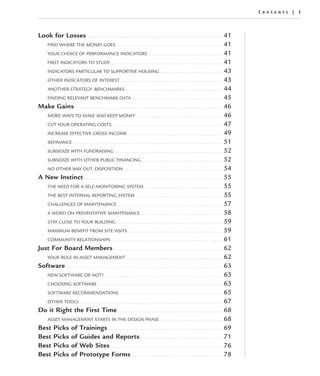
CONTENTS

           Acknowledgements . . . . . . . . . . . . . . . . . . . . . . . . . . . . . . . . . . . . . . . . . . . . . . . . . . . . . . . . . . . 4
           Preface . . . . . . . . . . . . . . . . . . . . . . . . . . . . . . . . . . . . . . . . . . . . . . . . . . . . . . . . . . . . . . . . . . . . . . . . . . . . 5
           Welcome . . . . . . . . . . . . . . . . . . . . . . . . . . . . . . . . . . . . . . . . . . . . . . . . . . . . . . . . . . . . . . . . . . . . . . . . . . 6
              SHOULD YOU READ THIS GUIDE? . . . . . . . . . . . . . . . . . . . . . . . . . . . . . . . . . . . . . . . . . . . . . . . . . . . . . 6
              WHAT WILL YOU LEARN? . . . . . . . . . . . . . . . . . . . . . . . . . . . . . . . . . . . . . . . . . . . . . . . . . . . . . . . . . . . . . . 6
              HOW SHOULD YOU USE THIS GUIDE? . . . . . . . . . . . . . . . . . . . . . . . . . . . . . . . . . . . . . . . . . . . . . . . . 7
              CAN YOU AFFORD TO WAIT? . . . . . . . . . . . . . . . . . . . . . . . . . . . . . . . . . . . . . . . . . . . . . . . . . . . . . . . . . . 7
           Introduction . . . . . . . . . . . . . . . . . . . . . . . . . . . . . . . . . . . . . . . . . . . . . . . . . . . . . . . . . . . . . . . . . . . . . 8
              WHAT DOES ASSET MANAGEMENT MEAN? . . . . . . . . . . . . . . . . . . . . . . . . . . . . . . . . . . . . . . . . 8
              WHY DOES SUPPORTIVE HOUSING NEED ASSET MANAGEMENT? . . . . . . . . . . . . . . . . . 9
              WHAT DOES THE JOB ENTAIL? . . . . . . . . . . . . . . . . . . . . . . . . . . . . . . . . . . . . . . . . . . . . . . . . . . . . 10
              HOW IS IT NOT PROPERTY MANAGEMENT? . . . . . . . . . . . . . . . . . . . . . . . . . . . . . . . . . . . . . . . 11
              SUPPORTIVE HOUSING—ADVANTAGED OR DISADVANTAGED? . . . . . . . . . . . . . . . . . . . . . . 12
           Before You Start . . . . . . . . . . . . . . . . . . . . . . . . . . . . . . . . . . . . . . . . . . . . . . . . . . . . . . . . . . . . . . . . 13
              DEFINE YOUR ASSET MANAGEMENT GOAL . . . . . . . . . . . . . . . . . . . . . . . . . . . . . . . . . . . . . . . . 13
              START TO THINK LIKE A BUSINESS . . . . . . . . . . . . . . . . . . . . . . . . . . . . . . . . . . . . . . . . . . . . . . . . 14
              ANSWER SOME BASIC QUESTIONS . . . . . . . . . . . . . . . . . . . . . . . . . . . . . . . . . . . . . . . . . . . . . . . . 15
              FIND A LITTLE MONEY TO START . . . . . . . . . . . . . . . . . . . . . . . . . . . . . . . . . . . . . . . . . . . . . . . . . . 16
              FIND MORE MONEY AS YOU GO . . . . . . . . . . . . . . . . . . . . . . . . . . . . . . . . . . . . . . . . . . . . . . . . . . . 17
              DELEGATE ASSET MANAGEMENT RESPONSIBILITY . . . . . . . . . . . . . . . . . . . . . . . . . . . . . . . . . 18
              PLAN FOR ASSET MANAGEMENT TO BE TAKEN SERIOUSLY . . . . . . . . . . . . . . . . . . . . . . . . . 20
           First Steps . . . . . . . . . . . . . . . . . . . . . . . . . . . . . . . . . . . . . . . . . . . . . . . . . . . . . . . . . . . . . . . . . . . . . . . . 21
              EDUCATE YOURSELF . . . . . . . . . . . . . . . . . . . . . . . . . . . . . . . . . . . . . . . . . . . . . . . . . . . . . . . . . . . . . . 21
              HOLD A MEETING . . . . . . . . . . . . . . . . . . . . . . . . . . . . . . . . . . . . . . . . . . . . . . . . . . . . . . . . . . . . . . . . 21
              START A BINDER . . . . . . . . . . . . . . . . . . . . . . . . . . . . . . . . . . . . . . . . . . . . . . . . . . . . . . . . . . . . . . . . . . 22
              WHAT GOES IN AN ASSET MANAGEMENT PLAN? . . . . . . . . . . . . . . . . . . . . . . . . . . . . . . . . . . 23
              SPECIAL WORDS ABOUT THE PROPERTY MANAGEMENT PLAN . . . . . . . . . . . . . . . . . . . . . . 24
              EVALUATE YOUR PROPERTY MANAGER . . . . . . . . . . . . . . . . . . . . . . . . . . . . . . . . . . . . . . . . . . . . 27
              IF YOU CONTRACT OUT PROPERTY MANAGEMENT . . . . . . . . . . . . . . . . . . . . . . . . . . . . . . . . 28
              GET ORGANIZED . . . . . . . . . . . . . . . . . . . . . . . . . . . . . . . . . . . . . . . . . . . . . . . . . . . . . . . . . . . . . . . . . 29
              START RESERVE ACCOUNTS . . . . . . . . . . . . . . . . . . . . . . . . . . . . . . . . . . . . . . . . . . . . . . . . . . . . . . . 31
              PLANNING YOUR CAPITAL RESERVE . . . . . . . . . . . . . . . . . . . . . . . . . . . . . . . . . . . . . . . . . . . . . . . 33
           Rise to the Standard . . . . . . . . . . . . . . . . . . . . . . . . . . . . . . . . . . . . . . . . . . . . . . . . . . . . . . . . . 37
              THE NEED TO COMPARE YOURSELF . . . . . . . . . . . . . . . . . . . . . . . . . . . . . . . . . . . . . . . . . . . . . . . 37
              PERFORMANCE STANDARDS TO CONSULT . . . . . . . . . . . . . . . . . . . . . . . . . . . . . . . . . . . . . . . . 38
              RED FLAGS TO WATCH FOR . . . . . . . . . . . . . . . . . . . . . . . . . . . . . . . . . . . . . . . . . . . . . . . . . . . . . . . 40
Contents | 3


Look for Losses                          ................................................................                                                    41
   FIND WHERE THE MONEY GOES . . . . . . . . . . . . . . . . . . . . . . . . . . . . . . . . . . . . . . . . . . . . . . . . . . 41
   YOUR CHOICE OF PERFORMANCE INDICATORS . . . . . . . . . . . . . . . . . . . . . . . . . . . . . . . . . . . 41
   FIRST INDICATORS TO STUDY . . . . . . . . . . . . . . . . . . . . . . . . . . . . . . . . . . . . . . . . . . . . . . . . . . . . . 41
   INDICATORS PARTICULAR TO SUPPORTIVE HOUSING . . . . . . . . . . . . . . . . . . . . . . . . . . . . . . 43
   OTHER INDICATORS OF INTEREST . . . . . . . . . . . . . . . . . . . . . . . . . . . . . . . . . . . . . . . . . . . . . . . . 43
   ANOTHER STRATEGY: BENCHMARKS . . . . . . . . . . . . . . . . . . . . . . . . . . . . . . . . . . . . . . . . . . . . . . 44
   FINDING RELEVANT BENCHMARK DATA . . . . . . . . . . . . . . . . . . . . . . . . . . . . . . . . . . . . . . . . . . . 45
Make Gains . . . . . . . . . . . . . . . . . . . . . . . . . . . . . . . . . . . . . . . . . . . . . . . . . . . . . . . . . . . . . . . . . . . . . . 46
   MORE WAYS TO MAKE AND KEEP MONEY . . . . . . . . . . . . . . . . . . . . . . . . . . . . . . . . . . . . . . . . . 46
   CUT YOUR OPERATING COSTS . . . . . . . . . . . . . . . . . . . . . . . . . . . . . . . . . . . . . . . . . . . . . . . . . . . . 47
   INCREASE EFFECTIVE GROSS INCOME . . . . . . . . . . . . . . . . . . . . . . . . . . . . . . . . . . . . . . . . . . . . . 49
   REFINANCE . . . . . . . . . . . . . . . . . . . . . . . . . . . . . . . . . . . . . . . . . . . . . . . . . . . . . . . . . . . . . . . . . . . . . . . 51
   SUBSIDIZE WITH FUNDRAISING . . . . . . . . . . . . . . . . . . . . . . . . . . . . . . . . . . . . . . . . . . . . . . . . . . . 52
   SUBSIDIZE WITH OTHER PUBLIC FINANCING . . . . . . . . . . . . . . . . . . . . . . . . . . . . . . . . . . . . . . 52
   NO OTHER WAY OUT: DISPOSITION . . . . . . . . . . . . . . . . . . . . . . . . . . . . . . . . . . . . . . . . . . . . . . . 54
A New Instinct . . . . . . . . . . . . . . . . . . . . . . . . . . . . . . . . . . . . . . . . . . . . . . . . . . . . . . . . . . . . . . . . . . 55
   THE NEED FOR A SELF-MONITORING SYSTEM . . . . . . . . . . . . . . . . . . . . . . . . . . . . . . . . . . . . . 55
   THE BEST INTERNAL REPORTING SYSTEM . . . . . . . . . . . . . . . . . . . . . . . . . . . . . . . . . . . . . . . . . 55
   CHALLENGES OF MAINTENANCE . . . . . . . . . . . . . . . . . . . . . . . . . . . . . . . . . . . . . . . . . . . . . . . . . . 57
   A WORD ON PREVENTATIVE MAINTENANCE . . . . . . . . . . . . . . . . . . . . . . . . . . . . . . . . . . . . . . . 58
   STAY CLOSE TO YOUR BUILDING . . . . . . . . . . . . . . . . . . . . . . . . . . . . . . . . . . . . . . . . . . . . . . . . . . 59
   MAXIMUM BENEFIT FROM SITE VISITS . . . . . . . . . . . . . . . . . . . . . . . . . . . . . . . . . . . . . . . . . . . . . 59
   COMMUNITY RELATIONSHIPS . . . . . . . . . . . . . . . . . . . . . . . . . . . . . . . . . . . . . . . . . . . . . . . . . . . . . 61
Just For Board Members . . . . . . . . . . . . . . . . . . . . . . . . . . . . . . . . . . . . . . . . . . . . . . . . . . . . 62
   YOUR ROLE IN ASSET MANAGEMENT . . . . . . . . . . . . . . . . . . . . . . . . . . . . . . . . . . . . . . . . . . . . . . 62
Software . . . . . . . . . . . . . . . . . . . . . . . . . . . . . . . . . . . . . . . . . . . . . . . . . . . . . . . . . . . . . . . . . . . . . . . . . . 63
   NEW SOFTWARE OR NOT? . . . . . . . . . . . . . . . . . . . . . . . . . . . . . . . . . . . . . . . . . . . . . . . . . . . . . . . . 63
   CHOOSING SOFTWARE . . . . . . . . . . . . . . . . . . . . . . . . . . . . . . . . . . . . . . . . . . . . . . . . . . . . . . . . . . . 63
   SOFTWARE RECOMMENDATIONS . . . . . . . . . . . . . . . . . . . . . . . . . . . . . . . . . . . . . . . . . . . . . . . . . 65
   OTHER TOOLS . . . . . . . . . . . . . . . . . . . . . . . . . . . . . . . . . . . . . . . . . . . . . . . . . . . . . . . . . . . . . . . . . . . . 67
Do it Right the First Time . . . . . . . . . . . . . . . . . . . . . . . . . . . . . . . . . . . . . . . . . . . . . . . . . . 68
   ASSET MANAGEMENT STARTS IN THE DESIGN PHASE . . . . . . . . . . . . . . . . . . . . . . . . . . . . . . 68
Best Picks of Trainings . . . . . . . . . . . . . . . . . . . . . . . . . . . . . . . . . . . . . . . . . . . . . . . . . . . . . . 69
Best Picks of Guides and Reports . . . . . . . . . . . . . . . . . . . . . . . . . . . . . . . . . . . . . . . 71
Best Picks of Web Sites . . . . . . . . . . . . . . . . . . . . . . . . . . . . . . . . . . . . . . . . . . . . . . . . . . . . . 76
Best Picks of Prototype Forms . . . . . . . . . . . . . . . . . . . . . . . . . . . . . . . . . . . . . . . . . . . 78
AC K N OW L E D G M E N T S

                 AIDS Housing of Washington would like to thank the author, Kristina Hals,
                 for her diligent research and invaluable expertise in the creation of this
                 guide.

                 We would also like to thank asset management experts David Fromm of The
                 Enterprise Foundation and Judith Rose of the Local Initiatives Support
                 Corporation for their invaluable advice regarding the content of this guide.


                 The research, development, and publication of this manual was funded
                 by the Housing Opportunities for Persons with AIDS (HOPWA) National
                 Technical Assistance Program in partnership with the U.S. Department of
                 Housing and Urban Development’s Office of HIV/AIDS Housing. The
                 substance and findings of the work are dedicated to the public. The author
                 and publisher are solely responsible for the accuracy of the statements and
                 interpretations contained in this publication. Such interpretations do not
                 necessarily reflect the views of the Government.
P R E FAC E

“Be careful what you wish for. Now that you have created housing, you have
the responsibility of owning and managing property. If you are going to be
a landlord, then you should be a good landlord. As a nonprofit, you don’t
have the financial cushion to do this work badly. Asset management of your
property is going to be a very significant enterprise. People who are in your
housing are dependent on you to hit your targets.”1

   – John Vogel, Expert on Asset Management in Affordable Housing


                                                                                   1. Amos Tuck School
                                                                                of Business, Dartmouth
                                                                                College, Lecture at Lincoln
                                                                                Filenes Institute on Com-
                                                                                munity Development,
                                                                                Medford, MA, 1999.
WELCOME

                            SHOULD YOU READ THIS GUIDE?
                            This guide is intended for anyone with a role in managing supportive
                            housing. By “supportive housing,” we mean residences targeted to persons
                            with special needs such as HIV/AIDS, mental illness, substance abuse, and
                            other conditions that frequently occur with homelessness. Typically, such
READERS OF                  settings combine housing with “supportive” services to stabilize and insure
THIS GUIDE                  the well-being of residents. If your group owns real estate that is used to
                            house and support special populations in this manner, this guide is written
• AIDS Housing              with you in mind.
  Providers
                            If you simply lease property for your housing program, this guide will be an
• Supportive Housing        education in the long-term issues to anticipate, should your organization
  Groups                    buy its own real estate in the future.
• Property Managers of      Others who may have an interest are property managers associated with
  Supportive Housing        supportive housing and contract managers or underwriters working for
• Boards of Directors for   institutions with financial investments in supportive housing.
  Supportive Housing
                            WHAT WILL YOU LEARN?
• Contract Managers of
                            The material presented here is an introduction to basic concepts of asset
  Supportive Housing
                            management. It translates practices from the more mainstream field of
• Underwriters of           affordable housing to the specialized context of supportive housing.
  Supportive Housing
                            It encourages supportive housing professionals to step outside their tradi-
• Staff of Supportive       tional vantage point of measuring success in the exclusive terms of today’s
  Housing                   tenants’ well-being. It includes specifics about predicting trends in your
                            property’s finances, operating more efficiently, using systems and tools to
                            improve operations, and tracking financial indicators. In general, the guide
                            provides ideas on how to think and operate more like a business. It also
                            presents the argument for why an asset management approach is necessary
                            to protect the long-term availability of supportive housing.
                            Asset management should not be mistaken for property management.
                            Although it may take some convincing on our part, you will learn to distin-
                            guish between these two different aspects of managing a property. Aspects
                            of property management are discussed in the guide but only insofar as they
                            intersect with ideas about asset management. For those looking for a guide
                            with more substance about property management, recommended resources
                            on this topic are listed in the Best Picks section at the back of this guide.
Welcome | 7


HOW SHOULD YOU USE THIS GUIDE?
First, browse this guide for the big picture of what asset management
means. Then, go back and read topics that appear to be realistic first steps—
or next steps—for your organization to begin asset management. Review other
parts of the guide with the expectation that you will not accomplish all tasks
at once. Expect to gradually build your asset management program over time.
Consult references at the back of the guide. At the back of this guide are
numerous Best Picks that you can access for additional information related to
your particular supportive housing program. There is a wealth of publications
on individual aspects of asset management; look for materials specific to your
particular housing group, whether you operate in a rural community, are
financed by low income housing tax credits, or function as your own proper-
ty management company. Worth exploring are the listings of trainings on
asset management just for nonprofit housing groups. As a next step after read-
ing this guide, consider educating a staff or board representative to become
your in-house expert.
Share this guide with colleagues. Once you are convinced of the need for an
asset management approach, spread the word. The more that AIDS housing
and supportive housing promote asset management, the better understood
will be requests for financial resources to carry it out. Bringing this guide to the
attention of supportive housing colleagues and board members, both inside
and outside your organization, will help the AIDS housing and supportive
housing communities develop long-term strategies for staying in business.

CAN YOU AFFORD TO WAIT?
Asset management is not a rainy day project. Those who have studied
trends in the long-term stability of affordable housing indicate that asset
management is an urgent agenda for all nonprofit housing groups.2
Research shows that if housing groups wait to introduce their organization to
asset management, problems affecting financial performance may gradually
grow to the point where they can’t be reversed quickly, or at all.
Pursue both agendas of creating and preserving housing with equal com-
mitment. Historically, there has been strong emphasis on creating affordable
housing. By comparison, preserving housing owned by nonprofit groups has
received relatively little attention. The concept of asset management is an
attempt to balance these two equally important agendas. It needs to be
applied to every sector of affordable housing.
Follow the lead of affordable housing groups doing asset management.                      2. Rachel Bratt, Confront-
                                                                                       ing the Management Chal-
Traditionally, supportive housing groups have not identified closely with the          lenge: Affordable Housing in
wider affordable housing movement. However, asset management is an agen-               the Nonprofit Sector. New
                                                                                       School for Social Research,
da where supportive housing has considerable common ground with the rest               1994, p. 204. Available from
of the country’s affordable housing organizations. Supportive housing groups           the Community Develop-
                                                                                       ment Research Center at
should seek out opportunities to gain knowledge, resources, and momentum               the New School for Social
on asset management generated by mainstream housing groups.                            Research.
I N T RO D U C T I O N

                                 WHAT DOES ASSET MANAGEMENT MEAN?
                                 Asset management is in favor with today’s government funders and
                                 housing groups nationwide. It is a concept that is borrowed from private
                                 sector real estate and is increasingly relevant to nonprofit providers of low-
                                 income housing. Yet, despite its growing popularity, asset management is
“Asset management
                                 poorly understood. Often confused with property management, few groups
involves planning for            know what asset management might involve for them or how they could
the long-term con-               apply it. Supportive housing providers, particularly smaller organizations
cern for bricks and              with backgrounds primarily in social services, AIDS care, or homeless pro-
mortar...the long-               grams, seem least likely of all to know about asset management.
term economic and
physical viability of            The term “asset” refers to a piece of real estate that has current and future
                                 value. The asset management approach asks that you consider the proper-
the building.”3
                                 ties you use for supportive housing in terms of their monetary value. Asset
                                 management means taking the long view—meaning the next ten to fifteen
                                 years—of whether your property’s value is stable, growing, or decreasing.
“The group’s horizon             The idea is that things you do today will set the stage for financial perform-
for planning, budget-            ance tomorrow.
ing, and monitoring
must be extended                 Conventionally focused on the short term, AIDS housing and supportive
                                 housing groups in particular need to shift their perspective if they are to
into the future. We
                                 adopt this long-term approach. Ultimately, the asset management mentali-
need to do things
                                 ty translates into concrete practices and policies that will protect and
today to make sure               enhance the viability of the asset’s future.
real estate endures
as supportive hous-
ing and achieves its
goals to benefit as
many people as pos-
sible in the long
run.”4


   3. Bratt, p.86.
   4. Bob Stone, “A Guide to
the Roles and Responsibilities
of an Asset Manager,” Occa-
sional Paper Series, Local
Initiatives Support Corpo-
ration, Organizational Devel-
opment Initiative, p. 3. New
York, 1997.
Introduc tion | 9


WHY DOES SUPPORTIVE HOUSING NEED
ASSET MANAGEMENT?
Many supportive housing providers have “backed into” the real estate
business with minimal experience owning and managing property.
Before getting into housing, most of your organization’s background may
have been in delivering support services of one kind or another. In all like-
lihood, your agency became a property owner in response to a crisis of
homelessness among your service constituency. If you are like many sup-
portive housing groups, you have a social work orientation to your housing
work. While helpful in day-to-day management of residents’ needs, this pre-
disposes the whole organization towards short-term goals. Staff may turn
over with the relatively high frequency common among social service organ-
izations. This leaves your organization without a long-term “owner” with
memory of when the housing was created. These patterns diminish the long
view of where your program has been, in what direction it is going, and
what needs doing in the long run.

The financial structure of funding for supportive housing is a weak link.
Supportive housing has evolved from a series of specialized government
funding mechanisms that have relatively short commitments. Thus, many
supportive housing groups find themselves built upon insecure, time-limit-
ed resources without contingency plans, should this money dry up.
Although some groups have taken steps to build in more long-term financ-
ing, others are left with little monetary cushion and cannot afford to do
business badly. In these situations, careful monitoring of financial trends
through asset management is essential.

A mission of delivering transitional housing can mean financial vulnera-
bility. For the subset of supportive housing groups who provide housing on
a short-term basis, there are inherent financial problems that come with this
way of structuring the housing. High turnover rates of residents, while desir-
able from the perspective of these groups’ missions, result in many costs and
financial losses that are difficult to recoup. A compounding problem is the
fluctuating market for supportive housing groups who operate in a special-
ized niche such as HIV/AIDS housing. If you are a niche provider, changes
in the status of your target population may reduce the desirability of your
housing program in unanticipated ways and create financial losses until
your census recovers.
10 | Put Your House in Order


                  WHAT DOES THE JOB ENTAIL?
                  The practice of asset management is made up of a number of discrete tasks. In
                  planning your approach, it may be helpful to think of the work in the for-
                  mat of a job description with certain tasks associated with the start-up of the
                  project and others involved with its ongoing implementation.


                      Job Description for Asset Management in Supportive Housing
                                                       Start-up
                  •   Develop long-term asset management goals reflecting the individuality of
                      each piece of real estate used for supportive housing.
                  •   Create a tailored asset management plan made up of policies for meeting
                      the unique needs of each individual property today, such that it will per-
                      form best tomorrow.
                  •   Systematize operations for collecting data on the property’s operations
                      and finances with well-designed forms, databases, and software.
                  •   Assess performance against standards in the nonprofit housing industry.
                  •   Reevaluate existing arrangements for property management with an asset
                      management approach.
                  •   Compare the financial performance of the property with indicators from
                      comparable properties in the affordable housing industry.
                  •   Analyze trends if the property is losing money and develop solutions.
                                              Ongoing Implementation
                  •   Monitor income, expenses, and cash flows to track trends in financial per-
                      formance.
                  •   Inspect conditions of the property and develop timelines that anticipate
                      capital costs and maintenance schedules.
                  •   Budget using a ten-year spreadsheet of anticipated capital costs.
                  •   Save or raise money to create reserve accounts as part of project develop-
                      ment, or fund as part of ongoing operations.
                  •   Assess performance against standards in the nonprofit housing industry.
                  •   Compare financial performance of the property with indicators from com-
                      parable properties in the affordable housing industry.
                  •   Analyze trends where property loses money and develop solutions.
                  •   Report at close intervals on indicators of the property’s performance.
                  •   Communicate with boards of directors, investors, and government agen-
                      cies on the property’s status, performance, and long-term needs.
                  •   Ensure compliance with all regulations, reporting requirements, and contracts.
                  •   Anticipate the endpoint of funding programs and seek substitutes.
Introduc tion | 11


HOW IS IT NOT PROPERTY MANAGEMENT?
Asset management is a broader, longer-term activity than property man-
agement. Property management addresses day-to-day needs of the building
by carrying out rent collection, record keeping, and routine maintenance. Its
emphasis is on details and delivery of basic services. In contrast, asset man-
agement has an extended horizon for considering the property’s needs and
the big picture of performance trends over time. For example, this extended,
broader perspective includes creating a ten-to-twenty-year spreadsheet to
predict the property’s ability to pay for its long-range expenses, secure long-
term funding, and examine long-term values in the neighborhood.

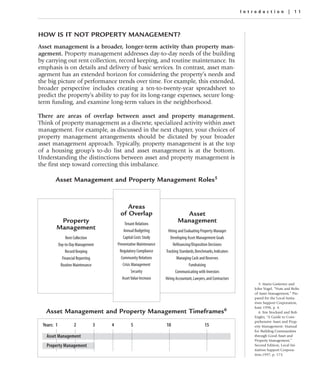
There are areas of overlap between asset and property management.
Think of property management as a discrete, specialized activity within asset
management. For example, as discussed in the next chapter, your choices of
property management arrangements should be dictated by your broader
asset management approach. Typically, property management is at the top
of a housing group’s to-do list and asset management is at the bottom.
Understanding the distinctions between asset and property management is
the first step toward correcting this imbalance.

       Asset Management and Property Management Roles5


                                            Areas
                                         of Overlap                          Asset
         Property                            Tenant Relations
                                                                           Management
        Management                          Annual Budgeting        Hiring and Evaluating Property Manager
                Rent Collection            Capital Costs Study         Developing Asset Management Goals
            Day-to-Day Management       Preventative Maintenance        Refinancing/Disposition Decisions
                Record Keeping           Regulatory Compliance     Tracking Standards, Benchmarks, Indicators
              Financial Reporting         Community Relations              Managing Cash and Reserves
             Routine Maintenance           Crisis Management                       Fundraising
                                                  Security                Communicating with Investors
                                           Asset Value Increase    Hiring Accountant, Lawyers, and Contractors
                                                                                                                        5. Maria Gutierrez and
                                                                                                                     John Vogel, “Nuts and Bolts
                                                                                                                     of Asset Management,” Pre-
                                                                                                                     pared for the Local Initia-
                                                                                                                     tives Support Corporation,
                                                                                                                     June 1998, p. 4.
   Asset Management and Property Management Timeframes6                                                                 6. Jim Stockard and Bob
                                                                                                                     Engler, “A Guide to Com-
                                                                                                                     prehensive Asset and Prop-
 Years: 1            2          3   4           5                  10                        15                      erty Management: Manual
                                                                                                                     for Building Communities
   Asset Management                                                                                                  through Good Asset and
                                                                                                                     Property Management,”
   Property Management                                                                                               Second Edition, Local Ini-
                                                                                                                     tiatives Support Corpora-
                                                                                                                     tion,1997, p. 173.
12 | Put Your House in Order


                               SUPPORTIVE HOUSING—ADVANTAGED OR DISADVANTAGED?
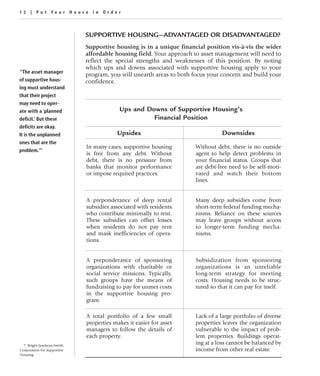
                               Supportive housing is in a unique financial position vis-à-vis the wider
                               affordable housing field. Your approach to asset management will need to
                               reflect the special strengths and weaknesses of this position. By noting
                               which ups and downs associated with supportive housing apply to your
 “The asset manager
                               program, you will unearth areas to both focus your concern and build your
of supportive hous-            confidence.
ing must understand
that their project
may need to oper-
ate with a ‘planned                         Ups and Downs of Supportive Housing’s
deficit.’ But these                                   Financial Position
deficits are okay.
It is the unplanned                         Upsides                                Downsides
ones that are the
                               In many cases, supportive housing        Without debt, there is no outside
problem.”7
                               is free from any debt. Without           agent to help detect problems in
                               debt, there is no pressure from          your financial status. Groups that
                               banks that monitor performance           are debt-free need to be self-moti-
                               or impose required practices.            vated and watch their bottom
                                                                        lines.


                               A preponderance of deep rental           Many deep subsidies come from
                               subsidies associated with residents      short-term federal funding mecha-
                               who contribute minimally to rent.        nisms. Reliance on these sources
                               These subsidies can offset losses        may leave groups without access
                               when residents do not pay rent           to longer-term funding mecha-
                               and mask inefficiencies of opera-        nisms.
                               tions.


                               A preponderance of sponsoring            Subsidization from sponsoring
                               organizations with charitable or         organizations is an unreliable
                               social service missions. Typically,      long-term strategy for meeting
                               such groups have the means of            costs. Housing needs to be struc-
                               fundraising to pay for unmet costs       tured so that it can pay for itself.
                               in the supportive housing pro-
                               gram.

                               A total portfolio of a few small         Lack of a large portfolio of diverse
                               properties makes it easier for asset     properties leaves the organization
                               managers to follow the details of        vulnerable to the impact of prob-
                               each property.                           lem properties. Buildings operat-
  7. Brigitt Jandreau-Smith,
                                                                        ing at a loss cannot be balanced by
Corporation for Supportive                                              income from other real estate.
Housing.
B E F O R E YO U S TA R T

DEFINE YOUR ASSET MANAGEMENT GOAL
Your asset management goal will dictate many of the decisions you
make. It will be the guiding principle for how you do business. It is not
to be confused with the programmatic goals your organization has estab-
lished for the services it delivers. Most supportive housing groups have a
goal statement related to desired changes in the status of their residents.
Asset management asks that you transfer that perspective to the property
itself. Ask what goals you have for the status of your property as an asset.

To begin, review what covenants exist for maintaining your building as
affordable AIDS or special needs housing and for what period of time.
For example, many supportive housing groups are obligated to maintain
their property as affordable housing for forty or more years as a condi-
tion of their financing. Housing Opportunities for Persons with AIDS
(HOPWA) requires a ten-year commitment to housing people with
AIDS.

Within the parameters of your covenants, define your asset manage-
ment goal. One group’s goal may be to maintain a building as AIDS
housing for as long as the HIV epidemic continues and to build an addi-
tion for a day care center onto the property. Another group may intend
to sell their building in the next five years to take advantage of the neigh-
borhood’s increased real estate values and adjust their housing model to
changes in their target population’s needs. They may want to use rev-
enues from the sale to create a larger, mixed special needs housing pro-
gram in a nearby neighborhood.


      Exercise in Developing Your Asset Management Goal
As an exercise, it may be helpful to think about goals for another asset that is common-
ly owned, such as a boat. A new boat is purchased with any one of several possible goals
of how it will be used. Perhaps the owners want to preserve it as a showpiece to be
passed along to future generations. Or perhaps they want to race it in regattas and sail
around the world. Depending on their goal, the boat’s owners will spend money differ-
ently and keep track of different aspects of its performance and wear and tear. Similarly,
if you are to plan how you will maintain and monitor the building you use for supportive
housing, you need to have a clear long-term asset management goal in mind.
14 | Put Your House in Order


                  START TO THINK LIKE A BUSINESS
                  The asset management approach requires an unfamiliar shift in roles.
                  You will need to take off your social worker and social activist hats for a
                  moment. Pretend you work in the private sector where work is conceptual-
                   ized in terms of bottom lines. In the private sector, you learn to keep your
                          eye on the bottom line: profits.

                            In supportive housing, you are trying to balance two bottom
                           lines: (1) meeting your costs and (2) providing the best possible
                          services on a day-to-day basis. This is known as the “double bot-
                       tom line.” In many cases, these two commitments compete with one
                    another, such as when more expensive programs are desired but the
                  budget cannot support them.

                  The asset management approach offers a different perspective on the
                  double bottom line. It suggests that the two goals of excellent service deliv-
                  ery and cost efficiency can complement one another. Try to reconceptualize
                  your approach to services from a business perspective; see how effective
                  social services can strengthen the bottom line. For example, programs such
                  as case management, relapse prevention, workforce participation services,
                  and personal budgeting encourage residents to have lower impacts on your
                  property. That is, they ultimately save you money. On the other side of the
                  equation, residents who are helped to increase their earnings may reduce
                  the amount of subsidy that comes in to the building from public funds.
                  Thus, there are many variables to consider.


                             Example of the “Double Bottom Line” Approach
                  AIDS housing offers a good example of the merits of thinking in terms of the “double
                  bottom line.” There is a current trend toward residents’ unprecedented independence from
                  home-based support services observed nationwide. In modifying programmatic models
                  to better fit residents’changed status, AIDS housing providers need to consider what is good
                  business. If they simply cut back on support services in response to this new pattern, they
                  may set off trends that deteriorate the property’s financial status. For example, having
                  fewer case managers may reduce regularity of rent payments, lead to higher turnover of
                  units, and allow more damage to the property to occur. When problems compound them-
                  selves over time, these results may cost more money than the investment in consistent sup-
                  port services. Ideally, AIDS housing providers will learn to give both bottom lines equal
                  weight when making these kinds of choices.
Before You Star t | 15


ANSWER SOME BASIC QUESTIONS
A good simple exercise to get started in asset manage-
ment is to sit down with your accountant and look at the
income statements for your property. Explore the simple
questions outlined below. Your answers to these questions
should help ignite concern for how you can continue to
provide a clean, safe, and comfortable environment, if you
don’t start evaluating and planning how to manage this
asset over the long term.


                Simple Questions for Your Accountant
• Does our supportive housing program meet its costs now?
• If there is a larger sponsoring organization, then what size subsidy is the
  larger group contributing to keep us in the black?
• How much government subsidy does our program receive? What is the
  likelihood that it will be renewed?
• Is subsidization of the housing program growing each year?
• Is the sponsoring organization in a reliable position to maintain this subsidy?
• What factors are causing the property to lose money?
• What specific system upgrades would reduce our operating costs?
• Does our program have operating reserves for planned deficits? How long
  will they last?
• Are there any costs showing unanticipated increases?
• Is the tenant rental income stable or does it fluctuate from month to month
  or year to year?
• How much do we write off on average for failing to collect at least 90 per-
  cent of rent contributions each month?
• How long does it take on average for us to fill a unit after it is vacated?
• What is our average vacancy rate?
• Do we know what big-ticket (capital) expenses are likely to accrue and
  when?
• Is there money in reserve accounts for unanticipated operating deficits
  and longer-term major improvements that may be needed for the property?
• Are we underinsured or do we have an insurance deductible that is bur-
  densome?
• Are we insured against local hazards, such as earthquakes, that could
  expose us to high repair costs?
• Do we know of any code upgrades our property currently needs?
• Do the owners of this property (e.g., the board) know the answers to these
  questions?
16 | Put Your House in Order


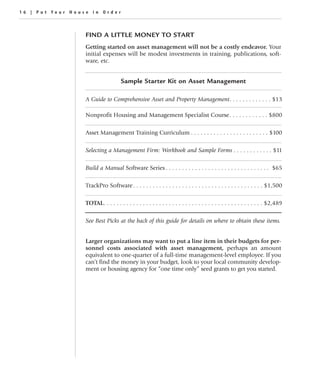
                  FIND A LITTLE MONEY TO START
                  Getting started on asset management will not be a costly endeavor. Your
                  initial expenses will be modest investments in training, publications, soft-
                  ware, etc.


                                     Sample Starter Kit on Asset Management

                  A Guide to Comprehensive Asset and Property Management. . . . . . . . . . . . . $13

                  Nonprofit Housing and Management Specialist Course. . . . . . . . . . . . $800

                  Asset Management Training Curriculum . . . . . . . . . . . . . . . . . . . . . . . . $100

                  Selecting a Management Firm: Workbook and Sample Forms . . . . . . . . . . . . $11

                  Build a Manual Software Series . . . . . . . . . . . . . . . . . . . . . . . . . . . . . . . . $65

                  TrackPro Software . . . . . . . . . . . . . . . . . . . . . . . . . . . . . . . . . . . . . . . . $1,500

                  TOTAL. . . . . . . . . . . . . . . . . . . . . . . . . . . . . . . . . . . . . . . . . . . . . . . . . $2,489

                  See Best Picks at the back of this guide for details on where to obtain these items.


                  Larger organizations may want to put a line item in their budgets for per-
                  sonnel costs associated with asset management, perhaps an amount
                  equivalent to one-quarter of a full-time management-level employee. If you
                  can’t find the money in your budget, look to your local community develop-
                  ment or housing agency for “one time only” seed grants to get you started.
Before You Star t | 17


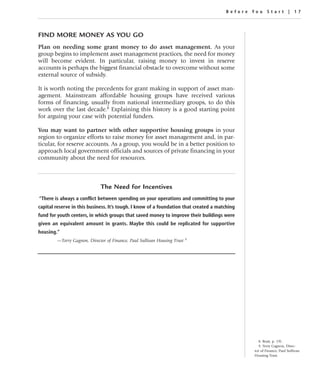
FIND MORE MONEY AS YOU GO
Plan on needing some grant money to do asset management. As your
group begins to implement asset management practices, the need for money
will become evident. In particular, raising money to invest in reserve
accounts is perhaps the biggest financial obstacle to overcome without some
external source of subsidy.

It is worth noting the precedents for grant making in support of asset man-
agement. Mainstream affordable housing groups have received various
forms of financing, usually from national intermediary groups, to do this
work over the last decade.8 Explaining this history is a good starting point
for arguing your case with potential funders.

You may want to partner with other supportive housing groups in your
region to organize efforts to raise money for asset management and, in par-
ticular, for reserve accounts. As a group, you would be in a better position to
approach local government officials and sources of private financing in your
community about the need for resources.


                             The Need for Incentives
“There is always a conflict between spending on your operations and committing to your
capital reserve in this business. It’s tough. I know of a foundation that created a matching
fund for youth centers, in which groups that saved money to improve their buildings were
given an equivalent amount in grants. Maybe this could be replicated for supportive
housing.”
        —Terry Gagnon, Director of Finance, Paul Sullivan Housing Trust   9


                                                                                                 8. Bratt, p. 191.
                                                                                                 9. Terry Gagnon, Direc-
                                                                                               tor of Finance, Paul Sullivan
                                                                                               Housing Trust.
18 | Put Your House in Order


                              DELEGATE ASSET MANAGEMENT RESPONSIBILITY
                              There are many ways to delegate the responsibilities of asset management.
                              Your choices will depend on the size and skill of your staff. Perhaps your
                              organization’s busy schedule makes it seem that there is no choice at all. In
                              fact, many supportive housing groups believe that asset management will be
                              an extra burden that their organization cannot bear with their current
                              staffing. But, in all likelihood, it will just require thinking creatively about
                              how the work can be accomplished. Keep in mind that asset management
                              is the responsibility of the actual owner—your agency’s board of directors—
                              so the work should be done as close to the hierarchy of the board as possible.


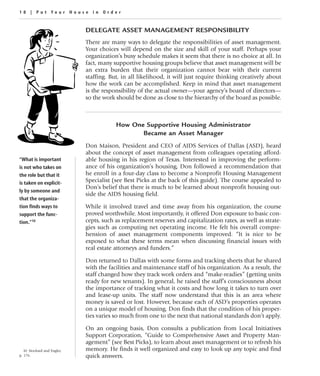
                                          How One Supportive Housing Administrator
                                                 Became an Asset Manager
                              Don Maison, President and CEO of AIDS Services of Dallas (ASD), heard
                              about the concept of asset management from colleagues operating afford-
“What is important            able housing in his region of Texas. Interested in improving the perform-
is not who takes on           ance of his organization’s housing, Don followed a recommendation that
the role but that it          he enroll in a four-day class to become a Nonprofit Housing Management
is taken on explicit-         Specialist (see Best Picks at the back of this guide). The course appealed to
                              Don’s belief that there is much to be learned about nonprofit housing out-
ly by someone and
                              side the AIDS housing field.
that the organiza-
tion finds ways to            While it involved travel and time away from his organization, the course
support the func-             proved worthwhile. Most importantly, it offered Don exposure to basic con-
tion.”10                      cepts, such as replacement reserves and capitalization rates, as well as strate-
                              gies such as computing net operating income. He felt his overall compre-
                              hension of asset management components improved. “It is nice to be
                              exposed to what these terms mean when discussing financial issues with
                              real estate attorneys and funders.”

                              Don returned to Dallas with some forms and tracking sheets that he shared
                              with the facilities and maintenance staff of his organization. As a result, the
                              staff changed how they track work orders and “make-readies” (getting units
                              ready for new tenants). In general, he raised the staff’s consciousness about
                              the importance of tracking what it costs and how long it takes to turn over
                              and lease-up units. The staff now understand that this is an area where
                              money is saved or lost. However, because each of ASD’s properties operates
                              on a unique model of housing, Don finds that the condition of his proper-
                              ties varies so much from one to the next that national standards don’t apply.

                              On an ongoing basis, Don consults a publication from Local Initiatives
                              Support Corporation, “Guide to Comprehensive Asset and Property Man-
                              agement” (see Best Picks), to learn about asset management or to refresh his
   10. Stockard and Engler,   memory. He finds it well organized and easy to look up any topic and find
p. 176.                       quick answers.
Before You Star t | 19


Don is growing naturally into the role of asset manager for his organization.
The board of directors falls into the role of oversight and buy-in of his work.
Next steps in asset management for AIDS Services of Dallas include research-
ing and purchasing some kind of software to improve property management
(see Best Picks). Currently, they use Excel. Don plans to explore LISC’s
“Track-It!” software, which is designed to produce reports on asset manage-
ment for nonprofit housing providers.

The creation of replacement and operating reserves for all ASD properties is
also on Don’s longer-term agenda. As required by one of the organization’s
funding mechanisms, the Low Income Housing Tax Credit Program, one of
the organization’s properties already has such a reserve. Although he has yet
to find the time or resources to expand this standard to all the properties,
Don now better understands the need for them.

Like those of most AIDS housing organizations, ASD’s properties do not
meet their costs independent of the organization’s reserves. AIDS Services of
Dallas has been fortunate over the years to “tap into a lot of freebies” and
benefit from successful capital campaigns. Nevertheless, this is not a secure
plan for doing business. Don’s long-term strategy for getting ASD properties
to pay their costs is to diversify the organization’s real estate portfolio to
include non-special needs housing that will have a healthier cash flow than
AIDS housing. He believes all supportive housing groups need to become
more familiar with funding streams that are not dedicated to AIDS, home-
less, or special needs populations (see Best Picks). “Were it not for HOPWA
[Housing Opportunities for Persons with AIDS], what does the future hold
for small AIDS housing groups reliant on these narrow resources?”

Don’s example points to the benefit of becoming educated about asset man-
agement through the many courses, printed materials, web sites, and soft-
ware packages that exist outside the supportive housing field. His work also
demonstrates that introducing asset management is likely to be a gradual
process that will build over time.


             Options for Delegating Asset Management11
a. For small organizations, the executive director may make recommendations and the
   board make decisions.
b. A new trend in larger nonprofits is to have a full-time asset manager on staff.
c. Middle-sized organizations may have the housing director serve as asset manager in
   addition to other responsibilities.
d. The property manager may be delegated asset management functions if the indivi-
   dual or firm has the necessary experience to do so.
                                                                                                  11 Stockard and Engler.,
                                                                                                p.169–180
20 | Put Your House in Order


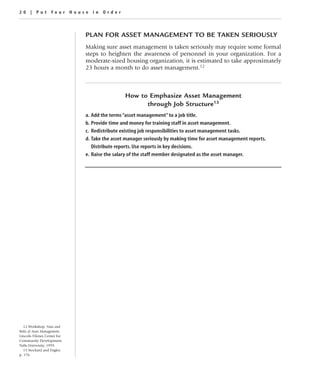
                             PLAN FOR ASSET MANAGEMENT TO BE TAKEN SERIOUSLY
                             Making sure asset management is taken seriously may require some formal
                             steps to heighten the awareness of personnel in your organization. For a
                             moderate-sized housing organization, it is estimated to take approximately
                             23 hours a month to do asset management.12


                                              How to Emphasize Asset Management
                                                    through Job Structure13
                             a. Add the terms “asset management” to a job title.
                             b. Provide time and money for training staff in asset management.
                             c. Redistribute existing job responsibilities to asset management tasks.
                             d. Take the asset manager seriously by making time for asset management reports.
                                Distribute reports. Use reports in key decisions.
                             e. Raise the salary of the staff member designated as the asset manager.


   12 Workshop: Nuts and
Bolts of Asset Management,
Lincoln Filenes Center for
Community Development,
Tufts University, 1999.
   13 Stockard and Engler,
p. 176.
FIRST STEPS

EDUCATE YOURSELF
Invest time in reviewing materials about asset management. Realize that
this guide is a basic primer. Many more detailed resources about asset man-
agement are available and are listed in Best Picks at the back of this guide.
In recent years, several national organizations have collaborated on devel-
oping trainings, publications, and conferences on asset management
in the nonprofit housing sector, all of which are available at afford-
able prices.


                  Questions to Anticipate from Staff
a. What does asset management mean?     c. Why is it important?
b. How does it differ from property     d. What will it entail to start?
   management?                          e. How will this affect our current jobs?


HOLD A MEETING
Expect that it will take some focused time to introduce the concept of
asset management to staff and board members. Set aside a special meet-
ing to cover the topic well the first time. You want to convey that while staff
and board may identify strongly with the nonprofit sector, by virtue of work-
ing in housing they have crossed over into the business world. If the organi-
zation’s assets (its housing resources) are going to be protected and reach
their full potential, everyone will need to be business savvy.

In meeting with staff, plan a presentation that works for the diverse back-
grounds and learning styles that are especially common in supportive hous-
ing organizations. Try using a variety of approaches, including small group
discussions, to help them grasp your message. Conclude your meeting by
outlining the first steps your organization will take and their anticipated
time frame.
22 | Put Your House in Order


                            Questions to Help Generate Staff Discussion on
                                          Asset Management
                  • “How many of you can think of a special needs housing program of some
                    kind that has gone out of business in our community? What problems
                    contributed to its demise? What do you think the sponsor could have
                    done differently to avert these problems? What lessons for our work can
                    we take from these observations?”

                  • “If you joined an Internet start-up company with employee stock options,
                    what would you want to know before you took the job? How would you
                    evaluate whether to stay with that company? How would you obtain the
                    information you need to make your career decision? What parallels exist
                    within this context and how should staff of our organization evaluate the
                    status of our properties?


                  START A BINDER
                  Experts recommend that housing groups create detailed Asset
                  Management Plans. Don’t mistake the need for such a plan as an empty
                  formality. Basically, the Asset Management Plan is a collection of written
                  strategies and policies for how the property will be administered.

                  Think of your Asset Management Plan as a work in progress. A simple
                  way to approach the task is to put in writing all the decisions that are made
                  along the way. Then create a binder with tabbed dividers and add elements
                  as your asset management work progresses. Have copies of the plan avail-
                  able at each of your sites.

                  The objective of the plan is to transform your hard work into a lasting
                  tool and standard that can be passed on to staff members who inherit the
                  responsibility of preserving your housing program. Whatever format you
                  follow, taking the time to write down how things get done is a worthwhile
                  investment of your time and energy. If your organization is like most sup-
                  portive housing organizations, it has a relatively high rate of turnover at the
                  managerial level. The Asset Management Plan will outlast such personnel
                  changes and pass on a permanent standard.
First Steps | 23


WHAT GOES IN AN ASSET MANAGEMENT PLAN?
An Asset Management Plan need not conform to any standard or model.
It is primarily an internal document and its workability should reflect that.
You can follow the recommended format below or, alternatively, invent
names of elements that are most relevant to your particular housing group.
Note that a good Asset Management Plan makes a strong impression on fun-
ders and underwriters. They will gain confidence in your operations from
reading it on their visits to your site.


                Contents of the Asset Management Plan14
a. Goals explaining why you own and provide supportive housing
b. Finance Plan containing your initial pro forma and a twenty-year spreadsheet
  for operations
c. Copies of legal documents that have covenants that need to be monitored (e.g.,
  Funding and Disbursement Agreement)
d. Monitoring Strategy detailing how you will study financial trends and upkeep
  of the property
e. Annual Budget compared to Actual Comparisons
f. Updated Pro Forma Budgets that capture information that changes over time
g. Property Management Plan outlining the day-to-day operations of the building
h. Finance Plan enumerating all funding sources and obligations
i. Long-Range Capital Plan explaining the intended sources that will pay for major
  costs in the future
j. Resident Participation Plan encouraging involvement of consumers in oversight
  of the housing
k. Resident Selection Plan defining the eligibility and tenant-screening criteria and
  process used for applicants to your program
l. Preventative Maintenance Plan outlining detailed plans for maintaining major
  building elements in good working order


                                                                                            14 Workshop: Nuts and
                                                                                          Bolts of Asset Management.
24 | Put Your House in Order


                  SPECIAL WORDS ABOUT THE PROPERTY MANAGEMENT PLAN
                  Fundamental to all the written policies will be your Property Manage-
                  ment Plan. The Property Management Plan explains how the building will
                  be managed on a day-to-day basis and what standards are expected. Hous-
                  ing experts say that before longer-term asset management can be achieved,
                  the Property Management plan must be perfected.

                  Every housing program will have its unique property management
                  needs. Variables influencing these needs include the target population,
                  security issues, marketing dynamics, support services, and lease provisions.
                  Given these variables, you will find that copying a generic property man-
                  agement plan is not a good idea. Experts recommend that you create a plan
                  to represent your specific tenant clientele and to meet your particular goals.

                  Find a general model of a plan you like and then carefully tailor your own
                  documents for each housing program you operate. See Best Picks at the back
                  of this guide for publications and software that can help you create a fine-
                  tuned Property Management Plan.
First Steps | 25


                   Asset Management Advice Column

Dear Advice Guru,
I am the director of housing programs for a large social service agency. Among the
programs I manage is a small multi-family property used as special needs homeless
housing. The property was bequeathed to my organization, which is primarily a
social service provider, before I started working here. When they received it, my
organization had no experience, or strong interest for that matter, in managing
rental property. As a result, I inherited the job of managing the building with noth-
ing in writing and skeletal systems in place. While the building is in good condi-
tion and the residents are generally very satisfied and stable, the long-term outlook
for the property is vague. Our income does not begin to meet our costs, so my organ-
ization must contribute money from its own reserves. There are questions about how
long this can continue. In this vacuum of clarity, management is a challenge. It is
hard to know how to make decisions regarding improvements, clarify my role, plan
for the building’s long-term needs, and balance the double bottom line of excellent
service delivery with cost efficiency. What should I do?
         Sincerely,
         Housing Director
         AIDS Series Committee, your town

Dear Housing Director,
You’ve come to the right place. If things continue along their present course, your
organization will probably be forced to sell its property some time in the future and
the residents will lose their home. Your organization needs to begin an Asset
Management Plan. Start with writing a Property Management Plan right away.
Put everything you do now—tenant issues, maintenance, grievances, rent collec-
tion, inspections, etc.— in writing right away. The more detail and specificity, the
better. Then take your work, your concerns, and literature about asset management
to a meeting with administrators of your organization. Make your case for the asset
management approach and ask that your efforts be supported.
         Advisedly,
         Your Guru
26 | Put Your House in Order


                                    Table of Contents for a Property Management Plan15

                             a. Marketing and Outreach Strategies       n. Drug Policies
                             b. Eligibility Requirements and Required   o. Guest/Visitor Policy
                                Documents                               p. Pet Policy
                             c. Tenant Selection Screening              q. Storage Policy
                             d. Credit Check Process and Fees           r. List of Furnishings
                             e. Waiting List Practices                  s. Pest Control Practices
                             f. First and Last Month Rent/Security      t. Unit Inspection Practices
                                Deposit Policy                          u. Cleaning Practices
                             g. Leasing Procedures                      v. Grievance and Complaints Policies
                             h. Move-In Procedures                      w. List of Maintenance Priorities
                             i. Tenant Orientation                      x. Work Orders
                             j. Common Space and Building Rules         y. Unit Turnover
                             k. Parking                                 z. Security
                             l. Community Relations                     aa. Forms and Permits Required by
                             m. Resident Involvement Practices             City/State/County


  15 Workshop: Nuts and
Bolts of Asset Management.
First Steps | 27


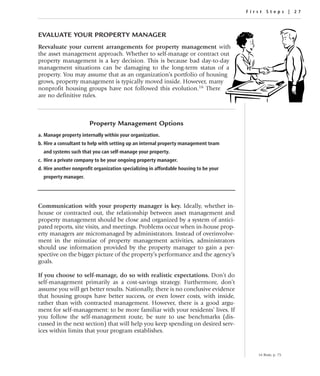
EVALUATE YOUR PROPERTY MANAGER
Reevaluate your current arrangements for property management with
the asset management approach. Whether to self-manage or contract out
property management is a key decision. This is because bad day-to-day
management situations can be damaging to the long-term status of a
property. You may assume that as an organization’s portfolio of housing
grows, property management is typically moved inside. However, many
nonprofit housing groups have not followed this evolution.16 There
are no definitive rules.


                       Property Management Options
a. Manage property internally within your organization.
b. Hire a consultant to help with setting up an internal property management team
  and systems such that you can self-manage your property.
c. Hire a private company to be your ongoing property manager.
d. Hire another nonprofit organization specializing in affordable housing to be your
  property manager.


Communication with your property manager is key. Ideally, whether in-
house or contracted out, the relationship between asset management and
property management should be close and organized by a system of antici-
pated reports, site visits, and meetings. Problems occur when in-house prop-
erty managers are micromanaged by administrators. Instead of overinvolve-
ment in the minutiae of property management activities, administrators
should use information provided by the property manager to gain a per-
spective on the bigger picture of the property’s performance and the agency’s
goals.

If you choose to self-manage, do so with realistic expectations. Don’t do
self-management primarily as a cost-savings strategy. Furthermore, don’t
assume you will get better results. Nationally, there is no conclusive evidence
that housing groups have better success, or even lower costs, with inside,
rather than with contracted management. However, there is a good argu-
ment for self-management: to be more familiar with your residents’ lives. If
you follow the self-management route, be sure to use benchmarks (dis-
cussed in the next section) that will help you keep spending on desired serv-
ices within limits that your program establishes.


                                                                                          16 Bratt, p. 75.
28 | Put Your House in Order


                                            Criteria for Deciding Between Inside and Outside
                                                         Property Management17
                                  a. Availability of outside management agents, including other housing nonprofits or
“You are not simply                  housing authorities in your area
a community group                 b. Private managers’ willingness to work with a nonprofit client
dabbling in housing               c. Pressure from your financing agents to “go outside” for management services
and desperate to                  d. Your interest in staying close to your residents’ day-to-day lives
find someone to
solve management
problems.”18                      IF YOU CONTRACT OUT PROPERTY MANAGEMENT
                                  Those who contract out property management have special concerns. If
                                  you follow this route, make sure that your organization does not divorce
                                  itself from the property so much that you lose track of information needed
                                  for asset management. In addition, think through the criteria by which you
                                  will evaluate your property manager. Expect more than the minimum yard
                                  work, painting, exterminating, etc. Communicate that you want the proper-
                                  ty manager to contribute value to your asset.

                                  The selection and contracting process sets the tone for your relationship
                                  with your property manager. Try to come across as professional and knowl-
                                  edgeable. A formal process to choose your vendor will help give this impression.


                                       Recommended Steps for Choosing a Property Manager19
                                  a. Do outreach to property management firms.
                                  b. Prepare a formal request for proposal.
                                  c. Review and evaluate the proposals with a ranking sheet.
                                  d. Check references.
                                  e. Look for experience with the U.S. Department of Housing and Urban Development
                                     housing programs.
                                  f. Review their presentation of financial data for other projects.
                                  g. Compare administrative fees among management firms.
                                  h. Negotiate a deal to suit your specific project and goals.
                                  i. Educate your property manager about the particular needs of the residents you house.
   17 Ibid.                       j. Outline the criteria on which the property manager will be evaluated.
   18 Joan Wallstein,
“Selecting a Management
Firm: A Workbook and
Sample Forms,” Occasional
Paper Series, Local Initiatives   Be vigilant in your checks and balances of property management ven-
Support Corporation, Orga-        dors. As an industry, property management suffers from a reputation of ille-
nizational Development
Initiative, 1996, p. 11.          gal activities such as kickbacks. Plan on verifying the property manager’s
   19 Ibid., p. 5.                work by visiting the site and checking with residents on a regular basis.
First Steps | 29


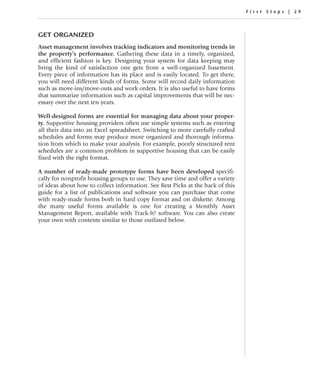
GET ORGANIZED
Asset management involves tracking indicators and monitoring trends in
the property’s performance. Gathering these data in a timely, organized,
and efficient fashion is key. Designing your system for data keeping may
bring the kind of satisfaction one gets from a well-organized basement.
Every piece of information has its place and is easily located. To get there,
you will need different kinds of forms. Some will record daily information
such as move-ins/move-outs and work orders. It is also useful to have forms
that summarize information such as capital improvements that will be nec-
essary over the next ten years.

Well-designed forms are essential for managing data about your proper-
ty. Supportive housing providers often use simple systems such as entering
all their data into an Excel spreadsheet. Switching to more carefully crafted
schedules and forms may produce more organized and thorough informa-
tion from which to make your analysis. For example, poorly structured rent
schedules are a common problem in supportive housing that can be easily
fixed with the right format.

A number of ready-made prototype forms have been developed specifi-
cally for nonprofit housing groups to use. They save time and offer a variety
of ideas about how to collect information. See Best Picks at the back of this
guide for a list of publications and software you can purchase that come
with ready-made forms both in hard copy format and on diskette. Among
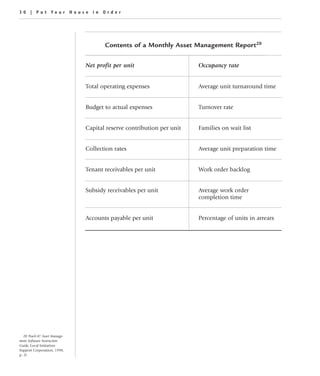
the many useful forms available is one for creating a Monthly Asset
Management Report, available with Track-It! software. You can also create
your own with contents similar to those outlined below.
30 | Put Your House in Order


                                       Contents of a Monthly Asset Management Report20

                                Net profit per unit                     Occupancy rate


                                Total operating expenses                Average unit turnaround time


                                Budget to actual expenses               Turnover rate


                                Capital reserve contribution per unit   Families on wait list


                                Collection rates                        Average unit preparation time


                                Tenant receivables per unit             Work order backlog


                                Subsidy receivables per unit            Average work order
                                                                        completion time


                                Accounts payable per unit               Percentage of units in arrears


   20 Track-It! Asset Manage-
ment Software Instruction
Guide, Local Initiatives
Support Corporation, 1998,
p. 21.
First Steps | 31


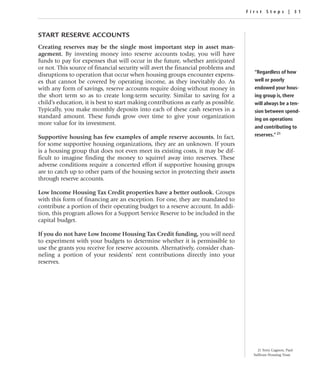
START RESERVE ACCOUNTS
Creating reserves may be the single most important step in asset man-
agement. By investing money into reserve accounts today, you will have
funds to pay for expenses that will occur in the future, whether anticipated
or not. This source of financial security will avert the financial problems and
                                                                                      “Regardless of how
disruptions to operation that occur when housing groups encounter expens-
es that cannot be covered by operating income, as they inevitably do. As              well or poorly
with any form of savings, reserve accounts require doing without money in             endowed your hous-
the short term so as to create long-term security. Similar to saving for a            ing group is, there
child’s education, it is best to start making contributions as early as possible.     will always be a ten-
Typically, you make monthly deposits into each of these cash reserves in a            sion between spend-
standard amount. These funds grow over time to give your organization                 ing on operations
more value for its investment.
                                                                                      and contributing to
Supportive housing has few examples of ample reserve accounts. In fact,               reserves.” 21
for some supportive housing organizations, they are an unknown. If yours
is a housing group that does not even meet its existing costs, it may be dif-
ficult to imagine finding the money to squirrel away into reserves. These
adverse conditions require a concerted effort if supportive housing groups
are to catch up to other parts of the housing sector in protecting their assets
through reserve accounts.

Low Income Housing Tax Credit properties have a better outlook. Groups
with this form of financing are an exception. For one, they are mandated to
contribute a portion of their operating budget to a reserve account. In addi-
tion, this program allows for a Support Service Reserve to be included in the
capital budget.

If you do not have Low Income Housing Tax Credit funding, you will need
to experiment with your budgets to determine whether it is permissible to
use the grants you receive for reserve accounts. Alternatively, consider chan-
neling a portion of your residents’ rent contributions directly into your
reserves.


                                                                                        21 Terry Gagnon, Paul
                                                                                      Sullivan Housing Trust.
32 | Put Your House in Order


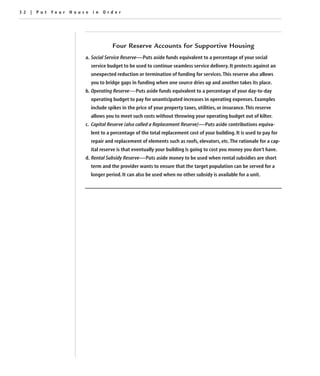
                              Four Reserve Accounts for Supportive Housing
                  a. Social Service Reserve—Puts aside funds equivalent to a percentage of your social
                    service budget to be used to continue seamless service delivery. It protects against an
                    unexpected reduction or termination of funding for services. This reserve also allows
                    you to bridge gaps in funding when one source dries up and another takes its place.
                  b. Operating Reserve—Puts aside funds equivalent to a percentage of your day-to-day
                    operating budget to pay for unanticipated increases in operating expenses. Examples
                    include spikes in the price of your property taxes, utilities, or insurance. This reserve
                    allows you to meet such costs without throwing your operating budget out of kilter.
                  c. Capital Reserve (also called a Replacement Reserve)—Puts aside contributions equiva-
                    lent to a percentage of the total replacement cost of your building. It is used to pay for
                    repair and replacement of elements such as roofs, elevators, etc. The rationale for a cap-
                    ital reserve is that eventually your building is going to cost you money you don’t have.
                  d. Rental Subsidy Reserve—Puts aside money to be used when rental subsidies are short
                    term and the provider wants to ensure that the target population can be served for a
                    longer period. It can also be used when no other subsidy is available for a unit.
First Steps | 33


PLANNING YOUR CAPITAL RESERVE
The need for a capital reserve deserves special priority. Research into the
longevity of affordable housing resources reveals that groups who lack ade-
quate capital reserves have an uncertain future.22 For-profits in the real estate
industry have heard this warning and are generally better prepared to pay for
what they will need. The practice of saving large sums of money in a capital                      “Do not turn away
reserve generally runs contrary to common practice in nonprofit housing,                          from the establish-
where practitioners are constantly trying to do more with less. Reserve plan-                     ment of a capital
ning is an area where nonprofits would do well to mimic more closely their                        reserve—it will not
for-profit counterparts.                                                                          go away. Do not let
                                                                                                  the account slide.
Start your capital reserve by estimating savings goals for the amount of
                                                                                                  This would be sign-
money you want to accumulate and maintain in your reserve. Keep in mind
that moderately rehabilitated properties will need capital infusions much                         ing a death warrant
earlier than buildings developed as new construction or complete rehabili-                        for your property. If
tation. All the major elements of your property will ultimately need repair                       necessary, cover the
or replacement.                                                                                   need in phases. But
                                                                                                  do cover the need.”24


    Two Ways to Estimate Savings Goals for a Capital Reserve
1. The simplest strategy is to adopt the nonprofit housing industry’s standard of accumu-
  lating savings equivalent to 5 to 20 percent of your property’s replacement value.23
  Because major components may need replacement sooner, moderately rehabilitated
  buildings will require a higher percentage set aside than either new construction or
  substantially rehabilitated property. To calculate, consult your property insurance carrier
  each year for an updated estimate of the replacement value for your property. A draw-
  back to this method is that it doesn’t project anticipated expenses along a timeline,
  leaving you without a sense of when your savings goals must be met.
2. The most thorough strategy is to conduct a capital cost study of all the major elements
  of your building and predict both the life expectancy of each element and the future
  replacement costs. Use these calculations to estimate the total amount of the capital
  reserve goal and the timing of future outlays. See the following page for a breakdown
  of steps in such a survey.


                                                                                                    22 Bratt, p. 86.
                                                                                                    23 LISC, p. 119.
                                                                                                    24 Text from Institute
                                                                                                  for Real Estate Management
                                                                                                  Course #305, p. 16.
34 | Put Your House in Order


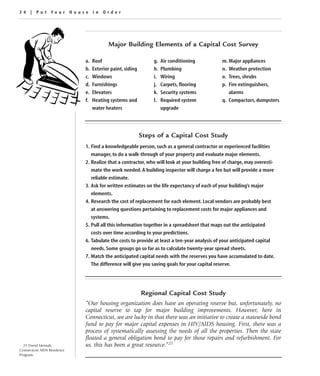
                                          Major Building Elements of a Capital Cost Survey

                             a.   Roof                         g.   Air conditioning          m. Major appliances
                             b.   Exterior paint, siding       h.   Plumbing                  n. Weather protection
                             c.   Windows                      i.   Wiring                    o. Trees, shrubs
                             d.   Furnishings                  j.   Carpets, flooring         p. Fire extinguishers,
                             e.   Elevators                    k.   Security systems             alarms
                             f.   Heating systems and          l.   Required system           q. Compactors, dumpsters
                                  water heaters                     upgrade


                                                           Steps of a Capital Cost Study
                             1. Find a knowledgeable person, such as a general contractor or experienced facilities
                                manager, to do a walk-through of your property and evaluate major elements.
                             2. Realize that a contractor, who will look at your building free of charge, may overesti-
                                mate the work needed. A building inspector will charge a fee but will provide a more
                                reliable estimate.
                             3. Ask for written estimates on the life expectancy of each of your building’s major
                                elements.
                             4. Research the cost of replacement for each element. Local vendors are probably best
                                at answering questions pertaining to replacement costs for major appliances and
                                systems.
                             5. Pull all this information together in a spreadsheet that maps out the anticipated
                                costs over time according to your predictions.
                             6. Tabulate the costs to provide at least a ten-year analysis of your anticipated capital
                                needs. Some groups go so far as to calculate twenty-year spread sheets.
                             7. Match the anticipated capital needs with the reserves you have accumulated to date.
                                The difference will give you saving goals for your capital reserve.


                                                           Regional Capital Cost Study
                             “Our housing organization does have an operating reserve but, unfortunately, no
                             capital reserve to tap for major building improvements. However, here in
                             Connecticut, we are lucky in that there was an initiative to create a statewide bond
                             fund to pay for major capital expenses in HIV/AIDS housing. First, there was a
                             process of systematically assessing the needs of all the properties. Then the state
                             floated a general obligation bond to pay for those repairs and refurbishment. For
  25 David Mensah,           us, this has been a great resource.”25
Connecticut AIDS Residence
Program.
First Steps | 35


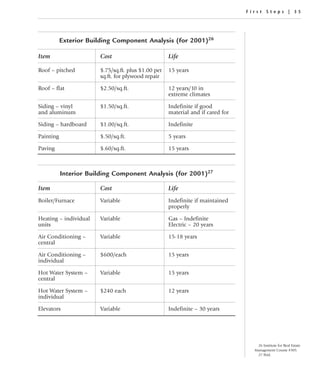
           Exterior Building Component Analysis (for 2001)26

Item                    Cost                         Life

Roof – pitched          $.75/sq.ft. plus $1.00 per   15 years
                        sq.ft. for plywood repair

Roof – flat             $2.50/sq.ft.                 12 years/10 in
                                                     extreme climates

Siding – vinyl          $1.50/sq.ft.                 Indefinite if good
and aluminum                                         material and if cared for

Siding – hardboard      $1.00/sq.ft.                 Indefinite

Painting                $.50/sq.ft.                  5 years

Paving                  $.60/sq.ft.                  15 years


           Interior Building Component Analysis (for 2001)27

Item                    Cost                         Life
Boiler/Furnace          Variable                     Indefinite if maintained
                                                     properly

Heating – individual    Variable                     Gas – Indefinite
units                                                Electric – 20 years

Air Conditioning –      Variable                     15-18 years
central

Air Conditioning –      $600/each                    15 years
individual

Hot Water System –      Variable                     15 years
central

Hot Water System –      $240 each                    12 years
individual

Elevators               Variable                     Indefinite – 30 years


                                                                                    26 Institute for Real Estate
                                                                                   Management Course #305.
                                                                                    27 Ibid.
36 | Put Your House in Order


                                         Interior Small Items Building Component Analysis28

                                Item                   Cost                 Life

                                Carpet in units        $10/sq.yd.           12 years

                                Carpet in                                   8 years
                                common areas

                                Tile in units          $10/sq.yd.           18 years

                                Tile in common areas                        12 years

                                Cabinets               $150/linear foot     18 years
                                                       minimum

                                Ranges                 $400 minimum         15 years

                                Refrigerators          $350 minimum         15 years

                                Disposals              $75                  12 years

                                Exhaust Fans           $80                  8 years

                                Dishwashers            $410 minimum         8 years

                                Washers                $410                 10 years

                                Dryers                 $300 minimum         12 years


 28 Institute for Real Estate
Management Course #305.
R I S E T O T H E S TA N DA R D

THE NEED TO COMPARE YOURSELF
The affordable housing community has agreed upon certain perform-
ance standards towards which nonprofits can strive in the way they do
business. These performance standards prompt an organization to
push itself towards optimum efficiency and financial stability.

Performance standards are not to be confused with service
delivery standards. In fact, in many cases the performance of the
asset can be hidden from tenants, who may feel well served
and satisfied with their experience in your supportive housing
facility. A program may be functioning at a high level in terms
of service delivery despite problems with performance.

To date, no special performance standards have been created just for sup-
portive housing. However, there are some documents spelling out “stan-
dards of care” for supportive housing. If you obtain these documents, you
will find some recommendations related to asset management issues that
will be worth your attention. Consult Best Picks at the back of this guide for
a listing of standards-of-care publications.

For now, supportive housing groups need to look outside their own
housing niche for performance standards. As there are, to date, no official
standards for the specialty of supportive housing, you will need to start by
consulting those of the broader field. Note those standards with which your
group is consistently out of line. Ask yourself if there is anything about the
profile of your housing that makes these standards not applicable. Consider
adopting those standards that seem relevant to the context of your work and
write them into your Asset Management Plan.
38 | Put Your House in Order


                  PERFORMANCE STANDARDS TO CONSULT


                                      Performance Standards re: Budgeting
                  a. The budget is developed annually and reviewed monthly.
                  b. An income and expense report is produced and revised monthly.
                  c. The operating budget is sufficient to cover all expenses.
                  d. Variance between spending and allocations in your annual budget is within 10%
                    for the year.
                  e. Total operating expenses are less than 90% of your income. The remaining 10%
                    of income is put into an operating reserve.
                  f. A capital reserve is maintained, equivalent to 5% to 20% of the estimated value
                    of your property.
                  g. An operating reserve is maintained, representing between 10% and 25% of the
                    annual operating budget, depending on how much cash flow is generated after
                    debt service.
                  h. A supportive service reserve is maintained, equivalent of 20% of your annual
                    supportive service budget.
                  i. Expenses incurred once or twice in a year are divided into twelve monthly
                    increments in the annual budget.


                                        Performance Standards re: Leasing
                  a. 95% of your rental units are occupied at all times.
                  b. 95% of your rents are collected from tenants by the middle of the month.
                  c. Your waiting list is updated every three months.
                  d. Five active applicants are on the waiting list for every available unit size in your
                    facility.
                  e. A unit is made ready for occupancy by maintenance in one to two days and leased
                    in another two to three days.
                  f. Management screens tenants on your waiting list before units become vacant.
                  g. Management consults references from prospective tenants’ last two housing
                    arrangements.
                  h. Average monthly turnaround time is ten to fifteen business days.
                  i. No more than 15 to 20% of units turn over in a month.
Rise to the Standard | 39


                  Performance Standards re: Maintenance
a. Every unit is inspected once a year.
b. Emergency maintenance is performed within twenty-four hours.
c. Routine maintenance is performed in three to seven business days.
d. Preventative maintenance is performed every two weeks.
e. The curb appeal of the building is superior or comparable to the surrounding properties.
f. There are monthly inspections of curb appeal.


                          Other Performance Standards
a. A capital needs study is undertaken every five years.
b. Utility consumption is monitored as well as costs.
c. Energy bills do not vary out of proportion to changes in utility rates and weather
  conditions.
d. Bills are paid within thirty days of receipt.
e. All reports are submitted within ten days of the deadline.
f. Resident satisfaction with the property and its management is assessed annually.
g. Appropriate emergency drills (e.g., fire, earthquake, tornado) occur twice a year.
40 | Put Your House in Order


                     RED FLAGS TO WATCH FOR
                     There are indicators that problems may lie ahead for your property. It is
                     helpful to have an idea which of these indicators may signal problematic
                     trends. If such trends persist, changes are needed.


                                             Indicators of Problems Ahead29
                     a. Rent collection is less than 90% of rent roll.
                     b. Accounts receivable are greater than 20% of your current assets and tenant
                       accounts receivable are greater than 50% of your total accounts receivable.
                     c. There is a growing gap between your expenses and income.
                     d. The capital reserve is less than 5% of the replacement cost of the property.
                     e. The operating reserve is less than 10% of your operating budget.
                     f. The vacancy rate is higher than acceptable.
                     g. The turnover rate is higher than acceptable.
                     h. There are an inordinate amount of maintenance costs.


 29 Bratt, p. 119.
LOOK FOR LOSSES

FIND WHERE THE MONEY GOES
The asset management approach schools you in the art of saving money.
Whether your program is financially stable or troubled, there are always
going to be areas where operations contribute to financial losses. Rather
than jumping into austerity measures in an effort to save, it is worthwhile
to first study where the money goes. Part of this process also involves
distinguishing between controllable and uncontrollable costs.

Performance indicators and benchmarks identify where you are leaching
money. Note that performance indicators are different from performance
standards discussed in the last chapter.

Using both indicators and benchmarks requires research and tracking
data. It may be easier to start with performance indicators, as no outside
information will be required. Benchmarking is a longer-term project that
would involve the cooperation of the supportive housing providers in your
community.


YOUR CHOICE OF PERFORMANCE INDICATORS
There is much to be learned from the wider nonprofit housing field
about performance indicators. Other nonprofit housing providers have
developed recommended measures for reviewing the performance of assets
over time and identifying positive and negative directional movement. You
will find many of their indicators applicable to your particular supportive
housing project(s).

Choose some measures of interest to you and set up your organization to
produce monthly reports on these particular trends. A simple Excel spread-
sheet can help you calculate and track this information. However, Local
Initiatives Support Corporation’s Track-It! software may be a more useful
tool for tracking and calculating this information. Track-It! allows you to
create charts and tables to view monthly trends and changes over time. See
Best Picks at the back of this guide for information on how to obtain it.


FIRST INDICATORS TO STUDY
A few simple calculations on a monthly basis will produce informative
indicators. These relate primarily to housing groups with income tied to
their tenancies. Some supportive housing has no reliance on occupancy to
generate income. However, if, like most housing organizations, your prop-
erty’s revenue is based on the number of units leased and/or rent contribu-
tions, try calculating the indicators described below.
42 | Put Your House in Order


                                                       Monthly Calculations30

                                                            Occupancy Rate =
                             (# days in the month x # of units) – (total vacant days for all units in the month)
                                                     # days in the month x # of units
                            This calculation is the first indicator to measure each month. It tells you the
                            percentage of actual tenant days versus the total number of potential tenant
                            days. Consider how your occupancy rate compares with the allowances built
                            into your pro forma and funding streams. Low occupancy rates affect your
                            bottom line and may signify problems with your market, an insufficient
                            waiting list, or lack of appeal of your property or service program, etc.

                                                      Average Turnaround Time =
                                        total # of days all units re-rented this month were vacant
                                                   # of units re-rented during the month
                            This calculation tells you the amount of time it takes from the day a tenant
                            vacates a unit to the day the next tenant moves in. It is an indicator of man-
                            agement efficiency. More detailed analysis could include clocking the steps
                            in between, such as the time it takes to complete inspections and make
                            them ready. Over the long term, slow turnaround is typically one of the
                            biggest drains on rental real estate.

                                                        Average Turnover =
                                          # of move-outs which took place during the month
                                                             # of units
                            Turnover is a measure of trends in tenants moving in and out of the build-
                            ing. Unless short stays are part of your program’s mission, high turnover
                            should be avoided as it creates high costs in cleaning and preparing apart-
                            ments for new tenants. A high turnover may be an early warning sign that
                            problems exist in the resident community.

                                                           Rent Collection Rate =
                                 total actual rent collected during the period – amount collected in arrears
                                                      gross potential rent – vacancy loss
                            This tally speaks to the effectiveness of management’s collection efforts and
                            policies. Many supportive housing providers choose not to pressure tenants
                            for their rent contribution. If this is your organization’s policy, track your rent
                            collection rate for a few months and calculate your losses. Then consider
                            whether those losses over the long term of five to ten years are tolerable.


  30 Gutierrez and Vogel,
pp. 2-3 to 2-9.
Look for Losses | 43


INDICATORS PARTICULAR TO SUPPORTIVE HOUSING
It may be of interest to track per-unit costs of supportive services.
Although the overall budget for support services is usually static on a
month-to-month basis, support services calculated on a per-unit (i.e., per
consumer) basis often fluctuate widely from one building to the next. Try
comparing your per-unit costs for support services with another housing
program on either a monthly or annual basis.
Comparing per-unit service delivery costs provides perspective on the
cost effectiveness of your program. If you are a provider who bills third
parties for supportive services on a per-unit basis, you have a different set of
reasons for measuring this kind of cost effectiveness. While it doesn’t affect
your bottom line to spend less on each consumer, it does improve your bar-
gaining position with parties providing reimbursement.

OTHER INDICATORS OF INTEREST
Another strategy for tracking your performance is following operating
expenses on a monthly basis and then dividing by the number of units in
your property. These are referred to as per-unit per-month costs. Those that
pertain to utilities should be broken out on a seasonal, as opposed to
monthly, basis to achieve the most relevant comparisons. For example, elec-
tric bills looked at from one summer to the next will tell you the extent of
increased savings made on air-conditioning.
Use your per-unit per-month calculations to focus your attention. After
several months of tracking this information, you may identify some indicators
that are consistently high or steadily increasing. Pay attention to those costs
that are within your power to control. After identifying your building’s prob-
lem areas, you can campaign to bring those expenses down. This information
can also be used to support requests for an increase in rental subsidies.
Heating and cooling are a primary focus for savings, both in cold parts of
the country such as the Northeast and in areas experiencing an energy crisis
such as the Northwest. For example, unanticipated heating and air-condi-
tioning costs may warrant investing in energy conservation and weatheriza-
tion projects. The results of your efforts to reduce these costs will be evident
in your ongoing collection of per-unit performance. Some utilities give
rebates for weatherization organization; check in your own community for
this potential option.


              Per-unit Per-month Operations Indicators
      a. Water/sewer expenses per unit   e. Taxes per unit
      b. Other utilities per unit        f. Overall profit per unit
      c. Maintenance costs per unit      g. Other per-unit per-month indicators that
      d. Insurance costs per unit           have relevance to your particular program
44 | Put Your House in Order


                              ANOTHER STRATEGY: BENCHMARKS
                              Yet another approach to saving money is “benchmarking” your costs.
                              This means comparing your property’s controllable costs against “bench-
                              marks” representing the average price paid industry-wide. Benchmarking is
                              used widely in private sector real estate management and is increasingly of
                              interest in nonprofit real estate as well.

                              Benchmarks are just numbers, not quality indicators. They are available
                              to help you target your energy and put your efforts into big savings. For
                              example, if benchmarks indicate that your utility costs are twice the average
                              of other supportive housing in your region, focus your energies there.
                              However, in some instances, spending more money than others do to buy a
                              lasting-quality product, such as a top-grade elevator, may produce more sav-
                              ings in the long run. So keep benchmarking data in perspective.

                              Benchmarks are also good motivators for staff to change. When present-
                              ed with data showing how something is done at a lower cost somewhere
                              else, staff gain confidence that perhaps your organization can do it cheaper
                              as well.


                                              Recommended Costs for Benchmarking31
                                      a. Total operating costs   d. Maintenance          g. Replacement
                                      b. Administrative costs    e. Property insurance     reserves
                                      c. Utilities               f. Management fees      h. Capital expenses


   31 Guitierrez and Vogel,
p. 4-2.
Look for Losses | 45


FINDING RELEVANT BENCHMARK DATA
Currently, there is no database of benchmarks for nonprofit housing.
Some national organizations are working with the Multi-Family Housing
Institute to establish such a resource sometime in the future.
                                                                                 “One of the best
Until benchmarks for nonprofit housing exist, consult community devel-
opment officials and nonprofit housing leaders for leads on local bench-         services that could
mark data or suggestions for gathering data for such a project. You may also     be provided to the
want to take a look at data supplied by the Institute for Real Estate            supportive housing
Management’s Income and Expense Exchange. See Best Picks at the back of          constituency would
this guide for how to contact them.                                              be to create a spe-
                                                                                 cialized benchmark-
Keep benchmarks in perspective. It is important to find benchmarking data
                                                                                 ing database just for
representing properties comparable to your own in size, location, and other
                                                                                 this sector of hous-
variables. For example, it is much more expensive to operate a moderately
rehabilitated building than new construction, or to gut rehabilitation. So if    ing, and then make
your building is a rehab, stick to comparing it with other rehabs.               it available to these
Additionally, don’t let benchmarks cloud your judgment about the need for        groups.”32
quality investments in your building’s infrastructure. Nonprofit housing
groups, in particular, cannot afford the maintenance costs that result from
skimping on quality.


                                                                                    32 Judith Rose, Senior
                                                                                 Program Officer, Local Ini-
                                                                                 iatives Support Corporation.
MAKE GAINS

             MORE WAYS TO MAKE AND KEEP MONEY
             Asset management requires ongoing vigilance to find money and sav-
             ings. Therefore, in addition to the strategies discussed so far in this guide
             (standards, indicators, and benchmarks), it is important to hunt for other
               clues about how to adjust your finances.

               The more money you earn and save, the better protected your program
                will be from the vagaries of your property’s future. Use your resource-
                 fulness to try to make adjustments on both sides of the financial equa-
                   tion: what you bring in and what you spend.

                    In choosing where to put your energies, recognize that your time
             is money. Before setting off in a particular direction, ask yourselves if you
             can afford the cost of paying staff for their time on such work. Is it worth
             the anticipated outcome? Furthermore, before changes are made, always
             evaluate the payoff. Cost considerations should include not only price but
             also value. In supportive housing, it is a challenge to take care of a proper-
             ty without good investments in high quality infrastructure.


                           Three Options for Financial Adjustments
                               a. Cut your operating costs.
                               b. Increase your effective gross income.
                               c. Subsidize your financing with other sources.
Make Gains | 47


CUT YOUR OPERATING COSTS33
Start your search for gains by brainstorming on how to cut your operating
costs. Consult the list below for ideas.


               Tips on Saving Administrative Costs from a
                        Housing Group in Seattle
George Osborne, a consultant to nonprofit housing development firms, finds that patroniz-
ing “big-box” supply stores such as Home Depot is not always cost-effective for affordable
housing groups. As an alternative approach, he recommends seeking out smaller vendors to
form long-term relationships. A paint store, for example, might agree to track the colors of
paint used in your building and store partially used paint for you in return for your commit-
ment to buy exclusively from them. A locksmith could track codes for all the keys in your
building in return for the same commitment. In the long run, these partnerships can save
you money by eliminating administrative functions and guaranteeing good service.


                                Staffing Cost Savings
a. Comparison shop for an affordable staff benefits package.
b. Evaluate the costs and benefits of contractual services versus paying hourly wages
   to contractors.
c. Carefully consider the level of experience needed for staff positions and avoid hiring
   overly qualified personnel who cost more.


                                Utilities Cost Savings
a. Educate tenants about energy conservation and provide incentives for them to change
   their energy-use habits.
b. Integrate energy conservation into community activities and the responsibilities of tenants.
c. Contact your utility companies and request an analysis of their rate schedule to ensure
   that you are getting the lowest possible rate.
d. Request a use audit from your utility company and use it to analyze where and how you
   are spending.
e. Ask your electric and gas companies for free energy-saving devices that may be available.
                                                                                                       33 Birute Skurdenis, “Tips
f. Upgrade windows and exterior doors for greater heat retention.                                   and Strategies for Control-
                                                                                                    ling Costs in Affordable
                                                                                                    Housing,” p. 1.
48 | Put Your House in Order


                                            Administrative Cost Savings
                  a. Refinance your mortgage to reduce debt-service costs.
                  b. Analyze your bank account for fees and interest rates. Could you save money elsewhere?
                  c. Ensure that your replacement reserve is in a longer-term, higher-interest instrument.
                  d. Consider placing all your deposits in a market-rate account.
                  e. Comparison shop for your accounting, insurance, and legal services. Look for group rates
                    on insurance and pro bono legal services.


                                              Maintenance Cost Savings
                  a. Evaluate the cost/benefit of contractual services versus hourly labor.
                  b. Regularly obtain bids on costly items such as carpet, painting, etc.
                  c. Increase recycling to save on dumpster charges.
                  d. Purchase maintenance items through catalogs or join a buyer’s club.
                  e. Purchase janitorial equipment that can withstand heavy use of multi-family properties.
                  f. Maintain a full inventory of specialty items that may be more costly to buy locally.
                  g. Encourage donations of maintenance items and solicit volunteer labor and free skilled
                    work in areas such as painting and grounds work. Try forming a partnership with a local
                    corporation, sheltered workshop, or local college for this purpose.
Make Gains | 49


INCREASE EFFECTIVE GROSS INCOME
Effective Gross Income is your ability to maximize earnings from rent
contributions. Many supportive housing providers have a pattern of main-
taining tenants who are not paying rent or who are no longer eligible or cer-
tified for the program. Such providers often believe the special circum-
                                                                                          “You can increase
stances of their residents’ lives require extra flexibility and tolerance around
lease violations.                                                                         your Effective Gross
                                                                                          Income and not con-
Residents who do not pay rent or are delinquent can cost you in several                   tradict the afford-
ways. It is important to take into account that such residents can have a dou-            able housing mission
bly negative impact if they are occupying without paying for units that could             by implementing
bring in revenue. Apart from loss of income, there is also a spillover effect             efficient manage-
from rent payments that get written off. Other residents are less likely to pay
                                                                                          ment policies and
when there is no clear and universal expectation from the owner regarding
                                                                                          procedures.”35
timely payment of rent.

If you have a low Effective Gross Income, think of the issue in terms of
costs and benefits. Is forgiving your tenants’ rent obligations creating a ben-
efit to you or to them that outweighs the costs of lost revenue?


                     The Right Place for Compassion
“Supportive housing groups need to learn to be consistent and not tolerate lease vio-
lations such as unpaid rent. Residents will stay inside the lines in an atmosphere of
consistency. Don’t let up on tenants who owe money. Every tenant should feel the
obligation of rent. It’s a mistake to try to be compassionate about rent. Put your
compassion into finding other places for a resident to live who can’t make it in your
program.”34


                                                                                             34 Mark Woeful, Property
                                                                                          Manager, Rogerson Commu-
                                                                                          nities, Boston.
                                                                                             35 David Fromm, Effecting
                                                                                          Income, p. 1. Available online:
                                                                                          www.enterprisefoundation.org.
50 | Put Your House in Order


                                                   Strategies for
                                         Increasing Effective Gross Income

                  a. Be familiar with social service supports in your community that can stabilize
                    tenancies and increase the likelihood of rent coming in.
                  b. Apply for project-based rental assistance programs to subsidize tenants’ rent
                    contributions.
                  c. Cultivate a sense of urgency for apartment lease-up and best maintenance
                    systems for preoccupancy preparations.
                  d. Arrange for “protective payee” rent contributions whereby rent is garnished
                    from entitlement checks, such as social security, and entered directly into a
                    local bank account set up for rent contributions.
                  e. Plan on avoiding evictions as a last resort, given their high costs.
                  f. Enlist a lawyer to help you perform proper and timely evictions.
                  g. Send notices of eviction at the earliest possible time. Delays in sending notices
                    cost money.
                  h. Grant yourselves permission to perform timely and efficient evictions.
                  i. Have the asset manager in your organization play the “bad guy” role with
                    collections and evictions, underscoring the significance of rent to the future
                    of the housing program.
                  j. Perform proper and timely recertification for rental subsidies if participating
                    in any public- or tax credit-financed projects.
Make Gains | 51


REFINANCE
Refinancing debt can be a tool for bringing down monthly costs.
Increasingly, supportive housing providers are using loans from private
banks in conjunction with grants to pay for their programs. Even if your
property carries no debt today, in the future, your housing group may be
forced to enter into loans, if there is a change in your existing funding or if
there is a gap that cannot be filled by other resources. Thus, all supportive
housing groups should have an idea of how to benefit from refinancing.

If you have any mortgage on your property, the asset manager should
make an annual evaluation of the desirability of refinancing based on cur-
rent interest rates and the overall benefits over a ten-year period to the prop-
erty’s financial status. It is important to figure in the fees associated with refi-
nancing.

Before entering into refinancing, put your best financial foot forward.
You can do this by “dressing up” the financial status of your property to look
its best. Suggested strategies include deferring big-ticket items so that your
balance sheet looks optimally balanced. You can also work to reduce insur-
ance, support service, or other costs that, in light of your limited income,
may appear expensive to a potential lender.


                       Know the “Five          Cs” of Refinancing36
a. Character—your overall reputation in the community.
b. Credit—your track record of repaying other loans.

c. Capacity—whether you have executed a project of similar scope.

d. Cash Flow—whether there is sufficient anticipated cash flow from the building
     to pay the debt with a cushion.

e.   Collateral—the ratio of loan to value of the building. The bank will want to know,
     if it needs to seize the property, whether it can sell it for at least 75% of the
     original price on today’s market.


                                                                                             36 Vogel.
52 | Put Your House in Order


                               SUBSIDIZE WITH FUNDRAISING
                               Private fundraising is one financial arena in which supportive housing
                               providers have an advantage. Relative to mainstream housing counterparts,
                               many supportive housing providers have strong track records with fundrais-
                               ing and capital campaigns. Perhaps the unique appeal of serving special
“The key to asset
                               needs groups has given supportive housing its advantage in this arena.
management for
supportive housing             If your organization has yet to tap into this particular capacity for suc-
groups is to under-            cess, it is essential that it explore avenues of private fundraising from foun-
stand all the subsidy          dations and individual donors. Set a goal of trying to raise at least 10 per-
and subsidy-renewal            cent of your budget from private sources. If you have already achieved this
processes and proce-           level, it may be a mistake to believe a track record of success in private
                               fundraising will continue indefinitely. Public donors can be fickle. They
dures, as well as
                               tend to change their priorities over time, and this can leave organizations
funding availability
                               vulnerable if they come to rely on these monies.
in their local area.”37

                               SUBSIDIZE WITH OTHER PUBLIC FINANCING
                               In all probability, your existing public financing structure is not ideal. If
                               you are like many supportive housing groups—Section 8 Moderate
                               Rehabilitation recipients being a lucky exception—your existing financing is
                               on a short time frame. This inherent financial uncertainty is so typical of
                               some supportive housing that it is often perceived as a necessary way of
                               doing business. Many providers seem to operate on faith that grants will be
                               renewed or that some other resource will magically come their way.

                               The only way to guard against funding instability is through proactive
                               efforts to expand financing options. In all probability, there are other
                               funding mechanisms for which your housing group would qualify. A diverse
                               funding stream may add complexity to your operations, but it will stabilize
                               your bottom line. Learning about other funding sources may also inspire
                               your organization to expand its portfolio of housing by developing new
                               programs. Such organizational growth may have a stabilizing effect on your
                               existing financial profile. To learn details about all public sources of financ-
                               ing that may apply to supportive housing and how to pursue them, see Best
                               Picks at the back of this guide.


  37 Brigitt Jandreau-Smith,
Corporation for Supportive
Housing.
Make Gains | 53


          Public Financing Sources for Supportive Housing38
a. Section 8 Housing for People with Disabilities Single Room Occupancy
b. The Supportive Housing Program
c. Project basing of Shelter Plus Care
d. Low Income Housing Tax Credit Program
e. Housing authorities’ ability to project base Section 8’s
f. Homeless Providers Grant and Per Diem Program
g. Supportive Housing for Persons with Disabilities—Section 811
h. Ryan White Comprehensive AIDS Resources Emergency Act (CARE)
i. Runaway and Homeless Youth Program, Transitional Living Program for Homeless Youth
j. Section 515: Rural Rental and Cooperative Housing
k. Health Care for the Homeless
l. Community Development Block Grant
m. HOME Investments Partnership Program
n. Housing Opportunities for Persons with AIDS (HOPWA)
o. Emergency Shelter Grants


                                                                                            38 Financing Supportive
                                                                                          Housing, AIDS Housing of
                                                                                          Washington, 2002.
54 | Put Your House in Order


                          NO OTHER WAY OUT: DISPOSITION
                            Selling your building should not occur in crisis mode. If your prop-
                            erty is troubled today or runs into trouble in the future, it is important
                           to have a framework developed ahead of time for deciding under what
                           circumstances you would sell. A panicked process for disposing of your
                          property could hurt your organization’s bottom line and your reputation
                          with funders and community members.

                          Before you sell, hunt for external solutions. If debt is a problem, call a
                          meeting with your lender to work out better terms on your loan. If the
                         financial responsibilities of the property are just too great, look for com-
                         munity partners who might assume ownership and enter into a collabora-
                        tion with you. Remember, affordable housing of any kind is an increasing-
                       ly scarce resource, so one should fight hard to preserve it.

                       Planning the criteria for the potential disposition of your property is key.
                       Each property is unique and the circumstances under which one property
                       will be disposed of will differ from the next. Once you have arrived at cir-
                       cumstances for your property’s disposition, make sure to inform the proper-
                       ty manager and other parties involved with monitoring your building.


                                  Some Circumstances for Disposing of a Property
                       a. The building consistently loses money over a three-year period.
                       b. A certain percentage of the units is consistently unoccupied.
                       c. All opportunities to refinance or restructure funding have been tried.
                       d. The owner’s subsidization of the property has reached a maximum percentage
                         of the building’s budget.
                       e. Your particular niche of supportive housing has experienced a reduction in the
                         market that does not appear to be reversing itself.


                                                  Tips for a Successful Sale39
                       a. Keep your building looking its best while trying to sell.
                       b. Hire a broker with a track record of selling property in your neighborhood.
                       c. Make clear in the marketing plans what is expected of your broker. Follow up by looking
                         for advertisements for your property in local real estate sections of newspapers, etc.
                       d. Come to the bargaining table prepared to negotiate your price but with a clear picture
                         of your bottom line.
39 Stone, p. 16.
A NEW INSTINCT


THE NEED FOR A SELF-MONITORING SYSTEM
Self-monitoring systems are a way of institutionalizing asset management
within your organization. Ideally, you will build an infrastructure of self-
monitoring systems that are guaranteed to be followed year in and year out.

Supportive housing organizations have a tendency to keep self-
monitoring a folksy, informal affair. However, supportive housing
groups need formality perhaps more than other organizations, given
their relatively high turnover rates at the managerial level, which per-
haps is a result of the demands of working with special populations.

There are two important areas for self-monitoring: the creation of inter-
nal reports and a schedule of visits to/inspections of the property itself.
Since they are essential to the asset management approach, neither of these
tasks should be left to the property manager alone.


THE BEST INTERNAL REPORTING SYSTEM
Your group already has some method for gathering information to
respond to external demands for reports. This guide has also discussed
strategies for gathering information for internal examination. Some of these
strategies lend themselves to ongoing tracking.

The asset management approach will coordinate reporting to external
parties with these internal processes of collecting information. A number
of the publications listed in Best Picks at the back of this guide include
diskettes with prototype forms that you can modify.


        Characteristics of Effective Forms and Schedules40

        a. Collects information regularly   d. Highlight issues of importance
        b. Are easily understood            e. Use consistent data forms from
        c. Are as focused and simple          internal to external reports
          as possible                       f. Are not cluttered on the page


                                                                                      40 Vogel.
56 | Put Your House in Order


                                   Contents of a High-Performance Reporting System41

                                                        Occupancy Reports
                             Weekly Reports             Incident Reports

                             Monthly or                 Monthly Asset Management Reports
                             Quarterly Reports          Rent Collection Reports
                                                        Utility Consumption Reports
                                                        Financial Statements – Balance Sheet,
                                                           Income and Expense Statement,
                                                           Accounts Payable and Receivable
                                                           Reports
                                                        Maintenance Repair Log
                                                        Waiting List Status
                                                        Work Order Status
                                                        Turnaround Time Reports

                             Annual Reports             Annual Asset Management Report
                                                        Annual Audit
                                                        Management Letters


   41 Stockard and Engler,
p. 190.
A New Instinc t | 57


CHALLENGES OF MAINTENANCE
Plan your maintenance strategy with an eye towards preserving
the property for the long term. Your goal should be to sort out the
array of tasks that need doing and to prioritize work that will preserve
the building’s longevity in the least expensive way. You want to be a good
landlord today and save the building from disrepair tomorrow.

The first step is to write out your plans for maintenance and organize
them by categories. Asset management experts recommend four categories
of maintenance plans as an effective strategy for balancing maintenance
activities between day-to-day issues and long-term care of the property. Each
plan should have its own prescribed schedule or time frame in which work-
ers must complete the associated maintenance tasks.


                    Four Categories of Maintenance
           a. Preventative Maintenance   c. Emergency Maintenance
           b. Routine Maintenance        d. Requested Maintenance


Most important is your process of prioritizing maintenance activities. In
supportive housing, you will always be trying to do more maintenance with
less staff and resources than other sectors of real estate. The only way to suc-
ceed is to keep the expensive parts of your property in good shape so they
don’t lead to repairs or require replacement. Building experts (contractors,
inspectors) can be hired as consultants to help evaluate the status of your
property on an ongoing basis.

For many groups, day-to-day requests from residents dominate mainte-
nance activities. Creating maintenance plans will help workers structure
their day so this does not occur. In general, maintenance plans add elements
of formality and detail that will increase results.
58 | Put Your House in Order


                        A WORD ON PREVENTATIVE MAINTENANCE
                        The asset management approach requires special emphasis on pre-
                        ventative maintenance. The preventative maintenance plan tells your
                        crew how each element of the building should be maintained so that it
                        gives good service over the long term. It outlines specific maintenance
                        tasks to be performed at prescribed intervals.

                         Walk through your building with a general contractor and applicable
                         subcontractors or vendors. Have them explain and demonstrate how
                    and when to inspect and perform preventative maintenance on the build-
                    ing’s equipment. Document this information in your Preventative Mainte-
                    nance Guide. If appropriate and convenient, document this walk-through
                    with a video camera to produce an additional training resource for mainte-
                    nance staff.42


                                     Building Components that Require
                                          Preventative Maintenance
                                 a. Gutters                 i. Porches and decks
                                 b. Furnace, radiators,     j. Weather protection
                                    hot water heaters       k. Trees, shrubs, landscaping,
                                 c. Air-conditioning           sprinklers
                                 d. Plumbing                l. Fire extinguishers, alarms
                                 e. Wiring                  m. Compactors, dumpsters
                                 f. Carpets, flooring       n. Elevators
                                 g. Elevators               o. Exterior walls and roof
                                 h. Security


 42 Stone, p. 10.
A New Instinc t | 59


STAY CLOSE TO YOUR BUILDING
Get out and visit your building regularly. Asset managers should consider
it their role to personally monitor the status and performance of the agency’s
properties. Inform your property manager to expect this way of doing busi-
ness and make both scheduled and unscheduled visits. The purpose of these
visits is to find clues that reveal general trends in the property’s condition
and performance.


              Recommended Building Monitoring Schedule
                      by Asset Management
a. Unit inspections annually
b. Exterior and common site visits semiannually
c. Risk management inspections annually (looking for fire hazards and inspecting
  safety features)


MAXIMUM BENEFIT FROM SITE VISITS
Site visits to your property are a quick way to study the management’s
overall performance. Conduct your visits with a list of details you plan to
examine. Learn to notice clues that your property or its immediate neigh-
borhood is vulnerable to decline or neglect and the consequential loss in
value.
60 | Put Your House in Order


                               Getting Maximum Value from a Site Visit43

                  If you find these clues…          You may have a problem with…
                  Graffiti                          Vandalism and poor security
                  Untidy grounds and trash          Lack of attention to curb appeal and
                                                    community relationships

                  Poor condition of                 Falling property values
                  neighboring properties

                  Insufficient night lighting       Lack of security

                  Excessive vehicles parked         Poor rule enforcement – residents not
                  on or near premises               on the lease or unregulated auto repairs

                  Disorganized or dirty             Inadequate housekeeping of high-
                  laundry room                      traffic areas – signaling worse condi-
                                                    tions in low-traffic areas

                  Water damage at base of gutters   Poor preventative maintenance, over-
                                                    looked seasonal gutter cleaning and
                                                    other weatherization strategies

                  Bulletin boards that are not up   Lack of communication between
                  to date or informative            tenants and management


 43 Vogel.
A New Instinc t | 61


COMMUNITY RELATIONSHIPS
There is much to be learned from affordable housing groups about
building community relationships. They have a long tradition of
maintaining close ties with the neighborhoods where their projects
are sited. In fact, their mission is often enmeshed in the health and
well-being of a neighborhood. Supportive housing is less likely to
have natural ties with its surrounding community. Typically, support-
ive housing is administered by outside groups with no reputation in
the neighborhood.

Strong connections to community protect your asset. Getting
involved with local community members and their neighborhood
groups, newspapers, banks, and city officials will build your group’s rep-
utation in the community. Such a strong reputation helps ensure that
your housing program is accepted in the neighborhood. Ultimately, it
protects the resale value of your property. Furthermore, the approval of com-
munity members looks favorable to lenders and buyers of your property.

Spend money on your building’s curb appeal. Community members will
judge your property purely upon its exterior appearance, so clean windows,
tidy grounds, landscaping, flower plantings, exterior maintenance, and good
exterior lighting are more than superficial details. They are of primary
importance to your housing group’s status in the community.

If your program is located in a distressed neighborhood, leading and par-
ticipating in efforts to improve the neighborhood are important parts of sta-
bilizing the value of your property. Crime prevention activities, neighbor-
hood clean-ups, and environmental health projects are excellent activities in
which to involve your group. In fact, this kind of neighborhood improve-
ment can increase the value of your asset by making the neighborhood more
desirable.
J U S T F O R B OA R D M E M B E R S

                 YOUR ROLE IN ASSET MANAGEMENT
                 As a member of the board of directors, you have ultimate fiscal respon-
                 sibility for the property that is used as supportive housing. In the end, its
                 financial problems are yours to solve, and its solvency gives you peace of
                 mind. Therefore, you and your fellow board members, above all other stake-
                 holders associated with your housing group, have reason to encourage the
                 practice of asset management.


                              Questions to Ask Yourself as Board Members
                 a. Do I know who the asset manager is for my organization?
                 b. Are our staff and board sufficiently skilled at asset management?
                 c. How will asset management information be communicated to me?
                 d. Do I know enough to intelligently interpret this information?
                 e. Am I confident we are doing everything we can to manage our assets?
                 f. Should additional expertise be added to the board to assure that buildings
                   are well-managed?


                          Ideas for Board Involvement in Asset Management
                 a. Conduct an educational meeting for all board members on the concepts and practices
                   of asset management.
                 b. Send at least one board member to an intensive training on asset management in the
                   affordable housing sector. See Best Picks at the back of this guide.
                 c. Appoint one board member or a subcommittee of the board to work with staff on
                   building the organization’s asset management capacity and improving its performance.
                 d. Structure an asset management update into the board’s agenda on a regular basis.
                 e. Conduct annual or biennial strategy sessions on asset management to ensure that it
                   remains one of the board’s priorities.
S O F T WA R E

NEW SOFTWARE OR NOT?
Buying new software is an appealing approach to profes-
sionalizing the way you do business. If you are like many
small supportive housing groups, you currently rely on a
combination of accounting software and Excel spread-
sheets to track budgets and other data. But you may not
be aware of the availability of more sophisticated property
management software. With mixed success, community
development corporations and other nonprofit housing
groups have been using such products for the last decade.

Unfortunately, much of the property management software available is
not the best fit for small supportive housing groups. At this time, there
                                                                                “I don’t think all
doesn’t seem to be a perfect package to recommend to the supportive hous-
ing constituency. However, there are a handful of packages that may improve     these high-flung
your asset and property management significantly. They are described in the     software packages
next pages of this guide.                                                       are going to be that
                                                                                relevant to your con-
Alternatively, you may want to stick with your current arrangements until       stituency of small
more software is created with the needs of small nonprofit housing groups       supportive housing
in mind. In the future, in all likelihood these programs will be available
                                                                                groups.” 44
online and with links between property and asset management functions. As
asset management becomes more commonplace, related functions will like-
ly appear in updates for existing software packages.


CHOOSING SOFTWARE
There are many variables to your property management software needs.
Needs vary depending on staff size and expertise, the number of properties
in your portfolio, your budget, and your need for support to understand the
software.


                                                                                   44 Judith Rose, Local
                                                                                Initiatives Support Corpo-
                                                                                ration.
64 | Put Your House in Order


                                                           Steps in Choosing Software45
                                  1. Involve your accountant in investigating some recommended software programs.
                                  2. Brainstorm with staff and determine which outputs are important to those who
                                    use your financial reports (internally and externally).
                                  3. Look for a package with a flexible report writer that can create user-defined reports
                                    by accessing every data element and can store these reports.
                                  4. Eliminate the kinds of packages that don’t meet your needs.
                                  5. Select several packages that seem appropriate and gather information about them.
                                  6. Order demonstration diskettes or limited-use versions of the software at little or no
                                    cost. These let you play with the actual program using your own data.
                                  7. Narrow down the choices.
                                  8. Get the names of other nonprofits that have used the software and call them.
                                  9. Determine if the software is easy to use and could be operated by someone with no
                                    accounting experience.


   45 LaCharla Figgs and
D. Crowley, “Accounting
Software for Community
Development Corpora-
tions,” p. 2. Available online:
www.enterprisefoundation.org.
Software | 65


SOFTWARE RECOMMENDATIONS
Track-It! Specialized Asset Management Software for Nonprofits
Available from Local Initiatives Support Corporation, Organizational Devel-
opment Initiative, 733 3rd Ave., 8th Floor, New York, NY 10017, (212) 455-
9800.
This software is a unique program designed for nonprofit housing groups to
organize and process asset management data on a monthly basis. Created by
a national intermediary housing group, it helps in crunching numbers and
preparing charts to show performance based on a handful of indicators. You
can use this software to spot problems, identify trends, and ultimately
improve performance. It is not meant to prepare information for an audit or
for other financial reports. It runs on Windows 95 using Excel 97. For those
with older versions of Excel, the diskette contains a saved version, which will
run on Excel 5 or 7. This is a separate entry system that is not coordinated
with any property management software. Therefore, groups need to manu-
ally enter data from any other software in their use.

BUILD A MANUAL: Software for Creating Your Property
Management Plan
Available from LISC, Organizational Development Initiative, 733 3rd Ave.,
8th Floor, New York, NY 10017, (212) 455-9800.
This software, designed exclusively for nonprofit real estate, will create a cus-
tomized and detailed Property Management Plan. By answering thirty-five
questions concerning the property’s operation, you construct a manual with
chapters on financial management, leasing, tenant relations, rent collection,
lease enforcement, maintenance, administration, and tax credit compliance.
This software can save you considerable money, as consultants typically
charge a lot to produce such property management plans. Also included is a
diskette with standard letters, tracking sheets, and inter-staff memos, as well
as financial, leasing, and maintenance forms, all of which are well-designed.
Perhaps most useful of all are prototypes for compiling your own handy
summaries of key information about the project. You can create a Project
Addendum for your manual that summarizes information on the history of
your project, applicable government programs and related agreements,
underwriting information, and performance standards. Such an addendum
can also summarize information on the regulations, leasing criteria, rent
limits, and reporting requirements associated with each government fund-
ing program you use.
66 | Put Your House in Order


                             TrackPro – for Low Income Housing Tax Credit Properties
                             and others
                             Available from Trackpro Services, c/o Heartland Properties, Inc. 122 W.
                             Washington Ave., Hovde Building, 6th Floor, Madison, WI 53703. Visit web
                             site: www.trackproservices.com or call (800) 742-5442.
                             A nonprofit housing group developed this Windows-based software when
                             they couldn’t find an appropriate program to meet their own in-house
                             needs. It is designed foremost for operators of tax credit-financed properties.
                             However, it has many features that would be useful to any supportive hous-
                             ing group that seeks a simple, straightforward program. TrackPro handles
                             information such as income limits, rent limits, applications, number of
                             family members, lease information, and likely violations of Low Income
                             Housing Tax Credits regulations. It also has a simple rent roll that tracks cur-
                             rent rent balances and keeps them rolling forward from month to month.
                             The next update will include assorted asset management functions. An
                             internet-enabled version of the program was scheduled to be introduced
                             late in 2001. When support is needed, users of this software deal directly
                             with nonprofit housing professionals at Heartland Properties. A feature of
                             their support services is individualized “file assessments.” If you want to
                             avoid corporate software, TrackPro may be an accessible and affordable
                             alternative.

                             YARDI: Recommended Software for any HUD-Funded Program46
                             Available from Yardi Systems, 819 Reddick Ave., Santa Barbara, CA 93103.
                             Visit web site: www.yardi.com or call (800) 866-1144.
                             This property management software is an “integrated program,” including
                             general ledger and accounts payable, along with separate property manage-
                             ment and maintenance programs that share files. It is popular among larg-
                             er nonprofit housing groups who do in-house property management. It is
                             relatively easy to use, as the interface is intuitive and easy to grasp. As one
                             of the few property management software programs that is Windows-based,
                             it is user-friendly. YARDI has a reputation of being easy to use and conven-
                             ient for data entry, and it can perform several tasks simultaneously. It has a
                             “subsidized enhanced module” that interfaces with A&M HUD Manager.

                             Other Software Packages Compatible with HUD Programs
                             CAM II Software (800) 548-6656
                             HUD Manager (800) 448-3647
                             MICROHUD www.realpage.com
   46 Murray Dropkin,
“Property Management
Software Review,” Occa-
sional Paper Series, Local
Initiatives Support Cor-
poration, Organizational
Development Initiative,
1996, p. 7.
Software | 67


OTHER TOOLS
HEWLETT-PACKARD 12C Financial Calculator
Available at any major electronic store. It retails for approximately $60.00.
This financial calculator performs math functions that are sometimes used
in financial analysis associated with asset management. It can be used to cal-
culate amortization of debt payments, depreciation of capital costs, net pres-
ent and future value, interest conversions, etc. If your property holds debt,
this calculator is essential for helping estimate the value of refinancing
options.
DO IT RIGHT THE FIRST TIME

                      ASSET MANAGEMENT STARTS IN THE DESIGN PHASE
                   To a great extent, the financial status of your housing program is
                   predetermined. The design and development phase of nonprofit
                   real estate is the best opportunity an organization will get to influ-
                   ence a building’s long-term outlook. Supportive housing groups
                   who consider long-term asset management during this stage will
                have the advantage over groups who piece their deal together by any
              means necessary.

               In creating supportive housing, a lack of long-term cash flow should
            be anticipated. This means the property needs to be highly durable and its
            components long lasting. Such an approach amounts to higher costs at the
            front end, knowing that it will be a greater challenge to replace components
            of the building as it ages. Additional wise choices, from the level of insur-
            ance purchased to the type of neighborhood where the building is located,
            will increase the long-term viability of the housing program.


                 Tips for Starting Asset Management in the Design Phase
            a. Create as many building improvements and updates as possible before occupancy.
            b. Buy only highly durable and sophisticated building components.
            c. Purchase building components that can be maintained by any party rather than those
              linked to a maintenance contract with one vendor.
            d. Invest money on exterior appearances, such as perennial shrub plantings and a
              gardening irrigation system.
            e. Upgrade old housing stock to the highest possible standard.
            f. Look for moderate- to large-scale projects, as the smaller the scale of your property,
              the more expensive it will be to manage. If your property is small, try to group its
              management with other sites.
            g. Purchase property that has a good reputation in the community. If your building has
              a troubled history, make concentrated steps to reverse its reputation.
            h. Start reserve accounts when you begin budgeting.
            i. If you choose a property in a declined neighborhood, prioritize security and durability
              in exterior elements such as fencing, alarms, etc.
BEST PICKS OF TRAININGS

Nonprofit Housing Management Specialist Course (NHMS)
Information available on the CHAM web site: www.cham.org
The NHMS course is a four-day intensive introduction to the field of asset
management for any party involved in the oversight of affordable housing.
It is offered at rotating sites across the country. While most students of this
course are associated with multi-family affordable housing, a number of
AIDS/homeless housing providers have taken the course and been satisfied
with it. Working in teams, students write a management plan for a hypo-
thetical property. They are also presented with a case study to which they
must apply the tools of asset management. Financial performance and
some number crunching round out the course.

Certified Asset and Housing Manager Program of Study
Information available on the CHAM web site: www.cham.org
For those who have completed the NHMS course and want to become excel-
lent asset managers, there is a more extensive course of study for the
Certified Asset and Housing Manager. This certification is achieved by com-
pleting eight required courses such as Nuts and Bolts of Asset Management
and Improving Income Performance. The NHMS course is a prerequisite. It
also requires taking continuing education and completing an exam. Courses
are affordable and offered across the country, mostly through the Neighbor-
hood Reinvestment Training Institutes. This program offers the only recog-
nized “asset management” designation in the affordable housing field. To
apply, one must have a college degree or work experience in the nonprofit
housing management field. CHAM has the backing of The Enterprise Foun-
dation, Local Initiatives Support Corporation, Neighborhood Reinvest-
ment, Freddie MAC, National Equity Fund, and other major players in the
affordable housing field.

Neighborhood Reinvestment Training Institutes (NRT)
Information available on the Neighbor Works web site: www.neighborworks.net
The NRT institute offers courses across the country on affordable housing
and community development. Many courses offered at the institute fulfill
requirements for becoming a Certified Housing and Asset Manager.

Minority Managers Training Institute
Massachusetts Housing Finance Agency, One Beacon Street, Boston, MA 02109,
(617) 854-1029.
This is a year-long combination of classroom and internship placements
that prepares minority individuals for a career in the nonprofit property
management/development field. Stipend provided.
70 | Put Your House in Order


                  National Center for Housing Management Certification Program
                  1275 K Street NW, Washington, DC 20005, (202) 872-1717.
                  This congressionally-chartered nonprofit provides training on housing
                  management. A certification program is offered as part of its wide range of
                  course offerings.

                  Institute of Real Estate Management Designation (IREM)
                  Information available on the web site: www.irem.org
                  IREM offers courses and certification much like the NHMS and CHAM pro-
                  grams but targeted to the private sector. While all training may not apply to
                  the nonprofit context, IREM does have a greater variety of courses than the
                  nonprofit training groups. Courses of interest may include Turning
                  Troubled Properties into Valuable Real Estate Assets and Writing and Using
                  Property Management Plans. The seminars are offered at every skill level
                  and in many major metropolitan areas.

                         Home Study: Turning Troubled Properties into Profitable
                         Real Estate Assets
                         Information available on the web site: www.irem.org
                         This is a home-study course to help turn around properties that are
                         losing money. The course shows you how to identify strategies for
                         achieving the fullest financial potential of real estate. Course materi-
                         als can be saved as reference guides for ongoing use. Requires that
                         you have a Hewlett-Packard Financial Calculator.

                         Home Study: Measuring Performance of Real Estate
                         Assets
                         Information available on the web site: www.irem.org
                         This is a home-study course designed to teach the fiscal analysis
                         skills needed to maximize the long-term value of real estate. With
                         this home-study course, you will focus on a variety of techniques for
                         evaluating financial performance and then turn theory into practice
                         by applying your skills. Requires that you have a Hewlett-Packard
                         Financial Calculator.
BEST PICKS OF GUIDES & REPORTS

Roles and Responsibilities of the Asset Manager
Occasional Paper Series, 1997
Available from Local Initiatives Support Corporation, Organizational Development
Initiative, 733 3rd Ave., 8th Floor, New York, NY 10017 (212) 455-9800.
This short, concise booklet quickly defines the roles and responsibilities of
the asset manager at each stage of a property’s life—from development
through disposition. AIDS/homeless housing groups could circulate this
quick read through their organization to educate staff and board about asset
management concepts. Basically, it details the broad range of activities per-
formed by the asset manager. The paper also includes a computer diskette
containing checklists, forms, and schedules that can be used to complete
many of the asset manager’s tasks.

A Guide to Comprehensive Asset and Property Management:
Manual for Building Communities through Good Asset and
Property Management
Second Edition, 1997
Available from LISC, Organizational Development Initiative, 733 3rd Ave.,
8th Floor, New York, NY 10017, (212) 455-9814.
This lengthy (250 pages) guide is a thorough description and how-to man-
ual on property and asset management in nonprofit real estate. Its sugges-
tions go beyond basic rent collection and lease enforcement. Considerable
attention is given to the double bottom line of the property’s financial
health and the well-being of residents. It is based on the assumption that
these two interests can reinforce one another. Of note are ideas on how to
engage residents in the management of a property. This book will be very
useful for gleaning ideas on how to raise your standards for asset and prop-
erty management. It may also be useful for lenders to help them assess the
management of the AIDS housing in which they are invested.
72 | Put Your House in Order


                  Confronting the Management Challenge: Affordable Housing
                  in the Nonprofit Sector
                  Rachel Bratt, New School for Social Research
                  Available from the Community Development Research Center at the
                  New School for Social Research, (212) 229-5404.
                  This is an interesting and substantial report of the findings of a New School
                  for Social Research team that took an in-depth look at thirty-four nonprof-
                  it housing properties in six U.S. cities. The report examines how nonprofits
                  handle the responsibility of being owners. It looks at issues such as their
                  decisions to self-manage or contract out, and management of their assets. It
                  also examines indicators of management performance. This comprehensive
                  report would be useful to anyone researching background and trends in the
                  nonprofit sector and how the need for asset management became apparent.
                  For technical assistance organizations, researchers, and students, this report
                  is a provocative analysis of the long-term viability of affordable housing.

                  Selecting a Management Firm: Workbook and Sample Forms
                  Occasional Paper Series, November, 1996
                  Available from LISC, Organizational Development Initiative, 733 3rd Ave.,
                  8th Floor, New York, NY 10017, (212) 455-9800.
                  Whether or not to manage your property in-house or hire a property man-
                  agement firm is a key decision in asset management. This workbook out-
                  lines the key steps for selecting the right company. It tells you how to use a
                  competitive process and how to avoid common pitfalls. The inclusion of
                  sample documents, questionnaires, checklists, and forms on computer
                  diskettes makes them easy to use and modify.

                  Asset Management Training Curriculum
                  Available from LISC, Organizational Development Initiative, 733 3rd Ave.,
                  8th Floor, New York, NY 10017, (212) 455-9800.
                  This volume is used in national training about asset management. For
                  AIDS/homeless housing providers who cannot enroll in such a course but
                  want more hands-on ideas for learning asset management, this could be
                  used as an independent study tool. Staff groups could review the materials
                  together. The manual contains the most frequently requested modules from
                  LISC’s courses including: Elements of Asset Management, the Initial Pro
                  Forma, Building a Property Management Plan, Contracting Out vs. Manag-
                  ing for Yourself, Performance Standards, Reporting and Monitoring, Asset-
                  Based Budgeting, Financial Workouts, Roles for Board and Staff.
Best Picks of Guides and Repor ts | 73


Should We Do it Ourselves or Hire Someone Else? A Rural
Property Management Planning Guide
Available from the Housing Assistance Corporation, Washington, D.C.,
(202) 842-8600.
This guide is especially designed for rural nonprofits that are deciding
between in-house property management and outsourcing. The guide ana-
lyzes the issues in depth. It is not a detailed guide to property management
itself.

A Guide for the Management of Low Income Housing Tax Credits
Available from CHAM, 10227 Wincopin Circle, Suite 500, Columbia,
MD 21044-3400, www.cham.org.
This guide and accompanying video provide an overview of compliance
issues mandated by the Low Income Housing Tax Credit Program. For staff
managing AIDS/homeless housing developed with tax credits, this publica-
tion is a good tool for orientating oneself to this notoriously complex pro-
gram. It includes a concise description of the tax credit program and its basic
requirements. It also contains eligibility predetermination checklists and
forms necessary for compliance with reporting and monitoring.

Tips and Strategies for Controlling Costs in Affordable Housing
Birute Skurdenis
Available from CHAM, 10227 Wincopin Circle, Suite 500, Columbia, MD
21044-3400, www.cham.org.
This lengthy article discusses ideas for property managers to use in control-
ling costs in affordable housing administration, utilities, maintenance, laun-
dry, taxes, insurance, and staffing.

Outline of a Residential Property Management Plan
Available from The Enterprise Foundation, 10227 Wincopin Circle,
Suite 500, Columbia, MD 21044-3400, www.enterprisefoundation.org.
This is an outline for developing a residential property management plan. It
was adopted from a “fill-in-the-blanks” form used in property management
training, which has been offered by The Enterprise Foundation.
74 | Put Your House in Order


                  Successful Residential Management for Professionals Guide
                  Barbara Holland
                  Available from The Institute of Real Estate Management, 430 N. Michigan Ave.,
                  Chicago, IL 60611, (800) 837-0706, www.irem.org.
                  This textbook is used in training residential site managers who work in pri-
                  vate sector residential real estate. It may be useful to larger AIDS housing
                  organizations that are building their own in-house property management
                  capacity. Although there is little mention of low-income housing manage-
                  ment, it covers a wide range of property management basics. It moves from
                  big concepts such as maximizing the bottom line to nitty-gritty details on
                  day-to-day matters.

                  Effecting Income
                  David Fromm
                  Can be downloaded from The Enterprise Foundation web site:
                  www.enterprisefoundation.org.
                  This article focuses on ways that managers can have an impact on the rev-
                  enue of projects. It discusses “downtime,” efficient rent collection and evic-
                  tion proceedings, and rectification (relative to tax credit properties).

                  Cost-Reduction Ideas for Rental Housing Property Management
                  Can be downloaded from The Enterprise Foundation web site:
                  www.enterprisefoundation.org.
                  This brief document, adapted from one used by the Development Training
                  Institute, lists a number of cost-saving ideas for operation of rental properties.

                  Collection of Asset Management Articles
                  Available from IREM, 430 N. Michigan Ave., Chicago, IL 60611,
                  (800) 837-0706, www.irem.org.
                  This collection of articles teaches techniques for interacting with institu-
                  tional investors and creating an asset management plan.
Best Picks of Guides and Repor ts | 75


Enhancing Residential Property Value
Can be downloaded from The Enterprise Foundation web site:
www.enterprisefoundation.org.
Best new ideas for containing costs and keeping residents satisfied.

Financing Supportive Housing
Available from AIDS Housing of Washington, 2014 East Madison,
Suite 200, Seattle, WA 98122, (206) 322-9444.
Available on their web site: www.aidshousing.org.

Doing it Best: The Practice of HIV Supportive Housing
Available from AIDS Housing Corporation, 29 Stanhope Street, Boston,
MA 02116, (617) 927-0088, www.ahc.org.
This document outlines standards of care for supportive housing practice.
Although it is written for HIV housing programs, it has relevance to all spe-
cial needs housing.
BEST PICKS OF WEB SITES

            The Consortium for Housing and Asset Management (CHAM)
            10227 Wincopin Circle, Suite 500, Columbia, MD 21044-3400.
            www.cham.org
            CHAM is a consortium that specializes in training on asset management in
            the affordable housing arena. Its work is a collaboration of The Enterprise
            Foundation, the Local Initiatives Support Corporation, and the
            Neighborhood Reinvestment Corporation. No longer a self-standing organ-
            ization, CHAM now has an asset management specialist on staff with each
            of the three collaborators. Its web site has up-to-date information on the
            introductory and advanced asset management training sponsored by this
            group. Also on the site are useful prototype forms for asset management
            and property management that can be downloaded. In the future, the site
            will provide examples of how groups have used asset management to their
            benefit. Staff members travel extensively and may not be easily accessible by
            phone. Nevertheless, CHAM is an essential resource to be explored through
            its web site, trainings, and national conference. Presently, CHAM has five
            training regions.

            Neighbor Works Network
            1325 G Street NW, Suite 800, Washington, DC 20005, (202) 220-2300.
            www.neighborworks.net
            The Neighbor Works Network web site is a clearinghouse of information
            pertaining to educational services offered by the Neighborhood
            Reinvestment Corporation, Neighborhood Housing Services of America,
            and a national network of public and private partnerships. Most impor-
            tantly, this web site has up-to-date information on all upcoming
            Neighborhood Reinvestment Training Institutes. The NRT Institute is the
            source for a majority of the advanced courses pertaining to asset manage-
            ment-related topics for the nonprofit housing sector.
Best Picks of Web Sites | 77


The Enterprise Foundation
10227 Wincopin Circle, Suite 500, Columbia, MD 21044-3400
www.enterprisefoundation.org.
The Enterprise Foundation is a national leader in nonprofit affordable hous-
ing and community development. Its extensive web site has many features
that may be useful to those seeking information on specific aspects of asset
management. Searching the resource database will give you citations and, in
some cases, full text of articles on the topic. Also of interest is the Enterprise
Money net push button that provides extensive up-to-date information on
financing sources for affordable housing.

The Institute for Real Estate Management (IREM)
430 N. Michigan Ave., Chicago, IL 60611, (800) 837-0706.
www.irem.org.
IREM is the primary clearinghouse organization for training in private sec-
tor property and asset management. IREM provides national training, certi-
fication, publications, and conferences. Local chapters are located through-
out the United States.

National Assisted Housing Management Association (NAHMA)
526 King Street, Suite 511, Alexandria, VA 22314, (703) 683-8630.
www.nahma.org.
NAHMA is a membership organization of property management agents
managing affordable housing, with an emphasis on HUD-subsidized pro-
grams. Regional chapters are located throughout the United States.
B E S T P I C K S O F P RO T O T Y P E F O R M S

                  Roles and Responsibilities of the Asset Manager
                  Occasional Paper Series, December 1997.
                  Available from Local Initiatives Support Corporation, Organizational Development
                  Initiative, 733 3rd Ave., 8th Floor, New York, NY 10017, (212) 455-9800.
                  Forms include:
                  • Summary of Loan, Grant, Subsidy Terms and Requirements
                  • Project Regulatory Compliance and Monitoring Schedule
                  • Property Insurance Coverage Schedule
                  • Management Monitoring Schedule
                  • Estimated Replacement Costs of Capital Items
                  • Annual Replacement Reserves Cash Flow Details
                  • Performance Standard Worksheet

                  A Guide to Comprehensive Asset and Property Management:
                  Manual for Building Communities through Good Asset and
                  Property Management
                  Second Edition, 1997.
                  Available from LISC, Organizational Development Initiative, 733 3rd Ave.,
                  8th Floor, New York, NY 10017, (212) 455-9800.
                  Forms include:
                  • Maintenance Job Descriptions
                  • Staff Evaluation Forms
                  • Maintenance Monitoring Sheets
                  • Quality Control Inquiry
                  • Sample Financials
                  • Vacancy Log
                  • Rent Delinquency Report
                  • Maintenance Monitoring Worksheet
Best Picks of Prototype Forms | 79


Selecting a Management Firm: Workbook and Sample Forms
Occasional Paper Series, November 1996.
Available from LISC, Organizational Development Initiative, 733 3rd Ave.,
8th Floor, New York, NY 10017, (212) 455-9800.
Forms include:
• Selection Process Calendar Workplan
• Sample Request for Proposal for Property Management Services
• Firm Qualification Questionnaire
• Management Fee Bid Form
• Reference Questionnaire
• Resident Satisfaction Questionnaire
• Firm Interview Outline
• Management Firm Scoring Form

Track-It! Specialized Asset Management Software for Nonprofits
Available from LISC, Organizational Development Initiative, 733 3rd Ave.,
8th Floor, New York, NY 10017, (212) 455-9800.
• Monthly Asset Management Report

A Guide for the Management of Low Income Housing Tax
Credits
Available from CHAM, 10227 Wincopin Circle, Suite 500, Columbia, MD 21044-
3400, www.cham.org.
• Eligibility Predetermination Checklists
• Forms for Compliance with Reporting and Requirements

Guidebook: Supportive Housing Asset Management

  • 1.
    Put Your House inOrder Securing Your Supportive Housing Program’s Future through Effective Asset Management AIDS HOUSING OF WASHINGTON S E AT T L E 2 0 0 2
  • 2.
    CONTENTS Acknowledgements . . . . . . . . . . . . . . . . . . . . . . . . . . . . . . . . . . . . . . . . . . . . . . . . . . . . . . . . . . . 4 Preface . . . . . . . . . . . . . . . . . . . . . . . . . . . . . . . . . . . . . . . . . . . . . . . . . . . . . . . . . . . . . . . . . . . . . . . . . . . . 5 Welcome . . . . . . . . . . . . . . . . . . . . . . . . . . . . . . . . . . . . . . . . . . . . . . . . . . . . . . . . . . . . . . . . . . . . . . . . . . 6 SHOULD YOU READ THIS GUIDE? . . . . . . . . . . . . . . . . . . . . . . . . . . . . . . . . . . . . . . . . . . . . . . . . . . . . . 6 WHAT WILL YOU LEARN? . . . . . . . . . . . . . . . . . . . . . . . . . . . . . . . . . . . . . . . . . . . . . . . . . . . . . . . . . . . . . . 6 HOW SHOULD YOU USE THIS GUIDE? . . . . . . . . . . . . . . . . . . . . . . . . . . . . . . . . . . . . . . . . . . . . . . . . 7 CAN YOU AFFORD TO WAIT? . . . . . . . . . . . . . . . . . . . . . . . . . . . . . . . . . . . . . . . . . . . . . . . . . . . . . . . . . . 7 Introduction . . . . . . . . . . . . . . . . . . . . . . . . . . . . . . . . . . . . . . . . . . . . . . . . . . . . . . . . . . . . . . . . . . . . . 8 WHAT DOES ASSET MANAGEMENT MEAN? . . . . . . . . . . . . . . . . . . . . . . . . . . . . . . . . . . . . . . . . 8 WHY DOES SUPPORTIVE HOUSING NEED ASSET MANAGEMENT? . . . . . . . . . . . . . . . . . 9 WHAT DOES THE JOB ENTAIL? . . . . . . . . . . . . . . . . . . . . . . . . . . . . . . . . . . . . . . . . . . . . . . . . . . . . 10 HOW IS IT NOT PROPERTY MANAGEMENT? . . . . . . . . . . . . . . . . . . . . . . . . . . . . . . . . . . . . . . . 11 SUPPORTIVE HOUSING—ADVANTAGED OR DISADVANTAGED? . . . . . . . . . . . . . . . . . . . . . . 12 Before You Start . . . . . . . . . . . . . . . . . . . . . . . . . . . . . . . . . . . . . . . . . . . . . . . . . . . . . . . . . . . . . . . . 13 DEFINE YOUR ASSET MANAGEMENT GOAL . . . . . . . . . . . . . . . . . . . . . . . . . . . . . . . . . . . . . . . . 13 START TO THINK LIKE A BUSINESS . . . . . . . . . . . . . . . . . . . . . . . . . . . . . . . . . . . . . . . . . . . . . . . . 14 ANSWER SOME BASIC QUESTIONS . . . . . . . . . . . . . . . . . . . . . . . . . . . . . . . . . . . . . . . . . . . . . . . . 15 FIND A LITTLE MONEY TO START . . . . . . . . . . . . . . . . . . . . . . . . . . . . . . . . . . . . . . . . . . . . . . . . . . 16 FIND MORE MONEY AS YOU GO . . . . . . . . . . . . . . . . . . . . . . . . . . . . . . . . . . . . . . . . . . . . . . . . . . . 17 DELEGATE ASSET MANAGEMENT RESPONSIBILITY . . . . . . . . . . . . . . . . . . . . . . . . . . . . . . . . . 18 PLAN FOR ASSET MANAGEMENT TO BE TAKEN SERIOUSLY . . . . . . . . . . . . . . . . . . . . . . . . . 20 First Steps . . . . . . . . . . . . . . . . . . . . . . . . . . . . . . . . . . . . . . . . . . . . . . . . . . . . . . . . . . . . . . . . . . . . . . . . 21 EDUCATE YOURSELF . . . . . . . . . . . . . . . . . . . . . . . . . . . . . . . . . . . . . . . . . . . . . . . . . . . . . . . . . . . . . . 21 HOLD A MEETING . . . . . . . . . . . . . . . . . . . . . . . . . . . . . . . . . . . . . . . . . . . . . . . . . . . . . . . . . . . . . . . . 21 START A BINDER . . . . . . . . . . . . . . . . . . . . . . . . . . . . . . . . . . . . . . . . . . . . . . . . . . . . . . . . . . . . . . . . . . 22 WHAT GOES IN AN ASSET MANAGEMENT PLAN? . . . . . . . . . . . . . . . . . . . . . . . . . . . . . . . . . . 23 SPECIAL WORDS ABOUT THE PROPERTY MANAGEMENT PLAN . . . . . . . . . . . . . . . . . . . . . . 24 EVALUATE YOUR PROPERTY MANAGER . . . . . . . . . . . . . . . . . . . . . . . . . . . . . . . . . . . . . . . . . . . . 27 IF YOU CONTRACT OUT PROPERTY MANAGEMENT . . . . . . . . . . . . . . . . . . . . . . . . . . . . . . . . 28 GET ORGANIZED . . . . . . . . . . . . . . . . . . . . . . . . . . . . . . . . . . . . . . . . . . . . . . . . . . . . . . . . . . . . . . . . . 29 START RESERVE ACCOUNTS . . . . . . . . . . . . . . . . . . . . . . . . . . . . . . . . . . . . . . . . . . . . . . . . . . . . . . . 31 PLANNING YOUR CAPITAL RESERVE . . . . . . . . . . . . . . . . . . . . . . . . . . . . . . . . . . . . . . . . . . . . . . . 33 Rise to the Standard . . . . . . . . . . . . . . . . . . . . . . . . . . . . . . . . . . . . . . . . . . . . . . . . . . . . . . . . . 37 THE NEED TO COMPARE YOURSELF . . . . . . . . . . . . . . . . . . . . . . . . . . . . . . . . . . . . . . . . . . . . . . . 37 PERFORMANCE STANDARDS TO CONSULT . . . . . . . . . . . . . . . . . . . . . . . . . . . . . . . . . . . . . . . . 38 RED FLAGS TO WATCH FOR . . . . . . . . . . . . . . . . . . . . . . . . . . . . . . . . . . . . . . . . . . . . . . . . . . . . . . . 40
  • 3.
    Contents | 3 Lookfor Losses ................................................................ 41 FIND WHERE THE MONEY GOES . . . . . . . . . . . . . . . . . . . . . . . . . . . . . . . . . . . . . . . . . . . . . . . . . . 41 YOUR CHOICE OF PERFORMANCE INDICATORS . . . . . . . . . . . . . . . . . . . . . . . . . . . . . . . . . . . 41 FIRST INDICATORS TO STUDY . . . . . . . . . . . . . . . . . . . . . . . . . . . . . . . . . . . . . . . . . . . . . . . . . . . . . 41 INDICATORS PARTICULAR TO SUPPORTIVE HOUSING . . . . . . . . . . . . . . . . . . . . . . . . . . . . . . 43 OTHER INDICATORS OF INTEREST . . . . . . . . . . . . . . . . . . . . . . . . . . . . . . . . . . . . . . . . . . . . . . . . 43 ANOTHER STRATEGY: BENCHMARKS . . . . . . . . . . . . . . . . . . . . . . . . . . . . . . . . . . . . . . . . . . . . . . 44 FINDING RELEVANT BENCHMARK DATA . . . . . . . . . . . . . . . . . . . . . . . . . . . . . . . . . . . . . . . . . . . 45 Make Gains . . . . . . . . . . . . . . . . . . . . . . . . . . . . . . . . . . . . . . . . . . . . . . . . . . . . . . . . . . . . . . . . . . . . . . 46 MORE WAYS TO MAKE AND KEEP MONEY . . . . . . . . . . . . . . . . . . . . . . . . . . . . . . . . . . . . . . . . . 46 CUT YOUR OPERATING COSTS . . . . . . . . . . . . . . . . . . . . . . . . . . . . . . . . . . . . . . . . . . . . . . . . . . . . 47 INCREASE EFFECTIVE GROSS INCOME . . . . . . . . . . . . . . . . . . . . . . . . . . . . . . . . . . . . . . . . . . . . . 49 REFINANCE . . . . . . . . . . . . . . . . . . . . . . . . . . . . . . . . . . . . . . . . . . . . . . . . . . . . . . . . . . . . . . . . . . . . . . . 51 SUBSIDIZE WITH FUNDRAISING . . . . . . . . . . . . . . . . . . . . . . . . . . . . . . . . . . . . . . . . . . . . . . . . . . . 52 SUBSIDIZE WITH OTHER PUBLIC FINANCING . . . . . . . . . . . . . . . . . . . . . . . . . . . . . . . . . . . . . . 52 NO OTHER WAY OUT: DISPOSITION . . . . . . . . . . . . . . . . . . . . . . . . . . . . . . . . . . . . . . . . . . . . . . . 54 A New Instinct . . . . . . . . . . . . . . . . . . . . . . . . . . . . . . . . . . . . . . . . . . . . . . . . . . . . . . . . . . . . . . . . . . 55 THE NEED FOR A SELF-MONITORING SYSTEM . . . . . . . . . . . . . . . . . . . . . . . . . . . . . . . . . . . . . 55 THE BEST INTERNAL REPORTING SYSTEM . . . . . . . . . . . . . . . . . . . . . . . . . . . . . . . . . . . . . . . . . 55 CHALLENGES OF MAINTENANCE . . . . . . . . . . . . . . . . . . . . . . . . . . . . . . . . . . . . . . . . . . . . . . . . . . 57 A WORD ON PREVENTATIVE MAINTENANCE . . . . . . . . . . . . . . . . . . . . . . . . . . . . . . . . . . . . . . . 58 STAY CLOSE TO YOUR BUILDING . . . . . . . . . . . . . . . . . . . . . . . . . . . . . . . . . . . . . . . . . . . . . . . . . . 59 MAXIMUM BENEFIT FROM SITE VISITS . . . . . . . . . . . . . . . . . . . . . . . . . . . . . . . . . . . . . . . . . . . . . 59 COMMUNITY RELATIONSHIPS . . . . . . . . . . . . . . . . . . . . . . . . . . . . . . . . . . . . . . . . . . . . . . . . . . . . . 61 Just For Board Members . . . . . . . . . . . . . . . . . . . . . . . . . . . . . . . . . . . . . . . . . . . . . . . . . . . . 62 YOUR ROLE IN ASSET MANAGEMENT . . . . . . . . . . . . . . . . . . . . . . . . . . . . . . . . . . . . . . . . . . . . . . 62 Software . . . . . . . . . . . . . . . . . . . . . . . . . . . . . . . . . . . . . . . . . . . . . . . . . . . . . . . . . . . . . . . . . . . . . . . . . . 63 NEW SOFTWARE OR NOT? . . . . . . . . . . . . . . . . . . . . . . . . . . . . . . . . . . . . . . . . . . . . . . . . . . . . . . . . 63 CHOOSING SOFTWARE . . . . . . . . . . . . . . . . . . . . . . . . . . . . . . . . . . . . . . . . . . . . . . . . . . . . . . . . . . . 63 SOFTWARE RECOMMENDATIONS . . . . . . . . . . . . . . . . . . . . . . . . . . . . . . . . . . . . . . . . . . . . . . . . . 65 OTHER TOOLS . . . . . . . . . . . . . . . . . . . . . . . . . . . . . . . . . . . . . . . . . . . . . . . . . . . . . . . . . . . . . . . . . . . . 67 Do it Right the First Time . . . . . . . . . . . . . . . . . . . . . . . . . . . . . . . . . . . . . . . . . . . . . . . . . . 68 ASSET MANAGEMENT STARTS IN THE DESIGN PHASE . . . . . . . . . . . . . . . . . . . . . . . . . . . . . . 68 Best Picks of Trainings . . . . . . . . . . . . . . . . . . . . . . . . . . . . . . . . . . . . . . . . . . . . . . . . . . . . . . 69 Best Picks of Guides and Reports . . . . . . . . . . . . . . . . . . . . . . . . . . . . . . . . . . . . . . . 71 Best Picks of Web Sites . . . . . . . . . . . . . . . . . . . . . . . . . . . . . . . . . . . . . . . . . . . . . . . . . . . . . 76 Best Picks of Prototype Forms . . . . . . . . . . . . . . . . . . . . . . . . . . . . . . . . . . . . . . . . . . . 78
  • 4.
    AC K NOW L E D G M E N T S AIDS Housing of Washington would like to thank the author, Kristina Hals, for her diligent research and invaluable expertise in the creation of this guide. We would also like to thank asset management experts David Fromm of The Enterprise Foundation and Judith Rose of the Local Initiatives Support Corporation for their invaluable advice regarding the content of this guide. The research, development, and publication of this manual was funded by the Housing Opportunities for Persons with AIDS (HOPWA) National Technical Assistance Program in partnership with the U.S. Department of Housing and Urban Development’s Office of HIV/AIDS Housing. The substance and findings of the work are dedicated to the public. The author and publisher are solely responsible for the accuracy of the statements and interpretations contained in this publication. Such interpretations do not necessarily reflect the views of the Government.
  • 5.
    P R EFAC E “Be careful what you wish for. Now that you have created housing, you have the responsibility of owning and managing property. If you are going to be a landlord, then you should be a good landlord. As a nonprofit, you don’t have the financial cushion to do this work badly. Asset management of your property is going to be a very significant enterprise. People who are in your housing are dependent on you to hit your targets.”1 – John Vogel, Expert on Asset Management in Affordable Housing 1. Amos Tuck School of Business, Dartmouth College, Lecture at Lincoln Filenes Institute on Com- munity Development, Medford, MA, 1999.
  • 6.
    WELCOME SHOULD YOU READ THIS GUIDE? This guide is intended for anyone with a role in managing supportive housing. By “supportive housing,” we mean residences targeted to persons with special needs such as HIV/AIDS, mental illness, substance abuse, and other conditions that frequently occur with homelessness. Typically, such READERS OF settings combine housing with “supportive” services to stabilize and insure THIS GUIDE the well-being of residents. If your group owns real estate that is used to house and support special populations in this manner, this guide is written • AIDS Housing with you in mind. Providers If you simply lease property for your housing program, this guide will be an • Supportive Housing education in the long-term issues to anticipate, should your organization Groups buy its own real estate in the future. • Property Managers of Others who may have an interest are property managers associated with Supportive Housing supportive housing and contract managers or underwriters working for • Boards of Directors for institutions with financial investments in supportive housing. Supportive Housing WHAT WILL YOU LEARN? • Contract Managers of The material presented here is an introduction to basic concepts of asset Supportive Housing management. It translates practices from the more mainstream field of • Underwriters of affordable housing to the specialized context of supportive housing. Supportive Housing It encourages supportive housing professionals to step outside their tradi- • Staff of Supportive tional vantage point of measuring success in the exclusive terms of today’s Housing tenants’ well-being. It includes specifics about predicting trends in your property’s finances, operating more efficiently, using systems and tools to improve operations, and tracking financial indicators. In general, the guide provides ideas on how to think and operate more like a business. It also presents the argument for why an asset management approach is necessary to protect the long-term availability of supportive housing. Asset management should not be mistaken for property management. Although it may take some convincing on our part, you will learn to distin- guish between these two different aspects of managing a property. Aspects of property management are discussed in the guide but only insofar as they intersect with ideas about asset management. For those looking for a guide with more substance about property management, recommended resources on this topic are listed in the Best Picks section at the back of this guide.
  • 7.
    Welcome | 7 HOWSHOULD YOU USE THIS GUIDE? First, browse this guide for the big picture of what asset management means. Then, go back and read topics that appear to be realistic first steps— or next steps—for your organization to begin asset management. Review other parts of the guide with the expectation that you will not accomplish all tasks at once. Expect to gradually build your asset management program over time. Consult references at the back of the guide. At the back of this guide are numerous Best Picks that you can access for additional information related to your particular supportive housing program. There is a wealth of publications on individual aspects of asset management; look for materials specific to your particular housing group, whether you operate in a rural community, are financed by low income housing tax credits, or function as your own proper- ty management company. Worth exploring are the listings of trainings on asset management just for nonprofit housing groups. As a next step after read- ing this guide, consider educating a staff or board representative to become your in-house expert. Share this guide with colleagues. Once you are convinced of the need for an asset management approach, spread the word. The more that AIDS housing and supportive housing promote asset management, the better understood will be requests for financial resources to carry it out. Bringing this guide to the attention of supportive housing colleagues and board members, both inside and outside your organization, will help the AIDS housing and supportive housing communities develop long-term strategies for staying in business. CAN YOU AFFORD TO WAIT? Asset management is not a rainy day project. Those who have studied trends in the long-term stability of affordable housing indicate that asset management is an urgent agenda for all nonprofit housing groups.2 Research shows that if housing groups wait to introduce their organization to asset management, problems affecting financial performance may gradually grow to the point where they can’t be reversed quickly, or at all. Pursue both agendas of creating and preserving housing with equal com- mitment. Historically, there has been strong emphasis on creating affordable housing. By comparison, preserving housing owned by nonprofit groups has received relatively little attention. The concept of asset management is an attempt to balance these two equally important agendas. It needs to be applied to every sector of affordable housing. Follow the lead of affordable housing groups doing asset management. 2. Rachel Bratt, Confront- ing the Management Chal- Traditionally, supportive housing groups have not identified closely with the lenge: Affordable Housing in wider affordable housing movement. However, asset management is an agen- the Nonprofit Sector. New School for Social Research, da where supportive housing has considerable common ground with the rest 1994, p. 204. Available from of the country’s affordable housing organizations. Supportive housing groups the Community Develop- ment Research Center at should seek out opportunities to gain knowledge, resources, and momentum the New School for Social on asset management generated by mainstream housing groups. Research.
  • 8.
    I N TRO D U C T I O N WHAT DOES ASSET MANAGEMENT MEAN? Asset management is in favor with today’s government funders and housing groups nationwide. It is a concept that is borrowed from private sector real estate and is increasingly relevant to nonprofit providers of low- income housing. Yet, despite its growing popularity, asset management is “Asset management poorly understood. Often confused with property management, few groups involves planning for know what asset management might involve for them or how they could the long-term con- apply it. Supportive housing providers, particularly smaller organizations cern for bricks and with backgrounds primarily in social services, AIDS care, or homeless pro- mortar...the long- grams, seem least likely of all to know about asset management. term economic and physical viability of The term “asset” refers to a piece of real estate that has current and future value. The asset management approach asks that you consider the proper- the building.”3 ties you use for supportive housing in terms of their monetary value. Asset management means taking the long view—meaning the next ten to fifteen years—of whether your property’s value is stable, growing, or decreasing. “The group’s horizon The idea is that things you do today will set the stage for financial perform- for planning, budget- ance tomorrow. ing, and monitoring must be extended Conventionally focused on the short term, AIDS housing and supportive housing groups in particular need to shift their perspective if they are to into the future. We adopt this long-term approach. Ultimately, the asset management mentali- need to do things ty translates into concrete practices and policies that will protect and today to make sure enhance the viability of the asset’s future. real estate endures as supportive hous- ing and achieves its goals to benefit as many people as pos- sible in the long run.”4 3. Bratt, p.86. 4. Bob Stone, “A Guide to the Roles and Responsibilities of an Asset Manager,” Occa- sional Paper Series, Local Initiatives Support Corpo- ration, Organizational Devel- opment Initiative, p. 3. New York, 1997.
  • 9.
    Introduc tion |9 WHY DOES SUPPORTIVE HOUSING NEED ASSET MANAGEMENT? Many supportive housing providers have “backed into” the real estate business with minimal experience owning and managing property. Before getting into housing, most of your organization’s background may have been in delivering support services of one kind or another. In all like- lihood, your agency became a property owner in response to a crisis of homelessness among your service constituency. If you are like many sup- portive housing groups, you have a social work orientation to your housing work. While helpful in day-to-day management of residents’ needs, this pre- disposes the whole organization towards short-term goals. Staff may turn over with the relatively high frequency common among social service organ- izations. This leaves your organization without a long-term “owner” with memory of when the housing was created. These patterns diminish the long view of where your program has been, in what direction it is going, and what needs doing in the long run. The financial structure of funding for supportive housing is a weak link. Supportive housing has evolved from a series of specialized government funding mechanisms that have relatively short commitments. Thus, many supportive housing groups find themselves built upon insecure, time-limit- ed resources without contingency plans, should this money dry up. Although some groups have taken steps to build in more long-term financ- ing, others are left with little monetary cushion and cannot afford to do business badly. In these situations, careful monitoring of financial trends through asset management is essential. A mission of delivering transitional housing can mean financial vulnera- bility. For the subset of supportive housing groups who provide housing on a short-term basis, there are inherent financial problems that come with this way of structuring the housing. High turnover rates of residents, while desir- able from the perspective of these groups’ missions, result in many costs and financial losses that are difficult to recoup. A compounding problem is the fluctuating market for supportive housing groups who operate in a special- ized niche such as HIV/AIDS housing. If you are a niche provider, changes in the status of your target population may reduce the desirability of your housing program in unanticipated ways and create financial losses until your census recovers.
  • 10.
    10 | PutYour House in Order WHAT DOES THE JOB ENTAIL? The practice of asset management is made up of a number of discrete tasks. In planning your approach, it may be helpful to think of the work in the for- mat of a job description with certain tasks associated with the start-up of the project and others involved with its ongoing implementation. Job Description for Asset Management in Supportive Housing Start-up • Develop long-term asset management goals reflecting the individuality of each piece of real estate used for supportive housing. • Create a tailored asset management plan made up of policies for meeting the unique needs of each individual property today, such that it will per- form best tomorrow. • Systematize operations for collecting data on the property’s operations and finances with well-designed forms, databases, and software. • Assess performance against standards in the nonprofit housing industry. • Reevaluate existing arrangements for property management with an asset management approach. • Compare the financial performance of the property with indicators from comparable properties in the affordable housing industry. • Analyze trends if the property is losing money and develop solutions. Ongoing Implementation • Monitor income, expenses, and cash flows to track trends in financial per- formance. • Inspect conditions of the property and develop timelines that anticipate capital costs and maintenance schedules. • Budget using a ten-year spreadsheet of anticipated capital costs. • Save or raise money to create reserve accounts as part of project develop- ment, or fund as part of ongoing operations. • Assess performance against standards in the nonprofit housing industry. • Compare financial performance of the property with indicators from com- parable properties in the affordable housing industry. • Analyze trends where property loses money and develop solutions. • Report at close intervals on indicators of the property’s performance. • Communicate with boards of directors, investors, and government agen- cies on the property’s status, performance, and long-term needs. • Ensure compliance with all regulations, reporting requirements, and contracts. • Anticipate the endpoint of funding programs and seek substitutes.
  • 11.
    Introduc tion |11 HOW IS IT NOT PROPERTY MANAGEMENT? Asset management is a broader, longer-term activity than property man- agement. Property management addresses day-to-day needs of the building by carrying out rent collection, record keeping, and routine maintenance. Its emphasis is on details and delivery of basic services. In contrast, asset man- agement has an extended horizon for considering the property’s needs and the big picture of performance trends over time. For example, this extended, broader perspective includes creating a ten-to-twenty-year spreadsheet to predict the property’s ability to pay for its long-range expenses, secure long- term funding, and examine long-term values in the neighborhood. There are areas of overlap between asset and property management. Think of property management as a discrete, specialized activity within asset management. For example, as discussed in the next chapter, your choices of property management arrangements should be dictated by your broader asset management approach. Typically, property management is at the top of a housing group’s to-do list and asset management is at the bottom. Understanding the distinctions between asset and property management is the first step toward correcting this imbalance. Asset Management and Property Management Roles5 Areas of Overlap Asset Property Tenant Relations Management Management Annual Budgeting Hiring and Evaluating Property Manager Rent Collection Capital Costs Study Developing Asset Management Goals Day-to-Day Management Preventative Maintenance Refinancing/Disposition Decisions Record Keeping Regulatory Compliance Tracking Standards, Benchmarks, Indicators Financial Reporting Community Relations Managing Cash and Reserves Routine Maintenance Crisis Management Fundraising Security Communicating with Investors Asset Value Increase Hiring Accountant, Lawyers, and Contractors 5. Maria Gutierrez and John Vogel, “Nuts and Bolts of Asset Management,” Pre- pared for the Local Initia- tives Support Corporation, June 1998, p. 4. Asset Management and Property Management Timeframes6 6. Jim Stockard and Bob Engler, “A Guide to Com- prehensive Asset and Prop- Years: 1 2 3 4 5 10 15 erty Management: Manual for Building Communities Asset Management through Good Asset and Property Management,” Property Management Second Edition, Local Ini- tiatives Support Corpora- tion,1997, p. 173.
  • 12.
    12 | PutYour House in Order SUPPORTIVE HOUSING—ADVANTAGED OR DISADVANTAGED? Supportive housing is in a unique financial position vis-à-vis the wider affordable housing field. Your approach to asset management will need to reflect the special strengths and weaknesses of this position. By noting which ups and downs associated with supportive housing apply to your “The asset manager program, you will unearth areas to both focus your concern and build your of supportive hous- confidence. ing must understand that their project may need to oper- ate with a ‘planned Ups and Downs of Supportive Housing’s deficit.’ But these Financial Position deficits are okay. It is the unplanned Upsides Downsides ones that are the In many cases, supportive housing Without debt, there is no outside problem.”7 is free from any debt. Without agent to help detect problems in debt, there is no pressure from your financial status. Groups that banks that monitor performance are debt-free need to be self-moti- or impose required practices. vated and watch their bottom lines. A preponderance of deep rental Many deep subsidies come from subsidies associated with residents short-term federal funding mecha- who contribute minimally to rent. nisms. Reliance on these sources These subsidies can offset losses may leave groups without access when residents do not pay rent to longer-term funding mecha- and mask inefficiencies of opera- nisms. tions. A preponderance of sponsoring Subsidization from sponsoring organizations with charitable or organizations is an unreliable social service missions. Typically, long-term strategy for meeting such groups have the means of costs. Housing needs to be struc- fundraising to pay for unmet costs tured so that it can pay for itself. in the supportive housing pro- gram. A total portfolio of a few small Lack of a large portfolio of diverse properties makes it easier for asset properties leaves the organization managers to follow the details of vulnerable to the impact of prob- each property. lem properties. Buildings operat- 7. Brigitt Jandreau-Smith, ing at a loss cannot be balanced by Corporation for Supportive income from other real estate. Housing.
  • 13.
    B E FO R E YO U S TA R T DEFINE YOUR ASSET MANAGEMENT GOAL Your asset management goal will dictate many of the decisions you make. It will be the guiding principle for how you do business. It is not to be confused with the programmatic goals your organization has estab- lished for the services it delivers. Most supportive housing groups have a goal statement related to desired changes in the status of their residents. Asset management asks that you transfer that perspective to the property itself. Ask what goals you have for the status of your property as an asset. To begin, review what covenants exist for maintaining your building as affordable AIDS or special needs housing and for what period of time. For example, many supportive housing groups are obligated to maintain their property as affordable housing for forty or more years as a condi- tion of their financing. Housing Opportunities for Persons with AIDS (HOPWA) requires a ten-year commitment to housing people with AIDS. Within the parameters of your covenants, define your asset manage- ment goal. One group’s goal may be to maintain a building as AIDS housing for as long as the HIV epidemic continues and to build an addi- tion for a day care center onto the property. Another group may intend to sell their building in the next five years to take advantage of the neigh- borhood’s increased real estate values and adjust their housing model to changes in their target population’s needs. They may want to use rev- enues from the sale to create a larger, mixed special needs housing pro- gram in a nearby neighborhood. Exercise in Developing Your Asset Management Goal As an exercise, it may be helpful to think about goals for another asset that is common- ly owned, such as a boat. A new boat is purchased with any one of several possible goals of how it will be used. Perhaps the owners want to preserve it as a showpiece to be passed along to future generations. Or perhaps they want to race it in regattas and sail around the world. Depending on their goal, the boat’s owners will spend money differ- ently and keep track of different aspects of its performance and wear and tear. Similarly, if you are to plan how you will maintain and monitor the building you use for supportive housing, you need to have a clear long-term asset management goal in mind.
  • 14.
    14 | PutYour House in Order START TO THINK LIKE A BUSINESS The asset management approach requires an unfamiliar shift in roles. You will need to take off your social worker and social activist hats for a moment. Pretend you work in the private sector where work is conceptual- ized in terms of bottom lines. In the private sector, you learn to keep your eye on the bottom line: profits. In supportive housing, you are trying to balance two bottom lines: (1) meeting your costs and (2) providing the best possible services on a day-to-day basis. This is known as the “double bot- tom line.” In many cases, these two commitments compete with one another, such as when more expensive programs are desired but the budget cannot support them. The asset management approach offers a different perspective on the double bottom line. It suggests that the two goals of excellent service deliv- ery and cost efficiency can complement one another. Try to reconceptualize your approach to services from a business perspective; see how effective social services can strengthen the bottom line. For example, programs such as case management, relapse prevention, workforce participation services, and personal budgeting encourage residents to have lower impacts on your property. That is, they ultimately save you money. On the other side of the equation, residents who are helped to increase their earnings may reduce the amount of subsidy that comes in to the building from public funds. Thus, there are many variables to consider. Example of the “Double Bottom Line” Approach AIDS housing offers a good example of the merits of thinking in terms of the “double bottom line.” There is a current trend toward residents’ unprecedented independence from home-based support services observed nationwide. In modifying programmatic models to better fit residents’changed status, AIDS housing providers need to consider what is good business. If they simply cut back on support services in response to this new pattern, they may set off trends that deteriorate the property’s financial status. For example, having fewer case managers may reduce regularity of rent payments, lead to higher turnover of units, and allow more damage to the property to occur. When problems compound them- selves over time, these results may cost more money than the investment in consistent sup- port services. Ideally, AIDS housing providers will learn to give both bottom lines equal weight when making these kinds of choices.
  • 15.
    Before You Start | 15 ANSWER SOME BASIC QUESTIONS A good simple exercise to get started in asset manage- ment is to sit down with your accountant and look at the income statements for your property. Explore the simple questions outlined below. Your answers to these questions should help ignite concern for how you can continue to provide a clean, safe, and comfortable environment, if you don’t start evaluating and planning how to manage this asset over the long term. Simple Questions for Your Accountant • Does our supportive housing program meet its costs now? • If there is a larger sponsoring organization, then what size subsidy is the larger group contributing to keep us in the black? • How much government subsidy does our program receive? What is the likelihood that it will be renewed? • Is subsidization of the housing program growing each year? • Is the sponsoring organization in a reliable position to maintain this subsidy? • What factors are causing the property to lose money? • What specific system upgrades would reduce our operating costs? • Does our program have operating reserves for planned deficits? How long will they last? • Are there any costs showing unanticipated increases? • Is the tenant rental income stable or does it fluctuate from month to month or year to year? • How much do we write off on average for failing to collect at least 90 per- cent of rent contributions each month? • How long does it take on average for us to fill a unit after it is vacated? • What is our average vacancy rate? • Do we know what big-ticket (capital) expenses are likely to accrue and when? • Is there money in reserve accounts for unanticipated operating deficits and longer-term major improvements that may be needed for the property? • Are we underinsured or do we have an insurance deductible that is bur- densome? • Are we insured against local hazards, such as earthquakes, that could expose us to high repair costs? • Do we know of any code upgrades our property currently needs? • Do the owners of this property (e.g., the board) know the answers to these questions?
  • 16.
    16 | PutYour House in Order FIND A LITTLE MONEY TO START Getting started on asset management will not be a costly endeavor. Your initial expenses will be modest investments in training, publications, soft- ware, etc. Sample Starter Kit on Asset Management A Guide to Comprehensive Asset and Property Management. . . . . . . . . . . . . $13 Nonprofit Housing and Management Specialist Course. . . . . . . . . . . . $800 Asset Management Training Curriculum . . . . . . . . . . . . . . . . . . . . . . . . $100 Selecting a Management Firm: Workbook and Sample Forms . . . . . . . . . . . . $11 Build a Manual Software Series . . . . . . . . . . . . . . . . . . . . . . . . . . . . . . . . $65 TrackPro Software . . . . . . . . . . . . . . . . . . . . . . . . . . . . . . . . . . . . . . . . $1,500 TOTAL. . . . . . . . . . . . . . . . . . . . . . . . . . . . . . . . . . . . . . . . . . . . . . . . . $2,489 See Best Picks at the back of this guide for details on where to obtain these items. Larger organizations may want to put a line item in their budgets for per- sonnel costs associated with asset management, perhaps an amount equivalent to one-quarter of a full-time management-level employee. If you can’t find the money in your budget, look to your local community develop- ment or housing agency for “one time only” seed grants to get you started.
  • 17.
    Before You Start | 17 FIND MORE MONEY AS YOU GO Plan on needing some grant money to do asset management. As your group begins to implement asset management practices, the need for money will become evident. In particular, raising money to invest in reserve accounts is perhaps the biggest financial obstacle to overcome without some external source of subsidy. It is worth noting the precedents for grant making in support of asset man- agement. Mainstream affordable housing groups have received various forms of financing, usually from national intermediary groups, to do this work over the last decade.8 Explaining this history is a good starting point for arguing your case with potential funders. You may want to partner with other supportive housing groups in your region to organize efforts to raise money for asset management and, in par- ticular, for reserve accounts. As a group, you would be in a better position to approach local government officials and sources of private financing in your community about the need for resources. The Need for Incentives “There is always a conflict between spending on your operations and committing to your capital reserve in this business. It’s tough. I know of a foundation that created a matching fund for youth centers, in which groups that saved money to improve their buildings were given an equivalent amount in grants. Maybe this could be replicated for supportive housing.” —Terry Gagnon, Director of Finance, Paul Sullivan Housing Trust 9 8. Bratt, p. 191. 9. Terry Gagnon, Direc- tor of Finance, Paul Sullivan Housing Trust.
  • 18.
    18 | PutYour House in Order DELEGATE ASSET MANAGEMENT RESPONSIBILITY There are many ways to delegate the responsibilities of asset management. Your choices will depend on the size and skill of your staff. Perhaps your organization’s busy schedule makes it seem that there is no choice at all. In fact, many supportive housing groups believe that asset management will be an extra burden that their organization cannot bear with their current staffing. But, in all likelihood, it will just require thinking creatively about how the work can be accomplished. Keep in mind that asset management is the responsibility of the actual owner—your agency’s board of directors— so the work should be done as close to the hierarchy of the board as possible. How One Supportive Housing Administrator Became an Asset Manager Don Maison, President and CEO of AIDS Services of Dallas (ASD), heard about the concept of asset management from colleagues operating afford- “What is important able housing in his region of Texas. Interested in improving the perform- is not who takes on ance of his organization’s housing, Don followed a recommendation that the role but that it he enroll in a four-day class to become a Nonprofit Housing Management is taken on explicit- Specialist (see Best Picks at the back of this guide). The course appealed to Don’s belief that there is much to be learned about nonprofit housing out- ly by someone and side the AIDS housing field. that the organiza- tion finds ways to While it involved travel and time away from his organization, the course support the func- proved worthwhile. Most importantly, it offered Don exposure to basic con- tion.”10 cepts, such as replacement reserves and capitalization rates, as well as strate- gies such as computing net operating income. He felt his overall compre- hension of asset management components improved. “It is nice to be exposed to what these terms mean when discussing financial issues with real estate attorneys and funders.” Don returned to Dallas with some forms and tracking sheets that he shared with the facilities and maintenance staff of his organization. As a result, the staff changed how they track work orders and “make-readies” (getting units ready for new tenants). In general, he raised the staff’s consciousness about the importance of tracking what it costs and how long it takes to turn over and lease-up units. The staff now understand that this is an area where money is saved or lost. However, because each of ASD’s properties operates on a unique model of housing, Don finds that the condition of his proper- ties varies so much from one to the next that national standards don’t apply. On an ongoing basis, Don consults a publication from Local Initiatives Support Corporation, “Guide to Comprehensive Asset and Property Man- agement” (see Best Picks), to learn about asset management or to refresh his 10. Stockard and Engler, memory. He finds it well organized and easy to look up any topic and find p. 176. quick answers.
  • 19.
    Before You Start | 19 Don is growing naturally into the role of asset manager for his organization. The board of directors falls into the role of oversight and buy-in of his work. Next steps in asset management for AIDS Services of Dallas include research- ing and purchasing some kind of software to improve property management (see Best Picks). Currently, they use Excel. Don plans to explore LISC’s “Track-It!” software, which is designed to produce reports on asset manage- ment for nonprofit housing providers. The creation of replacement and operating reserves for all ASD properties is also on Don’s longer-term agenda. As required by one of the organization’s funding mechanisms, the Low Income Housing Tax Credit Program, one of the organization’s properties already has such a reserve. Although he has yet to find the time or resources to expand this standard to all the properties, Don now better understands the need for them. Like those of most AIDS housing organizations, ASD’s properties do not meet their costs independent of the organization’s reserves. AIDS Services of Dallas has been fortunate over the years to “tap into a lot of freebies” and benefit from successful capital campaigns. Nevertheless, this is not a secure plan for doing business. Don’s long-term strategy for getting ASD properties to pay their costs is to diversify the organization’s real estate portfolio to include non-special needs housing that will have a healthier cash flow than AIDS housing. He believes all supportive housing groups need to become more familiar with funding streams that are not dedicated to AIDS, home- less, or special needs populations (see Best Picks). “Were it not for HOPWA [Housing Opportunities for Persons with AIDS], what does the future hold for small AIDS housing groups reliant on these narrow resources?” Don’s example points to the benefit of becoming educated about asset man- agement through the many courses, printed materials, web sites, and soft- ware packages that exist outside the supportive housing field. His work also demonstrates that introducing asset management is likely to be a gradual process that will build over time. Options for Delegating Asset Management11 a. For small organizations, the executive director may make recommendations and the board make decisions. b. A new trend in larger nonprofits is to have a full-time asset manager on staff. c. Middle-sized organizations may have the housing director serve as asset manager in addition to other responsibilities. d. The property manager may be delegated asset management functions if the indivi- dual or firm has the necessary experience to do so. 11 Stockard and Engler., p.169–180
  • 20.
    20 | PutYour House in Order PLAN FOR ASSET MANAGEMENT TO BE TAKEN SERIOUSLY Making sure asset management is taken seriously may require some formal steps to heighten the awareness of personnel in your organization. For a moderate-sized housing organization, it is estimated to take approximately 23 hours a month to do asset management.12 How to Emphasize Asset Management through Job Structure13 a. Add the terms “asset management” to a job title. b. Provide time and money for training staff in asset management. c. Redistribute existing job responsibilities to asset management tasks. d. Take the asset manager seriously by making time for asset management reports. Distribute reports. Use reports in key decisions. e. Raise the salary of the staff member designated as the asset manager. 12 Workshop: Nuts and Bolts of Asset Management, Lincoln Filenes Center for Community Development, Tufts University, 1999. 13 Stockard and Engler, p. 176.
  • 21.
    FIRST STEPS EDUCATE YOURSELF Investtime in reviewing materials about asset management. Realize that this guide is a basic primer. Many more detailed resources about asset man- agement are available and are listed in Best Picks at the back of this guide. In recent years, several national organizations have collaborated on devel- oping trainings, publications, and conferences on asset management in the nonprofit housing sector, all of which are available at afford- able prices. Questions to Anticipate from Staff a. What does asset management mean? c. Why is it important? b. How does it differ from property d. What will it entail to start? management? e. How will this affect our current jobs? HOLD A MEETING Expect that it will take some focused time to introduce the concept of asset management to staff and board members. Set aside a special meet- ing to cover the topic well the first time. You want to convey that while staff and board may identify strongly with the nonprofit sector, by virtue of work- ing in housing they have crossed over into the business world. If the organi- zation’s assets (its housing resources) are going to be protected and reach their full potential, everyone will need to be business savvy. In meeting with staff, plan a presentation that works for the diverse back- grounds and learning styles that are especially common in supportive hous- ing organizations. Try using a variety of approaches, including small group discussions, to help them grasp your message. Conclude your meeting by outlining the first steps your organization will take and their anticipated time frame.
  • 22.
    22 | PutYour House in Order Questions to Help Generate Staff Discussion on Asset Management • “How many of you can think of a special needs housing program of some kind that has gone out of business in our community? What problems contributed to its demise? What do you think the sponsor could have done differently to avert these problems? What lessons for our work can we take from these observations?” • “If you joined an Internet start-up company with employee stock options, what would you want to know before you took the job? How would you evaluate whether to stay with that company? How would you obtain the information you need to make your career decision? What parallels exist within this context and how should staff of our organization evaluate the status of our properties? START A BINDER Experts recommend that housing groups create detailed Asset Management Plans. Don’t mistake the need for such a plan as an empty formality. Basically, the Asset Management Plan is a collection of written strategies and policies for how the property will be administered. Think of your Asset Management Plan as a work in progress. A simple way to approach the task is to put in writing all the decisions that are made along the way. Then create a binder with tabbed dividers and add elements as your asset management work progresses. Have copies of the plan avail- able at each of your sites. The objective of the plan is to transform your hard work into a lasting tool and standard that can be passed on to staff members who inherit the responsibility of preserving your housing program. Whatever format you follow, taking the time to write down how things get done is a worthwhile investment of your time and energy. If your organization is like most sup- portive housing organizations, it has a relatively high rate of turnover at the managerial level. The Asset Management Plan will outlast such personnel changes and pass on a permanent standard.
  • 23.
    First Steps |23 WHAT GOES IN AN ASSET MANAGEMENT PLAN? An Asset Management Plan need not conform to any standard or model. It is primarily an internal document and its workability should reflect that. You can follow the recommended format below or, alternatively, invent names of elements that are most relevant to your particular housing group. Note that a good Asset Management Plan makes a strong impression on fun- ders and underwriters. They will gain confidence in your operations from reading it on their visits to your site. Contents of the Asset Management Plan14 a. Goals explaining why you own and provide supportive housing b. Finance Plan containing your initial pro forma and a twenty-year spreadsheet for operations c. Copies of legal documents that have covenants that need to be monitored (e.g., Funding and Disbursement Agreement) d. Monitoring Strategy detailing how you will study financial trends and upkeep of the property e. Annual Budget compared to Actual Comparisons f. Updated Pro Forma Budgets that capture information that changes over time g. Property Management Plan outlining the day-to-day operations of the building h. Finance Plan enumerating all funding sources and obligations i. Long-Range Capital Plan explaining the intended sources that will pay for major costs in the future j. Resident Participation Plan encouraging involvement of consumers in oversight of the housing k. Resident Selection Plan defining the eligibility and tenant-screening criteria and process used for applicants to your program l. Preventative Maintenance Plan outlining detailed plans for maintaining major building elements in good working order 14 Workshop: Nuts and Bolts of Asset Management.
  • 24.
    24 | PutYour House in Order SPECIAL WORDS ABOUT THE PROPERTY MANAGEMENT PLAN Fundamental to all the written policies will be your Property Manage- ment Plan. The Property Management Plan explains how the building will be managed on a day-to-day basis and what standards are expected. Hous- ing experts say that before longer-term asset management can be achieved, the Property Management plan must be perfected. Every housing program will have its unique property management needs. Variables influencing these needs include the target population, security issues, marketing dynamics, support services, and lease provisions. Given these variables, you will find that copying a generic property man- agement plan is not a good idea. Experts recommend that you create a plan to represent your specific tenant clientele and to meet your particular goals. Find a general model of a plan you like and then carefully tailor your own documents for each housing program you operate. See Best Picks at the back of this guide for publications and software that can help you create a fine- tuned Property Management Plan.
  • 25.
    First Steps |25 Asset Management Advice Column Dear Advice Guru, I am the director of housing programs for a large social service agency. Among the programs I manage is a small multi-family property used as special needs homeless housing. The property was bequeathed to my organization, which is primarily a social service provider, before I started working here. When they received it, my organization had no experience, or strong interest for that matter, in managing rental property. As a result, I inherited the job of managing the building with noth- ing in writing and skeletal systems in place. While the building is in good condi- tion and the residents are generally very satisfied and stable, the long-term outlook for the property is vague. Our income does not begin to meet our costs, so my organ- ization must contribute money from its own reserves. There are questions about how long this can continue. In this vacuum of clarity, management is a challenge. It is hard to know how to make decisions regarding improvements, clarify my role, plan for the building’s long-term needs, and balance the double bottom line of excellent service delivery with cost efficiency. What should I do? Sincerely, Housing Director AIDS Series Committee, your town Dear Housing Director, You’ve come to the right place. If things continue along their present course, your organization will probably be forced to sell its property some time in the future and the residents will lose their home. Your organization needs to begin an Asset Management Plan. Start with writing a Property Management Plan right away. Put everything you do now—tenant issues, maintenance, grievances, rent collec- tion, inspections, etc.— in writing right away. The more detail and specificity, the better. Then take your work, your concerns, and literature about asset management to a meeting with administrators of your organization. Make your case for the asset management approach and ask that your efforts be supported. Advisedly, Your Guru
  • 26.
    26 | PutYour House in Order Table of Contents for a Property Management Plan15 a. Marketing and Outreach Strategies n. Drug Policies b. Eligibility Requirements and Required o. Guest/Visitor Policy Documents p. Pet Policy c. Tenant Selection Screening q. Storage Policy d. Credit Check Process and Fees r. List of Furnishings e. Waiting List Practices s. Pest Control Practices f. First and Last Month Rent/Security t. Unit Inspection Practices Deposit Policy u. Cleaning Practices g. Leasing Procedures v. Grievance and Complaints Policies h. Move-In Procedures w. List of Maintenance Priorities i. Tenant Orientation x. Work Orders j. Common Space and Building Rules y. Unit Turnover k. Parking z. Security l. Community Relations aa. Forms and Permits Required by m. Resident Involvement Practices City/State/County 15 Workshop: Nuts and Bolts of Asset Management.
  • 27.
    First Steps |27 EVALUATE YOUR PROPERTY MANAGER Reevaluate your current arrangements for property management with the asset management approach. Whether to self-manage or contract out property management is a key decision. This is because bad day-to-day management situations can be damaging to the long-term status of a property. You may assume that as an organization’s portfolio of housing grows, property management is typically moved inside. However, many nonprofit housing groups have not followed this evolution.16 There are no definitive rules. Property Management Options a. Manage property internally within your organization. b. Hire a consultant to help with setting up an internal property management team and systems such that you can self-manage your property. c. Hire a private company to be your ongoing property manager. d. Hire another nonprofit organization specializing in affordable housing to be your property manager. Communication with your property manager is key. Ideally, whether in- house or contracted out, the relationship between asset management and property management should be close and organized by a system of antici- pated reports, site visits, and meetings. Problems occur when in-house prop- erty managers are micromanaged by administrators. Instead of overinvolve- ment in the minutiae of property management activities, administrators should use information provided by the property manager to gain a per- spective on the bigger picture of the property’s performance and the agency’s goals. If you choose to self-manage, do so with realistic expectations. Don’t do self-management primarily as a cost-savings strategy. Furthermore, don’t assume you will get better results. Nationally, there is no conclusive evidence that housing groups have better success, or even lower costs, with inside, rather than with contracted management. However, there is a good argu- ment for self-management: to be more familiar with your residents’ lives. If you follow the self-management route, be sure to use benchmarks (dis- cussed in the next section) that will help you keep spending on desired serv- ices within limits that your program establishes. 16 Bratt, p. 75.
  • 28.
    28 | PutYour House in Order Criteria for Deciding Between Inside and Outside Property Management17 a. Availability of outside management agents, including other housing nonprofits or “You are not simply housing authorities in your area a community group b. Private managers’ willingness to work with a nonprofit client dabbling in housing c. Pressure from your financing agents to “go outside” for management services and desperate to d. Your interest in staying close to your residents’ day-to-day lives find someone to solve management problems.”18 IF YOU CONTRACT OUT PROPERTY MANAGEMENT Those who contract out property management have special concerns. If you follow this route, make sure that your organization does not divorce itself from the property so much that you lose track of information needed for asset management. In addition, think through the criteria by which you will evaluate your property manager. Expect more than the minimum yard work, painting, exterminating, etc. Communicate that you want the proper- ty manager to contribute value to your asset. The selection and contracting process sets the tone for your relationship with your property manager. Try to come across as professional and knowl- edgeable. A formal process to choose your vendor will help give this impression. Recommended Steps for Choosing a Property Manager19 a. Do outreach to property management firms. b. Prepare a formal request for proposal. c. Review and evaluate the proposals with a ranking sheet. d. Check references. e. Look for experience with the U.S. Department of Housing and Urban Development housing programs. f. Review their presentation of financial data for other projects. g. Compare administrative fees among management firms. h. Negotiate a deal to suit your specific project and goals. i. Educate your property manager about the particular needs of the residents you house. 17 Ibid. j. Outline the criteria on which the property manager will be evaluated. 18 Joan Wallstein, “Selecting a Management Firm: A Workbook and Sample Forms,” Occasional Paper Series, Local Initiatives Be vigilant in your checks and balances of property management ven- Support Corporation, Orga- dors. As an industry, property management suffers from a reputation of ille- nizational Development Initiative, 1996, p. 11. gal activities such as kickbacks. Plan on verifying the property manager’s 19 Ibid., p. 5. work by visiting the site and checking with residents on a regular basis.
  • 29.
    First Steps |29 GET ORGANIZED Asset management involves tracking indicators and monitoring trends in the property’s performance. Gathering these data in a timely, organized, and efficient fashion is key. Designing your system for data keeping may bring the kind of satisfaction one gets from a well-organized basement. Every piece of information has its place and is easily located. To get there, you will need different kinds of forms. Some will record daily information such as move-ins/move-outs and work orders. It is also useful to have forms that summarize information such as capital improvements that will be nec- essary over the next ten years. Well-designed forms are essential for managing data about your proper- ty. Supportive housing providers often use simple systems such as entering all their data into an Excel spreadsheet. Switching to more carefully crafted schedules and forms may produce more organized and thorough informa- tion from which to make your analysis. For example, poorly structured rent schedules are a common problem in supportive housing that can be easily fixed with the right format. A number of ready-made prototype forms have been developed specifi- cally for nonprofit housing groups to use. They save time and offer a variety of ideas about how to collect information. See Best Picks at the back of this guide for a list of publications and software you can purchase that come with ready-made forms both in hard copy format and on diskette. Among the many useful forms available is one for creating a Monthly Asset Management Report, available with Track-It! software. You can also create your own with contents similar to those outlined below.
  • 30.
    30 | PutYour House in Order Contents of a Monthly Asset Management Report20 Net profit per unit Occupancy rate Total operating expenses Average unit turnaround time Budget to actual expenses Turnover rate Capital reserve contribution per unit Families on wait list Collection rates Average unit preparation time Tenant receivables per unit Work order backlog Subsidy receivables per unit Average work order completion time Accounts payable per unit Percentage of units in arrears 20 Track-It! Asset Manage- ment Software Instruction Guide, Local Initiatives Support Corporation, 1998, p. 21.
  • 31.
    First Steps |31 START RESERVE ACCOUNTS Creating reserves may be the single most important step in asset man- agement. By investing money into reserve accounts today, you will have funds to pay for expenses that will occur in the future, whether anticipated or not. This source of financial security will avert the financial problems and “Regardless of how disruptions to operation that occur when housing groups encounter expens- es that cannot be covered by operating income, as they inevitably do. As well or poorly with any form of savings, reserve accounts require doing without money in endowed your hous- the short term so as to create long-term security. Similar to saving for a ing group is, there child’s education, it is best to start making contributions as early as possible. will always be a ten- Typically, you make monthly deposits into each of these cash reserves in a sion between spend- standard amount. These funds grow over time to give your organization ing on operations more value for its investment. and contributing to Supportive housing has few examples of ample reserve accounts. In fact, reserves.” 21 for some supportive housing organizations, they are an unknown. If yours is a housing group that does not even meet its existing costs, it may be dif- ficult to imagine finding the money to squirrel away into reserves. These adverse conditions require a concerted effort if supportive housing groups are to catch up to other parts of the housing sector in protecting their assets through reserve accounts. Low Income Housing Tax Credit properties have a better outlook. Groups with this form of financing are an exception. For one, they are mandated to contribute a portion of their operating budget to a reserve account. In addi- tion, this program allows for a Support Service Reserve to be included in the capital budget. If you do not have Low Income Housing Tax Credit funding, you will need to experiment with your budgets to determine whether it is permissible to use the grants you receive for reserve accounts. Alternatively, consider chan- neling a portion of your residents’ rent contributions directly into your reserves. 21 Terry Gagnon, Paul Sullivan Housing Trust.
  • 32.
    32 | PutYour House in Order Four Reserve Accounts for Supportive Housing a. Social Service Reserve—Puts aside funds equivalent to a percentage of your social service budget to be used to continue seamless service delivery. It protects against an unexpected reduction or termination of funding for services. This reserve also allows you to bridge gaps in funding when one source dries up and another takes its place. b. Operating Reserve—Puts aside funds equivalent to a percentage of your day-to-day operating budget to pay for unanticipated increases in operating expenses. Examples include spikes in the price of your property taxes, utilities, or insurance. This reserve allows you to meet such costs without throwing your operating budget out of kilter. c. Capital Reserve (also called a Replacement Reserve)—Puts aside contributions equiva- lent to a percentage of the total replacement cost of your building. It is used to pay for repair and replacement of elements such as roofs, elevators, etc. The rationale for a cap- ital reserve is that eventually your building is going to cost you money you don’t have. d. Rental Subsidy Reserve—Puts aside money to be used when rental subsidies are short term and the provider wants to ensure that the target population can be served for a longer period. It can also be used when no other subsidy is available for a unit.
  • 33.
    First Steps |33 PLANNING YOUR CAPITAL RESERVE The need for a capital reserve deserves special priority. Research into the longevity of affordable housing resources reveals that groups who lack ade- quate capital reserves have an uncertain future.22 For-profits in the real estate industry have heard this warning and are generally better prepared to pay for what they will need. The practice of saving large sums of money in a capital “Do not turn away reserve generally runs contrary to common practice in nonprofit housing, from the establish- where practitioners are constantly trying to do more with less. Reserve plan- ment of a capital ning is an area where nonprofits would do well to mimic more closely their reserve—it will not for-profit counterparts. go away. Do not let the account slide. Start your capital reserve by estimating savings goals for the amount of This would be sign- money you want to accumulate and maintain in your reserve. Keep in mind that moderately rehabilitated properties will need capital infusions much ing a death warrant earlier than buildings developed as new construction or complete rehabili- for your property. If tation. All the major elements of your property will ultimately need repair necessary, cover the or replacement. need in phases. But do cover the need.”24 Two Ways to Estimate Savings Goals for a Capital Reserve 1. The simplest strategy is to adopt the nonprofit housing industry’s standard of accumu- lating savings equivalent to 5 to 20 percent of your property’s replacement value.23 Because major components may need replacement sooner, moderately rehabilitated buildings will require a higher percentage set aside than either new construction or substantially rehabilitated property. To calculate, consult your property insurance carrier each year for an updated estimate of the replacement value for your property. A draw- back to this method is that it doesn’t project anticipated expenses along a timeline, leaving you without a sense of when your savings goals must be met. 2. The most thorough strategy is to conduct a capital cost study of all the major elements of your building and predict both the life expectancy of each element and the future replacement costs. Use these calculations to estimate the total amount of the capital reserve goal and the timing of future outlays. See the following page for a breakdown of steps in such a survey. 22 Bratt, p. 86. 23 LISC, p. 119. 24 Text from Institute for Real Estate Management Course #305, p. 16.
  • 34.
    34 | PutYour House in Order Major Building Elements of a Capital Cost Survey a. Roof g. Air conditioning m. Major appliances b. Exterior paint, siding h. Plumbing n. Weather protection c. Windows i. Wiring o. Trees, shrubs d. Furnishings j. Carpets, flooring p. Fire extinguishers, e. Elevators k. Security systems alarms f. Heating systems and l. Required system q. Compactors, dumpsters water heaters upgrade Steps of a Capital Cost Study 1. Find a knowledgeable person, such as a general contractor or experienced facilities manager, to do a walk-through of your property and evaluate major elements. 2. Realize that a contractor, who will look at your building free of charge, may overesti- mate the work needed. A building inspector will charge a fee but will provide a more reliable estimate. 3. Ask for written estimates on the life expectancy of each of your building’s major elements. 4. Research the cost of replacement for each element. Local vendors are probably best at answering questions pertaining to replacement costs for major appliances and systems. 5. Pull all this information together in a spreadsheet that maps out the anticipated costs over time according to your predictions. 6. Tabulate the costs to provide at least a ten-year analysis of your anticipated capital needs. Some groups go so far as to calculate twenty-year spread sheets. 7. Match the anticipated capital needs with the reserves you have accumulated to date. The difference will give you saving goals for your capital reserve. Regional Capital Cost Study “Our housing organization does have an operating reserve but, unfortunately, no capital reserve to tap for major building improvements. However, here in Connecticut, we are lucky in that there was an initiative to create a statewide bond fund to pay for major capital expenses in HIV/AIDS housing. First, there was a process of systematically assessing the needs of all the properties. Then the state floated a general obligation bond to pay for those repairs and refurbishment. For 25 David Mensah, us, this has been a great resource.”25 Connecticut AIDS Residence Program.
  • 35.
    First Steps |35 Exterior Building Component Analysis (for 2001)26 Item Cost Life Roof – pitched $.75/sq.ft. plus $1.00 per 15 years sq.ft. for plywood repair Roof – flat $2.50/sq.ft. 12 years/10 in extreme climates Siding – vinyl $1.50/sq.ft. Indefinite if good and aluminum material and if cared for Siding – hardboard $1.00/sq.ft. Indefinite Painting $.50/sq.ft. 5 years Paving $.60/sq.ft. 15 years Interior Building Component Analysis (for 2001)27 Item Cost Life Boiler/Furnace Variable Indefinite if maintained properly Heating – individual Variable Gas – Indefinite units Electric – 20 years Air Conditioning – Variable 15-18 years central Air Conditioning – $600/each 15 years individual Hot Water System – Variable 15 years central Hot Water System – $240 each 12 years individual Elevators Variable Indefinite – 30 years 26 Institute for Real Estate Management Course #305. 27 Ibid.
  • 36.
    36 | PutYour House in Order Interior Small Items Building Component Analysis28 Item Cost Life Carpet in units $10/sq.yd. 12 years Carpet in 8 years common areas Tile in units $10/sq.yd. 18 years Tile in common areas 12 years Cabinets $150/linear foot 18 years minimum Ranges $400 minimum 15 years Refrigerators $350 minimum 15 years Disposals $75 12 years Exhaust Fans $80 8 years Dishwashers $410 minimum 8 years Washers $410 10 years Dryers $300 minimum 12 years 28 Institute for Real Estate Management Course #305.
  • 37.
    R I SE T O T H E S TA N DA R D THE NEED TO COMPARE YOURSELF The affordable housing community has agreed upon certain perform- ance standards towards which nonprofits can strive in the way they do business. These performance standards prompt an organization to push itself towards optimum efficiency and financial stability. Performance standards are not to be confused with service delivery standards. In fact, in many cases the performance of the asset can be hidden from tenants, who may feel well served and satisfied with their experience in your supportive housing facility. A program may be functioning at a high level in terms of service delivery despite problems with performance. To date, no special performance standards have been created just for sup- portive housing. However, there are some documents spelling out “stan- dards of care” for supportive housing. If you obtain these documents, you will find some recommendations related to asset management issues that will be worth your attention. Consult Best Picks at the back of this guide for a listing of standards-of-care publications. For now, supportive housing groups need to look outside their own housing niche for performance standards. As there are, to date, no official standards for the specialty of supportive housing, you will need to start by consulting those of the broader field. Note those standards with which your group is consistently out of line. Ask yourself if there is anything about the profile of your housing that makes these standards not applicable. Consider adopting those standards that seem relevant to the context of your work and write them into your Asset Management Plan.
  • 38.
    38 | PutYour House in Order PERFORMANCE STANDARDS TO CONSULT Performance Standards re: Budgeting a. The budget is developed annually and reviewed monthly. b. An income and expense report is produced and revised monthly. c. The operating budget is sufficient to cover all expenses. d. Variance between spending and allocations in your annual budget is within 10% for the year. e. Total operating expenses are less than 90% of your income. The remaining 10% of income is put into an operating reserve. f. A capital reserve is maintained, equivalent to 5% to 20% of the estimated value of your property. g. An operating reserve is maintained, representing between 10% and 25% of the annual operating budget, depending on how much cash flow is generated after debt service. h. A supportive service reserve is maintained, equivalent of 20% of your annual supportive service budget. i. Expenses incurred once or twice in a year are divided into twelve monthly increments in the annual budget. Performance Standards re: Leasing a. 95% of your rental units are occupied at all times. b. 95% of your rents are collected from tenants by the middle of the month. c. Your waiting list is updated every three months. d. Five active applicants are on the waiting list for every available unit size in your facility. e. A unit is made ready for occupancy by maintenance in one to two days and leased in another two to three days. f. Management screens tenants on your waiting list before units become vacant. g. Management consults references from prospective tenants’ last two housing arrangements. h. Average monthly turnaround time is ten to fifteen business days. i. No more than 15 to 20% of units turn over in a month.
  • 39.
    Rise to theStandard | 39 Performance Standards re: Maintenance a. Every unit is inspected once a year. b. Emergency maintenance is performed within twenty-four hours. c. Routine maintenance is performed in three to seven business days. d. Preventative maintenance is performed every two weeks. e. The curb appeal of the building is superior or comparable to the surrounding properties. f. There are monthly inspections of curb appeal. Other Performance Standards a. A capital needs study is undertaken every five years. b. Utility consumption is monitored as well as costs. c. Energy bills do not vary out of proportion to changes in utility rates and weather conditions. d. Bills are paid within thirty days of receipt. e. All reports are submitted within ten days of the deadline. f. Resident satisfaction with the property and its management is assessed annually. g. Appropriate emergency drills (e.g., fire, earthquake, tornado) occur twice a year.
  • 40.
    40 | PutYour House in Order RED FLAGS TO WATCH FOR There are indicators that problems may lie ahead for your property. It is helpful to have an idea which of these indicators may signal problematic trends. If such trends persist, changes are needed. Indicators of Problems Ahead29 a. Rent collection is less than 90% of rent roll. b. Accounts receivable are greater than 20% of your current assets and tenant accounts receivable are greater than 50% of your total accounts receivable. c. There is a growing gap between your expenses and income. d. The capital reserve is less than 5% of the replacement cost of the property. e. The operating reserve is less than 10% of your operating budget. f. The vacancy rate is higher than acceptable. g. The turnover rate is higher than acceptable. h. There are an inordinate amount of maintenance costs. 29 Bratt, p. 119.
  • 41.
    LOOK FOR LOSSES FINDWHERE THE MONEY GOES The asset management approach schools you in the art of saving money. Whether your program is financially stable or troubled, there are always going to be areas where operations contribute to financial losses. Rather than jumping into austerity measures in an effort to save, it is worthwhile to first study where the money goes. Part of this process also involves distinguishing between controllable and uncontrollable costs. Performance indicators and benchmarks identify where you are leaching money. Note that performance indicators are different from performance standards discussed in the last chapter. Using both indicators and benchmarks requires research and tracking data. It may be easier to start with performance indicators, as no outside information will be required. Benchmarking is a longer-term project that would involve the cooperation of the supportive housing providers in your community. YOUR CHOICE OF PERFORMANCE INDICATORS There is much to be learned from the wider nonprofit housing field about performance indicators. Other nonprofit housing providers have developed recommended measures for reviewing the performance of assets over time and identifying positive and negative directional movement. You will find many of their indicators applicable to your particular supportive housing project(s). Choose some measures of interest to you and set up your organization to produce monthly reports on these particular trends. A simple Excel spread- sheet can help you calculate and track this information. However, Local Initiatives Support Corporation’s Track-It! software may be a more useful tool for tracking and calculating this information. Track-It! allows you to create charts and tables to view monthly trends and changes over time. See Best Picks at the back of this guide for information on how to obtain it. FIRST INDICATORS TO STUDY A few simple calculations on a monthly basis will produce informative indicators. These relate primarily to housing groups with income tied to their tenancies. Some supportive housing has no reliance on occupancy to generate income. However, if, like most housing organizations, your prop- erty’s revenue is based on the number of units leased and/or rent contribu- tions, try calculating the indicators described below.
  • 42.
    42 | PutYour House in Order Monthly Calculations30 Occupancy Rate = (# days in the month x # of units) – (total vacant days for all units in the month) # days in the month x # of units This calculation is the first indicator to measure each month. It tells you the percentage of actual tenant days versus the total number of potential tenant days. Consider how your occupancy rate compares with the allowances built into your pro forma and funding streams. Low occupancy rates affect your bottom line and may signify problems with your market, an insufficient waiting list, or lack of appeal of your property or service program, etc. Average Turnaround Time = total # of days all units re-rented this month were vacant # of units re-rented during the month This calculation tells you the amount of time it takes from the day a tenant vacates a unit to the day the next tenant moves in. It is an indicator of man- agement efficiency. More detailed analysis could include clocking the steps in between, such as the time it takes to complete inspections and make them ready. Over the long term, slow turnaround is typically one of the biggest drains on rental real estate. Average Turnover = # of move-outs which took place during the month # of units Turnover is a measure of trends in tenants moving in and out of the build- ing. Unless short stays are part of your program’s mission, high turnover should be avoided as it creates high costs in cleaning and preparing apart- ments for new tenants. A high turnover may be an early warning sign that problems exist in the resident community. Rent Collection Rate = total actual rent collected during the period – amount collected in arrears gross potential rent – vacancy loss This tally speaks to the effectiveness of management’s collection efforts and policies. Many supportive housing providers choose not to pressure tenants for their rent contribution. If this is your organization’s policy, track your rent collection rate for a few months and calculate your losses. Then consider whether those losses over the long term of five to ten years are tolerable. 30 Gutierrez and Vogel, pp. 2-3 to 2-9.
  • 43.
    Look for Losses| 43 INDICATORS PARTICULAR TO SUPPORTIVE HOUSING It may be of interest to track per-unit costs of supportive services. Although the overall budget for support services is usually static on a month-to-month basis, support services calculated on a per-unit (i.e., per consumer) basis often fluctuate widely from one building to the next. Try comparing your per-unit costs for support services with another housing program on either a monthly or annual basis. Comparing per-unit service delivery costs provides perspective on the cost effectiveness of your program. If you are a provider who bills third parties for supportive services on a per-unit basis, you have a different set of reasons for measuring this kind of cost effectiveness. While it doesn’t affect your bottom line to spend less on each consumer, it does improve your bar- gaining position with parties providing reimbursement. OTHER INDICATORS OF INTEREST Another strategy for tracking your performance is following operating expenses on a monthly basis and then dividing by the number of units in your property. These are referred to as per-unit per-month costs. Those that pertain to utilities should be broken out on a seasonal, as opposed to monthly, basis to achieve the most relevant comparisons. For example, elec- tric bills looked at from one summer to the next will tell you the extent of increased savings made on air-conditioning. Use your per-unit per-month calculations to focus your attention. After several months of tracking this information, you may identify some indicators that are consistently high or steadily increasing. Pay attention to those costs that are within your power to control. After identifying your building’s prob- lem areas, you can campaign to bring those expenses down. This information can also be used to support requests for an increase in rental subsidies. Heating and cooling are a primary focus for savings, both in cold parts of the country such as the Northeast and in areas experiencing an energy crisis such as the Northwest. For example, unanticipated heating and air-condi- tioning costs may warrant investing in energy conservation and weatheriza- tion projects. The results of your efforts to reduce these costs will be evident in your ongoing collection of per-unit performance. Some utilities give rebates for weatherization organization; check in your own community for this potential option. Per-unit Per-month Operations Indicators a. Water/sewer expenses per unit e. Taxes per unit b. Other utilities per unit f. Overall profit per unit c. Maintenance costs per unit g. Other per-unit per-month indicators that d. Insurance costs per unit have relevance to your particular program
  • 44.
    44 | PutYour House in Order ANOTHER STRATEGY: BENCHMARKS Yet another approach to saving money is “benchmarking” your costs. This means comparing your property’s controllable costs against “bench- marks” representing the average price paid industry-wide. Benchmarking is used widely in private sector real estate management and is increasingly of interest in nonprofit real estate as well. Benchmarks are just numbers, not quality indicators. They are available to help you target your energy and put your efforts into big savings. For example, if benchmarks indicate that your utility costs are twice the average of other supportive housing in your region, focus your energies there. However, in some instances, spending more money than others do to buy a lasting-quality product, such as a top-grade elevator, may produce more sav- ings in the long run. So keep benchmarking data in perspective. Benchmarks are also good motivators for staff to change. When present- ed with data showing how something is done at a lower cost somewhere else, staff gain confidence that perhaps your organization can do it cheaper as well. Recommended Costs for Benchmarking31 a. Total operating costs d. Maintenance g. Replacement b. Administrative costs e. Property insurance reserves c. Utilities f. Management fees h. Capital expenses 31 Guitierrez and Vogel, p. 4-2.
  • 45.
    Look for Losses| 45 FINDING RELEVANT BENCHMARK DATA Currently, there is no database of benchmarks for nonprofit housing. Some national organizations are working with the Multi-Family Housing Institute to establish such a resource sometime in the future. “One of the best Until benchmarks for nonprofit housing exist, consult community devel- opment officials and nonprofit housing leaders for leads on local bench- services that could mark data or suggestions for gathering data for such a project. You may also be provided to the want to take a look at data supplied by the Institute for Real Estate supportive housing Management’s Income and Expense Exchange. See Best Picks at the back of constituency would this guide for how to contact them. be to create a spe- cialized benchmark- Keep benchmarks in perspective. It is important to find benchmarking data ing database just for representing properties comparable to your own in size, location, and other this sector of hous- variables. For example, it is much more expensive to operate a moderately rehabilitated building than new construction, or to gut rehabilitation. So if ing, and then make your building is a rehab, stick to comparing it with other rehabs. it available to these Additionally, don’t let benchmarks cloud your judgment about the need for groups.”32 quality investments in your building’s infrastructure. Nonprofit housing groups, in particular, cannot afford the maintenance costs that result from skimping on quality. 32 Judith Rose, Senior Program Officer, Local Ini- iatives Support Corporation.
  • 46.
    MAKE GAINS MORE WAYS TO MAKE AND KEEP MONEY Asset management requires ongoing vigilance to find money and sav- ings. Therefore, in addition to the strategies discussed so far in this guide (standards, indicators, and benchmarks), it is important to hunt for other clues about how to adjust your finances. The more money you earn and save, the better protected your program will be from the vagaries of your property’s future. Use your resource- fulness to try to make adjustments on both sides of the financial equa- tion: what you bring in and what you spend. In choosing where to put your energies, recognize that your time is money. Before setting off in a particular direction, ask yourselves if you can afford the cost of paying staff for their time on such work. Is it worth the anticipated outcome? Furthermore, before changes are made, always evaluate the payoff. Cost considerations should include not only price but also value. In supportive housing, it is a challenge to take care of a proper- ty without good investments in high quality infrastructure. Three Options for Financial Adjustments a. Cut your operating costs. b. Increase your effective gross income. c. Subsidize your financing with other sources.
  • 47.
    Make Gains |47 CUT YOUR OPERATING COSTS33 Start your search for gains by brainstorming on how to cut your operating costs. Consult the list below for ideas. Tips on Saving Administrative Costs from a Housing Group in Seattle George Osborne, a consultant to nonprofit housing development firms, finds that patroniz- ing “big-box” supply stores such as Home Depot is not always cost-effective for affordable housing groups. As an alternative approach, he recommends seeking out smaller vendors to form long-term relationships. A paint store, for example, might agree to track the colors of paint used in your building and store partially used paint for you in return for your commit- ment to buy exclusively from them. A locksmith could track codes for all the keys in your building in return for the same commitment. In the long run, these partnerships can save you money by eliminating administrative functions and guaranteeing good service. Staffing Cost Savings a. Comparison shop for an affordable staff benefits package. b. Evaluate the costs and benefits of contractual services versus paying hourly wages to contractors. c. Carefully consider the level of experience needed for staff positions and avoid hiring overly qualified personnel who cost more. Utilities Cost Savings a. Educate tenants about energy conservation and provide incentives for them to change their energy-use habits. b. Integrate energy conservation into community activities and the responsibilities of tenants. c. Contact your utility companies and request an analysis of their rate schedule to ensure that you are getting the lowest possible rate. d. Request a use audit from your utility company and use it to analyze where and how you are spending. e. Ask your electric and gas companies for free energy-saving devices that may be available. 33 Birute Skurdenis, “Tips f. Upgrade windows and exterior doors for greater heat retention. and Strategies for Control- ling Costs in Affordable Housing,” p. 1.
  • 48.
    48 | PutYour House in Order Administrative Cost Savings a. Refinance your mortgage to reduce debt-service costs. b. Analyze your bank account for fees and interest rates. Could you save money elsewhere? c. Ensure that your replacement reserve is in a longer-term, higher-interest instrument. d. Consider placing all your deposits in a market-rate account. e. Comparison shop for your accounting, insurance, and legal services. Look for group rates on insurance and pro bono legal services. Maintenance Cost Savings a. Evaluate the cost/benefit of contractual services versus hourly labor. b. Regularly obtain bids on costly items such as carpet, painting, etc. c. Increase recycling to save on dumpster charges. d. Purchase maintenance items through catalogs or join a buyer’s club. e. Purchase janitorial equipment that can withstand heavy use of multi-family properties. f. Maintain a full inventory of specialty items that may be more costly to buy locally. g. Encourage donations of maintenance items and solicit volunteer labor and free skilled work in areas such as painting and grounds work. Try forming a partnership with a local corporation, sheltered workshop, or local college for this purpose.
  • 49.
    Make Gains |49 INCREASE EFFECTIVE GROSS INCOME Effective Gross Income is your ability to maximize earnings from rent contributions. Many supportive housing providers have a pattern of main- taining tenants who are not paying rent or who are no longer eligible or cer- tified for the program. Such providers often believe the special circum- “You can increase stances of their residents’ lives require extra flexibility and tolerance around lease violations. your Effective Gross Income and not con- Residents who do not pay rent or are delinquent can cost you in several tradict the afford- ways. It is important to take into account that such residents can have a dou- able housing mission bly negative impact if they are occupying without paying for units that could by implementing bring in revenue. Apart from loss of income, there is also a spillover effect efficient manage- from rent payments that get written off. Other residents are less likely to pay ment policies and when there is no clear and universal expectation from the owner regarding procedures.”35 timely payment of rent. If you have a low Effective Gross Income, think of the issue in terms of costs and benefits. Is forgiving your tenants’ rent obligations creating a ben- efit to you or to them that outweighs the costs of lost revenue? The Right Place for Compassion “Supportive housing groups need to learn to be consistent and not tolerate lease vio- lations such as unpaid rent. Residents will stay inside the lines in an atmosphere of consistency. Don’t let up on tenants who owe money. Every tenant should feel the obligation of rent. It’s a mistake to try to be compassionate about rent. Put your compassion into finding other places for a resident to live who can’t make it in your program.”34 34 Mark Woeful, Property Manager, Rogerson Commu- nities, Boston. 35 David Fromm, Effecting Income, p. 1. Available online: www.enterprisefoundation.org.
  • 50.
    50 | PutYour House in Order Strategies for Increasing Effective Gross Income a. Be familiar with social service supports in your community that can stabilize tenancies and increase the likelihood of rent coming in. b. Apply for project-based rental assistance programs to subsidize tenants’ rent contributions. c. Cultivate a sense of urgency for apartment lease-up and best maintenance systems for preoccupancy preparations. d. Arrange for “protective payee” rent contributions whereby rent is garnished from entitlement checks, such as social security, and entered directly into a local bank account set up for rent contributions. e. Plan on avoiding evictions as a last resort, given their high costs. f. Enlist a lawyer to help you perform proper and timely evictions. g. Send notices of eviction at the earliest possible time. Delays in sending notices cost money. h. Grant yourselves permission to perform timely and efficient evictions. i. Have the asset manager in your organization play the “bad guy” role with collections and evictions, underscoring the significance of rent to the future of the housing program. j. Perform proper and timely recertification for rental subsidies if participating in any public- or tax credit-financed projects.
  • 51.
    Make Gains |51 REFINANCE Refinancing debt can be a tool for bringing down monthly costs. Increasingly, supportive housing providers are using loans from private banks in conjunction with grants to pay for their programs. Even if your property carries no debt today, in the future, your housing group may be forced to enter into loans, if there is a change in your existing funding or if there is a gap that cannot be filled by other resources. Thus, all supportive housing groups should have an idea of how to benefit from refinancing. If you have any mortgage on your property, the asset manager should make an annual evaluation of the desirability of refinancing based on cur- rent interest rates and the overall benefits over a ten-year period to the prop- erty’s financial status. It is important to figure in the fees associated with refi- nancing. Before entering into refinancing, put your best financial foot forward. You can do this by “dressing up” the financial status of your property to look its best. Suggested strategies include deferring big-ticket items so that your balance sheet looks optimally balanced. You can also work to reduce insur- ance, support service, or other costs that, in light of your limited income, may appear expensive to a potential lender. Know the “Five Cs” of Refinancing36 a. Character—your overall reputation in the community. b. Credit—your track record of repaying other loans. c. Capacity—whether you have executed a project of similar scope. d. Cash Flow—whether there is sufficient anticipated cash flow from the building to pay the debt with a cushion. e. Collateral—the ratio of loan to value of the building. The bank will want to know, if it needs to seize the property, whether it can sell it for at least 75% of the original price on today’s market. 36 Vogel.
  • 52.
    52 | PutYour House in Order SUBSIDIZE WITH FUNDRAISING Private fundraising is one financial arena in which supportive housing providers have an advantage. Relative to mainstream housing counterparts, many supportive housing providers have strong track records with fundrais- ing and capital campaigns. Perhaps the unique appeal of serving special “The key to asset needs groups has given supportive housing its advantage in this arena. management for supportive housing If your organization has yet to tap into this particular capacity for suc- groups is to under- cess, it is essential that it explore avenues of private fundraising from foun- stand all the subsidy dations and individual donors. Set a goal of trying to raise at least 10 per- and subsidy-renewal cent of your budget from private sources. If you have already achieved this processes and proce- level, it may be a mistake to believe a track record of success in private fundraising will continue indefinitely. Public donors can be fickle. They dures, as well as tend to change their priorities over time, and this can leave organizations funding availability vulnerable if they come to rely on these monies. in their local area.”37 SUBSIDIZE WITH OTHER PUBLIC FINANCING In all probability, your existing public financing structure is not ideal. If you are like many supportive housing groups—Section 8 Moderate Rehabilitation recipients being a lucky exception—your existing financing is on a short time frame. This inherent financial uncertainty is so typical of some supportive housing that it is often perceived as a necessary way of doing business. Many providers seem to operate on faith that grants will be renewed or that some other resource will magically come their way. The only way to guard against funding instability is through proactive efforts to expand financing options. In all probability, there are other funding mechanisms for which your housing group would qualify. A diverse funding stream may add complexity to your operations, but it will stabilize your bottom line. Learning about other funding sources may also inspire your organization to expand its portfolio of housing by developing new programs. Such organizational growth may have a stabilizing effect on your existing financial profile. To learn details about all public sources of financ- ing that may apply to supportive housing and how to pursue them, see Best Picks at the back of this guide. 37 Brigitt Jandreau-Smith, Corporation for Supportive Housing.
  • 53.
    Make Gains |53 Public Financing Sources for Supportive Housing38 a. Section 8 Housing for People with Disabilities Single Room Occupancy b. The Supportive Housing Program c. Project basing of Shelter Plus Care d. Low Income Housing Tax Credit Program e. Housing authorities’ ability to project base Section 8’s f. Homeless Providers Grant and Per Diem Program g. Supportive Housing for Persons with Disabilities—Section 811 h. Ryan White Comprehensive AIDS Resources Emergency Act (CARE) i. Runaway and Homeless Youth Program, Transitional Living Program for Homeless Youth j. Section 515: Rural Rental and Cooperative Housing k. Health Care for the Homeless l. Community Development Block Grant m. HOME Investments Partnership Program n. Housing Opportunities for Persons with AIDS (HOPWA) o. Emergency Shelter Grants 38 Financing Supportive Housing, AIDS Housing of Washington, 2002.
  • 54.
    54 | PutYour House in Order NO OTHER WAY OUT: DISPOSITION Selling your building should not occur in crisis mode. If your prop- erty is troubled today or runs into trouble in the future, it is important to have a framework developed ahead of time for deciding under what circumstances you would sell. A panicked process for disposing of your property could hurt your organization’s bottom line and your reputation with funders and community members. Before you sell, hunt for external solutions. If debt is a problem, call a meeting with your lender to work out better terms on your loan. If the financial responsibilities of the property are just too great, look for com- munity partners who might assume ownership and enter into a collabora- tion with you. Remember, affordable housing of any kind is an increasing- ly scarce resource, so one should fight hard to preserve it. Planning the criteria for the potential disposition of your property is key. Each property is unique and the circumstances under which one property will be disposed of will differ from the next. Once you have arrived at cir- cumstances for your property’s disposition, make sure to inform the proper- ty manager and other parties involved with monitoring your building. Some Circumstances for Disposing of a Property a. The building consistently loses money over a three-year period. b. A certain percentage of the units is consistently unoccupied. c. All opportunities to refinance or restructure funding have been tried. d. The owner’s subsidization of the property has reached a maximum percentage of the building’s budget. e. Your particular niche of supportive housing has experienced a reduction in the market that does not appear to be reversing itself. Tips for a Successful Sale39 a. Keep your building looking its best while trying to sell. b. Hire a broker with a track record of selling property in your neighborhood. c. Make clear in the marketing plans what is expected of your broker. Follow up by looking for advertisements for your property in local real estate sections of newspapers, etc. d. Come to the bargaining table prepared to negotiate your price but with a clear picture of your bottom line. 39 Stone, p. 16.
  • 55.
    A NEW INSTINCT THENEED FOR A SELF-MONITORING SYSTEM Self-monitoring systems are a way of institutionalizing asset management within your organization. Ideally, you will build an infrastructure of self- monitoring systems that are guaranteed to be followed year in and year out. Supportive housing organizations have a tendency to keep self- monitoring a folksy, informal affair. However, supportive housing groups need formality perhaps more than other organizations, given their relatively high turnover rates at the managerial level, which per- haps is a result of the demands of working with special populations. There are two important areas for self-monitoring: the creation of inter- nal reports and a schedule of visits to/inspections of the property itself. Since they are essential to the asset management approach, neither of these tasks should be left to the property manager alone. THE BEST INTERNAL REPORTING SYSTEM Your group already has some method for gathering information to respond to external demands for reports. This guide has also discussed strategies for gathering information for internal examination. Some of these strategies lend themselves to ongoing tracking. The asset management approach will coordinate reporting to external parties with these internal processes of collecting information. A number of the publications listed in Best Picks at the back of this guide include diskettes with prototype forms that you can modify. Characteristics of Effective Forms and Schedules40 a. Collects information regularly d. Highlight issues of importance b. Are easily understood e. Use consistent data forms from c. Are as focused and simple internal to external reports as possible f. Are not cluttered on the page 40 Vogel.
  • 56.
    56 | PutYour House in Order Contents of a High-Performance Reporting System41 Occupancy Reports Weekly Reports Incident Reports Monthly or Monthly Asset Management Reports Quarterly Reports Rent Collection Reports Utility Consumption Reports Financial Statements – Balance Sheet, Income and Expense Statement, Accounts Payable and Receivable Reports Maintenance Repair Log Waiting List Status Work Order Status Turnaround Time Reports Annual Reports Annual Asset Management Report Annual Audit Management Letters 41 Stockard and Engler, p. 190.
  • 57.
    A New Instinct | 57 CHALLENGES OF MAINTENANCE Plan your maintenance strategy with an eye towards preserving the property for the long term. Your goal should be to sort out the array of tasks that need doing and to prioritize work that will preserve the building’s longevity in the least expensive way. You want to be a good landlord today and save the building from disrepair tomorrow. The first step is to write out your plans for maintenance and organize them by categories. Asset management experts recommend four categories of maintenance plans as an effective strategy for balancing maintenance activities between day-to-day issues and long-term care of the property. Each plan should have its own prescribed schedule or time frame in which work- ers must complete the associated maintenance tasks. Four Categories of Maintenance a. Preventative Maintenance c. Emergency Maintenance b. Routine Maintenance d. Requested Maintenance Most important is your process of prioritizing maintenance activities. In supportive housing, you will always be trying to do more maintenance with less staff and resources than other sectors of real estate. The only way to suc- ceed is to keep the expensive parts of your property in good shape so they don’t lead to repairs or require replacement. Building experts (contractors, inspectors) can be hired as consultants to help evaluate the status of your property on an ongoing basis. For many groups, day-to-day requests from residents dominate mainte- nance activities. Creating maintenance plans will help workers structure their day so this does not occur. In general, maintenance plans add elements of formality and detail that will increase results.
  • 58.
    58 | PutYour House in Order A WORD ON PREVENTATIVE MAINTENANCE The asset management approach requires special emphasis on pre- ventative maintenance. The preventative maintenance plan tells your crew how each element of the building should be maintained so that it gives good service over the long term. It outlines specific maintenance tasks to be performed at prescribed intervals. Walk through your building with a general contractor and applicable subcontractors or vendors. Have them explain and demonstrate how and when to inspect and perform preventative maintenance on the build- ing’s equipment. Document this information in your Preventative Mainte- nance Guide. If appropriate and convenient, document this walk-through with a video camera to produce an additional training resource for mainte- nance staff.42 Building Components that Require Preventative Maintenance a. Gutters i. Porches and decks b. Furnace, radiators, j. Weather protection hot water heaters k. Trees, shrubs, landscaping, c. Air-conditioning sprinklers d. Plumbing l. Fire extinguishers, alarms e. Wiring m. Compactors, dumpsters f. Carpets, flooring n. Elevators g. Elevators o. Exterior walls and roof h. Security 42 Stone, p. 10.
  • 59.
    A New Instinct | 59 STAY CLOSE TO YOUR BUILDING Get out and visit your building regularly. Asset managers should consider it their role to personally monitor the status and performance of the agency’s properties. Inform your property manager to expect this way of doing busi- ness and make both scheduled and unscheduled visits. The purpose of these visits is to find clues that reveal general trends in the property’s condition and performance. Recommended Building Monitoring Schedule by Asset Management a. Unit inspections annually b. Exterior and common site visits semiannually c. Risk management inspections annually (looking for fire hazards and inspecting safety features) MAXIMUM BENEFIT FROM SITE VISITS Site visits to your property are a quick way to study the management’s overall performance. Conduct your visits with a list of details you plan to examine. Learn to notice clues that your property or its immediate neigh- borhood is vulnerable to decline or neglect and the consequential loss in value.
  • 60.
    60 | PutYour House in Order Getting Maximum Value from a Site Visit43 If you find these clues… You may have a problem with… Graffiti Vandalism and poor security Untidy grounds and trash Lack of attention to curb appeal and community relationships Poor condition of Falling property values neighboring properties Insufficient night lighting Lack of security Excessive vehicles parked Poor rule enforcement – residents not on or near premises on the lease or unregulated auto repairs Disorganized or dirty Inadequate housekeeping of high- laundry room traffic areas – signaling worse condi- tions in low-traffic areas Water damage at base of gutters Poor preventative maintenance, over- looked seasonal gutter cleaning and other weatherization strategies Bulletin boards that are not up Lack of communication between to date or informative tenants and management 43 Vogel.
  • 61.
    A New Instinct | 61 COMMUNITY RELATIONSHIPS There is much to be learned from affordable housing groups about building community relationships. They have a long tradition of maintaining close ties with the neighborhoods where their projects are sited. In fact, their mission is often enmeshed in the health and well-being of a neighborhood. Supportive housing is less likely to have natural ties with its surrounding community. Typically, support- ive housing is administered by outside groups with no reputation in the neighborhood. Strong connections to community protect your asset. Getting involved with local community members and their neighborhood groups, newspapers, banks, and city officials will build your group’s rep- utation in the community. Such a strong reputation helps ensure that your housing program is accepted in the neighborhood. Ultimately, it protects the resale value of your property. Furthermore, the approval of com- munity members looks favorable to lenders and buyers of your property. Spend money on your building’s curb appeal. Community members will judge your property purely upon its exterior appearance, so clean windows, tidy grounds, landscaping, flower plantings, exterior maintenance, and good exterior lighting are more than superficial details. They are of primary importance to your housing group’s status in the community. If your program is located in a distressed neighborhood, leading and par- ticipating in efforts to improve the neighborhood are important parts of sta- bilizing the value of your property. Crime prevention activities, neighbor- hood clean-ups, and environmental health projects are excellent activities in which to involve your group. In fact, this kind of neighborhood improve- ment can increase the value of your asset by making the neighborhood more desirable.
  • 62.
    J U ST F O R B OA R D M E M B E R S YOUR ROLE IN ASSET MANAGEMENT As a member of the board of directors, you have ultimate fiscal respon- sibility for the property that is used as supportive housing. In the end, its financial problems are yours to solve, and its solvency gives you peace of mind. Therefore, you and your fellow board members, above all other stake- holders associated with your housing group, have reason to encourage the practice of asset management. Questions to Ask Yourself as Board Members a. Do I know who the asset manager is for my organization? b. Are our staff and board sufficiently skilled at asset management? c. How will asset management information be communicated to me? d. Do I know enough to intelligently interpret this information? e. Am I confident we are doing everything we can to manage our assets? f. Should additional expertise be added to the board to assure that buildings are well-managed? Ideas for Board Involvement in Asset Management a. Conduct an educational meeting for all board members on the concepts and practices of asset management. b. Send at least one board member to an intensive training on asset management in the affordable housing sector. See Best Picks at the back of this guide. c. Appoint one board member or a subcommittee of the board to work with staff on building the organization’s asset management capacity and improving its performance. d. Structure an asset management update into the board’s agenda on a regular basis. e. Conduct annual or biennial strategy sessions on asset management to ensure that it remains one of the board’s priorities.
  • 63.
    S O FT WA R E NEW SOFTWARE OR NOT? Buying new software is an appealing approach to profes- sionalizing the way you do business. If you are like many small supportive housing groups, you currently rely on a combination of accounting software and Excel spread- sheets to track budgets and other data. But you may not be aware of the availability of more sophisticated property management software. With mixed success, community development corporations and other nonprofit housing groups have been using such products for the last decade. Unfortunately, much of the property management software available is not the best fit for small supportive housing groups. At this time, there “I don’t think all doesn’t seem to be a perfect package to recommend to the supportive hous- ing constituency. However, there are a handful of packages that may improve these high-flung your asset and property management significantly. They are described in the software packages next pages of this guide. are going to be that relevant to your con- Alternatively, you may want to stick with your current arrangements until stituency of small more software is created with the needs of small nonprofit housing groups supportive housing in mind. In the future, in all likelihood these programs will be available groups.” 44 online and with links between property and asset management functions. As asset management becomes more commonplace, related functions will like- ly appear in updates for existing software packages. CHOOSING SOFTWARE There are many variables to your property management software needs. Needs vary depending on staff size and expertise, the number of properties in your portfolio, your budget, and your need for support to understand the software. 44 Judith Rose, Local Initiatives Support Corpo- ration.
  • 64.
    64 | PutYour House in Order Steps in Choosing Software45 1. Involve your accountant in investigating some recommended software programs. 2. Brainstorm with staff and determine which outputs are important to those who use your financial reports (internally and externally). 3. Look for a package with a flexible report writer that can create user-defined reports by accessing every data element and can store these reports. 4. Eliminate the kinds of packages that don’t meet your needs. 5. Select several packages that seem appropriate and gather information about them. 6. Order demonstration diskettes or limited-use versions of the software at little or no cost. These let you play with the actual program using your own data. 7. Narrow down the choices. 8. Get the names of other nonprofits that have used the software and call them. 9. Determine if the software is easy to use and could be operated by someone with no accounting experience. 45 LaCharla Figgs and D. Crowley, “Accounting Software for Community Development Corpora- tions,” p. 2. Available online: www.enterprisefoundation.org.
  • 65.
    Software | 65 SOFTWARERECOMMENDATIONS Track-It! Specialized Asset Management Software for Nonprofits Available from Local Initiatives Support Corporation, Organizational Devel- opment Initiative, 733 3rd Ave., 8th Floor, New York, NY 10017, (212) 455- 9800. This software is a unique program designed for nonprofit housing groups to organize and process asset management data on a monthly basis. Created by a national intermediary housing group, it helps in crunching numbers and preparing charts to show performance based on a handful of indicators. You can use this software to spot problems, identify trends, and ultimately improve performance. It is not meant to prepare information for an audit or for other financial reports. It runs on Windows 95 using Excel 97. For those with older versions of Excel, the diskette contains a saved version, which will run on Excel 5 or 7. This is a separate entry system that is not coordinated with any property management software. Therefore, groups need to manu- ally enter data from any other software in their use. BUILD A MANUAL: Software for Creating Your Property Management Plan Available from LISC, Organizational Development Initiative, 733 3rd Ave., 8th Floor, New York, NY 10017, (212) 455-9800. This software, designed exclusively for nonprofit real estate, will create a cus- tomized and detailed Property Management Plan. By answering thirty-five questions concerning the property’s operation, you construct a manual with chapters on financial management, leasing, tenant relations, rent collection, lease enforcement, maintenance, administration, and tax credit compliance. This software can save you considerable money, as consultants typically charge a lot to produce such property management plans. Also included is a diskette with standard letters, tracking sheets, and inter-staff memos, as well as financial, leasing, and maintenance forms, all of which are well-designed. Perhaps most useful of all are prototypes for compiling your own handy summaries of key information about the project. You can create a Project Addendum for your manual that summarizes information on the history of your project, applicable government programs and related agreements, underwriting information, and performance standards. Such an addendum can also summarize information on the regulations, leasing criteria, rent limits, and reporting requirements associated with each government fund- ing program you use.
  • 66.
    66 | PutYour House in Order TrackPro – for Low Income Housing Tax Credit Properties and others Available from Trackpro Services, c/o Heartland Properties, Inc. 122 W. Washington Ave., Hovde Building, 6th Floor, Madison, WI 53703. Visit web site: www.trackproservices.com or call (800) 742-5442. A nonprofit housing group developed this Windows-based software when they couldn’t find an appropriate program to meet their own in-house needs. It is designed foremost for operators of tax credit-financed properties. However, it has many features that would be useful to any supportive hous- ing group that seeks a simple, straightforward program. TrackPro handles information such as income limits, rent limits, applications, number of family members, lease information, and likely violations of Low Income Housing Tax Credits regulations. It also has a simple rent roll that tracks cur- rent rent balances and keeps them rolling forward from month to month. The next update will include assorted asset management functions. An internet-enabled version of the program was scheduled to be introduced late in 2001. When support is needed, users of this software deal directly with nonprofit housing professionals at Heartland Properties. A feature of their support services is individualized “file assessments.” If you want to avoid corporate software, TrackPro may be an accessible and affordable alternative. YARDI: Recommended Software for any HUD-Funded Program46 Available from Yardi Systems, 819 Reddick Ave., Santa Barbara, CA 93103. Visit web site: www.yardi.com or call (800) 866-1144. This property management software is an “integrated program,” including general ledger and accounts payable, along with separate property manage- ment and maintenance programs that share files. It is popular among larg- er nonprofit housing groups who do in-house property management. It is relatively easy to use, as the interface is intuitive and easy to grasp. As one of the few property management software programs that is Windows-based, it is user-friendly. YARDI has a reputation of being easy to use and conven- ient for data entry, and it can perform several tasks simultaneously. It has a “subsidized enhanced module” that interfaces with A&M HUD Manager. Other Software Packages Compatible with HUD Programs CAM II Software (800) 548-6656 HUD Manager (800) 448-3647 MICROHUD www.realpage.com 46 Murray Dropkin, “Property Management Software Review,” Occa- sional Paper Series, Local Initiatives Support Cor- poration, Organizational Development Initiative, 1996, p. 7.
  • 67.
    Software | 67 OTHERTOOLS HEWLETT-PACKARD 12C Financial Calculator Available at any major electronic store. It retails for approximately $60.00. This financial calculator performs math functions that are sometimes used in financial analysis associated with asset management. It can be used to cal- culate amortization of debt payments, depreciation of capital costs, net pres- ent and future value, interest conversions, etc. If your property holds debt, this calculator is essential for helping estimate the value of refinancing options.
  • 68.
    DO IT RIGHTTHE FIRST TIME ASSET MANAGEMENT STARTS IN THE DESIGN PHASE To a great extent, the financial status of your housing program is predetermined. The design and development phase of nonprofit real estate is the best opportunity an organization will get to influ- ence a building’s long-term outlook. Supportive housing groups who consider long-term asset management during this stage will have the advantage over groups who piece their deal together by any means necessary. In creating supportive housing, a lack of long-term cash flow should be anticipated. This means the property needs to be highly durable and its components long lasting. Such an approach amounts to higher costs at the front end, knowing that it will be a greater challenge to replace components of the building as it ages. Additional wise choices, from the level of insur- ance purchased to the type of neighborhood where the building is located, will increase the long-term viability of the housing program. Tips for Starting Asset Management in the Design Phase a. Create as many building improvements and updates as possible before occupancy. b. Buy only highly durable and sophisticated building components. c. Purchase building components that can be maintained by any party rather than those linked to a maintenance contract with one vendor. d. Invest money on exterior appearances, such as perennial shrub plantings and a gardening irrigation system. e. Upgrade old housing stock to the highest possible standard. f. Look for moderate- to large-scale projects, as the smaller the scale of your property, the more expensive it will be to manage. If your property is small, try to group its management with other sites. g. Purchase property that has a good reputation in the community. If your building has a troubled history, make concentrated steps to reverse its reputation. h. Start reserve accounts when you begin budgeting. i. If you choose a property in a declined neighborhood, prioritize security and durability in exterior elements such as fencing, alarms, etc.
  • 69.
    BEST PICKS OFTRAININGS Nonprofit Housing Management Specialist Course (NHMS) Information available on the CHAM web site: www.cham.org The NHMS course is a four-day intensive introduction to the field of asset management for any party involved in the oversight of affordable housing. It is offered at rotating sites across the country. While most students of this course are associated with multi-family affordable housing, a number of AIDS/homeless housing providers have taken the course and been satisfied with it. Working in teams, students write a management plan for a hypo- thetical property. They are also presented with a case study to which they must apply the tools of asset management. Financial performance and some number crunching round out the course. Certified Asset and Housing Manager Program of Study Information available on the CHAM web site: www.cham.org For those who have completed the NHMS course and want to become excel- lent asset managers, there is a more extensive course of study for the Certified Asset and Housing Manager. This certification is achieved by com- pleting eight required courses such as Nuts and Bolts of Asset Management and Improving Income Performance. The NHMS course is a prerequisite. It also requires taking continuing education and completing an exam. Courses are affordable and offered across the country, mostly through the Neighbor- hood Reinvestment Training Institutes. This program offers the only recog- nized “asset management” designation in the affordable housing field. To apply, one must have a college degree or work experience in the nonprofit housing management field. CHAM has the backing of The Enterprise Foun- dation, Local Initiatives Support Corporation, Neighborhood Reinvest- ment, Freddie MAC, National Equity Fund, and other major players in the affordable housing field. Neighborhood Reinvestment Training Institutes (NRT) Information available on the Neighbor Works web site: www.neighborworks.net The NRT institute offers courses across the country on affordable housing and community development. Many courses offered at the institute fulfill requirements for becoming a Certified Housing and Asset Manager. Minority Managers Training Institute Massachusetts Housing Finance Agency, One Beacon Street, Boston, MA 02109, (617) 854-1029. This is a year-long combination of classroom and internship placements that prepares minority individuals for a career in the nonprofit property management/development field. Stipend provided.
  • 70.
    70 | PutYour House in Order National Center for Housing Management Certification Program 1275 K Street NW, Washington, DC 20005, (202) 872-1717. This congressionally-chartered nonprofit provides training on housing management. A certification program is offered as part of its wide range of course offerings. Institute of Real Estate Management Designation (IREM) Information available on the web site: www.irem.org IREM offers courses and certification much like the NHMS and CHAM pro- grams but targeted to the private sector. While all training may not apply to the nonprofit context, IREM does have a greater variety of courses than the nonprofit training groups. Courses of interest may include Turning Troubled Properties into Valuable Real Estate Assets and Writing and Using Property Management Plans. The seminars are offered at every skill level and in many major metropolitan areas. Home Study: Turning Troubled Properties into Profitable Real Estate Assets Information available on the web site: www.irem.org This is a home-study course to help turn around properties that are losing money. The course shows you how to identify strategies for achieving the fullest financial potential of real estate. Course materi- als can be saved as reference guides for ongoing use. Requires that you have a Hewlett-Packard Financial Calculator. Home Study: Measuring Performance of Real Estate Assets Information available on the web site: www.irem.org This is a home-study course designed to teach the fiscal analysis skills needed to maximize the long-term value of real estate. With this home-study course, you will focus on a variety of techniques for evaluating financial performance and then turn theory into practice by applying your skills. Requires that you have a Hewlett-Packard Financial Calculator.
  • 71.
    BEST PICKS OFGUIDES & REPORTS Roles and Responsibilities of the Asset Manager Occasional Paper Series, 1997 Available from Local Initiatives Support Corporation, Organizational Development Initiative, 733 3rd Ave., 8th Floor, New York, NY 10017 (212) 455-9800. This short, concise booklet quickly defines the roles and responsibilities of the asset manager at each stage of a property’s life—from development through disposition. AIDS/homeless housing groups could circulate this quick read through their organization to educate staff and board about asset management concepts. Basically, it details the broad range of activities per- formed by the asset manager. The paper also includes a computer diskette containing checklists, forms, and schedules that can be used to complete many of the asset manager’s tasks. A Guide to Comprehensive Asset and Property Management: Manual for Building Communities through Good Asset and Property Management Second Edition, 1997 Available from LISC, Organizational Development Initiative, 733 3rd Ave., 8th Floor, New York, NY 10017, (212) 455-9814. This lengthy (250 pages) guide is a thorough description and how-to man- ual on property and asset management in nonprofit real estate. Its sugges- tions go beyond basic rent collection and lease enforcement. Considerable attention is given to the double bottom line of the property’s financial health and the well-being of residents. It is based on the assumption that these two interests can reinforce one another. Of note are ideas on how to engage residents in the management of a property. This book will be very useful for gleaning ideas on how to raise your standards for asset and prop- erty management. It may also be useful for lenders to help them assess the management of the AIDS housing in which they are invested.
  • 72.
    72 | PutYour House in Order Confronting the Management Challenge: Affordable Housing in the Nonprofit Sector Rachel Bratt, New School for Social Research Available from the Community Development Research Center at the New School for Social Research, (212) 229-5404. This is an interesting and substantial report of the findings of a New School for Social Research team that took an in-depth look at thirty-four nonprof- it housing properties in six U.S. cities. The report examines how nonprofits handle the responsibility of being owners. It looks at issues such as their decisions to self-manage or contract out, and management of their assets. It also examines indicators of management performance. This comprehensive report would be useful to anyone researching background and trends in the nonprofit sector and how the need for asset management became apparent. For technical assistance organizations, researchers, and students, this report is a provocative analysis of the long-term viability of affordable housing. Selecting a Management Firm: Workbook and Sample Forms Occasional Paper Series, November, 1996 Available from LISC, Organizational Development Initiative, 733 3rd Ave., 8th Floor, New York, NY 10017, (212) 455-9800. Whether or not to manage your property in-house or hire a property man- agement firm is a key decision in asset management. This workbook out- lines the key steps for selecting the right company. It tells you how to use a competitive process and how to avoid common pitfalls. The inclusion of sample documents, questionnaires, checklists, and forms on computer diskettes makes them easy to use and modify. Asset Management Training Curriculum Available from LISC, Organizational Development Initiative, 733 3rd Ave., 8th Floor, New York, NY 10017, (212) 455-9800. This volume is used in national training about asset management. For AIDS/homeless housing providers who cannot enroll in such a course but want more hands-on ideas for learning asset management, this could be used as an independent study tool. Staff groups could review the materials together. The manual contains the most frequently requested modules from LISC’s courses including: Elements of Asset Management, the Initial Pro Forma, Building a Property Management Plan, Contracting Out vs. Manag- ing for Yourself, Performance Standards, Reporting and Monitoring, Asset- Based Budgeting, Financial Workouts, Roles for Board and Staff.
  • 73.
    Best Picks ofGuides and Repor ts | 73 Should We Do it Ourselves or Hire Someone Else? A Rural Property Management Planning Guide Available from the Housing Assistance Corporation, Washington, D.C., (202) 842-8600. This guide is especially designed for rural nonprofits that are deciding between in-house property management and outsourcing. The guide ana- lyzes the issues in depth. It is not a detailed guide to property management itself. A Guide for the Management of Low Income Housing Tax Credits Available from CHAM, 10227 Wincopin Circle, Suite 500, Columbia, MD 21044-3400, www.cham.org. This guide and accompanying video provide an overview of compliance issues mandated by the Low Income Housing Tax Credit Program. For staff managing AIDS/homeless housing developed with tax credits, this publica- tion is a good tool for orientating oneself to this notoriously complex pro- gram. It includes a concise description of the tax credit program and its basic requirements. It also contains eligibility predetermination checklists and forms necessary for compliance with reporting and monitoring. Tips and Strategies for Controlling Costs in Affordable Housing Birute Skurdenis Available from CHAM, 10227 Wincopin Circle, Suite 500, Columbia, MD 21044-3400, www.cham.org. This lengthy article discusses ideas for property managers to use in control- ling costs in affordable housing administration, utilities, maintenance, laun- dry, taxes, insurance, and staffing. Outline of a Residential Property Management Plan Available from The Enterprise Foundation, 10227 Wincopin Circle, Suite 500, Columbia, MD 21044-3400, www.enterprisefoundation.org. This is an outline for developing a residential property management plan. It was adopted from a “fill-in-the-blanks” form used in property management training, which has been offered by The Enterprise Foundation.
  • 74.
    74 | PutYour House in Order Successful Residential Management for Professionals Guide Barbara Holland Available from The Institute of Real Estate Management, 430 N. Michigan Ave., Chicago, IL 60611, (800) 837-0706, www.irem.org. This textbook is used in training residential site managers who work in pri- vate sector residential real estate. It may be useful to larger AIDS housing organizations that are building their own in-house property management capacity. Although there is little mention of low-income housing manage- ment, it covers a wide range of property management basics. It moves from big concepts such as maximizing the bottom line to nitty-gritty details on day-to-day matters. Effecting Income David Fromm Can be downloaded from The Enterprise Foundation web site: www.enterprisefoundation.org. This article focuses on ways that managers can have an impact on the rev- enue of projects. It discusses “downtime,” efficient rent collection and evic- tion proceedings, and rectification (relative to tax credit properties). Cost-Reduction Ideas for Rental Housing Property Management Can be downloaded from The Enterprise Foundation web site: www.enterprisefoundation.org. This brief document, adapted from one used by the Development Training Institute, lists a number of cost-saving ideas for operation of rental properties. Collection of Asset Management Articles Available from IREM, 430 N. Michigan Ave., Chicago, IL 60611, (800) 837-0706, www.irem.org. This collection of articles teaches techniques for interacting with institu- tional investors and creating an asset management plan.
  • 75.
    Best Picks ofGuides and Repor ts | 75 Enhancing Residential Property Value Can be downloaded from The Enterprise Foundation web site: www.enterprisefoundation.org. Best new ideas for containing costs and keeping residents satisfied. Financing Supportive Housing Available from AIDS Housing of Washington, 2014 East Madison, Suite 200, Seattle, WA 98122, (206) 322-9444. Available on their web site: www.aidshousing.org. Doing it Best: The Practice of HIV Supportive Housing Available from AIDS Housing Corporation, 29 Stanhope Street, Boston, MA 02116, (617) 927-0088, www.ahc.org. This document outlines standards of care for supportive housing practice. Although it is written for HIV housing programs, it has relevance to all spe- cial needs housing.
  • 76.
    BEST PICKS OFWEB SITES The Consortium for Housing and Asset Management (CHAM) 10227 Wincopin Circle, Suite 500, Columbia, MD 21044-3400. www.cham.org CHAM is a consortium that specializes in training on asset management in the affordable housing arena. Its work is a collaboration of The Enterprise Foundation, the Local Initiatives Support Corporation, and the Neighborhood Reinvestment Corporation. No longer a self-standing organ- ization, CHAM now has an asset management specialist on staff with each of the three collaborators. Its web site has up-to-date information on the introductory and advanced asset management training sponsored by this group. Also on the site are useful prototype forms for asset management and property management that can be downloaded. In the future, the site will provide examples of how groups have used asset management to their benefit. Staff members travel extensively and may not be easily accessible by phone. Nevertheless, CHAM is an essential resource to be explored through its web site, trainings, and national conference. Presently, CHAM has five training regions. Neighbor Works Network 1325 G Street NW, Suite 800, Washington, DC 20005, (202) 220-2300. www.neighborworks.net The Neighbor Works Network web site is a clearinghouse of information pertaining to educational services offered by the Neighborhood Reinvestment Corporation, Neighborhood Housing Services of America, and a national network of public and private partnerships. Most impor- tantly, this web site has up-to-date information on all upcoming Neighborhood Reinvestment Training Institutes. The NRT Institute is the source for a majority of the advanced courses pertaining to asset manage- ment-related topics for the nonprofit housing sector.
  • 77.
    Best Picks ofWeb Sites | 77 The Enterprise Foundation 10227 Wincopin Circle, Suite 500, Columbia, MD 21044-3400 www.enterprisefoundation.org. The Enterprise Foundation is a national leader in nonprofit affordable hous- ing and community development. Its extensive web site has many features that may be useful to those seeking information on specific aspects of asset management. Searching the resource database will give you citations and, in some cases, full text of articles on the topic. Also of interest is the Enterprise Money net push button that provides extensive up-to-date information on financing sources for affordable housing. The Institute for Real Estate Management (IREM) 430 N. Michigan Ave., Chicago, IL 60611, (800) 837-0706. www.irem.org. IREM is the primary clearinghouse organization for training in private sec- tor property and asset management. IREM provides national training, certi- fication, publications, and conferences. Local chapters are located through- out the United States. National Assisted Housing Management Association (NAHMA) 526 King Street, Suite 511, Alexandria, VA 22314, (703) 683-8630. www.nahma.org. NAHMA is a membership organization of property management agents managing affordable housing, with an emphasis on HUD-subsidized pro- grams. Regional chapters are located throughout the United States.
  • 78.
    B E ST P I C K S O F P RO T O T Y P E F O R M S Roles and Responsibilities of the Asset Manager Occasional Paper Series, December 1997. Available from Local Initiatives Support Corporation, Organizational Development Initiative, 733 3rd Ave., 8th Floor, New York, NY 10017, (212) 455-9800. Forms include: • Summary of Loan, Grant, Subsidy Terms and Requirements • Project Regulatory Compliance and Monitoring Schedule • Property Insurance Coverage Schedule • Management Monitoring Schedule • Estimated Replacement Costs of Capital Items • Annual Replacement Reserves Cash Flow Details • Performance Standard Worksheet A Guide to Comprehensive Asset and Property Management: Manual for Building Communities through Good Asset and Property Management Second Edition, 1997. Available from LISC, Organizational Development Initiative, 733 3rd Ave., 8th Floor, New York, NY 10017, (212) 455-9800. Forms include: • Maintenance Job Descriptions • Staff Evaluation Forms • Maintenance Monitoring Sheets • Quality Control Inquiry • Sample Financials • Vacancy Log • Rent Delinquency Report • Maintenance Monitoring Worksheet
  • 79.
    Best Picks ofPrototype Forms | 79 Selecting a Management Firm: Workbook and Sample Forms Occasional Paper Series, November 1996. Available from LISC, Organizational Development Initiative, 733 3rd Ave., 8th Floor, New York, NY 10017, (212) 455-9800. Forms include: • Selection Process Calendar Workplan • Sample Request for Proposal for Property Management Services • Firm Qualification Questionnaire • Management Fee Bid Form • Reference Questionnaire • Resident Satisfaction Questionnaire • Firm Interview Outline • Management Firm Scoring Form Track-It! Specialized Asset Management Software for Nonprofits Available from LISC, Organizational Development Initiative, 733 3rd Ave., 8th Floor, New York, NY 10017, (212) 455-9800. • Monthly Asset Management Report A Guide for the Management of Low Income Housing Tax Credits Available from CHAM, 10227 Wincopin Circle, Suite 500, Columbia, MD 21044- 3400, www.cham.org. • Eligibility Predetermination Checklists • Forms for Compliance with Reporting and Requirements