1882-1941
Life and works: 
 
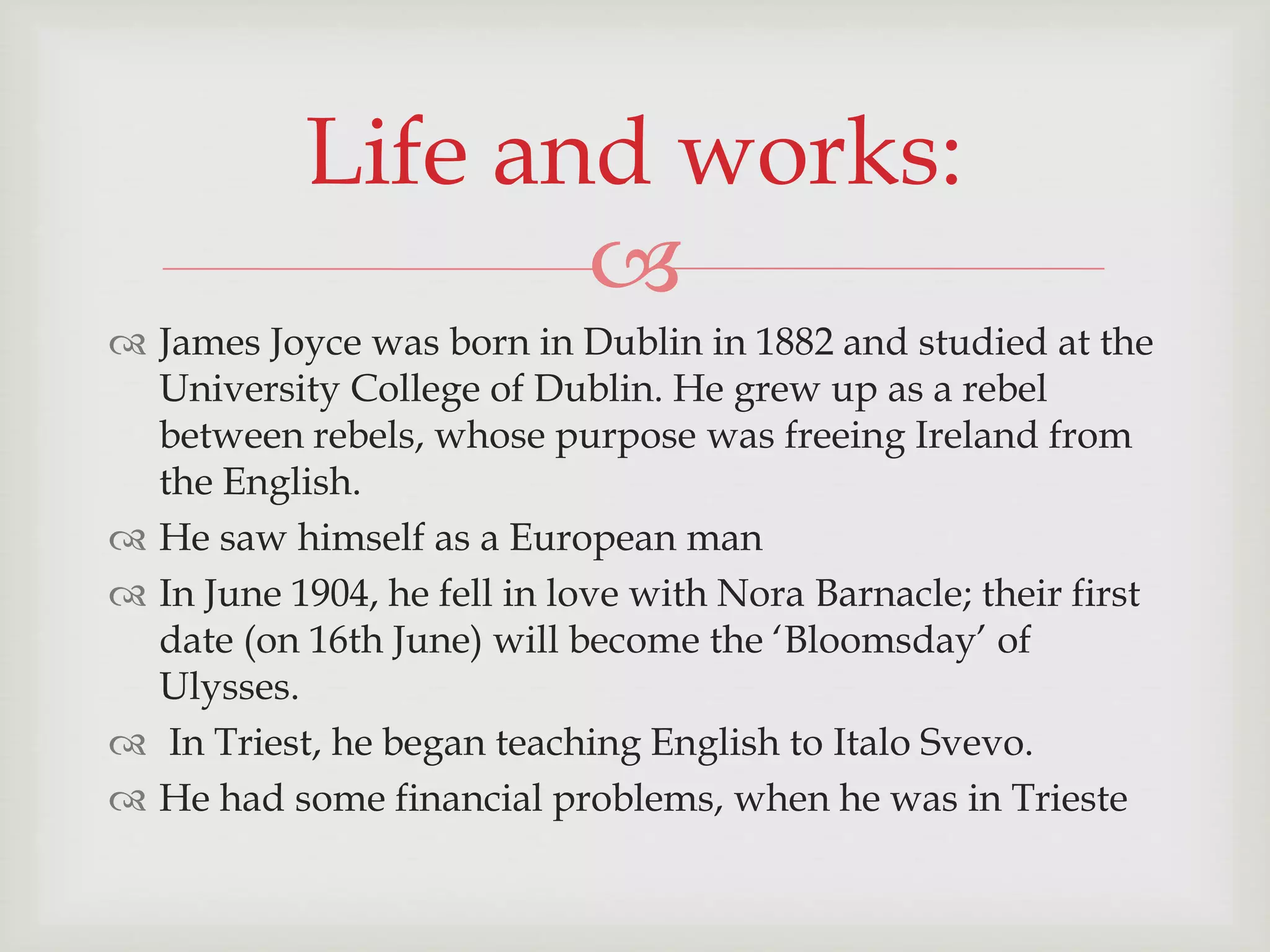
 James Joyce was born in Dublin in 1882 and studied at the 
University College of Dublin. He grew up as a rebel 
between rebels, whose purpose was freeing Ireland from 
the English. 
 He saw himself as a European man 
 In June 1904, he fell in love with Nora Barnacle; their first 
date (on 16th June) will become the ‘Bloomsday’ of 
Ulysses. 
 In Triest, he began teaching English to Italo Svevo. 
 He had some financial problems, when he was in Trieste
Life and Works: 
 
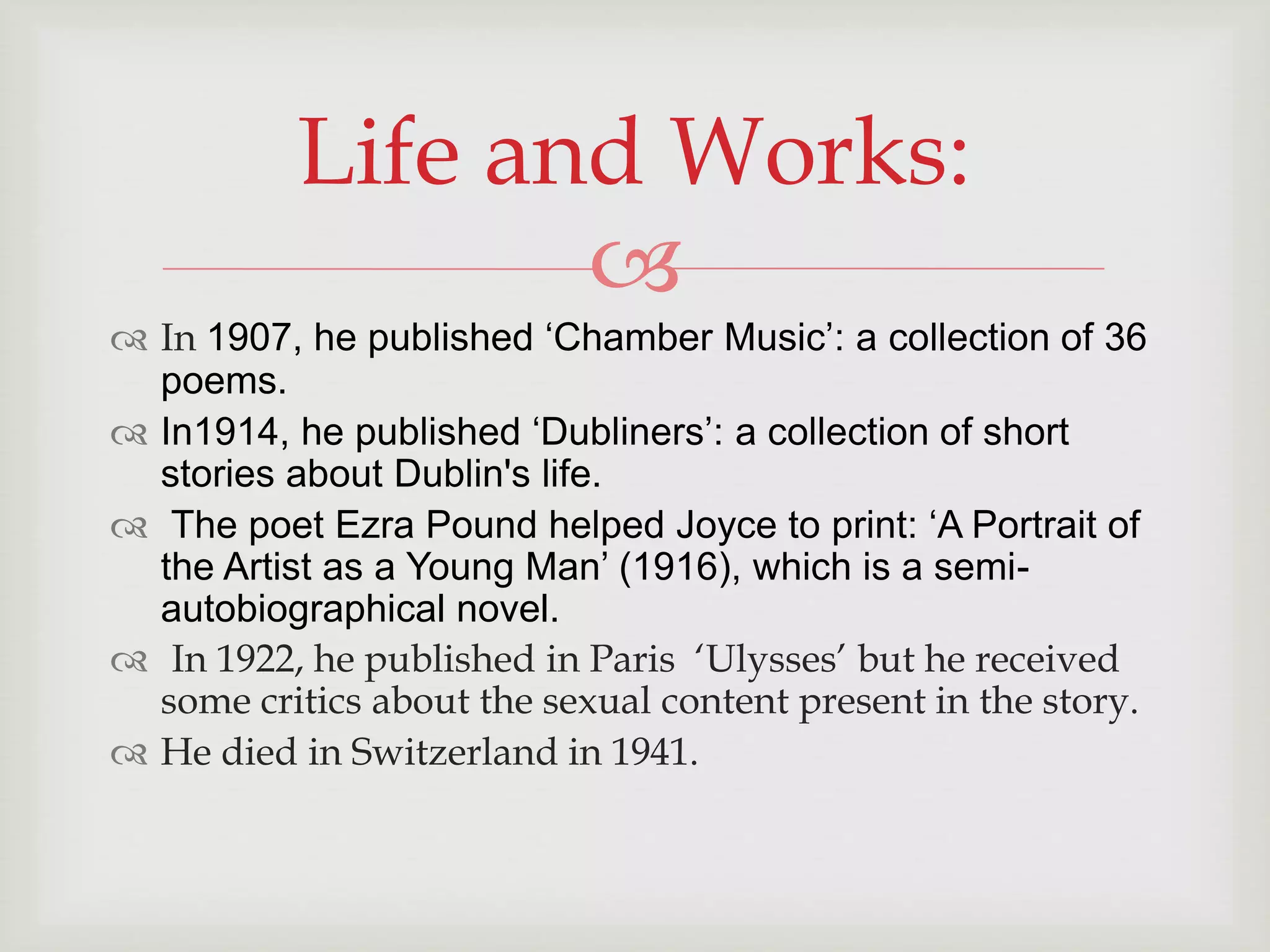
 In 1907, he published ‘Chamber Music’: a collection of 36 
poems. 
 In1914, he published ‘Dubliners’: a collection of short 
stories about Dublin's life. 
 The poet Ezra Pound helped Joyce to print: ‘A Portrait of 
the Artist as a Young Man’ (1916), which is a semi-autobiographical 
novel. 
 In 1922, he published in Paris ‘Ulysses’ but he received 
some critics about the sexual content present in the story. 
 He died in Switzerland in 1941.
Ordinary Dublin: 
 
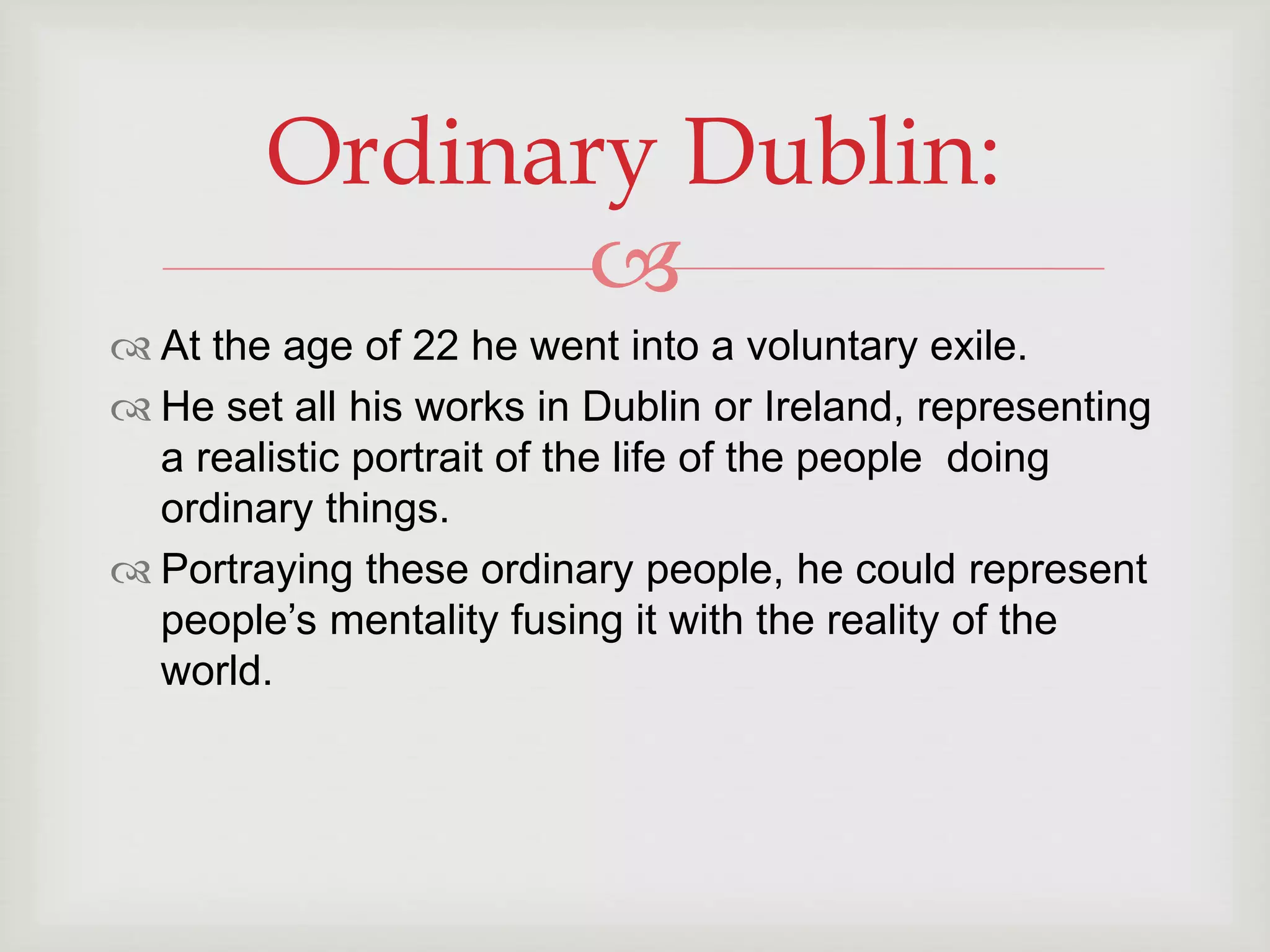
 At the age of 22 he went into a voluntary exile. 
 He set all his works in Dublin or Ireland, representing 
a realistic portrait of the life of the people doing 
ordinary things. 
 Portraying these ordinary people, he could represent 
people’s mentality fusing it with the reality of the 
world.
The rebellion against the 
Church: 
 
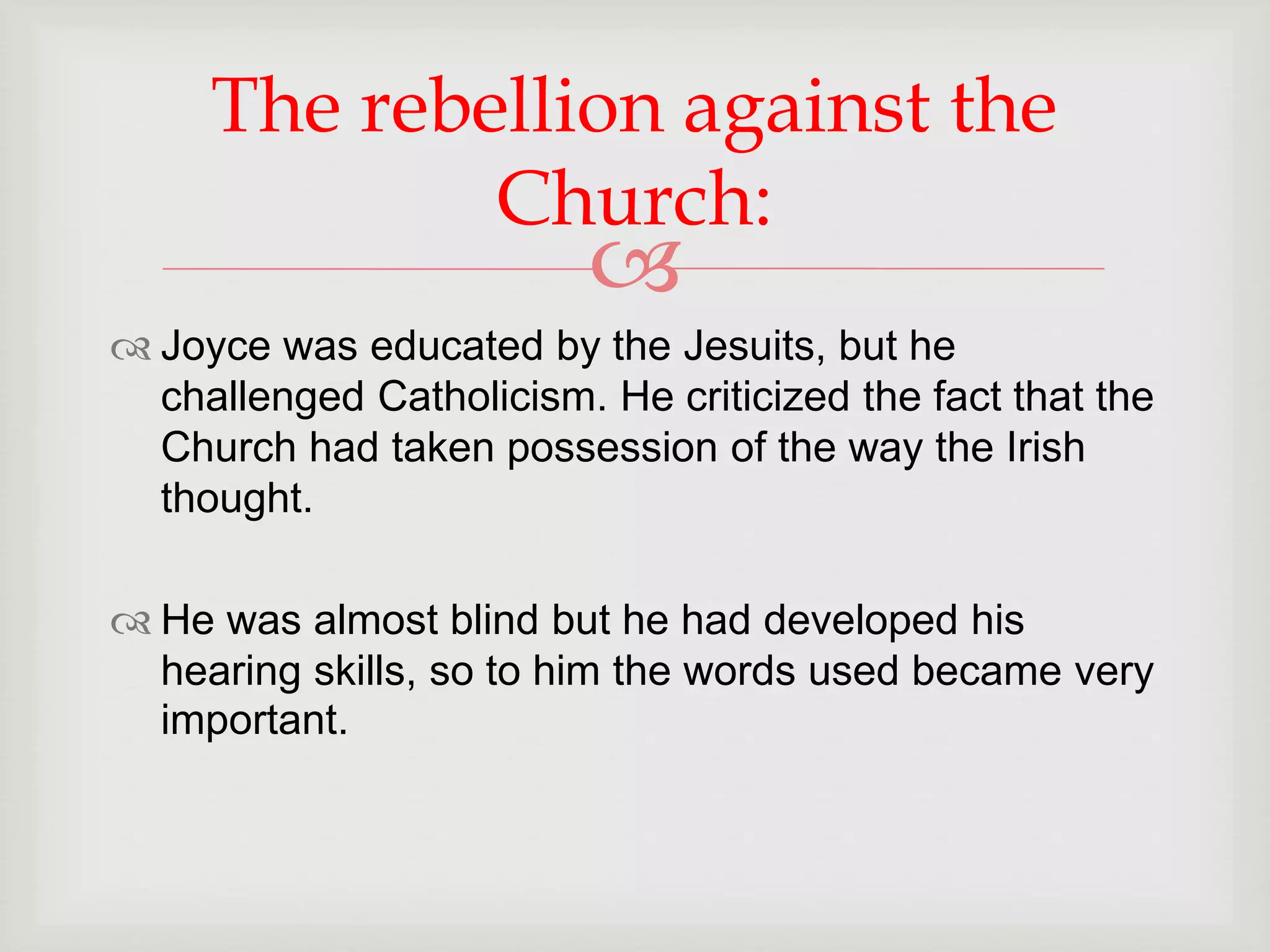
 Joyce was educated by the Jesuits, but he 
challenged Catholicism. He criticized the fact that the 
Church had taken possession of the way the Irish 
thought. 
 He was almost blind but he had developed his 
hearing skills, so to him the words used became very 
important.
A subjective perception of time: 
 
 Joyce was a modernist writer. 
 In his works, the facts become confused and were 
studied from a different point of view simultaneously, 
in fact they are presented as clues and not 
with the use of an omniscient narrator. 
 Joyce's story opens with medias res and the analysis 
of a particular moment, and the portrait of the 
character is based on introspection; accordingly this 
introspection is subjective and follows the characters’ 
psychological change.
The impersonality of the artist: 
 
 Influenced by French authors Joyce believed in the 
impersonality of the artist. 
 The artist has to give the readers a realistic image of 
life, so there is an author's isolation from the society. 
Of course in the work, the point of view of the author 
isn't present: so often he uses free direct speech, the 
epiphany and the interior monologue to describe the 
feelings of the characters.
1914
Dubliners: 
 
 Dubliners is a psychological realistic picture of lower 
middle class people of the time oppressed by Religion, 
Politics and Cultural and Economic forces. 
 It consists of fifteen short stories. 
 The stories are arranged into four groups: Childhood, 
Adolescence, Mature Life and Public Life. 
 The opening stories deal with childhood and youth in 
Dublin the others, advancing in time and expanding in 
scope, concern the middle years of characters and their 
social and political affairs.
Dubliners: 
 
 He chose Dublin for the scene because that city 
seemed to Joyce the center of paralysis and his 
intention was to write a chapter of the moral history 
of his country 
 The Dead could be considered Joyce’s first 
masterpiece; it’s at once the summary and climax of 
Dubliners 
 The same themes, symbols, narrative techniques and 
a particular structure are the common points in all 
the stories.
The use of epiphany: 
 
 The description is realistic, it has an abundance of 
external details. 
 The use of realism is mixed with symbolism 
 He wanted to take the reader beyond the usual 
aspects of life, using the ‘epiphany’ that is ‘the 
sudden spiritual manifestation’ caused by a trivial 
gesture or a banal situation, which is used to lead the 
character to a sudden self-realization about 
himself/herself.
A pervasive theme: paralysis 
 
 The paralysis of Dublin is both physical and moral. 
 The Dubliners aren’t aware of it or because they lack 
of courage to break the chains that bind them. 
 They are weak and scared people. 
 The main theme is the failure to find a way out of 
the paralysis, the opposite of it is the ‘escape’ and its 
consequent failure. 
 Every character experiences a sense of enclosure that 
causes the failure.
Narrative technique: 
 
 The stories are told from the perspective of a 
character. 
 He used free direct speech or free direct thoughts; in 
this way the reader can acquire direct knowledge of 
the characters. 
 The linguistic register is varied. It suits the age, the 
social class and the role of the characters.
1922
Ulysses: 
 
 The time setting is on 16th June 1904, which was an 
important day because Nora Barnacle, James’ future 
wife, made her fondness clear to him. 
 The place setting is Dublin. 
 The protagonists of the story are: Leopold Bloom, 
Stephen Dedalus and Molly (Bloom’s wife). 
 This novel sums up the themes and techniques that 
Joyce had developed in his previous works.
The plot: 
 
 The story deals with the events of a day. The 
protagonist, Bloom, leaves his home at eight 
o’clock to buy his breakfast and comes back at two of 
the following morning. Leopold wanders into many 
streets and in a brothel he meets Stephen (the 
protagonist of “A Portrait of an Artist as a Young 
Man”) who became his adopted son. The novel ends 
with Molly who is planning an afternoon of 
adultery with her music director.
Ulysses & Odyssey: 
 
 Joyce inspired his novel on Homer’s epic novel, in fact he used 
this famous tale as a structural framework for his book and 
arranged his characters on the heroic model. 
 Bloom, a common man, represents Ulysses. 
 Stephen is Telemachus. 
 Molly represents Penelope but unlike her she is unfaith. 
 Ulysses can be divided into three parts and eighteen episodes: 
Chapters 1 to 3 : Telemachiad; 
Chapters 4 to 15 :Odyssey; 
Chapters 16 to 18: Nostos ; 
Each chapter is organized around a different hour, a colour, an 
organ of the body, a sense or a symbol.
The setting: 
 
 Joyce wanted to give a description of ordinary life so 
he placed the characters in house, pubs and streets 
that he had frequented. 
 Each movement of the characters is planned. 
 Through his novel Joyce managed to make the real 
air of Dublin with his atmosphere. Consequently, 
Dublin becomes itself a character of the story.
The representation of human 
nature: 
 
 Stephen Dedalus, Mr. and Mrs. Bloom are the symbols of 
two aspects of human nature: Stephen is the prototype of 
a man in search of maturity (in his stream of 
consciousness he associates things by resemblance); Mrs. 
Bloom identifies herself with her sensual nature and 
fecundity because she stands for flesh. Her thoughts are 
driven by memories; Mr. Bloom is everybody (he 
represents the human variety), in his stream of 
consciousness things are linked through a relation of 
cause-effect ore space and time. 
 The theme of the novel is moral: human life means 
suffering but it’s also a instrument to reach good.
The mythical method: 
 
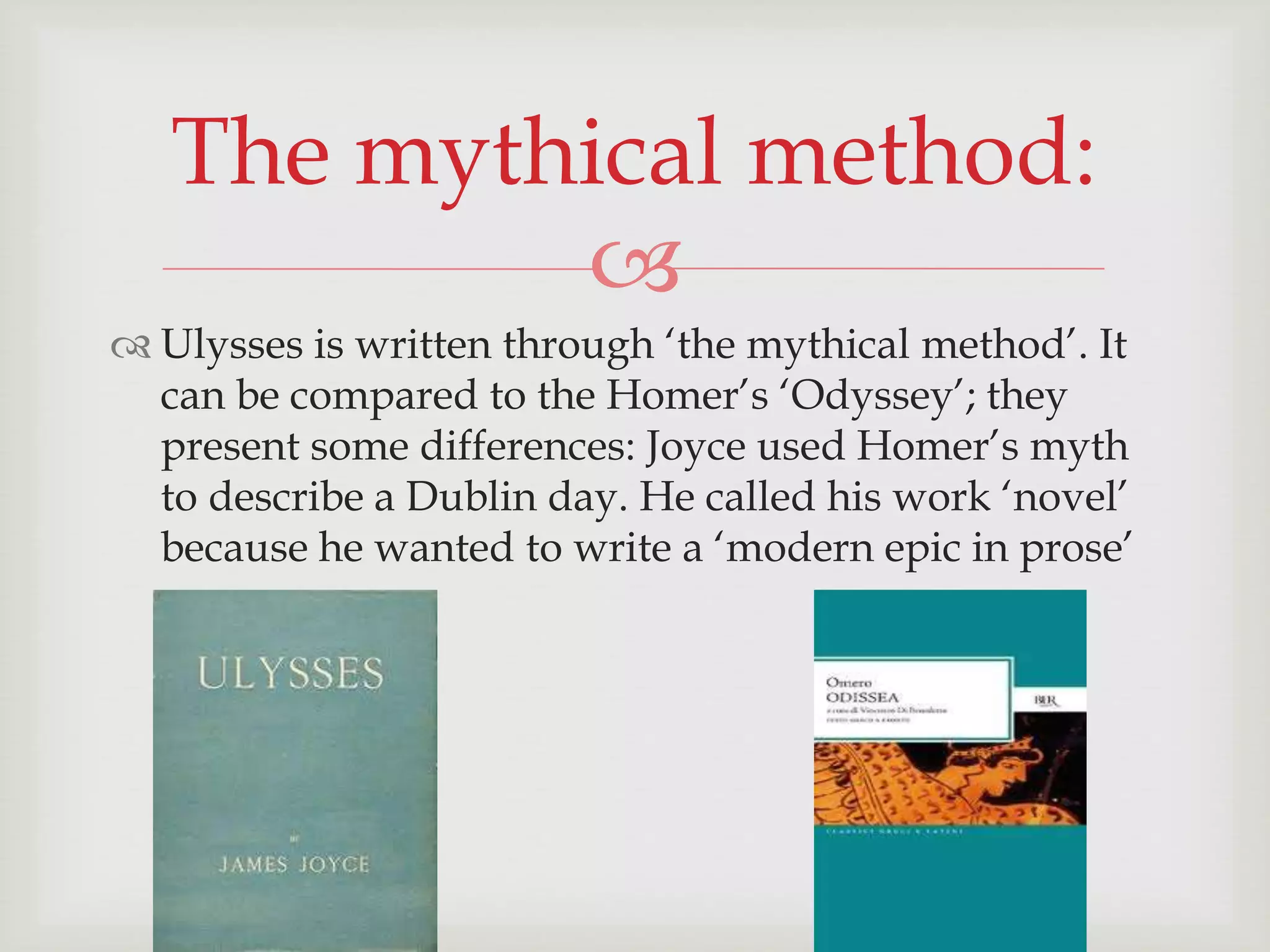
 Ulysses is written through ‘the mythical method’. It 
can be compared to the Homer’s ‘Odyssey’; they 
present some differences: Joyce used Homer’s myth 
to describe a Dublin day. He called his work ‘novel’ 
because he wanted to write a ‘modern epic in prose’
A revolutionary prose: 
 
 Joyce used several methods to present various matters. 
He created the ‘collage technique’, combining: the stream 
of consciousness technique, the cinematic technique, 
flashbacks, tracking shots, suspension of speech, question 
and answer, dramatic dialogue and the juxtaposition of 
events. This technique is similar of cubist artists’ one. 
Joyce perfected the internal monologue through the levels 
of narration, one external to the character’s mind and the 
other internal. 
 The language is characterized by puns, images, 
paradoxes, interruptions (he used also foreign words and 
allusions to other texts.

James joyce

  • 1.
  • 2.
    Life and works:   James Joyce was born in Dublin in 1882 and studied at the University College of Dublin. He grew up as a rebel between rebels, whose purpose was freeing Ireland from the English.  He saw himself as a European man  In June 1904, he fell in love with Nora Barnacle; their first date (on 16th June) will become the ‘Bloomsday’ of Ulysses.  In Triest, he began teaching English to Italo Svevo.  He had some financial problems, when he was in Trieste
  • 3.
    Life and Works:   In 1907, he published ‘Chamber Music’: a collection of 36 poems.  In1914, he published ‘Dubliners’: a collection of short stories about Dublin's life.  The poet Ezra Pound helped Joyce to print: ‘A Portrait of the Artist as a Young Man’ (1916), which is a semi-autobiographical novel.  In 1922, he published in Paris ‘Ulysses’ but he received some critics about the sexual content present in the story.  He died in Switzerland in 1941.
  • 4.
    Ordinary Dublin:   At the age of 22 he went into a voluntary exile.  He set all his works in Dublin or Ireland, representing a realistic portrait of the life of the people doing ordinary things.  Portraying these ordinary people, he could represent people’s mentality fusing it with the reality of the world.
  • 5.
    The rebellion againstthe Church:   Joyce was educated by the Jesuits, but he challenged Catholicism. He criticized the fact that the Church had taken possession of the way the Irish thought.  He was almost blind but he had developed his hearing skills, so to him the words used became very important.
  • 6.
    A subjective perceptionof time:   Joyce was a modernist writer.  In his works, the facts become confused and were studied from a different point of view simultaneously, in fact they are presented as clues and not with the use of an omniscient narrator.  Joyce's story opens with medias res and the analysis of a particular moment, and the portrait of the character is based on introspection; accordingly this introspection is subjective and follows the characters’ psychological change.
  • 7.
    The impersonality ofthe artist:   Influenced by French authors Joyce believed in the impersonality of the artist.  The artist has to give the readers a realistic image of life, so there is an author's isolation from the society. Of course in the work, the point of view of the author isn't present: so often he uses free direct speech, the epiphany and the interior monologue to describe the feelings of the characters.
  • 8.
  • 9.
    Dubliners:  Dubliners is a psychological realistic picture of lower middle class people of the time oppressed by Religion, Politics and Cultural and Economic forces.  It consists of fifteen short stories.  The stories are arranged into four groups: Childhood, Adolescence, Mature Life and Public Life.  The opening stories deal with childhood and youth in Dublin the others, advancing in time and expanding in scope, concern the middle years of characters and their social and political affairs.
  • 10.
    Dubliners:  He chose Dublin for the scene because that city seemed to Joyce the center of paralysis and his intention was to write a chapter of the moral history of his country  The Dead could be considered Joyce’s first masterpiece; it’s at once the summary and climax of Dubliners  The same themes, symbols, narrative techniques and a particular structure are the common points in all the stories.
  • 11.
    The use ofepiphany:   The description is realistic, it has an abundance of external details.  The use of realism is mixed with symbolism  He wanted to take the reader beyond the usual aspects of life, using the ‘epiphany’ that is ‘the sudden spiritual manifestation’ caused by a trivial gesture or a banal situation, which is used to lead the character to a sudden self-realization about himself/herself.
  • 12.
    A pervasive theme:paralysis   The paralysis of Dublin is both physical and moral.  The Dubliners aren’t aware of it or because they lack of courage to break the chains that bind them.  They are weak and scared people.  The main theme is the failure to find a way out of the paralysis, the opposite of it is the ‘escape’ and its consequent failure.  Every character experiences a sense of enclosure that causes the failure.
  • 13.
    Narrative technique:   The stories are told from the perspective of a character.  He used free direct speech or free direct thoughts; in this way the reader can acquire direct knowledge of the characters.  The linguistic register is varied. It suits the age, the social class and the role of the characters.
  • 14.
  • 15.
    Ulysses:  The time setting is on 16th June 1904, which was an important day because Nora Barnacle, James’ future wife, made her fondness clear to him.  The place setting is Dublin.  The protagonists of the story are: Leopold Bloom, Stephen Dedalus and Molly (Bloom’s wife).  This novel sums up the themes and techniques that Joyce had developed in his previous works.
  • 16.
    The plot:   The story deals with the events of a day. The protagonist, Bloom, leaves his home at eight o’clock to buy his breakfast and comes back at two of the following morning. Leopold wanders into many streets and in a brothel he meets Stephen (the protagonist of “A Portrait of an Artist as a Young Man”) who became his adopted son. The novel ends with Molly who is planning an afternoon of adultery with her music director.
  • 17.
    Ulysses & Odyssey:   Joyce inspired his novel on Homer’s epic novel, in fact he used this famous tale as a structural framework for his book and arranged his characters on the heroic model.  Bloom, a common man, represents Ulysses.  Stephen is Telemachus.  Molly represents Penelope but unlike her she is unfaith.  Ulysses can be divided into three parts and eighteen episodes: Chapters 1 to 3 : Telemachiad; Chapters 4 to 15 :Odyssey; Chapters 16 to 18: Nostos ; Each chapter is organized around a different hour, a colour, an organ of the body, a sense or a symbol.
  • 18.
    The setting:   Joyce wanted to give a description of ordinary life so he placed the characters in house, pubs and streets that he had frequented.  Each movement of the characters is planned.  Through his novel Joyce managed to make the real air of Dublin with his atmosphere. Consequently, Dublin becomes itself a character of the story.
  • 19.
    The representation ofhuman nature:   Stephen Dedalus, Mr. and Mrs. Bloom are the symbols of two aspects of human nature: Stephen is the prototype of a man in search of maturity (in his stream of consciousness he associates things by resemblance); Mrs. Bloom identifies herself with her sensual nature and fecundity because she stands for flesh. Her thoughts are driven by memories; Mr. Bloom is everybody (he represents the human variety), in his stream of consciousness things are linked through a relation of cause-effect ore space and time.  The theme of the novel is moral: human life means suffering but it’s also a instrument to reach good.
  • 20.
    The mythical method:   Ulysses is written through ‘the mythical method’. It can be compared to the Homer’s ‘Odyssey’; they present some differences: Joyce used Homer’s myth to describe a Dublin day. He called his work ‘novel’ because he wanted to write a ‘modern epic in prose’
  • 21.
    A revolutionary prose:   Joyce used several methods to present various matters. He created the ‘collage technique’, combining: the stream of consciousness technique, the cinematic technique, flashbacks, tracking shots, suspension of speech, question and answer, dramatic dialogue and the juxtaposition of events. This technique is similar of cubist artists’ one. Joyce perfected the internal monologue through the levels of narration, one external to the character’s mind and the other internal.  The language is characterized by puns, images, paradoxes, interruptions (he used also foreign words and allusions to other texts.