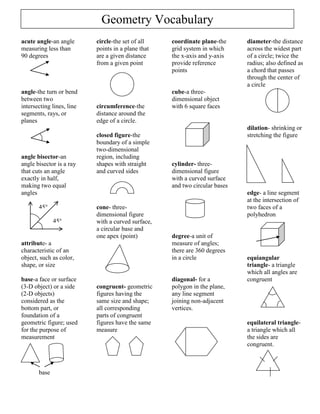
acute angle-an angle
measuring less than
90 degrees
angle-the turn or bend
between two
intersecting lines, line
segments, rays, or
planes
angle bisector-an
angle bisector is a ray
that cuts an angle
exactly in half,
making two equal
angles
attribute- a
characteristic of an
object, such as color,
shape, or size
base-a face or surface
(3-D object) or a side
(2-D objects)
considered as the
bottom part, or
foundation of a
geometric figure; used
for the purpose of
measurement
circle-the set of all
points in a plane that
are a given distance
from a given point
circumference-the
distance around the
edge of a circle.
closed figure-the
boundary of a simple
two-dimensional
region, including
shapes with straight
and curved sides
cone- three-
dimensional figure
with a curved surface,
a circular base and
one apex (point)
congruent- geometric
figures having the
same size and shape;
all corresponding
parts of congruent
figures have the same
measure
coordinate plane-the
grid system in which
the x-axis and y-axis
provide reference
points
cube-a three-
dimensional object
with 6 square faces
cylinder- three-
dimensional figure
with a curved surface
and two circular bases
degree-a unit of
measure of angles;
there are 360 degrees
in a circle
diagonal- for a
polygon in the plane,
any line segment
joining non-adjacent
vertices.
diameter-the distance
across the widest part
of a circle; twice the
radius; also defined as
a chord that passes
through the center of
a circle
dilation- shrinking or
stretching the figure
edge- a line segment
at the intersection of
two faces of a
polyhedron
equiangular
triangle- a triangle
which all angles are
congruent
equilateral triangle-
a triangle which all
the sides are
congruent.
45
45
base
Geometry Vocabulary
face- a polygonal
region of a three-
dimensional figure
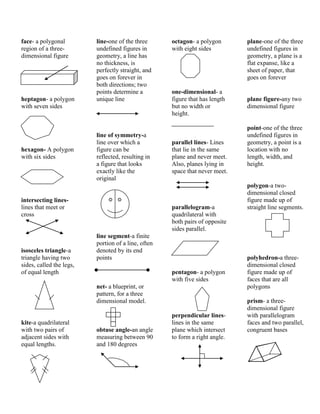
heptagon- a polygon
with seven sides
hexagon- A polygon
with six sides
intersecting lines-
lines that meet or
cross
isosceles triangle-a
triangle having two
sides, called the legs,
of equal length
kite-a quadrilateral
with two pairs of
adjacent sides with
equal lengths.
line-one of the three
undefined figures in
geometry, a line has
no thickness, is
perfectly straight, and
goes on forever in
both directions; two
points determine a
unique line
line of symmetry-a
line over which a
figure can be
reflected, resulting in
a figure that looks
exactly like the
original
line segment-a finite
portion of a line, often
denoted by its end
points
net- a blueprint, or
pattern, for a three
dimensional model.
obtuse angle-an angle
measuring between 90
and 180 degrees
octagon- a polygon
with eight sides
one-dimensional- a
figure that has length
but no width or
height.
parallel lines- Lines
that lie in the same
plane and never meet.
Also, planes lying in
space that never meet.
parallelogram-a
quadrilateral with
both pairs of opposite
sides parallel.
pentagon- a polygon
with five sides
perpendicular lines-
lines in the same
plane which intersect
to form a right angle.
plane-one of the three
undefined figures in
geometry, a plane is a
flat expanse, like a
sheet of paper, that
goes on forever
plane figure-any two
dimensional figure
point-one of the three
undefined figures in
geometry, a point is a
location with no
length, width, and
height.
polygon-a two-
dimensional closed
figure made up of
straight line segments.
polyhedron-a three-
dimensional closed
figure made up of
faces that are all
polygons
prism- a three-
dimensional figure
with parallelogram
faces and two parallel,
congruent bases

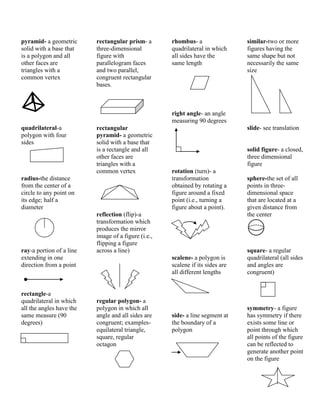
pyramid- a geometric
solid with a base that
is a polygon and all
other faces are
triangles with a
common vertex

quadrilateral-a
polygon with four
sides
radius-the distance
from the center of a
circle to any point on
its edge; half a
diameter
ray-a portion of a line
extending in one
direction from a point
rectangle-a
quadrilateral in which
all the angles have the
same measure (90
degrees)
rectangular prism- a
three-dimensional
figure with
parallelogram faces
and two parallel,
congruent rectangular
bases.
rectangular
pyramid- a geometric
solid with a base that
is a rectangle and all
other faces are
triangles with a
common vertex
reflection (flip)-a
transformation which
produces the mirror
image of a figure (i.e.,
flipping a figure
across a line)
regular polygon- a
polygon in which all
angle and all sides are
congruent; examples-
equilateral triangle,
square, regular
octagon
rhombus- a
quadrilateral in which
all sides have the
same length
right angle- an angle
measuring 90 degrees
rotation (turn)- a
transformation
obtained by rotating a
figure around a fixed
point (i.e., turning a
figure about a point).
scalene- a polygon is
scalene if its sides are
all different lengths
side- a line segment at
the boundary of a
polygon
similar-two or more
figures having the
same shape but not
necessarily the same
size
slide- see translation
solid figure- a closed,
three dimensional
figure
sphere-the set of all
points in three-
dimensional space
that are located at a
given distance from
the center

square- a regular
quadrilateral (all sides
and angles are
congruent)
symmetry- a figure
has symmetry if there
exists some line or
point through which
all points of the figure
can be reflected to
generate another point
on the figure
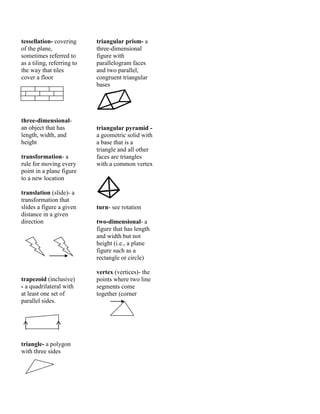
tessellation- covering
of the plane,
sometimes referred to
as a tiling, referring to
the way that tiles
cover a floor
three-dimensional-
an object that has
length, width, and
height
transformation- a
rule for moving every
point in a plane figure
to a new location
translation (slide)- a
transformation that
slides a figure a given
distance in a given
direction
trapezoid (inclusive)
- a quadrilateral with
at least one set of
parallel sides.
triangle- a polygon
with three sides
triangular prism- a
three-dimensional
figure with
parallelogram faces
and two parallel,
congruent triangular
bases

triangular pyramid -
a geometric solid with
a base that is a
triangle and all other
faces are triangles
with a common vertex

turn- see rotation
two-dimensional- a
figure that has length
and width but not
height (i.e., a plane
figure such as a
rectangle or circle)
vertex (vertices)- the
points where two line
segments come
together (corner
Geometry terms (1)

Geometry terms (1)

  • 1.
    acute angle-an angle measuringless than 90 degrees angle-the turn or bend between two intersecting lines, line segments, rays, or planes angle bisector-an angle bisector is a ray that cuts an angle exactly in half, making two equal angles attribute- a characteristic of an object, such as color, shape, or size base-a face or surface (3-D object) or a side (2-D objects) considered as the bottom part, or foundation of a geometric figure; used for the purpose of measurement circle-the set of all points in a plane that are a given distance from a given point circumference-the distance around the edge of a circle. closed figure-the boundary of a simple two-dimensional region, including shapes with straight and curved sides cone- three- dimensional figure with a curved surface, a circular base and one apex (point) congruent- geometric figures having the same size and shape; all corresponding parts of congruent figures have the same measure coordinate plane-the grid system in which the x-axis and y-axis provide reference points cube-a three- dimensional object with 6 square faces cylinder- three- dimensional figure with a curved surface and two circular bases degree-a unit of measure of angles; there are 360 degrees in a circle diagonal- for a polygon in the plane, any line segment joining non-adjacent vertices. diameter-the distance across the widest part of a circle; twice the radius; also defined as a chord that passes through the center of a circle dilation- shrinking or stretching the figure edge- a line segment at the intersection of two faces of a polyhedron equiangular triangle- a triangle which all angles are congruent equilateral triangle- a triangle which all the sides are congruent. 45 45 base Geometry Vocabulary
  • 2.
    face- a polygonal regionof a three- dimensional figure heptagon- a polygon with seven sides hexagon- A polygon with six sides intersecting lines- lines that meet or cross isosceles triangle-a triangle having two sides, called the legs, of equal length kite-a quadrilateral with two pairs of adjacent sides with equal lengths. line-one of the three undefined figures in geometry, a line has no thickness, is perfectly straight, and goes on forever in both directions; two points determine a unique line line of symmetry-a line over which a figure can be reflected, resulting in a figure that looks exactly like the original line segment-a finite portion of a line, often denoted by its end points net- a blueprint, or pattern, for a three dimensional model. obtuse angle-an angle measuring between 90 and 180 degrees octagon- a polygon with eight sides one-dimensional- a figure that has length but no width or height. parallel lines- Lines that lie in the same plane and never meet. Also, planes lying in space that never meet. parallelogram-a quadrilateral with both pairs of opposite sides parallel. pentagon- a polygon with five sides perpendicular lines- lines in the same plane which intersect to form a right angle. plane-one of the three undefined figures in geometry, a plane is a flat expanse, like a sheet of paper, that goes on forever plane figure-any two dimensional figure point-one of the three undefined figures in geometry, a point is a location with no length, width, and height. polygon-a two- dimensional closed figure made up of straight line segments. polyhedron-a three- dimensional closed figure made up of faces that are all polygons prism- a three- dimensional figure with parallelogram faces and two parallel, congruent bases 
  • 3.
    pyramid- a geometric solidwith a base that is a polygon and all other faces are triangles with a common vertex  quadrilateral-a polygon with four sides radius-the distance from the center of a circle to any point on its edge; half a diameter ray-a portion of a line extending in one direction from a point rectangle-a quadrilateral in which all the angles have the same measure (90 degrees) rectangular prism- a three-dimensional figure with parallelogram faces and two parallel, congruent rectangular bases. rectangular pyramid- a geometric solid with a base that is a rectangle and all other faces are triangles with a common vertex reflection (flip)-a transformation which produces the mirror image of a figure (i.e., flipping a figure across a line) regular polygon- a polygon in which all angle and all sides are congruent; examples- equilateral triangle, square, regular octagon rhombus- a quadrilateral in which all sides have the same length right angle- an angle measuring 90 degrees rotation (turn)- a transformation obtained by rotating a figure around a fixed point (i.e., turning a figure about a point). scalene- a polygon is scalene if its sides are all different lengths side- a line segment at the boundary of a polygon similar-two or more figures having the same shape but not necessarily the same size slide- see translation solid figure- a closed, three dimensional figure sphere-the set of all points in three- dimensional space that are located at a given distance from the center  square- a regular quadrilateral (all sides and angles are congruent) symmetry- a figure has symmetry if there exists some line or point through which all points of the figure can be reflected to generate another point on the figure
  • 4.
    tessellation- covering of theplane, sometimes referred to as a tiling, referring to the way that tiles cover a floor three-dimensional- an object that has length, width, and height transformation- a rule for moving every point in a plane figure to a new location translation (slide)- a transformation that slides a figure a given distance in a given direction trapezoid (inclusive) - a quadrilateral with at least one set of parallel sides. triangle- a polygon with three sides triangular prism- a three-dimensional figure with parallelogram faces and two parallel, congruent triangular bases  triangular pyramid - a geometric solid with a base that is a triangle and all other faces are triangles with a common vertex  turn- see rotation two-dimensional- a figure that has length and width but not height (i.e., a plane figure such as a rectangle or circle) vertex (vertices)- the points where two line segments come together (corner