Physical Geology
PhD. PhạmBảo Ngọc 6
QUESTIONS
1. The difference between stress and strain .
Three types of stress and the resulting strain
2. The ways rock behaved with stress?
3. What is the difference between strike, direction of dip, and angle
of
dip?
4. Draw a sketch of an anticline and label the limbs, axial plane,
and
hinge line
5. The different types of folds
6. What is the difference between a joint and a fault?
7. The different types of faults
8. Why folds and faults are very important in Petroleum Exploration
7.
Physical Geology
PhD. PhạmBảo Ngọc 7
QUESTION 1
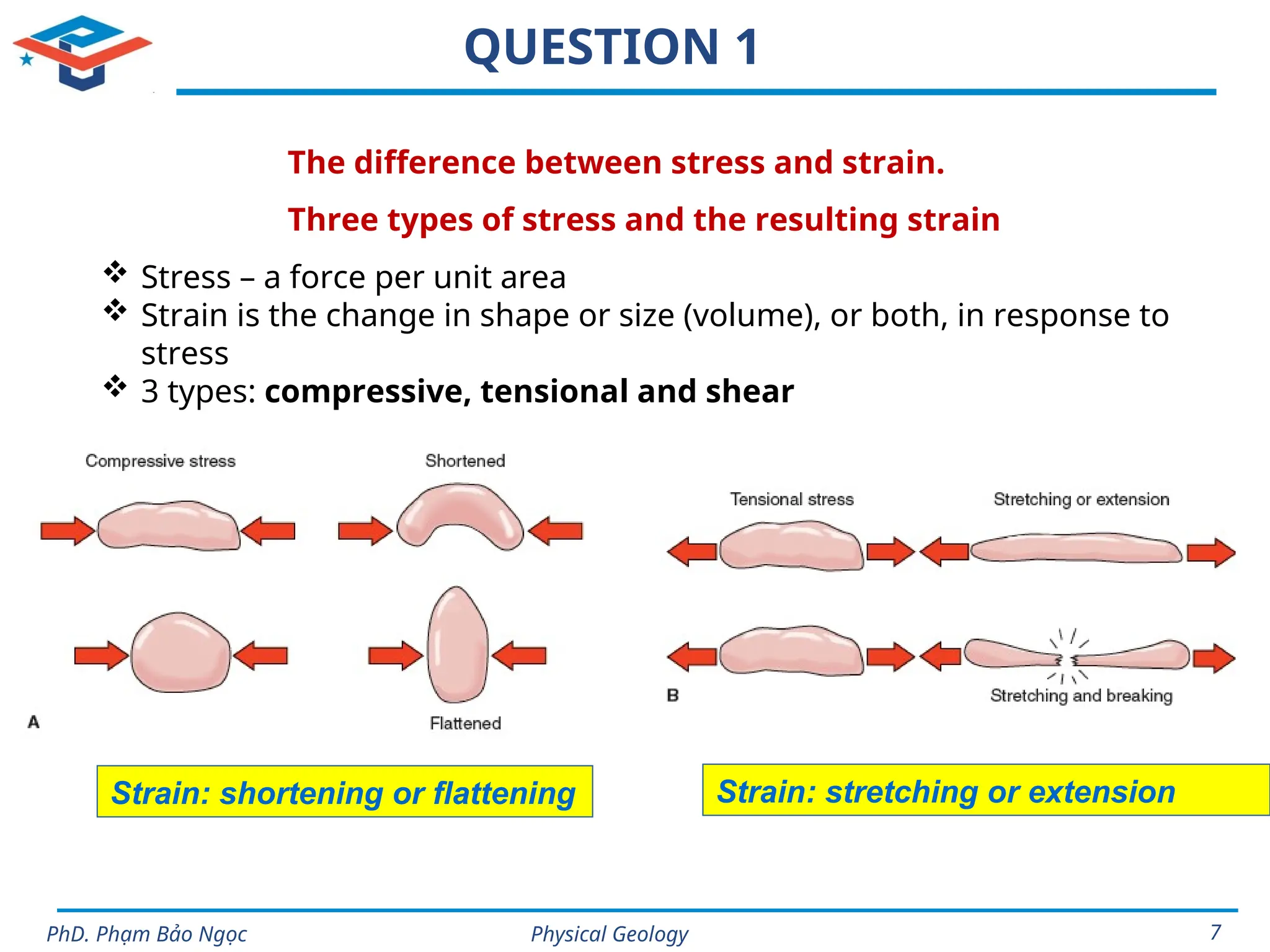
The difference between stress and strain.
Three types of stress and the resulting strain
Stress – a force per unit area
Strain is the change in shape or size (volume), or both, in response to
stress
3 types: compressive, tensional and shear
Strain: shortening or flattening Strain: stretching or extension
8.
Physical Geology
PhD. PhạmBảo Ngọc 8
QUESTION 1
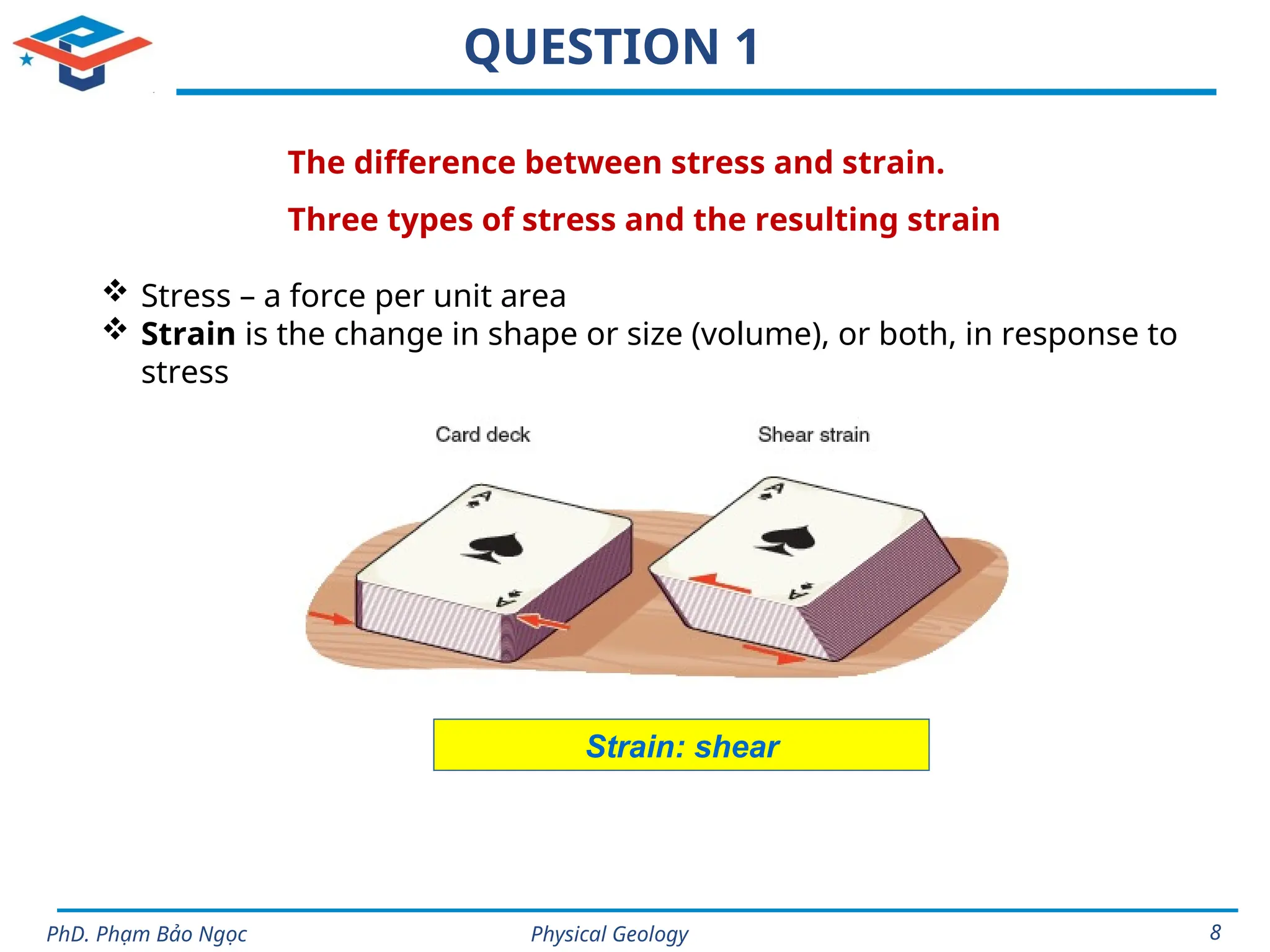
The difference between stress and strain.
Three types of stress and the resulting strain
Stress – a force per unit area
Strain is the change in shape or size (volume), or both, in response to
stress
Strain: shear
9.
Physical Geology
PhD. PhạmBảo Ngọc 9
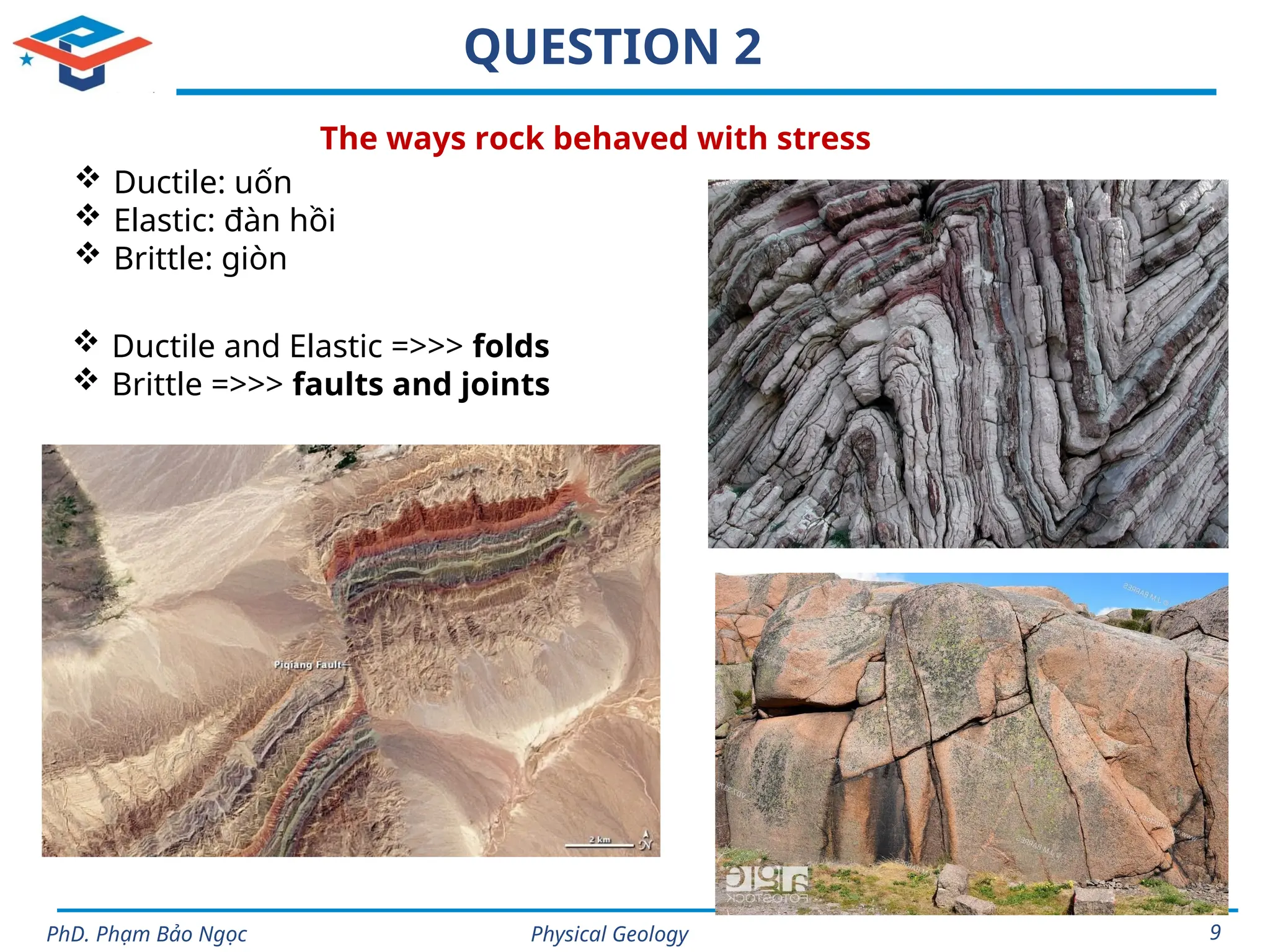
QUESTION 2
Ductile: uốn
Elastic: đàn hồi
Brittle: giòn
The ways rock behaved with stress
Ductile and Elastic =>>> folds
Brittle =>>> faults and joints
10.
Physical Geology
PhD. PhạmBảo Ngọc 10
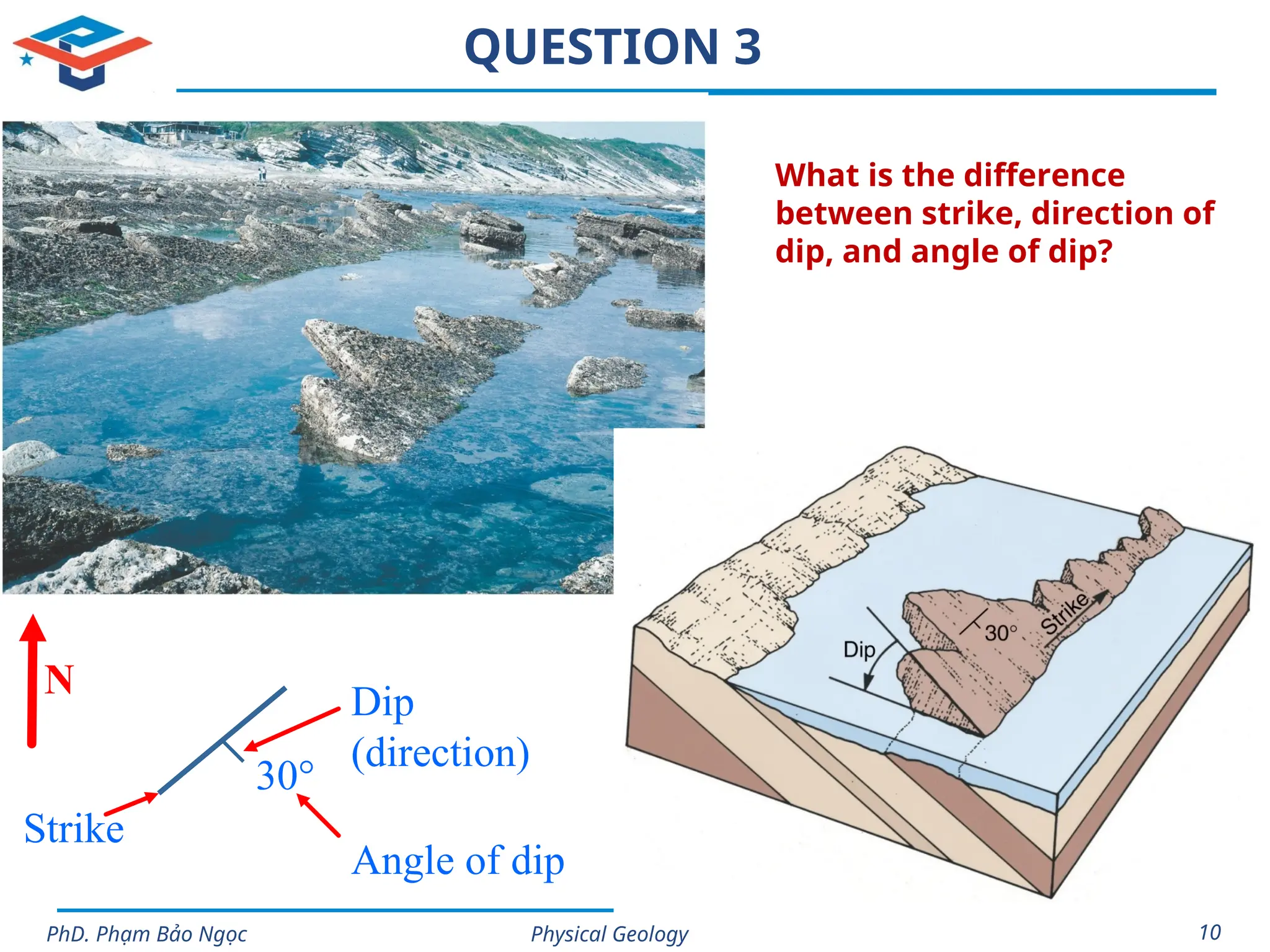
QUESTION 3
What is the difference
between strike, direction of
dip, and angle of dip?
30°
Strike
Dip
(direction)
Angle of dip
N
11.
Physical Geology
PhD. PhạmBảo Ngọc 11
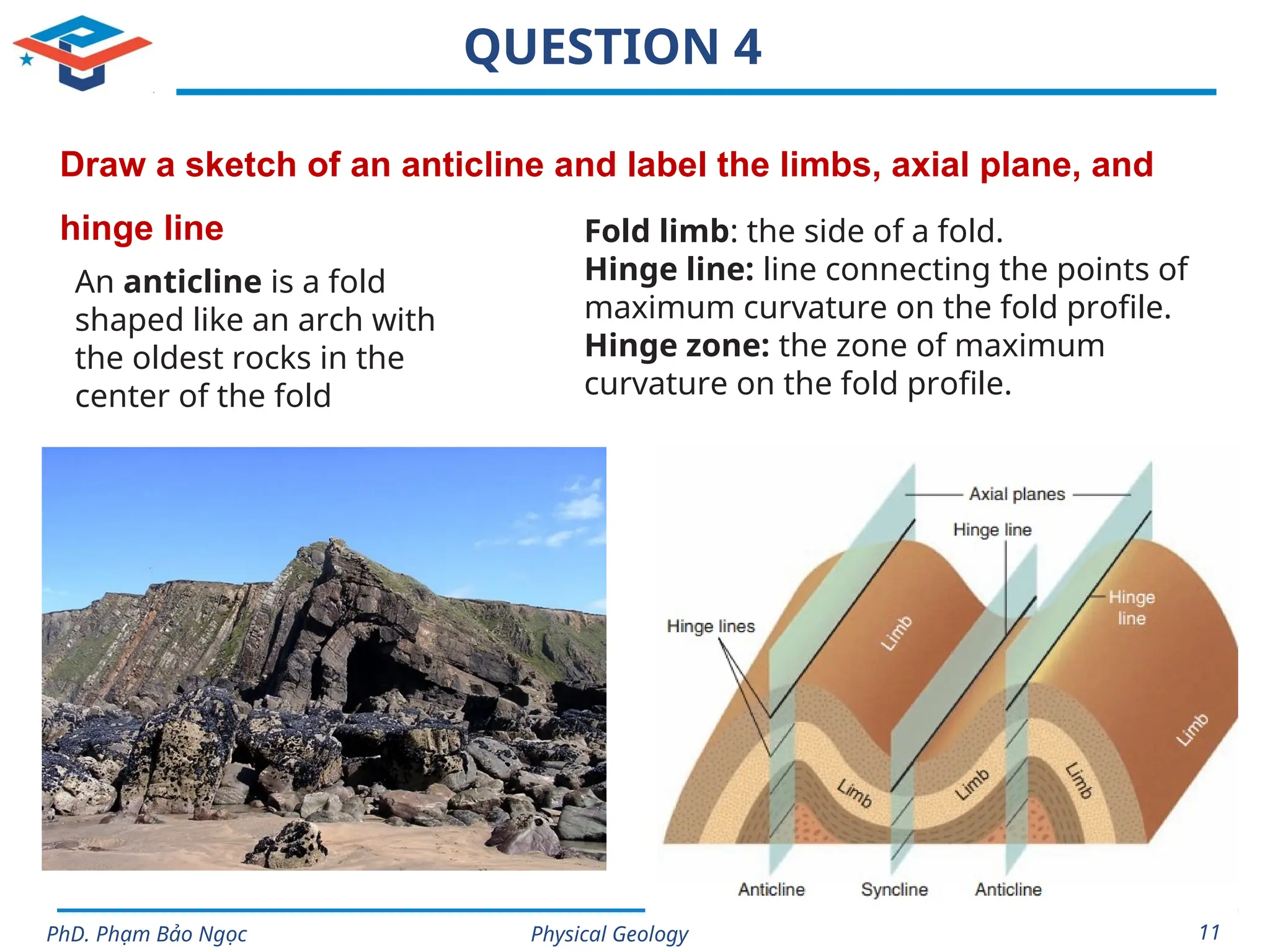
QUESTION 4
Draw a sketch of an anticline and label the limbs, axial plane, and
hinge line
An anticline is a fold
shaped like an arch with
the oldest rocks in the
center of the fold
Fold limb: the side of a fold.
Hinge line: line connecting the points of
maximum curvature on the fold profile.
Hinge zone: the zone of maximum
curvature on the fold profile.
12.
Physical Geology
PhD. PhạmBảo Ngọc 12
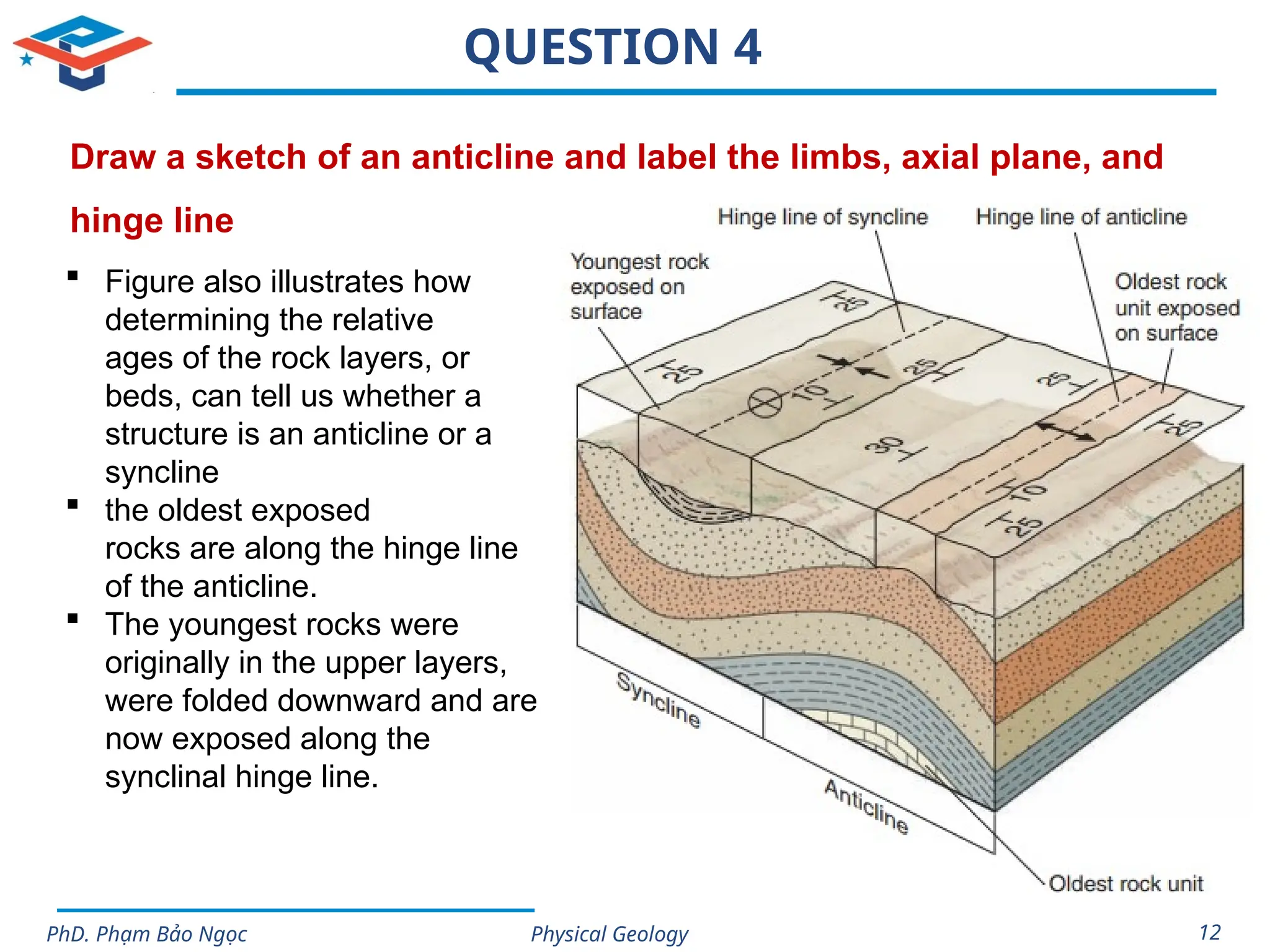
QUESTION 4
Draw a sketch of an anticline and label the limbs, axial plane, and
hinge line
Figure also illustrates how
determining the relative
ages of the rock layers, or
beds, can tell us whether a
structure is an anticline or a
syncline
the oldest exposed
rocks are along the hinge line
of the anticline.
The youngest rocks were
originally in the upper layers,
were folded downward and are
now exposed along the
synclinal hinge line.
13.
Physical Geology
PhD. PhạmBảo Ngọc 13
QUESTION 5
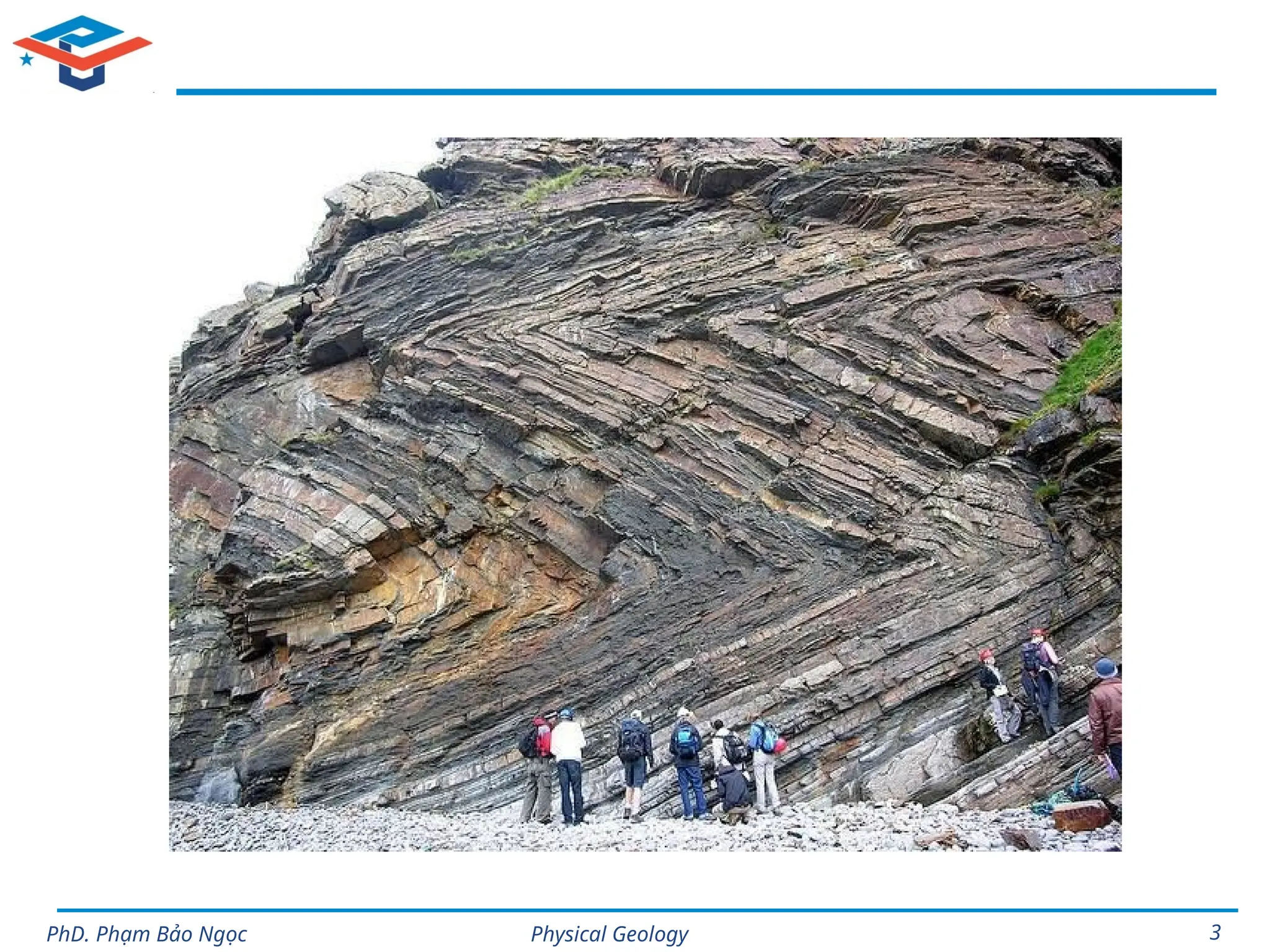
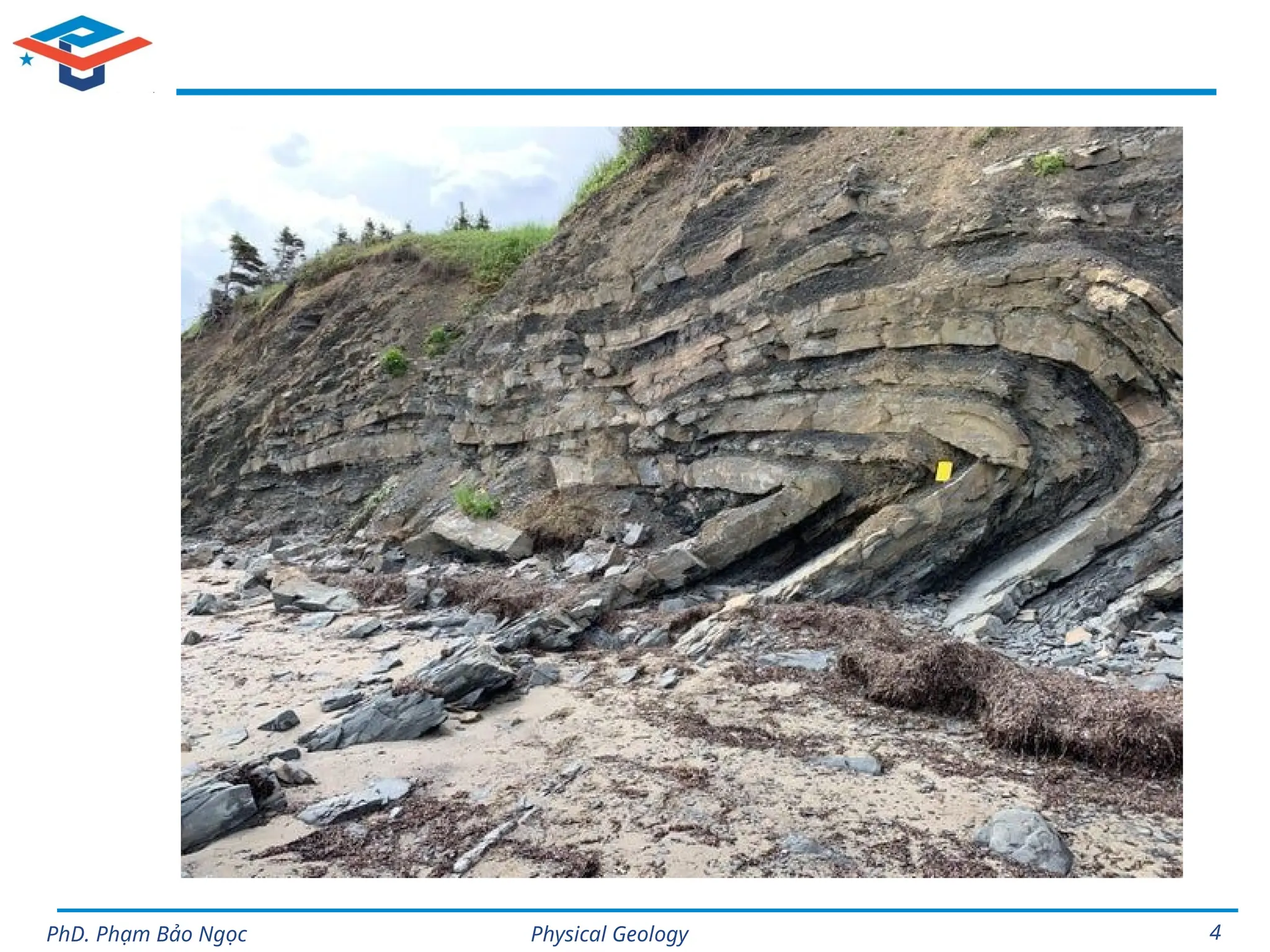
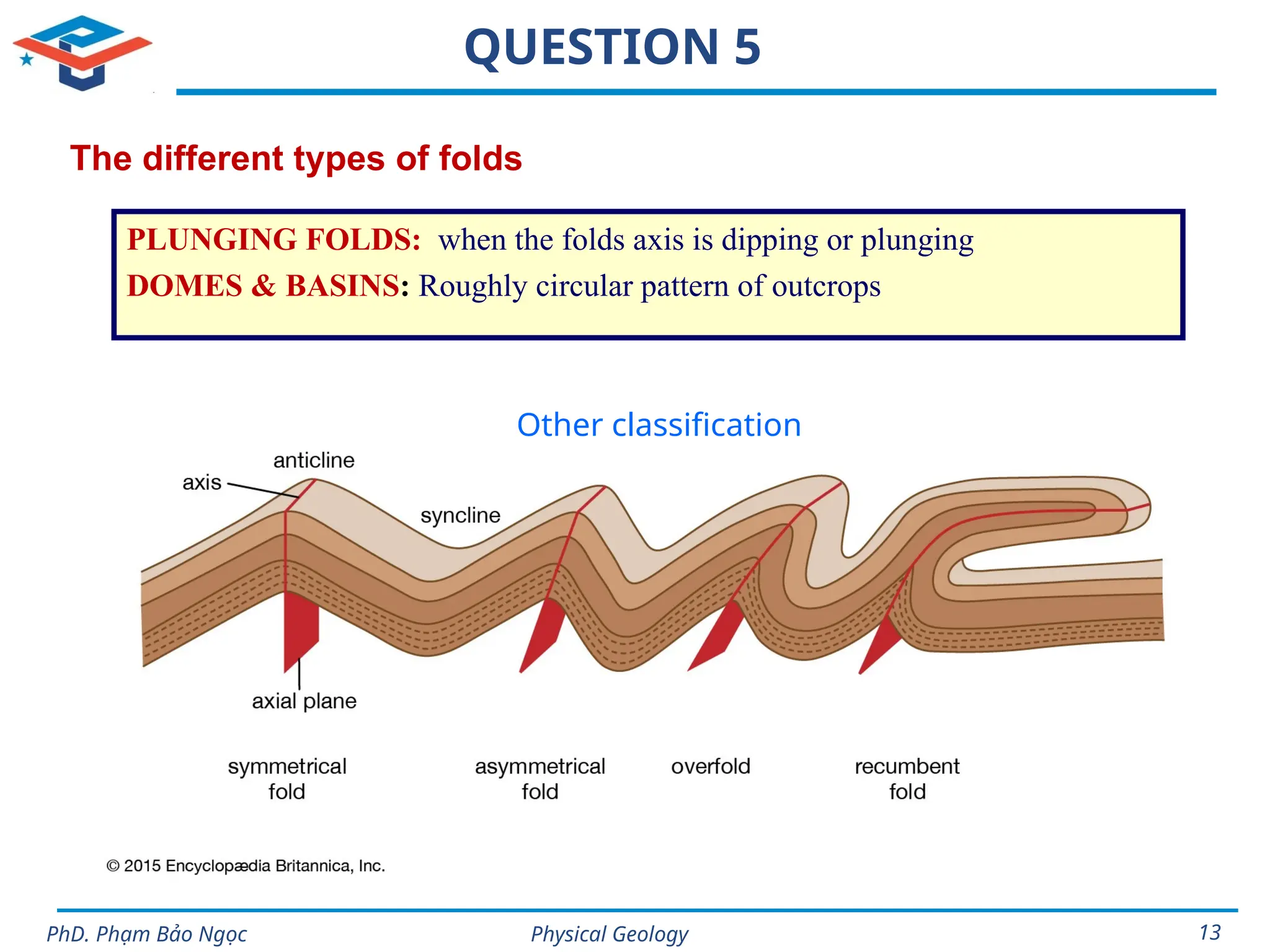
The different types of folds
PLUNGING FOLDS: when the folds axis is dipping or plunging
DOMES & BASINS: Roughly circular pattern of outcrops
Other classification
14.
Physical Geology
PhD. PhạmBảo Ngọc 14
QUESTION 5
The different types of folds
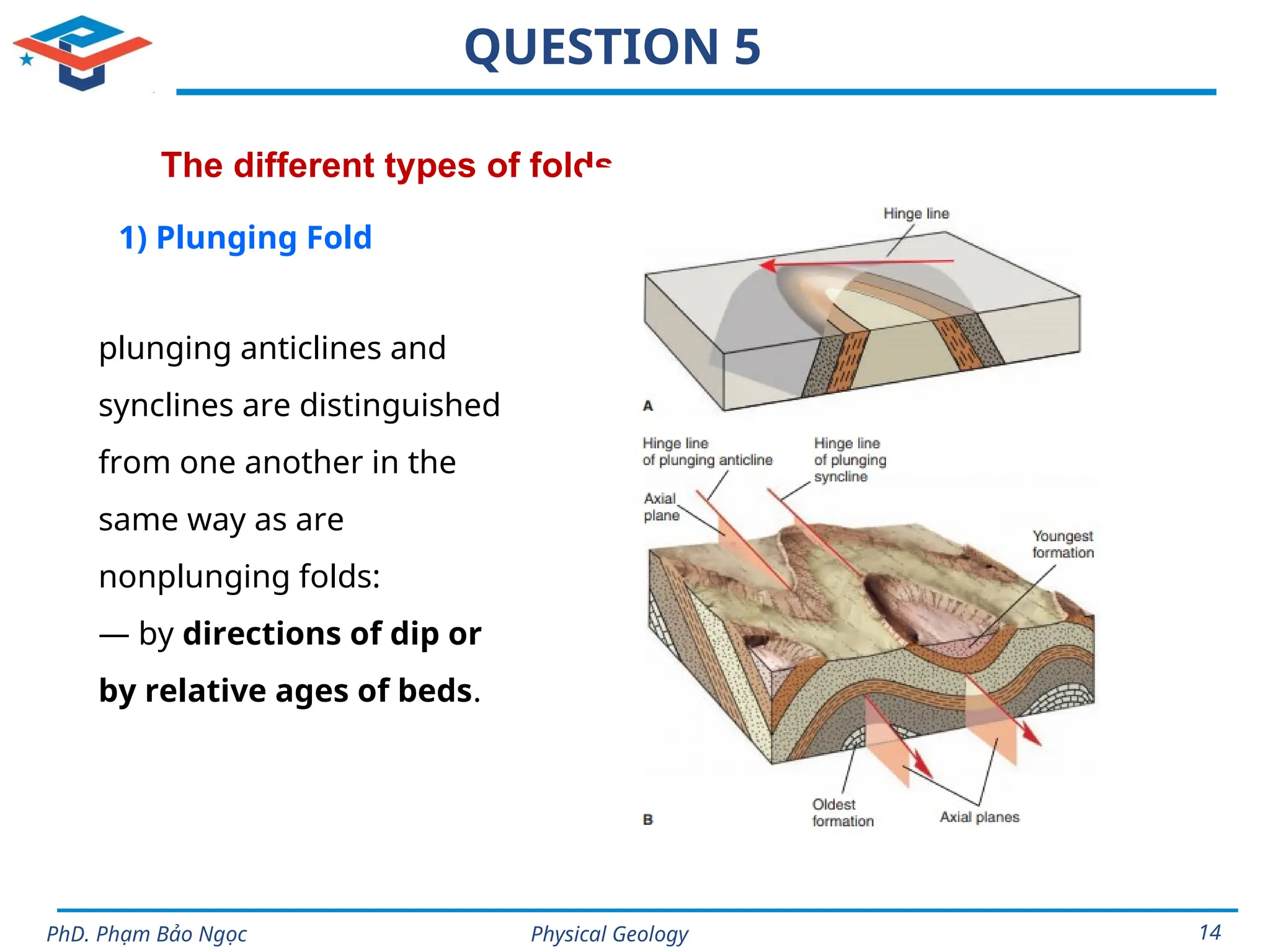
1) Plunging Fold
plunging anticlines and
synclines are distinguished
from one another in the
same way as are
nonplunging folds:
— by directions of dip or
by relative ages of beds.
15.
Physical Geology
PhD. PhạmBảo Ngọc 15
QUESTION 5
The different types of folds
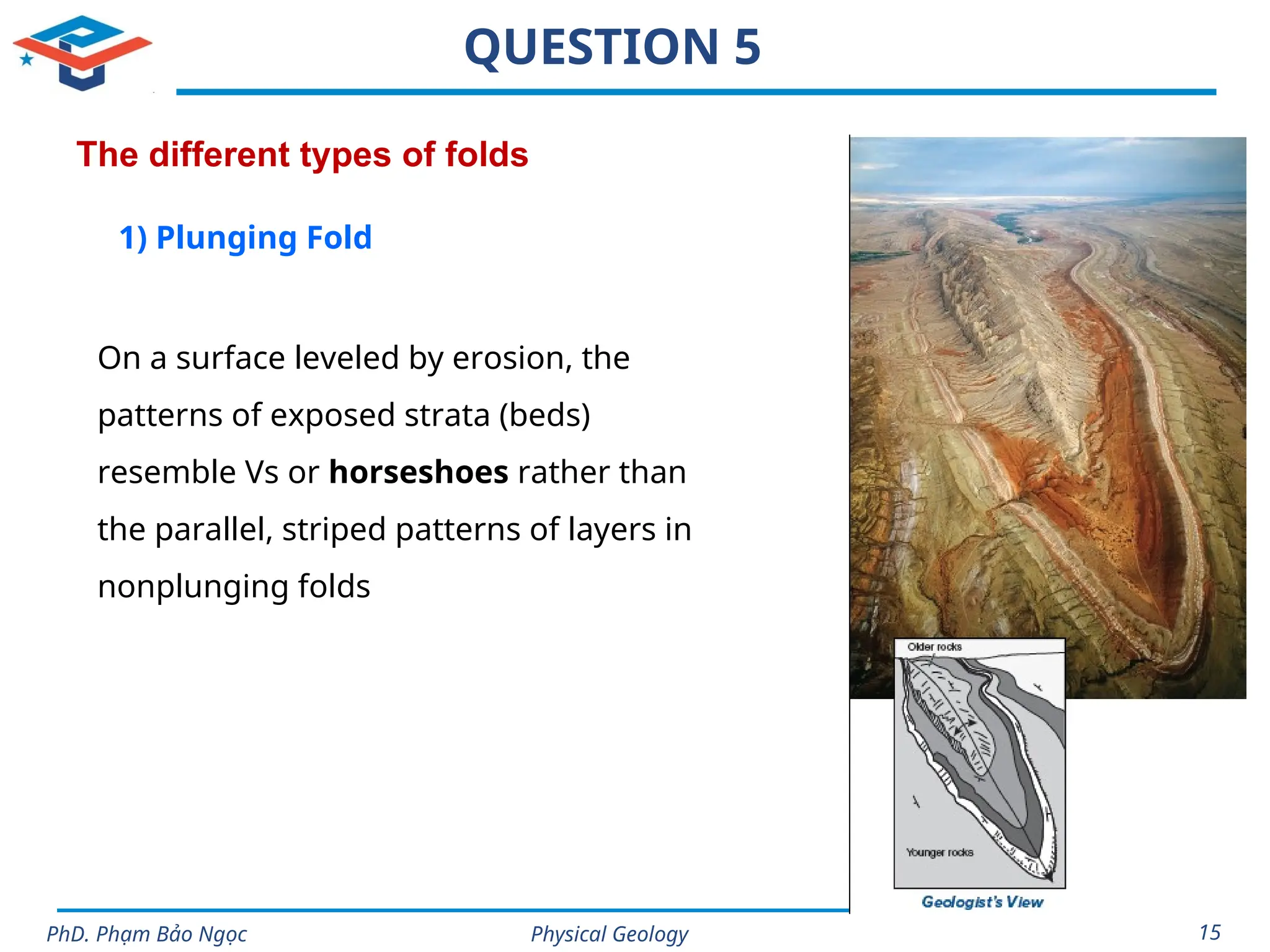
1) Plunging Fold
On a surface leveled by erosion, the
patterns of exposed strata (beds)
resemble Vs or horseshoes rather than
the parallel, striped patterns of layers in
nonplunging folds
16.
Physical Geology
PhD. PhạmBảo Ngọc 16
QUESTION 5
The different types of folds
2) Structural Domes and Structural Basins
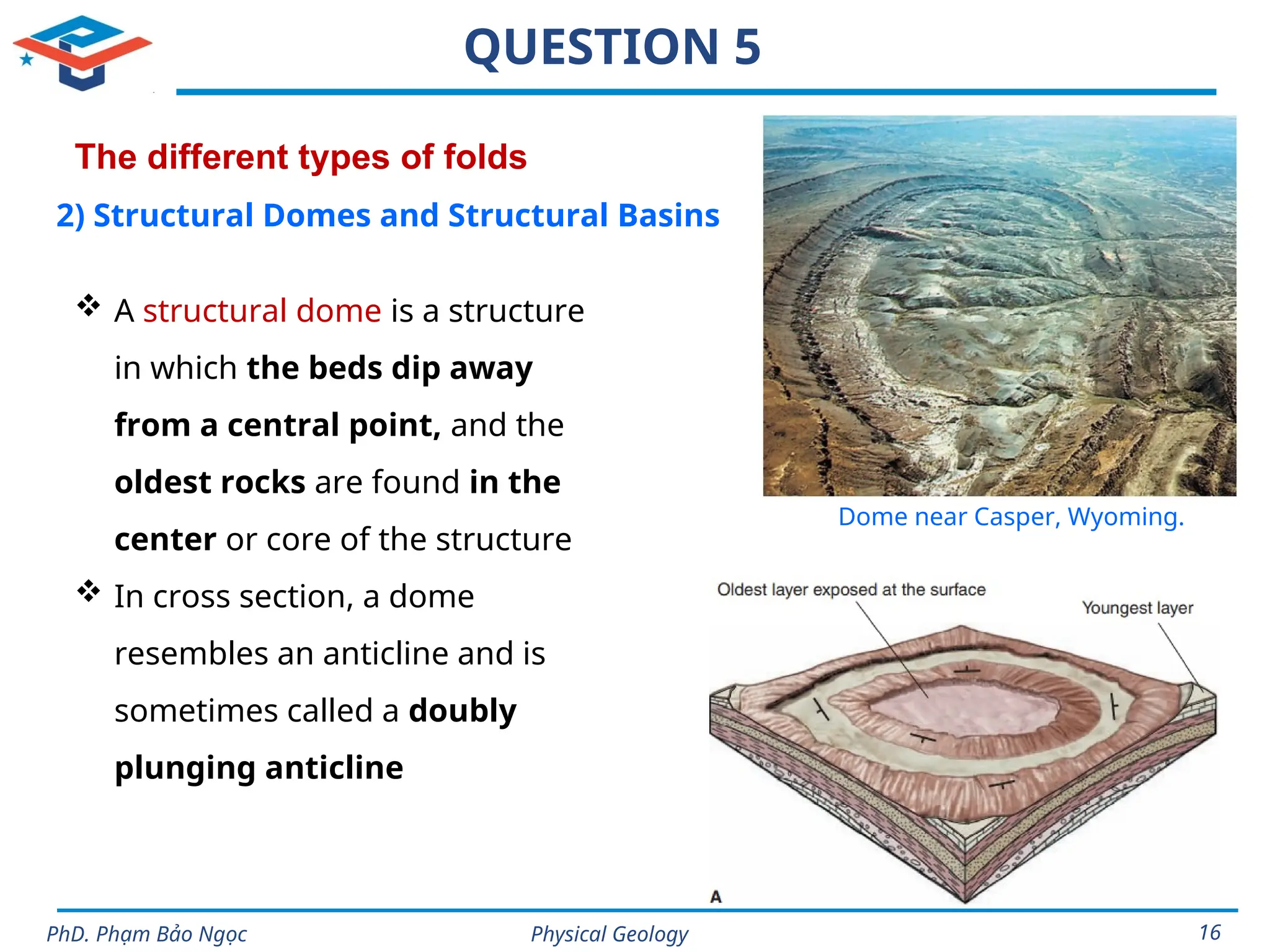
A structural dome is a structure
in which the beds dip away
from a central point, and the
oldest rocks are found in the
center or core of the structure
In cross section, a dome
resembles an anticline and is
sometimes called a doubly
plunging anticline
Dome near Casper, Wyoming.
17.
Physical Geology
PhD. PhạmBảo Ngọc 17
QUESTION 5
The different types of folds
2) Structural Domes and Structural Basins
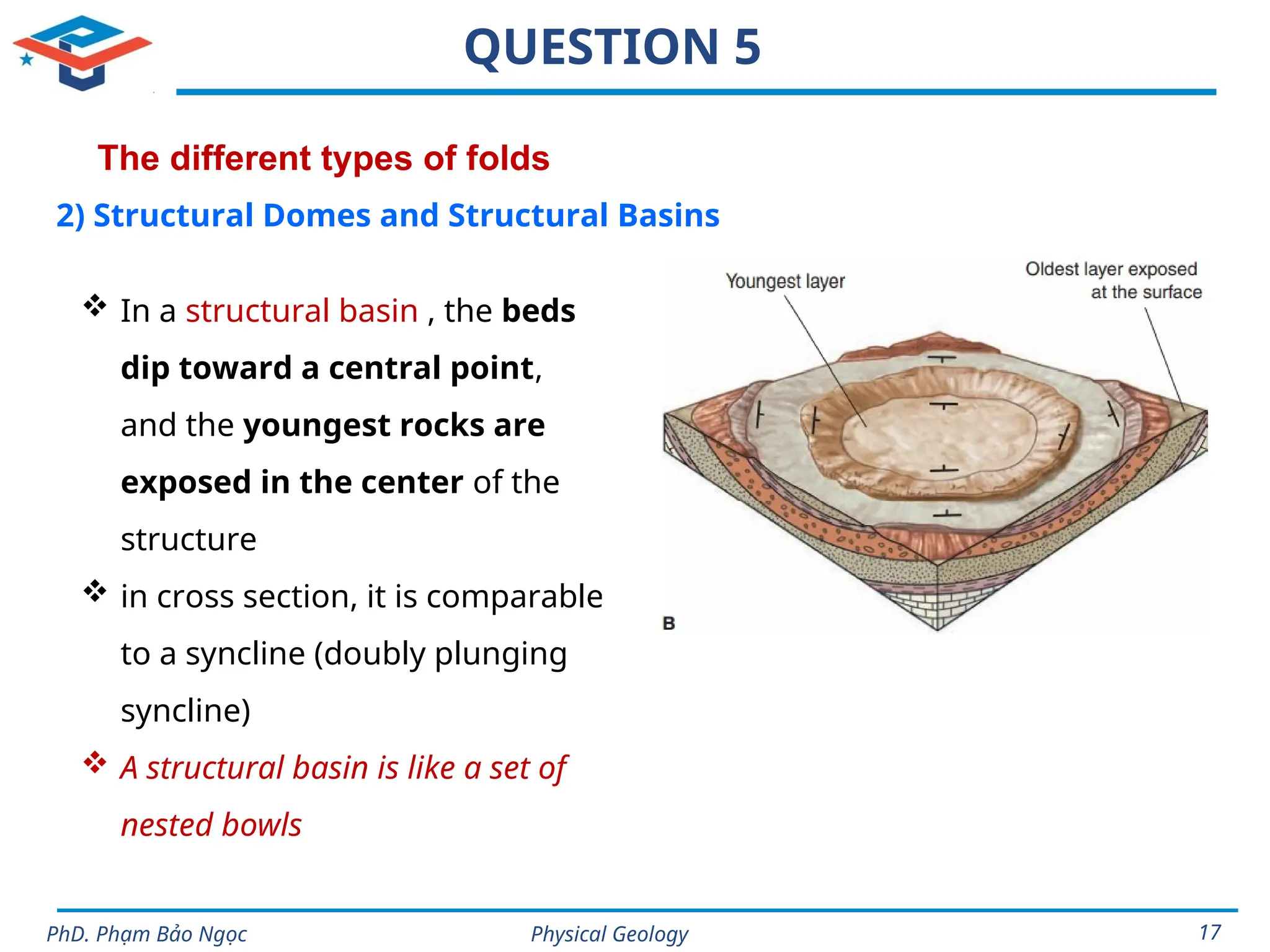
In a structural basin , the beds
dip toward a central point,
and the youngest rocks are
exposed in the center of the
structure
in cross section, it is comparable
to a syncline (doubly plunging
syncline)
A structural basin is like a set of
nested bowls
18.
Physical Geology
PhD. PhạmBảo Ngọc 18
QUESTION 5
The different types of folds
2) Structural Domes and Structural Basins
Domes and basins tend to be features on a grand scale
(some are more than a hundred kilometers across), formed
by uplift somewhat greater (for domes) or less (for
basins)
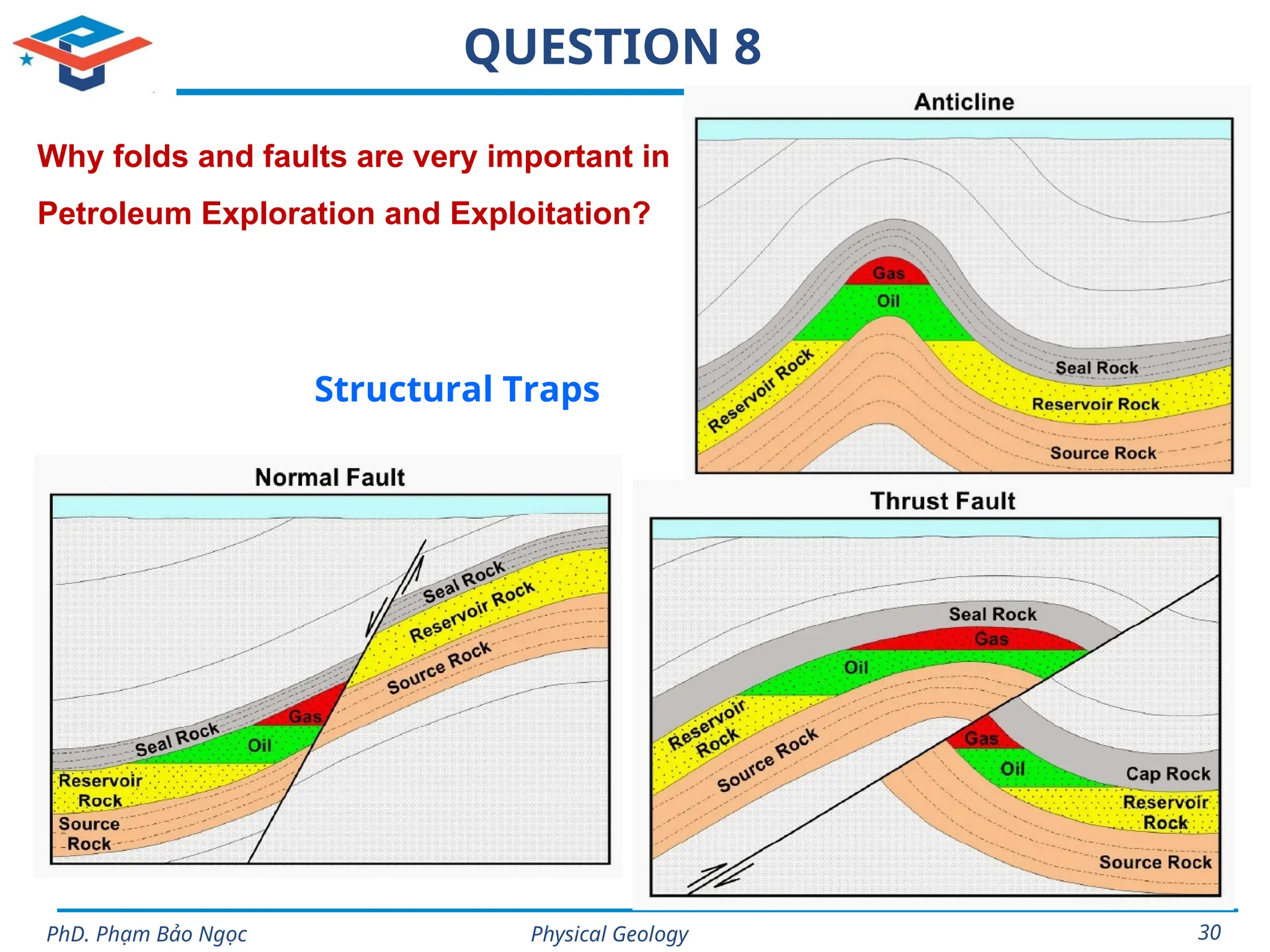
Domes and anticlines (as well as some other structures)
are important to the world’s petroleum resources
19.
Physical Geology
PhD. PhạmBảo Ngọc 19
QUESTION 6
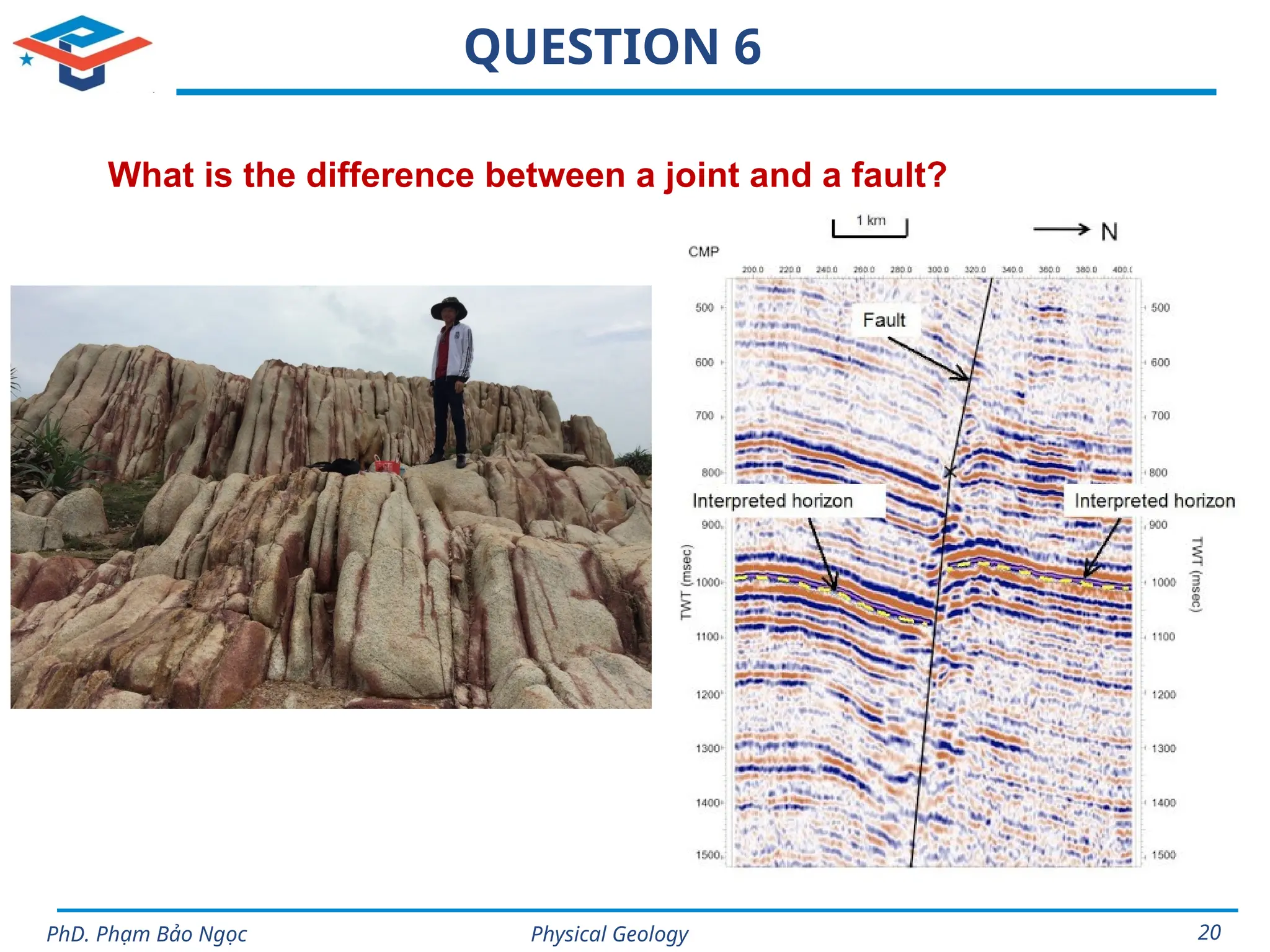
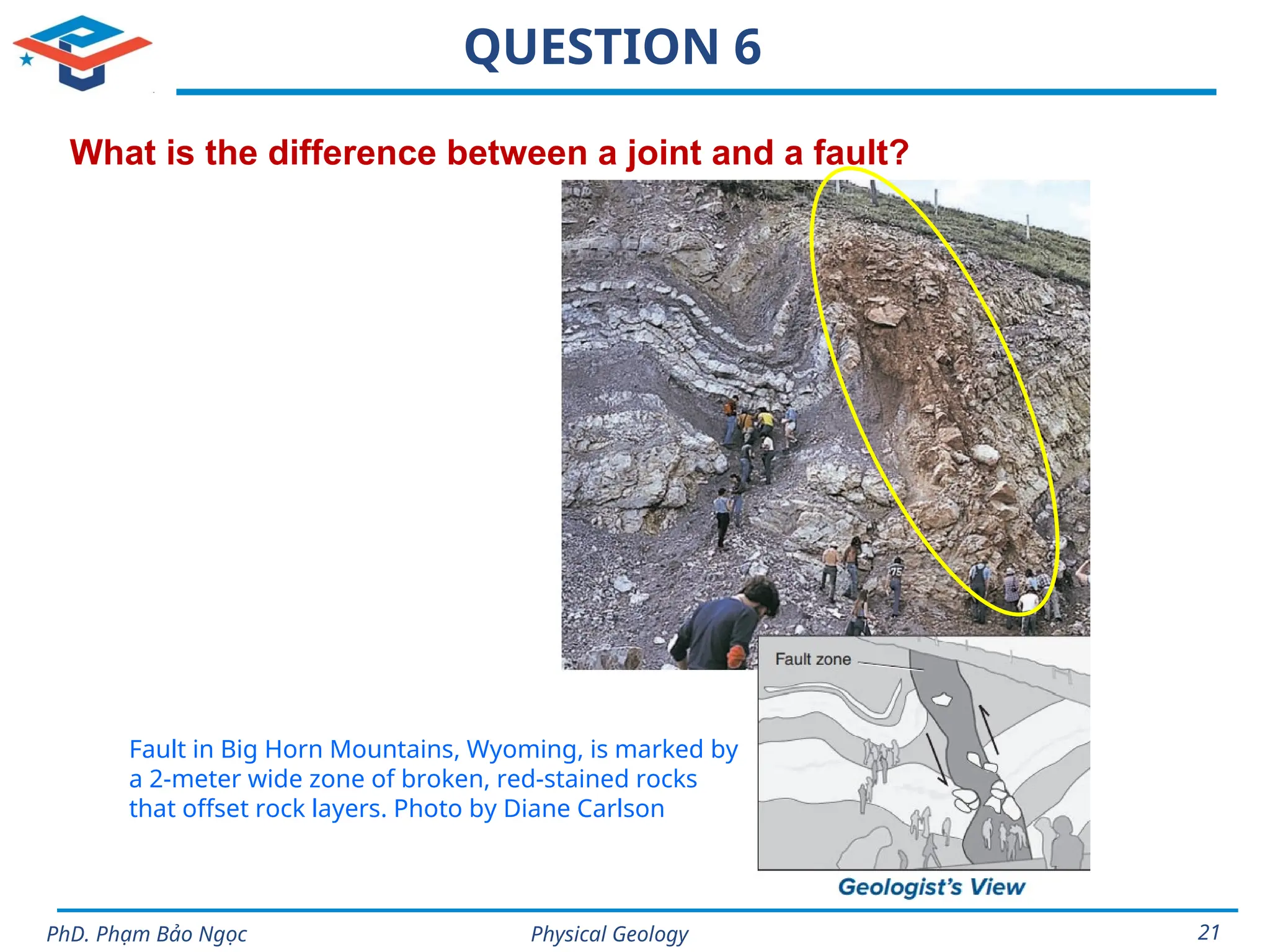
What is the difference between a joint and a fault?
If a rock is brittle ->> it will fracture ->> there is some
movement or displacement.
If essentially no shear displacement occurs, a fracture or
crack in bedrock is called a joint .
If the rock on either side of a fracture moves parallel to
the fracture plane, the fracture is a fault.
Most rock at or near the surface is brittle, so nearly all
exposed bedrock is jointed to some extent
Physical Geology
PhD. PhạmBảo Ngọc 21
QUESTION 6
What is the difference between a joint and a fault?
Fault in Big Horn Mountains, Wyoming, is marked by
a 2-meter wide zone of broken, red-stained rocks
that offset rock layers. Photo by Diane Carlson
22.
Physical Geology
PhD. PhạmBảo Ngọc 22
QUESTION 7
The different types of faults
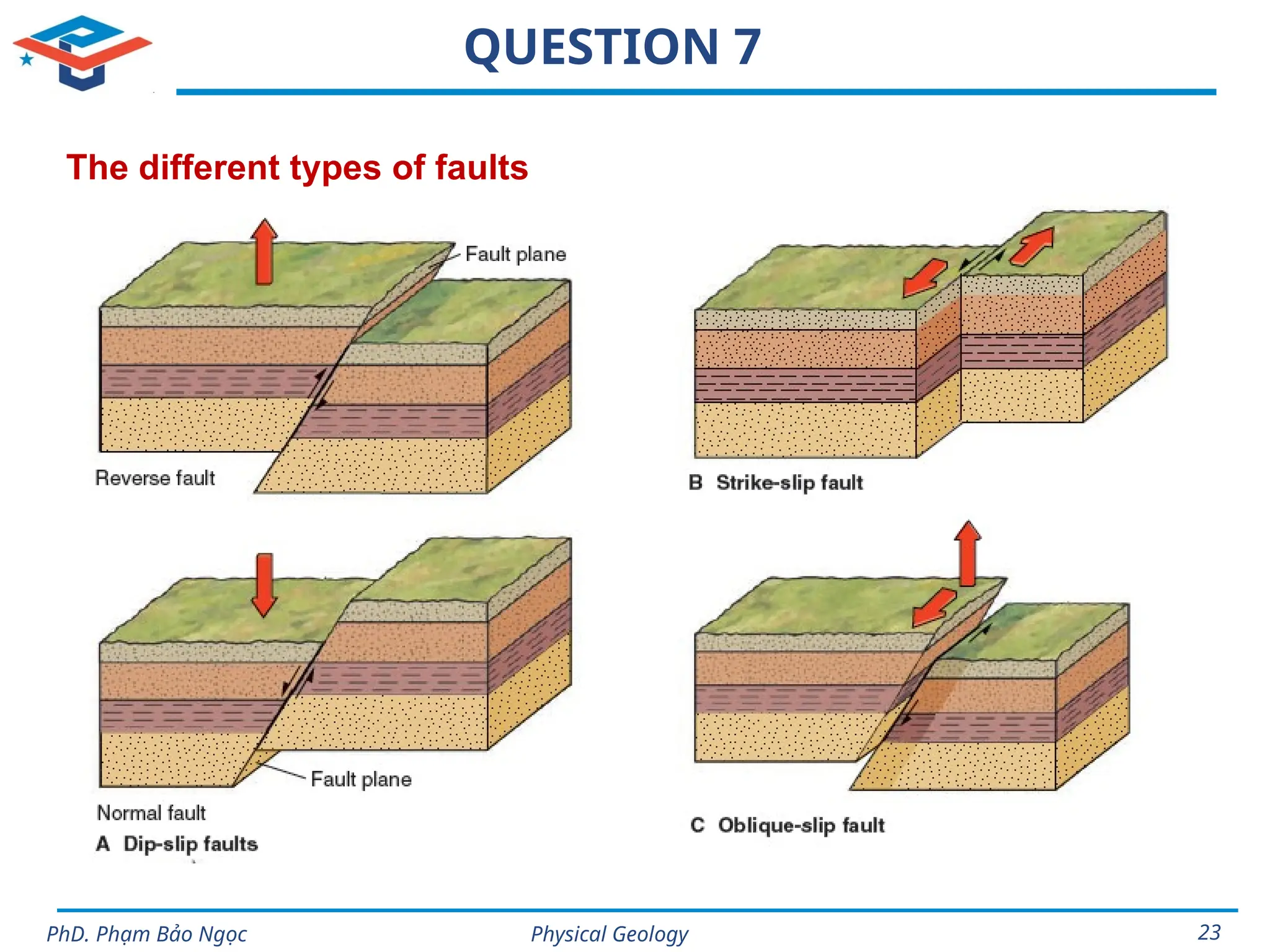
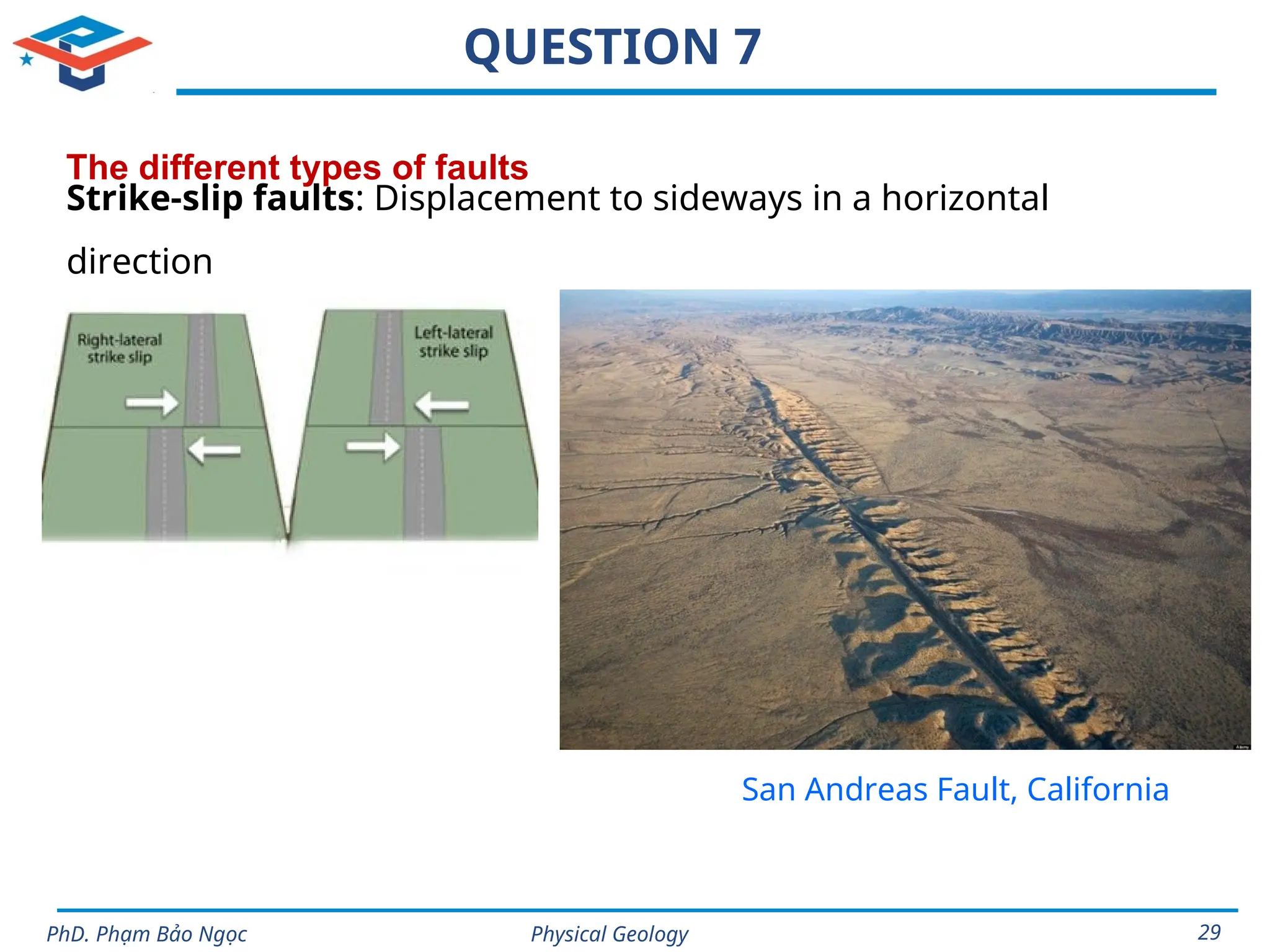
Based on direction of slippage: dip-slip, strike-slip, or oblique-slip.
In a dip-slip fault , movement is parallel to the dip of the fault
surface. It consist of normal faults and reverse faults
A strike-slip fault indicates horizontal motion parallel to the
strike of the fault surface. It consist of right-lateral fault and left-
lateral fault
An oblique-slip fault has both strike-slip and dip-slip
components.
Physical Geology
PhD. PhạmBảo Ngọc 24
QUESTION 7
The different types of faults
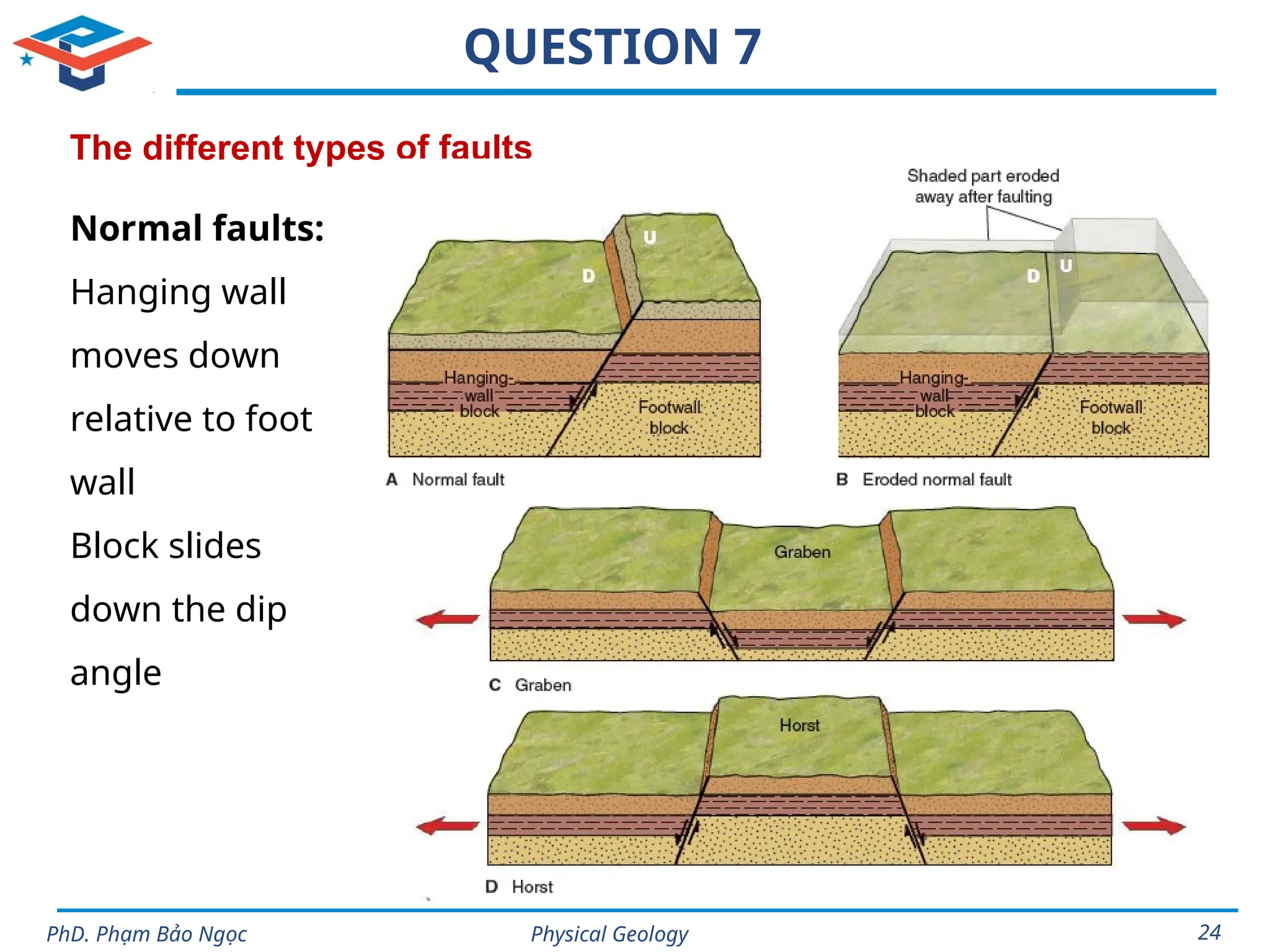
Normal faults:
Hanging wall
moves down
relative to foot
wall
Block slides
down the dip
angle
25.
Physical Geology
PhD. PhạmBảo Ngọc 25
QUESTION 7
The different types of faults
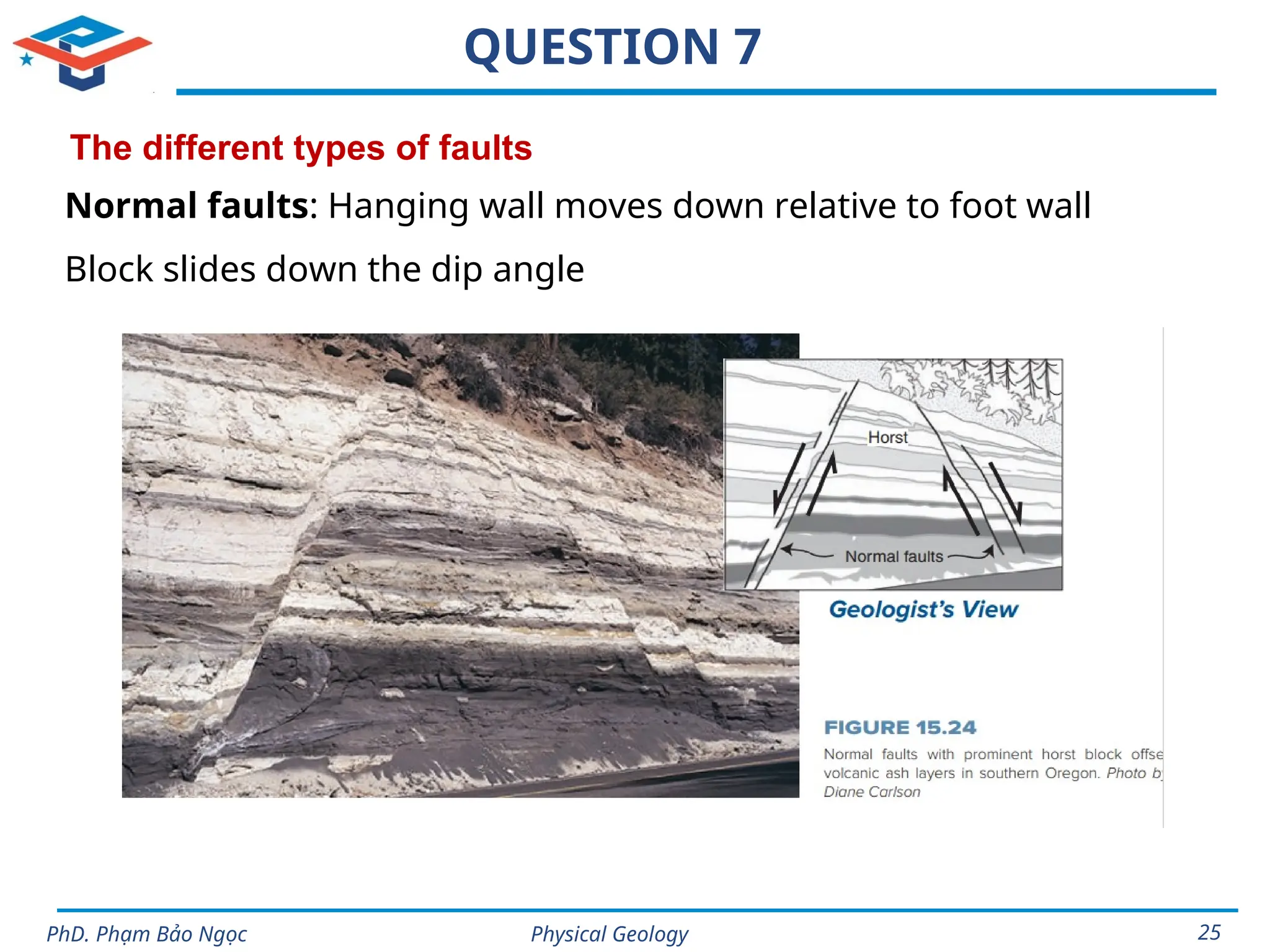
Normal faults: Hanging wall moves down relative to foot wall
Block slides down the dip angle
26.
Physical Geology
PhD. PhạmBảo Ngọc 26
QUESTION 7
The different types of faults
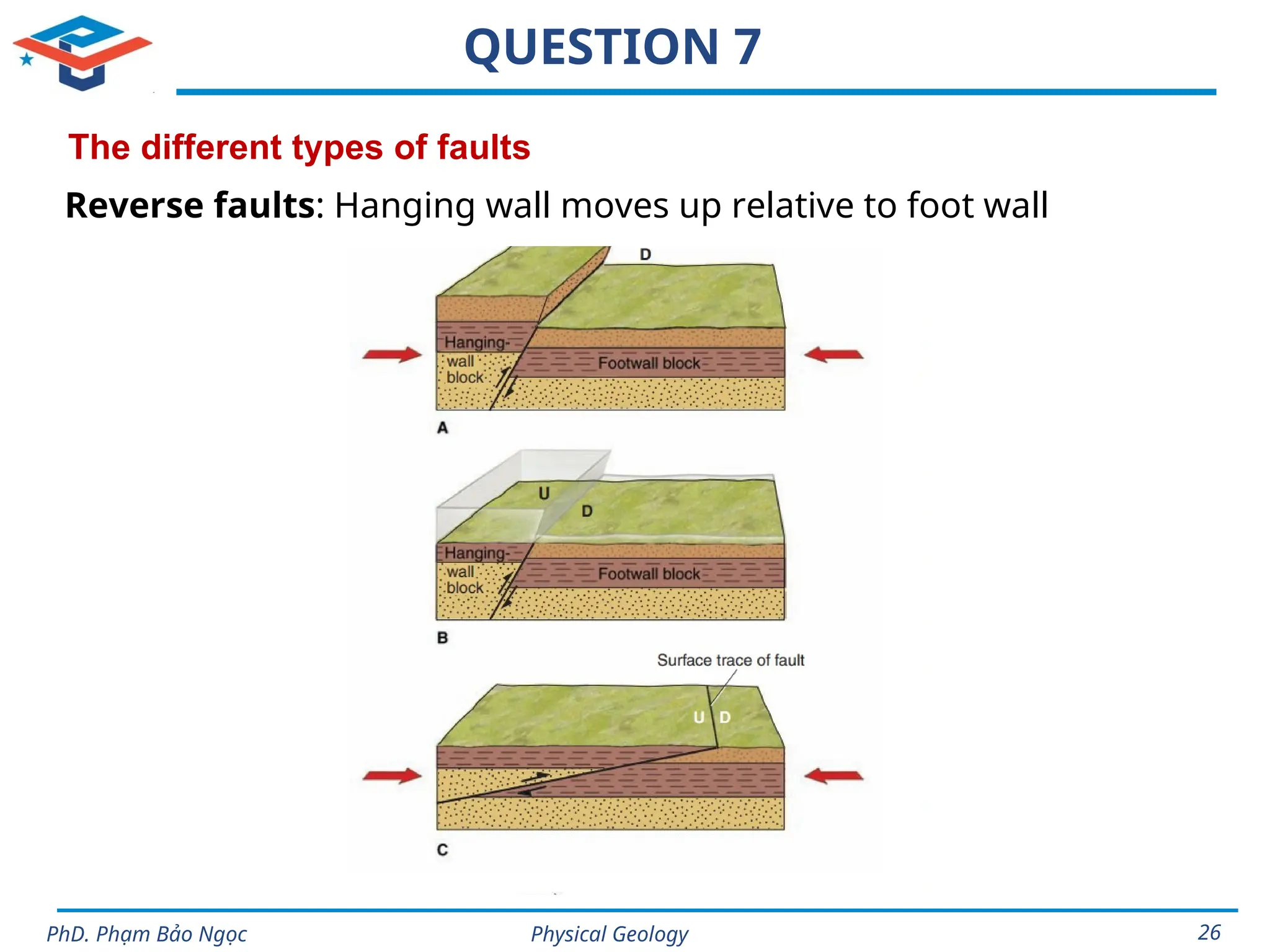
Reverse faults: Hanging wall moves up relative to foot wall
27.
Physical Geology
PhD. PhạmBảo Ngọc 27
QUESTION 7
The different types of faults
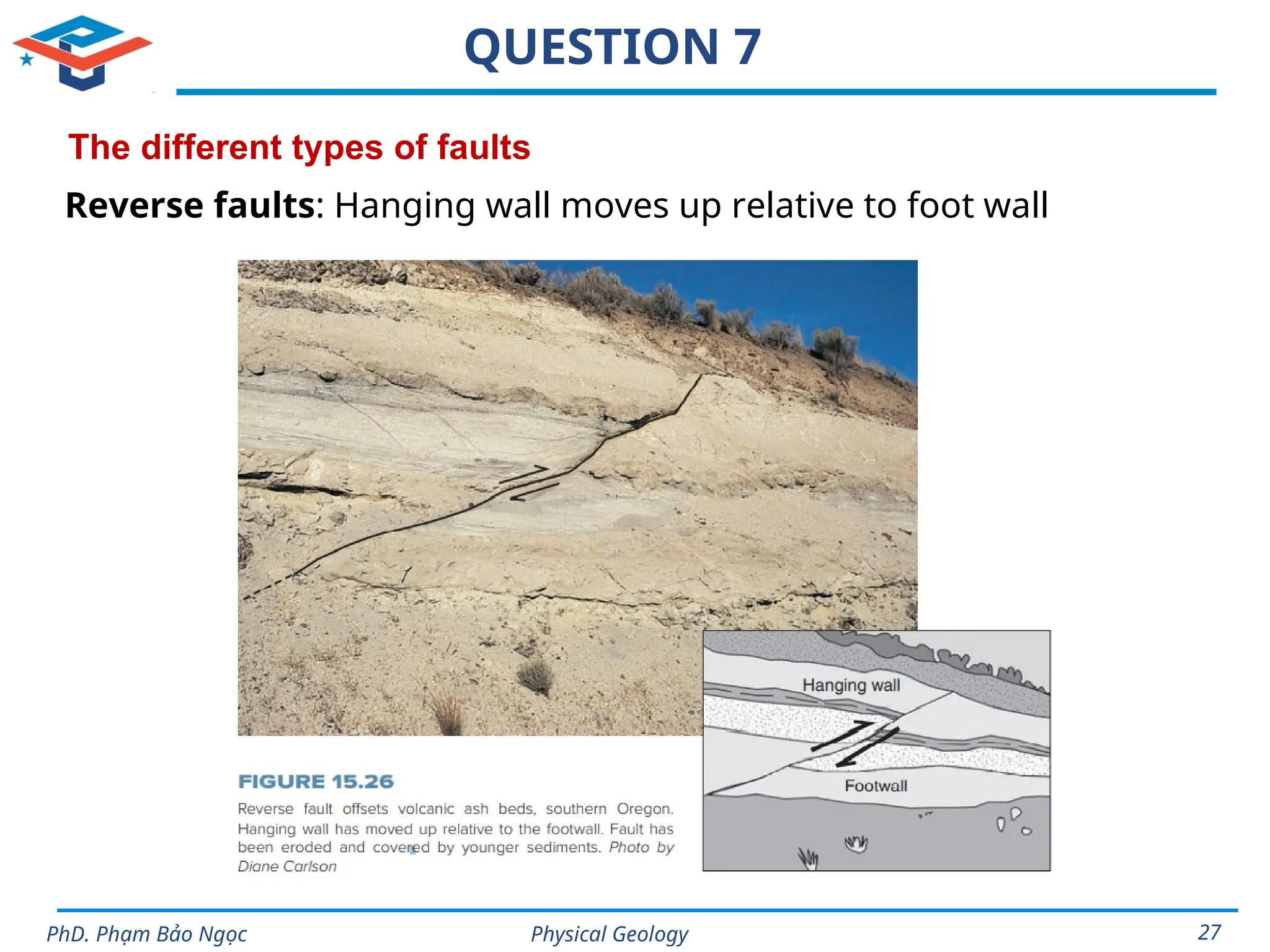
Reverse faults: Hanging wall moves up relative to foot wall
28.
Physical Geology
PhD. PhạmBảo Ngọc 28
QUESTION 7
The different types of faults
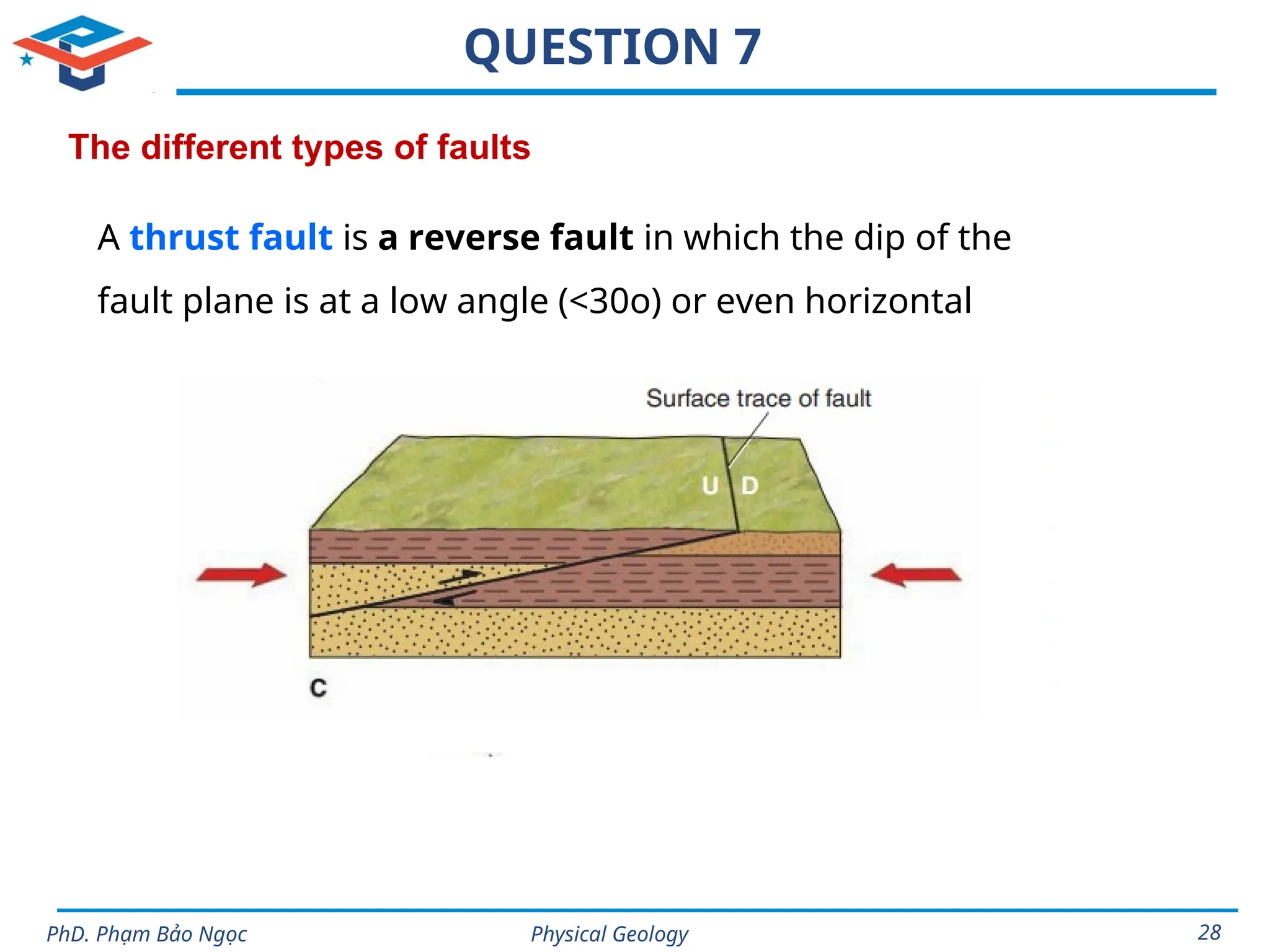
A thrust fault is a reverse fault in which the dip of the
fault plane is at a low angle (<30o) or even horizontal
29.
Physical Geology
PhD. PhạmBảo Ngọc 29
QUESTION 7
The different types of faults
Strike-slip faults: Displacement to sideways in a horizontal
direction
San Andreas Fault, California
30.
Physical Geology
PhD. PhạmBảo Ngọc 30
QUESTION 8
Why folds and faults are very important in
Petroleum Exploration and Exploitation?
Structural Traps