Geological Hazards
Disaster Readiness and Risk Reduction
Introduction
Geological hazards are natural phenomena that
cause major problems around the world. The
expansion and development of cities has led to an
increase in impact and damage due to geological
hazards. In general, most of the geological
hazards are related to natural conditions,
although some may be due to human activities.
Activity: Present a Situation
Direction: These are the some of the
landslide precaution signs often found on the
roadsides. Answer the following questions
below.
1. Have you ever seen one of these signages
on the roadsides? If yes, where, and when?
2. What do these signages mean?
3. Why is the second image highlighted in
red?
4. What is common in these places where
they are placed?
Focus of Discussion
Landslide
And
Sinkholes
Landslide
A landslide is a ground movement on a sloping terrain. It does not
happen on flat ground because of the angle on the ground, gravity
induces the land to move downward. It is aggravated by rain because
water is a natural agent for erosion. If rain or any source of water
frequently flows down a sloping area, the gravitational descent of
loosened soil makes it possible for landslide to occur.
Structures that are built on steep-slope mountains have a high
vulnerability to landslide hazards especially during heavy rains. Areas
with: steep slope, dense population and denuded terrain are
distinguished by a high susceptibility to rainfall-induced landslide
hazards.
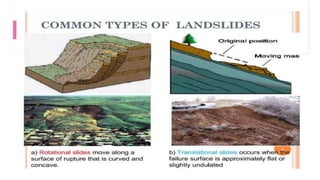
Classifications of Landslide
• Type of material involved
Debris, mud, earth, and rock
• Type of motion
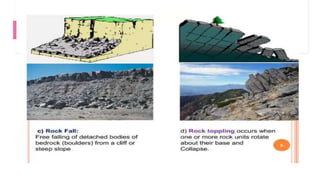
Fall: freefall of pieces
Slide: Material moves along a surface
Flow: Material moves as a viscous fluid
Creep: Very slow and gradual movement
Geological Hazards.pptx

Geological Hazards.pptx

  • 1.
  • 2.
    Introduction Geological hazards arenatural phenomena that cause major problems around the world. The expansion and development of cities has led to an increase in impact and damage due to geological hazards. In general, most of the geological hazards are related to natural conditions, although some may be due to human activities.
  • 3.
    Activity: Present aSituation Direction: These are the some of the landslide precaution signs often found on the roadsides. Answer the following questions below. 1. Have you ever seen one of these signages on the roadsides? If yes, where, and when? 2. What do these signages mean? 3. Why is the second image highlighted in red? 4. What is common in these places where they are placed?
  • 4.
  • 5.
    Landslide A landslide isa ground movement on a sloping terrain. It does not happen on flat ground because of the angle on the ground, gravity induces the land to move downward. It is aggravated by rain because water is a natural agent for erosion. If rain or any source of water frequently flows down a sloping area, the gravitational descent of loosened soil makes it possible for landslide to occur. Structures that are built on steep-slope mountains have a high vulnerability to landslide hazards especially during heavy rains. Areas with: steep slope, dense population and denuded terrain are distinguished by a high susceptibility to rainfall-induced landslide hazards.
  • 6.
    Classifications of Landslide •Type of material involved Debris, mud, earth, and rock • Type of motion Fall: freefall of pieces Slide: Material moves along a surface Flow: Material moves as a viscous fluid Creep: Very slow and gradual movement