
The Commonwealth of Australia
Lecturer: Kob Isa
Group Member’s Name: Ekchan ProsPov
Ea Vatana
Heang Chan Borey
Ean Socheata
ChaoChan Thavy
សកលវ ិទ្យាល័យកម្ព ុជាអន្តរជាតិ
CAMBODIAN INTERNATIONAL UNIVERSITY
25 June 2014
Content
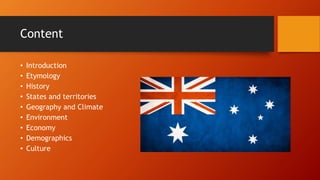
• Introduction
• Etymology
• History
• States and territories
• Geography and Climate
• Environment
• Economy
• Demographics
• Culture
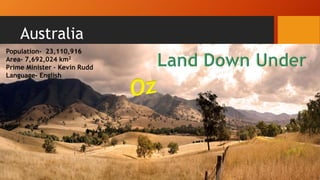
Australia
Population- 23,110,916
Area- 7,692,024 km2
Prime Minister – Kevin Rudd
Language- English
Introduction
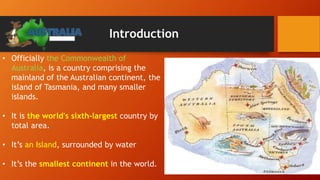
• Officially the Commonwealth of
Australia, is a country comprising the
mainland of the Australian continent, the
island of Tasmania, and many smaller
islands.
• It is the world's sixth-largest country by
total area.
• It’s an Island, surrounded by water
• It’s the smallest continent in the world.
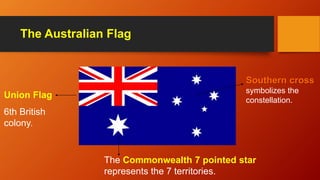
The Australian Flag
Union Flag
6th British
colony.
Southern cross
symbolizes the
constellation.
The Commonwealth 7 pointed star
represents the 7 territories.
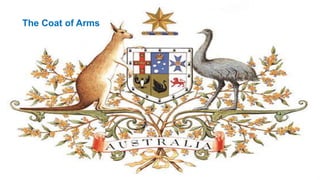
The Coat of Arms
Etymology
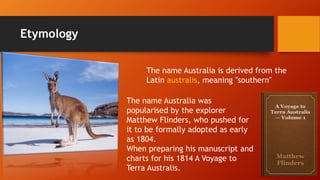
The name Australia is derived from the
Latin australis, meaning "southern"
The name Australia was
popularised by the explorer
Matthew Flinders, who pushed for
it to be formally adopted as early
as 1804.
When preparing his manuscript and
charts for his 1814 A Voyage to
Terra Australis.
Etymology
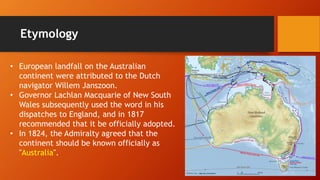
• European landfall on the Australian
continent were attributed to the Dutch
navigator Willem Janszoon.
• Governor Lachlan Macquarie of New South
Wales subsequently used the word in his
dispatches to England, and in 1817
recommended that it be officially adopted.
• In 1824, the Admiralty agreed that the
continent should be known officially as
"Australia".
History of Australia
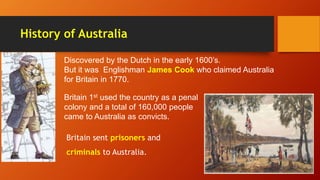
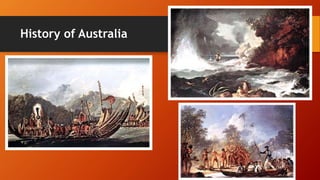
Discovered by the Dutch in the early 1600’s.
But it was Englishman James Cook who claimed Australia
for Britain in 1770.
Britain 1st used the country as a penal
colony and a total of 160,000 people
came to Australia as convicts.
Britain sent prisoners and
criminals to Australia.
History of Australia
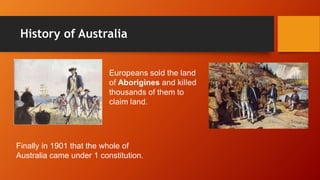
Finally in 1901 that the whole of
Australia came under 1 constitution.
History of Australia
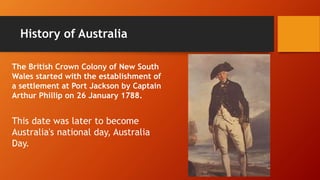
The British Crown Colony of New South
Wales started with the establishment of
a settlement at Port Jackson by Captain
Arthur Phillip on 26 January 1788.
This date was later to become
Australia's national day, Australia
Day.
History of Australia
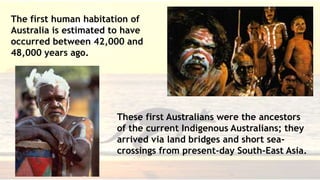
• The first human habitation of Australia is estimated to
have occurred between 42,000 and 48,000 years ago.
• These first Australians were the ancestors of the current
Indigenous Australians; they arrived via land bridges and
short sea-crossings from present-day South-East Asia.
The first human habitation of
Australia is estimated to have
occurred between 42,000 and
48,000 years ago.
These first Australians were the ancestors
of the current Indigenous Australians; they
arrived via land bridges and short sea-
crossings from present-day South-East Asia.
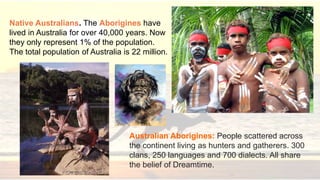
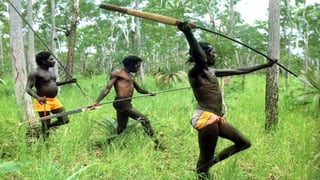
Australian Aborigines: People scattered across
the continent living as hunters and gatherers. 300
clans, 250 languages and 700 dialects. All share
the belief of Dreamtime.
Native Australians. The Aborigines have
lived in Australia for over 40,000 years. Now
they only represent 1% of the population.
The total population of Australia is 22 million.
Government of Australia
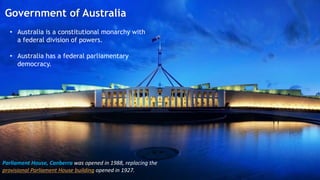
Parliament House, Canberra was opened in 1988, replacing the
provisional Parliament House building opened in 1927.
• Australia is a constitutional monarchy with
a federal division of powers.
• Australia has a federal parliamentary
democracy.
Political Issues
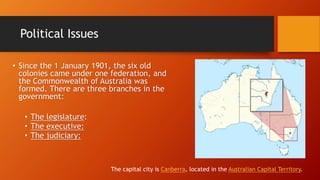
• Since the 1 January 1901, the six old
colonies came under one federation, and
the Commonwealth of Australia was
formed. There are three branches in the
government:
• The legislature:
• The executive:
• The judiciary:
The capital city is Canberra, located in the Australian Capital Territory.
Political Issues
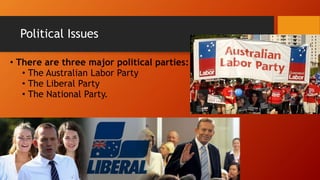
• There are three major political parties:
• The Australian Labor Party
• The Liberal Party
• The National Party.
Government
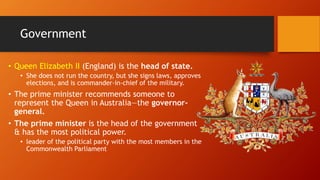
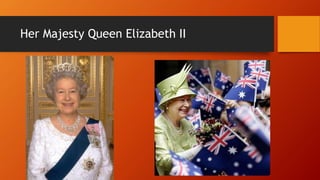
• Queen Elizabeth II (England) is the head of state.
• She does not run the country, but she signs laws, approves
elections, and is commander-in-chief of the military.
• The prime minister recommends someone to
represent the Queen in Australia—the governor-
general.
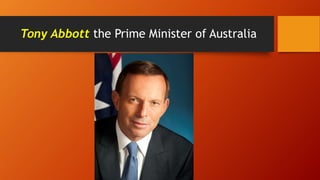
• The prime minister is the head of the government
& has the most political power.
• leader of the political party with the most members in the
Commonwealth Parliament
Her Majesty Queen Elizabeth II
Tony Abbott the Prime Minister of Australia
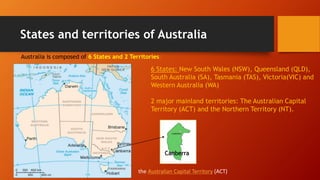
States and territories of Australia
Australia is composed of 6 States and 2 Territories:
the Australian Capital Territory (ACT)
Canberra
6 States: New South Wales (NSW), Queensland (QLD),
South Australia (SA), Tasmania (TAS), Victoria(VIC) and
Western Australia (WA)
2 major mainland territories: The Australian Capital
Territory (ACT) and the Northern Territory (NT).
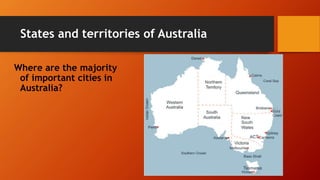
States and territories of Australia
Where are the majority
of important cities in
Australia?
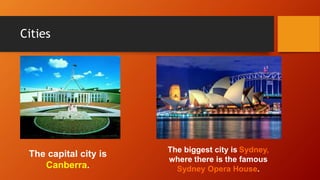
Cities
The capital city is
Canberra.
The biggest city is Sydney,
where there is the famous
Sydney Opera House.
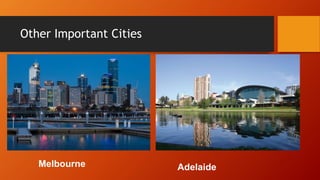
Other Important Cities
Melbourne Adelaide
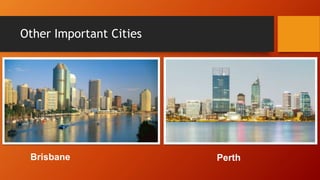
Other Important Cities
Brisbane Perth
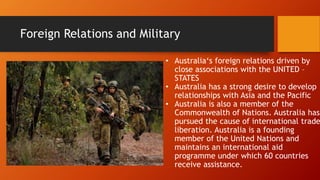
Foreign Relations and Military
• Australia‘s foreign relations driven by
close associations with the UNITED –
STATES
• Australia has a strong desire to develop
relationships with Asia and the Pacific
• Australia is also a member of the
Commonwealth of Nations. Australia has
pursued the cause of international trade
liberation. Australia is a founding
member of the United Nations and
maintains an international aid
programme under which 60 countries
receive assistance.
Geography and Climate
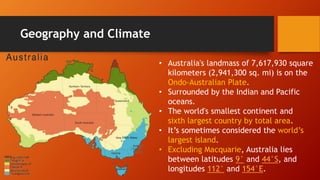
• Australia's landmass of 7,617,930 square
kilometers (2,941,300 sq. mi) is on the
Ondo-Australian Plate.
• Surrounded by the Indian and Pacific
oceans.
• The world's smallest continent and
sixth largest country by total area.
• It’s sometimes considered the world’s
largest island.
• Excluding Macquarie, Australia lies
between latitudes 9° and 44°S, and
longitudes 112° and 154°E.
Geography and Climate
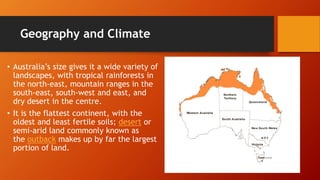
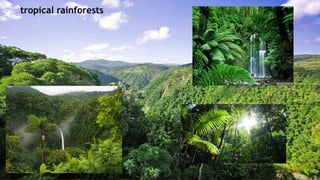
• Australia’s size gives it a wide variety of
landscapes, with tropical rainforests in
the north-east, mountain ranges in the
south-east, south-west and east, and
dry desert in the centre.
• It is the flattest continent, with the
oldest and least fertile soils; desert or
semi-arid land commonly known as
the outback makes up by far the largest
portion of land.
tropical rainforests
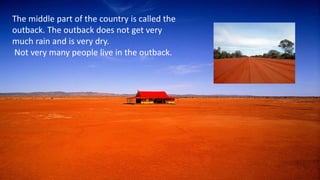
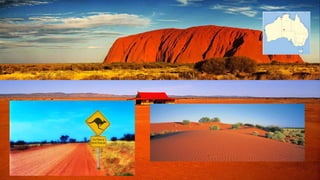
The middle part of the country is called the outback. The
outback does not get very much rain and is very dry.
Not very many people live in the outback.
The middle part of the country is called the
outback. The outback does not get very
much rain and is very dry.
Not very many people live in the outback.
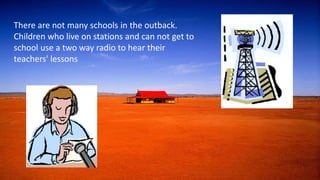
There are not many schools in the outback.
Children who live on stations and can not get to
school use a two way radio to hear their
teachers' lessons
Ayers Rock or Uluru
Kangaroos in the Outback
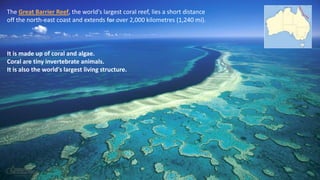
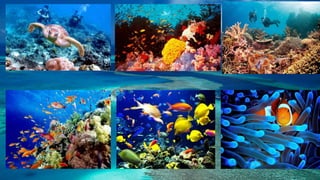
The Great Barrier Reef, the world's largest coral reef, lies a short distance
off the north-east coast and extends for over 2,000 kilometres (1,240 mi).
It is made up of coral and algae.
Coral are tiny invertebrate animals.
It is also the world's largest living structure.
Geography and Climate
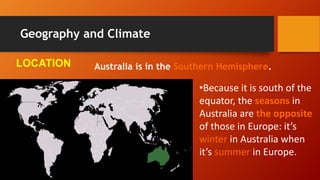
Australia is in the Southern Hemisphere.
•Because it is south of the
equator, the seasons in
Australia are the opposite
of those in Europe: it’s
winter in Australia when
it’s summer in Europe.
LOCATION
Environment of Australia
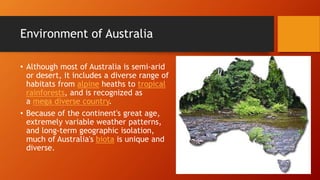
• Although most of Australia is semi-arid
or desert, it includes a diverse range of
habitats from alpine heaths to tropical
rainforests, and is recognized as
a mega diverse country.
• Because of the continent's great age,
extremely variable weather patterns,
and long-term geographic isolation,
much of Australia's biota is unique and
diverse.
Environment of Australia
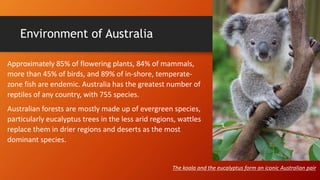
The koala and the eucalyptus form an iconic Australian pair
Approximately 85% of flowering plants, 84% of mammals,
more than 45% of birds, and 89% of in-shore, temperate-
zone fish are endemic. Australia has the greatest number of
reptiles of any country, with 755 species.
Australian forests are mostly made up of evergreen species,
particularly eucalyptus trees in the less arid regions, wattles
replace them in drier regions and deserts as the most
dominant species.
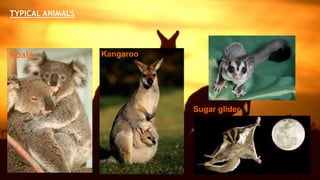
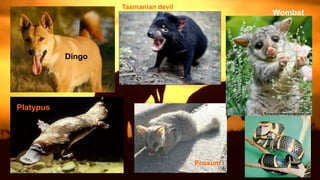
TYPICAL ANIMALS
Koala Kangaroo
Sugar glider
Dingo
Platypus
Tasmanian devil
Possum
Wombat
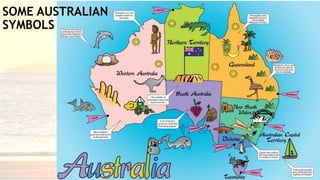
SOME AUSTRALIAN
SYMBOLS
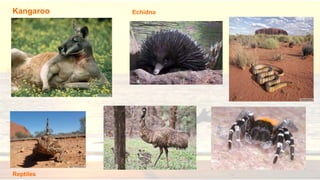
Kangaroo Echidna
Reptiles
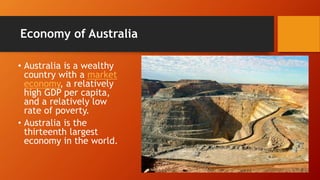
Economy of Australia
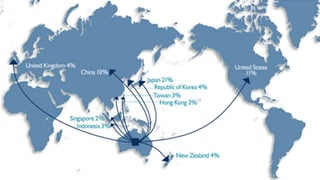
• Australia is a wealthy
country with a market
economy, a relatively
high GDP per capita,
and a relatively low
rate of poverty.
• Australia is the
thirteenth largest
economy in the world.
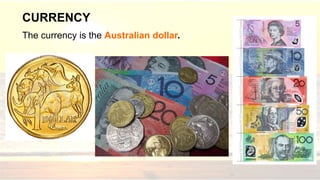
CURRENCY
The currency is the Australian dollar.
Resources
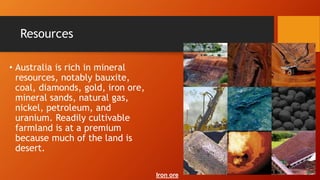
• Australia is rich in mineral
resources, notably bauxite,
coal, diamonds, gold, iron ore,
mineral sands, natural gas,
nickel, petroleum, and
uranium. Readily cultivable
farmland is at a premium
because much of the land is
desert.
Iron ore
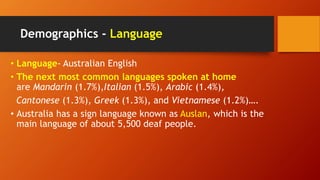
Demographics - Language
• Language- Australian English
• The next most common languages spoken at home
are Mandarin (1.7%),Italian (1.5%), Arabic (1.4%),
Cantonese (1.3%), Greek (1.3%), and Vietnamese (1.2%)….
• Australia has a sign language known as Auslan, which is the
main language of about 5,500 deaf people.
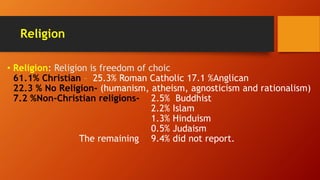
Religion
• Religion: Religion is freedom of choic
61.1% Christian - 25.3% Roman Catholic 17.1 %Anglican
22.3 % No Religion- (humanism, atheism, agnosticism and rationalism)
7.2 %Non-Christian religions- 2.5% Buddhist
2.2% Islam
1.3% Hinduism
0.5% Judaism
The remaining 9.4% did not report.
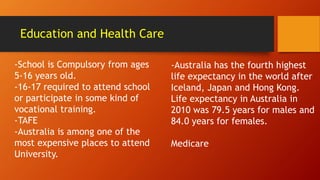
Education and Health Care
-School is Compulsory from ages
5-16 years old.
-16-17 required to attend school
or participate in some kind of
vocational training.
-TAFE
-Australia is among one of the
most expensive places to attend
University.
-Australia has the fourth highest
life expectancy in the world after
Iceland, Japan and Hong Kong.
Life expectancy in Australia in
2010 was 79.5 years for males and
84.0 years for females.
Medicare
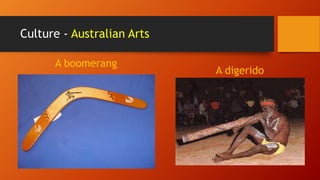
Culture - Australian Arts
A digerido
A boomerang
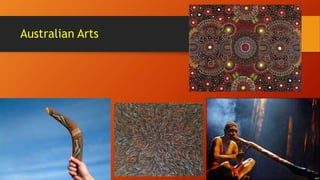
Australian Arts
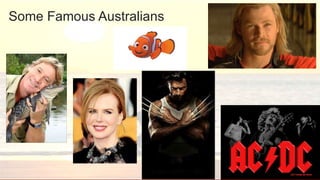
Some Famous Australians
Australian Arts
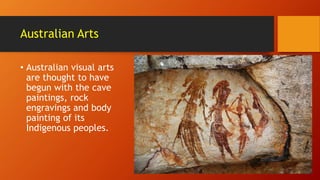
• Australian visual arts
are thought to have
begun with the cave
paintings, rock
engravings and body
painting of its
Indigenous peoples.
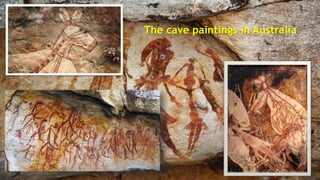
The cave paintings in Australia
Cuisine
Sport
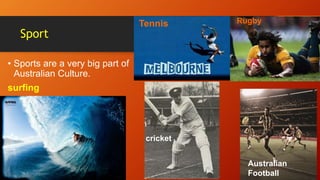
• Sports are a very big part of
Australian Culture.
cricket
Tennis
surfing
cricket
Australian
Football
Rugby
References
• http://www.slideshare.net/search/slideshow?searchfrom=header
&q=Austrulia
• http://en.wikipedia.org/wiki/Australia
• https://www.google.com.kh/search?q=Australia&tbm=isch&tbo=u
&source=univ&sa=X&ei=EwCpU_C2F8yB8gWKx4HAAQ&ved=0CDkQs
AQ&biw=1366&bih=681
Reference
Thanks For Paying Attention
Slide Design by Ekchan ProsPov
Date: 24 June 2014

Australia's presentatoin

  • 1.
    The Commonwealth ofAustralia Lecturer: Kob Isa Group Member’s Name: Ekchan ProsPov Ea Vatana Heang Chan Borey Ean Socheata ChaoChan Thavy សកលវ ិទ្យាល័យកម្ព ុជាអន្តរជាតិ CAMBODIAN INTERNATIONAL UNIVERSITY 25 June 2014
  • 2.
    Content • Introduction • Etymology •History • States and territories • Geography and Climate • Environment • Economy • Demographics • Culture
  • 3.
    Australia Population- 23,110,916 Area- 7,692,024km2 Prime Minister – Kevin Rudd Language- English
  • 4.
    Introduction • Officially theCommonwealth of Australia, is a country comprising the mainland of the Australian continent, the island of Tasmania, and many smaller islands. • It is the world's sixth-largest country by total area. • It’s an Island, surrounded by water • It’s the smallest continent in the world.
  • 5.
    The Australian Flag UnionFlag 6th British colony. Southern cross symbolizes the constellation. The Commonwealth 7 pointed star represents the 7 territories.
  • 6.
  • 7.
    Etymology The name Australiais derived from the Latin australis, meaning "southern" The name Australia was popularised by the explorer Matthew Flinders, who pushed for it to be formally adopted as early as 1804. When preparing his manuscript and charts for his 1814 A Voyage to Terra Australis.
  • 8.
    Etymology • European landfallon the Australian continent were attributed to the Dutch navigator Willem Janszoon. • Governor Lachlan Macquarie of New South Wales subsequently used the word in his dispatches to England, and in 1817 recommended that it be officially adopted. • In 1824, the Admiralty agreed that the continent should be known officially as "Australia".
  • 9.
    History of Australia Discoveredby the Dutch in the early 1600’s. But it was Englishman James Cook who claimed Australia for Britain in 1770. Britain 1st used the country as a penal colony and a total of 160,000 people came to Australia as convicts. Britain sent prisoners and criminals to Australia.
  • 10.
    History of Australia Finallyin 1901 that the whole of Australia came under 1 constitution.
  • 11.
    History of Australia TheBritish Crown Colony of New South Wales started with the establishment of a settlement at Port Jackson by Captain Arthur Phillip on 26 January 1788. This date was later to become Australia's national day, Australia Day.
  • 12.
  • 13.
    History of Australia •The first human habitation of Australia is estimated to have occurred between 42,000 and 48,000 years ago. • These first Australians were the ancestors of the current Indigenous Australians; they arrived via land bridges and short sea-crossings from present-day South-East Asia. The first human habitation of Australia is estimated to have occurred between 42,000 and 48,000 years ago. These first Australians were the ancestors of the current Indigenous Australians; they arrived via land bridges and short sea- crossings from present-day South-East Asia.
  • 14.
    Australian Aborigines: Peoplescattered across the continent living as hunters and gatherers. 300 clans, 250 languages and 700 dialects. All share the belief of Dreamtime. Native Australians. The Aborigines have lived in Australia for over 40,000 years. Now they only represent 1% of the population. The total population of Australia is 22 million.
  • 16.
    Government of Australia Governmentof Australia Parliament House, Canberra was opened in 1988, replacing the provisional Parliament House building opened in 1927. • Australia is a constitutional monarchy with a federal division of powers. • Australia has a federal parliamentary democracy.
  • 17.
    Political Issues • Sincethe 1 January 1901, the six old colonies came under one federation, and the Commonwealth of Australia was formed. There are three branches in the government: • The legislature: • The executive: • The judiciary: The capital city is Canberra, located in the Australian Capital Territory.
  • 18.
    Political Issues • Thereare three major political parties: • The Australian Labor Party • The Liberal Party • The National Party.
  • 19.
    Government • Queen ElizabethII (England) is the head of state. • She does not run the country, but she signs laws, approves elections, and is commander-in-chief of the military. • The prime minister recommends someone to represent the Queen in Australia—the governor- general. • The prime minister is the head of the government & has the most political power. • leader of the political party with the most members in the Commonwealth Parliament
  • 20.
    Her Majesty QueenElizabeth II
  • 21.
    Tony Abbott thePrime Minister of Australia
  • 22.
    States and territoriesof Australia Australia is composed of 6 States and 2 Territories: the Australian Capital Territory (ACT) Canberra 6 States: New South Wales (NSW), Queensland (QLD), South Australia (SA), Tasmania (TAS), Victoria(VIC) and Western Australia (WA) 2 major mainland territories: The Australian Capital Territory (ACT) and the Northern Territory (NT).
  • 23.
    States and territoriesof Australia Where are the majority of important cities in Australia?
  • 24.
    Cities The capital cityis Canberra. The biggest city is Sydney, where there is the famous Sydney Opera House.
  • 25.
  • 26.
  • 27.
    Foreign Relations andMilitary • Australia‘s foreign relations driven by close associations with the UNITED – STATES • Australia has a strong desire to develop relationships with Asia and the Pacific • Australia is also a member of the Commonwealth of Nations. Australia has pursued the cause of international trade liberation. Australia is a founding member of the United Nations and maintains an international aid programme under which 60 countries receive assistance.
  • 28.
    Geography and Climate •Australia's landmass of 7,617,930 square kilometers (2,941,300 sq. mi) is on the Ondo-Australian Plate. • Surrounded by the Indian and Pacific oceans. • The world's smallest continent and sixth largest country by total area. • It’s sometimes considered the world’s largest island. • Excluding Macquarie, Australia lies between latitudes 9° and 44°S, and longitudes 112° and 154°E.
  • 29.
    Geography and Climate •Australia’s size gives it a wide variety of landscapes, with tropical rainforests in the north-east, mountain ranges in the south-east, south-west and east, and dry desert in the centre. • It is the flattest continent, with the oldest and least fertile soils; desert or semi-arid land commonly known as the outback makes up by far the largest portion of land.
  • 30.
  • 31.
    The middle partof the country is called the outback. The outback does not get very much rain and is very dry. Not very many people live in the outback. The middle part of the country is called the outback. The outback does not get very much rain and is very dry. Not very many people live in the outback.
  • 32.
    There are notmany schools in the outback. Children who live on stations and can not get to school use a two way radio to hear their teachers' lessons
  • 33.
    Ayers Rock orUluru Kangaroos in the Outback
  • 34.
    The Great BarrierReef, the world's largest coral reef, lies a short distance off the north-east coast and extends for over 2,000 kilometres (1,240 mi). It is made up of coral and algae. Coral are tiny invertebrate animals. It is also the world's largest living structure.
  • 36.
    Geography and Climate Australiais in the Southern Hemisphere. •Because it is south of the equator, the seasons in Australia are the opposite of those in Europe: it’s winter in Australia when it’s summer in Europe. LOCATION
  • 37.
    Environment of Australia •Although most of Australia is semi-arid or desert, it includes a diverse range of habitats from alpine heaths to tropical rainforests, and is recognized as a mega diverse country. • Because of the continent's great age, extremely variable weather patterns, and long-term geographic isolation, much of Australia's biota is unique and diverse.
  • 38.
    Environment of Australia Thekoala and the eucalyptus form an iconic Australian pair Approximately 85% of flowering plants, 84% of mammals, more than 45% of birds, and 89% of in-shore, temperate- zone fish are endemic. Australia has the greatest number of reptiles of any country, with 755 species. Australian forests are mostly made up of evergreen species, particularly eucalyptus trees in the less arid regions, wattles replace them in drier regions and deserts as the most dominant species.
  • 39.
  • 40.
  • 41.
  • 42.
  • 43.
    Economy of Australia •Australia is a wealthy country with a market economy, a relatively high GDP per capita, and a relatively low rate of poverty. • Australia is the thirteenth largest economy in the world.
  • 44.
    CURRENCY The currency isthe Australian dollar.
  • 45.
    Resources • Australia isrich in mineral resources, notably bauxite, coal, diamonds, gold, iron ore, mineral sands, natural gas, nickel, petroleum, and uranium. Readily cultivable farmland is at a premium because much of the land is desert. Iron ore
  • 47.
    Demographics - Language •Language- Australian English • The next most common languages spoken at home are Mandarin (1.7%),Italian (1.5%), Arabic (1.4%), Cantonese (1.3%), Greek (1.3%), and Vietnamese (1.2%)…. • Australia has a sign language known as Auslan, which is the main language of about 5,500 deaf people.
  • 48.
    Religion • Religion: Religionis freedom of choic 61.1% Christian - 25.3% Roman Catholic 17.1 %Anglican 22.3 % No Religion- (humanism, atheism, agnosticism and rationalism) 7.2 %Non-Christian religions- 2.5% Buddhist 2.2% Islam 1.3% Hinduism 0.5% Judaism The remaining 9.4% did not report.
  • 49.
    Education and HealthCare -School is Compulsory from ages 5-16 years old. -16-17 required to attend school or participate in some kind of vocational training. -TAFE -Australia is among one of the most expensive places to attend University. -Australia has the fourth highest life expectancy in the world after Iceland, Japan and Hong Kong. Life expectancy in Australia in 2010 was 79.5 years for males and 84.0 years for females. Medicare
  • 50.
    Culture - AustralianArts A digerido A boomerang
  • 51.
  • 52.
  • 53.
    Australian Arts • Australianvisual arts are thought to have begun with the cave paintings, rock engravings and body painting of its Indigenous peoples.
  • 54.
    The cave paintingsin Australia
  • 55.
  • 56.
    Sport • Sports area very big part of Australian Culture. cricket Tennis surfing cricket Australian Football Rugby
  • 57.
    References • http://www.slideshare.net/search/slideshow?searchfrom=header &q=Austrulia • http://en.wikipedia.org/wiki/Australia •https://www.google.com.kh/search?q=Australia&tbm=isch&tbo=u &source=univ&sa=X&ei=EwCpU_C2F8yB8gWKx4HAAQ&ved=0CDkQs AQ&biw=1366&bih=681
  • 58.
  • 59.
    Slide Design byEkchan ProsPov Date: 24 June 2014