New Zealand
Fact File
Official name New Zealand (English); Aoteraoa (Maori)
Capital city Wellington
Largest cities Auckland, Christchurch, Dunedin
Total area 268, 680 sq km
Population 4,116, 000 people
Main religions Christian, Catholic
Major ethnic groups Europeans, Maori, Pacific Islanders, Asian
Consist of North Island, South Island, Stewart Island,
Chatman Islands and minor islands
Currency New Zealand Dollar (NZ$)
Official language English, Maori
Nationality a New Zealander (the New Zealanders)
Form of government parliamentary democratic monarchy
Natural resources land (for farming, dairy farming, cattle
breeding), forests
Flag the New Zealand Flag
Internet TLD (top-level domain) .nz
International dialing code + 64
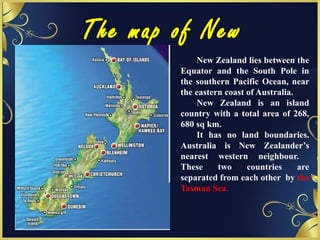
The map of New
Zealand New Zealand lies between the
Equator and the South Pole in
the southern Pacific Ocean, near
the eastern coast of Australia.
New Zealand is an island
country with a total area of 268,
680 sq km.
It has no land boundaries.
Australia is New Zealander’s
nearest western neighbour.
These two countries are
separated from each other by the
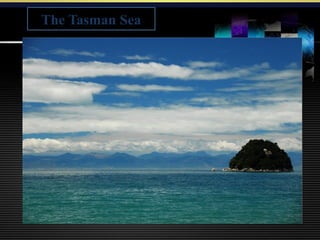
Tasman Sea.
The geographical
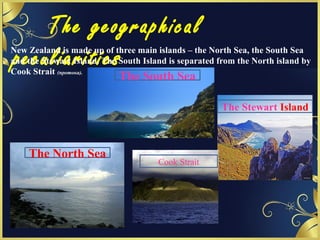
peculiaritiesNew Zealand is made up of three main islands – the North Sea, the South Sea
and the Stewart Island. The South Island is separated from the North island by
Cook Strait (протока).
The Stewart Island
Cook Strait
The North Sea
The South Sea
The geographical
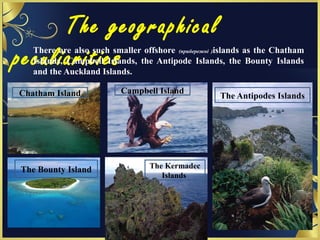
peculiaritiesThere are also such smaller offshore (прибережні )islands as the Chatham
Islands, Campbell Islands, the Antipode Islands, the Bounty Islands
and the Auckland Islands.
The Antipodes Islands
The Kermadec
Islands
Chatham Island
The Bounty Island
Campbell Island
It’s interesting to
know……New Zealand is 12 hours ahead of Greenwich Mean Time (GMT). So, it is
one of the first places in the world to see the new day.
…The Maori people call New Zealand Aotearoa, which is usually
translated into English as “The Land of the Long White Cloud”.
…New Zealand is also called “Godzone”, “Pig Isles”, “Shaky Isles” (хиткі),
“Quaky Isles” (тремтячі), “Maoriland” and “Kiwiland”
An interesting historical fact…
The name “New Zealand” came from Dutch cartographers, who called the
islands “Nova Zeelandia”, after the Dutch province of Zeeland. British
explorer James Cook adapted the name to the English language
and the name became New Zealand.
The geographical
peculiaritiesThough the country is so small there are so many beautiful things that
attract attention - volcanoes, subtropical rainforests, geysers, fiords,
beaches, glaciers and high mountain peaks.
New Zealand lies on the plates that make geological movements.
Volcanic action still continues on the islands. Earthquakes are frequent here
though they are not so damaging.(наносити збитків)
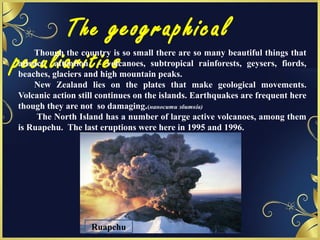
The North Island has a number of large active volcanoes, among them
is Ruapehu. The last eruptions were here in 1995 and 1996.
Ruapehu
Flora and fauna of New
ZealandFlora in New Zealand is very rich. There are about 2,000 species
where 1,500 are endemic (which are only found in this country). It
also has some of the oldest trees.
Fauna in this country is also special. Long time ago, without
enemies, some birds lost their ability to fly, and some insects became
gigantic.
It’s interesting to know…
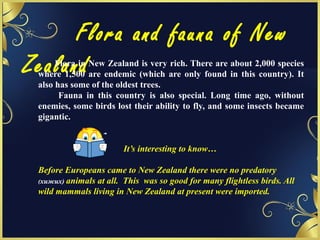
Before Europeans came to New Zealand there were no predatory
(хижих) animals at all. This was so good for many flightless birds. All
wild mammals living in New Zealand at present were imported.
Flora and fauna of New
Zealand
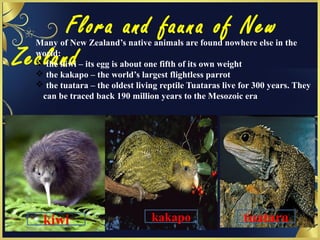
Many of New Zealand’s native animals are found nowhere else in the
world:
 the kiwi – its egg is about one fifth of its own weight
 the kakapo – the world’s largest flightless parrot
 the tuatara – the oldest living reptile Tuataras live for 300 years. They
can be traced back 190 million years to the Mesozoic era
kiwi kakapo tuatara
Flora and fauna of New Zealand
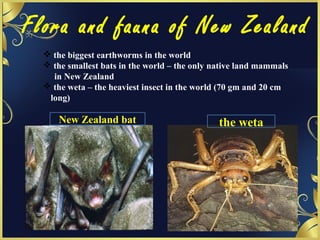
 the biggest earthworms in the world
 the smallest bats in the world – the only native land mammals
in New Zealand
 the weta – the heaviest insect in the world (70 gm and 20 cm
long)
the wetaNew Zealand bat
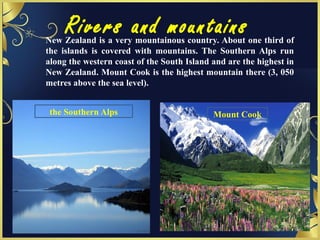
Rivers and mountainsNew Zealand is a very mountainous country. About one third of
the islands is covered with mountains. The Southern Alps run
along the western coast of the South Island and are the highest in
New Zealand. Mount Cook is the highest mountain there (3, 050
metres above the sea level).
the Southern Alps Mount Cook
Rivers and mountains
It’s interesting to know…
Sometimes New Zealanders say that
the North Island means “beaches”
and the South Island means
“mountains”
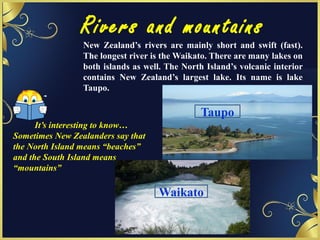
New Zealand’s rivers are mainly short and swift (fast).
The longest river is the Waikato. There are many lakes on
both islands as well. The North Island’s volcanic interior
contains New Zealand’s largest lake. Its name is lake
Taupo.
Waikato
Taupo
Climate
New Zealand is known for its maritime climate which is quite
good during the whole year. It is moist, temperate and is affected by
latitude and the proximity of the ocean. (вологий, помірний і залежить від
широти і близькості океану)
Climate of this country has no extremes and no wide range of
temperatures. The difference of winter and summer temperatures is
about 10 degrees. That is why New Zealand is very attractive for
tourists. Seasons here are reverse of the Northern Hemisphere like in
Australia.
Because of New Zealand’s wet and mild climate many inhabitants
of the country are busy with farming and dairy goods production.
There are heavy rainfalls in New Zealand all year round which is
very good for cattle –farming, sheep- farming, growing fruit,
vegetables and flowers.
Big cities
More than 85 per cent of the population of New Zealand lives in
urban (міські) areas. The principal country cities are Wellington (the
capital), Auckland, Christchurch, Dunedin, Hamilton, Palmerston
North, Hutt City, Invercargill. Early in the 20th century the first four
mentioned cities were almost equal in importance but then they started
to develop rapidly except for Dunedin.
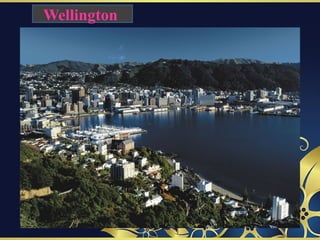
Wellington is the capital of the country, its second largest city, the
main port, the centre of finance and commerce and a sit of the
government. It is situated on the southern coast of the North Island.
The population of greater Wellington is about 350,000 people.
Wellington has been the capital of the country since 1865.
Big cities
An interesting historical fact…
Wellington’s nickname is “the windy city”. The first European name
of the city was “Port Nicholson” named after a captain of the British
navy who in 1839 bought the land from the local Maori tribe in
exchange for blankets. In 1840 the first settlers arrived from Britain
and called this settlement “Britannia”. And “Britannia” later
became “Wellington”.
Auckland is New Zealand’s largest city and its former capital. It
has a population of over a million people. Auckland was first
established as the capital of the British colonial government.
Despite the fact that Auckland is much larger than Wellington it
is geographically less central. So, this was the major deciding factor
for transferring the capital to Wellington.
Christchurch and Dunedin are two main cities of the South
Island. These cities are very much like British ones because of their
atmosphere.
The population of the country
 the Maori – маорі, представники полінезійської раси,
аборигени Нової Зеландії
The population of New Zealand is over four million people. It
is unevenly distributed. (розподіляється нерівномірно)
The main part of the population lives on the North Island
which is obviously closer to the Equator and warmer. About 50
per cent of the population lives in four cities of Auckland,
Wellington, Christchurch and Dunedin.
It’s interesting to know…
Arthur Lydiard, a New Zealander, invented jogging – the method
of building physical fitness by increasing stamina gradually
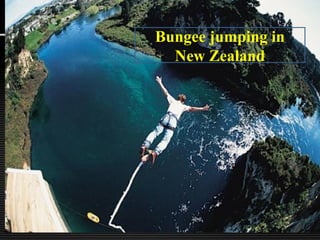
through running slowly. Bungee jumping was also invented in
New Zealand.
The population of the
country
Almost 70 per cent of the population is people of European (mainly
British) background. And about eight per cent is the Maori, New Zealand’s
indigenous inhabitants or Aborigines. There are also small minorities of
Pacific Islanders and Asians.
The Maori originate from a Polynesian people from south-east Asia. The
exact date of Polynesian settlement on islands of New Zealand is unknown.
It could be between 950-1130 AD.
The Maori tribes had lived on the islands of New Zealand for hundreds
of years before the white people came there.
Abel Tasman was the first European explorer who saw New Zealand
in 1642. But captain James Cook, an Englishman, was the first who first set
foot on New Zealand’s soil in 1769. After his voyages Europeans began to
come frequently.
The population of the country
An interesting historical fact…
Before Europeans came to the island, the tribes of Maori did not have the
name for themselves. They adopted the name “Maori” meaning “normal” to
distinguish themselves from Europeans.
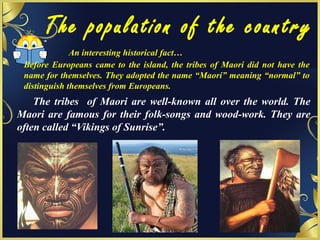
The tribes of Maori are well-known all over the world. The
Maori are famous for their folk-songs and wood-work. They are
often called “Vikings of Sunrise”.
The population of the country
In the 19th century there was a struggle
between the Maori people and the British
colonies. It was a series of the Maori Wars. Many
of the Maori were killed and English settlers took
their lands.
Both English and Maori are official languages.
English is more widely spoken, though the Maori
language is now coming back thanks to the
revival of their native language Maoritanga and
Maori culture.
The symbols of New Zealand
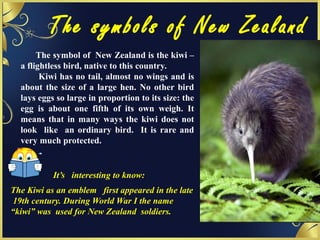
The symbol of New Zealand is the kiwi –
a flightless bird, native to this country.
Kiwi has no tail, almost no wings and is
about the size of a large hen. No other bird
lays eggs so large in proportion to its size: the
egg is about one fifth of its own weigh. It
means that in many ways the kiwi does not
look like an ordinary bird. It is rare and
very much protected.
It’s interesting to know:
The Kiwi as an emblem first appeared in the late
19th century. During World War I the name
“kiwi” was used for New Zealand soldiers.
The symbols of New Zealand
Today, New Zealanders overseas (and at home) are called “Kiwis”. The
Kiwi is closely associated with the Armed Forces (Збройні Сили). The green fruit
with the brown skin that we call “kiwi” is known as “kiwifruit”.
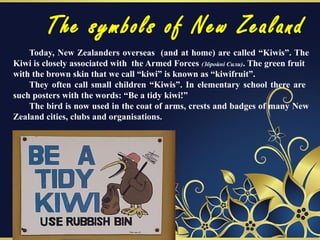
They often call small children “Kiwis”. In elementary school there are
such posters with the words: “Be a tidy kiwi!”
The bird is now used in the coat of arms, crests and badges of many New
Zealand cities, clubs and organisations.
The symbols of New Zealand
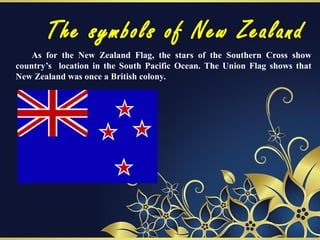
As for the New Zealand Flag, the stars of the Southern Cross show
country’s location in the South Pacific Ocean. The Union Flag shows that
New Zealand was once a British colony.
The symbols of New Zealand
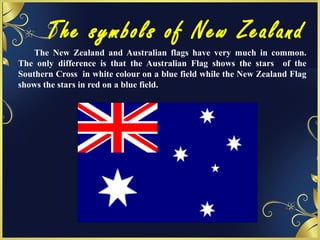
The New Zealand and Australian flags have very much in common.
The only difference is that the Australian Flag shows the stars of the
Southern Cross in white colour on a blue field while the New Zealand Flag
shows the stars in red on a blue field.
The symbols of New Zealand
There are two national anthems of New Zealand and both have equal
status. These are “God defend New Zealand” and “God Save the
Queen”. The first one is always used on sports occasions.
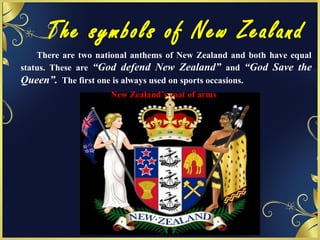
New Zealand’s coat of arms
The political system of New Zealan
New Zealand is an independent state and a member of the
Commonwealth of Nations and the United Nations.
This country is a constitutional monarchy. The British monarch is the
Head of State but Governor-General (генерал-губернатор), usually a New
Zealander, represents the Queen by carrying out responsibilities.
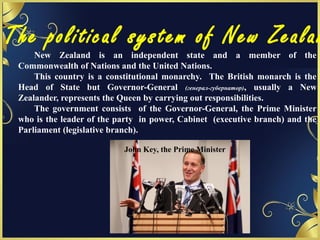
The government consists of the Governor-General, the Prime Minister
who is the leader of the party in power, Cabinet (executive branch) and the
Parliament (legislative branch).
John Key, the Prime Minister
The political system of New Zeala
The Parliament, contrary to the UK, consists of only
one chamber – the House of Representatives. There are
120 members. Its members are elected every three
years.
The chief political parties are the Labour Party, the
National Party and the New Zealand First Party.
Some details of culture of New Zeal
The culture of New Zealand is a mixture of different cultures:
British, Aboriginal and other European countries.
Today New Zealanders are highly educated and sophisticated
urban dwellers.(жителі)
There is a cultural phenomenon in New Zealand known as
“kiwiana”. You know that New Zealanders are called “kiwis” around
the world after the native bird “kiwi”. Now their “kiwi” sense of
humor, “kiwi” view of life make up “Kiwiana”, which is all the
special things and details that show their national identity, their
“kiwi nationhood”.
Kiwifruit, for example, was once known as Chinese gooseberry
(агрус), but the fact that it was imported from New Zealand made
world call this fruit – kiwifruit.
Some details of culture of New Zea
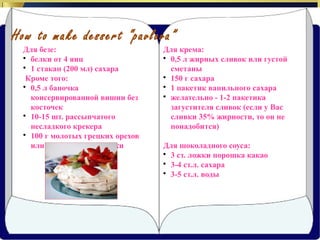
There is a famous New Zealand dessert called “pavlova”
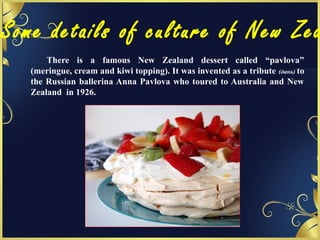
(meringue, cream and kiwi topping). It was invented as a tribute (дань) to
the Russian ballerina Anna Pavlova who toured to Australia and New
Zealand in 1926.
How to make dessert “pavlova”
Для безе:
• белки от 4 яиц
• 1 стакан (200 мл) сахара
Кроме того:
• 0,5 л баночка
консервированной вишни без
косточек
• 10-15 шт. рассыпчатого
несладкого крекера
• 100 г молотых грецких орехов
или миндальной стружки
Для крема:
• 0,5 л жирных сливок или густой
сметаны
• 150 г сахара
• 1 пакетик ванильного сахара
• желательно - 1-2 пакетика
загустителя сливок (если у Вас
сливки 35% жирности, то он не
понадобится)
Для шоколадного соуса:
• 3 ст. ложки порошка какао
• 3-4 ст.л. сахара
• 3-5 ст.л. воды
Some details of culture of New Zea
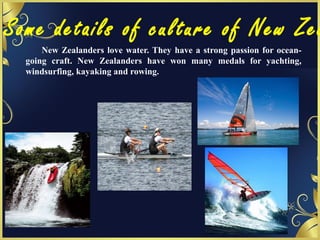
New Zealanders love water. They have a strong passion for ocean-
going craft. New Zealanders have won many medals for yachting,
windsurfing, kayaking and rowing.
Some details of culture of New Zeal
Among the qualities valued by New Zealanders are individualism,
self-reliance (впевненість у своїх силах) and a genius for invention. Long time
ago first people in New Zealand dealt with isolation and the elements, so
that it developed their ingenuity (винахідливість) and made them multi-
skilled (багатопрофільними). That contributed a lot to their character.
They also have a strong sense of fair play and teamwork. New
Zealand was one of the first countries who gave women the right to vote.
The language in this country is close to Australian English with some
elements of the Maori language.
Wellington
The Tasman Sea
Bungee jumping in
New Zealand

New zealand 11 form

  • 1.
  • 2.
    Fact File Official nameNew Zealand (English); Aoteraoa (Maori) Capital city Wellington Largest cities Auckland, Christchurch, Dunedin Total area 268, 680 sq km Population 4,116, 000 people Main religions Christian, Catholic Major ethnic groups Europeans, Maori, Pacific Islanders, Asian Consist of North Island, South Island, Stewart Island, Chatman Islands and minor islands Currency New Zealand Dollar (NZ$) Official language English, Maori Nationality a New Zealander (the New Zealanders) Form of government parliamentary democratic monarchy Natural resources land (for farming, dairy farming, cattle breeding), forests Flag the New Zealand Flag Internet TLD (top-level domain) .nz International dialing code + 64
  • 3.
    The map ofNew Zealand New Zealand lies between the Equator and the South Pole in the southern Pacific Ocean, near the eastern coast of Australia. New Zealand is an island country with a total area of 268, 680 sq km. It has no land boundaries. Australia is New Zealander’s nearest western neighbour. These two countries are separated from each other by the Tasman Sea.
  • 4.
    The geographical peculiaritiesNew Zealandis made up of three main islands – the North Sea, the South Sea and the Stewart Island. The South Island is separated from the North island by Cook Strait (протока). The Stewart Island Cook Strait The North Sea The South Sea
  • 5.
    The geographical peculiaritiesThere arealso such smaller offshore (прибережні )islands as the Chatham Islands, Campbell Islands, the Antipode Islands, the Bounty Islands and the Auckland Islands. The Antipodes Islands The Kermadec Islands Chatham Island The Bounty Island Campbell Island
  • 6.
    It’s interesting to know……NewZealand is 12 hours ahead of Greenwich Mean Time (GMT). So, it is one of the first places in the world to see the new day. …The Maori people call New Zealand Aotearoa, which is usually translated into English as “The Land of the Long White Cloud”. …New Zealand is also called “Godzone”, “Pig Isles”, “Shaky Isles” (хиткі), “Quaky Isles” (тремтячі), “Maoriland” and “Kiwiland” An interesting historical fact… The name “New Zealand” came from Dutch cartographers, who called the islands “Nova Zeelandia”, after the Dutch province of Zeeland. British explorer James Cook adapted the name to the English language and the name became New Zealand.
  • 7.
    The geographical peculiaritiesThough thecountry is so small there are so many beautiful things that attract attention - volcanoes, subtropical rainforests, geysers, fiords, beaches, glaciers and high mountain peaks. New Zealand lies on the plates that make geological movements. Volcanic action still continues on the islands. Earthquakes are frequent here though they are not so damaging.(наносити збитків) The North Island has a number of large active volcanoes, among them is Ruapehu. The last eruptions were here in 1995 and 1996. Ruapehu
  • 8.
    Flora and faunaof New ZealandFlora in New Zealand is very rich. There are about 2,000 species where 1,500 are endemic (which are only found in this country). It also has some of the oldest trees. Fauna in this country is also special. Long time ago, without enemies, some birds lost their ability to fly, and some insects became gigantic. It’s interesting to know… Before Europeans came to New Zealand there were no predatory (хижих) animals at all. This was so good for many flightless birds. All wild mammals living in New Zealand at present were imported.
  • 9.
    Flora and faunaof New Zealand Many of New Zealand’s native animals are found nowhere else in the world:  the kiwi – its egg is about one fifth of its own weight  the kakapo – the world’s largest flightless parrot  the tuatara – the oldest living reptile Tuataras live for 300 years. They can be traced back 190 million years to the Mesozoic era kiwi kakapo tuatara
  • 10.
    Flora and faunaof New Zealand  the biggest earthworms in the world  the smallest bats in the world – the only native land mammals in New Zealand  the weta – the heaviest insect in the world (70 gm and 20 cm long) the wetaNew Zealand bat
  • 11.
    Rivers and mountainsNewZealand is a very mountainous country. About one third of the islands is covered with mountains. The Southern Alps run along the western coast of the South Island and are the highest in New Zealand. Mount Cook is the highest mountain there (3, 050 metres above the sea level). the Southern Alps Mount Cook
  • 12.
    Rivers and mountains It’sinteresting to know… Sometimes New Zealanders say that the North Island means “beaches” and the South Island means “mountains” New Zealand’s rivers are mainly short and swift (fast). The longest river is the Waikato. There are many lakes on both islands as well. The North Island’s volcanic interior contains New Zealand’s largest lake. Its name is lake Taupo. Waikato Taupo
  • 13.
    Climate New Zealand isknown for its maritime climate which is quite good during the whole year. It is moist, temperate and is affected by latitude and the proximity of the ocean. (вологий, помірний і залежить від широти і близькості океану) Climate of this country has no extremes and no wide range of temperatures. The difference of winter and summer temperatures is about 10 degrees. That is why New Zealand is very attractive for tourists. Seasons here are reverse of the Northern Hemisphere like in Australia. Because of New Zealand’s wet and mild climate many inhabitants of the country are busy with farming and dairy goods production. There are heavy rainfalls in New Zealand all year round which is very good for cattle –farming, sheep- farming, growing fruit, vegetables and flowers.
  • 14.
    Big cities More than85 per cent of the population of New Zealand lives in urban (міські) areas. The principal country cities are Wellington (the capital), Auckland, Christchurch, Dunedin, Hamilton, Palmerston North, Hutt City, Invercargill. Early in the 20th century the first four mentioned cities were almost equal in importance but then they started to develop rapidly except for Dunedin. Wellington is the capital of the country, its second largest city, the main port, the centre of finance and commerce and a sit of the government. It is situated on the southern coast of the North Island. The population of greater Wellington is about 350,000 people. Wellington has been the capital of the country since 1865.
  • 15.
    Big cities An interestinghistorical fact… Wellington’s nickname is “the windy city”. The first European name of the city was “Port Nicholson” named after a captain of the British navy who in 1839 bought the land from the local Maori tribe in exchange for blankets. In 1840 the first settlers arrived from Britain and called this settlement “Britannia”. And “Britannia” later became “Wellington”. Auckland is New Zealand’s largest city and its former capital. It has a population of over a million people. Auckland was first established as the capital of the British colonial government. Despite the fact that Auckland is much larger than Wellington it is geographically less central. So, this was the major deciding factor for transferring the capital to Wellington. Christchurch and Dunedin are two main cities of the South Island. These cities are very much like British ones because of their atmosphere.
  • 16.
    The population ofthe country  the Maori – маорі, представники полінезійської раси, аборигени Нової Зеландії The population of New Zealand is over four million people. It is unevenly distributed. (розподіляється нерівномірно) The main part of the population lives on the North Island which is obviously closer to the Equator and warmer. About 50 per cent of the population lives in four cities of Auckland, Wellington, Christchurch and Dunedin. It’s interesting to know… Arthur Lydiard, a New Zealander, invented jogging – the method of building physical fitness by increasing stamina gradually through running slowly. Bungee jumping was also invented in New Zealand.
  • 17.
    The population ofthe country Almost 70 per cent of the population is people of European (mainly British) background. And about eight per cent is the Maori, New Zealand’s indigenous inhabitants or Aborigines. There are also small minorities of Pacific Islanders and Asians. The Maori originate from a Polynesian people from south-east Asia. The exact date of Polynesian settlement on islands of New Zealand is unknown. It could be between 950-1130 AD. The Maori tribes had lived on the islands of New Zealand for hundreds of years before the white people came there. Abel Tasman was the first European explorer who saw New Zealand in 1642. But captain James Cook, an Englishman, was the first who first set foot on New Zealand’s soil in 1769. After his voyages Europeans began to come frequently.
  • 18.
    The population ofthe country An interesting historical fact… Before Europeans came to the island, the tribes of Maori did not have the name for themselves. They adopted the name “Maori” meaning “normal” to distinguish themselves from Europeans. The tribes of Maori are well-known all over the world. The Maori are famous for their folk-songs and wood-work. They are often called “Vikings of Sunrise”.
  • 19.
    The population ofthe country In the 19th century there was a struggle between the Maori people and the British colonies. It was a series of the Maori Wars. Many of the Maori were killed and English settlers took their lands. Both English and Maori are official languages. English is more widely spoken, though the Maori language is now coming back thanks to the revival of their native language Maoritanga and Maori culture.
  • 20.
    The symbols ofNew Zealand The symbol of New Zealand is the kiwi – a flightless bird, native to this country. Kiwi has no tail, almost no wings and is about the size of a large hen. No other bird lays eggs so large in proportion to its size: the egg is about one fifth of its own weigh. It means that in many ways the kiwi does not look like an ordinary bird. It is rare and very much protected. It’s interesting to know: The Kiwi as an emblem first appeared in the late 19th century. During World War I the name “kiwi” was used for New Zealand soldiers.
  • 21.
    The symbols ofNew Zealand Today, New Zealanders overseas (and at home) are called “Kiwis”. The Kiwi is closely associated with the Armed Forces (Збройні Сили). The green fruit with the brown skin that we call “kiwi” is known as “kiwifruit”. They often call small children “Kiwis”. In elementary school there are such posters with the words: “Be a tidy kiwi!” The bird is now used in the coat of arms, crests and badges of many New Zealand cities, clubs and organisations.
  • 22.
    The symbols ofNew Zealand As for the New Zealand Flag, the stars of the Southern Cross show country’s location in the South Pacific Ocean. The Union Flag shows that New Zealand was once a British colony.
  • 23.
    The symbols ofNew Zealand The New Zealand and Australian flags have very much in common. The only difference is that the Australian Flag shows the stars of the Southern Cross in white colour on a blue field while the New Zealand Flag shows the stars in red on a blue field.
  • 24.
    The symbols ofNew Zealand There are two national anthems of New Zealand and both have equal status. These are “God defend New Zealand” and “God Save the Queen”. The first one is always used on sports occasions. New Zealand’s coat of arms
  • 25.
    The political systemof New Zealan New Zealand is an independent state and a member of the Commonwealth of Nations and the United Nations. This country is a constitutional monarchy. The British monarch is the Head of State but Governor-General (генерал-губернатор), usually a New Zealander, represents the Queen by carrying out responsibilities. The government consists of the Governor-General, the Prime Minister who is the leader of the party in power, Cabinet (executive branch) and the Parliament (legislative branch). John Key, the Prime Minister
  • 26.
    The political systemof New Zeala The Parliament, contrary to the UK, consists of only one chamber – the House of Representatives. There are 120 members. Its members are elected every three years. The chief political parties are the Labour Party, the National Party and the New Zealand First Party.
  • 27.
    Some details ofculture of New Zeal The culture of New Zealand is a mixture of different cultures: British, Aboriginal and other European countries. Today New Zealanders are highly educated and sophisticated urban dwellers.(жителі) There is a cultural phenomenon in New Zealand known as “kiwiana”. You know that New Zealanders are called “kiwis” around the world after the native bird “kiwi”. Now their “kiwi” sense of humor, “kiwi” view of life make up “Kiwiana”, which is all the special things and details that show their national identity, their “kiwi nationhood”. Kiwifruit, for example, was once known as Chinese gooseberry (агрус), but the fact that it was imported from New Zealand made world call this fruit – kiwifruit.
  • 28.
    Some details ofculture of New Zea There is a famous New Zealand dessert called “pavlova” (meringue, cream and kiwi topping). It was invented as a tribute (дань) to the Russian ballerina Anna Pavlova who toured to Australia and New Zealand in 1926.
  • 29.
    How to makedessert “pavlova” Для безе: • белки от 4 яиц • 1 стакан (200 мл) сахара Кроме того: • 0,5 л баночка консервированной вишни без косточек • 10-15 шт. рассыпчатого несладкого крекера • 100 г молотых грецких орехов или миндальной стружки Для крема: • 0,5 л жирных сливок или густой сметаны • 150 г сахара • 1 пакетик ванильного сахара • желательно - 1-2 пакетика загустителя сливок (если у Вас сливки 35% жирности, то он не понадобится) Для шоколадного соуса: • 3 ст. ложки порошка какао • 3-4 ст.л. сахара • 3-5 ст.л. воды
  • 30.
    Some details ofculture of New Zea New Zealanders love water. They have a strong passion for ocean- going craft. New Zealanders have won many medals for yachting, windsurfing, kayaking and rowing.
  • 31.
    Some details ofculture of New Zeal Among the qualities valued by New Zealanders are individualism, self-reliance (впевненість у своїх силах) and a genius for invention. Long time ago first people in New Zealand dealt with isolation and the elements, so that it developed their ingenuity (винахідливість) and made them multi- skilled (багатопрофільними). That contributed a lot to their character. They also have a strong sense of fair play and teamwork. New Zealand was one of the first countries who gave women the right to vote. The language in this country is close to Australian English with some elements of the Maori language.
  • 32.
  • 33.
  • 34.