By: Kali Fields and
Dhanielle Tobias
•1606-Dutch, Portuguese, and Spanish
ships sighted Australia
•Australia was a part of Godwana
•1st inhabitants: Aborigines
•Migrated there at least 40,000 yrs. ago
from Southeast Asia
•1616-became known as New Holland
•Australia-comes from “Terra Australis”
•1688-British arrived
•1770-Great Britain claimed possession,
calling it New South Wales
• 3 island territories in the Pacific:
– Norfolk Island
– Christmas Island
– Cocos Islands
• Only nation to occupy an entire continent
• Flattest and (after Antarctica) driest of continents
– North: rainforests and vast plains
– South East: snowfields
– Centre: desert
– East, South, and South West: fertile croplands
Geography
Geography (cont’d)
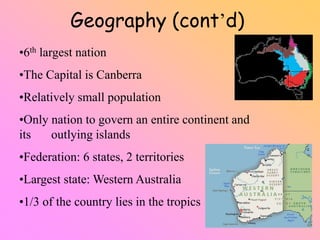
•6th largest nation
•The Capital is Canberra
•Relatively small population
•Only nation to govern an entire continent and
its outlying islands
•Federation: 6 states, 2 territories
•Largest state: Western Australia
•1/3 of the country lies in the tropics
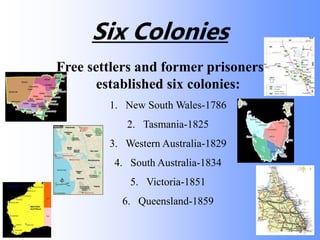
Six Colonies
Free settlers and former prisoners
established six colonies:
1. New South Wales-1786
2. Tasmania-1825
3. Western Australia-1829
4. South Australia-1834
5. Victoria-1851
6. Queensland-1859
Attractions/Important
Economic Enterprises
•Famous weapon:
Aborigine’s boomerang
•Gold rushes/mining
•Sheep farming
•Grain
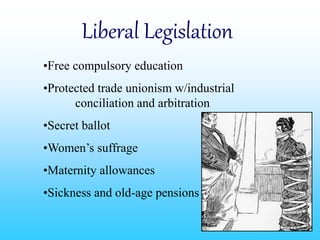
Liberal Legislation
•Free compulsory education
•Protected trade unionism w/industrial
conciliation and arbitration
•Secret ballot
•Women’s suffrage
•Maternity allowances
•Sickness and old-age pensions
Australia’s National Anthem
•“Advance Australia Fair”
•April 1984-declared national anthem
•Replaced “God Save the Queen”
•Same yr.-officially adopted green and gold as
its national colors
National Day
“Australia Day”-January 26
1788-Captain Arthur Phillip takes possession of
the eastern part of the continent for England
He established a settlement, now Australia’s
largest city, Sydney
Government/Immigration
• Democracy
• Britishmonarch-symbolic executive power
• Culturallydiverse society
– Indigenouspeoples
– Since1945, over6 millionpeoplefrom200 countrieshavecometo Australia
asnewsettlers.
– Vietnam,Greece, China,andUK
• Immigration policies
– Non-discriminatory
•Practices reflect British and
North American models but
still unique
•Parliamentary system -Queen
Elizabeth II
•Governments of states and
territories responsible for
matters not assigned to
commonwealth.
•Government divided into 3 branches:
1. Legislature
2. Executive
3. Judiciary
•National General Election must be held
within 3 years of first meeting of new
federal parliament.
•1 vote per person voting system
•Prime minister nominates members to
serve on Cabinet – John Howard
•Federal Parliament has Senate and House
of Representatives.
•Three major political parties: Labor Party,
Liberal Party, National Party
•Mostly low plateaus with deserts
•Several Small Mountain Ranges
- Australian Alps(highest- In
SouthEast)
- West Coast Range(Tasmania)
- Central Highlands(Victoria)
• Population: Around 20 million
•English speaking country – more
than 4.1 million speak a second
language
•Most Australians live on the
coast in major cities
•75% of population lives in
urban areas
•Stable
•Skilled Workforce
•Strong & Competetive
•High Growth
•Low Inflation & Interest Rate
•Efficient Government
•Flexible Labor Market
•Very Competitive Business Sector
•Workforce of 10 million highly trained
•Almost half of workforce has university,
trade, or diploma qualifications.
•Monetary System based on Australian dollar
•Weights and measures based on the metric
system
•Many native plants, animals, birds:
*kangaroos *wallabies *King Parrot
*wombat *koala *grasses
*mosses *lichens *mushrooms
*toadstools *emu *platypus
•No native animals domesticated
•The macadamia nut only
domesticated plant specie
•Mining
•Food Processing
•Chemicals
•Steel
•Industrial & Transportation Equipment
•Wine
•Natural gas & petroleum
•Diamonds
•Nickel
•Uranium
•Bauxite
•Coal
•Zinc
•Tin
•Iron ore
•Mineral sands
•Silver
•Lead
•Tungsten
•Aluminum
•Coal
•Gold
•Meats
•Wool
•Iron ore
•Wheat
•Machinery
•Transport equipment
•Crude Oil & Petroleum Products
•Computers and office equipment
•Telecommunications equipment and
parts
•Machinery and transport equipment
•China
•Germany
•Japan
•New Zealand
•U.S.
•U.K.
•Member of Commonwealth of Nations – Allied with Great Britain and the
US, among other countries
•Seasons are opposite of Northern Hemisphere
•Spectacular natural environment
•Multicultural communities
•Food and wine
•Friendly people
•Favorable weather
•Different lifestyles
•Tourism is one of the largest and fastest growing
industries in Australia.
•Most Important: Sheep,
cattle, poultry, wheat,
barley, sugarcane, and
fruits
•Tobacco industry small
but important
•Cotton grown on limited
scale
•Agriculture has declined from 20% of
GDP in the 1950s to 3% in recent years
•Ag exports accounted for 60% of total
exports in 1960s and only 25% today
•¾ of land is arid or semi-arid
•Challenges in Agriculture, Economy,
and Conservation.
•Only 6.9% of the land is arable – 90% of
which is used largely for rough grazing
•Drought, fires, and floods are common
hazards
•Lack of water
•Unsuitable Soil and topography – salinity
•Replacing
natural
vegetation with
shallow rooted
crops – rising
groundwater
levels including
dissolved salts
•Salt transferred
into crops root
zones and
wetlands,
streams and
rivers
•Western Australia is hit the hardest
•One of Australia’s biggest environmental
problems – damages total $270 million each
year
•The condition is expected to get much
worse if action is not taken
•Effects: Soil erosion, poor vegetation, poor
water conditions, road and building
problems
•Need to take action to prevent further
outbreaks of salinity by retaining vegetation
cover and protecting areas of biodiversity
significance
•Claire Helm-“An Australian Journal”, source: Momentum 31 no4 54-6 .Firstsearch.org
•“Australian Catholic Schools: Why We Have Them and What They Aim to Achieve” Feb. 2000.
Firstsearch.org
•Goecher, J. 1999. Australia: The Land Down Under. Singapore: Times Edition Pte Ltd. The
Chronicle, Australian Catholic University, Vol. 9, No. 2, July 2000, p. 11 Firstsearch.org
•Russell, Michael. 2001-2006. “Australia – Facts and History.” Ezine Articles.
http:www.ego4u.de/de/read-on/countries/australia/facts-history
•Gale, Thomas. 2006. Australia: Agriculture. Thomson Corporation.
http://www.nationsencylopedia.com/Asia-and-Oceania/Australia-AGRICULTURE.html
•Encarta. Australia. 2006. http://encarta.msn.com/encyclopedia_761568792/Australia.html
•Australia Now. Australian Government: Department of Foreign Affairs and Trade.
http://www.dfat.gov.au/facts/aust_today.html

AUSTRALIA powerpoint.ppt

  • 1.
    By: Kali Fieldsand Dhanielle Tobias
  • 3.
    •1606-Dutch, Portuguese, andSpanish ships sighted Australia •Australia was a part of Godwana •1st inhabitants: Aborigines •Migrated there at least 40,000 yrs. ago from Southeast Asia •1616-became known as New Holland •Australia-comes from “Terra Australis” •1688-British arrived •1770-Great Britain claimed possession, calling it New South Wales
  • 4.
    • 3 islandterritories in the Pacific: – Norfolk Island – Christmas Island – Cocos Islands • Only nation to occupy an entire continent • Flattest and (after Antarctica) driest of continents – North: rainforests and vast plains – South East: snowfields – Centre: desert – East, South, and South West: fertile croplands Geography
  • 5.
    Geography (cont’d) •6th largestnation •The Capital is Canberra •Relatively small population •Only nation to govern an entire continent and its outlying islands •Federation: 6 states, 2 territories •Largest state: Western Australia •1/3 of the country lies in the tropics
  • 6.
    Six Colonies Free settlersand former prisoners established six colonies: 1. New South Wales-1786 2. Tasmania-1825 3. Western Australia-1829 4. South Australia-1834 5. Victoria-1851 6. Queensland-1859
  • 7.
    Attractions/Important Economic Enterprises •Famous weapon: Aborigine’sboomerang •Gold rushes/mining •Sheep farming •Grain
  • 8.
    Liberal Legislation •Free compulsoryeducation •Protected trade unionism w/industrial conciliation and arbitration •Secret ballot •Women’s suffrage •Maternity allowances •Sickness and old-age pensions
  • 9.
    Australia’s National Anthem •“AdvanceAustralia Fair” •April 1984-declared national anthem •Replaced “God Save the Queen” •Same yr.-officially adopted green and gold as its national colors
  • 10.
    National Day “Australia Day”-January26 1788-Captain Arthur Phillip takes possession of the eastern part of the continent for England He established a settlement, now Australia’s largest city, Sydney
  • 11.
    Government/Immigration • Democracy • Britishmonarch-symbolicexecutive power • Culturallydiverse society – Indigenouspeoples – Since1945, over6 millionpeoplefrom200 countrieshavecometo Australia asnewsettlers. – Vietnam,Greece, China,andUK • Immigration policies – Non-discriminatory
  • 12.
    •Practices reflect Britishand North American models but still unique •Parliamentary system -Queen Elizabeth II •Governments of states and territories responsible for matters not assigned to commonwealth.
  • 13.
    •Government divided into3 branches: 1. Legislature 2. Executive 3. Judiciary •National General Election must be held within 3 years of first meeting of new federal parliament. •1 vote per person voting system •Prime minister nominates members to serve on Cabinet – John Howard •Federal Parliament has Senate and House of Representatives. •Three major political parties: Labor Party, Liberal Party, National Party
  • 14.
    •Mostly low plateauswith deserts •Several Small Mountain Ranges - Australian Alps(highest- In SouthEast) - West Coast Range(Tasmania) - Central Highlands(Victoria)
  • 16.
    • Population: Around20 million •English speaking country – more than 4.1 million speak a second language
  • 17.
    •Most Australians liveon the coast in major cities •75% of population lives in urban areas
  • 18.
    •Stable •Skilled Workforce •Strong &Competetive •High Growth •Low Inflation & Interest Rate
  • 19.
    •Efficient Government •Flexible LaborMarket •Very Competitive Business Sector •Workforce of 10 million highly trained •Almost half of workforce has university, trade, or diploma qualifications. •Monetary System based on Australian dollar •Weights and measures based on the metric system
  • 20.
    •Many native plants,animals, birds: *kangaroos *wallabies *King Parrot *wombat *koala *grasses *mosses *lichens *mushrooms *toadstools *emu *platypus •No native animals domesticated •The macadamia nut only domesticated plant specie
  • 21.
  • 22.
    •Natural gas &petroleum •Diamonds •Nickel •Uranium •Bauxite •Coal •Zinc •Tin •Iron ore •Mineral sands •Silver •Lead •Tungsten
  • 23.
  • 24.
    •Crude Oil &Petroleum Products •Computers and office equipment •Telecommunications equipment and parts •Machinery and transport equipment
  • 25.
    •China •Germany •Japan •New Zealand •U.S. •U.K. •Member ofCommonwealth of Nations – Allied with Great Britain and the US, among other countries
  • 26.
    •Seasons are oppositeof Northern Hemisphere •Spectacular natural environment •Multicultural communities •Food and wine •Friendly people •Favorable weather •Different lifestyles •Tourism is one of the largest and fastest growing industries in Australia.
  • 27.
    •Most Important: Sheep, cattle,poultry, wheat, barley, sugarcane, and fruits •Tobacco industry small but important •Cotton grown on limited scale
  • 28.
    •Agriculture has declinedfrom 20% of GDP in the 1950s to 3% in recent years •Ag exports accounted for 60% of total exports in 1960s and only 25% today
  • 29.
    •¾ of landis arid or semi-arid •Challenges in Agriculture, Economy, and Conservation.
  • 30.
    •Only 6.9% ofthe land is arable – 90% of which is used largely for rough grazing •Drought, fires, and floods are common hazards •Lack of water •Unsuitable Soil and topography – salinity
  • 31.
    •Replacing natural vegetation with shallow rooted crops– rising groundwater levels including dissolved salts •Salt transferred into crops root zones and wetlands, streams and rivers
  • 32.
    •Western Australia ishit the hardest •One of Australia’s biggest environmental problems – damages total $270 million each year •The condition is expected to get much worse if action is not taken •Effects: Soil erosion, poor vegetation, poor water conditions, road and building problems •Need to take action to prevent further outbreaks of salinity by retaining vegetation cover and protecting areas of biodiversity significance
  • 33.
    •Claire Helm-“An AustralianJournal”, source: Momentum 31 no4 54-6 .Firstsearch.org •“Australian Catholic Schools: Why We Have Them and What They Aim to Achieve” Feb. 2000. Firstsearch.org •Goecher, J. 1999. Australia: The Land Down Under. Singapore: Times Edition Pte Ltd. The Chronicle, Australian Catholic University, Vol. 9, No. 2, July 2000, p. 11 Firstsearch.org •Russell, Michael. 2001-2006. “Australia – Facts and History.” Ezine Articles. http:www.ego4u.de/de/read-on/countries/australia/facts-history •Gale, Thomas. 2006. Australia: Agriculture. Thomson Corporation. http://www.nationsencylopedia.com/Asia-and-Oceania/Australia-AGRICULTURE.html •Encarta. Australia. 2006. http://encarta.msn.com/encyclopedia_761568792/Australia.html •Australia Now. Australian Government: Department of Foreign Affairs and Trade. http://www.dfat.gov.au/facts/aust_today.html