
Country Presentation


                Presented by
               Megha Mishra
              Ajay Kumar Singh
              Harshit Srivastava
                    Arpan
                 Vivek Thota
Our country
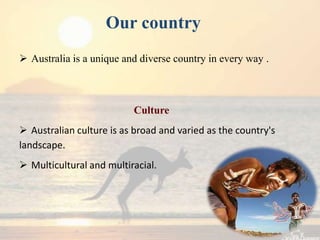
 Australia is a unique and diverse country in every way .


                          Culture
 Australian culture is as broad and varied as the country's
landscape.
 Multicultural and multiracial.
History

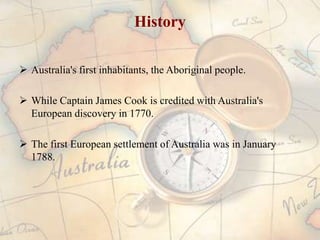
 Australia's first inhabitants, the Aboriginal people.

 While Captain James Cook is credited with Australia's
  European discovery in 1770.

 The first European settlement of Australia was in January
  1788.
Geography
 Covering a total area of 7.69 million square kilometers.
 Australia is the world’s largest island - but smallest continent.
 Canberra is Australia's capital city.

Natural Resources
    Australia as known as the land down under is not only known
  for its beautiful holiday spots but also with its inextricably
  intertwined natural resources and mineral exploitation.
Mineral Resources
 The most important mineral resources are bauxite, gold and
  iron ore.
Energy resources
 Australia has extensive deposits of coal.
 Natural gas is abundantly present.
 Australia also contains one-third of the world's uranium
  supply.


Land resource
 Australia's land itself can be considered as a resource.
 Australian soil is used to grow food.
 Australian forests are used as a source of wood for building
  and making paper.
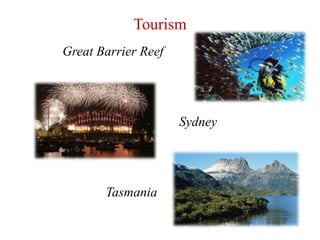
Tourism
Great Barrier Reef


                     Sydney


       Tasmania
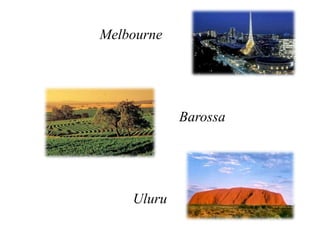
Melbourne


            Barossa


    Uluru
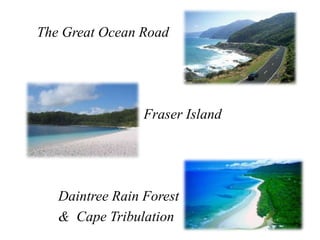
The Great Ocean Road


                 Fraser Island


   Daintree Rain Forest
   & Cape Tribulation
Government
 Australia’s system of government is founded in the liberal
  democratic tradition. Based on the values of religious
  tolerance, freedom of speech and association, and the rule of
  law.
 Australia’s institutions and practices of government reflect
  British and North American models.


A written constitution
 The Australian Constitution defines the responsibilities of the
  federal government, which include foreign relations, trade,
  defense and immigration.
 Parliamentary sovereignty
  The Australian Constitution sets out the powers of government
  in three separate chapters—the legislature, the executive and
  the judiciary—but insists that members of the legislature must
  also be members of the executive.

 Frequent elections
  A national general election must be held within three years of
  the first meeting of a new federal parliament.

 Voting

 Parties
Economy
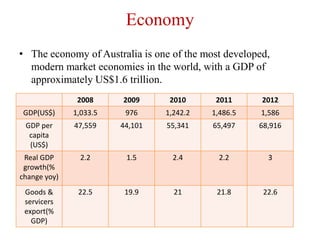
• The economy of Australia is one of the most developed,
  modern market economies in the world, with a GDP of
  approximately US$1.6 trillion.
               2008     2009      2010      2011      2012
 GDP(US$)     1,033.5    976     1,242.2   1,486.5    1,586
 GDP per      47,559    44,101   55,341    65,497    68,916
  capita
  (US$)
 Real GDP       2.2      1.5       2.4       2.2       3
 growth(%
change yoy)
 Goods &       22.5      19.9      21       21.8      22.6
 servicers
 export(%
   GDP)
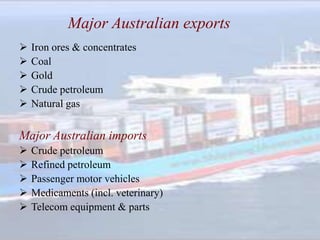
Major Australian exports
   Iron ores & concentrates
   Coal
   Gold
   Crude petroleum
   Natural gas


Major Australian imports
   Crude petroleum
   Refined petroleum
   Passenger motor vehicles
   Medicaments (incl. veterinary)
   Telecom equipment & parts
Currency

Australian dollar

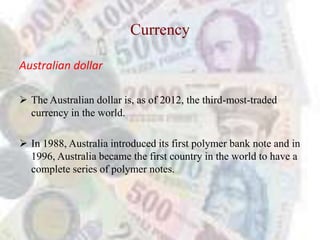
 The Australian dollar is, as of 2012, the third-most-traded
  currency in the world.

 In 1988, Australia introduced its first polymer bank note and in
  1996, Australia became the first country in the world to have a
  complete series of polymer notes.
Kangaroos


 The kangaroo is one of Australia’s most iconic animals.
 There are over 60 different species of kangaroo.

The kangaroo industry

 Australia’s kangaroo industry began exporting kangaroo meat
  to Europe in 1959 in response to interest from the European
  game meat industry.
Excom (1)

Excom (1)

  • 1.
    Country Presentation Presented by Megha Mishra Ajay Kumar Singh Harshit Srivastava Arpan Vivek Thota
  • 2.
    Our country  Australiais a unique and diverse country in every way . Culture  Australian culture is as broad and varied as the country's landscape.  Multicultural and multiracial.
  • 3.
    History  Australia's firstinhabitants, the Aboriginal people.  While Captain James Cook is credited with Australia's European discovery in 1770.  The first European settlement of Australia was in January 1788.
  • 4.
    Geography  Covering atotal area of 7.69 million square kilometers.  Australia is the world’s largest island - but smallest continent.  Canberra is Australia's capital city. Natural Resources  Australia as known as the land down under is not only known for its beautiful holiday spots but also with its inextricably intertwined natural resources and mineral exploitation. Mineral Resources  The most important mineral resources are bauxite, gold and iron ore.
  • 5.
    Energy resources  Australiahas extensive deposits of coal.  Natural gas is abundantly present.  Australia also contains one-third of the world's uranium supply. Land resource  Australia's land itself can be considered as a resource.  Australian soil is used to grow food.  Australian forests are used as a source of wood for building and making paper.
  • 6.
  • 7.
    Melbourne Barossa Uluru
  • 8.
    The Great OceanRoad Fraser Island Daintree Rain Forest & Cape Tribulation
  • 9.
    Government  Australia’s systemof government is founded in the liberal democratic tradition. Based on the values of religious tolerance, freedom of speech and association, and the rule of law.  Australia’s institutions and practices of government reflect British and North American models. A written constitution  The Australian Constitution defines the responsibilities of the federal government, which include foreign relations, trade, defense and immigration.
  • 10.
     Parliamentary sovereignty The Australian Constitution sets out the powers of government in three separate chapters—the legislature, the executive and the judiciary—but insists that members of the legislature must also be members of the executive.  Frequent elections A national general election must be held within three years of the first meeting of a new federal parliament.  Voting  Parties
  • 11.
    Economy • The economyof Australia is one of the most developed, modern market economies in the world, with a GDP of approximately US$1.6 trillion. 2008 2009 2010 2011 2012 GDP(US$) 1,033.5 976 1,242.2 1,486.5 1,586 GDP per 47,559 44,101 55,341 65,497 68,916 capita (US$) Real GDP 2.2 1.5 2.4 2.2 3 growth(% change yoy) Goods & 22.5 19.9 21 21.8 22.6 servicers export(% GDP)
  • 12.
    Major Australian exports  Iron ores & concentrates  Coal  Gold  Crude petroleum  Natural gas Major Australian imports  Crude petroleum  Refined petroleum  Passenger motor vehicles  Medicaments (incl. veterinary)  Telecom equipment & parts
  • 13.
    Currency Australian dollar  TheAustralian dollar is, as of 2012, the third-most-traded currency in the world.  In 1988, Australia introduced its first polymer bank note and in 1996, Australia became the first country in the world to have a complete series of polymer notes.
  • 14.
    Kangaroos  The kangaroois one of Australia’s most iconic animals.  There are over 60 different species of kangaroo. The kangaroo industry  Australia’s kangaroo industry began exporting kangaroo meat to Europe in 1959 in response to interest from the European game meat industry.