Geography Basics
Tools of Geography
• Maps
• Globes
• Global Positioning Satellites (GPS)
• Remote Sensing
• Geographic Information Systems (GIS)
Maps
• A map is a diagrammatic representation of an
area of land or sea showing physical features,
cities, roads, etc.
• Maps are usually printed on paper and are still
relevant today as they are more easily produced
and much harder to completely destroy than
computers or mobile devices.
• If you drop a paper map on a rock it’s just fine
but if you drop your phone out of your pocket it’s
liable to break.
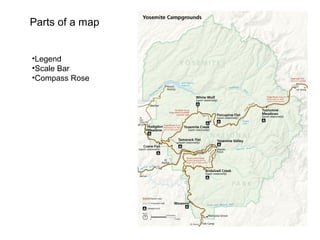
Parts of a map
•Legend
•Scale Bar
•Compass Rose
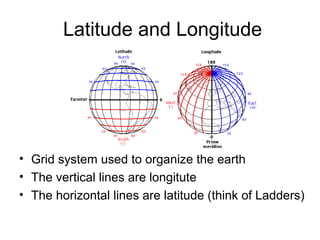
Latitude and Longitude
• Grid system used to organize the earth
• The vertical lines are longitute
• The horizontal lines are latitude (think of Ladders)
Coordinate System
• We use longitude and latitude to reference
the position of things on the planet with a
coordinate system.
• Earth is divided into four hemispheres;
East, West, North, and South.
• Coordinates written with latitude first
• e.g. 34N 117W (San Bernardino)
Globes
• We use globes to chart the earth more
accurately than maps
• Cannot flatten out a sphere
• Useful when trying to look at things on a
global scale
GPS
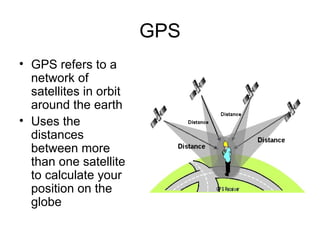
• GPS refers to a
network of
satellites in orbit
around the earth
• Uses the
distances
between more
than one satellite
to calculate your
position on the
globe
Remote Sensing
• The study of an object or surface from a
distance by using various instruments
• This includes: Aerial photographs, color
and color infrared sensing, thermal
infrared sensing, microwave sensing,
radar, sonar, multispectral, and SPOT
imagery
GIS
• Geographic Information Systems (GIS) are automated systems for
the capture, storage, retrieval, analysis, and display of spatial data.
• Uses both computer hardware and software to analyze geographic
location and handle spatial data.
• Virtually, libraries of information that use maps instead of alphabet
to organize and store data.
• Allows data management by linking tabular data (spreadsheets) and
maps.
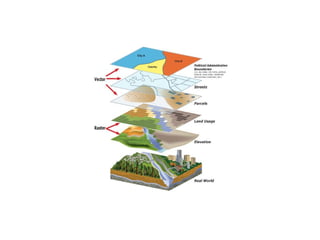
• Mainly used in overlay analysis, where two or more layers of data
are superimposed or integrated.
• First uses were in surveying, photogrammetry, computer
cartography, spatial statistics, and remote sensing; now being used
in all forms of geographic analysis, and bringing a new and more
complete perspective to resource management, environmental
monitoring, and environmental site assessment.
Geography basics

Geography basics

  • 1.
  • 2.
    Tools of Geography •Maps • Globes • Global Positioning Satellites (GPS) • Remote Sensing • Geographic Information Systems (GIS)
  • 3.
    Maps • A mapis a diagrammatic representation of an area of land or sea showing physical features, cities, roads, etc. • Maps are usually printed on paper and are still relevant today as they are more easily produced and much harder to completely destroy than computers or mobile devices. • If you drop a paper map on a rock it’s just fine but if you drop your phone out of your pocket it’s liable to break.
  • 4.
    Parts of amap •Legend •Scale Bar •Compass Rose
  • 5.
    Latitude and Longitude •Grid system used to organize the earth • The vertical lines are longitute • The horizontal lines are latitude (think of Ladders)
  • 6.
    Coordinate System • Weuse longitude and latitude to reference the position of things on the planet with a coordinate system. • Earth is divided into four hemispheres; East, West, North, and South. • Coordinates written with latitude first • e.g. 34N 117W (San Bernardino)
  • 7.
    Globes • We useglobes to chart the earth more accurately than maps • Cannot flatten out a sphere • Useful when trying to look at things on a global scale
  • 8.
    GPS • GPS refersto a network of satellites in orbit around the earth • Uses the distances between more than one satellite to calculate your position on the globe
  • 9.
    Remote Sensing • Thestudy of an object or surface from a distance by using various instruments • This includes: Aerial photographs, color and color infrared sensing, thermal infrared sensing, microwave sensing, radar, sonar, multispectral, and SPOT imagery
  • 10.
    GIS • Geographic InformationSystems (GIS) are automated systems for the capture, storage, retrieval, analysis, and display of spatial data. • Uses both computer hardware and software to analyze geographic location and handle spatial data. • Virtually, libraries of information that use maps instead of alphabet to organize and store data. • Allows data management by linking tabular data (spreadsheets) and maps. • Mainly used in overlay analysis, where two or more layers of data are superimposed or integrated. • First uses were in surveying, photogrammetry, computer cartography, spatial statistics, and remote sensing; now being used in all forms of geographic analysis, and bringing a new and more complete perspective to resource management, environmental monitoring, and environmental site assessment.