Patent……..

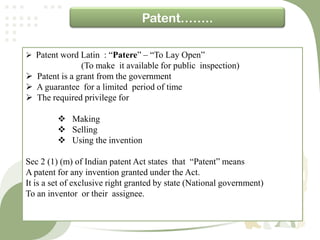
 Patent word Latin : “Patere” – “To Lay Open”
               (To make it available for public inspection)
 Patent is a grant from the government
 A guarantee for a limited period of time
 The required privilege for

          Making
          Selling
          Using the invention

Sec 2 (1) (m) of Indian patent Act states that “Patent” means
A patent for any invention granted under the Act.
It is a set of exclusive right granted by state (National government)
To an inventor or their assignee.
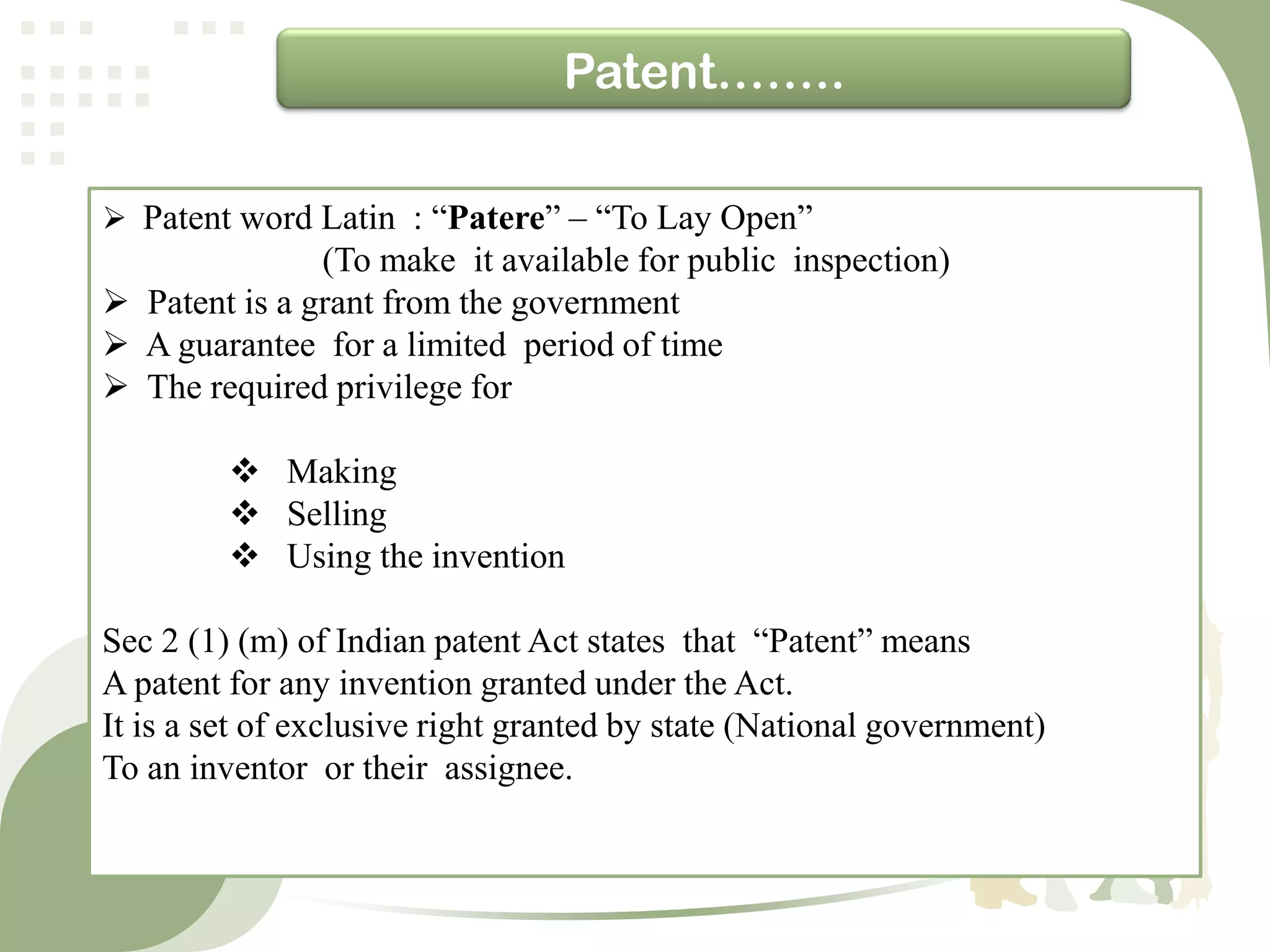
History of Patenting in India


 The first patenting related act in India was passed in 1911
   by the name of “patent and design Act ,1911”.
 Later after Independence the patent bill was unsuccessfully
   introduced before the parliament in 1949 & 1965 and
   finally the bill was passed in the year 1970 and the act came into force on
  20th April 1970 .
 The patent system in India is governed by the “Patent Act 1970 (No.39 of
  1970)” and the patent “Rules” 2003.
 The patent act has been amended several times in 1974, 1985, 1999 ,2002
  and in 2005 and the rules have been
  amended in 2006.
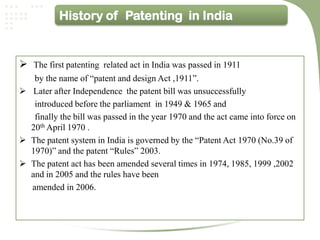
Why I go for getting a patent ???


To enjoy the exclusive right over the
        invention


         To ensure commercial return


         To protect my invention & proceedings
Related Term…
 Patent Agent - Means a person for the time being registered under this
   act as a patent agent . Sec 2 (1)(n).
 Patent Article & Patent process – Means respectively an
    article or process in respect of which a patent is in
    force . Sec 2 (1)(o).
 Patentee- Means the person for the time being entered on register as the
   grantee or proprietor of the patent Sec 2(1)(p).
 Invention – Means a new product or process involving an inventing step
   and capable of industrial application
   Sec 2 (1)(j.)
                             (OR)
Invention is a creative process . An open and curious mind allows an inventor
   to see beyond what is known. Seeing a new possibility, connection, or
   relationship can spark an invention. Inventive thinking frequently involves
   combining concepts or elements from different realms that would not
   normally be put together. Sometimes inventors disregard the boundaries
   between distinctly separate territories or fields.
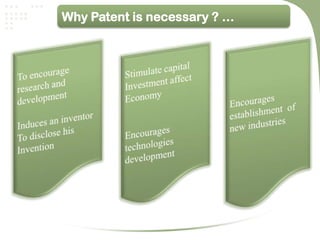
Why Patent is necessary ? …
EMR ( Exclusive Marketing Right )…
TRIPS- Trade Related Aspects of Intellectual Property Rights


 TRIPS requires that member countries of the WTO not having provision in
  their laws for granting product patents in respect of drugs and
  agrochemical, must introduce Exclusive Marketing Rights (EMR) for such
  products, if the following criteria are satisfied:
 A patent application covering the new drug or agrochemical should have
  been filed in any of the WTO member countries after 1 January, 1995;
 A patent on the product should have been obtained in any of the member
  countries (which provides for product patents in drugs and agrochemical)
  after 1 January 1995;
 Marketing approvals for the product should have been obtained in any of
  the member countries;
Contd ……..


 A patent application covering the product should have been filed after 1
  January 1995 in the country where the EMR is sought;
 The applicant should apply seeking an EMR by making use of the
  prescribed form and paying requisite fee.
 EMR is only a right for exclusive marketing of the product and is quite
  different from a patent right. It is valid up to a maximum period of 5 years
  or until the time the product patent laws come into effect.
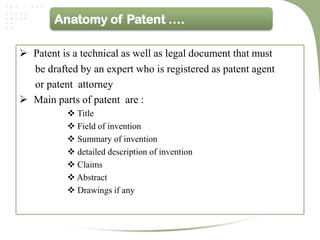
Anatomy of Patent ….

 Patent is a technical as well as legal document that must
  be drafted by an expert who is registered as patent agent
  or patent attorney
 Main parts of patent are :
            Title
            Field of invention
            Summary of invention
            detailed description of invention
            Claims
            Abstract
            Drawings if any
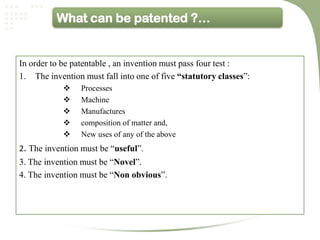
What can be patented ?…


In order to be patentable , an invention must pass four test :
1. The invention must fall into one of five “statutory classes”:
                Processes
                Machine
                Manufactures
                composition of matter and,
                New uses of any of the above
2. The invention must be “useful”.
3. The invention must be “Novel”.
4. The invention must be “Non obvious”.
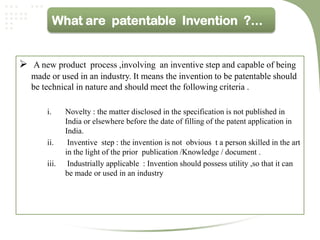
What are patentable Invention ?...


 A new product process ,involving an inventive step and capable of being
   made or used in an industry. It means the invention to be patentable should
   be technical in nature and should meet the following criteria .

       i.     Novelty : the matter disclosed in the specification is not published in
              India or elsewhere before the date of filling of the patent application in
              India.
       ii.     Inventive step : the invention is not obvious t a person skilled in the art
              in the light of the prior publication /Knowledge / document .
       iii.    Industrially applicable : Invention should possess utility ,so that it can
              be made or used in an industry
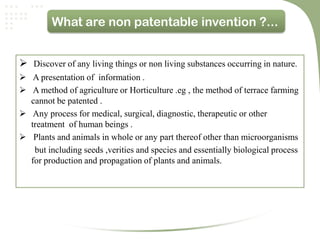
What are non patentable invention ?...


 Discover of any living things or non living substances occurring in nature.
 A presentation of information .
 A method of agriculture or Horticulture .eg , the method of terrace farming
  cannot be patented .
 Any process for medical, surgical, diagnostic, therapeutic or other
  treatment of human beings .
 Plants and animals in whole or any part thereof other than microorganisms
   but including seeds ,verities and species and essentially biological process
  for production and propagation of plants and animals.
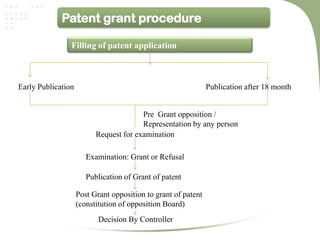
Patent grant procedure

                Filling of patent application


Early Publication                                              Publication after 18 month


                                        Pre Grant opposition /
                                        Representation by any person
                          Request for examination

                       Examination: Grant or Refusal

                       Publication of Grant of patent

                    Post Grant opposition to grant of patent
                    (constitution of opposition Board)
                           Decision By Controller
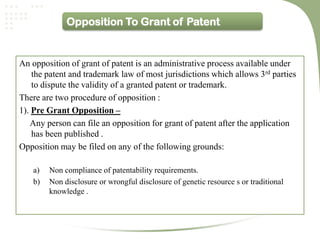
Opposition To Grant of Patent


An opposition of grant of patent is an administrative process available under
    the patent and trademark law of most jurisdictions which allows 3rd parties
    to dispute the validity of a granted patent or trademark.
There are two procedure of opposition :
1). Pre Grant Opposition –
   Any person can file an opposition for grant of patent after the application
    has been published .
Opposition may be filed on any of the following grounds:

    a)   Non compliance of patentability requirements.
    b)   Non disclosure or wrongful disclosure of genetic resource s or traditional
         knowledge .
Contd ….

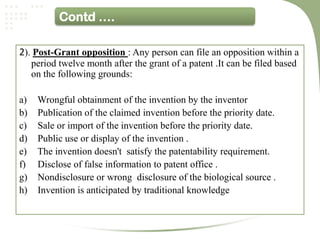
2). Post-Grant opposition : Any person can file an opposition within a
     period twelve month after the grant of a patent .It can be filed based
     on the following grounds:

a)    Wrongful obtainment of the invention by the inventor
b)    Publication of the claimed invention before the priority date.
c)    Sale or import of the invention before the priority date.
d)    Public use or display of the invention .
e)    The invention doesn't satisfy the patentability requirement.
f)    Disclose of false information to patent office .
g)    Nondisclosure or wrong disclosure of the biological source .
h)    Invention is anticipated by traditional knowledge
Contd…


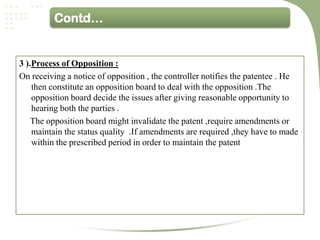
3 ).Process of Opposition :
On receiving a notice of opposition , the controller notifies the patentee . He
    then constitute an opposition board to deal with the opposition .The
    opposition board decide the issues after giving reasonable opportunity to
    hearing both the parties .
    The opposition board might invalidate the patent ,require amendments or
    maintain the status quality .If amendments are required ,they have to made
    within the prescribed period in order to maintain the patent
Surrender of patent


  Surrender of patents:

(1) A patentee may, at any time by giving notice in the prescribed manner to the
Controller, offer to surrender his patent.
(2) Where such an offer is made, the Controller shall advertise the offer in the
prescribed manner, and also notify every person other than the patentee whose
name appears in the register as having an interest in the patent.
(3) Any person interested may, within the prescribed period after such
advertisement, give notice to the Controller of opposition to the surrender, and
where any such notice is given the Controller shall notify the patentee.
(4) If the Controller is satisfied after hearing the patentee and any opponent, if
desirous of being heard, that the patent may properly be surrendered, he may accept
the offer and, by order, revoke the patent
Infringement of patent


Patent infringement :
     Patent infringement is the commission of a prohibited act with respect to
    a patented invention without permission from the patent holder.

 The definition of patent infringement may vary by jurisdiction, but it
  typically includes using or selling the patented invention.
Types of Patent Infringement


1) Direct patent infringement:-
    Direct patent infringement is the most obvious and the most common form
   of patent infringement. ,i.e. anyone who makes, uses or sells the patented
   invention.

2) Indirect patent infringement :-
   It is an action or an activity by a third party encouraging another to make,
    use or sell the invention.
WTO….


 The World Trade Organization (WTO) is the only global
  international organization dealing with the rules of trade
  between nations.

 The WTO agreements, are negotiated and signed by the
  bulk of the world’s trading nations and ratified in their
  parliaments.

 The goal is to help producers of goods and services,
  exporters, and importers conduct their business.
WTO and patent rules:


 The grant and enforcement of patents are governed by
  national laws and international treaties.
 There is a trend towards global harmonization of patent
  laws and the WTO is actively participating in this area.

 The TRIPS [ Trade Related Intellectual Property Rights]
  agreement has been successful in providing a forum for
  nations to agree on an aligned set of patent laws.
Thank you Any

Patnt act

  • 1.
    Patent……..  Patent wordLatin : “Patere” – “To Lay Open” (To make it available for public inspection)  Patent is a grant from the government  A guarantee for a limited period of time  The required privilege for  Making  Selling  Using the invention Sec 2 (1) (m) of Indian patent Act states that “Patent” means A patent for any invention granted under the Act. It is a set of exclusive right granted by state (National government) To an inventor or their assignee.
  • 2.
    History of Patentingin India  The first patenting related act in India was passed in 1911 by the name of “patent and design Act ,1911”.  Later after Independence the patent bill was unsuccessfully introduced before the parliament in 1949 & 1965 and finally the bill was passed in the year 1970 and the act came into force on 20th April 1970 .  The patent system in India is governed by the “Patent Act 1970 (No.39 of 1970)” and the patent “Rules” 2003.  The patent act has been amended several times in 1974, 1985, 1999 ,2002 and in 2005 and the rules have been amended in 2006.
  • 3.
    Why I gofor getting a patent ??? To enjoy the exclusive right over the invention To ensure commercial return To protect my invention & proceedings
  • 4.
    Related Term…  PatentAgent - Means a person for the time being registered under this act as a patent agent . Sec 2 (1)(n).  Patent Article & Patent process – Means respectively an article or process in respect of which a patent is in force . Sec 2 (1)(o).  Patentee- Means the person for the time being entered on register as the grantee or proprietor of the patent Sec 2(1)(p).  Invention – Means a new product or process involving an inventing step and capable of industrial application Sec 2 (1)(j.) (OR) Invention is a creative process . An open and curious mind allows an inventor to see beyond what is known. Seeing a new possibility, connection, or relationship can spark an invention. Inventive thinking frequently involves combining concepts or elements from different realms that would not normally be put together. Sometimes inventors disregard the boundaries between distinctly separate territories or fields.
  • 5.
    Why Patent isnecessary ? …
  • 6.
    EMR ( ExclusiveMarketing Right )… TRIPS- Trade Related Aspects of Intellectual Property Rights  TRIPS requires that member countries of the WTO not having provision in their laws for granting product patents in respect of drugs and agrochemical, must introduce Exclusive Marketing Rights (EMR) for such products, if the following criteria are satisfied:  A patent application covering the new drug or agrochemical should have been filed in any of the WTO member countries after 1 January, 1995;  A patent on the product should have been obtained in any of the member countries (which provides for product patents in drugs and agrochemical) after 1 January 1995;  Marketing approvals for the product should have been obtained in any of the member countries;
  • 7.
    Contd ……..  Apatent application covering the product should have been filed after 1 January 1995 in the country where the EMR is sought;  The applicant should apply seeking an EMR by making use of the prescribed form and paying requisite fee.  EMR is only a right for exclusive marketing of the product and is quite different from a patent right. It is valid up to a maximum period of 5 years or until the time the product patent laws come into effect.
  • 8.
    Anatomy of Patent….  Patent is a technical as well as legal document that must be drafted by an expert who is registered as patent agent or patent attorney  Main parts of patent are :  Title  Field of invention  Summary of invention  detailed description of invention  Claims  Abstract  Drawings if any
  • 9.
    What can bepatented ?… In order to be patentable , an invention must pass four test : 1. The invention must fall into one of five “statutory classes”:  Processes  Machine  Manufactures  composition of matter and,  New uses of any of the above 2. The invention must be “useful”. 3. The invention must be “Novel”. 4. The invention must be “Non obvious”.
  • 10.
    What are patentableInvention ?...  A new product process ,involving an inventive step and capable of being made or used in an industry. It means the invention to be patentable should be technical in nature and should meet the following criteria . i. Novelty : the matter disclosed in the specification is not published in India or elsewhere before the date of filling of the patent application in India. ii. Inventive step : the invention is not obvious t a person skilled in the art in the light of the prior publication /Knowledge / document . iii. Industrially applicable : Invention should possess utility ,so that it can be made or used in an industry
  • 11.
    What are nonpatentable invention ?...  Discover of any living things or non living substances occurring in nature.  A presentation of information .  A method of agriculture or Horticulture .eg , the method of terrace farming cannot be patented .  Any process for medical, surgical, diagnostic, therapeutic or other treatment of human beings .  Plants and animals in whole or any part thereof other than microorganisms but including seeds ,verities and species and essentially biological process for production and propagation of plants and animals.
  • 12.
    Patent grant procedure Filling of patent application Early Publication Publication after 18 month Pre Grant opposition / Representation by any person Request for examination Examination: Grant or Refusal Publication of Grant of patent Post Grant opposition to grant of patent (constitution of opposition Board) Decision By Controller
  • 13.
    Opposition To Grantof Patent An opposition of grant of patent is an administrative process available under the patent and trademark law of most jurisdictions which allows 3rd parties to dispute the validity of a granted patent or trademark. There are two procedure of opposition : 1). Pre Grant Opposition – Any person can file an opposition for grant of patent after the application has been published . Opposition may be filed on any of the following grounds: a) Non compliance of patentability requirements. b) Non disclosure or wrongful disclosure of genetic resource s or traditional knowledge .
  • 14.
    Contd …. 2). Post-Grantopposition : Any person can file an opposition within a period twelve month after the grant of a patent .It can be filed based on the following grounds: a) Wrongful obtainment of the invention by the inventor b) Publication of the claimed invention before the priority date. c) Sale or import of the invention before the priority date. d) Public use or display of the invention . e) The invention doesn't satisfy the patentability requirement. f) Disclose of false information to patent office . g) Nondisclosure or wrong disclosure of the biological source . h) Invention is anticipated by traditional knowledge
  • 15.
    Contd… 3 ).Process ofOpposition : On receiving a notice of opposition , the controller notifies the patentee . He then constitute an opposition board to deal with the opposition .The opposition board decide the issues after giving reasonable opportunity to hearing both the parties . The opposition board might invalidate the patent ,require amendments or maintain the status quality .If amendments are required ,they have to made within the prescribed period in order to maintain the patent
  • 16.
    Surrender of patent Surrender of patents: (1) A patentee may, at any time by giving notice in the prescribed manner to the Controller, offer to surrender his patent. (2) Where such an offer is made, the Controller shall advertise the offer in the prescribed manner, and also notify every person other than the patentee whose name appears in the register as having an interest in the patent. (3) Any person interested may, within the prescribed period after such advertisement, give notice to the Controller of opposition to the surrender, and where any such notice is given the Controller shall notify the patentee. (4) If the Controller is satisfied after hearing the patentee and any opponent, if desirous of being heard, that the patent may properly be surrendered, he may accept the offer and, by order, revoke the patent
  • 17.
    Infringement of patent Patentinfringement :  Patent infringement is the commission of a prohibited act with respect to a patented invention without permission from the patent holder.  The definition of patent infringement may vary by jurisdiction, but it typically includes using or selling the patented invention.
  • 18.
    Types of PatentInfringement 1) Direct patent infringement:- Direct patent infringement is the most obvious and the most common form of patent infringement. ,i.e. anyone who makes, uses or sells the patented invention. 2) Indirect patent infringement :- It is an action or an activity by a third party encouraging another to make, use or sell the invention.
  • 19.
    WTO….  The WorldTrade Organization (WTO) is the only global international organization dealing with the rules of trade between nations.  The WTO agreements, are negotiated and signed by the bulk of the world’s trading nations and ratified in their parliaments.  The goal is to help producers of goods and services, exporters, and importers conduct their business.
  • 20.
    WTO and patentrules:  The grant and enforcement of patents are governed by national laws and international treaties.  There is a trend towards global harmonization of patent laws and the WTO is actively participating in this area.  The TRIPS [ Trade Related Intellectual Property Rights] agreement has been successful in providing a forum for nations to agree on an aligned set of patent laws.
  • 21.