INTELLECTUAL
PROPERTY RIGHTS:
GEOGRAPHICAL
INDICATIONS
Basics of GI Tags in India
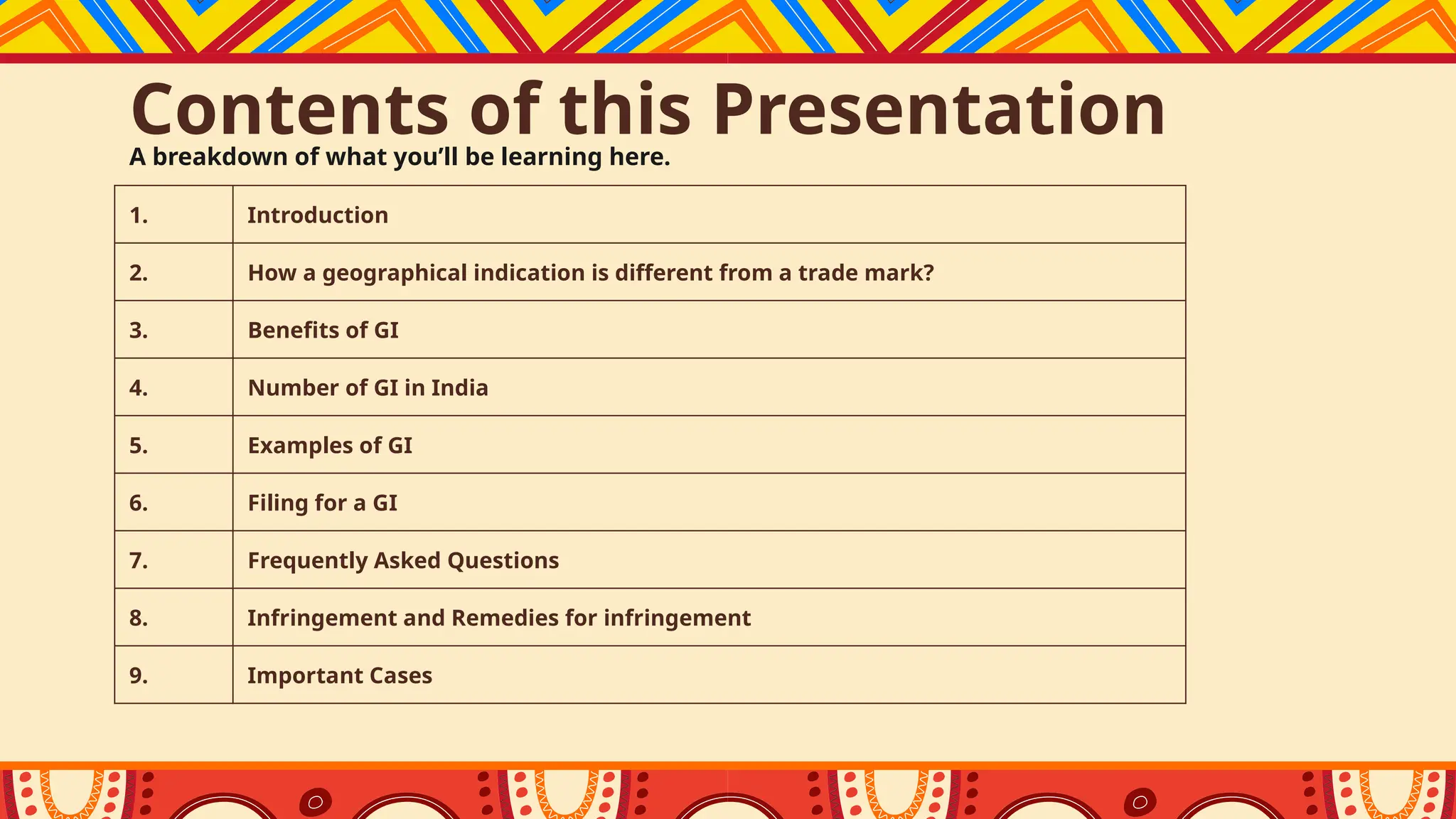
Contents of this Presentation
1. Introduction
2. How a geographical indication is different from a trade mark?
3. Benefits of GI
4. Number of GI in India
5. Examples of GI
6. Filing for a GI
7. Frequently Asked Questions
8. Infringement and Remedies for infringement
9. Important Cases
A breakdown of what you’ll be learning here.
Introduction
What is a GI?
01
Geographical Indications of Goods are defined as that
aspect of industrial property which refer to the
geographical indication referring to a country or to a
place situated therein as being the country or place of
origin of that product. Typically, such a name conveys an
assurance of quality and distinctiveness which is
essentially attributable to the fact of its origin in that
defined geographical locality, region or country. Under
Articles 1 (2) and 10 of the Paris Convention for the
Protection of Industrial Property, geographical
indications are covered as an element of IPRs. They are
also covered under Articles 22 to 24 of the Trade Related
Aspects of Intellectual Property Rights (TRIPS)
Agreement, which was part of the Agreements
concluding the Uruguay Round of GATT negotiations.
How a geographical indication is different from a
trade mark?
A trade mark is a sign which is used in the
course of trade and it distinguishes goods or
services of one enterprise from those of other
enterprises.
Whereas a geographical indication is an indication
used to identify goods having special
characteristics originating from a definite
geographical territory.
Intellectual
Property
Trademark
Geographical
Indication
Significance of GI Tag
GI protection has wider positive benefits, especially for local communities. In particular, it
encourages the preservation of biodiversity, local know-how and natural resources and
this is where India can do well.
Multiple benefits flow from a strong GI ecosystem, which can be a wellspring of economic
and soft power.
The hyper-localised nature of GI offers solutions to reverse urban migration and conserve
India’s ancient crafts, culture and food.
Benefits to Local Community:
Economic and Soft Power
Reverse Urban Migration:
390
Total GI Tags in India in 2022
India’s Oldest GI
Darjeeling Tea
Blue Pottery
Jaipur
Wooden Mask
of Kushmandi
West Bengal
SOME FAMOUS PRODUCTS WITH GI TAGS
Filing an
application for
a GI Tag
STEP 1 : Filing of application
■ Check whether the indication comes within the ambit of the
definition of a Gl under section 2(1)(e). The association of persons or
producers or any organization or authority should represent the
interest of producers of the concerned goods and should file an
affidavit how the applicant claims to represent their interest.
■ Application must be made in triplicate.
■ The application shall be signed by the applicant or his agent and
must be accompanied by a statement of case.
■ Details of the special characteristics and how those standards are
maintained.
■ Three certified copies of the map of the region to which the GI
relates.
STEP 1 : Filing of application
■ Details of the inspection structure if any to regulate the use of the GI
in the territory to which it relates.
■ Give details of all the applicant together with address. If there is a
large number of producers a collective reference to all the producers
of the goods may be made in the application and the G.I., If
registered will be indicated accordingly in the register.
STEP 2 and 3: Preliminary
scrutiny and examination
■ The Examiner will scrutinize the application for any deficiencies.
■ The applicant should within one month of the communication in this
regard, remedy the same.
■ The content of statement of case is assessed by a consultative group
of experts will versed on the subject.
■ The will ascertain the correctness of particulars furnished.
■ Thereafter an Examination Report would be issued.
STEP 4: Show cause notice
■ If the Registrar has any objection to the application, he will
communicate such objection.
■ The applicant must respond within two months or apply for a
hearing.
■ The decision will be duly communicated. If the applicant wishes to
appeal, he may within one month make a request.
■ The Registrar is also empowered to withdraw an application, if it is
accepted in error, after giving on opportunity of being heard.
STEP 5: Publication in the
geographical indications
Journal
■ Every application, within three moths of acceptance
shall be published in the Geographical Indications
Journal.
STEP 6: Opposition to Registration
■ Any person can file a notice of opposition within three months
(extendable by another month on request which has to be filed
before three months) opposing the GI application published in the
Journal.
■ The registrar shall serve a copy of the notice on the applicant.
■ Within two months the applicant shall sent a copy of the counter
statement.
■ If he does not do this be shall be deemed to have abandoned his
application. Where the counter-statement has been filed, the
registrar shall serve a copy on the person giving the notice of
opposition.
■ Thereafter, both sides will lead their respective evidences by way of
affidavit and supporting documents.
■ A date for hearing of the case will be fixed thereafter.
STEP 7: Registration
■ Where an application for a GI has been accepted, the registrar shall
register the geographical indication. If registered the date of filing of
the application shall be deemed to be the date of registration.
■ The registrar shall issue to the applicant a certificate with the seal of
the Geographical indications registry.
STEP 8: Renewal
■ A registered GI shall be valid for 10 years and can be
renewed on payment of renewal fee.
STEP 9: Additional protection to
notified goods
■ A registered GI shall be valid for 10 years and can be
renewed on payment of renewal fee.
What Indications are not registrable ?
■ For registrability, the indications must fall within the
scope of section 2(1)e of GI Act, 1999. Being so, it has
to also satisfy the provisions of section 9, which
prohibits registration of a Geographical Indication.
Additional protection to certain goods
■ An application may be made to the registrar in respect of
goods notified by the central Government for additional
protection for a registered geographical indication in Form
GI-9 accompanied in triplicate along with a statement of
case and shall be accompanied with the copy of the
notification issued.
■ The application shall be made jointly by the registered
proprietor of the Geographical indications in India and by all
Frequently Asked Questions
• Any association of persons, producers, organisation or authority established by or
under the law can apply:
• The applicant must represent the interest of the producers
• The application should be in writing in the prescribed form
• The application should be addressed to the Registrar of Geographical Indications
along with prescribed fee.
1 Who can apply for the registration of a geographical indication?
Frequently Asked Questions
• No, however, registration affords better legal protection to facilitate an action
for infringement
• The registered proprietor and authorised users can initiate infringement
actions
• The authorised users can exercise the exclusive right to use the geographical
indication
2
3
Is registration is compulsory?
How long the registration of Geographical Indication is valid?
• It can be renewed from time to time for further period of 10 years each. If a
registered geographical indication is not renewed it is liable to be removed from
the register.
When the use of another
geographical indication
results in false
representation to the public
that goods originate in a
territory in respect of which
a registered geographical
indication relates.
When is a registered Geographical Indication said to be
infringed?
The registered proprietor or authorised users of a registered geographical indication can initiate an
infringement action.
When an unauthorized user
uses a geographical
indication that indicates or
suggests that such goods
originate in a geographical
area other than the true
place of origin of such
goods in a manner which
mislead the public as to the
geographical origin of such
goods.
When the use of
geographical indication
result in an unfair
competition including
passing off in respect of
registered geographical
indication.
Remedies for infringement of Geographical
Indications
Under the (Indian) Geographical Indicators Goods (Registration and Protection) Act, 1999,
remedies for the falsification of a geographical indication have been given. Remedies which
are available for conservation of geographical indications may be broadly classified into two
categories:
Civil Remedies
■ Injuction
■ Damages
■ Delivery of infringing labels and indications containing products
Criminal Remedies
■ Chapter VIII of the Act deals with offences and punishment for such crimes. The Act has
penal provisions for violation of various provisions related to Geographical indications
Important Cases
THE CASE OF NAVARA RICE – TAMIL NADU VS. KERALA
Navara Rice is a unique grain plant in the Oryza group and one of the various forms of rice
found in India. It is indigenous to Kerala and is well-known for its therapeutic benefits. The
award of GI to Navara Rice Farmers' Society in 2007 had enraged other producers of the crop
in Kerala and Tamil Nadu. However, it was held that only farmers from this community are
permitted to market their harvest as Navara rice. "Nobody has evidence on the historical
origin of Navara rice," says Sridhar of the Kerala-based NGO Thanal, who works with farmers
on sustainable agriculture. Furthermore, he said that we cannot confer GI to seeds since
seeds travel and adapt to local ecosystem through genetic modifications.
Important Cases
THE FAMOUS KOLHAPURI CHAPPALS
In the year 2019, The Controller General of Patents, Designs, and Trade Marks (CGPDTM)
granted Geographical Indication (GI) tag for Kolhapuris, the ethnic leather chappal to
Kolhapur, Sangli, Solapur and Satara districts of Maharashtra and Belgaum, Dharwad,
Bagalkot and Bijapur districts of Karnataka. There was a joint bid for GI tag of Kolhapuri
Chappals by the Sant Rohidas Leather Industries & Charmakar Development Corporation
Limited of Maharashtra (LIDCOM) and the Dr. Babu Jagjeevan Ram Leather Industries
Development Corporation of Karnataka (LIDKAR) in 2009, which fructified in 2018 into GI tag
being granted in favor of the artisans of the two states.
The reason for granting the GI for Kolhapuri Chappals to two states and 8 districts within
them was because of the large demand for Kolhapuris and the reduction of supply of leather
in Maharashtra.
Thanks for
Watching!

Intellectual Property Rights: Geographical Indications

  • 1.
  • 2.
    Contents of thisPresentation 1. Introduction 2. How a geographical indication is different from a trade mark? 3. Benefits of GI 4. Number of GI in India 5. Examples of GI 6. Filing for a GI 7. Frequently Asked Questions 8. Infringement and Remedies for infringement 9. Important Cases A breakdown of what you’ll be learning here.
  • 3.
  • 4.
    Geographical Indications ofGoods are defined as that aspect of industrial property which refer to the geographical indication referring to a country or to a place situated therein as being the country or place of origin of that product. Typically, such a name conveys an assurance of quality and distinctiveness which is essentially attributable to the fact of its origin in that defined geographical locality, region or country. Under Articles 1 (2) and 10 of the Paris Convention for the Protection of Industrial Property, geographical indications are covered as an element of IPRs. They are also covered under Articles 22 to 24 of the Trade Related Aspects of Intellectual Property Rights (TRIPS) Agreement, which was part of the Agreements concluding the Uruguay Round of GATT negotiations.
  • 5.
    How a geographicalindication is different from a trade mark? A trade mark is a sign which is used in the course of trade and it distinguishes goods or services of one enterprise from those of other enterprises. Whereas a geographical indication is an indication used to identify goods having special characteristics originating from a definite geographical territory. Intellectual Property Trademark Geographical Indication
  • 6.
    Significance of GITag GI protection has wider positive benefits, especially for local communities. In particular, it encourages the preservation of biodiversity, local know-how and natural resources and this is where India can do well. Multiple benefits flow from a strong GI ecosystem, which can be a wellspring of economic and soft power. The hyper-localised nature of GI offers solutions to reverse urban migration and conserve India’s ancient crafts, culture and food. Benefits to Local Community: Economic and Soft Power Reverse Urban Migration:
  • 7.
    390 Total GI Tagsin India in 2022
  • 8.
    India’s Oldest GI DarjeelingTea Blue Pottery Jaipur Wooden Mask of Kushmandi West Bengal SOME FAMOUS PRODUCTS WITH GI TAGS
  • 9.
  • 10.
    STEP 1 :Filing of application ■ Check whether the indication comes within the ambit of the definition of a Gl under section 2(1)(e). The association of persons or producers or any organization or authority should represent the interest of producers of the concerned goods and should file an affidavit how the applicant claims to represent their interest. ■ Application must be made in triplicate. ■ The application shall be signed by the applicant or his agent and must be accompanied by a statement of case. ■ Details of the special characteristics and how those standards are maintained. ■ Three certified copies of the map of the region to which the GI relates.
  • 11.
    STEP 1 :Filing of application ■ Details of the inspection structure if any to regulate the use of the GI in the territory to which it relates. ■ Give details of all the applicant together with address. If there is a large number of producers a collective reference to all the producers of the goods may be made in the application and the G.I., If registered will be indicated accordingly in the register.
  • 12.
    STEP 2 and3: Preliminary scrutiny and examination ■ The Examiner will scrutinize the application for any deficiencies. ■ The applicant should within one month of the communication in this regard, remedy the same. ■ The content of statement of case is assessed by a consultative group of experts will versed on the subject. ■ The will ascertain the correctness of particulars furnished. ■ Thereafter an Examination Report would be issued.
  • 13.
    STEP 4: Showcause notice ■ If the Registrar has any objection to the application, he will communicate such objection. ■ The applicant must respond within two months or apply for a hearing. ■ The decision will be duly communicated. If the applicant wishes to appeal, he may within one month make a request. ■ The Registrar is also empowered to withdraw an application, if it is accepted in error, after giving on opportunity of being heard.
  • 14.
    STEP 5: Publicationin the geographical indications Journal ■ Every application, within three moths of acceptance shall be published in the Geographical Indications Journal.
  • 15.
    STEP 6: Oppositionto Registration ■ Any person can file a notice of opposition within three months (extendable by another month on request which has to be filed before three months) opposing the GI application published in the Journal. ■ The registrar shall serve a copy of the notice on the applicant. ■ Within two months the applicant shall sent a copy of the counter statement. ■ If he does not do this be shall be deemed to have abandoned his application. Where the counter-statement has been filed, the registrar shall serve a copy on the person giving the notice of opposition. ■ Thereafter, both sides will lead their respective evidences by way of affidavit and supporting documents. ■ A date for hearing of the case will be fixed thereafter.
  • 16.
    STEP 7: Registration ■Where an application for a GI has been accepted, the registrar shall register the geographical indication. If registered the date of filing of the application shall be deemed to be the date of registration. ■ The registrar shall issue to the applicant a certificate with the seal of the Geographical indications registry.
  • 17.
    STEP 8: Renewal ■A registered GI shall be valid for 10 years and can be renewed on payment of renewal fee. STEP 9: Additional protection to notified goods ■ A registered GI shall be valid for 10 years and can be renewed on payment of renewal fee.
  • 18.
    What Indications arenot registrable ? ■ For registrability, the indications must fall within the scope of section 2(1)e of GI Act, 1999. Being so, it has to also satisfy the provisions of section 9, which prohibits registration of a Geographical Indication. Additional protection to certain goods ■ An application may be made to the registrar in respect of goods notified by the central Government for additional protection for a registered geographical indication in Form GI-9 accompanied in triplicate along with a statement of case and shall be accompanied with the copy of the notification issued. ■ The application shall be made jointly by the registered proprietor of the Geographical indications in India and by all
  • 19.
    Frequently Asked Questions •Any association of persons, producers, organisation or authority established by or under the law can apply: • The applicant must represent the interest of the producers • The application should be in writing in the prescribed form • The application should be addressed to the Registrar of Geographical Indications along with prescribed fee. 1 Who can apply for the registration of a geographical indication?
  • 20.
    Frequently Asked Questions •No, however, registration affords better legal protection to facilitate an action for infringement • The registered proprietor and authorised users can initiate infringement actions • The authorised users can exercise the exclusive right to use the geographical indication 2 3 Is registration is compulsory? Is registration is compulsory? How long the registration of Geographical Indication is valid? • It can be renewed from time to time for further period of 10 years each. If a registered geographical indication is not renewed it is liable to be removed from the register.
  • 21.
    When the useof another geographical indication results in false representation to the public that goods originate in a territory in respect of which a registered geographical indication relates. When is a registered Geographical Indication said to be infringed? The registered proprietor or authorised users of a registered geographical indication can initiate an infringement action. When an unauthorized user uses a geographical indication that indicates or suggests that such goods originate in a geographical area other than the true place of origin of such goods in a manner which mislead the public as to the geographical origin of such goods. When the use of geographical indication result in an unfair competition including passing off in respect of registered geographical indication.
  • 22.
    Remedies for infringementof Geographical Indications Under the (Indian) Geographical Indicators Goods (Registration and Protection) Act, 1999, remedies for the falsification of a geographical indication have been given. Remedies which are available for conservation of geographical indications may be broadly classified into two categories: Civil Remedies ■ Injuction ■ Damages ■ Delivery of infringing labels and indications containing products Criminal Remedies ■ Chapter VIII of the Act deals with offences and punishment for such crimes. The Act has penal provisions for violation of various provisions related to Geographical indications
  • 23.
    Important Cases THE CASEOF NAVARA RICE – TAMIL NADU VS. KERALA Navara Rice is a unique grain plant in the Oryza group and one of the various forms of rice found in India. It is indigenous to Kerala and is well-known for its therapeutic benefits. The award of GI to Navara Rice Farmers' Society in 2007 had enraged other producers of the crop in Kerala and Tamil Nadu. However, it was held that only farmers from this community are permitted to market their harvest as Navara rice. "Nobody has evidence on the historical origin of Navara rice," says Sridhar of the Kerala-based NGO Thanal, who works with farmers on sustainable agriculture. Furthermore, he said that we cannot confer GI to seeds since seeds travel and adapt to local ecosystem through genetic modifications.
  • 24.
    Important Cases THE FAMOUSKOLHAPURI CHAPPALS In the year 2019, The Controller General of Patents, Designs, and Trade Marks (CGPDTM) granted Geographical Indication (GI) tag for Kolhapuris, the ethnic leather chappal to Kolhapur, Sangli, Solapur and Satara districts of Maharashtra and Belgaum, Dharwad, Bagalkot and Bijapur districts of Karnataka. There was a joint bid for GI tag of Kolhapuri Chappals by the Sant Rohidas Leather Industries & Charmakar Development Corporation Limited of Maharashtra (LIDCOM) and the Dr. Babu Jagjeevan Ram Leather Industries Development Corporation of Karnataka (LIDKAR) in 2009, which fructified in 2018 into GI tag being granted in favor of the artisans of the two states. The reason for granting the GI for Kolhapuri Chappals to two states and 8 districts within them was because of the large demand for Kolhapuris and the reduction of supply of leather in Maharashtra.
  • 25.