This project has been funded with support from the European Commission. This Web site reflects the views only of the authors,
and the Commission cannot be held responsible for any use which may be made of the information contained therein.
http://www.geocapabilities.org
GeoCapabilities 3
Panel Discussion – What makes
learning geography ‘powerful’?
Powerful geographical knowledge in practice and with attention to social
justice – some implications of the Geocapabilities 3 project
Mitchell, D., Beneker, T., Biddulph, M. ,
Hanus, M., Leininger, C. , Zwartjes, L.,
and Donert, K.
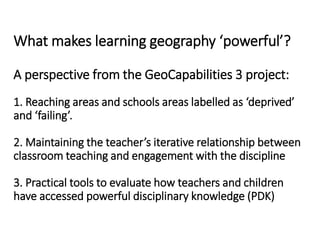
What makes learning geography ‘powerful’?
A perspective from the GeoCapabilities 3 project:
1. Reaching areas and schools areas labelled as ‘deprived’
and ‘failing’.
2. Maintaining the teacher’s iterative relationship between
classroom teaching and engagement with the discipline
3. Practical tools to evaluate how teachers and children
have accessed powerful disciplinary knowledge (PDK)
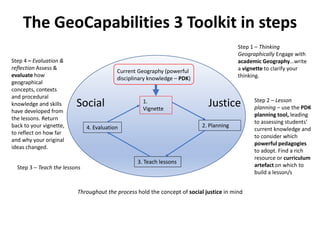
1.
Vignette
Current Geography (powerful
disciplinary knowledge – PDK)
2. Planning
3. Teach lessons
4. Evaluation
Social Justice
The GeoCapabilities 3 Toolkit in steps
Step 1 – Thinking
Geographically Engage with
academic Geography…write
a vignette to clarify your
thinking.
Step 2 – Lesson
planning – use the PDK
planning tool, leading
to assessing students’
current knowledge and
to consider which
powerful pedagogies
to adopt. Find a rich
resource or curriculum
artefact on which to
build a lesson/s
Step 4 – Evaluation &
reflection Assess &
evaluate how
geographical
concepts, contexts
and procedural
knowledge and skills
have developed from
the lessons. Return
back to your vignette,
to reflect on how far
and why your original
ideas changed.
Step 3 – Teach the lessons
Throughout the process hold the concept of social justice in mind
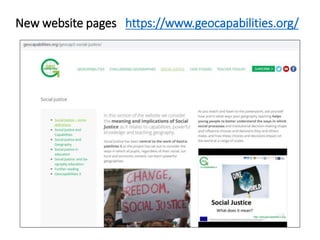
New website pages https://www.geocapabilities.org/
This project has been funded with support from the European Commission. This Web site reflects the views only of the authors,
and the Commission cannot be held responsible for any use which may be made of the information contained therein.
http://www.geocapabilities.org
GeoCapabilities 3
What next for the
GeoCapabilities Project?
Some suggested directions:
1. Knowledge capabilities (interdisciplinary – not just Geo…?)
2. Values dimension for capabilities (PDK downplays values?)
3. Primary education?
4. Climate change education as focus?
Current bids for research:
EPoCH (Engagement with Knowledge Power in Schools and the Development of Capabilities
for the Human Epoch) Marie Curie
Curriculum Making for the Anthropocene Spencer foundation
KCaVES (knowledge capabilities and values for environmental sustainability) Esmee Fairbairn
Questions & Discussion – What makes learning geography ‘powerful’?
1. What next for the GoCapabilities project?
2. The Geocapability approach aims to improve student learning but the theory is
focused on teacher's practices. How can theory evolve to improve the
consideration of student learning?
3. How best can we add value to teachers who are using a GeoCapabilities
approach?.....What needs do we (as a geography education community) need to
meet?
4. What social justice lessons does GeoCapabilities 3 provide? What needs to be
done to share these more widely? What follow up is needed?
5. What can be done by the geography community to help teachers get better
access to the latest updated Powerful Geography Disciplinary Knowledge?
Which are the channels? Who should be responsible?
6. How could the GeoCapabilities toolkit and supporting materials be used? Is
there any advice we can supply?
7. In recent years, Geocapabilities have become an important approach in
geographical education in many countries around the world. However, this
knowledge is fragmented into different platforms (web pages, journals etc).
Would it be possible / appropriate to invite authors to share their experiences
and then concentrate them in one place / portal?
8. What perspectives are needed in geography curriculum design and
development?

Panel Discussion – What makes learning geography ‘powerful’?

  • 1.
    This project hasbeen funded with support from the European Commission. This Web site reflects the views only of the authors, and the Commission cannot be held responsible for any use which may be made of the information contained therein. http://www.geocapabilities.org GeoCapabilities 3 Panel Discussion – What makes learning geography ‘powerful’? Powerful geographical knowledge in practice and with attention to social justice – some implications of the Geocapabilities 3 project Mitchell, D., Beneker, T., Biddulph, M. , Hanus, M., Leininger, C. , Zwartjes, L., and Donert, K.
  • 2.
    What makes learninggeography ‘powerful’? A perspective from the GeoCapabilities 3 project: 1. Reaching areas and schools areas labelled as ‘deprived’ and ‘failing’. 2. Maintaining the teacher’s iterative relationship between classroom teaching and engagement with the discipline 3. Practical tools to evaluate how teachers and children have accessed powerful disciplinary knowledge (PDK)
  • 3.
    1. Vignette Current Geography (powerful disciplinaryknowledge – PDK) 2. Planning 3. Teach lessons 4. Evaluation Social Justice The GeoCapabilities 3 Toolkit in steps Step 1 – Thinking Geographically Engage with academic Geography…write a vignette to clarify your thinking. Step 2 – Lesson planning – use the PDK planning tool, leading to assessing students’ current knowledge and to consider which powerful pedagogies to adopt. Find a rich resource or curriculum artefact on which to build a lesson/s Step 4 – Evaluation & reflection Assess & evaluate how geographical concepts, contexts and procedural knowledge and skills have developed from the lessons. Return back to your vignette, to reflect on how far and why your original ideas changed. Step 3 – Teach the lessons Throughout the process hold the concept of social justice in mind
  • 4.
    New website pageshttps://www.geocapabilities.org/
  • 5.
    This project hasbeen funded with support from the European Commission. This Web site reflects the views only of the authors, and the Commission cannot be held responsible for any use which may be made of the information contained therein. http://www.geocapabilities.org GeoCapabilities 3 What next for the GeoCapabilities Project? Some suggested directions: 1. Knowledge capabilities (interdisciplinary – not just Geo…?) 2. Values dimension for capabilities (PDK downplays values?) 3. Primary education? 4. Climate change education as focus? Current bids for research: EPoCH (Engagement with Knowledge Power in Schools and the Development of Capabilities for the Human Epoch) Marie Curie Curriculum Making for the Anthropocene Spencer foundation KCaVES (knowledge capabilities and values for environmental sustainability) Esmee Fairbairn
  • 6.
    Questions & Discussion– What makes learning geography ‘powerful’? 1. What next for the GoCapabilities project? 2. The Geocapability approach aims to improve student learning but the theory is focused on teacher's practices. How can theory evolve to improve the consideration of student learning? 3. How best can we add value to teachers who are using a GeoCapabilities approach?.....What needs do we (as a geography education community) need to meet? 4. What social justice lessons does GeoCapabilities 3 provide? What needs to be done to share these more widely? What follow up is needed? 5. What can be done by the geography community to help teachers get better access to the latest updated Powerful Geography Disciplinary Knowledge? Which are the channels? Who should be responsible? 6. How could the GeoCapabilities toolkit and supporting materials be used? Is there any advice we can supply? 7. In recent years, Geocapabilities have become an important approach in geographical education in many countries around the world. However, this knowledge is fragmented into different platforms (web pages, journals etc). Would it be possible / appropriate to invite authors to share their experiences and then concentrate them in one place / portal? 8. What perspectives are needed in geography curriculum design and development?