Geography in schools and education for survivalDavid Lambert
Geography in schools and education for survival
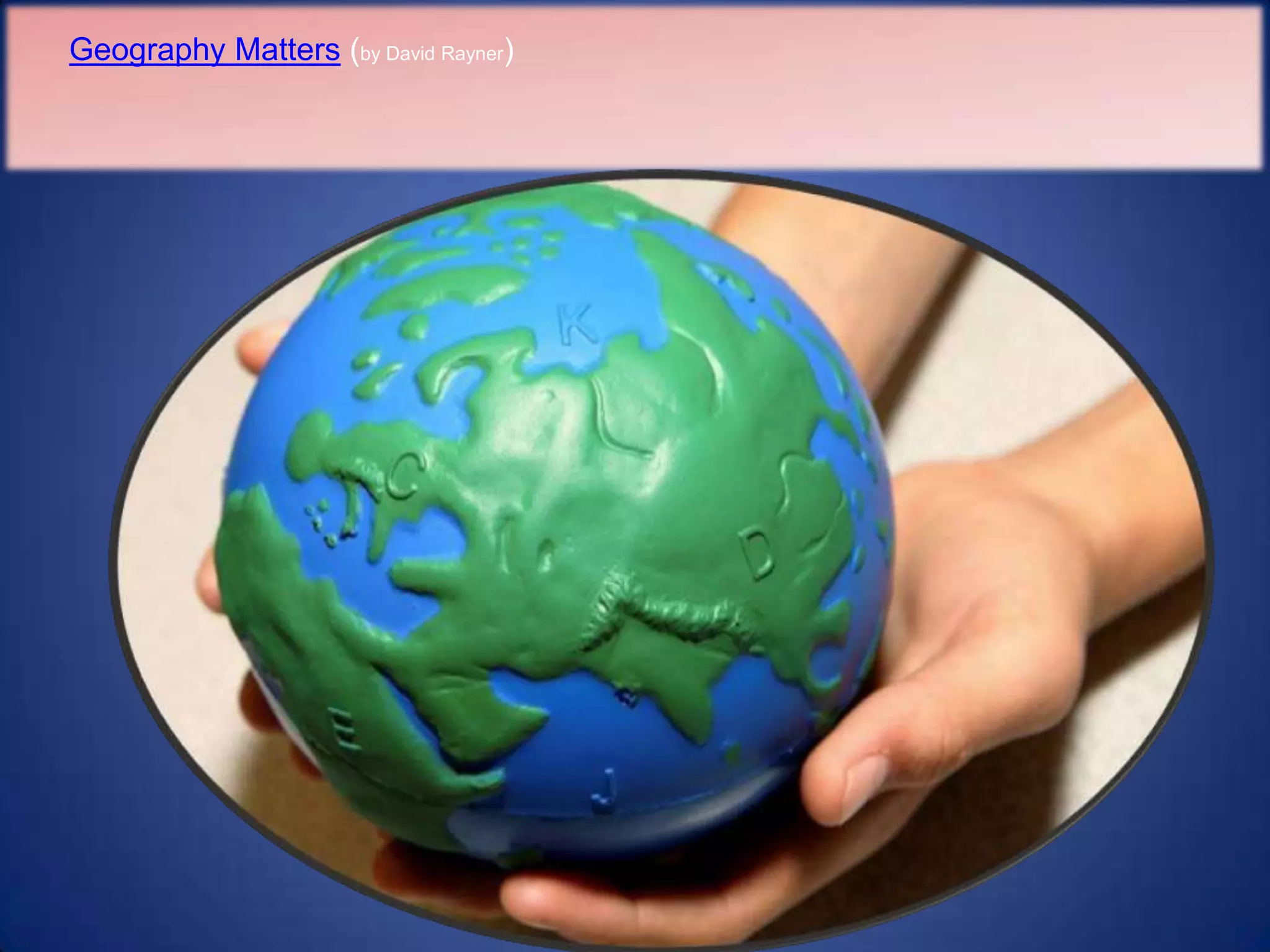
Geography Matters(by David Rayner)
Crisis, what crisis?Environmental global climate changeEconomic global financial crisisEducational how to respond?
What geography is significant to the 21st century learner?
What’s the purpose of school geography?And end in itself?OrA means to an end?
Geography underpins a lifelong ‘conversation’ about the earth as the home of humankind. It is not a narrow academic subject for the few.  It is a fundamental idea. It is of relevance to everyone.- Geography fascinates and inspires - Geography deepens understanding-Thinking with geography enablesdecision-making - Geographical enquiry encourages skills developmentSource: the GA Manifesto A Different View(www.geography.org.uk/adifferentview)
	‘Geography is all about the living, breathing essence of the world we live in. It explains the past, illuminates the present and prepares us for the future. 	What could be more important than that?’Michael Palin, 27 November 2007 At the reception at the Speaker’s House, House of Commons, to celebrate the successes of the Action Plan for Geography.
“I want my children to understand the world, but not just because the world is fascinating and the human mind is curious. I want them to understand it so they will be positioned to make it a better place.”Gardner H (2000) Intelligence Reframed: multiple intelligences for the 21st century, NY: Basic Books. P 180-1
The moral implications of teaching geographyQuestions:What are the children learning (anyhow)What are the children learning through my teaching?In what ways is this learning an educational achievement?Has it enabled students to travel ‘with a different view’?
According to the QCA: The curriculum aims to enable all young people to becomeSuccessful learnerswho make progress and achieveConfident Individualswho lead safe and healthy livesResponsible Citizenswho make a positive contribution to society
Whole CurriculumSkills, Knowledge  and Attributes:Skills; Functional Skills (Lit/Number/ICT)  +  Personal, Learning and Thinking SkillsKnowledge and Understanding; Big ideas that shape the world - eg chronology, conflict, scientific methodAttitudes and dispositions; eg determined, adaptable, learning to learn
Some Different Aims From the Nuffield Reviewwww.nuffield14-19review.org.ukTo introduce ideals which inspire and are worth pursuingTo introduce a defensible set of values which can sustain young people into the futureTo encourage the disposition to take responsibility for self, the environment and wider communityTo provide insights into the physical, moral, social, cultural and economic worldsTo prepare young people for employment  - through self knowledge, basic competences and understanding and confidence in learning
The subjectGeography – not as an end in itself but a resource in the service of educational aimsGeography - “defined not as a collection of facts but as the state of the art conceptual frameworks of the subject”
Engaging with young people’s curiosity: questions that can be addressed by ‘thinking geographically’Identity: Who am I? Where do I come from? Who is my family? What is my ‘story’? Who are the people around me? Where do they come from? What is their ‘story’?Place in the world: Where do I live? How does it look? How do I feel about it? How is it changing? How do I want it to change?The Physical world: What is the world (and this place) made of? Why do things move? What becomes of things?The Human world: Who decides on who gets what, and why? What is fair? How do we handle differences of opinion?
Curriculum MakingWhich learning activity ?Does this take the learner beyond what they already know ?Student ExperiencesGeography: the subjectTeacher ChoicesUnderpinned by Key ConceptsThinking Geographically
skills and ways of thinkingKey processesRange and contentopportunitiesCurriculumKey conceptsknowledge and understandingessential ideascontexts for learningLess prescribed contentbut an increased focuson subject discipline… the key ideas and skillsthat underpin a subject.A new look at subjectsImportanceWhy the subject matters and how it contributes to the aims
The study of geography stimulates an interest in, and a sense of wonder about, places and helps make sense of a complex and dynamically changing world. It explains how places and landscapes are formed, how people and environment interact, and how a diverse range of economies and societies are interconnected. It builds on pupils’ own experiences to investigate at all scales from the personal to the global.	Geographical enquiry encourages questioning, investigation and critical thinking about issues affecting the world and people’s lives, for the present and future. Fieldwork is an essential element of this. Pupils learn to think spatially, using maps, visual images and new technologies, including geographical information systems, to obtain, present and analyse information. Geography inspires pupils to become global citizens by exploring their own place in the world, their values and responsibilities to other people, to the environment and to the sustainability of the planet.
What are the key concepts in Geography?
KEY PROCESSES
What are the stages of enquiry?Creating a need to knowspeculating, hypothesising,generating ideas, asking questions,planning how to research Using sourceslocating evidence,collecting, selecting, sorting, classifying,sequencingReflecting on Learningevaluating,identifying areas forimprovementMaking sensedescribing, explaining,comapring, contrasting,analysing, concluding
Chesterton College, Cambridge
The moral implications of teaching geographyQuestions:What are the children learning (anyhow)What are the children learning through my teaching?In what ways is this learning an educational achievement?Has it enabled students to travel ‘with a different view’?
School Geography and “Capabilities”
A student‘thinking geographically’.What does that mean? What does she need in order to be able to do that?
CapabilityDerives from Amartya Sen and Martha Nussbaum and their work in human welfare and development economics:What it is to be ‘truly human’?	Anything that prevents fully human functioning is a 	deprivation of capability
Thus, poverty  is not simply ‘low income’. It is:	a lack of choice	a lack of opportunity
Other examples of capabilities:  being able to imagine, use the senses, think and reason
 being able to form a conception of the good and to plan one’s life accordingly
 being able to show concern for others, to empathise and to live successfully with others
 being able participate effectively in political choices, with free speech and association[after Nussbaum 1993]
Human capabilities and educationNot to be confused with imparting value free ‘skills’ for the ‘knowledge economy’Education to enhance the agency of youngpeople, clarifying values and deepening understanding.
Human (intellectual) ‘functioning’Based on significant organising ideasFor example,A “Global Sense of Place” Porous boundaries
Meeting points
 Power geometriesThis  enables a framework for understanding. It helps us puts more specific matters into the context of wider implications and interdependencies.
Human capabilities and education   autonomy and rights
   choices about how to live
   creativity and productivityIn a context of ‘moral seriousness’
  The neo-liberal orthodoxy has “dulled our ability to think for, or beyond, ourselves”[Wadley 2008]“Vibrant City”
IdentityWho am I? Where am I from? Who is my ‘family’? What is their story? And the people around me?SocietyWho decides on who gets what, where and why? What is fair? Why  care?
The physical environmentWhat is the world (and this place) made of? Why do things move? What becomes of things?Our place in the worldWhere do I live? How does it look? How is it changing? How might it become?
School geography and capabilitiesSchool geography enables young people to extend and develop their: world knowledge and knowledge of earth as the home of humankind
 relational understanding of people and places in the world
disposition to link social, economic and environmental processes“We are encouraging schools to be outward looking, globally minded and future focused.(Schools should) enable open-ended engagement with wider world issues … It’s the tensions that students confront when they do so that are important.”Prof Bill Scott
A Different View

School geography and survival

  • 1.
    Geography in schoolsand education for survivalDavid Lambert
  • 2.
    Geography in schoolsand education for survival
  • 3.
  • 4.
    Crisis, what crisis?Environmentalglobal climate changeEconomic global financial crisisEducational how to respond?
  • 5.
    What geography issignificant to the 21st century learner?
  • 7.
    What’s the purposeof school geography?And end in itself?OrA means to an end?
  • 8.
    Geography underpins alifelong ‘conversation’ about the earth as the home of humankind. It is not a narrow academic subject for the few. It is a fundamental idea. It is of relevance to everyone.- Geography fascinates and inspires - Geography deepens understanding-Thinking with geography enablesdecision-making - Geographical enquiry encourages skills developmentSource: the GA Manifesto A Different View(www.geography.org.uk/adifferentview)
  • 9.
    ‘Geography is allabout the living, breathing essence of the world we live in. It explains the past, illuminates the present and prepares us for the future. What could be more important than that?’Michael Palin, 27 November 2007 At the reception at the Speaker’s House, House of Commons, to celebrate the successes of the Action Plan for Geography.
  • 10.
    “I want mychildren to understand the world, but not just because the world is fascinating and the human mind is curious. I want them to understand it so they will be positioned to make it a better place.”Gardner H (2000) Intelligence Reframed: multiple intelligences for the 21st century, NY: Basic Books. P 180-1
  • 11.
    The moral implicationsof teaching geographyQuestions:What are the children learning (anyhow)What are the children learning through my teaching?In what ways is this learning an educational achievement?Has it enabled students to travel ‘with a different view’?
  • 13.
    According to theQCA: The curriculum aims to enable all young people to becomeSuccessful learnerswho make progress and achieveConfident Individualswho lead safe and healthy livesResponsible Citizenswho make a positive contribution to society
  • 14.
    Whole CurriculumSkills, Knowledge and Attributes:Skills; Functional Skills (Lit/Number/ICT) + Personal, Learning and Thinking SkillsKnowledge and Understanding; Big ideas that shape the world - eg chronology, conflict, scientific methodAttitudes and dispositions; eg determined, adaptable, learning to learn
  • 15.
    Some Different AimsFrom the Nuffield Reviewwww.nuffield14-19review.org.ukTo introduce ideals which inspire and are worth pursuingTo introduce a defensible set of values which can sustain young people into the futureTo encourage the disposition to take responsibility for self, the environment and wider communityTo provide insights into the physical, moral, social, cultural and economic worldsTo prepare young people for employment - through self knowledge, basic competences and understanding and confidence in learning
  • 16.
    The subjectGeography –not as an end in itself but a resource in the service of educational aimsGeography - “defined not as a collection of facts but as the state of the art conceptual frameworks of the subject”
  • 17.
    Engaging with youngpeople’s curiosity: questions that can be addressed by ‘thinking geographically’Identity: Who am I? Where do I come from? Who is my family? What is my ‘story’? Who are the people around me? Where do they come from? What is their ‘story’?Place in the world: Where do I live? How does it look? How do I feel about it? How is it changing? How do I want it to change?The Physical world: What is the world (and this place) made of? Why do things move? What becomes of things?The Human world: Who decides on who gets what, and why? What is fair? How do we handle differences of opinion?
  • 18.
    Curriculum MakingWhich learningactivity ?Does this take the learner beyond what they already know ?Student ExperiencesGeography: the subjectTeacher ChoicesUnderpinned by Key ConceptsThinking Geographically
  • 20.
    skills and waysof thinkingKey processesRange and contentopportunitiesCurriculumKey conceptsknowledge and understandingessential ideascontexts for learningLess prescribed contentbut an increased focuson subject discipline… the key ideas and skillsthat underpin a subject.A new look at subjectsImportanceWhy the subject matters and how it contributes to the aims
  • 21.
    The study ofgeography stimulates an interest in, and a sense of wonder about, places and helps make sense of a complex and dynamically changing world. It explains how places and landscapes are formed, how people and environment interact, and how a diverse range of economies and societies are interconnected. It builds on pupils’ own experiences to investigate at all scales from the personal to the global. Geographical enquiry encourages questioning, investigation and critical thinking about issues affecting the world and people’s lives, for the present and future. Fieldwork is an essential element of this. Pupils learn to think spatially, using maps, visual images and new technologies, including geographical information systems, to obtain, present and analyse information. Geography inspires pupils to become global citizens by exploring their own place in the world, their values and responsibilities to other people, to the environment and to the sustainability of the planet.
  • 22.
    What are thekey concepts in Geography?
  • 23.
  • 24.
    What are thestages of enquiry?Creating a need to knowspeculating, hypothesising,generating ideas, asking questions,planning how to research Using sourceslocating evidence,collecting, selecting, sorting, classifying,sequencingReflecting on Learningevaluating,identifying areas forimprovementMaking sensedescribing, explaining,comapring, contrasting,analysing, concluding
  • 25.
  • 26.
    The moral implicationsof teaching geographyQuestions:What are the children learning (anyhow)What are the children learning through my teaching?In what ways is this learning an educational achievement?Has it enabled students to travel ‘with a different view’?
  • 27.
    School Geography and“Capabilities”
  • 28.
    A student‘thinking geographically’.Whatdoes that mean? What does she need in order to be able to do that?
  • 29.
    CapabilityDerives from AmartyaSen and Martha Nussbaum and their work in human welfare and development economics:What it is to be ‘truly human’? Anything that prevents fully human functioning is a deprivation of capability
  • 30.
    Thus, poverty is not simply ‘low income’. It is: a lack of choice a lack of opportunity
  • 31.
    Other examples ofcapabilities: being able to imagine, use the senses, think and reason
  • 32.
    being ableto form a conception of the good and to plan one’s life accordingly
  • 33.
    being ableto show concern for others, to empathise and to live successfully with others
  • 34.
    being ableparticipate effectively in political choices, with free speech and association[after Nussbaum 1993]
  • 35.
    Human capabilities andeducationNot to be confused with imparting value free ‘skills’ for the ‘knowledge economy’Education to enhance the agency of youngpeople, clarifying values and deepening understanding.
  • 36.
    Human (intellectual) ‘functioning’Basedon significant organising ideasFor example,A “Global Sense of Place” Porous boundaries
  • 37.
  • 38.
    Power geometriesThis enables a framework for understanding. It helps us puts more specific matters into the context of wider implications and interdependencies.
  • 39.
    Human capabilities andeducation autonomy and rights
  • 40.
    choices about how to live
  • 41.
    creativity and productivityIn a context of ‘moral seriousness’
  • 42.
    Theneo-liberal orthodoxy has “dulled our ability to think for, or beyond, ourselves”[Wadley 2008]“Vibrant City”
  • 43.
    IdentityWho am I?Where am I from? Who is my ‘family’? What is their story? And the people around me?SocietyWho decides on who gets what, where and why? What is fair? Why care?
  • 44.
    The physical environmentWhatis the world (and this place) made of? Why do things move? What becomes of things?Our place in the worldWhere do I live? How does it look? How is it changing? How might it become?
  • 45.
    School geography andcapabilitiesSchool geography enables young people to extend and develop their: world knowledge and knowledge of earth as the home of humankind
  • 46.
    relational understandingof people and places in the world
  • 47.
    disposition to linksocial, economic and environmental processes“We are encouraging schools to be outward looking, globally minded and future focused.(Schools should) enable open-ended engagement with wider world issues … It’s the tensions that students confront when they do so that are important.”Prof Bill Scott
  • 48.
  • 55.
    The GA’s ‘manifesto’linksGeography: “Knowledge about the earth as the home of humankind”and Education“ ... to travel with a different view”www.geography.org.uk/adifferentview
  • 56.
    Sharing and learningfrom good practice - FEB 2008
  • 57.
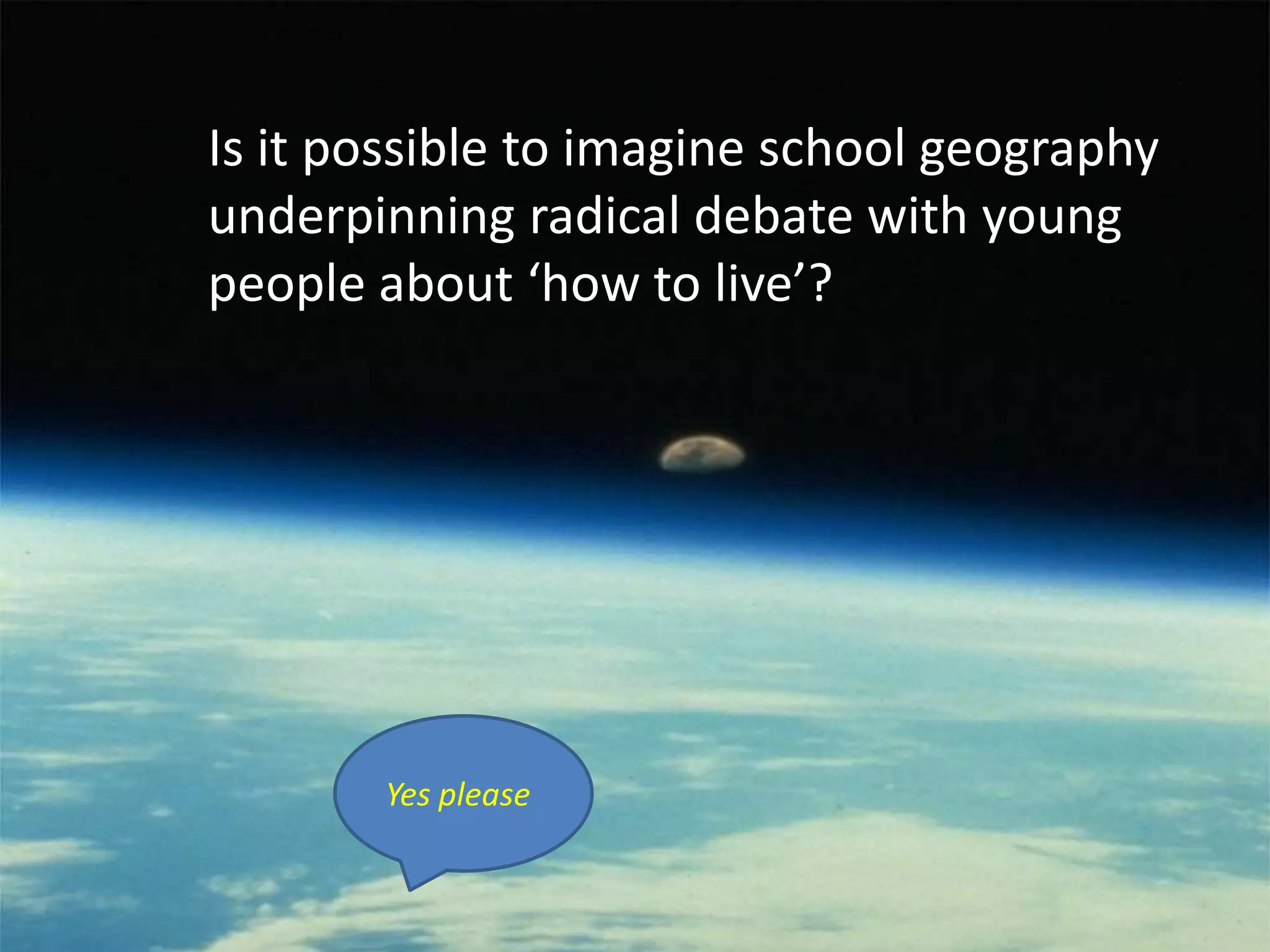
    Sharing and learningfrom good practice - FEB 2008Is it possible to imagine school geography underpinning radical debate with young people about ‘how to live’?
  • 58.
    Sharing and learningfrom good practice - FEB 2008Is it possible to imagine school geography underpinning radical debate with young people about ‘how to live’?Yes please
  • 59.
    Geography in schoolsand education for survival