GEOLAND
A learning path
for HE students and professors
Case Study - Greece
Implementing the Landscape Convention
• Article 24 of the Constitution mandates the preservation of
the local, residential, and cultural environments
• landscape incorporated in regional and urban planning
policies
• Emphasises building a culture of respect for the
environment in society
• guidelines of a National Landscape Strategy formulated
Implementing the Landscape Convention
• Serious landscape deficit in common law
• Modern understanding of the environment as a setting for
living has not been developed
• Landscape included using zoning and urban planning
techniques
• Statutory guidelines for landscape protection in the General
Framework for Spatial Planning and Sustainable Development
• Recently, landscapes listed as a component of Special
Protection Areas and Special Status Areas
National level Planning for the future
• Proposes reforms of national planning systems
• Streamline and modernise the planning process (Karimi and
Adams, 2019)
• Bring a design focus and increased sustainability
• Contribute to infrastructure
• Enable more land to be made available for development
where needed
Karimi, A. and Adams, V.M., (2019). Planning for the future: Combining spatially-explicit public
preferences with tenure policies to support land-use planning. Land use policy, 82, pp.497-508
Landscape Designation at national level
"the protection of the natural and cultural environment
constitutes a duty of the State and a right of every person”
• landscape is indirectly protected in the context of
environmental protection
• Greek law does not contain any special laws on
environmental protection
Organisations involved
• Directorate of Spatial Planning, Ministry of the Environment
and Energy of Greece has main responsibility
• Some NGOs and think-tanks active
• Universities also involved
• An Environmental Awareness and Awareness Programme for
students is in place
How is participation organised?
• Modest tradition of public participation
• Ministries and the Regions, seek the participation of
organisations and citizens in gathering opinions
• OpenGOV.gr is the Greek open government platform
• Policy initiatives posted to the platform prior to submission
to Parliament
• issues related to Landscape legislation, monitoring and
management are discussed and resolved
How is participation organised?
• Landscape Public Participation Tools (LPPT) Program
established to highlight the significance of landscape
management and citizen participation in Greece
https://med-ina.org/project/landscape-public-participation-
tools-lppt/
• MedINA created and is presently implementing a program with
the Society for the Protection of Prespa (SPP)
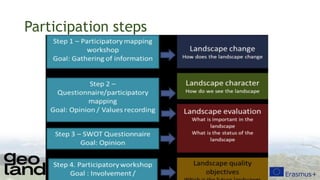
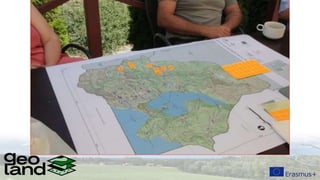
Participation steps
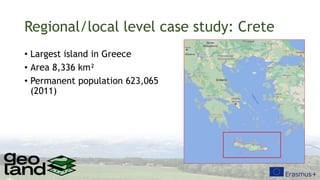
Regional/local level case study: Crete
• Largest island in Greece
• Area 8,336 km²
• Permanent population 623,065
(2011)
Regional/local level case study: Crete
Priorities for landscapes of value and degraded ones are:
• implementation of integrated and coordinated actions
• formulation of guidelines for their protection, management
and promotion (spatial planning)
• institutionalisation of quality objectives for each landscape
• taking accompanying measures to minimise pressures exerted
• activation of civil society at the local level for monitoring
policies and priorities
Regional framework: Crete
There are two basic elements of the Landscape Units:
• natural environment - geomorphology, flora, fauna,
soilsm water, climate etc.
• anthropogenic environment - constructions etc.
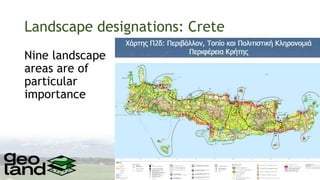
Landscape designations: Crete
Nine landscape
areas are of
particular
importance
Landscape designations 1: Crete
Unit 1 East Coast (PE Lasithi, Municipality of Sitia).
Unit 2 Gulf of Merabelo and wider surrounding area (PE: Lasithi,
Heraklion, Municipalities: Agios Nikolaos, Lasithi Plateau,
Ierapetra and eastern part of Hersonissos)
Unit 3 Heraklion, Dias, Knossos, Jouchtas (P.E. of Heraklion,
Municipality of Heraklion)
Unit 4 Asterousia, Gortyna (P.E. of Heraklion, Municipalities:
Gortyna, Phaistos and southern part of Archana/Asterousia)
Unit 5 Rethymno and surrounding area (P.E. Rethymno,
Municipalities: Rethymno, Agios Vasilios, Amario)
Landscape designations 2: Crete
Unit 6 Mylopotamos, Idi (P.I. of Rethymno, Heraklion,
Municipalities: Mylopotamos, Anogeion, Phaistos)
Unit 7 Chania, Akrotiri, Vammos (P.E. of Chania, Municipalities:
Chania, Platania, Apokoronou)
Unit 8 Western Coast to Akrotiri Krios (P.E. Chania,
Municipalities: Platania, Kissamos, Kantanou-Selinou)
Unit 9 South Coast to Frangokastelos (P.E. Chania and
Rethymnon, Municipalities: Kantanou-Selinou, Sfakion, Agios
Vassiliou)
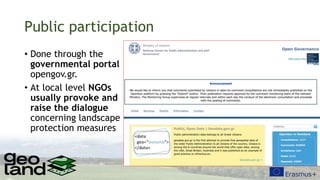
Public participation
• Done through the
governmental portal
opengov.gr.
• At local level NGOs
usually provoke and
raise the dialogue
concerning landscape
protection measures
For more about GEOLAND
GEOLAND Web site
https://www.geolandproject.eu
GEOLAND on social media
https://www.facebook.com/GEOLANDthePROJECT

GEOLAND Landscape Policy Case Study: Greece

  • 1.
    GEOLAND A learning path forHE students and professors Case Study - Greece
  • 2.
    Implementing the LandscapeConvention • Article 24 of the Constitution mandates the preservation of the local, residential, and cultural environments • landscape incorporated in regional and urban planning policies • Emphasises building a culture of respect for the environment in society • guidelines of a National Landscape Strategy formulated
  • 3.
    Implementing the LandscapeConvention • Serious landscape deficit in common law • Modern understanding of the environment as a setting for living has not been developed • Landscape included using zoning and urban planning techniques • Statutory guidelines for landscape protection in the General Framework for Spatial Planning and Sustainable Development • Recently, landscapes listed as a component of Special Protection Areas and Special Status Areas
  • 4.
    National level Planningfor the future • Proposes reforms of national planning systems • Streamline and modernise the planning process (Karimi and Adams, 2019) • Bring a design focus and increased sustainability • Contribute to infrastructure • Enable more land to be made available for development where needed Karimi, A. and Adams, V.M., (2019). Planning for the future: Combining spatially-explicit public preferences with tenure policies to support land-use planning. Land use policy, 82, pp.497-508
  • 5.
    Landscape Designation atnational level "the protection of the natural and cultural environment constitutes a duty of the State and a right of every person” • landscape is indirectly protected in the context of environmental protection • Greek law does not contain any special laws on environmental protection
  • 6.
    Organisations involved • Directorateof Spatial Planning, Ministry of the Environment and Energy of Greece has main responsibility • Some NGOs and think-tanks active • Universities also involved • An Environmental Awareness and Awareness Programme for students is in place
  • 7.
    How is participationorganised? • Modest tradition of public participation • Ministries and the Regions, seek the participation of organisations and citizens in gathering opinions • OpenGOV.gr is the Greek open government platform • Policy initiatives posted to the platform prior to submission to Parliament • issues related to Landscape legislation, monitoring and management are discussed and resolved
  • 8.
    How is participationorganised? • Landscape Public Participation Tools (LPPT) Program established to highlight the significance of landscape management and citizen participation in Greece https://med-ina.org/project/landscape-public-participation- tools-lppt/ • MedINA created and is presently implementing a program with the Society for the Protection of Prespa (SPP)
  • 9.
  • 11.
    Regional/local level casestudy: Crete • Largest island in Greece • Area 8,336 km² • Permanent population 623,065 (2011)
  • 12.
    Regional/local level casestudy: Crete Priorities for landscapes of value and degraded ones are: • implementation of integrated and coordinated actions • formulation of guidelines for their protection, management and promotion (spatial planning) • institutionalisation of quality objectives for each landscape • taking accompanying measures to minimise pressures exerted • activation of civil society at the local level for monitoring policies and priorities
  • 13.
    Regional framework: Crete Thereare two basic elements of the Landscape Units: • natural environment - geomorphology, flora, fauna, soilsm water, climate etc. • anthropogenic environment - constructions etc.
  • 14.
    Landscape designations: Crete Ninelandscape areas are of particular importance
  • 15.
    Landscape designations 1:Crete Unit 1 East Coast (PE Lasithi, Municipality of Sitia). Unit 2 Gulf of Merabelo and wider surrounding area (PE: Lasithi, Heraklion, Municipalities: Agios Nikolaos, Lasithi Plateau, Ierapetra and eastern part of Hersonissos) Unit 3 Heraklion, Dias, Knossos, Jouchtas (P.E. of Heraklion, Municipality of Heraklion) Unit 4 Asterousia, Gortyna (P.E. of Heraklion, Municipalities: Gortyna, Phaistos and southern part of Archana/Asterousia) Unit 5 Rethymno and surrounding area (P.E. Rethymno, Municipalities: Rethymno, Agios Vasilios, Amario)
  • 16.
    Landscape designations 2:Crete Unit 6 Mylopotamos, Idi (P.I. of Rethymno, Heraklion, Municipalities: Mylopotamos, Anogeion, Phaistos) Unit 7 Chania, Akrotiri, Vammos (P.E. of Chania, Municipalities: Chania, Platania, Apokoronou) Unit 8 Western Coast to Akrotiri Krios (P.E. Chania, Municipalities: Platania, Kissamos, Kantanou-Selinou) Unit 9 South Coast to Frangokastelos (P.E. Chania and Rethymnon, Municipalities: Kantanou-Selinou, Sfakion, Agios Vassiliou)
  • 17.
    Public participation • Donethrough the governmental portal opengov.gr. • At local level NGOs usually provoke and raise the dialogue concerning landscape protection measures
  • 18.
    For more aboutGEOLAND GEOLAND Web site https://www.geolandproject.eu GEOLAND on social media https://www.facebook.com/GEOLANDthePROJECT