URINARY SYSTEM


 Kidneys
 Urinaty tract
URINARY SYSTEM


Nephrogenic     Kidneys
mesoderm
                Urunary tract
Mesonephral
                organs:
duct
                Ureter

Urogenital      Urinary bladder
sinus           Urethra
Kidney

     GENERAL CHARACTERISTICS

Type of structure – parenchymal lobulated
organs with
- cortex and
- medulla

Parenchyma – epithelium:
 Epithelium forms:
  - Nephrons
  - Collecting duct system


Stroma – Connective tissue
   - Capsule (DCT)
   - narrow sheats of LCT (with
specialized system of vessels)
Renal vessels

                         Arteries/Veins:
                         - Renal
                         - Superior/inf
                         - arcuate
                         - interlobular

                         Arteriols
                         - afferent
                         - efferent

                         Capillaries:
                         -Primary - glomerular
                         - secondary - peritubular


   FUNCIONAL signifacince:
   - filtration (glomerular meswork)
   - reabsorbtion (peritubular meswork)
   --   nutrition of renal parenchyme
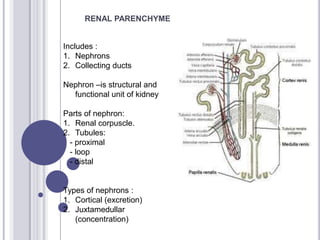
RENAL PARENCHYME


Includes :
1. Nephrons
2. Collecting ducts

Nephron –is structural and
  functional unit of kidney

Parts of nephron:
1. Renal corpuscle.
2. Tubules:
  - proximal
  - loop
  - distal


Types of nephrons :
1. Cortical (excretion)
2. Juxtamedullar
   (concentration)
HOW TO DIFFERENTIATE RENAL CORTEX AND MEDULLA?

                       5

                                                       8


                           7   8
          9
    1                                          1       9
                                       4
                                                       6


                                           3

                               6                       10

              10               6
                                               2
    2
              10


                                   1


                   А                               Б
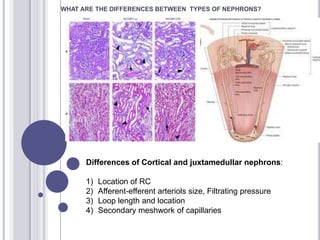
WHAT ARE THE DIFFERENCES BETWEEN TYPES OF NEPHRONS?


      Differences of Cortical and juxtamedullar nephrons:

      1)   Location of RC
      2)   Afferent-efferent arteriols size, Filtrating pressure
      3)   Loop length and location
      4)   Secondary meshwork of capillaries
RENAL CORPUSCULE STRUCTURE


                    2    8   5 76          4 5


1            7


5             8

2            1
                                     3
9


    RC consists of:
    1. Glomerulus (primary meshwork of capillaries)
    2. Epithelial Bowmen`s capsule:
     - parietal layer (flattened cells);
     - visceral layer (podocytes)
RENAL CORPUSCULE STRUCTURE
FILTRATING BARRIER

 Filtrating barrier:
 -  Fenestrated endothelium
 -  Basal lamina
 -  Split diaphragms between podocytes cytopedicules


              1                       7         6
                                                       3
        2                                       8


                           3

                                                       2
                                            1

    4                             2

            5 6


  Filtration rate depends on:
  - Diameter of arteriols

  - Hydrostatic pressure

  - Oncotic pressure
MESANGIAL CELLS


                         Рис. 7


   Mesangial cells functions:
   - Production of mesangial matrix

   - Contraction

   - Phagocytosis
RENAL TUBULES. DIAGNOSTICS


                             1


                                 2


                             3


                             4
PROXIMAL CONVOLUTED TUBULES


                                     4           Глюкоза
                                                           ионы
                                                   амк
                             1
                                 5                                 3
    1                        4           3
                                                           2
    А                Б

                             6

                             5
2                                        1
                             2                                 1
3
                                             6


    В            Г       Д
DISTAL CONVOLUTED TUBULE
RENAL MEDULLA

                    1

                4   2


                    3


                5   6
Countercurrent system. Urine concentrating


                     2             1         5


                                       3             4


                            А                    Б
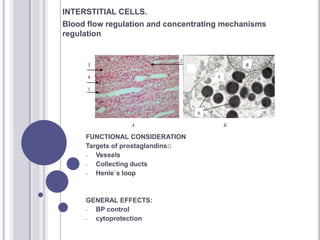
INTERSTITIAL CELLS.
Blood flow regulation and concentrating mechanisms
regulation


                              2
      3                                        Я

      4                                5

      1


                                   6

                 А                         Б

     FUNCTIONAL CONSIDERATION
     Targets of prostaglandins::
     -  Vessels
     -  Collecting ducts
     -  Henle`s loop


     GENERAL EFFECTS:
     - BP control
     - cytoprotection
JUXTAGLOMERULLAR APPARATUS


     4
              1
     5
                      2

                              5
                          3


          3

          А               Б


 1


                  2
                  5
 4
                  3
URINARY TRACT


 2


 1

 3


 4
                            1

                        2

                А
 5
                                3


 6                  В
                Б

Urinary system 121023

  • 1.
  • 2.
    URINARY SYSTEM Nephrogenic Kidneys mesoderm Urunary tract Mesonephral organs: duct Ureter Urogenital Urinary bladder sinus Urethra
  • 3.
    Kidney GENERAL CHARACTERISTICS Type of structure – parenchymal lobulated organs with - cortex and - medulla Parenchyma – epithelium: Epithelium forms: - Nephrons - Collecting duct system Stroma – Connective tissue - Capsule (DCT) - narrow sheats of LCT (with specialized system of vessels)
  • 4.
    Renal vessels Arteries/Veins: - Renal - Superior/inf - arcuate - interlobular Arteriols - afferent - efferent Capillaries: -Primary - glomerular - secondary - peritubular FUNCIONAL signifacince: - filtration (glomerular meswork) - reabsorbtion (peritubular meswork) -- nutrition of renal parenchyme
  • 5.
    RENAL PARENCHYME Includes : 1.Nephrons 2. Collecting ducts Nephron –is structural and functional unit of kidney Parts of nephron: 1. Renal corpuscle. 2. Tubules: - proximal - loop - distal Types of nephrons : 1. Cortical (excretion) 2. Juxtamedullar (concentration)
  • 6.
    HOW TO DIFFERENTIATERENAL CORTEX AND MEDULLA? 5 8 7 8 9 1 1 9 4 6 3 6 10 10 6 2 2 10 1 А Б
  • 7.
    WHAT ARE THEDIFFERENCES BETWEEN TYPES OF NEPHRONS? Differences of Cortical and juxtamedullar nephrons: 1) Location of RC 2) Afferent-efferent arteriols size, Filtrating pressure 3) Loop length and location 4) Secondary meshwork of capillaries
  • 8.
    RENAL CORPUSCULE STRUCTURE 2 8 5 76 4 5 1 7 5 8 2 1 3 9 RC consists of: 1. Glomerulus (primary meshwork of capillaries) 2. Epithelial Bowmen`s capsule: - parietal layer (flattened cells); - visceral layer (podocytes)
  • 9.
  • 10.
  • 11.
    FILTRATING BARRIER Filtratingbarrier: - Fenestrated endothelium - Basal lamina - Split diaphragms between podocytes cytopedicules 1 7 6 3 2 8 3 2 1 4 2 5 6 Filtration rate depends on: - Diameter of arteriols - Hydrostatic pressure - Oncotic pressure
  • 12.
    MESANGIAL CELLS Рис. 7 Mesangial cells functions: - Production of mesangial matrix - Contraction - Phagocytosis
  • 13.
  • 14.
    PROXIMAL CONVOLUTED TUBULES 4 Глюкоза ионы амк 1 5 3 1 4 3 2 А Б 6 5 2 1 2 1 3 6 В Г Д
  • 15.
  • 16.
    RENAL MEDULLA 1 4 2 3 5 6
  • 17.
    Countercurrent system. Urineconcentrating 2 1 5 3 4 А Б
  • 18.
    INTERSTITIAL CELLS. Blood flowregulation and concentrating mechanisms regulation 2 3 Я 4 5 1 6 А Б FUNCTIONAL CONSIDERATION Targets of prostaglandins:: - Vessels - Collecting ducts - Henle`s loop GENERAL EFFECTS: - BP control - cytoprotection
  • 19.
    JUXTAGLOMERULLAR APPARATUS 4 1 5 2 5 3 3 А Б 1 2 5 4 3
  • 20.
    URINARY TRACT 2 1 3 4 1 2 А 5 3 6 В Б