Inheritance
CHAPTER 16
Inheritance
Inheritance is the way in which parents pass on their
characteristics to their offspring.
The study of inheritance is called genetics.
Genes from the father is present in the nucleus of the
sperm and gene from the mother is present in the
nucleus of the egg.
When the nucleus of sperm and egg fuses they form
a zygote containing genetic information half from the
mother and half from the father.
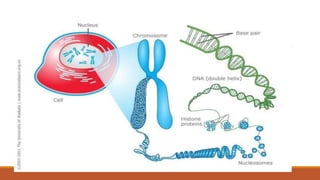
Chromosome
Chromosome is a threadlike structure of nucleic acids
and protein found in the nucleus of cells, carrying
genetic information in the form of genes.
Gene
A small length of DNA that contributes to a function.
Each chromosome is made up of thousands of genes.
Eg. Gene for eye colour/height
The material of inheritance
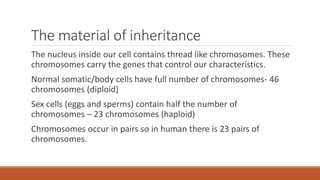
The nucleus inside our cell contains thread like chromosomes. These
chromosomes carry the genes that control our characteristics.
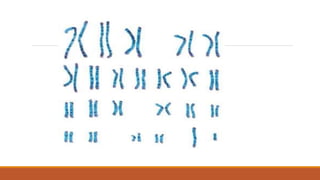
Normal somatic/body cells have full number of chromosomes- 46
chromosomes (diploid)
Sex cells (eggs and sperms) contain half the number of
chromosomes – 23 chromosomes (haploid)
Chromosomes occur in pairs so in human there is 23 pairs of
chromosomes.
DNA
DNA is the chemical basis of heredity.
Heredity- Passing of trait from parents to offsprings.
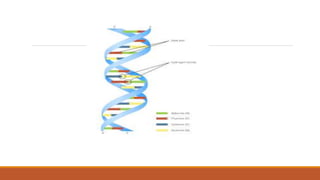
Deoxyribonucleic acid is a molecule composed of two chains that coil around
each other to form a double helix carrying the genetic instructions used in the
growth, development, functioning, and reproduction of organisms.
Chromosome is made up of nucleic acid called DNA- Deoxyribonucleic acid
A single gene is made up of a short length of DNA.
A DNA molecule is made up of thousands of units, each called nucleotide.
Structure of DNA
DNA molecules are made up of nucleotides.
A single nucleotide is made out of 3 parts:
1. a phosphate
2. a sugar
3. a base
The sugar phosphate part forms the backbone of the DNA.
A single DNA molecule is composed of two strands of nucleotides, forming
a double helix structure. This structure was proposed by James Watson
and Francis Crick in 1953.
Nucleotide
Sugar part- Deoxyribose sugar
Nitrogenous bases- 2 types
1. Purines- double ring structure
A) Adenine (A)
B) Guanine (G)
2. Pyrimidine- single ring structure
A) Thymine (T)
B) Cytosine (C)
Base pairing
The bases always pair in the same way:
Adenine pairs with Thymine
Guanine with Cytosine
Between the two bases hydrogen bond is present holding them together.
2 hydrogen bonds between Adenine and Thymine
3 hydrogen bonds between Cytosine and Guanine
DNA Replication
Before a cell divides, the amount of DNA doubles.
1. Firstly the hydrogen bonds holding the bases together break.
2. Then the DNA double helix unwinds to give two single strands.
3. Each single strand attracts separate nucleotides present inside the
nucleus.
4. These nucleotides line up along each single DNA strand following
the rule of ‘base pairing’. So C lines up alongside G and A alongside T.
5.The nucleotides join up and so two new DNA molecules are formed
and each one is an identical copy of the parent cell’s DNA.
Cell division
Two types of cell division-
1. Mitosis:
All cells are made by mitosis except sex cells.
By mitosis two new daughter cells are formed.
Mitosis occur in growth- eg. Growth of baby, healing of wound.
Mitosis also occur in asexual reproduction.
2. Meiosis:
Sex cells are formed by meiosis.
Stages of mitosis:
Before a cell divides by mitosis it must make a second set of chromosomes.
1. Each chromosome makes an identical copy for itself. For a moment there are 92
chromosomes in the nucleus.
2. The cells start to divide into two. One complete set of chromosomes goes into each of the two
new daughter cells.
3. Two new daughter cells identical to the parent cell are formed.
Stages of meiosis
1. Each chromosomes make an identical copies of itself.
2. The cell divides into four. One chromosome from each pair goes into each of the four sex cells
which are made.
3.Four new daughter cells are formed. Each containing 23 single chromosomes.
Differences between mitosis and meiosis
Mitosis Meiosis
Definition A type of cell division in which the
cell divides into two daughter
cells, producing two identical cells
with an equal number of
chromosomes in the diploid cells.
A type of cell division where the
number of chromosomes are
reduced by half, producing four
haploid cells.
Occurs in All somatic cells Sex cells
Type of reproduction involved Asexual Sexual
Genetically Produces identical cells Produces genetically different
cells
Pairing of homologous
chromosomes
Yes No
Number of daughter cells
produced
2 diploid cells 4 haploid cells
Sex determination
Chromosome pair 23 are called sex chromosomes. They determine
the sex.
In male- XY
One long X chromosome and one short Y chromosome
In female- XX
Two long X chromosomes
All the eggs contain an X chromosome. Half the sperm contain an X
chromosome and half a Y chromosome. At fertilization the egg may
join with either X sperm or Y sperm. The child has an equal chance to
be a boy or a girl.
Work of Gregor Mendel
Gregor Mendel was an Austrian monk and teacher.
He studied the way how characteristics of pea plant was passed from
one generation to the next eg. Flower colour,plant height, pea
shape,pea colour.
Homologous chromosomes
Homologous chromosomes exist in pairs. One chromosome
in the pair comes from the male parent and the other from
the female parent. They are similar in shape and size and
same gene location.
Allele
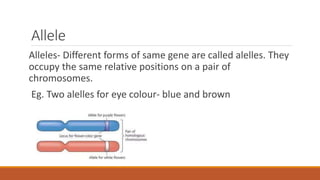
Alleles- Different forms of same gene are called alelles. They
occupy the same relative positions on a pair of
chromosomes.
Eg. Two alelles for eye colour- blue and brown
Genotype- A genotype is the genetic makeup (pairs of alleles) of an
organism, that is, the combination of genes in an organism. Eg. Bb/ bb/
BB
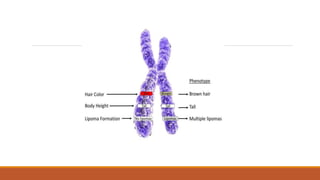
Phenotype- Phenotype refers to the expressed trait in an organism, for
eg, the outward appearance of an organism.
Eg. Symbol for brown eye allele is B and blue eye allele is b
If you have alleles BB, it means you have genotype BB and phenotype
brown
Homozygous- An organism is said to be homozygous for a trait if the
two alleles controlling the trait are identical, eg. BB or bb
Heterozygous- An organism is heterozygous for a trait if the alleles
controlling the trait are different, eg. Bb
When there are two different alleles , one is stronger than the
other.
Recessive allele- Not expressed when the dominant form of trait
is present. It does not express itself in the heterozygous
condition. It only expresses in homozygous condition. Eg blue
eye only when bb genotype is present.
Dominant allele – A dominant allele expresses itself and gives
the same phenotype in both the homozygous and heterozygous
conditions. Eg. Brown eye have Bb or BB genotype. The
expressed form of the trait, it covers up the other forms.
Eg. B is the dominant allele and b is the recessive allele.
So when the genotype is Bb , B will mask the effect of b and will
show the effect of B.
So phenotype will be that of B.
Mutation
Mutation means sudden permanent change in a gene or
chromosome.
Causes- Radiations like UV rays/ Gamma rays/ X rays,
Chemicals and sometimes naturally at random
Most of the times the mutant gene is recessive so it’s effect
is masked and sometimes it shows effect like albino, genetic
diseases- eg. cystic fibrosis.
Inherited diseases
Diseases caused by inheriting faulty genes from the parents.
Example:
1. Cystic fibrosis: Occurs due to gene mutation.
Symptoms- thick and sticky mucus production that blocks air passages and tubes
in digestive tract. So the affected person has difficulty in breathing and digesting
food.
Cystic fibrosis is caused by a recessive allele – let’s call it ‘c’
So to have cystic fibrosis you need to have two faulty genes- cc
If you have Cc you won’t be the sufferer but be a carrier.
2. Sickle cell anemia- Another eg. of inherited diseases.
Those who are sufferers will have sickle shaped red blood cells. Having abnormal
haemoglobin will mean inefficient carrying of oxygen.
Carriers are resistant to the disease malaria as the parasite can not affect sickle
shaped blood cells.
3. Huntington’s disease:
A rare inherited disease. The cells of the brain degenerate and the patient makes
clumsy and jerky movements. Sufferers become moody and their memory is
affected.
It occurs due to a dominant gene. So only one allele is necessary to give the
disease. So all heterozygous people are sufferers.
Genetic engineering
Genetic engineering means removing a gene from one living organism and putting it into
another.
This is how it helps in diabetic patients:
1. The human gene that codes for the production of insulin is identified.
2. Special enzymes are used as chemical scissors. These cut out the insulin making gene from
rest of the DNA.
3. A circular piece of DNA called plasmid is removed from a bacterium.
4. The same restriction enzymes are used to cut open the plasmid.
5. The two ends of the DNA of the insulin making gene are an exact match with the two DNA
ends of the plasmid.
These are called sticky ends.
6. Another enzyme called ligase is used to attach the sticky ends of the insulin making gene to
the sticky ends of the plasmid.
The plasmid is put into the bacterium.
The bacteria makes insulin.
The bacteria multiply very rapidly.
All the bacteria produced will have the insulin gene. Lots of insulin will be made.
Selective Breeding
Human determine which genes are passed on to future generations and which are lost.
(Artificial selection)
Techniques such as artificial insemination and embryo transplantation have increased the
success of selective breeding of animals.
The danger of selective breeding is too much inbreeding. This may result in harmful recessive
alleles being passed on to the descendants and a reduction in variation.

Inheritance

  • 1.
  • 2.
    Inheritance Inheritance is theway in which parents pass on their characteristics to their offspring. The study of inheritance is called genetics.
  • 3.
    Genes from thefather is present in the nucleus of the sperm and gene from the mother is present in the nucleus of the egg. When the nucleus of sperm and egg fuses they form a zygote containing genetic information half from the mother and half from the father.
  • 5.
    Chromosome Chromosome is athreadlike structure of nucleic acids and protein found in the nucleus of cells, carrying genetic information in the form of genes.
  • 8.
    Gene A small lengthof DNA that contributes to a function. Each chromosome is made up of thousands of genes. Eg. Gene for eye colour/height
  • 9.
    The material ofinheritance The nucleus inside our cell contains thread like chromosomes. These chromosomes carry the genes that control our characteristics. Normal somatic/body cells have full number of chromosomes- 46 chromosomes (diploid) Sex cells (eggs and sperms) contain half the number of chromosomes – 23 chromosomes (haploid) Chromosomes occur in pairs so in human there is 23 pairs of chromosomes.
  • 11.
    DNA DNA is thechemical basis of heredity. Heredity- Passing of trait from parents to offsprings. Deoxyribonucleic acid is a molecule composed of two chains that coil around each other to form a double helix carrying the genetic instructions used in the growth, development, functioning, and reproduction of organisms. Chromosome is made up of nucleic acid called DNA- Deoxyribonucleic acid A single gene is made up of a short length of DNA. A DNA molecule is made up of thousands of units, each called nucleotide.
  • 12.
    Structure of DNA DNAmolecules are made up of nucleotides. A single nucleotide is made out of 3 parts: 1. a phosphate 2. a sugar 3. a base The sugar phosphate part forms the backbone of the DNA. A single DNA molecule is composed of two strands of nucleotides, forming a double helix structure. This structure was proposed by James Watson and Francis Crick in 1953.
  • 14.
  • 15.
    Sugar part- Deoxyribosesugar Nitrogenous bases- 2 types 1. Purines- double ring structure A) Adenine (A) B) Guanine (G) 2. Pyrimidine- single ring structure A) Thymine (T) B) Cytosine (C)
  • 16.
    Base pairing The basesalways pair in the same way: Adenine pairs with Thymine Guanine with Cytosine Between the two bases hydrogen bond is present holding them together. 2 hydrogen bonds between Adenine and Thymine 3 hydrogen bonds between Cytosine and Guanine
  • 17.
    DNA Replication Before acell divides, the amount of DNA doubles. 1. Firstly the hydrogen bonds holding the bases together break. 2. Then the DNA double helix unwinds to give two single strands. 3. Each single strand attracts separate nucleotides present inside the nucleus. 4. These nucleotides line up along each single DNA strand following the rule of ‘base pairing’. So C lines up alongside G and A alongside T. 5.The nucleotides join up and so two new DNA molecules are formed and each one is an identical copy of the parent cell’s DNA.
  • 18.
    Cell division Two typesof cell division- 1. Mitosis: All cells are made by mitosis except sex cells. By mitosis two new daughter cells are formed. Mitosis occur in growth- eg. Growth of baby, healing of wound. Mitosis also occur in asexual reproduction. 2. Meiosis: Sex cells are formed by meiosis.
  • 19.
    Stages of mitosis: Beforea cell divides by mitosis it must make a second set of chromosomes. 1. Each chromosome makes an identical copy for itself. For a moment there are 92 chromosomes in the nucleus. 2. The cells start to divide into two. One complete set of chromosomes goes into each of the two new daughter cells. 3. Two new daughter cells identical to the parent cell are formed.
  • 21.
    Stages of meiosis 1.Each chromosomes make an identical copies of itself. 2. The cell divides into four. One chromosome from each pair goes into each of the four sex cells which are made. 3.Four new daughter cells are formed. Each containing 23 single chromosomes.
  • 23.
    Differences between mitosisand meiosis Mitosis Meiosis Definition A type of cell division in which the cell divides into two daughter cells, producing two identical cells with an equal number of chromosomes in the diploid cells. A type of cell division where the number of chromosomes are reduced by half, producing four haploid cells. Occurs in All somatic cells Sex cells Type of reproduction involved Asexual Sexual Genetically Produces identical cells Produces genetically different cells Pairing of homologous chromosomes Yes No Number of daughter cells produced 2 diploid cells 4 haploid cells
  • 25.
    Sex determination Chromosome pair23 are called sex chromosomes. They determine the sex. In male- XY One long X chromosome and one short Y chromosome In female- XX Two long X chromosomes All the eggs contain an X chromosome. Half the sperm contain an X chromosome and half a Y chromosome. At fertilization the egg may join with either X sperm or Y sperm. The child has an equal chance to be a boy or a girl.
  • 26.
    Work of GregorMendel Gregor Mendel was an Austrian monk and teacher. He studied the way how characteristics of pea plant was passed from one generation to the next eg. Flower colour,plant height, pea shape,pea colour.
  • 27.
    Homologous chromosomes Homologous chromosomesexist in pairs. One chromosome in the pair comes from the male parent and the other from the female parent. They are similar in shape and size and same gene location.
  • 28.
    Allele Alleles- Different formsof same gene are called alelles. They occupy the same relative positions on a pair of chromosomes. Eg. Two alelles for eye colour- blue and brown
  • 29.
    Genotype- A genotypeis the genetic makeup (pairs of alleles) of an organism, that is, the combination of genes in an organism. Eg. Bb/ bb/ BB Phenotype- Phenotype refers to the expressed trait in an organism, for eg, the outward appearance of an organism. Eg. Symbol for brown eye allele is B and blue eye allele is b If you have alleles BB, it means you have genotype BB and phenotype brown Homozygous- An organism is said to be homozygous for a trait if the two alleles controlling the trait are identical, eg. BB or bb Heterozygous- An organism is heterozygous for a trait if the alleles controlling the trait are different, eg. Bb
  • 30.
    When there aretwo different alleles , one is stronger than the other. Recessive allele- Not expressed when the dominant form of trait is present. It does not express itself in the heterozygous condition. It only expresses in homozygous condition. Eg blue eye only when bb genotype is present. Dominant allele – A dominant allele expresses itself and gives the same phenotype in both the homozygous and heterozygous conditions. Eg. Brown eye have Bb or BB genotype. The expressed form of the trait, it covers up the other forms. Eg. B is the dominant allele and b is the recessive allele. So when the genotype is Bb , B will mask the effect of b and will show the effect of B. So phenotype will be that of B.
  • 34.
    Mutation Mutation means suddenpermanent change in a gene or chromosome. Causes- Radiations like UV rays/ Gamma rays/ X rays, Chemicals and sometimes naturally at random Most of the times the mutant gene is recessive so it’s effect is masked and sometimes it shows effect like albino, genetic diseases- eg. cystic fibrosis.
  • 35.
    Inherited diseases Diseases causedby inheriting faulty genes from the parents. Example: 1. Cystic fibrosis: Occurs due to gene mutation. Symptoms- thick and sticky mucus production that blocks air passages and tubes in digestive tract. So the affected person has difficulty in breathing and digesting food. Cystic fibrosis is caused by a recessive allele – let’s call it ‘c’ So to have cystic fibrosis you need to have two faulty genes- cc If you have Cc you won’t be the sufferer but be a carrier.
  • 36.
    2. Sickle cellanemia- Another eg. of inherited diseases. Those who are sufferers will have sickle shaped red blood cells. Having abnormal haemoglobin will mean inefficient carrying of oxygen. Carriers are resistant to the disease malaria as the parasite can not affect sickle shaped blood cells. 3. Huntington’s disease: A rare inherited disease. The cells of the brain degenerate and the patient makes clumsy and jerky movements. Sufferers become moody and their memory is affected. It occurs due to a dominant gene. So only one allele is necessary to give the disease. So all heterozygous people are sufferers.
  • 37.
    Genetic engineering Genetic engineeringmeans removing a gene from one living organism and putting it into another. This is how it helps in diabetic patients: 1. The human gene that codes for the production of insulin is identified. 2. Special enzymes are used as chemical scissors. These cut out the insulin making gene from rest of the DNA. 3. A circular piece of DNA called plasmid is removed from a bacterium. 4. The same restriction enzymes are used to cut open the plasmid. 5. The two ends of the DNA of the insulin making gene are an exact match with the two DNA ends of the plasmid.
  • 38.
    These are calledsticky ends. 6. Another enzyme called ligase is used to attach the sticky ends of the insulin making gene to the sticky ends of the plasmid. The plasmid is put into the bacterium. The bacteria makes insulin. The bacteria multiply very rapidly. All the bacteria produced will have the insulin gene. Lots of insulin will be made.
  • 40.
    Selective Breeding Human determinewhich genes are passed on to future generations and which are lost. (Artificial selection) Techniques such as artificial insemination and embryo transplantation have increased the success of selective breeding of animals. The danger of selective breeding is too much inbreeding. This may result in harmful recessive alleles being passed on to the descendants and a reduction in variation.