Seminar I
1
Prepared & Presented By
CHANNAVEER S MALGE
M. Sc. (Agri.)
PG18AGR10072
Dept. of Molecular Biology & Agricultural Biotechnology
FLOW OF SEMINAR
• Introduction
• Major Losses Due To BPH
• Approaches For Genetic Improvement For BPH
Resistance
• Need For BPH Resistant Varieties In Rice
• Relation Between BPH Biotypes And Resistant
Genes In Rice
• Evaluation Of BPH Resistance
• Mapped BPH Resistance Genes
• Case Studies
• Conclusion
2
INTRODUCTION
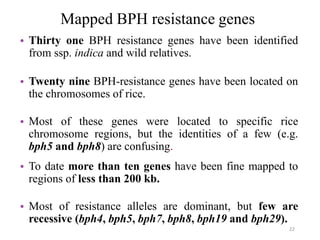
• Rice is the seed of the grass species Oryza sativa
L. (Asian rice) or Oryza glaberrima (African rice).
• Rice is the major staple crop for about half of the
worlds population. It is the primary source of calories
for more than one–third of the world population.
• More than 90 % of the world’s rice is grown and
consumed in Asia.
• India ranks second in production of rice after China.
• Serious yield losses occur due to diseases and insect
pests which accounts up to 60% yield loss is commonly
cultivated rice cultivars.
3
(Bhogadhi et al., 2015)
BROWN PLANT HOPPER
(Nilaparvata lugens Stal)
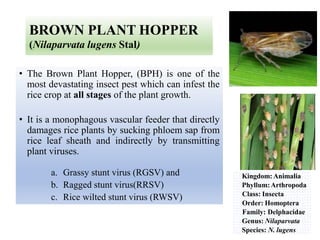
• The Brown Plant Hopper, (BPH) is one of the
most devastating insect pest which can infest the
rice crop at all stages of the plant growth.
• It is a monophagous vascular feeder that directly
damages rice plants by sucking phloem sap from
rice leaf sheath and indirectly by transmitting
plant viruses.
a. Grassy stunt virus (RGSV) and
b. Ragged stunt virus(RRSV)
c. Rice wilted stunt virus (RWSV)
4
Kingdom: Animalia
Phyllum:Arthropoda
Class: Insecta
Order: Homoptera
Family: Delphacidae
Genus: Nilaparvata
Species: N. lugens
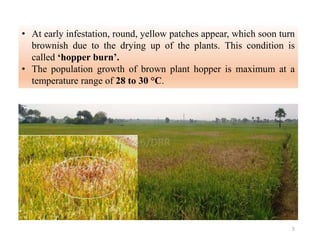
• At early infestation, round, yellow patches appear, which soon turn
brownish due to the drying up of the plants. This condition is
called ‘hopper burn’.
• The population growth of brown plant hopper is maximum at a
temperature range of 28 to 30 °C.
5
Some Major Economic losses due to BPH
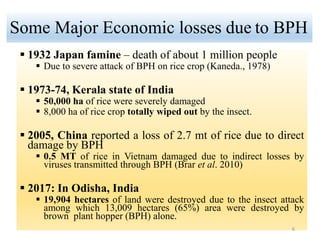
 1932 Japan famine – death of about 1 million people
 Due to severe attack of BPH on rice crop (Kaneda., 1978)
 1973-74, Kerala state of India
 50,000 ha of rice were severely damaged
 8,000 ha of rice crop totally wiped out by the insect.
 2005, China reported a loss of 2.7 mt of rice due to direct
damage by BPH
 0.5 MT of rice in Vietnam damaged due to indirect losses by
viruses transmitted through BPH (Brar et al. 2010)
 2017: In Odisha, India
 19,904 hectares of land were destroyed due to the insect attack
among which 13,009 hectares (65%) area were destroyed by
brown plant hopper (BPH) alone.
6
APPROACHES FOR GENETIC
IMPROVEMENT FOR BPH
RESISTANCE
• Traditional breeding
• Marker-assisted breeding
• Gene Pyramiding
• Transgenic technology
7
Traditional breeding
• The general approach of traditional breeding is to
combine certain traits from two parents into one
offspring.
• It also involves screening for resistance genes in
cultivated and wild rice sources
• The advantage of traditional breeding is that you
don't need to know which gene variations influence
which traits.
• The disadvantages are that it can take a lot of time
(often many years) and effort, and it may not
produce the desired result.
8
Marker-assisted breeding
• Marker-assisted breeding is much more efficient
than traditional breeding, because only the plants
that carry the desired alleles are grown and
evaluated.
• Marker-assisted breeding can be used on multiple
alleles at once—allowing for efficient selection of
gene combinations that may happen only rarely.
9
Gene Pyramiding
• Gene pyramiding or stacking can be defined as a
process of combining two or more genes from
multiple parents to develop elite lines and varieties.
• MAS based gene pyramiding could facilitate in
pyramiding of genes effectively into a single genetic
background.
10
Transgenic technology
• TRANSGENE - It is a foreign gene or genetic
material that has been transferred naturally or by
any of a number of genetic engineering techniques
from one organism to another.
• TRANSGENIC PLANTS- The plant whose genome
is altered by adding one or more transgenes are
known as transgenic plants.
11
NEED FOR BPH RESISTANT
VARIETIES IN RICE
• BPH is a monophagous pest causing yield loss upto 70%
• Chemical insecticides resulted in problems like toxicity
to natural enemies
• Paddy ecosystem temperature range i.e. 28-30oC is
congenial for survival and establishment of its threshold
population
• Increased production cost of pesticides
• BPH sucks plant at the basal stem part, hence application
of insecticides at foliage is not effective
• Pesticide usage and resurgence of pest
• Long-term agro-ecosystem and human health damage by
chemical insecticides
12
• Hence, rice resistance is a cost effective and
environment friendly strategy for BPH management
• This can be done by identifying new BPH resistant
germplasm
• Plant resistance to insect pests is categorized into 3
types:
a. Antibiosis
b. Tolerance
c. Antixenosis/Non preference
13
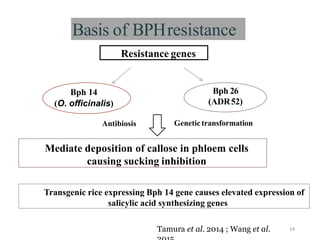
Basis of BPHresistance
Resistance genes
Bph 14
(O. officinalis)
Bph 26
(ADR52)
Genetic transformation
Mediate deposition of callose in phloem cells
causing sucking inhibition
Transgenic rice expressing Bph 14 gene causes elevated expression of
salicylic acid synthesizing genes
Tamura et al. 2014 ; Wang et al.
Antibiosis
14
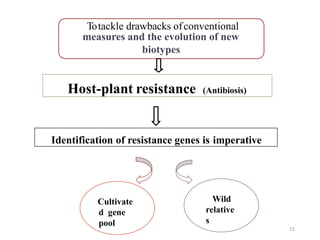
Host-plant resistance (Antibiosis)
Identification of resistance genes is imperative
Cultivate
d gene
pool
Wild
relative
s
Totackle drawbacks ofconventional
15
measures and the evolution of new
biotypes
RELATION BETWEEN BIOTYPES OF BPH
AND RESISTANCE GENES
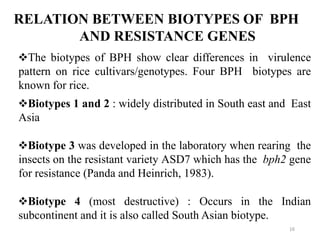
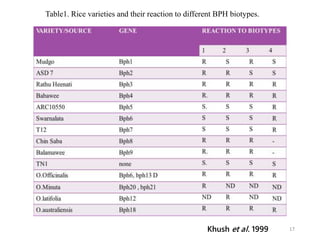
The biotypes of BPH show clear differences in virulence
pattern on rice cultivars/genotypes. Four BPH biotypes are
known for rice.
Biotypes 1 and 2 : widely distributed in South east and East
Asia
Biotype 3 was developed in the laboratory when rearing the
insects on the resistant variety ASD7 which has the bph2 gene
for resistance (Panda and Heinrich, 1983).
Biotype 4 (most destructive) : Occurs in the Indian
subcontinent and it is also called South Asian biotype.
16
17Khush et al. 1999
Table1. Rice varieties and their reaction to different BPH biotypes.
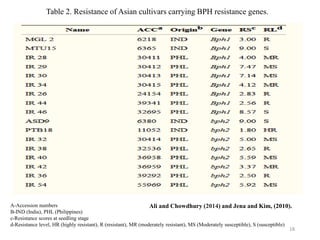
18
Ali and Chowdhury (2014) and Jena and Kim, (2010).A-Accession numbers
B-IND (India), PHL (Philippines)
c-Resistance scores at seedling stage
d-Resistance level, HR (highly resistant), R (resistant), MR (moderately resistant), MS (Moderately susceptible), S (susceptible)
Table 2. Resistance of Asian cultivars carrying BPH resistance genes.
Source of BPH resistance
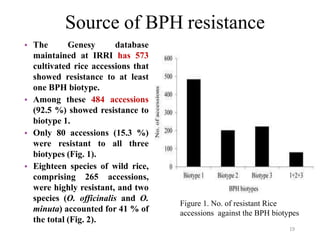
• The Genesy database
maintained at IRRI has 573
cultivated rice accessions that
showed resistance to at least
one BPH biotype.
• Among these 484 accessions
(92.5 %) showed resistance to
biotype 1.
• Only 80 accessions (15.3 %)
were resistant to all three
biotypes (Fig. 1).
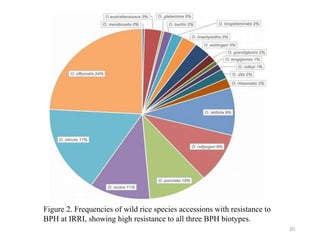
• Eighteen species of wild rice,
comprising 265 accessions,
were highly resistant, and two
species (O. officinalis and O.
minuta) accounted for 41 % of
the total (Fig. 2).
Figure 1. No. of resistant Rice
accessions against the BPH biotypes
19
Figure 2. Frequencies of wild rice species accessions with resistance to
BPH at IRRI, showing high resistance to all three BPH biotypes.
20
Evaluation of BPH resistance
• Based on the type host-pest interaction, evaluation methods
can be divided into two groups.
• The first evaluates host resistance by measuring the degree of
damage following BPH infestation.
▫ Standard seed box screening test (SSST) : It is recognized as a standard
method which assesses damage to seedlings caused by the progeny of an
initial infestation with a set number of nymphs (Panda and Khush, 1995).
• The second approach indirectly the relative host response by
examining the physiological and biochemical reactions of the
BPH (feeding rate, fecundity and survival) feeding on
different varieties.
▫ Parameters measured : Honeydew excretion, survival rates, preference
settling, and feeding behavior.
21
Mapped BPH resistance genes
• Thirty one BPH resistance genes have been identified
from ssp. indica and wild relatives.
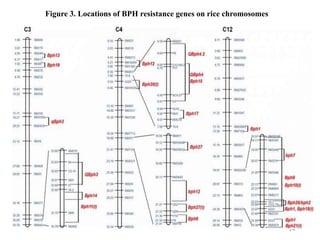
• Twenty nine BPH-resistance genes have been located on
the chromosomes of rice.
• Most of these genes were located to specific rice
chromosome regions, but the identities of a few (e.g.
bph5 and bph8) are confusing.
• To date more than ten genes have been fine mapped to
regions of less than 200 kb.
• Most of resistance alleles are dominant, but few are
recessive (bph4, bph5, bph7, bph8, bph19 and bph29).
22
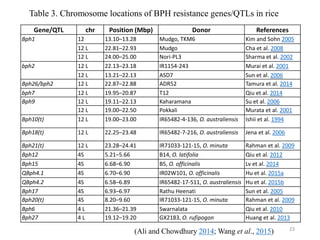
Gene/QTL chr Position (Mbp) Donor References
Bph1 12 13.10–13.28 Mudgo, TKM6 Kim and Sohn 2005
12 L 22.81–22.93 Mudgo Cha et al. 2008
12 L 24.00–25.00 Nori-PL3 Sharma et al. 2002
bph2 12 L 22.13–23.18 IR1154-243 Murai et al. 2001
12 L 13.21–22.13 ASD7 Sun et al. 2006
Bph26/bph2 12 L 22.87–22.88 ADR52 Tamura et al. 2014
bph7 12 L 19.95–20.87 T12 Qiu et al. 2014
Bph9 12 L 19.11–22.13 Kaharamana Su et al. 2006
12 L 19.00–22.50 Pokkali Murata et al. 2001
Bph10(t) 12 L 19.00–23.00 IR65482-4-136, O. australiensis Ishii et al. 1994
Bph18(t) 12 L 22.25–23.48 IR65482-7-216, O. australiensis Jena et al. 2006
Bph21(t) 12 L 23.28–24.41 IR71033-121-15, O. minuta Rahman et al. 2009
Bph12 4S 5.21–5.66 B14, O. latifolia Qiu et al. 2012
Bph15 4S 6.68–6.90 B5, O. officinalis Lv et al. 2014
QBph4.1 4S 6.70–6.90 IR02W101, O. officinalis Hu et al. 2015a
QBph4.2 4S 6.58–6.89 IR65482-17-511, O. australiensis Hu et al. 2015b
Bph17 4S 6.93–6.97 Rathu Heenati Sun et al. 2005
Bph20(t) 4S 8.20–9.60 IR71033-121-15, O. minuta Rahman et al. 2009
Bph6 4 L 21.36–21.39 Swarnalata Qiu et al. 2010
Bph27 4 L 19.12–19.20 GX2183, O. rufipogon Huang et al. 2013
23
Table 3. Chromosome locations of BPH resistance genes/QTLs in rice
(Ali and Chowdhury 2014; Wang et al., 2015)
24
Figure 3. Locations of BPH resistance genes on rice chromosomes
Genes and TFs associated with BPH
resistance
• Some genes and transcription factors (TFs) associated with
BPH resistance have been identified through reverse genetics
approaches such as T-DNA mutants and genes homology.
• Bphi008a is a resistance gene that is induced by BPH
feeding; it is involved in ethylene signaling. Plants carrying a
transgenic Bphi008a allele show significantly enhanced
resistance to BPH (Hu et al. 2011).
25
26
27
OBJECTIVE
• To know genotypic relationship for BPH resistance by
phenotypic screening methods
a. Standard seedbox screening technique (SSST)
b. Nymphal survival test
28
• The experimental material consisted of 28 elite rice genotypes
available at Barwale Foundation, viz; 1B, 2B, 7B, 8B, 9B, 14B,
16B, 18B, 21B, 22B, 24B, 25B, 28B, 30B, 36B, 40B, 41B, 44B,
IR129, 1R150, IR157, IR168, Swarna, TN1, BPT5204, Pokkali,
and PTB33.
• TN1 and PTB33 were used as susceptible and resistant check,
respectively.
MATERIALS AND METHODS
Standard seedbox screening technique
• The experiment was conducted at :
• The seeds were presoaked and sown in rows in 60 x 45 x
10 cm seed boxes along with resistant and susceptible
checks.
• 25 to 30 seedlings (Ten days old) per row per genotype
were infested with first instar nymphs at the rate of 8 to
10 nos. per seedling.
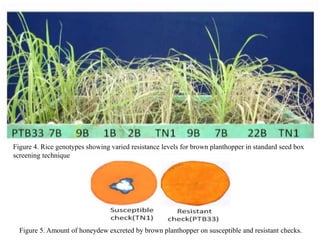
• Approximately one week after infestation “hopperburn”
symptom was observed.
• When more than 90% of susceptible check shows wilting,
the plants were scored individually based on scoring
system proposed by the International Rice Research
Institute
29
temperature of 28 to 30°C and
relative humidity of 70 to 80%.
Figure 4. Rice genotypes showing varied resistance levels for brown planthopper in standard seed box
screening technique
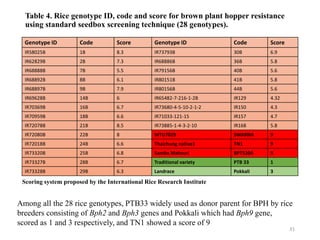
Figure 5. Amount of honeydew excreted by brown planthopper on susceptible and resistant checks.
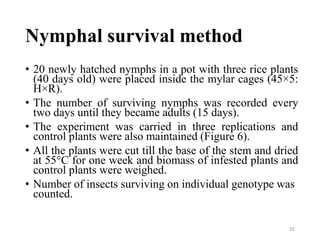
Table 4. Rice genotype ID, code and score for brown plant hopper resistance
using standard seedbox screening technique (28 genotypes).
31
Genotype ID Code Score Genotype ID Code Score
IR58025B 1B 8.3 IR73793B 30B 6.9
IR62829B 2B 7.3 IR68886B 36B 5.8
IR68888B 7B 5.5 IR79156B 40B 5.6
IR68892B 8B 6.1 IR80151B 41B 5.8
IR68897B 9B 7.9 IR80156B 44B 5.6
IR69628B 14B 6 IR65482-7-216-1-2B IR129 4.32
IR70369B 16B 6.7 IR73680-4-5-10-2-1-2 IR150 4.3
IR70959B 18B 6.6 IR71033-121-15 IR157 4.7
IR72078B 21B 8.5 IR73885-1-4-3-2-10 IR168 5.8
IR72080B 22B 8 MTU7029 SWARNA 9
IR72018B 24B 6.6 Thaichung native1 TN1 9
IR73320B 25B 6.8 Samba Mahsuri BPT5204 9
IR73327B 28B 6.7 Traditional variety PTB 33 1
IR73328B 29B 6.3 Landrace Pokkali 3
Among all the 28 rice genotypes, PTB33 widely used as donor parent for BPH by rice
breeders consisting of Bph2 and Bph3 genes and Pokkali which had Bph9 gene,
scored as 1 and 3 respectively, and TN1 showed a score of 9
Scoring system proposed by the International Rice Research Institute
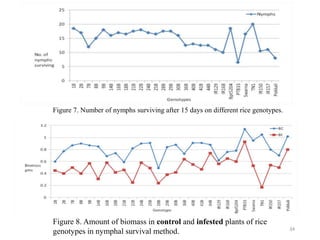
Nymphal survival method
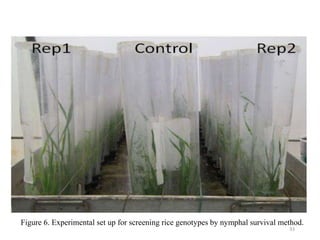
• 20 newly hatched nymphs in a pot with three rice plants
(40 days old) were placed inside the mylar cages (45×5:
H×R).
• The number of surviving nymphs was recorded every
two days until they became adults (15 days).
• The experiment was carried in three replications and
control plants were also maintained (Figure 6).
• All the plants were cut till the base of the stem and dried
at 55°C for one week and biomass of infested plants and
control plants were weighed.
• Number of insects surviving on individual genotype was
counted.
32
33
Figure 6. Experimental set up for screening rice genotypes by nymphal survival method.
Figure 8. Amount of biomass in control and infested plants of rice
genotypes in nymphal survival method.
Figure 7. Number of nymphs surviving after 15 days on different rice genotypes.
34
35
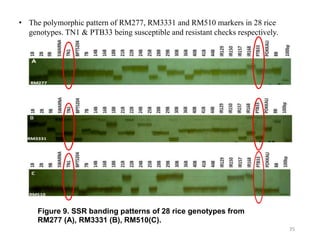
Figure 9. SSR banding patterns of 28 rice genotypes from
RM277 (A), RM3331 (B), RM510(C).
• The polymorphic pattern of RM277, RM3331 and RM510 markers in 28 rice
genotypes. TN1 & PTB33 being susceptible and resistant checks respectively.
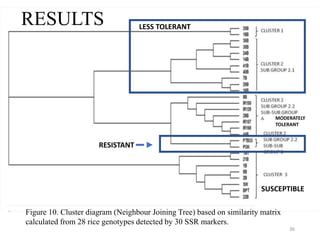
RESISTANT
LESS TOLERANT
SUSCEPTIBLE
MODERATELY
TOLERANT
Figure 10. Cluster diagram (Neighbour Joining Tree) based on similarity matrix
calculated from 28 rice genotypes detected by 30 SSR markers.
RESULTS
36
• Three BPH resistant(Ratnachoodi, Rajamudi, JBT 36/14) and
two susceptible donors (TN 1 and Jaya) of rice were studied at
ZARS, V. C. Farm, Mandya.
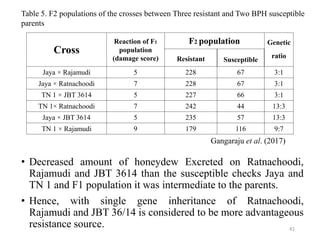
• F2 populations of Jaya × Rajamudi, Jaya ×Ratnachoodi, TN 1 ×
JBT 3614, Jaya × JBT 3614 and TN 1 × Ratnachoodi and TN 1 ×
Rajamudi were studied for for BPH resistance.
37
Materials and Methods
Reaction to BPH of parents, F1 and F2 populations
of six crosses during seedling stage.
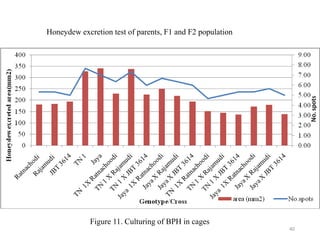
Honeydew production of BPH on parents, F1 and
F2 populations of six crosses.
• Honeydew measurements were taken on 3 plants, each for parents,
F1 and F2 populations respectively. The area of all the honey dew
spots were added and honey dew excretion was expressed as mm2
per 5 females.
38
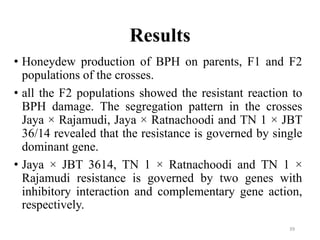
Results
• Honeydew production of BPH on parents, F1 and F2
populations of the crosses.
• all the F2 populations showed the resistant reaction to
BPH damage. The segregation pattern in the crosses
Jaya × Rajamudi, Jaya × Ratnachoodi and TN 1 × JBT
36/14 revealed that the resistance is governed by single
dominant gene.
• Jaya × JBT 3614, TN 1 × Ratnachoodi and TN 1 ×
Rajamudi resistance is governed by two genes with
inhibitory interaction and complementary gene action,
respectively.
39
Honeydew excretion test of parents, F1 and F2 population
Figure 11. Culturing of BPH in cages
40
Cross
Reaction of F1
population
(damage score)
F2 population Genetic
ratioResistant Susceptible
Jaya × Rajamudi 5 228 67 3:1
Jaya × Ratnachoodi 7 228 67 3:1
TN 1 × JBT 3614 5 227 66 3:1
TN 1× Ratnachoodi 7 242 44 13:3
Jaya × JBT 3614 5 235 57 13:3
TN 1 × Rajamudi 9 179 116 9:7
41
Table 5. F2 populations of the crosses between Three resistant and Two BPH susceptible
parents
• Decreased amount of honeydew Excreted on Ratnachoodi,
Rajamudi and JBT 3614 than the susceptible checks Jaya and
TN 1 and F1 population it was intermediate to the parents.
• Hence, with single gene inheritance of Ratnachoodi,
Rajamudi and JBT 36/14 is considered to be more advantageous
resistance source.
Gangaraju et al. (2017)
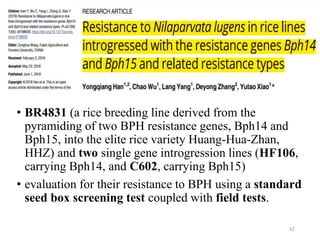
• BR4831 (a rice breeding line derived from the
pyramiding of two BPH resistance genes, Bph14 and
Bph15, into the elite rice variety Huang-Hua-Zhan,
HHZ) and two single gene introgression lines (HF106,
carrying Bph14, and C602, carrying Bph15)
• evaluation for their resistance to BPH using a standard
seed box screening test coupled with field tests.
42
MATERIALS AND METHODS
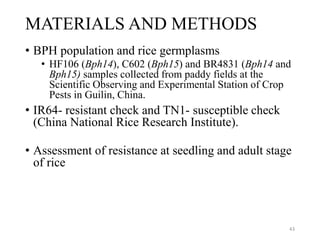
• BPH population and rice germplasms
• HF106 (Bph14), C602 (Bph15) and BR4831 (Bph14 and
Bph15) samples collected from paddy fields at the
Scientific Observing and Experimental Station of Crop
Pests in Guilin, China.
• IR64- resistant check and TN1- susceptible check
(China National Rice Research Institute).
• Assessment of resistance at seedling and adult stage
of rice
43
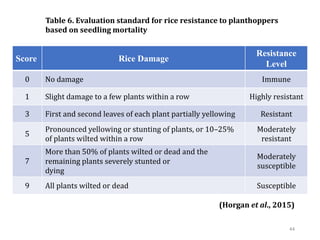
(Horgan et al., 2015)
Score Rice Damage
Resistance
Level
0 No damage Immune
1 Slight damage to a few plants within a row Highly resistant
3 First and second leaves of each plant partially yellowing Resistant
5
Pronounced yellowing or stunting of plants, or 10–25%
of plants wilted within a row
Moderately
resistant
7
More than 50% of plants wilted or dead and the
remaining plants severely stunted or
dying
Moderately
susceptible
9 All plants wilted or dead Susceptible
44
Table 6. Evaluation standard for rice resistance to planthoppers
based on seedling mortality
RESULTS
• TN1, HHZ, 9311 – SUSCEPTIBLE
• IR64, B5 - RESISTANT
45
Figure 12. Resistance to Nilaparvata lugens assessed with the standard
seed box test at the seedling stage of rice germplasms.
• On all 5 monitoring dates, the BPH populations
between the IR64 and B5 plots and among the TN1,
HHZ and 9311 plots were not significantly different
(except on August 29 between TN1 and 9311).
46
(2017)
Table 7. Population size (no./100 hills, mean ± SE) of Nilaparvata lugens in field plots
(n = 3) of the TN1, IR64, B5, HHZ, BR4831, 9311, HF106, and C602 rice germplasms.
Objective : Identification of new sources of resistance and
verification of resistance reaction of already reported donors.
47
MATERIALS AND METHODS
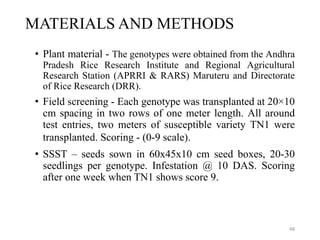
• Plant material - The genotypes were obtained from the Andhra
Pradesh Rice Research Institute and Regional Agricultural
Research Station (APRRI & RARS) Maruteru and Directorate
of Rice Research (DRR).
• Field screening - Each genotype was transplanted at 20×10
cm spacing in two rows of one meter length. All around
test entries, two meters of susceptible variety TN1 were
transplanted. Scoring - (0-9 scale).
• SSST – seeds sown in 60x45x10 cm seed boxes, 20-30
seedlings per genotype. Infestation @ 10 DAS. Scoring
after one week when TN1 shows score 9.
48
RESULTS
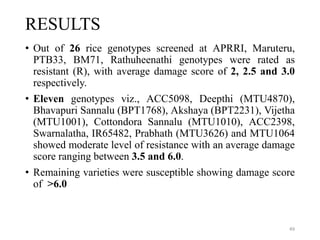
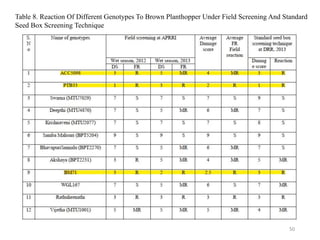
• Out of 26 rice genotypes screened at APRRI, Maruteru,
PTB33, BM71, Rathuheenathi genotypes were rated as
resistant (R), with average damage score of 2, 2.5 and 3.0
respectively.
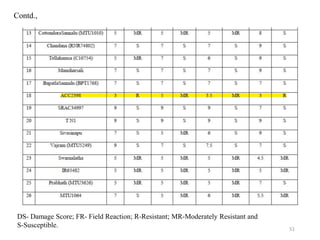
• Eleven genotypes viz., ACC5098, Deepthi (MTU4870),
Bhavapuri Sannalu (BPT1768), Akshaya (BPT2231), Vijetha
(MTU1001), Cottondora Sannalu (MTU1010), ACC2398,
Swarnalatha, IR65482, Prabhath (MTU3626) and MTU1064
showed moderate level of resistance with an average damage
score ranging between 3.5 and 6.0.
• Remaining varieties were susceptible showing damage score
of >6.0
49
50
Table 8. Reaction Of Different Genotypes To Brown Planthopper Under Field Screening And Standard
Seed Box Screening Technique
51
Contd.,
DS- Damage Score; FR- Field Reaction; R-Resistant; MR-Moderately Resistant and
S-Susceptible.
CONCLUSIONS
• Rice production needs to be increased by controlling the damage
caused by biotic stresses particularly BPH in terms of significant
yield loss annually.
• Host-plant resistance is an effective environment friendly approach
to reduce BPH damage and increase yield potential of cultivars.
• Although 31 BPH resistance genes have been identified, further
efforts are needed to identify new resistance genes from diverse
genetic sources which may confer resistance to new biotypes of
BPH.
• Some of the known resistance genes could be pyramided and tested
for efficacy in conferring resistance to new biotypes of BPH.
• In order to achieve stable resistance to BPH, pyramided major
genes or QTLs may provide durable resistance and improve yield
potential of cultivars.
52
REFERENCES
• https://www.wikipedia.org/
• Donors for Resistance to Brown Planthopper Nilaparvata lugens (Stål)
from Wild Rice Species (Sarao et al., 2016).
• Marker assisted pyramiding of two brown planthopper resistance genes,
Bph3 and Bph27 (t), into elite rice cultivars (Harini et al., 2013).
• Genetic Basis of Resistance to Brown Plant Hopper (Nilaparvata lugens
Stal.) in Local Landraces of Rice (Gangaraju et al., 2017).
• Screening of Rice Genotypes for Resistance to
Brown Plant Hopper Biotype 4 and Detection of
BPH Resistance Genes (Bhogadhi et al., 2015).
• Resistance to Nilaparvata lugens in rice lines introgressed with the
resistance genes Bph14 and Bph15 and related resistance types (Han et
al., 2018).
• Rice Knowledge Management Portal, Directorate of Rice Research
(DRR), Hyderabad (www.rkmp.co.in).
• https://learn.genetics.utah.edu/
53
54

Genetic improvement for bph tolerance in rice

  • 1.
    Seminar I 1 Prepared &Presented By CHANNAVEER S MALGE M. Sc. (Agri.) PG18AGR10072 Dept. of Molecular Biology & Agricultural Biotechnology
  • 2.
    FLOW OF SEMINAR •Introduction • Major Losses Due To BPH • Approaches For Genetic Improvement For BPH Resistance • Need For BPH Resistant Varieties In Rice • Relation Between BPH Biotypes And Resistant Genes In Rice • Evaluation Of BPH Resistance • Mapped BPH Resistance Genes • Case Studies • Conclusion 2
  • 3.
    INTRODUCTION • Rice isthe seed of the grass species Oryza sativa L. (Asian rice) or Oryza glaberrima (African rice). • Rice is the major staple crop for about half of the worlds population. It is the primary source of calories for more than one–third of the world population. • More than 90 % of the world’s rice is grown and consumed in Asia. • India ranks second in production of rice after China. • Serious yield losses occur due to diseases and insect pests which accounts up to 60% yield loss is commonly cultivated rice cultivars. 3 (Bhogadhi et al., 2015)
  • 4.
    BROWN PLANT HOPPER (Nilaparvatalugens Stal) • The Brown Plant Hopper, (BPH) is one of the most devastating insect pest which can infest the rice crop at all stages of the plant growth. • It is a monophagous vascular feeder that directly damages rice plants by sucking phloem sap from rice leaf sheath and indirectly by transmitting plant viruses. a. Grassy stunt virus (RGSV) and b. Ragged stunt virus(RRSV) c. Rice wilted stunt virus (RWSV) 4 Kingdom: Animalia Phyllum:Arthropoda Class: Insecta Order: Homoptera Family: Delphacidae Genus: Nilaparvata Species: N. lugens
  • 5.
    • At earlyinfestation, round, yellow patches appear, which soon turn brownish due to the drying up of the plants. This condition is called ‘hopper burn’. • The population growth of brown plant hopper is maximum at a temperature range of 28 to 30 °C. 5
  • 6.
    Some Major Economiclosses due to BPH  1932 Japan famine – death of about 1 million people  Due to severe attack of BPH on rice crop (Kaneda., 1978)  1973-74, Kerala state of India  50,000 ha of rice were severely damaged  8,000 ha of rice crop totally wiped out by the insect.  2005, China reported a loss of 2.7 mt of rice due to direct damage by BPH  0.5 MT of rice in Vietnam damaged due to indirect losses by viruses transmitted through BPH (Brar et al. 2010)  2017: In Odisha, India  19,904 hectares of land were destroyed due to the insect attack among which 13,009 hectares (65%) area were destroyed by brown plant hopper (BPH) alone. 6
  • 7.
    APPROACHES FOR GENETIC IMPROVEMENTFOR BPH RESISTANCE • Traditional breeding • Marker-assisted breeding • Gene Pyramiding • Transgenic technology 7
  • 8.
    Traditional breeding • Thegeneral approach of traditional breeding is to combine certain traits from two parents into one offspring. • It also involves screening for resistance genes in cultivated and wild rice sources • The advantage of traditional breeding is that you don't need to know which gene variations influence which traits. • The disadvantages are that it can take a lot of time (often many years) and effort, and it may not produce the desired result. 8
  • 9.
    Marker-assisted breeding • Marker-assistedbreeding is much more efficient than traditional breeding, because only the plants that carry the desired alleles are grown and evaluated. • Marker-assisted breeding can be used on multiple alleles at once—allowing for efficient selection of gene combinations that may happen only rarely. 9
  • 10.
    Gene Pyramiding • Genepyramiding or stacking can be defined as a process of combining two or more genes from multiple parents to develop elite lines and varieties. • MAS based gene pyramiding could facilitate in pyramiding of genes effectively into a single genetic background. 10
  • 11.
    Transgenic technology • TRANSGENE- It is a foreign gene or genetic material that has been transferred naturally or by any of a number of genetic engineering techniques from one organism to another. • TRANSGENIC PLANTS- The plant whose genome is altered by adding one or more transgenes are known as transgenic plants. 11
  • 12.
    NEED FOR BPHRESISTANT VARIETIES IN RICE • BPH is a monophagous pest causing yield loss upto 70% • Chemical insecticides resulted in problems like toxicity to natural enemies • Paddy ecosystem temperature range i.e. 28-30oC is congenial for survival and establishment of its threshold population • Increased production cost of pesticides • BPH sucks plant at the basal stem part, hence application of insecticides at foliage is not effective • Pesticide usage and resurgence of pest • Long-term agro-ecosystem and human health damage by chemical insecticides 12
  • 13.
    • Hence, riceresistance is a cost effective and environment friendly strategy for BPH management • This can be done by identifying new BPH resistant germplasm • Plant resistance to insect pests is categorized into 3 types: a. Antibiosis b. Tolerance c. Antixenosis/Non preference 13
  • 14.
    Basis of BPHresistance Resistancegenes Bph 14 (O. officinalis) Bph 26 (ADR52) Genetic transformation Mediate deposition of callose in phloem cells causing sucking inhibition Transgenic rice expressing Bph 14 gene causes elevated expression of salicylic acid synthesizing genes Tamura et al. 2014 ; Wang et al. Antibiosis 14
  • 15.
    Host-plant resistance (Antibiosis) Identificationof resistance genes is imperative Cultivate d gene pool Wild relative s Totackle drawbacks ofconventional 15 measures and the evolution of new biotypes
  • 16.
    RELATION BETWEEN BIOTYPESOF BPH AND RESISTANCE GENES The biotypes of BPH show clear differences in virulence pattern on rice cultivars/genotypes. Four BPH biotypes are known for rice. Biotypes 1 and 2 : widely distributed in South east and East Asia Biotype 3 was developed in the laboratory when rearing the insects on the resistant variety ASD7 which has the bph2 gene for resistance (Panda and Heinrich, 1983). Biotype 4 (most destructive) : Occurs in the Indian subcontinent and it is also called South Asian biotype. 16
  • 17.
    17Khush et al.1999 Table1. Rice varieties and their reaction to different BPH biotypes.
  • 18.
    18 Ali and Chowdhury(2014) and Jena and Kim, (2010).A-Accession numbers B-IND (India), PHL (Philippines) c-Resistance scores at seedling stage d-Resistance level, HR (highly resistant), R (resistant), MR (moderately resistant), MS (Moderately susceptible), S (susceptible) Table 2. Resistance of Asian cultivars carrying BPH resistance genes.
  • 19.
    Source of BPHresistance • The Genesy database maintained at IRRI has 573 cultivated rice accessions that showed resistance to at least one BPH biotype. • Among these 484 accessions (92.5 %) showed resistance to biotype 1. • Only 80 accessions (15.3 %) were resistant to all three biotypes (Fig. 1). • Eighteen species of wild rice, comprising 265 accessions, were highly resistant, and two species (O. officinalis and O. minuta) accounted for 41 % of the total (Fig. 2). Figure 1. No. of resistant Rice accessions against the BPH biotypes 19
  • 20.
    Figure 2. Frequenciesof wild rice species accessions with resistance to BPH at IRRI, showing high resistance to all three BPH biotypes. 20
  • 21.
    Evaluation of BPHresistance • Based on the type host-pest interaction, evaluation methods can be divided into two groups. • The first evaluates host resistance by measuring the degree of damage following BPH infestation. ▫ Standard seed box screening test (SSST) : It is recognized as a standard method which assesses damage to seedlings caused by the progeny of an initial infestation with a set number of nymphs (Panda and Khush, 1995). • The second approach indirectly the relative host response by examining the physiological and biochemical reactions of the BPH (feeding rate, fecundity and survival) feeding on different varieties. ▫ Parameters measured : Honeydew excretion, survival rates, preference settling, and feeding behavior. 21
  • 22.
    Mapped BPH resistancegenes • Thirty one BPH resistance genes have been identified from ssp. indica and wild relatives. • Twenty nine BPH-resistance genes have been located on the chromosomes of rice. • Most of these genes were located to specific rice chromosome regions, but the identities of a few (e.g. bph5 and bph8) are confusing. • To date more than ten genes have been fine mapped to regions of less than 200 kb. • Most of resistance alleles are dominant, but few are recessive (bph4, bph5, bph7, bph8, bph19 and bph29). 22
  • 23.
    Gene/QTL chr Position(Mbp) Donor References Bph1 12 13.10–13.28 Mudgo, TKM6 Kim and Sohn 2005 12 L 22.81–22.93 Mudgo Cha et al. 2008 12 L 24.00–25.00 Nori-PL3 Sharma et al. 2002 bph2 12 L 22.13–23.18 IR1154-243 Murai et al. 2001 12 L 13.21–22.13 ASD7 Sun et al. 2006 Bph26/bph2 12 L 22.87–22.88 ADR52 Tamura et al. 2014 bph7 12 L 19.95–20.87 T12 Qiu et al. 2014 Bph9 12 L 19.11–22.13 Kaharamana Su et al. 2006 12 L 19.00–22.50 Pokkali Murata et al. 2001 Bph10(t) 12 L 19.00–23.00 IR65482-4-136, O. australiensis Ishii et al. 1994 Bph18(t) 12 L 22.25–23.48 IR65482-7-216, O. australiensis Jena et al. 2006 Bph21(t) 12 L 23.28–24.41 IR71033-121-15, O. minuta Rahman et al. 2009 Bph12 4S 5.21–5.66 B14, O. latifolia Qiu et al. 2012 Bph15 4S 6.68–6.90 B5, O. officinalis Lv et al. 2014 QBph4.1 4S 6.70–6.90 IR02W101, O. officinalis Hu et al. 2015a QBph4.2 4S 6.58–6.89 IR65482-17-511, O. australiensis Hu et al. 2015b Bph17 4S 6.93–6.97 Rathu Heenati Sun et al. 2005 Bph20(t) 4S 8.20–9.60 IR71033-121-15, O. minuta Rahman et al. 2009 Bph6 4 L 21.36–21.39 Swarnalata Qiu et al. 2010 Bph27 4 L 19.12–19.20 GX2183, O. rufipogon Huang et al. 2013 23 Table 3. Chromosome locations of BPH resistance genes/QTLs in rice (Ali and Chowdhury 2014; Wang et al., 2015)
  • 24.
    24 Figure 3. Locationsof BPH resistance genes on rice chromosomes
  • 25.
    Genes and TFsassociated with BPH resistance • Some genes and transcription factors (TFs) associated with BPH resistance have been identified through reverse genetics approaches such as T-DNA mutants and genes homology. • Bphi008a is a resistance gene that is induced by BPH feeding; it is involved in ethylene signaling. Plants carrying a transgenic Bphi008a allele show significantly enhanced resistance to BPH (Hu et al. 2011). 25
  • 26.
  • 27.
  • 28.
    OBJECTIVE • To knowgenotypic relationship for BPH resistance by phenotypic screening methods a. Standard seedbox screening technique (SSST) b. Nymphal survival test 28 • The experimental material consisted of 28 elite rice genotypes available at Barwale Foundation, viz; 1B, 2B, 7B, 8B, 9B, 14B, 16B, 18B, 21B, 22B, 24B, 25B, 28B, 30B, 36B, 40B, 41B, 44B, IR129, 1R150, IR157, IR168, Swarna, TN1, BPT5204, Pokkali, and PTB33. • TN1 and PTB33 were used as susceptible and resistant check, respectively. MATERIALS AND METHODS
  • 29.
    Standard seedbox screeningtechnique • The experiment was conducted at : • The seeds were presoaked and sown in rows in 60 x 45 x 10 cm seed boxes along with resistant and susceptible checks. • 25 to 30 seedlings (Ten days old) per row per genotype were infested with first instar nymphs at the rate of 8 to 10 nos. per seedling. • Approximately one week after infestation “hopperburn” symptom was observed. • When more than 90% of susceptible check shows wilting, the plants were scored individually based on scoring system proposed by the International Rice Research Institute 29 temperature of 28 to 30°C and relative humidity of 70 to 80%.
  • 30.
    Figure 4. Ricegenotypes showing varied resistance levels for brown planthopper in standard seed box screening technique Figure 5. Amount of honeydew excreted by brown planthopper on susceptible and resistant checks.
  • 31.
    Table 4. Ricegenotype ID, code and score for brown plant hopper resistance using standard seedbox screening technique (28 genotypes). 31 Genotype ID Code Score Genotype ID Code Score IR58025B 1B 8.3 IR73793B 30B 6.9 IR62829B 2B 7.3 IR68886B 36B 5.8 IR68888B 7B 5.5 IR79156B 40B 5.6 IR68892B 8B 6.1 IR80151B 41B 5.8 IR68897B 9B 7.9 IR80156B 44B 5.6 IR69628B 14B 6 IR65482-7-216-1-2B IR129 4.32 IR70369B 16B 6.7 IR73680-4-5-10-2-1-2 IR150 4.3 IR70959B 18B 6.6 IR71033-121-15 IR157 4.7 IR72078B 21B 8.5 IR73885-1-4-3-2-10 IR168 5.8 IR72080B 22B 8 MTU7029 SWARNA 9 IR72018B 24B 6.6 Thaichung native1 TN1 9 IR73320B 25B 6.8 Samba Mahsuri BPT5204 9 IR73327B 28B 6.7 Traditional variety PTB 33 1 IR73328B 29B 6.3 Landrace Pokkali 3 Among all the 28 rice genotypes, PTB33 widely used as donor parent for BPH by rice breeders consisting of Bph2 and Bph3 genes and Pokkali which had Bph9 gene, scored as 1 and 3 respectively, and TN1 showed a score of 9 Scoring system proposed by the International Rice Research Institute
  • 32.
    Nymphal survival method •20 newly hatched nymphs in a pot with three rice plants (40 days old) were placed inside the mylar cages (45×5: H×R). • The number of surviving nymphs was recorded every two days until they became adults (15 days). • The experiment was carried in three replications and control plants were also maintained (Figure 6). • All the plants were cut till the base of the stem and dried at 55°C for one week and biomass of infested plants and control plants were weighed. • Number of insects surviving on individual genotype was counted. 32
  • 33.
    33 Figure 6. Experimentalset up for screening rice genotypes by nymphal survival method.
  • 34.
    Figure 8. Amountof biomass in control and infested plants of rice genotypes in nymphal survival method. Figure 7. Number of nymphs surviving after 15 days on different rice genotypes. 34
  • 35.
    35 Figure 9. SSRbanding patterns of 28 rice genotypes from RM277 (A), RM3331 (B), RM510(C). • The polymorphic pattern of RM277, RM3331 and RM510 markers in 28 rice genotypes. TN1 & PTB33 being susceptible and resistant checks respectively.
  • 36.
    RESISTANT LESS TOLERANT SUSCEPTIBLE MODERATELY TOLERANT Figure 10.Cluster diagram (Neighbour Joining Tree) based on similarity matrix calculated from 28 rice genotypes detected by 30 SSR markers. RESULTS 36
  • 37.
    • Three BPHresistant(Ratnachoodi, Rajamudi, JBT 36/14) and two susceptible donors (TN 1 and Jaya) of rice were studied at ZARS, V. C. Farm, Mandya. • F2 populations of Jaya × Rajamudi, Jaya ×Ratnachoodi, TN 1 × JBT 3614, Jaya × JBT 3614 and TN 1 × Ratnachoodi and TN 1 × Rajamudi were studied for for BPH resistance. 37
  • 38.
    Materials and Methods Reactionto BPH of parents, F1 and F2 populations of six crosses during seedling stage. Honeydew production of BPH on parents, F1 and F2 populations of six crosses. • Honeydew measurements were taken on 3 plants, each for parents, F1 and F2 populations respectively. The area of all the honey dew spots were added and honey dew excretion was expressed as mm2 per 5 females. 38
  • 39.
    Results • Honeydew productionof BPH on parents, F1 and F2 populations of the crosses. • all the F2 populations showed the resistant reaction to BPH damage. The segregation pattern in the crosses Jaya × Rajamudi, Jaya × Ratnachoodi and TN 1 × JBT 36/14 revealed that the resistance is governed by single dominant gene. • Jaya × JBT 3614, TN 1 × Ratnachoodi and TN 1 × Rajamudi resistance is governed by two genes with inhibitory interaction and complementary gene action, respectively. 39
  • 40.
    Honeydew excretion testof parents, F1 and F2 population Figure 11. Culturing of BPH in cages 40
  • 41.
    Cross Reaction of F1 population (damagescore) F2 population Genetic ratioResistant Susceptible Jaya × Rajamudi 5 228 67 3:1 Jaya × Ratnachoodi 7 228 67 3:1 TN 1 × JBT 3614 5 227 66 3:1 TN 1× Ratnachoodi 7 242 44 13:3 Jaya × JBT 3614 5 235 57 13:3 TN 1 × Rajamudi 9 179 116 9:7 41 Table 5. F2 populations of the crosses between Three resistant and Two BPH susceptible parents • Decreased amount of honeydew Excreted on Ratnachoodi, Rajamudi and JBT 3614 than the susceptible checks Jaya and TN 1 and F1 population it was intermediate to the parents. • Hence, with single gene inheritance of Ratnachoodi, Rajamudi and JBT 36/14 is considered to be more advantageous resistance source. Gangaraju et al. (2017)
  • 42.
    • BR4831 (arice breeding line derived from the pyramiding of two BPH resistance genes, Bph14 and Bph15, into the elite rice variety Huang-Hua-Zhan, HHZ) and two single gene introgression lines (HF106, carrying Bph14, and C602, carrying Bph15) • evaluation for their resistance to BPH using a standard seed box screening test coupled with field tests. 42
  • 43.
    MATERIALS AND METHODS •BPH population and rice germplasms • HF106 (Bph14), C602 (Bph15) and BR4831 (Bph14 and Bph15) samples collected from paddy fields at the Scientific Observing and Experimental Station of Crop Pests in Guilin, China. • IR64- resistant check and TN1- susceptible check (China National Rice Research Institute). • Assessment of resistance at seedling and adult stage of rice 43
  • 44.
    (Horgan et al.,2015) Score Rice Damage Resistance Level 0 No damage Immune 1 Slight damage to a few plants within a row Highly resistant 3 First and second leaves of each plant partially yellowing Resistant 5 Pronounced yellowing or stunting of plants, or 10–25% of plants wilted within a row Moderately resistant 7 More than 50% of plants wilted or dead and the remaining plants severely stunted or dying Moderately susceptible 9 All plants wilted or dead Susceptible 44 Table 6. Evaluation standard for rice resistance to planthoppers based on seedling mortality
  • 45.
    RESULTS • TN1, HHZ,9311 – SUSCEPTIBLE • IR64, B5 - RESISTANT 45 Figure 12. Resistance to Nilaparvata lugens assessed with the standard seed box test at the seedling stage of rice germplasms.
  • 46.
    • On all5 monitoring dates, the BPH populations between the IR64 and B5 plots and among the TN1, HHZ and 9311 plots were not significantly different (except on August 29 between TN1 and 9311). 46 (2017) Table 7. Population size (no./100 hills, mean ± SE) of Nilaparvata lugens in field plots (n = 3) of the TN1, IR64, B5, HHZ, BR4831, 9311, HF106, and C602 rice germplasms.
  • 47.
    Objective : Identificationof new sources of resistance and verification of resistance reaction of already reported donors. 47
  • 48.
    MATERIALS AND METHODS •Plant material - The genotypes were obtained from the Andhra Pradesh Rice Research Institute and Regional Agricultural Research Station (APRRI & RARS) Maruteru and Directorate of Rice Research (DRR). • Field screening - Each genotype was transplanted at 20×10 cm spacing in two rows of one meter length. All around test entries, two meters of susceptible variety TN1 were transplanted. Scoring - (0-9 scale). • SSST – seeds sown in 60x45x10 cm seed boxes, 20-30 seedlings per genotype. Infestation @ 10 DAS. Scoring after one week when TN1 shows score 9. 48
  • 49.
    RESULTS • Out of26 rice genotypes screened at APRRI, Maruteru, PTB33, BM71, Rathuheenathi genotypes were rated as resistant (R), with average damage score of 2, 2.5 and 3.0 respectively. • Eleven genotypes viz., ACC5098, Deepthi (MTU4870), Bhavapuri Sannalu (BPT1768), Akshaya (BPT2231), Vijetha (MTU1001), Cottondora Sannalu (MTU1010), ACC2398, Swarnalatha, IR65482, Prabhath (MTU3626) and MTU1064 showed moderate level of resistance with an average damage score ranging between 3.5 and 6.0. • Remaining varieties were susceptible showing damage score of >6.0 49
  • 50.
    50 Table 8. ReactionOf Different Genotypes To Brown Planthopper Under Field Screening And Standard Seed Box Screening Technique
  • 51.
    51 Contd., DS- Damage Score;FR- Field Reaction; R-Resistant; MR-Moderately Resistant and S-Susceptible.
  • 52.
    CONCLUSIONS • Rice productionneeds to be increased by controlling the damage caused by biotic stresses particularly BPH in terms of significant yield loss annually. • Host-plant resistance is an effective environment friendly approach to reduce BPH damage and increase yield potential of cultivars. • Although 31 BPH resistance genes have been identified, further efforts are needed to identify new resistance genes from diverse genetic sources which may confer resistance to new biotypes of BPH. • Some of the known resistance genes could be pyramided and tested for efficacy in conferring resistance to new biotypes of BPH. • In order to achieve stable resistance to BPH, pyramided major genes or QTLs may provide durable resistance and improve yield potential of cultivars. 52
  • 53.
    REFERENCES • https://www.wikipedia.org/ • Donorsfor Resistance to Brown Planthopper Nilaparvata lugens (Stål) from Wild Rice Species (Sarao et al., 2016). • Marker assisted pyramiding of two brown planthopper resistance genes, Bph3 and Bph27 (t), into elite rice cultivars (Harini et al., 2013). • Genetic Basis of Resistance to Brown Plant Hopper (Nilaparvata lugens Stal.) in Local Landraces of Rice (Gangaraju et al., 2017). • Screening of Rice Genotypes for Resistance to Brown Plant Hopper Biotype 4 and Detection of BPH Resistance Genes (Bhogadhi et al., 2015). • Resistance to Nilaparvata lugens in rice lines introgressed with the resistance genes Bph14 and Bph15 and related resistance types (Han et al., 2018). • Rice Knowledge Management Portal, Directorate of Rice Research (DRR), Hyderabad (www.rkmp.co.in). • https://learn.genetics.utah.edu/ 53
  • 54.

Editor's Notes

  • #9 resistance is influenced by variations in multiple genes, each of which may have a very small effect. Making a plant drought resistant requires generating offspring with certain gene combinations that may form only rarely.
  • #14 antibiosis, which reduces herbivore performance following the ingestion of host tissue; (2) tolerance, in which herbivorous infestation is endured; and (3) antixenosis, which repels or disturbs insects, causing a reduction in colonization or oviposition
  • #21 Data are summarized from a search of the Genesy database; 265 accessions (involving 18 species) showed high resistance to all three BPH biotypes
  • #31 SCORING OBSERVATIONS 0 no visible damage 1 partial yellowing of first leaf 3 first and second leaves partially yellowing 5 pronounced yellowing or some stunting 7 mostly wilted plant but still alive 9 the plant completely wilted or dead
  • #32 0 TO 3 RESISTANT 3.1 TO 6.9 MODERATELY RESISTANT 7 TO 9 SUSCEPTIBLE