A member of CGIAR consortium www.iita.org
Cassava pests and disease
Rachid Hanna, A. Fotso
+
Numerous colleagues, students and partners
Contract review presentation, IITA-Ibadan, 18 February. 2015
A member of CGIAR consortium www.iita.org
Importance of cassava for Africa
 > 50% of world production
in Africa
 > 90 million tons fresh
production; > any other crop
in Africa
 Vital to livelihoods of > 200
million people
 Key food security role
 Huge untapped potential for
commercial development.
A member of CGIAR consortium www.iita.org
Major constraints of production
 Pests and diseases
 Local varieties with low
yield potential
 Poor agronomic practices
 Poor soil fertility and other
soil characteristics
 Relative lack of
commercialization
Cassava mosaic disease
Cassava green mite
A member of CGIAR consortium www.iita.org
Component of an integrated management
programs of cassava pests and diseases
Factors affecting abundance
Incidence/severity
Distribution, seasonality,
Diversity
Knowledge dissemination, training,
and grower adoption
Biological
control
Cultural
controls
Host plant
resistance
Chemical
controls Monitoring
A member of CGIAR consortium www.iita.org
Ecologically-based pest management
Use of multiple
tactics to
manage pests
in the
agroecosystem
www.sare.org
A member of CGIAR consortium www.iita.org
Major cassava pests and diseases in
Central Africa
African root
and tuber scale
Cassava green
mite
Cassava mosaic
virus disease
Cassava
mealybug
Climate change
Cassava brown
streak virus disease
Whitflies
Cassava
Anthracnose and
Bacterial Blight
A member of CGIAR consortium www.iita.org
Major challenges to African Agriculture:
Accidental introduction and spread of
cassava mealybug and cassava green mite
UgandaVenezuela
Brazil
Colombia
Peru
Bolivia
Paraguay
Kenya
AFRICA
S. AMERICA
Early 1970s
A member of CGIAR consortium www.iita.org
Cassava mealybug
Phenacoccus
manihoti
A member of CGIAR consortium www.iita.org
Anagyrus lopezi in Africa
 A. lopezi
provided
excellent
control
 Some
challenges on
poor soils
where
outbreaks can
still occir
A member of CGIAR consortium www.iita.org
Cassava Green Mite
Mononychellus
tanajoa
A member of CGIAR consortium www.iita.org
Typhlodromalus aripo in Africa
1st released
In Benin
Typhlodromalus aripo
A member of CGIAR consortium www.iita.org
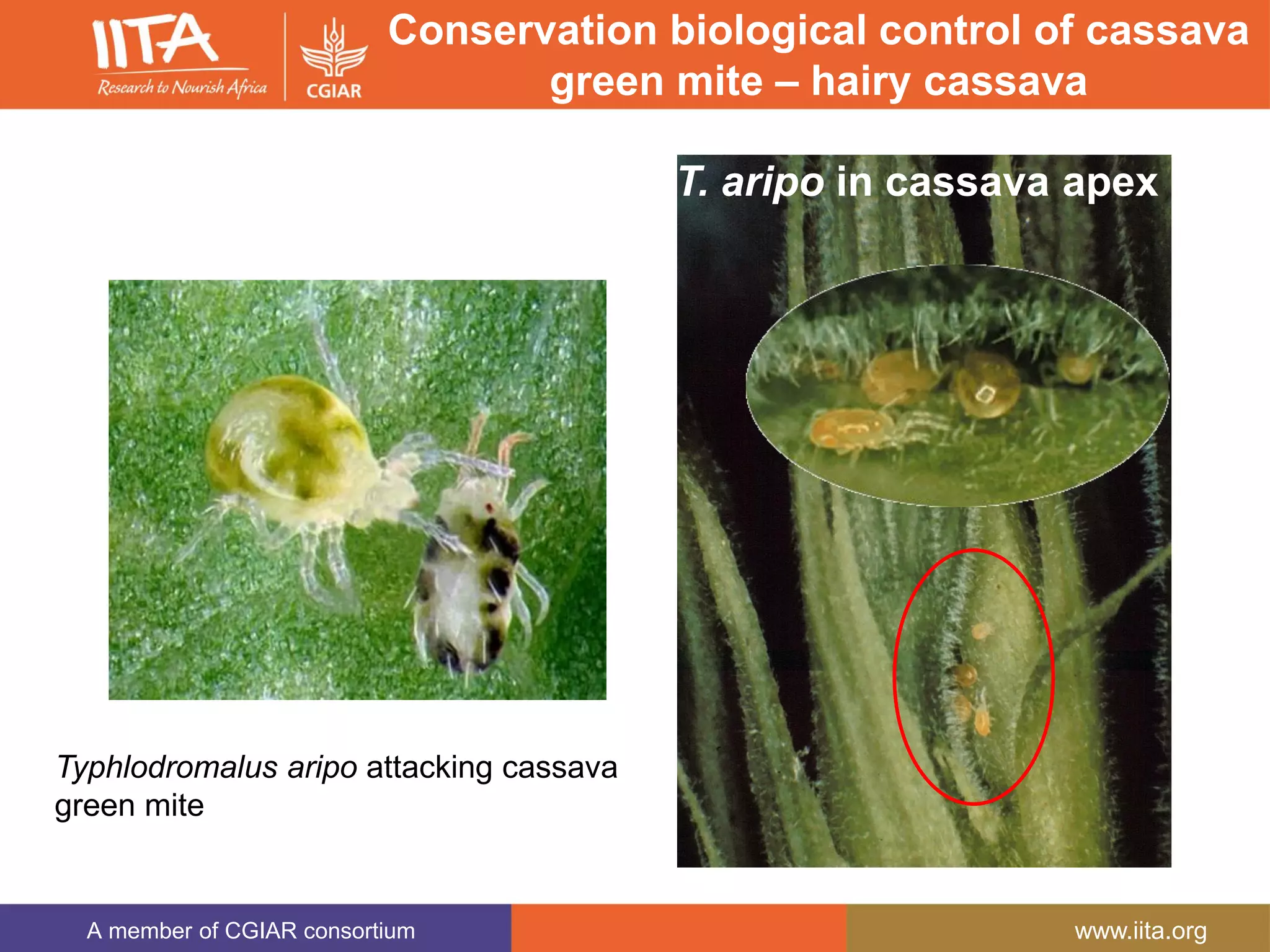
T. aripo in cassava apex
Typhlodromalus aripo attacking cassava
green mite
Conservation biological control of cassava
green mite – hairy cassava
A member of CGIAR consortium www.iita.org
But displays a strong
pattern of diurnal vertical
migration at night
apex
leaf 2
leaf 1
leaf 7
leaf 20
leaf 8
apex
leaf 2
leaf 1
leaf 7
leaf 20
leaf 8
Predator resides in apex of cassava branches
Day
Night
(Onzo et al. 2003)
A member of CGIAR consortium www.iita.org
TMS 30572 AgricOdoungbo
0.0
0.2
0.4
0.6
0.8
1.0
1 2 3 4 5
Apex hairiness
ProportionofapiceswithT.aripo
Preference for hairy
cassava genotypes
(Hanna et al. unpubl)
A member of CGIAR consortium www.iita.org
Complementary strategies for
CGM biocontrol
Conservation biological control – using hairy
cassava varieties
Use of entomopathogenic fungus Neozygites
tanajoae from Brazil
Fungus present in Africa but Brazilian isolates
much more virulent
First introduced in Benin 1999
Increased infection but we lacked tools to
distinguish isolates.
Primers recently developed to identify isolates
(Cornell and Gottingen Universities).
Potential to introduce fungus to other countries
A member of CGIAR consortium www.iita.org
African root and tuber scale
in Central Africa
Countries with S. vayssierei
Approximate distribution
Hot spot
Cassava
Cocoyam
Aframomum
 First described from Manihot
esculenta (Richard 1971)
 Reported as pest on cassava in
Cameroon in 1981 (Mutsaers et
al.) & later as major constraint to
cassava production in
Cameroon and the DR Congo
 But until recently very little was
known about its biology,
ecology, and management
 Crop losses can reach 70% in
severely affected areas.
A member of CGIAR consortium www.iita.org
Types of damage
A member of CGIAR consortium www.iita.org
Likely factors in rise
in scale problem:
shorter fallow and
abundance of host
plants in the young
fallows
+2.4 fold
Scalesperplant
Prior vegetation type
All blocks179
74
0
50
100
150
200
Young fallow Secondary
Forest
Yaounde Block
Cassava
Likely factors in rise in scale problem
A member of CGIAR consortium www.iita.org
Anoplolepis tenella
Scale-ant association
 >200 morphospecies (35 genera) of ants
found in scale habitat - cassava fields and
surrounding forest and fallow vegetation
 Anoplolepis tenella (brown crazy ant) most
frequently associated with S. vayssierei
(98%)
 Laboratory and field experiments showed
that ant is essential of scale survival
 Tends the scale (for honeydew); shown
experimentally to be agent of dispersal - it
carries crawlers to new infestation sites
 Factors affecting abundance and distribution
of A. tenella and underlying factors affecting
its close association to the ARTS
 Developed a bait to disrupt ant-scale
association.
S. vayssierei
A member of CGIAR consortium www.iita.org
ARTS management summary
 Shorter fallows coupled with higher frequency of left-
over cassava and other host plants contribute to
scale/ant reservoir which exacerbate scale problem.
Follow management – i.e., reducing host residues during
fallow period and/or host plant residue removal before
planting – can help in reducing scale infestations and
improve cassava yield.
 Host plant tolerance – no resistance yet found – but large
variations in suitability to the scale
Several tolerant varieties are presently being promoted;
should be tested in other affected countries; local
germplasm should be screened for susceptibility to the
scale
 Ant management: use of boric acid + sugar bait can be
effective in reducing the ant and therefore the scale
A member of CGIAR consortium www.iita.org
Cassava whiteflies
Bemisia and Aleurodicus
B. tabaci B. afer Spiralling whitefly
A member of CGIAR consortium www.iita.org
Damage caused by SWF
Direct feeding can cause
premature leaf drop,
reduces plant vigor and
yields
Indirect damage - sooty moulds
(reduce photosynthesis and
yields.
A member of CGIAR consortium www.iita.org
Serendipitous parasitoid
introductions
1993
Encarsia dispersa
E. guadeloupea
A member of CGIAR consortium www.iita.org
Bemisia tabaci
 Worldwide distribution
 Exists in many types – now being
split into species.
 Very large host range but types
closely associated with specific
host plants
 Young and adults feed by sucking
on leave
 Generally not much direct damage
 Principal economic importance is
vector of many viruses: cassava
mosaic and cassava brown streak
viruses
 But new superabundant species
A member of CGIAR consortium www.iita.org
Physical damage to upper leaves
A member of CGIAR consortium www.iita.org
26
Insects and mites for whitefly
control
A member of CGIAR consortium www.iita.org
 True resistance to B. tabaci not found yet among African cassava
varieties – but lots of variability.
 Early flowering and susceptibility to mites – possible factors.
 Presently working with clones from CIAT that are resistance to
another whitefly - Aleurotrachelus socialis
 Parasitism by several aphelinid parasitoids can reach 40% at
time and likely play a important role in whitefly control – need to
better understand diversity and role of the parasitoids and
develop ways to promote their control of whiteflies.
 Surveillance and containment of spread of B. tabaci
superabundant biotypes.
 Biotechnology – RNAi (gene silencing)
Summary B. tabaci management
A member of CGIAR consortium www.iita.org
Cassava mosaic virus diseases
Healthy Cassava
Diseased cassava
A member of CGIAR consortium www.iita.org
Pandemic of sever CMD
CMD pandemic zones
Not surveyed
Pandemic affected
Unaffected
James Legg - IITA
Eastern Cameroon
Alabi et al 2010.
N. Angola – Kumar et al., 2009
Tabora
Ndyetabula
et al., 2008
Uganda 1990s
A member of CGIAR consortium www.iita.org
Severe cassava mosaic disease
in Cameroon
Distribution of
EACMV-UG in
Cameroon. Each
point represents a
location from which
cassava samples
were collected for
EAMCV-UG, ACMV
and EACMV
analysis. Locations
where EACMV-UG
positive samples is
indicated in red; and
the sites where only
ACMV/EACMV was
detected is
indicated in blue.
EACMV-UG found first time in
2009
Alabi et al. 2010
A member of CGIAR consortium www.iita.org
Severe CMD in Cameroon
2015/2016
A member of CGIAR consortium www.iita.orgJ. Legg - IITA
Cassava Brown Streak Virus Disease
A member of CGIAR consortium www.iita.org
1930s
2009
2004
2005
2005
New Outbreaks of CBSD
A member of CGIAR consortium www.iita.org
 Plenty of resistance to CMD; some resistance for CBSD (IITA
working on transgenic cassava for both disease and whitefly
resistance); varieties must be disseminated;
 Vigorous campaigns in DRC and Cameroon, but other countries
– CAR, Tchad, Gabon, Congo, Eq. Guinea need more
investment in variety dissemination.
 CMD spread in CAR, Tchad, Gabon, Congo, Eq. Guinea
requires updating (information is old); surveillance and actions
to reduce spread into unaffected areas;
 Similar efforts are needed for CBSD;
 Need more information on whiteflies diversity and associated
parasitoids from all CA countries;
 Farmer training on disease recognition and management.
CMD and CBSD management
A member of CGIAR consortium www.iita.org
Resistant/tolerant varieties: TMS
96/0023; TME 419, TMS
96/1414, TMS 92/0067);
Use cuttings that do not show
symptoms of the disease
(cankers)
Remove severly affected plants
Keep your field clean (weed-
free).
CAD management
Cassava Anthracnose Disease
A member of CGIAR consortium www.iita.org
Resistant/tolerant varieties:TMS
92/0067) and use cuttings from
unaffected fields.
Remove symptomatic leaves an bury
infected leaves and debri.
Rotate cassava with other crops.
Remove severly affected plants
Keep your field clean (weed-free).
Reduce grasshopper abundance –
vectors.
CBB management
Cassava Bacterial Blight (CBB)
A member of CGIAR consortium www.iita.org
 Implementation of developed IPM for
Africa root and tuber scale
 Conservation biological control of
cassava green mite
 Surveillance of severe cassava
mosaic disease (CMD) and CBSD
especially unaffected countries, and
development and promotion of
cassava resistance to CMD
 Host plant resistance and biological
control of Bemisia tabaci, vector of
cassava mosaic viruse
 Information dissemination sand
capacity development
Cassava IPM outlook
A member of CGIAR consortium www.iita.orgA member of CGIAR consortium
Projected global effects on
agriculture due to climate change
www.iita.org
A member of CGIAR consortium www.iita.org
Why? Impact of climate change
An increase in extreme climate events, changes in moisture
conditions, temperature increase, elevated CO2 concentrations
expected to magnify pest pressure on agricultural systems
 Accelerated pest development leading to more pest cycles per
season.
 Susceptibility to pests increases in drought stressed plants.
 Asynchronization of pests and antagonists - > risk of pest outbreaks.
 Range expansion - existing pests and invasion by new pests
 Increase damage potential from invasive alien species.
 Exacerbate already existing food security problems.
 Numerous examples of increasing pest status have been
documented and modeled.
 Level of vulnerability may be agroecosystem specific hence the need
to understand and predict climate change effect
Adapted from J. Kroschel
A member of CGIAR consortium www.iita.org
Phenology modelling for climate change and
adaptation planning
Cassava mealybug
& A. lopezi
Cassava green mite
& T. aripo
Banana aphid
Bactrocera invadens & Fopius arisanus
A member of CGIAR consortium www.iita.org
Divide into groups – by country (of if too few, join neighboring
country).
Elect an animator and rapporteur.
Develop a priority list of interventions for pest and disease
management – do not to forget capacity building.
Provide a list of on-going programs, research and development
organization active in cassava sector, and present and potential
donors.
Present summary of discussion: 5-8 min/country.
Rapporteur should provide soft version of each country summary.
Way forward for our session
A member of CGIAR consortium www.iita.orgA member of CGIAR consortium www.iita.org
Thank you very much for your
kind attention
Merci beaucoup pour votre amiable attention
Thank you et Merci

Cassava pests and disease

  • 1.
    A member ofCGIAR consortium www.iita.org Cassava pests and disease Rachid Hanna, A. Fotso + Numerous colleagues, students and partners Contract review presentation, IITA-Ibadan, 18 February. 2015
  • 2.
    A member ofCGIAR consortium www.iita.org Importance of cassava for Africa  > 50% of world production in Africa  > 90 million tons fresh production; > any other crop in Africa  Vital to livelihoods of > 200 million people  Key food security role  Huge untapped potential for commercial development.
  • 3.
    A member ofCGIAR consortium www.iita.org Major constraints of production  Pests and diseases  Local varieties with low yield potential  Poor agronomic practices  Poor soil fertility and other soil characteristics  Relative lack of commercialization Cassava mosaic disease Cassava green mite
  • 4.
    A member ofCGIAR consortium www.iita.org Component of an integrated management programs of cassava pests and diseases Factors affecting abundance Incidence/severity Distribution, seasonality, Diversity Knowledge dissemination, training, and grower adoption Biological control Cultural controls Host plant resistance Chemical controls Monitoring
  • 5.
    A member ofCGIAR consortium www.iita.org Ecologically-based pest management Use of multiple tactics to manage pests in the agroecosystem www.sare.org
  • 6.
    A member ofCGIAR consortium www.iita.org Major cassava pests and diseases in Central Africa African root and tuber scale Cassava green mite Cassava mosaic virus disease Cassava mealybug Climate change Cassava brown streak virus disease Whitflies Cassava Anthracnose and Bacterial Blight
  • 7.
    A member ofCGIAR consortium www.iita.org Major challenges to African Agriculture: Accidental introduction and spread of cassava mealybug and cassava green mite UgandaVenezuela Brazil Colombia Peru Bolivia Paraguay Kenya AFRICA S. AMERICA Early 1970s
  • 8.
    A member ofCGIAR consortium www.iita.org Cassava mealybug Phenacoccus manihoti
  • 9.
    A member ofCGIAR consortium www.iita.org Anagyrus lopezi in Africa  A. lopezi provided excellent control  Some challenges on poor soils where outbreaks can still occir
  • 10.
    A member ofCGIAR consortium www.iita.org Cassava Green Mite Mononychellus tanajoa
  • 11.
    A member ofCGIAR consortium www.iita.org Typhlodromalus aripo in Africa 1st released In Benin Typhlodromalus aripo
  • 12.
    A member ofCGIAR consortium www.iita.org T. aripo in cassava apex Typhlodromalus aripo attacking cassava green mite Conservation biological control of cassava green mite – hairy cassava
  • 13.
    A member ofCGIAR consortium www.iita.org But displays a strong pattern of diurnal vertical migration at night apex leaf 2 leaf 1 leaf 7 leaf 20 leaf 8 apex leaf 2 leaf 1 leaf 7 leaf 20 leaf 8 Predator resides in apex of cassava branches Day Night (Onzo et al. 2003)
  • 14.
    A member ofCGIAR consortium www.iita.org TMS 30572 AgricOdoungbo 0.0 0.2 0.4 0.6 0.8 1.0 1 2 3 4 5 Apex hairiness ProportionofapiceswithT.aripo Preference for hairy cassava genotypes (Hanna et al. unpubl)
  • 15.
    A member ofCGIAR consortium www.iita.org Complementary strategies for CGM biocontrol Conservation biological control – using hairy cassava varieties Use of entomopathogenic fungus Neozygites tanajoae from Brazil Fungus present in Africa but Brazilian isolates much more virulent First introduced in Benin 1999 Increased infection but we lacked tools to distinguish isolates. Primers recently developed to identify isolates (Cornell and Gottingen Universities). Potential to introduce fungus to other countries
  • 16.
    A member ofCGIAR consortium www.iita.org African root and tuber scale in Central Africa Countries with S. vayssierei Approximate distribution Hot spot Cassava Cocoyam Aframomum  First described from Manihot esculenta (Richard 1971)  Reported as pest on cassava in Cameroon in 1981 (Mutsaers et al.) & later as major constraint to cassava production in Cameroon and the DR Congo  But until recently very little was known about its biology, ecology, and management  Crop losses can reach 70% in severely affected areas.
  • 17.
    A member ofCGIAR consortium www.iita.org Types of damage
  • 18.
    A member ofCGIAR consortium www.iita.org Likely factors in rise in scale problem: shorter fallow and abundance of host plants in the young fallows +2.4 fold Scalesperplant Prior vegetation type All blocks179 74 0 50 100 150 200 Young fallow Secondary Forest Yaounde Block Cassava Likely factors in rise in scale problem
  • 19.
    A member ofCGIAR consortium www.iita.org Anoplolepis tenella Scale-ant association  >200 morphospecies (35 genera) of ants found in scale habitat - cassava fields and surrounding forest and fallow vegetation  Anoplolepis tenella (brown crazy ant) most frequently associated with S. vayssierei (98%)  Laboratory and field experiments showed that ant is essential of scale survival  Tends the scale (for honeydew); shown experimentally to be agent of dispersal - it carries crawlers to new infestation sites  Factors affecting abundance and distribution of A. tenella and underlying factors affecting its close association to the ARTS  Developed a bait to disrupt ant-scale association. S. vayssierei
  • 20.
    A member ofCGIAR consortium www.iita.org ARTS management summary  Shorter fallows coupled with higher frequency of left- over cassava and other host plants contribute to scale/ant reservoir which exacerbate scale problem. Follow management – i.e., reducing host residues during fallow period and/or host plant residue removal before planting – can help in reducing scale infestations and improve cassava yield.  Host plant tolerance – no resistance yet found – but large variations in suitability to the scale Several tolerant varieties are presently being promoted; should be tested in other affected countries; local germplasm should be screened for susceptibility to the scale  Ant management: use of boric acid + sugar bait can be effective in reducing the ant and therefore the scale
  • 21.
    A member ofCGIAR consortium www.iita.org Cassava whiteflies Bemisia and Aleurodicus B. tabaci B. afer Spiralling whitefly
  • 22.
    A member ofCGIAR consortium www.iita.org Damage caused by SWF Direct feeding can cause premature leaf drop, reduces plant vigor and yields Indirect damage - sooty moulds (reduce photosynthesis and yields.
  • 23.
    A member ofCGIAR consortium www.iita.org Serendipitous parasitoid introductions 1993 Encarsia dispersa E. guadeloupea
  • 24.
    A member ofCGIAR consortium www.iita.org Bemisia tabaci  Worldwide distribution  Exists in many types – now being split into species.  Very large host range but types closely associated with specific host plants  Young and adults feed by sucking on leave  Generally not much direct damage  Principal economic importance is vector of many viruses: cassava mosaic and cassava brown streak viruses  But new superabundant species
  • 25.
    A member ofCGIAR consortium www.iita.org Physical damage to upper leaves
  • 26.
    A member ofCGIAR consortium www.iita.org 26 Insects and mites for whitefly control
  • 27.
    A member ofCGIAR consortium www.iita.org  True resistance to B. tabaci not found yet among African cassava varieties – but lots of variability.  Early flowering and susceptibility to mites – possible factors.  Presently working with clones from CIAT that are resistance to another whitefly - Aleurotrachelus socialis  Parasitism by several aphelinid parasitoids can reach 40% at time and likely play a important role in whitefly control – need to better understand diversity and role of the parasitoids and develop ways to promote their control of whiteflies.  Surveillance and containment of spread of B. tabaci superabundant biotypes.  Biotechnology – RNAi (gene silencing) Summary B. tabaci management
  • 28.
    A member ofCGIAR consortium www.iita.org Cassava mosaic virus diseases Healthy Cassava Diseased cassava
  • 29.
    A member ofCGIAR consortium www.iita.org Pandemic of sever CMD CMD pandemic zones Not surveyed Pandemic affected Unaffected James Legg - IITA Eastern Cameroon Alabi et al 2010. N. Angola – Kumar et al., 2009 Tabora Ndyetabula et al., 2008 Uganda 1990s
  • 30.
    A member ofCGIAR consortium www.iita.org Severe cassava mosaic disease in Cameroon Distribution of EACMV-UG in Cameroon. Each point represents a location from which cassava samples were collected for EAMCV-UG, ACMV and EACMV analysis. Locations where EACMV-UG positive samples is indicated in red; and the sites where only ACMV/EACMV was detected is indicated in blue. EACMV-UG found first time in 2009 Alabi et al. 2010
  • 31.
    A member ofCGIAR consortium www.iita.org Severe CMD in Cameroon 2015/2016
  • 32.
    A member ofCGIAR consortium www.iita.orgJ. Legg - IITA Cassava Brown Streak Virus Disease
  • 33.
    A member ofCGIAR consortium www.iita.org 1930s 2009 2004 2005 2005 New Outbreaks of CBSD
  • 34.
    A member ofCGIAR consortium www.iita.org  Plenty of resistance to CMD; some resistance for CBSD (IITA working on transgenic cassava for both disease and whitefly resistance); varieties must be disseminated;  Vigorous campaigns in DRC and Cameroon, but other countries – CAR, Tchad, Gabon, Congo, Eq. Guinea need more investment in variety dissemination.  CMD spread in CAR, Tchad, Gabon, Congo, Eq. Guinea requires updating (information is old); surveillance and actions to reduce spread into unaffected areas;  Similar efforts are needed for CBSD;  Need more information on whiteflies diversity and associated parasitoids from all CA countries;  Farmer training on disease recognition and management. CMD and CBSD management
  • 35.
    A member ofCGIAR consortium www.iita.org Resistant/tolerant varieties: TMS 96/0023; TME 419, TMS 96/1414, TMS 92/0067); Use cuttings that do not show symptoms of the disease (cankers) Remove severly affected plants Keep your field clean (weed- free). CAD management Cassava Anthracnose Disease
  • 36.
    A member ofCGIAR consortium www.iita.org Resistant/tolerant varieties:TMS 92/0067) and use cuttings from unaffected fields. Remove symptomatic leaves an bury infected leaves and debri. Rotate cassava with other crops. Remove severly affected plants Keep your field clean (weed-free). Reduce grasshopper abundance – vectors. CBB management Cassava Bacterial Blight (CBB)
  • 37.
    A member ofCGIAR consortium www.iita.org  Implementation of developed IPM for Africa root and tuber scale  Conservation biological control of cassava green mite  Surveillance of severe cassava mosaic disease (CMD) and CBSD especially unaffected countries, and development and promotion of cassava resistance to CMD  Host plant resistance and biological control of Bemisia tabaci, vector of cassava mosaic viruse  Information dissemination sand capacity development Cassava IPM outlook
  • 38.
    A member ofCGIAR consortium www.iita.orgA member of CGIAR consortium Projected global effects on agriculture due to climate change www.iita.org
  • 39.
    A member ofCGIAR consortium www.iita.org Why? Impact of climate change An increase in extreme climate events, changes in moisture conditions, temperature increase, elevated CO2 concentrations expected to magnify pest pressure on agricultural systems  Accelerated pest development leading to more pest cycles per season.  Susceptibility to pests increases in drought stressed plants.  Asynchronization of pests and antagonists - > risk of pest outbreaks.  Range expansion - existing pests and invasion by new pests  Increase damage potential from invasive alien species.  Exacerbate already existing food security problems.  Numerous examples of increasing pest status have been documented and modeled.  Level of vulnerability may be agroecosystem specific hence the need to understand and predict climate change effect Adapted from J. Kroschel
  • 40.
    A member ofCGIAR consortium www.iita.org Phenology modelling for climate change and adaptation planning Cassava mealybug & A. lopezi Cassava green mite & T. aripo Banana aphid Bactrocera invadens & Fopius arisanus
  • 41.
    A member ofCGIAR consortium www.iita.org Divide into groups – by country (of if too few, join neighboring country). Elect an animator and rapporteur. Develop a priority list of interventions for pest and disease management – do not to forget capacity building. Provide a list of on-going programs, research and development organization active in cassava sector, and present and potential donors. Present summary of discussion: 5-8 min/country. Rapporteur should provide soft version of each country summary. Way forward for our session
  • 42.
    A member ofCGIAR consortium www.iita.orgA member of CGIAR consortium www.iita.org Thank you very much for your kind attention Merci beaucoup pour votre amiable attention Thank you et Merci