RELEVANCE AND IMPLICATIONS
P R E P A R E D B Y : J E N N I F E R C . G R A G E R A , R N
U N I V E R S I T Y O F N O R T H E R N P H I L I P P I N E S
M A S T E R O F A R T S I N N U R S I N G
GENES, CHROMOSOMES,
AND GENETIC CODE:
THE NORMAL CELL
 Healthy cells have a structure determined by their
DNA. They need energy to exist and thrive, which
they derive from chemicals in the food you consume.
Cells need a system to deliver nutrients such as
amino acids, carbohydrates, fats, vitamins, and
minerals to them. This system is the body's network
of blood vessels. Growth factors take a cell from birth
(mitosis and meiosis) to death (apoptosis), all the
while helping it to function normally.
CELL STRUCTURE
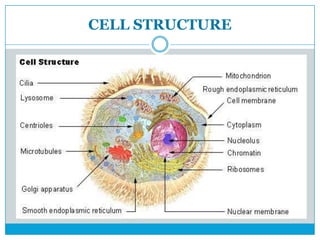
The Parts of a Cell
 Cells have two main parts, the cytoplasm and the nucleus.
 The cytoplasm surrounds the nucleus, much the way the
white surrounds the yolk in an egg.
 The nucleus is separated from the cytoplasm by the nuclear
membrane.
 The cell membrane surrounds the cytoplasm.
The Cytoplasm
The cytoplasm contains many organelles. Organelles are like
tiny organs. Each has specific jobs to do within the cell.
Some of the important organelles are:
 The endoplasmic reticulum helps make protein.
 The golgi apparatus helps move materials out of the cells in
which they are made.
 Mitochondria make energy needed for cell function.
 Lysosomes digest substances brought into the cell.
 The substance surrounding organelles within the cytoplasm
is known as the cytosol.
The Nucleus
The nucleus plays an important role in heredity and
cell division.
 Heredity is what you "inherit" from your parents
through your genes. (Genes are found in
chromosomes.)
 Cell division is how new cells are made.
Two Types of Nuclei/Two Types of Cells
 Somatic cells - cells that make up the body
contain the usual 46 chromosomes.
 Gametes - sex cells (the egg and sperm)
contain only 23 chromosomes. That's half
the number found in somatic cells.
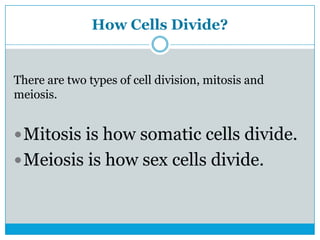
How Cells Divide?
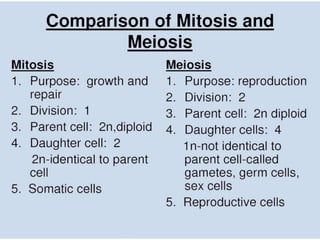
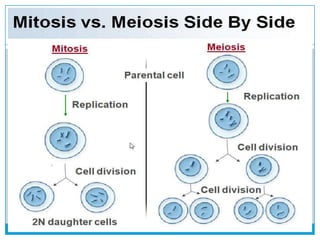
There are two types of cell division, mitosis and
meiosis.
Mitosis is how somatic cells divide.
Meiosis is how sex cells divide.
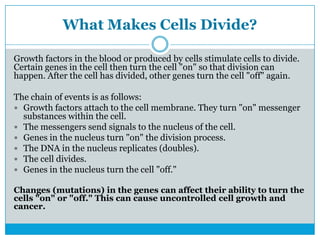
What Makes Cells Divide?
Growth factors in the blood or produced by cells stimulate cells to divide.
Certain genes in the cell then turn the cell "on" so that division can
happen. After the cell has divided, other genes turn the cell "off" again.
The chain of events is as follows:
 Growth factors attach to the cell membrane. They turn "on" messenger
substances within the cell.
 The messengers send signals to the nucleus of the cell.
 Genes in the nucleus turn "on" the division process.
 The DNA in the nucleus replicates (doubles).
 The cell divides.
 Genes in the nucleus turn the cell "off."
Changes (mutations) in the genes can affect their ability to turn the
cells "on" or "off." This can cause uncontrolled cell growth and
cancer.
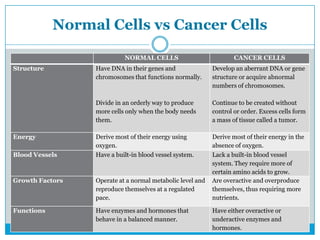
Normal Cells vs Cancer Cells
NORMAL CELLS CANCER CELLS
Structure Have DNA in their genes and
chromosomes that functions normally.
Divide in an orderly way to produce
more cells only when the body needs
them.
Develop an aberrant DNA or gene
structure or acquire abnormal
numbers of chromosomes.
Continue to be created without
control or order. Excess cells form
a mass of tissue called a tumor.
Energy Derive most of their energy using
oxygen.
Derive most of their energy in the
absence of oxygen.
Blood Vessels Have a built-in blood vessel system. Lack a built-in blood vessel
system. They require more of
certain amino acids to grow.
Growth Factors Operate at a normal metabolic level and
reproduce themselves at a regulated
pace.
Are overactive and overproduce
themselves, thus requiring more
nutrients.
Functions Have enzymes and hormones that
behave in a balanced manner.
Have either overactive or
underactive enzymes and
hormones.
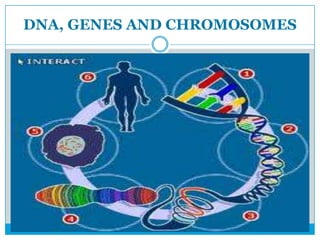
DNA, GENES AND CHROMOSOMES
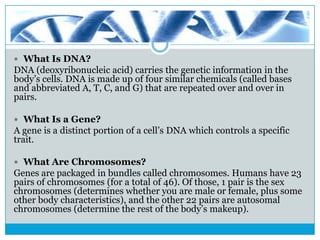
 What Is DNA?
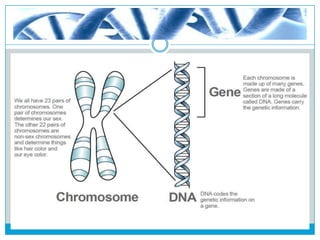
DNA (deoxyribonucleic acid) carries the genetic information in the
body’s cells. DNA is made up of four similar chemicals (called bases
and abbreviated A, T, C, and G) that are repeated over and over in
pairs.
 What Is a Gene?
A gene is a distinct portion of a cell’s DNA which controls a specific
trait.
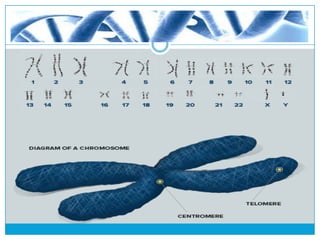
 What Are Chromosomes?
Genes are packaged in bundles called chromosomes. Humans have 23
pairs of chromosomes (for a total of 46). Of those, 1 pair is the sex
chromosomes (determines whether you are male or female, plus some
other body characteristics), and the other 22 pairs are autosomal
chromosomes (determine the rest of the body’s makeup).
GENETIC DISORDERS
There are three types of genetic disorders:
 Chromosomal disorders/abnormalities
 Single-gene disorders
 Multifactorial and Polygenic (Complex)
disorders
CHROMOSOMAL
DISORDERS/ABNORMALITIES
A chromosome abnormality reflects an abnormality of chromosome number
or structure. There are many types of chromosome abnormalities.
However, they can be organized into two basic groups:
a. Numerical Abnormalities
 When an individual is missing either a chromosome from a pair
(monosomy) or has more than two chromosomes of a pair
(trisomy).
 An example of a condition caused by numerical abnormalities is
Down Syndrome, also known as Trisomy 21 (an individual with
Down Syndrome has three copies of chromosome 21, rather than
two).
 Turner Syndrome is an example of monosomy, where the individual
- in this case a female - is born with only one sex chromosome, an X.
b. Structural Abnormalities:
 Deletions: A portion of the chromosome is missing or deleted.
 Duplications: A portion of the chromosome is
duplicated, resulting in extra genetic material.
 Translocations: Segments from two different chromosomes are
exchanged.
 Inversions: A portion of the chromosome has broken off, turned
upside down and reattached, therefore the genetic material is
inverted.
 Insertions: A portion of a chromosome has broken off and
attaches to another chromosome.
How do chromosome abnormalities
happen?
 Chromosome abnormalities usually occur when
there is an error in cell division.
 In both processes, the correct number of
chromosomes is supposed to end up in the resulting
cells. However, errors in cell division can result in
cells with too few or too many copies of a
chromosome. Errors can also occur when the
chromosomes are being duplicated.
Other factors that can increase the risk of
chromosome abnormalities
 Maternal Age: Women are born with all the eggs they
will ever have. Therefore, when a woman is 30 years
old, so are her eggs. Some researchers believe that errors
can crop up in the eggs' genetic material as they age over
time. Therefore, older women are more at risk of giving
birth to babies with chromosome abnormalities than
younger women.
 Environment: Although there is no conclusive
evidence that specific environmental factors cause
chromosome abnormalities, it is still a possibility that the
environment may play a role in the occurence of genetic
errors.
SINGLE GENE DISORDERS
A single gene disorder is the result of a single mutated gene.
Single gene disorders can be passed on to subsequent
generations in several ways.
 Non-X-linked Inheritance/Autosomal (Dominant and
Recessive Disorders)
 X-Linked Inheritance (Dominant and Recessive Disorders)
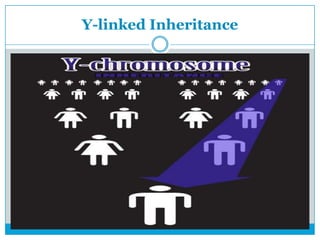
 Y-Linked Inheritance
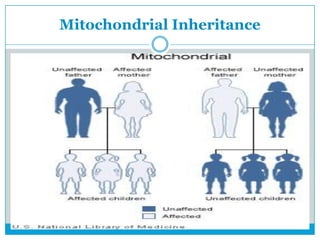
 Mitochondrial Inheritance
Definition of Terms
 Autosomal: the gene responsible for the phenotype is
located on one of the 22 pairs of autosomes (non-sex
determining chromosomes).
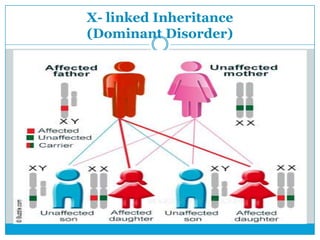
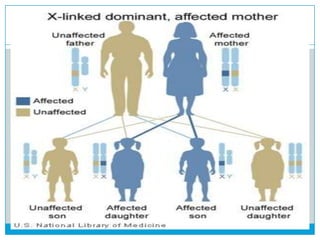
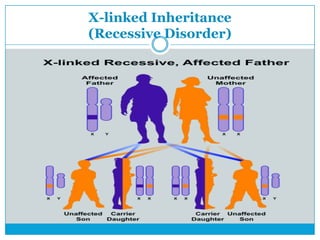
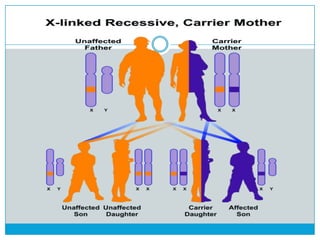
 X-linked: the gene that encodes for the trait is located on the
X chromosome.
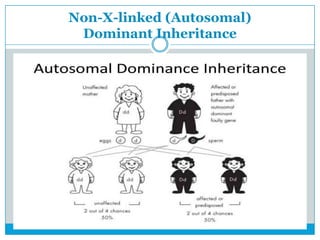
 Dominant: conditions that are manifest in heterozygotes
(individuals with just one copy of the mutant allele).
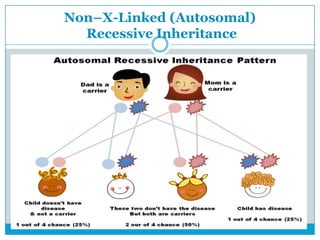
 Recessive: conditions are only manifest in individuals who
have two copies of the mutant allele (are homozygous).
Non-X-linked (Autosomal)
Dominant Inheritance
Non–X-Linked (Autosomal)
Recessive Inheritance
X- linked Inheritance
(Dominant Disorder)
X-linked Inheritance
(Recessive Disorder)
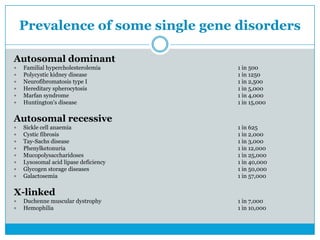
Prevalence of some single gene disorders
Autosomal dominant
 Familial hypercholesterolemia 1 in 500
 Polycystic kidney disease 1 in 1250
 Neurofibromatosis type I 1 in 2,500
 Hereditary spherocytosis 1 in 5,000
 Marfan syndrome 1 in 4,000
 Huntington's disease 1 in 15,000
Autosomal recessive
 Sickle cell anaemia 1 in 625
 Cystic fibrosis 1 in 2,000
 Tay-Sachs disease 1 in 3,000
 Phenylketonuria 1 in 12,000
 Mucopolysaccharidoses 1 in 25,000
 Lysosomal acid lipase deficiency 1 in 40,000
 Glycogen storage diseases 1 in 50,000
 Galactosemia 1 in 57,000
X-linked
 Duchenne muscular dystrophy 1 in 7,000
 Hemophilia 1 in 10,000
Y-linked Inheritance
Mitochondrial Inheritance
MULTIFACTORIAL AND POLYGENIC
(COMPLEX) DISORDER
 Genetic disorders may also be
complex, multifactorial, or polygenic, meaning they
are likely associated with the effects of multiple
genes in combination with lifestyles and
environmental factors.
 Although complex disorders often cluster in
families, they do not have a clear-cut pattern of
inheritance. This makes it difficult to determine a
person’s risk of inheriting or passing on these
disorders.
Examples of Multifactorial and Polygenic (Complex)
Disorders:
 asthma
 autoimmune diseases such as multiple sclerosis
 cancers
 cleft palate
 diabetes
 heart disease
 hypertension
 inflammatory bowel disease
 mental retardation
 mood disorder
 obesity
 refractive error
TESTING FOR CHROMOSOMAL AND
GENETIC ABNORMALITIES
 A person's chromosomes and genes can be evaluated
by analyzing a sample of blood.
 In addition, doctors can use cells from amniocentesis
or chorionic villus sampling to detect certain
chromosomal or genetic abnormalities in a fetus.
 If the fetus has an abnormality, further tests may be
done to detect specific birth defects.
PREVENTION
 Although chromosomal abnormalities cannot be
corrected, some birth defects can sometimes be
prevented (for example, taking folate [folic acid] to
prevent neural tube defects or screening parents for
carrier status of certain genetic abnormalities).
 Did you know…
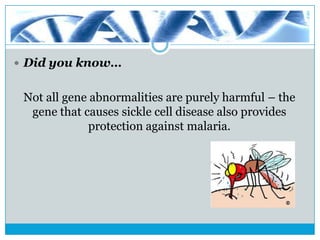
Not all gene abnormalities are purely harmful – the
gene that causes sickle cell disease also provides
protection against malaria.
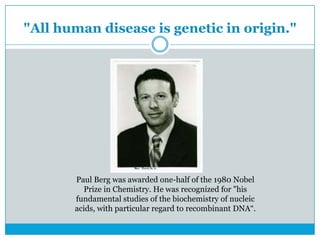
"All human disease is genetic in origin."
Paul Berg was awarded one-half of the 1980 Nobel
Prize in Chemistry. He was recognized for "his
fundamental studies of the biochemistry of nucleic
acids, with particular regard to recombinant DNA“.
THANK YOU!!!

Genes, Chromosomes and Genetic Code: Relevance and Implications

  • 1.
    RELEVANCE AND IMPLICATIONS PR E P A R E D B Y : J E N N I F E R C . G R A G E R A , R N U N I V E R S I T Y O F N O R T H E R N P H I L I P P I N E S M A S T E R O F A R T S I N N U R S I N G GENES, CHROMOSOMES, AND GENETIC CODE:
  • 2.
    THE NORMAL CELL Healthy cells have a structure determined by their DNA. They need energy to exist and thrive, which they derive from chemicals in the food you consume. Cells need a system to deliver nutrients such as amino acids, carbohydrates, fats, vitamins, and minerals to them. This system is the body's network of blood vessels. Growth factors take a cell from birth (mitosis and meiosis) to death (apoptosis), all the while helping it to function normally.
  • 3.
  • 4.
    The Parts ofa Cell  Cells have two main parts, the cytoplasm and the nucleus.  The cytoplasm surrounds the nucleus, much the way the white surrounds the yolk in an egg.  The nucleus is separated from the cytoplasm by the nuclear membrane.  The cell membrane surrounds the cytoplasm.
  • 5.
    The Cytoplasm The cytoplasmcontains many organelles. Organelles are like tiny organs. Each has specific jobs to do within the cell. Some of the important organelles are:  The endoplasmic reticulum helps make protein.  The golgi apparatus helps move materials out of the cells in which they are made.  Mitochondria make energy needed for cell function.  Lysosomes digest substances brought into the cell.  The substance surrounding organelles within the cytoplasm is known as the cytosol.
  • 6.
    The Nucleus The nucleusplays an important role in heredity and cell division.  Heredity is what you "inherit" from your parents through your genes. (Genes are found in chromosomes.)  Cell division is how new cells are made.
  • 7.
    Two Types ofNuclei/Two Types of Cells  Somatic cells - cells that make up the body contain the usual 46 chromosomes.  Gametes - sex cells (the egg and sperm) contain only 23 chromosomes. That's half the number found in somatic cells.
  • 8.
    How Cells Divide? Thereare two types of cell division, mitosis and meiosis. Mitosis is how somatic cells divide. Meiosis is how sex cells divide.
  • 11.
    What Makes CellsDivide? Growth factors in the blood or produced by cells stimulate cells to divide. Certain genes in the cell then turn the cell "on" so that division can happen. After the cell has divided, other genes turn the cell "off" again. The chain of events is as follows:  Growth factors attach to the cell membrane. They turn "on" messenger substances within the cell.  The messengers send signals to the nucleus of the cell.  Genes in the nucleus turn "on" the division process.  The DNA in the nucleus replicates (doubles).  The cell divides.  Genes in the nucleus turn the cell "off." Changes (mutations) in the genes can affect their ability to turn the cells "on" or "off." This can cause uncontrolled cell growth and cancer.
  • 12.
    Normal Cells vsCancer Cells NORMAL CELLS CANCER CELLS Structure Have DNA in their genes and chromosomes that functions normally. Divide in an orderly way to produce more cells only when the body needs them. Develop an aberrant DNA or gene structure or acquire abnormal numbers of chromosomes. Continue to be created without control or order. Excess cells form a mass of tissue called a tumor. Energy Derive most of their energy using oxygen. Derive most of their energy in the absence of oxygen. Blood Vessels Have a built-in blood vessel system. Lack a built-in blood vessel system. They require more of certain amino acids to grow. Growth Factors Operate at a normal metabolic level and reproduce themselves at a regulated pace. Are overactive and overproduce themselves, thus requiring more nutrients. Functions Have enzymes and hormones that behave in a balanced manner. Have either overactive or underactive enzymes and hormones.
  • 13.
    DNA, GENES ANDCHROMOSOMES
  • 14.
     What IsDNA? DNA (deoxyribonucleic acid) carries the genetic information in the body’s cells. DNA is made up of four similar chemicals (called bases and abbreviated A, T, C, and G) that are repeated over and over in pairs.  What Is a Gene? A gene is a distinct portion of a cell’s DNA which controls a specific trait.  What Are Chromosomes? Genes are packaged in bundles called chromosomes. Humans have 23 pairs of chromosomes (for a total of 46). Of those, 1 pair is the sex chromosomes (determines whether you are male or female, plus some other body characteristics), and the other 22 pairs are autosomal chromosomes (determine the rest of the body’s makeup).
  • 17.
    GENETIC DISORDERS There arethree types of genetic disorders:  Chromosomal disorders/abnormalities  Single-gene disorders  Multifactorial and Polygenic (Complex) disorders
  • 18.
    CHROMOSOMAL DISORDERS/ABNORMALITIES A chromosome abnormalityreflects an abnormality of chromosome number or structure. There are many types of chromosome abnormalities. However, they can be organized into two basic groups: a. Numerical Abnormalities  When an individual is missing either a chromosome from a pair (monosomy) or has more than two chromosomes of a pair (trisomy).  An example of a condition caused by numerical abnormalities is Down Syndrome, also known as Trisomy 21 (an individual with Down Syndrome has three copies of chromosome 21, rather than two).  Turner Syndrome is an example of monosomy, where the individual - in this case a female - is born with only one sex chromosome, an X.
  • 19.
    b. Structural Abnormalities: Deletions: A portion of the chromosome is missing or deleted.  Duplications: A portion of the chromosome is duplicated, resulting in extra genetic material.  Translocations: Segments from two different chromosomes are exchanged.  Inversions: A portion of the chromosome has broken off, turned upside down and reattached, therefore the genetic material is inverted.  Insertions: A portion of a chromosome has broken off and attaches to another chromosome.
  • 21.
    How do chromosomeabnormalities happen?  Chromosome abnormalities usually occur when there is an error in cell division.  In both processes, the correct number of chromosomes is supposed to end up in the resulting cells. However, errors in cell division can result in cells with too few or too many copies of a chromosome. Errors can also occur when the chromosomes are being duplicated.
  • 22.
    Other factors thatcan increase the risk of chromosome abnormalities  Maternal Age: Women are born with all the eggs they will ever have. Therefore, when a woman is 30 years old, so are her eggs. Some researchers believe that errors can crop up in the eggs' genetic material as they age over time. Therefore, older women are more at risk of giving birth to babies with chromosome abnormalities than younger women.  Environment: Although there is no conclusive evidence that specific environmental factors cause chromosome abnormalities, it is still a possibility that the environment may play a role in the occurence of genetic errors.
  • 23.
    SINGLE GENE DISORDERS Asingle gene disorder is the result of a single mutated gene. Single gene disorders can be passed on to subsequent generations in several ways.  Non-X-linked Inheritance/Autosomal (Dominant and Recessive Disorders)  X-Linked Inheritance (Dominant and Recessive Disorders)  Y-Linked Inheritance  Mitochondrial Inheritance
  • 24.
    Definition of Terms Autosomal: the gene responsible for the phenotype is located on one of the 22 pairs of autosomes (non-sex determining chromosomes).  X-linked: the gene that encodes for the trait is located on the X chromosome.  Dominant: conditions that are manifest in heterozygotes (individuals with just one copy of the mutant allele).  Recessive: conditions are only manifest in individuals who have two copies of the mutant allele (are homozygous).
  • 25.
  • 26.
  • 27.
  • 29.
  • 31.
    Prevalence of somesingle gene disorders Autosomal dominant  Familial hypercholesterolemia 1 in 500  Polycystic kidney disease 1 in 1250  Neurofibromatosis type I 1 in 2,500  Hereditary spherocytosis 1 in 5,000  Marfan syndrome 1 in 4,000  Huntington's disease 1 in 15,000 Autosomal recessive  Sickle cell anaemia 1 in 625  Cystic fibrosis 1 in 2,000  Tay-Sachs disease 1 in 3,000  Phenylketonuria 1 in 12,000  Mucopolysaccharidoses 1 in 25,000  Lysosomal acid lipase deficiency 1 in 40,000  Glycogen storage diseases 1 in 50,000  Galactosemia 1 in 57,000 X-linked  Duchenne muscular dystrophy 1 in 7,000  Hemophilia 1 in 10,000
  • 32.
  • 33.
  • 34.
    MULTIFACTORIAL AND POLYGENIC (COMPLEX)DISORDER  Genetic disorders may also be complex, multifactorial, or polygenic, meaning they are likely associated with the effects of multiple genes in combination with lifestyles and environmental factors.  Although complex disorders often cluster in families, they do not have a clear-cut pattern of inheritance. This makes it difficult to determine a person’s risk of inheriting or passing on these disorders.
  • 35.
    Examples of Multifactorialand Polygenic (Complex) Disorders:  asthma  autoimmune diseases such as multiple sclerosis  cancers  cleft palate  diabetes  heart disease  hypertension  inflammatory bowel disease  mental retardation  mood disorder  obesity  refractive error
  • 36.
    TESTING FOR CHROMOSOMALAND GENETIC ABNORMALITIES  A person's chromosomes and genes can be evaluated by analyzing a sample of blood.  In addition, doctors can use cells from amniocentesis or chorionic villus sampling to detect certain chromosomal or genetic abnormalities in a fetus.  If the fetus has an abnormality, further tests may be done to detect specific birth defects.
  • 37.
    PREVENTION  Although chromosomalabnormalities cannot be corrected, some birth defects can sometimes be prevented (for example, taking folate [folic acid] to prevent neural tube defects or screening parents for carrier status of certain genetic abnormalities).
  • 38.
     Did youknow… Not all gene abnormalities are purely harmful – the gene that causes sickle cell disease also provides protection against malaria.
  • 39.
    "All human diseaseis genetic in origin." Paul Berg was awarded one-half of the 1980 Nobel Prize in Chemistry. He was recognized for "his fundamental studies of the biochemistry of nucleic acids, with particular regard to recombinant DNA“.
  • 40.