Genetic Disorders
Mrs. Ambreen Wasif Almas
RN,RM,Post RN
Objectives
1. Differentiate between Genetic & Congenital disorder
2. Define the following terminologies related to genetic
disorders:
Trisomy
• Monosomy
• Polysomy
3. Discuss the Chromosomal defects with special emphasis
on aneuploidy
4. Describe the pathophysiology and the clinical
manifestation of the following genetics disorders.
• Down’s syndrome
• Turner’s syndrome
• Kleinfelters syndrome
Cell discovery
• Robert Hooke discovered the cell in 1665. Robert Hooke
observed a piece of bottle cork under a compound
microscope and noticed minuscule structures that
reminded him of small rooms. Consequently, he named
these “rooms” as cells. Hooke concluded that these were
non-living entities.
• Later Anton Van Leeuwenhoek observed cells under
another compound microscope with higher magnification.
This time, he had noted that the cells exhibited some form
of movement (motility). As a result, Leeuwenhoek
concluded that these microscopic entities were “alive.”
• In 1883, Robert Brown, a Scottish botanist, provided the
very first insights into the cell structure. He was able to
describe the nucleus present in the cells of orchids.
PHYSIOLOGY OF NORMAL HUMAN
CELL
• The cell is the body’s basic building block. It’s the
smallest living component of an organism.
• Many organisms are made up of one independent,
microscopically tiny cell. Other organisms,
• such as humans, consist of millions of cells grouped into
highly specialized units that function together
throughout the organism’s life.
• Large groups of individual cells form tissues, such as
muscle, blood, and bone. Tissues form the organs (such
as the brain, heart, and liver), which are integrated into
body systems (such as the central nervous system [CNS],
cardiovascular system, and digestive system).
Characteristics of Cells
• Following are the various essential characteristics of cells:
• Cells provide structure and support to the body of an organism.
• The cell interior is organized into different individual organelles
surrounded by a separate membrane.
• The nucleus (major organelle) holds genetic information
necessary for reproduction and cell growth.
• Every cell has one nucleus and membrane-bound organelles in
the cytoplasm.
• Mitochondria, a double membrane-bound organelle is mainly
responsible for the energy transactions vital for the survival of
the cell.
• Lysosomes digest unwanted materials in the cell.
• Endoplasmic reticulum plays a significant role in the internal
organization of the cell by synthesizing selective molecules and
processing, directing and sorting them to their appropriate
locations.
Cell division
Cell division is ongoing for our entire life.
Our body is constantly replacing cells. Cells need to
divide for a number of reasons, including the growth
of an organism and to fill gaps left by dead and
destroyed cells after an injury, for instance.
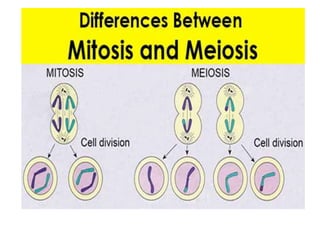
There are two types of cell division: Mitosis and
meiosis.
• Mitosis
Mitosis is how most of the cells in the body divide.
The “parent” cell splits into two “daughter” cells.
Both daughter cells have the same chromosomes as
each other and the parent. They are referred to as
diploid because they have two complete copies of the
chromosomes.
Meiosis
• Meiosis creates sex cells, such as the male sperm
and female egg cells. In meiosis, a small portion
of each chromosome breaks off and sticks to
another chromosome; this is called genetic
recombination. This means that each of the new
cells has a unique set of genetic information. It is
this process that allows genetic diversity to occur.
So, in brief, mitosis helps us grow, and meiosis
makes sure we are all unique.
Human genetics
• A gene is the basic physical and
functional unit of heredity. Genes are
made up of DNA. Some genes act as
instructions to make molecules called
proteins. However, many genes do not
code for proteins. ... Alleles are forms of
the same gene with small differences in
their sequence of DNA bases.
Structure of DNA
DNA VS RNA
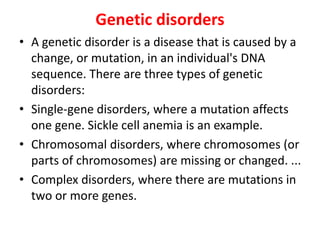
Genetic disorders
• A genetic disorder is a disease that is caused by a
change, or mutation, in an individual's DNA
sequence. There are three types of genetic
disorders:
• Single-gene disorders, where a mutation affects
one gene. Sickle cell anemia is an example.
• Chromosomal disorders, where chromosomes (or
parts of chromosomes) are missing or changed. ...
• Complex disorders, where there are mutations in
two or more genes.
Congenital disorders
• A congenital disorder is a condition that is
present from birth. Congenital disorders can be
inherited or caused by environmental factors.
Their impact on a child's health and
development isn't always severe, and
sometimes it can be quite mild. The most
common, severe congenital anomalies are heart
defects, neural tube defects etc. Congenital
anomalies may be the result of one or more
genetic, infectious, nutritional or environmental
factors.
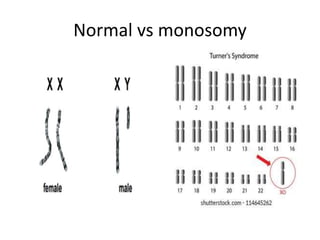
MONOSOMY
• Monosomy is the state of having a single copy
of a chromosome pair instead of the usual two
copies found in diploid cells. Monosomy can
be partial if a portion of the second
chromosome copy is present. Monosomy, or
partial monosomy , is the cause of some
human diseases such as Turner syndrome and
Cri du Chat syndrome.
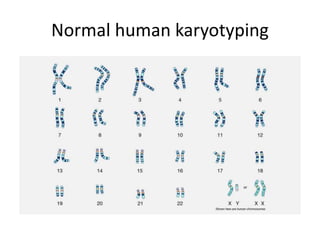
Normal human karyotyping
Normal vs monosomy
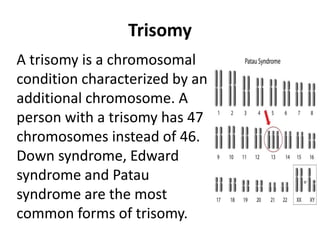
Trisomy
A trisomy is a chromosomal
condition characterized by an
additional chromosome. A
person with a trisomy has 47
chromosomes instead of 46.
Down syndrome, Edward
syndrome and Patau
syndrome are the most
common forms of trisomy.
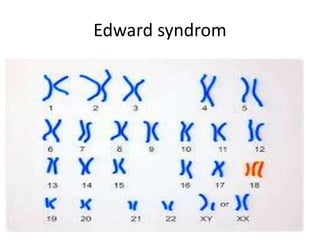
Edward syndrom
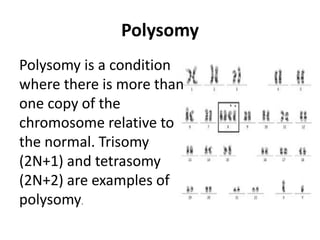
Polysomy
Polysomy is a condition
where there is more than
one copy of the
chromosome relative to
the normal. Trisomy
(2N+1) and tetrasomy
(2N+2) are examples of
polysomy.
Aneuploidy
• Aneuploidy is defined as any deviation from
the numerical change i.e. normal number of
chromosomes, usually meaning a cell nucleus
possessing too many or too few
chromosomes.
• The different conditions of aneuploidy are
nullisomy (2N-2), monosomy (2N-1), trisomy
(2N+1), and tetrasomy (2N+2). The suffix –
somy is used rather than –ploidy.
Conti…
• Trisomy is the most common aneuploidy. In
trisomy, there is an extra chromosome. A
common trisomy is Down syndrome (trisomy
21). Other trisomies include Patau syndrome
(trisomy 13) and Edwards syndrome (trisomy
18). aneuploidy is the leading genetic cause of
spontaneous miscarriage and congenital birth
defects in our species.
Chromosomal defects
• Some chromosomal abnormalities occur when
there is an extra chromosome, while others
occur when a section of a chromosome is
deleted or duplicated. Examples of
chromosomal abnormalities include Down
syndrome, Trisomy 18, Trisomy 13, Klinefelter
syndrome, XYY syndrome, Turner syndrome
and triple X syndrome.
Down Syndrome
• Down syndrome (sometimes called Down's
syndrome) is a condition in which a child is
born with an extra copy of their 21st
chromosome — hence its other name, trisomy
21. This causes physical and mental
developmental delays and disabilities. Down
syndrome is the most frequent chromosomal
cause of mild to moderate intellectual
disability, and it occurs in all ethnic and
economic groups.
Clinical menifestatons
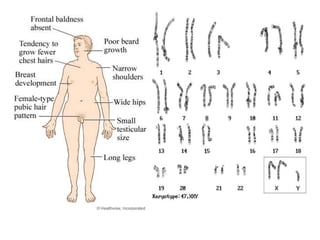
Klinefelter Syndrome
• Klinefelter syndrome can be caused by: One
extra copy of the X chromosome in each cell
(XXY), the most common cause. An extra X
chromosome in some of the cells (mosaic
Klinefelter syndrome), with fewer symptoms.
More than one extra copy of the X
chromosome, which is rare and results in a
severe form.
Conti..
• Klinefelter syndrome is a genetic condition
that results when a boy is born with an extra
copy of the X chromosome. Klinefelter
syndrome is a genetic condition affecting
males, and it often isn't diagnosed until
adulthood.
Turner Syndrome
• Turner syndrome is a genetic disorder
affecting girls and women. The cause of
Turner syndrome is a completely or partially
missing X chromosome. Turner syndrome
symptoms include short stature and lack of
breast development and periods. Treatment
for Turner syndrome may include hormone
therapy.
Turner syndrome
Genetic Disorders ppt.pptx

Genetic Disorders ppt.pptx

  • 1.
    Genetic Disorders Mrs. AmbreenWasif Almas RN,RM,Post RN
  • 2.
    Objectives 1. Differentiate betweenGenetic & Congenital disorder 2. Define the following terminologies related to genetic disorders: Trisomy • Monosomy • Polysomy 3. Discuss the Chromosomal defects with special emphasis on aneuploidy 4. Describe the pathophysiology and the clinical manifestation of the following genetics disorders. • Down’s syndrome • Turner’s syndrome • Kleinfelters syndrome
  • 3.
    Cell discovery • RobertHooke discovered the cell in 1665. Robert Hooke observed a piece of bottle cork under a compound microscope and noticed minuscule structures that reminded him of small rooms. Consequently, he named these “rooms” as cells. Hooke concluded that these were non-living entities. • Later Anton Van Leeuwenhoek observed cells under another compound microscope with higher magnification. This time, he had noted that the cells exhibited some form of movement (motility). As a result, Leeuwenhoek concluded that these microscopic entities were “alive.” • In 1883, Robert Brown, a Scottish botanist, provided the very first insights into the cell structure. He was able to describe the nucleus present in the cells of orchids.
  • 4.
    PHYSIOLOGY OF NORMALHUMAN CELL • The cell is the body’s basic building block. It’s the smallest living component of an organism. • Many organisms are made up of one independent, microscopically tiny cell. Other organisms, • such as humans, consist of millions of cells grouped into highly specialized units that function together throughout the organism’s life. • Large groups of individual cells form tissues, such as muscle, blood, and bone. Tissues form the organs (such as the brain, heart, and liver), which are integrated into body systems (such as the central nervous system [CNS], cardiovascular system, and digestive system).
  • 6.
    Characteristics of Cells •Following are the various essential characteristics of cells: • Cells provide structure and support to the body of an organism. • The cell interior is organized into different individual organelles surrounded by a separate membrane. • The nucleus (major organelle) holds genetic information necessary for reproduction and cell growth. • Every cell has one nucleus and membrane-bound organelles in the cytoplasm. • Mitochondria, a double membrane-bound organelle is mainly responsible for the energy transactions vital for the survival of the cell. • Lysosomes digest unwanted materials in the cell. • Endoplasmic reticulum plays a significant role in the internal organization of the cell by synthesizing selective molecules and processing, directing and sorting them to their appropriate locations.
  • 7.
    Cell division Cell divisionis ongoing for our entire life. Our body is constantly replacing cells. Cells need to divide for a number of reasons, including the growth of an organism and to fill gaps left by dead and destroyed cells after an injury, for instance. There are two types of cell division: Mitosis and meiosis. • Mitosis Mitosis is how most of the cells in the body divide. The “parent” cell splits into two “daughter” cells. Both daughter cells have the same chromosomes as each other and the parent. They are referred to as diploid because they have two complete copies of the chromosomes.
  • 8.
    Meiosis • Meiosis createssex cells, such as the male sperm and female egg cells. In meiosis, a small portion of each chromosome breaks off and sticks to another chromosome; this is called genetic recombination. This means that each of the new cells has a unique set of genetic information. It is this process that allows genetic diversity to occur. So, in brief, mitosis helps us grow, and meiosis makes sure we are all unique.
  • 10.
    Human genetics • Agene is the basic physical and functional unit of heredity. Genes are made up of DNA. Some genes act as instructions to make molecules called proteins. However, many genes do not code for proteins. ... Alleles are forms of the same gene with small differences in their sequence of DNA bases.
  • 12.
  • 13.
  • 14.
    Genetic disorders • Agenetic disorder is a disease that is caused by a change, or mutation, in an individual's DNA sequence. There are three types of genetic disorders: • Single-gene disorders, where a mutation affects one gene. Sickle cell anemia is an example. • Chromosomal disorders, where chromosomes (or parts of chromosomes) are missing or changed. ... • Complex disorders, where there are mutations in two or more genes.
  • 15.
    Congenital disorders • Acongenital disorder is a condition that is present from birth. Congenital disorders can be inherited or caused by environmental factors. Their impact on a child's health and development isn't always severe, and sometimes it can be quite mild. The most common, severe congenital anomalies are heart defects, neural tube defects etc. Congenital anomalies may be the result of one or more genetic, infectious, nutritional or environmental factors.
  • 16.
    MONOSOMY • Monosomy isthe state of having a single copy of a chromosome pair instead of the usual two copies found in diploid cells. Monosomy can be partial if a portion of the second chromosome copy is present. Monosomy, or partial monosomy , is the cause of some human diseases such as Turner syndrome and Cri du Chat syndrome.
  • 17.
  • 18.
  • 19.
    Trisomy A trisomy isa chromosomal condition characterized by an additional chromosome. A person with a trisomy has 47 chromosomes instead of 46. Down syndrome, Edward syndrome and Patau syndrome are the most common forms of trisomy.
  • 20.
  • 21.
    Polysomy Polysomy is acondition where there is more than one copy of the chromosome relative to the normal. Trisomy (2N+1) and tetrasomy (2N+2) are examples of polysomy.
  • 22.
    Aneuploidy • Aneuploidy isdefined as any deviation from the numerical change i.e. normal number of chromosomes, usually meaning a cell nucleus possessing too many or too few chromosomes. • The different conditions of aneuploidy are nullisomy (2N-2), monosomy (2N-1), trisomy (2N+1), and tetrasomy (2N+2). The suffix – somy is used rather than –ploidy.
  • 23.
    Conti… • Trisomy isthe most common aneuploidy. In trisomy, there is an extra chromosome. A common trisomy is Down syndrome (trisomy 21). Other trisomies include Patau syndrome (trisomy 13) and Edwards syndrome (trisomy 18). aneuploidy is the leading genetic cause of spontaneous miscarriage and congenital birth defects in our species.
  • 24.
    Chromosomal defects • Somechromosomal abnormalities occur when there is an extra chromosome, while others occur when a section of a chromosome is deleted or duplicated. Examples of chromosomal abnormalities include Down syndrome, Trisomy 18, Trisomy 13, Klinefelter syndrome, XYY syndrome, Turner syndrome and triple X syndrome.
  • 25.
    Down Syndrome • Downsyndrome (sometimes called Down's syndrome) is a condition in which a child is born with an extra copy of their 21st chromosome — hence its other name, trisomy 21. This causes physical and mental developmental delays and disabilities. Down syndrome is the most frequent chromosomal cause of mild to moderate intellectual disability, and it occurs in all ethnic and economic groups.
  • 26.
  • 27.
    Klinefelter Syndrome • Klinefeltersyndrome can be caused by: One extra copy of the X chromosome in each cell (XXY), the most common cause. An extra X chromosome in some of the cells (mosaic Klinefelter syndrome), with fewer symptoms. More than one extra copy of the X chromosome, which is rare and results in a severe form.
  • 29.
    Conti.. • Klinefelter syndromeis a genetic condition that results when a boy is born with an extra copy of the X chromosome. Klinefelter syndrome is a genetic condition affecting males, and it often isn't diagnosed until adulthood.
  • 31.
    Turner Syndrome • Turnersyndrome is a genetic disorder affecting girls and women. The cause of Turner syndrome is a completely or partially missing X chromosome. Turner syndrome symptoms include short stature and lack of breast development and periods. Treatment for Turner syndrome may include hormone therapy.
  • 32.