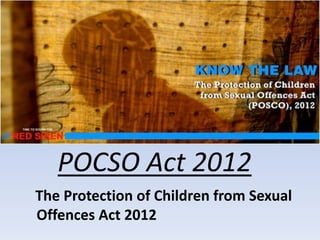
POCSO Act 2012
The Protection of Children from Sexual
Offences Act 2012
What is POCSO Act 2012 ?
• The Protection of Children from Sexual
Offences (POCSO) Act 2012 is applicable to the
whole of India. The POCSO Act 2012 defines a
child as any person below the age of 18 years
and provides protection to all children under
the age of 18 years from sexual abuse. It also
intends to protect the child through all stages
of judicial process and gives paramount
importance to the principle of "best interest of
the child".
What does it protect from ?
• Penetrative and aggravated
penetrative sexual assault, sexual
and aggravated sexual assault,
sexual harassment, and using a
child for pornographic purposes
are the five offences against
children that are covered by this
act. This act envisages punishing
even abetment or an attempt to
commit the offences defined in
the act. It recognizes that the
intent to commit an offence, even
when unsuccessful needs to be
penalized. The punishment for
the attempt to commit is up to
half the punishment prescribed
for the commission of the
offence.
What does it suggest ?
• This act suggests that any person, who has an
apprehension that an offence is likely to be committed
or has knowledge that an offence has been committed,
has a mandatory obligation to report the matter i.e.
media personnel, staff of hotel/ lodges, hospitals,
clubs, studios, or photographic facilities. Failure to
report attracts punishment with imprisonment of up to
six months or fine or both. It is now mandatory for
police to register an FIR in all cases of child abuse. A
child's statement can be recorded even at the child's
residence or a place of his choice and should be
preferably done by a female police officer not below
the rank of sub-inspector.
What about the victim ?
• As per this act, the child's medical examination can
be conducted even prior to registration of an FIR. This
discretion is left up to the Investigation Officer (IO).
The IO has to get the child medically examined in a
government hospital or local hospital within 24 hours
of receiving information about the offence. This is
done with the consent of the child or parent or a
competent person whom the child trusts and in their
presence. The rules laid down in this act also had
defined a criteria of awarding the compensations by
the special court that includes loss of educational and
employment opportunities along with disability,
disease or pregnancy as the consequence of the
abuse. This compensation would be awarded at the
interim stage as well as after the trial ends.
Role of CWC in POCSO Act
• Child Welfare Committees (CWC) play a vital role
under the POCSO Act, cases registered under this
act need to be reported to the CWC within 24
hours of recording the complaint. The CWC
should take into account the opinion of the child
to decide on the case within three days and
conclude whether the child should remain in an
institution or be with the family. The CWC should
nominate with the consent of the child parent /
guardian / other person who the child trusts, a
support person to assist the child during the
investigation and trial of the case.
Role of SCPCR in POCSO Act
• The State Commissions for Protection of Child Rights
(SCPCR) has been empowered and with the
responsibility of monitoring the implementation of the
provisions of the POCSO Act 2012, to conduct inquiries
and to report the activities undertaken under the
POCSO Act 2012, in its annual report. The commission
is also empowered to call for a report on any specific
case of child sexual abuse falling within the jurisdiction
of a CWC. The commission can also recommend
interim relief, or make recommendations to the state
government to effectively redress the matter.
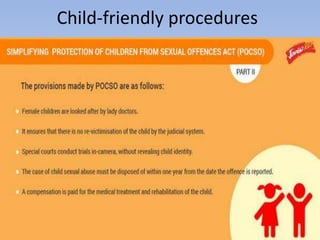
Child-friendly procedures
Some more child-friendly procedures which are
envisaged under the POCSO Act are as follows:-
• At night no child to be detained in the police station.
• The statement of the child to be recorded as spoken by
the child.
• Frequent breaks for the child during trial.
• Child not to be called repeatedly to testify.
• For offences under this act the burden of proof is shifted
on the accused, keeping in view the vulnerability and
innocence of children. To prevent misuse of the law,
punishment has been provided for false complaints or
false information with malicious intent.
• The media has been barred from disclosing the identity
of the child without the permission of the special
court. The punishment for breaching this provision by
media may be from six months to one year.
• For speedy trial, the evidence of the child is to be
recorded within a period of 30 days. Also, the Special
Court is to complete the trial within one year.
• The act casts duty on state to spread awareness to the
general public, of the provisions of this act through
media i.e. television, radio and print at regular
intervals.
Conclusion
• The POCSO Act of 2012 looks into a support system
for children through a friendly atmosphere in the
criminal justice system with the existing machinery
i.e. the CWC and the commission. The positive
aspect is the appointment of the support person for
the child who would assist during investigation, pre-
trial, trial and post trial. The major challenge also
would be convergence between different entities
under different legislations. The act makes it
mandatory to report to the police about any offence
defined under POCSO Act 2012.
The recent decision of the cabinet in a bill to reduce
the age of consent for sex to 16 years will mean that
the protection given under this law to protect
children from sexual crimes will be restricted to the
children who are 16 years of age. There is a fear that
this would end up taking away safeguards available
to victims under the POCSO Act, especially girls in
the 16-18 age bracket. The benefits of POCSO Act
would trickle down to the child only if this act is
implemented in its true sense and spirit by all the
agencies.

POCSO ACT 2012

  • 1.
    POCSO Act 2012 TheProtection of Children from Sexual Offences Act 2012
  • 2.
    What is POCSOAct 2012 ? • The Protection of Children from Sexual Offences (POCSO) Act 2012 is applicable to the whole of India. The POCSO Act 2012 defines a child as any person below the age of 18 years and provides protection to all children under the age of 18 years from sexual abuse. It also intends to protect the child through all stages of judicial process and gives paramount importance to the principle of "best interest of the child".
  • 3.
    What does itprotect from ? • Penetrative and aggravated penetrative sexual assault, sexual and aggravated sexual assault, sexual harassment, and using a child for pornographic purposes are the five offences against children that are covered by this act. This act envisages punishing even abetment or an attempt to commit the offences defined in the act. It recognizes that the intent to commit an offence, even when unsuccessful needs to be penalized. The punishment for the attempt to commit is up to half the punishment prescribed for the commission of the offence.
  • 4.
    What does itsuggest ? • This act suggests that any person, who has an apprehension that an offence is likely to be committed or has knowledge that an offence has been committed, has a mandatory obligation to report the matter i.e. media personnel, staff of hotel/ lodges, hospitals, clubs, studios, or photographic facilities. Failure to report attracts punishment with imprisonment of up to six months or fine or both. It is now mandatory for police to register an FIR in all cases of child abuse. A child's statement can be recorded even at the child's residence or a place of his choice and should be preferably done by a female police officer not below the rank of sub-inspector.
  • 5.
    What about thevictim ? • As per this act, the child's medical examination can be conducted even prior to registration of an FIR. This discretion is left up to the Investigation Officer (IO). The IO has to get the child medically examined in a government hospital or local hospital within 24 hours of receiving information about the offence. This is done with the consent of the child or parent or a competent person whom the child trusts and in their presence. The rules laid down in this act also had defined a criteria of awarding the compensations by the special court that includes loss of educational and employment opportunities along with disability, disease or pregnancy as the consequence of the abuse. This compensation would be awarded at the interim stage as well as after the trial ends.
  • 6.
    Role of CWCin POCSO Act • Child Welfare Committees (CWC) play a vital role under the POCSO Act, cases registered under this act need to be reported to the CWC within 24 hours of recording the complaint. The CWC should take into account the opinion of the child to decide on the case within three days and conclude whether the child should remain in an institution or be with the family. The CWC should nominate with the consent of the child parent / guardian / other person who the child trusts, a support person to assist the child during the investigation and trial of the case.
  • 7.
    Role of SCPCRin POCSO Act • The State Commissions for Protection of Child Rights (SCPCR) has been empowered and with the responsibility of monitoring the implementation of the provisions of the POCSO Act 2012, to conduct inquiries and to report the activities undertaken under the POCSO Act 2012, in its annual report. The commission is also empowered to call for a report on any specific case of child sexual abuse falling within the jurisdiction of a CWC. The commission can also recommend interim relief, or make recommendations to the state government to effectively redress the matter.
  • 8.
  • 9.
    Some more child-friendlyprocedures which are envisaged under the POCSO Act are as follows:- • At night no child to be detained in the police station. • The statement of the child to be recorded as spoken by the child. • Frequent breaks for the child during trial. • Child not to be called repeatedly to testify. • For offences under this act the burden of proof is shifted on the accused, keeping in view the vulnerability and innocence of children. To prevent misuse of the law, punishment has been provided for false complaints or false information with malicious intent.
  • 10.
    • The mediahas been barred from disclosing the identity of the child without the permission of the special court. The punishment for breaching this provision by media may be from six months to one year. • For speedy trial, the evidence of the child is to be recorded within a period of 30 days. Also, the Special Court is to complete the trial within one year. • The act casts duty on state to spread awareness to the general public, of the provisions of this act through media i.e. television, radio and print at regular intervals.
  • 11.
    Conclusion • The POCSOAct of 2012 looks into a support system for children through a friendly atmosphere in the criminal justice system with the existing machinery i.e. the CWC and the commission. The positive aspect is the appointment of the support person for the child who would assist during investigation, pre- trial, trial and post trial. The major challenge also would be convergence between different entities under different legislations. The act makes it mandatory to report to the police about any offence defined under POCSO Act 2012.
  • 12.
    The recent decisionof the cabinet in a bill to reduce the age of consent for sex to 16 years will mean that the protection given under this law to protect children from sexual crimes will be restricted to the children who are 16 years of age. There is a fear that this would end up taking away safeguards available to victims under the POCSO Act, especially girls in the 16-18 age bracket. The benefits of POCSO Act would trickle down to the child only if this act is implemented in its true sense and spirit by all the agencies.