Report:
Cell Phone System Technology
INTRODUCTION:
In the latest strings of technological advancements and
innovations of 21st Century, smartphones are the
leading devices taking the front end. Smartphone is a
part of an advanced category of mobile phones that
runs on a powerful complete operating system in a
manner similar to a computer, which offers innovative
computing abilities and connectivity options. The
evolutionary course of convergence of wireless
communications and computing technologies have led
to rapid advances and developments in mobile phones that brought about social changes
in many areas including financial institutions, health, business, and education. As a result,
the smartphone emerged as a leading technology of the aforementioned convergence.
Sony Ericsson, Palm Treo, Blackberry, Nokia T-Mobile Sidekick, Torq, Motorola Q, E-
Ten, HP iPAQ, Apple iPads, iPod, iPhone, and Samsung Galaxy Tabs are some of the
examples of smartphones/tablets.
The smartphone functionalities include: instant messaging, calling, sending and receiving
text messages, surfing the Web, display photos, play games, play videos, navigation,
built-in camera, audio/video playback and recording, among others. The smartphones
use one of the following powerful operating systems: Windows, Symbian (or its
derivatives), Blackberry, Android, and iOS. Smartphones are redefining the academic
environment in developing countries and are the ready tool for faster access to all type of
knowledge. By using iPhone, iPad, other smartphones and tablets, required information
can be easily accessed by students and lecturers. Mobile Telephone System (MTS),
Advanced Mobile Telephone System (AMTS), and Improved Mobile Telephone Service
(IMTS). Moreover, various different standards of IG were used in different countries.
United Kingdom used Total Access Communications System (TACS), United States used
Advanced Mobile Phone System (AMPS), and Nordic Mobile Telephone (NMT) was used
by Nordic countries, Eastern Europe and Russia. Guavas pointed out that 1G had low
capacity coupled with no security of voice calls, unreliable handoff, and poor voice links.
Hence, there was need for improved transmission quality, higher system capacity, better
system coverage, better and more services, security, and better spectral efficiency that
paved the way towards second generation cellular systems.
The second generation of Mobile phones was 2G that was based on Global System for
Mobile communications (GSM), a standard developed by the European
Telecommunications Standards Institute (ETSI) meant to describe the protocols for 2G
digital cellular networks. The main features of 2G technology included: digital signals
instead of analogue for voice transmission with long life mobile batteries as the digital
signals consume less battery power, speed up to 64 kbps, improved voice clarity and
reduced noise in the line, short message service (SMS), picture messages, and
Multimedia message service (MMS). The other service provided by 2G was e-mail and
worldwide wireless web (WWW) access.
2G was followed by Third Generation (3G) which is superseding all previous generations,
including First Generation (1G) and Second generation (2G) The success factors and
user acceptance of the third-generation mobile network and its services have been
investigated by many researchers. 3G provided some distinct enhancements over 1G and
2G such as Web and WAP browsing at higher speeds, Video-conferencing, Enhanced
audio and video streaming, higher data speed and IPTV (TV through the Internet) support.
Sending/Receiving large email messages, High speed web, More security, Video
conferencing, High speed downloads, 3D gaming, Large capacities and Broadband
capabilities. In addition, 3G is cheaper for service providers and is extremely faster.
However, 3G technology also has some disadvantages such that download speeds can
sometimes be slower than expected due to variation in the signal strength depending
upon the device being used.
4G is the fourth generation of mobile technology, which is fundamentally the expansion
in the 3G that removed the limitations and problems of 3G system and is 10 times faster
than 3G. Long Term Evolution (LTE) is considered as 4G technology. In 4Gmobile
systems different access technologies such as WLAN, WMAN and cellular recombined
on a common platform and they interoperate to offer different services in different radio
environments. The main features of 4G include: the capability to interface with wire line
backbone network which can transmit various multimedia and data across the world,
frequency band ranges from 2 to 8 GHz, data rate is more than 20 Mbps, bandwidth is
5-20 MHz same as of 3G, uses the multi-carrier–CDMA or OFDM (TDMA), switching
technique is packet switching, has ability to quickly download files over a wireless
network, provides extremely high voice quality, can easily access Internet and social
Networks, has ability of streaming media, and facilitates video calling services. Author
added some more features in 4G such as high security, provides any kind of service at
any time as per user requirements anywhere, and offers multimedia expanded
Smartphone is a perfect tool for distance learning. The recent advancements in wireless
communication systems are transforming the definition of distance learning from print
media to “digital and an interactive education” (cited in). Author maintains that mobile
communication technology bridges the gap between distance learners and instructors
as the technology has the potential to deliver learning content to anywhere, any time as
per needs, and enabling a two-way interaction between participants.
GROWTH IN MOBILE TECHNOLOGY:
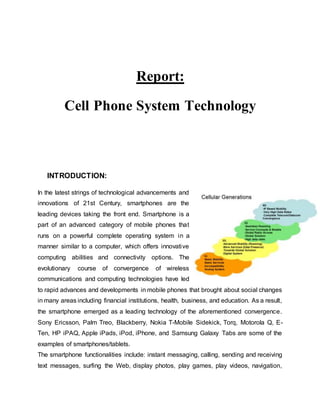
Simply, the "G" stands for "GENERATION”. While you connected to internet, the
speed of your internet is depending upon the signal strength that has been shown in
alphabets like 2G, 3G, 4G etc. right next to the signal bar on your home screen. Each
Generation is defined as a set of telephone network standards, which detail the
technological implementation of a particular mobile phone system. The speed increases
and the technology used to achieve that speed also changes. For e.g., 1G offers 2.4
kbps, 2G offers 64 Kbps and is based on GSM, 3G offers 144 kbps-2 maps’ whereas
4G offers 100 Mbps - 1 Gbps and is based on LTE technology.
The aim of wireless communication is to provide high quality, reliable communication just
like wired communication (optical fiber) and each new generation of services represents
a big step (a leap rather) in that direction. This evolution journey was started in 1979 from
1G and it is still continuing to 5G. Each of the Generations has standards that must be
met to officially use the G terminology. There are institutions in charge of standardizing
each generation of mobile technology. Each generation has requirements that specify
things like throughput, delay, etc. that need to be met to be considered part of that
generation. Each generation built upon the research and development which happened
since the last generation. 1G was not used to identify wireless technology until 2G, or
the second generation, was released. That was a major jump in the technology when the
wireless networks went from analog to digital.
1G - First Generation
This was the first generation of cell phone technology. The very first
generation of commercial cellular network was introduced in the late 70's with
fully implemented standards being established throughout the 80's. It was
introduced in 1987 by Telecom (known today as Telstra), Australia received
its first cellular mobile phone network utilizing a 1G analog system. 1G is an
analog technology and the phones generally had poor battery life and voice
quality was large without much security, and would sometimes experience dropped
calls. These are the analog telecommunications standards that were introduced in the
1980s and continued until being replaced by 2G digital telecommunications. The
maximum speed of 1G is 2.4 Kbps.
2G - Second Generation
Cell phones received their first major upgrade when
they went from 1G to 2G. The main difference
between the two mobile telephone systems (1G and
2G), is that the radio signals used by 1G network are
analog, while 2G networks are digital. Main motive of
this generation was to provide secure and reliable communication channel. It
implemented the concept of CDMA and GSM. Provided small data service like SMS and
mms. Second generation 2G cellular telecom networks were commercially launched on
the GSM standard in Finland by Radiolinja (now part of Elisa Oyj) in 1991. 2G capabilities
are achieved by allowing multiple users on a single channel via multiplexing. During 2G
Cellular phones are used for data also along with voice. The advance in technology from
1G to 2G introduced many of the fundamental services that we still use today, such as
SMS, internal roaming, conference calls, call hold and billing based on services e.g.
charges based on long distance calls and real time billing. The max speed of 2G with
General Packet Radio Service (GPRS) is 50 Kbps or 1 Mbps with Enhanced Data Rates
for GSM Evolution (EDGE). Before making the major leap from 2G to 3G wireless
networks, the lesser-known 2.5G and 2.75G was an interim standard that bridged the
gap.
3G - Third Generation
This generation set the standards for most of the wireless
technology we have come to know and love. Web browsing,
email, video downloading, picture sharing and
another Smartphone technology were introduced in the
third generation. Introduced commercially in 2001, the goals
set out for third generation mobile communication were to facilitate greater voice and data
capacity, support a wider range of applications, and increase data transmission at a lower
cost.
The 3G standard utilizes a new technology called UMTS as its core network architecture
- Universal Mobile Telecommunications System. This network combines aspects of the
2G network with some new technology and protocols to deliver a significantly faster data
rate. Based on a set of standards used for mobile devices and mobile telecommunications
use services and networks that comply with the International Mobile Telecommunications-
2000 (IMT-2000) specifications by the International Telecommunication Union. One of
requirements set by IMT-2000 was that speed should be at least 200Kbps to call it as 3G
service.
3G has Multimedia services support along with streaming are more popular. In 3G,
Universal access and portability across different device types are made possible
(Telephones, PDA's, etc.). 3G increased the efficiency of frequency spectrum by
improving how audio is compressed during a call, so more simultaneous calls can
happen in the same frequency range. The UN's International Telecommunications
Union IMT-2000 standard requires stationary speeds of 2Mbps and mobile speeds of
384kbps for a "true" 3G. The theoretical max speed for HSPA+ is 21.6 Mbps.
Like 2G, 3G evolved into 3.5G and 3.75G as more features were introduced in order to
bring about 4G. A 3G phone cannot communicate through a 4G network, but newer
generations of phones are practically always designed to be backward compatible, so a
4G phone can communicate through a 3G or even 2G network.
4G - Fourth Generation
4G is a very different technology as compared to 3G and was made
possible practically only because of the advancements in the
technology in the last 10 years. Its purpose is to provide high speed,
high quality and high capacity to users while improving security and
lower the cost of voice and data services, multimedia and internet
over IP. Potential and current applications include amended mobile
web access, IP telephony, gaming services, high-definition mobile
TV, video conferencing, 3D television, and cloud computing.
The key technologies that have made this possible are MIMO (Multiple Input Multiple
Output) and OFDM (Orthogonal Frequency Division Multiplexing). The two important 4G
standards are WiMAX (has now fizzled out) and LTE (has seen widespread deployment).
LTE (Long Term Evolution) is a series of upgrades to existing UMTS technology and will
be rolled out on Telstra's existing 1800MHz frequency band. The max speed of a 4G
network when the device is moving is 100 Mbps or 1 Gbps for low mobility communication
like when stationary or walking, latency reduced from around 300ms to less than 100ms,
and significantly lower congestion. When 4G first became available, it was simply a little
faster than 3G. 4G is not the same as 4G LTE which is very close to meeting the criteria
of the standards. To download a new game or stream a TV show in HD, you can do
it without buffering.
Newer generations of phones are usually designed to be backward-compatible, so a
4G phone can communicate through a 3G or even 2G network. All carriers seem to agree
that OFDM is one of the chief indicators that a service can be legitimately marketed as
being 4G. OFDM is a type of digital modulation in which a signal is split into several
narrowband channels at different frequencies. There is a significant amount of
infrastructure changes needed to be implemented by service providers in order to supply
because voice calls in GSM, UMTS and CDMA2000 are circuit switched, so with the
adoption of LTE, carriers will have to re-engineer their voice call network. And again, we
have the fractional parts: 4.5G and 4.9G marking the transition of LTE (in the stage called
LTE-Advanced Pro) getting us more MIMO, more D2D on the way to IMT-2020 and the
requirements of 5G.
5G - Fifth Generation
5G is a generation currently under development, that's intended to improve on
4G. 5G promises significantly faster data rates, higher
connection density, much lower latency, among other
improvements. Some of the plans for 5G include device-to-
device communication, better battery consumption, and
improved overall wireless coverage. The max speed of 5G
is aimed at being as fast as 35.46 Gbps, which is over 35
times faster than 4G.
Key technologies to look out for: Massive MIMO, Millimeter Wave Mobile
Communications etc. Massive MIMO, millimeter wave, small cells, Li-Fi all the new
technologies from the previous decade could be used to give 10Gb/s to a user, with an
unseen low latency, and allow connections for at least 100 billion devices. Different
estimations have been made for the date of commercial introduction of 5G networks. Next
Generation Mobile Networks Alliance feel that 5G should be rolled out by 2020 to meet
business and consumer demands.
IMPACT OF TECHNOLOGY ADVANCEMENTS ON HIGHER
EDUCATION:
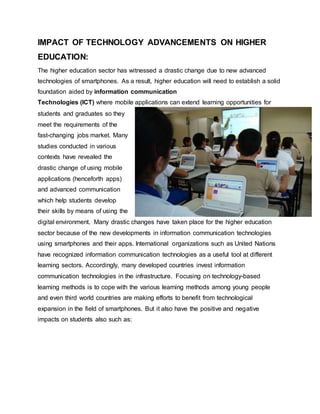
The higher education sector has witnessed a drastic change due to new advanced
technologies of smartphones. As a result, higher education will need to establish a solid
foundation aided by information communication
Technologies (ICT) where mobile applications can extend learning opportunities for
students and graduates so they
meet the requirements of the
fast-changing jobs market. Many
studies conducted in various
contexts have revealed the
drastic change of using mobile
applications (henceforth apps)
and advanced communication
which help students develop
their skills by means of using the
digital environment. Many drastic changes have taken place for the higher education
sector because of the new developments in information communication technologies
using smartphones and their apps. International organizations such as United Nations
have recognized information communication technologies as a useful tool at different
learning sectors. Accordingly, many developed countries invest information
communication technologies in the infrastructure. Focusing on technology-based
learning methods is to cope with the various learning methods among young people
and even third world countries are making efforts to benefit from technological
expansion in the field of smartphones. But it also have the positive and negative
impacts on students also such as:
Positive Impacts:
The Institution of Higher learning in developing countries might unarguably be the most
prevalent beneficiary of the advancements in mobile technologies. In developing
countries services rendered by smart phone can play integral role in education, they are
not mere additional devices. The smartphones enable students to access to larger
amount of learning material Internet is one of the main challenges some of developing
countries facing whereby smartphone can easily handle that issue. In developing
countries smartphone tool can help
students to achieve or perform well by
learning faster outside the lecture room,
accessing the Internet and easy retrieval
of required academic material. Using
smartphones lecturers can also keep
themselves aware of any recent
developments and global trend required
in their teaching and research needs. The
major areas where smartphones have made tremendous impact on the universities in
developing countries in education are easy and fast internet access, high speed
browsing, saving time and money going to internet café or campus computer laboratory,
easy access to teaching and learning content which is enough relief to the lecturers and
students as the smart devices are at their disposal to save them from stress in
accessing the required information which were previously difficult. Research indicates
that a larger percentage of students at universities in emerging economies have latest
smartphones and have expertise in using their services such as GPRS for location,
WhatsApp, Facebook for networking, taking pictures, creating albums, checking email,
Internet surfing and using for other programs. Moreover, these smartphones with
various functionalities make easier for students to use them for distance learning, where
they can collaborate with fellow class mates and lecturers.
Negative Impacts:
Using smartphones students can send and receive text messages, interact on social
media, use e-mail services, play online games, and even watch TV programmers, which
are sources of distraction for themselves, and for other students. Using smartphone
students can cheat by accessing information online during examinations. The study
conducted by concluded that students in the institutions of higher learning in developing
countries are moving fast with technology advancements, especially in mobile phones
and waste much of their precious
time in non-academic activities such
as attending to message notifications
on WhatsApp, Twitter, Instagram,
Facebook and chatting each other,
taking selfie pictures to share with
one another in social networks about
the status. Researchers also noted that smartphones hinder students from performing
better in their studies.
Sir asserts that in developing countries students face some other challenges that
include Non-availability of experts to repairs on campus, operational difficulties or poor
usage skills, high cost of data subscription from Internet Service Providers (ISPs),
irregular/unstable power supply for regular charging of battery on campus and other
barriers facing the use of smartphone. Smart phones are high-tech digital devices, with
many functionalities that require user to have some knowledge to use them, otherwise
this will amount to frustration and underutilization of the devices for academic purposes.
Research shows that in addition, Technological, intellectual, access and lack of
awareness were some of the other possible barriers of smartphones usage by students
and academic staff in developing countries.
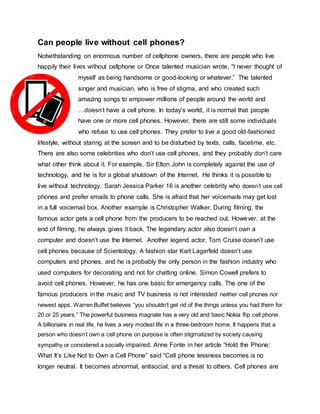
Can people live without cell phones?
Notwithstanding on enormous number of cellphone owners, there are people who live
happily their lives without cellphone or Once talented musician wrote, “I never thought of
myself as being handsome or good-looking or whatever.” The talented
singer and musician, who is free of stigma, and who created such
amazing songs to empower millions of people around the world and
…doesn’t have a cell phone. In today’s world, it is normal that people
have one or more cell phones. However, there are still some individuals
who refuse to use cell phones. They prefer to live a good old-fashioned
lifestyle, without staring at the screen and to be disturbed by texts, calls, facetime, etc.
There are also some celebrities who don’t use cell phones, and they probably don’t care
what other think about it. For example, Sir Elton John is completely against the use of
technology, and he is for a global shutdown of the Internet. He thinks it is possible to
live without technology. Sarah Jessica Parker 16 is another celebrity who doesn’t use cell
phones and prefer emails to phone calls. She is afraid that her voicemails may get lost
in a full voicemail box. Another example is Christopher Walker. During filming, the
famous actor gets a cell phone from the producers to be reached out. However, at the
end of filming, he always gives it back. The legendary actor also doesn’t own a
computer and doesn’t use the Internet. Another legend actor, Tom Cruise doesn’t use
cell phones because of Scientology. A fashion star Karl Lagerfeld doesn’t use
computers and phones, and he is probably the only person in the fashion industry who
used computers for decorating and not for chatting online. Simon Cowell prefers to
avoid cell phones. However, he has one basic for emergency calls. The one of the
famous producers in the music and TV business is not interested neither cell phones nor
newest apps. Warren Buffet believes “you shouldn’t get rid of the things unless you had them for
20 or 25 years.” The powerful business magnate has a very old and basic Nokia flip cell phone.
A billionaire in real life, he lives a very modest life in a three-bedroom home. It happens that a
person who doesn’t own a cell phone on purpose is often stigmatized by society causing
sympathy or considered a socially impaired. Anne Fonte in her article “Hold the Phone:
What It’s Like Not to Own a Cell Phone” said “Cell phone lessness becomes is no
longer neutral. It becomes abnormal, antisocial, and a threat to others. Cell phones are
no longer just a choice you might make, like deciding who to vote for or choosing not to
have children or plastic vs. paper. According to the Pew Research Center, 91 percent of
American adults now have cell phones, and in the last couple years I’ve noticed the
mania ratcheting up to a full-blown obsession. People work, sleep, walk and drive with
their cell phones. Each year, cell phones play a part in more than 1.6 million car
crashes. Forty-four percent of cell phone owners sleep with it next to their bed, so they
don’t miss any calls or texts during the night. They take them out during movies, in the
middle of conversations. Sixty-seven percent of cell phone owners check their phones
even when they haven’t rung.
There is some lesson that you learn without cell phone:
 I am more productive: Again, don’t think that since I have no
phone, I can’t fall into the Netflix-procrastination trap. I’m still a
normal(?) human being who loves to procrastinate, although my
current situation of being phoneless actually has decreased the
chances of me getting distracted by notifications, feeds, or group messages and
helps to treat the multitasking syndrome we all have. I solve only what’s in front of
me, right now.
 I have more meaningfulinteractions: This s is a huge
one. Not having a phone means that you can’t easily
communicate with everybody around you: remember, no more
WhatsApp, no more Messenger, no more Telegrams, phone calls
or instantly replied e-mails. This makes you carefully choose who you’re going to talk
to when you have the chance to do so, because isn’t nobody got time for
meaningless conversations only to waste time when bored.
 I’ve learnedto cope with awkward situations: You know when
you suddenly find yourself in the middle of a social event, where you
know nobody and nobody knows you? Of course, you know! You usually
pull out your phone from your pocket and check your mail, send a tweet
or take a photo of your drink to post on Facebook! Like everyone else does,
pretending they are just too cool to be there! Well, now imagine you can’t do that
because you don’t have a phone. Believe me, you (quoting the xxi century rap-poet
Kendrick Lamar) be humble, and push yourself to interact with new people or go
home.
 I am less anxious: My levels of anxiety decreased a lot since I don’t
really have to be permanently keeping an eye on to a device to see if I
got any new messages, notifications or updates. When I had a phone, I
even felt paranoid and thought it was vibrating, when it really wasn’t.
 I use my laptop for everything: For communicating, for music, for
YouTube, for Medium. And you can’t really drag your laptop with you
everywhere, so whatever happens on the internet, stays there until you
turn it on again.
 I read more: This is a side effect of productivity but had to include it on
the list. I’ve devoured around 3 to 4 books since not having a phone. Well,
I had to put my time into something, what better than reading? It help me
to clear my mind set and make me positive all the type instead of using cell phone I
read more books
Impacts of Cell Phone on Society:
smartphones are popular among people for the applications they offer to users.
Smartphones make communications with people quite easier. People enjoy a lot of
benefits in various forms of their daily work. Some advantages smartphones provide –
better means of communication, learning options to users, great exposure to the latest
things, ways to personality development, simple ways to access applications, ideas to
succeed in business, platforms to grow their applications and more.
1. Impacton Business
Smartphones create new dimensions for business. It is not only the smartphone
vendors enjoying business but also created a new domain for app development
companies, Internet service providers, and other related sectors.
2. Impacton Education
Smartphones provide a unique way to improve the quality of education. The use of the
Internet has become a part of life for every student. Internet together with Smartphones
– provide an alternative channel to deliver education services and distance education.
3. Health Impact
According to surveys, more than 10 million users in the USA use Smartphone to search
for health information and facilities. 27% of the users use smartphones for online
activities. Today there are several apps to manage prescriptions, promote alternative
treatment options, provide price comparison, and validate prescriptions. Today several
apps are available to track exercise, diet and blood pressure – enabling smartphones to
play a key role in the health sector.
4. PsychologicalImpact
Smartphones are said to reduce stress in busy work life. I today’s busy schedules
mobile phones provide a means to interact with friends and families as an when they
get time. The smart use of Smartphone increases your brain’s functioning helping to
stay active. Instead of using Smartphone only for entertainment it could be used to
access useful information, for example, access the news headlines, latest technology
updates, and more.
5. SocialImpact
Social life has been drastically changed with the introduction of smartphones and this
domain has encountered most of the impact from the use of smartphones. Smartphones
play an important role in the integration process of people with special needs, elderly
age and with some sort of disabilities.
CONCLUSION:
In this this report literature was drawn from various resources on modern advancements
in mobile technology. Evolution of mobile telecommunication network from 1G to 5G is
highlighted. The paper also discussed the impact of these technological advancements
on higher education in developing countries. Both positive and negative impacts are
clearly explained. However, it is important to educate students in Institutions of Higher
learning in developing countries on how to use smartphones smartly to enhance their
academic career. At the same time, they should focus on how to avoid smartly the
misuse of innovative technology. The study concludes that positive impacts of
technology advancements are tremendous and negative impacts are minor on Higher
Education Institutions in developing countries. We also discuss that can people can live
without cell phone or not many people can live their live with cell phone or many cannot
if we do a survey, we can easily find the statistic of many people around the world can
engaged it. And the last we see the impact of cell phone technology on our society in
which discuss that effect on our Business, Education, Health, and social impact.

Cell Phone System Technology Final Report

  • 1.
    Report: Cell Phone SystemTechnology INTRODUCTION: In the latest strings of technological advancements and innovations of 21st Century, smartphones are the leading devices taking the front end. Smartphone is a part of an advanced category of mobile phones that runs on a powerful complete operating system in a manner similar to a computer, which offers innovative computing abilities and connectivity options. The evolutionary course of convergence of wireless communications and computing technologies have led to rapid advances and developments in mobile phones that brought about social changes in many areas including financial institutions, health, business, and education. As a result, the smartphone emerged as a leading technology of the aforementioned convergence. Sony Ericsson, Palm Treo, Blackberry, Nokia T-Mobile Sidekick, Torq, Motorola Q, E- Ten, HP iPAQ, Apple iPads, iPod, iPhone, and Samsung Galaxy Tabs are some of the examples of smartphones/tablets. The smartphone functionalities include: instant messaging, calling, sending and receiving text messages, surfing the Web, display photos, play games, play videos, navigation,
  • 2.
    built-in camera, audio/videoplayback and recording, among others. The smartphones use one of the following powerful operating systems: Windows, Symbian (or its derivatives), Blackberry, Android, and iOS. Smartphones are redefining the academic environment in developing countries and are the ready tool for faster access to all type of knowledge. By using iPhone, iPad, other smartphones and tablets, required information can be easily accessed by students and lecturers. Mobile Telephone System (MTS), Advanced Mobile Telephone System (AMTS), and Improved Mobile Telephone Service (IMTS). Moreover, various different standards of IG were used in different countries. United Kingdom used Total Access Communications System (TACS), United States used Advanced Mobile Phone System (AMPS), and Nordic Mobile Telephone (NMT) was used by Nordic countries, Eastern Europe and Russia. Guavas pointed out that 1G had low capacity coupled with no security of voice calls, unreliable handoff, and poor voice links. Hence, there was need for improved transmission quality, higher system capacity, better system coverage, better and more services, security, and better spectral efficiency that paved the way towards second generation cellular systems. The second generation of Mobile phones was 2G that was based on Global System for Mobile communications (GSM), a standard developed by the European Telecommunications Standards Institute (ETSI) meant to describe the protocols for 2G digital cellular networks. The main features of 2G technology included: digital signals instead of analogue for voice transmission with long life mobile batteries as the digital signals consume less battery power, speed up to 64 kbps, improved voice clarity and reduced noise in the line, short message service (SMS), picture messages, and Multimedia message service (MMS). The other service provided by 2G was e-mail and worldwide wireless web (WWW) access. 2G was followed by Third Generation (3G) which is superseding all previous generations, including First Generation (1G) and Second generation (2G) The success factors and user acceptance of the third-generation mobile network and its services have been investigated by many researchers. 3G provided some distinct enhancements over 1G and 2G such as Web and WAP browsing at higher speeds, Video-conferencing, Enhanced
  • 3.
    audio and videostreaming, higher data speed and IPTV (TV through the Internet) support. Sending/Receiving large email messages, High speed web, More security, Video conferencing, High speed downloads, 3D gaming, Large capacities and Broadband capabilities. In addition, 3G is cheaper for service providers and is extremely faster. However, 3G technology also has some disadvantages such that download speeds can sometimes be slower than expected due to variation in the signal strength depending upon the device being used. 4G is the fourth generation of mobile technology, which is fundamentally the expansion in the 3G that removed the limitations and problems of 3G system and is 10 times faster than 3G. Long Term Evolution (LTE) is considered as 4G technology. In 4Gmobile systems different access technologies such as WLAN, WMAN and cellular recombined on a common platform and they interoperate to offer different services in different radio environments. The main features of 4G include: the capability to interface with wire line backbone network which can transmit various multimedia and data across the world, frequency band ranges from 2 to 8 GHz, data rate is more than 20 Mbps, bandwidth is 5-20 MHz same as of 3G, uses the multi-carrier–CDMA or OFDM (TDMA), switching technique is packet switching, has ability to quickly download files over a wireless network, provides extremely high voice quality, can easily access Internet and social Networks, has ability of streaming media, and facilitates video calling services. Author added some more features in 4G such as high security, provides any kind of service at any time as per user requirements anywhere, and offers multimedia expanded Smartphone is a perfect tool for distance learning. The recent advancements in wireless communication systems are transforming the definition of distance learning from print media to “digital and an interactive education” (cited in). Author maintains that mobile communication technology bridges the gap between distance learners and instructors as the technology has the potential to deliver learning content to anywhere, any time as per needs, and enabling a two-way interaction between participants. GROWTH IN MOBILE TECHNOLOGY:
  • 4.
    Simply, the "G"stands for "GENERATION”. While you connected to internet, the speed of your internet is depending upon the signal strength that has been shown in alphabets like 2G, 3G, 4G etc. right next to the signal bar on your home screen. Each Generation is defined as a set of telephone network standards, which detail the technological implementation of a particular mobile phone system. The speed increases and the technology used to achieve that speed also changes. For e.g., 1G offers 2.4 kbps, 2G offers 64 Kbps and is based on GSM, 3G offers 144 kbps-2 maps’ whereas 4G offers 100 Mbps - 1 Gbps and is based on LTE technology. The aim of wireless communication is to provide high quality, reliable communication just like wired communication (optical fiber) and each new generation of services represents a big step (a leap rather) in that direction. This evolution journey was started in 1979 from 1G and it is still continuing to 5G. Each of the Generations has standards that must be met to officially use the G terminology. There are institutions in charge of standardizing each generation of mobile technology. Each generation has requirements that specify things like throughput, delay, etc. that need to be met to be considered part of that generation. Each generation built upon the research and development which happened since the last generation. 1G was not used to identify wireless technology until 2G, or the second generation, was released. That was a major jump in the technology when the wireless networks went from analog to digital.
  • 5.
    1G - FirstGeneration This was the first generation of cell phone technology. The very first generation of commercial cellular network was introduced in the late 70's with fully implemented standards being established throughout the 80's. It was introduced in 1987 by Telecom (known today as Telstra), Australia received its first cellular mobile phone network utilizing a 1G analog system. 1G is an analog technology and the phones generally had poor battery life and voice quality was large without much security, and would sometimes experience dropped calls. These are the analog telecommunications standards that were introduced in the 1980s and continued until being replaced by 2G digital telecommunications. The maximum speed of 1G is 2.4 Kbps. 2G - Second Generation Cell phones received their first major upgrade when they went from 1G to 2G. The main difference between the two mobile telephone systems (1G and 2G), is that the radio signals used by 1G network are analog, while 2G networks are digital. Main motive of this generation was to provide secure and reliable communication channel. It implemented the concept of CDMA and GSM. Provided small data service like SMS and mms. Second generation 2G cellular telecom networks were commercially launched on the GSM standard in Finland by Radiolinja (now part of Elisa Oyj) in 1991. 2G capabilities are achieved by allowing multiple users on a single channel via multiplexing. During 2G Cellular phones are used for data also along with voice. The advance in technology from 1G to 2G introduced many of the fundamental services that we still use today, such as SMS, internal roaming, conference calls, call hold and billing based on services e.g. charges based on long distance calls and real time billing. The max speed of 2G with General Packet Radio Service (GPRS) is 50 Kbps or 1 Mbps with Enhanced Data Rates for GSM Evolution (EDGE). Before making the major leap from 2G to 3G wireless
  • 6.
    networks, the lesser-known2.5G and 2.75G was an interim standard that bridged the gap. 3G - Third Generation This generation set the standards for most of the wireless technology we have come to know and love. Web browsing, email, video downloading, picture sharing and another Smartphone technology were introduced in the third generation. Introduced commercially in 2001, the goals set out for third generation mobile communication were to facilitate greater voice and data capacity, support a wider range of applications, and increase data transmission at a lower cost. The 3G standard utilizes a new technology called UMTS as its core network architecture - Universal Mobile Telecommunications System. This network combines aspects of the 2G network with some new technology and protocols to deliver a significantly faster data rate. Based on a set of standards used for mobile devices and mobile telecommunications use services and networks that comply with the International Mobile Telecommunications- 2000 (IMT-2000) specifications by the International Telecommunication Union. One of requirements set by IMT-2000 was that speed should be at least 200Kbps to call it as 3G service. 3G has Multimedia services support along with streaming are more popular. In 3G, Universal access and portability across different device types are made possible (Telephones, PDA's, etc.). 3G increased the efficiency of frequency spectrum by improving how audio is compressed during a call, so more simultaneous calls can happen in the same frequency range. The UN's International Telecommunications Union IMT-2000 standard requires stationary speeds of 2Mbps and mobile speeds of 384kbps for a "true" 3G. The theoretical max speed for HSPA+ is 21.6 Mbps. Like 2G, 3G evolved into 3.5G and 3.75G as more features were introduced in order to bring about 4G. A 3G phone cannot communicate through a 4G network, but newer
  • 7.
    generations of phonesare practically always designed to be backward compatible, so a 4G phone can communicate through a 3G or even 2G network. 4G - Fourth Generation 4G is a very different technology as compared to 3G and was made possible practically only because of the advancements in the technology in the last 10 years. Its purpose is to provide high speed, high quality and high capacity to users while improving security and lower the cost of voice and data services, multimedia and internet over IP. Potential and current applications include amended mobile web access, IP telephony, gaming services, high-definition mobile TV, video conferencing, 3D television, and cloud computing. The key technologies that have made this possible are MIMO (Multiple Input Multiple Output) and OFDM (Orthogonal Frequency Division Multiplexing). The two important 4G standards are WiMAX (has now fizzled out) and LTE (has seen widespread deployment). LTE (Long Term Evolution) is a series of upgrades to existing UMTS technology and will be rolled out on Telstra's existing 1800MHz frequency band. The max speed of a 4G network when the device is moving is 100 Mbps or 1 Gbps for low mobility communication like when stationary or walking, latency reduced from around 300ms to less than 100ms, and significantly lower congestion. When 4G first became available, it was simply a little faster than 3G. 4G is not the same as 4G LTE which is very close to meeting the criteria of the standards. To download a new game or stream a TV show in HD, you can do it without buffering. Newer generations of phones are usually designed to be backward-compatible, so a 4G phone can communicate through a 3G or even 2G network. All carriers seem to agree that OFDM is one of the chief indicators that a service can be legitimately marketed as being 4G. OFDM is a type of digital modulation in which a signal is split into several
  • 8.
    narrowband channels atdifferent frequencies. There is a significant amount of infrastructure changes needed to be implemented by service providers in order to supply because voice calls in GSM, UMTS and CDMA2000 are circuit switched, so with the adoption of LTE, carriers will have to re-engineer their voice call network. And again, we have the fractional parts: 4.5G and 4.9G marking the transition of LTE (in the stage called LTE-Advanced Pro) getting us more MIMO, more D2D on the way to IMT-2020 and the requirements of 5G. 5G - Fifth Generation 5G is a generation currently under development, that's intended to improve on 4G. 5G promises significantly faster data rates, higher connection density, much lower latency, among other improvements. Some of the plans for 5G include device-to- device communication, better battery consumption, and improved overall wireless coverage. The max speed of 5G is aimed at being as fast as 35.46 Gbps, which is over 35 times faster than 4G. Key technologies to look out for: Massive MIMO, Millimeter Wave Mobile Communications etc. Massive MIMO, millimeter wave, small cells, Li-Fi all the new technologies from the previous decade could be used to give 10Gb/s to a user, with an unseen low latency, and allow connections for at least 100 billion devices. Different estimations have been made for the date of commercial introduction of 5G networks. Next Generation Mobile Networks Alliance feel that 5G should be rolled out by 2020 to meet business and consumer demands.
  • 9.
    IMPACT OF TECHNOLOGYADVANCEMENTS ON HIGHER EDUCATION: The higher education sector has witnessed a drastic change due to new advanced technologies of smartphones. As a result, higher education will need to establish a solid foundation aided by information communication Technologies (ICT) where mobile applications can extend learning opportunities for students and graduates so they meet the requirements of the fast-changing jobs market. Many studies conducted in various contexts have revealed the drastic change of using mobile applications (henceforth apps) and advanced communication which help students develop their skills by means of using the digital environment. Many drastic changes have taken place for the higher education sector because of the new developments in information communication technologies using smartphones and their apps. International organizations such as United Nations have recognized information communication technologies as a useful tool at different learning sectors. Accordingly, many developed countries invest information communication technologies in the infrastructure. Focusing on technology-based learning methods is to cope with the various learning methods among young people and even third world countries are making efforts to benefit from technological expansion in the field of smartphones. But it also have the positive and negative impacts on students also such as:
  • 10.
    Positive Impacts: The Institutionof Higher learning in developing countries might unarguably be the most prevalent beneficiary of the advancements in mobile technologies. In developing countries services rendered by smart phone can play integral role in education, they are not mere additional devices. The smartphones enable students to access to larger amount of learning material Internet is one of the main challenges some of developing countries facing whereby smartphone can easily handle that issue. In developing countries smartphone tool can help students to achieve or perform well by learning faster outside the lecture room, accessing the Internet and easy retrieval of required academic material. Using smartphones lecturers can also keep themselves aware of any recent developments and global trend required in their teaching and research needs. The major areas where smartphones have made tremendous impact on the universities in developing countries in education are easy and fast internet access, high speed browsing, saving time and money going to internet café or campus computer laboratory, easy access to teaching and learning content which is enough relief to the lecturers and students as the smart devices are at their disposal to save them from stress in accessing the required information which were previously difficult. Research indicates that a larger percentage of students at universities in emerging economies have latest smartphones and have expertise in using their services such as GPRS for location, WhatsApp, Facebook for networking, taking pictures, creating albums, checking email, Internet surfing and using for other programs. Moreover, these smartphones with various functionalities make easier for students to use them for distance learning, where they can collaborate with fellow class mates and lecturers.
  • 11.
    Negative Impacts: Using smartphonesstudents can send and receive text messages, interact on social media, use e-mail services, play online games, and even watch TV programmers, which are sources of distraction for themselves, and for other students. Using smartphone students can cheat by accessing information online during examinations. The study conducted by concluded that students in the institutions of higher learning in developing countries are moving fast with technology advancements, especially in mobile phones and waste much of their precious time in non-academic activities such as attending to message notifications on WhatsApp, Twitter, Instagram, Facebook and chatting each other, taking selfie pictures to share with one another in social networks about the status. Researchers also noted that smartphones hinder students from performing better in their studies. Sir asserts that in developing countries students face some other challenges that include Non-availability of experts to repairs on campus, operational difficulties or poor usage skills, high cost of data subscription from Internet Service Providers (ISPs), irregular/unstable power supply for regular charging of battery on campus and other barriers facing the use of smartphone. Smart phones are high-tech digital devices, with many functionalities that require user to have some knowledge to use them, otherwise this will amount to frustration and underutilization of the devices for academic purposes. Research shows that in addition, Technological, intellectual, access and lack of awareness were some of the other possible barriers of smartphones usage by students and academic staff in developing countries.
  • 12.
    Can people livewithout cell phones? Notwithstanding on enormous number of cellphone owners, there are people who live happily their lives without cellphone or Once talented musician wrote, “I never thought of myself as being handsome or good-looking or whatever.” The talented singer and musician, who is free of stigma, and who created such amazing songs to empower millions of people around the world and …doesn’t have a cell phone. In today’s world, it is normal that people have one or more cell phones. However, there are still some individuals who refuse to use cell phones. They prefer to live a good old-fashioned lifestyle, without staring at the screen and to be disturbed by texts, calls, facetime, etc. There are also some celebrities who don’t use cell phones, and they probably don’t care what other think about it. For example, Sir Elton John is completely against the use of technology, and he is for a global shutdown of the Internet. He thinks it is possible to live without technology. Sarah Jessica Parker 16 is another celebrity who doesn’t use cell phones and prefer emails to phone calls. She is afraid that her voicemails may get lost in a full voicemail box. Another example is Christopher Walker. During filming, the famous actor gets a cell phone from the producers to be reached out. However, at the end of filming, he always gives it back. The legendary actor also doesn’t own a computer and doesn’t use the Internet. Another legend actor, Tom Cruise doesn’t use cell phones because of Scientology. A fashion star Karl Lagerfeld doesn’t use computers and phones, and he is probably the only person in the fashion industry who used computers for decorating and not for chatting online. Simon Cowell prefers to avoid cell phones. However, he has one basic for emergency calls. The one of the famous producers in the music and TV business is not interested neither cell phones nor newest apps. Warren Buffet believes “you shouldn’t get rid of the things unless you had them for 20 or 25 years.” The powerful business magnate has a very old and basic Nokia flip cell phone. A billionaire in real life, he lives a very modest life in a three-bedroom home. It happens that a person who doesn’t own a cell phone on purpose is often stigmatized by society causing sympathy or considered a socially impaired. Anne Fonte in her article “Hold the Phone: What It’s Like Not to Own a Cell Phone” said “Cell phone lessness becomes is no longer neutral. It becomes abnormal, antisocial, and a threat to others. Cell phones are
  • 13.
    no longer justa choice you might make, like deciding who to vote for or choosing not to have children or plastic vs. paper. According to the Pew Research Center, 91 percent of American adults now have cell phones, and in the last couple years I’ve noticed the mania ratcheting up to a full-blown obsession. People work, sleep, walk and drive with their cell phones. Each year, cell phones play a part in more than 1.6 million car crashes. Forty-four percent of cell phone owners sleep with it next to their bed, so they don’t miss any calls or texts during the night. They take them out during movies, in the middle of conversations. Sixty-seven percent of cell phone owners check their phones even when they haven’t rung. There is some lesson that you learn without cell phone:  I am more productive: Again, don’t think that since I have no phone, I can’t fall into the Netflix-procrastination trap. I’m still a normal(?) human being who loves to procrastinate, although my current situation of being phoneless actually has decreased the chances of me getting distracted by notifications, feeds, or group messages and helps to treat the multitasking syndrome we all have. I solve only what’s in front of me, right now.  I have more meaningfulinteractions: This s is a huge one. Not having a phone means that you can’t easily communicate with everybody around you: remember, no more WhatsApp, no more Messenger, no more Telegrams, phone calls or instantly replied e-mails. This makes you carefully choose who you’re going to talk to when you have the chance to do so, because isn’t nobody got time for meaningless conversations only to waste time when bored.  I’ve learnedto cope with awkward situations: You know when you suddenly find yourself in the middle of a social event, where you know nobody and nobody knows you? Of course, you know! You usually pull out your phone from your pocket and check your mail, send a tweet
  • 14.
    or take aphoto of your drink to post on Facebook! Like everyone else does, pretending they are just too cool to be there! Well, now imagine you can’t do that because you don’t have a phone. Believe me, you (quoting the xxi century rap-poet Kendrick Lamar) be humble, and push yourself to interact with new people or go home.  I am less anxious: My levels of anxiety decreased a lot since I don’t really have to be permanently keeping an eye on to a device to see if I got any new messages, notifications or updates. When I had a phone, I even felt paranoid and thought it was vibrating, when it really wasn’t.  I use my laptop for everything: For communicating, for music, for YouTube, for Medium. And you can’t really drag your laptop with you everywhere, so whatever happens on the internet, stays there until you turn it on again.  I read more: This is a side effect of productivity but had to include it on the list. I’ve devoured around 3 to 4 books since not having a phone. Well, I had to put my time into something, what better than reading? It help me to clear my mind set and make me positive all the type instead of using cell phone I read more books Impacts of Cell Phone on Society: smartphones are popular among people for the applications they offer to users. Smartphones make communications with people quite easier. People enjoy a lot of benefits in various forms of their daily work. Some advantages smartphones provide – better means of communication, learning options to users, great exposure to the latest things, ways to personality development, simple ways to access applications, ideas to succeed in business, platforms to grow their applications and more.
  • 15.
    1. Impacton Business Smartphonescreate new dimensions for business. It is not only the smartphone vendors enjoying business but also created a new domain for app development companies, Internet service providers, and other related sectors. 2. Impacton Education Smartphones provide a unique way to improve the quality of education. The use of the Internet has become a part of life for every student. Internet together with Smartphones – provide an alternative channel to deliver education services and distance education. 3. Health Impact According to surveys, more than 10 million users in the USA use Smartphone to search for health information and facilities. 27% of the users use smartphones for online activities. Today there are several apps to manage prescriptions, promote alternative treatment options, provide price comparison, and validate prescriptions. Today several apps are available to track exercise, diet and blood pressure – enabling smartphones to play a key role in the health sector. 4. PsychologicalImpact Smartphones are said to reduce stress in busy work life. I today’s busy schedules mobile phones provide a means to interact with friends and families as an when they get time. The smart use of Smartphone increases your brain’s functioning helping to stay active. Instead of using Smartphone only for entertainment it could be used to access useful information, for example, access the news headlines, latest technology updates, and more. 5. SocialImpact Social life has been drastically changed with the introduction of smartphones and this domain has encountered most of the impact from the use of smartphones. Smartphones play an important role in the integration process of people with special needs, elderly age and with some sort of disabilities.
  • 16.
    CONCLUSION: In this thisreport literature was drawn from various resources on modern advancements in mobile technology. Evolution of mobile telecommunication network from 1G to 5G is highlighted. The paper also discussed the impact of these technological advancements on higher education in developing countries. Both positive and negative impacts are clearly explained. However, it is important to educate students in Institutions of Higher learning in developing countries on how to use smartphones smartly to enhance their academic career. At the same time, they should focus on how to avoid smartly the misuse of innovative technology. The study concludes that positive impacts of technology advancements are tremendous and negative impacts are minor on Higher Education Institutions in developing countries. We also discuss that can people can live without cell phone or not many people can live their live with cell phone or many cannot if we do a survey, we can easily find the statistic of many people around the world can engaged it. And the last we see the impact of cell phone technology on our society in which discuss that effect on our Business, Education, Health, and social impact.