Presenter ID: 181-23-5270
Presentation on
Flame retardant and flame proof textile
Course Code: TE-315
Course Title: Textile texting and quality control-II
01
Table of Contents
01 02 03
Introduction Difference
Flameproof
textile
02
04
Flame retardant
textile
02
Testing method
03
Conclusion
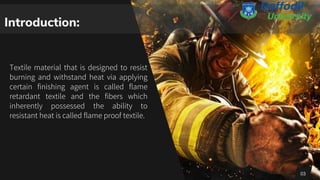
Introduction:
Textile material that is designed to resist
burning and withstand heat via applying
certain finishing agent is called flame
retardant textile and the fibers which
inherently possessed the ability to
resistant heat is called flame proof textile.
03
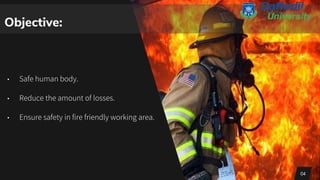
Objective:
• Safe human body.
• Reduce the amount of losses.
• Ensure safety in fire friendly working area.
04
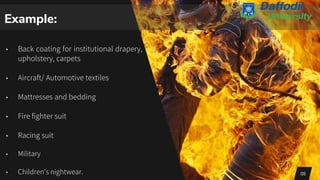
Example:
• Back coating for institutional drapery,
upholstery, carpets
• Aircraft/ Automotive textiles
• Mattresses and bedding
• Fire fighter suit
• Racing suit
• Military
• Children’s nightwear. 05
Inherently nonflammable
Does not chemically treated
Burns slowly .
Costly
More lustrous
Inherently flammable.
Chemically treated.
Burns quickly .
Cheap.
Less lustrous.
Flameproof fibre Flame resistance fibre
Difference between flameproof and fire retardent textile:
06
Flameproof textile
07
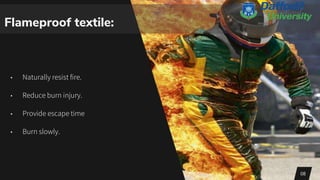
Flameproof textile:
• Naturally resist fire.
• Reduce burn injury.
• Provide escape time
• Burn slowly.
08
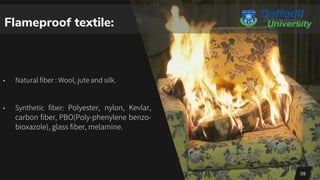
Flameproof textile:
• Natural fiber : Wool, jute and silk.
• Synthetic fiber: Polyester, nylon, Kevlar,
carbon fiber, PBO(Poly-phenylene benzo-
bioxazole), glass fiber, melamine.
09
Flame retardant textile
10
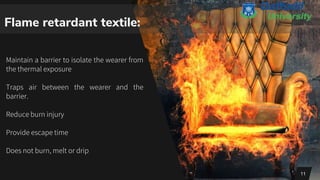
Flame retardant textile:
Maintain a barrier to isolate the wearer from
the thermal exposure
Traps air between the wearer and the
barrier.
Reduce burn injury
Provide escape time
Does not burn, melt or drip
11
02.
Blending heat resistant fiber
03.
Suitable structural
engineering
01.
Chemical treatment
12
Flame retardant process:
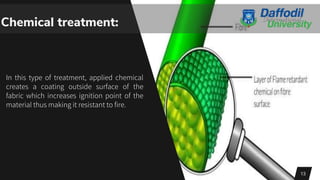
Chemical treatment:
In this type of treatment, applied chemical
creates a coating outside surface of the
fabric which increases ignition point of the
material thus making it resistant to fire.
13
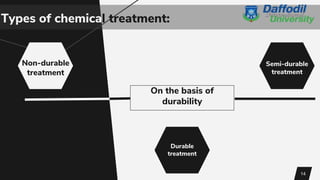
On the basis of
durability
Non-durable
treatment
Semi-durable
treatment
Durable
treatment
14
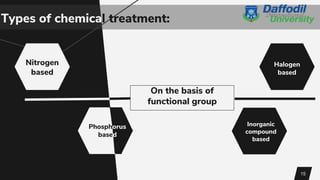
Types of chemical treatment:
Nitrogen
based
Number
of strand Halogen
based
Phosphorus
based
Inorganic
compound
based
15
On the basis of
functional group
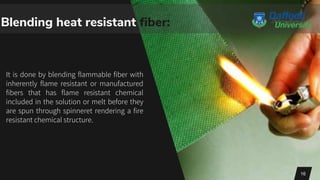
It is done by blending flammable fiber with
inherently flame resistant or manufactured
fibers that has flame resistant chemical
included in the solution or melt before they
are spun through spinneret rendering a fire
resistant chemical structure.
16
Blending heat resistant fiber:
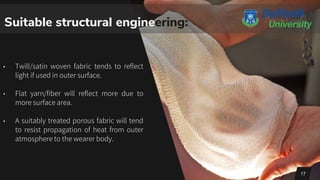
• Twill/satin woven fabric tends to reflect
light if used in outer surface.
• Flat yarn/fiber will reflect more due to
more surface area.
• A suitably treated porous fabric will tend
to resist propagation of heat from outer
atmosphere to the wearer body.
17
Suitable structural engineering:
Testing method
18
Conductive heat test method:
• Standard- ASTM D4108-82
• Gas flame- Methane gas
• Heat flux- 84 ± 2 kW/ m2 (2.00 ± 0.05
cal/cm2/second)
• Distance between fabric sample and
burner top- 50mm
• Air gap between fabric and copper sensor-
3.2mm
19
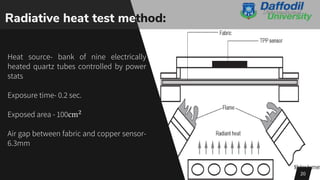
Radiative heat test method:
Heat source- bank of nine electrically
heated quartz tubes controlled by power
stats
Exposure time- 0.2 sec.
Exposed area - 100cm2
Air gap between fabric and copper sensor-
6.3mm
20
Limitation
21
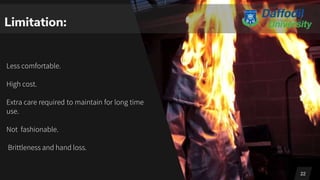
Less comfortable.
High cost.
Extra care required to maintain for long time
use.
Not fashionable.
Brittleness and hand loss.
22
Limitation:
Conclusion
23
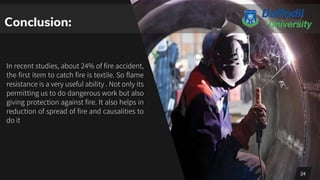
In recent studies, about 24% of fire accident,
the first item to catch fire is textile. So flame
resistance is a very useful ability . Not only its
permitting us to do dangerous work but also
giving protection against fire. It also helps in
reduction of spread of fire and causalities to
do it
24
Conclusion:
Thank you
25

Flameretardant and flameproof textiles

  • 1.
    Presenter ID: 181-23-5270 Presentationon Flame retardant and flame proof textile Course Code: TE-315 Course Title: Textile texting and quality control-II 01
  • 2.
    Table of Contents 0102 03 Introduction Difference Flameproof textile 02 04 Flame retardant textile 02 Testing method 03 Conclusion
  • 3.
    Introduction: Textile material thatis designed to resist burning and withstand heat via applying certain finishing agent is called flame retardant textile and the fibers which inherently possessed the ability to resistant heat is called flame proof textile. 03
  • 4.
    Objective: • Safe humanbody. • Reduce the amount of losses. • Ensure safety in fire friendly working area. 04
  • 5.
    Example: • Back coatingfor institutional drapery, upholstery, carpets • Aircraft/ Automotive textiles • Mattresses and bedding • Fire fighter suit • Racing suit • Military • Children’s nightwear. 05
  • 6.
    Inherently nonflammable Does notchemically treated Burns slowly . Costly More lustrous Inherently flammable. Chemically treated. Burns quickly . Cheap. Less lustrous. Flameproof fibre Flame resistance fibre Difference between flameproof and fire retardent textile: 06
  • 7.
  • 8.
    Flameproof textile: • Naturallyresist fire. • Reduce burn injury. • Provide escape time • Burn slowly. 08
  • 9.
    Flameproof textile: • Naturalfiber : Wool, jute and silk. • Synthetic fiber: Polyester, nylon, Kevlar, carbon fiber, PBO(Poly-phenylene benzo- bioxazole), glass fiber, melamine. 09
  • 10.
  • 11.
    Flame retardant textile: Maintaina barrier to isolate the wearer from the thermal exposure Traps air between the wearer and the barrier. Reduce burn injury Provide escape time Does not burn, melt or drip 11
  • 12.
    02. Blending heat resistantfiber 03. Suitable structural engineering 01. Chemical treatment 12 Flame retardant process:
  • 13.
    Chemical treatment: In thistype of treatment, applied chemical creates a coating outside surface of the fabric which increases ignition point of the material thus making it resistant to fire. 13
  • 14.
    On the basisof durability Non-durable treatment Semi-durable treatment Durable treatment 14 Types of chemical treatment:
  • 15.
    Types of chemicaltreatment: Nitrogen based Number of strand Halogen based Phosphorus based Inorganic compound based 15 On the basis of functional group
  • 16.
    It is doneby blending flammable fiber with inherently flame resistant or manufactured fibers that has flame resistant chemical included in the solution or melt before they are spun through spinneret rendering a fire resistant chemical structure. 16 Blending heat resistant fiber:
  • 17.
    • Twill/satin wovenfabric tends to reflect light if used in outer surface. • Flat yarn/fiber will reflect more due to more surface area. • A suitably treated porous fabric will tend to resist propagation of heat from outer atmosphere to the wearer body. 17 Suitable structural engineering:
  • 18.
  • 19.
    Conductive heat testmethod: • Standard- ASTM D4108-82 • Gas flame- Methane gas • Heat flux- 84 ± 2 kW/ m2 (2.00 ± 0.05 cal/cm2/second) • Distance between fabric sample and burner top- 50mm • Air gap between fabric and copper sensor- 3.2mm 19
  • 20.
    Radiative heat testmethod: Heat source- bank of nine electrically heated quartz tubes controlled by power stats Exposure time- 0.2 sec. Exposed area - 100cm2 Air gap between fabric and copper sensor- 6.3mm 20
  • 21.
  • 22.
    Less comfortable. High cost. Extracare required to maintain for long time use. Not fashionable. Brittleness and hand loss. 22 Limitation:
  • 23.
  • 24.
    In recent studies,about 24% of fire accident, the first item to catch fire is textile. So flame resistance is a very useful ability . Not only its permitting us to do dangerous work but also giving protection against fire. It also helps in reduction of spread of fire and causalities to do it 24 Conclusion:
  • 25.