Welcome To All
&
Honorable Teacher
GENERATOR
1. Avijit Adhikary [ID:173-33-549]
2. Md. Habibulla [ID:173-33-542]
3. Md. Amran Nazir [ID:173-33-552]
4. Mofazzal Hossen [ID:173-33-556]
5. .Sajib Rana [ID:173-33-551]
Context
• Introduction Generator
• Principle of Working
• Working Law of Generator
• History of Generator
• Inventor of Generator
• Law of Faraday
• Types of Generator
• Parts of Generator
• Simple Problems of a
Generator
• Generator in Daily Life
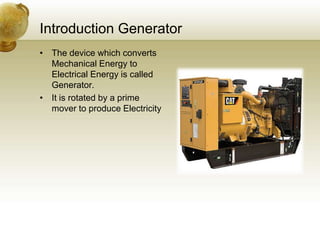
Introduction Generator
• The device which converts
Mechanical Energy to
Electrical Energy is called
Generator.
• It is rotated by a prime
mover to produce Electricity
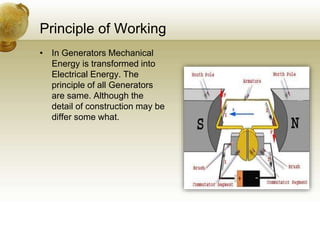
Principle of Working
• In Generators Mechanical
Energy is transformed into
Electrical Energy. The
principle of all Generators
are same. Although the
detail of construction may be
differ some what.
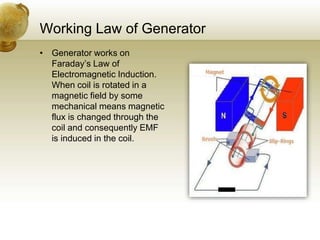
Working Law of Generator
• Generator works on
Faraday’s Law of
Electromagnetic Induction.
When coil is rotated in a
magnetic field by some
mechanical means magnetic
flux is changed through the
coil and consequently EMF
is induced in the coil.
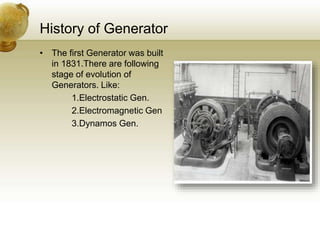
History of Generator
• The first Generator was built
in 1831.There are following
stage of evolution of
Generators. Like:
1.Electrostatic Gen.
2.Electromagnetic Gen
3.Dynamos Gen.
Inventor of Generator
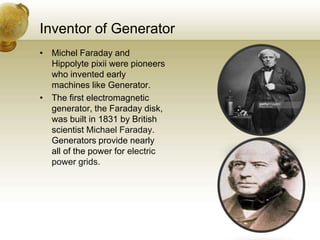
• Michel Faraday and
Hippolyte pixii were pioneers
who invented early
machines like Generator.
• The first electromagnetic
generator, the Faraday disk,
was built in 1831 by British
scientist Michael Faraday.
Generators provide nearly
all of the power for electric
power grids.
Law of Faraday
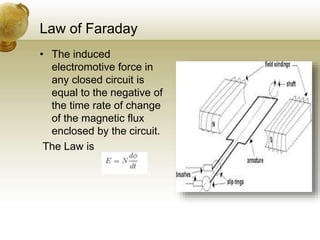
• The induced
electromotive force in
any closed circuit is
equal to the negative of
the time rate of change
of the magnetic flux
enclosed by the circuit.
The Law is
Types of Generator
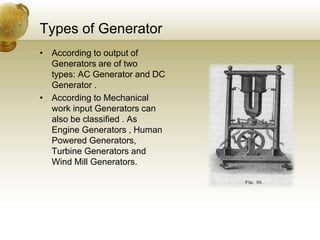
• According to output of
Generators are of two
types: AC Generator and DC
Generator .
• According to Mechanical
work input Generators can
also be classified . As
Engine Generators , Human
Powered Generators,
Turbine Generators and
Wind Mill Generators.
Parts of generator
• The generator is made up of
9 main parts . Like:
1.Engine.
2.Alternator.
3.Fuel system.
4.Voltage regulator.
5.Cooling system.
6.Lubrication system.
7.Control panel.
8.Exhaust system.
9.Battery charger.
Simple Problems of a Generator
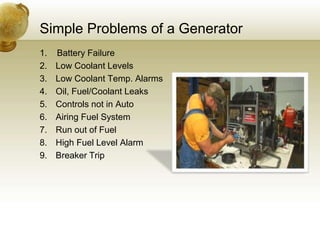
1. Battery Failure
2. Low Coolant Levels
3. Low Coolant Temp. Alarms
4. Oil, Fuel/Coolant Leaks
5. Controls not in Auto
6. Airing Fuel System
7. Run out of Fuel
8. High Fuel Level Alarm
9. Breaker Trip
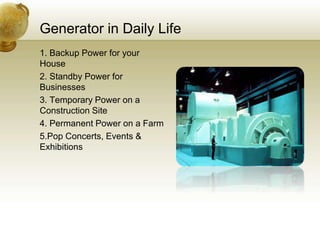
Generator in Daily Life
1. Backup Power for your
House
2. Standby Power for
Businesses
3. Temporary Power on a
Construction Site
4. Permanent Power on a Farm
5.Pop Concerts, Events &
Exhibitions
Thank You
All

Generator

  • 1.
  • 2.
    GENERATOR 1. Avijit Adhikary[ID:173-33-549] 2. Md. Habibulla [ID:173-33-542] 3. Md. Amran Nazir [ID:173-33-552] 4. Mofazzal Hossen [ID:173-33-556] 5. .Sajib Rana [ID:173-33-551]
  • 3.
    Context • Introduction Generator •Principle of Working • Working Law of Generator • History of Generator • Inventor of Generator • Law of Faraday • Types of Generator • Parts of Generator • Simple Problems of a Generator • Generator in Daily Life
  • 4.
    Introduction Generator • Thedevice which converts Mechanical Energy to Electrical Energy is called Generator. • It is rotated by a prime mover to produce Electricity
  • 5.
    Principle of Working •In Generators Mechanical Energy is transformed into Electrical Energy. The principle of all Generators are same. Although the detail of construction may be differ some what.
  • 6.
    Working Law ofGenerator • Generator works on Faraday’s Law of Electromagnetic Induction. When coil is rotated in a magnetic field by some mechanical means magnetic flux is changed through the coil and consequently EMF is induced in the coil.
  • 7.
    History of Generator •The first Generator was built in 1831.There are following stage of evolution of Generators. Like: 1.Electrostatic Gen. 2.Electromagnetic Gen 3.Dynamos Gen.
  • 8.
    Inventor of Generator •Michel Faraday and Hippolyte pixii were pioneers who invented early machines like Generator. • The first electromagnetic generator, the Faraday disk, was built in 1831 by British scientist Michael Faraday. Generators provide nearly all of the power for electric power grids.
  • 9.
    Law of Faraday •The induced electromotive force in any closed circuit is equal to the negative of the time rate of change of the magnetic flux enclosed by the circuit. The Law is
  • 10.
    Types of Generator •According to output of Generators are of two types: AC Generator and DC Generator . • According to Mechanical work input Generators can also be classified . As Engine Generators , Human Powered Generators, Turbine Generators and Wind Mill Generators.
  • 11.
    Parts of generator •The generator is made up of 9 main parts . Like: 1.Engine. 2.Alternator. 3.Fuel system. 4.Voltage regulator. 5.Cooling system. 6.Lubrication system. 7.Control panel. 8.Exhaust system. 9.Battery charger.
  • 12.
    Simple Problems ofa Generator 1. Battery Failure 2. Low Coolant Levels 3. Low Coolant Temp. Alarms 4. Oil, Fuel/Coolant Leaks 5. Controls not in Auto 6. Airing Fuel System 7. Run out of Fuel 8. High Fuel Level Alarm 9. Breaker Trip
  • 13.
    Generator in DailyLife 1. Backup Power for your House 2. Standby Power for Businesses 3. Temporary Power on a Construction Site 4. Permanent Power on a Farm 5.Pop Concerts, Events & Exhibitions
  • 14.