GENERATORS
Induced Current in a Generator 
The effect of inducing a current in a coil by moving a 
magnet inside it is used for the generation of 
electricity in power plants 
There are TWO TYPES OF GENERATOR. 
Both turn rotational energy into electrical energy. 
1. One type involves rotating a coil inside a magnet. 
2. The other type involves rotating a magnet inside 
a coil 
Both types produce ALTERNATING CURRENT.
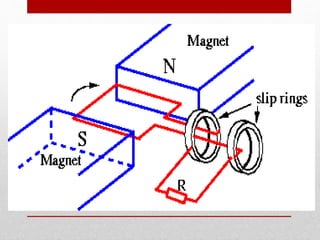
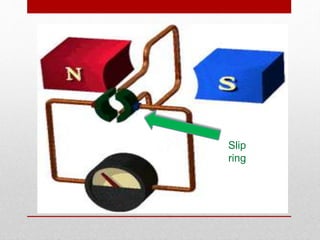
An electric generator consists of a: 
• MAGNET- creates a magnetic field, and a 
• LOOP OF WIRE- rotates in the magnetic field 
As the wire rotates in the magnetic field, the changing 
strength of the magnetic field through the wire 
produces a force which drives the electric charges 
around the wire. 
As the loop spins, the direction of the force changes, 
so too then does the direction of the current . 
The changing direction of the force after every 180 
degrees of rotation gives the alternating current.
Slip 
ring
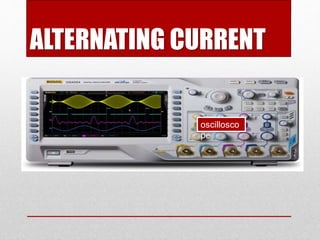
ALTERNATING CURRENT 
oscillosco 
pe
ALTERNATING CURRENT 
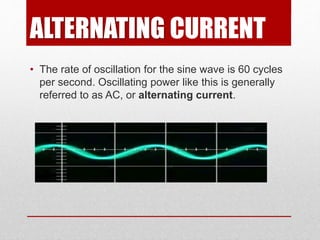
• The rate of oscillation for the sine wave is 60 cycles 
per second. Oscillating power like this is generally 
referred to as AC, or alternating current.
ALTERNATING CURRENT 
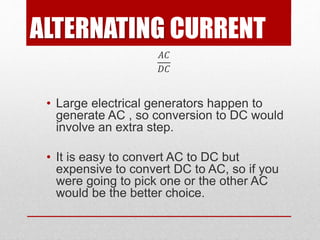
퐴퐶 
퐷퐶 
• Large electrical generators happen to 
generate AC , so conversion to DC would 
involve an extra step. 
• It is easy to convert AC to DC but 
expensive to convert DC to AC, so if you 
were going to pick one or the other AC 
would be the better choice.

Generators

  • 1.
  • 2.
    Induced Current ina Generator The effect of inducing a current in a coil by moving a magnet inside it is used for the generation of electricity in power plants There are TWO TYPES OF GENERATOR. Both turn rotational energy into electrical energy. 1. One type involves rotating a coil inside a magnet. 2. The other type involves rotating a magnet inside a coil Both types produce ALTERNATING CURRENT.
  • 3.
    An electric generatorconsists of a: • MAGNET- creates a magnetic field, and a • LOOP OF WIRE- rotates in the magnetic field As the wire rotates in the magnetic field, the changing strength of the magnetic field through the wire produces a force which drives the electric charges around the wire. As the loop spins, the direction of the force changes, so too then does the direction of the current . The changing direction of the force after every 180 degrees of rotation gives the alternating current.
  • 5.
  • 6.
  • 7.
    ALTERNATING CURRENT •The rate of oscillation for the sine wave is 60 cycles per second. Oscillating power like this is generally referred to as AC, or alternating current.
  • 8.
    ALTERNATING CURRENT 퐴퐶 퐷퐶 • Large electrical generators happen to generate AC , so conversion to DC would involve an extra step. • It is easy to convert AC to DC but expensive to convert DC to AC, so if you were going to pick one or the other AC would be the better choice.

Editor's Notes

  • #6 Green thingy is the slip ring
  • #8  𝐴𝐶 𝐷𝐶 -large electrical generators generate AC -expensive to convert DC to AC