

GENERALIZED
ANXIETY
DISORDER
By
Joysri Roy
B.Sc Psychology(Hons)
Bethune college,Kolkata
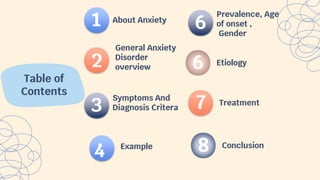
Prevalence, Age
of onset ,
Gender
8
Treatment
About Anxiety
2
General Anxiety
Disorder
overview
3
Symptoms And
Diagnosis Critera
Example Conclusion
Etiology
7
6
4
1 6
Table of
Contents
About
Anxiety
1
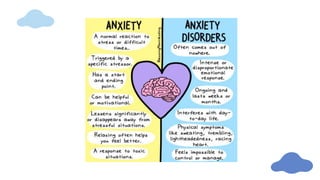
ANXIETY
Anxiety involves a general feeling
of apprehension about possible
future danger.
Anxiety disorders create
enormous personal ,economic,
health care problems for those
affected and for society more
generally. It is often associate
with other medical conditions
including asthma, chronic pain,
hypertension, arthritis,
cardiovascular disease ,and
irritable bowel syndrome.
 General Anxiety Disorder
 Phobias
 Social anxiety disorder
 Panic disorder
 Obsession-compulsive Disorder
Types of Anxiety Disorders
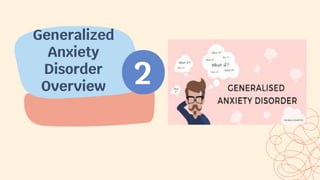
Generalized
Anxiety
Disorder
Overview 2
People with generalized anxiety disorder experience excessive
anxiety under most circumstances and worry about practically
anything. In fact, their problem is sometimes described as free
floating anxiety. For some People ,worry about many different aspect
of life become chronic, excessive and unreasonable. The worry must
be about a number of events and activities and its content cannot be
exclusively related to the worry associated with another concurrent
disorders,like,the possibility of panic attack. People with GAD are relatively
future-oriented and diffuse uneasiness that they cannot control.
Generalized Anxiety Disorder(GAD)
Symptoms and
diagnisis
criteria of GAD 2
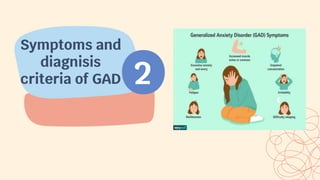
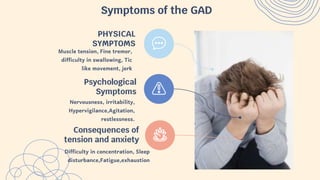
Symptoms of the GAD
Muscle tension, Fine tremor,
difficulty in swallowing, Tic
like movement, jerk
PHYSICAL
SYMPTOMS
Nervousness, irritability,
Hypervigilance,Agitation,
restlessness.
Psychological
Symptoms
Difficulty in concentration, Sleep
disturbance,Fatigue,exhaustion
Consequences of
tension and anxiety
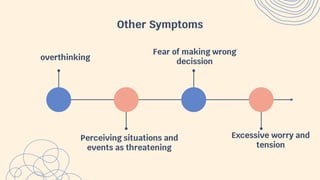
Other Symptoms
Excessive worry and
tension
Perceiving situations and
events as threatening
Fear of making wrong
decission
overthinking
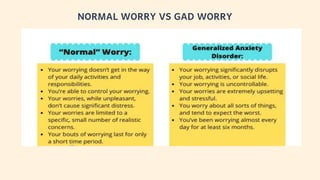
NORMAL WORRY VS GAD WORRY
DSM 5 Criteria
A. Excessive anxiety and worry (apprehensive expectation),
occurring more days than not for at least 6 months, about
a number of events or activities (such as work or school
performance).
B. The individual finds it difficult to control the worry.
C. The anxiety and worry are associated with three (or more)
of the following six symptoms (with at least some symptoms
having been present for more days than not for the past 6
months):
Note: Only one item is required in children.
1. Restlessness or feeling keyed up or on edge.
2. Being easily fatigued.
3. Difficulty concentrating or mind going blank.
4. Irritability.
5. Muscle tension.
6. Sleep disturbance (difficulty falling or staying asleep, or
restless, unsatisfying sleep).
D. The anxiety, worry, or physical symptoms cause clinically
significant distress or impairment in social, occupational, or
other important areas of functioning.
E. The disturbance is not attributable to the physiological
effects of a substance (e.g., a drug of abuse, a medication) or
another medical condition (e.g., hyperthyroidism).
F. The disturbance is not better explained by another mental
disorder (e.g., anxiety or worry about having panic attacks
in panic disorder, negative evaluation in social anxiety
disorder [social phobia], contamination or other
obsessions in obsessive-compulsive disorder, separation
from attachment figures in separation anxiety disorder,
reminders of traumatic events in posttraumatic stress
disorder, gaining weight in anorexia nervosa, physical
complaints in somatic symptom disorder, perceived
appearance flaws in body dysmorphic disorder, having a
serious illness in illness anxiety disorder, or the content of
delusional beliefs in schizophrenia or delusional disorder).
Source: Reprinted with permission from the Diagnostic and
Statistical Manual of Mental Disorders, Fifth Edition,
(Copyright 2013). American Psychiatric Association.
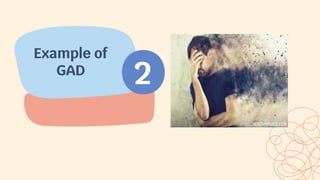
Example of
GAD
2
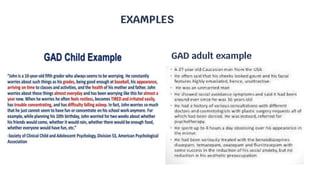
EXAMPLES
GAD adult example
Prevalence
,Age of onset,
Gender 2
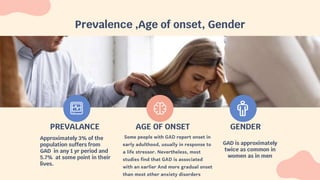
Prevalence ,Age of onset, Gender
GAD is approximately
twice as common in
women as in men
Some people with GAD report onset in
early adulthood, usually in response to
a life stressor. Nevertheless, most
studies find that GAD is associated
with an earlier And more gradual onset
than most other anxiety disorders
PREVALANCE AGE OF ONSET GENDER
Approximately 3% of the
population suffers from
GAD in any 1 yr period and
5.7% at some point in their
lives.
Sigmund Freud (1933, 1917) believed that
all children experience some degree of
anxiety as part of growing up and that all
use ego defense mechanisms to help
control such anxiety child’s ego defense
mechanisms may be too weak to cope with
even normal levels of anxiety.
Overprotected children, shielded by their
parents from all frustrations and threats,
have little opportunity to develop effective
defense mechanisms. When they face the
pressures of adult life, their defense
mechanismsmay be too weak to cope with
the resulting anxieties.
Psychodynamics
perspective
Rogers believed that children who fail to
receive unconditional positive regard from
others may become overly critical of
themselves and develop harsh self-
standards, what Rogers called conditions of
worth. They try to meet these standards by
repeatedly distorting and denying their
true thoughts and experiences. Despite
such efforts, however, threatening self
judgments keep breaking through and
causing them intense anxiety. This
onslaught of anxiety sets the stage for
generalized anxiety disorder or some other
form of psychological dysfunctioning.
Humanistic
perspective
Psychological Perspective
Psychological
perspective
Cognitive
perspective
Biological
perspective
Sociocultural
perspective
ETIOLOGY
Generally anxious people tend to preferentially allocate their
attention toward threatening cues when both threat and nonthreat
cues are present in the environment. Attentional vigilance for
threat cues can occur at a very early stage of information
processing, even before the information has entered the person’s
conscious awareness. If a person is already anxious, having her or
his attention automatically focused on threat cues in the
environment would seem only to maintain the anxiety or even
make it worse. Generally anxious people are also more likely than
nonanxious people to think that bad things are likely to happen in
the future, and they have a much stronger tendency to interpret
ambiguous information in a threatening way.
COGNITIVE PERSPECTIVE
Several large twin studies reveal exactly how
heritability estimates vary as a function of one’s
definition of GAD .The largest and most recent of
these twin studies using the DSM-IV-TR
Diagnostic criteria estimate that 15 to 20 percent
of the variance in liability to GAD is due to
Genetic factors. The evidence is increasingly
strong that GAD and major depressive disorder
have a common underlying genetic predisposition
What determines whether individuals with a
genetic risk for GAD and/or major depression
develop one or the other disorder seems to
depend entirely on the specific environmental
experiences they have (no shared environment).
GENETICS
Gamma-aminobutyric acid (GABA), a common neurotransmitter in the
brain,carry Messages from one neuron to another. GABA carries
inhibitory messages: when GABA is received at a receptor, it causes the
neuron to stop firing. highly anxious people have a kind of functional
deficiency in GABA, which ordinarily plays an important role in the
way our brain inhibits anxiety in stressful situations. The
benzodiazepine drugs appear to reduce anxiety by increasing GABA
activity in certain parts of the brain implicated in neurotransmitter
serotonin—is also involved in modulating generalized anxiety When
activated by stress or perceived threat, CRH stimulates the release of
ACTH from the pituitary gland, which in turn causes release of the
stress hormone cortisol from the adrenal gland cortisol helps
the body deal with stress. The CRH hormone may play an important
role in generalized anxiety through its effects on the bed nucleus of
the striaterminalis
NEUROTRANSMITTER
AND HORMONES
BIOLOGICAL PERSPECTIVE
BRAIN DYSFUNCTIONING
BIOLOGICAL PERSPECTIVES
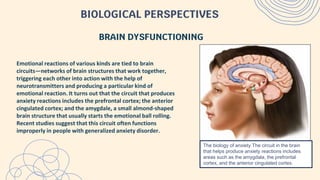
Emotional reactions of various kinds are tied to brain
circuits—networks of brain structures that work together,
triggering each other into action with the help of
neurotransmitters and producing a particular kind of
emotional reaction. It turns out that the circuit that produces
anxiety reactions includes the prefrontal cortex; the anterior
cingulated cortex; and the amygdale, a small almond-shaped
brain structure that usually starts the emotional ball rolling.
Recent studies suggest that this circuit often functions
improperly in people with generalized anxiety disorder.
The biology of anxiety The circuit in the brain
that helps produce anxiety reactions includes
areas such as the amygdala, the prefrontal
cortex, and the anterior cingulated cortex.
SOCIOCULTURAL PERSPECTIVE
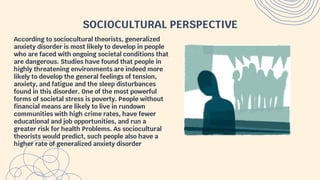
According to sociocultural theorists, generalized
anxiety disorder is most likely to develop in people
who are faced with ongoing societal conditions that
are dangerous. Studies have found that people in
highly threatening environments are indeed more
likely to develop the general feelings of tension,
anxiety, and fatigue and the sleep disturbances
found in this disorder. One of the most powerful
forms of societal stress is poverty. People without
financial means are likely to live in rundown
communities with high crime rates, have fewer
educational and job opportunities, and run a
greater risk for health Problems. As sociocultural
theorists would predict, such people also have a
higher rate of generalized anxiety disorder
TREATMENT OF GAD
MEDICATION
CBT
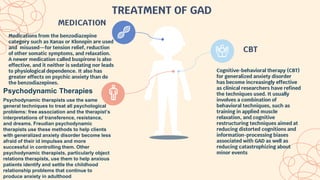
Medications from the benzodiazepine
category such as Xanax or Klonopin are used
and misused—for tension relief, reduction
of other somatic symptoms, and relaxation.
A newer medication called buspirone is also
effective, and it neither is sedating nor leads
to physiological dependence. It also has
greater effects on psychic anxiety than do
the benzodiazepines.
Cognitive-behavioral therapy (CBT)
for generalized anxiety disorder
has become increasingly effective
as clinical researchers have refined
the techniques used. It usually
involves a combination of
behavioral techniques, such as
training in applied muscle
relaxation, and cognitive
restructuring techniques aimed at
reducing distorted cognitions and
information-processing biases
associated with GAD as well as
reducing catastrophizing about
minor events
Psychodynamic therapists use the same
general techniques to treat all psychological
problems: free association and the therapist’s
interpretations of transference, resistance,
and dreams. Freudian psychodynamic
therapists use these methods to help clients
with generalized anxiety disorder become less
afraid of their id impulses and more
successful in controlling them. Other
psychodynamic therapists, particularly object
relations therapists, use them to help anxious
patients identify and settle the childhood
relationship problems that continue to
produce anxiety in adulthood
Psychodynamic Therapies
CONCLUSION
Generalized anxiety disorder can lead to many serious
conditions. There are medications and effective
psychotherapies available for GAD. So, we have to fight
against the GAD and recover it.
REFERENCES
THANK
YOU

Generalized anxiety disorder

  • 1.
  • 2.
    Prevalence, Age of onset, Gender 8 Treatment About Anxiety 2 General Anxiety Disorder overview 3 Symptoms And Diagnosis Critera Example Conclusion Etiology 7 6 4 1 6 Table of Contents
  • 3.
  • 4.
    ANXIETY Anxiety involves ageneral feeling of apprehension about possible future danger. Anxiety disorders create enormous personal ,economic, health care problems for those affected and for society more generally. It is often associate with other medical conditions including asthma, chronic pain, hypertension, arthritis, cardiovascular disease ,and irritable bowel syndrome.
  • 6.
     General AnxietyDisorder  Phobias  Social anxiety disorder  Panic disorder  Obsession-compulsive Disorder Types of Anxiety Disorders
  • 7.
  • 8.
    People with generalizedanxiety disorder experience excessive anxiety under most circumstances and worry about practically anything. In fact, their problem is sometimes described as free floating anxiety. For some People ,worry about many different aspect of life become chronic, excessive and unreasonable. The worry must be about a number of events and activities and its content cannot be exclusively related to the worry associated with another concurrent disorders,like,the possibility of panic attack. People with GAD are relatively future-oriented and diffuse uneasiness that they cannot control. Generalized Anxiety Disorder(GAD)
  • 9.
  • 10.
    Symptoms of theGAD Muscle tension, Fine tremor, difficulty in swallowing, Tic like movement, jerk PHYSICAL SYMPTOMS Nervousness, irritability, Hypervigilance,Agitation, restlessness. Psychological Symptoms Difficulty in concentration, Sleep disturbance,Fatigue,exhaustion Consequences of tension and anxiety
  • 11.
    Other Symptoms Excessive worryand tension Perceiving situations and events as threatening Fear of making wrong decission overthinking
  • 12.
    NORMAL WORRY VSGAD WORRY
  • 13.
    DSM 5 Criteria A.Excessive anxiety and worry (apprehensive expectation), occurring more days than not for at least 6 months, about a number of events or activities (such as work or school performance). B. The individual finds it difficult to control the worry. C. The anxiety and worry are associated with three (or more) of the following six symptoms (with at least some symptoms having been present for more days than not for the past 6 months): Note: Only one item is required in children. 1. Restlessness or feeling keyed up or on edge. 2. Being easily fatigued. 3. Difficulty concentrating or mind going blank. 4. Irritability. 5. Muscle tension. 6. Sleep disturbance (difficulty falling or staying asleep, or restless, unsatisfying sleep). D. The anxiety, worry, or physical symptoms cause clinically significant distress or impairment in social, occupational, or other important areas of functioning. E. The disturbance is not attributable to the physiological effects of a substance (e.g., a drug of abuse, a medication) or another medical condition (e.g., hyperthyroidism). F. The disturbance is not better explained by another mental disorder (e.g., anxiety or worry about having panic attacks in panic disorder, negative evaluation in social anxiety disorder [social phobia], contamination or other obsessions in obsessive-compulsive disorder, separation from attachment figures in separation anxiety disorder, reminders of traumatic events in posttraumatic stress disorder, gaining weight in anorexia nervosa, physical complaints in somatic symptom disorder, perceived appearance flaws in body dysmorphic disorder, having a serious illness in illness anxiety disorder, or the content of delusional beliefs in schizophrenia or delusional disorder). Source: Reprinted with permission from the Diagnostic and Statistical Manual of Mental Disorders, Fifth Edition, (Copyright 2013). American Psychiatric Association.
  • 14.
  • 15.
  • 16.
  • 17.
    Prevalence ,Age ofonset, Gender GAD is approximately twice as common in women as in men Some people with GAD report onset in early adulthood, usually in response to a life stressor. Nevertheless, most studies find that GAD is associated with an earlier And more gradual onset than most other anxiety disorders PREVALANCE AGE OF ONSET GENDER Approximately 3% of the population suffers from GAD in any 1 yr period and 5.7% at some point in their lives.
  • 18.
    Sigmund Freud (1933,1917) believed that all children experience some degree of anxiety as part of growing up and that all use ego defense mechanisms to help control such anxiety child’s ego defense mechanisms may be too weak to cope with even normal levels of anxiety. Overprotected children, shielded by their parents from all frustrations and threats, have little opportunity to develop effective defense mechanisms. When they face the pressures of adult life, their defense mechanismsmay be too weak to cope with the resulting anxieties. Psychodynamics perspective Rogers believed that children who fail to receive unconditional positive regard from others may become overly critical of themselves and develop harsh self- standards, what Rogers called conditions of worth. They try to meet these standards by repeatedly distorting and denying their true thoughts and experiences. Despite such efforts, however, threatening self judgments keep breaking through and causing them intense anxiety. This onslaught of anxiety sets the stage for generalized anxiety disorder or some other form of psychological dysfunctioning. Humanistic perspective Psychological Perspective
  • 19.
  • 20.
    Generally anxious peopletend to preferentially allocate their attention toward threatening cues when both threat and nonthreat cues are present in the environment. Attentional vigilance for threat cues can occur at a very early stage of information processing, even before the information has entered the person’s conscious awareness. If a person is already anxious, having her or his attention automatically focused on threat cues in the environment would seem only to maintain the anxiety or even make it worse. Generally anxious people are also more likely than nonanxious people to think that bad things are likely to happen in the future, and they have a much stronger tendency to interpret ambiguous information in a threatening way. COGNITIVE PERSPECTIVE
  • 21.
    Several large twinstudies reveal exactly how heritability estimates vary as a function of one’s definition of GAD .The largest and most recent of these twin studies using the DSM-IV-TR Diagnostic criteria estimate that 15 to 20 percent of the variance in liability to GAD is due to Genetic factors. The evidence is increasingly strong that GAD and major depressive disorder have a common underlying genetic predisposition What determines whether individuals with a genetic risk for GAD and/or major depression develop one or the other disorder seems to depend entirely on the specific environmental experiences they have (no shared environment). GENETICS Gamma-aminobutyric acid (GABA), a common neurotransmitter in the brain,carry Messages from one neuron to another. GABA carries inhibitory messages: when GABA is received at a receptor, it causes the neuron to stop firing. highly anxious people have a kind of functional deficiency in GABA, which ordinarily plays an important role in the way our brain inhibits anxiety in stressful situations. The benzodiazepine drugs appear to reduce anxiety by increasing GABA activity in certain parts of the brain implicated in neurotransmitter serotonin—is also involved in modulating generalized anxiety When activated by stress or perceived threat, CRH stimulates the release of ACTH from the pituitary gland, which in turn causes release of the stress hormone cortisol from the adrenal gland cortisol helps the body deal with stress. The CRH hormone may play an important role in generalized anxiety through its effects on the bed nucleus of the striaterminalis NEUROTRANSMITTER AND HORMONES BIOLOGICAL PERSPECTIVE
  • 22.
    BRAIN DYSFUNCTIONING BIOLOGICAL PERSPECTIVES Emotionalreactions of various kinds are tied to brain circuits—networks of brain structures that work together, triggering each other into action with the help of neurotransmitters and producing a particular kind of emotional reaction. It turns out that the circuit that produces anxiety reactions includes the prefrontal cortex; the anterior cingulated cortex; and the amygdale, a small almond-shaped brain structure that usually starts the emotional ball rolling. Recent studies suggest that this circuit often functions improperly in people with generalized anxiety disorder. The biology of anxiety The circuit in the brain that helps produce anxiety reactions includes areas such as the amygdala, the prefrontal cortex, and the anterior cingulated cortex.
  • 23.
    SOCIOCULTURAL PERSPECTIVE According tosociocultural theorists, generalized anxiety disorder is most likely to develop in people who are faced with ongoing societal conditions that are dangerous. Studies have found that people in highly threatening environments are indeed more likely to develop the general feelings of tension, anxiety, and fatigue and the sleep disturbances found in this disorder. One of the most powerful forms of societal stress is poverty. People without financial means are likely to live in rundown communities with high crime rates, have fewer educational and job opportunities, and run a greater risk for health Problems. As sociocultural theorists would predict, such people also have a higher rate of generalized anxiety disorder
  • 24.
    TREATMENT OF GAD MEDICATION CBT Medicationsfrom the benzodiazepine category such as Xanax or Klonopin are used and misused—for tension relief, reduction of other somatic symptoms, and relaxation. A newer medication called buspirone is also effective, and it neither is sedating nor leads to physiological dependence. It also has greater effects on psychic anxiety than do the benzodiazepines. Cognitive-behavioral therapy (CBT) for generalized anxiety disorder has become increasingly effective as clinical researchers have refined the techniques used. It usually involves a combination of behavioral techniques, such as training in applied muscle relaxation, and cognitive restructuring techniques aimed at reducing distorted cognitions and information-processing biases associated with GAD as well as reducing catastrophizing about minor events Psychodynamic therapists use the same general techniques to treat all psychological problems: free association and the therapist’s interpretations of transference, resistance, and dreams. Freudian psychodynamic therapists use these methods to help clients with generalized anxiety disorder become less afraid of their id impulses and more successful in controlling them. Other psychodynamic therapists, particularly object relations therapists, use them to help anxious patients identify and settle the childhood relationship problems that continue to produce anxiety in adulthood Psychodynamic Therapies
  • 25.
    CONCLUSION Generalized anxiety disordercan lead to many serious conditions. There are medications and effective psychotherapies available for GAD. So, we have to fight against the GAD and recover it.
  • 26.
  • 27.