Generalized Anxiety
Disorder
Prakash Gajbhiye
M.Phil clinical psychology
Gwalior Mansik Arogyashala
INTRODUCTION
• Anxiety can be conceptualized as a
normal and adaptive response to threat
that prepares the organism for flight or
fight.
• Persons who seem to be anxious about
almost everything, however, are likely to
be classified as having generalized
anxiety disorder.
• Generalized anxiety disorder is defined as
excessive anxiety and worry about several
events or activities for most days during
at least a 6-month period.
• The worry is difficult to control and is
associated with somatic symptoms, such
as muscle tension, irritability, difficulty
sleeping, and restlessness.
• The anxiety is not focused on features of
another disorder
• is not caused by substance use or a general
medical condition
• and does not occur only during a mood or
psychiatric disorder.
• The anxiety is difficult to control, is
subjectively distressing, and produces
impairment in important areas of a
person’s life.
CLINICAL PICTURE
•Worry and apprehension that are more
prolonged than in healthy people.
•The worries are widespread and are not
focused on a specific issue as they are in panic
disorder (i.e. on having a panic attack), social
phobia (i.e. on being embarrassed), or OCD (i.e.
on contamination).
•The person feels that these widespread worries
are difficult to control.
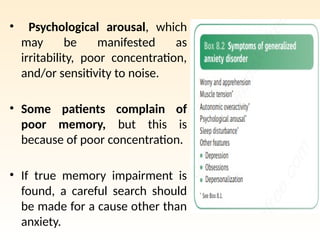
• Psychological arousal, which
may be manifested as
irritability, poor concentration,
and/or sensitivity to noise.
• Some patients complain of
poor memory, but this is
because of poor concentration.
• If true memory impairment is
found, a careful search should
be made for a cause other than
anxiety.
Autonomic over-activity
• which is most often experienced as sweating,
palpitations, dry mouth, epigastric discomfort, and
dizziness.
Muscle tension
• which may be experienced as restlessness, trembling,
inability to relax, headache (usually bilateral and frontal
or occipital), and aching of the shoulders and back.
Hyperventilation
• which may lead to dizziness, tingling in
the extremities and, paradoxically, a
feeling of shortness of breath.
Sleep disturbances
• difficulty in falling asleep and persistent
worrying thoughts.
• Sleep is often intermittent, unrefreshing,
and accompanied by unpleasant dreams.
• Some patients have night terrors and wake
suddenly feeling extremely anxious.
• Early-morning waking is not a feature of
GAD, and its presence strongly suggests a
depressive disorder.
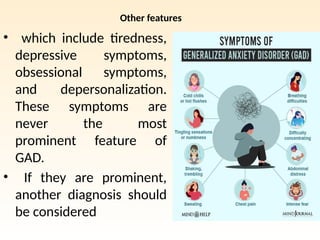
Other features
• which include tiredness,
depressive symptoms,
obsessional symptoms,
and depersonalization.
These symptoms are
never the most
prominent feature of
GAD.
• If they are prominent,
another diagnosis should
be considered
CLINICAL SIGNS
• The face appears strained, the brow is
furrowed, and the posture is tense. The
person is restless and may tremble. The skin is
pale, and sweating is common, especially from
the hands, feet, and axillae. Being close to
tears, which may at first suggest depression,
reflects the generally apprehensive state.
ICD10 DIGNOSTIC GUIDELINES
• The sufferer must have primary symptoms of anxiety
most days for at least several weeks at a time and
usually for several months. These symptoms should
usually involve elements of ;
In children, Frequent need for reassurance and recurrent
somatic complains may be prominent.
apprehension Motor tension Autonomic over-activity
worries about future
misfortunes. feeling “on
age”, Difficulty in
concentrating. Etc
restless fidgeting, tension
headaches ,Trembling ,
Inability to relax
lightheadedness,
Sweating , Tachycardia or
tachypnoea, Epigastric
discomfort, Dizziness. Dry
mouth, etc.
COMORBIDITY
• Generalized anxiety disorder is probably the
disorder that most often coexists with another
mental disorder, usually social phobia, specific
phobia, panic disorder, or a depressive disorder.
• Perhaps 50 to 90 percent of patients with
generalized anxiety disorder have another
mental disorder.
• As many as 25 percent of patients eventually
experience panic disorder.
• An additional high percentage of patients
are likely to have major depressive
disorder.
• Other common disorders associated
with generalized anxiety disorder are
dysthymic disorder and substance
related disorders
EPIDEMIOLOGY
• The Adult Psychiatric Morbidity Survey
found a 12-month prevalence of 4.4% for
GAD in England .
• a similar figure has been reported in US
surveys, with rather lower prevalence
figures in European countries (around 2%;
Wittchen et al., 2011).
• Rates in women are about twice as high as
those in men.
Prevalence of anxiety disorders in India
• Reddy and Chandrashekhar, in their meta-analysis of
13 studies with a sample size of 33 572 subjects,
found neurotic disorders to have the highest
estimated prevalence rate, 20.7% (18.7% to 22.7%).
Of the neurotic disorders they studied, only phobia
and GAD are included under anxiety disorders as
per the current DSM-5 criteria, with weighted
prevalence values of 4.2% and 5.8% respectively.
• Urban communities had higher prevalence rates
(35.7% vs 13.9%) than rural communities.
• GAD is associated with several indices of
social disadvantage, including lower
household income and unemployment, as
well as divorce and separation (McManus
et al., 2009).
• Rates of anxiety, as well as expressions of
anxiety, vary across development, and the
anxiety disorders are the most common
child mental disorders
AETIOLOGY
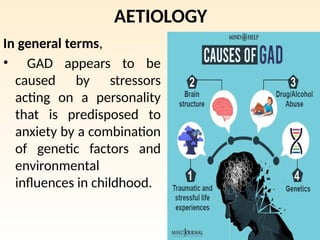
In general terms,
• GAD appears to be
caused by stressors
acting on a personality
that is predisposed to
anxiety by a combination
of genetic factors and
environmental
influences in childhood.
Stressful events
• A study by Kendler et al. (2003) showed that
stressful life events characterized by loss
increased the risk of both depression and
GAD. However, life events characterized by
‘danger’ (where the full import of the event
was yet to be realized) were more common in
those who subsequently developed GAD.
Genetic causes
• Early twin studies, such as that by Slater and
Shields (1969), showed a higher concordance
for anxiety disorder between monozygotic
than dizygotic pairs, which suggests that the
familial association has a genetic cause.
• However, the genes involved in the
transmission of GAD appear to increase
susceptibility to other anxiety conditions, such
as panic disorder and agoraphobia, as well as to
major depression.
• Overall, the findings suggest that genes play a
significant although moderate role in the
aetiology of GAD, but that the genes involved
predispose to a range of anxiety and
depressive disorders, rather than GAD
specifically (Shimada-Sugimoto et al., 2015).
Social Factors
• Brown and Harris (1993) studied the
relationship between adverse experience in
childhood and anxiety disorder in adult life in
404 working-class women living in an inner
city.
• Adverse early experience was assessed from
patients’ accounts of parental indifference and
of physical or sexual abuse.
• Women who reported early adversity
had increased rates of GAD (and also
of agoraphobia and depressive
disorder, but not of simple phobia).
Parenting styles
• characterized by overprotection and lack of
emotional warmth may also be a risk factor for
GAD, as well as for other anxiety and
depressive disorders in offspring.
Psychoanalytic theories
Psychoanalytical theory proposes that
anxiety arises from intra-psychic conflict
when the ego is overwhelmed by
excitation from any of the following three
sources
Early experiences
• Accounts given by anxious patients of
their experience in childhood suggest
that early adverse experience is a cause
of GAD. These accounts have given rise
to objective studies and to
psychoanalytic theories.
• the outside world (realistic anxiety);
• the instinctual levels of the id, including
love, anger, and sex (neurotic anxiety);
THE SUPEREGO (moral anxiety)
• According to this theory, in GAD, anxiety
is experienced directly unmodified by the
defence mechanisms that are thought to
be the basis of phobias or obsessions.
• The theory proposes that in GADs the
ego is readily overwhelmed because it has
been weakened by a development failure
in childhood.
• Normally, children overcome this anxiety
through secure relationships with loving
parents.
• However, if they do not achieve this
security, as adults they will be vulnerable
to anxiety when experiencing separation
or potentially threatening events.
• Thus both psychoanalytic ideas and
objective studies suggest that good
parenting can protect against anxiety by
giving the child a secure emotional base
from which to explore an uncertain world
Cognitive Behavioural Theory
• Conditioning theories propose that GAD arises
when there is an inherited predisposition to
excessive responsiveness of the autonomic
nervous system, together with generalization of
the responses through conditioning of anxiety
to previously neutral stimuli.
• This theory has not been supported by a
body of objective data.
• Cognitive theory. Particular coping and
cognitive styles may also predispose
individuals to the development of GAD,
• it seems likely that people who lack a sense of
control of events and of personal
effectiveness, perhaps because of early life
experiences, are more prone to anxiety
disorders.
• Such individuals may also demonstrate trait-
like cognitive biases in the form of increased
attention to potentially threatening stimuli,
overestimation of environmental threat, and
enhanced memory of threatening material.
• More recent cognitive formulations have focused on
the process of worry itself. It has been proposed
that people who are predisposed to GAD use worry
as a positive coping strategy for dealing with
potential threats,
• whereby the individual cannot relax until they have
examined all of the possible dangers and identified
ways of dealing with them.
• However, this can lead to ‘worry about worry’,
when a person comes to believe, for example,
that worrying in this way, although necessary for
them, is also uncontrollable and harmful.
• This ‘metacognitive belief’ may form a transition
between excessive but normal worrying, and
GAD (Wells, 2013)
Personality
• Anxiety symptoms are associated with
neuroticism, and twin studies have shown
an overlap between the genetic factors
related to neuroticism and those related to
GAD (Hettema et al., 2004).
Personality disorder
• GAD occurs in people with anxious–avoidant
personality disorders, but also in individuals
with other personality disorders
Neurobiological mechanism
• Studies in animals have indicated a key role for
the amygdala, which receives sensory
information both directly from the thalamus
and from a longer pathway involving the
somatosensory cortex and anterior cingulate
cortex.
• Cortical involvement in anxiety is important
because it indicates a role for cognitive
processes in its expression.
• The hippocampus is also believed to have an
important role in the regulation of anxiety,
because it relates fearful memories to relevant
present contexts.
• Breakdown of this mechanism could lead to an
overgeneralization of fear in response to
nonthreatening stimuli (Cain et al., 2013).
Animal experimental
• studies have led to an understanding of the
regulation of anxiety in the brain by
neurotransmitters and neuromodulators.
• Noradrenergic neurons that originate in the locus
coeruleus increase arousal and anxiety,
• whereas 5-HT neurons that arise in the raphe
nuclei appear to have complex effects, and serve
both to signal the presence of anxiety-producing
stimuli in the environment and also to restrain the
associated behavioral responses.
(GABA)
• Gamma-aminobutyric acid receptors, which
are widely distributed in the brain, are
inhibitory and reduce anxiety, as do the
associated benzodiazepine-binding sites.
• There is probably also an important role for
corticotropin-releasing hormone, which increases
anxiety-related behaviours and is found in high
concentration in the amygdala.
• However, although pharmacological manipulation
of 5-HT and GABA mechanisms can be helpful in
the treatment of generalized anxiety, there is no
firm evidence that changes in these
neurotransmitters are fundamentally involved in
the pathophysiology of the disorder (Garner
et al., 2009).
• Functional imaging of the brain during the
presentation of aversive stimuli (e.g. fearful
faces) has shown inconsistent changes in
amygdala reactivity in patients with GAD.
• There is more reliable evidence of altered
activity in cortical regulatory regions such as
the ventrolateral prefrontal cortex and
altered connectivity between this region
and the amygdala
Differential diagnosis
• GAD has to be distinguished not only from
other psychiatric disorders but also from
certain physical conditions.
• Anxiety symptoms can occur in nearly all
psychiatric disorders, but there are some in
which particular diagnostic difficulties arise.
Depressive disorder
• Anxiety is a common symptom in
depressive disorder, and GAD often
includes some depressive symptoms.
• The usual convention is that the diagnosis
is decided on the basis of the severity of
two kinds of symptom and the order in
which they appeared
Information on these two points should be
obtained, if possible, from a relative or other
informant as well as from the patient.
Whichever type of symptoms appeared first and is
more severe is considered primary.
An important diagnostic error is to misdiagnose
the agitated type of severe depressive disorder as
GAD.
This mistake will seldom be made if anxious
patients are asked routinely about symptoms of a
depressive disorder, including depressive thinking
and, when appropriate, suicidal ideas.
As noted above, in some patients a depressive
disorder and GAD coexist and both diagnoses can
be made
Schizophrenia
• People with schizophrenia sometimes complain of
anxiety before the other symptoms are recognized.
• The chance of misdiagnosis can be reduced by asking
anxious patients routinely what they think caused their
symptoms.
• Schizophrenic patients may give an unusual reply,
which leads to the discovery of previously unexpressed
delusional ideas.
Dementia
• Anxiety may be the first abnormality to be
complained of by a person developing
dementia.
• When this happens, the clinician may not
detect an associated impairment of memory, or
may dismiss it as the result of poor
concentration. Therefore memory should be
assessed in middle-aged or older patients who
present with anxiety.
Substance Misuse
• Some people take drugs or alcohol to relieve
anxiety.
• Patients who are dependent on drugs or
alcohol sometimes believe that the symptoms
of drug withdrawal are those of anxiety, and
take anxiolytic or other drugs to control them.
• The clinician should be alert to this possibility,
particularly when anxiety is severe on waking in
the morning, which is the time when alcohol
and drug withdrawal symptoms tend to occur.
Prognosis
• One of the DSM-5 criteria for GAD is that the
symptoms should have been present for 6 months.
• One of the reasons for this cut-off is that anxiety
disorders that last for longer than 6 months have a
poor prognosis.
• Thus most clinical studies suggest that
GAD is typically a chronic condition with
low rates of remission over the short and
medium term.
• Evaluation of the prognosis is complicated
by the frequent comorbidity with other
anxiety disorders and depression, which
worsen the long-term outcome and
accompanying burden of disability
• In the Harvard–Brown Anxiety Research
Program, which recruited patients from Boston
hospitals, the mean age of onset of GAD was
21 years, although many patients had been
unwell since their teenage years.
• The average duration of illness in this group
was about 20 years and, despite treatment, the
outcome over the next 3 years was relatively
poor, with only one in four patients showing
symptomatic remission from GAD (Yonkers
et al., 1996).
• However, the participants in the above study
were recruited from hospital services, and
may not be representative of GAD in
community settings.
• In a naturalistic study in the UK, Tyrer and
colleagues (2004a) followed up patients with
anxiety and identified in primary care and
found that, 12 years later, 40% of those
initially diagnosed with GAD had recovered, in
the sense that they no longer met the criteria
for any DSM-III psychiatric disorder.
• The remaining participants continued to be
symptomatic, but in only 3% was GAD still the
principal diagnosis. In the vast majority of
patients, conditions such as dysthymia, major
depression, and agoraphobia were now more
prominent.
• This study confirms the chronic and fluctuating
symptomatic course of GAD in many clinically
identified patients
TREATMENT
• SELF-HELP AND PSYCHOEDUCATION - A variety of
forms of self-help have been studied in patients
with anxiety disorders, including GAD.
• Such approaches typically include written and
electronic materials with information about the
disorder, and practical exercises to carry out based
on the principles of cognitive behaviourl therapy.
• Typically self-help has minimal therapist
input.
• but it is also possible for self-help for anxiety
disorders to be guided by a trained
practitioner (guided self-help).
GROUP PSYCHOEDUCATION
• where one therapist works with up to a dozen
clients in about six weekly sessions of
interactive learning and shared experience.
• The evidence for the benefit of these forms
of treatment is limited and the effects,
although superior to no treatment, appear to
be modest.
• However, these approaches are useful as part
of an initial stepped-care approach.
RELAXATION TRAINING
• If practised regularly, relaxation appears to be
able to reduce anxiety in less severe cases.
• However, many patients with such disorders do
not practise the relaxation exercises regularly.
• Motivation may be improved if the training
takes place in a group, and some people engage
more with treatment when relaxation is taught
as part of a programme of yoga exercises.
• A structured therapy, known as applied
relaxation, does appear to be effective in
lowering anxiety over 12–15 sessions
guided by a trained therapist (Hoyer et
al., 2009).
• A critical element of this treatment is the
application of learned relaxation skills to
anxiety-provoking situation
Cognitive behaviour therapy
• This treatment combines relaxation with
cognitive procedures designed to help
patients to control worrying thoughts.
• Compared with treatment as usual,
cognitive behaviour therapy produces quite
substantial benefits in terms of symptom
resolution, with relatively few dropouts.
• However, the outcome obtained with
cognitive therapy does not appear to differ
from that obtained with other kinds of
psychological interventions, such as
applied relaxation and non-directive
counselling, and there are few data on
longer-term outcomes.
Medication
• Medication can be used to bring symptoms
under control quickly while the effects of
psychological treatment are awaited.
• It can also be used when psychological treatment
has failed.
• However, medication is often prescribed too
readily and for too long.
• Before prescribing, it is appropriate to recall
that, even though GAD is said to have a poor
prognosis, in short-term studies of medication,
pill placebo treatment in the context of the
clinical care provided by a controlled trial is
beneficial for a significant proportion of patients.
• For example, in a 12-week, placebo-controlled
trial of escitalopram and paroxetine, just over
40% of patients responded to placebo, and
around 30% reached remission .
Short-term treatment
• One of the longer-acting benzodiazepines, such
as diazepam, is appropriate for the short-term
treatment of GADs—for example, diazepam in a
dose ranging from 5 mg twice-daily in mild
cases to 10 mg three times daily in the most
severe cases.
• Anxiolytic drugs should seldom be prescribed
for more than 3 weeks, because of the risk of
dependence when they are given for longer.
• Buspirone is similarly effective for short-term
management of GAD and is less likely to cause
dependency, but has a slower onset of action.
• Betaadrenergic antagonists are sometimes
used to control anxiety associated with
sympathetic stimulation.
• However, they are more often used for
performance anxiety than for GAD.
Long-term treatment
• Because GAD often requires lengthy
treatment, for which benzodiazepines are
unsuitable (see above), and is often comorbid
with depression and other anxiety disorders,
treatment guidelines usually recommend
• selective serotonin reuptake inhibitors
(SSRIs) as the initial choice,
• Serotonin and noradrenaline reuptake
inhibitors (SNRIs) such as duloxetine and
venlafaxine are also effective, but are
somewhat less well tolerated than SSRIs.
• The anticonvulsant pregabalin is also
licensed for the treatment of GAD in the
UK.
• It has a different side effect profile to
SSRIs and SNRIs, and might therefore be
useful in patients who cannot tolerate the
latter agents.
• Where patients with GAD respond to
medication, the risk of relapse is substantially
reduced if treatment is maintained for at least 6
months, and probably longer.
Thank You

Genaralised anxiety disorder presentation

  • 1.
    Generalized Anxiety Disorder Prakash Gajbhiye M.Philclinical psychology Gwalior Mansik Arogyashala
  • 2.
    INTRODUCTION • Anxiety canbe conceptualized as a normal and adaptive response to threat that prepares the organism for flight or fight. • Persons who seem to be anxious about almost everything, however, are likely to be classified as having generalized anxiety disorder.
  • 3.
    • Generalized anxietydisorder is defined as excessive anxiety and worry about several events or activities for most days during at least a 6-month period. • The worry is difficult to control and is associated with somatic symptoms, such as muscle tension, irritability, difficulty sleeping, and restlessness.
  • 4.
    • The anxietyis not focused on features of another disorder • is not caused by substance use or a general medical condition
  • 5.
    • and doesnot occur only during a mood or psychiatric disorder. • The anxiety is difficult to control, is subjectively distressing, and produces impairment in important areas of a person’s life.
  • 6.
    CLINICAL PICTURE •Worry andapprehension that are more prolonged than in healthy people. •The worries are widespread and are not focused on a specific issue as they are in panic disorder (i.e. on having a panic attack), social phobia (i.e. on being embarrassed), or OCD (i.e. on contamination). •The person feels that these widespread worries are difficult to control.
  • 7.
    • Psychological arousal,which may be manifested as irritability, poor concentration, and/or sensitivity to noise. • Some patients complain of poor memory, but this is because of poor concentration. • If true memory impairment is found, a careful search should be made for a cause other than anxiety.
  • 8.
    Autonomic over-activity • whichis most often experienced as sweating, palpitations, dry mouth, epigastric discomfort, and dizziness. Muscle tension • which may be experienced as restlessness, trembling, inability to relax, headache (usually bilateral and frontal or occipital), and aching of the shoulders and back.
  • 9.
    Hyperventilation • which maylead to dizziness, tingling in the extremities and, paradoxically, a feeling of shortness of breath.
  • 10.
    Sleep disturbances • difficultyin falling asleep and persistent worrying thoughts. • Sleep is often intermittent, unrefreshing, and accompanied by unpleasant dreams. • Some patients have night terrors and wake suddenly feeling extremely anxious. • Early-morning waking is not a feature of GAD, and its presence strongly suggests a depressive disorder.
  • 11.
    Other features • whichinclude tiredness, depressive symptoms, obsessional symptoms, and depersonalization. These symptoms are never the most prominent feature of GAD. • If they are prominent, another diagnosis should be considered
  • 12.
    CLINICAL SIGNS • Theface appears strained, the brow is furrowed, and the posture is tense. The person is restless and may tremble. The skin is pale, and sweating is common, especially from the hands, feet, and axillae. Being close to tears, which may at first suggest depression, reflects the generally apprehensive state.
  • 13.
    ICD10 DIGNOSTIC GUIDELINES •The sufferer must have primary symptoms of anxiety most days for at least several weeks at a time and usually for several months. These symptoms should usually involve elements of ; In children, Frequent need for reassurance and recurrent somatic complains may be prominent. apprehension Motor tension Autonomic over-activity worries about future misfortunes. feeling “on age”, Difficulty in concentrating. Etc restless fidgeting, tension headaches ,Trembling , Inability to relax lightheadedness, Sweating , Tachycardia or tachypnoea, Epigastric discomfort, Dizziness. Dry mouth, etc.
  • 14.
    COMORBIDITY • Generalized anxietydisorder is probably the disorder that most often coexists with another mental disorder, usually social phobia, specific phobia, panic disorder, or a depressive disorder. • Perhaps 50 to 90 percent of patients with generalized anxiety disorder have another mental disorder. • As many as 25 percent of patients eventually experience panic disorder.
  • 15.
    • An additionalhigh percentage of patients are likely to have major depressive disorder. • Other common disorders associated with generalized anxiety disorder are dysthymic disorder and substance related disorders
  • 16.
    EPIDEMIOLOGY • The AdultPsychiatric Morbidity Survey found a 12-month prevalence of 4.4% for GAD in England . • a similar figure has been reported in US surveys, with rather lower prevalence figures in European countries (around 2%; Wittchen et al., 2011). • Rates in women are about twice as high as those in men.
  • 17.
    Prevalence of anxietydisorders in India • Reddy and Chandrashekhar, in their meta-analysis of 13 studies with a sample size of 33 572 subjects, found neurotic disorders to have the highest estimated prevalence rate, 20.7% (18.7% to 22.7%). Of the neurotic disorders they studied, only phobia and GAD are included under anxiety disorders as per the current DSM-5 criteria, with weighted prevalence values of 4.2% and 5.8% respectively. • Urban communities had higher prevalence rates (35.7% vs 13.9%) than rural communities.
  • 18.
    • GAD isassociated with several indices of social disadvantage, including lower household income and unemployment, as well as divorce and separation (McManus et al., 2009). • Rates of anxiety, as well as expressions of anxiety, vary across development, and the anxiety disorders are the most common child mental disorders
  • 19.
    AETIOLOGY In general terms, •GAD appears to be caused by stressors acting on a personality that is predisposed to anxiety by a combination of genetic factors and environmental influences in childhood.
  • 20.
    Stressful events • Astudy by Kendler et al. (2003) showed that stressful life events characterized by loss increased the risk of both depression and GAD. However, life events characterized by ‘danger’ (where the full import of the event was yet to be realized) were more common in those who subsequently developed GAD.
  • 21.
    Genetic causes • Earlytwin studies, such as that by Slater and Shields (1969), showed a higher concordance for anxiety disorder between monozygotic than dizygotic pairs, which suggests that the familial association has a genetic cause. • However, the genes involved in the transmission of GAD appear to increase susceptibility to other anxiety conditions, such as panic disorder and agoraphobia, as well as to major depression.
  • 22.
    • Overall, thefindings suggest that genes play a significant although moderate role in the aetiology of GAD, but that the genes involved predispose to a range of anxiety and depressive disorders, rather than GAD specifically (Shimada-Sugimoto et al., 2015).
  • 23.
    Social Factors • Brownand Harris (1993) studied the relationship between adverse experience in childhood and anxiety disorder in adult life in 404 working-class women living in an inner city. • Adverse early experience was assessed from patients’ accounts of parental indifference and of physical or sexual abuse.
  • 24.
    • Women whoreported early adversity had increased rates of GAD (and also of agoraphobia and depressive disorder, but not of simple phobia).
  • 25.
    Parenting styles • characterizedby overprotection and lack of emotional warmth may also be a risk factor for GAD, as well as for other anxiety and depressive disorders in offspring.
  • 26.
    Psychoanalytic theories Psychoanalytical theoryproposes that anxiety arises from intra-psychic conflict when the ego is overwhelmed by excitation from any of the following three sources
  • 27.
    Early experiences • Accountsgiven by anxious patients of their experience in childhood suggest that early adverse experience is a cause of GAD. These accounts have given rise to objective studies and to psychoanalytic theories. • the outside world (realistic anxiety); • the instinctual levels of the id, including love, anger, and sex (neurotic anxiety);
  • 28.
    THE SUPEREGO (moralanxiety) • According to this theory, in GAD, anxiety is experienced directly unmodified by the defence mechanisms that are thought to be the basis of phobias or obsessions. • The theory proposes that in GADs the ego is readily overwhelmed because it has been weakened by a development failure in childhood.
  • 29.
    • Normally, childrenovercome this anxiety through secure relationships with loving parents. • However, if they do not achieve this security, as adults they will be vulnerable to anxiety when experiencing separation or potentially threatening events.
  • 30.
    • Thus bothpsychoanalytic ideas and objective studies suggest that good parenting can protect against anxiety by giving the child a secure emotional base from which to explore an uncertain world
  • 31.
    Cognitive Behavioural Theory •Conditioning theories propose that GAD arises when there is an inherited predisposition to excessive responsiveness of the autonomic nervous system, together with generalization of the responses through conditioning of anxiety to previously neutral stimuli.
  • 32.
    • This theoryhas not been supported by a body of objective data. • Cognitive theory. Particular coping and cognitive styles may also predispose individuals to the development of GAD,
  • 33.
    • it seemslikely that people who lack a sense of control of events and of personal effectiveness, perhaps because of early life experiences, are more prone to anxiety disorders. • Such individuals may also demonstrate trait- like cognitive biases in the form of increased attention to potentially threatening stimuli, overestimation of environmental threat, and enhanced memory of threatening material.
  • 34.
    • More recentcognitive formulations have focused on the process of worry itself. It has been proposed that people who are predisposed to GAD use worry as a positive coping strategy for dealing with potential threats, • whereby the individual cannot relax until they have examined all of the possible dangers and identified ways of dealing with them.
  • 35.
    • However, thiscan lead to ‘worry about worry’, when a person comes to believe, for example, that worrying in this way, although necessary for them, is also uncontrollable and harmful. • This ‘metacognitive belief’ may form a transition between excessive but normal worrying, and GAD (Wells, 2013)
  • 36.
    Personality • Anxiety symptomsare associated with neuroticism, and twin studies have shown an overlap between the genetic factors related to neuroticism and those related to GAD (Hettema et al., 2004).
  • 37.
    Personality disorder • GADoccurs in people with anxious–avoidant personality disorders, but also in individuals with other personality disorders
  • 38.
    Neurobiological mechanism • Studiesin animals have indicated a key role for the amygdala, which receives sensory information both directly from the thalamus and from a longer pathway involving the somatosensory cortex and anterior cingulate cortex. • Cortical involvement in anxiety is important because it indicates a role for cognitive processes in its expression.
  • 39.
    • The hippocampusis also believed to have an important role in the regulation of anxiety, because it relates fearful memories to relevant present contexts. • Breakdown of this mechanism could lead to an overgeneralization of fear in response to nonthreatening stimuli (Cain et al., 2013).
  • 40.
    Animal experimental • studieshave led to an understanding of the regulation of anxiety in the brain by neurotransmitters and neuromodulators. • Noradrenergic neurons that originate in the locus coeruleus increase arousal and anxiety, • whereas 5-HT neurons that arise in the raphe nuclei appear to have complex effects, and serve both to signal the presence of anxiety-producing stimuli in the environment and also to restrain the associated behavioral responses.
  • 41.
    (GABA) • Gamma-aminobutyric acidreceptors, which are widely distributed in the brain, are inhibitory and reduce anxiety, as do the associated benzodiazepine-binding sites.
  • 42.
    • There isprobably also an important role for corticotropin-releasing hormone, which increases anxiety-related behaviours and is found in high concentration in the amygdala. • However, although pharmacological manipulation of 5-HT and GABA mechanisms can be helpful in the treatment of generalized anxiety, there is no firm evidence that changes in these neurotransmitters are fundamentally involved in the pathophysiology of the disorder (Garner et al., 2009).
  • 43.
    • Functional imagingof the brain during the presentation of aversive stimuli (e.g. fearful faces) has shown inconsistent changes in amygdala reactivity in patients with GAD. • There is more reliable evidence of altered activity in cortical regulatory regions such as the ventrolateral prefrontal cortex and altered connectivity between this region and the amygdala
  • 44.
    Differential diagnosis • GADhas to be distinguished not only from other psychiatric disorders but also from certain physical conditions. • Anxiety symptoms can occur in nearly all psychiatric disorders, but there are some in which particular diagnostic difficulties arise.
  • 45.
    Depressive disorder • Anxietyis a common symptom in depressive disorder, and GAD often includes some depressive symptoms. • The usual convention is that the diagnosis is decided on the basis of the severity of two kinds of symptom and the order in which they appeared
  • 46.
    Information on thesetwo points should be obtained, if possible, from a relative or other informant as well as from the patient. Whichever type of symptoms appeared first and is more severe is considered primary.
  • 47.
    An important diagnosticerror is to misdiagnose the agitated type of severe depressive disorder as GAD. This mistake will seldom be made if anxious patients are asked routinely about symptoms of a depressive disorder, including depressive thinking and, when appropriate, suicidal ideas. As noted above, in some patients a depressive disorder and GAD coexist and both diagnoses can be made
  • 48.
    Schizophrenia • People withschizophrenia sometimes complain of anxiety before the other symptoms are recognized. • The chance of misdiagnosis can be reduced by asking anxious patients routinely what they think caused their symptoms. • Schizophrenic patients may give an unusual reply, which leads to the discovery of previously unexpressed delusional ideas.
  • 49.
    Dementia • Anxiety maybe the first abnormality to be complained of by a person developing dementia. • When this happens, the clinician may not detect an associated impairment of memory, or may dismiss it as the result of poor concentration. Therefore memory should be assessed in middle-aged or older patients who present with anxiety.
  • 50.
    Substance Misuse • Somepeople take drugs or alcohol to relieve anxiety. • Patients who are dependent on drugs or alcohol sometimes believe that the symptoms of drug withdrawal are those of anxiety, and take anxiolytic or other drugs to control them. • The clinician should be alert to this possibility, particularly when anxiety is severe on waking in the morning, which is the time when alcohol and drug withdrawal symptoms tend to occur.
  • 51.
    Prognosis • One ofthe DSM-5 criteria for GAD is that the symptoms should have been present for 6 months. • One of the reasons for this cut-off is that anxiety disorders that last for longer than 6 months have a poor prognosis.
  • 52.
    • Thus mostclinical studies suggest that GAD is typically a chronic condition with low rates of remission over the short and medium term. • Evaluation of the prognosis is complicated by the frequent comorbidity with other anxiety disorders and depression, which worsen the long-term outcome and accompanying burden of disability
  • 53.
    • In theHarvard–Brown Anxiety Research Program, which recruited patients from Boston hospitals, the mean age of onset of GAD was 21 years, although many patients had been unwell since their teenage years. • The average duration of illness in this group was about 20 years and, despite treatment, the outcome over the next 3 years was relatively poor, with only one in four patients showing symptomatic remission from GAD (Yonkers et al., 1996).
  • 54.
    • However, theparticipants in the above study were recruited from hospital services, and may not be representative of GAD in community settings. • In a naturalistic study in the UK, Tyrer and colleagues (2004a) followed up patients with anxiety and identified in primary care and found that, 12 years later, 40% of those initially diagnosed with GAD had recovered, in the sense that they no longer met the criteria for any DSM-III psychiatric disorder.
  • 55.
    • The remainingparticipants continued to be symptomatic, but in only 3% was GAD still the principal diagnosis. In the vast majority of patients, conditions such as dysthymia, major depression, and agoraphobia were now more prominent. • This study confirms the chronic and fluctuating symptomatic course of GAD in many clinically identified patients
  • 56.
    TREATMENT • SELF-HELP ANDPSYCHOEDUCATION - A variety of forms of self-help have been studied in patients with anxiety disorders, including GAD. • Such approaches typically include written and electronic materials with information about the disorder, and practical exercises to carry out based on the principles of cognitive behaviourl therapy.
  • 57.
    • Typically self-helphas minimal therapist input. • but it is also possible for self-help for anxiety disorders to be guided by a trained practitioner (guided self-help).
  • 58.
    GROUP PSYCHOEDUCATION • whereone therapist works with up to a dozen clients in about six weekly sessions of interactive learning and shared experience. • The evidence for the benefit of these forms of treatment is limited and the effects, although superior to no treatment, appear to be modest. • However, these approaches are useful as part of an initial stepped-care approach.
  • 59.
    RELAXATION TRAINING • Ifpractised regularly, relaxation appears to be able to reduce anxiety in less severe cases. • However, many patients with such disorders do not practise the relaxation exercises regularly. • Motivation may be improved if the training takes place in a group, and some people engage more with treatment when relaxation is taught as part of a programme of yoga exercises.
  • 60.
    • A structuredtherapy, known as applied relaxation, does appear to be effective in lowering anxiety over 12–15 sessions guided by a trained therapist (Hoyer et al., 2009). • A critical element of this treatment is the application of learned relaxation skills to anxiety-provoking situation
  • 61.
    Cognitive behaviour therapy •This treatment combines relaxation with cognitive procedures designed to help patients to control worrying thoughts. • Compared with treatment as usual, cognitive behaviour therapy produces quite substantial benefits in terms of symptom resolution, with relatively few dropouts.
  • 62.
    • However, theoutcome obtained with cognitive therapy does not appear to differ from that obtained with other kinds of psychological interventions, such as applied relaxation and non-directive counselling, and there are few data on longer-term outcomes.
  • 63.
    Medication • Medication canbe used to bring symptoms under control quickly while the effects of psychological treatment are awaited. • It can also be used when psychological treatment has failed.
  • 64.
    • However, medicationis often prescribed too readily and for too long. • Before prescribing, it is appropriate to recall that, even though GAD is said to have a poor prognosis, in short-term studies of medication, pill placebo treatment in the context of the clinical care provided by a controlled trial is beneficial for a significant proportion of patients.
  • 65.
    • For example,in a 12-week, placebo-controlled trial of escitalopram and paroxetine, just over 40% of patients responded to placebo, and around 30% reached remission .
  • 66.
    Short-term treatment • Oneof the longer-acting benzodiazepines, such as diazepam, is appropriate for the short-term treatment of GADs—for example, diazepam in a dose ranging from 5 mg twice-daily in mild cases to 10 mg three times daily in the most severe cases. • Anxiolytic drugs should seldom be prescribed for more than 3 weeks, because of the risk of dependence when they are given for longer.
  • 67.
    • Buspirone issimilarly effective for short-term management of GAD and is less likely to cause dependency, but has a slower onset of action. • Betaadrenergic antagonists are sometimes used to control anxiety associated with sympathetic stimulation. • However, they are more often used for performance anxiety than for GAD.
  • 68.
    Long-term treatment • BecauseGAD often requires lengthy treatment, for which benzodiazepines are unsuitable (see above), and is often comorbid with depression and other anxiety disorders, treatment guidelines usually recommend
  • 69.
    • selective serotoninreuptake inhibitors (SSRIs) as the initial choice, • Serotonin and noradrenaline reuptake inhibitors (SNRIs) such as duloxetine and venlafaxine are also effective, but are somewhat less well tolerated than SSRIs.
  • 70.
    • The anticonvulsantpregabalin is also licensed for the treatment of GAD in the UK. • It has a different side effect profile to SSRIs and SNRIs, and might therefore be useful in patients who cannot tolerate the latter agents.
  • 71.
    • Where patientswith GAD respond to medication, the risk of relapse is substantially reduced if treatment is maintained for at least 6 months, and probably longer.
  • 72.