GAD
Generalized Anxiety Disorder
Epidemiology
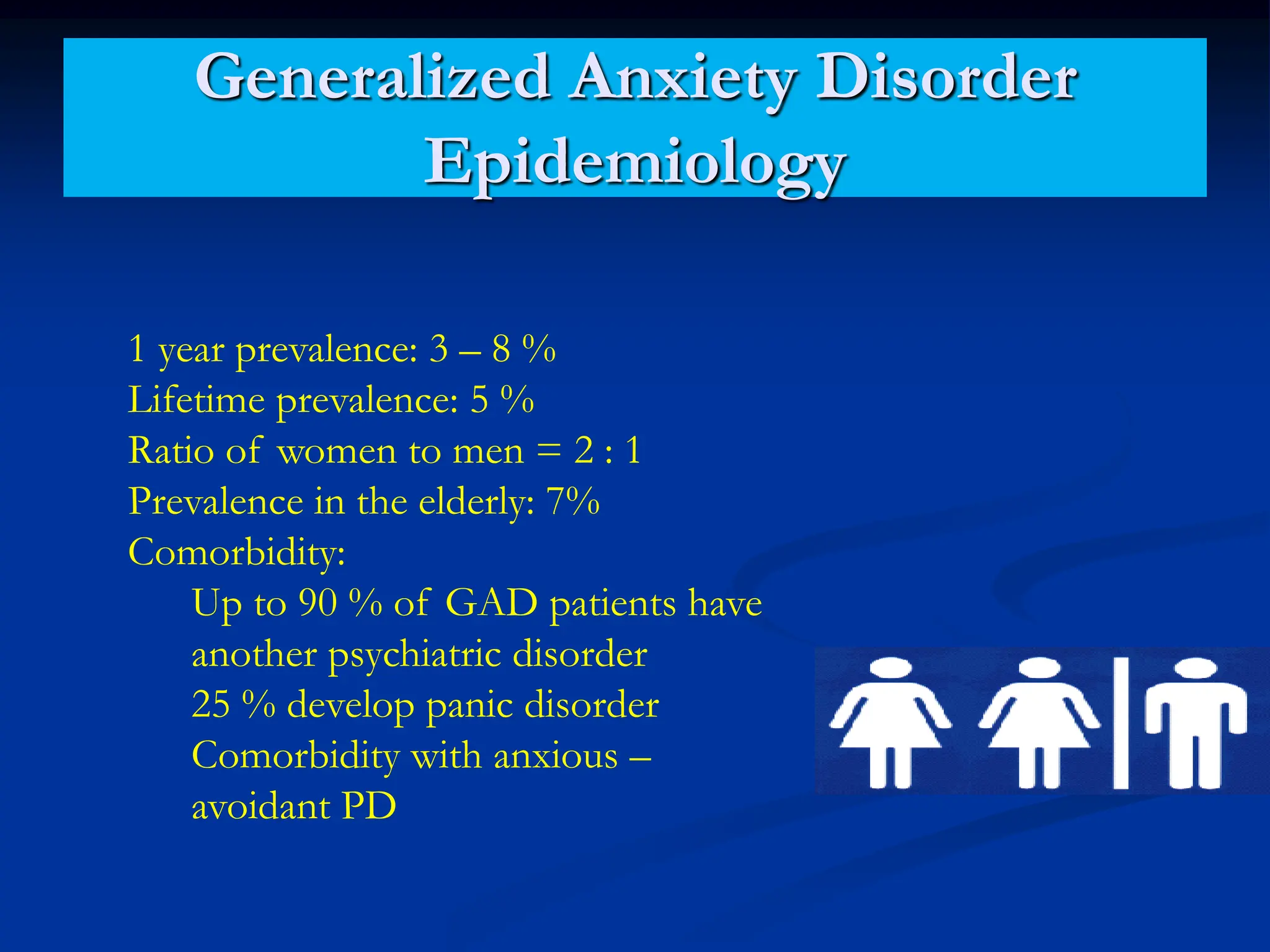
1 year prevalence: 3 – 8 %
Lifetime prevalence: 5 %
Ratio of women to men = 2 : 1
Prevalence in the elderly: 7%
Comorbidity:
Up to 90 % of GAD patients have
another psychiatric disorder
25 % develop panic disorder
Comorbidity with anxious –
avoidant PD
GAD
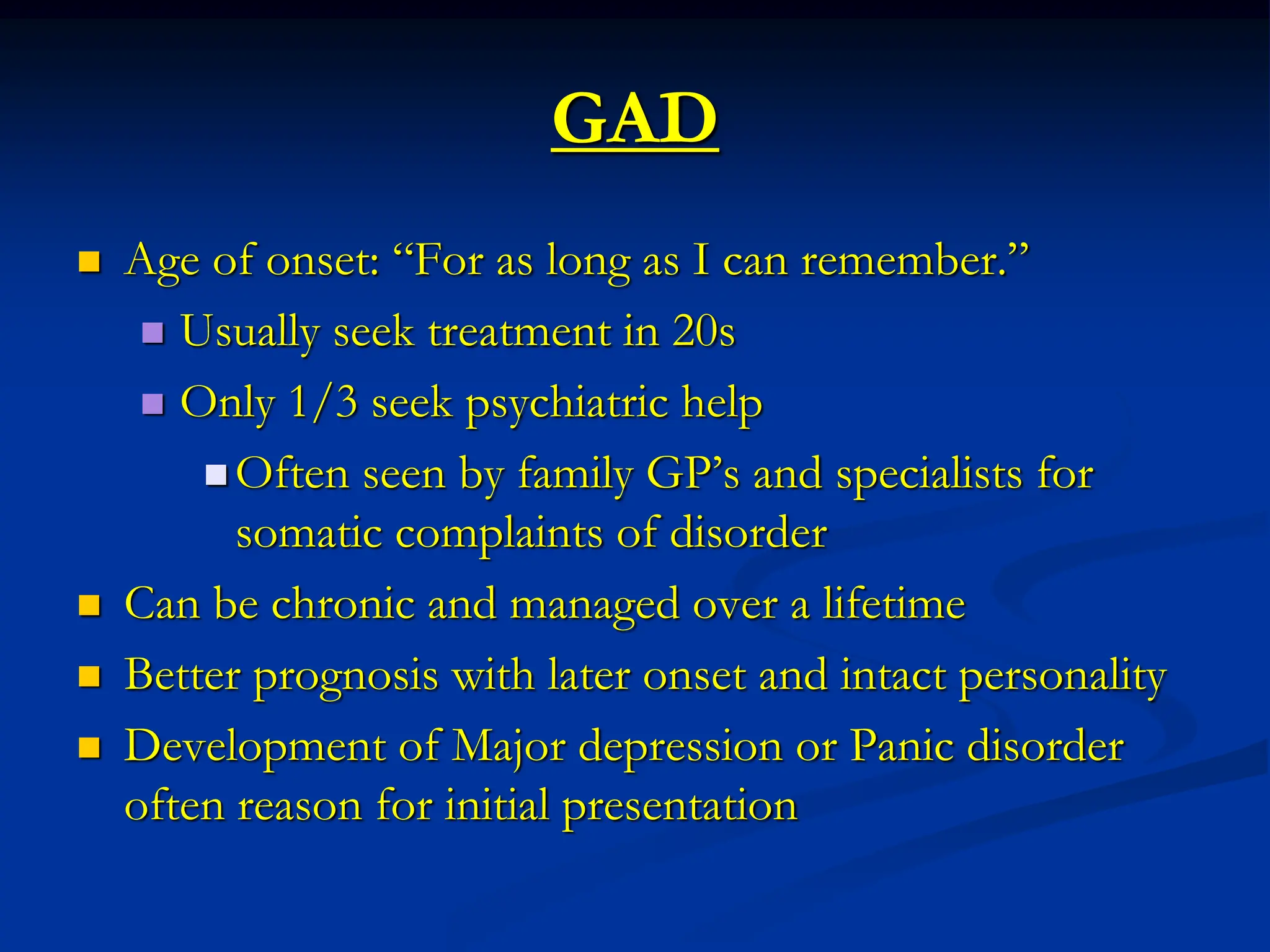
 Age of onset: “For as long as I can remember.”
 Usually seek treatment in 20s
 Only 1/3 seek psychiatric help
 Often seen by family GP’s and specialists for
somatic complaints of disorder
 Can be chronic and managed over a lifetime
 Better prognosis with later onset and intact personality
 Development of Major depression or Panic disorder
often reason for initial presentation
How does GAD present?
Video GAD
 Charles Story vimeo
Generalized Anxiety Disorder:
Diagnostic Criteria (DSM)
 Excessive anxiety or worry occurring more days
than not for at least 6 months about a number
of events or activities
 Difficulty controlling worry
 3 of 6 symptoms are present for more days than
not: restlessness, easily fatigued, difficulty
concentrating, irritability, muscle tension, sleep
disturbance
Somatic symptoms
 sweating, dry mouth, palpitations, urinary frequency,
 epigastric discomfort and frequent and/or loose bowel motions
 Hyperventilation may result in feelings of shortness of breath
and dizziness
 Increased muscle tension
 restlessness, inability to relax, headaches and aching pains,
particularly in the shoulders and back (Gelder et al., 2006)
Comorbidity
 The rates of comorbidity vary between studies
with estimates of
between 68 and 93%
 Comorbid disorders that are particularly
common include depressive disorders, other
anxiety disorders and somatoform disorders
 There is also significant comorbidity with
substance misuse especially among men
Physical Health
 GAD also often co-occurs with physical health
problems such as arthritis and gastrointestinal and
respiratory disorders and may mimic the presentation
of some physical conditions (for example,
hyperthyroidism) (Culpepper, 2009; Roy-Byrne)
 Care may emphasise somatic problems or sleep
disturbance central to GAD and physical comorbidities
Prognosis
 Chronic condition with low rates of remission over the short and
medium-term
 Evaluation of prognosis is complicated by the frequent
comorbidity with other anxiety disorders and depression
 The mean age of onset of GAD was in the Harvard-Brown
Anxiety Research Program was 21 years
 The average duration of illness in this group was about 20 years
and
 Despite treatment the outcome over 3 years was relatively poor,
with only one in four showing symptomatic remission from
GAD (Yonkers et al., 1996)
Depersonalisation/Derealisation
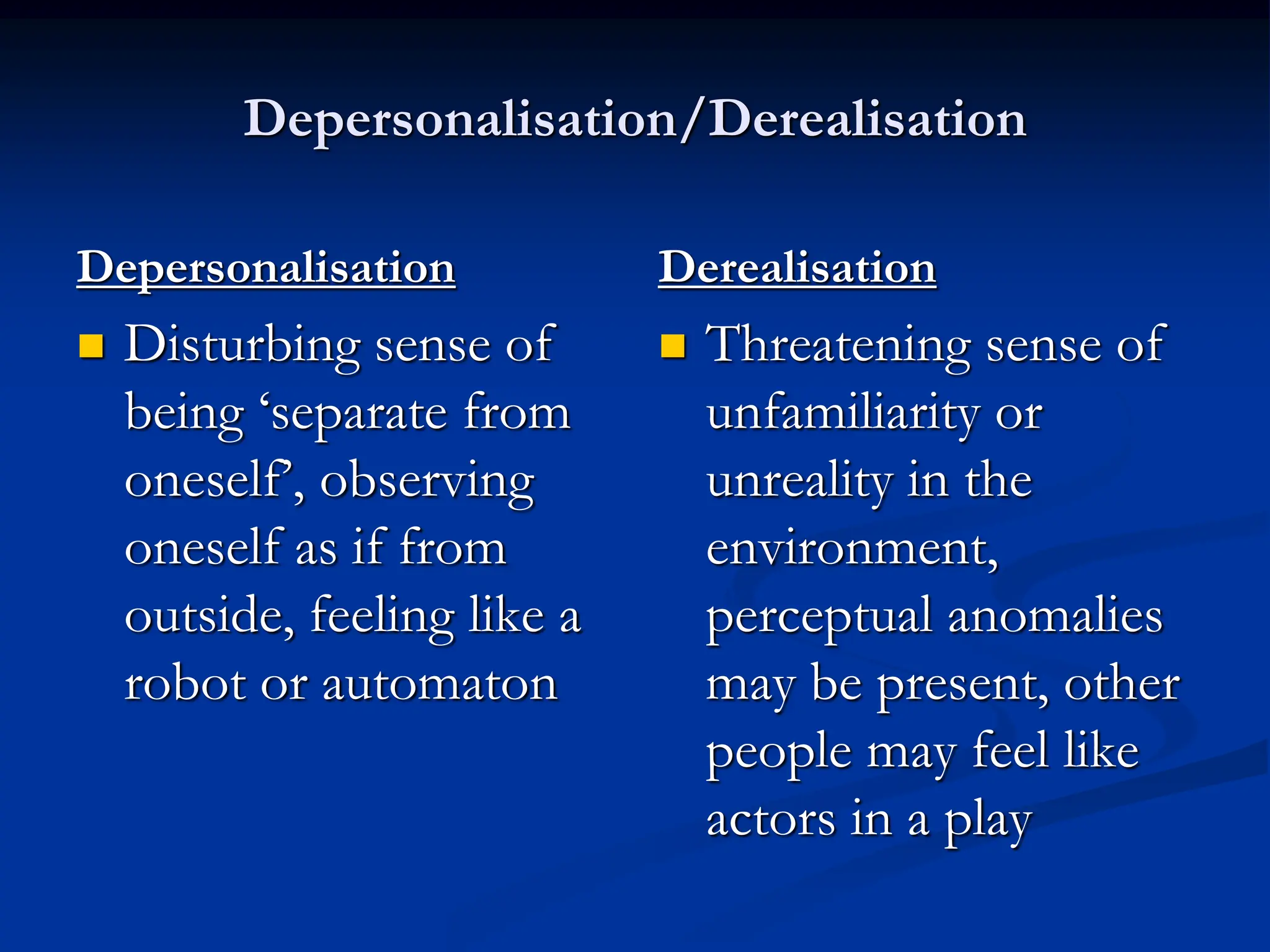
Depersonalisation
 Disturbing sense of
being ‘separate from
oneself’, observing
oneself as if from
outside, feeling like a
robot or automaton
Derealisation
 Threatening sense of
unfamiliarity or
unreality in the
environment,
perceptual anomalies
may be present, other
people may feel like
actors in a play
What are the longterm consequences of GAD ?
Impairment and Economic Cost
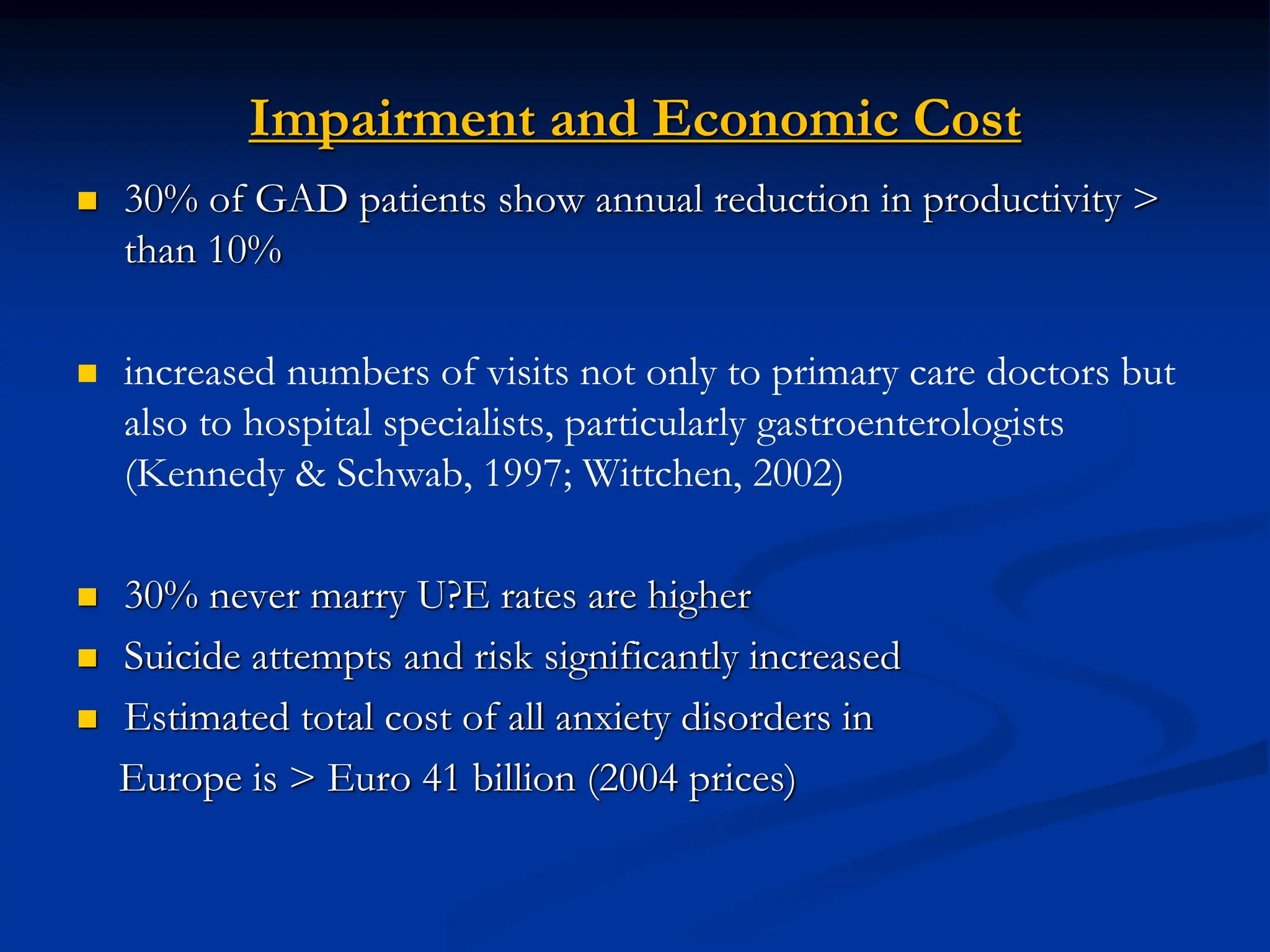
 30% of GAD patients show annual reduction in productivity >
than 10%
 increased numbers of visits not only to primary care doctors but
also to hospital specialists, particularly gastroenterologists
(Kennedy & Schwab, 1997; Wittchen, 2002)
 30% never marry U?E rates are higher
 Suicide attempts and risk significantly increased
 Estimated total cost of all anxiety disorders in
Europe is > Euro 41 billion (2004 prices)
Suicide Risk
 Suicidal ideation and suicide attempts are
significantly increased in GAD compared with
the general population, particularly in women,
and this increase is still greater in the presence of
comorbid major depression (Cougle et al., 2009)
Aethiology of GAD
 Evidence of genetic inheritance
 Biological models
 Environmental factors
 Social learning
Genetic Factors
 Familial studies (15% of the relatives of those with GAD display
it themselves-base rate is 4% in general population)
 Risk of GAD was greater for monozygotic female twin pairs
than for dizygotic twins.
 The tendency to be anxious tends to be inherited rather than
GAD specifically
 Heritability estimate of about 30 %
Biological Models
 Activation of the amygdala can occur prior to conscious
appreciation of threat but there are strong connections between
the amygdala and areas of prefrontal cortex
 Another structure involved in anxiety is the hippocampus, which
is important in relating fearful memories to their environmental
context
 Brain imaging studies of individuals with high trait anxiety and
people with GAD have shown exaggerated responses in both the
amygdala and prefrontal cortex during presentation of
emotionally threatening stimuli
 (Bishop et al., 2004; Nitschke et al., 2009)
Neurotransmitters
 Adversity experienced in childhood and current stresses can alter
the pattern of cortisol secretion in adult life
 well known is the role of HPA axis dysfunction in depression
( Pariante & Lightman, 2008)
 There is some evidence that GAD is also associated with
excessive glucocorticoid secretion (Mantella et al., 2008)
 Serotonin, Noradrenaline and GABA receptors show clear
evidence of response to drug treatments
Environmental/Psychological Factors
 Parenting
 Parental anxiety
 Separations
 Premorbid personality
 Traumatic Experiences
 Physical and mental health problems
Environmental/Psychological Factors
Parental styles characterised by overprotection and lack of emotional warmth
(Silove et al., 1991)
 Kendler and colleagues (2003) showed that stressful life events characterised
by loss increased the risk of both depression and GAD
 Life events characterised by ‘danger’ (where the full import of the event was
yet to be realised) were more common in those who subsequently developed
GAD
 people who lack a sense of control of events and personal effectiveness,
perhaps through early life experiences, are more prone to anxiety disorders
(Barlow, 2000)
Research into psychological factors
 Individuals with GAD show higher than normal
sensitivity to threat
 EEG studies show activity in left frontal lobe:
 individuals engage in frantic, intense thought processes
without accompanying images (different from obsessional
thoughts/images or flashbacks)
Bio Psychosocial Model
GAD : A cognitive
model and treatment
Psychological interventions
 CBT: moderate to large improvement good
quality evidence
 Applied Relaxation: clinical evidence for CBT is
more robust and CBT has a larger magnitude of
effect
 Psychodynamic Psychotherapy: Evidence that
CBT is more effective in the short term
Generalised Anxiety
Disorder
Excessive anxiety & worrying, more days than not re a
number of events or activities, for at least 6 months.
Subjectively difficult to control and leads to: (3 or more
needed)
Muscle tension
Restlessness/keyed up/on edge
Easily Fatigued
Irritability
Sleep disturbance (falling, staying or restless sleep).
Difficulties Concentrating or mind going blank
MR FISC
GAD Diagnostic Issues
 Relatively common, but often under detected or disregarded (as
worry is a normal process)
 Disregard of condition further fuels problem; diagnosis can
provide validating message & encourage engagement
 High co-morbidity with other Axis I disorders
 Depressive symptoms normal in moderate to severe GAD
 Themes of worry are the same as non-GAD people, but process
more stuck. Typically developmentally relevant concerns about
events in the person’s life
GAD Diagnostic Issues
 The main problem people will notice is that they feel anxious
and worried most of the time. Initial subjective focus may
therefore be on life-events rather than self
 Worry not constrained to one area (e.g. social phobia).
What is worry?
 ‘Worry is a chain of thoughts and images,
negatively affect-laden and relatively
uncontrollable; it represents and attempt to
engage in mental problem-solving on an issue
whose outcome is uncertain, but contains the
possibility of one or more negative outcomes;
consequently , worry relates closely to the fear
process. ( Borokovec et al., 1983:10)
Central cognition in GAD- what is
the threat?
 ‘ The world is potentially dangerous and I may
not be able to cope with whatever comes from
the future, so I must anticipate all bad things
that might happen so that I can avoid them or
prepare for them. ( Sibrava and Borkovec,
2006:239)
What is worry?
 About things where the outcome is uncertain.
 Kicked off by what if’s or equivalent.
 A strategic process (goal directed) that aims to help deal with uncertainty
 A method of solving problems and planning ahead
 A chain of (mostly) thoughts & (some) images experienced as a stream of
doubts
 Thoughts and images feel very real
 Problematic when difficult to interrupt or end
 A mental behaviour rather than a feeling-state
 Rarely shared
 Worry means living in an imagined future; loss of here and now
 Others…………
What do people worry about?
 Everyday events frequent
 (i.e. late for work, late payment on a bill)
 Chain into more serious events
 Everyday events that are less frequent
 Losing your job, losing a loved one, health worries
 Themes are
 Social (friends, family), work, finances, illness, and
consequences of these (often social)
 Worry about worry (all this worry will make me ill, will
make me lose control of my mind)
 What you been worrying about this week?
Helpful Assessment
Questions
 Nature, frequency and intensity of worry
 Is there a current stressful situaion?
 How does patient describe an episode of their worry? Can they give you a
typical example?
 Have you always been a worrier?
 If there is nothing to worry about, do you still find yourself worrying?
 Do minor everyday things spiral into major concerns?
 Once it starts, is your worry hard to stop?
 Does worry stop you enjoying your life?
 If you were not worrying about x, would you worry about something else?
Exercise 1: what have we worried about
this week? 15 min one-way-pairs
 Choose one thing you’ve been worrying about
 What were you worrying about? What was it about the situation
that led you into worry?
 Can you spot what triggered your worry?
 Talk about your experience of worry, describe the content and the
process.
 Be curious about the phenomenology. What is the immediate
emotional consequence of worry?
 What might be the longer term emotional consequence of worry?
 How does it impact on your behaviour?
 How did your worry impact on the thing you worried about?
Treatment for GAD
 Assessment and formulation- understanding a
basic model
Situation
Worry
Anxiety
Demoralisation
Exhaustion
What if…?
Dugas, Gagnon, Ladouceur and Freeston (1998).
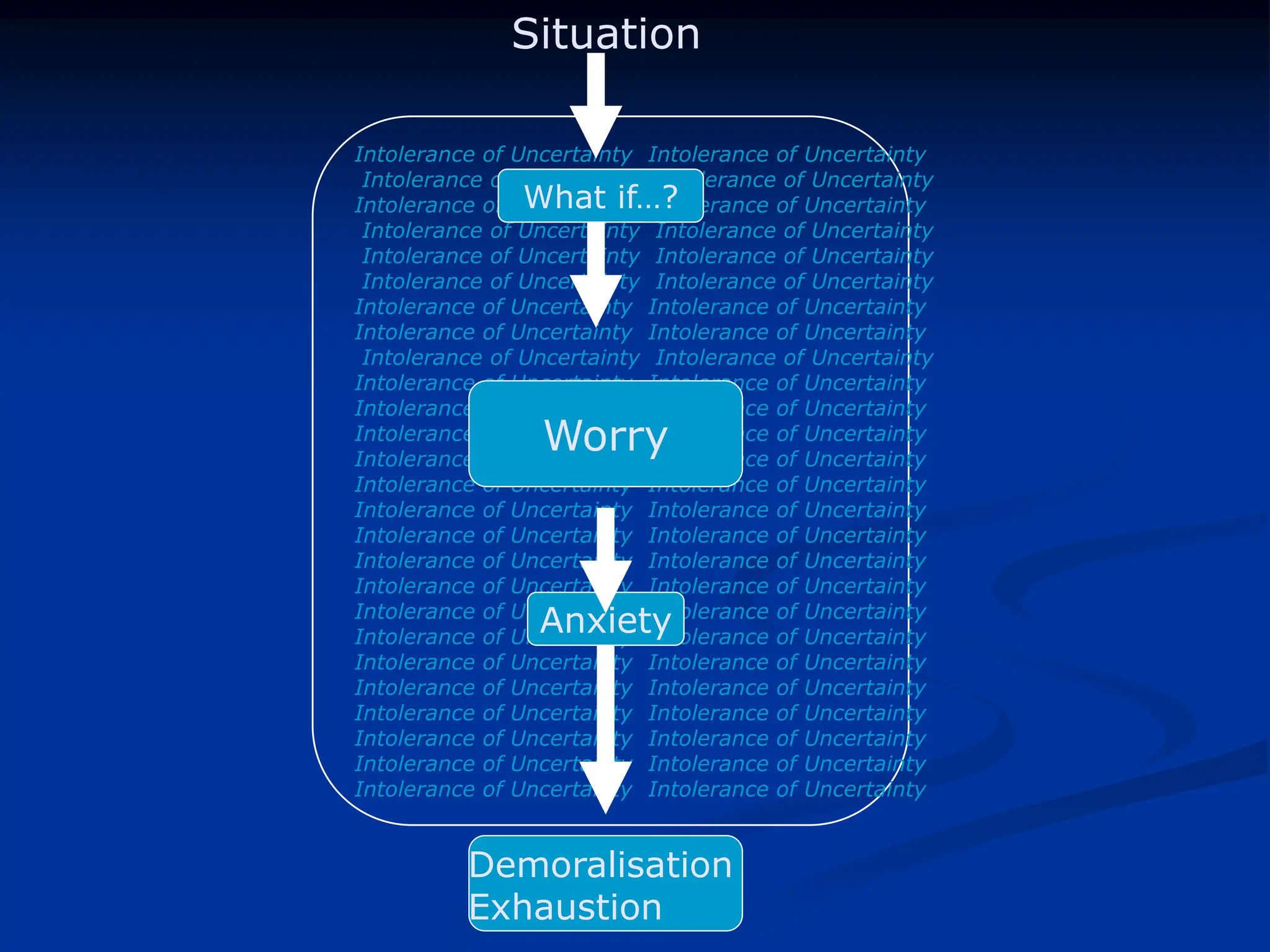
BRAT, 36, 215-226.
A basic
model of
GAD, after
Dugas et al
Intolerance of uncertainty
 Intolerance of uncerainty can be understood as negative
emotional, cognitive and behavioural reactions to
uncertain situations and events.
 People with IU find uncertainty upsetting and stressful,
think it is something to be avoided, and have difficulty
functioning in uncertain situations
 Intolerance of uncertainty is not unique to GAD but
 Research has shown that clients with GD have higher
levels of IU compared to people in the general
population, and also compared to people with other
types of anxiety disorders
Intolerance of uncertainty
 One way to manage uncertainty is to consider as
many possible negative outcomes as possible
 Advantages:?
 Disadvantages: increase number of hypothetical
scenarios, increases the uncertainty, keeps
attention on potentially worrying hypothetical
events
Intolerance of Uncertainty Intolerance of Uncertainty
Situation
Worry
Anxiety
Demoralisation
Exhaustion
What if…?
Positive beliefs about worry
 Positive beliefs about worry are important to
identify and understand
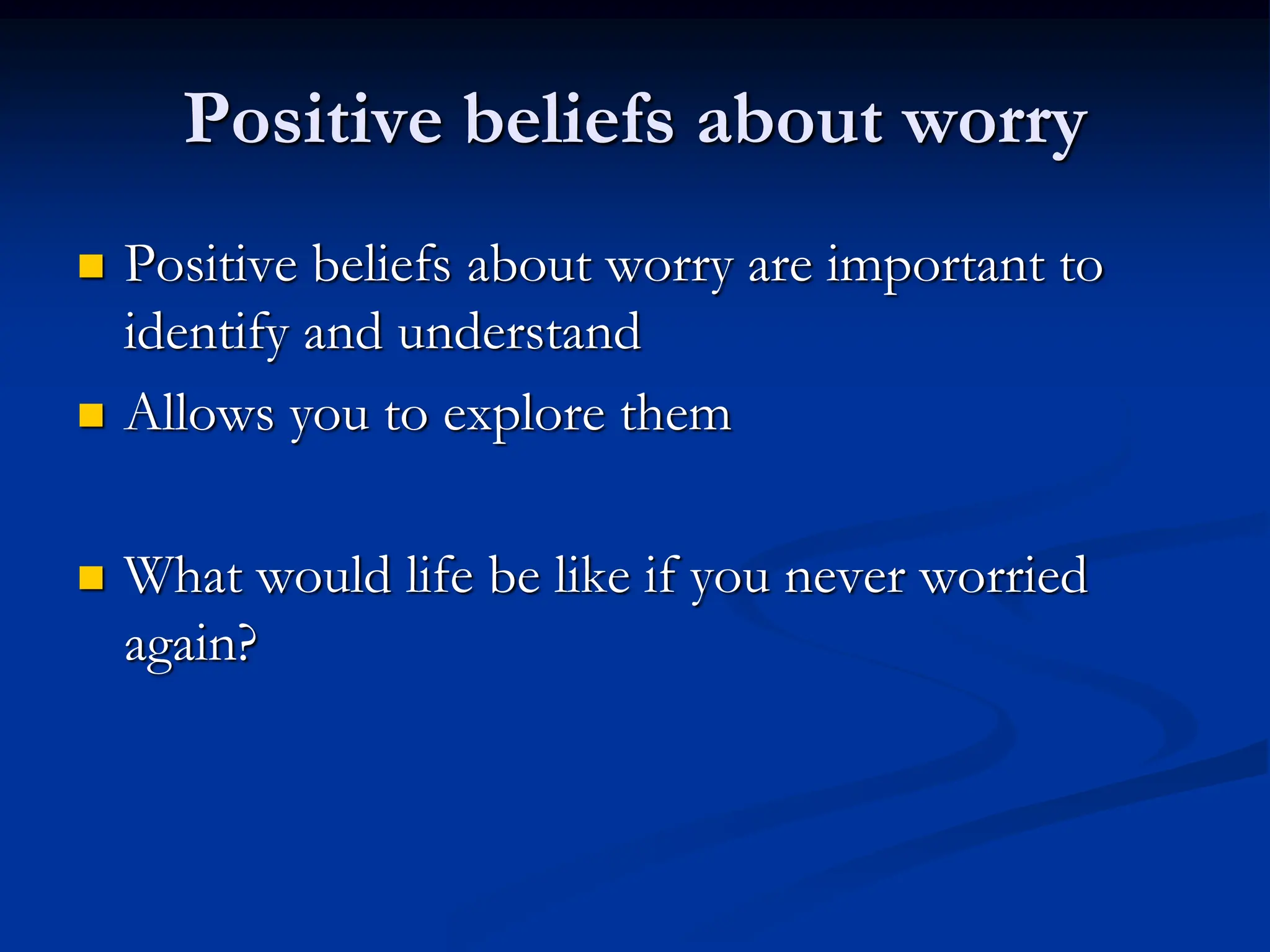
 Allows you to explore them
 What would life be like if you never worried
again?
Worry is useful because….
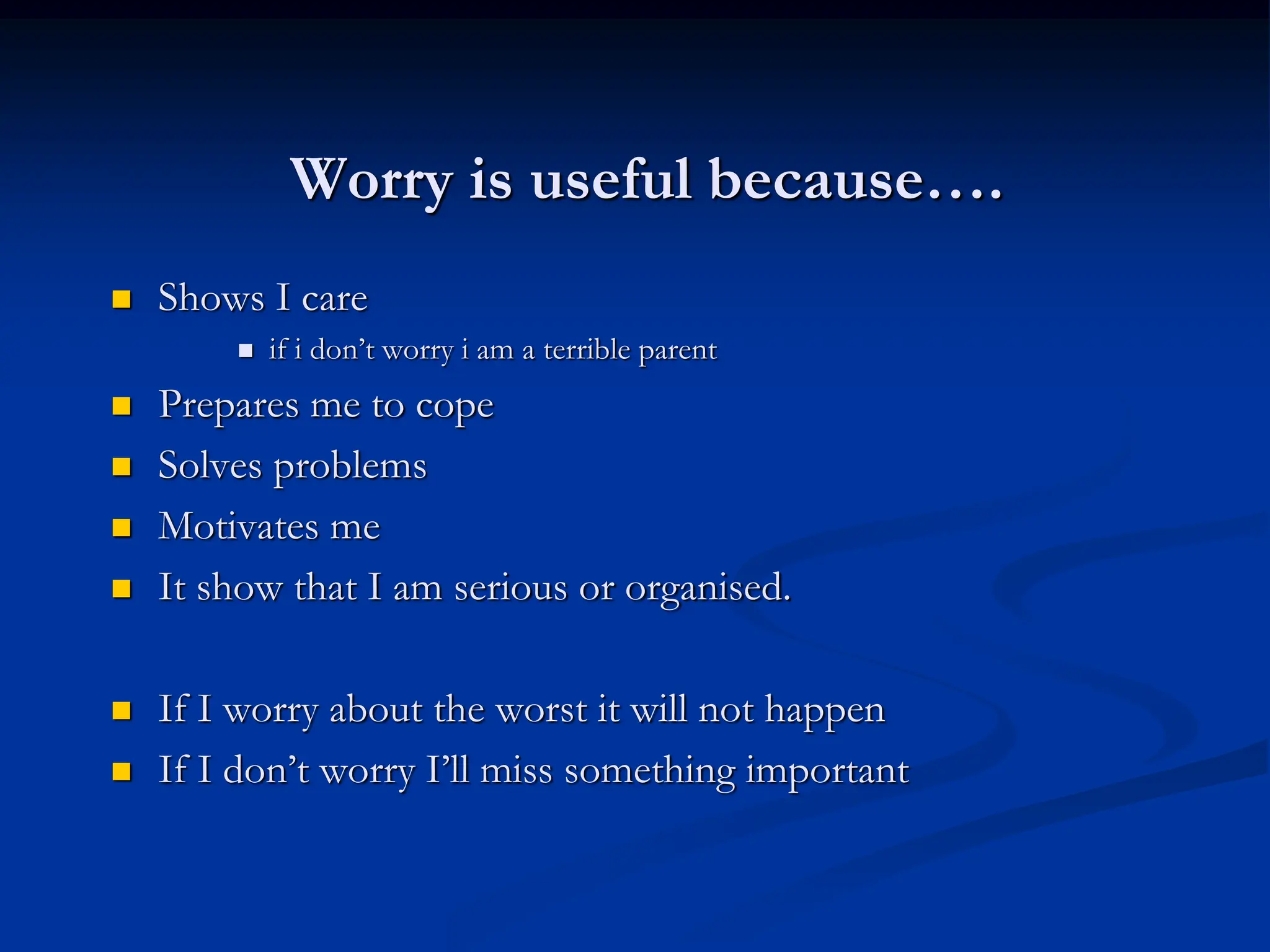
 Shows I care
 if i don’t worry i am a terrible parent
 Prepares me to cope
 Solves problems
 Motivates me
 It show that I am serious or organised.
 If I worry about the worst it will not happen
 If I don’t worry I’ll miss something important
Intolerance of Uncertainty Intolerance of Uncertainty
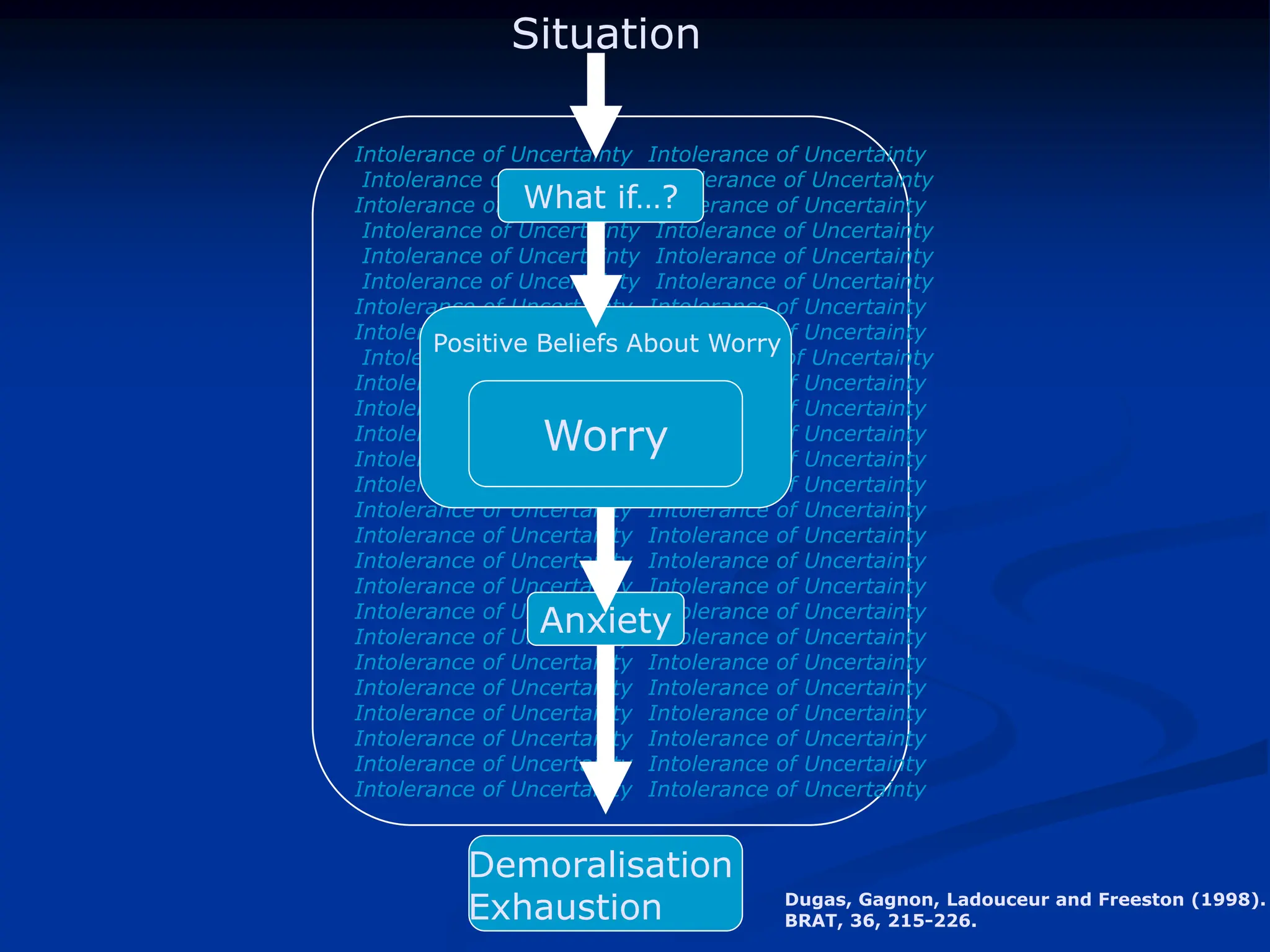
Situation
Positive Beliefs About Worry
Worry
Anxiety
Demoralisation
Exhaustion
What if…?
Dugas, Gagnon, Ladouceur and Freeston (1998).
BRAT, 36, 215-226.
Types of worry
 Real event worry
 Hypothetical event worry
Real event worry- negative problem
orientation
 People with GAD have good problem solving
skills
 However research has shown they have negative
‘problem orientation’
 Beliefs about the nature of problems e,g, problems
are threatening or unfair
 Appraisals of themselves as problem solving agents ,
e.g. doubt their ability to solve problems
 Expectations about the outcome of the problem
solving process e.g. pessimistic about the outcome
Intolerance of Uncertainty Intolerance of Uncertainty
Situation
Positive Beliefs About Worry
Worry
Negative
Problem
Orientation
Anxiety
Demoralisation
Exhaustion
What if…?
Dugas, Gagnon, Ladouceur and Freeston (1998).
BRAT, 36, 215-226.
Life
event
s
Hypothetical event worry
 Research has shown that high worry is related to
cognitive avoidance
 E.g.
 Suppressing worrying thoughts
 Substituting neutral or positive thoughts for worries
 Using distraction as a way to interrupt worrying
 Avoiding situations that can lead to worrisome
thinking
Cognitive avoidance in worry
 Cognitive avoidance is like other forms of avoidance
 Short term decrease in anxiety through not facing your
fear (in this case thinking about the uncertain situation)
However likely to:
• Consolidate negative beliefs about worry
• May get enhancement effects- trying not to think about
something makes it harder not to think about it, and
rebound effects. ‘Pink elephant’ and ‘monsters under
the bed’
Intolerance of Uncertainty Intolerance of Uncertainty
Situation
Positive Beliefs About Worry
Worry
Negative
Problem
Orientation
Anxiety
Demoralisatio
n
What if…?
Dugas, Gagnon, Ladouceur and Freeston (1998).
BRAT, 36, 215-226.
Cognitive
Avoidance
Mood
states
Life
event
s
General Treatment Aims
 To demonstrate the problem is not the object of
worries, but the propensity to worry.
 This shift is captured by the following;
 ‘my problem is that there are lots of things in my life that make me
worry’ (the problem is the things I worry about) to
 ‘my problem is that I worry a lot about the things in my life.’ (the
problem is the worry).
 To be able to shuttle between the process of worry
and its content.
 To enable clients to do this as well.
Treatment of GAD- (Laval model)
Outlined in CBT for worry and generalised anxiety disorder- Wilkinson, Meares
and Freeston
 Assessment and development of formulation
 1)Worry awareness training
 2)Recognising and overcoming intolerance of uncertainty
 3)Recognising and overcoming positive beliefs about worry
 4)Dealing with real event worry
 5)Dealing with hypothetical event worry
 6)Relapse prevention
Treatment : 1) Worry Awareness
 Psychoeducation;
 About CBT/Worry
 Traffic Analogy: how many individual cars would we need to focus
on to remedy traffic-flow problems?
 What other factors would we need to understand?
 What attitudes to problem solving would help or hinder progress?
 Explaining the diagnosis
 Worry as a continuum
 An everyday process that can become “locked in” under certain
circumstances
Treatment : 1)Worry Awareness
 Also beginning to think critically about the type of
worry.
 Current Problem or Hypothetical Situation
 Current Problem = Problem Solving
 Hypothetical Situation = Imaginal Exposure
 Note: not always neat categories, but this is part of process of helping
patients live with uncertainty
 Important to recognise when worry happens
 Diary: Date/Time, Description of Worry, What tells me I’m
worrying, The level of anxiety and the worry type
Treatment: 2) Recognising and overcoming
intolerance of uncertainty
Exercise: Reflecting on uncertainty
 In pairs working one way then the other using this
exercise and the following one.
 Exercise 2
 Think of a current situation in which the outcome is uncertain –
one you are willing to share.
 In pairs discuss the following;
 How does this situation make you feel?
 How do you tolerate the uncertainty?
 Is there anything useful/good or positive about the experience of
uncertainty?
 What kinds of beliefs and thoughts do you experience in the face of
uncertainty?
 What does the situation/affect/thoughts lead you to do?
 What do you do more of/less of?
 What is helpful and unhelpful?
 Are there any costs associated with the way you deal with this
uncertainty?
 What does this tell you about uncertainty/certainty in general?
Exercise 2: Reflecting on Certainty
 Exercise 3
 Reflect on why certainty is important to you.
 In pairs discuss the following;
 How does certainty make you feel?
 How do you tolerate the certainty?
 Is there anything unhelpful or negative about the experience of
certainty?
 Would you like more certainty in your life? If so how much? Total
certainty or moderate certainty? What would it be like to have total
certainty?
 What kinds of beliefs and thoughts do you experience in the face of
certainty?
 What does feeling certain lead you to do?
 What is helpful and unhelpful about this?
 Are there any costs associated with the way you deal with this
certainty?
 What does this tell you about the importance of certainty in general?
Treatment Aims 3: Intolerance of Uncertainty
 Allergy Analogy
 Once allergy present, dose is less important than presence of allergen
 Worriers prefer a negative outcome than an uncertain one.
 At least then I’ll know what to do
 Beliefs about uncertainty:
 stressful, dangerous, bad, unpleasant, to be avoided, etc…..
 “Uncertainty makes life intolerable”*
 “I always want to know what the future holds for me”*
 “The smallest doubt can stop me from acting”*
*Items from the Intolerance of Uncertainty scale. Buhr & Dugas, 2002)
Intolerance of Uncertainty
 Strong possibility that client & therapist will not share
initial goals:
Intolerance of Uncertainty
Therapist:
Increase tolerance
Client:
Increase certainty
Influence of IoU on behaviours…
Limits ‘growth’ with a sting in tail….
 Avoid investing in relationships….
 Find reasons not to do things
 I’m really not ready for that promotion
 I’m happy with the way things are
 I’ve got other things that need my attention….
 Procrastinate
 delay decisions & actions while seeking certainty
 Look for max info before proceeding (same info from different people)
 Questioning decisions until certain it’s right
 Over planning
 Don’t delegate
 I know (it’s certain) it’s done right if I do it
Improving tolerance of uncertainty
 Spotting it
 Discussion of certainty vs. uncertainty
 Drive towards knowing; survival value?
 Quotes…. To be absolutely certain about something, one must know
everything or nothing about it
 Olin Miller Author, 1918 - 2002
 Aim to gently increase cognitive and behavioural
flexibility by taking risks
 Buying a present without asking reassurance seeking questions.
 Make a minor decision without asking for reassurance (making
dinner, buying a dress).
 Delegating something small
 Only looking for a little info before making a decision.
Treatment: 3) Recognising and overcoming positive
beliefs about worry
Worry is useful because….
 Shows I care
 if i don’t worry i am a terrible parent
 Prepares me to cope
 Solves problems
 Motivates me
 It show that I am serious or organised.
 If I worry about the worst it will not happen
 If I don’t worry I’ll miss something important
Testing Worry Promoting Assumptions
 Identify worry-promoting assumption in self or other
 May be difficult until you pose the kind of situation in which you are really likely to worry
 Questions aim to focus on process
 E.g. Supposing you didn’t worry about that what would that say about you, what would happen?
 Have you ever prepared and not worried as much, what difference did that make?
 Express this in “If…then” terms
 If I do worry, then… (+ve outcome)
 If I don’t worry (-ve outcome)
 “Outcome” be
 expected consequence (prediction - It will go wrong, I won’t do it)
 personal meaning (the kind of person I’d be - uncaring, unprepared, thoughtless and so on).
 If your assumption is of the latter kind, you will need to operationalise the personal
meaning
 Back to your personal examples; can you spot the worry rule?
 How could you test this out?
Treatment: 4) Dealing with real event
worry
 Review their problem orientation: what do they do
when faced with a problem
 E.g’s
 Avoiding or delaying problem solving
 Trying not to think about it
 Asking others to solve the problem
 Impulsive problem solving
 Trying to solve everything at once
 Approach-avoidance
 Negatively prejudicing the outcome
 Overanalysing
Some strategies
 What is a problem
 Seeing problems as part of normal life
 Recognising problems before it’s too late
 Re-framing problems: opportunities vs threats
 Review problem- solving skills (D’Zurilla and
Nezu 1999)
Treatment 5) Dealing with
hypothetical event worry
 Increasing Anxiety – turbo charge worry
 I have no control over my worry
 I am out of control (now)
 If I worry like this then I will go crazy
 I am losing my mind (now)
 Other Emotions – exacerbate problems
 If I worry like this (or how it makes me feel) then I will
damage my health (more slow burn anxiety)
 I am going to die
 If I worrying like this then this just goes to show how stupid
I am
 Negative appraisals leading to low self-esteem, depression
 If I worry like this and other people knew then what would
they think
 Shame, guilt and so on.
Worry-Appraising judgments
I am out of control
I will be overwhelmed
I will go crazy
I will be unable to focus or work or perform
I will be condemned to a life of anxiety
I am on the downward slide to depression
I will become ill
I lack confidence
I am weak
I will be stuck forever in worry
I am not in control
Other Examples of turbo charging thoughts
Exercise: Testing Appraisals of worry
 Identify a worry of your own or other (client, friend, spouse…)
 What kind of judgement or appraisal of this worry and the
related feeling might this provoke?
 What behaviour (overt or mental) might derive from this
appraisal?
 Consider a way of changing the behaviour so that the judgement
is tested.
GAD summary
 The key characteristic of GAD is excessive
worry
 Worry is an attempt to reduce uncertainty by
identifying potential threats
References
References
 Otte, Christian Dialogues Clin Neurosa 2011 December. 13(4) 413-421
 Cognitive therapy in anxiety disorders current state of the evidence
 Epub 2011 Aug. 19 Interventions for generalised anxiety disorder in older adultsTherapist-
supported internet cognitive–behavioural therapy for anxiety disorders in adults Janine V. Olthuis,
Margo C. Watt, Kristen Bailey, Jill A. Hayden, Sherry H. Stewart
 BJPsych Advances September 2015, 290. DOI: 10.1192/apt.21.5.290
2014
Evidence-based pharmacological treatment
of anxiety disorders, post-traumatic stress
disorder and obsessive-compulsive disorder:
A revision of the 2005 guidelines from the
British Association for Psychopharmacology
 Adshead, Fonggy
 Adv in Psych Treatment 18 : 242-249
 How does psychotherapy work?
References
 Starcevic, Vladan
 Adv. in Psych Treatment 18:250-258
 Benzodiazepines for anxiety disorders
 Tyrer, Peter
 Adv in Psychiatric Treatment 18: 259-262
 Why benzodiazepines are not going away.
 Relevant NICE guidelines
 Title: Psychological therapies for generalised anxiety disorder.
 Citation: The Cochrane database of systematic reviews, Jan 2007, no. 1, p. CD001848. (2007)
 Author(s): Hunot, V, Churchill, R, Silva de Lima, M, Teixeira, V
 Title: Public health perspectives on generalized anxiety disorder.
 Citation: The Journal of clinical psychiatry, Jan 2004, vol. 65 Suppl 13, p. 3-7, 0160-6689 (2004)
 Author(s): Stein, Murray B
 Title: Benzodiazepines in generalized anxiety disorder: heterogeneity of outcomes based on a systematic review
and meta-analysis of clinical trials.
 Citation: Journal of psychopharmacology (Oxford, England), Sep 2007, vol. 21, no. 7, p. 774-782, 0269-8811
(September 2007)
 Author(s): Martin, Jose Luis R, Sainz-Pardo, María, Furukawa, Toshiaki A, Martín-Sánchez, Eva, Seoane,
Teresa, Galán, Cristina
References
 Title: Risk factors for the onset of panic and generalised anxiety disorders in the general adult
population: a systematic review of cohort studies.
 Citation: Journal of affective disorders, Oct 2014, vol. 168, p. 337-348 (October 2014)
 Author(s): Moreno-Peral, Patricia, Conejo-Cerón, Sonia, Motrico, Emma, Rodríguez-Morejón,
Alberto, Fernández, Anna, García-Campayo, Javier, Roca, Miquel, Serrano-Blanco, Antoni,
Rubio-Valera, Maria, Bellón, Juan Ángel
 Title: Pregabalin: a review of its use in adults with generalized anxiety disorder.
 Citation: CNS drugs, Sep 2014, vol. 28, no. 9, p. 835-854, 1172-7047 (September 2014)
 Author(s): Frampton, James E
 Title: Overview of generalized anxiety disorder: epidemiology, presentation, and course.
 Citation: The Journal of clinical psychiatry, Jan 2009, vol. 70 Suppl 2, p. 4-9 (2009)
 Author(s): Weisberg, Risa B
 Title: A meta-analysis of cognitive therapy for worry in generalized anxiety disorder.
 Citation: Clinical psychology review, Feb 2013, vol. 33, no. 1, p. 120-132 (February 2013)
 Author(s): Hanrahan, Fidelma, Field, Andy P, Jones, Fergal W, Davey, Graham C L

GAD model of Cognitive behavioural Therapy.

  • 1.
  • 2.
    Generalized Anxiety Disorder Epidemiology 1year prevalence: 3 – 8 % Lifetime prevalence: 5 % Ratio of women to men = 2 : 1 Prevalence in the elderly: 7% Comorbidity: Up to 90 % of GAD patients have another psychiatric disorder 25 % develop panic disorder Comorbidity with anxious – avoidant PD
  • 3.
    GAD  Age ofonset: “For as long as I can remember.”  Usually seek treatment in 20s  Only 1/3 seek psychiatric help  Often seen by family GP’s and specialists for somatic complaints of disorder  Can be chronic and managed over a lifetime  Better prognosis with later onset and intact personality  Development of Major depression or Panic disorder often reason for initial presentation
  • 4.
    How does GADpresent?
  • 5.
  • 6.
    Generalized Anxiety Disorder: DiagnosticCriteria (DSM)  Excessive anxiety or worry occurring more days than not for at least 6 months about a number of events or activities  Difficulty controlling worry  3 of 6 symptoms are present for more days than not: restlessness, easily fatigued, difficulty concentrating, irritability, muscle tension, sleep disturbance
  • 7.
    Somatic symptoms  sweating,dry mouth, palpitations, urinary frequency,  epigastric discomfort and frequent and/or loose bowel motions  Hyperventilation may result in feelings of shortness of breath and dizziness  Increased muscle tension  restlessness, inability to relax, headaches and aching pains, particularly in the shoulders and back (Gelder et al., 2006)
  • 8.
    Comorbidity  The ratesof comorbidity vary between studies with estimates of between 68 and 93%  Comorbid disorders that are particularly common include depressive disorders, other anxiety disorders and somatoform disorders  There is also significant comorbidity with substance misuse especially among men
  • 9.
    Physical Health  GADalso often co-occurs with physical health problems such as arthritis and gastrointestinal and respiratory disorders and may mimic the presentation of some physical conditions (for example, hyperthyroidism) (Culpepper, 2009; Roy-Byrne)  Care may emphasise somatic problems or sleep disturbance central to GAD and physical comorbidities
  • 10.
    Prognosis  Chronic conditionwith low rates of remission over the short and medium-term  Evaluation of prognosis is complicated by the frequent comorbidity with other anxiety disorders and depression  The mean age of onset of GAD was in the Harvard-Brown Anxiety Research Program was 21 years  The average duration of illness in this group was about 20 years and  Despite treatment the outcome over 3 years was relatively poor, with only one in four showing symptomatic remission from GAD (Yonkers et al., 1996)
  • 11.
    Depersonalisation/Derealisation Depersonalisation  Disturbing senseof being ‘separate from oneself’, observing oneself as if from outside, feeling like a robot or automaton Derealisation  Threatening sense of unfamiliarity or unreality in the environment, perceptual anomalies may be present, other people may feel like actors in a play
  • 12.
    What are thelongterm consequences of GAD ?
  • 13.
    Impairment and EconomicCost  30% of GAD patients show annual reduction in productivity > than 10%  increased numbers of visits not only to primary care doctors but also to hospital specialists, particularly gastroenterologists (Kennedy & Schwab, 1997; Wittchen, 2002)  30% never marry U?E rates are higher  Suicide attempts and risk significantly increased  Estimated total cost of all anxiety disorders in Europe is > Euro 41 billion (2004 prices)
  • 14.
    Suicide Risk  Suicidalideation and suicide attempts are significantly increased in GAD compared with the general population, particularly in women, and this increase is still greater in the presence of comorbid major depression (Cougle et al., 2009)
  • 15.
  • 16.
     Evidence ofgenetic inheritance  Biological models  Environmental factors  Social learning
  • 17.
    Genetic Factors  Familialstudies (15% of the relatives of those with GAD display it themselves-base rate is 4% in general population)  Risk of GAD was greater for monozygotic female twin pairs than for dizygotic twins.  The tendency to be anxious tends to be inherited rather than GAD specifically  Heritability estimate of about 30 %
  • 18.
    Biological Models  Activationof the amygdala can occur prior to conscious appreciation of threat but there are strong connections between the amygdala and areas of prefrontal cortex  Another structure involved in anxiety is the hippocampus, which is important in relating fearful memories to their environmental context  Brain imaging studies of individuals with high trait anxiety and people with GAD have shown exaggerated responses in both the amygdala and prefrontal cortex during presentation of emotionally threatening stimuli  (Bishop et al., 2004; Nitschke et al., 2009)
  • 19.
    Neurotransmitters  Adversity experiencedin childhood and current stresses can alter the pattern of cortisol secretion in adult life  well known is the role of HPA axis dysfunction in depression ( Pariante & Lightman, 2008)  There is some evidence that GAD is also associated with excessive glucocorticoid secretion (Mantella et al., 2008)  Serotonin, Noradrenaline and GABA receptors show clear evidence of response to drug treatments
  • 20.
    Environmental/Psychological Factors  Parenting Parental anxiety  Separations  Premorbid personality  Traumatic Experiences  Physical and mental health problems
  • 21.
    Environmental/Psychological Factors Parental stylescharacterised by overprotection and lack of emotional warmth (Silove et al., 1991)  Kendler and colleagues (2003) showed that stressful life events characterised by loss increased the risk of both depression and GAD  Life events characterised by ‘danger’ (where the full import of the event was yet to be realised) were more common in those who subsequently developed GAD  people who lack a sense of control of events and personal effectiveness, perhaps through early life experiences, are more prone to anxiety disorders (Barlow, 2000)
  • 22.
    Research into psychologicalfactors  Individuals with GAD show higher than normal sensitivity to threat  EEG studies show activity in left frontal lobe:  individuals engage in frantic, intense thought processes without accompanying images (different from obsessional thoughts/images or flashbacks)
  • 23.
  • 24.
    GAD : Acognitive model and treatment
  • 25.
    Psychological interventions  CBT:moderate to large improvement good quality evidence  Applied Relaxation: clinical evidence for CBT is more robust and CBT has a larger magnitude of effect  Psychodynamic Psychotherapy: Evidence that CBT is more effective in the short term
  • 26.
    Generalised Anxiety Disorder Excessive anxiety& worrying, more days than not re a number of events or activities, for at least 6 months. Subjectively difficult to control and leads to: (3 or more needed) Muscle tension Restlessness/keyed up/on edge Easily Fatigued Irritability Sleep disturbance (falling, staying or restless sleep). Difficulties Concentrating or mind going blank MR FISC
  • 27.
    GAD Diagnostic Issues Relatively common, but often under detected or disregarded (as worry is a normal process)  Disregard of condition further fuels problem; diagnosis can provide validating message & encourage engagement  High co-morbidity with other Axis I disorders  Depressive symptoms normal in moderate to severe GAD  Themes of worry are the same as non-GAD people, but process more stuck. Typically developmentally relevant concerns about events in the person’s life
  • 28.
    GAD Diagnostic Issues The main problem people will notice is that they feel anxious and worried most of the time. Initial subjective focus may therefore be on life-events rather than self  Worry not constrained to one area (e.g. social phobia).
  • 29.
    What is worry? ‘Worry is a chain of thoughts and images, negatively affect-laden and relatively uncontrollable; it represents and attempt to engage in mental problem-solving on an issue whose outcome is uncertain, but contains the possibility of one or more negative outcomes; consequently , worry relates closely to the fear process. ( Borokovec et al., 1983:10)
  • 30.
    Central cognition inGAD- what is the threat?  ‘ The world is potentially dangerous and I may not be able to cope with whatever comes from the future, so I must anticipate all bad things that might happen so that I can avoid them or prepare for them. ( Sibrava and Borkovec, 2006:239)
  • 31.
    What is worry? About things where the outcome is uncertain.  Kicked off by what if’s or equivalent.  A strategic process (goal directed) that aims to help deal with uncertainty  A method of solving problems and planning ahead  A chain of (mostly) thoughts & (some) images experienced as a stream of doubts  Thoughts and images feel very real  Problematic when difficult to interrupt or end  A mental behaviour rather than a feeling-state  Rarely shared  Worry means living in an imagined future; loss of here and now  Others…………
  • 32.
    What do peopleworry about?  Everyday events frequent  (i.e. late for work, late payment on a bill)  Chain into more serious events  Everyday events that are less frequent  Losing your job, losing a loved one, health worries  Themes are  Social (friends, family), work, finances, illness, and consequences of these (often social)  Worry about worry (all this worry will make me ill, will make me lose control of my mind)  What you been worrying about this week?
  • 33.
    Helpful Assessment Questions  Nature,frequency and intensity of worry  Is there a current stressful situaion?  How does patient describe an episode of their worry? Can they give you a typical example?  Have you always been a worrier?  If there is nothing to worry about, do you still find yourself worrying?  Do minor everyday things spiral into major concerns?  Once it starts, is your worry hard to stop?  Does worry stop you enjoying your life?  If you were not worrying about x, would you worry about something else?
  • 34.
    Exercise 1: whathave we worried about this week? 15 min one-way-pairs  Choose one thing you’ve been worrying about  What were you worrying about? What was it about the situation that led you into worry?  Can you spot what triggered your worry?  Talk about your experience of worry, describe the content and the process.  Be curious about the phenomenology. What is the immediate emotional consequence of worry?  What might be the longer term emotional consequence of worry?  How does it impact on your behaviour?  How did your worry impact on the thing you worried about?
  • 35.
    Treatment for GAD Assessment and formulation- understanding a basic model
  • 36.
    Situation Worry Anxiety Demoralisation Exhaustion What if…? Dugas, Gagnon,Ladouceur and Freeston (1998). BRAT, 36, 215-226. A basic model of GAD, after Dugas et al
  • 37.
    Intolerance of uncertainty Intolerance of uncerainty can be understood as negative emotional, cognitive and behavioural reactions to uncertain situations and events.  People with IU find uncertainty upsetting and stressful, think it is something to be avoided, and have difficulty functioning in uncertain situations  Intolerance of uncertainty is not unique to GAD but  Research has shown that clients with GD have higher levels of IU compared to people in the general population, and also compared to people with other types of anxiety disorders
  • 38.
    Intolerance of uncertainty One way to manage uncertainty is to consider as many possible negative outcomes as possible  Advantages:?  Disadvantages: increase number of hypothetical scenarios, increases the uncertainty, keeps attention on potentially worrying hypothetical events
  • 39.
    Intolerance of UncertaintyIntolerance of Uncertainty Intolerance of Uncertainty Intolerance of Uncertainty Intolerance of Uncertainty Intolerance of Uncertainty Intolerance of Uncertainty Intolerance of Uncertainty Intolerance of Uncertainty Intolerance of Uncertainty Intolerance of Uncertainty Intolerance of Uncertainty Intolerance of Uncertainty Intolerance of Uncertainty Intolerance of Uncertainty Intolerance of Uncertainty Intolerance of Uncertainty Intolerance of Uncertainty Intolerance of Uncertainty Intolerance of Uncertainty Intolerance of Uncertainty Intolerance of Uncertainty Intolerance of Uncertainty Intolerance of Uncertainty Intolerance of Uncertainty Intolerance of Uncertainty Intolerance of Uncertainty Intolerance of Uncertainty Intolerance of Uncertainty Intolerance of Uncertainty Intolerance of Uncertainty Intolerance of Uncertainty Intolerance of Uncertainty Intolerance of Uncertainty Intolerance of Uncertainty Intolerance of Uncertainty Intolerance of Uncertainty Intolerance of Uncertainty Intolerance of Uncertainty Intolerance of Uncertainty Intolerance of Uncertainty Intolerance of Uncertainty Intolerance of Uncertainty Intolerance of Uncertainty Intolerance of Uncertainty Intolerance of Uncertainty Intolerance of Uncertainty Intolerance of Uncertainty Intolerance of Uncertainty Intolerance of Uncertainty Intolerance of Uncertainty Intolerance of Uncertainty Situation Worry Anxiety Demoralisation Exhaustion What if…?
  • 40.
    Positive beliefs aboutworry  Positive beliefs about worry are important to identify and understand  Allows you to explore them  What would life be like if you never worried again?
  • 41.
    Worry is usefulbecause….  Shows I care  if i don’t worry i am a terrible parent  Prepares me to cope  Solves problems  Motivates me  It show that I am serious or organised.  If I worry about the worst it will not happen  If I don’t worry I’ll miss something important
  • 42.
    Intolerance of UncertaintyIntolerance of Uncertainty Intolerance of Uncertainty Intolerance of Uncertainty Intolerance of Uncertainty Intolerance of Uncertainty Intolerance of Uncertainty Intolerance of Uncertainty Intolerance of Uncertainty Intolerance of Uncertainty Intolerance of Uncertainty Intolerance of Uncertainty Intolerance of Uncertainty Intolerance of Uncertainty Intolerance of Uncertainty Intolerance of Uncertainty Intolerance of Uncertainty Intolerance of Uncertainty Intolerance of Uncertainty Intolerance of Uncertainty Intolerance of Uncertainty Intolerance of Uncertainty Intolerance of Uncertainty Intolerance of Uncertainty Intolerance of Uncertainty Intolerance of Uncertainty Intolerance of Uncertainty Intolerance of Uncertainty Intolerance of Uncertainty Intolerance of Uncertainty Intolerance of Uncertainty Intolerance of Uncertainty Intolerance of Uncertainty Intolerance of Uncertainty Intolerance of Uncertainty Intolerance of Uncertainty Intolerance of Uncertainty Intolerance of Uncertainty Intolerance of Uncertainty Intolerance of Uncertainty Intolerance of Uncertainty Intolerance of Uncertainty Intolerance of Uncertainty Intolerance of Uncertainty Intolerance of Uncertainty Intolerance of Uncertainty Intolerance of Uncertainty Intolerance of Uncertainty Intolerance of Uncertainty Intolerance of Uncertainty Intolerance of Uncertainty Intolerance of Uncertainty Situation Positive Beliefs About Worry Worry Anxiety Demoralisation Exhaustion What if…? Dugas, Gagnon, Ladouceur and Freeston (1998). BRAT, 36, 215-226.
  • 43.
    Types of worry Real event worry  Hypothetical event worry
  • 44.
    Real event worry-negative problem orientation  People with GAD have good problem solving skills  However research has shown they have negative ‘problem orientation’  Beliefs about the nature of problems e,g, problems are threatening or unfair  Appraisals of themselves as problem solving agents , e.g. doubt their ability to solve problems  Expectations about the outcome of the problem solving process e.g. pessimistic about the outcome
  • 45.
    Intolerance of UncertaintyIntolerance of Uncertainty Intolerance of Uncertainty Intolerance of Uncertainty Intolerance of Uncertainty Intolerance of Uncertainty Intolerance of Uncertainty Intolerance of Uncertainty Intolerance of Uncertainty Intolerance of Uncertainty Intolerance of Uncertainty Intolerance of Uncertainty Intolerance of Uncertainty Intolerance of Uncertainty Intolerance of Uncertainty Intolerance of Uncertainty Intolerance of Uncertainty Intolerance of Uncertainty Intolerance of Uncertainty Intolerance of Uncertainty Intolerance of Uncertainty Intolerance of Uncertainty Intolerance of Uncertainty Intolerance of Uncertainty Intolerance of Uncertainty Intolerance of Uncertainty Intolerance of Uncertainty Intolerance of Uncertainty Intolerance of Uncertainty Intolerance of Uncertainty Intolerance of Uncertainty Intolerance of Uncertainty Intolerance of Uncertainty Intolerance of Uncertainty Intolerance of Uncertainty Intolerance of Uncertainty Intolerance of Uncertainty Intolerance of Uncertainty Intolerance of Uncertainty Intolerance of Uncertainty Intolerance of Uncertainty Intolerance of Uncertainty Intolerance of Uncertainty Intolerance of Uncertainty Intolerance of Uncertainty Intolerance of Uncertainty Intolerance of Uncertainty Intolerance of Uncertainty Intolerance of Uncertainty Intolerance of Uncertainty Intolerance of Uncertainty Intolerance of Uncertainty Situation Positive Beliefs About Worry Worry Negative Problem Orientation Anxiety Demoralisation Exhaustion What if…? Dugas, Gagnon, Ladouceur and Freeston (1998). BRAT, 36, 215-226. Life event s
  • 46.
    Hypothetical event worry Research has shown that high worry is related to cognitive avoidance  E.g.  Suppressing worrying thoughts  Substituting neutral or positive thoughts for worries  Using distraction as a way to interrupt worrying  Avoiding situations that can lead to worrisome thinking
  • 47.
    Cognitive avoidance inworry  Cognitive avoidance is like other forms of avoidance  Short term decrease in anxiety through not facing your fear (in this case thinking about the uncertain situation) However likely to: • Consolidate negative beliefs about worry • May get enhancement effects- trying not to think about something makes it harder not to think about it, and rebound effects. ‘Pink elephant’ and ‘monsters under the bed’
  • 48.
    Intolerance of UncertaintyIntolerance of Uncertainty Intolerance of Uncertainty Intolerance of Uncertainty Intolerance of Uncertainty Intolerance of Uncertainty Intolerance of Uncertainty Intolerance of Uncertainty Intolerance of Uncertainty Intolerance of Uncertainty Intolerance of Uncertainty Intolerance of Uncertainty Intolerance of Uncertainty Intolerance of Uncertainty Intolerance of Uncertainty Intolerance of Uncertainty Intolerance of Uncertainty Intolerance of Uncertainty Intolerance of Uncertainty Intolerance of Uncertainty Intolerance of Uncertainty Intolerance of Uncertainty Intolerance of Uncertainty Intolerance of Uncertainty Intolerance of Uncertainty Intolerance of Uncertainty Intolerance of Uncertainty Intolerance of Uncertainty Intolerance of Uncertainty Intolerance of Uncertainty Intolerance of Uncertainty Intolerance of Uncertainty Intolerance of Uncertainty Intolerance of Uncertainty Intolerance of Uncertainty Intolerance of Uncertainty Intolerance of Uncertainty Intolerance of Uncertainty Intolerance of Uncertainty Intolerance of Uncertainty Intolerance of Uncertainty Intolerance of Uncertainty Intolerance of Uncertainty Intolerance of Uncertainty Intolerance of Uncertainty Intolerance of Uncertainty Intolerance of Uncertainty Intolerance of Uncertainty Intolerance of Uncertainty Intolerance of Uncertainty Intolerance of Uncertainty Intolerance of Uncertainty Situation Positive Beliefs About Worry Worry Negative Problem Orientation Anxiety Demoralisatio n What if…? Dugas, Gagnon, Ladouceur and Freeston (1998). BRAT, 36, 215-226. Cognitive Avoidance Mood states Life event s
  • 49.
    General Treatment Aims To demonstrate the problem is not the object of worries, but the propensity to worry.  This shift is captured by the following;  ‘my problem is that there are lots of things in my life that make me worry’ (the problem is the things I worry about) to  ‘my problem is that I worry a lot about the things in my life.’ (the problem is the worry).  To be able to shuttle between the process of worry and its content.  To enable clients to do this as well.
  • 50.
    Treatment of GAD-(Laval model) Outlined in CBT for worry and generalised anxiety disorder- Wilkinson, Meares and Freeston  Assessment and development of formulation  1)Worry awareness training  2)Recognising and overcoming intolerance of uncertainty  3)Recognising and overcoming positive beliefs about worry  4)Dealing with real event worry  5)Dealing with hypothetical event worry  6)Relapse prevention
  • 51.
    Treatment : 1)Worry Awareness  Psychoeducation;  About CBT/Worry  Traffic Analogy: how many individual cars would we need to focus on to remedy traffic-flow problems?  What other factors would we need to understand?  What attitudes to problem solving would help or hinder progress?  Explaining the diagnosis  Worry as a continuum  An everyday process that can become “locked in” under certain circumstances
  • 52.
    Treatment : 1)WorryAwareness  Also beginning to think critically about the type of worry.  Current Problem or Hypothetical Situation  Current Problem = Problem Solving  Hypothetical Situation = Imaginal Exposure  Note: not always neat categories, but this is part of process of helping patients live with uncertainty  Important to recognise when worry happens  Diary: Date/Time, Description of Worry, What tells me I’m worrying, The level of anxiety and the worry type
  • 53.
    Treatment: 2) Recognisingand overcoming intolerance of uncertainty
  • 54.
    Exercise: Reflecting onuncertainty  In pairs working one way then the other using this exercise and the following one.  Exercise 2  Think of a current situation in which the outcome is uncertain – one you are willing to share.  In pairs discuss the following;  How does this situation make you feel?  How do you tolerate the uncertainty?  Is there anything useful/good or positive about the experience of uncertainty?  What kinds of beliefs and thoughts do you experience in the face of uncertainty?  What does the situation/affect/thoughts lead you to do?  What do you do more of/less of?  What is helpful and unhelpful?  Are there any costs associated with the way you deal with this uncertainty?  What does this tell you about uncertainty/certainty in general?
  • 55.
    Exercise 2: Reflectingon Certainty  Exercise 3  Reflect on why certainty is important to you.  In pairs discuss the following;  How does certainty make you feel?  How do you tolerate the certainty?  Is there anything unhelpful or negative about the experience of certainty?  Would you like more certainty in your life? If so how much? Total certainty or moderate certainty? What would it be like to have total certainty?  What kinds of beliefs and thoughts do you experience in the face of certainty?  What does feeling certain lead you to do?  What is helpful and unhelpful about this?  Are there any costs associated with the way you deal with this certainty?  What does this tell you about the importance of certainty in general?
  • 56.
    Treatment Aims 3:Intolerance of Uncertainty  Allergy Analogy  Once allergy present, dose is less important than presence of allergen  Worriers prefer a negative outcome than an uncertain one.  At least then I’ll know what to do  Beliefs about uncertainty:  stressful, dangerous, bad, unpleasant, to be avoided, etc…..  “Uncertainty makes life intolerable”*  “I always want to know what the future holds for me”*  “The smallest doubt can stop me from acting”* *Items from the Intolerance of Uncertainty scale. Buhr & Dugas, 2002)
  • 57.
    Intolerance of Uncertainty Strong possibility that client & therapist will not share initial goals: Intolerance of Uncertainty Therapist: Increase tolerance Client: Increase certainty
  • 58.
    Influence of IoUon behaviours… Limits ‘growth’ with a sting in tail….  Avoid investing in relationships….  Find reasons not to do things  I’m really not ready for that promotion  I’m happy with the way things are  I’ve got other things that need my attention….  Procrastinate  delay decisions & actions while seeking certainty  Look for max info before proceeding (same info from different people)  Questioning decisions until certain it’s right  Over planning  Don’t delegate  I know (it’s certain) it’s done right if I do it
  • 59.
    Improving tolerance ofuncertainty  Spotting it  Discussion of certainty vs. uncertainty  Drive towards knowing; survival value?  Quotes…. To be absolutely certain about something, one must know everything or nothing about it  Olin Miller Author, 1918 - 2002  Aim to gently increase cognitive and behavioural flexibility by taking risks  Buying a present without asking reassurance seeking questions.  Make a minor decision without asking for reassurance (making dinner, buying a dress).  Delegating something small  Only looking for a little info before making a decision.
  • 60.
    Treatment: 3) Recognisingand overcoming positive beliefs about worry
  • 61.
    Worry is usefulbecause….  Shows I care  if i don’t worry i am a terrible parent  Prepares me to cope  Solves problems  Motivates me  It show that I am serious or organised.  If I worry about the worst it will not happen  If I don’t worry I’ll miss something important
  • 62.
    Testing Worry PromotingAssumptions  Identify worry-promoting assumption in self or other  May be difficult until you pose the kind of situation in which you are really likely to worry  Questions aim to focus on process  E.g. Supposing you didn’t worry about that what would that say about you, what would happen?  Have you ever prepared and not worried as much, what difference did that make?  Express this in “If…then” terms  If I do worry, then… (+ve outcome)  If I don’t worry (-ve outcome)  “Outcome” be  expected consequence (prediction - It will go wrong, I won’t do it)  personal meaning (the kind of person I’d be - uncaring, unprepared, thoughtless and so on).  If your assumption is of the latter kind, you will need to operationalise the personal meaning  Back to your personal examples; can you spot the worry rule?  How could you test this out?
  • 63.
    Treatment: 4) Dealingwith real event worry  Review their problem orientation: what do they do when faced with a problem  E.g’s  Avoiding or delaying problem solving  Trying not to think about it  Asking others to solve the problem  Impulsive problem solving  Trying to solve everything at once  Approach-avoidance  Negatively prejudicing the outcome  Overanalysing
  • 64.
    Some strategies  Whatis a problem  Seeing problems as part of normal life  Recognising problems before it’s too late  Re-framing problems: opportunities vs threats  Review problem- solving skills (D’Zurilla and Nezu 1999)
  • 65.
    Treatment 5) Dealingwith hypothetical event worry
  • 66.
     Increasing Anxiety– turbo charge worry  I have no control over my worry  I am out of control (now)  If I worry like this then I will go crazy  I am losing my mind (now)  Other Emotions – exacerbate problems  If I worry like this (or how it makes me feel) then I will damage my health (more slow burn anxiety)  I am going to die  If I worrying like this then this just goes to show how stupid I am  Negative appraisals leading to low self-esteem, depression  If I worry like this and other people knew then what would they think  Shame, guilt and so on. Worry-Appraising judgments
  • 67.
    I am outof control I will be overwhelmed I will go crazy I will be unable to focus or work or perform I will be condemned to a life of anxiety I am on the downward slide to depression I will become ill I lack confidence I am weak I will be stuck forever in worry I am not in control Other Examples of turbo charging thoughts
  • 68.
    Exercise: Testing Appraisalsof worry  Identify a worry of your own or other (client, friend, spouse…)  What kind of judgement or appraisal of this worry and the related feeling might this provoke?  What behaviour (overt or mental) might derive from this appraisal?  Consider a way of changing the behaviour so that the judgement is tested.
  • 69.
    GAD summary  Thekey characteristic of GAD is excessive worry  Worry is an attempt to reduce uncertainty by identifying potential threats
  • 70.
  • 73.
    References  Otte, ChristianDialogues Clin Neurosa 2011 December. 13(4) 413-421  Cognitive therapy in anxiety disorders current state of the evidence  Epub 2011 Aug. 19 Interventions for generalised anxiety disorder in older adultsTherapist- supported internet cognitive–behavioural therapy for anxiety disorders in adults Janine V. Olthuis, Margo C. Watt, Kristen Bailey, Jill A. Hayden, Sherry H. Stewart  BJPsych Advances September 2015, 290. DOI: 10.1192/apt.21.5.290 2014 Evidence-based pharmacological treatment of anxiety disorders, post-traumatic stress disorder and obsessive-compulsive disorder: A revision of the 2005 guidelines from the British Association for Psychopharmacology  Adshead, Fonggy  Adv in Psych Treatment 18 : 242-249  How does psychotherapy work?
  • 74.
    References  Starcevic, Vladan Adv. in Psych Treatment 18:250-258  Benzodiazepines for anxiety disorders  Tyrer, Peter  Adv in Psychiatric Treatment 18: 259-262  Why benzodiazepines are not going away.  Relevant NICE guidelines  Title: Psychological therapies for generalised anxiety disorder.  Citation: The Cochrane database of systematic reviews, Jan 2007, no. 1, p. CD001848. (2007)  Author(s): Hunot, V, Churchill, R, Silva de Lima, M, Teixeira, V  Title: Public health perspectives on generalized anxiety disorder.  Citation: The Journal of clinical psychiatry, Jan 2004, vol. 65 Suppl 13, p. 3-7, 0160-6689 (2004)  Author(s): Stein, Murray B  Title: Benzodiazepines in generalized anxiety disorder: heterogeneity of outcomes based on a systematic review and meta-analysis of clinical trials.  Citation: Journal of psychopharmacology (Oxford, England), Sep 2007, vol. 21, no. 7, p. 774-782, 0269-8811 (September 2007)  Author(s): Martin, Jose Luis R, Sainz-Pardo, María, Furukawa, Toshiaki A, Martín-Sánchez, Eva, Seoane, Teresa, Galán, Cristina
  • 75.
    References  Title: Riskfactors for the onset of panic and generalised anxiety disorders in the general adult population: a systematic review of cohort studies.  Citation: Journal of affective disorders, Oct 2014, vol. 168, p. 337-348 (October 2014)  Author(s): Moreno-Peral, Patricia, Conejo-Cerón, Sonia, Motrico, Emma, Rodríguez-Morejón, Alberto, Fernández, Anna, García-Campayo, Javier, Roca, Miquel, Serrano-Blanco, Antoni, Rubio-Valera, Maria, Bellón, Juan Ángel  Title: Pregabalin: a review of its use in adults with generalized anxiety disorder.  Citation: CNS drugs, Sep 2014, vol. 28, no. 9, p. 835-854, 1172-7047 (September 2014)  Author(s): Frampton, James E  Title: Overview of generalized anxiety disorder: epidemiology, presentation, and course.  Citation: The Journal of clinical psychiatry, Jan 2009, vol. 70 Suppl 2, p. 4-9 (2009)  Author(s): Weisberg, Risa B  Title: A meta-analysis of cognitive therapy for worry in generalized anxiety disorder.  Citation: Clinical psychology review, Feb 2013, vol. 33, no. 1, p. 120-132 (February 2013)  Author(s): Hanrahan, Fidelma, Field, Andy P, Jones, Fergal W, Davey, Graham C L