By Bharti
1
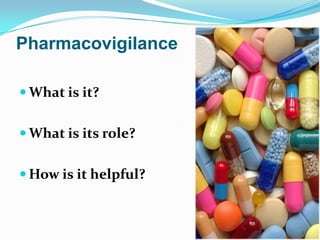
Pharmacovigilance
 What is it?
 What is its role?
 How is it helpful?
2
Pharmaco = Drug
Vigilance = to keep awake or alert, to
keep watch
3
Pharmacovigilance derived from
 Pharmacovigilance (abbreviated PV, PhV)
is drug safety.
 Is the pharmacological science related to the
detection, collection, assessment,
understanding and prevention of
adverse effects or any other medicine
related problem.
 Is the study of safety of marketed drug
under the practical conditions of clinical use
in large populations.
4
 Monitor the quality of drugs
 Identify the health risks involved in administration
of certain drugs
 Prevent harm to patients
 Research and efficacy of drugs
5
Goal of Pharmacovigilance
 Pharmacovigilance saves thousands of lives each
year. By monitoring the adverse effects of drugs
right from the lab to the pharmacy and then on for
many years
 Pharmacovigilance keeps track of any drastic
effects of dugs.
 This gives information about the hazards caused
by the medicines.
By this way, it prevents harm to patients using
those drugs
6
Pharmacovigilance: Preamble
 Thalidomide tragedy (1961): The greatest of all
drug disasters.
 Thalidomide had been introduced and welcomed
as a safe and effective hypnotic and antiemetic. It
rapidly became popular for the treatment of
nausea and vomiting in early pregnancy.
 Tragically the drug proved to be a potent human
teratogen that caused major birth defects in an
estimated 10,000 children
 Phocomelia was a characteristic feature
7
8
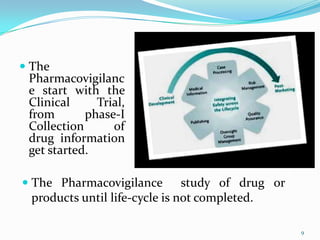
 The
Pharmacovigilanc
e start with the
Clinical Trial,
from phase-I
Collection of
drug information
get started.
 The Pharmacovigilance study of drug or
products until life-cycle is not completed.
9
Why do we study
Pharmacovigilance??
Whatever drug we take shows some ADRs which
were not knowing at the time of clinical trials, but
come after marketing in the large population
which show some events which are not seen at the
time of Clinical Trials.
After knowing this ADRs and ADEs
will arranged according to their severity to cause
toxicity to maintain the safety profile of the drug.
10
 Adverse event: Any untoward medical occurrence
that may present during treatment with a
pharmaceutical product but which does not
necessarily have a causal relationship with the
treatment.
 Adverse reaction: WHO technical report: A
response to a drug which is noxious and
unintended and which occurs at doses normally
used in humans for the prophylaxis, diagnosis or
therapy of disease or for the modification of
physiological function.
11
Glossary of terms
 Expected: As opposed to “unexpected”, an event that
is noted in the investigators brochure or labeling
(package insert or summary of product
characteristics).
 Unexpected adverse reaction: the nature or severity
of which is not consistent with the domestic labeling
or market authorization, or expected from
characteristics of the drug.
 Signal: Reported information on possible causal
relationship between an adverse event and a drug, the
relationship being unknown or incompletely
documented previously. Usually multiple report is
required to generate a signal depending upon the
seriousness of the event and quality of information.
12
Important organizations involved
in pharmacovigilance
FDA: The Food and Drug Administration (FDA or
USFDA) is an agency of the United States Department
of Health and Human Services, one of the United
States federal executive departments, responsible for
protecting and promoting public health through the
regulation and supervision of food safety, tobacco
products, dietary supplements, prescription and over-
the-counter pharmaceutical drugs (medications),
vaccines, biopharmaceuticals, blood transfusions,
medical devices, electromagnetic radiation emitting
devices (ERED), veterinary products, and cosmetics. 13
 EMEA: The European Medicines Agency is a
decentralised body of the European Union located
in London
 MHLW: Ministry of Health, Labor and
Welfare,Japan
 CDSCO: The government of India with the
assistance of world bank has initiated the National
pharmacovigilance programme. The central drugs
standard control organization (CDSCO) is
coordinating the country wide pharmacovigilance
programme under the aegis of Ministry of health
and family welfare, DGHS New Delhi
14
Uppsala monitoring centre
 The Uppsala monitoring centre(UMC, on behalf of
WHO) has over 3 million AE case reportes from
over 75 countries. The data are supplied by
national health authorities. Most of the data are
from the United states and supplied by the
FDA.The UMC does not review or assess the
individual cases put into database, but it does
pharmacovigilance analyses and signaling.
15
Conclusion
 The science and activities relating to the detection,
evaluation, understanding and prevention of
adverse drug reactions or any other drug-related
problems
 Pharmacovigilance is used for preventing patients
from being affected unnecessarily
 The work of WHO in the area of safety monitoring
of medicines is necessary if we are to achieve the
mission of EDM
 Medicines should be Available, Affordable, Safe
and Properly used 16
THANKS
17

Pharmacovigilance - an introduction

  • 1.
  • 2.
    Pharmacovigilance  What isit?  What is its role?  How is it helpful? 2
  • 3.
    Pharmaco = Drug Vigilance= to keep awake or alert, to keep watch 3 Pharmacovigilance derived from
  • 4.
     Pharmacovigilance (abbreviatedPV, PhV) is drug safety.  Is the pharmacological science related to the detection, collection, assessment, understanding and prevention of adverse effects or any other medicine related problem.  Is the study of safety of marketed drug under the practical conditions of clinical use in large populations. 4
  • 5.
     Monitor thequality of drugs  Identify the health risks involved in administration of certain drugs  Prevent harm to patients  Research and efficacy of drugs 5 Goal of Pharmacovigilance
  • 6.
     Pharmacovigilance savesthousands of lives each year. By monitoring the adverse effects of drugs right from the lab to the pharmacy and then on for many years  Pharmacovigilance keeps track of any drastic effects of dugs.  This gives information about the hazards caused by the medicines. By this way, it prevents harm to patients using those drugs 6
  • 7.
    Pharmacovigilance: Preamble  Thalidomidetragedy (1961): The greatest of all drug disasters.  Thalidomide had been introduced and welcomed as a safe and effective hypnotic and antiemetic. It rapidly became popular for the treatment of nausea and vomiting in early pregnancy.  Tragically the drug proved to be a potent human teratogen that caused major birth defects in an estimated 10,000 children  Phocomelia was a characteristic feature 7
  • 8.
  • 9.
     The Pharmacovigilanc e startwith the Clinical Trial, from phase-I Collection of drug information get started.  The Pharmacovigilance study of drug or products until life-cycle is not completed. 9
  • 10.
    Why do westudy Pharmacovigilance?? Whatever drug we take shows some ADRs which were not knowing at the time of clinical trials, but come after marketing in the large population which show some events which are not seen at the time of Clinical Trials. After knowing this ADRs and ADEs will arranged according to their severity to cause toxicity to maintain the safety profile of the drug. 10
  • 11.
     Adverse event:Any untoward medical occurrence that may present during treatment with a pharmaceutical product but which does not necessarily have a causal relationship with the treatment.  Adverse reaction: WHO technical report: A response to a drug which is noxious and unintended and which occurs at doses normally used in humans for the prophylaxis, diagnosis or therapy of disease or for the modification of physiological function. 11 Glossary of terms
  • 12.
     Expected: Asopposed to “unexpected”, an event that is noted in the investigators brochure or labeling (package insert or summary of product characteristics).  Unexpected adverse reaction: the nature or severity of which is not consistent with the domestic labeling or market authorization, or expected from characteristics of the drug.  Signal: Reported information on possible causal relationship between an adverse event and a drug, the relationship being unknown or incompletely documented previously. Usually multiple report is required to generate a signal depending upon the seriousness of the event and quality of information. 12
  • 13.
    Important organizations involved inpharmacovigilance FDA: The Food and Drug Administration (FDA or USFDA) is an agency of the United States Department of Health and Human Services, one of the United States federal executive departments, responsible for protecting and promoting public health through the regulation and supervision of food safety, tobacco products, dietary supplements, prescription and over- the-counter pharmaceutical drugs (medications), vaccines, biopharmaceuticals, blood transfusions, medical devices, electromagnetic radiation emitting devices (ERED), veterinary products, and cosmetics. 13
  • 14.
     EMEA: TheEuropean Medicines Agency is a decentralised body of the European Union located in London  MHLW: Ministry of Health, Labor and Welfare,Japan  CDSCO: The government of India with the assistance of world bank has initiated the National pharmacovigilance programme. The central drugs standard control organization (CDSCO) is coordinating the country wide pharmacovigilance programme under the aegis of Ministry of health and family welfare, DGHS New Delhi 14
  • 15.
    Uppsala monitoring centre The Uppsala monitoring centre(UMC, on behalf of WHO) has over 3 million AE case reportes from over 75 countries. The data are supplied by national health authorities. Most of the data are from the United states and supplied by the FDA.The UMC does not review or assess the individual cases put into database, but it does pharmacovigilance analyses and signaling. 15
  • 16.
    Conclusion  The scienceand activities relating to the detection, evaluation, understanding and prevention of adverse drug reactions or any other drug-related problems  Pharmacovigilance is used for preventing patients from being affected unnecessarily  The work of WHO in the area of safety monitoring of medicines is necessary if we are to achieve the mission of EDM  Medicines should be Available, Affordable, Safe and Properly used 16
  • 17.