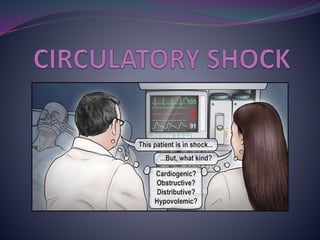
CIRCULATORY SHOCK
 Syndrome in which there is inadequate tissue
perfusion associated with relative or absolute decrease
in cardiac output.
TYPES
Hypovolemic shock
Distributive shock
Cardiogenic shock
Obstructive shock
HYPOVOLEMIC SHOCK
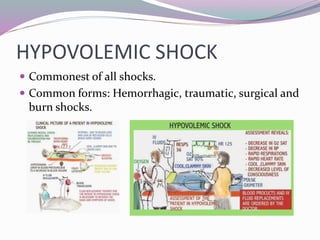
 Commonest of all shocks.
 Common forms: Hemorrhagic, traumatic, surgical and
burn shocks.
HEMORRHAGIC SHOCK
 Commonest of all shocks.
 Cause : Acute hemorrhage of more than 15ml/kg body
weight.
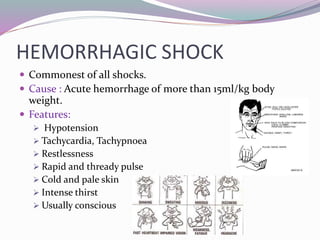
 Features:
 Hypotension
 Tachycardia, Tachypnoea
 Restlessness
 Rapid and thready pulse
 Cold and pale skin
 Intense thirst
 Usually conscious
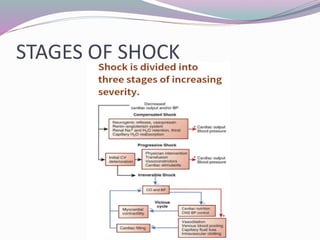
STAGES OF SHOCK
REVERSIBLE STAGE
 Rapid compensatory mechanisms
 Long-term compensatory mechanisms
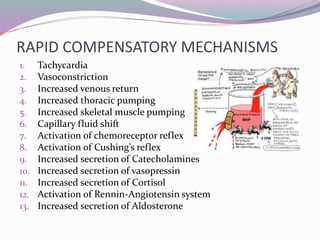
RAPID COMPENSATORY MECHANISMS
1. Tachycardia
2. Vasoconstriction
3. Increased venous return
4. Increased thoracic pumping
5. Increased skeletal muscle pumping
6. Capillary fluid shift
7. Activation of chemoreceptor reflex
8. Activation of Cushing’s reflex
9. Increased secretion of Catecholamines
10. Increased secretion of vasopressin
11. Increased secretion of Cortisol
12. Activation of Rennin-Angiotensin system
13. Increased secretion of Aldosterone
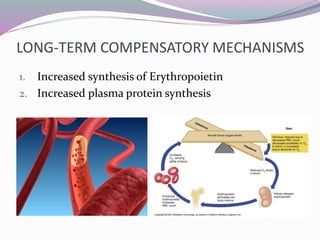
LONG-TERM COMPENSATORY MECHANISMS
1. Increased synthesis of Erythropoietin
2. Increased plasma protein synthesis
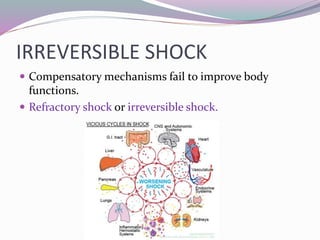
IRREVERSIBLE SHOCK
 Compensatory mechanisms fail to improve body
functions.
 Refractory shock or irreversible shock.
FEATURES
 Pre-capillary sphincters constrict
 Pre-capillary sphincters dilate
 Entry of bacteria into circulation
 Cardio-respiratory centres depressed
 Myocardial function decreases
 Disseminated intravascular coagulation
 Pulmonary microembolism
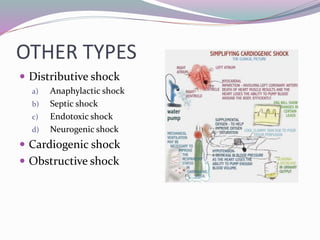
OTHER TYPES
 Distributive shock
a) Anaphylactic shock
b) Septic shock
c) Endotoxic shock
d) Neurogenic shock
 Cardiogenic shock
 Obstructive shock
TREATMENT OF SHOCK
 Blood transfusion
 Plasma transfusion
 Epinephrine
 Dopamine
 No sedatives
 Prevent over-warming of body
-R.MARIA JECINTHA RINA

Circulatory shock

  • 2.
    CIRCULATORY SHOCK  Syndromein which there is inadequate tissue perfusion associated with relative or absolute decrease in cardiac output. TYPES Hypovolemic shock Distributive shock Cardiogenic shock Obstructive shock
  • 3.
    HYPOVOLEMIC SHOCK  Commonestof all shocks.  Common forms: Hemorrhagic, traumatic, surgical and burn shocks.
  • 4.
    HEMORRHAGIC SHOCK  Commonestof all shocks.  Cause : Acute hemorrhage of more than 15ml/kg body weight.  Features:  Hypotension  Tachycardia, Tachypnoea  Restlessness  Rapid and thready pulse  Cold and pale skin  Intense thirst  Usually conscious
  • 5.
  • 6.
    REVERSIBLE STAGE  Rapidcompensatory mechanisms  Long-term compensatory mechanisms
  • 7.
    RAPID COMPENSATORY MECHANISMS 1.Tachycardia 2. Vasoconstriction 3. Increased venous return 4. Increased thoracic pumping 5. Increased skeletal muscle pumping 6. Capillary fluid shift 7. Activation of chemoreceptor reflex 8. Activation of Cushing’s reflex 9. Increased secretion of Catecholamines 10. Increased secretion of vasopressin 11. Increased secretion of Cortisol 12. Activation of Rennin-Angiotensin system 13. Increased secretion of Aldosterone
  • 8.
    LONG-TERM COMPENSATORY MECHANISMS 1.Increased synthesis of Erythropoietin 2. Increased plasma protein synthesis
  • 9.
    IRREVERSIBLE SHOCK  Compensatorymechanisms fail to improve body functions.  Refractory shock or irreversible shock.
  • 10.
    FEATURES  Pre-capillary sphinctersconstrict  Pre-capillary sphincters dilate  Entry of bacteria into circulation  Cardio-respiratory centres depressed  Myocardial function decreases  Disseminated intravascular coagulation  Pulmonary microembolism
  • 11.
    OTHER TYPES  Distributiveshock a) Anaphylactic shock b) Septic shock c) Endotoxic shock d) Neurogenic shock  Cardiogenic shock  Obstructive shock
  • 12.
    TREATMENT OF SHOCK Blood transfusion  Plasma transfusion  Epinephrine  Dopamine  No sedatives  Prevent over-warming of body
  • 13.