GENERAL METHODS OF ANALYSIS
OF LIPIDS
BY- TAPASH JYOTI BHATTARAI
M.PHARM (ANALYSIS) 1ST
SEM
24PG210047
PARUL INSTITUTE OF PHARMACY
FOOD ANALYSIS
GUIDED BY – DR. LIMA PATEL
ASSOCIATE PROFESSOR
PARUL INSTITUTE OF PHARMACY
CONTENTS
SL No. TOPIC PAGE No.
1 INTRODUCTION 1
2 SAMPLE PREPARATION 2
3 ANALYTICAL METHODS 3-4
4 SOLVENT EXTRACTION METHOD 5-12
5 NON-SOLVENT WET EXTRACTION
METHOD
13-14
6 INSTRUMENTAL METHOD 15-17
7 CONCLUSION 18
INTRODUCTION
o Lipids are a group of substances that, in general, are soluble in ether, chloroform, or
other organic solvents but are sparingly soluble in water.
o Lipids comprise a broad group of substances that have some common properties and
compositional similarities. However, some lipids, such as triacylglycerols, are very
hydrophobic.
Page No. 1
SAMPLE PREPARATION
o The validity of the fat analysis of a food depends on proper sampling and preservation of the
sample before the analysis. Vacuum oven drying at low temperature or lyophilization
increases the surface area of the sample for better lipid extraction.
o Acid hydrolysis breaks bound lipids into easily extractable lipid forms. The sample is
predigested by refluxing for 1hr with 3N hydrochloric acid, and ethanol and solid
hexametaphosphate are added to facilitate separation of lipids from other components.
o Ethyl ether and petroleum ether are the most commonly used solvents, but pentane and
hexane also are used to extract oil from soybeans. Ethyl ether is a better solvent for fat than
petroleum ether.
Page No. 2
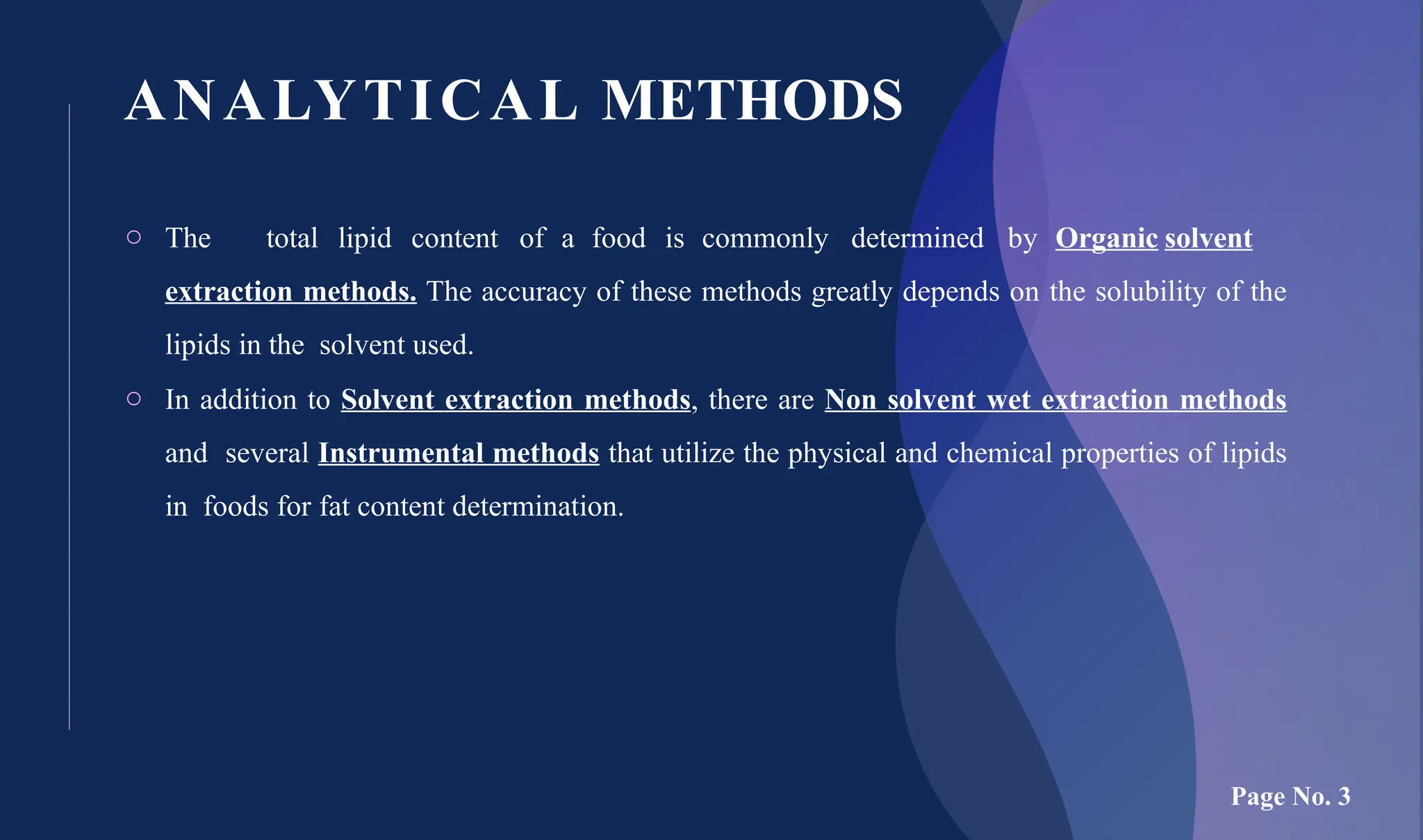
ANALYTICAL METHODS
o The total lipid content of a food is commonly determined by Organic solvent
extraction methods. The accuracy of these methods greatly depends on the solubility of the
lipids in the solvent used.
o In addition to Solvent extraction methods, there are Non solvent wet extraction methods
and several Instrumental methods that utilize the physical and chemical properties of lipids
in foods for fat content determination.
Page No. 3
Organic Solvent Extraction Methods
• Continuous Solvent Extraction Methods
• Semicontinuous Solvent Extraction Methods
• Discontinuous Solvent Extraction Methods
1. Mojonnier Method
2. Chloroform–Methanol Method
Non-solvent Wet Extraction Methods
• Babcock Method for Milk Fat
• Gerber Method for Milk Fat
Instrumental Methods
• Infrared Method
• Specific Gravity (Foss-Let Method)
• Nuclear Magnetic Resonance
Page No. 4
C O N T I N U O U S S O LV E N T E X T R A C T I O N METHODS
For C ontinuous solvent extraction, solvent from a boiling continuously flows over the sample
held in a ceramic thimble. Fat content is measured by weight loss of the sample or by weight of fat
removed.
Procedure:
Weigh pre-dried porous ceramic
extraction thimble. Place vacuum oven
dried sample in thimble and weigh
again.
Weigh pre-dried extraction
beaker.
Place anhydrous ethyl
ether in extraction beaker
and put beaker on heater
of apparatus.
Extract for 4 hr.
Lower heater and
let sample cool.
Remove the extraction beaker
and let air dry overnight, then at
100°C for 30 min. Cool beaker
in desiccator and weigh.
Page No. 5
CALCULATIONS
Weight of fat in sample =
(beaker + fat) − beaker
% Fat on dry weight basis =
(g of fat in sample / g of dried sample) × 100
Instrument Used: For Continuous solvent extraction method
Goldfish fat extractor is used
Fig- Goldfish fat extractor
Page No. 6
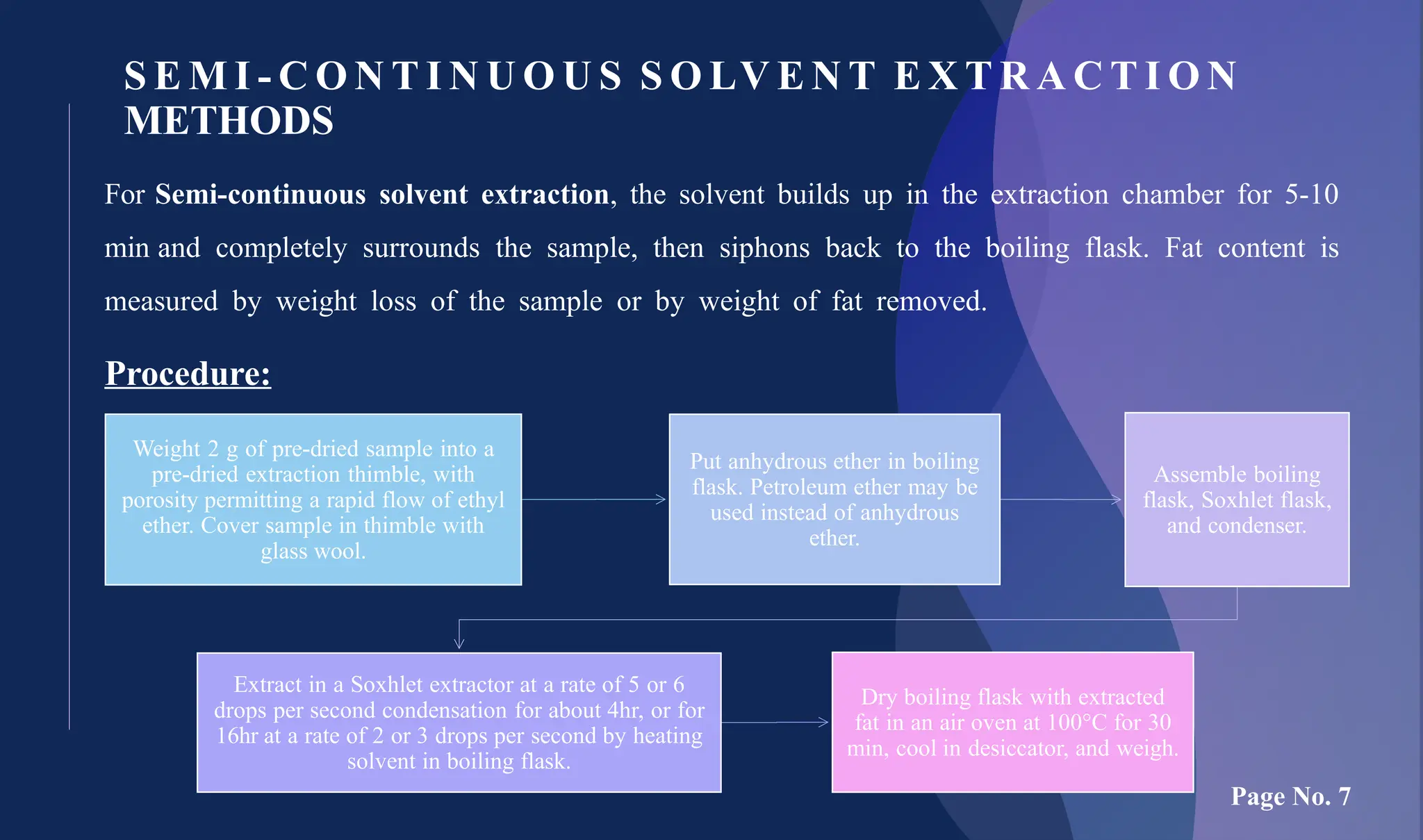
S E M I - C O N T I N U O U S S O LV E N T E X T R A C T I O N
METHODS
For Semi-continuous solvent extraction, the solvent builds up in the extraction chamber for 5-10
min and completely surrounds the sample, then siphons back to the boiling flask. Fat content is
measured by weight loss of the sample or by weight of fat removed.
Procedure:
Weight 2 g of pre-dried sample into a
pre-dried extraction thimble, with
porosity permitting a rapid flow of ethyl
ether. Cover sample in thimble with
glass wool.
Put anhydrous ether in boiling
flask. Petroleum ether may be
used instead of anhydrous
ether.
Assemble boiling
flask, Soxhlet flask,
and condenser.
Extract in a Soxhlet extractor at a rate of 5 or 6
drops per second condensation for about 4hr, or for
16hr at a rate of 2 or 3 drops per second by heating
solvent in boiling flask.
Dry boiling flask with extracted
fat in an air oven at 100°C for 30
min, cool in desiccator, and weigh.
Page No. 7
CALCULATIONS
% Fat on dry weight basis =
(g of fat in sample / g of dried sample) × 100
Instrument Used: For Semi-continuous Solvent extraction method
Soxhlet apparatus is Used.
Fig- Soxhlet Apparatus
Page No. 8
D I S C O N T I N U O U S S O LV E N T E X T R A C T I O N
M E T H O D S
1. Mojonnier Method:- Fat is extracted with a mixture of ethyl ether and petroleum ether in a
Mojonnier flask, and the extracted fat is dried to a constant weight and expressed as percent fat
by weight.
Procedure:
Weigh, to the
nearest 0.1 mg,
10 g of milk into
a Mojonnier fat
extraction flask.
Add 1.5 ml of NH4OH
and shake vigorously. Add
2 ml if the sample is sour.
NH4OH neutralizes the
acidic sample and
dissolves protein.
Add 10 ml of 95%
ethanol and shake
for 90 s. The alcohol
prevents possible
gel formation.
Add 25 ml of ethyl
ether and shake for
90 s. The ether
dissolves the lipid.
Cool if necessary, and add
25 ml of petroleum ether
and shake for 90 s. The
petroleum ether removes
moisture from the ethyl
ether extract and dissolves
more nonpolar lipid.
Centrifuge for 30 s at 600
rpm. Decant ether solution
from the Mojonnier flask
into the previously weighed
Mojonnier fat dish.
Perform second and third
extractions in the same manner as
for the first extraction described
previously (ethanol, ethyl ether,
petroleum ether, centrifugation,
decant).
Evaporate the solvent
in the dish on the
electric hot plate at
≤100◦C in a hood.
Dry the dish and fat to a
constant weight in a
forced air oven at 100◦C ±
1◦C. Cool the dish to room
temperature andweigh.
Page No. 9
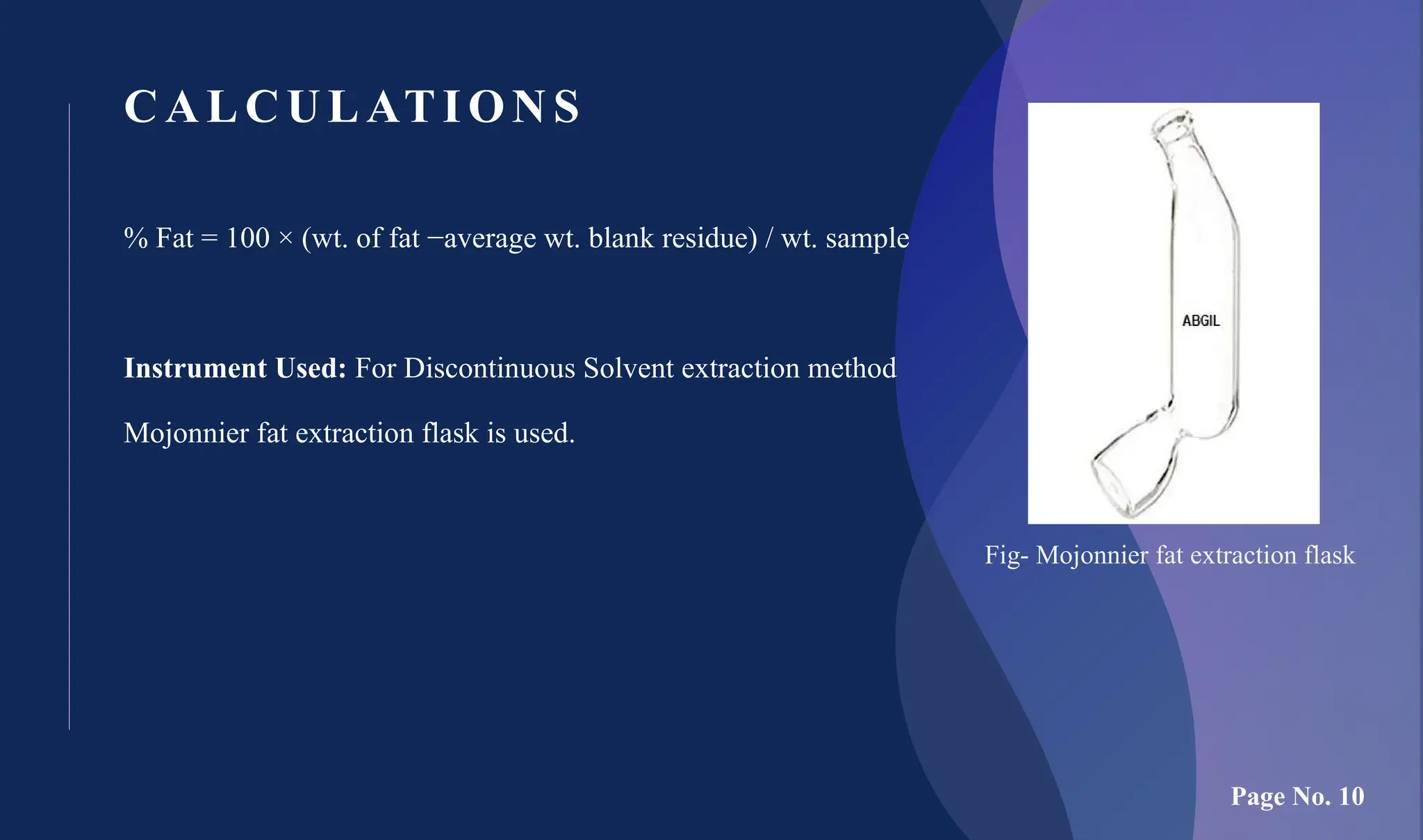
CALCULATIONS
% Fat = 100 × (wt. of fat −average wt. blank residue) / wt. sample
Instrument Used: For Discontinuous Solvent extraction method
Mojonnier fat extraction flask is used.
Fig- Mojonnier fat extraction flask
Page No. 10
BABCOCK METHOD FOR MI LK FAT
In the Babcock method, H2SO4 is added to a known amount of milk in the Babcock bottle. The
sulfuric acid digests protein, generates heat, and releases the fat. Centrifugation and hot water
addition isolate fat for quantitation in the graduated portion of the test bottle. The fat is measured
volumetrically, but the result is expressed as percent fat by weight.
Procedure:
Accurately pipette the
milk sample (17.6 ml) into
a Babcock test bottle
Add reagent grade (1.82 specific gravity)
sulfuric acid (17.5 ml) to the bottle,
allowing the acid to flow gently down the
neck of the bottle as it is being slowly
rotated.
Centrifuge the mixture for 5 min
and liquid fat will rise into the
calibrated bottle neck. The
centrifuge must be kept at 55–60◦C
during centrifugation.
Add hot water to bring liquid
fat up into the graduated neck
of the Babcock bottle.
The direct percentage of fat by weight is
read to the nearest 0.05% from the
graduation mark of the bottle.
Page No. 13
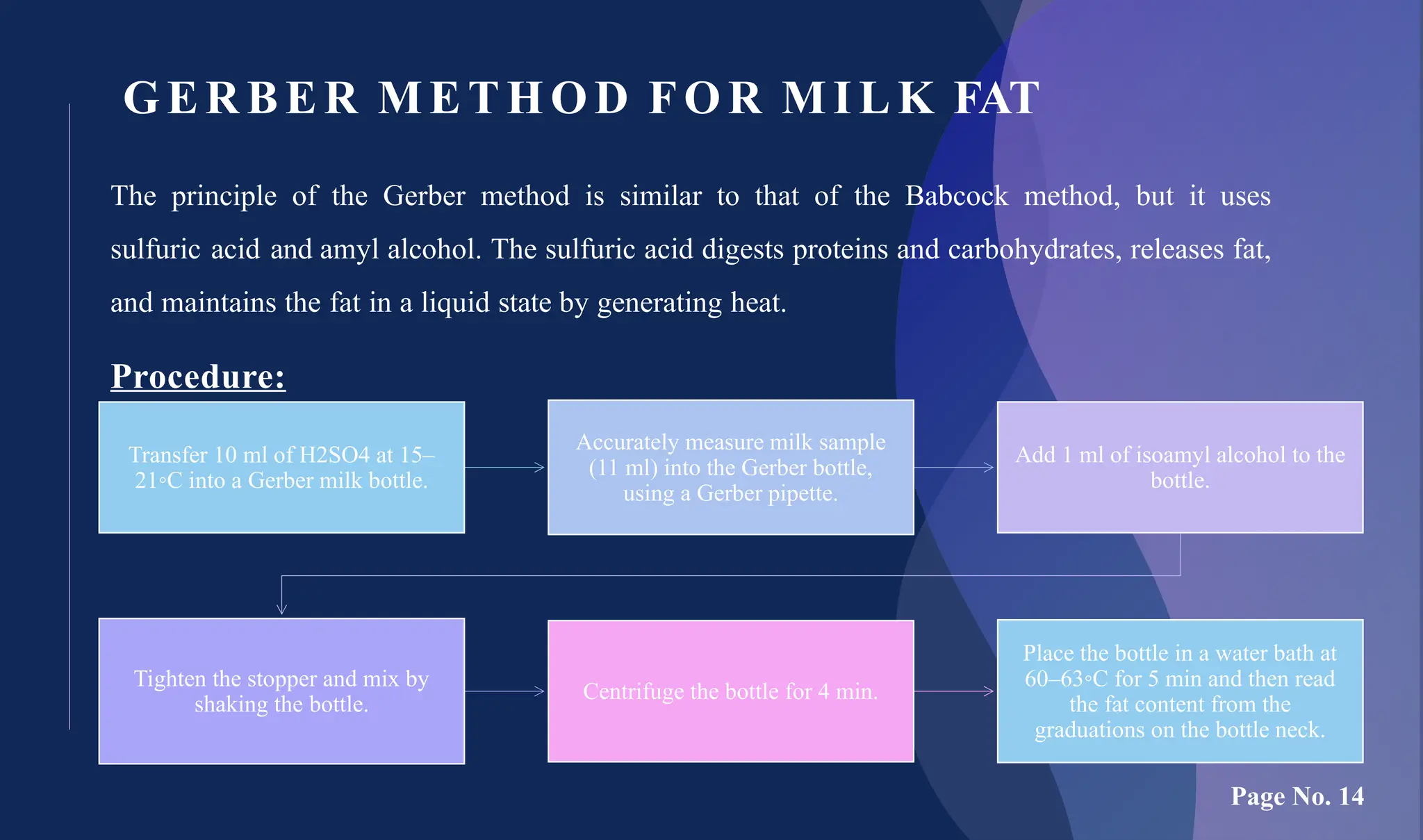
GERBER METHOD FO R MILK FAT
The principle of the Gerber method is similar to that of the Babcock method, but it uses
sulfuric acid and amyl alcohol. The sulfuric acid digests proteins and carbohydrates, releases fat,
and maintains the fat in a liquid state by generating heat.
Procedure:
Transfer 10 ml of H2SO4 at 15–
21◦C into a Gerber milk bottle.
Accurately measure milk sample
(11 ml) into the Gerber bottle,
using a Gerber pipette.
Add 1 ml of isoamyl alcohol to the
bottle.
Tighten the stopper and mix by
shaking the bottle.
Centrifuge the bottle for 4 min.
Place the bottle in a water bath at
60–63◦C for 5 min and then read
the fat content from the
graduations on the bottle neck.
Page No. 14
INFRARED METHOD
o The infrared (IR) method is based on absorption of IR energy by fat at a wavelength of 5.73
µm (1745 Wave Number).
o The more the energy absorption at 5.73 µm, the higher is the fat content of the sample. Mid-IR
spectroscopy is used in Infrared Milk Analyzers to determine milk fat content.
o Near-infrared (NIR) spectroscopy has been used to measure the fat content of commodities
such as meats, cereals, and oilseeds in the laboratory and is being adapted for on-line
measurement.
Page No. 15
SPECIFI C GRAVITY (FOSS-LET METHOD)
o Fat content by the Foss-Let method is determined as a function of the specific gravity of a
sample solvent extract.
o A sample of known weight is extracted for 1.5 to 2 min in a vibration reaction chamber with
perchloro-ethylene. The extract is filtered, and using a thermostatically controlled device with
digital readout, its specific gravity is determined.
o The reading can then be converted to oil or fat percentage using a conversion chart.
Page No. 16
NUCL EAR MAGNE TI C RESONANCE
o Nuclear magnetic resonance (NMR) can be used to measure lipids in food materials in a non-
destructive way.
o It is one of the most popular methods for use in determining lipid melting curves to measure
solid fat content, and with more affordable instruments is becoming more popular for
measuring total fat content.
o Total fat content can be measured using low-resolution pulsed NMR. NMR analysis is a very
rapid and accurate method.
Page No. 17
CONCLUSION
o Soxhlet extraction or its modified method is a common crude fat determination method in
many food commodities. However, this method requires a dried sample for the hydroscopic
ethyl ether extraction. If the samples are moist or liquid foods, the Mojonnier method is
generally applicable to determination of the fat content.
o The instrumental methods such as IR and NMR are very simple, reproducible, and fast, but are
available only for fat determination for specific foods
Page No. 18

GENERAL METHOD FOR ANALYSIS OF LIPIDS IN FOOD PRODUCTS

  • 1.
    GENERAL METHODS OFANALYSIS OF LIPIDS BY- TAPASH JYOTI BHATTARAI M.PHARM (ANALYSIS) 1ST SEM 24PG210047 PARUL INSTITUTE OF PHARMACY FOOD ANALYSIS GUIDED BY – DR. LIMA PATEL ASSOCIATE PROFESSOR PARUL INSTITUTE OF PHARMACY
  • 2.
    CONTENTS SL No. TOPICPAGE No. 1 INTRODUCTION 1 2 SAMPLE PREPARATION 2 3 ANALYTICAL METHODS 3-4 4 SOLVENT EXTRACTION METHOD 5-12 5 NON-SOLVENT WET EXTRACTION METHOD 13-14 6 INSTRUMENTAL METHOD 15-17 7 CONCLUSION 18
  • 3.
    INTRODUCTION o Lipids area group of substances that, in general, are soluble in ether, chloroform, or other organic solvents but are sparingly soluble in water. o Lipids comprise a broad group of substances that have some common properties and compositional similarities. However, some lipids, such as triacylglycerols, are very hydrophobic. Page No. 1
  • 4.
    SAMPLE PREPARATION o Thevalidity of the fat analysis of a food depends on proper sampling and preservation of the sample before the analysis. Vacuum oven drying at low temperature or lyophilization increases the surface area of the sample for better lipid extraction. o Acid hydrolysis breaks bound lipids into easily extractable lipid forms. The sample is predigested by refluxing for 1hr with 3N hydrochloric acid, and ethanol and solid hexametaphosphate are added to facilitate separation of lipids from other components. o Ethyl ether and petroleum ether are the most commonly used solvents, but pentane and hexane also are used to extract oil from soybeans. Ethyl ether is a better solvent for fat than petroleum ether. Page No. 2
  • 5.
    ANALYTICAL METHODS o Thetotal lipid content of a food is commonly determined by Organic solvent extraction methods. The accuracy of these methods greatly depends on the solubility of the lipids in the solvent used. o In addition to Solvent extraction methods, there are Non solvent wet extraction methods and several Instrumental methods that utilize the physical and chemical properties of lipids in foods for fat content determination. Page No. 3
  • 6.
    Organic Solvent ExtractionMethods • Continuous Solvent Extraction Methods • Semicontinuous Solvent Extraction Methods • Discontinuous Solvent Extraction Methods 1. Mojonnier Method 2. Chloroform–Methanol Method Non-solvent Wet Extraction Methods • Babcock Method for Milk Fat • Gerber Method for Milk Fat Instrumental Methods • Infrared Method • Specific Gravity (Foss-Let Method) • Nuclear Magnetic Resonance Page No. 4
  • 7.
    C O NT I N U O U S S O LV E N T E X T R A C T I O N METHODS For C ontinuous solvent extraction, solvent from a boiling continuously flows over the sample held in a ceramic thimble. Fat content is measured by weight loss of the sample or by weight of fat removed. Procedure: Weigh pre-dried porous ceramic extraction thimble. Place vacuum oven dried sample in thimble and weigh again. Weigh pre-dried extraction beaker. Place anhydrous ethyl ether in extraction beaker and put beaker on heater of apparatus. Extract for 4 hr. Lower heater and let sample cool. Remove the extraction beaker and let air dry overnight, then at 100°C for 30 min. Cool beaker in desiccator and weigh. Page No. 5
  • 8.
    CALCULATIONS Weight of fatin sample = (beaker + fat) − beaker % Fat on dry weight basis = (g of fat in sample / g of dried sample) × 100 Instrument Used: For Continuous solvent extraction method Goldfish fat extractor is used Fig- Goldfish fat extractor Page No. 6
  • 9.
    S E MI - C O N T I N U O U S S O LV E N T E X T R A C T I O N METHODS For Semi-continuous solvent extraction, the solvent builds up in the extraction chamber for 5-10 min and completely surrounds the sample, then siphons back to the boiling flask. Fat content is measured by weight loss of the sample or by weight of fat removed. Procedure: Weight 2 g of pre-dried sample into a pre-dried extraction thimble, with porosity permitting a rapid flow of ethyl ether. Cover sample in thimble with glass wool. Put anhydrous ether in boiling flask. Petroleum ether may be used instead of anhydrous ether. Assemble boiling flask, Soxhlet flask, and condenser. Extract in a Soxhlet extractor at a rate of 5 or 6 drops per second condensation for about 4hr, or for 16hr at a rate of 2 or 3 drops per second by heating solvent in boiling flask. Dry boiling flask with extracted fat in an air oven at 100°C for 30 min, cool in desiccator, and weigh. Page No. 7
  • 10.
    CALCULATIONS % Fat ondry weight basis = (g of fat in sample / g of dried sample) × 100 Instrument Used: For Semi-continuous Solvent extraction method Soxhlet apparatus is Used. Fig- Soxhlet Apparatus Page No. 8
  • 11.
    D I SC O N T I N U O U S S O LV E N T E X T R A C T I O N M E T H O D S 1. Mojonnier Method:- Fat is extracted with a mixture of ethyl ether and petroleum ether in a Mojonnier flask, and the extracted fat is dried to a constant weight and expressed as percent fat by weight. Procedure: Weigh, to the nearest 0.1 mg, 10 g of milk into a Mojonnier fat extraction flask. Add 1.5 ml of NH4OH and shake vigorously. Add 2 ml if the sample is sour. NH4OH neutralizes the acidic sample and dissolves protein. Add 10 ml of 95% ethanol and shake for 90 s. The alcohol prevents possible gel formation. Add 25 ml of ethyl ether and shake for 90 s. The ether dissolves the lipid. Cool if necessary, and add 25 ml of petroleum ether and shake for 90 s. The petroleum ether removes moisture from the ethyl ether extract and dissolves more nonpolar lipid. Centrifuge for 30 s at 600 rpm. Decant ether solution from the Mojonnier flask into the previously weighed Mojonnier fat dish. Perform second and third extractions in the same manner as for the first extraction described previously (ethanol, ethyl ether, petroleum ether, centrifugation, decant). Evaporate the solvent in the dish on the electric hot plate at ≤100◦C in a hood. Dry the dish and fat to a constant weight in a forced air oven at 100◦C ± 1◦C. Cool the dish to room temperature andweigh. Page No. 9
  • 12.
    CALCULATIONS % Fat =100 × (wt. of fat −average wt. blank residue) / wt. sample Instrument Used: For Discontinuous Solvent extraction method Mojonnier fat extraction flask is used. Fig- Mojonnier fat extraction flask Page No. 10
  • 13.
    BABCOCK METHOD FORMI LK FAT In the Babcock method, H2SO4 is added to a known amount of milk in the Babcock bottle. The sulfuric acid digests protein, generates heat, and releases the fat. Centrifugation and hot water addition isolate fat for quantitation in the graduated portion of the test bottle. The fat is measured volumetrically, but the result is expressed as percent fat by weight. Procedure: Accurately pipette the milk sample (17.6 ml) into a Babcock test bottle Add reagent grade (1.82 specific gravity) sulfuric acid (17.5 ml) to the bottle, allowing the acid to flow gently down the neck of the bottle as it is being slowly rotated. Centrifuge the mixture for 5 min and liquid fat will rise into the calibrated bottle neck. The centrifuge must be kept at 55–60◦C during centrifugation. Add hot water to bring liquid fat up into the graduated neck of the Babcock bottle. The direct percentage of fat by weight is read to the nearest 0.05% from the graduation mark of the bottle. Page No. 13
  • 14.
    GERBER METHOD FOR MILK FAT The principle of the Gerber method is similar to that of the Babcock method, but it uses sulfuric acid and amyl alcohol. The sulfuric acid digests proteins and carbohydrates, releases fat, and maintains the fat in a liquid state by generating heat. Procedure: Transfer 10 ml of H2SO4 at 15– 21◦C into a Gerber milk bottle. Accurately measure milk sample (11 ml) into the Gerber bottle, using a Gerber pipette. Add 1 ml of isoamyl alcohol to the bottle. Tighten the stopper and mix by shaking the bottle. Centrifuge the bottle for 4 min. Place the bottle in a water bath at 60–63◦C for 5 min and then read the fat content from the graduations on the bottle neck. Page No. 14
  • 15.
    INFRARED METHOD o Theinfrared (IR) method is based on absorption of IR energy by fat at a wavelength of 5.73 µm (1745 Wave Number). o The more the energy absorption at 5.73 µm, the higher is the fat content of the sample. Mid-IR spectroscopy is used in Infrared Milk Analyzers to determine milk fat content. o Near-infrared (NIR) spectroscopy has been used to measure the fat content of commodities such as meats, cereals, and oilseeds in the laboratory and is being adapted for on-line measurement. Page No. 15
  • 16.
    SPECIFI C GRAVITY(FOSS-LET METHOD) o Fat content by the Foss-Let method is determined as a function of the specific gravity of a sample solvent extract. o A sample of known weight is extracted for 1.5 to 2 min in a vibration reaction chamber with perchloro-ethylene. The extract is filtered, and using a thermostatically controlled device with digital readout, its specific gravity is determined. o The reading can then be converted to oil or fat percentage using a conversion chart. Page No. 16
  • 17.
    NUCL EAR MAGNETI C RESONANCE o Nuclear magnetic resonance (NMR) can be used to measure lipids in food materials in a non- destructive way. o It is one of the most popular methods for use in determining lipid melting curves to measure solid fat content, and with more affordable instruments is becoming more popular for measuring total fat content. o Total fat content can be measured using low-resolution pulsed NMR. NMR analysis is a very rapid and accurate method. Page No. 17
  • 18.
    CONCLUSION o Soxhlet extractionor its modified method is a common crude fat determination method in many food commodities. However, this method requires a dried sample for the hydroscopic ethyl ether extraction. If the samples are moist or liquid foods, the Mojonnier method is generally applicable to determination of the fat content. o The instrumental methods such as IR and NMR are very simple, reproducible, and fast, but are available only for fat determination for specific foods Page No. 18