General Anesthesia in
Cesarean Section
Objectives
To answer:
• Why is General Anesthesia indicated for Cesarean Section
• How is General Anesthesia done during Cesarean Section
• What are the medications for General Anesthesia during Cesarean
Section
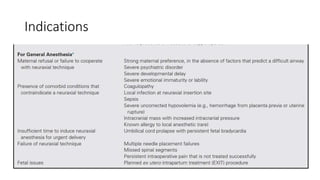
Indications
Preparation
• Assess Risk for Pulmonary Aspiration/Injury
• Fasting
• Meds: Metoclopramide 10mg, Ranitidine 50mg IV, Antacid (Sodium
Citrate 30 mL)
• Difficult Intubation Set/Awake Intubation
• Meds: Glycopyrrolate, Midazolam, Lidocaine/Benzocaine
• Nerve Block
Preparation
• Uterine Displacement
• Sniffing Position
• ASA Standard Monitoring
• Preoxygenation with 100% O2
• Prepare the Surgical Field
Induction
• Preoxygenation
• Rapid-Sequence Induction
• Administer Induction Agents
• Cricoid Pressure
Induction
• Agents:
• Thiopental: 4-6 mg/Kg
• Propofol: 2-2.8mg/Kg
• Ketamine: 1-1.5mg/Kg
• Etomidate: 0.3mg/Kg
• Succinylcholine: 1-1.5mg/Kg
• Rocuronium: 1mg/Kg
Induction
• Intubation
• ET Size: 6.5mm or 7.0mm (cuffed)
• Direct / Videolaryngoscope
• Flexible Stylet
• Check:
• Capnographic Tracing
• Auscultate
Maintenance
Goals:
Adequate Maternal and fetal oxygenation, with maintenance of
normocapnia for pregnancy
Appropriate Depth of Anesthesia to promote maternal comfort and a
quiescent surgical field and to prevent awareness and recall
Minimal effects on uterine tone after delivery
Minimal adverse effects on the neonate
Maintenance
Fetal Oxygenation:
• Maximal: 1.0 FiO2
• Absence of Fetal Compromise: .3 FiO2
Maternal Ventilation:
• Term Gestation: PaCO2: 30 to 32mmHg (Normocapnia)
Maintenance
MAC 1.0: Between Tracheal Intubation and Delivery
MAC 0.5 to 0.75: After Delivery
Nitrous Oxide 50% in O2 – reduce requirement of volatile agent
Propofol or Ketamine – Maintain depth of Anesthesia
Benzodiazepine: Reduce Maternal Awareness
Maintenance
Opioids
• Intravenous opioids are often withheld until after delivery to minimize
the potential for neonatal respiratory depression
• There may be circumstances in which maternal hemodynamic
stability or blunting of responses to airway manipulation and surgical
stimulation favor the administration of opioids during the induction
of general anesthesia.
• Lipid-Soluble Agents: Remifentanil, Fentanyl, Alfentanil
• Water-Soluble Agents: Morphine, Hydromorphone
Emergence and Tracheal Extubation
Tracheal Extubation
• Patient Awakens
• Semi-Recumbent Position
• Patient demonstrates Purposeful response to verbal command
• Return of Protective airway reflexes
Emergence and Tracheal Extubation
ASA Practice Guidelines for Post Anesthetic Care:
• Pulse Oximetry: for early detection of Hypoxemia
• Periodic Assessment:
• Airway Patency
• Respiratory Rate
• Oxygen Saturation
• Delayed Extubation/ICU Care:
• Repeated Airway Manipulation
• Massive hemorrhage
• Emergency Hysterectomy
Reference
Chestnut’s Obstetric Anesthesia, 6th Edition
Thank You

General Anesthesia in Cesarean Section.pptx

  • 1.
  • 2.
    Objectives To answer: • Whyis General Anesthesia indicated for Cesarean Section • How is General Anesthesia done during Cesarean Section • What are the medications for General Anesthesia during Cesarean Section
  • 3.
  • 4.
    Preparation • Assess Riskfor Pulmonary Aspiration/Injury • Fasting • Meds: Metoclopramide 10mg, Ranitidine 50mg IV, Antacid (Sodium Citrate 30 mL) • Difficult Intubation Set/Awake Intubation • Meds: Glycopyrrolate, Midazolam, Lidocaine/Benzocaine • Nerve Block
  • 5.
    Preparation • Uterine Displacement •Sniffing Position • ASA Standard Monitoring • Preoxygenation with 100% O2 • Prepare the Surgical Field
  • 6.
    Induction • Preoxygenation • Rapid-SequenceInduction • Administer Induction Agents • Cricoid Pressure
  • 7.
    Induction • Agents: • Thiopental:4-6 mg/Kg • Propofol: 2-2.8mg/Kg • Ketamine: 1-1.5mg/Kg • Etomidate: 0.3mg/Kg • Succinylcholine: 1-1.5mg/Kg • Rocuronium: 1mg/Kg
  • 8.
    Induction • Intubation • ETSize: 6.5mm or 7.0mm (cuffed) • Direct / Videolaryngoscope • Flexible Stylet • Check: • Capnographic Tracing • Auscultate
  • 9.
    Maintenance Goals: Adequate Maternal andfetal oxygenation, with maintenance of normocapnia for pregnancy Appropriate Depth of Anesthesia to promote maternal comfort and a quiescent surgical field and to prevent awareness and recall Minimal effects on uterine tone after delivery Minimal adverse effects on the neonate
  • 10.
    Maintenance Fetal Oxygenation: • Maximal:1.0 FiO2 • Absence of Fetal Compromise: .3 FiO2 Maternal Ventilation: • Term Gestation: PaCO2: 30 to 32mmHg (Normocapnia)
  • 11.
    Maintenance MAC 1.0: BetweenTracheal Intubation and Delivery MAC 0.5 to 0.75: After Delivery Nitrous Oxide 50% in O2 – reduce requirement of volatile agent Propofol or Ketamine – Maintain depth of Anesthesia Benzodiazepine: Reduce Maternal Awareness
  • 12.
    Maintenance Opioids • Intravenous opioidsare often withheld until after delivery to minimize the potential for neonatal respiratory depression • There may be circumstances in which maternal hemodynamic stability or blunting of responses to airway manipulation and surgical stimulation favor the administration of opioids during the induction of general anesthesia. • Lipid-Soluble Agents: Remifentanil, Fentanyl, Alfentanil • Water-Soluble Agents: Morphine, Hydromorphone
  • 13.
    Emergence and TrachealExtubation Tracheal Extubation • Patient Awakens • Semi-Recumbent Position • Patient demonstrates Purposeful response to verbal command • Return of Protective airway reflexes
  • 14.
    Emergence and TrachealExtubation ASA Practice Guidelines for Post Anesthetic Care: • Pulse Oximetry: for early detection of Hypoxemia • Periodic Assessment: • Airway Patency • Respiratory Rate • Oxygen Saturation • Delayed Extubation/ICU Care: • Repeated Airway Manipulation • Massive hemorrhage • Emergency Hysterectomy
  • 16.
  • 17.

Editor's Notes

  • #4 Regional anaesthesia is the most common method of providing anaesthesia for Caesarean section. When general anaesthesia is used, the most common indications are urgency (35% of cases in a non-teaching hospital), maternal refusal of regional techniques (20%), inadequate or failed regional attempts (22%), and regional contraindications including coagulation or spinal abnormalities (6%). Obstetric indications, such as placenta praevia, were in the past considered absolute indications for general anaesthesia. There are now multiple reports of these cases being performed safely under regional anaesthesia. This table is lifted from Chestnut Obstetric Anesthesia, 6th edition, this table outlines the possible indications for General Anesthesia during Cesarean section
  • #5 All pregnant patients requiring surgical anesthesia should be considered at risk for pulmonary aspiration of gastric contents Attempts should be made to minimize both the risk for maternal aspiration and the risk for pulmonary injury if aspiration occurs. Fasting policies should be shared with all members of the obstetric care team. Administer metoclopramide 10 mg and ranitidine 50 mg intravenously between 30 and 60 minutes before induction of general anesthesia, when possible, to diminish gastric volume and gastric acid secretion, respectively. A clear, nonparticulate antacid (sodium citrate 30 mL) should also be administered within 30 minutes of surgery to neutralize gastric acid; the antacid may be particularly important in the emergent situation when metoclopramide and ranitidine have not had the necessary time to exert their pharmacologic effects. If the patient has airway characteristics that herald difficult mask ventilation or intubation, consideration should be given to performing an awake tracheal intubation. Preparations include administering an antisialagogue (e.g., glycopyrrolate), judicious sedation (e.g., midazolam), and topical airway anesthesia (e.g., aerosolized lidocaine or benzocaine). Glossopharyngeal and laryngeal nerve blocks may also be considered, although these should be avoided in patients at excess risk for bleeding (e.g., Hemolysis, Elevated Liver enzymes and Low Platelet count [HELLP] syndrome).
  • #6 The patient should be placed supine with left uterine displacement. The head, neck, and shoulders should be optimally positioned for airway management (i.e., the sniffing position). Routine monitoring should be established, including ECG, pulse oximetry, blood pressure, and capnography. Preoxygenation (denitrogenation) with 100% oxygen accomplished by 3 minutes of tidal-volume breathing with a tight-fitting face mask should be performed to delay the onset of hypoxemia during apnea; this hypoxemia occurs more rapidly because of the pregnancy-induced decrease in functional residual capacity and increase in oxygen consumption In contrast to most surgical procedures, the patient’s abdomen is prepared and draped before induction of general anesthesia to minimize fetal exposure to general anesthesia. After the surgical drapes have been applied and the operating personnel are ready at the tableside, the surgeon should be instructed to delay the incision until the anesthesia provider confirms correct placement of the endotracheal tube and gives verbal instructions to proceed with surgery.
  • #7 A rapid-sequence induction is initiated with denitrogenation/ preoxygenation followed by administration of an induction agent, paralysis, and cricoid pressure. The technique for cricoid pressure begins with an assistant applying 10 newtons (N) of force, 1 N being the unit of force required to accelerate a mass of 1 kg by 1 m/s2 (force cannot be represented by mass alone, but as a practical guide to the amount of force to apply, 10 N is approximately equivalent to the downward force exerted by a weight of 1 kg). Following loss of consciousness, the amount of force is increased to 30 N. Application of the full amount of force while the patient is still awake can provoke active retching and regurgitation. In some cases, cricoid pressure may be briefly released to enable a successful intubation; not infrequently the benefit of release outweighs the risk for regurgitation. Cricoid pressure should then be reapplied until the correct endotracheal tube position is confirmed. Mask ventilation is traditionally not performed, because when it is applied without the application of cricoid pressure and with pressures greater than 20 cm H2O, insufflation of the stomach can occur.
  • #8 Historically, thiopental (4 to 6 mg/kg) has been the most frequently used induction agent. Propofol (2 to 2.8 mg/kg) is now commonly used to induce general anesthesia for cesarean delivery. Propofol, in a dose sufficient for induction and to prevent maternal awareness (2.5 mg/kg), may depress the infant more than thiopental. In the presence of hemodynamic instability, ketamine (1 to 1.5 mg/kg) or etomidate (0.3 mg/ kg) should be substituted for propofol. Paralysis is achieved by succinylcholine (1 to 1.5 mg/kg) in 30 to 40 seconds. Administration of a defasciculating dose of a nondepolarizing muscle relaxant is not recommended, because it may delay the onset of neuromuscular blockade with succinylcholine. Pregnancy appears to be associated with less severe succinylcholine-induced fasciculations and muscle pain. Rocuronium (1 mg/kg) may provide intubating conditions similar to those provided with succinylcholine (1 mg/ kg) for cesarean delivery and is a suitable alternative in situations in which succinylcholine should be avoided (e.g., malignant hyperthermia, myotonic dystrophy, spastic paraparesis). Some recent data suggest its use in cesarean delivery may be associated with a lower frequency of myalgia compared with succinylcholine.
  • #9 A small-diameter cuffed endotracheal tube (i.e., 6.5 or 7.0 mm) should be used during pregnancy; the use of a videolaryngoscopy device (e.g., C-MAC, Glidescope), a flexible stylet within the endotracheal tube, and a bougie on standby, allows a “first and best” attempt at tracheal intubation. Tissue trauma and airway edema may occur with repeated attempts at intubation. Correct endotracheal tube placement should be confirmed by checking for a normal capnographic tracing. Auscultation should be performed to rule out inadvertent endobronchial intubation. If incorrect endotracheal tube placement is promptly recognized, extubation (with continued cricoid pressure) will often allow another attempt without the need for additional muscle relaxant. Anticipation of a difficult endotracheal intubation, or a failed intubation attempt, should invoke the difficult airway algorithm and a call for assistance
  • #10 The goals for anesthetic maintenance include (1) adequate maternal and fetal oxygenation, with maintenance of normocapnia for pregnancy; (2) appropriate depth of anesthesia to promote maternal comfort and a quiescent surgical field and to prevent awareness and recall; (3) minimal effects on uterine tone after delivery; and (4) minimal adverse effects on the neonate. These goals can be accomplished using inhalational anesthesia or, less commonly, total intravenous anesthesia.
  • #11 Fetal oxygenation appears maximal when a maternal Fio2 of 1.0 is used; however, in the absence of fetal compromise, an Fio2 of 0.3 appears to provide sufficient oxygenation while minimizing the production of oxygen free radicals. Maternal ventilation should maintain normocapnia, which at term gestation is a Paco2 of 30 to 32 mm Hg (4.0 to 4.3 kPa). Excessive ventilation can cause uteroplacental vasoconstriction and a leftward shift of the oxyhemoglobin dissociation curve, which may result in compromised fetal oxygenation. On the other hand, hypercapnia can lead to maternal tachycardia and is also undesirable.
  • #12 In clinical practice, approximately 1.0 MAC of a volatile halogenated agent is typically administered between tracheal intubation and delivery. Halogenated agents cause dose-dependent depression of uterine contractility, which may lead to greater blood loss after delivery. Therefore, the concentration of the volatile agent is reduced to 0.5 to 0.75 MAC after delivery. Nitrous oxide 50% in oxygen is often added to reduce the required concentration of volatile agent, thereby mitigating adverse effects on uterine tone; intravenous propofol or ketamine can also be administered to maintain an appropriate depth of anesthesia. The administration of a benzodiazepine (e.g., midazolam) after delivery may reduce the risk for maternal awareness.
  • #13 Intravenous opioids are often withheld until after delivery to minimize the potential for neonatal respiratory depression; however, there may be circumstances in which maternal hemodynamic stability or blunting of responses to airway manipulation and surgical stimulation favor the administration of opioids during the induction of general anesthesia. The rapid onset and efficacy of intravenous lipid-soluble agents (e.g., remifentanil, fentanyl, alfentanil) make them ideal for mitigating the responses to laryngoscopy and intubation. Intraoperatively, the prolonged activity of water-soluble agents (e.g., morphine, hydromorphone) can be useful to minimize volatile anesthetic use and for the provision of intraoperative and postoperative analgesia
  • #14 When the patient awakens, tracheal extubation should be performed with the patient in a semi-recumbent position. The patient should demonstrate purposeful response to verbal commands and return of protective airway reflexes before tracheal extubation.
  • #15 The ASA Practice Guidelines for Postanesthetic Care suggest that pulse oximetry is associated with early detection of hypoxemia; the guidelines recommend periodic assessment of airway patency, respiratory rate, and oxygen saturation during emergence and recovery. If repeated airway manipulation, massive hemorrhage, or emergency hysterectomy has occurred, delayed extubation and/or transfer to an intensive care unit (ICU) should be considered.
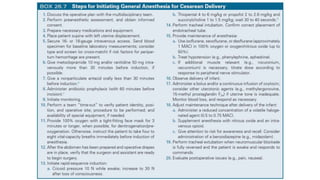
  • #16 This Table has been lifted from Chestnut’s Obstetric Anesthesia, 6th edition. It summarizes the Steps for initiating General Anesthesia for Cesarean Delivery which had been discussed Earlier