Obstetrical
Anesthesia
Dr Lindsey Patterson
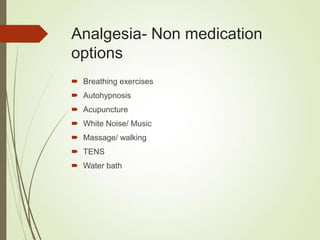
Analgesia- Non medication
options
 Breathing exercises
 Autohypnosis
 Acupuncture
 White Noise/ Music
 Massage/ walking
 TENS
 Water bath
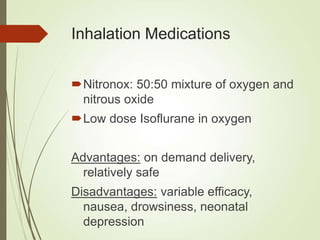
Inhalation Medications
Nitronox: 50:50 mixture of oxygen and
nitrous oxide
Low dose Isoflurane in oxygen
Advantages: on demand delivery,
relatively safe
Disadvantages: variable efficacy,
nausea, drowsiness, neonatal
depression
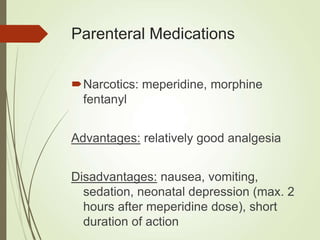
Parenteral Medications
Narcotics: meperidine, morphine
fentanyl
Advantages: relatively good analgesia
Disadvantages: nausea, vomiting,
sedation, neonatal depression (max. 2
hours after meperidine dose), short
duration of action
Regional techniques
Epidural, spinal, combined spinal-epidural
Advantages: excellent pain control, minimal
impact on progress of labor with low doses,
less drug transfer to fetus, improved uterine
blood flow, decrease in birth trauma e.g.
use of forceps, minimal neonatal depression
Disadvantages: invasive technique, side
effects (hypotension, headache, itching,
nausea, urinary retention, limited mobility),
nerve damage, infection
Anesthesia in the parturient
 General considerations of the parturient undergoing surgery
 Obstetric surgery
General considerations
 Altered physiology as mentioned
 Risks to the fetus:
 Effect of the disease process/therapies
 Possible teratogenicity of anesthetic agents
 Intraoperative effects on uteroplacental blood flow
 Increased risk of preterm labor/ risk of abortion
Maternal considerations
 Altered physiology
 Altered response to anesthesia
 Decrease in MAC
 Increased sensitivity to neuraxial agents
 Decreased plasma cholinesterase
 Decreased protein binding (more free drug)
 Limited drug information in parturients
Fetal Considerations
 Teratogenicity:
 Limited information due to impracticality of conducting trials
with sufficient power
 Guidelines based on a) effects on reproduction in animals; b)
epidemiological surveys of OR personnel; c) studies of
pregnancy outcomes in parturient undergoing ante partum
surgery
Nitrous oxide has been shown to have
a teratogenic effect in rats during the
first trimester
No anesthetic agent is a proven
teratogen in humans
Anesthetic agents deemed safe
include: thiopental,morphine,
meperidine,fentanyl, succinylcholine,
NDMRs
Limiting nitrous oxide use but only if
hypotension secondary to volatiles
can be avoided
 Anesthetic management in the parturient should be directed
to:
 Avoidance of hypoxemia
 Avoidance of hypotension
 Avoidance of acidosis
 Maintain PaCO2 in the normal range for the parturient
 Minimize effects of aortocaval compression
Anesthesia for Caesarean
Section
 Preparation
 Preventing complications
 Choice of Anesthetic technique
 Effects on the fetus
Preparation
Premeds: antacid (sodium citrate)
IV access and fluid bolus within 30
minutes of operating (avoid glucose
containing fluids)
Left lateral tilt with wedge under right
pelvis
Routine Monitors: ECG, NIBP, pulse
oximeter, fetal monitoring
Additional monitors for GAs: ETCO2,
nerve stimulator, temp probe
Preventing complications
 Aspiration prophylaxis
 Detailed airway assessment
 Fluid resuscitation/left lateral tilt to prevent hypotension
 Safe practice for placement of neuraxial blocks
Anesthetic techniques
 Local infiltration by surgeon
 Regional anesthesia: spinal, epidural, combined spinal-
epidural
 General anesthesia
Local Infiltration
 Rarely performed
 Patient usually in extremis
 Surgery must be done via midline incision, gentle retraction,
no exteriorization of the uterus
 Usually done to supplement a regional technique if local
anesthetic toxicity not a concern
Regional: Spinal Anesthesia
 Simple to perform
 Rapid onset
 Single shot technique
 Profound neural block
 Technique of choice for uncomplicated elective caesarean
sections and in many emergency caesarean sections
Spinal Anesthesia
 Potential Complications:
 Hypotension
 Headache (rare ~1:100)
 Backache (temporary ~24hrs)
 Nausea/vomiting (secondary to BP, narcotics)
 Neurological damage (very rare)
 Anaphylaxis (very rare)
Regional: Epidural Anesthesia
 More technically challenging
 Slower onset
 Used when already placed for labor analgesia
 Useful in parturient where a slow, controlled onset of block
is needed
 Allows prolongation of block should surgery be complicated
Epidural Anesthesia
 Potential Complications:
 Hypotension
 Headache (approx 1:100)
 Transient backache ~24hrs
 Urinary retention
 Unintentional spinal injection
 Intravascular injection of local anesthetic
 Neurological damage
 Infection
Regional: Combined spinal-
epidural
 Used when require the speed and density of a spinal
anesthetic with the flexibility of prolonging the block by
supplemental increments of local anesthesia via the
epidural catheter
 Complications: as mentioned for spinals and epidurals
General Anesthesia
 Used when
 Patient refuses regional technique
 Regional technique is contraindicated
 Emergency C/S when there is inadequate/absent regional
analgesia and to delay will cause undue risk to the fetus /
mother
General Anesthesia
 Complications:
 Failed intubation
 Failed ventilation causing death or neurological injury
 Awareness
 Aspiration pneumonia
Anesthesia: Effects on the
fetus
Avoid hypotension, hypoxia, acidosis,
hyperventilation
Limit time between uterine incision
and delivery to less than 3 minutes
Infants exposed to GA have lower
Apgar at one minute but no difference
at 5 mins
No significant alteration in
neurobehavioral scores with regional
techniques
MCQ 1. Epidural Anesthesia in
Obstetric Practice. Which of the
following is false.
 A. Commonly causes itching
 B. Can be used to control blood pressure in pre-eclampsia
 C. Causes uterine relaxation
 D. Causes urinary retention
 E. Contributes to the effects of aortocaval compression
MCQ 1. Epidural Anesthesia in
Obstetric Practice…
 A. Commonly causes itching
 B. Can be used to control blood pressure in pre-eclampsia
 C. Causes uterine relaxation
 D. Causes urinary retention
 E. Contributes to the effects of aortocaval compression
 Itching is one of the most common side-effects of opioids
when delivered in the epidural space. Their use allows for a
decreased concentration of local anesthetic whilst
maintaining excellent analgesia. Patients have better motor
function and retain the ability to push.
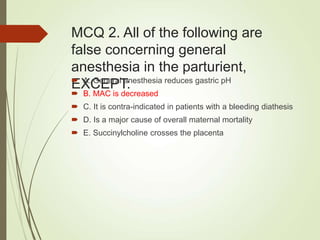
MCQ 2. All of the following are
false concerning general
anesthesia in the parturient,
EXCEPT:
 A. General anesthesia reduces gastric pH
 B. MAC is decreased
 C. It is contra-indicated in patients with a bleeding diathesis
 D. Is a major cause of overall maternal mortality
 E. Succinylcholine crosses the placenta
MCQ 2. All of the following are
false concerning general
anesthesia in the parturient,
EXCEPT:
 A. General anesthesia reduces gastric pH
 B. MAC is decreased
 C. It is contra-indicated in patients with a bleeding diathesis
 D. Is a major cause of overall maternal mortality
 E. Succinylcholine crosses the placenta
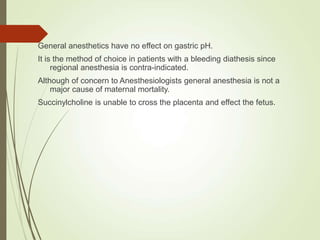
General anesthetics have no effect on gastric pH.
It is the method of choice in patients with a bleeding diathesis since
regional anesthesia is contra-indicated.
Although of concern to Anesthesiologists general anesthesia is not a
major cause of maternal mortality.
Succinylcholine is unable to cross the placenta and effect the fetus.
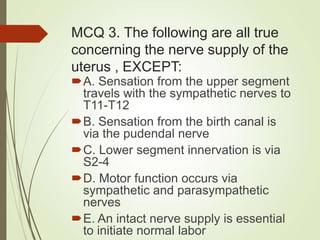
MCQ 3. The following are all true
concerning the nerve supply of the
uterus , EXCEPT:
A. Sensation from the upper segment
travels with the sympathetic nerves to
T11-T12
B. Sensation from the birth canal is
via the pudendal nerve
C. Lower segment innervation is via
S2-4
D. Motor function occurs via
sympathetic and parasympathetic
nerves
E. An intact nerve supply is essential
to initiate normal labor
MCQ 3. The following are all true
concerning the nerve supply of the
uterus , EXCEPT:
A. Sensation from the upper segment
travels with the sympathetic nerves to
T11-T12
B. Sensation from the birth canal is
via the pudendal nerve
C. Lower segment innervation is via
S2-4
D. Motor function occurs via
sympathetic and parasympathetic
nerves
E. An intact nerve supply is essential
to initiate normal labor
 Normal labor occurs in patients with a transected spinal
cord.
MCQ 4: Physiological changes
seen in the last trimester include all
EXCEPT
 A. Resting PaCO2 is decreased
 B. Hematocrit is decreased
 C. Blood volume is increased
 D. Gastric secretion is increased
 E. Total peripheral resistance is decreased
MCQ 4: Physiological changes
seen in the last trimester include all
EXCEPT
 A. Resting PaCO2 is decreased
 B. Hematocrit is decreased
 C. Blood volume is increased
 D. Gastric secretion is increased
 E. Total peripheral resistance is decreased
 Gastric acid production does not increase. There is an
increased risk of aspiration due to delayed gastric emptying
and a decrease in lower esophageal sphincter tone.
MCQ 5: All of the following are
suitable for aspiration prophylaxis
prior to caesarean section,
EXCEPT:
 A. Metoclopramide
 B. Glycopyrollate
 C. Sodium citrate
 D. Clear fluids 4 hours pre-op
 E. Ranitidine
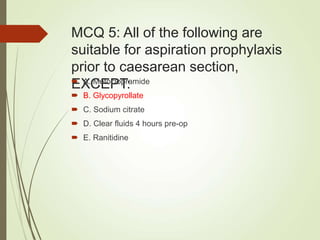
MCQ 5: All of the following are
suitable for aspiration prophylaxis
prior to caesarean section,
EXCEPT:
 A. Metoclopramide
 B. Glycopyrollate
 C. Sodium citrate
 D. Clear fluids 4 hours pre-op
 E. Ranitidine
Metoclopramide acts as a pro-kinetic to
empty the stomach of any gastric contents.
Sodium citrate is a non-particulate antacid
used to neutralize gastric contents.
Ranitidine is an H2 antagonist used to
prevent gastric acid secretion.
Allowing clear fluids up to 4 hours prior to
suregry has been shown to decrease the
gastric content volume so decreasing the
risk of aspiration.
Glycopyrollate is an anti-sialogogue used for
preoperative preparation when an awake
intubation is anticipated.
MCQ 6: All are suitable techniques
for pain relief in labor EXCEPT:
 A. Transcutaneous electrical nerve stimulation
 B. White noise
 C. Epidural bupivacaine
 D. Intrathecal narcotics
 E. 70% Nitrous oxide in Oxygen
MCQ 6: All are suitable techniques
for pain relief in labor EXCEPT:
 A. Transcutaneous electrical nerve stimulation
 B. White noise
 C. Epidural bupivacaine
 D. Intrathecal narcotics
 E. 70% Nitrous oxide in Oxygen
 The concentration of nitrous oxide in oxygen when used for
analgesia is 50%. Higher concentrations can result in loss
of consciousness.
MCQ 7: Which of the following is a
contraindication to epidural
analgesia in labor:
 A. Previous caesarean section
 B. Fetal distress
 C. INR 1.6
 D. Maternal exhaustion
 E. Maternal multiple sclerosis
MCQ 7: Which of the following is a
contraindication to epidural
analgesia in labor:
 A. Previous caesarean section
 B. Fetal distress
 C. INR 1.6
 D. Maternal exhaustion
 E. Maternal multiple sclerosis
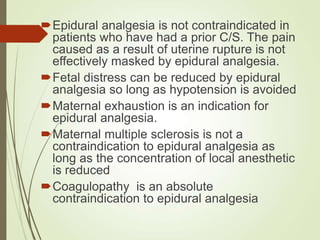
Epidural analgesia is not contraindicated in
patients who have had a prior C/S. The pain
caused as a result of uterine rupture is not
effectively masked by epidural analgesia.
Fetal distress can be reduced by epidural
analgesia so long as hypotension is avoided
Maternal exhaustion is an indication for
epidural analgesia.
Maternal multiple sclerosis is not a
contraindication to epidural analgesia as
long as the concentration of local anesthetic
is reduced
Coagulopathy is an absolute
contraindication to epidural analgesia
MCQ 8 : Likely complications of
epidural opioids include all of the
following, EXCEPT:
 A. Itching
 B. Urinary retention
 C. Hypotension
 D. Respiratory depression
 E. Nausea
MCQ 8 : Likely complications of
epidural opioids include all of the
following, EXCEPT:
 A. Itching
 B. Urinary retention
 C. Hypotension
 D. Respiratory depression
 E. Nausea
4493677 - Copy.ppt

  • 1.
  • 2.
    Analgesia- Non medication options Breathing exercises  Autohypnosis  Acupuncture  White Noise/ Music  Massage/ walking  TENS  Water bath
  • 3.
    Inhalation Medications Nitronox: 50:50mixture of oxygen and nitrous oxide Low dose Isoflurane in oxygen Advantages: on demand delivery, relatively safe Disadvantages: variable efficacy, nausea, drowsiness, neonatal depression
  • 4.
    Parenteral Medications Narcotics: meperidine,morphine fentanyl Advantages: relatively good analgesia Disadvantages: nausea, vomiting, sedation, neonatal depression (max. 2 hours after meperidine dose), short duration of action
  • 5.
    Regional techniques Epidural, spinal,combined spinal-epidural Advantages: excellent pain control, minimal impact on progress of labor with low doses, less drug transfer to fetus, improved uterine blood flow, decrease in birth trauma e.g. use of forceps, minimal neonatal depression Disadvantages: invasive technique, side effects (hypotension, headache, itching, nausea, urinary retention, limited mobility), nerve damage, infection
  • 6.
    Anesthesia in theparturient  General considerations of the parturient undergoing surgery  Obstetric surgery
  • 7.
    General considerations  Alteredphysiology as mentioned  Risks to the fetus:  Effect of the disease process/therapies  Possible teratogenicity of anesthetic agents  Intraoperative effects on uteroplacental blood flow  Increased risk of preterm labor/ risk of abortion
  • 8.
    Maternal considerations  Alteredphysiology  Altered response to anesthesia  Decrease in MAC  Increased sensitivity to neuraxial agents  Decreased plasma cholinesterase  Decreased protein binding (more free drug)  Limited drug information in parturients
  • 9.
    Fetal Considerations  Teratogenicity: Limited information due to impracticality of conducting trials with sufficient power  Guidelines based on a) effects on reproduction in animals; b) epidemiological surveys of OR personnel; c) studies of pregnancy outcomes in parturient undergoing ante partum surgery
  • 10.
    Nitrous oxide hasbeen shown to have a teratogenic effect in rats during the first trimester No anesthetic agent is a proven teratogen in humans Anesthetic agents deemed safe include: thiopental,morphine, meperidine,fentanyl, succinylcholine, NDMRs Limiting nitrous oxide use but only if hypotension secondary to volatiles can be avoided
  • 11.
     Anesthetic managementin the parturient should be directed to:  Avoidance of hypoxemia  Avoidance of hypotension  Avoidance of acidosis  Maintain PaCO2 in the normal range for the parturient  Minimize effects of aortocaval compression
  • 12.
    Anesthesia for Caesarean Section Preparation  Preventing complications  Choice of Anesthetic technique  Effects on the fetus
  • 13.
    Preparation Premeds: antacid (sodiumcitrate) IV access and fluid bolus within 30 minutes of operating (avoid glucose containing fluids) Left lateral tilt with wedge under right pelvis Routine Monitors: ECG, NIBP, pulse oximeter, fetal monitoring Additional monitors for GAs: ETCO2, nerve stimulator, temp probe
  • 14.
    Preventing complications  Aspirationprophylaxis  Detailed airway assessment  Fluid resuscitation/left lateral tilt to prevent hypotension  Safe practice for placement of neuraxial blocks
  • 15.
    Anesthetic techniques  Localinfiltration by surgeon  Regional anesthesia: spinal, epidural, combined spinal- epidural  General anesthesia
  • 16.
    Local Infiltration  Rarelyperformed  Patient usually in extremis  Surgery must be done via midline incision, gentle retraction, no exteriorization of the uterus  Usually done to supplement a regional technique if local anesthetic toxicity not a concern
  • 17.
    Regional: Spinal Anesthesia Simple to perform  Rapid onset  Single shot technique  Profound neural block  Technique of choice for uncomplicated elective caesarean sections and in many emergency caesarean sections
  • 18.
    Spinal Anesthesia  PotentialComplications:  Hypotension  Headache (rare ~1:100)  Backache (temporary ~24hrs)  Nausea/vomiting (secondary to BP, narcotics)  Neurological damage (very rare)  Anaphylaxis (very rare)
  • 19.
    Regional: Epidural Anesthesia More technically challenging  Slower onset  Used when already placed for labor analgesia  Useful in parturient where a slow, controlled onset of block is needed  Allows prolongation of block should surgery be complicated
  • 20.
    Epidural Anesthesia  PotentialComplications:  Hypotension  Headache (approx 1:100)  Transient backache ~24hrs  Urinary retention  Unintentional spinal injection  Intravascular injection of local anesthetic  Neurological damage  Infection
  • 21.
    Regional: Combined spinal- epidural Used when require the speed and density of a spinal anesthetic with the flexibility of prolonging the block by supplemental increments of local anesthesia via the epidural catheter  Complications: as mentioned for spinals and epidurals
  • 22.
    General Anesthesia  Usedwhen  Patient refuses regional technique  Regional technique is contraindicated  Emergency C/S when there is inadequate/absent regional analgesia and to delay will cause undue risk to the fetus / mother
  • 23.
    General Anesthesia  Complications: Failed intubation  Failed ventilation causing death or neurological injury  Awareness  Aspiration pneumonia
  • 24.
    Anesthesia: Effects onthe fetus Avoid hypotension, hypoxia, acidosis, hyperventilation Limit time between uterine incision and delivery to less than 3 minutes Infants exposed to GA have lower Apgar at one minute but no difference at 5 mins No significant alteration in neurobehavioral scores with regional techniques
  • 25.
    MCQ 1. EpiduralAnesthesia in Obstetric Practice. Which of the following is false.  A. Commonly causes itching  B. Can be used to control blood pressure in pre-eclampsia  C. Causes uterine relaxation  D. Causes urinary retention  E. Contributes to the effects of aortocaval compression
  • 26.
    MCQ 1. EpiduralAnesthesia in Obstetric Practice…  A. Commonly causes itching  B. Can be used to control blood pressure in pre-eclampsia  C. Causes uterine relaxation  D. Causes urinary retention  E. Contributes to the effects of aortocaval compression
  • 27.
     Itching isone of the most common side-effects of opioids when delivered in the epidural space. Their use allows for a decreased concentration of local anesthetic whilst maintaining excellent analgesia. Patients have better motor function and retain the ability to push.
  • 28.
    MCQ 2. Allof the following are false concerning general anesthesia in the parturient, EXCEPT:  A. General anesthesia reduces gastric pH  B. MAC is decreased  C. It is contra-indicated in patients with a bleeding diathesis  D. Is a major cause of overall maternal mortality  E. Succinylcholine crosses the placenta
  • 29.
    MCQ 2. Allof the following are false concerning general anesthesia in the parturient, EXCEPT:  A. General anesthesia reduces gastric pH  B. MAC is decreased  C. It is contra-indicated in patients with a bleeding diathesis  D. Is a major cause of overall maternal mortality  E. Succinylcholine crosses the placenta
  • 30.
    General anesthetics haveno effect on gastric pH. It is the method of choice in patients with a bleeding diathesis since regional anesthesia is contra-indicated. Although of concern to Anesthesiologists general anesthesia is not a major cause of maternal mortality. Succinylcholine is unable to cross the placenta and effect the fetus.
  • 31.
    MCQ 3. Thefollowing are all true concerning the nerve supply of the uterus , EXCEPT: A. Sensation from the upper segment travels with the sympathetic nerves to T11-T12 B. Sensation from the birth canal is via the pudendal nerve C. Lower segment innervation is via S2-4 D. Motor function occurs via sympathetic and parasympathetic nerves E. An intact nerve supply is essential to initiate normal labor
  • 32.
    MCQ 3. Thefollowing are all true concerning the nerve supply of the uterus , EXCEPT: A. Sensation from the upper segment travels with the sympathetic nerves to T11-T12 B. Sensation from the birth canal is via the pudendal nerve C. Lower segment innervation is via S2-4 D. Motor function occurs via sympathetic and parasympathetic nerves E. An intact nerve supply is essential to initiate normal labor
  • 33.
     Normal laboroccurs in patients with a transected spinal cord.
  • 34.
    MCQ 4: Physiologicalchanges seen in the last trimester include all EXCEPT  A. Resting PaCO2 is decreased  B. Hematocrit is decreased  C. Blood volume is increased  D. Gastric secretion is increased  E. Total peripheral resistance is decreased
  • 35.
    MCQ 4: Physiologicalchanges seen in the last trimester include all EXCEPT  A. Resting PaCO2 is decreased  B. Hematocrit is decreased  C. Blood volume is increased  D. Gastric secretion is increased  E. Total peripheral resistance is decreased
  • 36.
     Gastric acidproduction does not increase. There is an increased risk of aspiration due to delayed gastric emptying and a decrease in lower esophageal sphincter tone.
  • 37.
    MCQ 5: Allof the following are suitable for aspiration prophylaxis prior to caesarean section, EXCEPT:  A. Metoclopramide  B. Glycopyrollate  C. Sodium citrate  D. Clear fluids 4 hours pre-op  E. Ranitidine
  • 38.
    MCQ 5: Allof the following are suitable for aspiration prophylaxis prior to caesarean section, EXCEPT:  A. Metoclopramide  B. Glycopyrollate  C. Sodium citrate  D. Clear fluids 4 hours pre-op  E. Ranitidine
  • 39.
    Metoclopramide acts asa pro-kinetic to empty the stomach of any gastric contents. Sodium citrate is a non-particulate antacid used to neutralize gastric contents. Ranitidine is an H2 antagonist used to prevent gastric acid secretion. Allowing clear fluids up to 4 hours prior to suregry has been shown to decrease the gastric content volume so decreasing the risk of aspiration. Glycopyrollate is an anti-sialogogue used for preoperative preparation when an awake intubation is anticipated.
  • 40.
    MCQ 6: Allare suitable techniques for pain relief in labor EXCEPT:  A. Transcutaneous electrical nerve stimulation  B. White noise  C. Epidural bupivacaine  D. Intrathecal narcotics  E. 70% Nitrous oxide in Oxygen
  • 41.
    MCQ 6: Allare suitable techniques for pain relief in labor EXCEPT:  A. Transcutaneous electrical nerve stimulation  B. White noise  C. Epidural bupivacaine  D. Intrathecal narcotics  E. 70% Nitrous oxide in Oxygen
  • 42.
     The concentrationof nitrous oxide in oxygen when used for analgesia is 50%. Higher concentrations can result in loss of consciousness.
  • 43.
    MCQ 7: Whichof the following is a contraindication to epidural analgesia in labor:  A. Previous caesarean section  B. Fetal distress  C. INR 1.6  D. Maternal exhaustion  E. Maternal multiple sclerosis
  • 44.
    MCQ 7: Whichof the following is a contraindication to epidural analgesia in labor:  A. Previous caesarean section  B. Fetal distress  C. INR 1.6  D. Maternal exhaustion  E. Maternal multiple sclerosis
  • 45.
    Epidural analgesia isnot contraindicated in patients who have had a prior C/S. The pain caused as a result of uterine rupture is not effectively masked by epidural analgesia. Fetal distress can be reduced by epidural analgesia so long as hypotension is avoided Maternal exhaustion is an indication for epidural analgesia. Maternal multiple sclerosis is not a contraindication to epidural analgesia as long as the concentration of local anesthetic is reduced Coagulopathy is an absolute contraindication to epidural analgesia
  • 46.
    MCQ 8 :Likely complications of epidural opioids include all of the following, EXCEPT:  A. Itching  B. Urinary retention  C. Hypotension  D. Respiratory depression  E. Nausea
  • 47.
    MCQ 8 :Likely complications of epidural opioids include all of the following, EXCEPT:  A. Itching  B. Urinary retention  C. Hypotension  D. Respiratory depression  E. Nausea