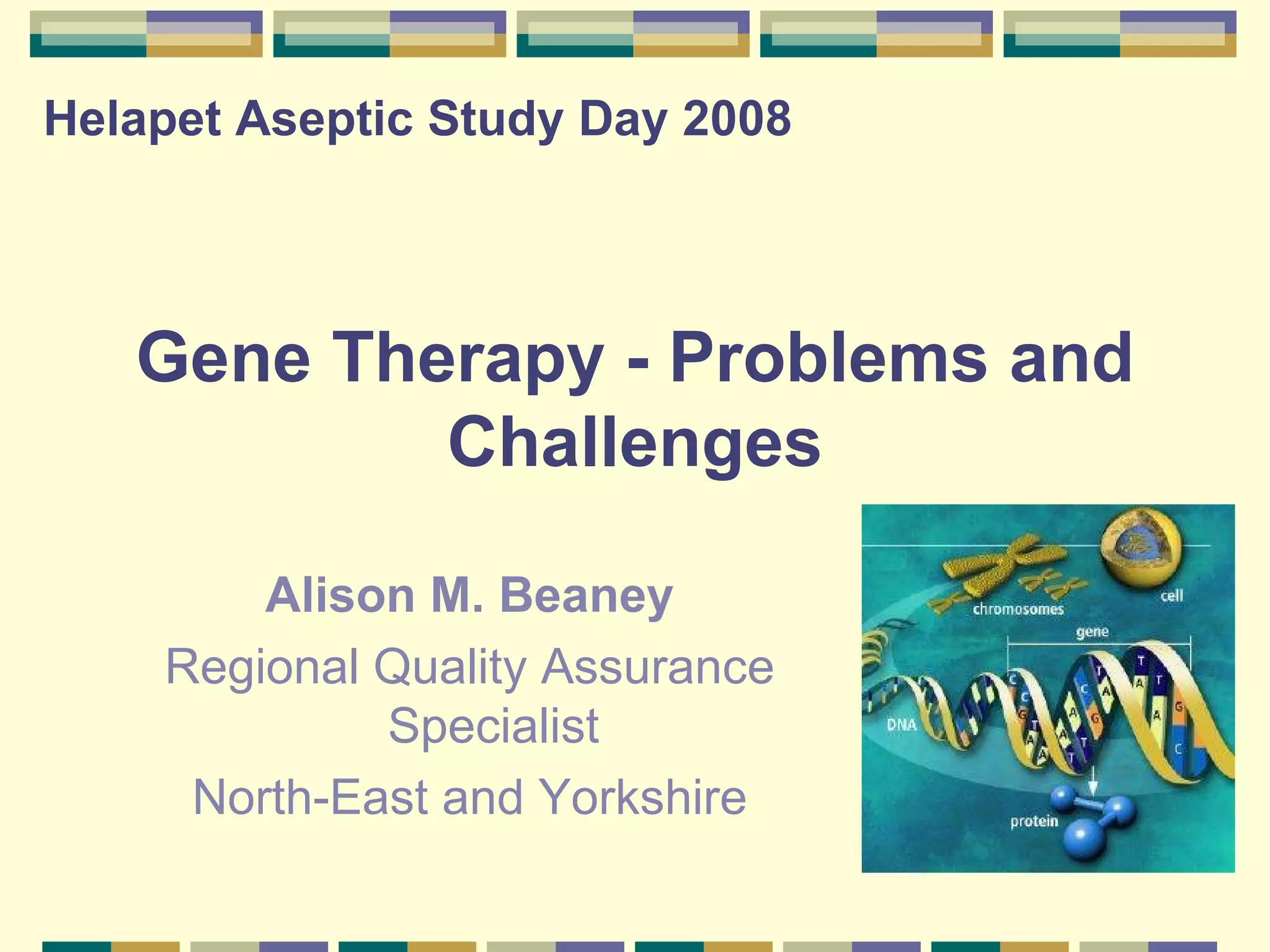
Gene Therapy - Problems and Challenges Alison M. Beaney Regional Quality Assurance Specialist North-East and Yorkshire Helapet Aseptic Study Day 2008
Gene Therapy  Background to Gene Therapy Potential Benefits Perceived Hazards and Risks Regulations Implications for Pharmacy Aseptic Units Future?
Gene Therapy Definition   The deliberate introduction of genetic material into human somatic cells for therapeutic, prophylactic or diagnostic purposes Addition of EXTRA genes Aim is to cure disease (or at least help the patient) First introduction of gene-modified cells into a patient was in 1989 First gene therapy product approved for market in 2004 Still very experimental and early in its development
PTQA April 2008
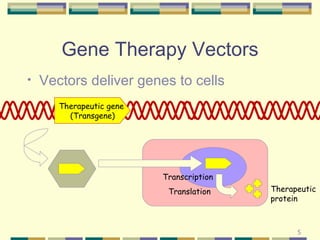
Gene Therapy Vectors Vectors deliver genes to cells Therapeutic gene  (Transgene) Therapeutic protein Vector   for efficient gene delivery Transcription Translation
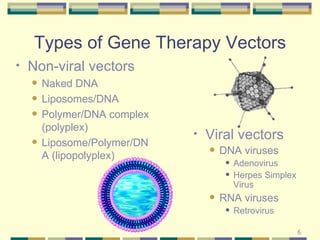
Types of Gene Therapy Vectors Non-viral vectors Naked DNA Liposomes/DNA Polymer/DNA complex (polyplex) Liposome/Polymer/DNA (lipopolyplex) Viral vectors DNA viruses Adenovirus Herpes Simplex Virus RNA viruses Retrovirus
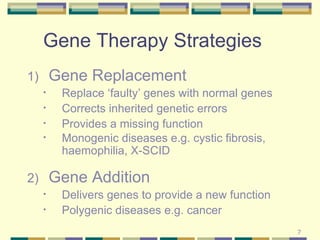
Gene Therapy Strategies Gene Replacement Replace ‘faulty’ genes with normal genes Corrects inherited genetic errors Provides a missing function Monogenic diseases e.g. cystic fibrosis, haemophilia, X-SCID Gene Addition Delivers genes to provide a new function Polygenic diseases e.g. cancer
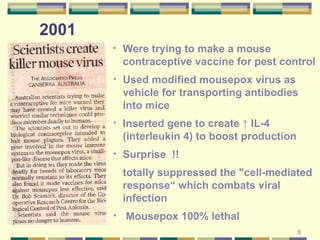
Were trying to make a mouse contraceptive vaccine for pest control Used modified mousepox virus as vehicle for transporting antibodies into mice Inserted gene to create ↑ IL-4 (interleukin 4) to boost production Surprise  !!  totally suppressed the "cell-mediated response“ which combats viral infection Mousepox 100% lethal 2001
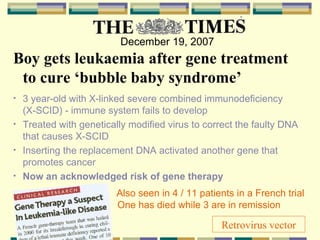
  December 19, 2007 Boy gets leukaemia after gene treatment to cure ‘bubble baby syndrome’ 3 year-old with X-linked severe combined immunodeficiency  (X-SCID) - immune system fails to develop Treated with genetically modified virus to correct the faulty DNA that causes X-SCID Inserting the replacement DNA activated another gene that promotes cancer Now an acknowledged risk of gene therapy   Also seen in 4 / 11 patients in a French trial    One has died while 3 are in remission  Retrovirus vector
Regulations governing the handling of gene therapy vectors No additional regulations governing the  handling  of  Non-Infectious  vectors Non-viral & Non-bacterial Viral vectors are Genetically Modified Genetically Modified Organisms (GMOs)
Genetic Modification Genetic modification is officially defined as ‘the alteration of genetic material (DNA or RNA) of an organism by means that could not occur naturally through mating and/or recombination’ A guide to Genetically modified organisms (Contained Use) Regulations 2000.  Health and Safety Executive
Regulations governing the handling of gene therapy viral vectors Two sets of Regulations: GMO (Contained Use) Regs 2000,  HSE All possible barriers (physical, biological or chemical) are in place to limit contact of the GMOs with humans and the environment GMO (Deliberate Release) Regs 2002 , DEFRA All appropriate measures are taken to avoid damage to the environment from the escape or release from human control of GMOs aimed at laboratories  (difficult to interpret clinically)  no reference to product or patient safety
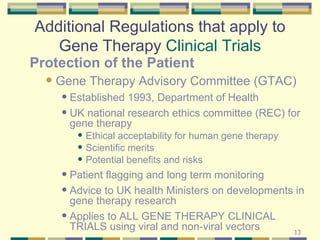
Additional Regulations that apply to Gene Therapy  Clinical Trials Protection of the Patient Gene Therapy Advisory Committee (GTAC) Established 1993, Department of Health UK national research ethics committee (REC) for gene therapy  Ethical acceptability for human gene therapy Scientific merits Potential benefits and risks Patient flagging and long term monitoring Advice to UK health Ministers on developments in gene therapy research Applies to ALL GENE THERAPY CLINICAL TRIALS using viral and non-viral vectors
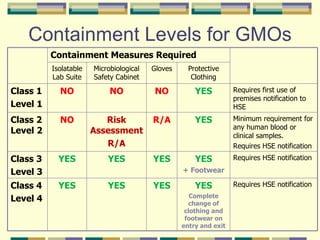
Containment Levels for GMOs Containment Measures Required Isolatable Lab Suite Microbiological Safety Cabinet Gloves Protective Clothing Class 1 Level 1 NO NO NO YES Requires first use of premises notification to HSE Class 2 Level 2 NO Risk Assessment R/A R/A YES Minimum requirement for any human blood or clinical samples. Requires HSE notification Class 3 Level 3 YES YES YES YES + Footwear Requires HSE notification Class 4 Level 4 YES YES YES YES Complete change of clothing and footwear on entry and exit Requires HSE notification
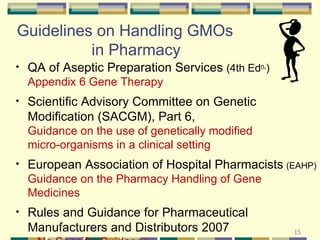
Guidelines on Handling GMOs  in Pharmacy QA of Aseptic Preparation Services  (4th Ed n. )  Appendix 6 Gene Therapy Scientific Advisory Committee on Genetic Modification (SACGM), Part 6,    Guidance on the use of genetically modified    micro-organisms in a clinical setting European Association of Hospital Pharmacists   (EAHP)  Guidance on the Pharmacy Handling of Gene Medicines Rules and Guidance for Pharmaceutical Manufacturers and Distributors 2007    – No Specific Guidance
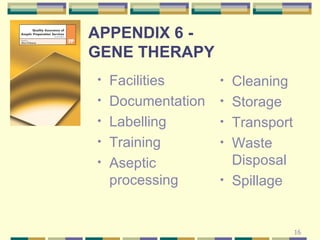
APPENDIX 6 -  GENE THERAPY Facilities Documentation Labelling Training Aseptic processing Cleaning Storage Transport Waste Disposal Spillage
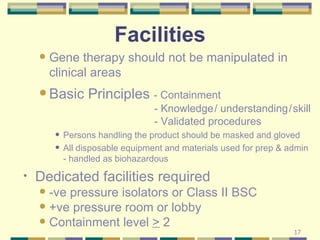
Facilities Gene therapy should not be manipulated in clinical areas Basic Principles  - Containment  - Knowledge   / understanding   /   skill  - Validated procedures Persons handling the product should be masked and gloved All disposable equipment and materials used for prep & admin - handled as biohazardous Dedicated facilities required -ve pressure isolators or Class II BSC +ve pressure room or lobby Containment level  >  2
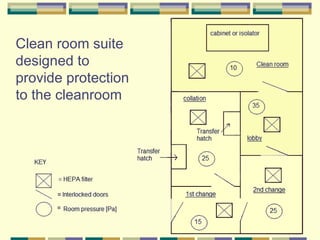
Clean room suite designed to provide protection to the cleanroom
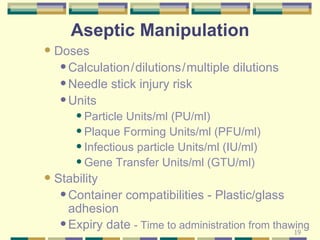
Aseptic Manipulation Doses Calculation   /   dilutions   /   multiple dilutions Needle stick injury risk Units Particle Units/ml (PU/ml) Plaque Forming Units/ml (PFU/ml) Infectious particle Units/ml (IU/ml) Gene Transfer Units/ml (GTU/ml) Stability Container compatibilities - Plastic/glass adhesion Expiry date  - Time to administration from thawing
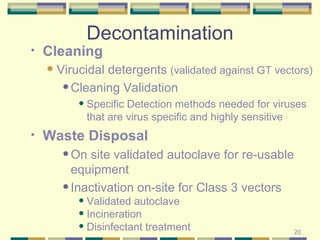
Decontamination Cleaning  Virucidal detergents  (validated against GT vectors) Cleaning Validation Specific Detection methods needed for viruses that are virus specific and highly sensitive Waste Disposal On site validated autoclave for re-usable equipment  Inactivation on-site for Class 3 vectors Validated autoclave Incineration  Disinfectant treatment
Spillage Specific to GT vector  Spillage kit Contents ( gloves, masks, aprons, goggles, disposable shoe covers, virucidal detergents, absorbent material, disposable forceps & biohazard incineration bag) Positioned in all GT handling areas Notification to HSE Accidental Exposure
SOPs needed Safe handling & protection Storage Operators  (Not pregnant, breastfeeding or immunosuppressed) Training  Facilities Spillage, contamination & needle stick Waste disposal, cleaning and transport
Risk Assessment Assess each product individually Cytolytic viruses Non-cytolytic viruses Replication competent Replication deficient Class I, II or III
What will the Future bring? Dedicated facilities Automation? The first gene medicine in Europe could be licensed in 2008 Licensed closed-system gene therapy products Use of gene therapy as an adjunct to standard therapy e.g. Radiotherapy & Chemotherapy Vector development e.g. Targeted vectors (viral & non-viral) Bacterial vectors
Additional Information Gene Therapy Advisory Committee (GTAC)  http://www. advisorybodies . doh . gov . uk /genetics/ gtac /index. htm Gene therapy trials worldwide. Provided by the Journal of gene medicine  http://82.182.180.141/trials/index.html A guide to Genetically modified organisms (Contained Use) regulations 2000.  Health and Safety Executive Genetically Modified Organism (Deliberate Release) Regulations 2002 [GMO(DR)].  Department for the Environment, Food and Rural Affairs (DEFRA) http://www.opsi.gov.uk/si/si2002/uksi_20022443_en.pdf Quality Assurance of Aseptic Preparation Services Fourth Edition.  A.M. Beaney. Pharmaceutical Press 2006. Appendix 6. Gene Therapy. EU Clinical Trials Directive.   http://www. wctn .org. uk /downloads/EU_Directive/Directive. pdf Implications of gene therapy for hospital pharmacists.  Simpson.J, Stoner. N.  www.pjonline.com/pdf/articles/ pj_20030726_ genetherapy .pdf
Additional Information Cancer gene therapy: from science to clinical trials . Searle. P.F, Spiers. I, Simpson. J, James. J.D. Drug Delivery Systems and Sciences 2002, 2 (1), 5-13. Standards for gene therapy clinical trials based on pro-active risk assessment in a London NHS Teaching Hospital Trust.  Bamford, K.B., Wood, S., Shaw, R.J. QJM 2005, 98, 75-86.  www. qjmed . oupjournals .org Progress in Gene Therapy – are hospital pharmacies the next barrier?   Simpson, J.  Hospital Pharmacist ,  2006 , 13 (8), 266  http://www. pjonline .com/ pdf /hp/200609/hp_200609_comment. pdf Cancer Biotherapy. An Introductory guide.  Young, A. Rowett, L. Kerr, D. Oxford University Press 2006 Scientific Advisory Committee on Genetic Modification (SACGM), Part 6, Guidance on the use of genetically modified microorganisms in a clinical setting.   http://www. hse . gov . uk / biosafety / gmo / acgm / acgmcomp /part6. pdf European Association of Hospital Pharmacists (EAHP) Guidance on the Pharmacy Handling of Gene Medicines.  http://www. ejhp . eu /

Gene Therapy

  • 1.
    Gene Therapy -Problems and Challenges Alison M. Beaney Regional Quality Assurance Specialist North-East and Yorkshire Helapet Aseptic Study Day 2008
  • 2.
    Gene Therapy Background to Gene Therapy Potential Benefits Perceived Hazards and Risks Regulations Implications for Pharmacy Aseptic Units Future?
  • 3.
    Gene Therapy Definition The deliberate introduction of genetic material into human somatic cells for therapeutic, prophylactic or diagnostic purposes Addition of EXTRA genes Aim is to cure disease (or at least help the patient) First introduction of gene-modified cells into a patient was in 1989 First gene therapy product approved for market in 2004 Still very experimental and early in its development
  • 4.
  • 5.
    Gene Therapy VectorsVectors deliver genes to cells Therapeutic gene (Transgene) Therapeutic protein Vector for efficient gene delivery Transcription Translation
  • 6.
    Types of GeneTherapy Vectors Non-viral vectors Naked DNA Liposomes/DNA Polymer/DNA complex (polyplex) Liposome/Polymer/DNA (lipopolyplex) Viral vectors DNA viruses Adenovirus Herpes Simplex Virus RNA viruses Retrovirus
  • 7.
    Gene Therapy StrategiesGene Replacement Replace ‘faulty’ genes with normal genes Corrects inherited genetic errors Provides a missing function Monogenic diseases e.g. cystic fibrosis, haemophilia, X-SCID Gene Addition Delivers genes to provide a new function Polygenic diseases e.g. cancer
  • 8.
    Were trying tomake a mouse contraceptive vaccine for pest control Used modified mousepox virus as vehicle for transporting antibodies into mice Inserted gene to create ↑ IL-4 (interleukin 4) to boost production Surprise !! totally suppressed the "cell-mediated response“ which combats viral infection Mousepox 100% lethal 2001
  • 9.
    December19, 2007 Boy gets leukaemia after gene treatment to cure ‘bubble baby syndrome’ 3 year-old with X-linked severe combined immunodeficiency (X-SCID) - immune system fails to develop Treated with genetically modified virus to correct the faulty DNA that causes X-SCID Inserting the replacement DNA activated another gene that promotes cancer Now an acknowledged risk of gene therapy Also seen in 4 / 11 patients in a French trial One has died while 3 are in remission Retrovirus vector
  • 10.
    Regulations governing thehandling of gene therapy vectors No additional regulations governing the handling of Non-Infectious vectors Non-viral & Non-bacterial Viral vectors are Genetically Modified Genetically Modified Organisms (GMOs)
  • 11.
    Genetic Modification Geneticmodification is officially defined as ‘the alteration of genetic material (DNA or RNA) of an organism by means that could not occur naturally through mating and/or recombination’ A guide to Genetically modified organisms (Contained Use) Regulations 2000. Health and Safety Executive
  • 12.
    Regulations governing thehandling of gene therapy viral vectors Two sets of Regulations: GMO (Contained Use) Regs 2000, HSE All possible barriers (physical, biological or chemical) are in place to limit contact of the GMOs with humans and the environment GMO (Deliberate Release) Regs 2002 , DEFRA All appropriate measures are taken to avoid damage to the environment from the escape or release from human control of GMOs aimed at laboratories (difficult to interpret clinically) no reference to product or patient safety
  • 13.
    Additional Regulations thatapply to Gene Therapy Clinical Trials Protection of the Patient Gene Therapy Advisory Committee (GTAC) Established 1993, Department of Health UK national research ethics committee (REC) for gene therapy Ethical acceptability for human gene therapy Scientific merits Potential benefits and risks Patient flagging and long term monitoring Advice to UK health Ministers on developments in gene therapy research Applies to ALL GENE THERAPY CLINICAL TRIALS using viral and non-viral vectors
  • 14.
    Containment Levels forGMOs Containment Measures Required Isolatable Lab Suite Microbiological Safety Cabinet Gloves Protective Clothing Class 1 Level 1 NO NO NO YES Requires first use of premises notification to HSE Class 2 Level 2 NO Risk Assessment R/A R/A YES Minimum requirement for any human blood or clinical samples. Requires HSE notification Class 3 Level 3 YES YES YES YES + Footwear Requires HSE notification Class 4 Level 4 YES YES YES YES Complete change of clothing and footwear on entry and exit Requires HSE notification
  • 15.
    Guidelines on HandlingGMOs in Pharmacy QA of Aseptic Preparation Services (4th Ed n. ) Appendix 6 Gene Therapy Scientific Advisory Committee on Genetic Modification (SACGM), Part 6, Guidance on the use of genetically modified micro-organisms in a clinical setting European Association of Hospital Pharmacists (EAHP) Guidance on the Pharmacy Handling of Gene Medicines Rules and Guidance for Pharmaceutical Manufacturers and Distributors 2007 – No Specific Guidance
  • 16.
    APPENDIX 6 - GENE THERAPY Facilities Documentation Labelling Training Aseptic processing Cleaning Storage Transport Waste Disposal Spillage
  • 17.
    Facilities Gene therapyshould not be manipulated in clinical areas Basic Principles - Containment - Knowledge / understanding / skill - Validated procedures Persons handling the product should be masked and gloved All disposable equipment and materials used for prep & admin - handled as biohazardous Dedicated facilities required -ve pressure isolators or Class II BSC +ve pressure room or lobby Containment level > 2
  • 18.
    Clean room suitedesigned to provide protection to the cleanroom
  • 19.
    Aseptic Manipulation DosesCalculation / dilutions / multiple dilutions Needle stick injury risk Units Particle Units/ml (PU/ml) Plaque Forming Units/ml (PFU/ml) Infectious particle Units/ml (IU/ml) Gene Transfer Units/ml (GTU/ml) Stability Container compatibilities - Plastic/glass adhesion Expiry date - Time to administration from thawing
  • 20.
    Decontamination Cleaning Virucidal detergents (validated against GT vectors) Cleaning Validation Specific Detection methods needed for viruses that are virus specific and highly sensitive Waste Disposal On site validated autoclave for re-usable equipment Inactivation on-site for Class 3 vectors Validated autoclave Incineration Disinfectant treatment
  • 21.
    Spillage Specific toGT vector Spillage kit Contents ( gloves, masks, aprons, goggles, disposable shoe covers, virucidal detergents, absorbent material, disposable forceps & biohazard incineration bag) Positioned in all GT handling areas Notification to HSE Accidental Exposure
  • 22.
    SOPs needed Safehandling & protection Storage Operators (Not pregnant, breastfeeding or immunosuppressed) Training Facilities Spillage, contamination & needle stick Waste disposal, cleaning and transport
  • 23.
    Risk Assessment Assesseach product individually Cytolytic viruses Non-cytolytic viruses Replication competent Replication deficient Class I, II or III
  • 24.
    What will theFuture bring? Dedicated facilities Automation? The first gene medicine in Europe could be licensed in 2008 Licensed closed-system gene therapy products Use of gene therapy as an adjunct to standard therapy e.g. Radiotherapy & Chemotherapy Vector development e.g. Targeted vectors (viral & non-viral) Bacterial vectors
  • 25.
    Additional Information GeneTherapy Advisory Committee (GTAC) http://www. advisorybodies . doh . gov . uk /genetics/ gtac /index. htm Gene therapy trials worldwide. Provided by the Journal of gene medicine http://82.182.180.141/trials/index.html A guide to Genetically modified organisms (Contained Use) regulations 2000. Health and Safety Executive Genetically Modified Organism (Deliberate Release) Regulations 2002 [GMO(DR)]. Department for the Environment, Food and Rural Affairs (DEFRA) http://www.opsi.gov.uk/si/si2002/uksi_20022443_en.pdf Quality Assurance of Aseptic Preparation Services Fourth Edition. A.M. Beaney. Pharmaceutical Press 2006. Appendix 6. Gene Therapy. EU Clinical Trials Directive. http://www. wctn .org. uk /downloads/EU_Directive/Directive. pdf Implications of gene therapy for hospital pharmacists. Simpson.J, Stoner. N. www.pjonline.com/pdf/articles/ pj_20030726_ genetherapy .pdf
  • 26.
    Additional Information Cancergene therapy: from science to clinical trials . Searle. P.F, Spiers. I, Simpson. J, James. J.D. Drug Delivery Systems and Sciences 2002, 2 (1), 5-13. Standards for gene therapy clinical trials based on pro-active risk assessment in a London NHS Teaching Hospital Trust. Bamford, K.B., Wood, S., Shaw, R.J. QJM 2005, 98, 75-86. www. qjmed . oupjournals .org Progress in Gene Therapy – are hospital pharmacies the next barrier? Simpson, J. Hospital Pharmacist , 2006 , 13 (8), 266 http://www. pjonline .com/ pdf /hp/200609/hp_200609_comment. pdf Cancer Biotherapy. An Introductory guide. Young, A. Rowett, L. Kerr, D. Oxford University Press 2006 Scientific Advisory Committee on Genetic Modification (SACGM), Part 6, Guidance on the use of genetically modified microorganisms in a clinical setting. http://www. hse . gov . uk / biosafety / gmo / acgm / acgmcomp /part6. pdf European Association of Hospital Pharmacists (EAHP) Guidance on the Pharmacy Handling of Gene Medicines. http://www. ejhp . eu /