Topic:
1.Gender Difference
2.Role Model
Gender Difference
A gender role is a set of societal norms dictating what types of
behaviors are generally considered acceptable, appropriate or
desirable for a person based on their actual.
In addition to the influence on gender behaviors of biological
factors, there are four principle psychological explanations of
gender-linked behavior patterns: Freudian theory's process
of identification, cognitive social learning theory, gender-schema
theory, and Kohlberg's cognitive developmental theory.
• GENDER-ROLE STANDARDS AND STEREOTYPES
Both within and across different cultures we find great consistency in standards
of desirable gender-role behavior. Males are expected to be independent,
assertive, and competitive; females are expected to be more passive, sensitive,
and supportive. These beliefs have changed little over the past twenty years
within the United States and apparently around the world as well.
• GENDER DIFFERENCES IN DEVELOPMENT
Girls are more physically and neurologically advanced at birth. Boys have more
mature muscular development but are more vulnerable to disease and hereditary
anomalies. Boys are more aggressive, and girls more nurturing. Boys have more
reading, speech, and emotional problems than girls. There are no gender
differences in sociability, conformity, achievement, self-esteem, or verbal
hostility.
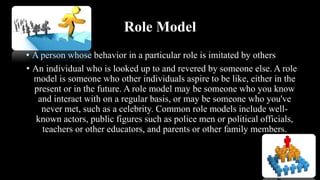
Role Model
• A person whose behavior in a particular role is imitated by others
• An individual who is looked up to and revered by someone else. A role
model is someone who other individuals aspire to be like, either in the
present or in the future. A role model may be someone who you know
and interact with on a regular basis, or may be someone who you've
never met, such as a celebrity. Common role models include well-
known actors, public figures such as police men or political officials,
teachers or other educators, and parents or other family members.
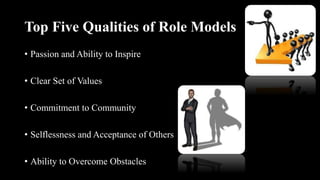
Top Five Qualities of Role Models
• Passion and Ability to Inspire
• Clear Set of Values
• Commitment to Community
• Selflessness and Acceptance of Others
• Ability to Overcome Obstacles

Gender difference & Role model

  • 1.
  • 2.
    Gender Difference A genderrole is a set of societal norms dictating what types of behaviors are generally considered acceptable, appropriate or desirable for a person based on their actual. In addition to the influence on gender behaviors of biological factors, there are four principle psychological explanations of gender-linked behavior patterns: Freudian theory's process of identification, cognitive social learning theory, gender-schema theory, and Kohlberg's cognitive developmental theory.
  • 3.
    • GENDER-ROLE STANDARDSAND STEREOTYPES Both within and across different cultures we find great consistency in standards of desirable gender-role behavior. Males are expected to be independent, assertive, and competitive; females are expected to be more passive, sensitive, and supportive. These beliefs have changed little over the past twenty years within the United States and apparently around the world as well. • GENDER DIFFERENCES IN DEVELOPMENT Girls are more physically and neurologically advanced at birth. Boys have more mature muscular development but are more vulnerable to disease and hereditary anomalies. Boys are more aggressive, and girls more nurturing. Boys have more reading, speech, and emotional problems than girls. There are no gender differences in sociability, conformity, achievement, self-esteem, or verbal hostility.
  • 4.
    Role Model • Aperson whose behavior in a particular role is imitated by others • An individual who is looked up to and revered by someone else. A role model is someone who other individuals aspire to be like, either in the present or in the future. A role model may be someone who you know and interact with on a regular basis, or may be someone who you've never met, such as a celebrity. Common role models include well- known actors, public figures such as police men or political officials, teachers or other educators, and parents or other family members.
  • 5.
    Top Five Qualitiesof Role Models • Passion and Ability to Inspire • Clear Set of Values • Commitment to Community • Selflessness and Acceptance of Others • Ability to Overcome Obstacles