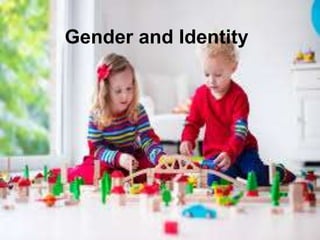
Gender and Identity
Young children and gender identity
Johnny (age 4 ½) I'm going to be an airplane builder
when I grow up.
Jimmy (age 4) When I grow up, I'll be a mommy.
Johnny No, you can't be a mommy. You
have to be a daddy.
Jimmy No, I'm going to be a mommy.
Johnny No, you're not a girl, you can't be a
mommy.
Jimmy Yes, I can.
Young children and gender identity
• Jimmy is at an age where he can label himself
as a boy.
• He believes that he can be a mommy when he
grows up.
• Jimmy is working on constructing a gender
identity and his current conception of this
identity does not restrict him to remaining the
same gender throughout his life.
Young children and gender identity
• Young children’s understanding of gender can
be described as a search for certainty.
• Children look for certainty in creating gender
categories but they base their decisions about
gender on social and cultural characteristics.
• Young children are less influenced by
biological knowledge as they do not fully
understand this knowledge.
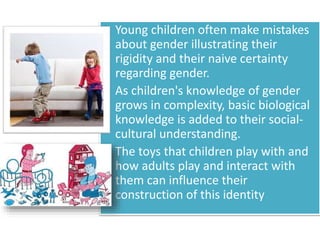
• Young children often make mistakes
about gender illustrating their
rigidity and their naive certainty
regarding gender.
• As children's knowledge of gender
grows in complexity, basic biological
knowledge is added to their social-
cultural understanding.
• The toys that children play with and
how adults play and interact with
them can influence their
construction of this identity
• One research study examined how primary school
children (aged 7 to 11 years) engage in pretend role play.
• The groups of children were asked to choose between
play situations of a hospital, hotel, or school, and they
had to choose the roles that they were going to play from
a set provided.
• The children's play was observed and their talk was
examined.
• In choosing their roles, boys took the high-status
positions of doctor, manager and head teacher slightly
more often than girls.
• Those boys taking high-status positions used their role to
exert domination and power far more often than did
girls.
What does the research say?
What does the research tell us?
• The gender roles the boys took on and
constructed could be described as ‘typically
masculine’ and those of the girls as ‘typically
feminine’.
• Particularly when playing in mixed groups, the
children constructed the gender roles as
oppositional to each other.
• In general, the research found that the girls
took on sensible, selfless, mature, and
facilitating behaviours, and boys took on silly,
selfish, immature, and demanding behaviours.
What does this mean?
• Children look for certainty in terms of gender
in the early years and can be stereotypical as a
result.
• Children's knowledge of gender in relation to
their own identity and that of others develops
over time.
• It gradually becomes more flexible and
incorporates diversity of roles, it also becomes
more reliable.
In summary
• Our gender identity is generally constructed
when we are children.
• Gender identity is different to our biological sex
or our sexual orientation
• It is our understanding of how something or
someone is manly or womanly.
• In the early days young children base this mostly
on social and cultural information.
• Young children can be rigid and stereotypical in
their understanding of gender e.g. boys play with
cars, girls play with dolls.
• This changes over time and our gender
identity becomes more flexible and adaptable.
• Our understanding of gender is important as it
can influence how we perceive ourselves and
our identity.
• Sometimes people who are biologically male
or female may identify more strongly with a
different gender.
• Sometimes people may not identify as either
male or female in terms of gender.
Gender and identity

Gender and identity

  • 1.
  • 2.
    Young children andgender identity Johnny (age 4 ½) I'm going to be an airplane builder when I grow up. Jimmy (age 4) When I grow up, I'll be a mommy. Johnny No, you can't be a mommy. You have to be a daddy. Jimmy No, I'm going to be a mommy. Johnny No, you're not a girl, you can't be a mommy. Jimmy Yes, I can.
  • 3.
    Young children andgender identity • Jimmy is at an age where he can label himself as a boy. • He believes that he can be a mommy when he grows up. • Jimmy is working on constructing a gender identity and his current conception of this identity does not restrict him to remaining the same gender throughout his life.
  • 4.
    Young children andgender identity • Young children’s understanding of gender can be described as a search for certainty. • Children look for certainty in creating gender categories but they base their decisions about gender on social and cultural characteristics. • Young children are less influenced by biological knowledge as they do not fully understand this knowledge.
  • 5.
    • Young childrenoften make mistakes about gender illustrating their rigidity and their naive certainty regarding gender. • As children's knowledge of gender grows in complexity, basic biological knowledge is added to their social- cultural understanding. • The toys that children play with and how adults play and interact with them can influence their construction of this identity
  • 6.
    • One researchstudy examined how primary school children (aged 7 to 11 years) engage in pretend role play. • The groups of children were asked to choose between play situations of a hospital, hotel, or school, and they had to choose the roles that they were going to play from a set provided. • The children's play was observed and their talk was examined. • In choosing their roles, boys took the high-status positions of doctor, manager and head teacher slightly more often than girls. • Those boys taking high-status positions used their role to exert domination and power far more often than did girls. What does the research say?
  • 7.
    What does theresearch tell us? • The gender roles the boys took on and constructed could be described as ‘typically masculine’ and those of the girls as ‘typically feminine’. • Particularly when playing in mixed groups, the children constructed the gender roles as oppositional to each other. • In general, the research found that the girls took on sensible, selfless, mature, and facilitating behaviours, and boys took on silly, selfish, immature, and demanding behaviours.
  • 8.
    What does thismean? • Children look for certainty in terms of gender in the early years and can be stereotypical as a result. • Children's knowledge of gender in relation to their own identity and that of others develops over time. • It gradually becomes more flexible and incorporates diversity of roles, it also becomes more reliable.
  • 9.
    In summary • Ourgender identity is generally constructed when we are children. • Gender identity is different to our biological sex or our sexual orientation • It is our understanding of how something or someone is manly or womanly. • In the early days young children base this mostly on social and cultural information. • Young children can be rigid and stereotypical in their understanding of gender e.g. boys play with cars, girls play with dolls.
  • 10.
    • This changesover time and our gender identity becomes more flexible and adaptable. • Our understanding of gender is important as it can influence how we perceive ourselves and our identity. • Sometimes people who are biologically male or female may identify more strongly with a different gender. • Sometimes people may not identify as either male or female in terms of gender.