A Presentation by Felicia Noyes
Those pictures are the BEFORE
pictures…
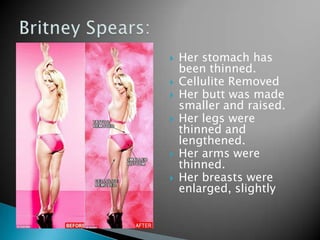
   Her stomach has
    been thinned.
   Cellulite Removed
   Her butt was made
    smaller and raised.
   Her legs were
    thinned and
    lengthened.
   Her arms were
    thinned.
   Her breasts were
    enlarged, slightly
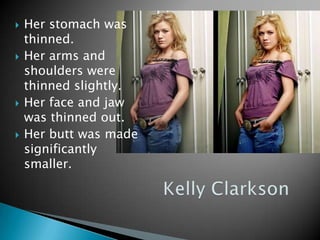
   Her stomach was
    thinned.
   Her arms and
    shoulders were
    thinned slightly.
   Her face and jaw
    was thinned out.
   Her butt was made
    significantly
    smaller.
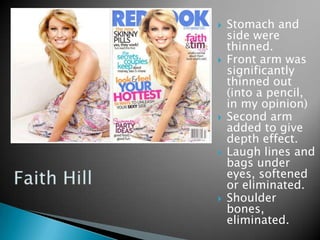
   Stomach and
    side were
    thinned.
   Front arm was
    significantly
    thinned out
    (into a pencil,
    in my opinion)
   Second arm
    added to give
    depth effect.
   Laugh lines and
    bags under
    eyes, softened
    or eliminated.
   Shoulder
    bones,
    eliminated.
Why do they need to be
photoshopped??
   Victoria Pruin DeFrancisco and Catherine
    Helen Palczewski, authors of Communicating
    Gender Diversity, talk about the power of
    media.
    ◦ “Female beauty is one example of media power over
      gender. Beauty norms change, and a driving force
      in that change is media representations of
      beauty…” (P. 238)
   It’s no doubt that our idea of beauty has
    changed over the years. However, our view of
    beauty is starting to become almost
    unrealistic.
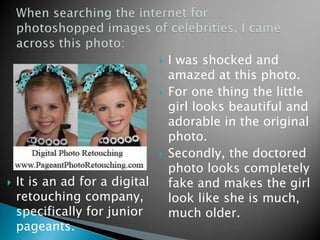
   I was shocked and
                                    amazed at this photo.
                                   For one thing the little
                                    girl looks beautiful and
                                    adorable in the original
                                    photo.
                                   Secondly, the doctored
                                    photo looks completely
   It is an ad for a digital       fake and makes the girl
    retouching company,             look like she is much,
    specifically for junior         much older.
    pageants.
You must look FAKE, in order
to be REALly beautiful?
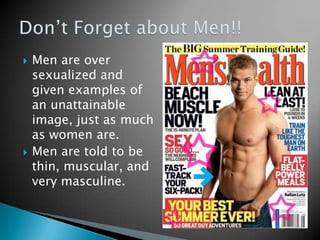
   Men are over
    sexualized and
    given examples of
    an unattainable
    image, just as much
    as women are.
   Men are told to be
    thin, muscular, and
    very masculine.
   An interesting fact about these images and
    how they are marketed towards us is that:
    ◦ “…women tend to overestimate the degree of
      thinness men find attractive. Why? One explanation
      is that the ideal of extreme thinness is most
      prominent in magazines targeting women, not in
      men’s magazines. Similarly, men tend to
      overestimate the degree of muscularity attractive to
      women. Why? Same dynamic.” (DeFrancisco and
      Palczewski, p. 242)
But in reality these images do
not reflect the preferences of
the opposite sex.
One example is the depiction
of rape in the media and
popular entertainment.
   When rape is portrayed on television there are usually
    certain gender roles that each of the characters are
    portrayed as.
   Almost always women are viewed as the victims of
    rape. While there are examples of male victims, they
    fall into the minority.
   These women are usually viewed as weak and though
    they might try to fight back, they are always defeated
    in the end.
   Or in some cases, the male protagonist saves them at
    the last minute.
   Men are usually viewed as being strong and
    powering, no matter if they are the perpetrator or the
    savior.
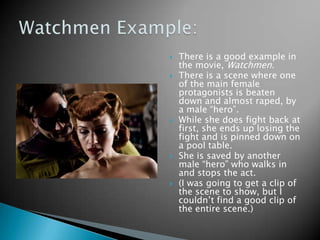
   There is a good example in
    the movie, Watchmen.
   There is a scene where one
    of the main female
    protagonists is beaten
    down and almost raped, by
    a male “hero”.
   While she does fight back at
    first, she ends up losing the
    fight and is pinned down on
    a pool table.
   She is saved by another
    male “hero” who walks in
    and stops the act.
   (I was going to get a clip of
    the scene to show, but I
    couldn’t find a good clip of
    the entire scene.)
   Do the “ideal” images that are portrayed in
    our magazines and media help create and
    form the different gender roles and ideals?
    ◦ If men are portrayed as being muscular and strong
      as being the ideal, then male characters in movies
      and TV will be portrayed the same way.
      Whether they are portrayed as being strong in a good,
       heroic sense, or strong in a bad, villain sense.
    ◦ And if women are portrayed as being skinny, sexual
      objects, without much muscles, then their
      characters will be viewed as being somewhat
      weaker and always the victims of sexual acts.
   The authors talk about
    the idea of the “Gaze”,
    aka. The way a woman
    is looked at and
    viewed in the eye of
    the audience, film, etc.
   “The way the camera,
    the audience, and the
    male character (with
    whom all spectators –
    male and female-
    identitfy) look at
    women reinforces the
    male as active and the
    female as passive.” (p.
    250)
   The way men and women are portrayed in the
    media physically, has a great effect on how their
    gender roles are portrayed .
   The power of media has a great influence on how
    gender roles are formed because the media is
    where we, sadly, get most of our information.
   The barrage of images of the “ideal” male and
    female bodies create not only unrealistic
    expectations for what a man and woman are
    supposed to look like, but it also creates a sense
    of how women and men are to act with one
    another. (Aka. Men are supposed to protect
    women from other men.) Women are viewed
    almost as property to men.

Gender and the media

  • 1.
    A Presentation byFelicia Noyes
  • 3.
    Those pictures arethe BEFORE pictures…
  • 4.
    Her stomach has been thinned.  Cellulite Removed  Her butt was made smaller and raised.  Her legs were thinned and lengthened.  Her arms were thinned.  Her breasts were enlarged, slightly
  • 5.
    Her stomach was thinned.  Her arms and shoulders were thinned slightly.  Her face and jaw was thinned out.  Her butt was made significantly smaller.
  • 6.
    Stomach and side were thinned.  Front arm was significantly thinned out (into a pencil, in my opinion)  Second arm added to give depth effect.  Laugh lines and bags under eyes, softened or eliminated.  Shoulder bones, eliminated.
  • 7.
    Why do theyneed to be photoshopped??
  • 8.
    Victoria Pruin DeFrancisco and Catherine Helen Palczewski, authors of Communicating Gender Diversity, talk about the power of media. ◦ “Female beauty is one example of media power over gender. Beauty norms change, and a driving force in that change is media representations of beauty…” (P. 238)  It’s no doubt that our idea of beauty has changed over the years. However, our view of beauty is starting to become almost unrealistic.
  • 9.
    I was shocked and amazed at this photo.  For one thing the little girl looks beautiful and adorable in the original photo.  Secondly, the doctored photo looks completely  It is an ad for a digital fake and makes the girl retouching company, look like she is much, specifically for junior much older. pageants.
  • 10.
    You must lookFAKE, in order to be REALly beautiful?
  • 11.
    Men are over sexualized and given examples of an unattainable image, just as much as women are.  Men are told to be thin, muscular, and very masculine.
  • 12.
    An interesting fact about these images and how they are marketed towards us is that: ◦ “…women tend to overestimate the degree of thinness men find attractive. Why? One explanation is that the ideal of extreme thinness is most prominent in magazines targeting women, not in men’s magazines. Similarly, men tend to overestimate the degree of muscularity attractive to women. Why? Same dynamic.” (DeFrancisco and Palczewski, p. 242)
  • 13.
    But in realitythese images do not reflect the preferences of the opposite sex.
  • 14.
    One example isthe depiction of rape in the media and popular entertainment.
  • 15.
    When rape is portrayed on television there are usually certain gender roles that each of the characters are portrayed as.  Almost always women are viewed as the victims of rape. While there are examples of male victims, they fall into the minority.  These women are usually viewed as weak and though they might try to fight back, they are always defeated in the end.  Or in some cases, the male protagonist saves them at the last minute.  Men are usually viewed as being strong and powering, no matter if they are the perpetrator or the savior.
  • 16.
    There is a good example in the movie, Watchmen.  There is a scene where one of the main female protagonists is beaten down and almost raped, by a male “hero”.  While she does fight back at first, she ends up losing the fight and is pinned down on a pool table.  She is saved by another male “hero” who walks in and stops the act.  (I was going to get a clip of the scene to show, but I couldn’t find a good clip of the entire scene.)
  • 17.
    Do the “ideal” images that are portrayed in our magazines and media help create and form the different gender roles and ideals? ◦ If men are portrayed as being muscular and strong as being the ideal, then male characters in movies and TV will be portrayed the same way.  Whether they are portrayed as being strong in a good, heroic sense, or strong in a bad, villain sense. ◦ And if women are portrayed as being skinny, sexual objects, without much muscles, then their characters will be viewed as being somewhat weaker and always the victims of sexual acts.
  • 18.
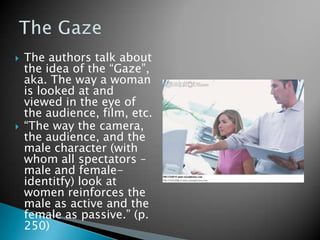
    The authors talk about the idea of the “Gaze”, aka. The way a woman is looked at and viewed in the eye of the audience, film, etc.  “The way the camera, the audience, and the male character (with whom all spectators – male and female- identitfy) look at women reinforces the male as active and the female as passive.” (p. 250)
  • 19.
    The way men and women are portrayed in the media physically, has a great effect on how their gender roles are portrayed .  The power of media has a great influence on how gender roles are formed because the media is where we, sadly, get most of our information.  The barrage of images of the “ideal” male and female bodies create not only unrealistic expectations for what a man and woman are supposed to look like, but it also creates a sense of how women and men are to act with one another. (Aka. Men are supposed to protect women from other men.) Women are viewed almost as property to men.