By: Brittany Quirk
MEDIA
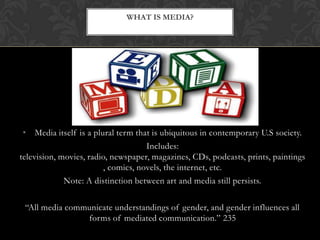
• Media itself is a plural term that is ubiquitous in contemporary U.S society.
Includes:
television, movies, radio, newspaper, magazines, CDs, podcasts, prints, paintings
, comics, novels, the internet, etc.
Note: A distinction between art and media still persists.
“All media communicate understandings of gender, and gender influences all
forms of mediated communication.” 235
WHAT IS MEDIA?
• Media is approached as an
institution to distinguish the
fact that focusing on a single
medium would be inadequate.
• Share conventions concerning
the creation of contents and
construction of audience.
• “Media is one of the primary
mechanisms that reiterate
gender while also providing
locations in which resistance
can occur, in both construction
and reception.” 237
MEDIA AS A SOCIAL INSTITUTION
• Economic processes and
institutional patterns govern
media messages.
• Maintain and increase
demand for consumption.
• “Ads that sell
commodities…to audiences
are part of a system in which
media corporations sell
audiences as commodities to
advertisers.” 237
MEDIA ECONOMICS
• Since institutions are organized in
accord with power, which further
constrains and facilitates behavior in
accordance with members of society
in which the institution exists.
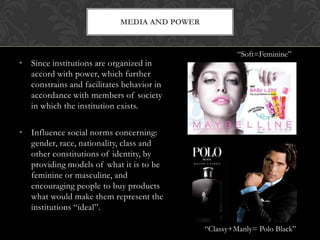
• Influence social norms concerning:
gender, race, nationality, class and
other constitutions of identity, by
providing models of what it is to be
feminine or masculine, and
encouraging people to buy products
what would make them represent the
institutions “ideal”.
MEDIA AND POWER
“Soft=Feminine”
“Classy+Manly= Polo Black”
• “Media as an institution of civil society, shape the cognitive structures through
which people perceive and evaluate social reality.” 239
• Must be maintained, repeated, and respond to outside forces that oppose it.
• Hegemony presumes the possibility of resistance and opposition by both
maintaining and challenging expectations.
MEDIA AND HEGEMONY
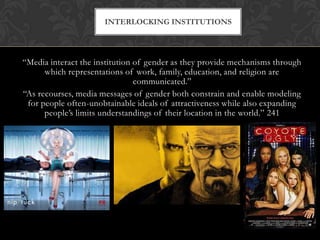
“Media interact the institution of gender as they provide mechanisms through
which representations of work, family, education, and religion are
communicated.”
“As recourses, media messages of gender both constrain and enable modeling
for people often-unobtainable ideals of attractiveness while also expanding
people’s limits understandings of their location in the world.” 241
INTERLOCKING INSTITUTIONS
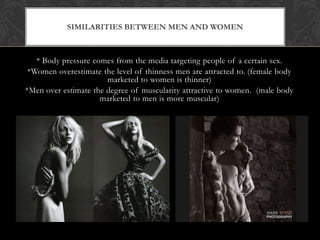
* Body pressure comes from the media targeting people of a certain sex.
*Women overestimate the level of thinness men are attracted to. (female body
marketed to women is thinner)
*Men over estimate the degree of muscularity attractive to women. (male body
marketed to men is more muscular)
SIMILARITIES BETWEEN MEN AND WOMEN
Body Image- factors in:
race, nationality, and sexual
orientation.
Beauty Standards- not the same for all
women.
Women as Sex Objects- not a universal
phenomenon
DIFFERENCES AMONG WOMEN
1)It defines power in terms of physical force and control.
2)Defined through occupational achievement.
3)It is represented in terms of familial patriarchy, in which the man is the
breadwinner.
4)It is symbolized by the frontiersman and the outdoorsman.
5) It is heterosexually defined.
5 CHARACTERISTICS OF U.S
HEGEMONIC MASCULINITY
• Content/Effects- Quantify what is in mediated product.
“Because media has a particular content, a particular effect follows.” 244
• Violence- Women and minorities are under reprented-> creates the
perception that they are not agents of action, capable of commenting on
and acting in the world.
*exposure to violent media directly effects violent behavior and are one of
the ways gendered violence is normalized in the U.S.
• Media Depictions of Rape- insight into how women are gendered and
raced as deserving or undeserving victims.
*leaves open the possibility that different audiences will interact in different
ways to these media representations.
MEDIA CONSTRUCT AND CONSTRAIN
GENDER
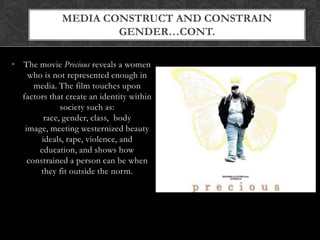
• The movie Precious reveals a women
who is not represented enough in
media. The film touches upon
factors that create an identity within
society such as:
race, gender, class, body
image, meeting westernized beauty
ideals, rape, violence, and
education, and shows how
constrained a person can be when
they fit outside the norm.
MEDIA CONSTRUCT AND CONSTRAIN
GENDER…CONT.
DO THESE FIT YOUR IDEA OF
MANLY?
Men act and women appear- men look
at women; women watch themselves being
looked at-> men as the “ideal spectator”-
> “It’s feminine to be on display.”
The fiction of an act-free appearance
persists.
Cinematic Gaze-The
camera, audience, and male character look
at women reinforces the male as active and
female as passive.
Oppositional gaze- Audience members
can actively choose to reposition their
gaze.
THE GAZE(S)
WOMEN AS SEXUAL OBJECTS
“Given the polyvalence of media products and that each audience member is
actively involved in the interpretation and reception of messages, even
seemingly restrictive media forms can be used for liberatory purposes.” 253.
4 Themes-
1) Gender is constructed through media representations, and media
representations are always in flux.
2) The boarders of genders are continually re-secured by media
representations in response to this change.
3) even progressive representations of gender can re-secure traditional
understandings of gender.
4) New technologies tend to replicate old gender dynamics.
MEDIA IS ALWAYS LIBERATORY
AND CONSTRAINING.
CHALLENGING THE NORM
FOOD FOR THOUGHT
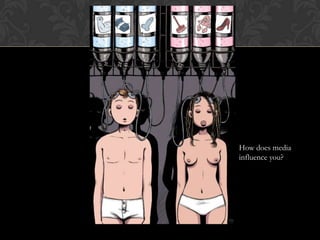
How does media
influence you?

Gender and media

  • 1.
  • 2.
    • Media itselfis a plural term that is ubiquitous in contemporary U.S society. Includes: television, movies, radio, newspaper, magazines, CDs, podcasts, prints, paintings , comics, novels, the internet, etc. Note: A distinction between art and media still persists. “All media communicate understandings of gender, and gender influences all forms of mediated communication.” 235 WHAT IS MEDIA?
  • 3.
    • Media isapproached as an institution to distinguish the fact that focusing on a single medium would be inadequate. • Share conventions concerning the creation of contents and construction of audience. • “Media is one of the primary mechanisms that reiterate gender while also providing locations in which resistance can occur, in both construction and reception.” 237 MEDIA AS A SOCIAL INSTITUTION
  • 4.
    • Economic processesand institutional patterns govern media messages. • Maintain and increase demand for consumption. • “Ads that sell commodities…to audiences are part of a system in which media corporations sell audiences as commodities to advertisers.” 237 MEDIA ECONOMICS
  • 5.
    • Since institutionsare organized in accord with power, which further constrains and facilitates behavior in accordance with members of society in which the institution exists. • Influence social norms concerning: gender, race, nationality, class and other constitutions of identity, by providing models of what it is to be feminine or masculine, and encouraging people to buy products what would make them represent the institutions “ideal”. MEDIA AND POWER “Soft=Feminine” “Classy+Manly= Polo Black”
  • 6.
    • “Media asan institution of civil society, shape the cognitive structures through which people perceive and evaluate social reality.” 239 • Must be maintained, repeated, and respond to outside forces that oppose it. • Hegemony presumes the possibility of resistance and opposition by both maintaining and challenging expectations. MEDIA AND HEGEMONY
  • 7.
    “Media interact theinstitution of gender as they provide mechanisms through which representations of work, family, education, and religion are communicated.” “As recourses, media messages of gender both constrain and enable modeling for people often-unobtainable ideals of attractiveness while also expanding people’s limits understandings of their location in the world.” 241 INTERLOCKING INSTITUTIONS
  • 8.
    * Body pressurecomes from the media targeting people of a certain sex. *Women overestimate the level of thinness men are attracted to. (female body marketed to women is thinner) *Men over estimate the degree of muscularity attractive to women. (male body marketed to men is more muscular) SIMILARITIES BETWEEN MEN AND WOMEN
  • 9.
    Body Image- factorsin: race, nationality, and sexual orientation. Beauty Standards- not the same for all women. Women as Sex Objects- not a universal phenomenon DIFFERENCES AMONG WOMEN
  • 10.
    1)It defines powerin terms of physical force and control. 2)Defined through occupational achievement. 3)It is represented in terms of familial patriarchy, in which the man is the breadwinner. 4)It is symbolized by the frontiersman and the outdoorsman. 5) It is heterosexually defined. 5 CHARACTERISTICS OF U.S HEGEMONIC MASCULINITY
  • 11.
    • Content/Effects- Quantifywhat is in mediated product. “Because media has a particular content, a particular effect follows.” 244 • Violence- Women and minorities are under reprented-> creates the perception that they are not agents of action, capable of commenting on and acting in the world. *exposure to violent media directly effects violent behavior and are one of the ways gendered violence is normalized in the U.S. • Media Depictions of Rape- insight into how women are gendered and raced as deserving or undeserving victims. *leaves open the possibility that different audiences will interact in different ways to these media representations. MEDIA CONSTRUCT AND CONSTRAIN GENDER
  • 12.
    • The moviePrecious reveals a women who is not represented enough in media. The film touches upon factors that create an identity within society such as: race, gender, class, body image, meeting westernized beauty ideals, rape, violence, and education, and shows how constrained a person can be when they fit outside the norm. MEDIA CONSTRUCT AND CONSTRAIN GENDER…CONT.
  • 13.
    DO THESE FITYOUR IDEA OF MANLY?
  • 14.
    Men act andwomen appear- men look at women; women watch themselves being looked at-> men as the “ideal spectator”- > “It’s feminine to be on display.” The fiction of an act-free appearance persists. Cinematic Gaze-The camera, audience, and male character look at women reinforces the male as active and female as passive. Oppositional gaze- Audience members can actively choose to reposition their gaze. THE GAZE(S)
  • 15.
  • 16.
    “Given the polyvalenceof media products and that each audience member is actively involved in the interpretation and reception of messages, even seemingly restrictive media forms can be used for liberatory purposes.” 253. 4 Themes- 1) Gender is constructed through media representations, and media representations are always in flux. 2) The boarders of genders are continually re-secured by media representations in response to this change. 3) even progressive representations of gender can re-secure traditional understandings of gender. 4) New technologies tend to replicate old gender dynamics. MEDIA IS ALWAYS LIBERATORY AND CONSTRAINING.
  • 17.
  • 18.
  • 19.