CAEP
Seizing the Opportunity
Dave Kommer
October 4, 2013
NCATE to CAEP
 Two Teacher Preparation Accrediting Bodies to
One
 NCATE
 TEAC
 Get to essence of teaching
 Produce highly effective teachers
 Best Practice
 Meet legislated requirements
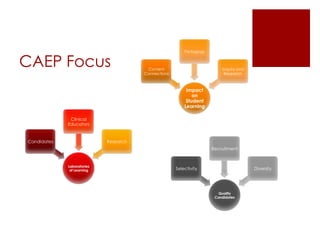
CAEP Focus
Impact
on
Student
Learning
Content
Connections
Pedagogy
Inquiry and
Research
Laboratories
of Learning
Candidates
Clinical
Educators
Research
Quality
Candidates
Selectivity
Recruitment
Diversity
Standard One
 Content and Pedagogical
Knowledge
The provider insures that
candidates develop a deep
understanding of the critical
concepts and principles of
their discipline and, by
completion, are able to use
discipline-specific practices
flexibly to advance the
learning of all students toward
attainment of college- and
career-readiness standards.
 Key Terms
 INTASC Standards
 Deeper learning
 Content connections
 Apply and transfer
 Learn to learn
 What students know
 Representations of ideas
 Modifying textbooks
 Analyzing learning
 Parents and communities
Standard Two
 Clinical Partnerships and
Practice
The provider ensures that
effective partnerships and
high-quality practice are
central to preparation so that
candidates develop the
knowledge, skills and
professional dispositions
necessary to demonstrate
positive impact on all P-12
students’ learning and
development.
 Key Terms
 Laboratory of learning
 Partnerships
 Impact on student
learning
 Virtual fields
 Clinical-based
preparation
 Clinical educators
Standard Three
 Candidate Quality, Recruitment,
and Selectivity
The provider demonstrates that the
quality of candidates is a continuing
and purposeful part of its
responsibility from recruitment, at
admission, through the progression
of courses and clinical experiences,
and to decisions that completers
are prepared to teach effectively
and are recommended for
certification. The provider
demonstrates that development of
candidate quality is the goal of
educator preparation in all phases
of the program. The process is
ultimately determined by a
program’s meeting of Standard 4.
 Key Terms
 Candidate quality
 Recruitment
 Selectivity
 Diversity
 Minimum Criteria
 3.0 GPA
 ACT, SAT, or GRE top 50%
 Scores increase annually to
top 33%
 Alternative criteria
 Candidate dispositions
 Monitor candidate progression
 Any completing candidate
meets high quality standards
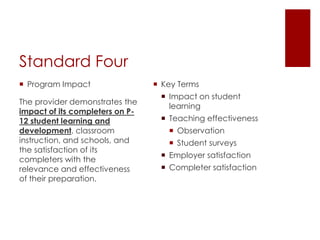
Standard Four
 Program Impact
The provider demonstrates the
impact of its completers on P-
12 student learning and
development, classroom
instruction, and schools, and
the satisfaction of its
completers with the
relevance and effectiveness
of their preparation.
 Key Terms
 Impact on student
learning
 Teaching effectiveness
 Observation
 Student surveys
 Employer satisfaction
 Completer satisfaction
Standard Five
 Provider Quality Assurance and
Continuous Improvement
The provider maintains a quality
assurance system comprised of
valid data from multiple measures,
including evidence of candidates’
and completers’ positive impact on
P-12 student learning and
development. The provider supports
continuous improvement that is
sustained and evidence-based, and
that evaluates the effectiveness of
its completers. The provider uses the
results of inquiry and data collection
to establish priorities, enhance
program elements and capacity,
and test innovations to improve
completers’ impact on P-12 student
learning and development.
 Key Terms
 Quality assurance (aka,
assessment)
 Reliable and valid data
 Transparency
 CAEP Pathways
 Inquiry Brief
 Continuous Improvement
 Transformational Pathway
 Impact of student learning
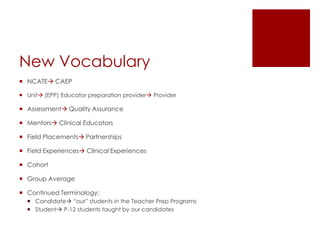
New Vocabulary
 NCATE CAEP
 Unit (EPP) Educator preparation provider Provider
 Assessment Quality Assurance
 Mentors Clinical Educators
 Field Placements Partnerships
 Field Experiences Clinical Experiences
 Cohort
 Group Average
 Continued Terminology:
 Candidate “our” students in the Teacher Prep Programs
 Student P-12 students taught by our candidates
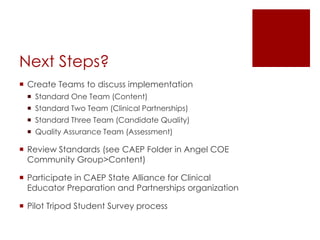
Next Steps?
 Create Teams to discuss implementation
 Standard One Team (Content)
 Standard Two Team (Clinical Partnerships)
 Standard Three Team (Candidate Quality)
 Quality Assurance Team (Assessment)
 Review Standards (see CAEP Folder in Angel COE
Community Group>Content)
 Participate in CAEP State Alliance for Clinical
Educator Preparation and Partnerships organization
 Pilot Tripod Student Survey process
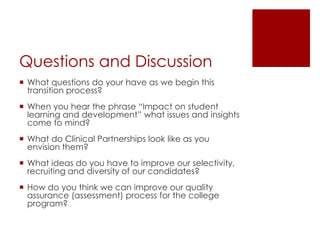
Questions and Discussion
 What questions do your have as we begin this
transition process?
 When you hear the phrase “Impact on student
learning and development” what issues and insights
come to mind?
 What do Clinical Partnerships look like as you
envision them?
 What ideas do you have to improve our selectivity,
recruiting and diversity of our candidates?
 How do you think we can improve our quality
assurance (assessment) process for the college
program?

Caep overview

  • 1.
    CAEP Seizing the Opportunity DaveKommer October 4, 2013
  • 2.
    NCATE to CAEP Two Teacher Preparation Accrediting Bodies to One  NCATE  TEAC  Get to essence of teaching  Produce highly effective teachers  Best Practice  Meet legislated requirements
  • 3.
    CAEP Focus Impact on Student Learning Content Connections Pedagogy Inquiry and Research Laboratories ofLearning Candidates Clinical Educators Research Quality Candidates Selectivity Recruitment Diversity
  • 4.
    Standard One  Contentand Pedagogical Knowledge The provider insures that candidates develop a deep understanding of the critical concepts and principles of their discipline and, by completion, are able to use discipline-specific practices flexibly to advance the learning of all students toward attainment of college- and career-readiness standards.  Key Terms  INTASC Standards  Deeper learning  Content connections  Apply and transfer  Learn to learn  What students know  Representations of ideas  Modifying textbooks  Analyzing learning  Parents and communities
  • 5.
    Standard Two  ClinicalPartnerships and Practice The provider ensures that effective partnerships and high-quality practice are central to preparation so that candidates develop the knowledge, skills and professional dispositions necessary to demonstrate positive impact on all P-12 students’ learning and development.  Key Terms  Laboratory of learning  Partnerships  Impact on student learning  Virtual fields  Clinical-based preparation  Clinical educators
  • 6.
    Standard Three  CandidateQuality, Recruitment, and Selectivity The provider demonstrates that the quality of candidates is a continuing and purposeful part of its responsibility from recruitment, at admission, through the progression of courses and clinical experiences, and to decisions that completers are prepared to teach effectively and are recommended for certification. The provider demonstrates that development of candidate quality is the goal of educator preparation in all phases of the program. The process is ultimately determined by a program’s meeting of Standard 4.  Key Terms  Candidate quality  Recruitment  Selectivity  Diversity  Minimum Criteria  3.0 GPA  ACT, SAT, or GRE top 50%  Scores increase annually to top 33%  Alternative criteria  Candidate dispositions  Monitor candidate progression  Any completing candidate meets high quality standards
  • 7.
    Standard Four  ProgramImpact The provider demonstrates the impact of its completers on P- 12 student learning and development, classroom instruction, and schools, and the satisfaction of its completers with the relevance and effectiveness of their preparation.  Key Terms  Impact on student learning  Teaching effectiveness  Observation  Student surveys  Employer satisfaction  Completer satisfaction
  • 8.
    Standard Five  ProviderQuality Assurance and Continuous Improvement The provider maintains a quality assurance system comprised of valid data from multiple measures, including evidence of candidates’ and completers’ positive impact on P-12 student learning and development. The provider supports continuous improvement that is sustained and evidence-based, and that evaluates the effectiveness of its completers. The provider uses the results of inquiry and data collection to establish priorities, enhance program elements and capacity, and test innovations to improve completers’ impact on P-12 student learning and development.  Key Terms  Quality assurance (aka, assessment)  Reliable and valid data  Transparency  CAEP Pathways  Inquiry Brief  Continuous Improvement  Transformational Pathway  Impact of student learning
  • 9.
    New Vocabulary  NCATECAEP  Unit (EPP) Educator preparation provider Provider  Assessment Quality Assurance  Mentors Clinical Educators  Field Placements Partnerships  Field Experiences Clinical Experiences  Cohort  Group Average  Continued Terminology:  Candidate “our” students in the Teacher Prep Programs  Student P-12 students taught by our candidates
  • 10.
    Next Steps?  CreateTeams to discuss implementation  Standard One Team (Content)  Standard Two Team (Clinical Partnerships)  Standard Three Team (Candidate Quality)  Quality Assurance Team (Assessment)  Review Standards (see CAEP Folder in Angel COE Community Group>Content)  Participate in CAEP State Alliance for Clinical Educator Preparation and Partnerships organization  Pilot Tripod Student Survey process
  • 11.
    Questions and Discussion What questions do your have as we begin this transition process?  When you hear the phrase “Impact on student learning and development” what issues and insights come to mind?  What do Clinical Partnerships look like as you envision them?  What ideas do you have to improve our selectivity, recruiting and diversity of our candidates?  How do you think we can improve our quality assurance (assessment) process for the college program?

Editor's Notes

  • #3 Viewed merge as opportunity to refine and refocus teacher preparation.Redesign was was grounded in empirical research, or where not available, best practice.This is not a repackaging of the old standardsOld Standards 5 & 6 are goneRedirection to the work of what teachers do.
  • #4 It might be helpful to look at the overarching goals or focus areas that are driving the new standards.Impact on Student Learning: It makes sense in this professional atmosphere of evaluating teachers partially on the gains their students make, that CAEP wants us to think ultimately how our efforts will help candidates make an impact on their students’ achievement.CAEP sees this task as a collective effort between us, the candidate and the clinical educators (mentors and supervisors) who support them.Laboratories of Learning: The old paradigm of asking classroom teachers to move aside and allow our candidates to “practice” on their students has been dying quickly as a result of new teacher evaluation programs. Instead of that model, CAEP wants clinical experiences to be restructured as a partnership in support of candidate growth. This growth should be evident in candidate knowledge of their content and teaching. Quality Candidates: CAEP stresses that the profession should strive to improve the quality of candidates coming into the profession. We need to become more involved in this process on several levels.
  • #7 High need areasSTEMLanguage LearnersSpecial NeedsMeeting employment trends and needs
  • #11 Standard One TeamWhat program and course changes may need to be made?What changes to our syllabi need to be madeEg, reflect focus on InTASCStandard Two TeamComplete restructure of Clinical PracticeStandard Three TeamWork with AdmissionsMarketingQuality Assurance TeamRedesignMeasure of effectivenessTransparency and WebsiteBe sure to mention:State AllianceTripod Student Survey