ECE and Technology Jenna Garrett
Research says… “ Research has also moved beyond the simple question of whether computers can help young children learn. They can. What we need to understand is how best to aid learning, what types of learning we should facilitate, and how to serve the needs of diverse populations.”
Developmental Dimensions From birth to age eight, children learn rapidly, using all of their senses Children learn through play and exploration across: Social and Emotional Development Language Development Physical Well-Being and Motor Development Cognition and General Knowledge Approaches Toward Learning
Technology and ECE “ For young learners, technology is part of their everyday lives.” Lesson directly connected to curriculum Active learning Interactive/discovery based Variety of tools available Applied to real problems Allows children to interact Computers in classroom
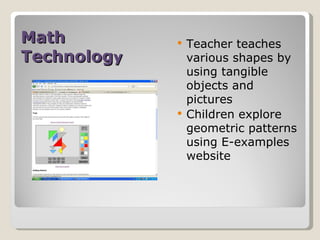
Math Technolog y Teacher teaches various shapes by using tangible objects and pictures Children explore geometric patterns using E-examples website
Benefits Challenges spatial abilities Transition from concrete to abstract understanding Visual representations help children understand information in a new way
Digital Cameras Combine observations and digital pictures of curriculum content Students come up with ideas Teacher demonstrates usage Students take and compile pictures
Benefits See immediate results Children focus and actively engage in learning experiences Children interact with people and objects in environment Close-up photos engage curiosity Children can refer to images in the classroom as they explore and build understanding Creativity and variability
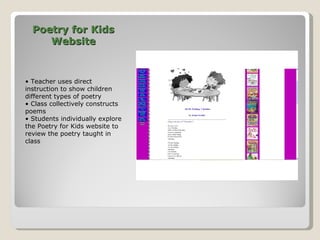
Poetry for Kids Website •  Teacher uses direct instruction to show children different types of poetry •  Class collectively constructs poems •  Students individually explore the Poetry for Kids website to review the poetry taught in class
Benefits Children enjoy poems by doing various activities with poetry such as rating their "giggle factor" and racing to say tongue twisters. Creative and unique Children learn how spoken language connects to print Effective with a wide range of learners
Sources Early Connections: Technology in Early Childhood Education http://www.netc.org/earlyconnections/primary/index.html Technology in Early Childhood Education: Finding the Balance http://www.nwrel.org/request/june01/child.html 5 Effective Ways for Young Children to Use Technology http://www.netc.org/earlyconnections/pub/brochure.pdf Learner, Language, and Technology:  Making Connections That Support Literacy http://www.netc.org/earlyconnections/pub/index.html

Ece And Technology

  • 1.
    ECE and TechnologyJenna Garrett
  • 2.
    Research says… “Research has also moved beyond the simple question of whether computers can help young children learn. They can. What we need to understand is how best to aid learning, what types of learning we should facilitate, and how to serve the needs of diverse populations.”
  • 3.
    Developmental Dimensions Frombirth to age eight, children learn rapidly, using all of their senses Children learn through play and exploration across: Social and Emotional Development Language Development Physical Well-Being and Motor Development Cognition and General Knowledge Approaches Toward Learning
  • 4.
    Technology and ECE“ For young learners, technology is part of their everyday lives.” Lesson directly connected to curriculum Active learning Interactive/discovery based Variety of tools available Applied to real problems Allows children to interact Computers in classroom
  • 5.
    Math Technolog yTeacher teaches various shapes by using tangible objects and pictures Children explore geometric patterns using E-examples website
  • 6.
    Benefits Challenges spatialabilities Transition from concrete to abstract understanding Visual representations help children understand information in a new way
  • 7.
    Digital Cameras Combineobservations and digital pictures of curriculum content Students come up with ideas Teacher demonstrates usage Students take and compile pictures
  • 8.
    Benefits See immediateresults Children focus and actively engage in learning experiences Children interact with people and objects in environment Close-up photos engage curiosity Children can refer to images in the classroom as they explore and build understanding Creativity and variability
  • 9.
    Poetry for KidsWebsite • Teacher uses direct instruction to show children different types of poetry • Class collectively constructs poems • Students individually explore the Poetry for Kids website to review the poetry taught in class
  • 10.
    Benefits Children enjoypoems by doing various activities with poetry such as rating their "giggle factor" and racing to say tongue twisters. Creative and unique Children learn how spoken language connects to print Effective with a wide range of learners
  • 11.
    Sources Early Connections:Technology in Early Childhood Education http://www.netc.org/earlyconnections/primary/index.html Technology in Early Childhood Education: Finding the Balance http://www.nwrel.org/request/june01/child.html 5 Effective Ways for Young Children to Use Technology http://www.netc.org/earlyconnections/pub/brochure.pdf Learner, Language, and Technology: Making Connections That Support Literacy http://www.netc.org/earlyconnections/pub/index.html