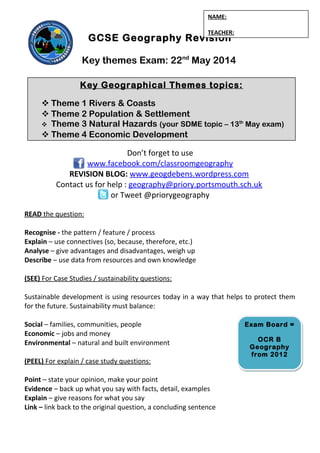
GCSE Geography Revision
Key themes Exam: 22nd
May 2014
Don’t forget to use
www.facebook.com/classroomgeography
REVISION BLOG: www.geogdebens.wordpress.com
Contact us for help : geography@priory.portsmouth.sch.uk
or Tweet @priorygeography
READ the question:
Recognise - the pattern / feature / process
Explain – use connectives (so, because, therefore, etc.)
Analyse – give advantages and disadvantages, weigh up
Describe – use data from resources and own knowledge
(SEE) For Case Studies / sustainability questions:
Sustainable development is using resources today in a way that helps to protect them
for the future. Sustainability must balance:
Social – families, communities, people
Economic – jobs and money
Environmental – natural and built environment
(PEEL) For explain / case study questions:
Point – state your opinion, make your point
Evidence – back up what you say with facts, detail, examples
Explain – give reasons for what you say
Link – link back to the original question, a concluding sentence
Key Geographical Themes topics:
 Theme 1 Rivers & Coasts
 Theme 2 Population & Settlement
 Theme 3 Natural Hazards (your SDME topic – 13th
May exam)
 Theme 4 Economic Development
NAME:
TEACHER:
Exam Board =
OCR B
Geography
from 2012
Exam Board =
OCR B
Geography
from 2012
Exam command words
Command word: What it means
Compare Show similarities and differences. A balanced answer is
required.
Consider Describe and give your thoughts on the subject.
Contrast Point out only the differences between two items.
Define Explain the precise meaning of a concept / word.
Describe Say what something is like, how it works, use adjectives.
Discuss Explain an item or concept, give details about it using info /
examples / facts. Give both points of view & come to a
conclusion.
Examine Investigate in detail, offer evidence for and against.
Explain Offer a detailed and exact explanation of an idea or principle.
Identify / State Express the relevant points briefly and clearly.
Illustrate Provide examples to demonstrate or prove a subject.
Justify Give reasons to support your answer / argument, and the main
objections
Summarise / Outline Provide a short summary of all the info on a subject
It might be useful to underline command words in an exam question.
Answering the questions…..
[1mark] questions = can be answered with a single word or simple sentence, often using
data or fact. E.g. Name a climatic hazard = drought [1]
[2mark] questions = either needs two simple sentences, often using data OR needs one
point then explained. E.g. Explain why LEDCs have a higher death rate = poor healthcare
leading to diseases [P] and a lack of food [P] [2] OR LEDCs have a higher death rate
due to a lack of medicine [P] and healthcare which means they cannot treat illnesses
and disease so die more easily [E] [2]
[4mark] questions = requires you to explain, compare, consider evidence, use facts,
refer to examples. The answer should be detailed. You should probably describe and
explain using P.E.E.L. E.g. Using the sources, suggest how afforestation may affect river
flow= Afforestation is the planting of trees / vegetation [P], which can reduce river
volume and increase the lag time as seen on the hydrograph at Point A [Ev]. This is
because vegetation increases interception which reduces surface runoff [Ex] and
therefore the amount of water entering the river and how quickly it gets there will be
reduced [L]. [4]
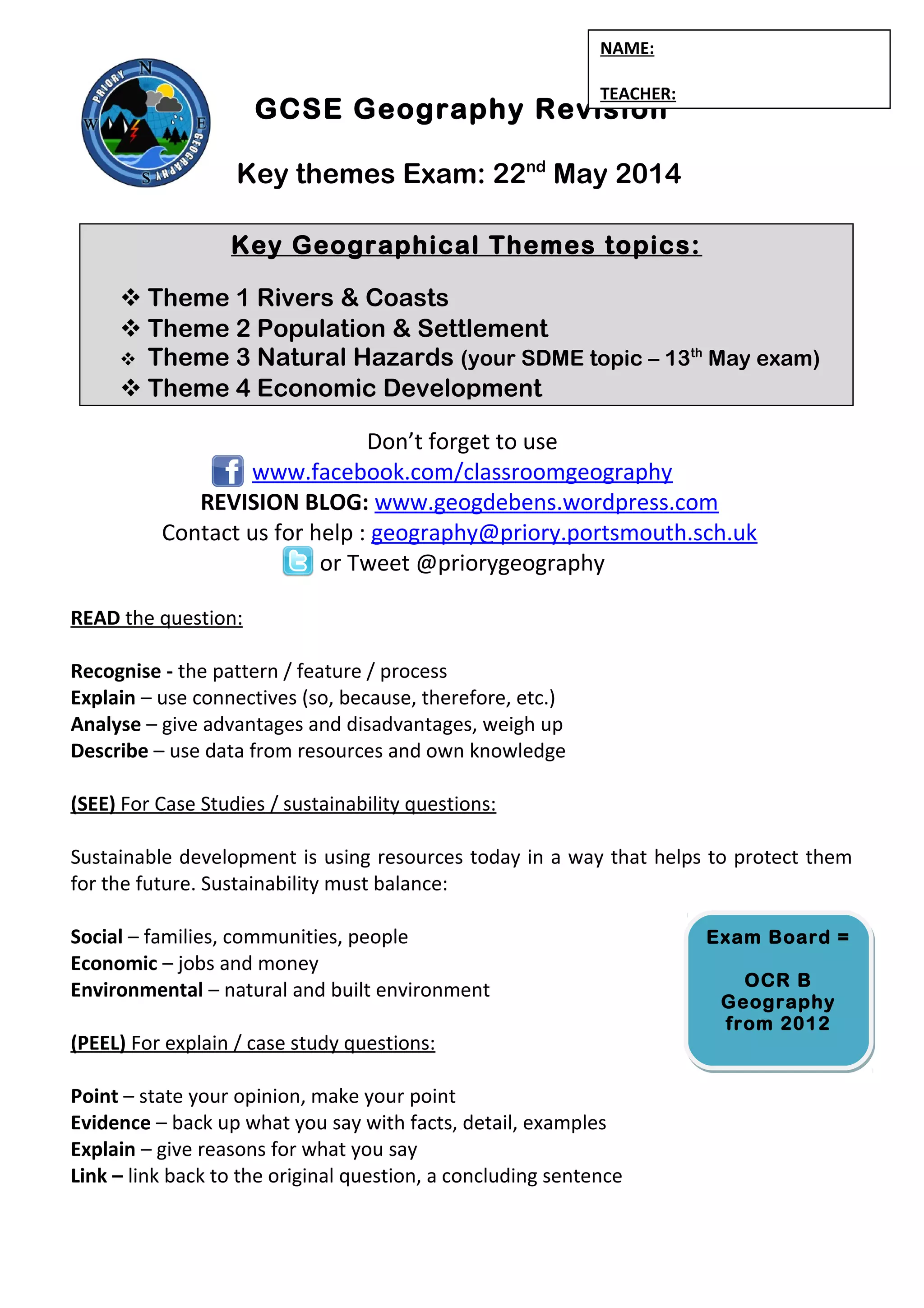
Theme 1 Rivers & Coasts checklist
Now I’ve reached the end of the Rivers & Coasts unit:
Yes Think so No
 I can understand and define the 4 types of erosion
 I can explain how the geology of an area influences how
rapidly it is eroded
 I can describe and explain longshore drift & its effects
 I can name types of hard & soft coastal management
 I can name types of hard & soft river management
 I can evaluate how sustainable landform management is
 I can name and describe a case study of coastal erosion
and the management used to protect it
 I can name and describe a case study of river flooding
and the responses to flooding in an MEDC
 I can give examples of primary & secondary impacts of
floods
 I can explain why river flooding occurs
 I can describe, analyse and explain the river hydrograph
 I can describe and explain how a river changes from the
upper to middle to lower course
 I can describe and explain river landforms such as
waterfalls, v-shape valleys, gorges, meanders, estuaries,
floodplains…
 I can describe and explain the causes of rotational cliff
slumping and formation of headlands, bays, caves,
arches, stacks and stumps
 I can describe and explain the formation of beaches,
bars, spits and tombolos
 I can describe how the coast is used & how this
influences coastal management policy
 I can describe how a river transports its load and causes
erosion and deposition in different areas
 I can explain what these terms mean:
attrition  abrasion  hydraulic action  corrosion  cliff rotational slumping cliff drainage
groynes  longshore drift  Beach replenishment  Gabionsrock armour bays 
spits  caves, arches, stacks & stumps  resistant rock  less resistant rock  headlands 
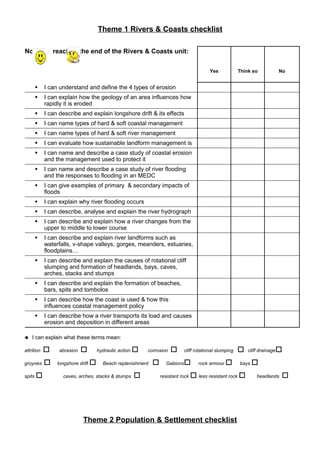
Theme 2 Population & Settlement checklist
Now I’ve reached the end of the Population &
Settlement unit:
Yes Think so No
 I can explain the reasons for settlements locating in particular sites
 I can name a local settlement and give reasons what location
advantages it has -Portsmouth
 I can explain the spheres of influence
 I can describe and explain the land use models for MEDC’s cities of
Hoyt and Burgess
 I can give reasons for the patterns of land use in cities
 I can describe and draw a diagram to show the settlement hierarchy
for my local area (Hamlet, village, town, city)
 I can describe the housing in Gunwharf and the positive and
negative impacts of the redevelopment.
 I can name a sustainable settlement, identify its sustainable
features and explain how it is sustainable.
I can explain how land use is changing within cities using the
example of Portsmouth - Gunwharf.
 I can explain why urbanization is happening in LEDC’s. I can give
push and pull factors. I can explain the impacts of urbanization in
LEDC cities
 I can explain the features of shanty towns and impacts
 I can explain what counter-urbanisation is, its causes and effects.
 I can identify and give reasons for the types of goods and retail
services found in urban and rural settlements
I can explain the reasons for town centre decline & retail service
change (include e-tailing, ethical shopping, out-of-town shopping)
I can show how retail provision changes over time through my case
study on Portsmouth.
I can explain how population changes over time and explain the
Demographic Transition Model
I can explain population growth and the impact of it and of ageing
populations
I can explain migration, internal and international. The push and pull
factors of migration and impacts to host and country of origin.
I can explain population management strategies that are pro-
natalist and anti-natalist and give case study detail.
 I can explain what these terms mean:
clone town  urbanization  counter-urbanization  shanty town  push/ pull factor suburb 
urban Sprawl  settlement  rural  CBD Infrastructure convenience goods 
retail change  CBD  inner city  anti-natalist  suburbs  e-tailing 
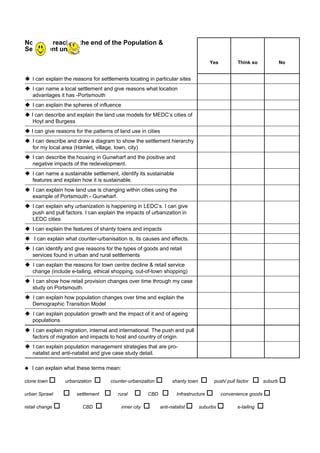
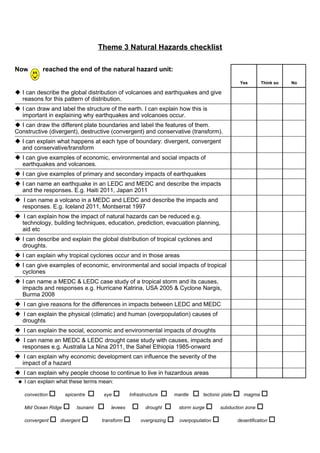
Theme 3 Natural Hazards checklist
Now I’ve reached the end of the natural hazard unit:
Yes Think so No
 I can describe the global distribution of volcanoes and earthquakes and give
reasons for this pattern of distribution.
 I can draw and label the structure of the earth. I can explain how this is
important in explaining why earthquakes and volcanoes occur.
 I can draw the different plate boundaries and label the features of them.
Constructive (divergent), destructive (convergent) and conservative (transform).
 I can explain what happens at each type of boundary: divergent, convergent
and conservative/transform
 I can give examples of economic, environmental and social impacts of
earthquakes and volcanoes.
 I can give examples of primary and secondary impacts of earthquakes
 I can name an earthquake in an LEDC and MEDC and describe the impacts
and the responses. E.g. Haiti 2011, Japan 2011
I can name a volcano in a MEDC and LEDC and describe the impacts and
responses. E.g. Iceland 2011, Montserrat 1997
I can explain how the impact of natural hazards can be reduced e.g.
technology, building techniques, education, prediction, evacuation planning,
aid etc
 I can describe and explain the global distribution of tropical cyclones and
droughts.
 I can explain why tropical cyclones occur and in those areas
 I can give examples of economic, environmental and social impacts of tropical
cyclones
 I can name a MEDC & LEDC case study of a tropical storm and its causes,
impacts and responses e.g. Hurricane Katrina, USA 2005 & Cyclone Nargis,
Burma 2008
I can give reasons for the differences in impacts between LEDC and MEDC
I can explain the physical (climatic) and human (overpopulation) causes of
droughts
I can explain the social, economic and environmental impacts of droughts
I can name an MEDC & LEDC drought case study with causes, impacts and
responses e.g. Australia La Nina 2011, the Sahel Ethiopia 1985-onward
I can explain why economic development can influence the severity of the
impact of a hazard
I can explain why people choose to continue to live in hazardous areas
 I can explain what these terms mean:
convection  epicentre  eye  Infrastructure  mantle tectonic plate magma 
Mid Ocean Ridge  tsunami  levees  drought storm surge subduction zone 
convergent divergent  transform  overgrazing  overpopulation  desertification 
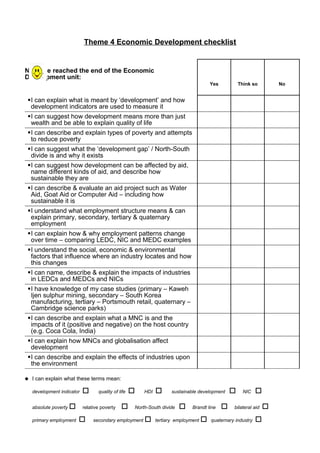
Theme 4 Economic Development checklist
Now I’ve reached the end of the Economic
Development unit:
Yes Think so No
I can explain what is meant by ‘development’ and how
development indicators are used to measure it
I can suggest how development means more than just
wealth and be able to explain quality of life
I can describe and explain types of poverty and attempts
to reduce poverty
I can suggest what the ‘development gap’ / North-South
divide is and why it exists
I can suggest how development can be affected by aid,
name different kinds of aid, and describe how
sustainable they are
I can describe & evaluate an aid project such as Water
Aid, Goat Aid or Computer Aid – including how
sustainable it is
I understand what employment structure means & can
explain primary, secondary, tertiary & quaternary
employment
I can explain how & why employment patterns change
over time – comparing LEDC, NIC and MEDC examples
I understand the social, economic & environmental
factors that influence where an industry locates and how
this changes
I can name, describe & explain the impacts of industries
in LEDCs and MEDCs and NICs
I have knowledge of my case studies (primary – Kaweh
Ijen sulphur mining, secondary – South Korea
manufacturing, tertiary – Portsmouth retail, quaternary –
Cambridge science parks)
I can describe and explain what a MNC is and the
impacts of it (positive and negative) on the host country
(e.g. Coca Cola, India)
I can explain how MNCs and globalisation affect
development
I can describe and explain the effects of industries upon
the environment
 I can explain what these terms mean:
development indicator  quality of life  HDI  sustainable development  NIC 
absolute poverty  relative poverty  North-South divide  Brandt line  bilateral aid 
primary employment secondary employment tertiary employment quaternary industry 
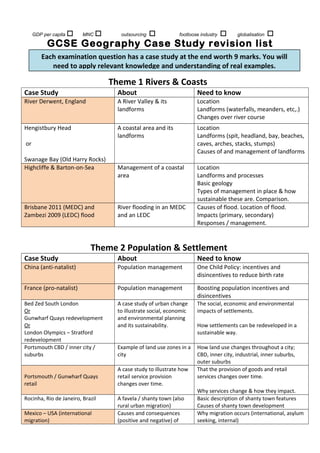
GDP per capita  MNC  outsourcing  footloose industry  globalisation 
GCSE Geography Case Study revision list
Theme 1 Rivers & Coasts
Case Study About Need to know
River Derwent, England A River Valley & its
landforms
Location
Landforms (waterfalls, meanders, etc,.)
Changes over river course
Hengistbury Head
or
Swanage Bay (Old Harry Rocks)
A coastal area and its
landforms
Location
Landforms (spit, headland, bay, beaches,
caves, arches, stacks, stumps)
Causes of and management of landforms
Highcliffe & Barton-on-Sea Management of a coastal
area
Location
Landforms and processes
Basic geology
Types of management in place & how
sustainable these are. Comparison.
Brisbane 2011 (MEDC) and
Zambezi 2009 (LEDC) flood
River flooding in an MEDC
and an LEDC
Causes of flood. Location of flood.
Impacts (primary, secondary)
Responses / management.
Theme 2 Population & Settlement
Case Study About Need to know
China (anti-natalist) Population management One Child Policy: incentives and
disincentives to reduce birth rate
France (pro-natalist) Population management Boosting population incentives and
disincentives
Bed Zed South London
Or
Gunwharf Quays redevelopment
Or
London Olympics – Stratford
redevelopment
A case study of urban change
to illustrate social, economic
and environmental planning
and its sustainability.
The social, economic and environmental
impacts of settlements.
How settlements can be redeveloped in a
sustainable way.
Portsmouth CBD / inner city /
suburbs
Example of land use zones in a
city
How land use changes throughout a city;
CBD, inner city, industrial, inner suburbs,
outer suburbs
Portsmouth / Gunwharf Quays
retail
A case study to illustrate how
retail service provision
changes over time.
That the provision of goods and retail
services changes over time.
Why services change & how they impact.
Rocinha, Rio de Janeiro, Brazil A favela / shanty town (also
rural urban migration)
Basic description of shanty town features
Causes of shanty town development
Mexico – USA (international
migration)
Causes and consequences
(positive and negative) of
Why migration occurs (international, asylum
seeking, internal)
Each examination question has a case study at the end worth 9 marks. You will
need to apply relevant knowledge and understanding of real examples.
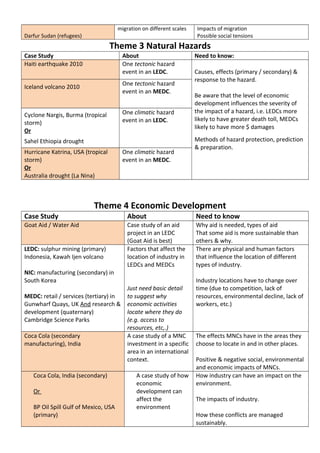
Darfur Sudan (refugees)
migration on different scales Impacts of migration
Possible social tensions
Theme 3 Natural Hazards
Case Study About Need to know:
Haiti earthquake 2010 One tectonic hazard
event in an LEDC. Causes, effects (primary / secondary) &
response to the hazard.
Be aware that the level of economic
development influences the severity of
the impact of a hazard, i.e. LEDCs more
likely to have greater death toll, MEDCs
likely to have more $ damages
Methods of hazard protection, prediction
& preparation.
Iceland volcano 2010
One tectonic hazard
event in an MEDC.
Cyclone Nargis, Burma (tropical
storm)
Or
Sahel Ethiopia drought
One climatic hazard
event in an LEDC.
Hurricane Katrina, USA (tropical
storm)
Or
Australia drought (La Nina)
One climatic hazard
event in an MEDC.
Theme 4 Economic Development
Case Study About Need to know
Goat Aid / Water Aid Case study of an aid
project in an LEDC
(Goat Aid is best)
Why aid is needed, types of aid
That some aid is more sustainable than
others & why.
LEDC: sulphur mining (primary)
Indonesia, Kawah Ijen volcano
NIC: manufacturing (secondary) in
South Korea
MEDC: retail / services (tertiary) in
Gunwharf Quays, UK And research &
development (quaternary)
Cambridge Science Parks
Factors that affect the
location of industry in
LEDCs and MEDCs
Just need basic detail
to suggest why
economic activities
locate where they do
(e.g. access to
resources, etc,.)
There are physical and human factors
that influence the location of different
types of industry.
Industry locations have to change over
time (due to competition, lack of
resources, environmental decline, lack of
workers, etc.)
Coca Cola (secondary
manufacturing), India
A case study of a MNC
investment in a specific
area in an international
context.
The effects MNCs have in the areas they
choose to locate in and in other places.
Positive & negative social, environmental
and economic impacts of MNCs.
Coca Cola, India (secondary)
Or
BP Oil Spill Gulf of Mexico, USA
(primary)
A case study of how
economic
development can
affect the
environment
How industry can have an impact on the
environment.
The impacts of industry.
How these conflicts are managed
sustainably.
Remember case study questions are Level marked i.e.:
Level 1 (1-3 marks): basic description showing limited knowledge and
understanding. Meaning not communicated very clearly. Little specific fact. A
generalised answer.
Level 2 (4-6 marks): Refers to named case study, some relevant knowledge
demonstrated and some place specific facts/evidence are included to
support answer. Meaning is communicated clearly. Answers are explained.
Level 3 (7-9 marks): Valid case study given and a full range of place-specific
detail used to effectively answer the question. Good knowledge and
understanding shown through facts / evidence. Meaning is communicated
very clearly. Answer links to key terms and is well explained.
You should write THREE well developed ideas in your answer! P.E.E.L.
Don’t forget SPaG = 3 marks per section, total 9 marks for paper
REMEMBER : Your Geography teachers are here to help you! Come
to workshops for support. Email at any time.
AND:
ALL resources, revision materials, case studies, and every lesson resource
used can be found on the GCSE blog
www.geogdebens.wordpress.com
GOOD LUCK!
These examples are best to know in most detail as are more likely to be used and can also cross-over
between exam Q topic. e,g. can use Coca Cola for an MNC example AND for environmental impact, can
use Portsmouth for land use change AND retail AND redevelopment.
Remember case study questions are Level marked i.e.:
Level 1 (1-3 marks): basic description showing limited knowledge and
understanding. Meaning not communicated very clearly. Little specific fact. A
generalised answer.
Level 2 (4-6 marks): Refers to named case study, some relevant knowledge
demonstrated and some place specific facts/evidence are included to
support answer. Meaning is communicated clearly. Answers are explained.
Level 3 (7-9 marks): Valid case study given and a full range of place-specific
detail used to effectively answer the question. Good knowledge and
understanding shown through facts / evidence. Meaning is communicated
very clearly. Answer links to key terms and is well explained.
You should write THREE well developed ideas in your answer! P.E.E.L.
Don’t forget SPaG = 3 marks per section, total 9 marks for paper
REMEMBER : Your Geography teachers are here to help you! Come
to workshops for support. Email at any time.
AND:
ALL resources, revision materials, case studies, and every lesson resource
used can be found on the GCSE blog
www.geogdebens.wordpress.com
GOOD LUCK!
These examples are best to know in most detail as are more likely to be used and can also cross-over
between exam Q topic. e,g. can use Coca Cola for an MNC example AND for environmental impact, can
use Portsmouth for land use change AND retail AND redevelopment.

Checklist 2014 for GCSE Geography OCR B

  • 1.
    GCSE Geography Revision Keythemes Exam: 22nd May 2014 Don’t forget to use www.facebook.com/classroomgeography REVISION BLOG: www.geogdebens.wordpress.com Contact us for help : geography@priory.portsmouth.sch.uk or Tweet @priorygeography READ the question: Recognise - the pattern / feature / process Explain – use connectives (so, because, therefore, etc.) Analyse – give advantages and disadvantages, weigh up Describe – use data from resources and own knowledge (SEE) For Case Studies / sustainability questions: Sustainable development is using resources today in a way that helps to protect them for the future. Sustainability must balance: Social – families, communities, people Economic – jobs and money Environmental – natural and built environment (PEEL) For explain / case study questions: Point – state your opinion, make your point Evidence – back up what you say with facts, detail, examples Explain – give reasons for what you say Link – link back to the original question, a concluding sentence Key Geographical Themes topics:  Theme 1 Rivers & Coasts  Theme 2 Population & Settlement  Theme 3 Natural Hazards (your SDME topic – 13th May exam)  Theme 4 Economic Development NAME: TEACHER: Exam Board = OCR B Geography from 2012 Exam Board = OCR B Geography from 2012
  • 2.
    Exam command words Commandword: What it means Compare Show similarities and differences. A balanced answer is required. Consider Describe and give your thoughts on the subject. Contrast Point out only the differences between two items. Define Explain the precise meaning of a concept / word. Describe Say what something is like, how it works, use adjectives. Discuss Explain an item or concept, give details about it using info / examples / facts. Give both points of view & come to a conclusion. Examine Investigate in detail, offer evidence for and against. Explain Offer a detailed and exact explanation of an idea or principle. Identify / State Express the relevant points briefly and clearly. Illustrate Provide examples to demonstrate or prove a subject. Justify Give reasons to support your answer / argument, and the main objections Summarise / Outline Provide a short summary of all the info on a subject It might be useful to underline command words in an exam question. Answering the questions….. [1mark] questions = can be answered with a single word or simple sentence, often using data or fact. E.g. Name a climatic hazard = drought [1] [2mark] questions = either needs two simple sentences, often using data OR needs one point then explained. E.g. Explain why LEDCs have a higher death rate = poor healthcare leading to diseases [P] and a lack of food [P] [2] OR LEDCs have a higher death rate due to a lack of medicine [P] and healthcare which means they cannot treat illnesses and disease so die more easily [E] [2] [4mark] questions = requires you to explain, compare, consider evidence, use facts, refer to examples. The answer should be detailed. You should probably describe and explain using P.E.E.L. E.g. Using the sources, suggest how afforestation may affect river flow= Afforestation is the planting of trees / vegetation [P], which can reduce river volume and increase the lag time as seen on the hydrograph at Point A [Ev]. This is because vegetation increases interception which reduces surface runoff [Ex] and therefore the amount of water entering the river and how quickly it gets there will be reduced [L]. [4]
  • 3.
    Theme 1 Rivers& Coasts checklist Now I’ve reached the end of the Rivers & Coasts unit: Yes Think so No  I can understand and define the 4 types of erosion  I can explain how the geology of an area influences how rapidly it is eroded  I can describe and explain longshore drift & its effects  I can name types of hard & soft coastal management  I can name types of hard & soft river management  I can evaluate how sustainable landform management is  I can name and describe a case study of coastal erosion and the management used to protect it  I can name and describe a case study of river flooding and the responses to flooding in an MEDC  I can give examples of primary & secondary impacts of floods  I can explain why river flooding occurs  I can describe, analyse and explain the river hydrograph  I can describe and explain how a river changes from the upper to middle to lower course  I can describe and explain river landforms such as waterfalls, v-shape valleys, gorges, meanders, estuaries, floodplains…  I can describe and explain the causes of rotational cliff slumping and formation of headlands, bays, caves, arches, stacks and stumps  I can describe and explain the formation of beaches, bars, spits and tombolos  I can describe how the coast is used & how this influences coastal management policy  I can describe how a river transports its load and causes erosion and deposition in different areas  I can explain what these terms mean: attrition  abrasion  hydraulic action  corrosion  cliff rotational slumping cliff drainage groynes  longshore drift  Beach replenishment  Gabionsrock armour bays  spits  caves, arches, stacks & stumps  resistant rock  less resistant rock  headlands  Theme 2 Population & Settlement checklist
  • 4.
    Now I’ve reachedthe end of the Population & Settlement unit: Yes Think so No  I can explain the reasons for settlements locating in particular sites  I can name a local settlement and give reasons what location advantages it has -Portsmouth  I can explain the spheres of influence  I can describe and explain the land use models for MEDC’s cities of Hoyt and Burgess  I can give reasons for the patterns of land use in cities  I can describe and draw a diagram to show the settlement hierarchy for my local area (Hamlet, village, town, city)  I can describe the housing in Gunwharf and the positive and negative impacts of the redevelopment.  I can name a sustainable settlement, identify its sustainable features and explain how it is sustainable. I can explain how land use is changing within cities using the example of Portsmouth - Gunwharf.  I can explain why urbanization is happening in LEDC’s. I can give push and pull factors. I can explain the impacts of urbanization in LEDC cities  I can explain the features of shanty towns and impacts  I can explain what counter-urbanisation is, its causes and effects.  I can identify and give reasons for the types of goods and retail services found in urban and rural settlements I can explain the reasons for town centre decline & retail service change (include e-tailing, ethical shopping, out-of-town shopping) I can show how retail provision changes over time through my case study on Portsmouth. I can explain how population changes over time and explain the Demographic Transition Model I can explain population growth and the impact of it and of ageing populations I can explain migration, internal and international. The push and pull factors of migration and impacts to host and country of origin. I can explain population management strategies that are pro- natalist and anti-natalist and give case study detail.  I can explain what these terms mean: clone town  urbanization  counter-urbanization  shanty town  push/ pull factor suburb  urban Sprawl  settlement  rural  CBD Infrastructure convenience goods  retail change  CBD  inner city  anti-natalist  suburbs  e-tailing 
  • 5.
    Theme 3 NaturalHazards checklist Now I’ve reached the end of the natural hazard unit: Yes Think so No  I can describe the global distribution of volcanoes and earthquakes and give reasons for this pattern of distribution.  I can draw and label the structure of the earth. I can explain how this is important in explaining why earthquakes and volcanoes occur.  I can draw the different plate boundaries and label the features of them. Constructive (divergent), destructive (convergent) and conservative (transform).  I can explain what happens at each type of boundary: divergent, convergent and conservative/transform  I can give examples of economic, environmental and social impacts of earthquakes and volcanoes.  I can give examples of primary and secondary impacts of earthquakes  I can name an earthquake in an LEDC and MEDC and describe the impacts and the responses. E.g. Haiti 2011, Japan 2011 I can name a volcano in a MEDC and LEDC and describe the impacts and responses. E.g. Iceland 2011, Montserrat 1997 I can explain how the impact of natural hazards can be reduced e.g. technology, building techniques, education, prediction, evacuation planning, aid etc  I can describe and explain the global distribution of tropical cyclones and droughts.  I can explain why tropical cyclones occur and in those areas  I can give examples of economic, environmental and social impacts of tropical cyclones  I can name a MEDC & LEDC case study of a tropical storm and its causes, impacts and responses e.g. Hurricane Katrina, USA 2005 & Cyclone Nargis, Burma 2008 I can give reasons for the differences in impacts between LEDC and MEDC I can explain the physical (climatic) and human (overpopulation) causes of droughts I can explain the social, economic and environmental impacts of droughts I can name an MEDC & LEDC drought case study with causes, impacts and responses e.g. Australia La Nina 2011, the Sahel Ethiopia 1985-onward I can explain why economic development can influence the severity of the impact of a hazard I can explain why people choose to continue to live in hazardous areas  I can explain what these terms mean: convection  epicentre  eye  Infrastructure  mantle tectonic plate magma  Mid Ocean Ridge  tsunami  levees  drought storm surge subduction zone  convergent divergent  transform  overgrazing  overpopulation  desertification 
  • 6.
    Theme 4 EconomicDevelopment checklist Now I’ve reached the end of the Economic Development unit: Yes Think so No I can explain what is meant by ‘development’ and how development indicators are used to measure it I can suggest how development means more than just wealth and be able to explain quality of life I can describe and explain types of poverty and attempts to reduce poverty I can suggest what the ‘development gap’ / North-South divide is and why it exists I can suggest how development can be affected by aid, name different kinds of aid, and describe how sustainable they are I can describe & evaluate an aid project such as Water Aid, Goat Aid or Computer Aid – including how sustainable it is I understand what employment structure means & can explain primary, secondary, tertiary & quaternary employment I can explain how & why employment patterns change over time – comparing LEDC, NIC and MEDC examples I understand the social, economic & environmental factors that influence where an industry locates and how this changes I can name, describe & explain the impacts of industries in LEDCs and MEDCs and NICs I have knowledge of my case studies (primary – Kaweh Ijen sulphur mining, secondary – South Korea manufacturing, tertiary – Portsmouth retail, quaternary – Cambridge science parks) I can describe and explain what a MNC is and the impacts of it (positive and negative) on the host country (e.g. Coca Cola, India) I can explain how MNCs and globalisation affect development I can describe and explain the effects of industries upon the environment  I can explain what these terms mean: development indicator  quality of life  HDI  sustainable development  NIC  absolute poverty  relative poverty  North-South divide  Brandt line  bilateral aid  primary employment secondary employment tertiary employment quaternary industry 
  • 7.
    GDP per capita MNC  outsourcing  footloose industry  globalisation  GCSE Geography Case Study revision list Theme 1 Rivers & Coasts Case Study About Need to know River Derwent, England A River Valley & its landforms Location Landforms (waterfalls, meanders, etc,.) Changes over river course Hengistbury Head or Swanage Bay (Old Harry Rocks) A coastal area and its landforms Location Landforms (spit, headland, bay, beaches, caves, arches, stacks, stumps) Causes of and management of landforms Highcliffe & Barton-on-Sea Management of a coastal area Location Landforms and processes Basic geology Types of management in place & how sustainable these are. Comparison. Brisbane 2011 (MEDC) and Zambezi 2009 (LEDC) flood River flooding in an MEDC and an LEDC Causes of flood. Location of flood. Impacts (primary, secondary) Responses / management. Theme 2 Population & Settlement Case Study About Need to know China (anti-natalist) Population management One Child Policy: incentives and disincentives to reduce birth rate France (pro-natalist) Population management Boosting population incentives and disincentives Bed Zed South London Or Gunwharf Quays redevelopment Or London Olympics – Stratford redevelopment A case study of urban change to illustrate social, economic and environmental planning and its sustainability. The social, economic and environmental impacts of settlements. How settlements can be redeveloped in a sustainable way. Portsmouth CBD / inner city / suburbs Example of land use zones in a city How land use changes throughout a city; CBD, inner city, industrial, inner suburbs, outer suburbs Portsmouth / Gunwharf Quays retail A case study to illustrate how retail service provision changes over time. That the provision of goods and retail services changes over time. Why services change & how they impact. Rocinha, Rio de Janeiro, Brazil A favela / shanty town (also rural urban migration) Basic description of shanty town features Causes of shanty town development Mexico – USA (international migration) Causes and consequences (positive and negative) of Why migration occurs (international, asylum seeking, internal) Each examination question has a case study at the end worth 9 marks. You will need to apply relevant knowledge and understanding of real examples.
  • 8.
    Darfur Sudan (refugees) migrationon different scales Impacts of migration Possible social tensions Theme 3 Natural Hazards Case Study About Need to know: Haiti earthquake 2010 One tectonic hazard event in an LEDC. Causes, effects (primary / secondary) & response to the hazard. Be aware that the level of economic development influences the severity of the impact of a hazard, i.e. LEDCs more likely to have greater death toll, MEDCs likely to have more $ damages Methods of hazard protection, prediction & preparation. Iceland volcano 2010 One tectonic hazard event in an MEDC. Cyclone Nargis, Burma (tropical storm) Or Sahel Ethiopia drought One climatic hazard event in an LEDC. Hurricane Katrina, USA (tropical storm) Or Australia drought (La Nina) One climatic hazard event in an MEDC. Theme 4 Economic Development Case Study About Need to know Goat Aid / Water Aid Case study of an aid project in an LEDC (Goat Aid is best) Why aid is needed, types of aid That some aid is more sustainable than others & why. LEDC: sulphur mining (primary) Indonesia, Kawah Ijen volcano NIC: manufacturing (secondary) in South Korea MEDC: retail / services (tertiary) in Gunwharf Quays, UK And research & development (quaternary) Cambridge Science Parks Factors that affect the location of industry in LEDCs and MEDCs Just need basic detail to suggest why economic activities locate where they do (e.g. access to resources, etc,.) There are physical and human factors that influence the location of different types of industry. Industry locations have to change over time (due to competition, lack of resources, environmental decline, lack of workers, etc.) Coca Cola (secondary manufacturing), India A case study of a MNC investment in a specific area in an international context. The effects MNCs have in the areas they choose to locate in and in other places. Positive & negative social, environmental and economic impacts of MNCs. Coca Cola, India (secondary) Or BP Oil Spill Gulf of Mexico, USA (primary) A case study of how economic development can affect the environment How industry can have an impact on the environment. The impacts of industry. How these conflicts are managed sustainably.
  • 9.
    Remember case studyquestions are Level marked i.e.: Level 1 (1-3 marks): basic description showing limited knowledge and understanding. Meaning not communicated very clearly. Little specific fact. A generalised answer. Level 2 (4-6 marks): Refers to named case study, some relevant knowledge demonstrated and some place specific facts/evidence are included to support answer. Meaning is communicated clearly. Answers are explained. Level 3 (7-9 marks): Valid case study given and a full range of place-specific detail used to effectively answer the question. Good knowledge and understanding shown through facts / evidence. Meaning is communicated very clearly. Answer links to key terms and is well explained. You should write THREE well developed ideas in your answer! P.E.E.L. Don’t forget SPaG = 3 marks per section, total 9 marks for paper REMEMBER : Your Geography teachers are here to help you! Come to workshops for support. Email at any time. AND: ALL resources, revision materials, case studies, and every lesson resource used can be found on the GCSE blog www.geogdebens.wordpress.com GOOD LUCK! These examples are best to know in most detail as are more likely to be used and can also cross-over between exam Q topic. e,g. can use Coca Cola for an MNC example AND for environmental impact, can use Portsmouth for land use change AND retail AND redevelopment.
  • 10.
    Remember case studyquestions are Level marked i.e.: Level 1 (1-3 marks): basic description showing limited knowledge and understanding. Meaning not communicated very clearly. Little specific fact. A generalised answer. Level 2 (4-6 marks): Refers to named case study, some relevant knowledge demonstrated and some place specific facts/evidence are included to support answer. Meaning is communicated clearly. Answers are explained. Level 3 (7-9 marks): Valid case study given and a full range of place-specific detail used to effectively answer the question. Good knowledge and understanding shown through facts / evidence. Meaning is communicated very clearly. Answer links to key terms and is well explained. You should write THREE well developed ideas in your answer! P.E.E.L. Don’t forget SPaG = 3 marks per section, total 9 marks for paper REMEMBER : Your Geography teachers are here to help you! Come to workshops for support. Email at any time. AND: ALL resources, revision materials, case studies, and every lesson resource used can be found on the GCSE blog www.geogdebens.wordpress.com GOOD LUCK! These examples are best to know in most detail as are more likely to be used and can also cross-over between exam Q topic. e,g. can use Coca Cola for an MNC example AND for environmental impact, can use Portsmouth for land use change AND retail AND redevelopment.