Euclidean Algorithm
How to find a greatest common
divisor in several easy steps
Euclidean Algorithm
The well known Euclidean algorithm
finds the greatest common divisor of
two numbers using only elementary
mathematical operations - division
and subtraction
Euclidean Algorithm
A divisor of a number a is an integer
that divides it without remainder
For example the divisors of 12 are 1,
2, 3, 4, 6 and 12
The divisors of 18 are 1, 2, 3, 6, 9
and 18.
Euclidean Algorithm
The greatest common divisor, or
GCD, of two numbers is the largest
divisor that is common to both of
them.
For example GCD(12, 18) is the
largest of the divisors common to
both 12 and 18.
Euclidean Algorithm
The common divisors of 12 and 18
are 1, 2, 3 and 6.
Hence GCD(12, 18)=6.
Euclidean Algorithm
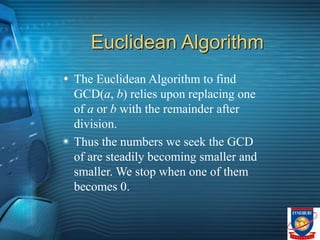
The Euclidean Algorithm to find
GCD(a, b) relies upon replacing one
of a or b with the remainder after
division.
Thus the numbers we seek the GCD
of are steadily becoming smaller and
smaller. We stop when one of them
becomes 0.
Euclidean Algorithm
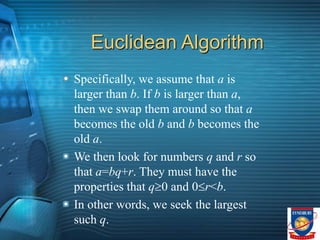
Specifically, we assume that a is
larger than b. If b is larger than a,
then we swap them around so that a
becomes the old b and b becomes the
old a.
We then look for numbers q and r so
that a=bq+r. They must have the
properties that q0 and 0r<b.
In other words, we seek the largest
such q.
Euclidean Algorithm
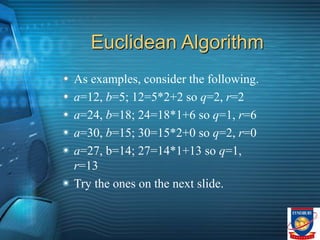
As examples, consider the following.
a=12, b=5; 12=5*2+2 so q=2, r=2
a=24, b=18; 24=18*1+6 so q=1, r=6
a=30, b=15; 30=15*2+0 so q=2, r=0
a=27, b=14; 27=14*1+13 so q=1,
r=13
Try the ones on the next slide.
Euclidean Algorithm
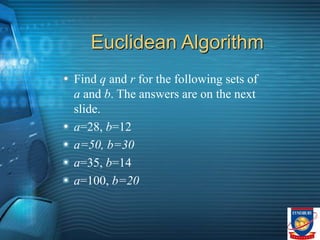
Find q and r for the following sets of
a and b. The answers are on the next
slide.
a=28, b=12
a=50, b=30
a=35, b=14
a=100, b=20
Euclidean Algorithm
Answers
q=2, r=4
q=1, r=20
q=2, r=7
q=5, r=0
Euclidean Algorithm
The algorithm works in the
following way.
Given a and b, we find numbers q
and r so that a=bq+r.
We make sure that q is as large as
possible (≥0), and 0≤r<b.
For example, if a=18, b=12, then
we write 18=12*1+6.
Euclidean Algorithm
Actually the number q isn’t important,
it is just easier to find r with it when
solving problems by hand. Most
software can find the remainder r
without finding q.
For example the Java statement below
will find r.
r=a%b;
Euclidean Algorithm
Once the remainder r has been found
we replace a by b and b by r.
This relies on the fact that
GCD(a,b)=GCD(b,r).
Hence we repeatedly find r, the
remainder after a is divided by b.
Then replace a by b and b by r, and
keep on in this way until r=0.
Euclidean Algorithm
Let us look at a graphical interpretation
of the Euclidean algorithm.
Obviously if p=GCD(a,b) then p|a and
p|b, that is to say p divides both a and b
evenly with no remainder.
Euclidean Algorithm
Suppose a and b are represented by
the lengths below.
Euclidean Algorithm
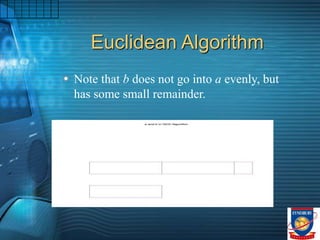
Note that b does not go into a evenly, but
has some small remainder.
Euclidean Algorithm
If p is the GCD of a and b then it divides
evenly into both a and b. Hence it divides
evenly into b and thus must divide evenly
into both of the larger two boxes in the
previous diagram.
Euclidean Algorithm
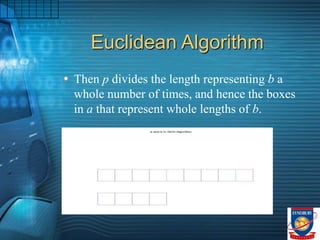
Then p divides the length representing b a
whole number of times, and hence the boxes
in a that represent whole lengths of b.
Euclidean Algorithm
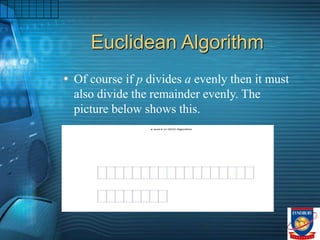
Of course if p divides a evenly then it must
also divide the remainder evenly. The
picture below shows this.
Euclidean Algorithm
Hopefully it will be clear that by now
any number that divides both a and b
must also divide the remainder r.
The largest of these will of course be
the GCD of a and b.
So GCD(a,b)=GCD(b,r).

GCD.ppt

  • 1.
    Euclidean Algorithm How tofind a greatest common divisor in several easy steps
  • 2.
    Euclidean Algorithm The wellknown Euclidean algorithm finds the greatest common divisor of two numbers using only elementary mathematical operations - division and subtraction
  • 3.
    Euclidean Algorithm A divisorof a number a is an integer that divides it without remainder For example the divisors of 12 are 1, 2, 3, 4, 6 and 12 The divisors of 18 are 1, 2, 3, 6, 9 and 18.
  • 4.
    Euclidean Algorithm The greatestcommon divisor, or GCD, of two numbers is the largest divisor that is common to both of them. For example GCD(12, 18) is the largest of the divisors common to both 12 and 18.
  • 5.
    Euclidean Algorithm The commondivisors of 12 and 18 are 1, 2, 3 and 6. Hence GCD(12, 18)=6.
  • 6.
    Euclidean Algorithm The EuclideanAlgorithm to find GCD(a, b) relies upon replacing one of a or b with the remainder after division. Thus the numbers we seek the GCD of are steadily becoming smaller and smaller. We stop when one of them becomes 0.
  • 7.
    Euclidean Algorithm Specifically, weassume that a is larger than b. If b is larger than a, then we swap them around so that a becomes the old b and b becomes the old a. We then look for numbers q and r so that a=bq+r. They must have the properties that q0 and 0r<b. In other words, we seek the largest such q.
  • 8.
    Euclidean Algorithm As examples,consider the following. a=12, b=5; 12=5*2+2 so q=2, r=2 a=24, b=18; 24=18*1+6 so q=1, r=6 a=30, b=15; 30=15*2+0 so q=2, r=0 a=27, b=14; 27=14*1+13 so q=1, r=13 Try the ones on the next slide.
  • 9.
    Euclidean Algorithm Find qand r for the following sets of a and b. The answers are on the next slide. a=28, b=12 a=50, b=30 a=35, b=14 a=100, b=20
  • 10.
  • 11.
    Euclidean Algorithm The algorithmworks in the following way. Given a and b, we find numbers q and r so that a=bq+r. We make sure that q is as large as possible (≥0), and 0≤r<b. For example, if a=18, b=12, then we write 18=12*1+6.
  • 12.
    Euclidean Algorithm Actually thenumber q isn’t important, it is just easier to find r with it when solving problems by hand. Most software can find the remainder r without finding q. For example the Java statement below will find r. r=a%b;
  • 13.
    Euclidean Algorithm Once theremainder r has been found we replace a by b and b by r. This relies on the fact that GCD(a,b)=GCD(b,r). Hence we repeatedly find r, the remainder after a is divided by b. Then replace a by b and b by r, and keep on in this way until r=0.
  • 14.
    Euclidean Algorithm Let uslook at a graphical interpretation of the Euclidean algorithm. Obviously if p=GCD(a,b) then p|a and p|b, that is to say p divides both a and b evenly with no remainder.
  • 15.
    Euclidean Algorithm Suppose aand b are represented by the lengths below.
  • 16.
    Euclidean Algorithm Note thatb does not go into a evenly, but has some small remainder.
  • 17.
    Euclidean Algorithm If pis the GCD of a and b then it divides evenly into both a and b. Hence it divides evenly into b and thus must divide evenly into both of the larger two boxes in the previous diagram.
  • 18.
    Euclidean Algorithm Then pdivides the length representing b a whole number of times, and hence the boxes in a that represent whole lengths of b.
  • 19.
    Euclidean Algorithm Of courseif p divides a evenly then it must also divide the remainder evenly. The picture below shows this.
  • 20.
    Euclidean Algorithm Hopefully itwill be clear that by now any number that divides both a and b must also divide the remainder r. The largest of these will of course be the GCD of a and b. So GCD(a,b)=GCD(b,r).