Peica Ionela- Anamaria
   Project software management is a collection of
    techniques used to develop and deliver various types
    of software product.
   Project management is all about getting things done in
    the most efficient manner possible.
   It’s important to the company’s success to invest time
    into the project.
   Computer ethics is about integrating computing technology and human
    values in such a way that technology advances and protects human values,
    rather than doing damage to them.
   Stakeholder impact analysis confronts requirements with specified tasks
    and all the stakeholders. It can exploit SoDIS (Software Development Impact
    Statement) approach and its supporting tool.
   Thus, the SoDIS process is expected to encourage the developers to think of
    people, groups, or organisations related to the project as well as identify
    significant ways in which the project may negatively affect stakeholders.
   The Customer and the Supplier co-operate in the project but they have their
    own missions, goals, shareholders, employees, risks and environments,
    some questions arise: what does he know about developer's stakeholders,
    the applied technology, software process organisation? and why should the
    Buyer think of the Supplier's shareholders? why should a project manager
    (Developer's side) bother about customer's stakeholders whose
    requirements are not in the contract?
   Computer ethics assurance (CEA) is a planned and
    systematic pattern of all actions necessary to provide
    adequate confidence that the item or product is developed,
    deployed and introduced following ethical canons.
   In order to satisfy this there should be performed
-   creating/maintaining CEA plans for the project
-   intended for ethics assurance
-   participating in the development process
-   evaluating the products and auditing the processes to make
    sure the development
-   deployment and usage keep to ethical codes.
   Stakeholders are individuals or groups who
    may be directly or indirectly affected by the
    project and thus have a stake in the project
    activities. A difference in stakeholder fans of
    the Customer and the Supplier projects can be
    seen - due to their missions and roles.
    We have 9 search directions for identifying Stakeholders
     presented below:
1.   Production chain
2.   End users and related organizations
3.   Designers
4.   Physical system
5.   Inspection agencies
6.   Regulators
7.   Research and consultancy
8.   Education
9.   Representative organizations
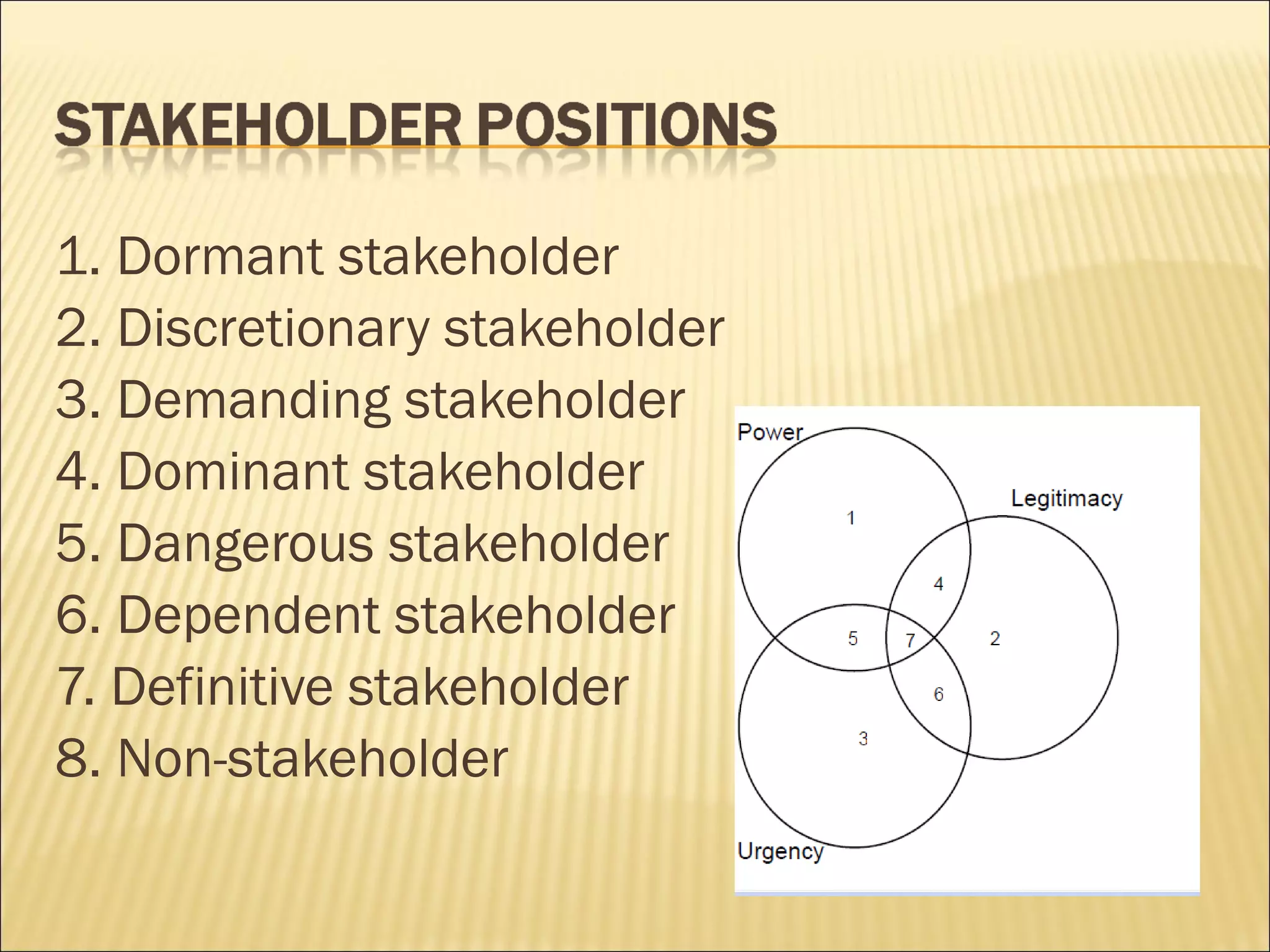
1. Dormant stakeholder
2. Discretionary stakeholder
3. Demanding stakeholder
4. Dominant stakeholder
5. Dangerous stakeholder
6. Dependent stakeholder
7. Definitive stakeholder
8. Non-stakeholder
   The paper introduces computer ethics assurance and forms a
    proposal how its activities can be incorporated into the software
    development process. This is done on the basis of distinguishing
    between customer and supplier processes - ethics assurance
    activities, like stakeholder impact analysis, ethics-dedicated tasks,
    monitoring and evaluation, are decomposed among the Customer
    and the Suppplier processes and placed inside the software
    development frmework.
   To evaluate the proposal, to tune the shape and contents of the
    computer ethics assurance process we need some practical projects
    to be modelled and evaluated.
   The Software Process organisational aspects and the concept of CEA
    Groups will be verified quite soon – as society will force IT companies
    to asssure ethics in systems development by any means
   http://www.idt.mdh.se/~gdc/work/ARTICLES/0
    5CEPE/PrivacyBackground/ethics_in_software
    _process.pdf
   http://www.ccsr.cse.dmu.ac.uk/staff/Srog/tea
    ching/sweden.htm

Ethics of software project management

  • 1.
  • 2.
    Project software management is a collection of techniques used to develop and deliver various types of software product.  Project management is all about getting things done in the most efficient manner possible.  It’s important to the company’s success to invest time into the project.
  • 4.
    Computer ethics is about integrating computing technology and human values in such a way that technology advances and protects human values, rather than doing damage to them.  Stakeholder impact analysis confronts requirements with specified tasks and all the stakeholders. It can exploit SoDIS (Software Development Impact Statement) approach and its supporting tool.  Thus, the SoDIS process is expected to encourage the developers to think of people, groups, or organisations related to the project as well as identify significant ways in which the project may negatively affect stakeholders.  The Customer and the Supplier co-operate in the project but they have their own missions, goals, shareholders, employees, risks and environments, some questions arise: what does he know about developer's stakeholders, the applied technology, software process organisation? and why should the Buyer think of the Supplier's shareholders? why should a project manager (Developer's side) bother about customer's stakeholders whose requirements are not in the contract?
  • 5.
    Computer ethics assurance (CEA) is a planned and systematic pattern of all actions necessary to provide adequate confidence that the item or product is developed, deployed and introduced following ethical canons.  In order to satisfy this there should be performed - creating/maintaining CEA plans for the project - intended for ethics assurance - participating in the development process - evaluating the products and auditing the processes to make sure the development - deployment and usage keep to ethical codes.
  • 6.
    Stakeholders are individuals or groups who may be directly or indirectly affected by the project and thus have a stake in the project activities. A difference in stakeholder fans of the Customer and the Supplier projects can be seen - due to their missions and roles.
  • 7.
    We have 9 search directions for identifying Stakeholders presented below: 1. Production chain 2. End users and related organizations 3. Designers 4. Physical system 5. Inspection agencies 6. Regulators 7. Research and consultancy 8. Education 9. Representative organizations
  • 8.
    1. Dormant stakeholder 2.Discretionary stakeholder 3. Demanding stakeholder 4. Dominant stakeholder 5. Dangerous stakeholder 6. Dependent stakeholder 7. Definitive stakeholder 8. Non-stakeholder
  • 9.
    The paper introduces computer ethics assurance and forms a proposal how its activities can be incorporated into the software development process. This is done on the basis of distinguishing between customer and supplier processes - ethics assurance activities, like stakeholder impact analysis, ethics-dedicated tasks, monitoring and evaluation, are decomposed among the Customer and the Suppplier processes and placed inside the software development frmework.  To evaluate the proposal, to tune the shape and contents of the computer ethics assurance process we need some practical projects to be modelled and evaluated.  The Software Process organisational aspects and the concept of CEA Groups will be verified quite soon – as society will force IT companies to asssure ethics in systems development by any means
  • 10.
    http://www.idt.mdh.se/~gdc/work/ARTICLES/0 5CEPE/PrivacyBackground/ethics_in_software _process.pdf  http://www.ccsr.cse.dmu.ac.uk/staff/Srog/tea ching/sweden.htm