Mathematics of Cryptography
Integer Arithmetic
Set of Integers
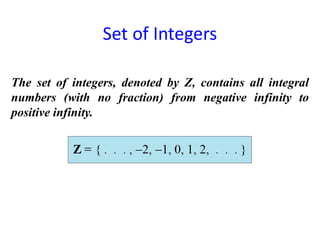
The set of integers, denoted by Z, contains all integral
numbers (with no fraction) from negative infinity to
positive infinity.
Binary Operations
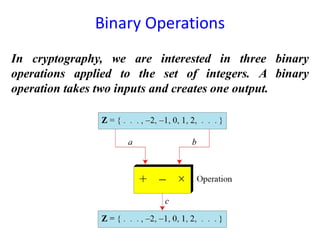
In cryptography, we are interested in three binary
operations applied to the set of integers. A binary
operation takes two inputs and creates one output.
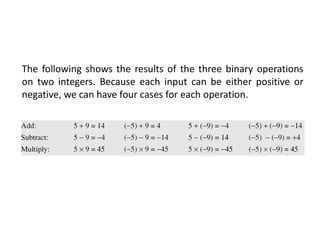
The following shows the results of the three binary operations
on two integers. Because each input can be either positive or
negative, we can have four cases for each operation.
Integer Division
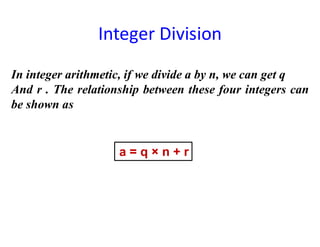
In integer arithmetic, if we divide a by n, we can get q
And r . The relationship between these four integers can
be shown as
a = q × n + r
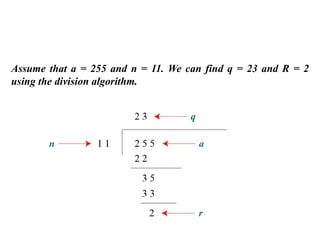
Assume that a = 255 and n = 11. We can find q = 23 and R = 2
using the division algorithm.
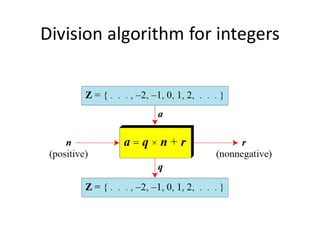
Division algorithm for integers
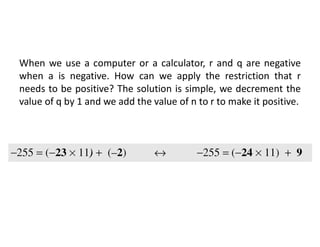
When we use a computer or a calculator, r and q are negative
when a is negative. How can we apply the restriction that r
needs to be positive? The solution is simple, we decrement the
value of q by 1 and we add the value of n to r to make it positive.
Note
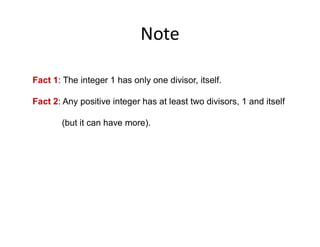
Fact 1: The integer 1 has only one divisor, itself.
Fact 2: Any positive integer has at least two divisors, 1 and itself
(but it can have more).
Note
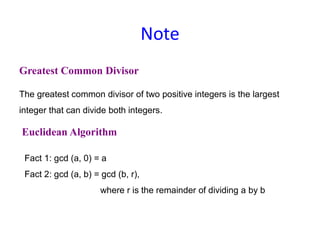
Greatest Common Divisor
The greatest common divisor of two positive integers is the largest
integer that can divide both integers.
Euclidean Algorithm
Fact 1: gcd (a, 0) = a
Fact 2: gcd (a, b) = gcd (b, r),
where r is the remainder of dividing a by b
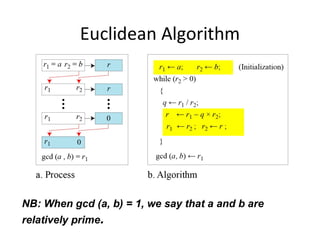
Euclidean Algorithm
NB: When gcd (a, b) = 1, we say that a and b are
relatively prime.
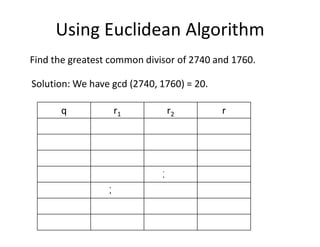
Using Euclidean Algorithm
Find the greatest common divisor of 2740 and 1760.
Solution: We have gcd (2740, 1760) = 20.
q r1 r2 r
1 2740 1760 980
1 1760 980 780
1 980 780 200
3 780 200 180
1 200 180 20
9 180 20 0
20 0
Extended Euclidean Algorithm
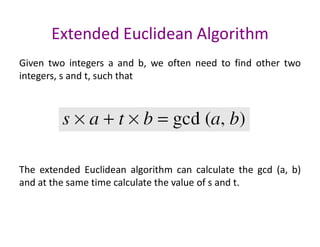
Given two integers a and b, we often need to find other two
integers, s and t, such that
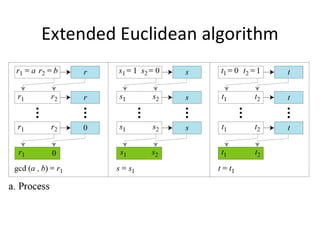
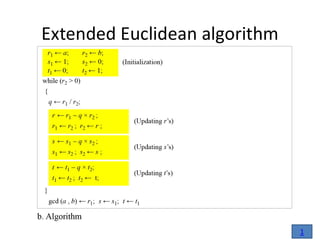
The extended Euclidean algorithm can calculate the gcd (a, b)
and at the same time calculate the value of s and t.
Extended Euclidean algorithm
1
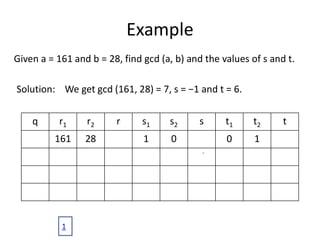
Example
q r1 r2 r s1 s2 s t1 t2 t
5 161 28 21 1 0 1 0 1 -5
1 28 21 7 0 1 -1 1 -5 6
3 21 7 0 1 -1 4 -5 6 -23
7 0 -1 4 6 -23
Given a = 161 and b = 28, find gcd (a, b) and the values of s and t.
Solution: We get gcd (161, 28) = 7, s = −1 and t = 6.
1

Lec_2.pdf

  • 1.
  • 2.
    Set of Integers Theset of integers, denoted by Z, contains all integral numbers (with no fraction) from negative infinity to positive infinity.
  • 3.
    Binary Operations In cryptography,we are interested in three binary operations applied to the set of integers. A binary operation takes two inputs and creates one output.
  • 4.
    The following showsthe results of the three binary operations on two integers. Because each input can be either positive or negative, we can have four cases for each operation.
  • 5.
    Integer Division In integerarithmetic, if we divide a by n, we can get q And r . The relationship between these four integers can be shown as a = q × n + r
  • 6.
    Assume that a= 255 and n = 11. We can find q = 23 and R = 2 using the division algorithm.
  • 7.
  • 8.
    When we usea computer or a calculator, r and q are negative when a is negative. How can we apply the restriction that r needs to be positive? The solution is simple, we decrement the value of q by 1 and we add the value of n to r to make it positive.
  • 9.
    Note Fact 1: Theinteger 1 has only one divisor, itself. Fact 2: Any positive integer has at least two divisors, 1 and itself (but it can have more).
  • 10.
    Note Greatest Common Divisor Thegreatest common divisor of two positive integers is the largest integer that can divide both integers. Euclidean Algorithm Fact 1: gcd (a, 0) = a Fact 2: gcd (a, b) = gcd (b, r), where r is the remainder of dividing a by b
  • 11.
    Euclidean Algorithm NB: Whengcd (a, b) = 1, we say that a and b are relatively prime.
  • 12.
    Using Euclidean Algorithm Findthe greatest common divisor of 2740 and 1760. Solution: We have gcd (2740, 1760) = 20. q r1 r2 r 1 2740 1760 980 1 1760 980 780 1 980 780 200 3 780 200 180 1 200 180 20 9 180 20 0 20 0
  • 13.
    Extended Euclidean Algorithm Giventwo integers a and b, we often need to find other two integers, s and t, such that The extended Euclidean algorithm can calculate the gcd (a, b) and at the same time calculate the value of s and t.
  • 14.
  • 15.
  • 16.
    Example q r1 r2r s1 s2 s t1 t2 t 5 161 28 21 1 0 1 0 1 -5 1 28 21 7 0 1 -1 1 -5 6 3 21 7 0 1 -1 4 -5 6 -23 7 0 -1 4 6 -23 Given a = 161 and b = 28, find gcd (a, b) and the values of s and t. Solution: We get gcd (161, 28) = 7, s = −1 and t = 6. 1