AP English Language
and Comp
Final Exam Review
Test-Taking Tips
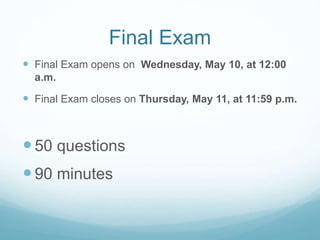
Final Exam
 Final Exam opens on Wednesday, May 10, at 12:00
a.m.
 Final Exam closes on Thursday, May 11, at 11:59 p.m.
50 questions
90 minutes
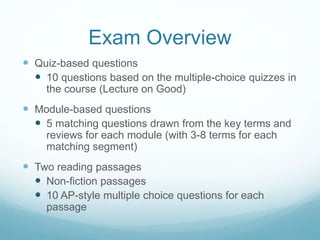
Exam Overview
 Quiz-based questions
 10 questions based on the multiple-choice quizzes in
the course (Lecture on Good)
 Module-based questions
 5 matching questions drawn from the key terms and
reviews for each module (with 3-8 terms for each
matching segment)
 Two reading passages
 Non-fiction passages
 10 AP-style multiple choice questions for each
passage
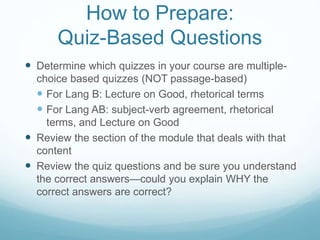
How to Prepare:
Quiz-Based Questions
 Determine which quizzes in your course are multiple-
choice based quizzes (NOT passage-based)
 For Lang B: Lecture on Good, rhetorical terms
 For Lang AB: subject-verb agreement, rhetorical
terms, and Lecture on Good
 Review the section of the module that deals with that
content
 Review the quiz questions and be sure you understand
the correct answers—could you explain WHY the
correct answers are correct?
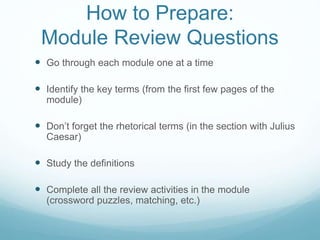
How to Prepare:
Module Review Questions
 Go through each module one at a time
 Identify the key terms (from the first few pages of the
module)
 Don’t forget the rhetorical terms (in the section with Julius
Caesar)
 Study the definitions
 Complete all the review activities in the module
(crossword puzzles, matching, etc.)
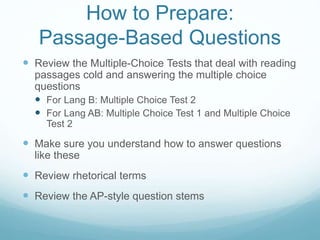
How to Prepare:
Passage-Based Questions
 Review the Multiple-Choice Tests that deal with reading
passages cold and answering the multiple choice
questions
 For Lang B: Multiple Choice Test 2
 For Lang AB: Multiple Choice Test 1 and Multiple Choice
Test 2
 Make sure you understand how to answer questions
like these
 Review rhetorical terms
 Review the AP-style question stems
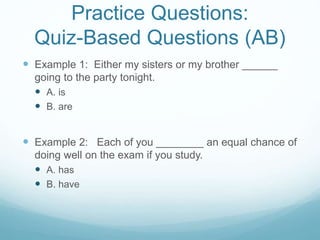
Practice Questions:
Quiz-Based Questions (AB)
 Example 1: Either my sisters or my brother ______
going to the party tonight.
 A. is
 B. are
 Example 2: Each of you ________ an equal chance of
doing well on the exam if you study.
 A. has
 B. have
Practice Questions:
Module Review Questions
(AB)
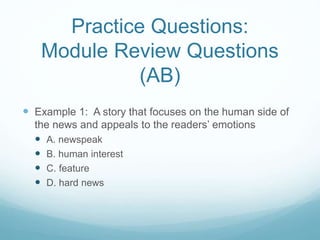
 Example 1: A story that focuses on the human side of
the news and appeals to the readers’ emotions
 A. newspeak
 B. human interest
 C. feature
 D. hard news
Practice Questions:
Module Review Questions
(AB)
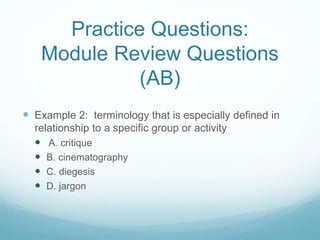
 Example 2: terminology that is especially defined in
relationship to a specific group or activity
 A. critique
 B. cinematography
 C. diegesis
 D. jargon
Practice Questions: Module
Review Questions (B)
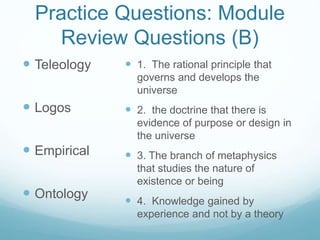
 Teleology
 Logos
 Empirical
 Ontology
 1. The rational principle that
governs and develops the
universe
 2. the doctrine that there is
evidence of purpose or design in
the universe
 3. The branch of metaphysics
that studies the nature of
existence or being
 4. Knowledge gained by
experience and not by a theory
Practice Questions:
Module Review Questions
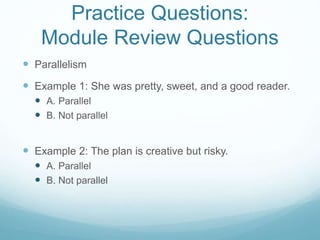
 Parallelism
 Example 1: She was pretty, sweet, and a good reader.
 A. Parallel
 B. Not parallel
 Example 2: The plan is creative but risky.
 A. Parallel
 B. Not parallel
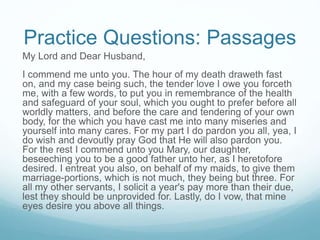
Practice Questions: Passages
My Lord and Dear Husband,
I commend me unto you. The hour of my death draweth fast
on, and my case being such, the tender love I owe you forceth
me, with a few words, to put you in remembrance of the health
and safeguard of your soul, which you ought to prefer before all
worldly matters, and before the care and tendering of your own
body, for the which you have cast me into many miseries and
yourself into many cares. For my part I do pardon you all, yea, I
do wish and devoutly pray God that He will also pardon you.
For the rest I commend unto you Mary, our daughter,
beseeching you to be a good father unto her, as I heretofore
desired. I entreat you also, on behalf of my maids, to give them
marriage-portions, which is not much, they being but three. For
all my other servants, I solicit a year's pay more than their due,
lest they should be unprovided for. Lastly, do I vow, that mine
eyes desire you above all things.
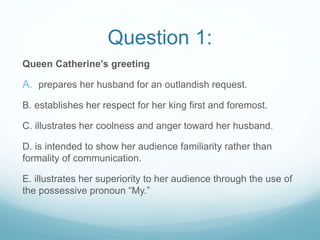
Question 1:
Queen Catherine’s greeting
A. prepares her husband for an outlandish request.
B. establishes her respect for her king first and foremost.
C. illustrates her coolness and anger toward her husband.
D. is intended to show her audience familiarity rather than
formality of communication.
E. illustrates her superiority to her audience through the use of
the possessive pronoun “My.”
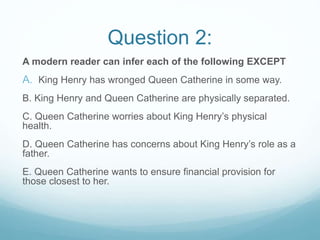
Question 2:
A modern reader can infer each of the following EXCEPT
A. King Henry has wronged Queen Catherine in some way.
B. King Henry and Queen Catherine are physically separated.
C. Queen Catherine worries about King Henry’s physical
health.
D. Queen Catherine has concerns about King Henry’s role as a
father.
E. Queen Catherine wants to ensure financial provision for
those closest to her.
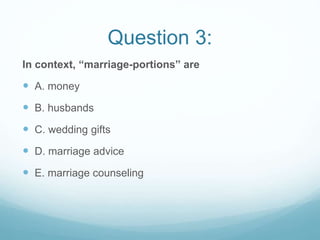
Question 3:
In context, “marriage-portions” are
 A. money
 B. husbands
 C. wedding gifts
 D. marriage advice
 E. marriage counseling
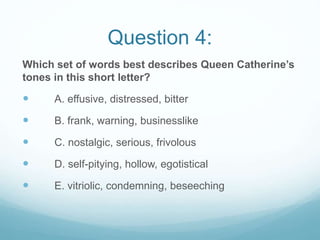
Question 4:
Which set of words best describes Queen Catherine’s
tones in this short letter?
 A. effusive, distressed, bitter
 B. frank, warning, businesslike
 C. nostalgic, serious, frivolous
 D. self-pitying, hollow, egotistical
 E. vitriolic, condemning, beseeching

GAVS AP Language Exam Review Spring 2017

  • 1.
    AP English Language andComp Final Exam Review Test-Taking Tips
  • 2.
    Final Exam  FinalExam opens on Wednesday, May 10, at 12:00 a.m.  Final Exam closes on Thursday, May 11, at 11:59 p.m. 50 questions 90 minutes
  • 3.
    Exam Overview  Quiz-basedquestions  10 questions based on the multiple-choice quizzes in the course (Lecture on Good)  Module-based questions  5 matching questions drawn from the key terms and reviews for each module (with 3-8 terms for each matching segment)  Two reading passages  Non-fiction passages  10 AP-style multiple choice questions for each passage
  • 4.
    How to Prepare: Quiz-BasedQuestions  Determine which quizzes in your course are multiple- choice based quizzes (NOT passage-based)  For Lang B: Lecture on Good, rhetorical terms  For Lang AB: subject-verb agreement, rhetorical terms, and Lecture on Good  Review the section of the module that deals with that content  Review the quiz questions and be sure you understand the correct answers—could you explain WHY the correct answers are correct?
  • 5.
    How to Prepare: ModuleReview Questions  Go through each module one at a time  Identify the key terms (from the first few pages of the module)  Don’t forget the rhetorical terms (in the section with Julius Caesar)  Study the definitions  Complete all the review activities in the module (crossword puzzles, matching, etc.)
  • 6.
    How to Prepare: Passage-BasedQuestions  Review the Multiple-Choice Tests that deal with reading passages cold and answering the multiple choice questions  For Lang B: Multiple Choice Test 2  For Lang AB: Multiple Choice Test 1 and Multiple Choice Test 2  Make sure you understand how to answer questions like these  Review rhetorical terms  Review the AP-style question stems
  • 7.
    Practice Questions: Quiz-Based Questions(AB)  Example 1: Either my sisters or my brother ______ going to the party tonight.  A. is  B. are  Example 2: Each of you ________ an equal chance of doing well on the exam if you study.  A. has  B. have
  • 8.
    Practice Questions: Module ReviewQuestions (AB)  Example 1: A story that focuses on the human side of the news and appeals to the readers’ emotions  A. newspeak  B. human interest  C. feature  D. hard news
  • 9.
    Practice Questions: Module ReviewQuestions (AB)  Example 2: terminology that is especially defined in relationship to a specific group or activity  A. critique  B. cinematography  C. diegesis  D. jargon
  • 10.
    Practice Questions: Module ReviewQuestions (B)  Teleology  Logos  Empirical  Ontology  1. The rational principle that governs and develops the universe  2. the doctrine that there is evidence of purpose or design in the universe  3. The branch of metaphysics that studies the nature of existence or being  4. Knowledge gained by experience and not by a theory
  • 11.
    Practice Questions: Module ReviewQuestions  Parallelism  Example 1: She was pretty, sweet, and a good reader.  A. Parallel  B. Not parallel  Example 2: The plan is creative but risky.  A. Parallel  B. Not parallel
  • 12.
    Practice Questions: Passages MyLord and Dear Husband, I commend me unto you. The hour of my death draweth fast on, and my case being such, the tender love I owe you forceth me, with a few words, to put you in remembrance of the health and safeguard of your soul, which you ought to prefer before all worldly matters, and before the care and tendering of your own body, for the which you have cast me into many miseries and yourself into many cares. For my part I do pardon you all, yea, I do wish and devoutly pray God that He will also pardon you. For the rest I commend unto you Mary, our daughter, beseeching you to be a good father unto her, as I heretofore desired. I entreat you also, on behalf of my maids, to give them marriage-portions, which is not much, they being but three. For all my other servants, I solicit a year's pay more than their due, lest they should be unprovided for. Lastly, do I vow, that mine eyes desire you above all things.
  • 13.
    Question 1: Queen Catherine’sgreeting A. prepares her husband for an outlandish request. B. establishes her respect for her king first and foremost. C. illustrates her coolness and anger toward her husband. D. is intended to show her audience familiarity rather than formality of communication. E. illustrates her superiority to her audience through the use of the possessive pronoun “My.”
  • 14.
    Question 2: A modernreader can infer each of the following EXCEPT A. King Henry has wronged Queen Catherine in some way. B. King Henry and Queen Catherine are physically separated. C. Queen Catherine worries about King Henry’s physical health. D. Queen Catherine has concerns about King Henry’s role as a father. E. Queen Catherine wants to ensure financial provision for those closest to her.
  • 15.
    Question 3: In context,“marriage-portions” are  A. money  B. husbands  C. wedding gifts  D. marriage advice  E. marriage counseling
  • 16.
    Question 4: Which setof words best describes Queen Catherine’s tones in this short letter?  A. effusive, distressed, bitter  B. frank, warning, businesslike  C. nostalgic, serious, frivolous  D. self-pitying, hollow, egotistical  E. vitriolic, condemning, beseeching